
SHIGEKI ENGLISH STORYEN
Japanese history in English
Ōtomo Sōrin: Twenty-Seven Years from Xavier’s Visit to Baptism
Yoshishige, Sōrin, Francisco: three names, the rise and burning of the trading town of Funai, and the traces of daily life recovered from the ground.
Ōtomo Sōrin met Francis Xavier in 1551 but was not baptized until 1578. Follow his succession, his rule over six provinces, his Zen devotion, the island castle at Usuki, the hospital and schools of Bungo, the defeat at Mimigawa, his appeal to Hideyoshi, the burning of Funai and the excavations that recovered the town.
At a glance
Before you enter the story
- When
- From Sōrin’s birth in 1530 to his death in 1587, with the fall of the Ōtomo in 1593 and modern excavations from 1996.
- Where
- Bungo Province, especially Funai and Usuki, in present-day Ōita Prefecture, with links across Kyushu, to Osaka and overseas.
- Key figures
- Ōtomo Sōrin, Francis Xavier, Luís de Almeida, Ōtomo Yoshimune, Toyotomi Hideyoshi
- What was at stake
- How a powerful lord’s long relationship with Christianity, trade and war shaped a town whose remains are still being studied.
Why this story matters
The larger history behind the turning point
Sōrin is often remembered by a single religious label. Following the twenty-seven years between his meeting with Xavier and his baptism shows how faith, diplomacy, trade and war overlapped in sixteenth-century Japan.
The story of Funai also reaches beyond one lord. Excavated objects and records of the town’s hospital and schools point to the many people who lived and worked in one of Kyushu’s great trading centers.
Historical context
What an international reader needs to know
One person, several names
Yoshishige was the name he took when he came of age. Sōrin was the name he adopted when he shaved his head in 1562. Francisco was his baptismal name from 1578. This article uses Yoshishige for the early years and Sōrin afterward.
Dates and names
Months and days follow the lunisolar calendar used in Japan at the time, so they do not match the modern calendar. Japanese family names come first, so Ōtomo is the family name of Ōtomo Sōrin.
Watch the film
See the story in motion
The film currently uses Japanese audio. This English article provides the context and source trail; it does not imply that an English subtitle track is available.
Opening
Twenty-seven years between a meeting and a baptism
Ōtomo Sōrin met Francis Xavier in 1551, and he was baptized as a Christian in 1578. The label “Christian daimyo” tends to press those two events together, as though one led straight to the other. In fact, twenty-seven years lay between them, and those years make up much of the life of this powerful Kyushu lord.
During that interval he became military governor of six provinces in northern Kyushu, shaved his head as a follower of Zen Buddhism and promoted trade overseas. His home base of Funai, in present-day Ōita City, gained a church and a hospital and grew into one of the largest towns in Kyushu, with roughly five thousand houses.
This article follows his career from his succession through his baptism, the defeat at Mimigawa, the burning of Funai and his death at Tsukumi, and then turns to the modern excavations that brought the lost town back to light. Where sources disagree about a date or a judgment, the disagreement is stated rather than smoothed over.
Chapter 1
Inheriting the house as Yoshishige
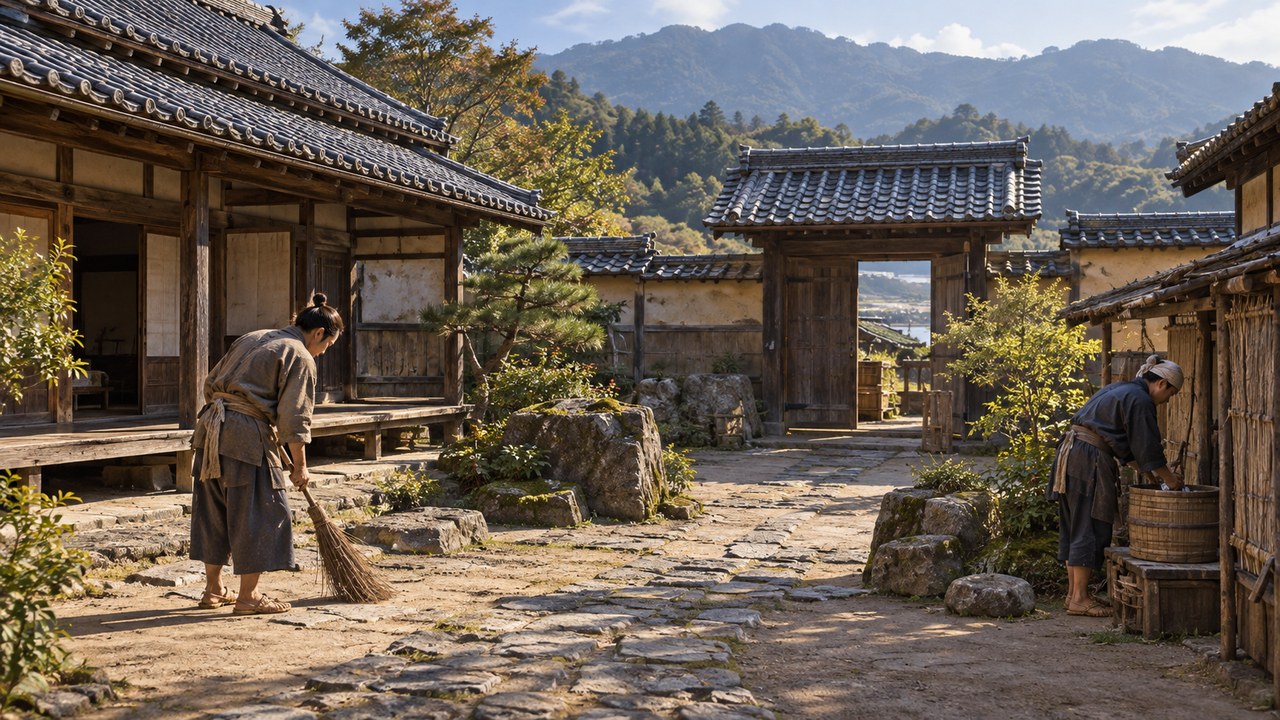
Sōrin was born in 1530, the eldest son of Ōtomo Yoshiaki, the twentieth head of the Ōtomo family. According to Ōita City’s biography, he came of age at ten and received the character “Yoshi” from the shogun Ashikaga Yoshiharu. He took the name Yoshishige, the name he would carry through the first part of his career.
In 1550 a violent dispute broke out within the family. Yoshiaki was killed by senior retainers in the episode remembered as the Ōtomo Nikai-kuzure, the “Collapse of the Second Floor.” After this crisis the twenty-year-old Yoshishige became the twenty-first head of the house, taking charge of a domain shaken by the death of its lord.
Yoshishige, Sōrin and Francisco are all names of one man, but each arose at a different time and for a different reason. Reading his early life backward from his later faith would distort it. At this point he is best understood simply as a young lord who had inherited a domain in the aftermath of a family conflict.
Chapter 2
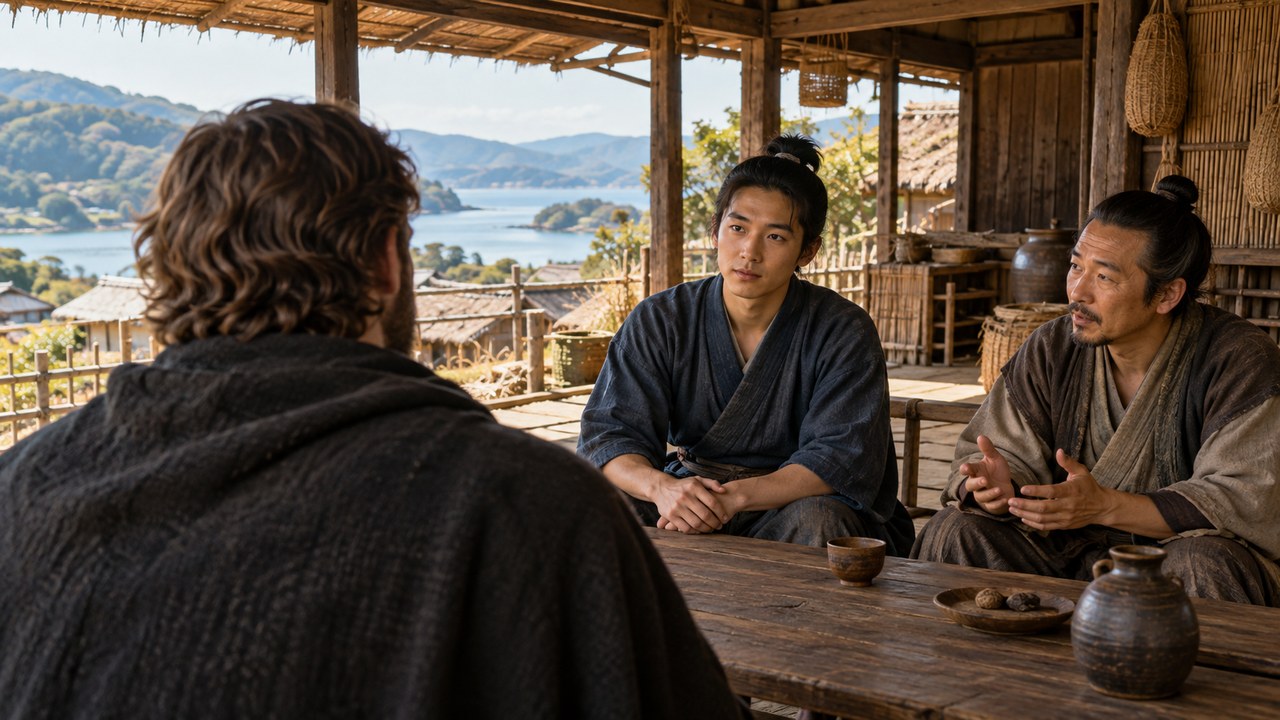
Xavier at Funai in 1551
In 1551, the year after his succession, Yoshishige invited Xavier to Funai, met him and gave permission for Christian preaching. From the following year, Portuguese missionaries began to visit the town. What began as a single encounter thus opened a connection that would continue, in one form or another, for decades after Xavier himself had left Japan.
By about 1553 a church known as the Funai Church, or Deus Hall, had been built with Yoshishige’s support and included a chapel among its buildings. A guide published by the Ōita City Board of Education states that there were about two thousand Christians in Funai by 1557, only six years after the meeting with Xavier.
Allowing missionaries to preach is not the same as becoming a believer. An Ōita Prefecture publication notes the view that one reason for the permission was access to guns, cannon and saltpeter, an ingredient of gunpowder. That explanation helps set the decision in its political context, but it cannot by itself account for all of his motives.
Chapter 3
The wider sea beyond Okinohama
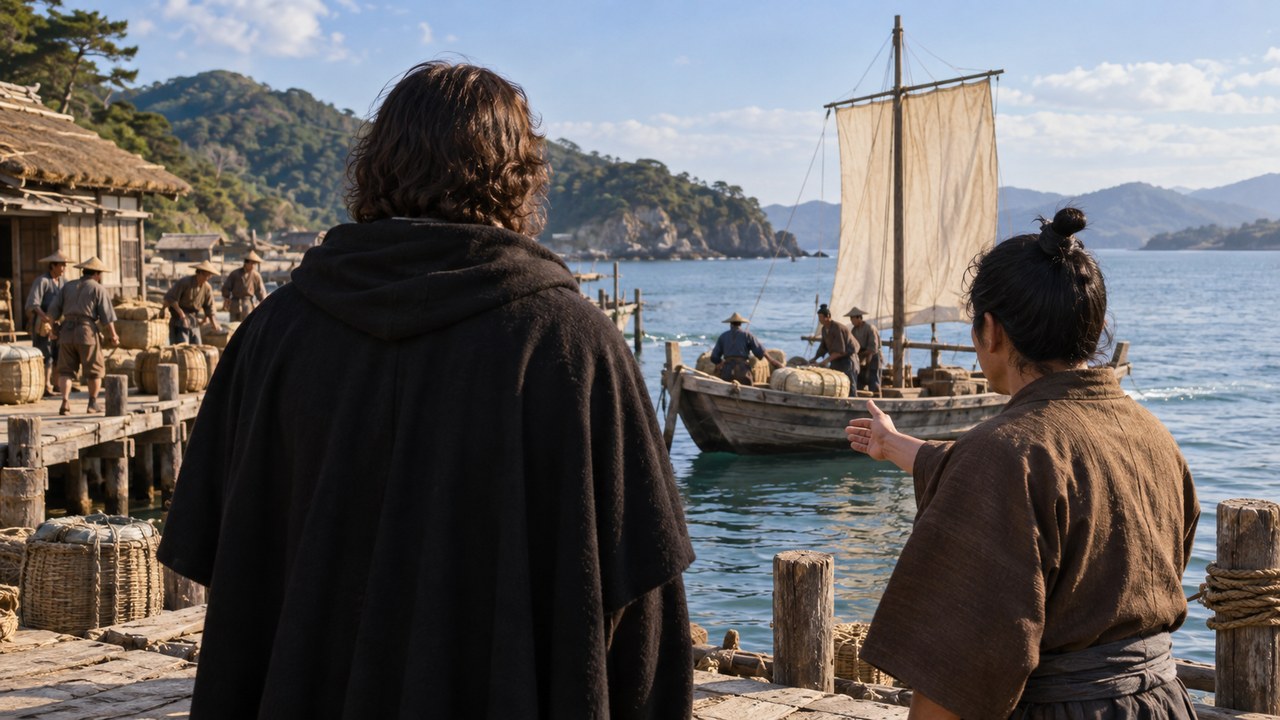
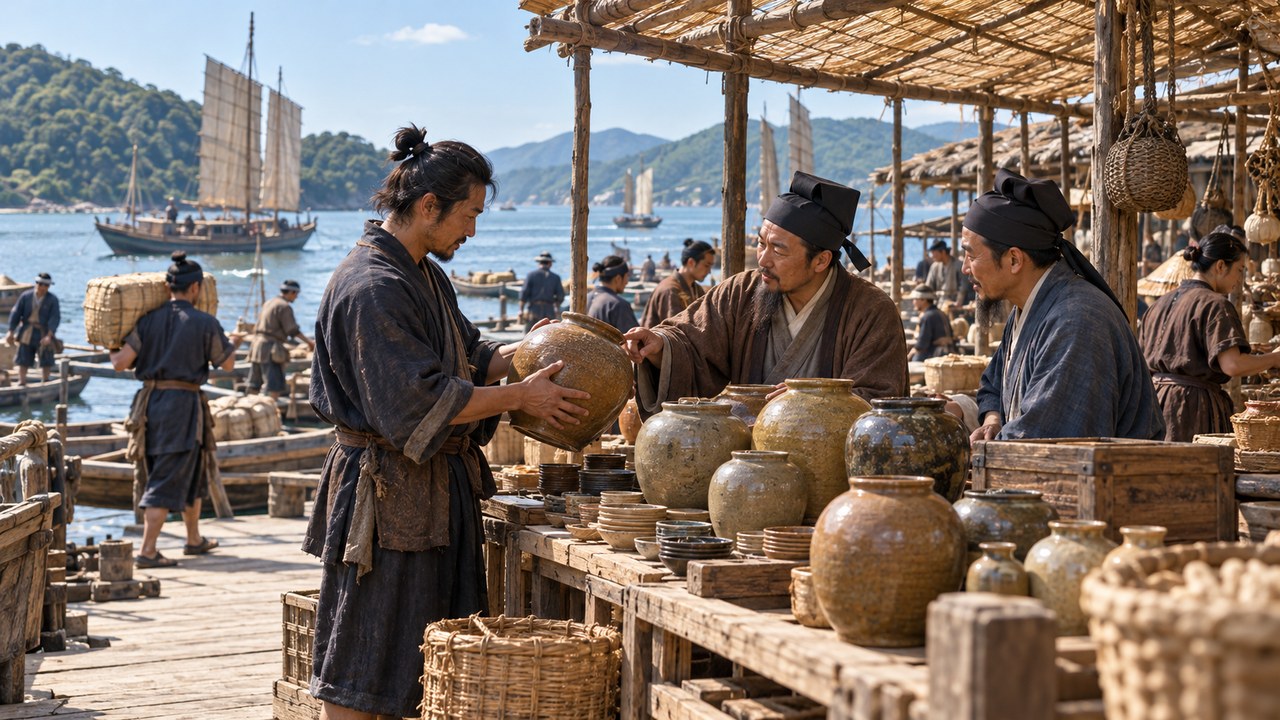
Funai’s gateway to the sea was the port of Okinohama. Trade with the Portuguese passed through it, and during the 1550s commerce with China and Southeast Asia also developed. Northeast of the Ōtomo residence lay Tōjin-machi, a quarter where many Chinese residents and other foreigners are thought to have lived, a sign of how international the town had become.
The town itself was large. Some forty neighborhoods are thought to have occupied an area about 2.1 kilometers from north to south and 0.7 kilometers from east to west, with around five thousand houses. The Ōita City Board of Education describes Funai as among the biggest cities in Kyushu, larger than Hakata and about the same size as Sakai.
Excavations have uncovered many goods imported from Ming China and Southeast Asia. Even so, such objects cannot reveal the route of each ship or the value of each transaction. It is one thing to show that the town was linked to several regions across the sea, and quite another to reconstruct the details of what passed between them.
Chapter 4
Six provinces and the name Sōrin
By 1559 Yoshishige had gained the governorships of Buzen and Chikuzen among others. Together with Bungo, Chikugo, Hizen and Higo, these gave him authority over six provinces. He was also appointed Kyushu deputy, or tandai, and the Ōtomo reached the height of their power in a history that spanned some four hundred years in Bungo.
In 1562 Yoshishige shaved his head and adopted the name Sōrin. It is often assumed to be a Christian name, but it was not; it belongs to his devotion to Zen Buddhism. His family temple is identified as Zuihō-in, a subtemple of Daitokuji in Kyoto, and the name marks a stage of his religious life long before baptism.
Sōrin protected Christianity while personally following Zen. To describe him in these years as a man moving steadily toward baptism would hide the fact that he was engaged with two religious worlds at the same time. The sixteen years between the name Sōrin and the name Francisco deserve to be read on their own terms.
Chapter 5
The island castle of Niujima
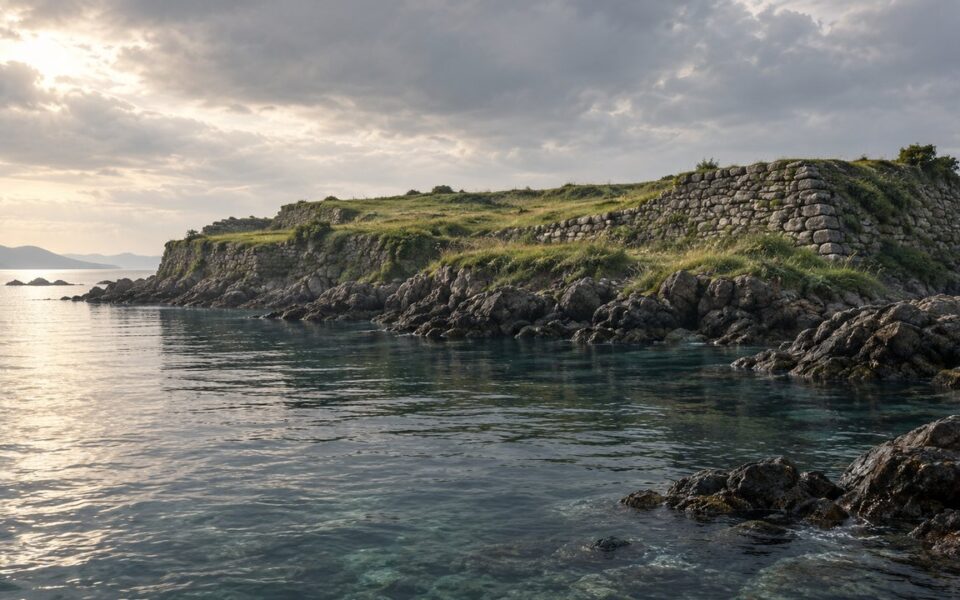
Sōrin moved his base from Funai to Niujima, a small island in Usuki Bay. Sources differ on the date. A Usuki City guide places the building of the castle and the move in 1556, Ōita City’s chronology and the Kokushi Daijiten historical dictionary give 1562, and the Nihon Daihyakka Zensho encyclopedia gives 1563. The differences are left unresolved here.
Usuki prospered through trade with Ming China and Portugal, and between about 1566 and 1586 a church and missionary residences are said to have stood in the town. Sōrin’s son Yoshimune was placed at Funai, an arrangement the Nihon Daihyakka Zensho calls dual rule, with authority divided between the island castle and the old provincial center.
In 1576 a cannon later known as Kunikuzushi, “Destroyer of Provinces,” was installed at Usuki. One explanation says Sōrin bought it from Portuguese missionaries, while another says Portuguese gave it to him. Whichever is correct, the gun shows how closely his contacts with Europeans were tied to the practical needs of defending his domain.
Chapter 6
The people and money behind a hospital
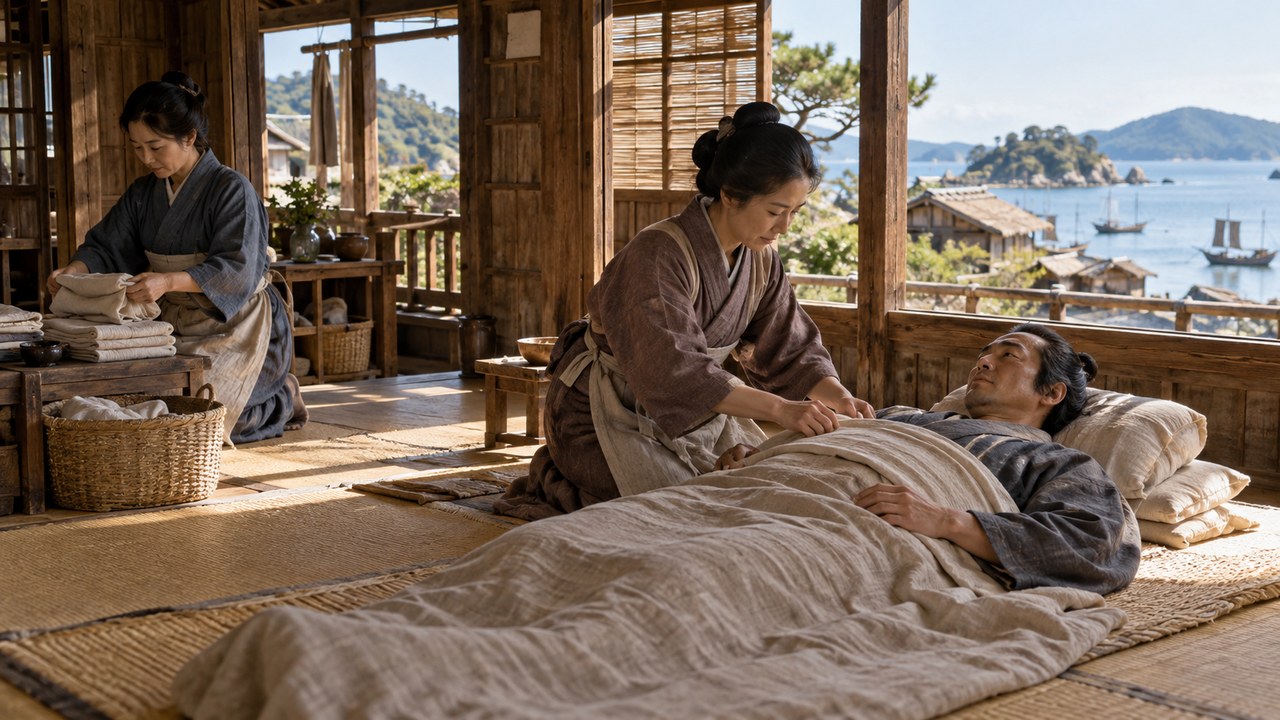
In 1555 Luís de Almeida, who had also been a merchant, built an infant home in Funai at his own expense. It later developed into a hospital with surgical and internal medicine departments. Ōita City’s chronology records that in 1557 Almeida built the Funai hospital and began treating the sick, a landmark in the town’s history.
According to the Ōita City Board of Education, the hospital had sixteen rooms and a staff of twelve, and its work was supported by the Misericórdia, a Christian confraternity of mercy. Usuki City’s explanation adds that wealth provided by Almeida and profits from trade sustained the institution, linking the commerce of the port directly to the care of patients.
A choir is said to have formed at the Funai church in 1556, and instruction on the viola was given there. Missionaries were not the only people who kept these activities going; local believers played a part as well. Crediting everything to Sōrin alone would erase the many townspeople whose work made such institutions possible.
Chapter 7
Becoming Francisco in 1578
Sōrin handed the headship of the family to Yoshimune, though the year is disputed. Ōita City’s chronology and the Kokushi Daijiten give 1573, a Yamakawa dictionary gives 1576, and another reference speaks of retirement around 1575 or 1576. What the sources do make clear is that his baptism came after he had stepped back from formal leadership.
In 1578, at the age of forty-eight, Sōrin was baptized and received the name Francisco. Ōita City’s biography reports that he is said to have chosen it in honor of Xavier. Twenty-seven years had passed since their meeting at Funai, a span long enough to include his rise, his Zen devotion and his retirement.
Public explanations cannot establish what finally moved him to take this step. Rather than reducing the decision to faith, politics or trade alone, it is more accurate to accept what can be known: that he reached baptism only after a very long association with Christianity, and that the path between the two events was anything but direct.
Chapter 8
Defeat at Mimigawa
In the same year, 1578, Sōrin’s forces advanced into Hyūga. The stated purpose was to help Itō Yoshisuke, who had lost to the Shimazu and fled to Bungo. An anecdote relates that one of Sōrin’s military advisers urged him to cancel the campaign because of bad omens.
In the eleventh month of that year the Ōtomo army met the Shimazu around Takajō and the Mimi River in Hyūga and suffered a crushing defeat. Many were killed and many are said to have drowned. The baptism and the battle belong to the same year, but sharing a year does not make one the cause of the other.
The effects spread across northern Kyushu. A Kurume City history sheet explains that the Ryūzōji of Hizen pushed into Chikugo while the Shimazu pressed from the south. Territory and allies that the Ōtomo had held for years began to slip away, and the defeat is widely treated as the turning point in the family’s decline.
Chapter 9
Schools and a boys’ embassy
In 1581 a college opened at Funai. At Usuki, a novitiate was built by the Jesuit visitor Alessandro Valignano with Sōrin’s permission. These were separate institutions with different roles in different towns. Later copperplate images that show them as grand European buildings should be read as imagined scenes rather than as reliable records of what stood there.
In the second month of 1582, four boys left Nagasaki as representatives of Christian daimyo. This was the Tenshō Embassy, which reached Rome and was received by the pope in 1585. The young envoys returned to Nagasaki in 1590, three years after Sōrin’s death.
Sōrin has traditionally been named as a sponsor of the mission alongside the Ōmura and Arima families. Yet the Nihon Daihyakka Zensho doubts that the idea was his, and the Sekai Daihyakka Jiten treats the letter carried in his name as a forgery. How far he was actually involved remains a question that should not be settled by assumption.
Chapter 10
The journey to Osaka and the burning of Funai
As Shimazu pressure mounted in 1586, Sōrin traveled in person to Osaka Castle to ask Toyotomi Hideyoshi for help. Ōita City materials say Hideyoshi received him warmly and even showed him around the castle himself. The Ōtomo accepted Hideyoshi’s plan for dividing Kyushu among its lords, but the Shimazu refused it, and war became unavoidable.
That year Shimazu forces invaded Bungo. When Usuki came under attack in the eleventh month, Sōrin called on local people to shelter in the castle, and Niujima did not fall. In the twelfth month, at the Battle of Hetsugigawa, Toyotomi vanguard units and Ōtomo troops were defeated, and Chōsokabe Nobuchika was killed at the age of twenty-two.
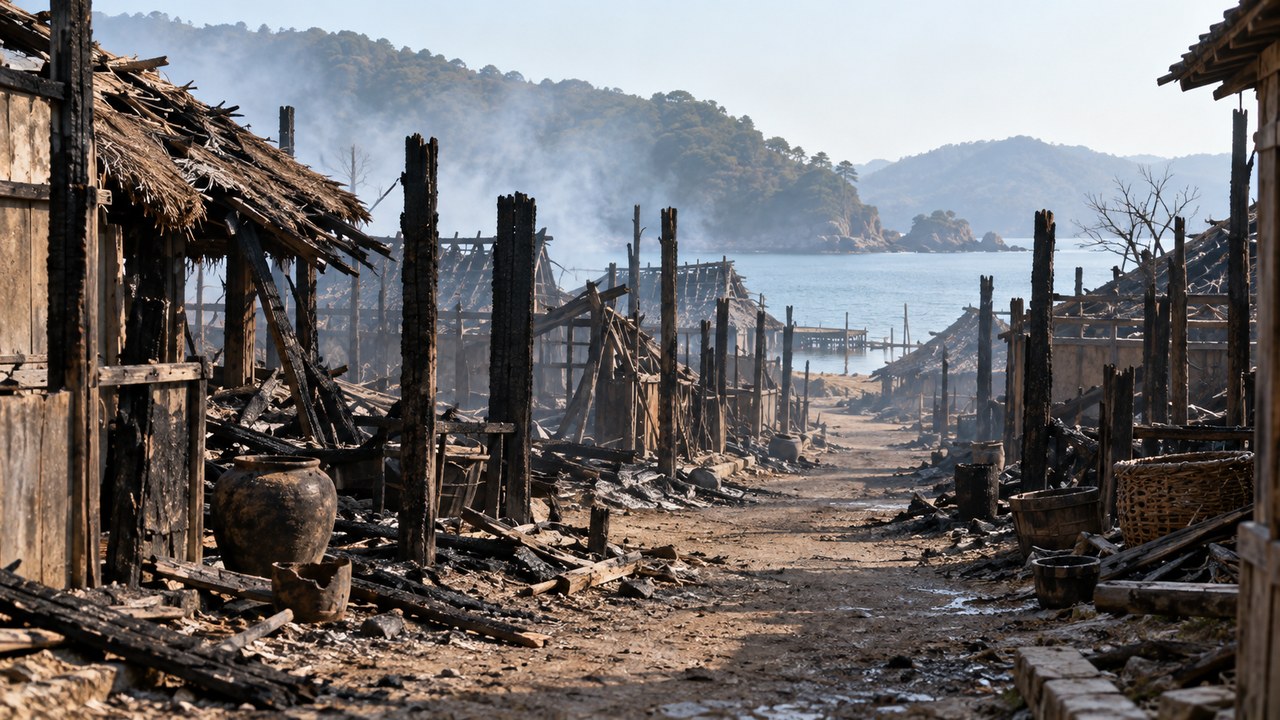
Funai burned in the fighting. The Ōtomo residence was destroyed and never rebuilt. The port of Okinohama burned with the town and, according to tradition, sank beneath the sea in the tsunami of the Keichō Bungo earthquake of 1596. The trading city that had grown over the previous decades lost much of its former landscape in these events.
Chapter 11
Last days at Tsukumi
In 1587 Hideyoshi’s huge army, said to number about two hundred thousand, entered Kyushu and the Shimazu surrendered. Yoshimune was confirmed in possession of Bungo. According to the Nihon Daihyakka Zensho, Hyūga was to be granted to Sōrin, but he declined it. By then he was living in retirement at Tsukumi.
On the twenty-third day of the fifth month of 1587, Sōrin died of illness at Tsukumi, where he had retired. Ōita City’s materials speak of a life of fifty-seven years, while the Kokushi Daijiten gives his age as fifty-eight. About a month later Hideyoshi issued his edict expelling Christian missionaries from Japan.
Tradition holds that Yoshimune converted his father’s grave at Tsukumi to Buddhist form. Today the Ōtomo Sōrin memorial park contains a Buddhist grave said to have been rebuilt in the Kansei era, around the 1790s, together with a Christian-style burial ground designed by the architect Isozaki Arata and completed in 1977, so that both of his religious lives are represented.
Chapter 12
A town returned from the ground
After Sōrin’s death, Yoshimune expelled the missionaries and ordered believers to give up their faith. In 1593 he was stripped of his domain for retreating during the invasion of Korea, ending Ōtomo rule in Bungo. Persecution continued under the Tokugawa, and in the Bungo-kuzure of 1659 to 1683 more than a thousand people are said to have been arrested.
Lost Funai eventually reappeared from beneath the ground. Large-scale excavations began in 1996, and work at the site of the Ōtomo residence, started in 1998, revealed the remains of its garden. In 2019 the national government designated 1,269 excavated objects as Important Cultural Properties, recognizing how clearly they reflect the character of the sixteenth-century town.
Imported ceramics, more than twenty clay dog figurines and a religious medal known as the Veronica medal all speak of people whose names are lost. They show a town too broad to be explained by one lord’s faith. To keep those twenty-seven years in view is also to recover the history of the place in which he lived.
How to read this work
History, interpretation, and reconstruction
Separating the meeting of 1551, the Zen name of 1562 and the baptism of 1578 reveals a life that the phrase “Christian daimyo” cannot contain, and a Bungo where trade, medicine and learning were carried on by many people.
This work is grounded in published sources and historical research. Interior thoughts, dialogue, and some visual details are cinematic reconstructions. Where historians disagree, the article presents the point as debated rather than settled fact.
Timeline
The story in time
People & terms
A guide for new readers
Key figures
- Ōtomo Sōrin
- Lord of Bungo who took the name Sōrin in 1562 and was baptized as Francisco in 1578.
- Francis Xavier
- Missionary who visited Funai and met Yoshishige in 1551.
- Luís de Almeida
- Former merchant who founded an infant home and hospital at Funai.
- Ōtomo Yoshimune
- Sōrin’s son and successor, stripped of his domain in 1593.
- Toyotomi Hideyoshi
- National ruler who received Sōrin at Osaka Castle in 1586 and invaded Kyushu the next year.
Glossary
- Daimyo 大名
- A regional lord who governed territory and commanded warriors.
- Shugo 守護
- A provincial military governor appointed under the Ashikaga shogunate.
- Funai 府内
- The Ōtomo capital in Bungo, located in present-day Ōita City.
- Okinohama 沖の浜
- The port that served as Funai’s gateway to the sea.
- Niujima 丹生島
- The island in Usuki Bay on which Sōrin’s castle stood.
- Kunikuzushi 国崩し
- The nickname of a European-style breech-loading cannon associated with Sōrin.
- Misericórdia ミゼリコルディア
- A Christian confraternity devoted to works of mercy.
- Collegio コレジオ
- A Jesuit college for advanced education.
- Noviciate ノビシャド
- A house in which new members of a religious order were trained.
- Bungo-kuzure 豊後崩れ
- The large-scale arrests of Christians in Bungo between 1659 and 1683.
Sources & method
How this article was built
This English edition follows the revised Japanese article scene by scene and keeps its twenty-five sources, their order and its sixteen timeline entries. It draws on Ōita City, the Ōita City Board of Education, Usuki City, Ōita Prefecture, Kurume City, national cultural institutions, reference works and explanatory articles.
Institutional explanations, reference works and the interpretation offered here are kept separate. Where sources differ, as they do on the move to Niujima, Sōrin’s retirement, his age at death and his role in the embassy to Europe, the difference is stated. Images are AI-generated reconstructions, not authentic portraits or historical photographs.
Sources
References and further reading
- Ōtomo Sōrin and His Times 大友宗麟とその時代 Title translated editorially for reader convenience. Ōita City 大分市 Birth, coming of age, succession, the meeting with Xavier, trade, Zen, baptism and death. Accessed 2026-11-19
- Azulejo Murals and Paintings: Explanations アズレージョの壁画・絵画解説 Title translated editorially for reader convenience. Usuki City 臼杵市 Schools, medical care, baptism and the later school images, used within the content confirmed on October 21, 2026. Accessed 2026-10-21
- Introducing the BVNGO Ōtomo Museum BVNGO大友資料館のご紹介 Title translated editorially for reader convenience. Ōita Prefectural Center for Archaeological Research 大分県立埋蔵文化財センター The burning of the town, excavation from 1996, the 2019 designation, imports, dog figurines and medals. Accessed 2026-11-19
- Ōita City Chronology 大分市年表 Title translated editorially for reader convenience. Ōita City Digital Archive 大分市デジタルアーカイブ Entries from 1550 to 1593. Accessed 2026-11-19
- Ōtomo Sōrin and the Town of Funai (8th edition) 大友宗麟と府内のまち(第8版) Title translated editorially for reader convenience. Ōita City Board of Education 大分市教育委員会 Town size, the Ōtomo residence, church, hospital, Tōjin-machi and excavation results. Accessed 2026-11-19
- Ōtomo Sōrin and the Town of Funai (6th edition) 大友宗麟と府内のまち(第6版) Title translated editorially for reader convenience. Ōita City Board of Education 大分市教育委員会 Sōrin’s dates, the infant home, choir, Okinohama and the Battle of Hetsugigawa. Accessed 2026-11-19
- Sōrin and the Rulers of the Realm 宗麟と天下人 Title translated editorially for reader convenience. Ōita City 大分市 Relations with Nobunaga and Hideyoshi, the reception at Osaka Castle, the division of Kyushu and the size of the army. Accessed 2026-11-19
- The Ōtomo Family Afterward 大友氏のその後 Title translated editorially for reader convenience. Ōita City 大分市 Sōrin’s death, Yoshimune’s dismissal and the end of four centuries of rule. Accessed 2026-11-19
- Bungo-kuzure 豊後崩れ Title translated editorially for reader convenience. Ōita City 大分市 Yoshimune’s expulsion of missionaries and the persecution of 1659 to 1683. Accessed 2026-11-19
- Ōtomo Sōrin 大友宗麟 Title translated editorially for reader convenience. Kotobank コトバンク Entries from Japanese reference works on governorships, the move to Niujima, retirement, Osaka, Hyūga and the embassy. Accessed 2026-11-19
- Ōtomo Sōrin (Kokushi Daijiten and other works) 大友宗麟(国史大辞典ほか) Title translated editorially for reader convenience. JapanKnowledge ジャパンナレッジ Excerpts on the move to Niujima, retirement and age at death. Accessed 2026-11-19
- Ōtomo Yoshimune 大友義統 Title translated editorially for reader convenience. Kotobank コトバンク The reason for his dismissal in 1593. Accessed 2026-11-19
- Usuki Castle Site: Great Waves of History Seen from a Small Castle 県史跡 臼杵城跡(小さな城からみえる、大きな歴史の波) Title translated editorially for reader convenience. Usuki City 臼杵市 The castle’s building in 1556, and the Shimazu attack and shelter of local people in 1586. Accessed 2026-11-19
- Usuki Walk: Places Associated with the Christian Daimyo Ōtomo Sōrin うすきあるき(キリシタン大名「大友宗麟」ゆかりの地を巡る) Title translated editorially for reader convenience. Usuki City Tourism Exchange Plaza 臼杵市観光交流プラザ Trade at Usuki, the church and novitiate, and Valignano’s request. Accessed 2026-11-19
- Ōtomo Sōrin Memorial Park 大友宗麟墓地公園 Title translated editorially for reader convenience. Nippon Tabi Magazine ニッポン旅マガジン The graves at Tsukumi and the Christian-style burial ground of 1977. Accessed 2026-11-19
- Usuki Castle and the Ōtomo Cannon (Kunikuzushi) 臼杵城・大友砲(国崩し) Title translated editorially for reader convenience. Nippon Tabi Magazine ニッポン旅マガジン The purchase of the cannon in 1576 and the repulse of 1586, as described in an explanatory article. Accessed 2026-11-19
- The Ōtomo Cannon (Kunikuzushi) 大友砲(国崩し) Title translated editorially for reader convenience. Ōita Prefecture 大分県 The survival of Niujima Castle and the uncertain history of the surviving gun. Accessed 2026-11-19
- Ōtomo Sōrin and Christian Culture: The Kunikuzushi at Usuki Castle Site 大友宗麟とキリシタン文化/臼杵城跡にある国崩し(大砲) Title translated editorially for reader convenience. Ōita Prefecture 大分県 Firearms as a suggested motive for permitting preaching, and the cannon of 1576. Accessed 2026-11-19
- Kurume, City of History: Story Sheet 1, The Sengoku Period 歴史のまち久留米 ストーリーシート1 戦国時代 Title translated editorially for reader convenience. Kurume City 久留米市 Conditions in Chikugo after the defeat at Mimigawa. Accessed 2026-11-19
- The Tragic End of Ōtomo Sōrin’s Military Adviser 不吉な「気」から大敗を予想!大友宗麟の軍配者「角隈石宗」の壮絶なラストとは? Title translated editorially for reader convenience. Wa-Raku Web (Shogakukan) 和樂web(小学館) The date of Mimigawa, the campaign’s stated purpose and the anecdote about omens. Accessed 2026-11-19
- Who Was Ōtomo Sōrin? 大友宗麟とはどんな人物? キリシタン大名、北九州6か国を支配した戦国大名の生涯 Title translated editorially for reader convenience. Serai.jp (Shogakukan) サライ.jp(小学館) The outline of his life, date of death and age. Accessed 2026-11-19
- The Last Days of Chōsokabe Nobuchika 長宗我部信親の最期 Title translated editorially for reader convenience. Serai.jp (Shogakukan) サライ.jp(小学館) The attack on Tsurugajō and the Battle of Hetsugigawa in 1586. Accessed 2026-11-19
- Portrait of Itō Mancio (Art Commons) 伊東マンショの肖像(Art Commons) Title translated editorially for reader convenience. The National Art Center, Tokyo 国立新美術館 The departure of the embassy in 1582 as representatives of Christian daimyo. Accessed 2026-11-19
- Classification of Historical Sources about the First Japanese Mission to Rome 天正遣欧使節の史料学 Title translated editorially for reader convenience. Ikawa Kenji, WASEDA RILAS JOURNAL No. 8 (Waseda University) 伊川健二(WASEDA RILAS JOURNAL NO.8、早稲田大学) The dates of the embassy’s departure and return. Accessed 2026-11-19
- Gualtieri, Account of the Tenshō Embassy グアルティエーリ『天正遣欧使節記』 Title translated editorially for reader convenience. Cultural Heritage Online (Agency for Cultural Affairs) 文化遺産オンライン(文化庁) The embassy’s audience with the pope in 1585. Accessed 2026-11-19
Continue reading
More stories from Shigeki
Shigeki English
Amakusa Shiro at Hara Castle: A Young Symbol in the Surviving Evidence
An Arima castle, Matsukura taxes, risings in Shimabara and Amakusa, Itakura’s death, Nobutsuna’s siege and the fall of the castle: the history of the people who gathered under a boy’s name, told within the limits of the sources.
- When Kan’ei 14–15 (1637–1638), with the castle’s construction (1599–1604) and modern excavation and World Heritage inscription (2018) as background
- Where Shimabara and Amakusa in southwestern Japan, culminating in the siege of Hara Castle
Shigeki English
From the Black Ships to Hakodate: Sixteen Years from Bakumatsu to Meiji
Treaties, the Sakuradamon incident, the Kinmon incident, the Satsuma–Choshu alliance, the return of power, Toba–Fushimi, Edo Castle, Aizu and Hakodate: diplomatic commitments, political authority and military command did not change at the same moment.
- When 1853–1869, with administrative changes in 1869 and 1871 placed separately
- Where Uraga, treaty ports, Edo, Kyoto, Toba–Fushimi, Aizu and Hakodate