
SHIGEKI ENGLISH STORYEN
Japanese history in English
From the Black Ships to Hakodate: Sixteen Years from Bakumatsu to Meiji
Diplomatic commitments, political authority and military command did not change at the same moment.
Trace 1853–1869 through treaties, political decisions and the continued movement of armed forces. Distinguish the transfer of power from the surrender of Edo Castle and the end of fighting at Hakodate, keeping regional experience and calendar differences visible.
At a glance
Before you enter the story
- When
- 1853–1869, with administrative changes in 1869 and 1871 placed separately
- Where
- Uraga, treaty ports, Kyoto, Edo, Aizu and Hakodate
- Key figures
- Tokugawa Yoshinobu, Kido Takayoshi and Sakamoto Ryoma, Katsu Kaishu and Saigo Takamori, Niijima Yae, Enomoto Takeaki
- What was at stake
- Why could a government change and a castle be surrendered while negotiations and fighting continued elsewhere?
Why this story matters
The larger history behind the turning point
Familiar turning points can make a political transition appear instantaneous. A treaty, the return of governing power, a castle’s surrender and the end of a war instead concern different commitments and organizations. Following their separate dates makes it possible to see both what changed and what remained unsettled.
The same distinction leaves room for regional and personal histories. A settlement in Edo did not make every armed force stop at once, and defeat did not end the later lives of people who experienced it. The account follows confirmed decisions and careers without turning one hero or one conversation into an explanation of the entire transition.
Historical context
What an international reader needs to know
Three questions as an editorial guide
Bakumatsu refers here to the final years of the Tokugawa shogunate, followed by the transition to Meiji government. The article asks what was promised to foreign powers, who could decide domestic politics and whose command moved armed forces. These questions are an editorial way of organizing the account, not a slogan shared by the historical participants.
The shogunate, imperial court and domains occupied different roles. Cooperation on one question could coexist with opposition on another. The later alliance of Satsuma and Choshu should not be projected backward as if both domains had always followed one unchanging policy.
Dates, decisions and later lives
Some events are given by year because a historical Japanese month and day must not be presented as the same Gregorian date without conversion. For the end of the Hakodate fighting, the article gives both 18 May of Meiji 2 in the old calendar and 27 June 1869 in the Gregorian calendar. These identify one event.
The end of fighting and later administrative reforms remain separate. Institutional explanations of collections and selected diary excerpts are also distinguished from new readings of entire original manuscripts. Conceptual images do not authenticate a participant’s face, a conversation or the exact layout of a battle.
Watch the film
See the story in motion
The film currently uses Japanese audio. This English article provides the context and source trail; it does not imply that an English subtitle track is available.
Scene 01
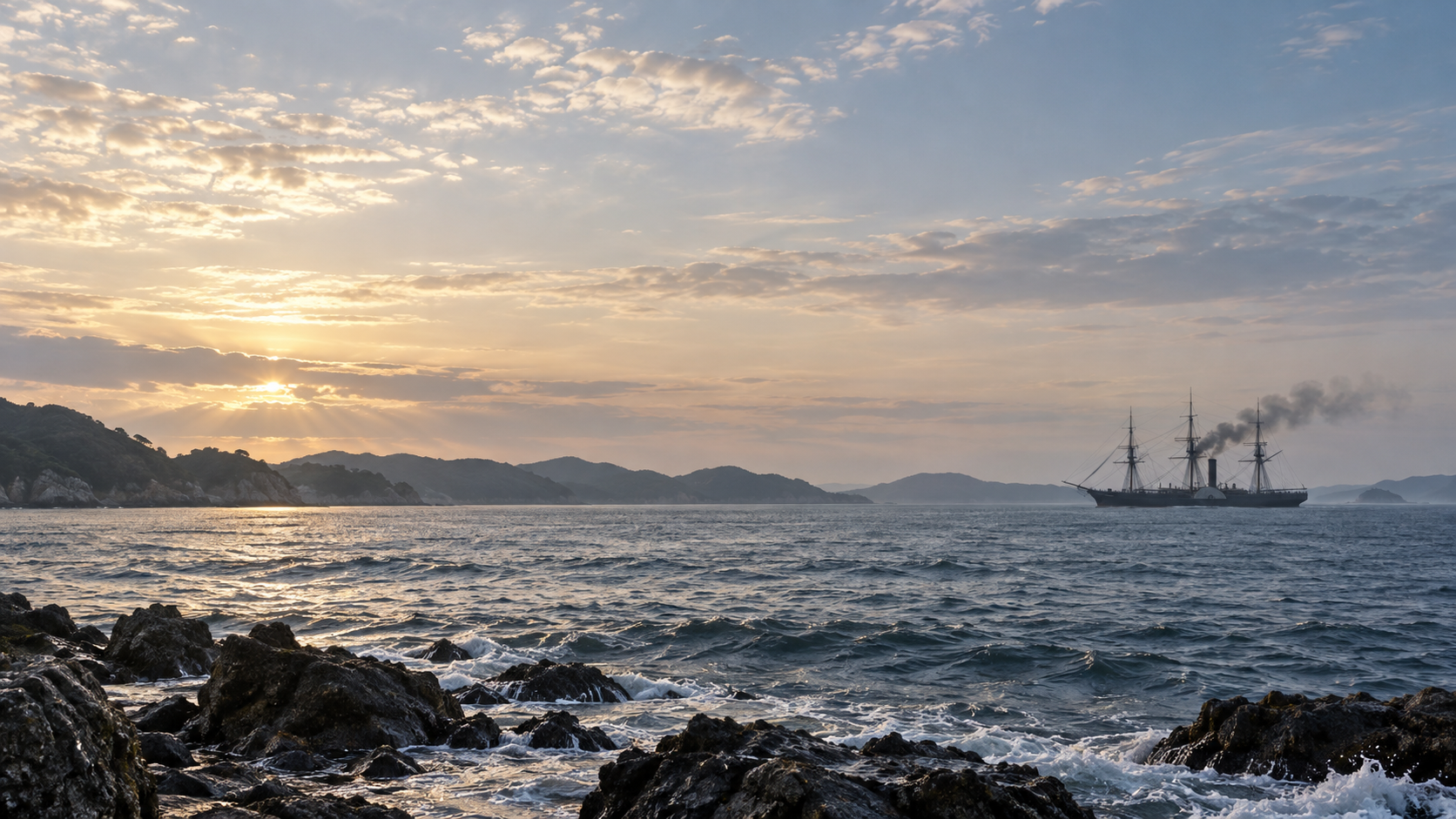
The Black Ships and three questions
Perry’s fleet appeared at Uraga in 1853, but the shogunate had already received overseas information through Nagasaki. The National Diet Library introduces reports on the Opium War and an 1852 warning of the coming American mission. Japan did not suddenly discover the outside world from a condition of having no foreign contact.
Possessing information and deciding a response to warships were different matters. Receiving demands, negotiating and implementing a decision required responsible people and authority. When the 1854 treaty opened Shimoda and Hakodate, those responsibilities continued beyond a single encounter.
Three questions guide this article: what to promise foreign powers, who would decide politics and under whose orders armed forces would act. They are an editorial framework, not historical dialogue. Between the opening negotiations and the end of fighting at Hakodate, the questions developed at different speeds.
Scene 02
Opening ports and organizing commerce
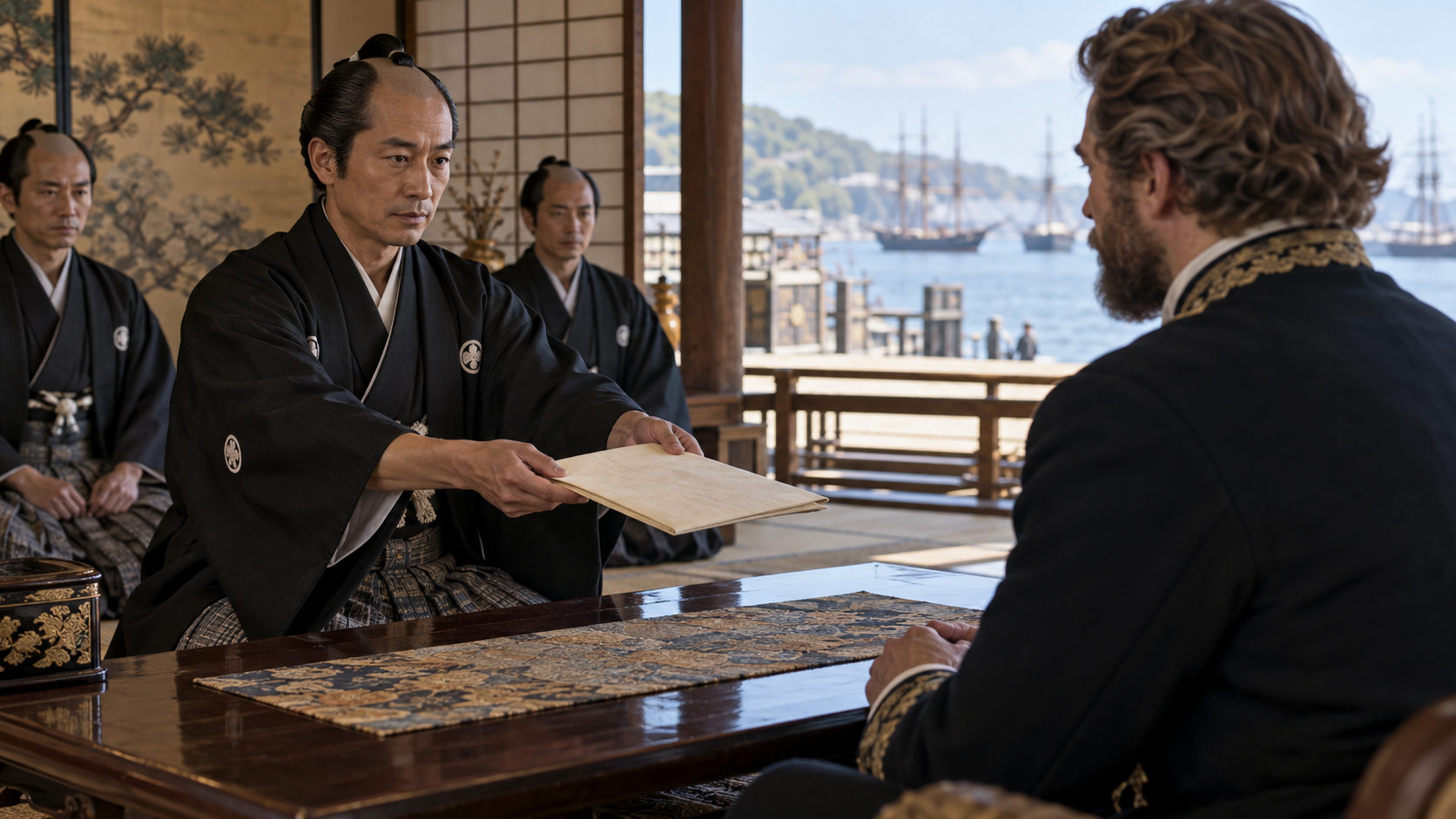
The 1854 Japan–United States Treaty of Peace and Amity provided for opening Shimoda and Hakodate, supplying ships with necessities and assisting shipwrecked vessels. Combining it with the later commercial treaty would obscure what changed at each stage.
The 1858 Treaty of Amity and Commerce established a broader trading arrangement. The Foreign Ministry explanation identifies trade, ports and cities opened to commerce, unilateral recognition of consular jurisdiction, and treaty-set tariff conditions. These included matters Japan could not determine by itself.
Decision-making procedure was another issue. After efforts to obtain imperial approval failed, senior councillor Ii Naosuke proceeded with signing without it. The question of foreign commitments thus became connected with domestic questions about who should approve a major political decision.
Scene 03
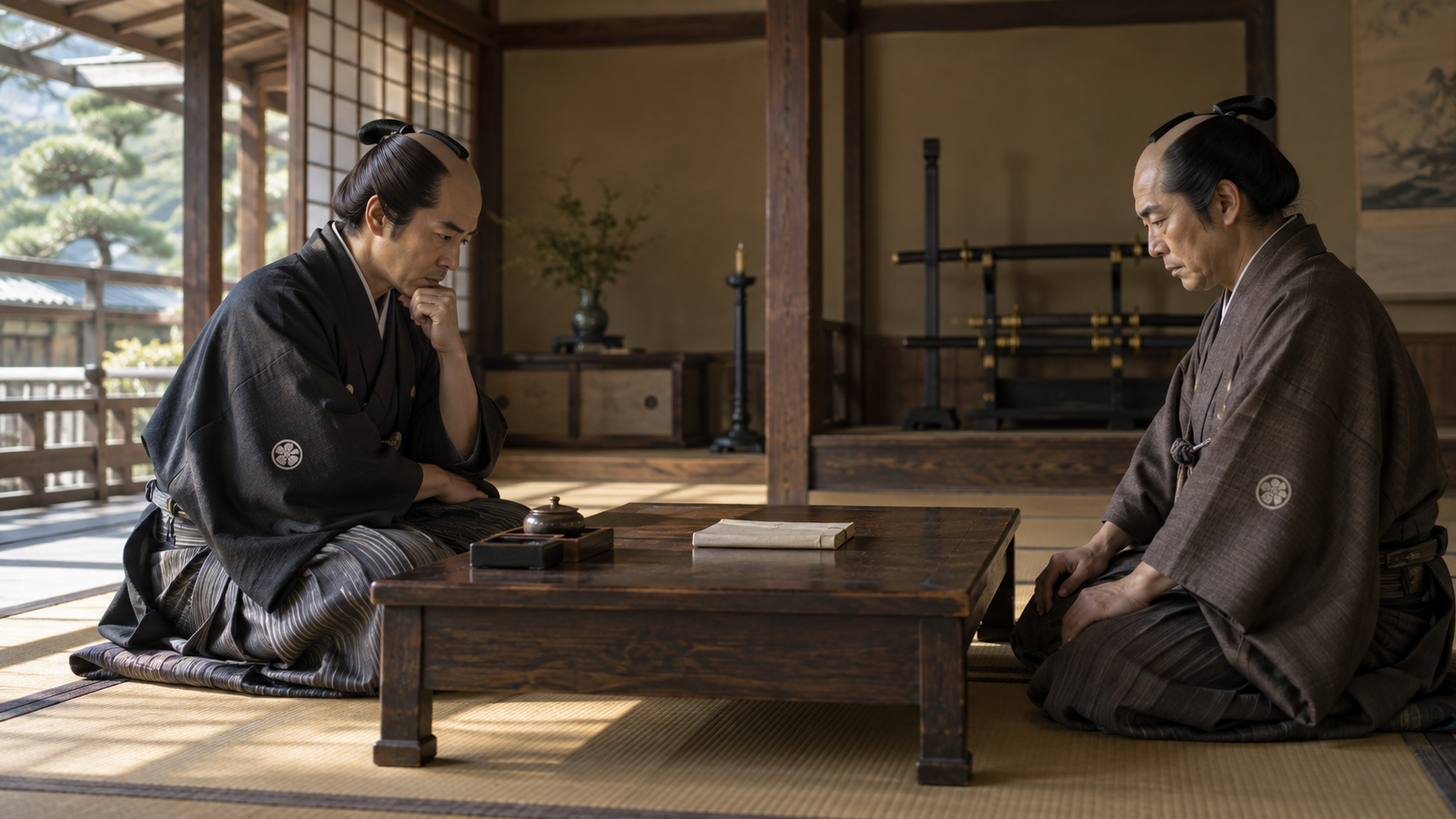
Enforcing a decision did not settle approval
Conflict over the treaty overlapped with the dispute over succession to the shogunate. Ii Naosuke supported Tokugawa Yoshitomi, while another side supported Hitotsubashi Yoshinobu. Yoshinobu was also subjected to confinement during the Ansei Purge. Diplomacy and succession were not unrelated episodes.
After the purge and the Sakuradamon incident, efforts to bring shogunate and court together advanced through the policy called kobu gattai. Shimazu Hisamitsu of Satsuma sought reform in that direction. Portraying Satsuma as consistently committed to overthrowing the shogunate from the outset would misrepresent its position in this period.
Relations among shogunate, court and domains cannot be divided into two fixed colours of support and opposition. Forces joined on one issue could disagree on another. This account follows the relationship between decisions and their approval rather than explaining weakening authority through one person’s character alone.
Scene 04
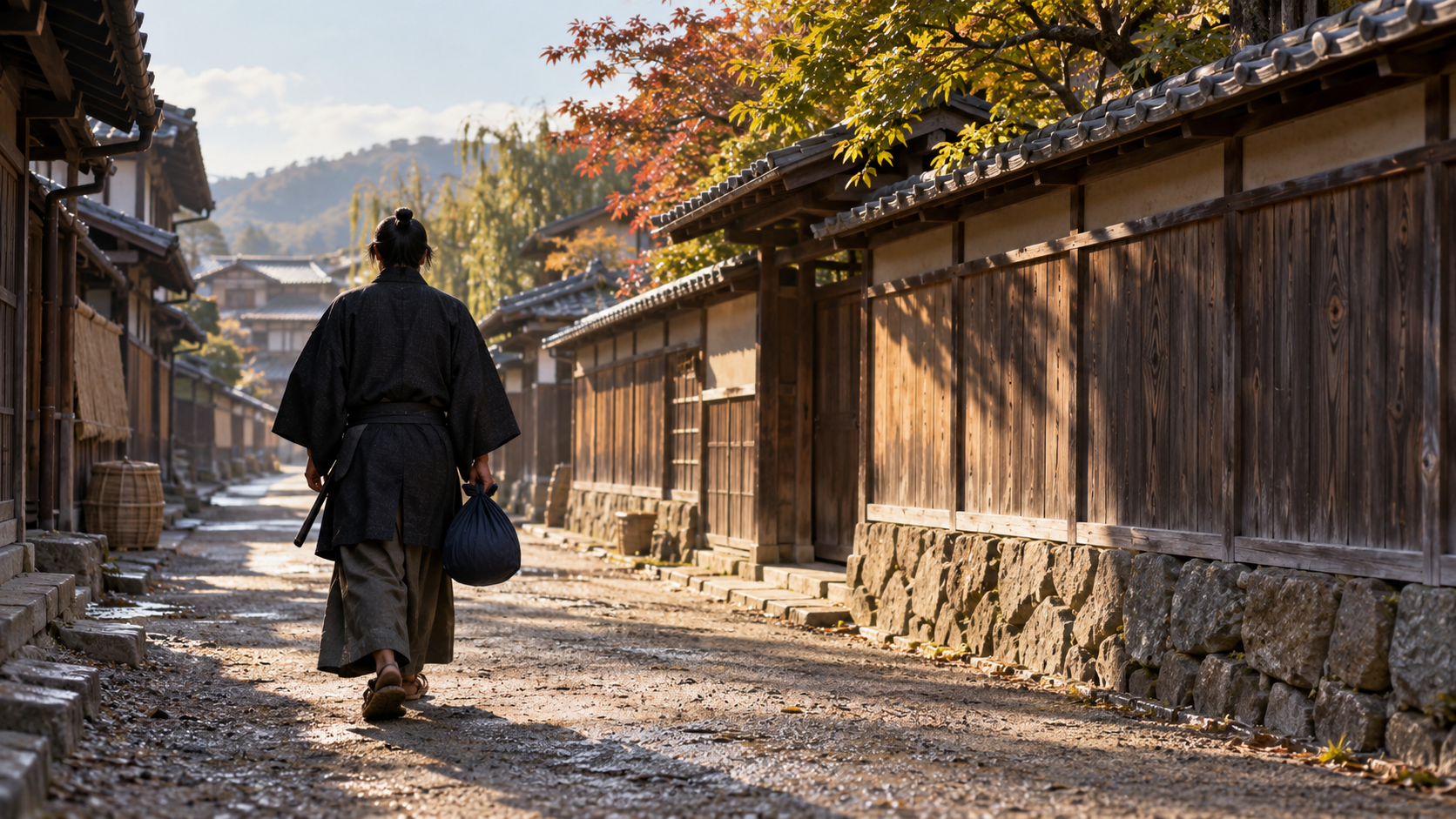
Order in Kyoto and changing domain positions
Security in Kyoto involved Matsudaira Katamori, lord of Aizu and Kyoto military commissioner, and the Shinsengumi under Aizu’s supervision. Looking at the authority under which the group operated links its duties to politics rather than treating its members as isolated figures.
Satsuma and Choshu were not then on the same side. Reimeikan’s exhibition explanation contrasts Satsuma’s support for court–shogunate cooperation with Choshu’s reverence-for-the-emperor and expel-the-foreigners position. Their policies and relationships changed through subsequent events, including the Anglo-Satsuma War and the multinational attack on Shimonoseki.
Fighting a foreign power did not automatically produce one predetermined domestic policy. Responses to foreign relations, the shogunate and possible cooperation with another domain each required consideration and negotiation. The article does not turn one military encounter into a complete explanation of an ideological change.
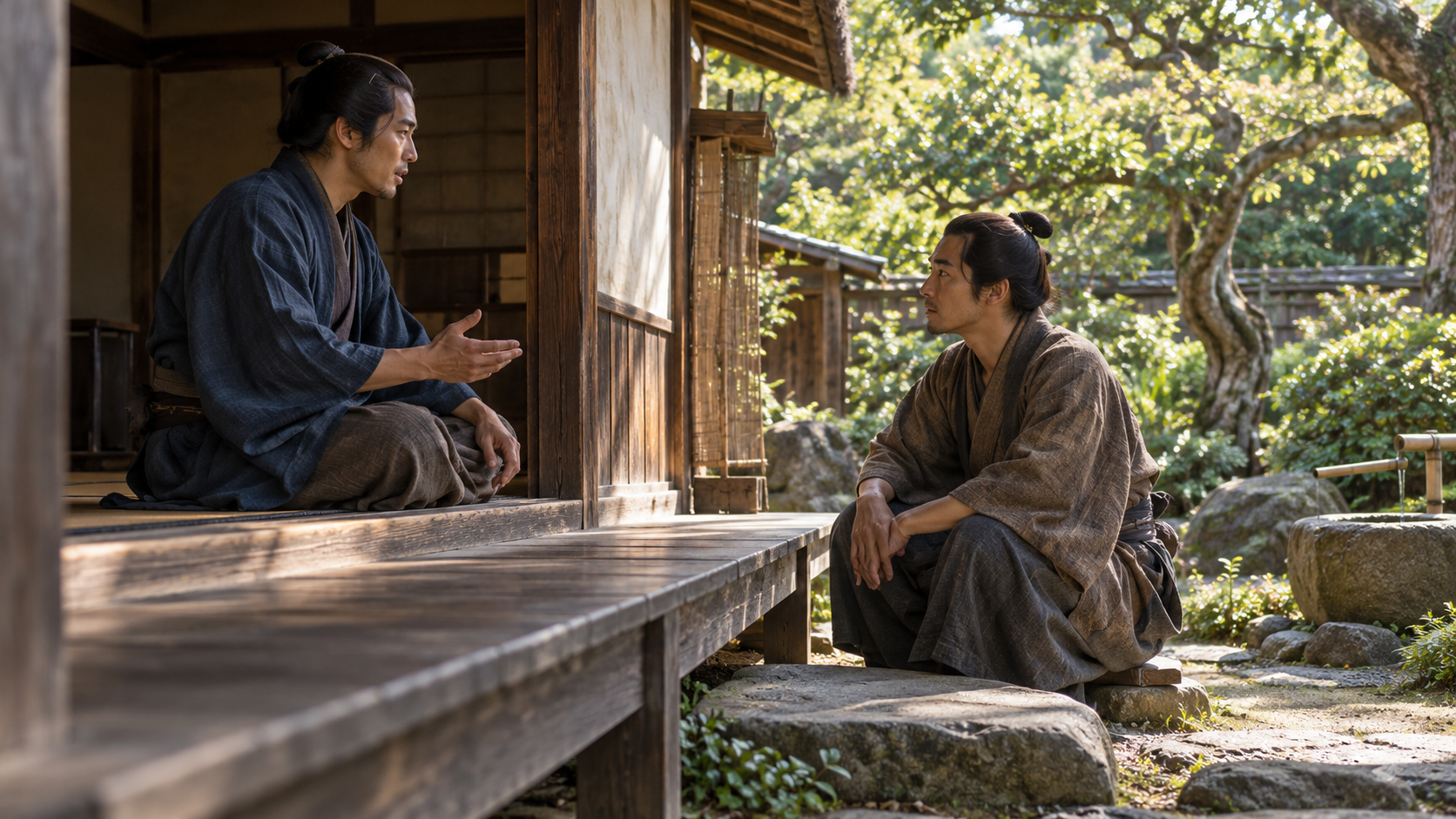
Scene 05
Confirming cooperation and negotiating withdrawal
Kido Takayoshi’s letter and Sakamoto Ryoma’s endorsement offer evidence for the Satsuma–Choshu alliance of 1866. The Imperial Household Agency explains that Kido summarized the terms in six items and requested confirmation; Ryoma replied that the contents were accurate.
The document does not prove that Ryoma alone changed history. Kido’s request itself shows the need to confirm the content of cooperation among participants. Agreement between them was also different from agreement among every political force in the country.
In the same year, after Iemochi’s death, the shogunate decided to stop the second Choshu expedition, and Katsu Kaishu undertook ceasefire talks. The National Diet Library’s selected diary explanation introduces negotiations including non-pursuit during withdrawal. Bringing troops back safely, as well as sending them into war, required arrangements.
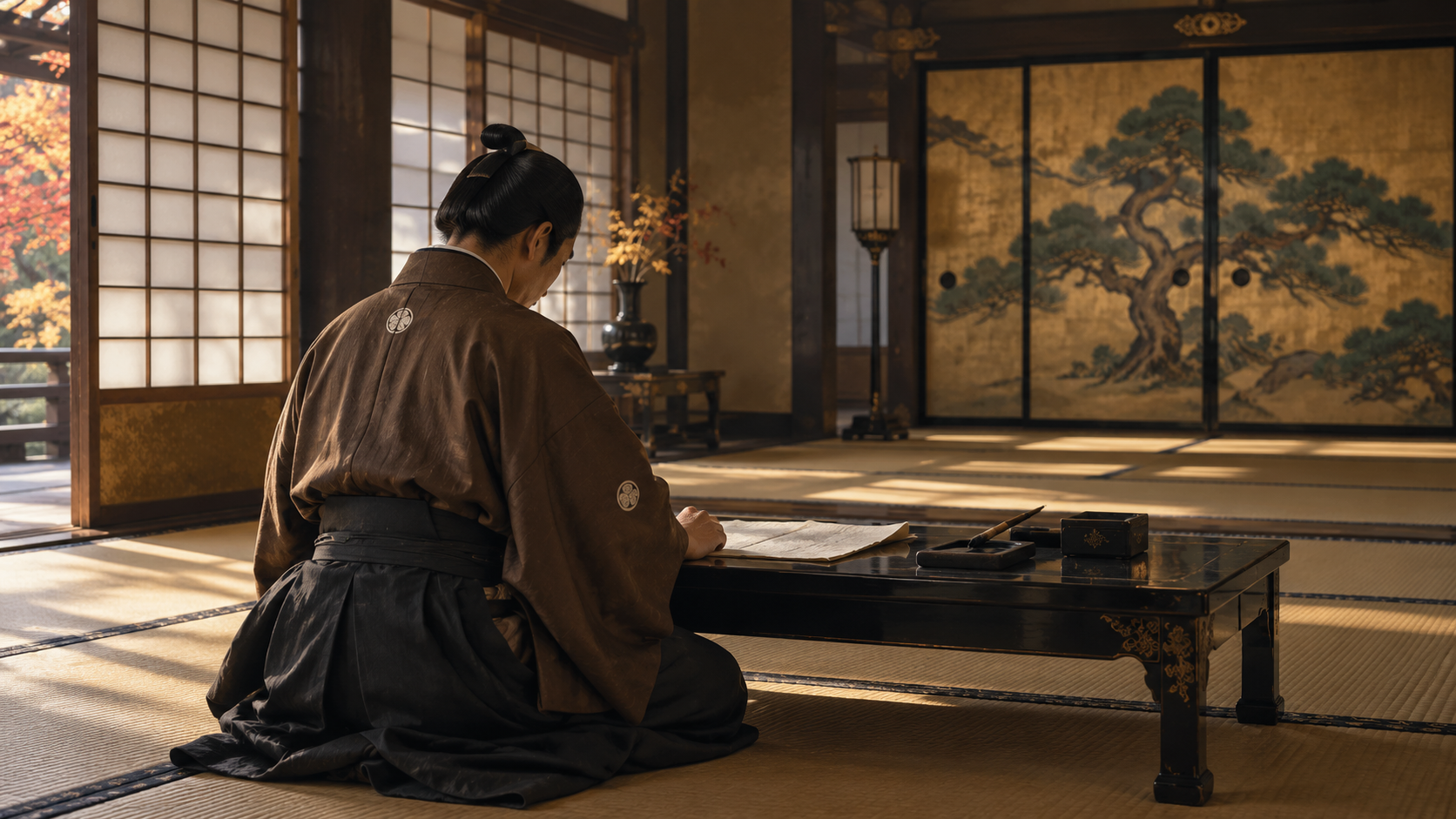
Scene 06
Returning power and restoring imperial rule
Yoshinobu became shogun in 1866 and returned governing power to the imperial court in 1867. That decision did not by itself settle every detail of the following political structure or the Tokugawa family’s future position.
The restoration of imperial rule was a further political turning point. The subsequent Kogosho conference decision concerning resignation of office and surrender of land addressed Yoshinobu’s position and territory. Returning power, forming a new government and deciding the Tokugawa settlement were different steps.
The article uses years for these 1867 developments rather than presenting old-calendar dates as unconverted Gregorian dates. The transition is not compressed into one document. Asking what had been decided and what remained unsettled helps explain the conflicts that followed.
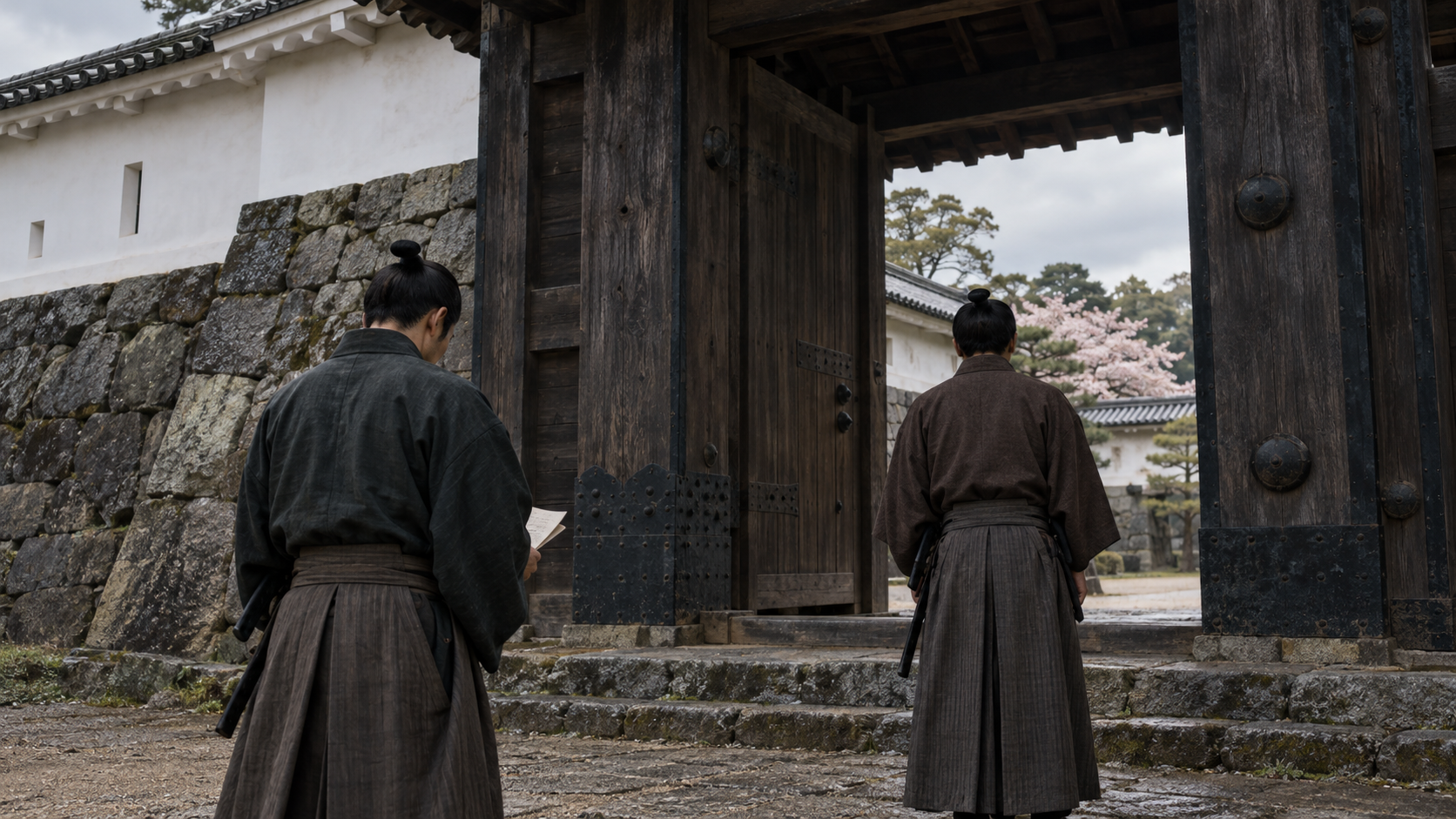
Scene 07
Edo Castle’s surrender was not a national ceasefire
After the battles of Toba and Fushimi in 1868, new-government forces advanced east. The government also notified foreign powers that it had assumed diplomatic sovereignty and inherited treaty relations. Recognition of a government abroad and continuing fighting within Japan need their own chronologies.
Edo Castle was handed over that year. The Tokyo Metropolitan Library describes the process through events of the third and fourth months of the historical calendar. The phrase bloodless surrender concerns the castle’s transfer, not the absence of fighting everywhere in Edo or instant peace throughout Japan.
The Ueno fighting, introduced in another library exhibition, illustrates the distinction between handing over a castle and conflict within the city. Knowing of Katsu and Saigo’s negotiations should not turn one conversation into a story in which all units simultaneously laid down their weapons.
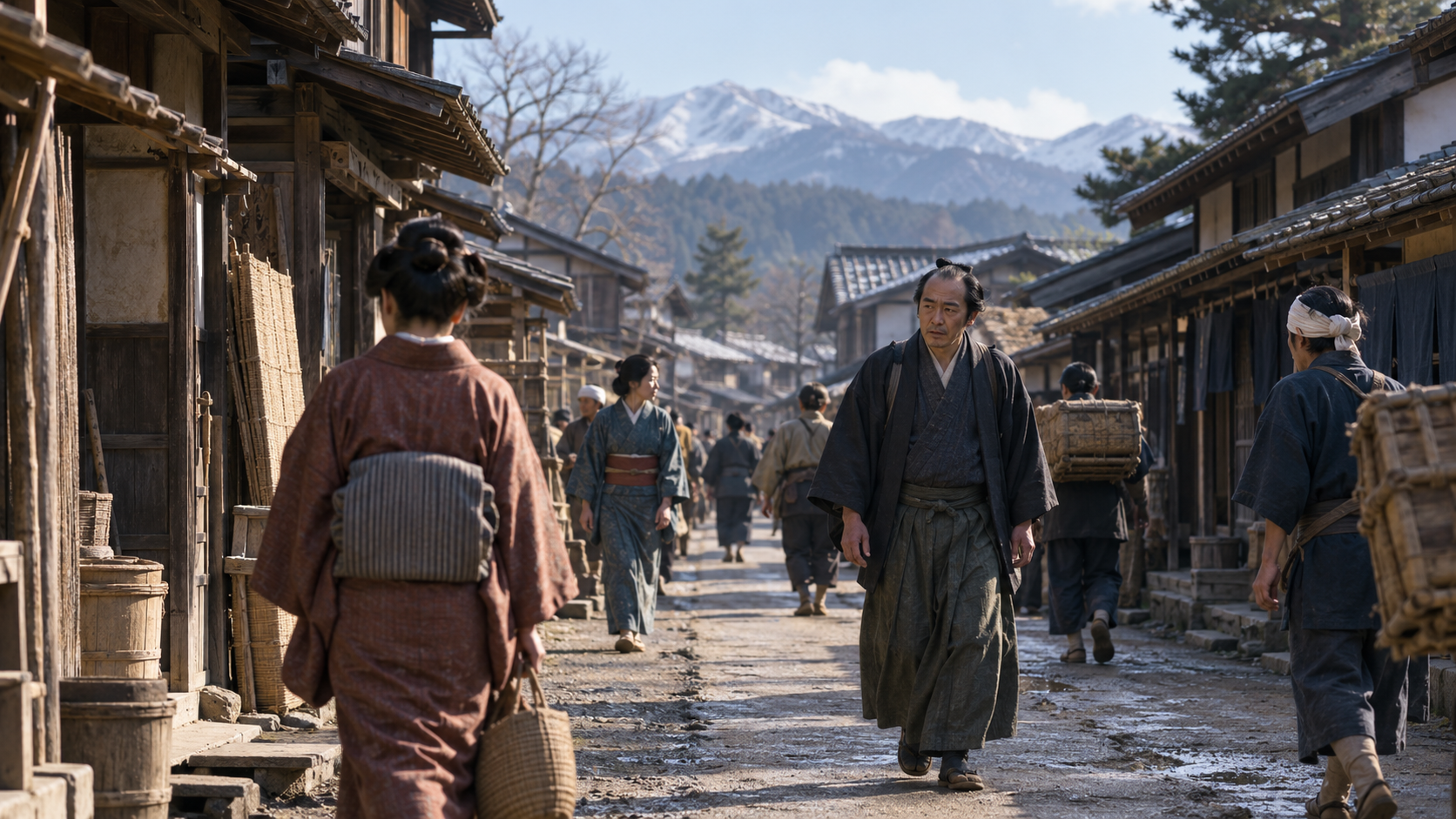
Scene 08
Aizu and lives beyond defeat
Aizu’s earlier responsibility for Kyoto security also invites attention to how political change looked from different positions. Explaining the new government’s formation alone cannot exhaust the experience of people who later fought or regions that became battlefields.
The National Diet Library’s account of Niijima Yae records her participation in the defence of Aizu in 1868. It also follows her later move to Kyoto and work involving education, Doshisha and nursing activity with the Japanese Red Cross Society.
A life should not end in the telling at one wartime scene. Her later activities provide a way to consider continuing work after defeat. This article follows the confirmed career without inventing thoughts or battlefield speech, leaving a connection between wartime experience and later life.
Scene 09
Ships, Ezo and the Hakodate fighting
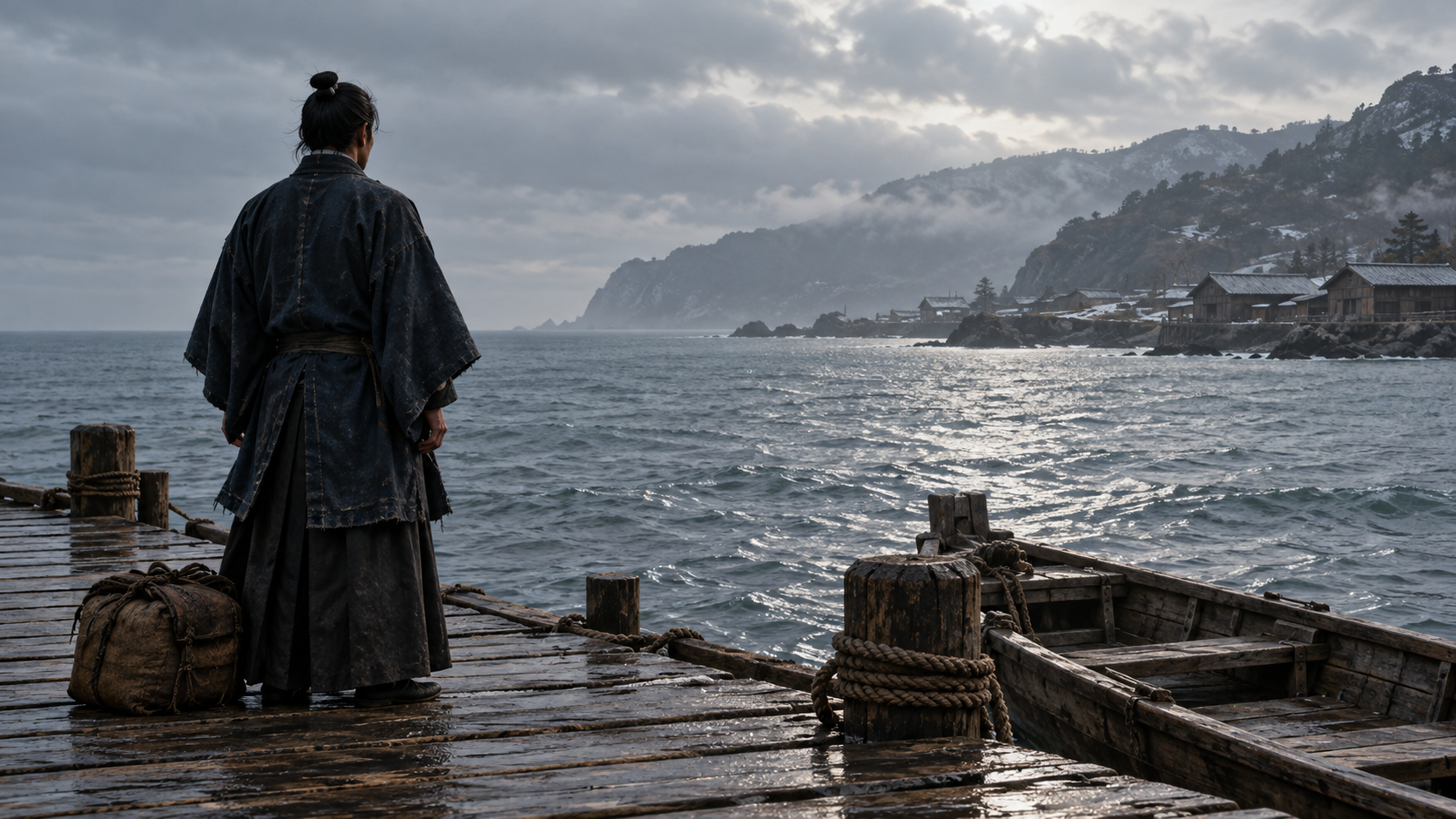
The former shogunate fleet led by Enomoto Takeaki left the waters off Shinagawa in 1868 and crossed to Ezo. Hakodate City’s account follows the landing at Washinoki, occupation of Goryokaku and formation of a provisional government headed by Enomoto. People, ships and military organization continued acting after the settlement in Edo.
Hakodate was a conflict on land and sea, involving ships, a port, positions and landing areas as well as the star-shaped fort. The former shogunate forces lost Kaiyo and came under increasing disadvantage as the new government counterattacked. Neither the fort’s shape nor one individual death explains the entire course of operations.
The image is a conceptual illustration for thinking about movement across the sea. It does not precisely reproduce a person, Washinoki’s actual landing place or Hakodate’s historical shoreline. The distinction between places and events comes from the sources, not from the appearance of generated scenery.
Scene 10
The end of war and further Meiji changes
The Hakodate fighting ended with the surrender of Enomoto and others in 1869. The Foreign Ministry explanation gives 18 May of Meiji 2 in the old calendar, equivalent to 27 June 1869 in the Gregorian calendar. These are two calendar expressions of one event, not separate endings in May and June.
Ending the war did not simultaneously replace all local administration. The return of domain registers and land in 1869, and the abolition of domains in 1871, were distinct institutional stages. Treaty issues inherited from the shogunate also did not disappear simply because a new government existed.
The years from Uraga in 1853 to Hakodate in 1869 were not one hero’s uninterrupted plan. Settlements over foreign commitments, political authority and military command left further questions. Distinguishing them reveals the time between a change of government, the ending of armed resistance and people’s continuing lives.
How to read this work
History, interpretation, and reconstruction
Diplomatic commitments, decisions about domestic authority and the ending of military operations moved at different speeds; their separate chronologies help explain the transition from Bakumatsu to Meiji.
This work is grounded in published sources and historical research. Interior thoughts, dialogue, and some visual details are cinematic reconstructions. Where historians disagree, the article presents the point as debated rather than settled fact.
Timeline
The story in time
-
Perry’s fleet arrives at Uraga.
Sources: h04 -
The Japan–United States Treaty of Peace and Amity opens Shimoda and Hakodate.
Sources: h01 -
The Treaty of Amity and Commerce is signed without imperial approval.
Sources: h35 -
Governing power is returned; restoration of imperial rule and decisions about office and land are separate steps.
Sources: h23 -
Return of domain registers and land, followed by abolition of domains, are institutional stages separate from the end of fighting.
Sources: h24
People & terms
A guide for new readers
Glossary
- Bakumatsu 幕末
- The final years of the Tokugawa shogunate discussed here through diplomacy, authority and military command.
- Kobu gattai 公武合体
- The movement to connect imperial court and shogunate, important to Satsuma’s position before its later policy change.
- Satsuma–Choshu alliance 薩長同盟
- The cooperation of 1866 examined through Kido’s confirmation request and Ryoma’s endorsement, rather than a claim of national unanimity.
- Taisei hokan 大政奉還
- The 1867 return of governing power to the imperial court, distinct from subsequent decisions about government and the Tokugawa family.
- Restoration of imperial rule 王政復古
- A further political turning point after the return of governing power, not the same single procedure.
- Jikan nochi 辞官納地
- The decision concerning resignation of office and surrender of land, addressing Yoshinobu’s position and territory.
- Ezo 蝦夷地
- The northern destination of Enomoto’s fleet, discussed with the provisional government and Hakodate conflict.
- Haihan chiken 廃藩置県
- The abolition of domains in 1871, a later administrative stage rather than the end of war itself.
Sources & method
How this article was built
All ten Japanese scenes, eight timeline entries and sixteen source identifiers are retained. Titles are editorial translations. Libraries and archives are grouped with their parent institutions rather than counted as independent publishers whenever their department names differ.
The three-question framework is the article’s interpretation. Treaty provisions, imperial approval, cooperation and political decisions are distinguished from military outcomes. The article preserves the old-calendar and Gregorian equivalence for the end of the Hakodate fighting and uses years where no conversion is supplied.
Institutional explanations, selected diary excerpts and collection descriptions are not presented as full new readings of original manuscripts. No displayed historical image is reproduced. Conceptual scenes do not prove sites, identities or battlefield details, and later lives remain part of the history beyond a wartime turning point.
Sources
References and further reading
- The opening of Japan and Japanese–Dutch relations 日本の開国と日蘭関係 Title translated editorially for reader convenience. National Diet Library 国立国会図書館 Used for overseas reports, the warning of the coming mission and the 1853–1854 opening process. Published images are not reproduced. Accessed 2026-10-29
- Japan–United States Treaty of Peace and Amity: replica 日米和親条約(複製) Title translated editorially for reader convenience. Ministry of Foreign Affairs 外務省 Used for principal 1854 provisions and the exhibition object’s status as a replica of the American-side signed document. Accessed 2026-10-29
- Treaty of Amity and Commerce: Important Cultural Property 日米修好通商条約(重要文化財) Title translated editorially for reader convenience. Ministry of Foreign Affairs 外務省 Used for signing without imperial approval and conditions on ports, commerce, consular jurisdiction and tariffs. Accessed 2026-10-29
- People who lived through Bakumatsu 幕末を生きた人々 Title translated editorially for reader convenience. National Diet Library 国立国会図書館 Used for institutional explanations concerning Ii Naosuke and politics. This is not a full independent reading of the displayed letters. Accessed 2026-10-29
- The road to overthrowing the shogunate 倒幕への道 Title translated editorially for reader convenience. Kagoshima Prefecture / Reimeikan 鹿児島県歴史・美術センター黎明館 Used for court–shogunate cooperation, Satsuma–Choshu opposition and changing relations. One foreign war is not treated as the sole cause of policy change. Accessed 2026-10-29
- Aizu and the Shinsengumi 会津と新選組 Title translated editorially for reader convenience. Aizuwakamatsu City 会津若松市 Used for the commissioner’s role and the group’s position under Aizu. Evaluative language about character or destiny is not adopted as fact. Accessed 2026-10-29
- Letter with Ryoma’s endorsement 尺牘(龍馬裏書) Title translated editorially for reader convenience. Imperial Household Agency 宮内庁 Used for the collection explanation of Kido’s request and Ryoma’s response, not a new full decipherment of the six original terms. Accessed 2026-10-29
- Katsu Kaishu’s diary: ceasefire talks in the Choshu expedition 勝海舟の日記より・長州征伐の停戦交渉 Title translated editorially for reader convenience. National Diet Library 国立国会図書館 Used for selected exhibition transcription and explanation of the 1866 talks. No reading of every volume of the diary is claimed. Accessed 2026-10-29
- The return of governing power 大政奉還 Title translated editorially for reader convenience. National Diet Library / International Library of Children’s Literature 国立国会図書館国際子ども図書館 Used for distinctions between return of power, restoration and office-and-land decisions. Historical dates are not silently converted. Accessed 2026-10-29
- Tokugawa Yoshinobu 徳川慶喜 Title translated editorially for reader convenience. National Diet Library 国立国会図書館 Used for becoming shogun in 1866, returning power the next year and subsequent submission. Private thoughts and dialogue are not invented. Accessed 2026-10-29
- Sources and explanation: the beginning of Meiji 史料と解説・明治のはじまり Title translated editorially for reader convenience. Ministry of Foreign Affairs / Diplomatic Archives 外務省外交史料館 Used for diplomatic notification, foreign recognition, inherited treaties and the calendar conversion for the end of the Hakodate war. Accessed 2026-10-29
- The bloodless surrender of Edo Castle 江戸無血開城 Title translated editorially for reader convenience. Tokyo Metropolitan Library 東京都立図書館 Used for the historical third- and fourth-month process and related-material guide. Recommended books are not all claimed as fully read. Accessed 2026-10-29
- Major events in Edo, Chapter 1 第1章 江戸の大事件 Title translated editorially for reader convenience. Tokyo Metropolitan Library 東京都立図書館 Used for separate treatment of coastal batteries, the castle surrender and Ueno fighting. Accessed 2026-10-29
- Niijima Yae 新島八重 Title translated editorially for reader convenience. National Diet Library 国立国会図書館 Used for Aizu’s defence and the later career involving education, Doshisha and nursing. Accessed 2026-10-29
- History of Goryokaku, from the Hakodate war onward 五稜郭の歴史(箱館戦争から現在) Title translated editorially for reader convenience. Hakodate City 函館市 Used for the fleet’s crossing, provisional government, ship loss, land-and-sea fighting and surrender. Exact death locations and troop figures are not added. Accessed 2026-10-29
- The new government and Kagoshima 新政府と鹿児島 Title translated editorially for reader convenience. Kagoshima Prefecture / Reimeikan 鹿児島県歴史・美術センター黎明館 Used for the separate timings of the new government, return of registers and land, and abolition of domains. Accessed 2026-10-29
Continue reading
More stories from Shigeki
Shigeki English
Enomoto Takeaki after Defeat: Government Service, Treaties and Migration
Follow the changing responsibilities behind a former opponent’s Meiji career.
- When From service under the shogunate to release in 1872, the treaty of 1875 and migration to Mexico in 1897
- Where Japan, Saint Petersburg, Siberia and overseas settlement projects
Shigeki English
Dojima Rice Market: Receipts, Accounts and the Movement of Prices
Trading without moving a bale did not make every transaction the same kind of trade.
- When Seventeenth-century Osaka; relocation around 1697; recognition in 1730; later Edo networks; institutional changes from 1869 to 1939
- Where Dojima and the Nakanoshima warehouse district in Osaka, linked to rice-producing regions and distant customers