

SHIGEKI ENGLISH STORYEN
Japanese history in English
The Battle of Yamazaki
Eleven days after Honnoji, why could Akechi Mitsuhide not turn victory into rule?
From the attack at Honnoji on June 2, 1582, to the Battle of Yamazaki on June 13, this story follows Akechi Mitsuhide as he tried to secure Kyoto and Azuchi, and Hashiba Hideyoshi as he returned from western Japan while assembling allies. Roads, bridges, letters, loyalties, and the narrow terrain between mountain and water reveal how a military victory failed to become durable political control.
At a glance
Before you enter the story
- When
- June 2-13, 1582, corresponding to Tensho 10 in the historical Japanese calendar
- Where
- Kyoto, Omi Province, and Yamazaki at the south-western edge of the Kyoto Basin, in present-day Kyoto and Osaka prefectures
- Key figures
- Akechi Mitsuhide, Hashiba Hideyoshi, Hosokawa Fujitaka, Hosokawa Tadaoki, Tsutsui Junkei
- What was at stake
- Whether the political and military vacuum left by the deaths of Oda Nobunaga and Oda Nobutada would be consolidated by Mitsuhide or reorganised by the forces returning against him
Why this story matters
The larger history behind the turning point
The Battle of Yamazaki is often compressed into a dramatic reversal: Akechi Mitsuhide overthrew Oda Nobunaga at Honnoji, only to be defeated by Hashiba Hideyoshi eleven days later. That outline is accurate, but it can hide the harder question. Removing a ruler created an opening; it did not automatically transfer the ruler's castles, officers, routes, and relationships to the victor.
The eleven-day interval shows politics operating through physical systems. A destroyed bridge could delay movement. A letter could request support without producing troops. A castle could be occupied without securing the wider region. An army returning from another front had to conclude one conflict, march east, and contact commanders along its route before it could fight at Yamazaki.
For readers new to the period, Yamazaki therefore offers more than a story about personal ambition or battlefield luck. It reveals how authority in late sixteenth-century Japan depended on networks of armed households, regional strongholds, communication, and access to roads and waterways. The battle mattered because two efforts to reconnect a shattered political order met there.
This account preserves uncertainty where the evidence does not support a single answer. It does not assign precise troop numbers, reconstruct a fixed order of attacks, or invent the private motives of commanders who did not join Mitsuhide. Its central explanation is an interpretation built by placing documented dates and actions beside one another.
Historical context
What an international reader needs to know
A Political Order Built Through Personal and Military Ties
The political and military centre associated with Oda Nobunaga depended on commanders whose forces, castles, and regional ties did not simply move with control of Kyoto. After Nobunaga and his heir Nobutada died, those commanders still had to decide how, when, and under whom they would act.
This is why requests for cooperation are central to the story. Mitsuhide's seizure of the capital gave him an immediate military advantage, yet support outside the capital required communication and practical commitment. Hideyoshi faced the same problem from the west: he could not oppose Mitsuhide until the conflict at Takamatsu had been closed and other commanders had been drawn into a new coalition.
Kyoto, Omi, and the Western Approach
Kyoto sat within a wider landscape of strategic places. Azuchi, Nobunaga's castle in Omi Province, lay to the east beyond the route across the Seta River. Sakamoto Castle formed another point in Mitsuhide's movement. To the south-west, Yamazaki occupied an approach between the slope of Mount Tenno and low ground shaped by rivers and waterways.
These locations were not interchangeable dots on a map. Bridges controlled passage, castles supported movement and retreat, and the routes through Yamazaki connected Kyoto with the Osaka region and western Japan. The geography did not dictate the result by itself, but it narrowed the ways in which large bodies of troops could approach, deploy, and withdraw.
Dates and the Historical Calendar
The dates used here follow the sequence recorded in Japanese historical sources and explanatory materials for Tensho 10. They are presented as June dates for readability, but they belong to the calendar then in use and should not be treated as a modern day-by-day timetable without qualification.
The phrase 'eleven days' describes the counted interval from the attack on June 2 to the battle on June 13. It is useful because it exposes how much had to happen in a short span, not because every hour of marching, negotiation, bridge repair, or military preparation can be recovered from the surviving evidence.
Watch the film
See the story in motion
The film currently uses Japanese audio. This English article provides the context and source trail; it does not imply that an English subtitle track is available.
June 2-13, 1582
The Victor at Honnoji Is in Flight Eleven Days Later
On June 2, 1582, Akechi Mitsuhide attacked in Kyoto, and Oda Nobunaga and Nobutada died. Their deaths opened a profound military and political vacuum at the centre of the Oda order. Mitsuhide held the initiative because he had acted first and controlled the immediate scene in the capital.
On June 13, however, Mitsuhide's army was defeated at Yamazaki. He withdrew first to Shoryuji Castle and then attempted to return towards Sakamoto Castle. Explanatory accounts place his death during that retreat, although the vivid details later attached to his final journey cannot all be treated as established fact.
The reversal becomes intelligible once occupation and rule are separated. Controlling Kyoto after a sudden attack was not the same as binding castles, roads, institutions, and regional commanders into a stable new order. Mitsuhide made efforts to do so, but the evidence does not show that his initial military victory automatically produced broad obedience.
This article follows the interacting conditions between the two dates rather than searching for one decisive cause. The documented chronology is secure in outline. The proposition that information, movement, support, transport, and geography formed a single structure of reversal is the article's interpretation.

June 2-5
Stopped at Seta Before Reaching Azuchi
After the attack in Kyoto, Mitsuhide aimed for Azuchi Castle, Nobunaga's principal stronghold. The route into Omi required a crossing at Seta, but Yamaoka Kagetaka, lord of Seta Castle, had destroyed the bridge. Mitsuhide could not simply continue with his army as planned.
He went instead to his own Sakamoto Castle while the bridge was repaired. The sources used here establish the interruption and the subsequent movement, but they do not permit a minute reconstruction of the repair work or an exact calculation of every hour lost by the army.
Mitsuhide is said to have entered Azuchi on June 5. Three days therefore separated the attacks in Kyoto from his arrival there, with the Seta crossing and Sakamoto between them. This did not erase his initiative, but it demonstrates that political expansion depended on vulnerable physical infrastructure.
The episode is a reminder that command was embodied in movement. A declaration in Kyoto could not carry soldiers across a missing bridge. The delay matters not as a complete explanation of defeat, but as one constraint within the short period in which Mitsuhide was trying to extend control beyond the capital.

Azuchi and Kyoto
Trying to Turn Victory into a Governable Order
At Azuchi and in Kyoto, Mitsuhide did more than move troops. Official explanatory sources describe approaches to the imperial court and religious institutions, as well as measures in the capital including the remission of ground rent. These actions indicate an effort to present and exercise authority after the attack.
He also sought cooperation from powerful commanders, including former associates of Nobunaga. A message sent was not yet an alliance, and an alliance was not yet a body of troops on the field. The surviving material identifies requests and responses more securely than it reveals every discussion behind them.
It would therefore be misleading to portray Mitsuhide as doing nothing after Honnoji merely because he eventually lost. The relevant question is narrower and more useful: how far did the actions visible in the record become effective political support and military concentration before June 13?
Kyoto was a crucial beginning, not a complete settlement. The castles, routes, armed households, and institutions beyond it still had to be connected to Mitsuhide in ways that produced action. The gap between winning a sudden military encounter and establishing durable rule is the first major lens through which this article reads Yamazaki.

June 9-10
Requests for Support Do Not Become an Army
Among those Mitsuhide approached were Hosokawa Fujitaka and his son Tadaoki. The connection was close: Tadaoki's wife Tama was Mitsuhide's daughter. A chronology published by Nagaokakyo City records that Mitsuhide issued a memorandum to the Hosokawa men on June 9.
Kinship did not automatically determine political and military action. Fujitaka and Tadaoki did not join Mitsuhide's force. Mitsuhide also sought the participation of Tsutsui Junkei of Yamato, but the official accounts used here indicate that the cooperation he wanted from the Hosokawa men and Junkei was not secured in the form required for Yamazaki.
The sources in this production packet do not establish one private motive, secret conversation, or emotional judgement that explains every refusal. Rather than repeat later anecdotes, this article confines itself to observable action: requests were made, and the named commanders did not converge with Mitsuhide before the battle.
Nor does this mean that Mitsuhide had no allies or troops. His side included commanders and soldiers whose presence should not be erased. The more precise conclusion is that he did not create a sufficiently broad concentration of support to meet the coalition forming against him by June 13.

June 3-6
News Reaches Bitchu, and Hideyoshi Turns East
Hashiba Hideyoshi was far from Kyoto, fighting the Mori side at Bitchu Takamatsu, when the political landscape changed. He is said to have learned of the Honnoji attack on June 3. Before returning east, he had to bring the conflict directly before him to an end.
A settlement with the Mori side followed on June 4 after the death of Shimizu Muneharu. Hideyoshi's force departed Takamatsu on June 6. This sequence matters because it replaces the image of an instantaneous return with three distinct actions: receiving news, ending one campaign, and redirecting an army.
The celebrated 'Great Return from Chugoku' is often told primarily through speed and distance. Those features were important, but speed alone can obscure the negotiation that closed the western front and the organisational work required to give the army a new objective.
The evidence securely supplies the sequence of June 3, 4, and 6. It does not justify filling every interval with invented conversations or exact marching statistics. Hideyoshi's return is best understood as a military transition as well as a rapid movement across space.

June 6-11
Building a Coalition While Marching
Hideyoshi's forces reached Himeji in Harima on June 8, rested, and moved east again on June 9. The journey should not be imagined as a single uninterrupted sprint. Stops, renewed departures, and the condition of the force formed part of the movement towards Settsu and Yamazaki.
A surviving copy of a letter dated June 10 records Hideyoshi asking Nakagawa Kiyohide to mobilise and communicating the state of contact with other commanders. This is concrete evidence that messengers and written communication were operating alongside the movement of the column.
The letter does not merely celebrate one man's speed. It shows an attempt to connect commanders already contacted with those whose action was still being requested. A name in the letter cannot supply an exact arrival time or troop strength, but it reveals coalition-building as part of the campaign itself.
By June 11, Hideyoshi had reached Amagasaki in Settsu and sought the participation of Oda Nobutaka, Niwa Nagahide, and others. At the same time that Mitsuhide was requesting support from Kyoto, Hideyoshi was gathering it along an eastward route. Yamazaki became the point at which these competing efforts to assemble people and armed force met.

South-west of the Kyoto Basin
Two Forces Gather Between Mountain and Water
Yamazaki lies at the south-western edge of the Kyoto Basin on a route connecting Kyoto with the Osaka area. The slope of Mount Tenno rises to the west, while lower ground associated with rivers and waterways extends to the east. Armies approaching the region did not encounter an unlimited open plain.
Nagaokakyo City describes the forces facing one another around the foot of Mount Tenno and across the Koizumi River. Shoryuji Castle, behind the battlefield, occupied a strategic position near the Saigoku Highway, the Koga Nawate route, and the Yodo river system.
Roads, slopes, wet ground, and waterways limited where large forces could move and form lines. This does not mean that geography selected a victor in advance. It means that concentration, combat, and withdrawal occurred through a constrained transport corridor rather than in abstract space.
Mount Tenno later became a metaphor for a decisive turning point, but the battle should not be reduced to one struggle for its summit. Mountain, river, roads, and castle are more useful when read as a connected geography shaping approach, deployment, and retreat.

June 12-13
From a Small Clash to General Battle
A Nagaokakyo City chronology records that foot soldiers from the two sides encountered one another west of Shoryuji Castle on June 12 and exchanged gunfire. On June 13, the conflict developed into the full Battle of Yamazaki.
Nakagawa Kiyohide, Takayama Ukon, and Ikeda Tsuneoki were among the forward commanders on Hideyoshi's side. Recent research by Babe Takahiro re-examines the role of these forces and the point at which Hideyoshi himself arrived. This is a scholarly argument, not permission to place Hideyoshi at an exact command post without further evidence.
Reported troop totals vary, and the exact order in which units moved along the slope, road, and waterside ground is not settled. The responsible narrative therefore stays with the supported outline: a smaller clash preceded the general battle, Mitsuhide's line failed, and his force withdrew.
No single element is fixed here as the sole decisive blow. Hideyoshi's return, the breadth of the coalition, access through the corridor, battlefield conditions, and the previous days of mobilisation all entered the fighting. Retaining uncertainty about the detailed battle sequence is part of the historical explanation, not a gap to be hidden.

Night of June 13
Retreat to Shoryuji, Then an Attempt to Reach Sakamoto
Mitsuhide withdrew from Yamazaki to Shoryuji Castle. Municipal material explains that he entered the castle and then left in retreat soon afterwards. The castle's proximity to the Saigoku Highway, Koga Nawate, and the Yodo river system made it a logical point behind the battlefield.
Shoryuji possessed stonework, earthworks, and dry moats, but entering a fortified site did not mean that Mitsuhide had restored the cohesion needed for another battle. In the supported sequence, he did not remain there to rebuild his force; he attempted instead to return to Sakamoto Castle.
He is understood to have died on that journey. Later military tales and popular retellings supply precise locations, attackers, weapons, final statements, and death poems. The sources used here do not make all those details equally secure, so the story ends with the broken route rather than a fully staged death scene.
This distinction protects the documented event from the dramatic confidence of later narrative. Retreat to Shoryuji and the attempted movement towards Sakamoto belong to the historical outline. The exact route, encounter, last words, and manner of death remain disputed or insufficiently established in this source packet.

Eleven days after Honnoji
Who Could Reconnect the Broken Centre First?
Mitsuhide killed Nobunaga and Nobutada, controlled Kyoto, entered Azuchi, approached institutions, and requested the cooperation of regional commanders. These actions demonstrate that he attempted to construct a post-Honnoji order; his defeat should not be projected backwards into an assumption of passivity.
Yet castles and correspondence did not automatically create a stable political network. Movement was checked at Seta, and requests to the Hosokawa men and Tsutsui Junkei did not become the participation Mitsuhide sought. This supports a conclusion about the result by June 13, not a claim that his personality made failure inevitable.
Meanwhile news travelled west. Hideyoshi closed the Takamatsu campaign, marched through Himeji and Amagasaki, and used messages such as the June 10 letter to request mobilisation. His force arriving from the west was also a coalition being assembled in motion.
At Yamazaki, the two projects met. Time, information, support, routes, and the ground between mountain and water did not act independently; they shaped one another. This synthesis is interpretive, but every component is tied to the dated actions and places preserved in the cited material.
The immediate supported consequence is limited but decisive. Mitsuhide's attempt to establish control in Kyoto and Omi ended with defeat, withdrawal to Shoryuji, and a return to Sakamoto that he did not complete. A fuller account of Hideyoshi's later rise would require a different source base. Here, the eleven days close at the point where Mitsuhide's initial victory failed to become durable rule.
How to read this work
History, interpretation, and reconstruction
Mitsuhide's defeat should not be reduced to one famous hill or to the speed of Hideyoshi's return: information, movement, political support, transport routes, and the concentration of forces converged over eleven days to shape the outcome at Yamazaki.
This work is grounded in published sources and historical research. Interior thoughts, dialogue, and some visual details are cinematic reconstructions. Where historians disagree, the article presents the point as debated rather than settled fact.
Timeline
The story in time
-
Oda Nobunaga and Nobutada die in the attacks in Kyoto. Mitsuhide aims for Azuchi but cannot cross at Seta and moves towards Sakamoto Castle.
Sources: ntj-nijo -
Hashiba Hideyoshi learns of the Honnoji attack and concludes a settlement with the Mori side.
Sources: ntj-yamazaki-route -
After waiting for the crossing to be restored, Mitsuhide enters Azuchi and continues approaches to the court and regional commanders.
Sources: ntj-nijo -
Hideyoshi's army leaves Takamatsu, passes through Himeji, and advances to Amagasaki in Settsu.
Sources: ntj-yamazaki-route -
Mitsuhide issues a memorandum to Hosokawa Tadaoki and Fujitaka.
Sources: nagaokakyo-chronology -
A surviving copy of Hideyoshi's letter asks Nakagawa Kiyohide to mobilise and reports contact with other commanders.
Sources: kobe-hideyoshi-letter -
Foot soldiers meet west of Shoryuji Castle and exchange gunfire as both sides prepare around Yamazaki.
Sources: nagaokakyo-chronology, ntj-yamazaki -
The Battle of Yamazaki develops into general combat. Mitsuhide's force is defeated and retreats to Shoryuji; Mitsuhide later dies while attempting to reach Sakamoto.
Sources: ntj-yamazaki, ntj-mitsuhide-end, nagaokakyo-shoryuji
People & terms
A guide for new readers
Key figures
- Akechi Mitsuhide
- The commander who moved to secure Kyoto and Omi after the attack at Honnoji and fought Hideyoshi's coalition at Yamazaki.
- Hashiba Hideyoshi
- The commander who turned his army east from Bitchu Takamatsu and assembled forces to oppose Mitsuhide.
- Hosokawa Fujitaka
- A powerful commander in Tango Province from whom Mitsuhide sought cooperation.
- Hosokawa Tadaoki
- Fujitaka's son and the husband of Mitsuhide's daughter Tama.
- Tsutsui Junkei
- A powerful commander in Yamato Province whose participation Mitsuhide awaited.
- Oda Nobutaka
- Nobunaga's third son, whom Hideyoshi asked to join him in Settsu.
- Niwa Nagahide
- An Oda commander whom Hideyoshi asked to join the campaign against Mitsuhide.
- Nakagawa Kiyohide
- A commander asked by Hideyoshi to mobilise who advanced towards Yamazaki.
- Takayama Ukon
- A commander from Settsu who advanced near Yamazaki and fought on Hideyoshi's side.
- Ikeda Tsuneoki
- A commander who took part in the fighting around Yamazaki among Hideyoshi's forward forces.
Glossary
- Honnoji Incident 本能寺の変
- The June 2, 1582 attack in Kyoto in which Akechi Mitsuhide turned against Oda Nobunaga; Nobunaga and his heir Nobutada died that day.
- Tensho 天正
- A Japanese era name. The events in this story occurred in Tensho 10, corresponding to 1582.
- Great Return from Chugoku 中国大返し
- The later name for Hideyoshi's rapid eastward movement from the campaign in the Chugoku region after he learned of the Honnoji attack.
- Ground rent 地子
- A form of land-related levy. Its remission in Kyoto is cited as one of Mitsuhide's efforts to exercise authority after Honnoji.
- Saigoku Highway 西国街道
- A major route linking Kyoto with areas to the west; Shoryuji Castle occupied a strategically important position near it.
- Mount Tenno 天王山
- The mountain beside Yamazaki that later became a metaphor for a decisive moment, although the battle cannot be reduced to control of the summit alone.
- Retainer 家臣
- A warrior bound in service to a lord, within a relationship that involved military duties, landholding, and political allegiance.
Sources & method
How this article was built
This English edition follows the identifiers, order, images, evidence levels, and source links of the reviewed Japanese source story. It translates the established account while adding only introductory political and geographic context needed by readers who may not know the Oda command structure or the geography around Kyoto.
Official cultural resources, municipal chronologies, a digitised letter copy, and a recent academic article answer different questions. The official and municipal materials establish dates, movements, places, and institutional actions. The letter supplies direct evidence of mobilisation in progress. The academic article is used to preserve an open research question about forward forces and Hideyoshi's arrival, not to create a definitive battlefield reconstruction.
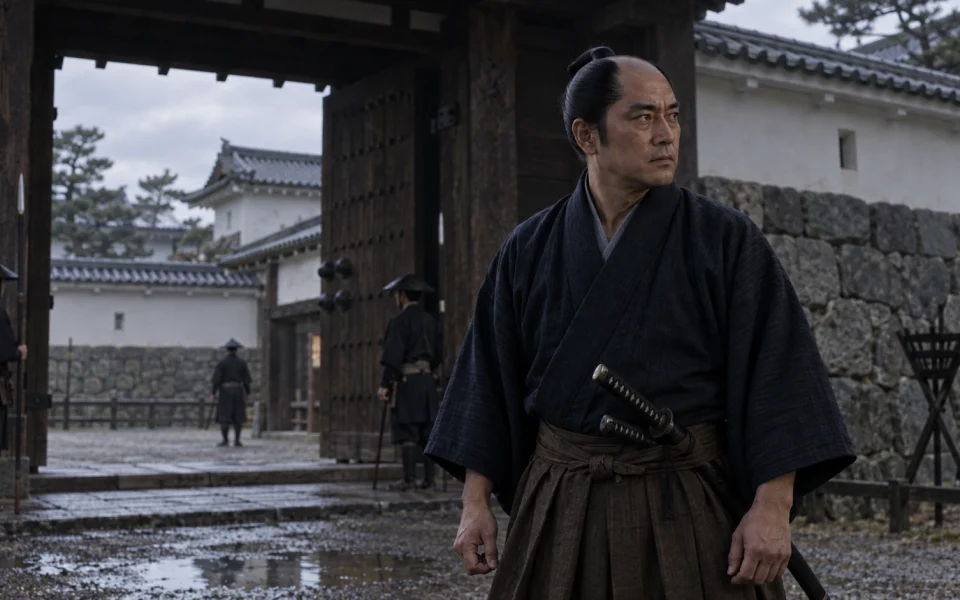
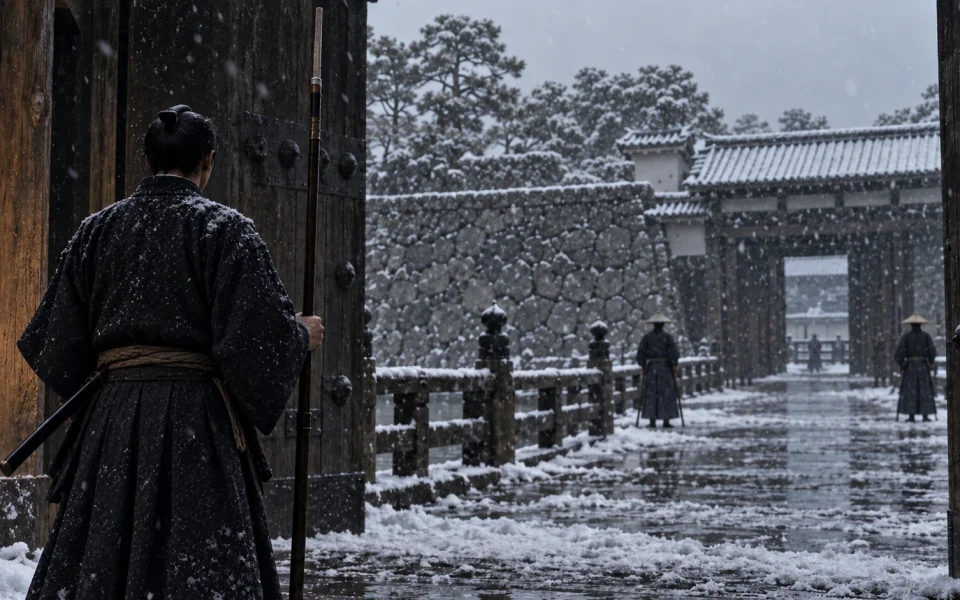
AI-generated images are inherited from the Japanese edition and are labelled as reconstructions. They do not establish faces, weather, troop totals, routes, architecture, or attack order. Where later stories offer dramatic detail, the English text retains the same evidentiary limits as the Japanese source and does not convert narrative tradition into documented fact.
Sources
References and further reading
- The Honnoji Incident: Nijo Castle and Azuchi Castle at the Time 本能寺の変:その時の二条城と安土城 Title translated editorially for reader convenience. Japan Arts Council, Cultural Digital Library 日本芸術文化振興会 文化デジタルライブラリー Supports the blocked crossing at Seta, Mitsuhide's movement to Sakamoto, his entry into Azuchi on June 5, and approaches to the court and commanders. Images from the page are not reproduced. Accessed 2026-07-24
- The Battle of Yamazaki: The Road to the Battle 山崎の戦い:合戦までの経緯 Title translated editorially for reader convenience. Japan Arts Council, Cultural Digital Library 日本芸術文化振興会 文化デジタルライブラリー Supports Hideyoshi's sequence from learning the news through Takamatsu, Himeji, and Amagasaki, as well as Mitsuhide's efforts in Kyoto and request to Tsutsui Junkei. Troop totals are not treated as fixed. Accessed 2026-07-24
- The Battle of Yamazaki: The Struggle around Mount Tenno 山崎の戦い:天王山の攻防 Title translated editorially for reader convenience. Japan Arts Council, Cultural Digital Library 日本芸術文化振興会 文化デジタルライブラリー Supports the smaller clash on June 12, the general battle on June 13, and the retreat to Shoryuji, while warning against a later simplification that makes Mount Tenno alone decisive. Accessed 2026-07-24
- Copy of a Letter from Hashiba Hideyoshi 羽柴秀吉書状写 Title translated editorially for reader convenience. Kobe University Library Digital Archive 神戸大学附属図書館デジタルアーカイブ A primary-source copy dated June 10, with catalogue commentary, supporting Hideyoshi's request for Nakagawa Kiyohide to mobilise and his reporting of contact with other commanders. The manuscript image is not reproduced. Accessed 2026-07-24
- The Battle of Yamazaki: The Death of Mitsuhide 山崎の戦い:光秀の最期 Title translated editorially for reader convenience. Japan Arts Council, Cultural Digital Library 日本芸術文化振興会 文化デジタルライブラリー Supports the retreat on June 13 and Mitsuhide's death while attempting to reach Sakamoto. Later details about Ogurusu and a death poem are not presented as settled fact. Accessed 2026-07-24
- Chronology: Ancient and Medieval Periods 年表(古代・中世) Title translated editorially for reader convenience. Nagaokakyo City 長岡京市 Supports the June 9 memorandum to Hosokawa Tadaoki and Fujitaka, the exchange of gunfire west of Shoryuji on June 12, and the defeat and retreat on June 13. Accessed 2026-07-24
- Shoryuji Castle, a Key to the Defence of Kyoto 京都防衛の要 勝龍寺城 Title translated editorially for reader convenience. Nagaokakyo City 長岡京市 Supports the castle's position near the Saigoku Highway, Koga Nawate, and Yodo river system, its defensive features, and Mitsuhide's temporary retreat there after Yamazaki. Accessed 2026-07-24
- Hashirida Shrine 走田神社(はしりだじんじゃ) Title translated editorially for reader convenience. Nagaokakyo City 長岡京市 Supports the geographic relationship among the foot of Mount Tenno, the Koizumi River, and the area in which the two forces faced one another. Modern photographs are not reproduced. Accessed 2026-07-24
- Part 20: Akechi Mitsuhide and the Honnoji Incident 第20回 明智光秀と本能寺の変 Title translated editorially for reader convenience. Kameoka City Museum of Culture 亀岡市文化資料館 Supports the museum's account that Mitsuhide did not obtain the desired cooperation from Hosokawa Fujitaka, Tadaoki, or Tsutsui Junkei. Page images are not reproduced. Accessed 2026-07-24
- The Battle of Yamazaki and Ikeda Tsuneoki 山崎の合戦と池田恒興 Title translated editorially for reader convenience. Chukyo University Literary Society, Chukyo University Bulletin of the Faculty of Letters 中京大学文学会『中京大学文学論叢』第60巻第2号 Babe Takahiro's 2026 study re-examines the roles of forward commanders including Takayama Ukon, Nakagawa Kiyohide, and Ikeda Tsuneoki, and the timing of Hideyoshi's arrival. It is presented as a scholarly argument rather than settled consensus. Accessed 2026-07-24
Continue reading
More stories from Shigeki
Shigeki English
Oishi Kuranosuke: The Road from Surrendering Ako Castle to the Raid
Before the famous night came accounts, letters, separation, and an attempt to restore a fallen house.
- When Genroku 14–16, spanning 1701–1703; month and day references retain the old Japanese calendar
- Where Ako, Yamashina near Kyoto, and Edo
Shigeki English
The Sakuradamon Incident: A Shogunate Wounded, but Still Governing
Follow the assassination of Ii Naosuke through the orders, letters, and announcements that followed it.
- When 1860, with political background in 1858 and an aftermath extending into the 1860s
- Where Edo Castle and Hikone, with reports circulating beyond Edo