

SHIGEKI ENGLISH STORYEN
Japanese history in English
The Sakuradamon Incident: A Shogunate Wounded, but Still Governing
Follow the assassination of Ii Naosuke through the orders, letters, and announcements that followed it.
In 1860, attackers killed the shogunate’s senior statesman outside Edo Castle. The murder exposed a failure to protect political authority, yet government business continued. Records of warnings, restraint, succession, and circulating news show why the incident cannot be reduced to a single dramatic morning.
At a glance
Before you enter the story
- When
- 1860, with political background in 1858 and an aftermath extending into the 1860s
- Where
- Edo Castle and Hikone, with reports circulating beyond Edo
- Key figures
- Ii Naosuke, Tokugawa Iemochi, Murata Zoroku, later Omura Masujiro, Akamatsu Noriyoshi
- What was at stake
- Who could make binding political decisions, and could the shogunate preserve order after failing to protect a leading official?
Why this story matters
The larger history behind the turning point
An assassination can reveal weakness without ending a government. The reports and orders after Sakuradamon allow us to examine what continued to function alongside the loss of authority.
Historical context
What an international reader needs to know
Two political centers
The shogun governed from Edo, while the emperor and court were in Kyoto. They were distinct institutions within the same political order. The controversy over treaty approval made their relationship a practical dispute over who could authorize major decisions.
A domain and a government office
A daimyo ruled a domain through a hereditary house and its retainers. Ii Naosuke was both lord of Hikone and tairo, a senior shogunal office. The obligations of the Ii house and the work of the shogunate overlapped through him, but they were not interchangeable.
Watch the film
See the story in motion
The film currently uses Japanese audio. This English article provides the context and source trail; it does not imply that an English subtitle track is available.
Chapter 1
Outside the gate
On the third day of the third month of Ansei 7, Ii Naosuke was attacked on his way into Edo Castle. A leading official had been killed beside the seat of the government he served. This was not a commander falling while storming an enemy fortress: it happened during a journey to the shogun’s own castle.
The location and the office matter together. The political center embodied by the tairo met the physical center represented by Edo Castle. Their failure to protect Naosuke made the attack more than the private misfortune of one powerful household. Yet the shogunate did not disappear that morning.
To understand what changed, we must follow what happened afterward. Reports were submitted, precautions ordered, suspects investigated, and the future of the Ii house addressed. These activities let us distinguish a wound to authority from the immediate loss of every governing function. The later fall of the shogunate should not predetermine our reading of 1860.

Chapter 2
Which third month?
The recorded date, Ansei 7, third month, third day, corresponds to March 24, 1860, in the Gregorian calendar. The old Japanese calendar must not be read as though its month and day numbers were modern dates. Retaining the original notation preserves the chronology used by the people and offices producing the records.
Naosuke was traveling to the castle for the customary observances associated with the third-day festival. The procession therefore belonged to the regular ceremonial movement of lords and officials. Its rank, destination, and occasion placed it within the ordinary workings of government, rather than outside political life.
Calendar conversion also limits what we can infer about the scene. Modern March 3 is not the date of this attack, and its seasonal associations cannot simply be transferred to it. The surviving evidence does not justify adding a minute-by-minute departure schedule or imagined conversations among the attendants.

Chapter 3
The office of tairo
Naosuke, lord of Hikone in Omi, became tairo in 1858. The shogunate faced disputes over foreign commerce and the succession to Shogun Iesada. Neither question could be settled as the internal business of a single domain. Naosuke entered central government where these conflicts intersected.
Being lord of Hikone and serving as tairo were different responsibilities held by the same person. One concerned the Ii house and its domain; the other concerned the shogun’s government. After the assassination, communications from Hikone and orders from shogunal officials consequently appear as related but distinct actions.
A high office did not make Naosuke the sole author of every decision. Officials, the Kyoto court, and daimyo supporting different successors acted from different positions. Identifying his office helps establish where he participated in a decision; it does not turn him into an all-powerful figure whose personal will explains the entire period.

Chapter 4
A treaty and the authority to approve it
In 1858 the shogunate concluded the commercial treaty with the United States without first obtaining imperial sanction. The disagreement concerned both foreign relations and political procedure. Who could decide a major national policy, and what approval should that decision require? The relationship between Kyoto and Edo became part of the dispute.
Hikone Castle Museum’s account of the negotiations complicates the familiar image of Naosuke simply forcing the treaty through alone. The diplomatic decision and the political reaction to it need to be examined separately. Labels such as opening the country or expelling foreigners cannot fully describe the institutional issues involved.
The National Diet Library introduces a letter in which Naosuke explained the signing to Sanjo Sanetsumu, invoking Qing China’s wartime difficulties. That is evidence of Naosuke’s own explanation, not an independent verdict that his policy was correct. A letter seeking understanding for a decision must be read with attention to its author, recipient, and purpose.

Chapter 5
Succession and an imperial message
Yoshitomi of the Kii Tokugawa house, later Shogun Iemochi, was selected as successor. Other political figures had supported Hitotsubashi Yoshinobu. This succession dispute intersected with the treaty controversy, but the positions of every participant cannot safely be compressed into two uniform camps.
The Bogo no Mitchoku, an imperial message critical of shogunal government, reached Mito with instructions for transmission to other domains. Its destination mattered as well as its content. An order from the court going directly to one domain challenged expectations about the shogunate’s place in political communication.
A document is therefore more than paper carrying an opinion. It embodies a relationship between the authority issuing instructions, the recipient, and those expected to hear them. The subsequent dispute over returning the message becomes clearer when we trace that route, rather than treating it as an isolated quarrel over possession of a letter.

Chapter 6
Punishment did not end the conflict
The shogunate investigated and punished opponents in what became known as the Ansei Purge. Daimyo, court nobles, and retainers were affected; Hashimoto Sanai and Yoshida Shoin were executed. The conflict over the imperial message in Mito deepened, and some radical opponents left their domain for Edo.
The shared name of the purge must not erase the different positions and punishments of those involved. Fukui City History Museum’s account of Hashimoto Sanai provides a specific connection between succession politics and repression. It does not imply that everyone targeted held identical views or had acted in the same way.
Suppressing opponents did not necessarily dissolve their claims or relationships. Still, persistent disagreement did not make assassination inevitable. Explaining the circumstances in which an attack was planned is different from portraying political killing as the only available response. The distinction keeps analysis from becoming retrospective justification.

Chapter 7
Eighteen attackers were not two domain armies
The attacking group is described as seventeen men who had left Mito and Arimura Jizaemon from Satsuma, eighteen in total. This does not mean that the Mito domain sent an army or that Satsuma as a whole joined a coordinated military operation. Origins and official authorization are different questions.
The number refers to participants in the assault, not every person present, every supporter, or the total casualties. We do not extend that figure into unsupported counts of guards or victims. Likewise, the attackers’ stated cause is evidence of their claims, rather than proof of the justice of their action.
This distinction becomes especially useful after the murder. Men associated with Mito and the Mito house receiving shogunal instructions were not the same political actor. Orders restraining conflict between Hikone and Mito addressed relations between domains as well as the problem of individual attackers. Shared geography alone cannot establish a single collective intention.

Chapter 8
A procession in the snow
Naosuke’s procession was attacked outside Sakuradamon on the morning of the third day. Snow appears in records transmitting contemporary information. It helps us understand the remembered setting, but its presence does not prove exactly how much the weather determined the outcome.
Accounts of who moved where and how weapons were used must be evaluated according to the kind of record preserving them. Snowfall cannot establish every person’s visibility, footing, or reaction. The central supported event is that Naosuke was attacked while going to the castle and lost his life there.
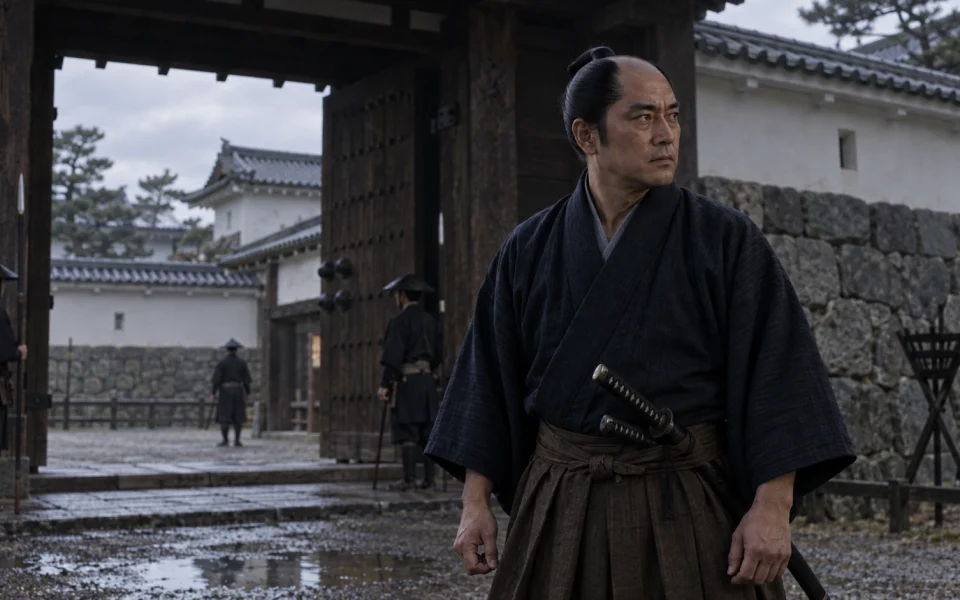
The illustrations offer a reconstruction of that setting. A hand holding a sword, the spacing of attendants, or the appearance of a wall is not a photographic trace of the morning. A convincing image cannot settle the first blow or the precise sequence of the assault. Those questions must return to documentary evidence.

Chapter 9
Pictures and reports are different kinds of evidence
Ibaraki Prefectural Library describes a drawing made by attack participant Hasuda Ichigoro while he was in custody. Its relationship to a participant’s memory makes it valuable. It remains a representation produced after the event, rather than an automatic recording of everything at the scene.
Neither of two easy judgments is adequate: participation does not guarantee that every detail is accurate, and later creation does not make the drawing worthless. The author’s position, memory, and purpose determine what questions it can help answer. A picture and an eyewitness photograph are not interchangeable categories.
Materials introduced by Wakayama Prefectural Archives preserve information that reached Kishu. Such records can reveal how people learned about the incident, even where they do not establish the mechanics of the attack. Comparing sources should expose their different perspectives, rather than combine convenient details into an apparently complete scene.

Chapter 10
The government responded
Government work continued after the assault. The University of Tokyo’s Historiographical Institute describes Hikone’s report and precautionary orders issued by senior councilors on the day of the incident. Calls for retaliation arose in Hikone, but the shogunate worked to prevent fighting between Hikone and Mito.
Our source is the institute’s public introduction to volume 26 of the Ii family records. We do not claim to have independently examined every underlying document. The summary supports discussion of reporting, precautions, and restraint; it does not authorize invented wording or exact issue times for individual orders.
The immediate precautions and the prohibition of inter-domain fighting should not all be assigned to a single same-day order without evidence. A connected sequence is not necessarily simultaneous. Nor does the existence of a response prove that it was adequate. It does show that administrative activity survived the loss of the tairo.

Chapter 11
Unfinished business after Naosuke
Senior councilors continued shogunal affairs after Naosuke’s death. In Hikone, senior retainers handled information and instructions. The same buildings could remain while the routes by which news arrived and decisions were made changed. The loss was more than an empty seat, but it did not remove the government’s outstanding problems.
Treaties, relations with the imperial court, and instructions to the domains still required attention. Killing Naosuke did not itself resolve the disputes surrounding those matters. Following the aftermath means asking both who assumed responsibilities and what unresolved business they inherited.
Shogunal councilors and Hikone’s household officials should not be treated as one undifferentiated group filling his place. They belonged to different institutions and handled different communications. Tracking who reported to whom makes the consequences of the assassination visible through practical government work, rather than only through abstract claims of decline.

Chapter 12
Death, retirement, and public mourning
Naosuke died on the third day of the third month, but his retirement as tairo was announced on the thirtieth day. The Ii house publicly entered mourning on the thirtieth day of the intercalary third month. These were separate dates and separate official acts.
The extra, intercalary month is essential to the chronology. Omitting it makes two different dates look identical and can wrongly collapse the retirement announcement and public mourning into one event. Calendar notation preserves institutional sequence, not merely an old-fashioned way of writing a date.
A person’s death, an announcement concerning his office, and his household’s public mourning need not occur together. Their separation does not negate the death or make every record erroneous. It reveals the continuing procedures through which a government and a hereditary house dealt with succession and public order after a violent loss.

Chapter 13
How the news traveled
Murata Zoroku, later known as Omura Masujiro, reported the incident in a letter dated the fifteenth day of the third month. That is twelve days after the recorded date of the attack. It establishes the letter’s date, not the day its recipients received it.
An event can have several relevant times: when it happened, when a writer learned of it, when the writer composed a message, and when another person received that message. Treating these as one moment exaggerates what a single dated letter can prove about the speed of communication.
Akamatsu Noriyoshi recorded what he heard at Uraga after returning from a voyage to America. The National Diet Library presents the entry for the fifth day of the fifth month of Manen 1, June 23, 1860. It is a record of later news, not testimony that he witnessed the assassination. Its distance from the event is part of its historical value.

Chapter 14
The years after the snow
The shogunate continued efforts to improve relations with the court. The marriage of Princess Kazunomiya and Iemochi proceeded, and in 1862 senior councilor Ando Nobumasa was attacked outside Sakashitamon. Neither political disagreement nor political violence ended with the morning at Sakuradamon.
The National Archives timeline places these developments within a longer sequence that also includes the return of governing authority in 1867 and the opening of Edo Castle in 1868. Chronological order is a starting point for explaining causes, not proof that each later event was caused by this assassination alone.
Court negotiations, diplomacy, domain politics, and new decisions continued to shape events. Calling Sakuradamon a turning point should leave those later conditions visible. It should not imply that the entire course to 1868 had already been fixed when Naosuke’s procession was attacked.

Chapter 15
What the gate could not protect
Naosuke lost his life, and the killing near Edo Castle exposed limits to the shogunate’s ability to protect its political center. Yet officials received reports, ordered precautions, restrained retaliation, and carried on governing. Damaged authority and continuing administration were both parts of the aftermath.
Judgments about Naosuke’s policies, the attackers, and the government’s capacity need not be identical. Criticizing a policy does not automatically justify killing its author. Recognizing the failure to protect him does not erase the subsequent effort to contain further violence. The event exceeds a simple story of a villain defeated or a government instantly destroyed.
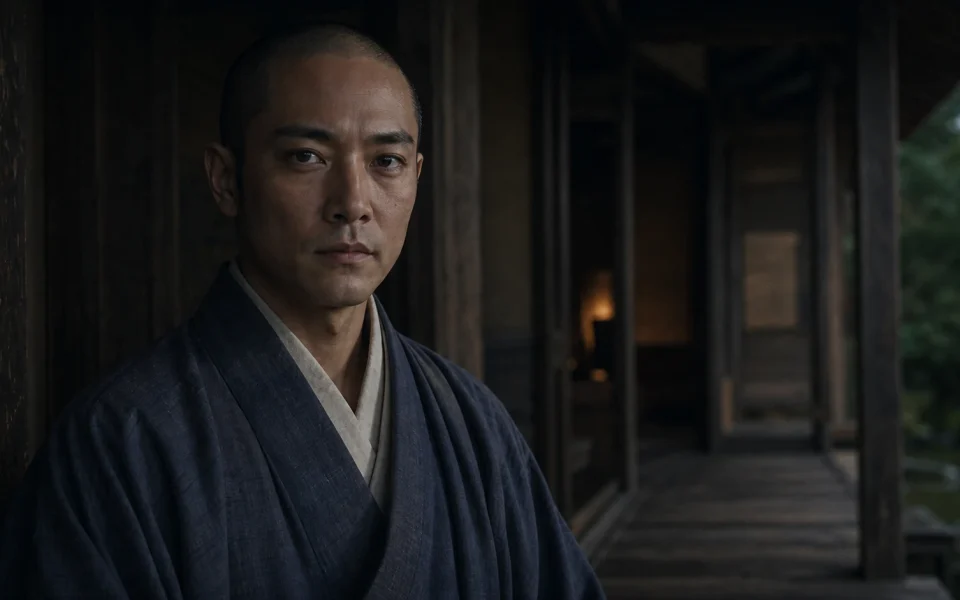
Drawings, letters, diaries, and family records preserve different relationships to the incident. Asking who created each record, when, and for what purpose takes us beyond the dramatic attack. This article separates supported events, historical interpretation, and visual reconstruction; its AI-generated illustrations are not records of actual appearances or moments.
How to read this work
History, interpretation, and reconstruction
The assassination damaged the shogunate’s authority without immediately destroying its machinery of government. Reading both the attack and its administrative aftermath reveals the difference.
This work is grounded in published sources and historical research. Interior thoughts, dialogue, and some visual details are cinematic reconstructions. Where historians disagree, the article presents the point as debated rather than settled fact.
Timeline
The story in time
-
Naosuke becomes tairo; the shogunate signs the commercial treaty with the United States.
Sources: hikone-family, archives-timeline -
Naosuke is attacked and killed while traveling to Edo Castle.
Sources: hikone-family, tokyo-incidents -
Murata Zoroku dates a letter reporting the incident; this is not a confirmed receipt date.
Sources: murata-letter -
Naosuke’s retirement as tairo is announced.
Sources: tokyo-iike26 -
The Ii house publicly enters mourning, on a different date from the retirement announcement.
Sources: tokyo-iike26 -
Akamatsu Noriyoshi records news heard at Uraga after returning to Japan.
Sources: ndl-diary -
Kazunomiya and Iemochi marry; the Sakashitamon attack occurs.
Sources: archives-timeline -
The return of governing authority is followed by the opening of Edo Castle.
Sources: archives-timeline
People & terms
A guide for new readers
Key figures
- Ii Naosuke
- Lord of Hikone and tairo of the Tokugawa shogunate
- Tokugawa Iemochi
- Fourteenth shogun, formerly Yoshitomi of the Kii Tokugawa house
- Murata Zoroku, later Omura Masujiro
- Writer of a letter reporting the incident on the fifteenth day of the third month
- Akamatsu Noriyoshi
- Diarist who recorded news of the incident after returning to Japan
Glossary
- Tairo 大老
- A high shogunal office held by Naosuke from 1858.
- Bakufu 幕府
- The shogun’s government, based in Edo during this period.
- Daimyo 大名
- A lord governing a domain through a hereditary house and retainers.
- Roju 老中
- Senior councilors conducting shogunal affairs.
- Intercalary month 閏月
- An additional month in the old calendar; its label must be preserved when distinguishing dates.
Sources & method
How this article was built
Source titles are editorial English translations. The linked Japanese museum, archive, and library materials remain the references. Institutional summaries are distinguished from the original documents they describe.
The political argument is an interpretation of the sequence and responsibilities described in those sources. Dialogue, inner thoughts, precise combat choreography, and unsupported casualty totals have not been supplied.
Sources
References and further reading
- The Sakuradamon Incident: News Reaching Kishu 桜田門外の変―幕末の転換点を紀州に伝える資料― Title translated editorially for reader convenience. Wakayama Prefectural Archives 和歌山県立文書館 Contemporary circulated reports; individual details require caution. Accessed 2026-09-09
- The Ii Lords of Hikone 彦根藩主井伊家 Title translated editorially for reader convenience. Hikone Castle Museum 彦根城博物館 Naosuke’s offices and the date of the attack. Accessed 2026-09-09
- Ii Naosuke 井伊直弼 Title translated editorially for reader convenience. International Library of Children’s Literature, National Diet Library 国立国会図書館 国際子ども図書館 Date conversion also checked against Tokyo Metropolitan Library; earlier source review noted a retrieval timeout. Accessed 2026-09-09
- Timeline of the Turbulent Late Tokugawa Period 激動幕末―年表 Title translated editorially for reader convenience. National Archives of Japan 国立公文書館 Chronology from treaty disputes to the end of shogunal government. Accessed 2026-09-09
- People of the Late Tokugawa Period: Handwritten Documents あの人の直筆 第2部 第1章 第1節 幕末を生きた人々 Title translated editorially for reader convenience. National Diet Library 国立国会図書館 An explanation of Naosuke’s letter about treaty signing; an interested participant’s account. Accessed 2026-09-09
- Ii Naosuke’s Politics as Tairo 井伊直弼の大老政治について Title translated editorially for reader convenience. Hikone Castle Museum 彦根城博物館 Museum interpretation of negotiations, succession, and the imperial message. Accessed 2026-09-09
- Drawing of the Sakuradamon Incident 桜田門外之変図 Title translated editorially for reader convenience. Ibaraki Prefectural Library 茨城県立図書館 A participant’s retrospective drawing, not a photograph. Accessed 2026-09-09
- Hashimoto Sanai and the Ansei Purge 橋本左内と安政の大獄 Title translated editorially for reader convenience. Fukui City History Museum 福井市立郷土歴史博物館 Succession politics and the punishment of Sanai. Accessed 2026-09-09
- Letter of Murata Zoroku, Third Month, Fifteenth Day of Ansei 7 村田蔵六書状〈安政七年三月十五日/真一、丈蔵宛〉 Title translated editorially for reader convenience. Agency for Cultural Affairs / Ehime Prefectural Museum of History and Culture 文化庁・愛媛県歴史文化博物館 Dated evidence of transmitted news; casualty details are not adopted. Accessed 2026-09-09
- Ii Family Records, Volume 26 大日本維新史料 類纂之部 井伊家史料二十六 Title translated editorially for reader convenience. Historiographical Institute, University of Tokyo 東京大学史料編纂所 Public volume introduction; reporting, restraint, retirement, and mourning. Accessed 2026-09-09
- Akamatsu Noriyoshi’s Diary for June 23, 1860 赤松則良:万延元年5月5日(1860年6月23日)の日記より Title translated editorially for reader convenience. National Diet Library 国立国会図書館 憲政資料室 Later news heard after returning to Japan, not eyewitness evidence of the attack. Accessed 2026-09-09
- Major Incidents in Edo 第1章 江戸の大事件 Title translated editorially for reader convenience. Tokyo Metropolitan Library 東京都立図書館 Incident chronology and the calendar conversion. Accessed 2026-09-09
- Memory Preservation Plate Guide: Edo Castle まちの記憶保存プレートガイド:江戸城築城 Title translated editorially for reader convenience. Chiyoda City 千代田区 The keep lost in the 1657 fire was not rebuilt; relevant to avoiding an anachronistic skyline. Accessed 2026-09-09
Continue reading
More stories from Shigeki
Shigeki English
Oishi Kuranosuke: The Road from Surrendering Ako Castle to the Raid
Before the famous night came accounts, letters, separation, and an attempt to restore a fallen house.
- When Genroku 14–16, spanning 1701–1703; month and day references retain the old Japanese calendar
- Where Ako, Yamashina near Kyoto, and Edo
Shigeki English
Hojo Takatoki: The Last Tokuso and the Fall of Kamakura
Why leaving office did not mean leaving power
- When 1311–1333, late Kamakura period
- Where Kamakura, Kyoto and the political connections between them