

SHIGEKI ENGLISH STORYEN
Japanese history in English
Oishi Kuranosuke: The Road from Surrendering Ako Castle to the Raid
Before the famous night came accounts, letters, separation, and an attempt to restore a fallen house.
Oishi Kuranosuke is remembered for leading the Ako retainers against Kira. But his decisions unfolded over time: surrendering a castle, settling obligations, maintaining contact, and seeking restoration of the Asano house. Following this sequence reveals a life that cannot be understood from the raid alone.
At a glance
Before you enter the story
- When
- Genroku 14–16, spanning 1701–1703; month and day references retain the old Japanese calendar
- Where
- Ako, Yamashina near Kyoto, and Edo
- Key figures
- Oishi Kuranosuke, Asano Naganori, Asano Nagahiro, Kira Yoshinaka
- What was at stake
- How could former retainers respond to the loss of their lord, their castle, and the institution that had supported their livelihoods?
Why this story matters
The larger history behind the turning point
Beginning with the castle surrender makes the period before the raid visible. It also prevents the famous outcome from turning every earlier decision into an inevitable step toward it.
Historical context
What an international reader needs to know
A house was also an institution
The Asano house of Ako governed a domain and employed retainers. Its dissolution changed relationships of service, finance, residence, and status. Losing a lord therefore raised practical questions about a whole organization, beyond personal grief or the wish for revenge.
History and Chushingura
The Ako incident inspired celebrated theatrical works, including Kanadehon Chushingura. These works have their own artistic value, but stage dialogue, costumes, and narrative order are not direct records of the Genroku-period events. This article follows institutional explanations of documents and chronology.
Watch the film
See the story in motion
The film currently uses Japanese audio. This English article provides the context and source trail; it does not imply that an English subtitle track is available.
Chapter 1
A castle before the raid
Oishi Kuranosuke is often imagined on the night of the raid. Yet the route to that night began with a castle surrendered without a battle. After the loss of his lord, he faced the departure of retainers and the dissolution of their established work. What could still be preserved?
Ako City’s chronology records financial settlement, the handover of the castle, efforts at restoration, and meetings. These were actions of a man who later joined the raid, but that does not make every one of them merely preparation for revenge. Their immediate purposes belong to the stages in which they occurred.
Following Oishi from Ako to Yamashina and then Edo shifts attention from the known ending to decisions made under changing conditions. The records cannot reveal every private thought. They can show a policy of waiting for a decision, followed by a later policy of taking action. That sequence is the starting point of this account.

Chapter 2
The message from Edo
On the fourteenth day of the third month of Genroku 14, Asano Naganori attacked Kira in the Pine Corridor of Edo Castle. Naganori was ordered to commit seppuku that day, and the Ako Asano house was dissolved. News reached Ako, where Oishi was based, on the nineteenth day.
The difference between the event date and the arrival of news matters. People in Ako did not begin responding at the same moment as those at the scene. A record of transmission shows how an incident in one place created new decisions and responsibilities at a distant castle.
The cause of the original attack should not be supplied from a familiar theatrical plot. The linked historical explanations support the sequence of the assault and punishment, but we do not invent insulting dialogue or demands for money. Uncertainty about motive can coexist with knowledge of what followed; an account need not fill every gap to remain intelligible.

Chapter 3
What a castle contained
Ako Castle was a defensive site, a residence, and a place of domain administration. Its palace, retainers’ residences, and connections to the castle town supported the Asano house’s government. Surrendering it affected the spatial relationships through which people had worked, not just the possession of walls and gates.
The Ako Castle Digital Museum explains the main, second, and third enclosures and their uses. Reading that structure alongside the handover makes visible a network of government and daily life. The loss of the house meant a loss of the institution on which service and status had depended.
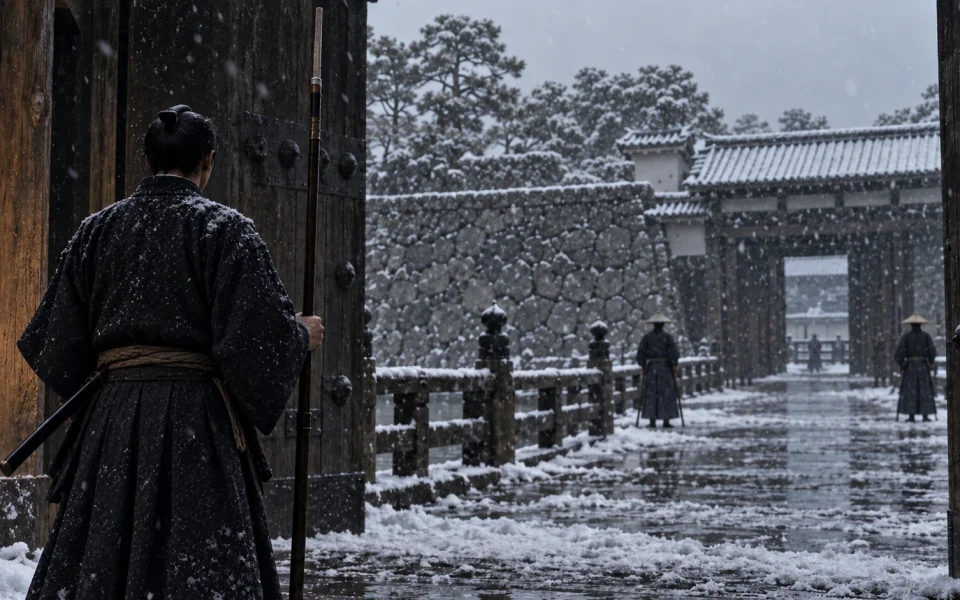
Ako had a foundation for a keep, but the keep itself was never constructed. A great tower burning down would therefore be a misleading opening image for this incident. Our illustrations use moats, stonework, and low gates as a reconstruction, without claiming that every architectural detail reproduces the castle on a specific day.

Chapter 4
Accounts before revenge
Practical work continued alongside debate about the castle. Domain notes had to be exchanged, money distributed within the household, and buildings and equipment prepared for transfer. Domain notes were paper money issued by the domain. Its dissolution raised immediate questions for people who had accepted them.
These tasks may look secondary when the later raid dominates the story. In Ako at the time, they concerned payments and the future of those affected by the house’s fall. The article does not add an unverified exchange rate or total sum. The supported point is that financial settlement formed part of the response.
Oishi’s leadership can consequently be considered through administrative work as well as commands and combat. Giving that work interpretive weight does not authorize an imagined scene in which he personally handled every payment. The chronology establishes responsibilities; a reconstructed office illustrates them without supplying undocumented conversations.

Chapter 5
Surrendering Ako Castle
The retainers did not automatically agree on what should follow their lord’s death. Resistance and surrender, together with the hope of restoring the house, posed different courses of action. On the nineteenth day of the fourth month of Genroku 14, Ako Castle was handed to the shogunate’s receiving officials.
Ako City’s chronology places the relocation of remaining administrative work outside the castle before the formal handover. The transfer was therefore more than opening a gate at one decisive instant. It required preparations that made the castle and its contents ready to pass into other hands.
Surrender did not end the attempt to preserve the Asano house. Restoration efforts continued afterward. The act should not immediately be labeled either a failure of loyalty or a disguise for a predetermined raid. At that stage, other possibilities were still being pursued, and the evidence should be read with those possibilities in view.

Chapter 6
Keeping people connected outside the castle
Oishi left Ako and moved to Yamashina near Kyoto. Former retainers lived apart in Ako, the Kyoto-Osaka region, Edo, and elsewhere. Communication now required letters, messengers, and occasional meetings. Having once served the same lord did not ensure that everyone would choose the same future.
A group working together in one castle operated under different conditions from people dispersed across separate communities. Some sought new service; some eventually joined the raid. Shared background alone could not guarantee agreement. Nor does evidence of correspondence prove that every person possessed the same information on the same day.
The visual scenes of travel and ordinary life help express that distance. They are not evidence that a named retainer or relative performed the illustrated task at the illustrated place. The documented move to Yamashina must remain separate from the anonymous details used to make separation understandable on screen.

Chapter 7
Could the Asano house return?
Restoration efforts centered on Asano Nagahiro, known as Daigaku, the deceased Naganori’s younger brother. Preserving the house through him offered one possible response to its dissolution. Other former retainers wanted to attack Kira. Restoration and retaliation were related concerns, but they were not identical actions.
The Hyogo literary museum account describes preparations in both directions. Ako City’s chronology also records the dispatch of a monk to Edo in the fifth month of Genroku 14 to work toward restoration. Surrendering the castle had not ended the effort to maintain the house.
The presence of both objectives in the accounts does not prove that one was merely a pretext from the beginning. It shows that more than the later raid requires explanation. We should establish that an effort was being made before assigning it a meaning derived entirely from the outcome we already know.

Chapter 8
A possible path closes
At a meeting in Yamashina in the second month of Genroku 15, the participants decided to wait for the ruling concerning Asano Daigaku. In the seventh month he was placed with the main Asano house in Hiroshima. This closed the prospect of restoration then being pursued.
A meeting in Kyoto on the twenty-eighth day of the seventh month is described as deciding to go to Edo and carry out the raid within the year. Placing the meetings in order distinguishes a policy of waiting from a later commitment to attack. Waiting was not necessarily an absence of policy.
The ruling, meeting, and movement toward Edo are distinct stages supported by the chronology. Their order helps explain changing circumstances without exposing anyone’s entire inner life. We do not turn the gap between them into invented hesitation, secret certainty, or a dramatic speech that no checked source records.

Chapter 9
Those who left and those who stayed
Some former retainers did not join the raid. Later stories can divide those who stayed and those who left into loyal and disloyal characters. But participation alone cannot account for a person’s whole life. Family, livelihood, and prospects of service are relevant questions, not reasons we may freely assign to particular people.
In his farewell letter, Oishi expressed harsh judgments about people who had left the group. Those words are meaningful evidence of the writer’s perspective and the cohesion he sought. The fact that his assessment survives does not make it a complete, neutral account of everyone he criticized.
We therefore identify whose evaluation a document preserves before adopting it. This is not an attempt to invent sympathetic explanations and reclassify the absent men as heroes. It is a limit on what the record can establish: one participant’s judgment cannot stand in for independent knowledge of every individual’s circumstances.

Chapter 10
A letter before departure
On the thirteenth day of the twelfth month of Genroku 15, Oishi wrote a lengthy farewell letter to temples in Ako. The Ako City Museum of History’s explanation describes his account of developments after reaching Edo and his intention to undertake the raid soon.
The letter also concerned dismissed servants, his separated wife and children, and later memorial observances. These matters place obligations to people left behind alongside the approaching action. Our reference is the museum’s published explanation, not a claim to have independently transcribed and translated the entire original document.
The coexistence of these concerns helps broaden a portrait otherwise dominated by resolve and martial action. It does not prove that the people mentioned were physically present while the letter was written. The illustration consequently concentrates on writing materials, rather than bringing absent family members into the room without evidence.

Chapter 11
Looking beyond theatrical costumes
The men assembling in Edo investigated Kira’s whereabouts and prepared for the raid. Their appearance is often imagined through matching black-and-white firemen’s costumes familiar from performance. That strong theatrical image should not be treated as direct evidence of what every participant wore.
Edo-Tokyo Museum’s explanation points instead to an agreement to wear black kosode, with equipment prepared individually. The records differ in detail. Avoiding a standardized stage costume therefore addresses a historical question about the basis of the image, rather than merely a preference in visual design.
It still does not allow us to reconstruct every knot, sandal, belt, or garment with certainty. The dark clothing and individual preparations shown here are an explanatory reconstruction based on the available account. Removing a familiar inaccuracy is not the same as proving that every replacement detail is exact.

Chapter 12
The night of the fourteenth
Preparations were completed on the night of the fourteenth day of the twelfth month of Genroku 15. The group entered Kira’s residence in Honjo, Edo, before dawn on the fifteenth. These are dates in the old Japanese calendar, not modern December dates read without conversion.
Kira was killed in the assault, which also brought death to people on his side. The famous action of the forty-seven retainers was an act of violence as well as the achievement of their objective. Describing that objective does not establish that the action was unconditionally permitted or justified.
Distinguishing the night of preparation from the following early morning preserves the sequence without inventing exact times. Nor can the darkness or snow shown in a reconstruction prove the precise conditions. This account does not add casualty totals beyond the checked sources, and it keeps success separate from moral or official approval.

Chapter 13
The story continued after the raid
The group went toward Sengakuji to report at their former lord’s grave. On Oishi’s instructions, Yoshida Chuzaemon and Tomimori Sukeemon reported themselves to the shogunate’s inspector. They entered a process of official disposition instead of disappearing after the attack.
Forty-six men were subsequently divided among four daimyo households for custody. The familiar designation of forty-seven retainers and the forty-six placed in custody count different things. They should not be made artificially identical for the sake of a smoother narrative.
Ending at the grave would conceal the shift into shogunal custody and judgment. The sources support that transition, but not an embellished account of each man’s treatment or every internal deliberation. The raid had fulfilled a purpose while leaving the participants’ future dependent on an authority beyond their own group.

Chapter 14
Loyalty and punishment
On the fourth day of the second month of Genroku 16, the forty-six men in custody were ordered to commit seppuku. Oishi’s life ended with that judgment. Admiration for action on behalf of a deceased lord and punishment imposed by the shogunate could coexist.
Punishment does not prove that admiration was absent, just as admiration does not prove official permission. The Ako and Japan Arts Council explanations help frame the tension between loyalty and the governing order. We do not turn it into a claim that every person in society shared one assessment.
The successful attack did not restore the castle or the former retainers’ earlier lives. Asking what they sought to protect, what they did, and who experienced the consequences allows the outcome to remain concrete. Achievement of an objective and recovery of everything lost are different results.

Chapter 15
The distance to a decision
The Ako incident became the basis of many works, including Kanadehon Chushingura. Those works offer rich artistic experiences. Establishing what happened in the Genroku era asks a different kind of question, one that cannot simply transfer stage dialogue and scene order into the historical record.
The road followed here passes through surrender, remaining administrative work, restoration efforts, correspondence, meetings, the raid, and judgment. A single hero instantly moving a united group leaves much of that road invisible. Oishi can instead be considered as someone whose responsibilities and options changed over time.
Chronologies establish sequence; explanations of letters reveal particular concerns; castle and clothing research guide the visual setting. None provides complete access to private thought. This article distinguishes supported events, interpretation, and reconstruction. Its AI-generated images help readers imagine settings but do not document actual appearances, conversations, or individual moments.
How to read this work
History, interpretation, and reconstruction
The raid was the endpoint of changing circumstances and decisions. Oishi’s administrative work and the effort to restore the Asano house deserve attention alongside the action for which he is remembered.
This work is grounded in published sources and historical research. Interior thoughts, dialogue, and some visual details are cinematic reconstructions. Where historians disagree, the article presents the point as debated rather than settled fact.
Timeline
The story in time
-
Naganori attacks Kira at Edo Castle and is ordered to commit seppuku that day.
Sources: ako-timeline, ntj-incident -
News of the incident reaches Ako.
Sources: ako-timeline -
Ako Castle is handed to the receiving officials.
Sources: ako-timeline -
A monk is sent to Edo to work toward restoring the Asano house.
Sources: ako-timeline -
Oishi leaves Ako and moves to Yamashina.
Sources: ako-timeline -
A meeting adopts a policy of waiting for the decision concerning Asano Daigaku.
Sources: ako-timeline, hyogo-history -
Daigaku is placed with the main Asano house in Hiroshima.
Sources: ako-timeline -
A Kyoto meeting decides to go to Edo and carry out the raid within the year.
Sources: ako-timeline, hyogo-history -
Oishi writes farewell letters to temples in Ako.
Sources: ako-letters -
The group completes preparations and enters Kira’s residence before dawn.
Sources: ako-timeline, ako-after -
Forty-six men are divided among four daimyo households for custody.
Sources: ako-sentence -
The forty-six are ordered to commit seppuku; Oishi dies.
Sources: ako-sentence
People & terms
A guide for new readers
Key figures
- Oishi Kuranosuke
- Senior retainer of the Asano house of Ako
- Asano Naganori
- Lord of Ako, also known by the title Takumi no Kami
- Asano Nagahiro
- Naganori’s younger brother, known as Daigaku, around whom restoration efforts centered
- Kira Yoshinaka
- Attacked by Naganori at Edo Castle and later killed in the Ako retainers’ raid
Glossary
- Karo 家老
- A senior retainer responsible for important affairs within a lord’s house.
- Han 藩
- A domain governed by a daimyo and the institutions of the ruling house.
- Hansatsu 藩札
- Paper money issued by a domain; its settlement was part of the Ako aftermath.
- Kosode 小袖
- A garment discussed in the museum account of the retainers’ clothing.
- Seppuku 切腹
- A form of suicide by disembowelment, here imposed as an official punishment.
Sources & method
How this article was built
Source titles are editorial English translations of the linked Japanese institutional materials. Museum explanations of letters are identified as explanations; no complete independent transcription of the original letters is claimed.
The sequence follows the reviewed Japanese article and its sources. All month and day labels in the Genroku chronology retain the old calendar. Assessments of leadership, administrative responsibility, and hindsight are interpretive rather than invented testimony.
Sources
References and further reading
- Brief Chronology of the Ako Retainers 赤穂義士略式年表 Title translated editorially for reader convenience. Ako City 赤穂市 Old-calendar dates and the sequence from the castle handover to restoration efforts and the raid. Accessed 2026-09-11
- Chushingura Gallery 忠臣蔵館 Title translated editorially for reader convenience. Hyogo Prefectural Museum of Art, Hyogo Literary Museum Online 兵庫県立美術館 ネットミュージアム兵庫文学館 Financial settlement, restoration efforts, preparations, and meetings; private motives are not assumed. Accessed 2026-09-11
- The Structure of Ako Castle 赤穂城の構造 Title translated editorially for reader convenience. Ako Castle Digital Museum 赤穂城デジタルミュージアム Enclosures, palace, and residences; later changes must be distinguished from the Genroku setting. Accessed 2026-09-11
- The Construction History of Ako Castle 赤穂城築城史 Title translated editorially for reader convenience. Ako Castle Digital Museum 赤穂城デジタルミュージアム The castle and town; the existing Japanese editorial review also checked related official material concerning the unbuilt keep. Accessed 2026-09-11
- Historical Background: The Ako Incident 史実とその時代:赤穂事件 Title translated editorially for reader convenience. Japan Arts Council 日本芸術文化振興会 The original assault, dissolution of the house, former retainers’ paths, and punishment. Accessed 2026-09-11
- Chushingura Terakoya, Part 8: Farewell Letters 忠臣蔵寺子屋 第8回 義士たちの暇乞い状 Title translated editorially for reader convenience. Ako City / Shinichi Ono, Ako City Museum of History 赤穂市・小野真一(赤穂市立歴史博物館) Published explanation of Oishi’s letter; neither a new transcription nor an unqualified adoption of his judgments. Accessed 2026-09-11
- Stage Firemen’s Costumes and the Retainers’ Equipment 仮名手本忠臣蔵の火事装束と実際の装備 Title translated editorially for reader convenience. Edo-Tokyo Museum 江戸東京博物館 Black kosode and individual equipment; differences between records remain. Accessed 2026-09-11
- Chushingura Terakoya, Part 7 忠臣蔵寺子屋 第7回 Title translated editorially for reader convenience. Ako City / Shinichi Ono, Ako City Museum of History 赤穂市・小野真一(赤穂市立歴史博物館) The journey toward Sengakuji and reporting to the shogunate after the raid. Accessed 2026-09-11
- Chushingura Terakoya, Part 10 忠臣蔵寺子屋 第10回 Title translated editorially for reader convenience. Ako City 赤穂市 Custody with four houses and the order to commit seppuku. Accessed 2026-09-11
- Revenge and Bushido 仇討ちと武士道 Title translated editorially for reader convenience. Japan Arts Council 日本芸術文化振興会 Loyalty and the governing order; not evidence of unanimous opinion. Accessed 2026-09-11
- Chushingura Terakoya, Part 9: Patterns in Chushingura Drama 忠臣蔵寺子屋 第9回 忠臣蔵劇のパターン化 Title translated editorially for reader convenience. Ako City Board of Education / Keigo Yano 赤穂市教育委員会・矢野圭吾 Theatrical conventions are distinguished from evidence of the historical incident. Accessed 2026-09-11
Continue reading
More stories from Shigeki
Shigeki English
The Sakuradamon Incident: A Shogunate Wounded, but Still Governing
Follow the assassination of Ii Naosuke through the orders, letters, and announcements that followed it.
- When 1860, with political background in 1858 and an aftermath extending into the 1860s
- Where Edo Castle and Hikone, with reports circulating beyond Edo
Shigeki English
Hojo Takatoki: The Last Tokuso and the Fall of Kamakura
Why leaving office did not mean leaving power
- When 1311–1333, late Kamakura period
- Where Kamakura, Kyoto and the political connections between them