
SHIGEKI ENGLISH STORYEN
Japanese history in English
Sakamoto Ryoma: What Did the Man Who Left Tosa Try to Connect?
Travel, shipping, correspondence, and proposals for a new political order
Ryoma’s work crossed shipping, commerce, political negotiation, and proposals for government. Letters and institutional histories help distinguish his role as an intermediary from later stories of a solitary hero who transformed Japan.
At a glance
Before you enter the story
- When
- 1835–1867, with a focus on activity after leaving Tosa in 1862
- Where
- Tosa, Nagasaki, Kyoto, and the networks connecting them
- Key figures
- Sakamoto Ryoma, Katsu Kaishu, Kido Takayoshi, Goto Shojiro, Nakaoka Shintaro
- What was at stake
- How an intermediary could connect organizations and proposals during the final years of Tokugawa rule, without possessing the authority to decide everything himself.
Why this story matters
The larger history behind the turning point
Ryoma’s fame can make his life appear to be a sequence of decisive acts by one exceptional individual. Looking at introductions, organizational support, and written confirmation reveals the other people and conditions involved. This approach makes his work more concrete rather than diminishing it.
His story also offers a useful exercise in reading evidence. An endorsement on a letter can establish participation without reproducing an entire conversation. A political proposal can preserve uncertainty about a name. Even a surviving photograph may leave its date or location unsettled. Those limits belong inside the account.
Historical context
What an international reader needs to know
Late Tokugawa Japan and the domains
Ryoma’s adult activity took place during the final years of Tokugawa government. Tosa, Satsuma, and Choshu were domains with their own authorities and political interests. Leaving a domain did not mean leaving all social connections behind or acquiring the power to make decisions for other organizations.
Shipping, commerce, and politics overlapped in this setting. An organization might depend on support from a domain and merchants while creating opportunities for its members to act. Modern labels such as startup or corporation can be suggestive, but they should not replace the actual relationships described in nineteenth-century sources.
Names, calendars, and the reading edition
Japanese names appear in family-name-first order. Dates from the old Japanese calendar are explicitly identified where used. Ryoma’s commonly stated age of thirty-three at death is a traditional counted age, not a direct statement of age under the modern birthday-based system.
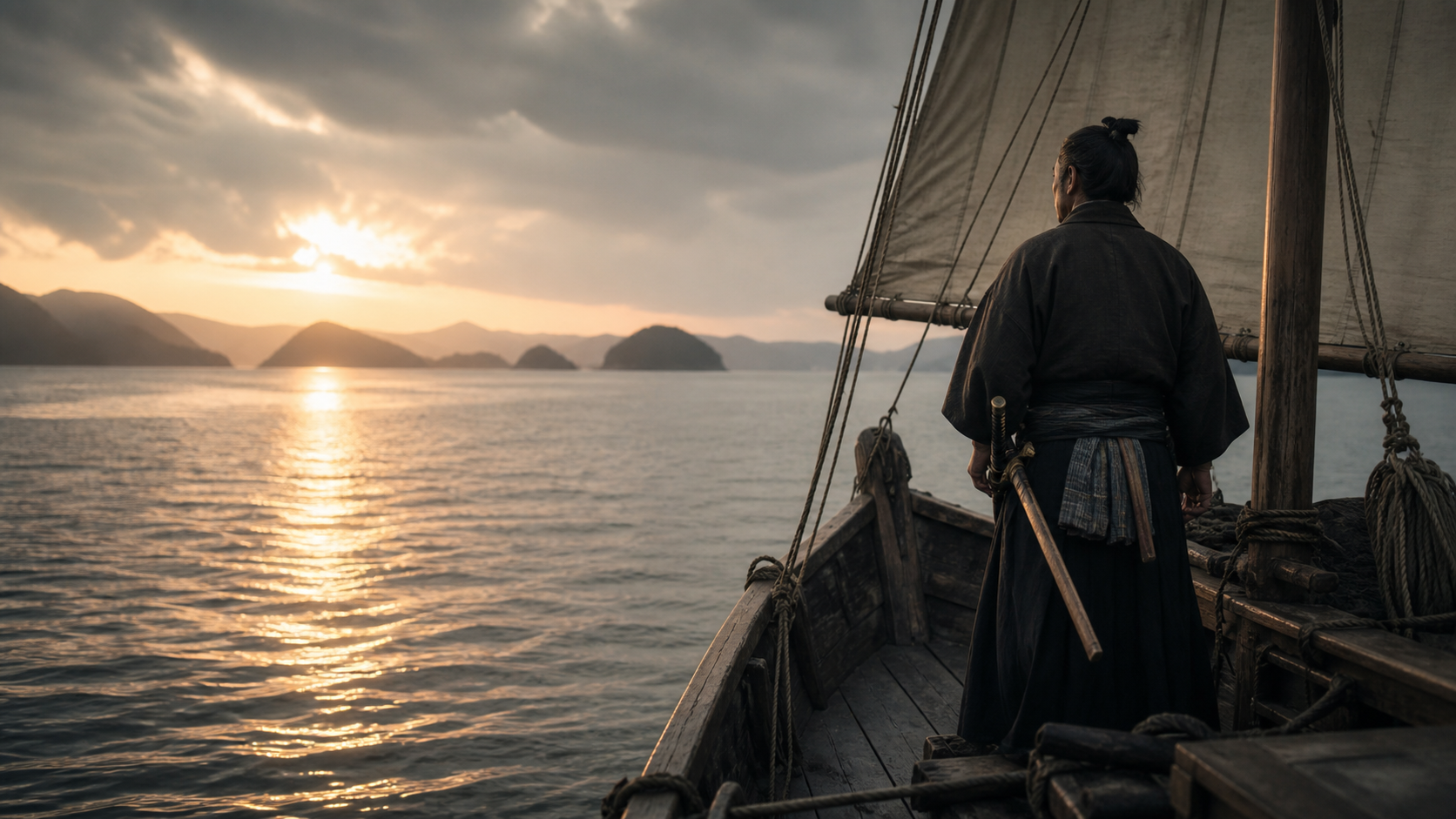
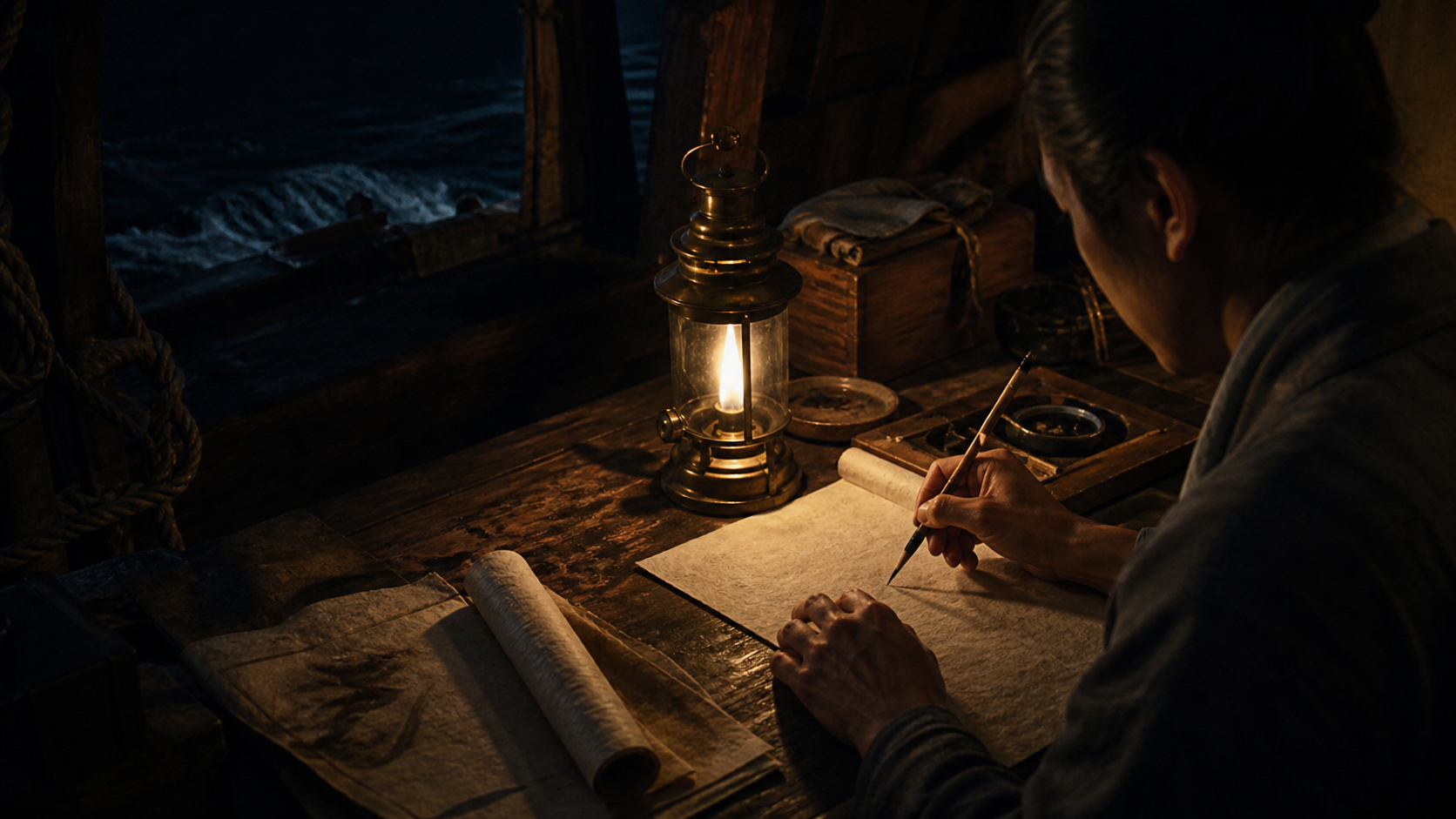
The accompanying film has Japanese audio. This English article adds background and definitions for readers unfamiliar with the setting. Every illustrative image is an AI-generated reconstruction: a harbor, meeting, or writing desk does not establish the appearance of an actual event or the words spoken there.
Watch the film
See the story in motion
The film currently uses Japanese audio. This English article provides the context and source trail; it does not imply that an English subtitle track is available.
Chapter 1
A life seen through connections
Sakamoto Ryoma was born in Tosa in 1835 and died in Kyoto in 1867. During a short period of activity, he became involved in shipping, trade, interdomain negotiation, and political proposals. Listed afterward, these activities can resemble one uninterrupted achievement. In practice, each involved different counterparts, organizations, and conditions.
The National Diet Library’s biographical outline traces his departure from Tosa, his connection with Katsu Kaishu, the Kameyama Shachu and Kaientai, and his mediation between Satsuma and Choshu. The outline suggests movement among networks, not simply a man issuing decisions to the state from a position of independent authority.
The question here is what Ryoma tried to connect. People and organizations are part of the answer, but so are the movement of goods and ideas about political arrangements. This is the article’s way of organizing the evidence. It is not a slogan placed in Ryoma’s mouth or a claim to know his single lifelong intention.
Later fame should not be confused with contemporary decision-making power. Attending a discussion, conveying a proposal, and authorizing a final agreement are different actions. Asking what the other parties confirmed or decided allows us to identify an intermediary’s work without either attributing everything to him or making his contribution disappear.
Chapter 2
Leaving Tosa did not end dependence on others
Ryoma left Tosa without authorization in 1862. This was an important change in his position, but it did not turn him into a wholly independent individual who needed no assistance. Travel and activity elsewhere still depended on access, introductions, resources, and places from which to work.
Kochi City’s historical account draws attention to contact with Matsudaira Shungaku and letters of introduction connecting Ryoma with figures including Katsu Kaishu. An introduction carried a relationship between sender and recipient across distance. It offers a concrete way to examine how a newcomer might gain access to another political or institutional circle.
The existence of contact does not establish the exact words exchanged at a dramatic first meeting. Before using a famous conversation, we would need to ask when and where its account appeared. This article follows the documented connection without reconstructing a single sentence as the moment that supposedly transformed the whole course of a life.
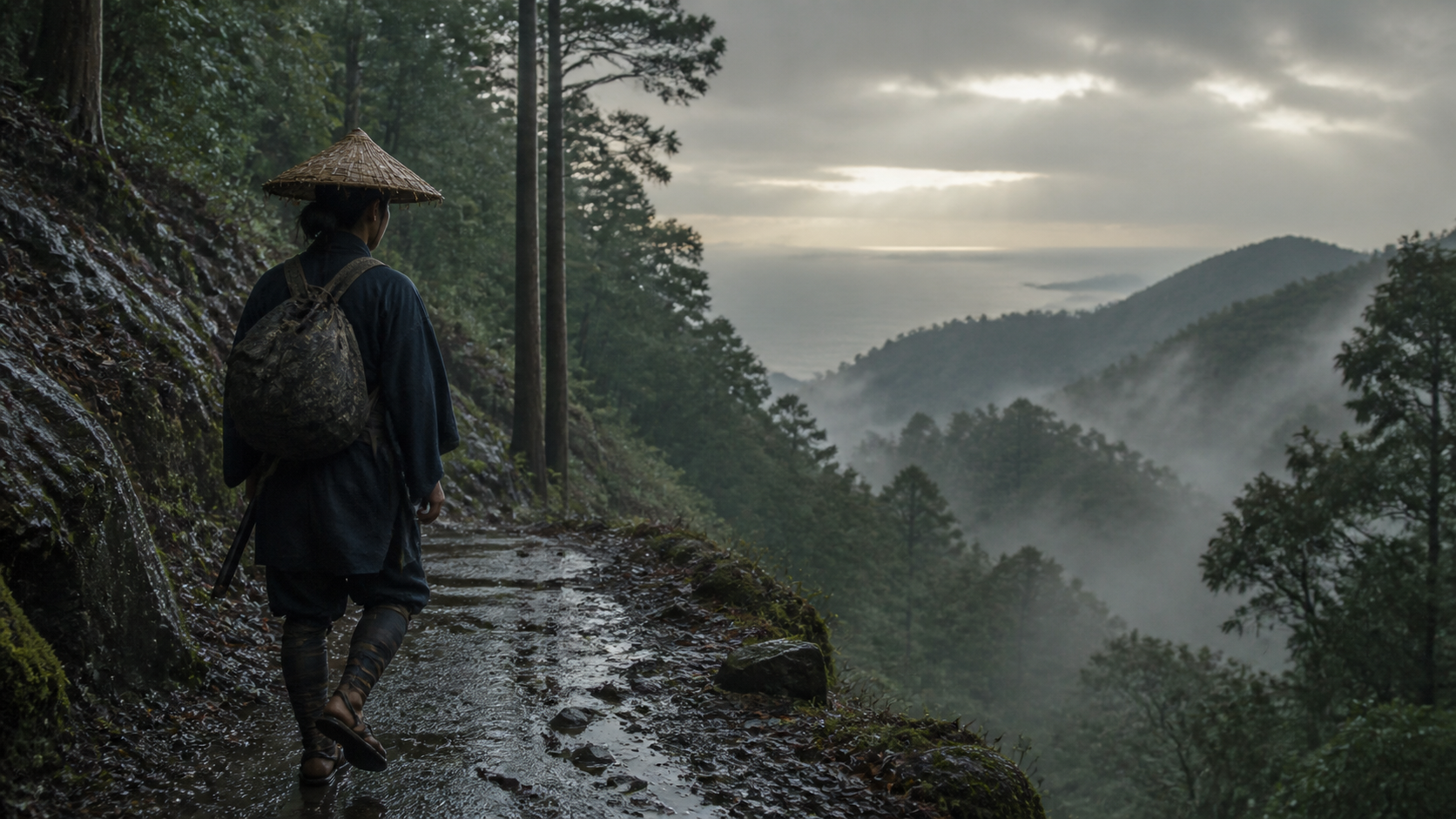
Leaving a domain also differed from losing every connection to people from it. Ryoma’s later discussions with Tosa figures make that distinction important. Rather than a clean break followed by complete independence, the story can be read as the rearrangement of relationships. The mountain-path image symbolizes movement; it does not document a particular route, day, or outfit.
Chapter 3
Shipping required support and organization
Through his connection with Katsu, Ryoma became involved in maritime and naval activity. The National Diet Library traces the Kameyama Shachu in 1865 and the later Kaientai. Looking toward the sea involved more than adopting an outlook: it meant participating in arrangements for moving people and goods.
Nagasaki City explains that support from Satsuma and Nagasaki merchants helped the Kameyama Shachu take shape. Presenting it entirely as one founder’s creation would erase those conditions. Dependence on supporters and room for organizational initiative should be considered together rather than treated as mutually exclusive descriptions.
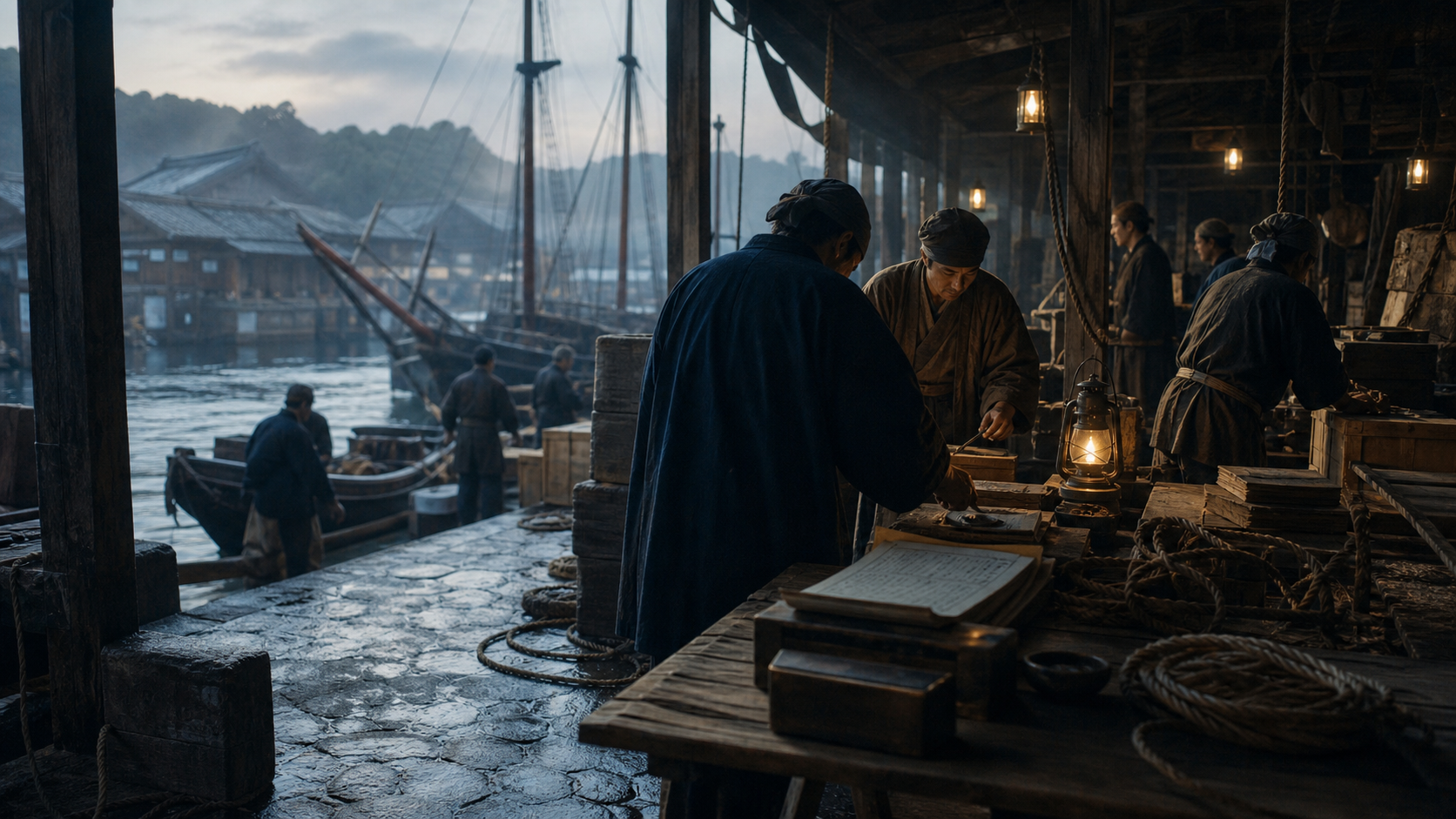
Shipping raises practical questions about cargo, costs, counterparties, and responsibility. These are general questions for reading an organization, not claims that the illustrated office reproduces a particular ledger or transaction. The room and documents in the image are AI reconstructions; their visual detail cannot establish how the actual office was arranged.
Modern business comparisons can make the organization approachable, but they cannot substitute for its domain support and political setting. Maritime and commercial activity also provides context for mediation: contact and the ability to arrange movement could matter. Whether a particular transaction caused a particular political outcome, however, requires evidence specific to that transaction.
Chapter 4
An alliance was more than one persuasive speech
Ryoma is especially associated with mediation between Satsuma and Choshu in 1866. The Sakamoto Ryoma Memorial Museum introduces Kido Takayoshi’s letter and Ryoma’s endorsement as evidence for the confirmation of arrangements. Before imagining a decisive scene, we can ask what those surviving words actually enable us to establish.
An agreement between political groups involves conditions as well as attitudes toward one another. Even when an intermediary is central to the story, both sides retain their own decision-makers and interests. Reducing the outcome to a single memorable speech obscures the terms that made cooperation possible and the parties who had to accept them.
The museum’s explanation directs attention to the contents of the letter and the act of confirmation. Mediation can include checking how an understanding has been recorded, not merely bringing people into one room. The document’s form therefore helps make the intermediary’s function specific without requiring an invented transcript of the meeting.
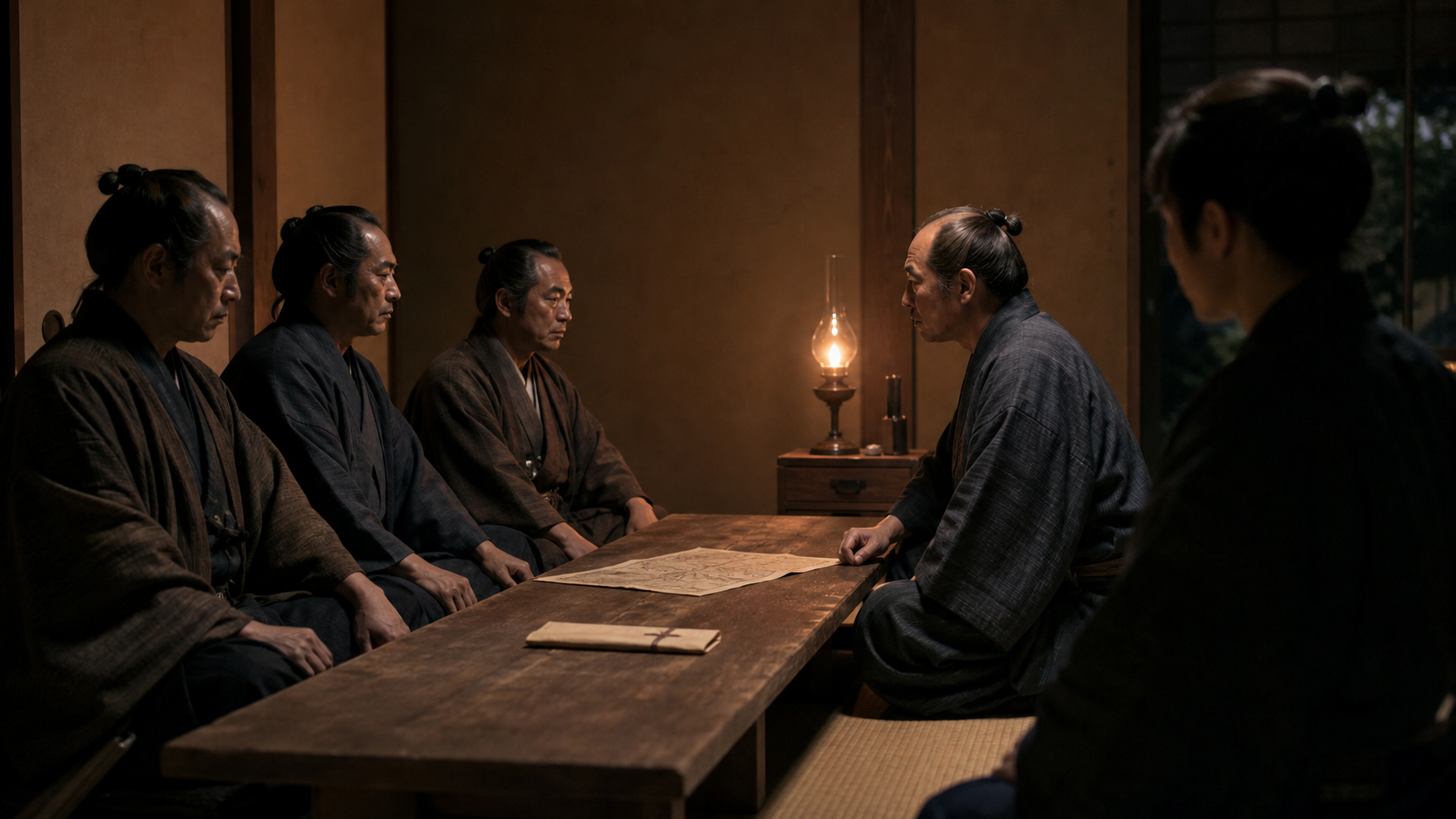
One letter cannot reveal every stage of negotiation or every participant’s intentions. Its date, recipient, and request for confirmation matter. Nor should later outcomes be written backward as goals everyone already shared. The meeting image is illustrative; it does not establish seating, architecture, gestures, or the sentence that moved another participant.
Chapter 5
What an endorsement can establish
The museum describes a document in which Ryoma confirmed the contents on the reverse of Kido’s letter. Writing by different people on its two sides makes the exchange visible. The document belongs to a relationship involving communication and confirmation, rather than to a single person’s private reflection preserved in isolation.
Its importance is not simply that a famous person’s handwriting appears on it. We need to ask what was being confirmed, who offered that confirmation, and to whom it was addressed. The signature and the surrounding text work together. Looking only at the most recognizable name would lose part of the document’s function.
Such evidence can illuminate involvement in negotiation without providing missing gestures or unrecorded speech. A confirmation document is not a verbatim transcript. It should be read as a historical object that performed a particular task, rather than as an imperfect replacement for a film of the meeting.
Exhibition information also requires attention to originals and reproductions. Reading a museum’s online explanation is different from conducting direct examination of an original. This article uses the publicly available descriptions and does not claim such examination. Within that limit, the document gives the idea of a connecting figure a firmer basis than a general claim about personal charisma.
Chapter 6
A political proposal with unresolved names
In 1867, Ryoma discussed political arrangements with Goto Shojiro. The National Diet Library explains the relationship between the proposals commonly called the Eight-Point Plan Composed Aboard Ship and the Eight-Point Program for a New Government. The issue extended beyond returning governing authority: it also concerned what arrangements might follow.
The library’s overview identifies subjects including deliberative institutions, official organization, diplomacy, and military arrangements. These proposals should not be equated automatically with present-day democracy. Their intended participants and assumptions about authority need to be understood through the language and circumstances of the period rather than through a modern institutional label.
The familiar story of the shipboard plan and the surviving document presented as the new-government program are not simply the same physical object. Distinguishing the account of a proposal, a subsequent formulation, and the location of surviving material helps identify the basis for a claim. The library also notes uncertainty over the person represented by an obscured name, including competing interpretations involving Yamauchi Yodo and Tokugawa Yoshinobu.
The blank is therefore not filled here. Nor is proposing a political structure treated as equivalent to implementing it. Ryoma, the Tosa officials involved in presenting proposals, and those who subsequently decided institutions were related but distinct actors. Assessing an idea does not require making its author the sole designer of the state that followed.
Chapter 7
The Omiya attack and the problem of dates
Ryoma and Nakaoka Shintaro were attacked at the Omiya in Kyoto on the fifteenth day of the eleventh month of Keio 3, using the old Japanese calendar. Ryoma died from the attack; Nakaoka died two days later. Sharing the date of an assault is not the same as sharing the date of death.
Ryoma is commonly described as having died at thirty-three by traditional counted age. That system differs from modern age measured by birthdays. Similarly, the old-calendar eleventh month and fifteenth day should not be silently presented as Gregorian November 15. Both conventions need to remain visible in an English account.
The museum distinguishes the course of events for the two men. Famous last words would require a separate examination of who reported them and when. This article supplies no unverified final statement, private emotion, or independently asserted identification of an attacker merely to make the ending more vivid.
An assassination creates a powerful ending to a biography, but it should not give every earlier act a predetermined meaning. The end of Ryoma’s life and the later paths of people and proposals connected with him are different questions. The lamplit desk is symbolic imagery, not a reconstruction proving the Omiya’s interior or the precise sequence of the attack.
Chapter 8
A photographed person can still leave uncertainty
Photographs of Ryoma survive, yet the museum’s FAQ distinguishes photographic types from the number of surviving prints and discusses uncertainty about dates and locations. The existence of a photograph does not make every circumstance of its production certain. The qualifications offered by the institution are part of the evidence.
This caution also applies to later images based on a recognizable likeness. A reference for someone’s face cannot establish clothing, position, or expression at another event. All images in this article are generated reconstructions. They do not fill gaps in the photographic record by becoming new documentary photographs of unrecorded events.
Letters likewise deserve careful reading even when written in the person’s own hand. They were addressed to particular recipients for particular purposes. Reading them alongside other people’s documents and institutional chronology helps us locate Ryoma within relationships, without assuming that each letter reveals every thought he held.
The connecting perspective does not remove his individuality. It asks where he made contact, offered confirmation, or presented a proposal, making the contribution more specific. Shipping, negotiation, correspondence, and political ideas illuminate different parts of that activity. The answer remains an interpretation grounded in records, with uncertainty preserved where those records do not settle the question.
How to read this work
History, interpretation, and reconstruction
Ryoma’s contribution becomes clearer when read through the people and organizations he connected. Assessing that contribution requires separating what correspondence establishes from the scenes and certainty added by later storytelling.
This work is grounded in published sources and historical research. Interior thoughts, dialogue, and some visual details are cinematic reconstructions. Where historians disagree, the article presents the point as debated rather than settled fact.
Timeline
The story in time
-
Ryoma is born in Tosa.
Sources: ndl-portrait-ryoma -
He leaves Tosa without authorization and broadens his activity outside the domain.
Sources: ndl-portrait-ryoma -
He participates in Satsuma–Choshu mediation and endorses Kido’s written confirmation.
Sources: museum-alliance -
Kaientai activity and political proposals involving Goto Shojiro and others.
Sources: ndl-portrait-ryoma, ndl-senchu-hassaku -
Ryoma dies following the Omiya attack. Nakaoka, attacked with him, dies two days later.
Sources: museum-faq
People & terms
A guide for new readers
Key figures
- Sakamoto Ryoma
- A man from Tosa involved in shipping, mediation, and proposals for government.
- Katsu Kaishu
- A Tokugawa official whose connection with Ryoma opened a route into naval activity.
- Kido Takayoshi
- A Choshu leader whose letter records confirmation of arrangements with Satsuma.
- Goto Shojiro
- A Tosa official who discussed political proposals with Ryoma.
- Nakaoka Shintaro
- A man from Tosa attacked with Ryoma at the Omiya; died two days later.
Glossary
- Domain 藩
- A territorial lordship in the Tokugawa-period political order; not equivalent to a modern prefectural government.
- Unauthorized departure 脱藩
- Leaving one’s domain without permission, the term used for Ryoma’s departure from Tosa.
- Kameyama Shachu 亀山社中
- An organization associated with Ryoma in Nagasaki, supported by domain and merchant connections.
- Kaientai 海援隊
- The later organization associated with Ryoma’s maritime and commercial activity.
- Endorsement 裏書
- A written confirmation on the reverse of a document; here, Ryoma’s confirmation of Kido’s account.
- Traditional counted age 数え年
- An age convention counting a person as one at birth and increasing age at the new year, distinct from birthday-based age.
- Old calendar 旧暦
- The historical Japanese calendar used for the stated date of the Omiya attack, not the modern Gregorian calendar.
Sources & method
How this article was built
The Japanese source article and this English edition distinguish the biographical sequence from interpretations of Ryoma as an intermediary. No invented quotation, last words, meeting transcript, or resolution of an explicitly uncertain name has been added.
Source titles are editorial translations of the linked Japanese pages. Museum explanations are cited as explanations, not as a claim that the originals were personally examined. The old-calendar date and traditional age convention remain explicit so that translation does not introduce false precision.
Sources
References and further reading
- Sakamoto Ryoma: Portraits of Modern Japanese Historical Figures 坂本竜馬|近代日本人の肖像 Title translated editorially for reader convenience. National Diet Library 国立国会図書館 Basic chronology and connections with Katsu, the Shachu, and Kaientai. Accessed 2026-09-07
- 1-2: Sakamoto Ryoma’s Political Proposals 1-2 坂本龍馬の政体構想 Title translated editorially for reader convenience. National Diet Library 国立国会図書館 The relationship between the two eight-point formulations and the unresolved obscured name. Accessed 2026-09-07
- Sakamoto Ryoma 坂本龍馬 Title translated editorially for reader convenience. Kochi City 高知市 A municipal overview of his origins and expanding activity. Accessed 2026-09-07
- Ryoma and Shungaku 龍馬と春嶽 Title translated editorially for reader convenience. Kochi City 高知市 Introductions and personal connections involving Matsudaira Shungaku. Accessed 2026-09-07
- Thirtieth Anniversary Exhibition: The Satsuma–Choshu Alliance Endorsement and Other Kido Family Documents 開館30周年記念・龍馬真筆書簡特別展示 宮内庁書陵部所蔵「薩長同盟裏書」他木戸家文書の展示について Title translated editorially for reader convenience. Kochi Prefectural Sakamoto Ryoma Memorial Museum 高知県立坂本龍馬記念館 Kido’s letter and Ryoma’s written confirmation. Accessed 2026-09-07
- Collections 所蔵品 Title translated editorially for reader convenience. Kochi Prefectural Sakamoto Ryoma Memorial Museum 高知県立坂本龍馬記念館 Introductions to correspondence and other materials, with original and reproduction distinguished. Accessed 2026-09-07
- Local Pride, No. 14: Kameyama Shachu 「じまん」その14 亀山社中(かめやましゃちゅう) Title translated editorially for reader convenience. Nagasaki City 長崎市 Support from Satsuma and Nagasaki merchants in the organization’s formation. Accessed 2026-09-07
- Ryoma FAQ 龍馬FAQ Title translated editorially for reader convenience. Kochi Prefectural Sakamoto Ryoma Memorial Museum 高知県立坂本龍馬記念館 Death chronology and qualifications concerning surviving photographs. Accessed 2026-09-07
Continue reading
More stories from Shigeki
Shigeki English
Oishi Kuranosuke: The Road from Surrendering Ako Castle to the Raid
Before the famous night came accounts, letters, separation, and an attempt to restore a fallen house.
- When Genroku 14–16, spanning 1701–1703; month and day references retain the old Japanese calendar
- Where Ako, Yamashina near Kyoto, and Edo
Shigeki English
The Sakuradamon Incident: A Shogunate Wounded, but Still Governing
Follow the assassination of Ii Naosuke through the orders, letters, and announcements that followed it.
- When 1860, with political background in 1858 and an aftermath extending into the 1860s
- Where Edo Castle and Hikone, with reports circulating beyond Edo