
SHIGEKI ENGLISH STORYEN
Japanese history in English
The Great Kanto Earthquake: Fire, Rumor, Violence, and Recovery
Reading the earthquake, urban damage, information, relief, and reconstruction as distinct processes
The earthquake of September 1, 1923 devastated Tokyo, Yokohama, and a wider region. Public records help distinguish shaking and fire from rumor-related violence, and emergency relief from the longer processes of rebuilding cities and lives.
At a glance
Before you enter the story
- When
- September 1, 1923, at 11:58 a.m.; relief and reconstruction continued afterward
- Where
- Tokyo, Yokohama, and the wider Kanto region of Japan
- Key figures
- People affected by the disaster, Victims of rumor-related violence, Local and institutional relief workers
- What was at stake
- Lives, homes, communications, and urban recovery, alongside responsibility for violence that cannot be treated as a natural consequence of an earthquake.
Why this story matters
The larger history behind the turning point
A single image of a ruined city can conceal several histories. Collapse, spreading fire, interrupted communications, killings, relief work, and rebuilding involve different causes and evidence. Distinguishing them makes the disaster easier to examine without reducing it to the first moment of shaking.
The distinction is especially necessary for violence directed at people amid false rumors. Describing the surrounding emergency does not justify that violence or make it inevitable. The historical account must preserve questions about human actions rather than placing all harm under the undifferentiated label of natural disaster.
Historical context
What an international reader needs to know
A regional disaster, not only Tokyo’s story
Kanto is the region of eastern Japan that includes Tokyo and Yokohama. The Cabinet Office describes the 1923 event as a magnitude 7.9 earthquake with its epicenter in northwestern Sagami Bay. Damage extended across a wide area, while local conditions and the forms of damage differed.
Tokyo’s prominence in accounts of reconstruction should not make its experience stand for every locality. Yokohama’s library materials provide another place-based entry point. Comparing records requires attention to the location, date, and coverage of each source rather than assuming that the most familiar city supplies the complete regional story.
What the records and images can show
An observation record, an administrative document, a photograph, and a later institutional overview have different functions. They may concern different moments even when grouped under the same disaster. Numbers also need their categories and estimation methods; a total cannot explain every person’s experience.
The accompanying film uses Japanese audio. All illustrations here are AI-generated reconstructions, not archival photographs. They do not identify actual victims, ethnic identities, addresses, or eyewitness viewpoints. The article concerns historical events; descriptions of places used in 1923 are not instructions for choosing an evacuation location today.
Watch the film
See the story in motion
The film currently uses Japanese audio. This English article provides the context and source trail; it does not imply that an English subtitle track is available.
Chapter 1
At 11:58, damage begins to unfold
A major earthquake struck the Kanto region at 11:58 a.m. on September 1, 1923. The Cabinet Office identifies an epicenter in northwestern Sagami Bay and a magnitude of 7.9. Understanding the resulting disaster requires following what happened after the initial shaking rather than treating that moment as the entire event.
Buildings collapsed and urban fires spread. The National Diet Library presents earthquake and conflagration as connected developments, but they were not the same physical process. Asking where, when, and how different forms of damage occurred is more useful than allowing one image of destruction to explain everything.
The Cabinet Office gives an estimated total of approximately 105,000 dead or missing. That figure conveys scale, but it does not describe every local sequence or individual experience. An estimate needs its category attached: combining the dead and missing is a stated measure, not a complete account of all forms of loss.
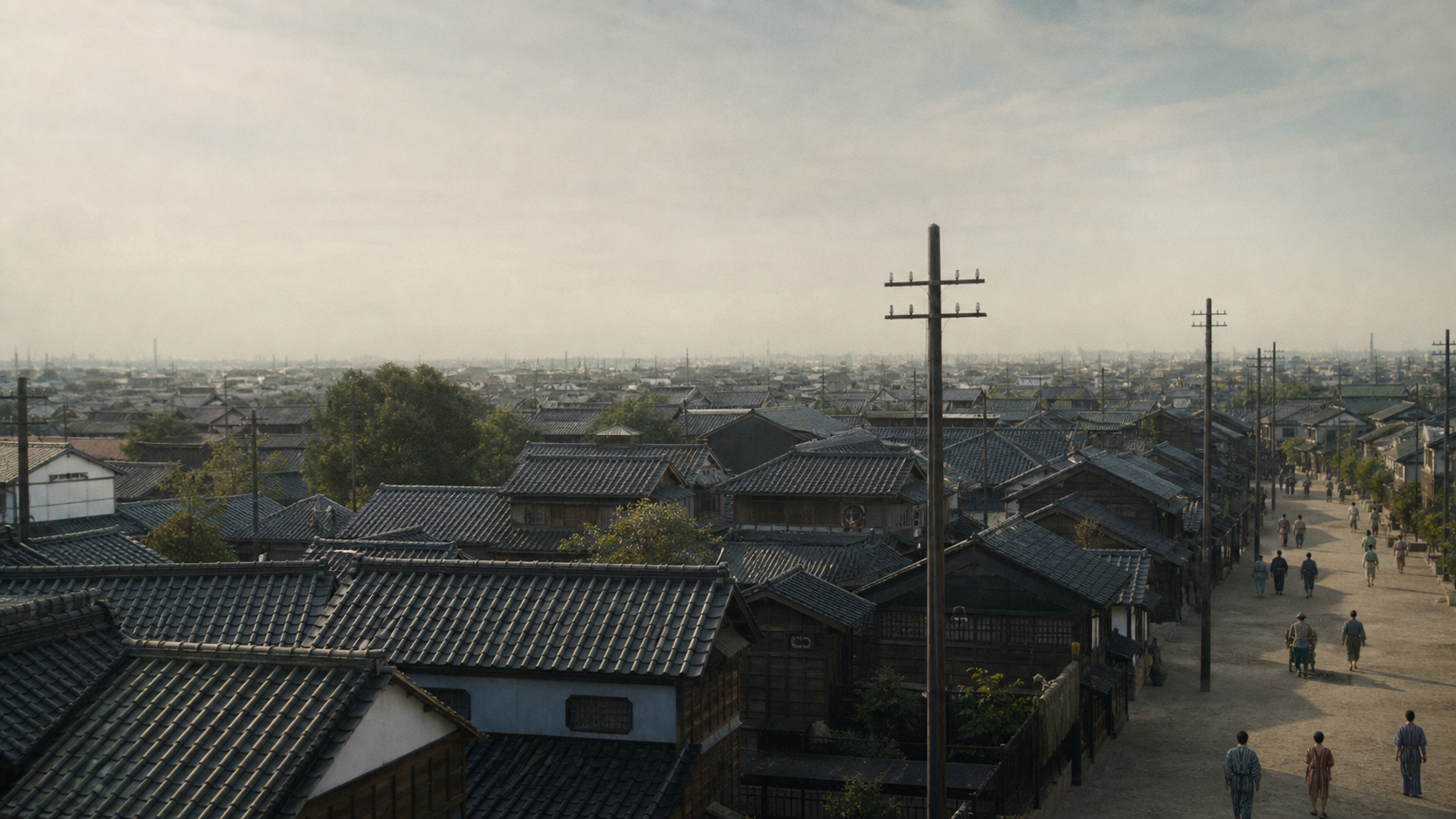
This article follows shaking, fire, information, human violence, relief, and rebuilding as distinct but connected subjects. If every injury is explained simply by the earthquake, questions about decisions and actions disappear. The opening cityscape is a reconstruction suggesting density; its buildings cannot be counted or mapped as evidence for a real neighborhood’s damage.
Chapter 2
Look beyond one city and one photograph
Reading the disaster only through photographs of burned Tokyo makes Yokohama and surrounding places less visible. The official regional overview describes a much wider event. Places included in the same disaster could differ in landform, construction, fire conditions, and transport, so one locality should not automatically represent all the others.
The Japan Meteorological Agency publishes observation data for the Kanto earthquake. Such records help frame the earthquake itself, but historical intensity categories should not be silently treated as identical to today’s categories. A recorded value belongs to the observation methods and classification system under which it was produced.
Yokohama City Library’s materials approach the earthquake and early Showa city through particular streets and locations. Comparing the same place at different times can help distinguish immediate damage from later change. It also provides a regional perspective that cannot be replaced simply by transferring an account of Tokyo’s reconstruction to Yokohama.
The agency’s intensity displays offer a concrete example of why labels matter. Observations using the 1923 scale, which ran from zero to six, appear separately from later estimates using the current scale and building-collapse evidence. Some areas are estimated to have probably reached seven. Six and seven on the same page are therefore not necessarily contradictory: the measurement context and the distinction between observation and reanalysis must be read first.
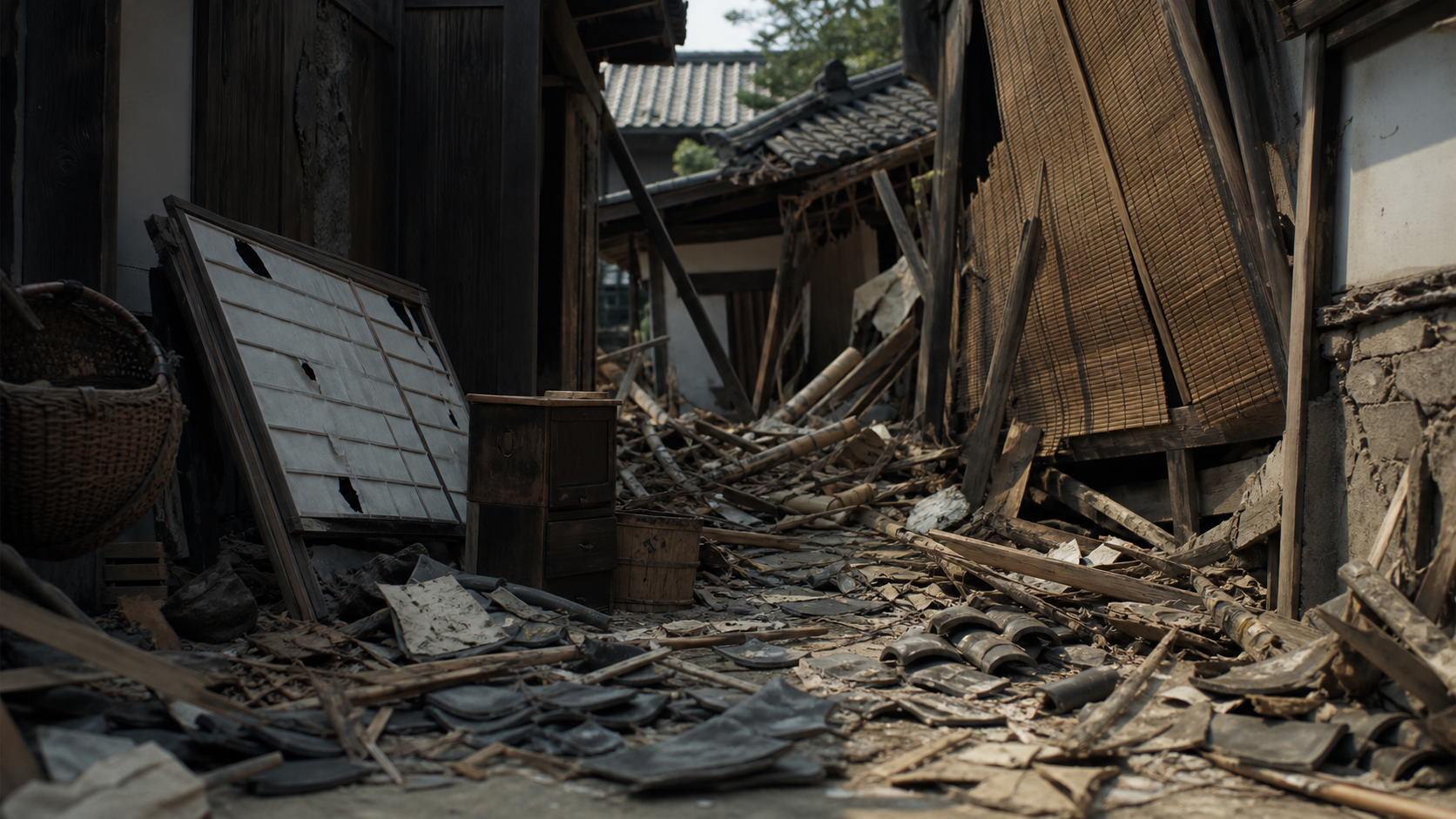
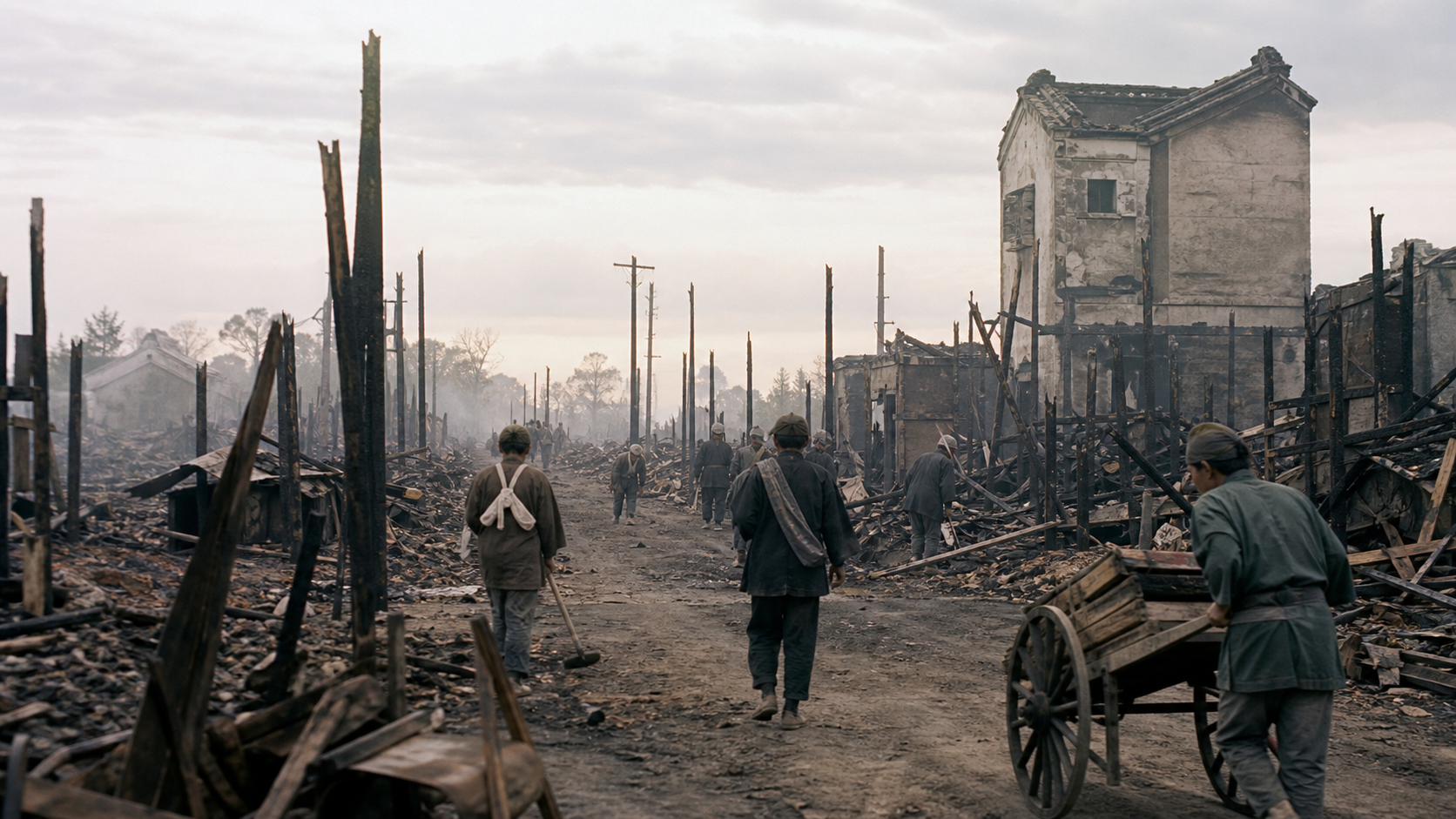
A photograph of severe destruction does not by itself establish the percentage of a whole city damaged. Its viewpoint, date, and framing matter. The reconstructed alley accompanying this chapter is not a reproduced historical photograph and supplies no address or identifiable victim. Local visual evidence and regional aggregation answer different questions.
Chapter 3
Missing information and incorrect information
The National Archives explains that broken telephone and telegraph communications delayed organized government relief. The places suffering damage could also lose the means to report it. Lack of communication therefore affected more than public knowledge: it could influence the information available for organizing assistance and contacting people elsewhere.
The failure of a message to arrive is different from the accuracy of a message that does arrive. Limited information may be taken to represent a wider situation. That is a useful question for reading the emergency, but it does not establish that every locality lost information in the same sequence or responded in the same way.
The Central Meteorological Observatory report introduced by the Japan Meteorological Agency belongs to subsequent investigation and documentation. The overview assembled afterward differs from the restricted information available immediately after the event. A historian should not give people at the beginning the complete picture that later research made possible.
The report’s organization is informative too. The agency lists land uplift, subsidence, and tsunami among the earthquake volume’s subjects, and fire and whirlwinds in the meteorological volume. The contents show different phenomena becoming separate objects of investigation. Consulting that contents list is not the same as having read every conclusion; it provides a route into the relevant section for a more focused question.
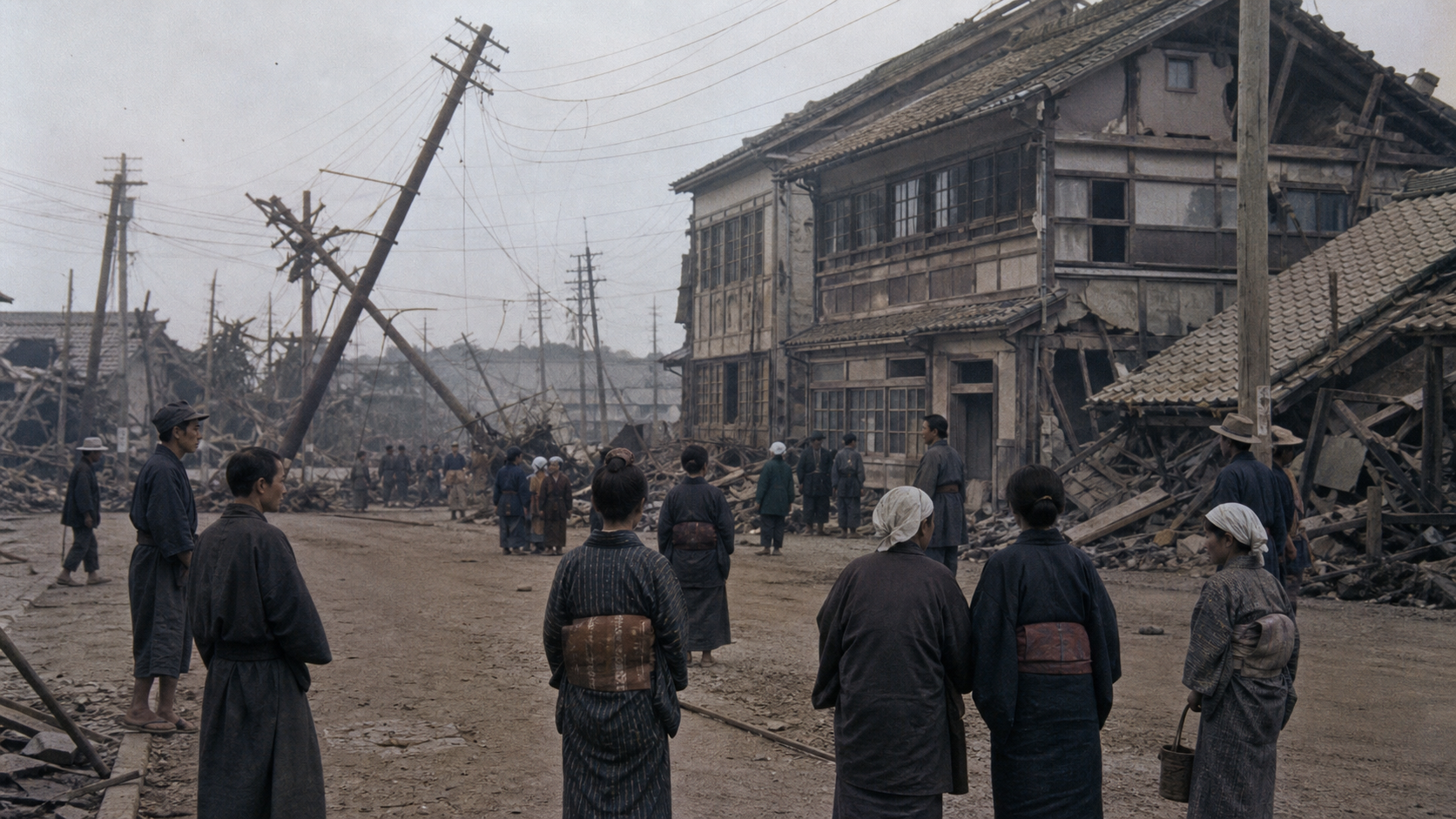
For any report, the sender, recipient, and recording date matter. A document preserving a rumor establishes that the rumor circulated; it does not automatically establish its truth. The damaged poles and gathering figures in the illustration symbolize disruption. They do not identify anyone’s ethnicity, words, or reasons for being there.
Chapter 4
Rumor-related killings were human acts
The National Diet Library states that false rumors about Koreans carrying out an uprising circulated, and that Koreans, Chinese people, and Japanese people were killed or injured. Reporting the existence of that rumor must not turn it into evidence that such an uprising actually occurred. The allegation and the violence associated with it require explicit separation.
Harm inflicted by people is different from the physical effects of shaking and fire. Describing emergency conditions does not justify violence or present it as an unavoidable natural response. Questions about who acted and how remain questions about human conduct, even within a much larger disaster.
Detailed totals or individual episodes require attention to the locality, scope of counting, and formation of the evidence. This article states the killings documented in the institutional overview without adding unsupported figures or a fictional victim’s testimony. Inventing precision would not make the historical harm more intelligible.
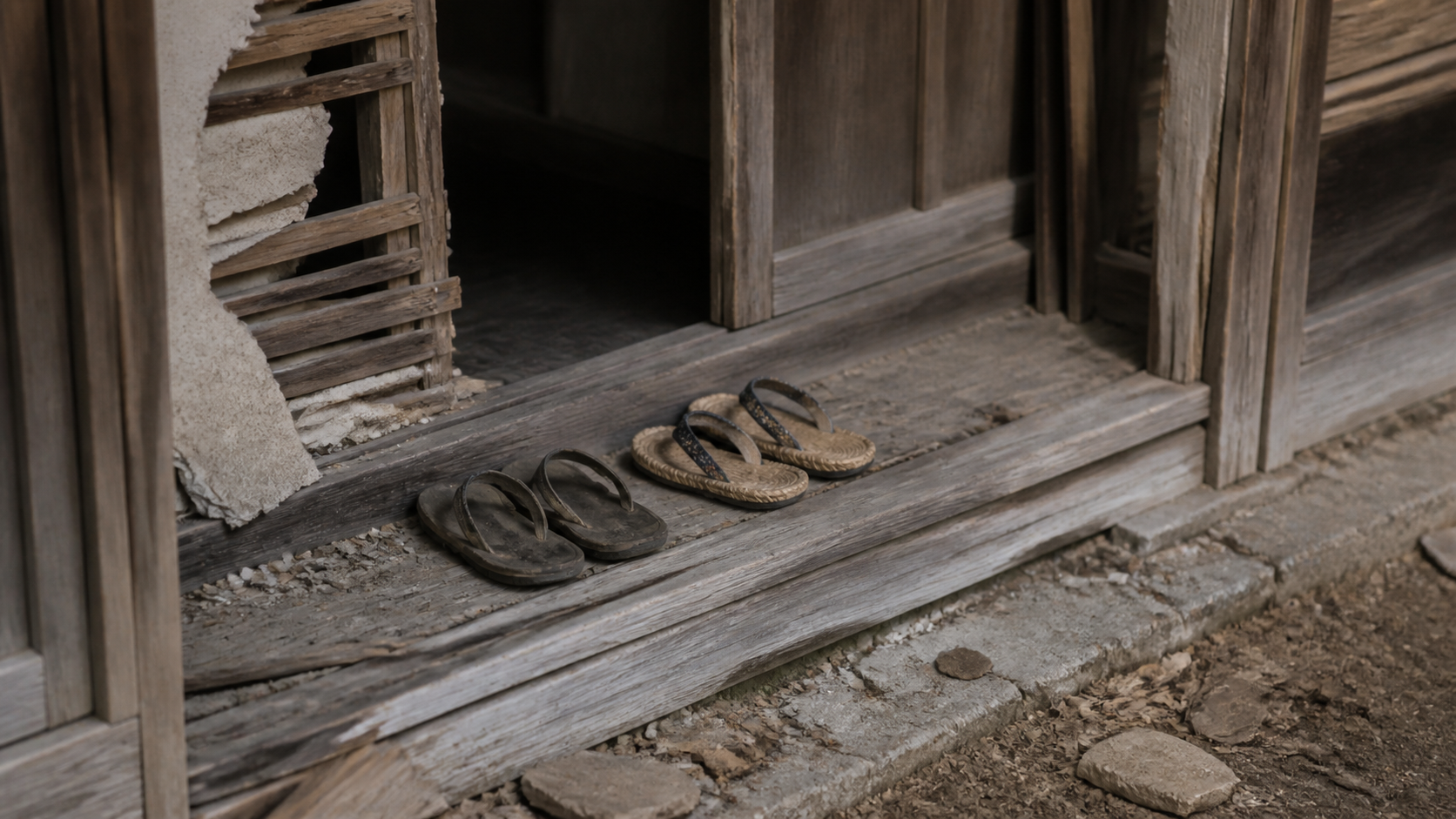
Repeating an allegation to examine it also differs from repeating it to create fear. Its false status must remain clear, and an illustration must not imply ethnic identification or reconstruct perpetrators without evidence. The empty threshold symbolizes loss; it is not a victim’s actual property or a documented scene of a killing.
Chapter 5
Relief began through several kinds of organization
The National Archives describes relief involving local associations and groups, public institutions, medical organizations, and assistance from outside the affected area. These different participants make it difficult to understand relief as one centrally initiated action that operated everywhere in the same way. The record instead opens questions about multiple points of response.
Rather than merely listing organizations, we can ask who knew local conditions, who transported supplies, and who provided care. These are questions for examining the records, not a claim that an identical division of labor existed at every site. Particular answers require evidence about the place and activity concerned.
An organization’s report that it acted does not establish that everyone who needed assistance received enough. Reports are important evidence of activity, but they cannot by themselves explain the full experience of recipients. We can acknowledge documented work while preserving questions about its reach, timing, and differences among those seeking help.
The National Archives offers a concrete example in a report on temporary shelter construction. Its explanation states that shortages, including building materials, left shelter insufficient even twenty days after the earthquake. Evidence that construction took place and an assessment of whether it met need can therefore give different answers. This record makes relief an ongoing process rather than a simple choice between complete success and complete failure.
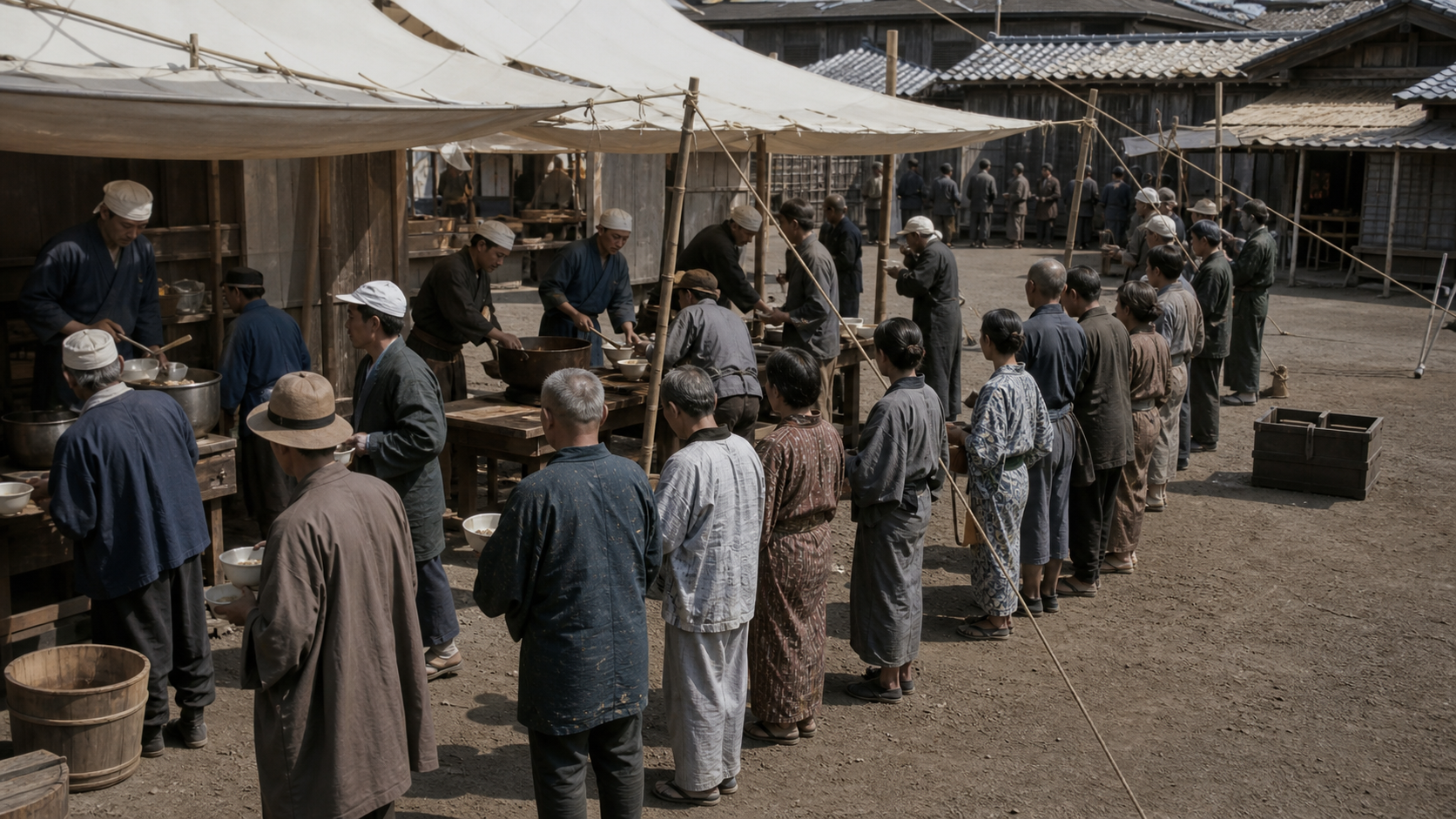
Donations and goods from elsewhere also show that the history extended beyond the damaged city. Information, collection, and delivery linked the affected region to outside support. The illustrated queue is not an actual distribution record: it does not establish its size, what was supplied, or whether every depicted person obtained adequate assistance.
Chapter 6
Places for care and places of refuge
The archival overview includes medical organizations such as the Japanese Red Cross and Saiseikai. The existence of a person needing treatment and the availability of treatment are different conditions. Space, communication, personnel, and supplies help frame the practical work involved, without allowing us to reconstruct every patient’s experience from an institutional summary.
The Ministry of Land, Infrastructure, Transport and Tourism describes parks as places used for refuge and connects that experience with park development during reconstruction. An urban space could acquire a role different from its everyday use. This does not support the general claim that any open space is safe in every emergency.
The subject here is the history of the 1923 city, not current evacuation advice for an individual location. Even historically, the role of a place must be examined alongside surrounding conditions and access. Its size on a map does not alone explain what happened there or how people used it.
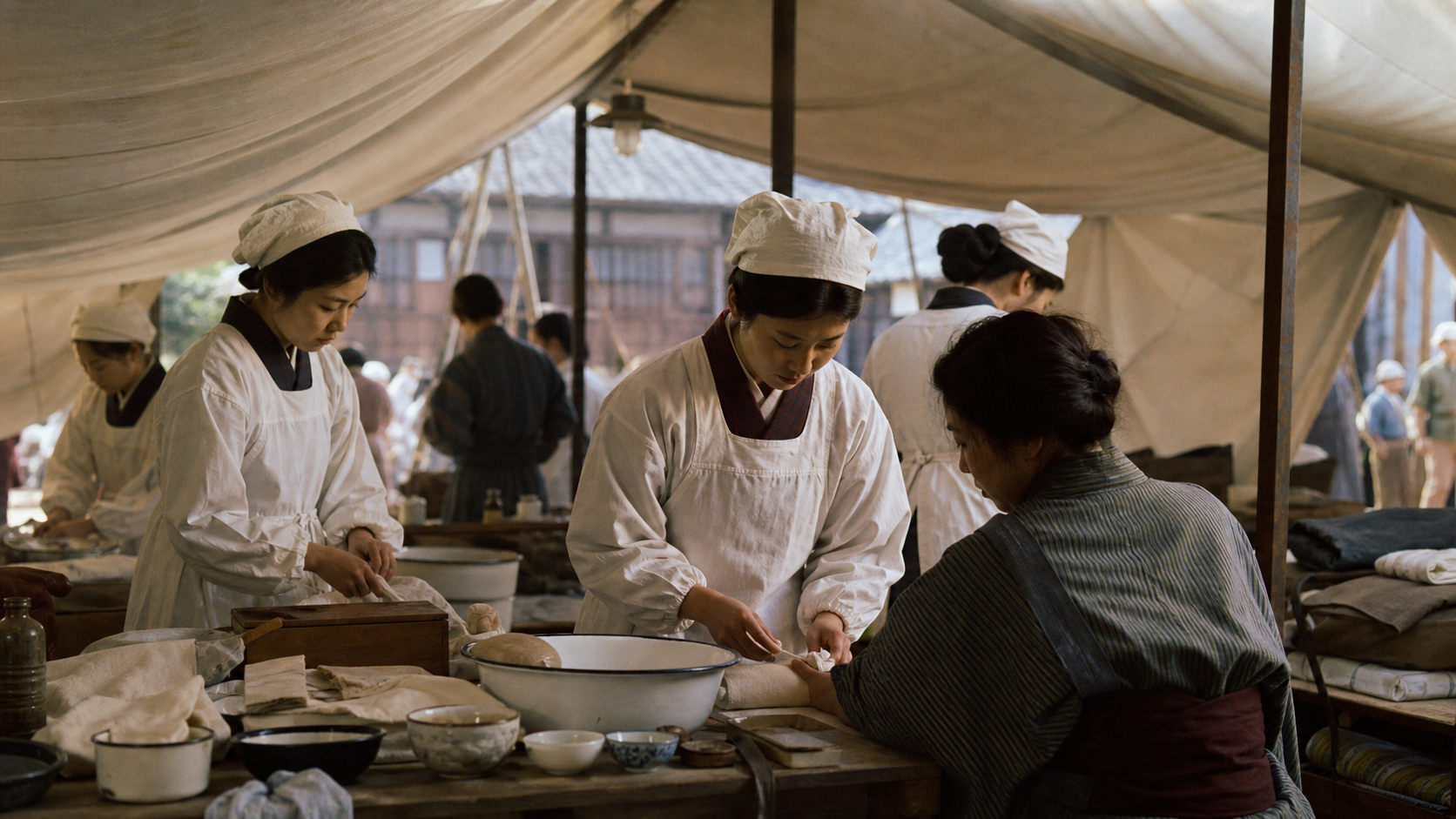
The medical workers in the image are reconstructed figures, not named individuals whose testimony is being reproduced. No fictional rescuer is credited with saving everyone. Reading care sites and refuge spaces together leads toward reconstruction, while preserving the distinction between immediate assistance and decisions about the city’s future form.
Chapter 7
A reconstruction policy was not completed recovery
The National Archives introduces the imperial rescript of September 12, 1923 affirming that Tokyo would remain the capital amid rumors of relocation. That document helps establish a governmental direction after the earthquake. The date of a stated policy, however, cannot be used as the date on which the city had recovered.
Reconstruction needs to be separated into proposals, plans, construction, and renewed use. A document describing a future city and a facility actually built there are different forms of evidence. Following a concrete subject such as parks makes this distinction easier to examine than treating reconstruction as a single undifferentiated accomplishment.
The ministry’s park history links the experience of refuge with later urban provision. Yet completion of roads or parks does not establish that homes, employment, or family life had recovered. Infrastructure records and the history of personal rebuilding operate at different scales. Moving from one to the other requires additional sources.
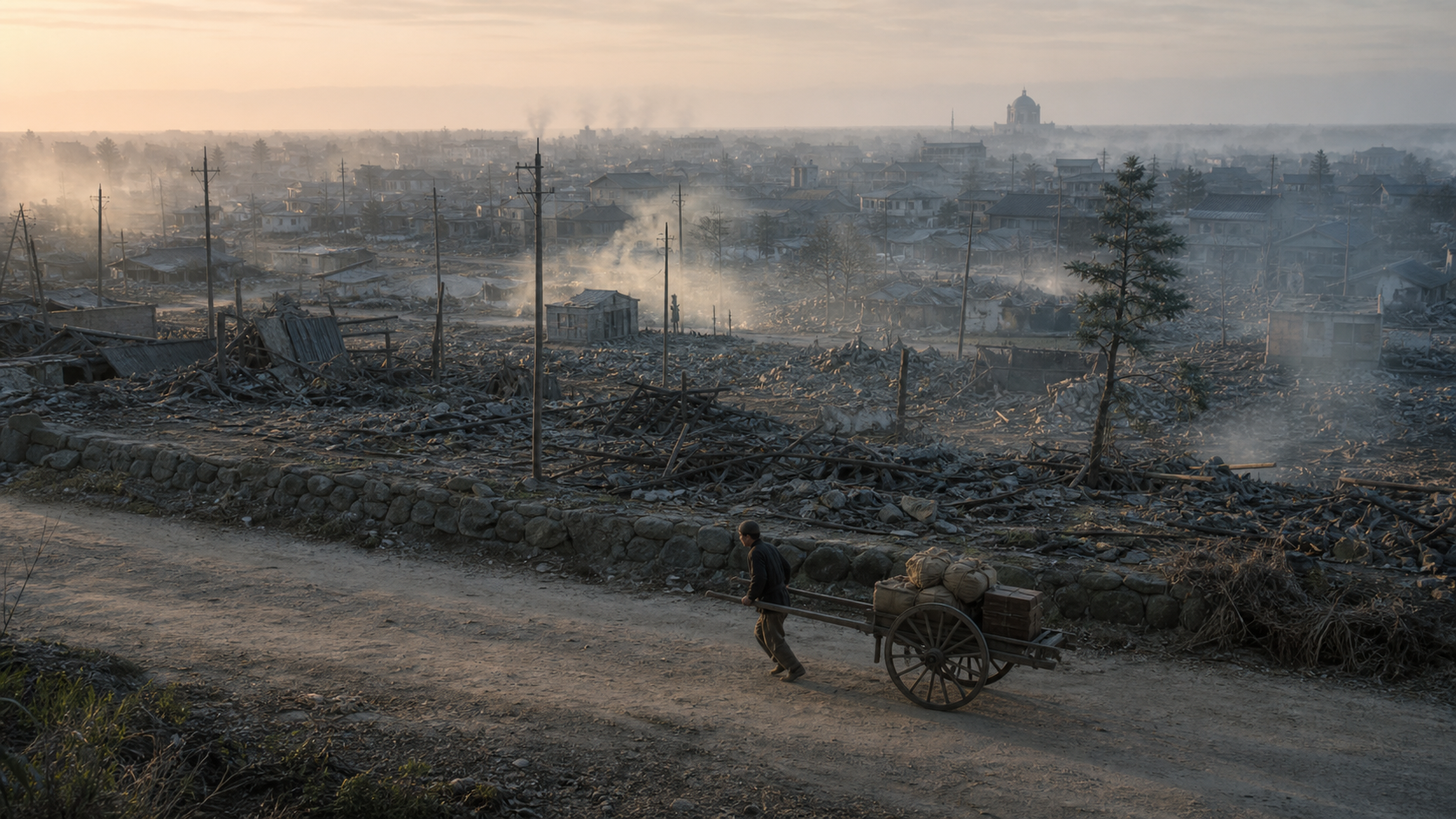
Yokohama’s place-based materials offer another way to approach change across time. Visible differences provide a starting point, while explanations of their causes require dates and planning evidence. The reconstructed supply cart illustrates continuing movement; it does not prove a delivery, a construction milestone, or the completion of a neighborhood’s recovery.
Chapter 8
Passing on the record with its limits intact
Observation data, public documents, photographs, and later exhibitions preserve different information. Measurements help examine the earthquake; activity records help examine relief; a photograph shows a particular view. No single kind of record needs to explain the whole disaster in order to contribute something valuable to its history.
The agency’s seismic-activity display also shows why the disaster cannot be reduced to one shock: it identifies two earthquakes exceeding magnitude 7.0 within twenty-four hours of the main event. Symbols, colors, and time axes describe different aspects of that continuing activity. Reading their legends provides another way to follow time and space, distinct from examining a photograph of damage.
Contemporary reporting and later investigation can also produce different figures or accounts. Before dismissing a difference, we need to examine the scope of counting, the method, and when information became available. The formation of a record is part of its meaning, especially when later knowledge is being compared with an immediate report.
Including rumor-related violence does not complicate the story artificially. It preserves a distinction between harms with different causes. The victims should not disappear behind a general natural-disaster total, and human actions should remain open to historical examination rather than being absorbed into the physical event that preceded them.
Every illustration in this article is AI-generated and separate from the linked evidence. A specific-looking person or street is not an actual identity or eyewitness location. Reading shaking and fire, information and violence, relief and recovery in distinct stages preserves the questions appropriate to each, alongside the limits of what the available records establish.
How to read this work
History, interpretation, and reconstruction
Understanding the disaster requires separating destruction caused by natural phenomena from harm caused by human decisions and actions. Relief and reconstruction also need to be read through different records, locations, and timescales.
This work is grounded in published sources and historical research. Interior thoughts, dialogue, and some visual details are cinematic reconstructions. Where historians disagree, the article presents the point as debated rather than settled fact.
Timeline
The story in time
-
The Kanto earthquake occurs; widespread collapse and urban fires follow.
Sources: cabinet-kanto, ndl-kanto -
Relief proceeds amid disrupted communications; rumor-related killings also occur.
Sources: archives-relief, ndl-kanto -
An imperial rescript states the policy of rebuilding Tokyo as the capital.
Sources: archives-reconstruction -
The Central Meteorological Observatory publishes its investigative report on the earthquake.
Sources: jma-records -
Urban works and the rebuilding of lives continue, with regional change examined by place and date.
Sources: yokohama-memory, mlit-parks
People & terms
A guide for new readers
Key figures
- People affected by the disaster
- Faced collapse, fire, and loss of everyday infrastructure; individual experiences should not be merged into one.
- Victims of rumor-related violence
- Koreans, Chinese people, and Japanese people were killed or injured; this harm is distinguished from natural destruction.
- People engaged in relief
- Local residents, medical workers, and public institutions acted from different positions and with different responsibilities.
Glossary
- Kanto 関東
- The eastern Japanese region including Tokyo and Yokohama.
- Magnitude マグニチュード
- A measure of earthquake size, distinct from the intensity of shaking at a particular location.
- Seismic intensity 震度
- A description of shaking at a location; historical categories must be read within their contemporary system.
- False rumor 流言
- Unverified or false information in circulation; recording its circulation does not establish its content as fact.
- Relief 救護
- Immediate assistance and care, involving different local and institutional participants.
- Reconstruction 復興
- The longer rebuilding process, whose policies and infrastructure works should not be equated with every person’s recovery.
- Imperial rescript 詔書
- A formal imperial document; here, the September 12 statement concerning Tokyo’s future as capital.
Sources & method
How this article was built
The account uses public institutional sources to distinguish physical destruction, human violence, relief activity, and subsequent reconstruction. It does not add fictional eyewitness testimony, unsupported individual cases, or unverified counts to make those histories more dramatic.
English source titles are editorial translations of the linked Japanese pages. Estimates retain their categories and historical measurement cautions. Generated illustrations are labeled as reconstructions and provide no new documentary evidence about individuals, ethnicity, exact buildings, or actual events.
Sources
References and further reading
- 3-11: The Great Kanto Earthquake 3-11 関東大震災 Title translated editorially for reader convenience. National Diet Library 国立国会図書館 The earthquake, fires, and killings associated with false rumors. Accessed 2026-09-07
- 08: The Great Kanto Earthquake, Part 3: Relief and Disaster Prevention 08 関東大震災③―救護活動と防災への動き― Title translated editorially for reader convenience. National Archives of Japan 国立公文書館 Interrupted communications, local response, institutional care, and outside assistance. Accessed 2026-09-07
- 16: Imperial Rescript on Reconstruction of the Capital 16. 帝都復興に関する詔書 Title translated editorially for reader convenience. National Archives of Japan 国立公文書館 The September 12 rescript and reconstruction policy, distinct from completed recovery. Accessed 2026-09-07
- One Hundred Years Since the Great Kanto Earthquake 関東大震災100年 Title translated editorially for reader convenience. Cabinet Office, Disaster Management 内閣府 防災担当 Event time, magnitude, and stated estimates of casualties and damage. Accessed 2026-09-07
- Records of the Great Kanto Earthquake 関東大震災の記録 Title translated editorially for reader convenience. Japan Meteorological Agency 気象庁 Access to contemporary investigation, including the 1924 observatory report. Accessed 2026-09-07
- Observation Data and Analysis Results 観測データ・解析結果 Title translated editorially for reader convenience. Japan Meteorological Agency 気象庁 Measurements and the historical context of intensity records. Accessed 2026-09-07
- Yokohama’s Memory 2: The Great Kanto Earthquake and Reconstruction Yokohama’s Memory2 関東大震災と復興 Title translated editorially for reader convenience. Yokohama City Library 横浜市立図書館 A place-based guide to regional visual records; the images are not reproduced here. Accessed 2026-09-07
- Chronology of Parks and Green Spaces 公園緑地年表 Title translated editorially for reader convenience. Ministry of Land, Infrastructure, Transport and Tourism 国土交通省 The historical role of parks in refuge and reconstruction. Accessed 2026-09-07
Continue reading
More stories from Shigeki
Shigeki English
Oishi Kuranosuke: The Road from Surrendering Ako Castle to the Raid
Before the famous night came accounts, letters, separation, and an attempt to restore a fallen house.
- When Genroku 14–16, spanning 1701–1703; month and day references retain the old Japanese calendar
- Where Ako, Yamashina near Kyoto, and Edo
Shigeki English
The Sakuradamon Incident: A Shogunate Wounded, but Still Governing
Follow the assassination of Ii Naosuke through the orders, letters, and announcements that followed it.
- When 1860, with political background in 1858 and an aftermath extending into the 1860s
- Where Edo Castle and Hikone, with reports circulating beyond Edo