

SHIGEKI ENGLISH STORYEN
Japanese history in English
The Battles of Ueda: How the Sanada Faced Tokugawa Armies
Two wars, in 1585 and 1600, understood through terrain, town, and political alliances
Ueda Castle faced Tokugawa forces twice under very different political conditions. Rivers, terraces, the castle town, divided family allegiances, and postwar decisions reveal why defending a stronghold and retaining its territory were different achievements.
At a glance
Before you enter the story
- When
- 1585 and 1600, with later destruction and rebuilding
- Where
- Ueda in Shinano Province, now eastern Nagano Prefecture
- Key figures
- Sanada Masayuki, Sanada Nobuyuki, Sanada Nobushige, Tokugawa Hidetada
- What was at stake
- The defense of a regional stronghold, changing alliances, and the difference between battlefield performance and postwar territorial settlement.
Why this story matters
The larger history behind the turning point
The fame of Ueda often rests on a compact story of a small force resisting a larger army. That starting point becomes more informative when we ask what space the defenders used, what political dispute brought an army there, and which larger conflict determined the consequences.
The two battles also make scale important. A castle could resist an attack while its lord’s wider coalition lost. Following that distinction helps explain the Sanada family’s divided paths after 1600, without turning either a tactical success or a national defeat into the whole story.
Historical context
What an international reader needs to know
A castle within a changing political landscape
The first battle belonged to the redistribution of power after the collapse of the Takeda and the death of Oda Nobunaga. Regional lords negotiated with stronger neighboring powers over territory and recognition. The second belonged to the broader conflict associated with Sekigahara in 1600. These were different political situations, separated by fifteen years.
A castle town was part of the setting in which people lived, traveled, and governed. Its streets and watercourses could also affect military movement. The word castle therefore needs to include more than an isolated tower or gate. At Ueda, reading the terrain together with the surrounding settlement changes the questions we ask of the site.
Names, sources, and the present-day site
Japanese names appear here in family-name-first order. Sanada Nobushige is the historical name used for the figure widely known in later storytelling as Yukimura. The article follows the Sanada Treasures Museum in distinguishing the documented person from later naming and literary traditions.
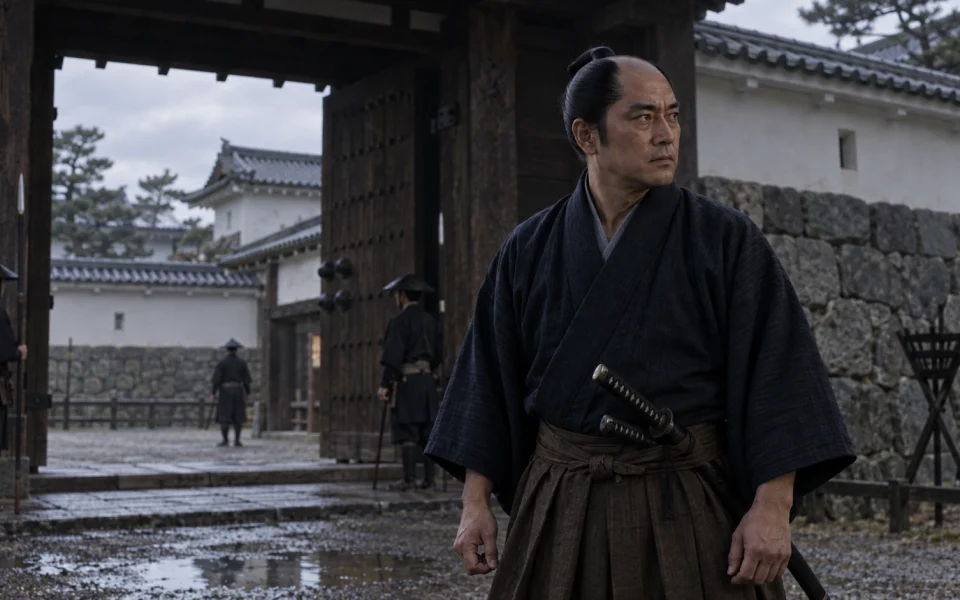
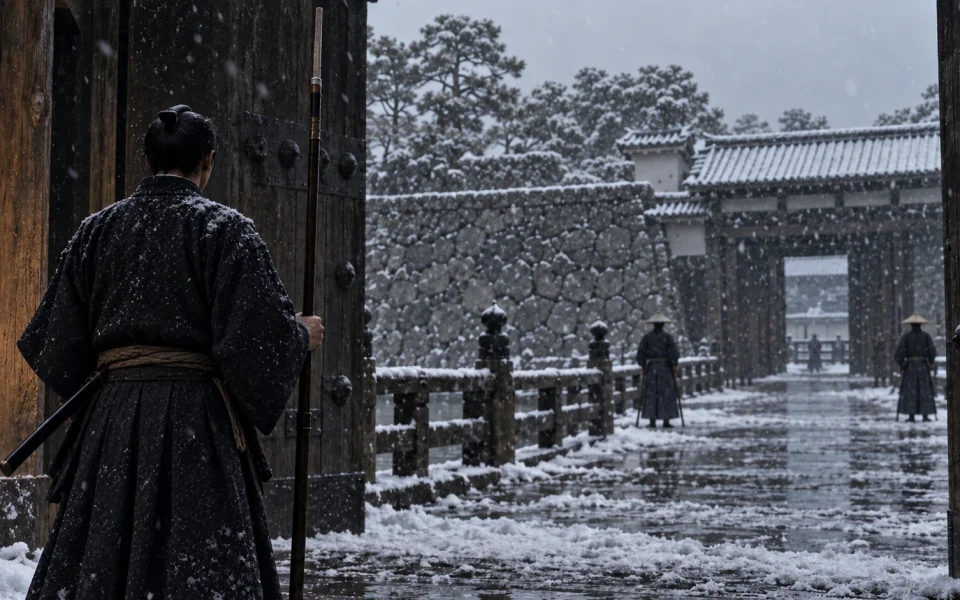
The present site contains layers of destruction, rebuilding, and modern conservation. Official descriptions of surviving features do not automatically establish that every feature existed in 1585. The linked film has Japanese audio. Its AI-generated imagery provides an illustrative setting, not an excavated reconstruction plan or a map from which troop positions can be calculated.
Watch the film
See the story in motion
The film currently uses Japanese audio. This English article provides the context and source trail; it does not imply that an English subtitle track is available.
Chapter 1
One castle, two different wars
Ueda Castle was involved in conflicts with Tokugawa forces in 1585 and 1600. Both are associated with Sanada military skill, but treating them as repetitions of the same encounter removes much of their meaning. The first task is to separate their dates, alliances, and political settings before comparing their defensive features.
The earlier conflict emerged from regional disputes after the Takeda collapsed and Oda Nobunaga died. The later conflict formed part of the wider east–west confrontation associated with Sekigahara. A familiar place-name connects the episodes, but it cannot make the surrounding political map or the interests of the participants identical.
The Sanada family itself was divided in 1600. Masayuki and Nobushige joined the western side, while Nobuyuki aligned with the Tokugawa. A shared family name therefore does not establish a shared wartime allegiance. Keeping the distinction visible is essential to understanding who subsequently retained territory and who had to leave Ueda.
This article asks how the castle’s space supported defense and how decisions outside that space shaped its future. The condition of a gate is one measure of an encounter; the survival of a lord’s territorial authority is another. Both matter, but they should not be used as though they answer the same question.

Chapter 2
Terrain and water as connected defenses
Ueda City locates the castle at the edge of a terrace between the Taro mountain range and the Chikuma River. This was not an isolated mountaintop fortress. Its position connected it to the basin and the town. Looking outward from the walls is therefore necessary to understand why the site mattered.
The municipal explanation describes the southern cliff and waters associated with Amagafuchi, alongside altered watercourses incorporated into defenses elsewhere. Natural features and human work overlapped. The important relationship is between water, height, routes, and enclosures, rather than a choice between a wholly natural fortress and a wholly artificial one.
Terrain does not guarantee a military outcome by itself. Water could restrict movement while also belonging to the everyday infrastructure of the castle and town. Questions about supply, access, and controlled approaches help turn a list of features into an explanation of connected space. They do not reconstruct the movements of every unit.
Some descriptions concern remains or plans from later periods. We should not project every visible feature back into the first battle. The aerial illustration is an AI reconstruction, not a survey. The heritage listing establishes the site’s cultural status; determining the date and form of a particular structure requires the relevant research evidence.

Chapter 3
A supported foundation becomes a contested stronghold
Ueda City dates Masayuki’s construction of the castle to 1583 and notes Tokugawa support. The site therefore did not begin simply as a fortress designed against the Tokugawa. Its later role arose as political relationships changed. Starting with the foundation prevents the subsequent conflict from becoming the castle’s only possible purpose.
The dispute over Numata territory formed part of that change. Territorial arrangements involving the Tokugawa and Hojo created a problem for Masayuki, who moved toward the Uesugi. The municipal histories connect these regional negotiations to the confrontation of 1585. A castle’s history and the history of alliances intersect at this point.
Changing allegiance should not serve only as a shortcut to describing personality. It concerned which territory a lord could control and which powers would recognize that control. Nor does identifying those pressures reveal every private calculation. The article follows the documented changes in relationships without supplying Masayuki with an invented inner monologue.
The resulting picture is reciprocal: a stronghold could affect bargaining, while a diplomatic change could turn that stronghold into a battlefield. Defensive construction did not make diplomacy unnecessary. Reading both together gives the first Ueda conflict a concrete regional setting, instead of presenting it as a timeless contest between clever defenders and a large army.
Chapter 4
The town beyond the inner enclosure
Walls and gates are only part of the defensive space described by Ueda City. Altered rivers also helped surround the castle and its town. An approaching army therefore faced routes and barriers extending beyond a single building. This wider view makes streets, watercourses, and access points relevant to the military question.
As a general spatial principle, a large force cannot deploy all its numbers through one narrow approach at once. That principle helps us ask about Ueda’s defenses, but it is not a recovered account of a particular minute in battle. Functional interpretation must be distinguished from documented orders and precisely located troop movements.
Popular battle narratives may describe lures, ambushes, or the use of water in a detailed sequence. The official overviews consulted here do not establish every such episode at equal certainty. A memorable story cannot substitute for checking when an account was written and what evidence supports its specific tactical claims.
The town was also a place of ordinary life. Considering it as defensive space should not erase its inhabitants, but their individual experiences require appropriate records. Modern walking guides help visitors approach the relationship between town and castle. They are not plans of the settlement on the day of either battle.

Chapter 5
The divided map of 1600
In 1600, Masayuki and Nobushige joined the western side while Nobuyuki joined the Tokugawa. Hidetada led the Tokugawa force that approached Ueda. The castle again faced an army, but this time local operations were connected to the larger conflict culminating at Sekigahara. The setting cannot be reduced to a repeat of 1585.
The Sanada Treasures Museum traces the family’s divided allegiances and later history. The fact that one branch survived does not prove that every participant had agreed on a single plan to secure that result. An outcome known afterward should not be turned into an intention supposedly shared beforehand.
Hidetada’s operations also raise the issue of time and movement between theaters. Fighting at one place could matter to a campaign elsewhere. However, this article does not establish Ueda as the sole explanation for his failure to reach Sekigahara in time. A complete account of that question requires the wider sequence of movements and communications.
Local performance and the conclusion of a war must therefore be measured at different scales. One requires attention to the castle and nearby action; the other requires attention to coalition outcomes and postwar decisions. Keeping both scales visible gives the defense meaning without claiming that success at one place settled everything outside it.

Chapter 6
A defense did not secure the lord’s future
After the western side lost at Sekigahara, Masayuki and Nobushige were exiled to Kudoyama. Ueda Castle was dismantled and the territory passed to Nobuyuki. The municipal history’s account of this transition makes the distinction between local defense and political settlement particularly clear: the future of the site depended on more than its resistance to attack.
Dismantling a castle after a war has a different meaning from damage inflicted during combat. A castle was both a defensive installation and a center of territorial power. Decisions about its continued existence could therefore express a new political arrangement even where the story of its battlefield performance had a different emphasis.
Nobuyuki’s inheritance does not mean that the Sanada continued in an entirely unchanged form. His future as a territorial lord separated from the experience of his father and brother. Calling a whole family victorious or defeated can conceal those differences. Following named individuals and their positions produces a more accurate account.
The empty gate illustrates a changed aftermath rather than an identified departure scene. No farewell conversation or private reaction is reconstructed. The argument remains grounded in exile, dismantling, and succession: to understand how Ueda was defended we must read its space, but to understand what followed we must look beyond that space.
Chapter 7
The castle now contains later centuries
Today’s Ueda Castle site preserves a history extending beyond the Sanada battles. Ueda City dates a rebuilding initiative under Sengoku Tadamasa to 1626. The place visitors encounter therefore cannot be treated as a setting that remained unchanged from Masayuki’s time. Destruction and reconstruction are themselves part of its history.
The city also publishes information on modern research and restoration. The west turret escaped dismantling, while the north and south turrets were moved away and returned in 1949; the eastern gate was reconstructed in 1994. For a reconstructed building, we need to ask which historical period it represents and what evidence informed its form. An old-looking exterior, the actual construction date, and the historical date targeted by a reconstruction are separate pieces of information.
A heritage site does not need to preserve every element from one moment to be valuable. Changes in use and efforts to conserve the remains also tell us how the place survived. Reading official site descriptions together with the heritage record helps visitors distinguish surviving fabric, later additions, and reconstructed features.
The same caution applies to our images. Visible roofs and gates do not establish their exact form in 1585 or 1600. An informed visit can instead begin by asking which landforms affected defense and which elements reflect later intervention, then follow the connections between the castle, town, and water.
Chapter 8
Battle pictures and the history of memory
The Sanada Treasures Museum’s exhibition list brings together portraits, battle pictures, memoranda, and letters. Their assigned dates and categories matter. A detailed battle image made later is a different kind of source from a contemporary letter, even when both concern the same family and appear in the same exhibition.
A later battle picture can illuminate how a conflict was remembered and represented. Using it as a precise diagram of every combatant’s position requires additional scrutiny. That distinction does not make later works worthless. It identifies the questions they are best equipped to answer and prevents visual detail from becoming automatic proof.
Names also carry layers of memory. The museum explains the later literary fame of Nobushige as Yukimura. This article uses Nobushige while identifying the familiar later name. Ueda City likewise warns that an old plan’s accuracy may be uncertain. Official publication of a source does not remove the qualifications supplied by its custodians.
Ueda’s interest extends beyond selecting one clever stratagem to explain victory. Terrain, alliances, territorial settlement, and remembrance meet at the site. Distinguishing the two battles and the dates of surviving sources turns the castle from a dramatic backdrop into an object of historical inquiry, with different kinds of evidence for each layer.
How to read this work
History, interpretation, and reconstruction
Ueda’s defenses extended beyond its buildings into terrain, watercourses, and the town. But maintaining a local defense did not determine who would retain political control after the wider war.
This work is grounded in published sources and historical research. Interior thoughts, dialogue, and some visual details are cinematic reconstructions. Where historians disagree, the article presents the point as debated rather than settled fact.
Timeline
The story in time
-
Masayuki builds Ueda Castle with Tokugawa support.
Sources: ueda-castle-history -
The first conflict with Tokugawa forces develops amid the Numata territorial dispute.
Sources: ueda-castle-legacy-history -
Masayuki and Nobushige join the western side; Nobuyuki joins the Tokugawa. Hidetada’s force confronts Ueda.
Sources: sanada-museum, ueda-castle-history -
Following exile, dismantling and the transfer of Ueda territory to Nobuyuki proceed.
Sources: ueda-castle-history -
Nobuyuki moves to Matsushiro; Sengoku Tadamasa enters Ueda.
Sources: ueda-castle-history -
Rebuilding under Sengoku Tadamasa begins.
Sources: ueda-castle-history
People & terms
A guide for new readers
Key figures
- Sanada Masayuki
- Builder of Ueda Castle and a central figure in both conflicts.
- Sanada Nobuyuki
- Joined the Tokugawa side in 1600 and subsequently inherited the Ueda territory.
- Sanada Nobushige
- Joined his father on the western side in 1600; later widely known as Yukimura.
- Tokugawa Hidetada
- Commander of the Tokugawa army that approached Ueda in 1600.
Glossary
- Shinano 信濃
- Historical province broadly corresponding to modern Nagano Prefecture.
- Castle town 城下町
- A settlement associated with a lord’s castle, including routes, residences, and economic activity.
- Enclosure 曲輪
- A defined area within a castle complex; its date and defensive role require attention to the specific site.
- Sekigahara 関ヶ原
- The 1600 battle central to a wider conflict between eastern and western coalitions.
- Kudoyama 九度山
- The place of exile associated with Masayuki and Nobushige after the western defeat.
- Yukimura 幸村
- The name through which Nobushige became widely known in later literary and popular traditions.
Sources & method
How this article was built
The account combines institutional chronology with a reading of defensive space. It avoids treating uncertain tactical stories, present-day structures, or later battle pictures as direct records of either battle. Approximate force comparisons are not used to imply an exact deployment map.
English source titles are editorial translations. The Japanese links lead to the underlying explanations and catalogue. Interpretations about scale, terrain, and political outcomes are identified as the article’s analysis, while the AI illustrations remain separate from the evidence.
Sources
References and further reading
- History of Ueda Castle 上田城の歴史 Title translated editorially for reader convenience. Ueda City 上田市 Chronology of foundation, battles, dismantling, and rebuilding. Accessed 2026-09-07
- Features of Ueda Castle 上田城の特徴 Title translated editorially for reader convenience. Ueda City 上田市 Terrain, watercourses, enclosures, and the town, with caution about period differences. Accessed 2026-09-07
- History of Ueda Castle: Municipal Overview 上田城の歴史 Title translated editorially for reader convenience. Ueda City 上田市 The Numata dispute, alliances, and postwar settlement. Accessed 2026-09-07
- Maintenance and Restoration 整備・復元 Title translated editorially for reader convenience. Ueda City 上田市 Modern restoration and its distinction from battle-period evidence. Accessed 2026-09-07
- Exploring the Atmosphere of Ueda’s Castle Town 上田城下町の風情をめぐる Title translated editorially for reader convenience. Ueda City 上田市 A present-day visitor guide, not a plan of the historical battlefield. Accessed 2026-09-07
- History of the Sanada Family 真田氏の歴史 Title translated editorially for reader convenience. Sanada Treasures Museum 真田宝物館 Family succession, divided allegiance, and the Nobushige–Yukimura distinction. Accessed 2026-09-07
- Ueda Castle Site 上田城跡 Title translated editorially for reader convenience. Agency for Cultural Affairs, Cultural Heritage Online 文化庁 文化遺産オンライン The castle remains as a designated heritage site. Accessed 2026-09-07
- The Sanada and Uwajima Date Families: Exhibition List 真田家と宇和島伊達家 展示資料一覧 Title translated editorially for reader convenience. Sanada Treasures Museum 真田宝物館 Dates and categories of paintings, portraits, memoranda, and letters. Accessed 2026-09-07
Continue reading
More stories from Shigeki
Shigeki English
Oishi Kuranosuke: The Road from Surrendering Ako Castle to the Raid
Before the famous night came accounts, letters, separation, and an attempt to restore a fallen house.
- When Genroku 14–16, spanning 1701–1703; month and day references retain the old Japanese calendar
- Where Ako, Yamashina near Kyoto, and Edo
Shigeki English
The Sakuradamon Incident: A Shogunate Wounded, but Still Governing
Follow the assassination of Ii Naosuke through the orders, letters, and announcements that followed it.
- When 1860, with political background in 1858 and an aftermath extending into the 1860s
- Where Edo Castle and Hikone, with reports circulating beyond Edo