
SHIGEKI ENGLISH STORYEN
Japanese history in English
After the Great Meireki Fire: Edo’s Unrebuilt Keep, Bridges and Open Spaces
Recovery meant more than rebuilding a burned town in its former shape. Follow a stone platform, broader streets and connections across the river.
What did Edo rebuild after the fire of 1657, and what did it leave unbuilt? Explore the keep base, open firebreaks, relocations, Ryōgoku Bridge, Honjo’s waterways and its later withdrawal and restart.
At a glance
Before you enter the story
- When
- The 1657 fire and recovery; Honjo’s withdrawal and restart in 1682–1688; later firefighting formations in 1720 and a separate fire in 1859. Historical dates retain the contemporary calendar.
- Where
- Edo Castle, the built-up town, the Sumida River crossing and developing areas including Honjo and Fukagawa.
- Key figures
- Tokugawa Ietsuna, Hoshina Masayuki
- What was at stake
- How to create conditions for people to live again: choosing what to restore, what to leave open and how to connect new places, while facing both fire and water.
Why this story matters
The larger history behind the turning point
The absence of Edo Castle’s keep can suggest a story of something never restored. Looking beyond the tower reveals active choices about repaired masonry, unbuilt spaces, wider roads, relocated institutions, bridges and water. Honjo’s later flooding and withdrawal also show why recovery cannot be treated as one straight progression from disaster to completion.
Historical context
What an international reader needs to know
A Castle Was More Than Its Keep
English accounts often use castle and keep loosely. Here they must be separated. The tenshu was the tower lost in 1657; the tenshudai was its stone base, repaired in 1658. The Honmaru palace was another structure with a different later history. The failure to rebuild a tower therefore does not mean that every part of Edo Castle remained unrepaired or that the castle ceased to function.
The account of Hoshina Masayuki and the 1659 decision is attributed to the Metropolitan Library’s explanation. It is not presented as a verbatim speech recovered from an original record. The archive’s keep-base drawing also has its own later date and context, so it is not silently used as an eyewitness picture of the great fire.
Separate the Disaster from Its Later Aftermath
The first-month dates of 1657 follow the calendar used in the historical accounts. They are not Gregorian January dates. The initial fire, bridge works, water supply, the floods of the 1680s, the iroha groups of 1720 and the fire of 1859 belong to different times. A familiar image or a damaged stone does not by itself establish which event it records.
The library’s casualty range remains a range, and its description of growth from two ri square to four ri square remains an explanation of urban extent rather than an exact area calculation. These limits matter when telling a story through images: the generated scenes illustrate functions and changes, not surveyed boundaries, verified individual experiences or exact measurements of damage.
Watch the film
See the story in motion
The film currently uses Japanese audio. This English article provides the context and source trail; it does not imply that an English subtitle track is available.
Chapter 01
Begin with a Base without a Tower
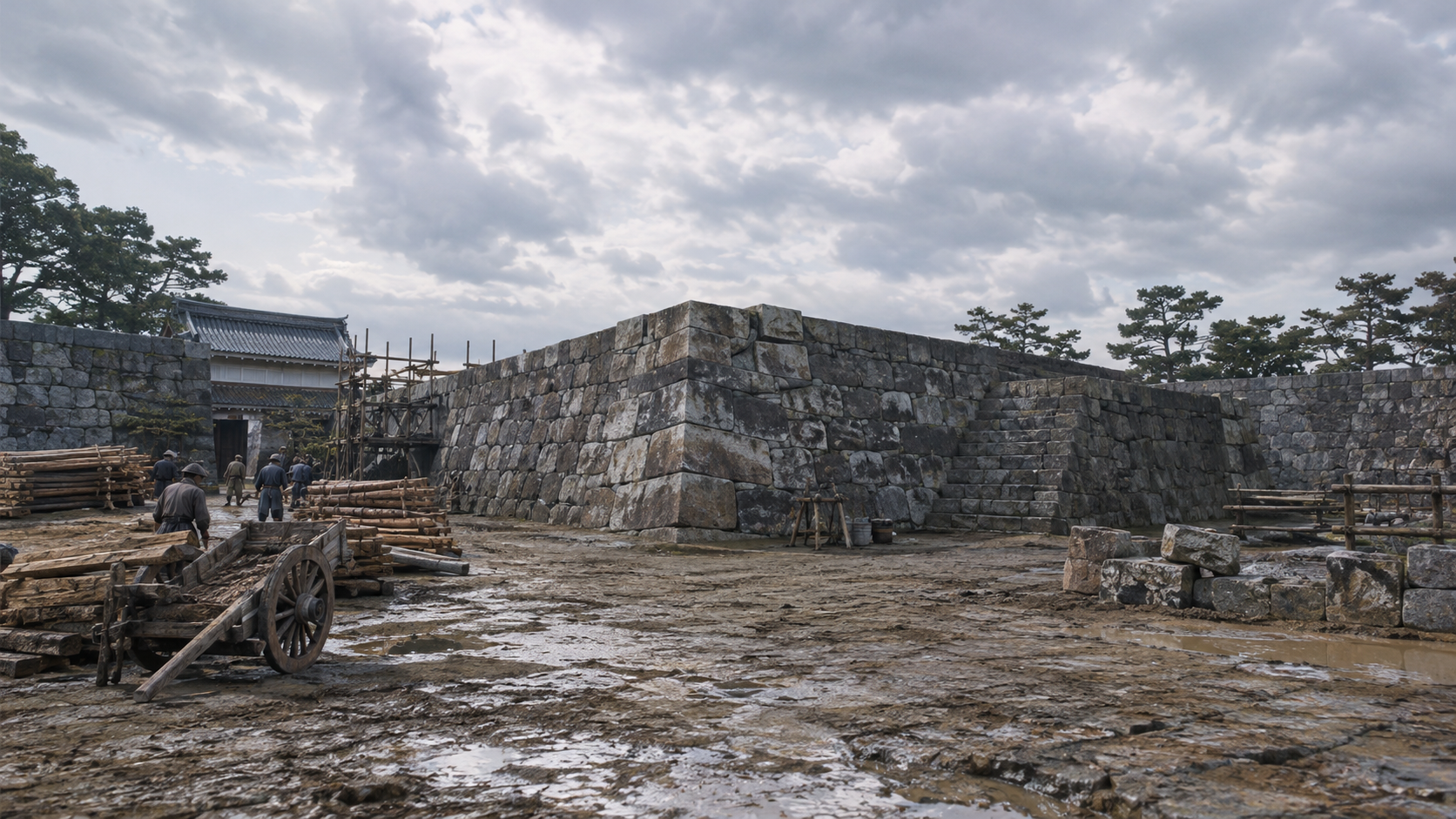
There is no keep standing on Edo Castle’s stone keep base. Separating the masonry platform from the empty space above it offers a starting point for the history after the Great Meireki Fire. The keep burned in 1657 and was not subsequently rebuilt. The missing tower is one part of the story, but the surviving base introduces a different question.
Repair work at the castle did not simply stop. Restoration of the keep base had been completed by the following year, 1658. Repairing the platform and leaving the tower unbuilt were compatible choices. That combination invites us to ask what recovery meant, rather than assuming that reconstruction had to reproduce every feature of the castle’s earlier appearance.
Outside the castle, work likewise went beyond filling every burned plot with its previous buildings. Land left open, wider roads, relocated temples and residences, and a bridge across the Sumida River changed the town’s arrangement. Rebuilding individual structures and reorganizing the spaces between them were connected, but they were not the same undertaking.
A history focused only on the lost keep cannot encompass all of Edo’s recovery. Moving from the castle to streets and from a bridge to land east of the river reveals other decisions. This account follows what was restored and what was changed through the spaces and connections needed for people to live in the city again.
Chapter 02
The Extent of a Burned City
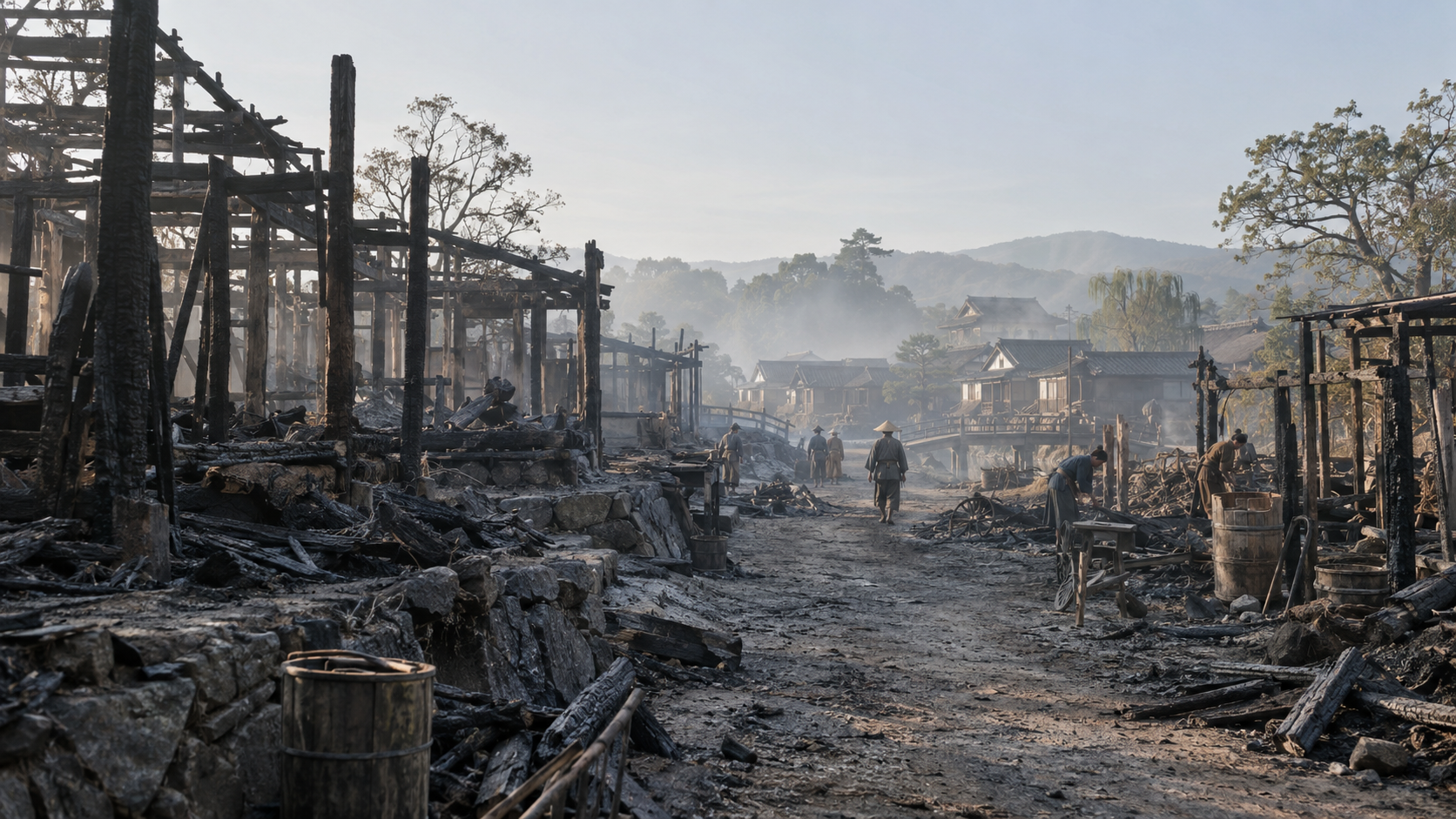
The fire occurred under Tokugawa Ietsuna, the fourth shogun. The Tokyo Metropolitan Library describes approximately sixty percent of Edo’s urban area as having burned. Damage extended beyond the castle to warrior residences, temples, shrines and places inhabited by townspeople. The institutional estimate gives a sense of urban scale without locating every affected household on a precise map.
The number of people who died is disputed. The range presented by the library is thirty thousand to one hundred thousand. Preserving that range is more responsible than selecting one figure and presenting it as an agreed count. Different transmitted records and ways of counting remain part of the evidence, rather than a problem solved by choosing the most memorable number.
A proportion of the city burned cannot represent every individual experience of disaster. It nevertheless helps establish how widely places to live had been lost. The damage was not something that could be reversed simply by erecting a house and declaring the earlier conditions restored. The surrounding urban environment also had to be considered.
Housing required routes to reach it, arrangements for supplying water, and destinations to which people and goods could move. Recovery thus extended beyond one building at a time. The interpretation developed here is that rebuilding involved reconsidering the city’s arrangement, as well as restoring the structures destroyed within it.
Chapter 03
The Robe Story and the Course of the Fires
The Meireki disaster is also known as the furisode fire. A story connects the deaths of young women, a long-sleeved robe and a memorial burning with the outbreak. Its vividness makes it memorable, but a memorable tale and an established explanation of a fire’s cause are different things. The narrative needs to keep them apart.
The Tokyo Fire Department’s explanation also introduces differences among versions, including the girls’ names and the history of the robe. The existence of a widely known plot does not establish one version as the cause of the entire disaster. The account here reports the tradition without reproducing it as a verified chain of events.
In the department’s description of the fires, an outbreak in Hongō spread on the eighteenth day of the first month in the calendar then in use. Further fires occurred the next day in Koishikawa and, later, Kōjimachi. Multiple outbreaks spreading in strong winds require attention. These historical month-and-day labels are not silently converted into Gregorian January dates.
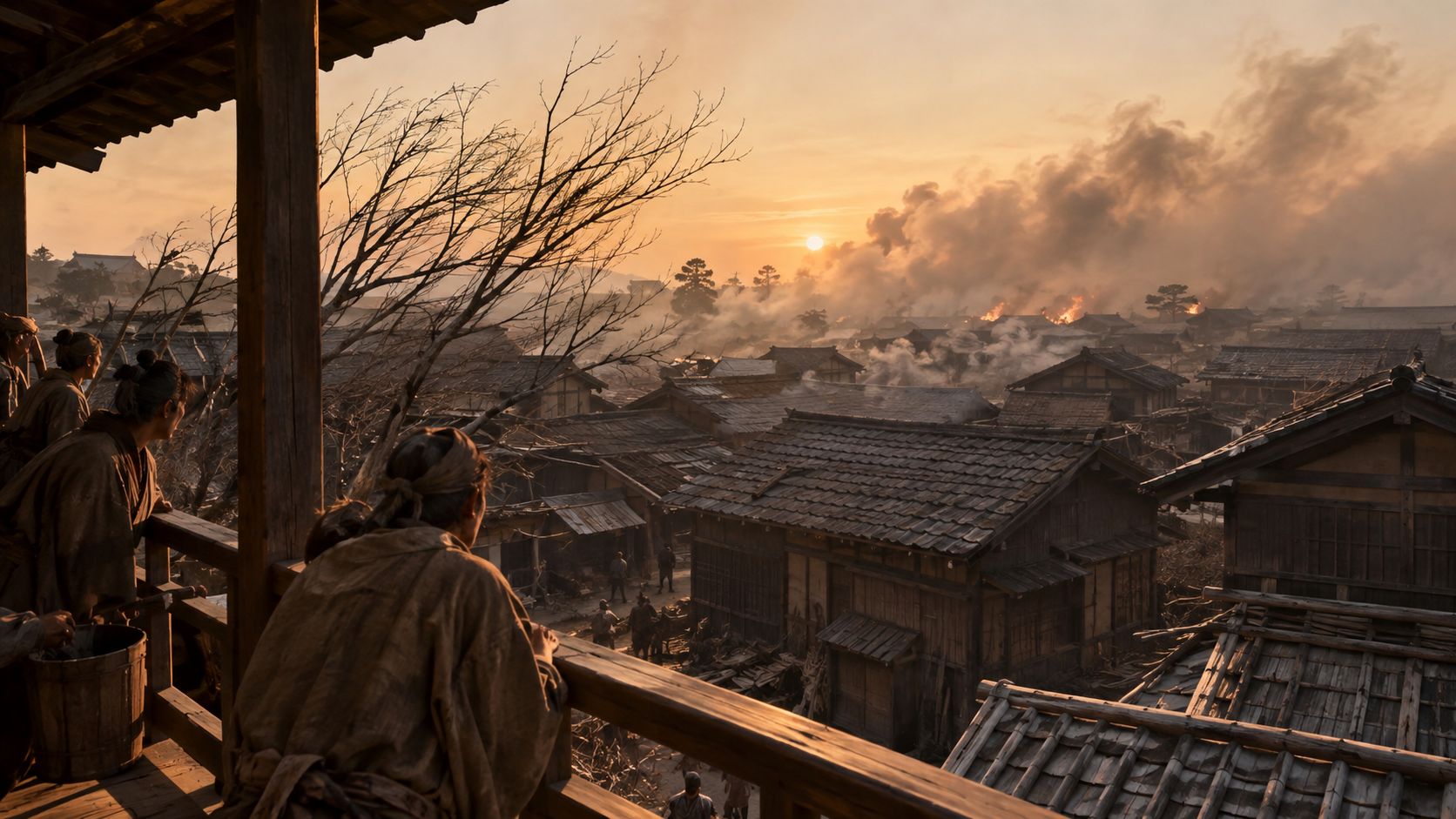
The story of a single garment cannot by itself explain extensive destruction across the city. Where fires began and the conditions through which they spread are separate questions. Recovery measures would address the continuous built environment as well as individual buildings. The imagined smoke above rooftops illustrates that concern; it is not a record of a specific day or proof of the legend.
Chapter 04
The Work Done by Empty Ground
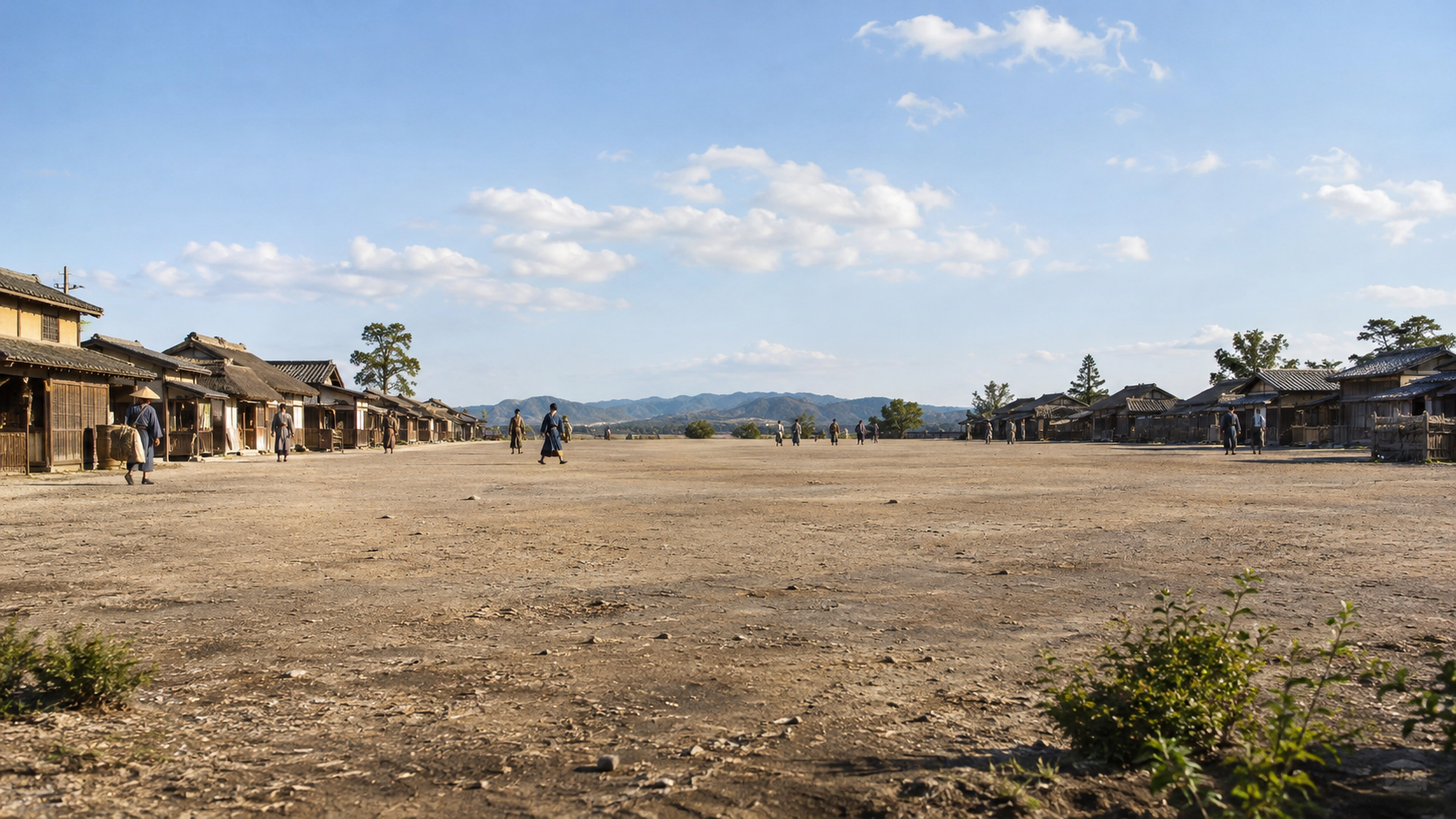
Not every burned site was filled again with buildings. Open areas called hiyokechi and broad roads known as hirokōji were established. Leaving land unbuilt and widening routes introduced space within the continuous fabric of the town. What was absent could therefore have a practical function, rather than simply marking reconstruction that had failed to take place.
Hiyokechi were open areas intended to impede the spread of fire. Such measures considered more than the construction of a single house. They sought to change the relationship through which flames could move to neighbouring buildings across a larger part of the town. The explanation concerns the purpose of the spaces, not a claim that they could eliminate every later fire.
The Tokyo Fire Department’s account also lists restrictions on building, fire-protective embankments and measures concerning roofs. Recovery included both building and placing conditions on how building could proceed. The sources support considering several measures together; they do not turn a conceptual illustration into the exact dimensions or implementation of one regulation.
Unbuilt ground could thus matter to the city. Counting only whether the same number of structures returned would miss this kind of change. Reserving space was another choice about the conditions in which people would live. The illustration evokes a broad opening among low buildings without identifying a particular historical firebreak or reconstructing its surveyed position.
Chapter 05
Where Temples and Residences Moved
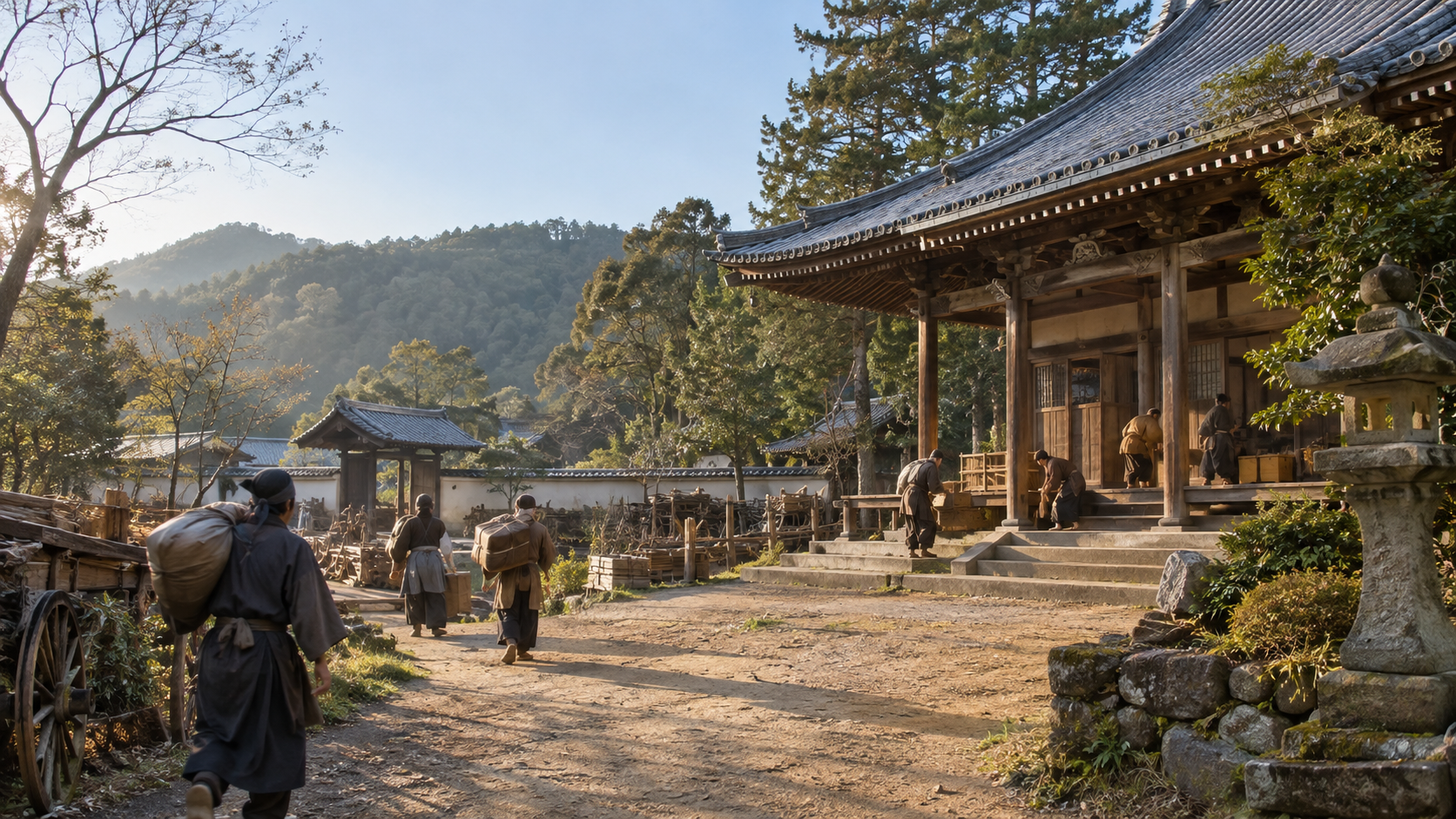
Creating broad spaces also meant changing the locations of facilities and homes. Daimyō residences, temples and shrines were moved toward outlying areas. Urban arrangements intended to address fire were connected with the movement of people. This was more than a question of replacing the timber and tiles of a building on its earlier plot.
The Fire Department names places including Asakusa, Komagome and Mita among destinations for relocated temples. Moving a temple also changed the destination of people visiting it or conducting business there. This connection is an interpretation of relocation’s practical meaning, not a reconstruction of one congregation’s journey or the timetable of an individual move.
Sumida City’s exhibition explanation describes warriors and townspeople moving, and temples and shrines relocating or being established, alongside development in Honjo and Fukagawa prompted by the fire. Changes in the central area were connected with the creation of places to live beyond it. These descriptions do not mean every later religious landscape was completed immediately after the disaster.
Returning to the earlier site was not the only route to recovery. Establishing homes and institutions elsewhere also required ways of reaching them. A bridge across the Sumida River, east of central Edo, would participate in those connections. Relocation and circulation therefore need to be read together rather than as independent lists of reconstruction works.
Chapter 06
Adding a Way across the River
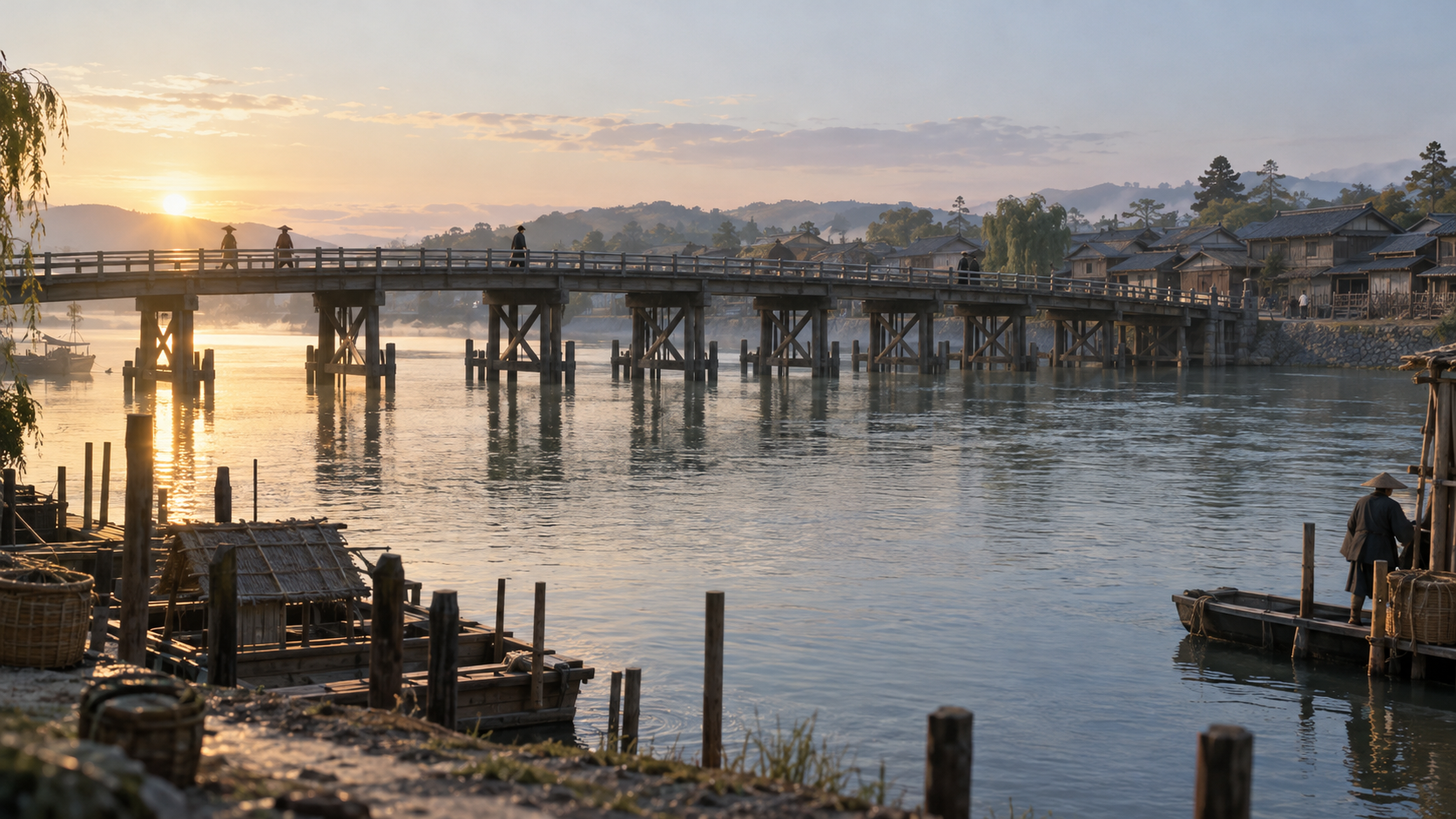
Ryōgoku Bridge was closely connected with recovery after the fire. Sumida City’s chronology places the appointment of officials responsible for its construction in 1658 and completion of the bridge in 1659. The disaster year and the completion year are therefore distinct. Here those dates follow the municipal chronology, rather than being presented as a reading of an original construction record.
The Fire Department relates the bridge to casualties among people unable to escape across the river and to development toward Honjo. The river could carry goods, but it was also a boundary crossed only at available points. That relationship between waterway and passage helps explain why the crossing belongs within the history of rebuilding the city.
Adding a crossing concerned both movement in a disaster and ordinary journeys. Extending inhabited areas to the eastern side and providing a way for people to get there were connected tasks. The bridge was one component in that relationship, rather than a structure whose significance can be explained only by its engineering or its appearance.
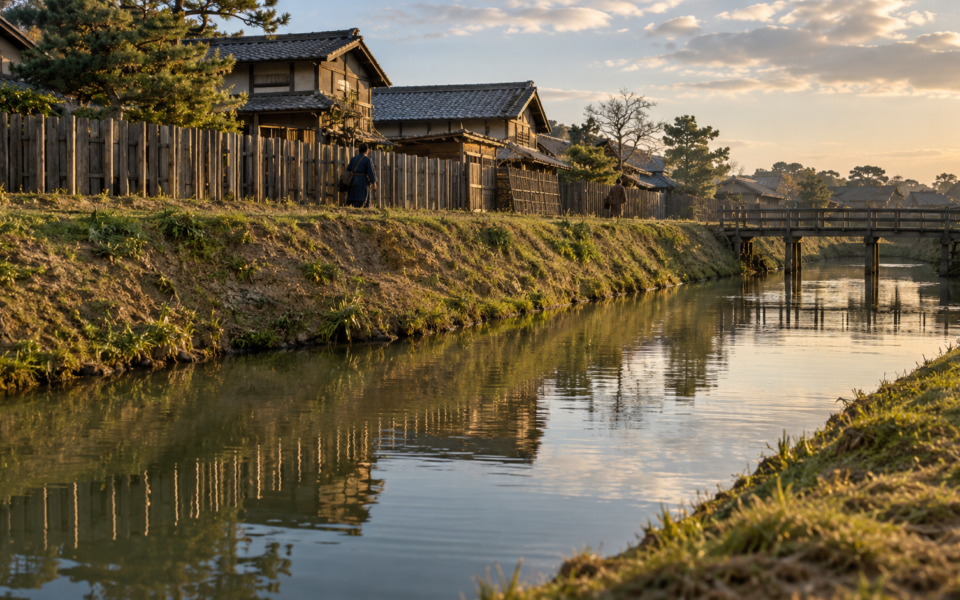
Ryōgoku Bridge must not, however, be called the first bridge ever built across the Sumida River. Following the addition of another crossing shows that recovery worked with existing settlement and transport. The illustrative wooden bridge is not an exact reconstruction of Ryōgoku Bridge’s design, number of supports or position.
Chapter 07
Digging Waterways and Supplying Water
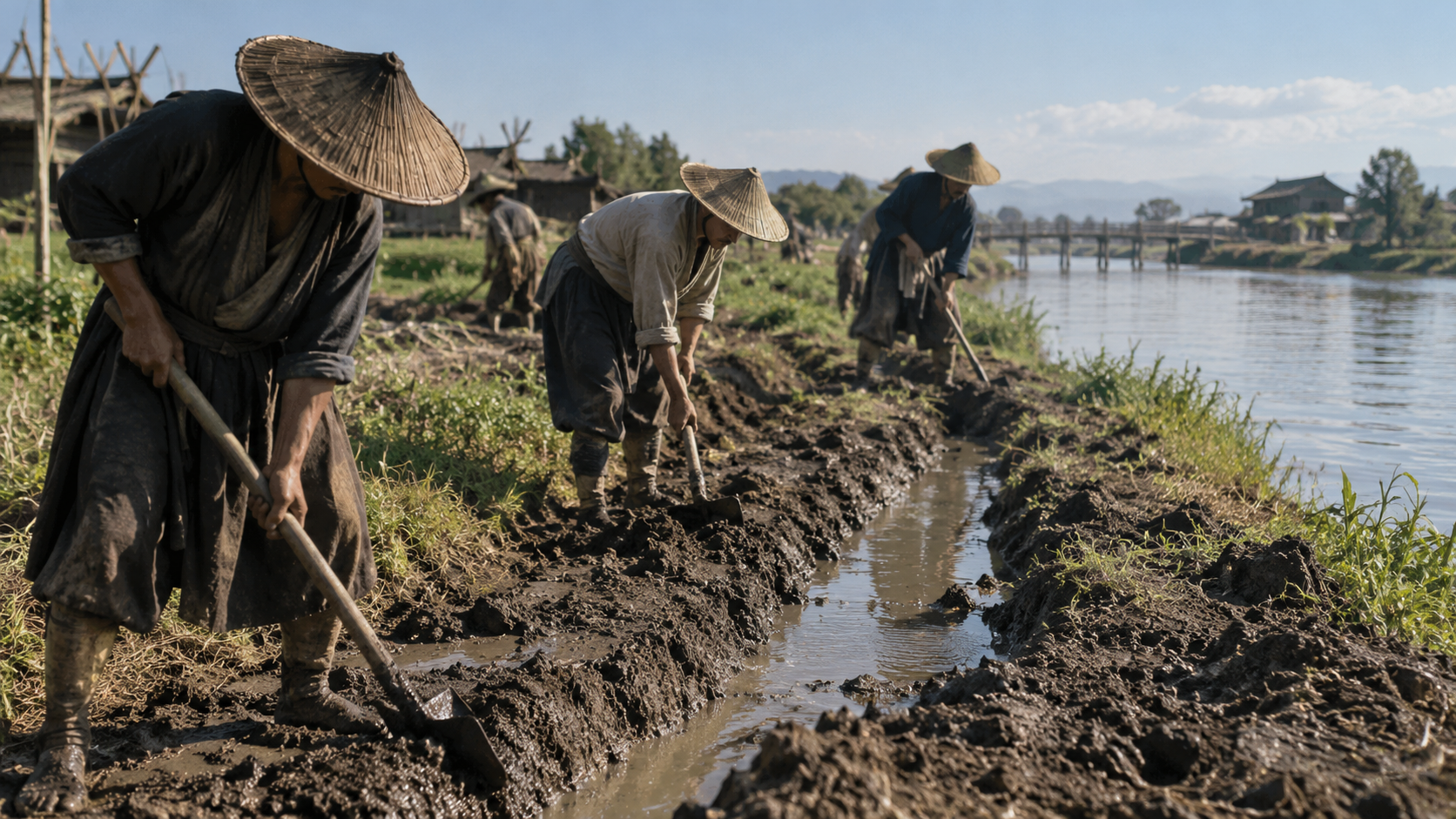
The presence of land beyond the river did not automatically create a town ready for many inhabitants. Sumida City’s chronology records that development in Honjo gained momentum in 1659 and work began on excavating the Tatekawa and Yokokawa waterways. The growth of an inhabited area involved works within the land, as well as a bridge leading toward it.
In 1660, an official position for Honjo land development was established, and water supply from the Kasai waterway began. Preparing places to live, digging channels and delivering water involved different functions of construction and management. These chronological entries should not be compressed into a single event in the immediate aftermath of the 1657 fire.
Bridge construction, land preparation, canals and water supply each supported something different. Keeping their roles separate makes urban expansion more concrete. The change was not merely an additional patch of colour on a map. The sources describe activities and arrangements through which land could become connected with the life of a town.
In low-lying areas, water sustained everyday life while also imposing conditions that required management. The expanded town would later face flooding as well as the threat of fire. Before following those later difficulties, the narrative returns to the castle, where the choice of what to rebuild presents another aspect of recovery.
Chapter 08
Repairing the Base, Leaving the Keep Unbuilt
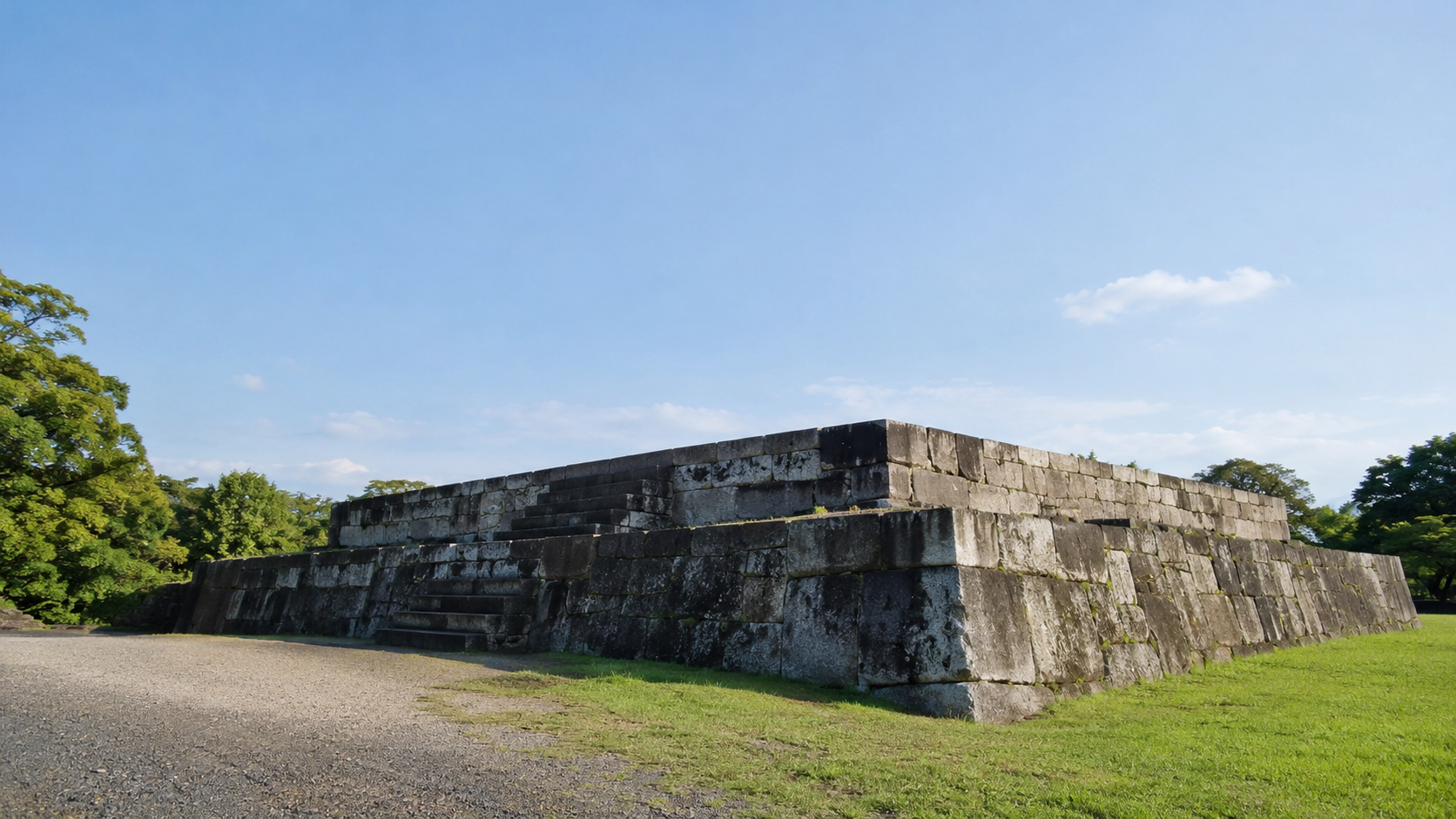
The Tokyo Metropolitan Library’s explanation states that the damaged keep base was restored by the Maeda family of Kaga, with the work completed in 1658. The masonry platform was repaired, but a keep did not subsequently rise above it. The state of the base and the absence of the tower must therefore be understood as different parts of the construction history.
The library places an objection by Hoshina Masayuki to spending resources and labour on the keep in 1659, along with the decision not to rebuild it. This sequence is attributed to the institution’s account. The narrative does not reproduce a speech word for word or claim direct access to Masayuki’s private reasoning beyond that explanation.
The Edo-Tokyo Museum also explains that plans to rebuild the keep after the fire were not realized. The Honmaru palace, meanwhile, underwent later alteration, destruction by fire and rebuilding. The missing tower did not mean that the castle as a whole lost every function. A keep and a palace should not be treated as alternative names for the same structure.
A simple choice between saying the castle was repaired and saying it was not repaired misses these distinctions. Separating platform, tower and palace shows that restoration involved selecting what would return. The conceptual view of a towerless stone base illustrates that distinction without claiming to show the actual surviving masonry or a precise reconstruction of its appearance in 1658.
Chapter 09
Stone That Speaks of a Different Fire
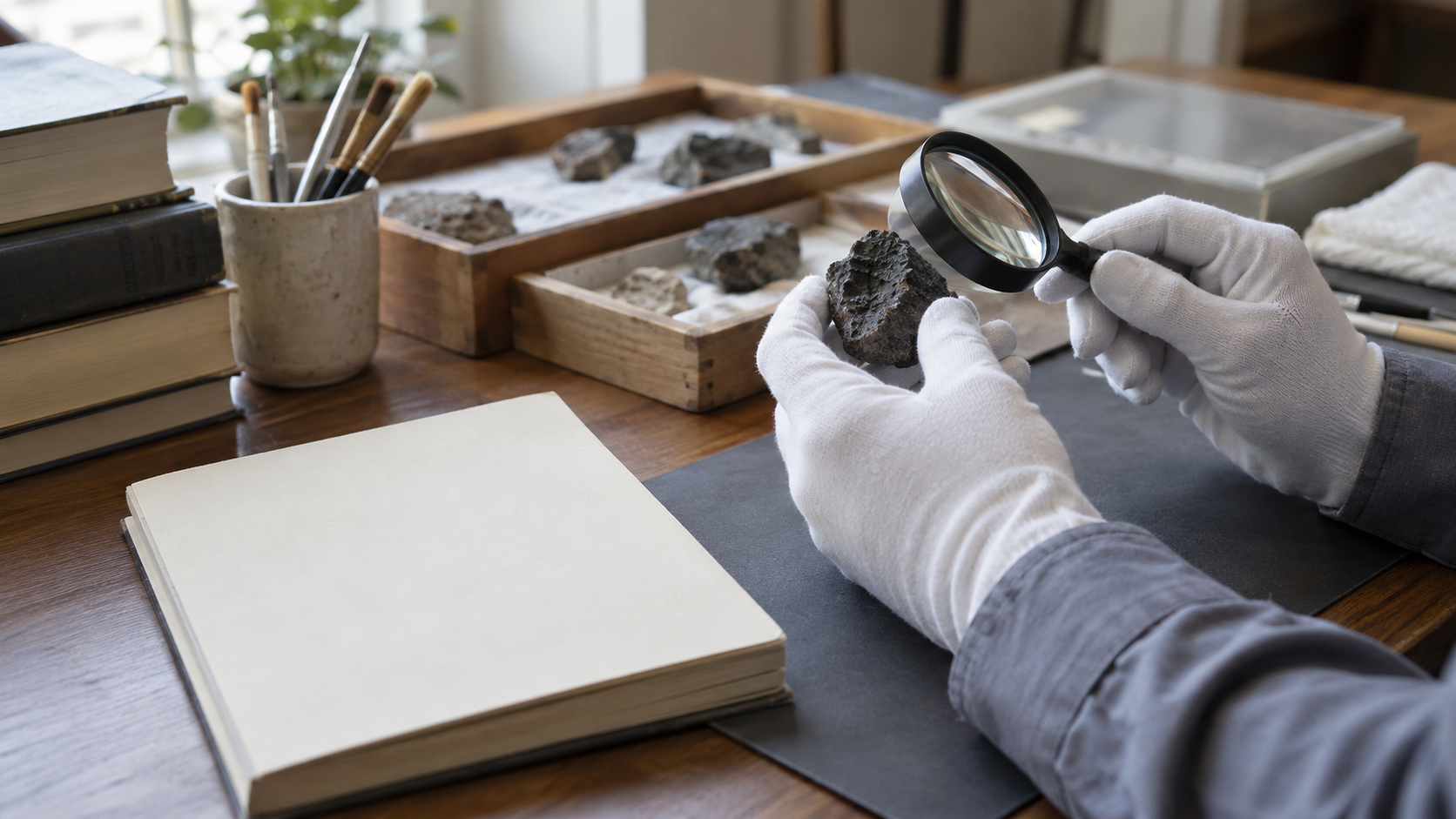
The stones visible now do not speak only of the fire of 1657. A Tokyo Metropolitan Library reference answer introduces an explanation that damaged surface stones of the keep base were replaced, while older stone was reused in foundations or other walls. The evidence presented is the institution’s summary of published research, not a new examination of each stone.
Repair after fire is another layer in the masonry’s history. Treating an old-looking stone as though it remained exactly in its disaster condition would overlook the work of those who repaired and reused material. A structure may preserve earlier fabric while also bearing the consequences of intervention, replacement and later events.
The library associates burning damage on part of the keep base with a fire in 1859. The presence of a scorched surface alone therefore cannot identify it as direct evidence of the Great Meireki Fire. The two fires were separated by roughly two centuries. That chronological distinction matters even when an object or a surface seems immediately evocative of disaster.
A drawing concerning the layout of the keep base likewise belongs, in its catalogue description, to work in the late Tokugawa period. Reading a surviving object or a drawing requires attention to when it was repaired or drawn, not only to the famous year of destruction. The imagined modern stone examination is neither the actual material nor an independent forensic identification.
Chapter 10
A Town That Withdrew after Flooding
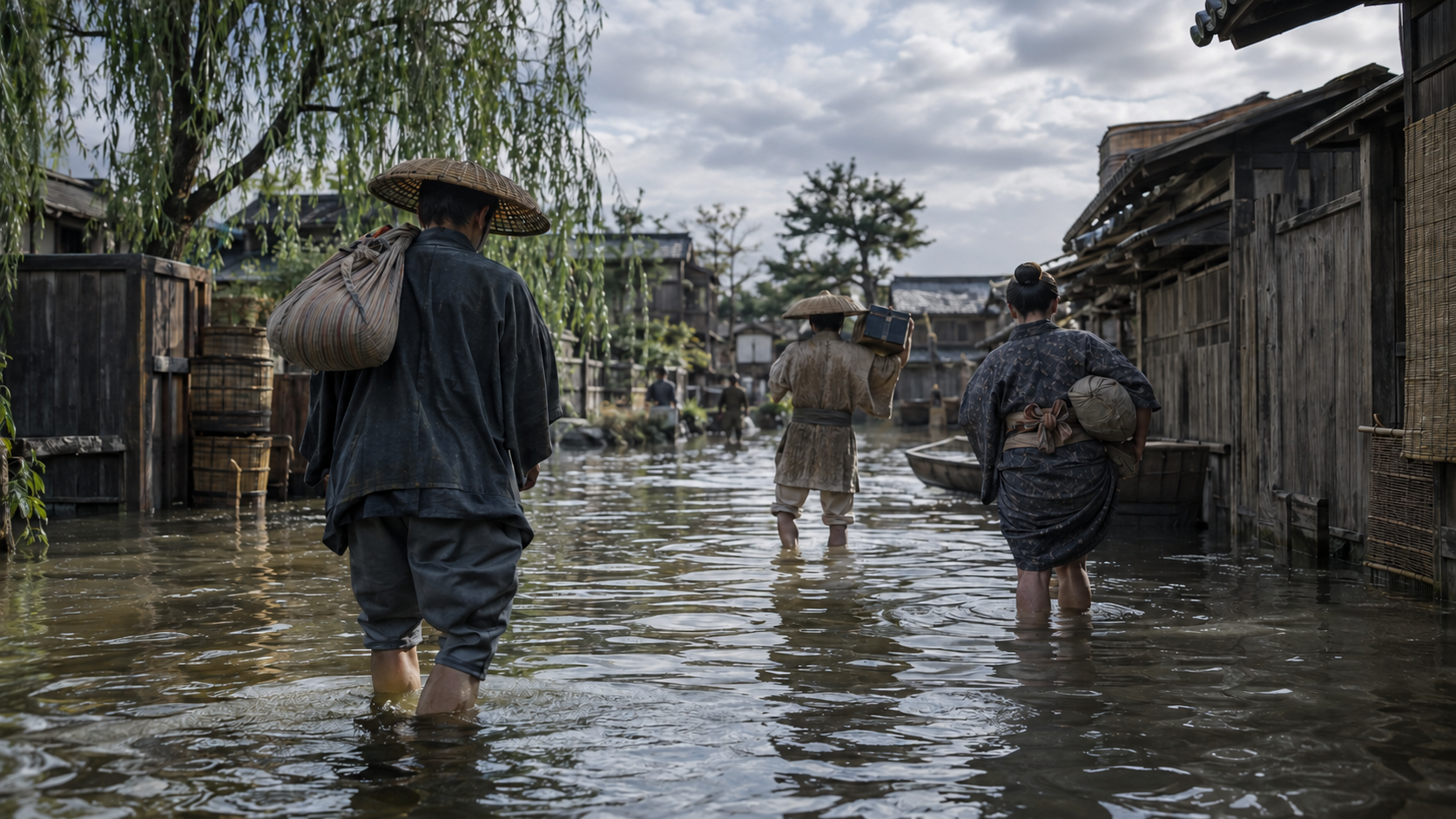
Did Honjo’s development proceed smoothly once it began? Further entries in Sumida City’s chronology describe a different course. In 1682, after repeated flooding, the shogunate abandoned its management of Honjo and permitted warrior residences to move away. This was a later episode, not another name for the immediate rebuilding after the fire.
Withdrawal from the urban area had been completed by 1684, with many places becoming fields. Management resumed in 1688, and the relocation of residences, temples and townspeople’s buildings was pursued again. These events occurred decades after the initial postfire development. Keeping the interval visible prevents the story from becoming one uninterrupted construction campaign.
A town expanded in response to fire still faced a different environmental condition in flooding. Leaving a developed area and later preparing it again complicates a simple route from the beginning of work to a finished city. Recovery could involve withdrawal and renewed activity, rather than a single completion that settled all the conditions of habitation.
The year construction began did not determine the entire later history of a place to live. Supplying water and responding to flood danger were both necessary concerns. Work on the conditions supporting everyday life continued after the great fire. The imagined flooded street does not establish the water level, district or individual experience of the 1682 event.
Chapter 11
Firefighters Also Have a Chronology
An image of Edo fire may bring to mind firefighters carrying a matoi standard. That familiar later appearance cannot simply be placed in the town of 1657. The dates at which organizations took shape and the differences among them need attention before their equipment and imagery are used to illustrate a particular disaster.
The Edo-Tokyo Museum describes jōbikeshi, daimyō-bikeshi and machi-bikeshi as three organizations with different chains of command. Treating everyone who fought fires as one body would hide differences in leadership and responsibility. The account uses the museum library’s published reference answer, rather than claiming to have read every book listed in its bibliography.
The museum’s explanation dates the formation of the iroha groups to 1720, more than sixty years after the Great Meireki Fire. Familiar later clothing and tools cannot authenticate activities on the day of the earlier disaster. An illustration of modern research is used here instead of presenting a later firefighting formation as a witnessed scene from 1657.
This chronological caution does not mean that Edo had no firefighting arrangements at all in 1657. Avoiding the importation of a later image allows different organizations and periods to remain distinct. In that way, the changing work of responding to fire becomes part of the longer urban history without being compressed into a single timeless picture.
Chapter 12
What Returned and What Changed
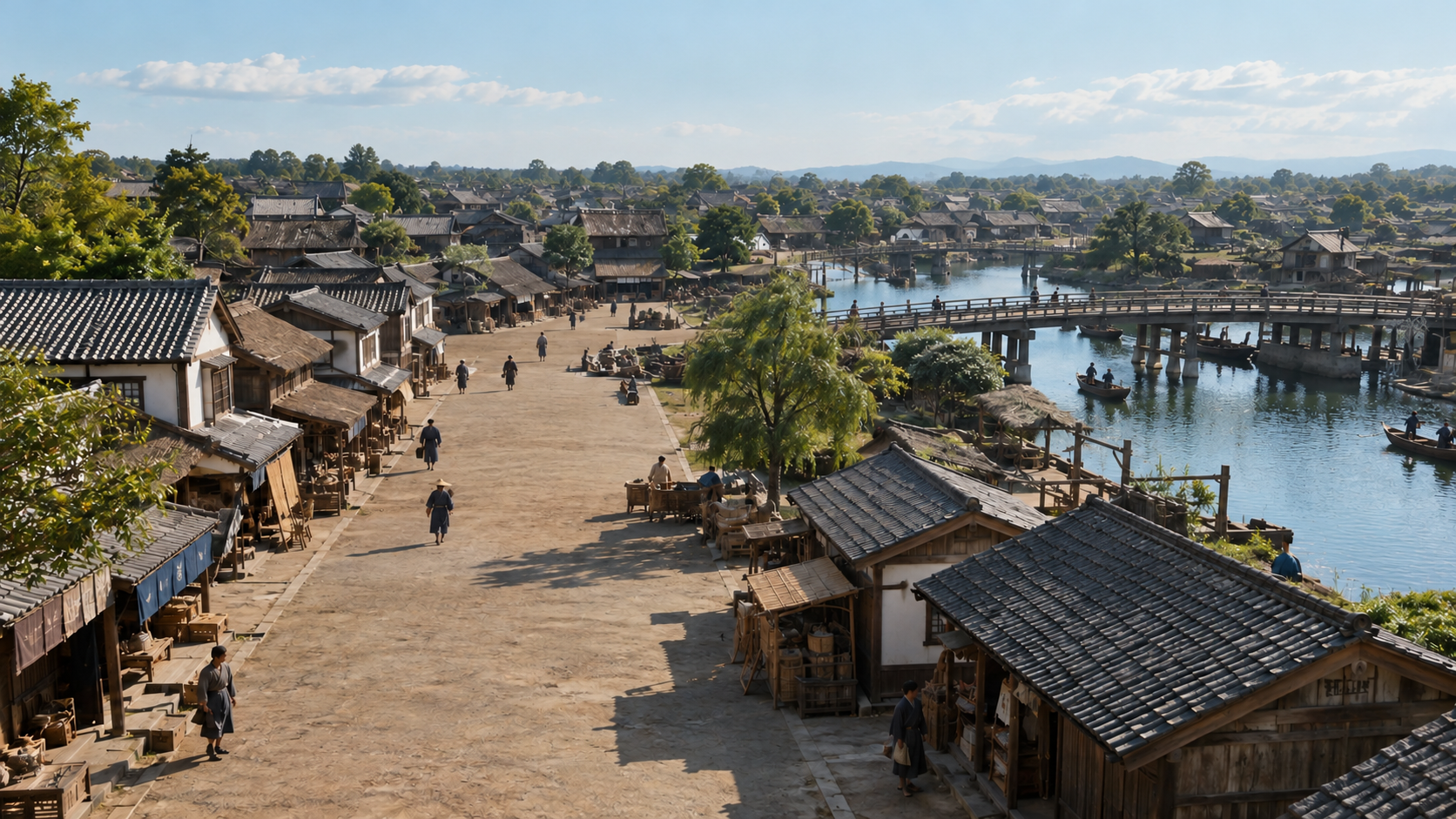
After the Great Meireki Fire, Edo gained open firebreak areas and wider roads. Residences, temples and shrines moved, while a bridge and new waterways added connections across and beyond the river. At the castle, the keep base was repaired but the keep was not built again. Recovery included choosing both what to restore and what spatial arrangements to change.
The Tokyo Metropolitan Library describes Edo’s extent as growing from two ri square to four ri square. This is an institutional explanation of urban expansion, not a precisely surveyed boundary or an exact calculation of the city’s area. The description should not be converted into a geometric measurement more certain than the source provides.
Sumida City also describes changes in the landscape as temple and shrine relocation was followed by visits and the circulation of people among places of interest. Later activity must not be mistaken for a complete town produced immediately after the disaster. Construction, flooding, withdrawal and renewed development belong in the intervening time.
What should be rebuilt, what should remain unbuilt, and where could people live? Beginning with a keep base without its tower leads toward open ground and connections across the river. Edo recovered through changes in its form as well as the return of buildings. Its history after the fire is therefore wider than the story of restoring a lost skyline.
How to read this work
History, interpretation, and reconstruction
Distinguishing keep from base, open ground from relocation, and bridges from waterways reveals recovery that changed the city, including later reversals in Honjo.
This work is grounded in published sources and historical research. Interior thoughts, dialogue, and some visual details are cinematic reconstructions. Where historians disagree, the article presents the point as debated rather than settled fact.
Timeline
The story in time
-
Sumida City’s chronology places completion of Ryōgoku Bridge and the start of Tatekawa and Yokokawa excavation in this year, as Honjo development gathered pace.
Sources: s03 -
The Metropolitan Library places Masayuki’s objection and the decision not to rebuild the keep in this year.
Sources: s05 -
An official position for Honjo land development was established and water supply from the Kasai waterway began.
Sources: s03 -
Repeated flooding led to abandonment of Honjo management and withdrawal from the urban area.
Sources: s03 -
Honjo management resumed and the relocation of residences, temples and townspeople’s buildings was pursued again.
Sources: s03 -
The iroha firefighting groups were formed, later than the 1657 disaster.
Sources: s06 -
The later fire with which the Metropolitan Library associates burning damage on part of the keep base.
Sources: s08
People & terms
A guide for new readers
Key figures
- Tokugawa Ietsuna
- The fourth shogun, during whose rule the Great Meireki Fire occurred.
- Hoshina Masayuki
- The Tokyo Metropolitan Library’s explanation associates his objection to rebuilding the keep with the decision described for 1659.
Glossary
- Great Meireki Fire 明暦の大火
- The major Edo disaster of 1657, discussed here through its outbreaks and the choices made during recovery.
- Edo 江戸
- The city whose postfire recovery is followed from castle buildings and central streets to land east of the Sumida River.
- Tenshu 天守
- The castle keep or tower, distinct from its stone platform and the palace.
- Tenshudai 天守台
- The stone base for the keep; repairing this platform did not necessarily entail rebuilding the tower.
- Honmaru palace 本丸御殿
- The palace within the castle’s main enclosure, with a history of later alteration, fires and reconstruction distinct from the unrebuilt keep.
- Hiyokechi 火除地
- Open areas reserved to help impede the spread of fire between buildings.
- Hirokōji 広小路
- Broad streets or openings in the urban fabric, associated here with postfire spatial changes.
- Ryōgoku Bridge 両国橋
- A crossing added after the fire; Sumida City’s chronology places its completion in 1659. It was not the first bridge across the river.
- Honjo 本所
- The area whose development, waterways, flooding, withdrawal and resumed management are followed through the municipal chronology.
- Daimyō 大名
- Lords whose residences and firefighting responsibilities appear in the institutional explanations; different from townspeople’s organizations.
- Jōbikeshi 定火消
- One of the firefighting organizations distinguished by the museum’s explanation, with a chain of command different from the other bodies.
- Machi-bikeshi 町火消
- Townspeople’s firefighting organizations, distinguished from permanent and daimyō firefighting bodies.
- Iroha groups いろは組
- Firefighting formations dated to 1720 in the museum’s explanation; they must not be silently placed in the 1657 disaster.
- Furisode fire 振袖火事
- A traditional name associated with stories of a long-sleeved robe; the variants do not establish a single proven cause of the disaster.
- Ri 里
- The historical distance unit used in the library’s description of Edo’s expanding extent; that wording is not treated as a precise area survey.
Sources & method
How this article was built
This English narrative translates the fixed Japanese article and retains its eight source identifiers and their order. Background explains castle terminology, historical dates and the different stages of recovery. English source titles are editorial translations. Interpretations connecting urban space and the conditions of living are distinguished from a quotation or a single original record.
The material consulted consists of modern institutional explanations, catalogue entries and library reference answers. Collection images, the original keep-base drawing, physical stones and the full books cited in reference bibliographies were not independently examined or read for this article. No original quotation from Masayuki, eyewitness conversation or personal psychology is reconstructed.
The Fire Department’s variant robe stories do not establish a single verified ignition cause. Casualty estimates remain disputed. The chronology follows each provider’s stated scope, with Ryōgoku Bridge dates attributed to Sumida City. Later exhibition pages are historical reference material, not current visitor announcements. Twentieth-century air-raid material adjacent to one exhibition page is not used as evidence for the seventeenth-century fire.
All twelve illustrations are retained SHIGEKI AI-generated explanatory scenes with corresponding rights and image bytes. They do not show authenticated portraits, actual disaster victims, precise maps, original buildings, identified stones or documentary views of specific fires and floods. Modern stone study and library research scenes are explicitly modern. Institutional photographs and collection images are not copied.
Publisher labels consolidate the Metropolitan Library, its archive and the Tokyo Fire Department under Tokyo Metropolitan Government, and both Sumida pages under Sumida City. The Edo-Tokyo Museum is identified through its operating foundation. Separate departments, archive pages and reference answers are not multiplied into independent publishers.
Sources
References and further reading
- Recovery after the Great Meireki Fire 「明暦の大火」からの復興 Title translated editorially for reader convenience. Tokyo Metropolitan Government 東京都立図書館 Metropolitan Library overview of the scale, disputed casualties, recovery measures and urban expansion; collection images not independently examined. Accessed 2026-10-19
- The Great Meireki Fire and Its Stories 明暦の大火とエピソード Title translated editorially for reader convenience. Tokyo Metropolitan Government 東京消防庁 Tokyo Fire Department explanation of outbreaks, damage traditions, recovery measures and variant robe legends, presented with its reference to a 2001 encyclopedia. Accessed 2026-10-19
- Chronology of Sumida History 墨田区通史年表 Title translated editorially for reader convenience. Sumida City 墨田区 Selected entries for the fire, bridge, Honjo development, waterways, water supply, withdrawal and restart; the full chronology is not claimed read. Accessed 2026-10-19
- Sumida Seen through Temple and Shrine Sites 寺社名所から見るすみだ Title translated editorially for reader convenience. Sumida City 墨田区 Past-exhibition explanation of relocation, development and later places of interest; distinct from an adjacent exhibition about the twentieth-century air raid. Accessed 2026-10-19
- Layout of Edo Castle’s Keep Base 江戸城天守台地割 Title translated editorially for reader convenience. Tokyo Metropolitan Government 東京都立図書館TOKYOアーカイブ Metropolitan Library archive catalogue and explanation of the 1658 base work and 1659 non-rebuilding decision; the catalogued drawing concerns later works and is not treated as a 1657 eyewitness image. Accessed 2026-10-19
- Firefighting in the Edo Period 江戸時代の火消について Title translated editorially for reader convenience. Tokyo Metropolitan Foundation for History and Culture 江戸東京博物館 Edo-Tokyo Museum library reference answer distinguishing organizations and the later iroha groups; the listed books themselves are not claimed read in full. Accessed 2026-10-19
- What Was Edo Castle’s Honmaru Like? 江戸城の本丸はどのような姿だったのか Title translated editorially for reader convenience. Tokyo Metropolitan Foundation for History and Culture 江戸東京博物館 Edo-Tokyo Museum reference explanation distinguishes keep and palace and their construction, destruction and rebuilding; cited books not independently read in full. Accessed 2026-10-19
- Stonework of Edo Castle’s Keep Base 江戸城天守台の石垣について Title translated editorially for reader convenience. Tokyo Metropolitan Government 東京都立図書館 Metropolitan Library reference answer on replacement, reuse and damage associated with the 1859 fire; no independent identification of physical stones or original photographs. Accessed 2026-10-19
Continue reading
More stories from Shigeki
Shigeki English
Sakai’s Merchant City: Trade, Self-Government and Survival
A port, a merchant council and town communities—from changing authority to rebuilding after fire.
- When From the later fifteenth century through the Sengoku period, the fire of 1615 and early Edo-period reconstruction.
- Where Sakai, in present-day Osaka Prefecture, where maritime routes met roads on land.
Shigeki English
The Aburanokōji Incident: After Leaving the Shinsengumi
A separation in spring, a new base in summer, and two successive attacks.
- When Kyoto in Keiō 3 (1867). The incident’s historical date corresponds to December 13, 1867.
- Where Kyoto: the guards’ successive bases, the Aburanokōji attack site and the later place of remembrance.