
SHIGEKI ENGLISH STORYEN
Japanese history in English
Katsu Kaishu and the Surrender of Edo Castle: Talks, Notification and Handover
A shogunate retainer born in Honjo studied the sea and came to negotiate the transfer of Edo Castle. From the talks to the day the castle changed hands, and on to his last years at Senzoku Pond.
Was Edo Castle handed over on the day Katsu Kaishu met Saigo Takamori? This article follows Katsu from his birth in Honjo through Dutch learning, naval training in Nagasaki, the Kanrin Maru, the Kobe naval training center and his dismissal, and the ceasefire with Choshu, then separates the talks of the third month, the notification on the fourth day of the fourth month and the handover on the eleventh. Yamaoka Tesshu's earlier contact, the fighting at Ueno, his Meiji offices and his last years at Senzoku Pond are also placed in view. Dates for 1868 follow the contemporary calendar.
At a glance
Before you enter the story
- When
- From his birth in 1823 through Nagasaki in 1855, the Kanrin Maru in 1860 and Kobe in 1864 to the surrender of Edo Castle in Keio 4 (1868), Meiji offices and his death in 1899; month and day references for 1868 use the contemporary Japanese calendar, without conversion
- Where
- Edo (Honjo, Takanawa, Tamachi, Edo Castle and Ueno), Nagasaki, San Francisco, Kobe, Miyajima, Shizuoka and Senzoku Pond in Tokyo
- Key figures
- Katsu Kaishu, Saigo Takamori, Yamaoka Tesshu, Tokugawa Yoshinobu, Sakamoto Ryoma
- What was at stake
- How did talks lead toward a castle transfer, and what does the expression bloodless surrender actually cover?
Why this story matters
The larger history behind the turning point
A famous meeting can become a substitute for the event it helped bring about. Following the dates keeps discussion, notification and implementation visible as successive actions, and following Katsu's career shows how a naval specialist came to stand at the negotiating table.
The sources also preserve limits that matter: a letter whose year is unknown, a summary of formal provisions, meeting places with more than one theory, recollections told decades later and a battle after the surrender. Keeping these details in the story makes its familiar title more precise without filling the record with imagined words.
Historical context
What an international reader needs to know
The people and institutions in the account
The shogunate was the military government served by Katsu and Yamaoka. The Tokugawa house is the family named in the formal decision described here. Saigo was their negotiating counterpart. These names identify participants and institutions whose roles differ across the talks, notification and transfer.
A domain, such as Owari, was a territorial unit under a lord. In the exhibition summary, Owari appears as the recipient of the castle. An imperial envoy carried the decision concerning the Tokugawa house into the castle. The glossary explains these terms as they function in this account.
Reading dates, places and documents
The Japanese article keeps the contemporary calendar of Keio 4, corresponding to 1868. This English edition uses expressions such as the third month and fourth month to avoid making them look like modern March and April. No Western calendar conversion has been supplied.
Edo Castle and Ueno are distinct settings in the account of Edo, later Tokyo. Likewise, a private letter, a government publication and a modern exhibition explanation are different kinds of source. These distinctions help readers follow both the progression of events and the basis for describing them.
Watch the film
See the story in motion
The film currently uses Japanese audio. This English article provides the context and source trail; it does not imply that an English subtitle track is available.
Opening
Did Edo Castle open on the day of the talks?
Was Edo Castle handed over on the same day that Katsu Kaishu and Saigo Takamori met? When the dates in an explanation by the Tokyo Metropolitan Library are lined up, the talks took place on the thirteenth and fourteenth days of the third month, an imperial envoy entered the castle on the fourth day of the fourth month, and the handover followed on the eleventh day of that month.
Around one famous scene, separate events followed one another. People met and negotiated, a decision was communicated, and then a castle was transferred. Separating these three stages shows what the familiar phrase "bloodless surrender" actually covers, and where its edges lie.
This article also follows the life of Katsu Kaishu, the man who handled the negotiations, from his birth to his last years. Dates for 1868 stay in the calendar used at the time, Keio 4, and no dialogue or private feelings are added where the consulted records do not provide them.
Chapter 1
Rintaro, born in Honjo
Katsu Kaishu was born on the thirtieth day of the first month of Bunsei 6, or 12 March 1823, in Honjo Kamezawa-cho in Edo. According to Nippon Tabi Magazine, the house was that of the Otani family, the birth family of his father Katsu Kokichi, and his childhood name was Rintaro.
The Japan Center for Asian Historical Records describes Kokichi as a low-ranking retainer of the shogunate. Rintaro is said to have lived in the Otani house until the age of seven and then in Honjo Irie-cho, in the same district on the east bank of the Sumida River.
In 1838 his father retired and Rintaro became head of the family. A monument now marks the reported birthplace in Ryogoku Park in Sumida Ward. The man who would later negotiate on behalf of the Tokugawa house began life in the household of a modest retainer. The shogunate he served, the domains that opposed it and the new government that replaced it all appear in this story, and each is kept distinct.
Chapter 2
Dutch learning and the road to the navy
Around 1845, Katsu studied Dutch learning under Nagai Seigai, according to the Japan Center for Asian Historical Records, and in 1850 he opened a school of his own. Through books written in Dutch, he came into contact with Western military science and the knowledge that came with it.
In 1855 he was sent to the naval training programme in Nagasaki, a place where the shogunate had begun training men to handle warships. The National Diet Library's biographical note also records that he studied Dutch learning and Western military science at the Nagasaki naval training institute.
In 1859 he became head instructor at the shogunate's naval training school in Edo. This background does not by itself explain any decision he later made at the negotiating table. It does show that Katsu first served the shogunate as a specialist in ships and the sea. His later titles and the name Kaishu, by which he is best known today, came long after these early years in Honjo.
Chapter 3
Across the Pacific on the Kanrin Maru
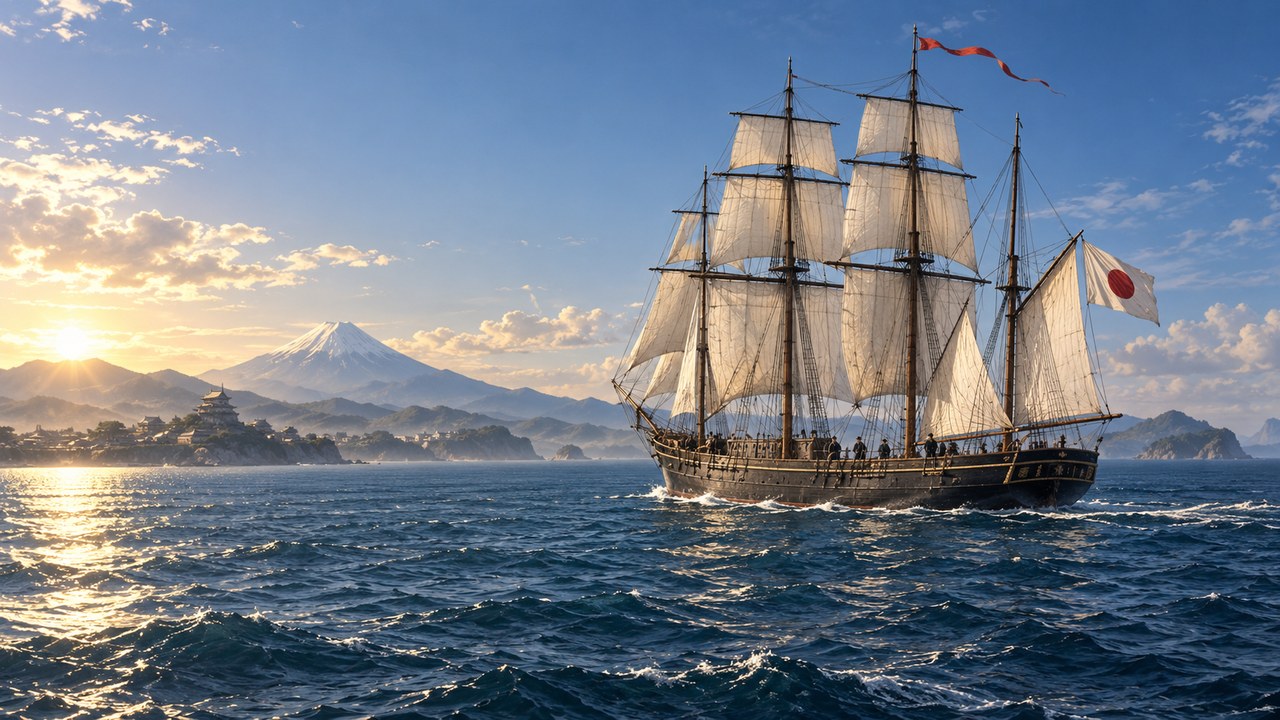
In 1860, Katsu crossed the Pacific to the United States as captain of the Kanrin Maru. The National Diet Library's biographical note presents this voyage as a major milestone in his career, alongside his naval training and his later work in teaching.
Dictionary entries collected on Kotobank record that the ship reached San Francisco, and one describes it as the first crossing of the Pacific achieved by Japanese. According to the Japan Center for Asian Historical Records, Katsu returned to Japan in the same year.
What seeing a foreign port and city with his own eyes meant for his thinking is not something this article can confirm from his own words, because no such source has been read here. The voyage is placed simply as one fact in the course of his life.
Chapter 4
The Kobe naval training center and a sudden dismissal
Katsu became deputy naval commissioner in 1862 and naval commissioner in 1864. According to the National Diet Library, he opened a naval training center in Kobe and taught students and activists from many domains there, including Sakamoto Ryoma.
Nippon Tabi Magazine explains that the center was established in the fifth month of 1864 at Katsu's suggestion and that Ryoma served as its head student. Because many of those who gathered there were not retainers of the shogunate, among other reasons, it was closed in 1865 after about a year of actual operation.
Katsu himself was removed from his post as naval commissioner in 1864. One encyclopedia entry on Kotobank explains that he was blamed for protecting masterless samurai. His position inside the shogunate was far from secure, even as his reputation as a naval expert grew. Later accounts often link the voyage to his views on Japan and the wider world, but such links are interpretations rather than findings of this article.
Chapter 5
A ceasefire with Choshu, then 1868
In 1866 Katsu was again appointed naval commissioner and handled ceasefire negotiations in the war between the shogunate and the Choshu domain. An encyclopedia entry places the talks at Miyajima in Aki Province. From this point his work as a negotiator becomes more prominent in the record.
In the first month of 1868 the shogunate's forces were defeated at the Battle of Toba-Fushimi. The Tokyo Metropolitan Library explains that the new government sent an eastern expeditionary army toward Edo to pursue Tokugawa Yoshinobu, and that the Tokugawa house adopted a posture of submission.
That year, according to the Japan Center for Asian Historical Records, Katsu became deputy naval commissioner and was appointed army commander-in-chief with the rank of a junior councillor. The naval specialist now faced the approaching army as a senior military official responsible for Edo. Those who trained there included men who went on to play roles in the turbulent years that followed, which is one reason the brief institution is remembered.
Chapter 6
Before the two men met
Before Katsu and Saigo sat down together, another man was involved in the negotiations: Yamaoka Tesshu. An exhibition by the Tokyo Metropolitan Library explains that Yamaoka met Saigo first, discussed the terms of surrender, and that a meeting with Katsu was arranged after that contact.
The exhibition also presents a letter Katsu sent to Yamaoka, asking him to come because there was a matter to discuss. Its date, however, is the seventeenth day of the twelfth month of an unknown year. The letter cannot be read as an instruction for the negotiations of the third month.
The National Diet Library holds a collection of Katsu's letters, diaries and other papers, but this article has not confirmed whether the displayed letter belongs to it. Matching names do not prove that the year and month of an event match as well.
Chapter 7
The thirteenth and fourteenth days: Takanawa and Tamachi
The Tokyo Metropolitan Library dates the talks between Katsu and Saigo in Edo to the thirteenth and fourteenth days of the third month. An encyclopedia entry adds that they met on the eve of the day set for the general assault on Edo. The talks were not a single meeting but took place over two days.
Nippon Tabi Magazine places the first day at the Satsuma domain's lower residence in Takanawa and the second at its warehouse residence in Tamachi, while noting that other theories exist. A monument reading "Site of the Meeting of Saigo Nanshu and Katsu Kaishu, Opening of Edo Castle" stands in Shiba 5-chome, Minato Ward.
Ota City's explanation says that the bloodless surrender came about after the meeting at the Satsuma residence and negotiations at Ikegami Honmonji temple. The exact words exchanged in the talks cannot be known from the sources read here. What they show is how the dates and places have been recorded and passed on. Keeping Yamaoka in the sequence shows that the famous meeting was prepared by earlier contact, rather than appearing suddenly between two individuals.
Chapter 8
The fourth day of the fourth month: a decision announced
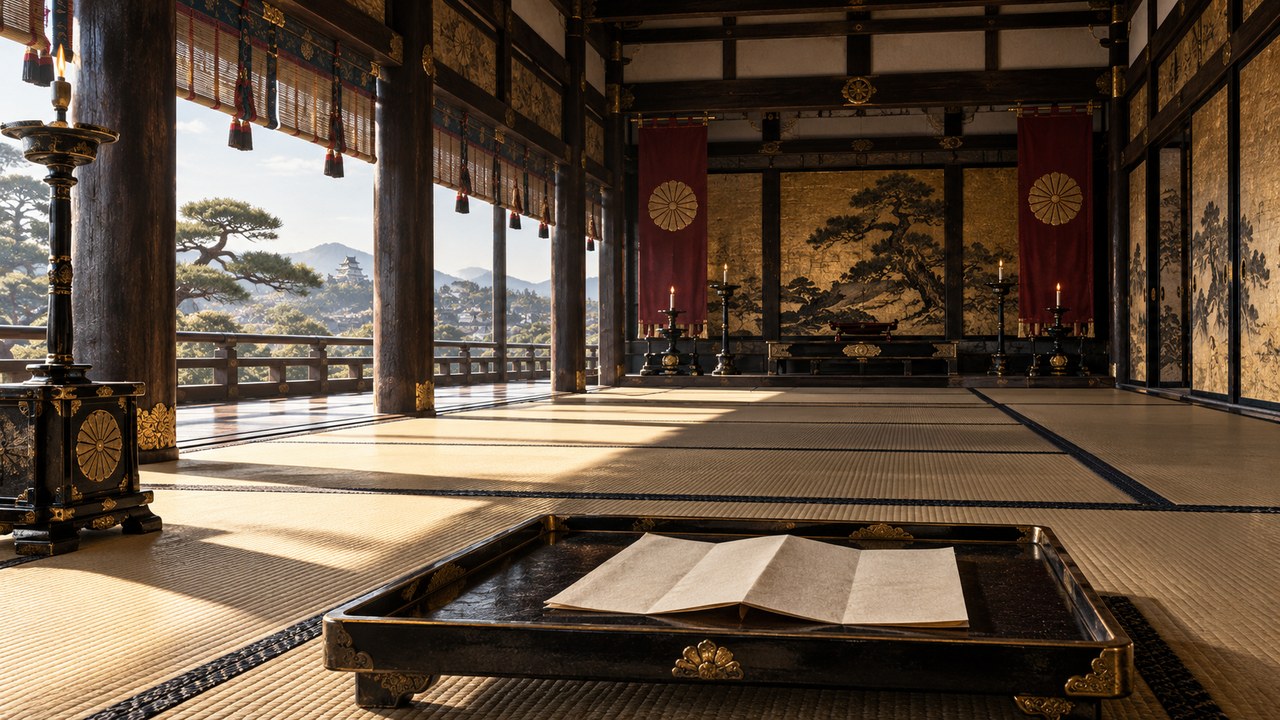
On the fourth day of the fourth month, an imperial envoy entered Edo Castle. The Tokyo Metropolitan Library explains that the decision on the Tokugawa house announced there appears in the Dajokan Nisshi, a government journal of the early Meiji years and a predecessor of today's official gazette.
The exhibition summary lists the preservation of the Tokugawa family name, Yoshinobu's withdrawal to Mito in confinement, and the surrender of the castle to the Owari domain among its provisions. This is a different stage from the meeting of two men: it is the stage at which a decision was communicated.
Here the exhibition summary is used, not a new reading of the original text. An explanation of the talks and a notice made public by the government play different roles as sources. It matters not to expect every answer from a single document. A monument of this kind records how the meeting came to be commemorated and remembered by later generations, rather than what was actually said inside the room.
Chapter 9
The handover on the eleventh day and Ueno in the fifth month
On the eleventh day of the fourth month, Edo Castle was handed over. This transfer is what the Tokyo Metropolitan Library describes as the bloodless surrender. The talks in the third month, the notification on the fourth day and the handover on the eleventh are distinct dates and distinct actions within one year.
Yet fighting in Edo did not end there. The library explains that in the fifth month the Shogitai, formed mainly of former shogunate retainers, fought the new government's forces at Ueno. The handover of the castle and the battle at Ueno differ in place and in kind.
The phrase bloodless surrender refers to the castle being handed over without a fight. It does not mean that the city of Edo never became a battlefield afterwards. Placing the castle in the fourth month and Ueno in the fifth month side by side keeps the meaning of the surrender from being stretched too far.
Chapter 10
In the Meiji government
An encyclopedia entry records that after the Restoration Katsu followed the Tokugawa house to Sunpu, now Shizuoka. According to the Japan Center for Asian Historical Records, in 1869 he held posts as a senior official in the foreign and military ministries and resigned at his own request in 1870.
He became vice minister of the navy in 1872 and, in 1873, a councillor of state and navy minister. He was appointed to the Genroin, the Senate, in 1875 but resigned in the same year. The National Diet Library likewise notes his service as vice minister of the navy, navy minister and senator.
He was made a count in 1887 and appointed a privy councillor in 1888. One dictionary gives 1889 for the privy council appointment, so sources differ. A former retainer of the shogunate thus also held roles at the centre of the new government.
Chapter 11
For former retainers, and for the record
Encyclopedia entries describe Katsu in the 1880s as working outside government to help former shogunate retainers make a living. He is also said to have taken care to restore the reputation of Saigo Takamori, who died in the Satsuma Rebellion of 1877.
Katsu compiled records of the shogunate period, editing Kaigun Rekishi, Rikugun Rekishi and Suijinroku. The well-known Hikawa Seiwa is described by some dictionaries as an autobiography and by others as a record of his conversations written down by others.
Words Katsu spoke in his later years are widely read, but they are recollections looking back. They need to be read separately from records of the negotiations of 1868. The appeal of his storytelling and the weight of contemporary documents are different things. His career in the new state shows continuity across 1868 as well as change, and that continuity is part of why his name endures.
Closing
By Senzoku Pond
According to Ota City, Katsu visited Senzoku Pond in 1890 and built a villa there called Senzokuken. He died on 19 January 1899 at the age of seventy-seven and, in accordance with his wishes, was buried beside the pond. One dictionary gives his date of death as 21 January.
The grave of Katsu and his wife in Senzokuike Park is a cultural property designated by Ota City. His wife Tami died in 1905 and her grave was moved here from Aoyama Cemetery after the war. The nearby former Seimei Bunko library is now used as the Ota City Katsu Kaishu Memorial Museum.
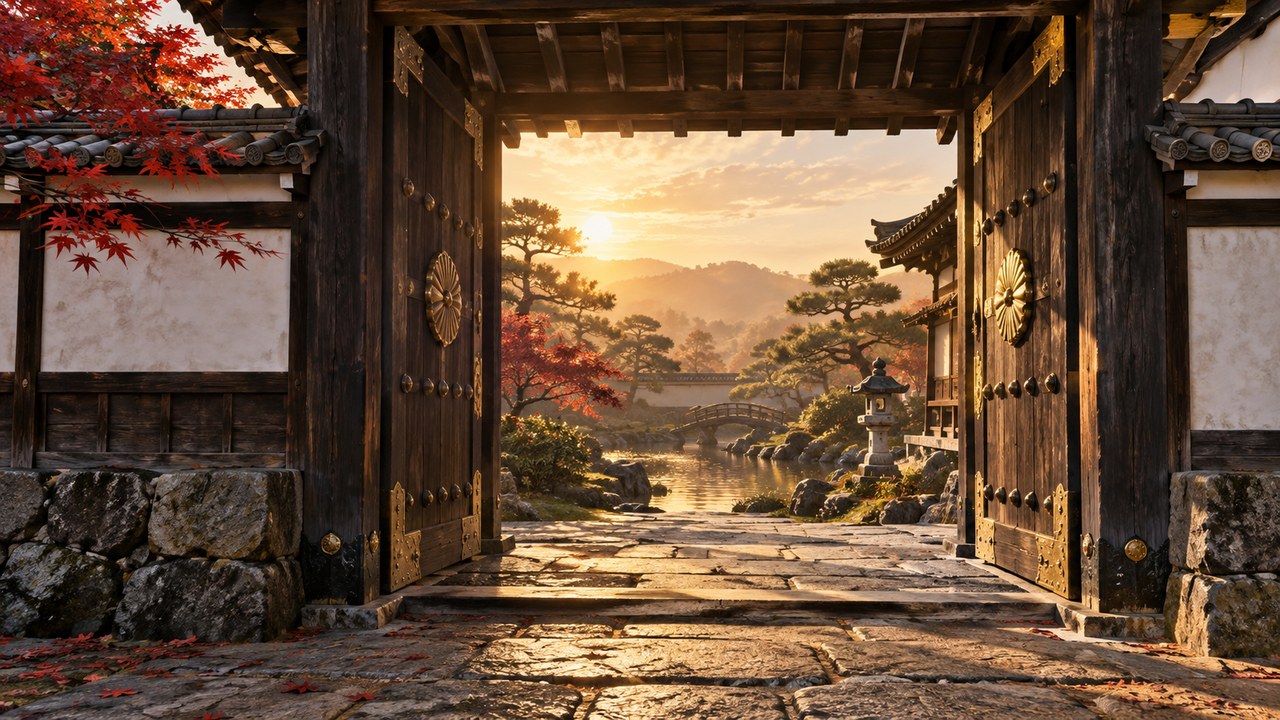
Focusing only on the two men at the table hides Yamaoka's contact, the notification of the fourth month, the handover and the fighting at Ueno. Knowing Katsu's role and keeping the other people and documents in view are compatible. Beyond the opened castle gate lay a period in which negotiation, notification and implementation overlapped. These works are valuable for what Katsu wanted remembered, which is itself a historical question worth keeping separate from the events of 1868.
How to read this work
History, interpretation, and reconstruction
Reading the surrender of Edo Castle as talks, notification and handover makes the negotiations around it, and the different roles of the sources, visible. Following Katsu's life shows that the negotiator emerged from a career as a naval specialist.
This work is grounded in published sources and historical research. Interior thoughts, dialogue, and some visual details are cinematic reconstructions. Where historians disagree, the article presents the point as debated rather than settled fact.
Timeline
The story in time
-
The shogunate's forces are defeated at Toba-Fushimi and the eastern expeditionary army heads for Edo.
Sources: e1 -
An imperial envoy enters Edo Castle and communicates the decision concerning the Tokugawa house.
Sources: e2 -
Edo Castle is handed over.
Sources: e2 -
The Shogitai and the new government's forces fight at Ueno.
Sources: e2
People & terms
A guide for new readers
Key figures
- Katsu Kaishu
- Retainer of the shogunate who took part in negotiations for the surrender of Edo Castle
- Saigo Takamori
- Negotiating counterpart who met Yamaoka Tesshu and Katsu Kaishu
- Yamaoka Tesshu
- Participant who approached Saigo before the talks with Katsu
- Tokugawa Yoshinobu
- The shogun who submitted after Toba-Fushimi and, under the announced decision, withdrew to Mito in confinement.
- Sakamoto Ryoma
- An activist from Tosa who studied at the Kobe naval training center and is said to have served as its head student.
Glossary
- Keio 4 慶応4年
- The era year corresponding to 1868. Month and day references here remain in the Japanese calendar used at the time.
- Edo 江戸
- The city later called Tokyo. The castle transfer and the subsequent fighting at Ueno are separate events within its history.
- Shogunate / bakufu 幕府
- The military government served by Katsu and Yamaoka. The account places its military defeat before the castle negotiations.
- Retainer of the shogunate 幕臣
- A person serving the shogunate. The Japanese article uses this designation for Katsu and for former retainers associated with the Shogitai.
- Domain / han 藩
- A territorial unit under a lord. Owari is the domain named as the recipient of the castle in the exhibition summary.
- Imperial envoy 勅使
- A messenger conveying an imperial decision. Envoys entered the castle to communicate the decision concerning the Tokugawa house.
- Dajokan Nisshi 太政官日誌
- The early Meiji government publication described by the exhibition as a predecessor of the official gazette. The article uses the exhibition summary rather than a new transcription.
- Shogitai 彰義隊
- The group described by the library as formed mainly around former shogunate retainers and involved in the later fighting at Ueno.
- Bloodless surrender 無血開城
- The familiar description of the peaceful castle handover. It does not establish that all later fighting in Edo ended.
- Naval commissioner 軍艦奉行
- A shogunate office responsible for warships. Katsu became deputy in 1862 and commissioner in 1864, was dismissed the same year and was reappointed in 1866.
- Kanrin Maru 咸臨丸
- The shogunate warship that Katsu captained across the Pacific to San Francisco in 1860.
- Kobe Naval Training Center 神戸海軍操練所
- A naval training institution set up in Kobe in 1864 at Katsu's suggestion and closed in 1865.
- Senzoku Pond 洗足池
- A pond in present-day Ota Ward, Tokyo, where Katsu built a villa and where he and his wife are buried.
Sources & method
How this article was built
This English edition follows the revised Japanese article scene by scene and keeps its sources, their order and its timeline. It draws on explanations by the Tokyo Metropolitan Library, the National Diet Library, the Japan Center for Asian Historical Records of the National Archives of Japan and Ota City, dictionary entries on Kotobank, and Nippon Tabi Magazine descriptions of historic sites.
Month and day references for 1868 stay in the contemporary calendar without conversion. The meeting places follow a travel publication that notes other theories, and its list of negotiation terms is not used. The date of death follows 19 January 1899, with a dictionary giving 21 January disclosed. Later recollections such as Hikawa Seiwa are kept apart from records of 1868.
Images are AI-generated conceptual scenes by SHIGEKI. They are not portraits of real people, original documents or exact reconstructions of historic sites. The film has Japanese audio.
Sources
References and further reading
- The Bloodless Surrender of Edo Castle 東京都立図書館「江戸無血開城」の巻 Title translated editorially for reader convenience. Tokyo Metropolitan Library 東京都立図書館 Used for the contemporary calendar, the military background and the two dates of the talks. Listed books and memoirs have not been treated as independently read sources. Accessed 2026-11-18
- Chapter 1: Major Events in Edo 東京都立図書館「第1章 江戸の大事件」 Title translated editorially for reader convenience. Tokyo Metropolitan Library 東京都立図書館 Used for Yamaoka's preliminary contact, the letter with an unknown year, notification, handover and Ueno. Explanatory summaries are distinguished from original document wording; source images are not reproduced. Accessed 2026-11-18
- Katsu Kaishu 国立国会図書館「勝海舟」 Title translated editorially for reader convenience. National Diet Library 国立国会図書館 Used for Katsu's position, naval study, voyage, educational work and the castle negotiations. His career is not used to infer private thoughts or exact spoken words. Accessed 2026-11-18
- Katsu Kaishu Papers 国立国会図書館「勝海舟関係文書」 Title translated editorially for reader convenience. National Diet Library 国立国会図書館 A guide to manuscripts, letters, books and diary extracts. Used as an entry point to a collection, not as proof that the letter displayed by the Tokyo library belongs to this collection or that original documents have been freshly transcribed. Accessed 2026-11-18
- Katsu Kaishu and Ota City 勝海舟と大田区 Title translated editorially for reader convenience. Ota City 大田区 Used for his birth in 1823, the meeting at the Satsuma residence and negotiations at Ikegami Honmonji, the Senzokuken villa of 1891, his death on 19 January 1899 and burial at Senzoku Pond, and the history of the Seimei Bunko, now the Katsu Kaishu Memorial Museum. Accessed 2026-11-18
- Grave of Katsu Kaishu and His Wife 勝海舟夫妻の墓 Title translated editorially for reader convenience. Ota City 大田区 Used for the designated grave site, his death on 19 January 1899 at seventy-seven and burial after the funeral on 25 January, his return to Senzoku Pond in 1890 and the villa, and the death of his wife Tami in 1905 and the postwar reburial. Accessed 2026-11-18
- Katsu Kaishu (glossary of names and terms) 勝海舟(人名・用語解説) Title translated editorially for reader convenience. Japan Center for Asian Historical Records, National Archives of Japan 国立公文書館アジア歴史資料センター Used for his father Kokichi, Dutch learning around 1845, his school in 1850, Nagasaki naval training in 1855, the naval training school in 1859, the 1860 voyage and return, posts and dismissal in 1862 and 1864, the 1866 ceasefire talks, his 1868 posts, and Meiji offices from 1869 to 1888. Accessed 2026-11-18
- Katsu Kaishu 勝海舟 Title translated editorially for reader convenience. Kotobank (The Asahi Shimbun Company) コトバンク(朝日新聞社) Dictionary entries used for Dutch learning under Nagai Seigai, the Kanrin Maru reaching San Francisco, the reason for his 1864 dismissal, the 1866 ceasefire talks at Miyajima, the meeting on the eve of the planned assault, the move to Sunpu, navy minister in 1873, count in 1887, differing years for the privy council, relief for former retainers, his writings and the nature of Hikawa Seiwa, and differing dates of death. Accessed 2026-11-18
- Ryogoku Park: Birthplace of Katsu Kaishu 両国公園・勝海舟生誕の地 Title translated editorially for reader convenience. Nippon Tabi Magazine ニッポン旅マガジン Used for his birth in the Otani house in Honjo Kamezawa-cho, his childhood name Rintaro, the move to Honjo Irie-cho, succession as family head in 1838 and the monument in Ryogoku Park. Accessed 2026-11-18
- Site of the Meeting of Saigo Nanshu and Katsu Kaishu, Opening of Edo Castle 江戸開城 西郷南洲 勝海舟会見の地 Title translated editorially for reader convenience. Nippon Tabi Magazine ニッポン旅マガジン Used for the commonly given locations of the meetings, the Takanawa lower residence on the thirteenth and the Tamachi warehouse residence on the fourteenth, the existence of other theories, and the monument in Shiba 5-chome. Its list of negotiation terms is not used because it cannot be matched with the library exhibition summary. Accessed 2026-11-18
- Site of the Kobe Naval Training Center 神戸海軍操練所跡 Title translated editorially for reader convenience. Nippon Tabi Magazine ニッポン旅マガジン Used for its establishment in the fifth month of 1864, Sakamoto Ryoma as head student, its closure in 1865 after about a year, and one reason for the closure. Accessed 2026-11-18
Continue reading
More stories from Shigeki
Shigeki English
Ishida Mitsunari: How a Magistrate of 190,000 Koku Came to Stand at the Center of Sekigahara
Was Sekigahara a war Mitsunari plotted? Fourteen scenes follow the third son of a village family from the survey fields and supply lines to the center of the decisive battle, and to the riverbed at Rokujō.
- When From his birth in 1560 to his execution on the 1st day of the 10th month of 1600.
- Where Ōmi (today Shiga Prefecture), Sakai, Kyushu and Hakata, Oshi in Musashi, Korea, Sawayama, Fushimi, Ōgaki, Sekigahara and Kyoto.
Shigeki English
Taira no Kiyomori: From the First Warrior Noble to a Capital by the Sea
Born as Tadamori’s heir, he rose through the Hogen and Heiji conflicts to grand minister of state, then turned from Fukuhara to Itsukushima, Owada no Tomari and Song ships, before the transfer and return of the capital, his death and the end of his family.
- When 1118–1181, from his birth to his death, with the defeat at Dan-no-ura in 1185 and the statue of 1967
- Where Kyoto, Fukuhara in present-day Kobe, Owada no Tomari, Itsukushima, the Ondo Strait and Dan-no-ura