
SHIGEKI ENGLISH STORYEN
Japanese history in English
Ishida Mitsunari: How a Magistrate of 190,000 Koku Came to Stand at the Center of Sekigahara
Was Sekigahara a war Mitsunari plotted? Fourteen scenes follow the third son of a village family from the survey fields and supply lines to the center of the decisive battle, and to the riverbed at Rokujō.
Born in a village in Ōmi and discovered by Hideyoshi, Ishida Mitsunari supported the Toyotomi regime as a magistrate of land surveys and supply. Follow the flooding of Oshi, the Korean invasion, the rules of Sawayama, the attack of the seven generals, the rising of 1600, Sekigahara and his execution, separating the familiar story from recent research on letters of the time.
At a glance
Before you enter the story
- When
- From his birth in 1560 to his execution on the 1st day of the 10th month of 1600.
- Where
- Ōmi (today Shiga Prefecture), Sakai, Kyushu and Hakata, Oshi in Musashi, Korea, Sawayama, Fushimi, Ōgaki, Sekigahara and Kyoto.
- Key figures
- Ishida Mitsunari, Toyotomi Hideyoshi, Ishida Masatsugu, Shima Sakon, Ōtani Yoshitsugu, Mōri Terumoto, Tokugawa Ieyasu, Kobayakawa Hideaki
- What was at stake
- Why a magistrate with a middling fief stood at the center of the battle that decided who would rule Japan, and how much of the familiar story the letters of the time support.
Why this story matters
The larger history behind the turning point
Ishida Mitsunari is remembered as the loser of Sekigahara and, for centuries, as the schemer who started it. Following his career shows a different figure: an administrator whose influence came from surveys, supply and correspondence with the great lords.
Recent research on contemporary letters questions both the idea that the western army was his plot alone and familiar episodes of the battle itself. Seeing where the familiar story and the documents diverge helps readers judge how history was written by the victors.
Historical context
What an international reader needs to know
Places and terms
Ōmi Province is today’s Shiga Prefecture, around Lake Biwa. Koku was a measure of rice used to express the size of a domain. A magistrate (bugyō) was an official who carried out the regime’s administrative work.
Dates and names
Months and days are given in the lunar calendar of the time, with Western years; the battle of the 15th day of the 9th month of 1600 fell on 21 October in the modern calendar. Japanese names are given with the family name first.
Watch the film
See the story in motion
The film currently uses Japanese audio. This English article provides the context and source trail; it does not imply that an English subtitle track is available.
Opening
Before the riverbed at Rokujō
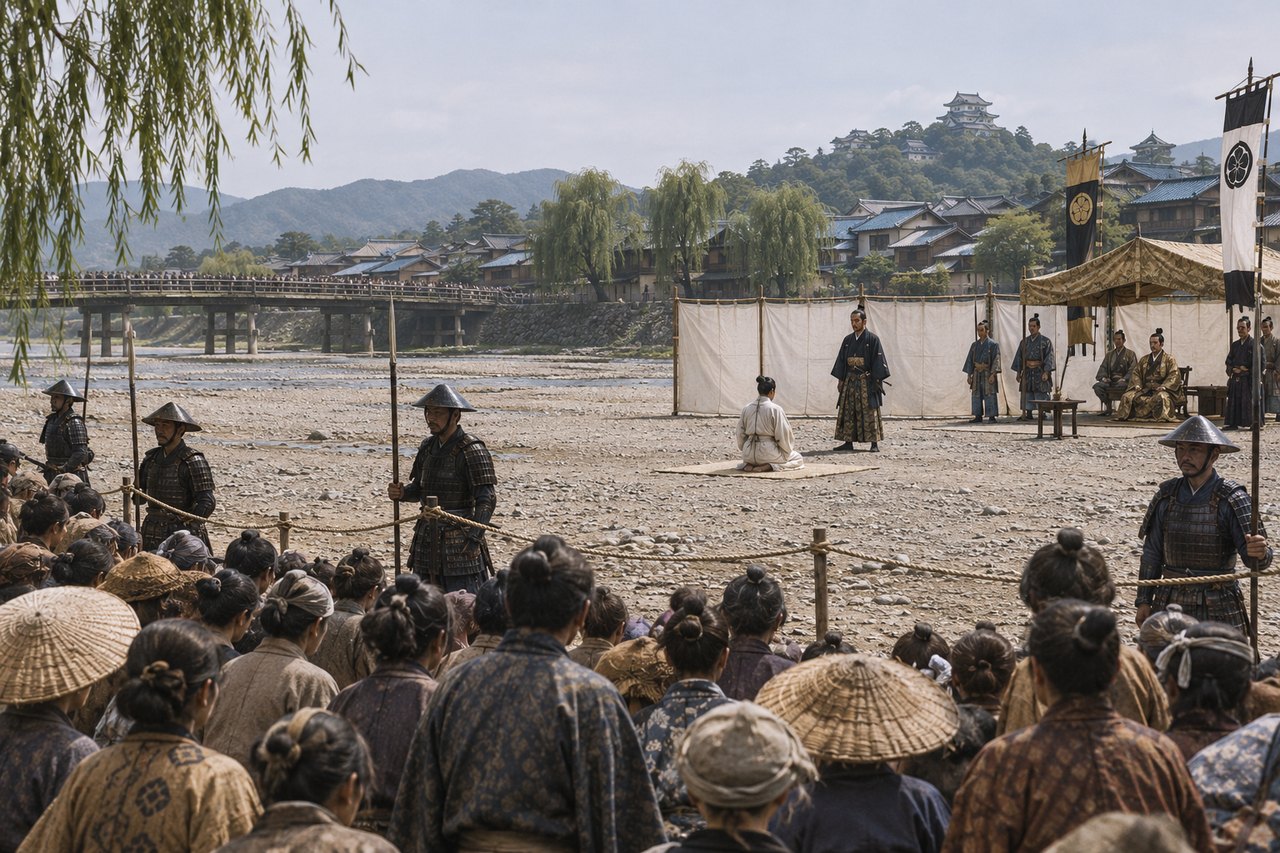
On the first day of the tenth month of 1600, Ishida Mitsunari was executed on the dry riverbed at Rokujō in Kyoto. He was forty-one. One encyclopedia places the execution at Sanjō instead. Half a month earlier, at the battle of Sekigahara, Mitsunari had been defeated as the central figure of the western army.
From the middle of the Edo period onward, the defeated Mitsunari was branded a scheming retainer and an incompetent commander. The idea that Sekigahara was a war Mitsunari himself had plotted was repeated for centuries, and it still shapes how many people picture him today.
Yet the Heibonsha World Encyclopedia notes that there is little firm evidence for the theory that he manipulated the great lords. Recent research has also re-examined the familiar story through letters written at the time. This article follows, in fourteen scenes, how a man from a village in Ōmi came to stand at the center of the battle that divided Japan.
Chapter 1
The boy from Ishida village and the three cups of tea
Mitsunari was born in 1560 in Ishida village, Sakata District, Ōmi Province, today Ishida-chō in the city of Nagahama, Shiga Prefecture. His father was Masatsugu and his elder brother Masazumi. His childhood name was Sakichi. A small local museum, the Ishida Kaikan, now stands on the site of the family house.
Mitsunari was noticed by Hashiba Hideyoshi, the future Toyotomi Hideyoshi, after Hideyoshi became lord of Nagahama Castle, and he entered his service while still young. The Heibonsha encyclopedia puts his age at about fifteen or sixteen at the time.
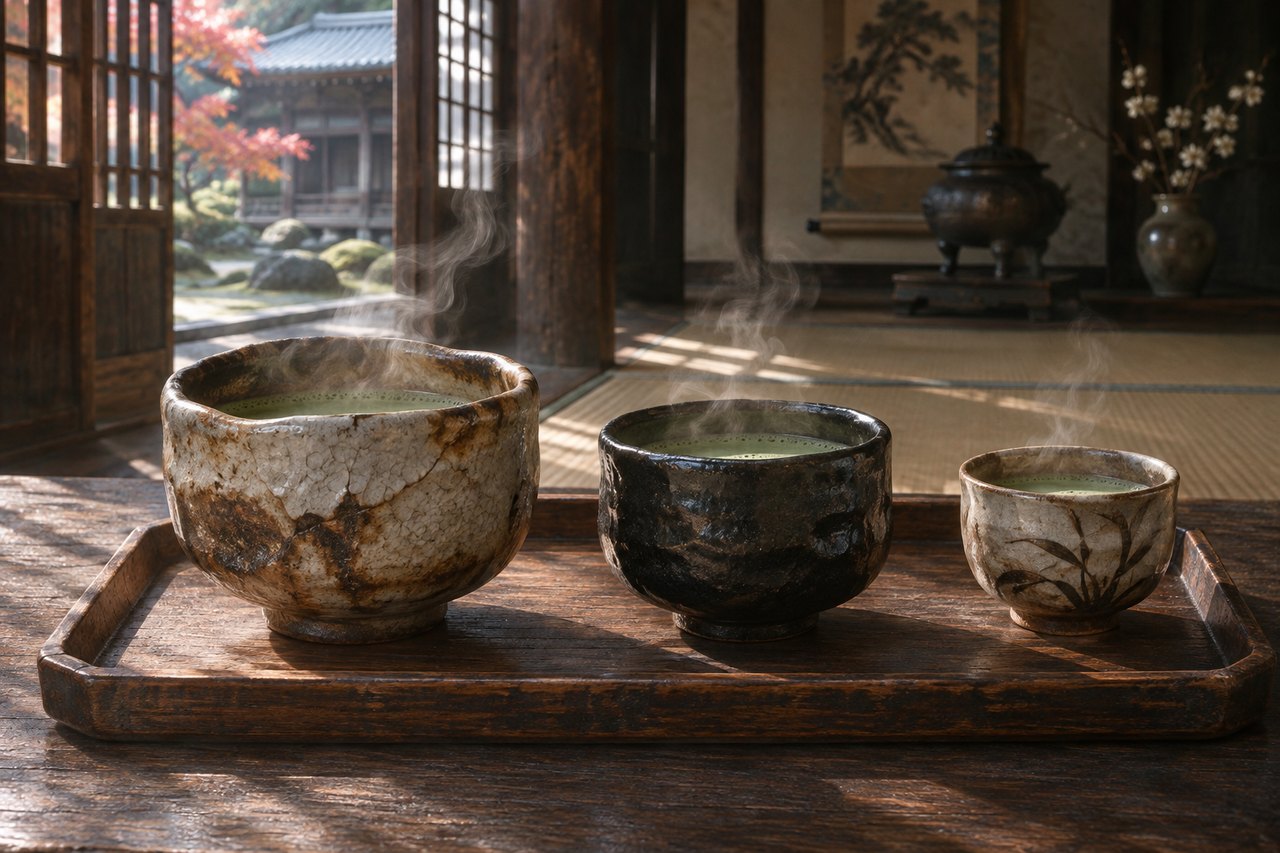
The best-known story of their meeting is that of the three cups of tea. A temple page offered the thirsty Hideyoshi lukewarm tea in a large bowl, then a smaller, hotter cup, and finally a small cup of hot tea. Shiga Prefecture names Kannonji in Maibara as the setting, while another account names Hokkeji, so it is best read as a later anecdote.
Chapter 2
From Shizugatake to the junior assistant of ceremonial
Mitsunari followed Hideyoshi on the western campaign against the Mōri and at the battle of Yamazaki. At Shizugatake in 1583 he won distinction, according to the Nipponica encyclopedia, and Shiga Prefecture says he served as a scout and gatherer of information. As a young man, Mitsunari did stand on the battlefield.
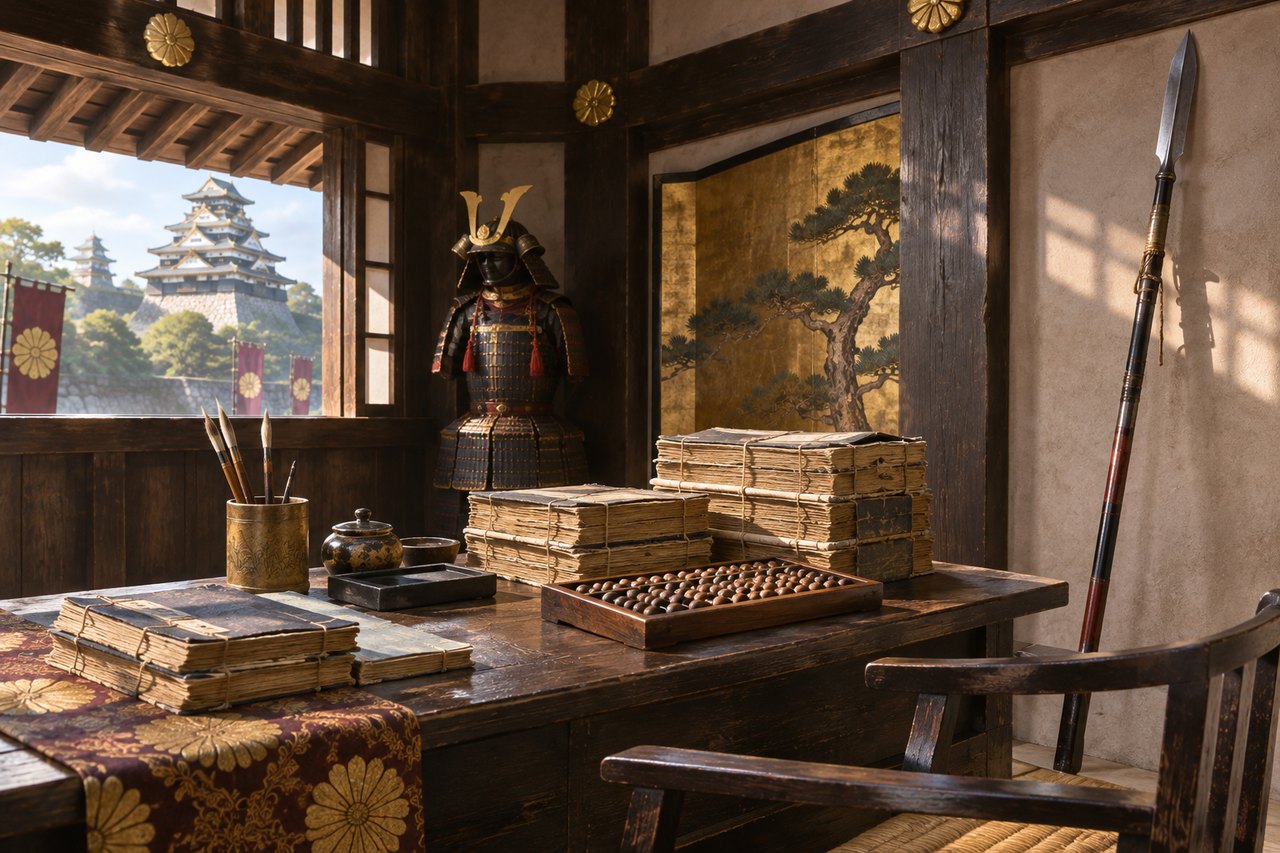
In 1585, when Hideyoshi became imperial regent, Mitsunari was chosen as one of twelve retainers given court rank. He became junior fifth rank, lower grade, and Jibu no shō, junior assistant in the ministry of ceremonial. The title Jibu no shō stayed with him as a familiar name for the rest of his life.
The following year he also served as magistrate of the port city of Sakai. Among the officials who worked directly for Hideyoshi, such as Asano Nagamasa, Mashita Nagamori, Natsuka Masaie and Maeda Gen’i, Mitsunari came to be regarded as the most capable magistrate of them all.
Chapter 3
The magistrate of the land survey
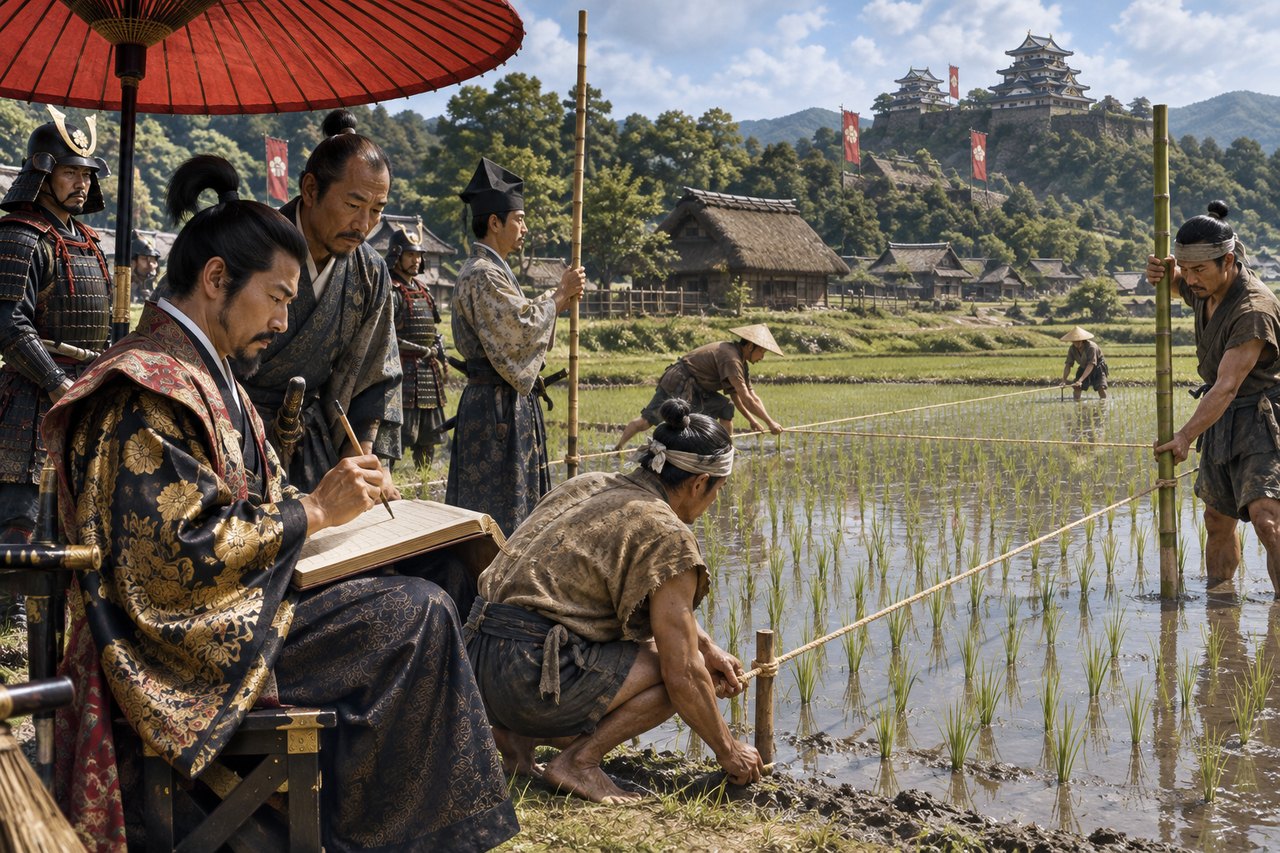
The work most often credited to Mitsunari is the Taikō land survey. A land survey measured the size of fields, estimated their harvest and recorded who farmed them. By expressing the productive power of land as a single figure in koku of rice, the regime fixed the basis for taxes and for the soldiers each lord had to provide.
According to the Heibonsha encyclopedia, Mitsunari began with the survey of Imazaike village in Ōmi in 1584 and went on to surveys in Mino, the northeast, Echigo and, in 1594, Satsuma, Ōsumi and Hyūga in the south and Hitachi and other provinces in the east.
For the survey of the Shimazu domains in southern Kyushu, Mitsunari drew up measuring standards and written rules for the surveyors. The same encyclopedia describes these documents as valuable evidence of how the Taikō survey was actually carried out on the ground.
Chapter 4
Kyushu and Hakata: the magistrate of supply
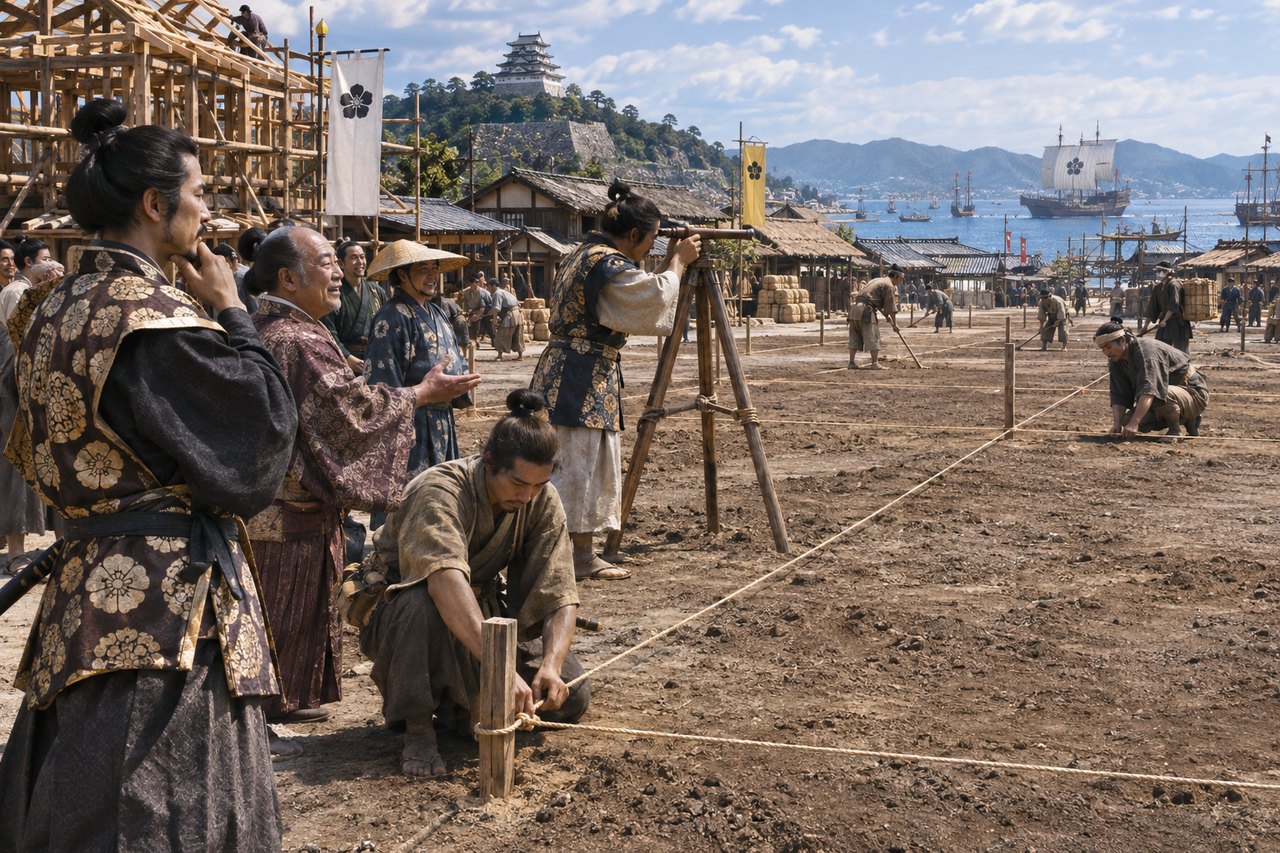
In 1587 Hideyoshi invaded Kyushu to subdue the Shimazu. Mitsunari was in charge of logistics, the work of moving rice, equipment and other supplies to a huge army at the front, and he also took part in negotiations with the Shimazu house as they submitted.
After the fighting, Mitsunari directed the rebuilding of Hakata, a port town ruined by years of war. He is said to have been on close terms with the great Hakata merchants Shimai Sōshitsu and Kamiya Sōtan. His task was not only to win the war but to put the town and its government back in order.
Mitsunari also served as steward of Toyotomi lands placed inside the domains of the Shimazu and the Satake, and he acted as an intermediary between Hideyoshi and many lords. The Heibonsha encyclopedia sees in this the reason he held influence among the great lords far beyond the size of his own fief.
Chapter 5
The flooding of Oshi Castle: whose idea was it?
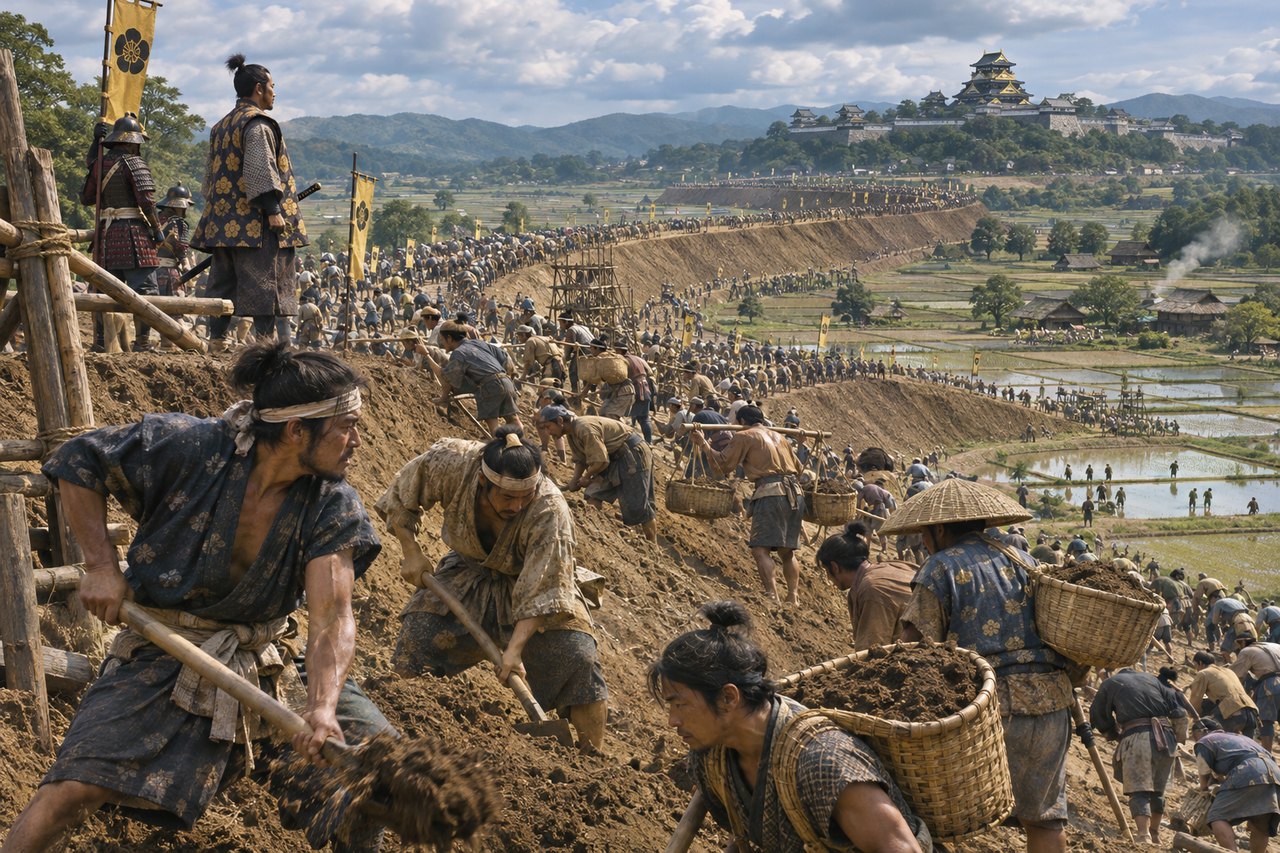
In the Odawara campaign of 1590, Mitsunari helped take Tatebayashi Castle and other strongholds and then attacked Oshi Castle in Musashi Province. The attackers built a long embankment around the castle to flood it with river water. The dike became known as the Ishida embankment and is said to have run for some twenty-eight kilometers.
Oshi did not fall. Odawara surrendered on the fifth day of the seventh month, and Oshi finally opened its gates on the sixteenth. For this, Mitsunari was long called a poor commander. Yet Warakuweb introduces a letter he sent to Asano Nagayoshi on the thirteenth day of the sixth month, complaining that the troops prepared only for flooding and would not advance, and arguing that the castle should be attacked directly.
Some see Hideyoshi himself as the one who insisted on flooding the castle. Either way, Mitsunari achieved little there, and afterward he worked in the northeast on transferring lords’ domains and suppressing uprisings. A part of the Ishida embankment still survives and is designated a historic site by Saitama Prefecture.
Chapter 6
The invasion of Korea and a widening rift
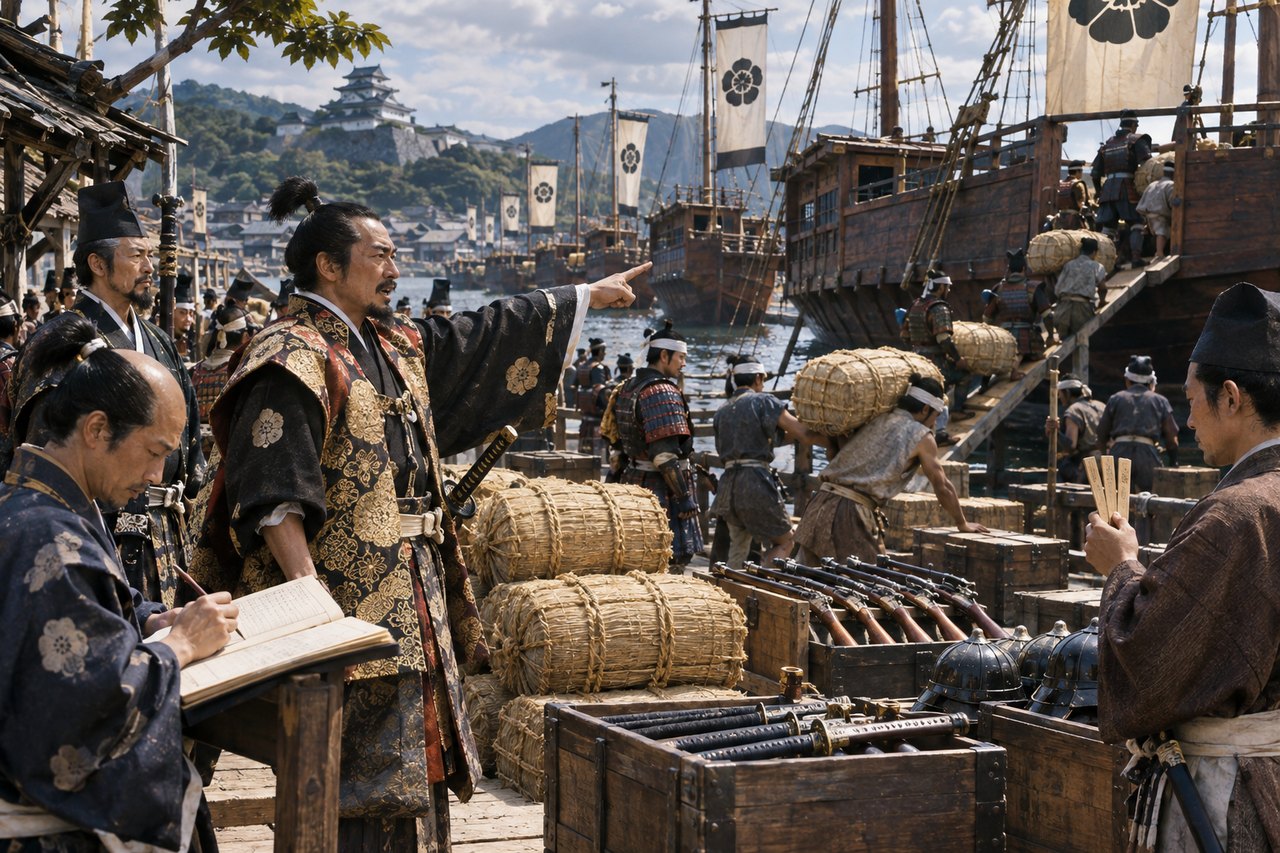
In 1592 Hideyoshi sent a vast army to Korea. Mitsunari served as a magistrate of ships at Nagoya in Hizen, the base for the crossing, and later crossed the sea himself as a commissioner with Mashita Nagamori, Ōtani Yoshitsugu and others to oversee the armies at the front.
Having seen the situation in Korea, Mitsunari supported peace negotiations with Ming China, and in 1593 he returned to Japan together with Ming envoys. Supplying the armies overseas and later bringing them home were also tasks carried out by magistrates like Mitsunari.
Meanwhile, commanders such as Katō Kiyomasa, who had fought hard battles, sometimes saw unfavorable reports sent to Hideyoshi and were punished. The historian Hongō Kazuto argues that the commanders’ anger was rooted in discontent with Hideyoshi himself, and that Mitsunari may have become a stand-in for the ruler they could not blame.
Chapter 7
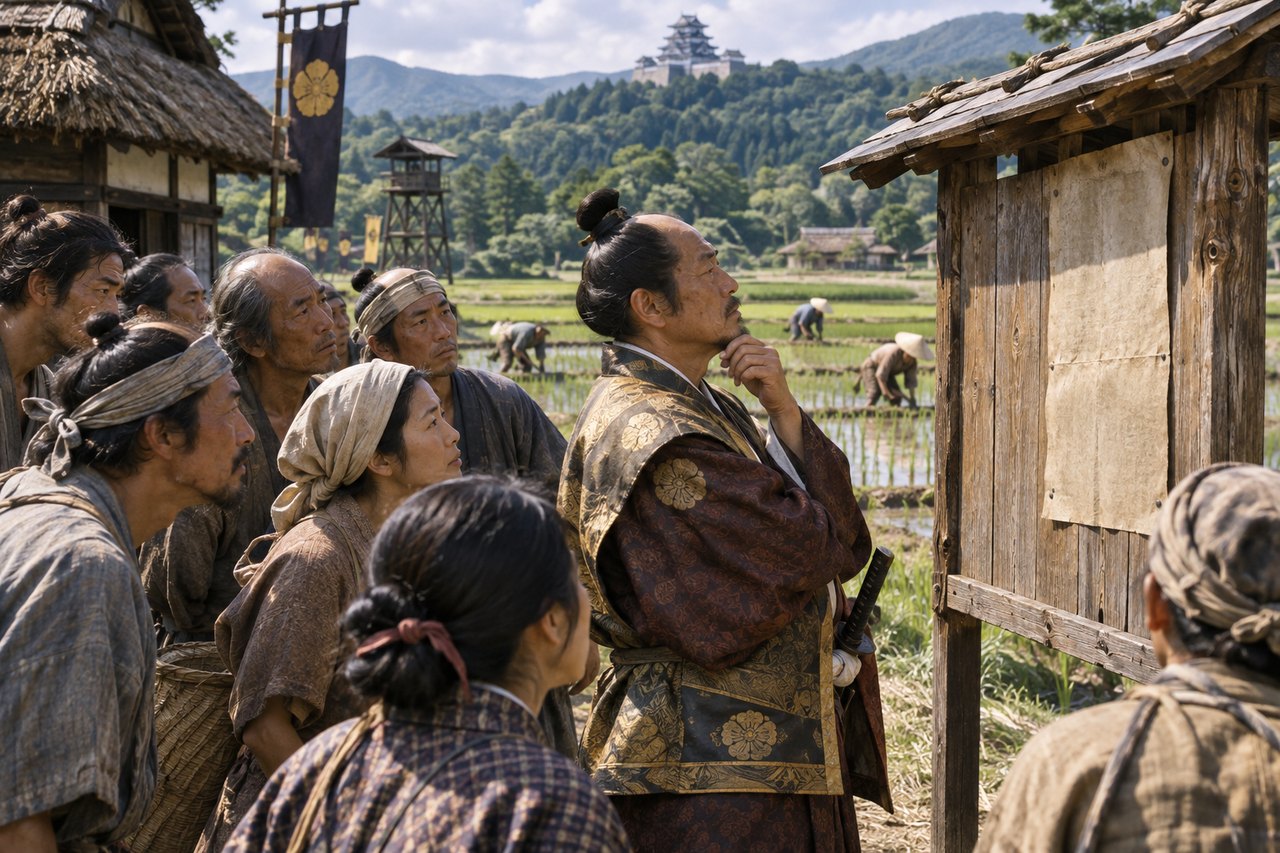
Sawayama Castle and the rules for the villages
Mitsunari made Sawayama Castle in Ōmi his seat and held a domain of more than 190,000 koku. Sawayama controlled the roads between east and west and looked over Lake Biwa. The year he took the castle is given differently in different sources: 1590, 1591 or 1595.
A satirical verse said that Mitsunari had two things too good for him: Shima Sakon and Sawayama Castle. The castle is said to have had a keep of five stories, but Shiga Prefecture notes a record that its interior was very plain. Mitsunari spent much of his time at Fushimi, and his father Masatsugu looked after the castle.
On the first day of the third month of 1596, Mitsunari issued written rules to the villages of his domain: thirteen articles for land under his direct control and nine for land held by his retainers. Written largely in simple kana so that farmers could understand them, they set out tax duties. The Nagahama Castle History Museum sees in them his care for local government.
Chapter 8
Hideyoshi’s death and the attack of the seven generals
Hideyoshi died in 1598. To support his young heir Hideyori, a system of five senior councillors and five magistrates had been put in place. After Hideyoshi’s death, Mitsunari traveled to Kyushu and worked hard to bring the armies home from Korea.
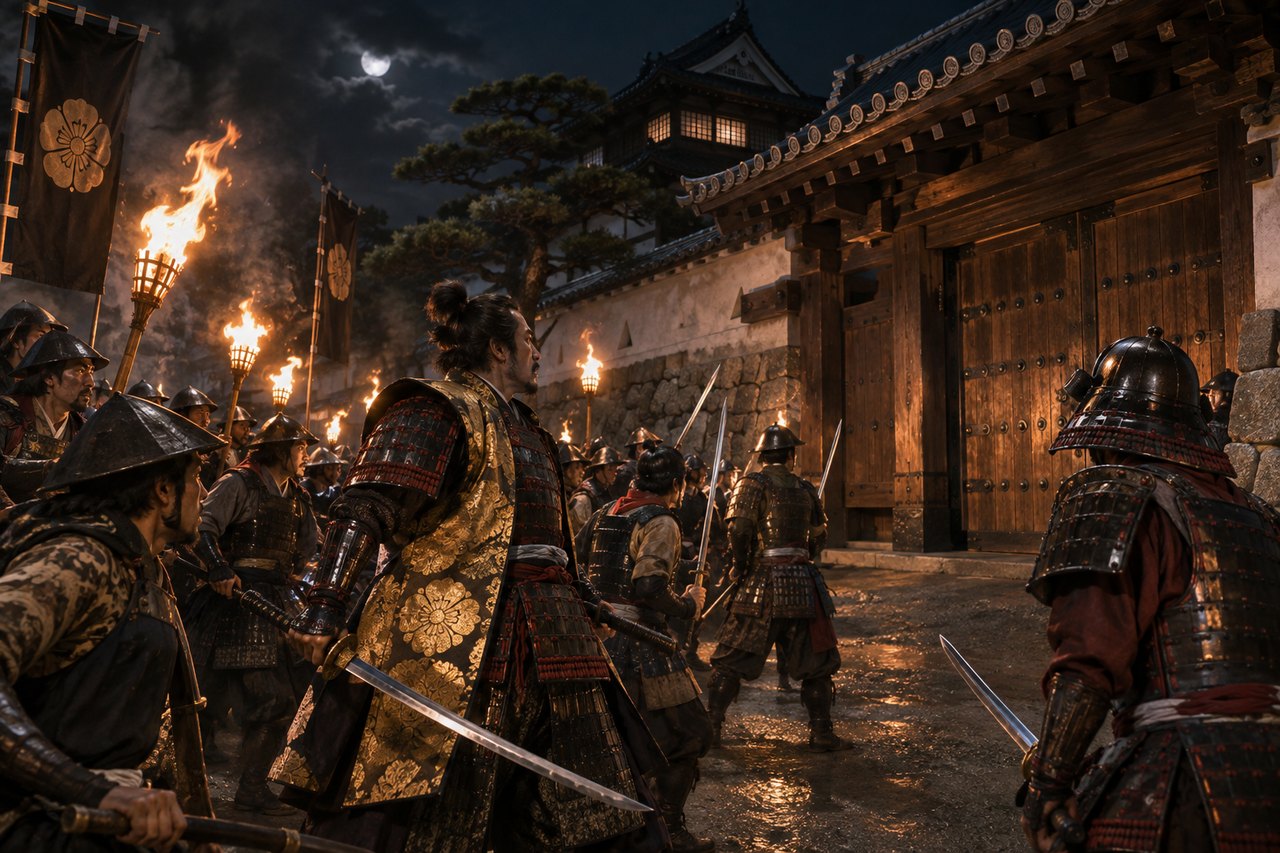
The next year, Maeda Toshiie, one of the five councillors and the counterweight to Tokugawa Ieyasu, died. Soon afterward seven generals, including Katō Kiyomasa, Fukushima Masanori and Kuroda Nagamasa, moved to attack Mitsunari. This is known as the attack of the seven generals.
Mitsunari escaped, but he had to withdraw to Sawayama. The quarrel is often told as a clash between military men and administrators, yet Hongō Kazuto questions that simple picture and points to the generals’ resentment of the war Hideyoshi had forced on them.
Chapter 9
The rising: who was really behind it?
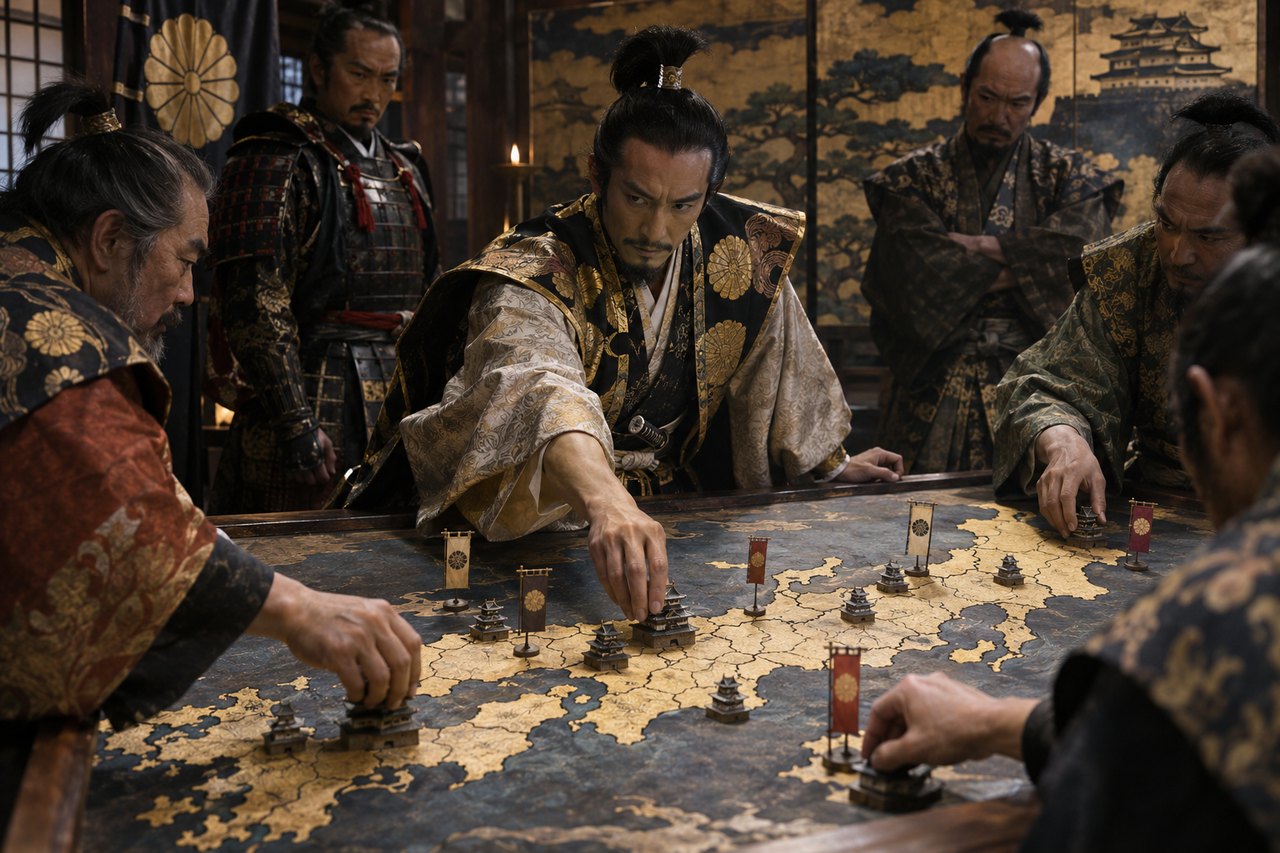
In the sixth month of 1600, Ieyasu left Osaka to march against Uesugi Kagekatsu in Aizu. According to the familiar account, Mitsunari seized this moment, made Mōri Terumoto the nominal leader, joined with Ōtani Yoshitsugu and others, and raised an army against Ieyasu.
Letters written at the time, however, show another picture. According to Takahashi Yōsuke, on the fifteenth day of the seventh month a request from the three magistrates Mashita Nagamori, Natsuka Masaie and Maeda Gen’i reached Terumoto, who left Hiroshima for Osaka that very day. On the sixth day of the eighth month, a war council was held in Osaka Castle under the lead of Mashita and Natsuka.
The western army attacked Fushimi Castle from the seventh month and took it on the first day of the eighth. Mitsunari certainly played a major role, but the western army was not his plot alone. It moved through the decisions of many people, including the other magistrates and the Mōri house.
Chapter 10
From Ōgaki Castle into a rainy night
Mitsunari entered Ōgaki Castle in Mino on the tenth day of the eighth month. The eastern army took Gifu Castle on the twenty-third, and on the fourteenth day of the ninth month Ieyasu set up camp at Akasaka, close to Ōgaki.
On the same fourteenth day, about five hundred men under Shima Sakon and others left Ōgaki Castle, lured out the eastern troops of Nakamura Kazuhide across the Kuise River and defeated them. The Gifu Prefecture tourism association notes that the river has changed course, so the exact site of the fight is unknown.
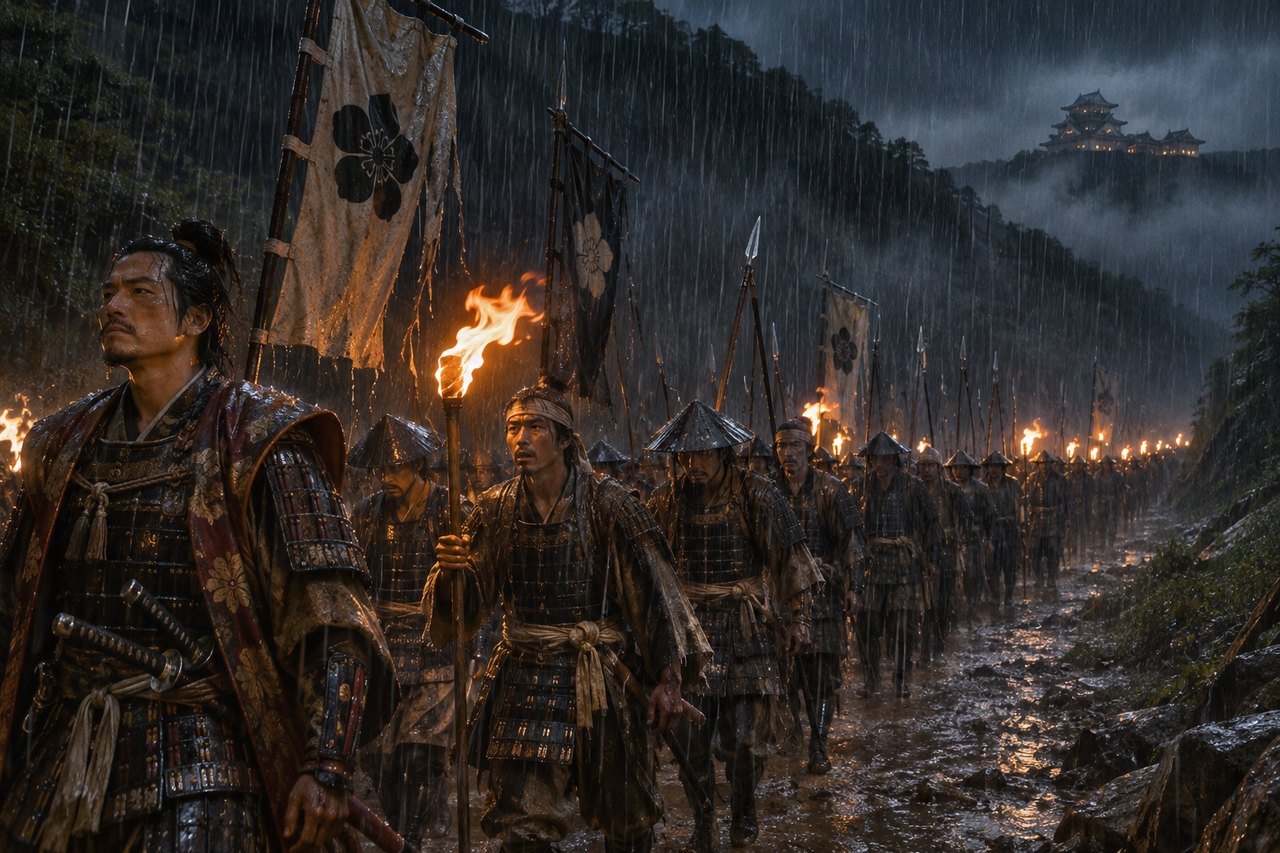
That night, Mitsunari and his allies left Ōgaki in the rain and moved toward Sekigahara. Kikkawa Hiroie took the move as a retreat toward Sawayama, while Ieyasu’s physician Itasaka Bokusai understood it as an attempt to strike Kobayakawa Hideaki, who had changed sides. The same march was read in different ways depending on where one stood.
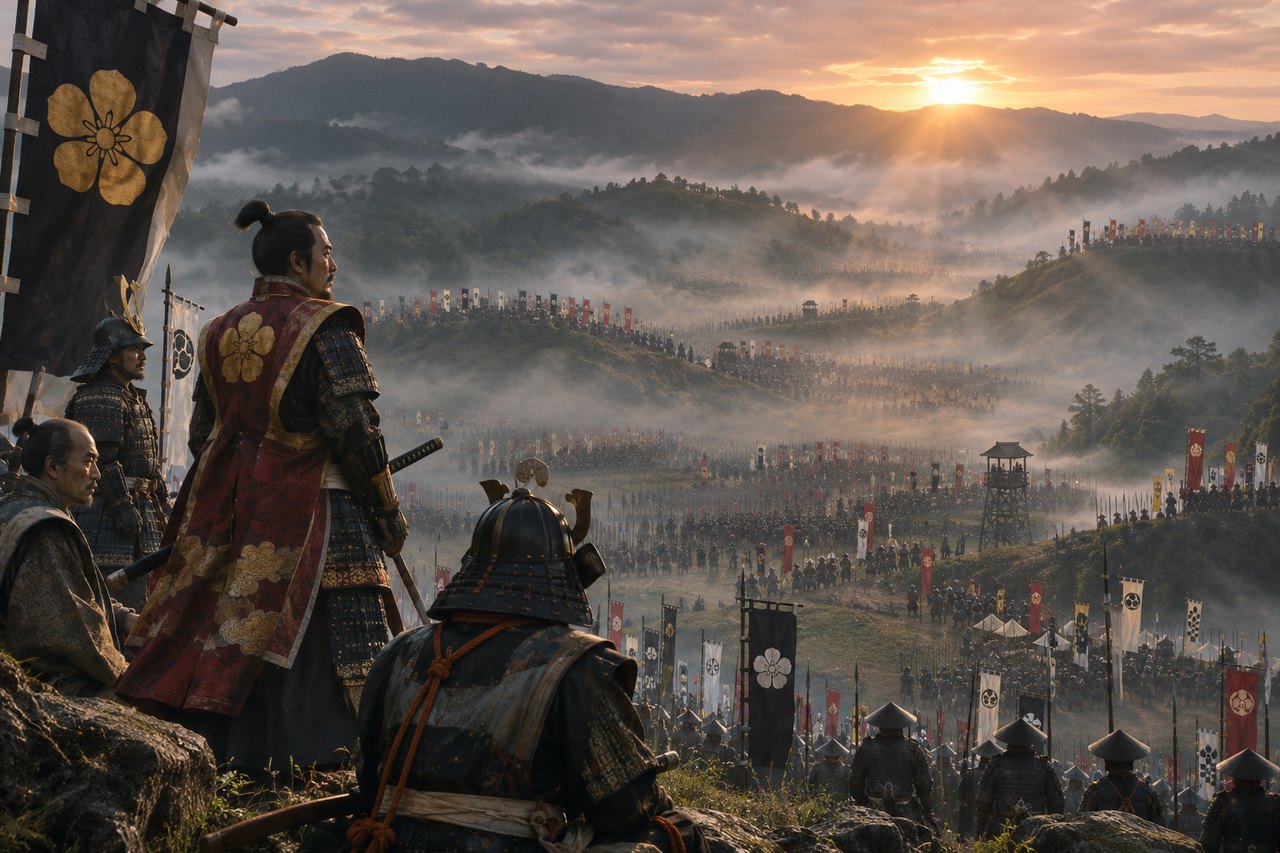
Chapter 11
One day at Sekigahara
The battle of Sekigahara began on the fifteenth day of the ninth month. In the familiar version, the west fought well in the morning; around noon Ieyasu had guns fired at Kobayakawa’s camp to force his decision, Kobayakawa turned on his allies, the western army broke, and the battle was decided around four in the afternoon.
The historian Shiramine Jun, however, has argued that this provoking gunfire was a later invention. Its earliest known mention is in a war chronicle of 1663. Based on a letter dated the seventeenth and other documents, some now argue that Kobayakawa switched sides as soon as the fighting began.
Ieyasu himself wrote to Date Masamune that around noon on the fifteenth he had fought at Yamanaka in Mino and destroyed the forces of Ukita, Shimazu, Konishi and Ishida. Some researchers also doubt the familiar total of 150,000 men and think far fewer actually fought. Mitsunari fled toward Mount Ibuki.
Chapter 12
From a mountain cave to the Rokujō riverbed
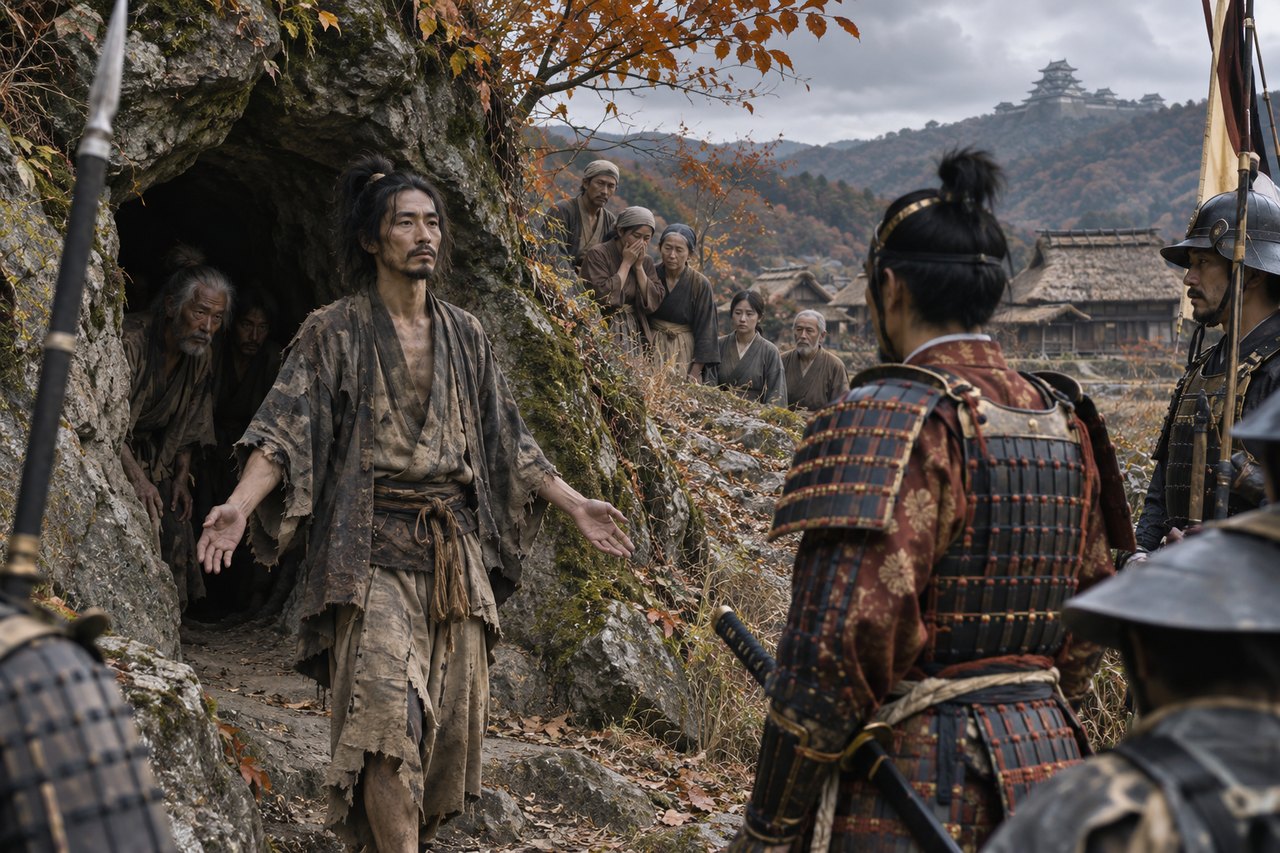
Mitsunari escaped into Ōmi and was sheltered in the village of Furuhashi, said to be his mother’s home. Shiga Prefecture relates that, on the villagers’ advice, he hid in a mountain cave known as the Serpent’s Cave. In the end, however, he was found and captured by Tanaka Yoshimasa.
Around the same time, Sawayama Castle came under attack by the eastern army. According to a dictionary of Japanese castles, some 2,800 people defended it, but traitors opened the way, the castle fell, and Mitsunari’s father Masatsugu and his wife were among those who took their own lives. Materials from the castle were later used to build Hikone Castle.
On the first day of the tenth month, Mitsunari was executed in Kyoto together with Konishi Yukinaga and Ankokuji Ekei. His grave lies at Sangen-in, a subtemple of Daitokuji in Kyoto.
Conclusion
What was Mitsunari trying to protect?
After Sekigahara the lords of the western side were punished severely. Mōri Terumoto’s holdings were cut from 1.12 million koku to 360,000, and Toyotomi Hideyori was reduced to a lord of 650,000 koku. For the victors, telling the war as Mitsunari’s plot may simply have been convenient.
The Heibonsha encyclopedia records that Mitsunari was said to be arrogant and lost the goodwill of many, yet it also calls him a capable official who promoted able people and stayed loyal to the Toyotomi. Survey registers, rules for villages and letters to lords across Japan: his strength lay in documents and administration more than on the battlefield.
A magistrate of 190,000 koku stood at the center of the western army because he held the practical work of the regime and was connected to many lords. Yet the war was not moved by Mitsunari alone. At Ryōtanji, at the foot of Mount Sawayama, a memorial stone to him still stands today.
How to read this work
History, interpretation, and reconstruction
Mitsunari stood at the center of the western army because he held the practical work of the regime and its ties with many lords. Yet the western army was not his plot alone; it moved through the decisions of many people, including the other magistrates and the Mōri house.
This work is grounded in published sources and historical research. Interior thoughts, dialogue, and some visual details are cinematic reconstructions. Where historians disagree, the article presents the point as debated rather than settled fact.
Timeline
The story in time
-
Invasion of Korea. He serves as magistrate of ships at Nagoya and later crosses as a commissioner; in 1593 he returns with Ming envoys.
Sources: k-ishida -
Directs surveys in Satsuma, Ōsumi, Hyūga, Hitachi and other provinces.
Sources: k-ishida -
Tokugawa Ieyasu leaves Osaka to march against Uesugi Kagekatsu in Aizu.
Sources: k-seki -
A request from the three magistrates Mashita, Natsuka and Maeda Gen’i reaches Mōri Terumoto, who leaves Hiroshima.
Sources: gendai1 -
Mitsunari enters Ōgaki Castle.
Sources: serai
People & terms
A guide for new readers
Key figures
- Ishida Mitsunari
- 1560–1600. From Ishida village in Ōmi; Hideyoshi’s magistrate for land surveys, supply and relations with the lords, and lord of Sawayama with over 190,000 koku. Defeated at Sekigahara as the central figure of the western army and executed in Kyoto.
- Toyotomi Hideyoshi
- Discovered Mitsunari while lord of Nagahama, became regent and unified Japan. Died in 1598.
- Ishida Masatsugu
- Mitsunari’s father, who kept Sawayama Castle and died when it fell in 1600.
- Shima Sakon
- Mitsunari’s retainer, praised in a verse as too good for him; he defeated eastern troops at the Kuise River the day before Sekigahara.
- Ōtani Yoshitsugu
- A magistrate who crossed to Korea with Mitsunari; he fought for the west at Sekigahara and took his own life.
- Mōri Terumoto
- One of the five councillors. In 1600 he came to Osaka at the magistrates’ request and became the nominal leader of the west; his domain was cut sharply afterward.
- Tokugawa Ieyasu
- Senior of the five councillors, who learned of the rising during the Aizu campaign and won at Sekigahara.
- Kobayakawa Hideaki
- A lord who changed to the eastern side at Sekigahara; the timing of his switch is debated.
Glossary
- Bugyō 奉行
- A magistrate or commissioner who carried out administrative work for the ruler.
- Taikō kenchi 太閤検地
- The nationwide land survey carried out under Toyotomi Hideyoshi.
- Koku 石
- A unit of rice used to measure the productive value of land and the size of domains.
- Kurairichi 蔵入地
- Land whose revenue went directly to the lord rather than to his retainers.
- Toi-deppō 問鉄砲
- The provoking gunfire Ieyasu is said to have aimed at Kobayakawa’s camp; recent research regards it as a later story.
Sources & method
How this article was built
This English edition follows the Japanese article scene by scene and keeps its fourteen scenes, twenty-two timeline entries, eight people and nineteen sources in the same order. It draws on encyclopedia entries on Kotobank, the Nagahama Castle History Museum, Shiga Prefecture, the Gifu Prefecture Tourism Association and published excerpts by historians. Source titles are editorial translations.
Where the sources disagree, as on the year Mitsunari took Sawayama, the place of his execution and the temple of the tea story, the differences are shown. Anecdotes and local traditions are marked as such, and the familiar account of Sekigahara is kept separate from recent research.
Sources
References and further reading
- Kotobank: Ishida Mitsunari (Daijisen, Nihon Kokugo Daijiten, Heibonsha World Encyclopedia, Nipponica) コトバンク「石田三成」(デジタル大辞泉・精選版日本国語大辞典・改訂新版世界大百科事典・日本大百科全書) Title translated editorially for reader convenience. Kotobank コトバンク His birth and family, early service, court rank in 1585, Sakai, the land surveys, Hakata, Oshi, Korea, Sawayama (1591 or 1595), his role as intermediary, the weak evidence for plot theories, the 1599 attack, his capture and execution (Sanjō or Rokujō) and his grave. Accessed 2026-11-20
- Kotobank: Battle of Sekigahara (Daijisen, Nipponica) コトバンク「関ヶ原の戦い」(デジタル大辞泉・日本大百科全書) Title translated editorially for reader convenience. Kotobank コトバンク Hideyoshi’s death, Toshiie’s death, the Aizu campaign, Fushimi, Gifu, the night move of the 14th, the familiar account of the battle and the reductions of the Mōri and Toyotomi. Accessed 2026-11-20
- Kotobank: Sawayama Castle (Dictionary of Japanese Castles) コトバンク「佐和山城」(日本の城がわかる事典) Title translated editorially for reader convenience. Kotobank コトバンク Mitsunari’s entry in 1590 (with other views), the keep, the fall of the castle with 2,800 defenders and the deaths of Masatsugu and Mitsunari’s wife, and reuse of materials for Hikone Castle. Accessed 2026-11-20
- Corner Exhibition: Ishida Mitsunari, a Toyotomi Magistrate from Ōmi コーナー展示「北近江と長浜」①近江出身の豊臣奉行・石田三成 Title translated editorially for reader convenience. Nagahama Castle History Museum 長浜城歴史博物館 His birth, the land survey, ties with the Shimazu and others, his rule of Sawayama and the village rules of the 1st day of the 3rd month of 1596. Accessed 2026-11-20
- Ishida Mitsunari: Hideyoshi’s Strategist of Knowledge (publication notice) 石田三成―秀吉を支えた知の参謀―(刊行物紹介) Title translated editorially for reader convenience. Nagahama Castle History Museum 長浜城歴史博物館 The museum’s description of his service and administrative work. Accessed 2026-10-24
- Ishida Mitsunari (learning material) 石田三成 Title translated editorially for reader convenience. Shizuoka Prefectural Comprehensive Education Center 静岡県総合教育センター・学習資料 His service to Hideyoshi and his capture and execution after Sekigahara. Accessed 2026-10-24
- Land survey (kenchi) 検地 Title translated editorially for reader convenience. Gakken Kids Net 学研キッズネット A general explanation of what a land survey recorded. Accessed 2026-10-24
- Places Associated with Mitsunari 三成ゆかりの地めぐり Title translated editorially for reader convenience. Shiga Prefecture 滋賀県 Sawayama Castle and the verse, Ishida-chō, Kannonji and the tea story, Shizugatake, the Serpent’s Cave at Furuhashi and Ryōtanji. Accessed 2026-11-20
- Was Ishida Mitsunari Really a Poor Commander? His True Opinion on Flooding Oshi Castle 石田三成は戦下手なんかじゃない!?忍城の水攻めに反対した本音 Title translated editorially for reader convenience. Warakuweb 和樂web The later image of Mitsunari, the siege of Oshi, his letter of the 13th day of the 6th month to Asano Nagayoshi and the view that Hideyoshi insisted on flooding. Accessed 2026-11-20
- Japan’s Three Great Flooding Sieges 日本三大水攻め Title translated editorially for reader convenience. Nippon Tabi Magazine ニッポン旅マガジン The Ishida embankment, its surviving section and the dates of the surrender of Odawara and Oshi. Accessed 2026-11-20
- Sawayama Castle 佐和山城 Title translated editorially for reader convenience. Nippon Tabi Magazine ニッポン旅マガジン Its strategic location, Mitsunari’s keep, the verse, Masatsugu as castle keeper and the fall of the castle. Accessed 2026-11-20
- The Life of Ishida Mitsunari, the Great Magistrate of the Toyotomi 豊臣政権を支えた名奉行・石田三成の生涯 Title translated editorially for reader convenience. Serai.jp サライ.jp The tea story, Shizugatake, Kyushu, Odawara, Sawayama, the 1596 rules, Ōgaki, Furuhashi and the execution at forty-one. Accessed 2026-11-20
- Why Was Ishida Mitsunari Attacked by the Seven Generals? (excerpt from Hongō Kazuto) なぜ石田三成は「七将襲撃事件」で襲われたのか(本郷和人『インテリジェンス関ヶ原』抜粋) Title translated editorially for reader convenience. Bunshun Online 文春オンライン Reports and punishments during the Korean invasion, Mitsunari’s role, the 1599 attack and the view of Mitsunari as Hideyoshi’s stand-in. Accessed 2026-11-20
- Why the Charges Against Ieyasu Were Sent Only to Kyushu (excerpt from Takahashi Yōsuke) 「内府ちがいの条々」が九州にしか送られていなかった理由(高橋陽介『シン・関ヶ原』抜粋) Title translated editorially for reader convenience. Kōdansha Gendai Business 現代ビジネス(講談社) The re-examination of the familiar story through some 170 letters and the request of the three magistrates to Terumoto on the 15th day of the 7th month. Accessed 2026-11-20
- The Western Army Ignored the Emperor’s Call for a Ceasefire (excerpt from Takahashi Yōsuke) 西軍は後陽成天皇による「即時停戦」の勅命を無視…(高橋陽介『シン・関ヶ原』抜粋) Title translated editorially for reader convenience. Kōdansha Gendai Business 現代ビジネス(講談社) The war council in Osaka Castle on the 6th day of the 8th month led by Mashita and Natsuka. Accessed 2026-11-20
- Secret Contacts Multiply in the Western Army (excerpt from Takahashi Yōsuke) 西軍から「内通者」が続出…(高橋陽介『シン・関ヶ原』抜粋) Title translated editorially for reader convenience. Kōdansha Gendai Business 現代ビジネス(講談社) The move from Ōgaki on the night of the 14th and how Kikkawa Hiroie and Itasaka Bokusai interpreted it. Accessed 2026-11-20
- How Many Actually Fought at Sekigahara? (excerpt from Takahashi Yōsuke) 「関ヶ原の戦い」で実際に戦った人数(高橋陽介『シン・関ヶ原』抜粋) Title translated editorially for reader convenience. Kōdansha Gendai Business 現代ビジネス(講談社) Ieyasu’s letter to Date Masamune, the western units engaged, and doubts about the familiar troop numbers and battle maps. Accessed 2026-11-20
- Ieyasu Did Not Urge Kobayakawa to Betray Quickly (Goza Yūichi) 家康は「早く裏切れ」と小早川秀秋に催促したわけではない(呉座勇一) Title translated editorially for reader convenience. President Online プレジデントオンライン The familiar course of the battle, Shiramine Jun’s rejection of the provoking gunfire, its first mention in 1663, and the view that Kobayakawa changed sides at once. Accessed 2026-11-20
- Kuise River Battlefield 杭瀬川古戦場 Title translated editorially for reader convenience. Gifu Prefecture Tourism Association 岐阜県観光連盟 The fight of the 14th day of the 9th month led by Shima Sakon and the uncertainty of the exact site. Accessed 2026-11-20
Continue reading
More stories from Shigeki
Shigeki English
Taira no Kiyomori: From the First Warrior Noble to a Capital by the Sea
Born as Tadamori’s heir, he rose through the Hogen and Heiji conflicts to grand minister of state, then turned from Fukuhara to Itsukushima, Owada no Tomari and Song ships, before the transfer and return of the capital, his death and the end of his family.
- When 1118–1181, from his birth to his death, with the defeat at Dan-no-ura in 1185 and the statue of 1967
- Where Kyoto, Fukuhara in present-day Kobe, Owada no Tomari, Itsukushima, the Ondo Strait and Dan-no-ura
Shigeki English
Oishi Riku: Beyond the End of Chushingura, the Family That Lived On
Born in Toyooka, a wife in Ako, then Yamashina, Toyooka again and Hiroshima: a spring homecoming and an autumn divorce letter, the deaths of husband and son, further losses, and a son’s appointment in Hiroshima.
- When 1669–1736, with the events of 1702 kept in their separate seasons, and later memory from 1748 to 2014
- Where Toyooka, Ako, Yamashina and Hiroshima