
SHIGEKI ENGLISH STORYEN
Japanese history in English
John Manjiro: How Experience Across the Ocean Became Knowledge
School, whaling voyages, recorded testimony and an English conversation book in a returning fisherman’s life.
Follow Manjiro from rescue and education in America to his return and work as an interpreter. Distinguish the stages of homecoming, Kawada Shoryo’s written account, an 1859 conversation book and the separate ships involved in the 1860 mission to America.
At a glance
Before you enter the story
- When
- Mainly 1841–1860; landing, homecoming and publication are dated separately
- Where
- Tosa, Torishima, Hawaii, Fairhaven, Ryukyu and the Pacific
- Key figures
- John Manjiro, also known as Nakahama Manjiro, Captain Whitfield, Kawada Shoryo, Katsu Kaishu
- What was at stake
- How could knowledge acquired abroad become explanations, practical work and books that others could use in Japan?
Why this story matters
The larger history behind the turning point
A rescue can be the beginning of an education rather than the ending of an adventure. Manjiro’s life connects classrooms and working ships with later testimony and publication. Following those different settings helps explain how an individual experience could become knowledge available to other people.
The process also involved other hands. A captain helped him reach an American town, a Japanese writer recorded his account, and books circulated in forms distinct from speech. Giving those activities separate places in the story avoids assigning every change in Japan’s foreign relations to one exceptional man.
Historical context
What an international reader needs to know
Returning was a sequence
The landing in Ryukyu in 1851, questioning in several places and return to Tosa in 1852 were separate stages. The National Diet Library’s biographical explanation distinguishes the two years. The John Mung Museum website gives a different homecoming year; this article follows the agreement of the national institutions and the Ryoma museum.
The distinction changes how the return is read. Arrival did not immediately restore the life he had left behind. His experience first became information to be questioned and subsequently knowledge sought by officials. The article keeps this sequence at year level rather than adding unverified dates or lengths of detention.
Several books, several kinds of evidence
Hyoson Kiryaku is the account Kawada Shoryo prepared from Manjiro’s testimony. Hyokaku Danki is another work concerning his experiences; the shared subject does not make the titles interchangeable. The Tokyo Metropolitan Library’s later annotated manuscript also requires its own history. It is not simply an autograph written during the original journey.
A further source is a 1938 compilation concerning Kanrin Maru. A limited passage distinguishes official roles, but that does not make the entire compilation a single contemporary document. This article separates institutional explanations, the adopted script’s bounded observations and the historical questions that remain open.
Watch the film
See the story in motion
The film currently uses Japanese audio. This English article provides the context and source trail; it does not imply that an English subtitle track is available.
Scene 01
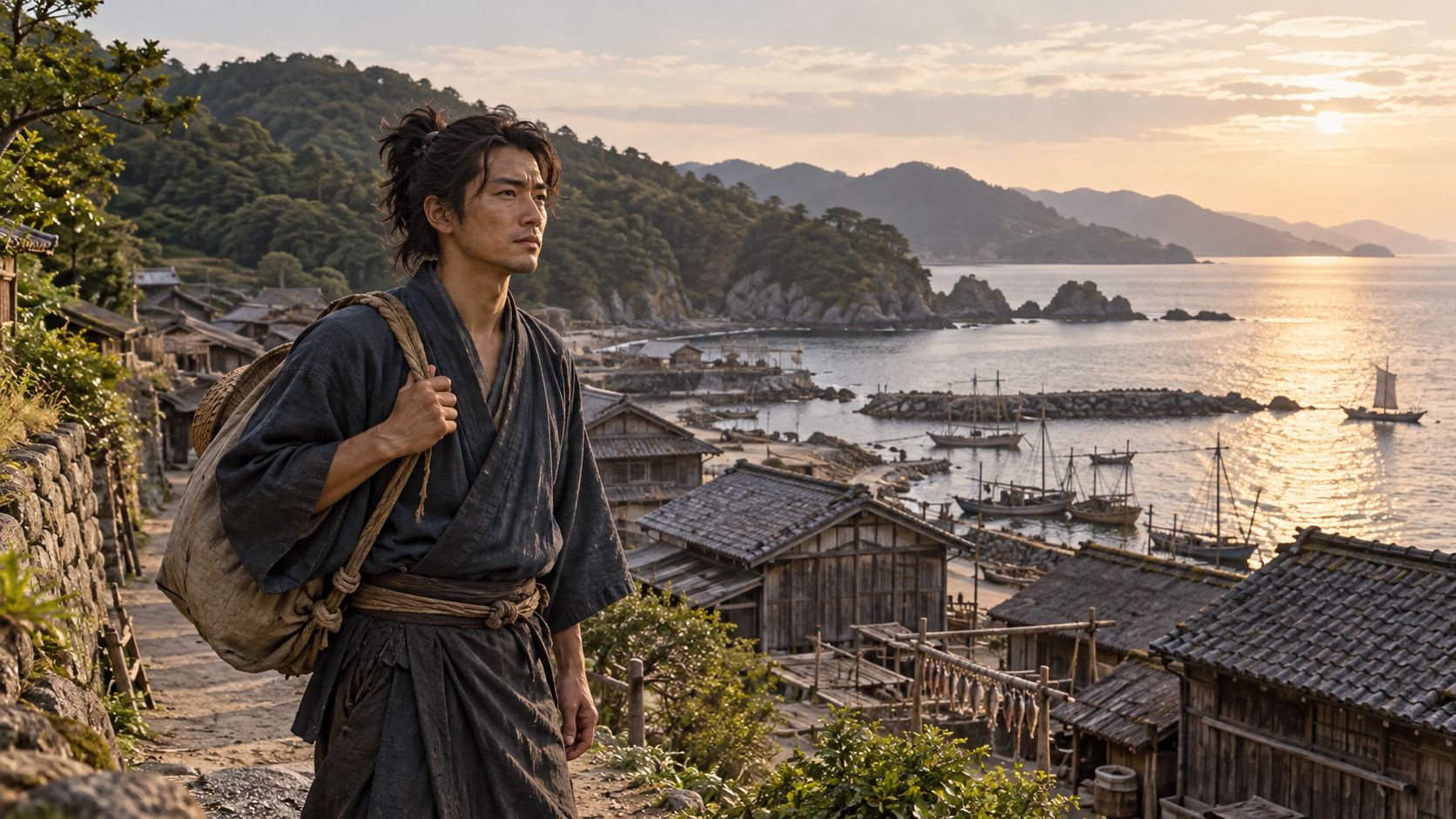
Learning after the rescue
A fisherman from Tosa was shipwrecked, learned about navigation abroad and returned to explain overseas affairs. The outline is familiar as an adventure across the sea. This account follows the less easily compressed question of what happened after he was rescued.
Education in a town, experience aboard ships and the work of putting experience into words belonged to different settings. Each helped create circumstances in which what one person had learned could become useful to others. Rescue alone does not explain those later activities.
The connection between these stages is the article’s interpretive thread. It follows the institutional accounts without presenting knowledge transfer as one formal programme or a policy designed in advance. Manjiro’s later role becomes visible through several kinds of learning and communication.
Scene 02
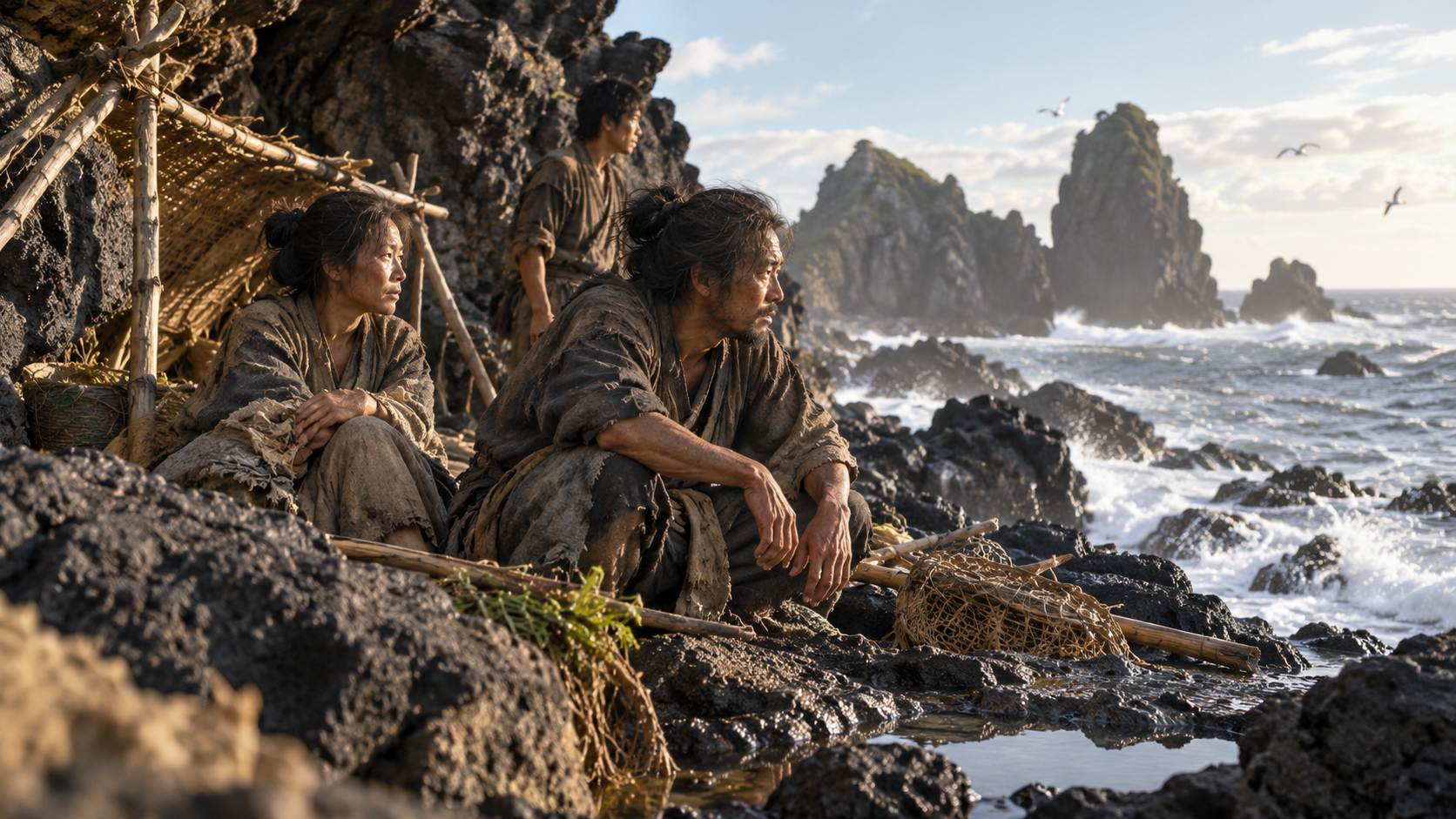
From Tosa to Torishima
Manjiro was a fisherman from Tosa. While fishing with companions, he was caught in a shipwreck and drifted to the uninhabited island of Torishima. After living there, the group was rescued by an American whaling ship.
The place where the fishing voyage began and the world into which the rescue carried him were far apart. A sea journey undertaken for work became an encounter with unfamiliar people, a different ship and a language he had not previously used in that setting.
The episode establishes the change of circumstances, rather than an imagined plan to study overseas. The article does not supply private dialogue or thoughts at the moment of rescue. What can be followed is the sequence from fishing, through survival on the island, to life aboard the rescuing vessel.
Scene 03
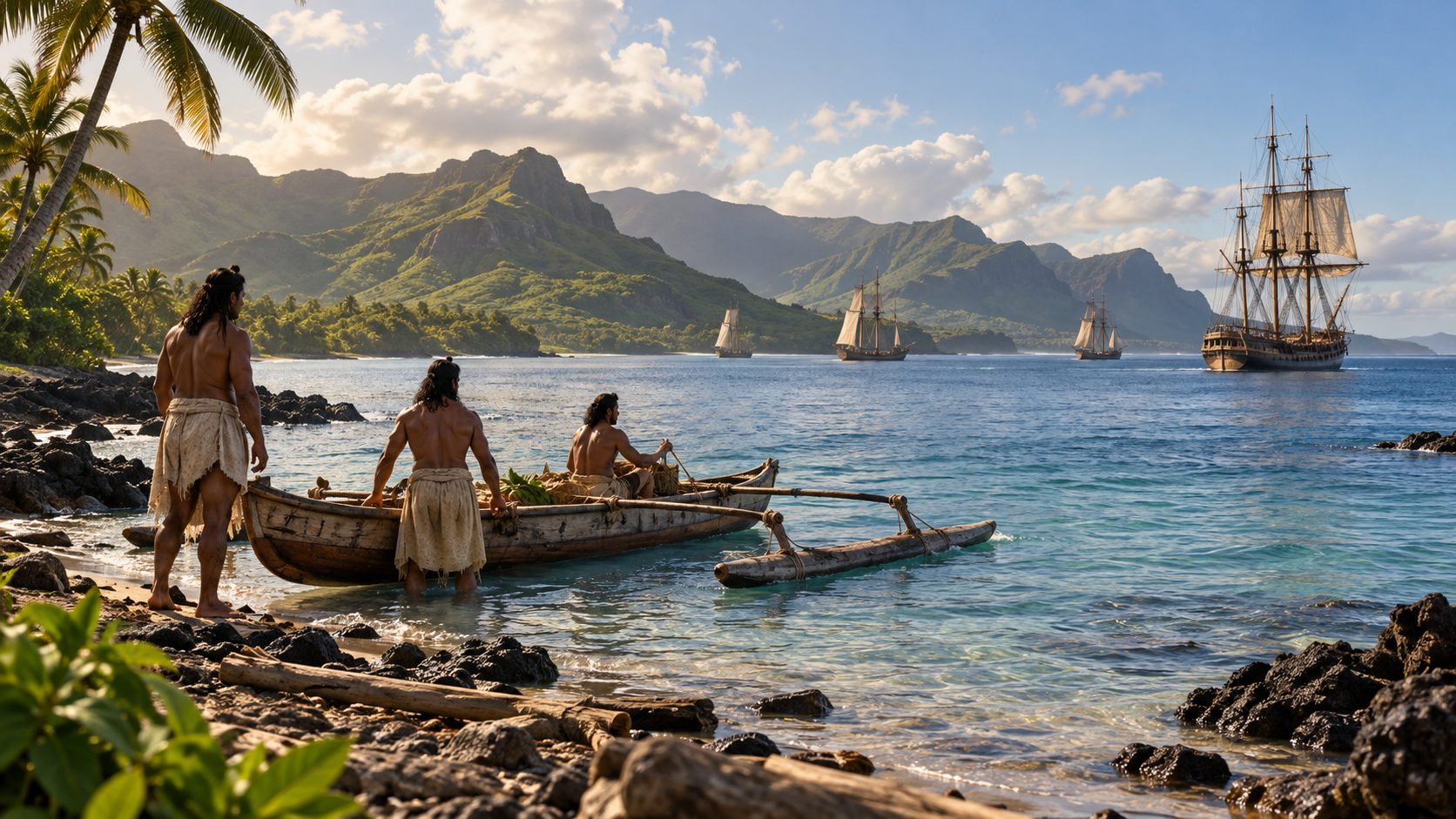
Paths divided in Hawaii
The whaling ship’s captain was Whitfield. Rescue did not mean that the castaways were immediately delivered back to Japan. Their next destinations differed from the fishing community they had left, and eventually differed from one another.
The companions left the ship in Hawaii, while Manjiro travelled on with the captain to the American mainland. The men who had shared a shipwreck and rescue did not thereafter share exactly the same route. This is one point where a collective experience became a distinct individual biography.
For Manjiro, time at sea was followed by schooling in Fairhaven. That transition matters to what he later brought home: he encountered a town and its daily life as well as a ship. The surviving accounts therefore lead beyond the island and the rescue vessel.
Scene 04
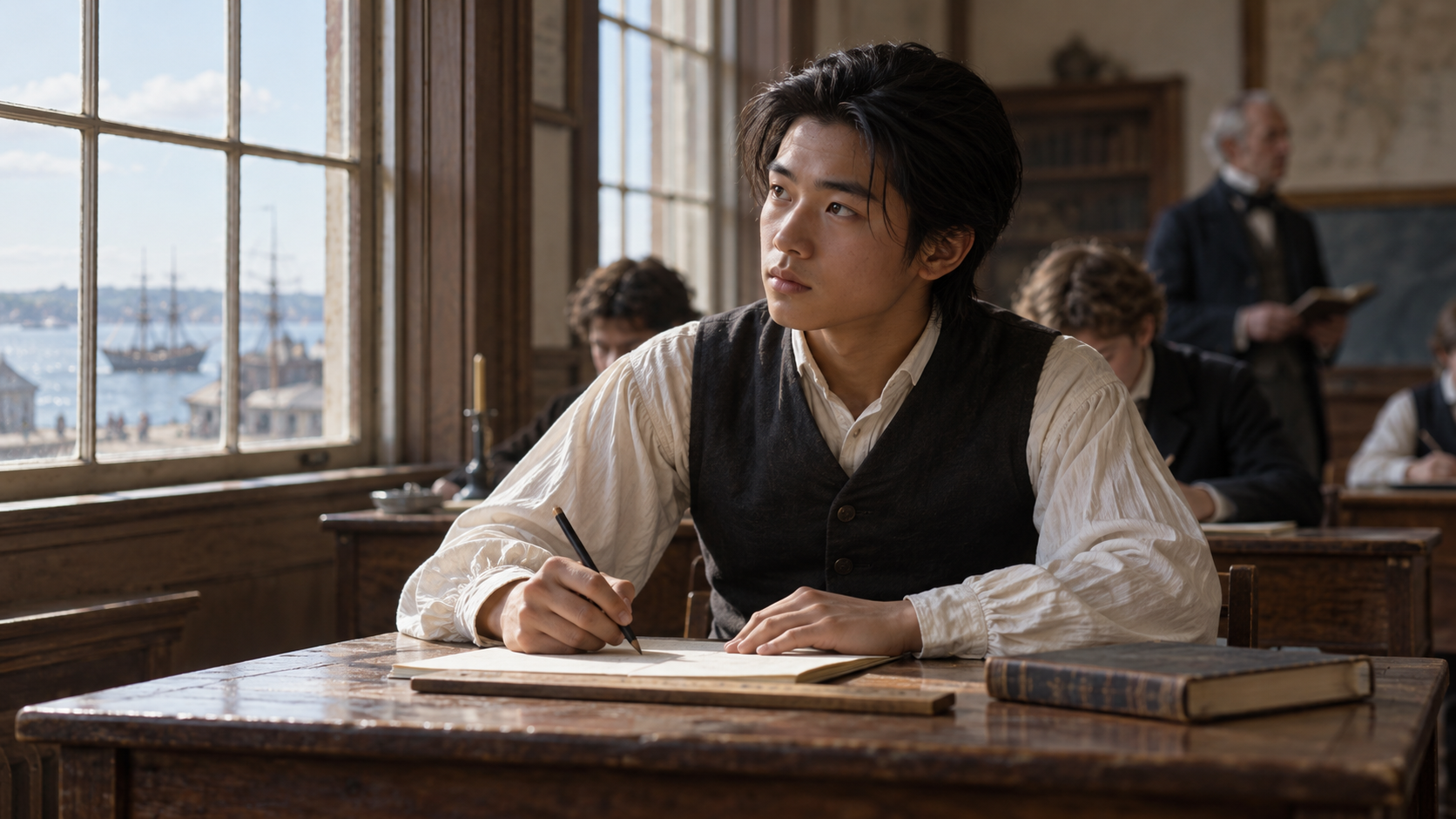
Education in Fairhaven
Manjiro’s navigational knowledge was not acquired merely by drifting across the ocean. In Fairhaven, Whitfield’s home town, he attended school. The National Archives of Japan lists English and mathematics alongside navigation, surveying and shipbuilding among the subjects he studied.
The subjects show a different relationship with the sea from that of an involuntary castaway. Language and technical study could help a person understand ships and voyages as things to be worked with. This change provides one important turning point in the account.
School subjects were only part of the overseas experience. The Sakamoto Ryoma Memorial Museum also describes learning about institutions, customs and culture. Living among people and encountering their social arrangements supplied another kind of material for later explanations about life abroad.
Scene 05
Knowledge in the classroom and experience at sea
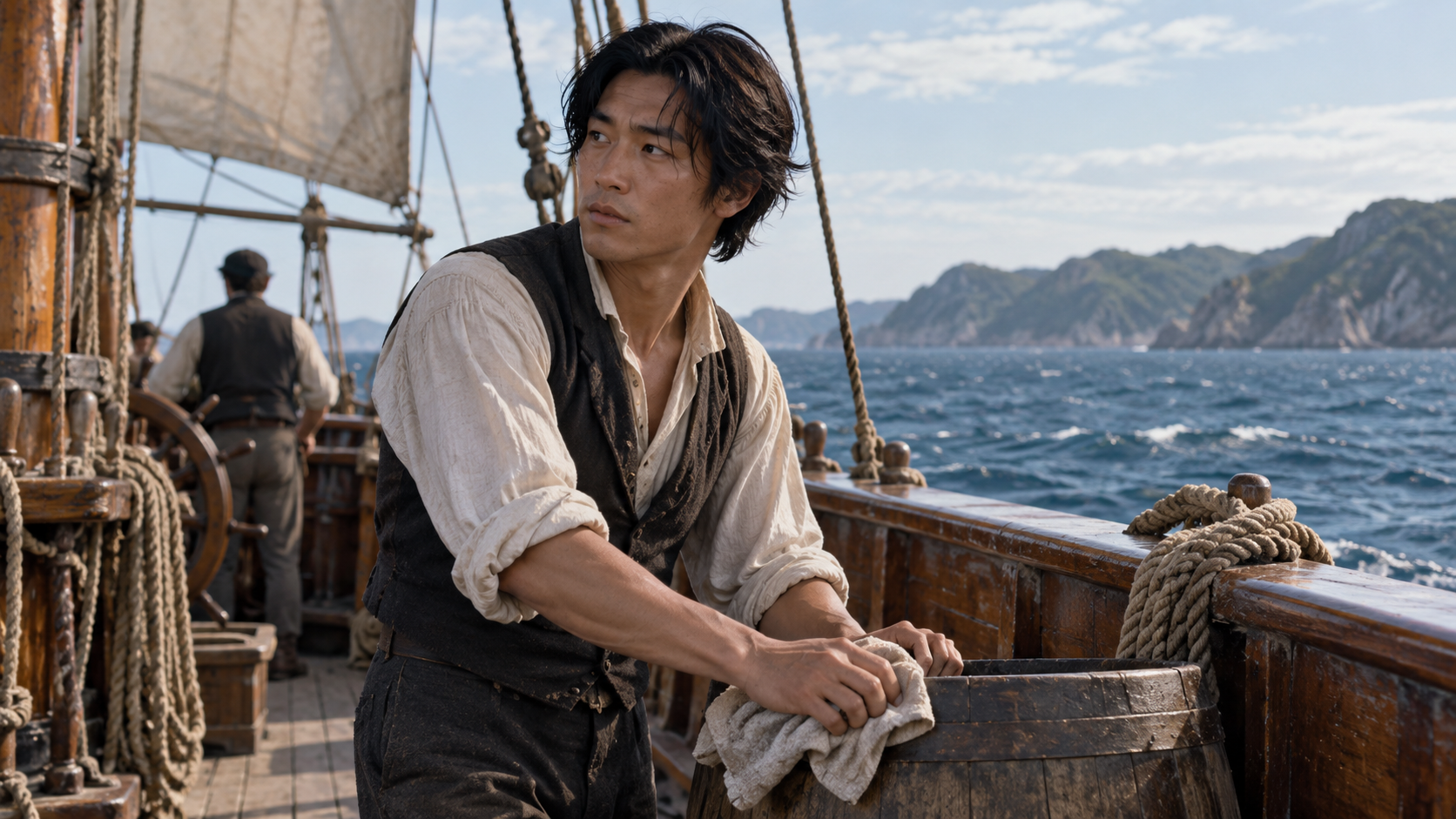
After school, Manjiro again sailed aboard whaling ships. His first experience aboard an American vessel had begun as a rescued castaway. Later voyages followed a period of education, linking life on land with further experience at sea.
The institutional accounts thus describe more than information acquired from books. English and mathematics were part of his learning, while living and working among different people aboard a ship supplied another setting in which knowledge and experience could meet.
This distinction helps explain the returning witness. When asked about overseas affairs, he was someone who had lived in foreign ships and towns. It does not follow that every story later attributed to him was independently verified; the narrower point is the combination of settings in his biography.
Scene 06
Landing, questioning and homecoming
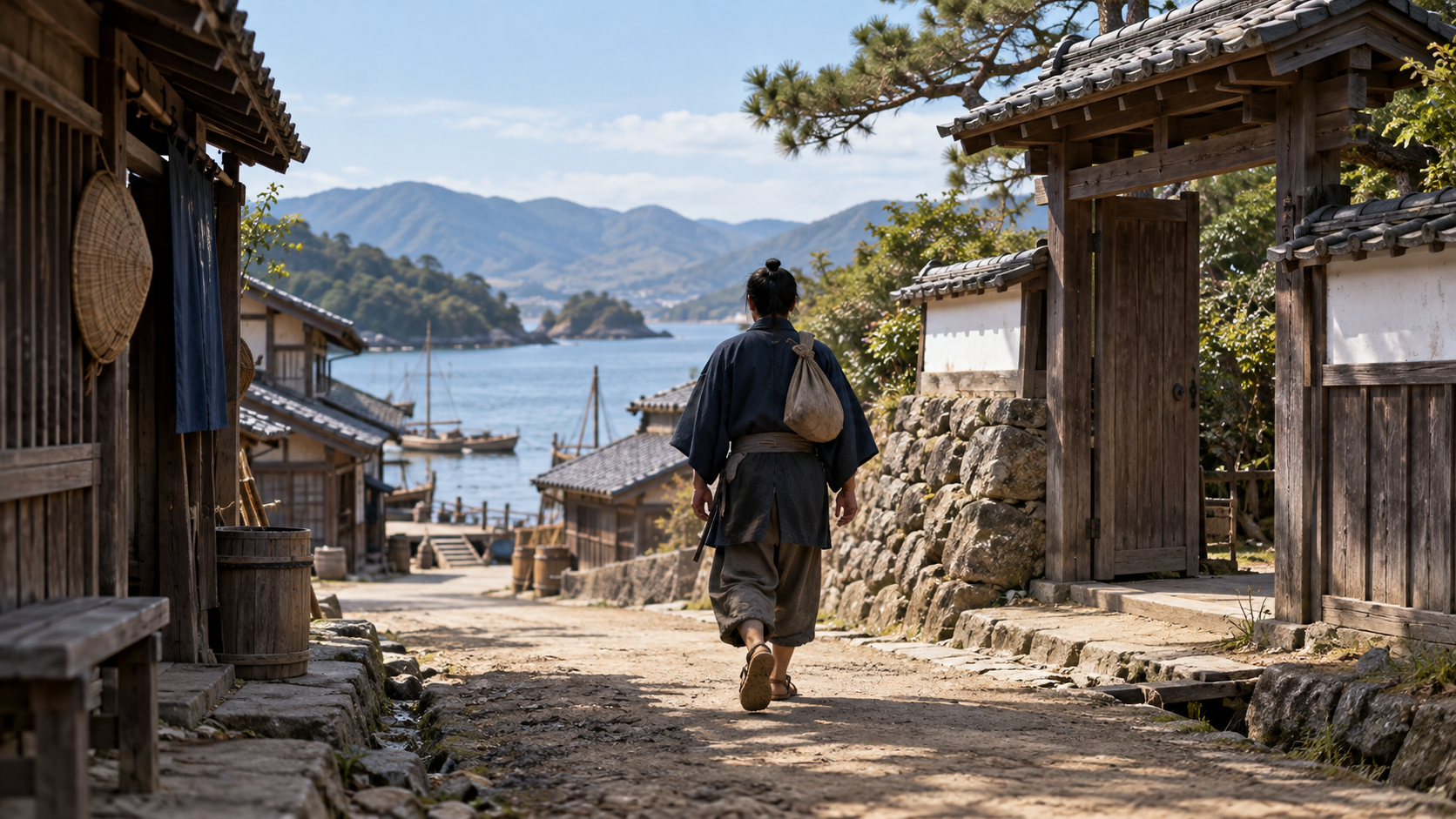
The return took several stages. Manjiro landed in Ryukyu in 1851, then underwent questioning in Satsuma and Nagasaki before returning to Tosa in 1852. The National Diet Library biography also distinguishes the year of landing from the year of homecoming.
Coming back from abroad did not mean going directly home. Keeping arrival, questioning and return separate prevents a lengthy sequence from disappearing into one word. The sources used here support the years; the article does not invent precise dates for every stage.
In 1853, around Perry’s arrival, the shogunate summoned him. His experience could be treated both as something to investigate and as information sought from someone who knew America. Those aspects belonged to the same returning person, rather than to two unrelated stories.
Scene 07
Kawada Shoryo listened and recorded
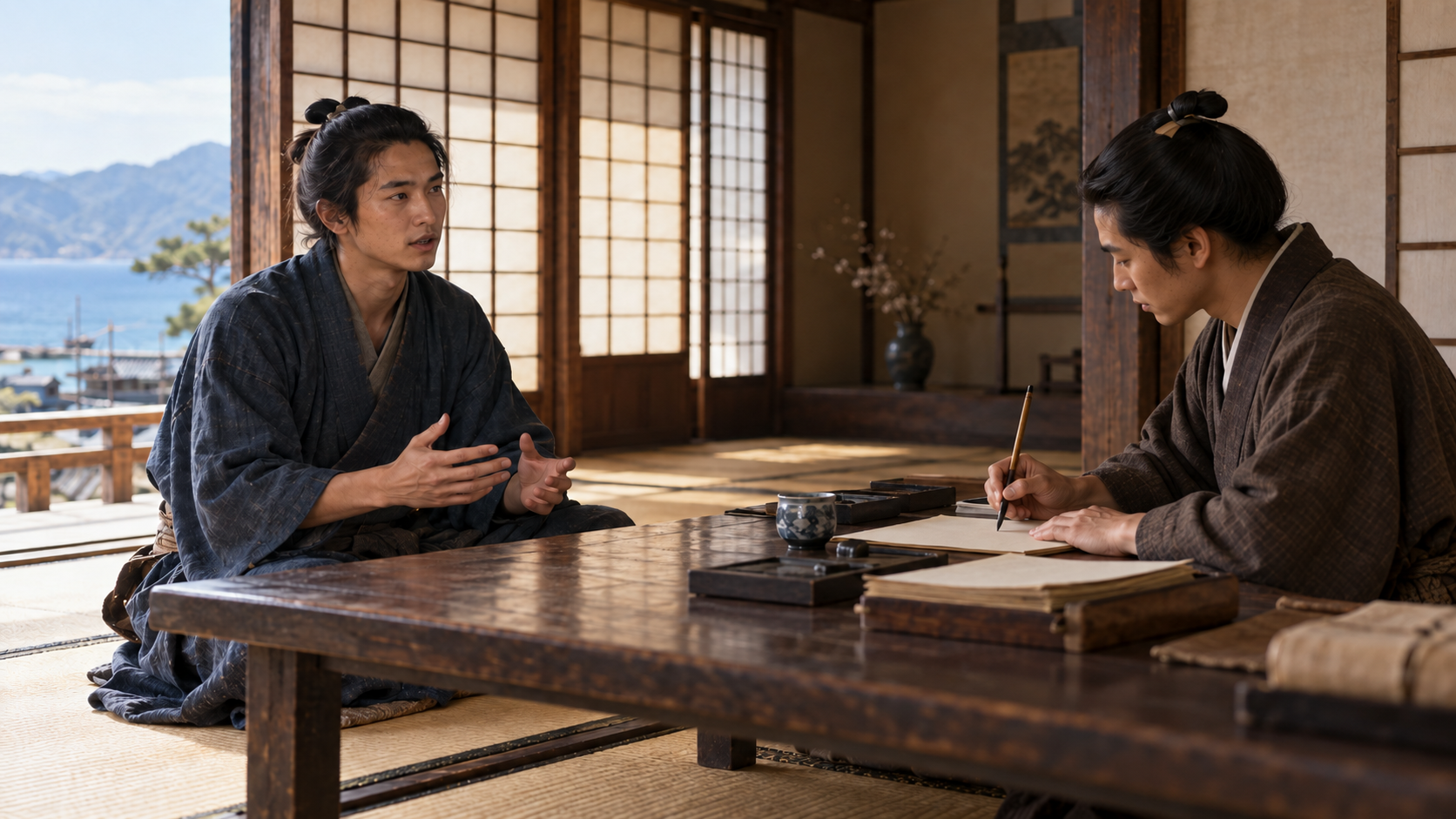
Manjiro’s experiences also reached people through someone who listened and wrote. The Tosa artist Kawada Shoryo compiled Hyoson Kiryaku. The Sakamoto Ryoma Memorial Museum explains that in 1852 he heard the returned Manjiro describe voyages and overseas affairs.
There are two roles in this account: the person who experienced the events and the person who arranged what he heard into writing and illustrations. Treating the work as Manjiro’s own diary would erase the recording process between the journey and the surviving text.
That process is part of the history of transmission. Experience did not become a book without another person’s work. This article follows the museum’s account of the compilation and does not claim a new complete decipherment of the original manuscript or a comparison of every surviving version.
Scene 08
Knowledge travelled through copies
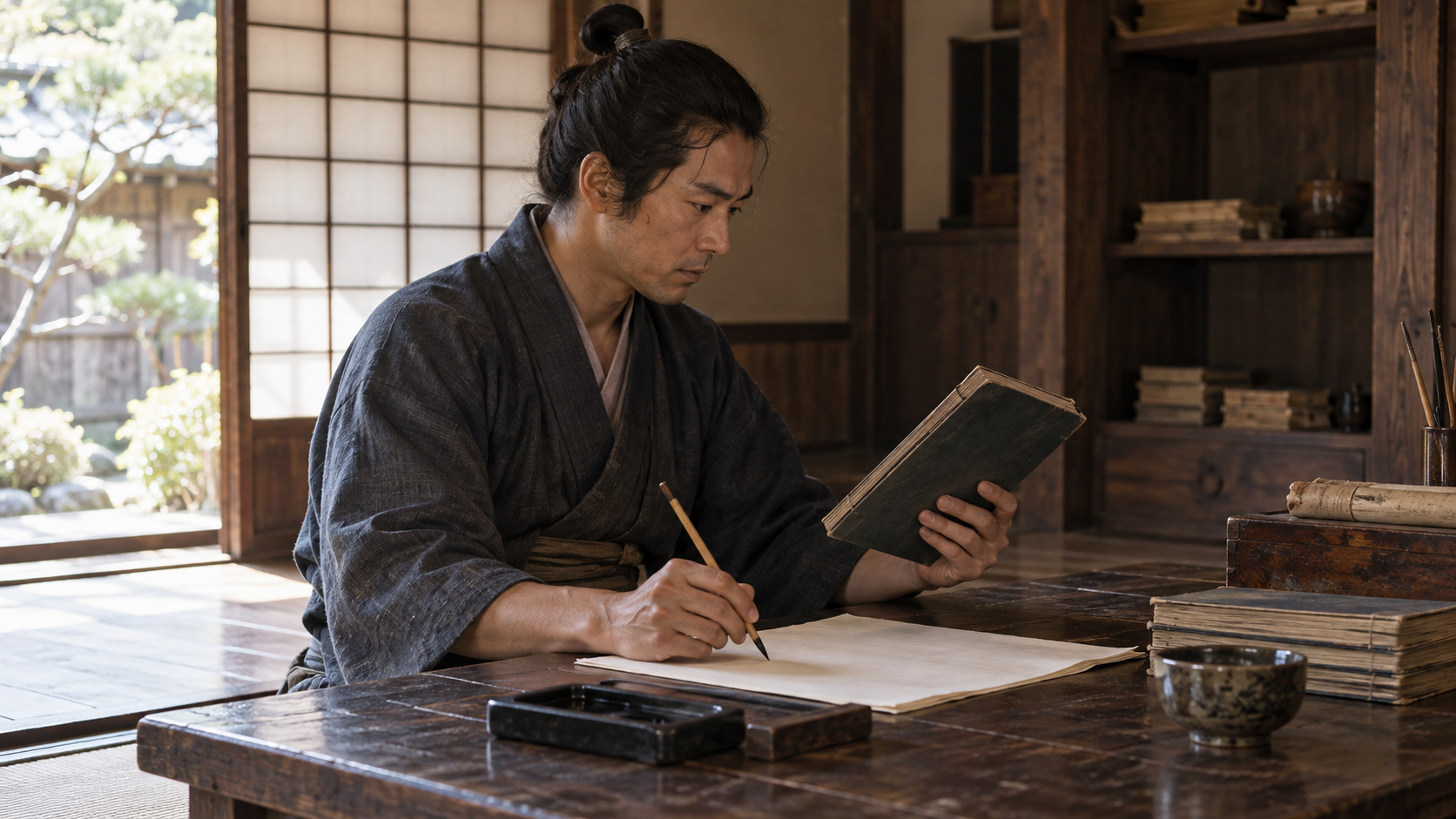
The museum introduces an Otsu version of Hyoson Kiryaku and also describes other manuscripts carrying accounts of Manjiro’s experience. What was spoken could be written, copied by another hand and encountered by readers who had never met the traveller.
The National Archives displays a map spread in Hyokaku Danki. Its existence is visible in the bounded observation retained with the adopted script. That observation does not establish the meaning of every line, a complete reading of all place names or a precise track of the voyages.
Books about the same person still have different identities. Asking who listened, who wrote and which copy survived keeps the journey from being detached from its sources. Later readers encountered the experience through those acts of preservation and copying as well as through the original witness.
Scene 09
Putting conversation into a learnable form
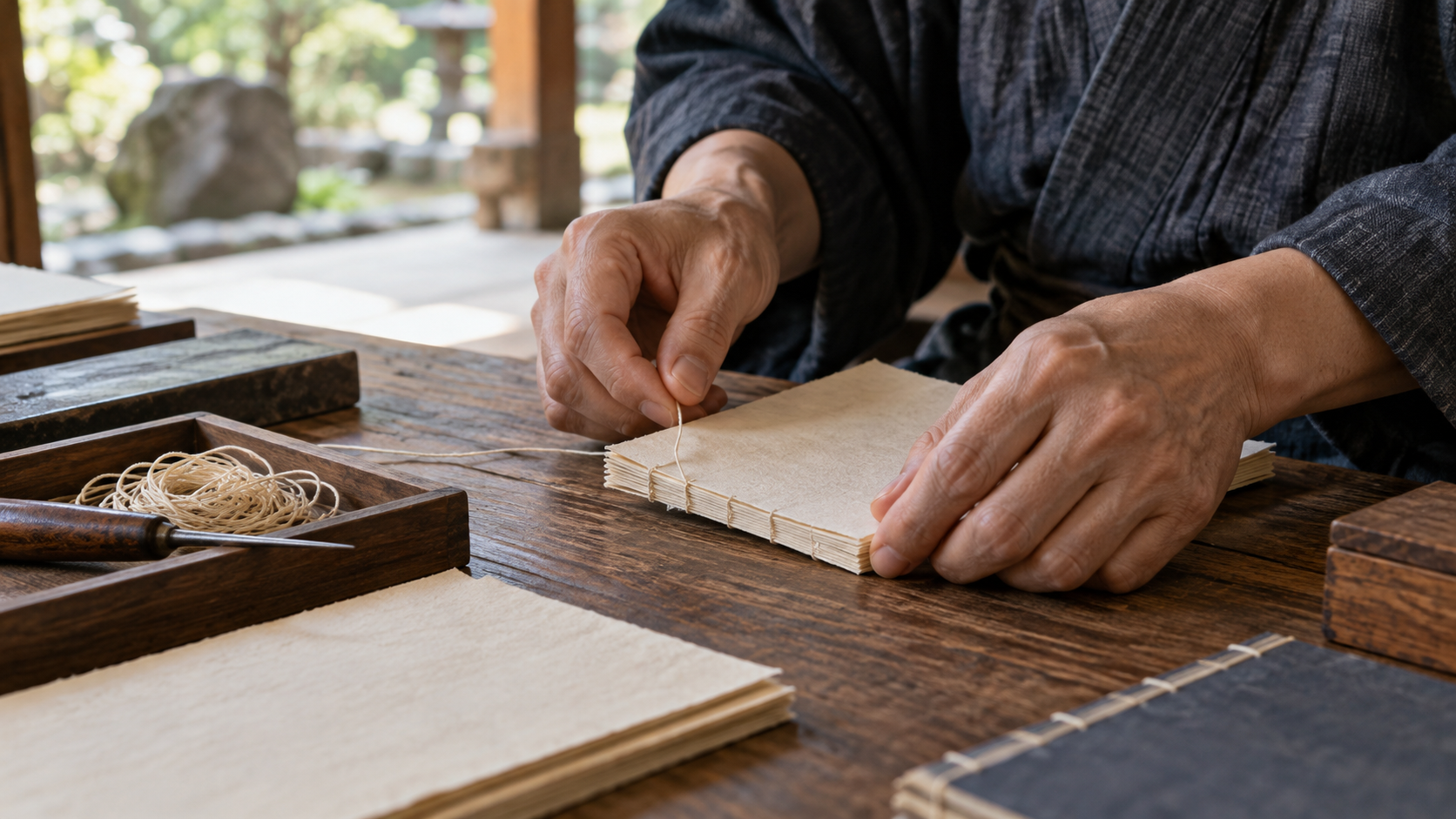
Another form of knowledge associated with Manjiro is the English conversation book Eibei Taiwa Shokei. In the Kochi University copy, the conversation examples are accompanied by small phonetic writing, including katakana, and corresponding Japanese text.
The adopted script’s observation of image twelve includes a short expression concerning how a person is feeling. The article uses that limited observation to discuss the arrangement of the page. It does not turn one inspected page into a verified transcription of the whole book.
Knowing a language and preparing something from which another person can learn it are different activities. The book makes that distinction concrete. Its arrangement offers a way to follow the passage from one speaker’s experience to a form that could be consulted beyond a face-to-face conversation.
Scene 10
Publication in 1859 and the question of readers
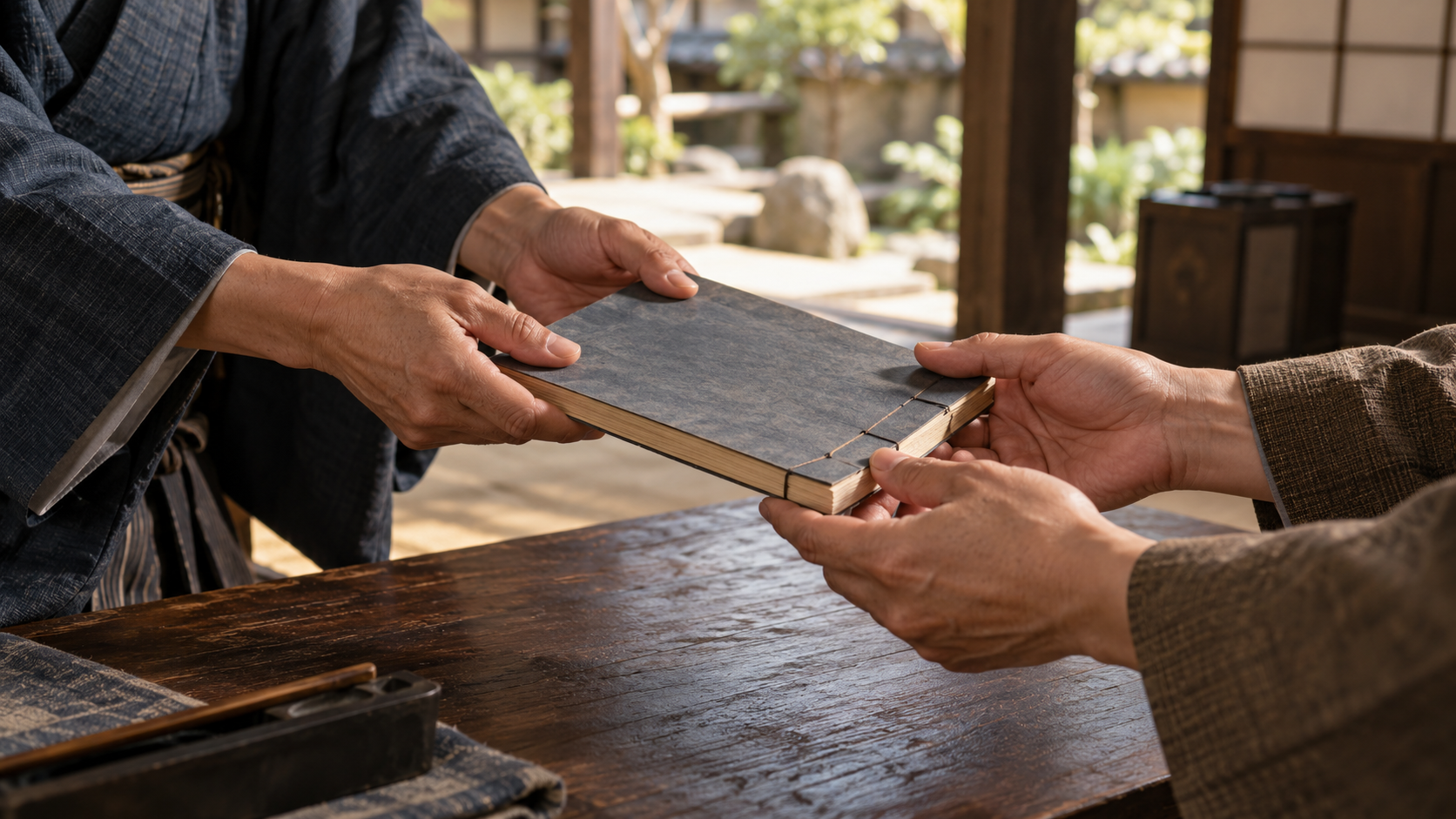
The holding library dates the publication to 1859, the year before Kanrin Maru’s voyage to America. Dating the book and dating the voyage separately allows their relationship to be considered without treating them as a single event.
The library’s explanation suggests that the work may initially have been intended for travellers. That remains a possibility in its account. It is not evidence that every person aboard the later ship used this exact copy or learned English from the same pages.
Publication, intended readership and actual use therefore remain different questions. The book’s existence supports a history of making language available in print. Establishing who read it, when and with what result would require evidence beyond its date and the design of a conversation page.
Scene 11
An interpreter on Kanrin Maru, and a second ship
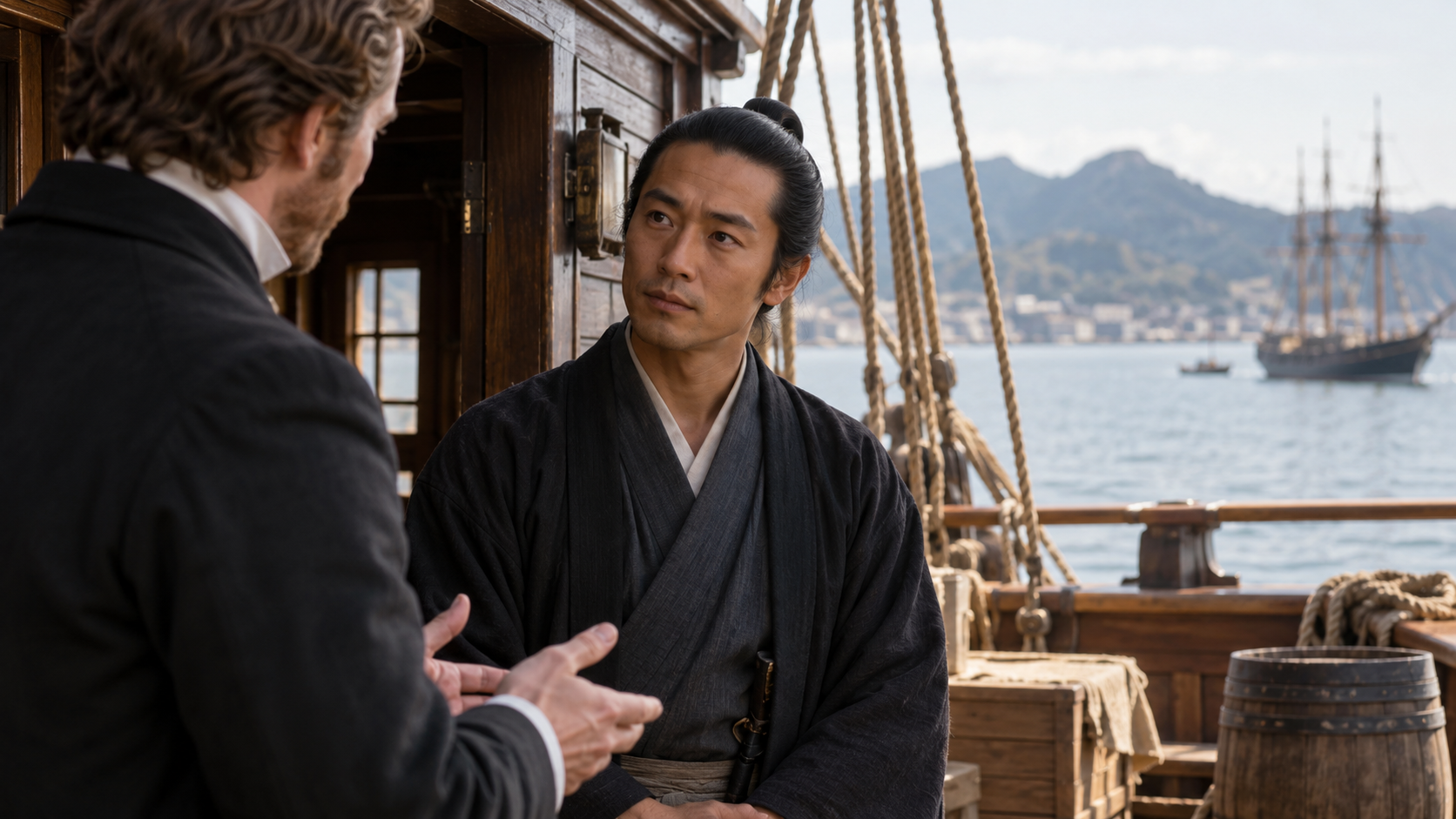
In 1860, Manjiro crossed the Pacific again aboard Kanrin Maru as an interpreter. A role list in a travel record reproduced in the 1938 compilation Bakumatsu Gunkan Kanrin Maru distinguishes him as interpreter from Katsu Rintaro, also known as Katsu Kaishu, as commander.
The treaty-ratification delegation travelled aboard the American warship Powhatan. That vessel and Kanrin Maru had different roles. The latter carried Japanese participants, including Katsu, and Americans, including Brooke; communication between people aboard was one of the tasks for which Manjiro’s experience mattered.
The role list establishes a distinction in titles, not a complete account of who carried out each task throughout the crossing. The article does not transform an assessment of practical assistance into an official command appointment. Daily navigation and decisions would need to be followed through additional records.
Scene 12
What remained as language, skills and records
What Manjiro brought back cannot be reduced to the single word English. The account includes technical education, life in a foreign town and time aboard working ships. Different experiences could be drawn on when he later explained, interpreted or taught.
Some of that experience also survived through writing. Recorded testimony and a printed conversation book were different means of making knowledge available beyond the person who first acquired it. The witness, recorder, copyist and reader belong to connected but distinct stages.
This is the interpretive conclusion of the article rather than a claim that one man decided every aspect of Japan’s opening. Following how experience became words, skills and records gives a more precise place to Manjiro within that wider history.
How to read this work
History, interpretation, and reconstruction
Connecting education, experience at sea, recorded testimony and publication makes Manjiro’s role in transmitting knowledge clearer than an adventure story alone.
This work is grounded in published sources and historical research. Interior thoughts, dialogue, and some visual details are cinematic reconstructions. Where historians disagree, the article presents the point as debated rather than settled fact.
Timeline
The story in time
-
Shipwrecked while fishing, reaches Torishima and is rescued by an American whaler.
Sources: 126-city-life, 126-ndl-portrait6123 -
Travels to the American mainland and receives education in Fairhaven.
Sources: 126-city-life, 126-naj-drift -
Lands in Ryukyu, a separate stage from returning to his home in Tosa.
Sources: 126-ndl-portrait6123 -
Returns to Tosa; Kawada Shoryo records his experiences in Hyoson Kiryaku.
Sources: 126-museum-record, 126-ndl-portrait6123 -
Summoned by the shogunate around the time of Perry’s arrival.
Sources: 126-ndl-portrait6123 -
Eibei Taiwa Shokei is published.
Sources: 126-kochi-u-eibei-canvas12 -
Crosses the Pacific on Kanrin Maru as an interpreter; the ratification delegation travels on Powhatan.
Sources: 126-ndl1921104-koma259, 126-jpsearch-kanrinmaru
People & terms
A guide for new readers
Glossary
- Tosa 土佐
- The historical province associated with Manjiro’s home, in present-day Kochi Prefecture.
- Hyoson Kiryaku 漂巽紀略
- Kawada Shoryo’s written account based on hearing Manjiro describe his experiences; it is not Manjiro’s autograph diary.
- Hyokaku Danki 漂客談奇
- A separate work concerning the returning castaway, represented by copies with their own histories.
- Eibei Taiwa Shokei 英米対話捷径
- An English conversation book associated with Manjiro, dated by the holding library to 1859.
- Interpreter and commander 通弁官・指揮官
- Different roles in the inspected record’s list; a role title alone does not reconstruct every action during a voyage.
Sources & method
How this article was built
The Japanese article follows the twelve scenes of the adopted published-video script. This English version preserves their source associations, historical limits and interpretive structure. Institutional pages were rechecked where accessible, while earlier bounded observations remain identified as such.
The homecoming discrepancy is disclosed instead of hidden. Landing in Ryukyu, questioning and reaching Tosa are kept separate. The 1852 year agrees across the National Diet Library, National Archives and Ryoma museum accounts used here.
The role list at image 259 was checked against the saved enlarged observation. It supports the distinction between interpreter and commander. It does not establish every practical task on the voyage, and the later compilation is not represented as an original autograph.
The twelve illustrations are existing anonymous generated scenes, adopted separately for article use after visual and file-identity checks. No historical scan, authentic portrait, third-party audio or unlicensed collection photograph is uploaded as an article illustration.
Sources
References and further reading
- John Manjiro: Life ジョン万次郎の生涯 Title translated editorially for reader convenience. Tosashimizu City 土佐清水市 Municipal account of rescue, schooling, voyages and the stages of return. Its assessment of practical leadership is not substituted for a formal command title. Accessed 2026-11-04
- The Life of John Manjiro ジョン万次郎の生涯 Title translated editorially for reader convenience. John Mung Museum ジョン万次郎資料館 Used for the divergent paths after Hawaii and the educational setting. Its 1853 Tosa homecoming differs from the national institutional accounts; this article follows their 1852 chronology. Accessed 2026-11-04
- Kanrin Maru: Japan Search Gallery ジャパンサーチ ギャラリー 咸臨丸 Title translated editorially for reader convenience. National Diet Library 国立国会図書館 Corroborates the distinction between the two vessels and introduces related records. Links to journals are not a claim that every linked document was read. Accessed 2026-11-04
- John Manjiro: People Around Fukuzawa Yukichi, 12 March 2026 三田評論 福澤諭吉をめぐる人々 ジョン万次郎(2026年3月12日) Title translated editorially for reader convenience. Keio University 慶應義塾 Modern institutional research introduction used for language learning and interpreting. Its quoted historical records are distinguished from independently inspected originals. Accessed 2026-11-04
- Eibei Taiwa Shokei: Catalogue and Digital Collection 英米對話捷徑 目録・デジタルコレクション Title translated editorially for reader convenience. Kochi University 高知大学 Chihido edition, library commentary and adopted observation of image twelve. Publication in 1859 is retained; the proposed audience remains tentative. No scan is reproduced. Accessed 2026-11-04
- Permanent Exhibition: John Manjiro Room 常設展 ジョン万次郎展示室 Title translated editorially for reader convenience. Sakamoto Ryoma Memorial Museum 高知県立坂本龍馬記念館 Explains Shoryo’s 1852 compilation, the Otsu version and related copies. The experience of the witness is distinguished from the recorder’s work. Accessed 2026-11-04
- Tales of Castaways: John Manjiro 漂流ものがたり ジョン万次郎漂流記 Title translated editorially for reader convenience. National Archives of Japan 国立公文書館 Institutional explanations of education and return, and separate holdings numbered 185-0205 and 185-0202. Observing a map spread does not establish the meaning of every line. Accessed 2026-11-04
- The World of Diaries: Katsu Kaishu 日記の世界 勝海舟 Title translated editorially for reader convenience. National Diet Library 国立国会図書館 Supplementary identification of Katsu; not evidence of a complete reading of his diaries or a reconstruction of every event in the 1860 crossing. Accessed 2026-11-04
- Portraits of Modern Japanese Historical Figures: Nakahama Manjiro 近代日本人の肖像 中浜万次郎 Title translated editorially for reader convenience. National Diet Library 国立国会図書館 Year-level corroboration of the 1851 landing, 1852 homecoming and 1853 summons. Exact dates and durations of questioning are not added. Accessed 2026-11-04
- Bakumatsu Gunkan Kanrin Maru, compiled by Fumikura Heijiro, 1938: Image 259 文倉平次郎編 幕末軍艦咸臨丸(巌松堂、1938年)コマ259 Title translated editorially for reader convenience. National Diet Library 国立国会図書館 The retained enlarged image distinguishes interpreter Manjiro and commander Katsu Rintaro. It is a passage reproduced in a later compilation, not a new comparison with an 1860 autograph or a reading of all 415 images. Accessed 2026-11-04
- Knowing the World: Hyokaku Danki 世界を知る 漂客談奇 Title translated editorially for reader convenience. Tokyo Metropolitan Library 東京都立図書館 Related holding described in the adopted review. A later annotated copy is not treated as an original autograph from the 1850s. Fresh retrieval returned 503; no collection image is reproduced. Accessed 2026-11-04
Continue reading
More stories from Shigeki
Shigeki English
Kobayakawa Hideaki after Sekigahara: Work beyond Okayama’s Keep
The outer moat offers a way into a short period of castle government.
- When Hideaki’s Okayama rule, 1600–1602; earlier construction in 1597 and later changes considered separately
- Where Okayama Castle, its outer enclosures and former western moat; Bizen and Mimasaka
Shigeki English
Passing Hakone Checkpoint: Identity, Direction and Travel Documents
A pass mattered, but the inspection depended on more than possessing paper.
- When Edo-period Hakone; establishment at the present location around 1619, regulations of 1711 and later reconstruction
- Where The Tokaido road between Lake Ashi and the surrounding mountains at Hakone