
SHIGEKI ENGLISH STORYEN
Japanese history in English
Tsutaya Juzaburo and Edo Publishing: The Work Behind a Print
Planning, paper, carving, printing and catalogues connected an artist’s work with its readers.
Follow Tsutaya Juzaburo’s publishing through guidebooks, collaborative books, woodblock production and surviving catalogues. Distinguish the first publisher from his successor, original designs from later impressions, and artistic reputation from evidence of commercial success.
At a glance
Before you enter the story
- When
- 1750–1797, with the successor’s shop in 1824 and later reproductions kept separate
- Where
- Yoshiwara and Toriaburacho in Nihonbashi, Edo
- Key figures
- Tsutaya Juzaburo, Kitagawa Utamaro, Toshusai Sharaku, Santo Kyoden, Carvers, printers and readers
- What was at stake
- What work joined a design, a wooden block and a sheet of paper into something that could reach a reader?
Why this story matters
The larger history behind the turning point
An artist’s signature identifies an important participant, but not everyone involved in a print. The publisher connected planning, artistic work, production and sale. Following that connection brings less visible crafts and commercial arrangements into the history of Edo culture.
Surviving books can reveal names, formats and catalogues without telling us every sales figure or reader response. Looking closely at what a particular object establishes helps preserve the difference between present fame and the circumstances of its original publication.
Historical context
What an international reader needs to know
A design and a surviving sheet have different dates
A famous eighteenth-century design may be encountered through a later impression or reproduction. The National Diet Library explicitly identifies Meiji- and Taisho-period reproductions among illustrations in its exhibition. The date of a design should not automatically become the date of the paper being viewed.
The same caution applies to places. A shop carrying Tsutaya’s name appears in an 1824 shopping guide, after the first Juzaburo’s death. CODH identifies it as the successor’s shop. The later image is evidence for its own period, not an eyewitness view of the first publisher at work.
Guidebooks and the lives beyond them
Yoshiwara saiken were guides containing information about Yoshiwara, including establishments and courtesans. They were publications made for particular readers and purposes. Their selected information and commercial presentation do not describe every aspect of the experiences of people living in the district.
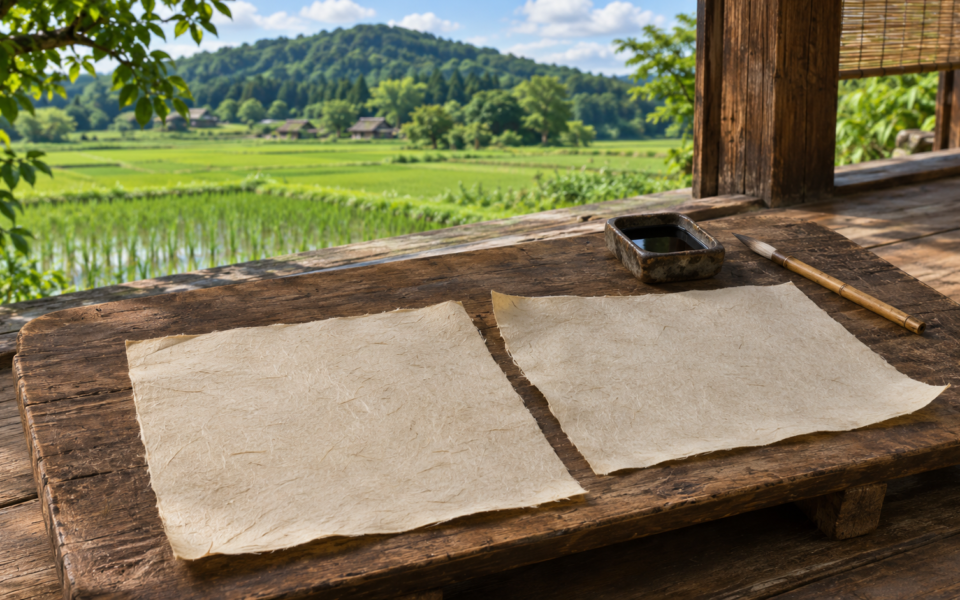
This article asks what information was selected, how a book was arranged and how production was organized. Its workshop illustrations are anonymous generated scenes. They are neither authentic portraits nor copies of surviving prints, shop interiors or historical documents.
Watch the film
See the story in motion
The film currently uses Japanese audio. This English article provides the context and source trail; it does not imply that an English subtitle track is available.
Scene 01
Beyond the artist’s name
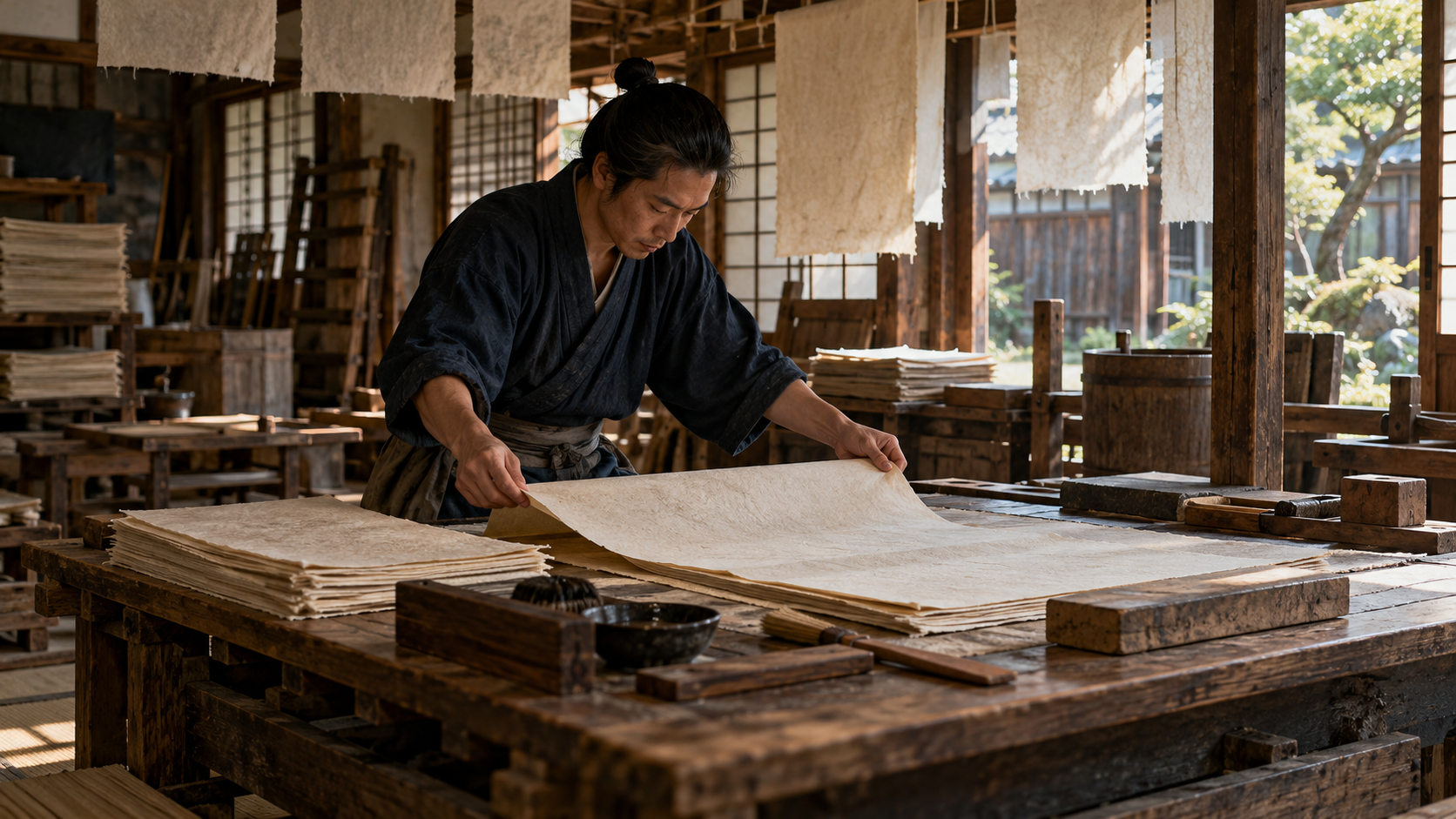
An artist’s name at the edge of a print helps identify who designed it. Another question remains: who turned that work into a publication or product and helped it reach readers?
Edo publishing involved planning, writing and drawing, carving wooden blocks and printing on paper. The publisher occupied a position connecting those activities. A completed picture therefore contains a history wider than the artist’s signature.
Titles, catalogues at the back of books and publishers’ names offer further clues. Following them shifts attention from the famous image alone to the work between a creator and a reader.
Scene 02
Information as an early product
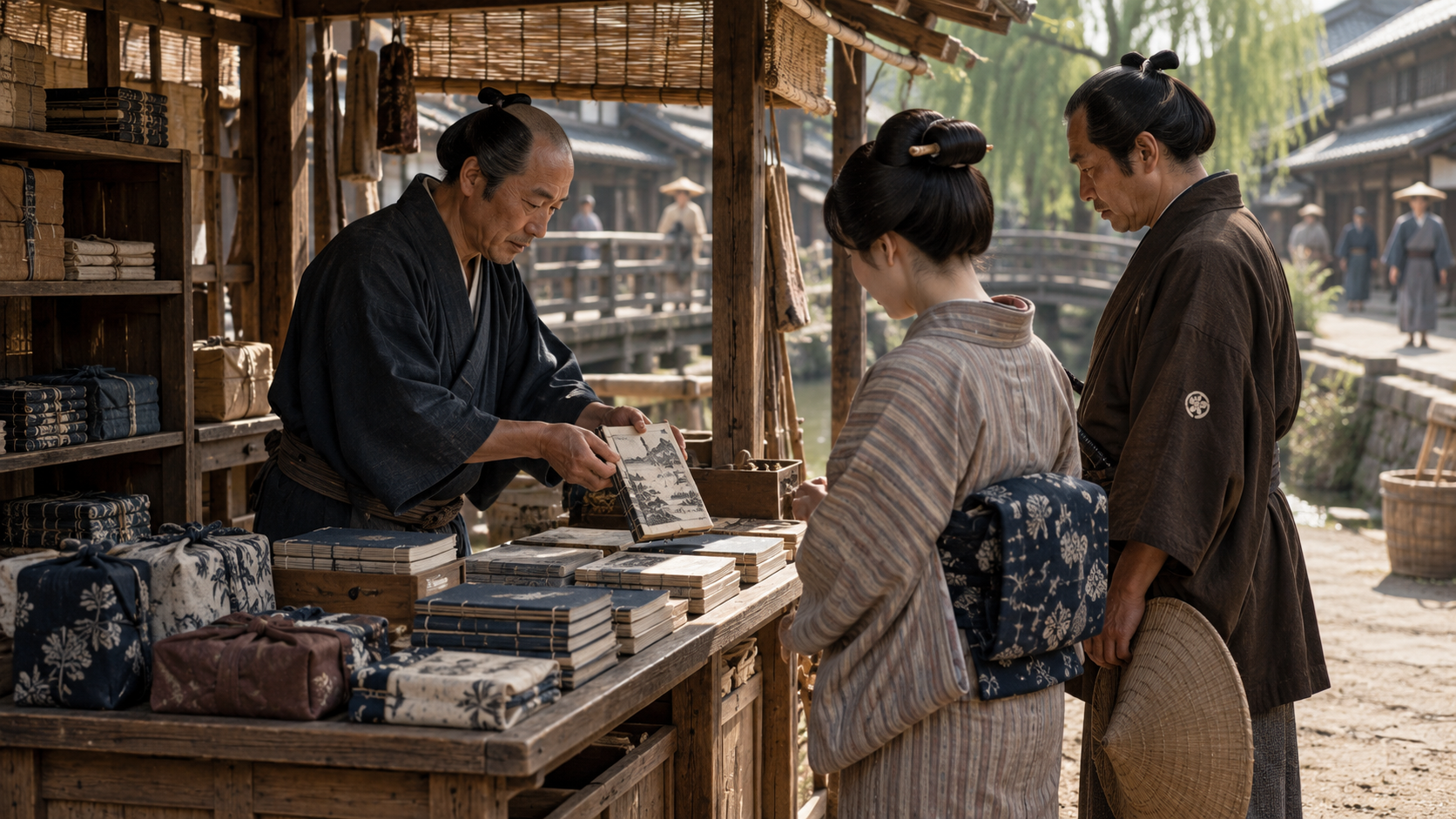
Tsutaya Juzaburo was born in Yoshiwara in 1750 and began the book trade in the early 1770s. Yoshiwara saiken, guides to the district, are central to understanding that early work.
These books conveyed information tied to a place rather than simply presenting a distant scenic view. Their contents included establishments and courtesans, arranged for readers seeking a particular kind of guide.
Selecting what to include, deciding its order and making it convenient to consult were publishing decisions. The book’s attractive presentation should still be distinguished from a full account of the lives of those represented in its pages.
Scene 03
Paper and format were part of the plan
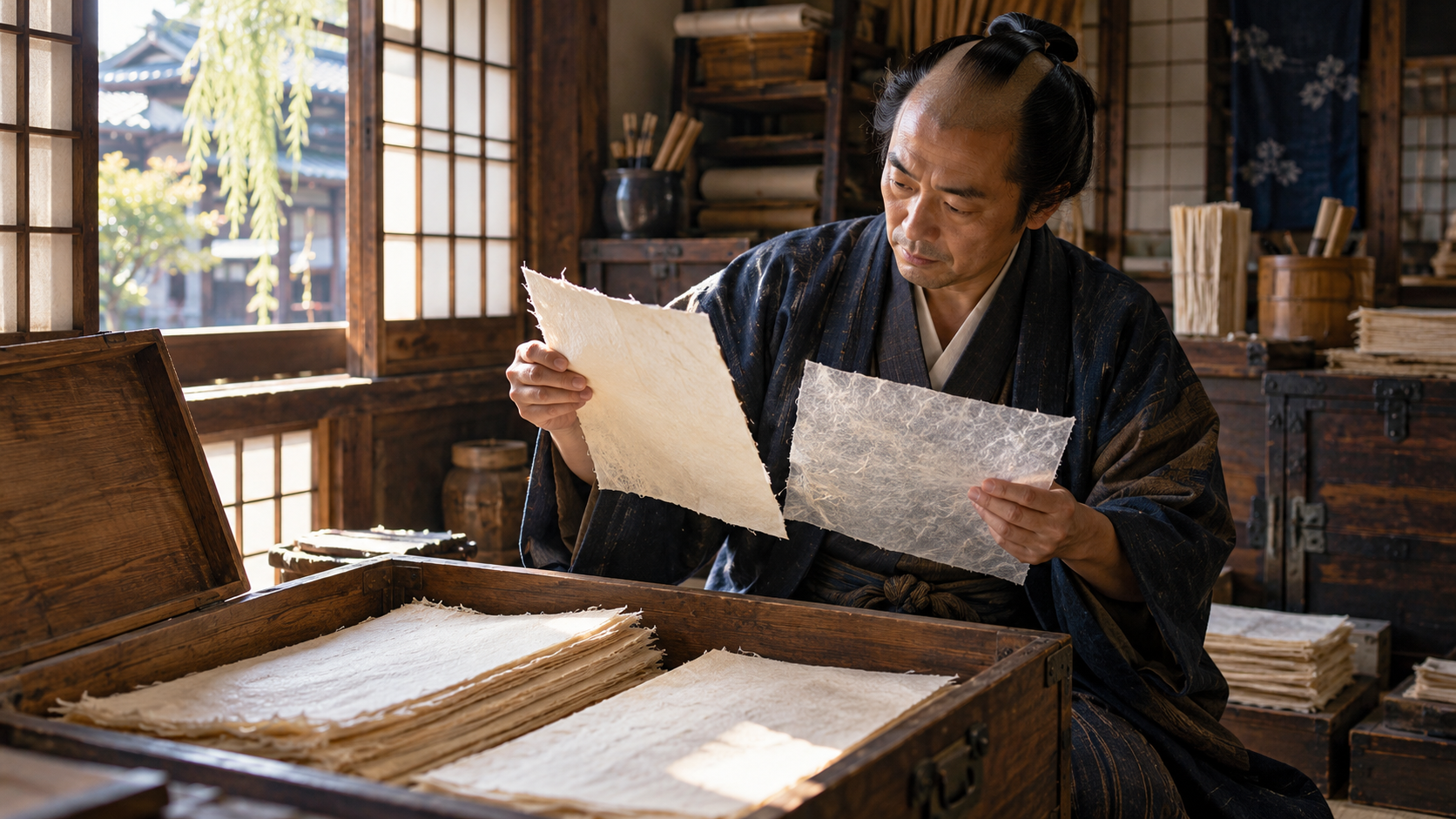
Tokyo Metropolitan Library describes changes to Tsutaya’s guides that enlarged the format, reduced the number of leaves and lowered the price. The physical form was part of how information reached readers.
A 1784 guide held by the University of Tokyo identifies Tsutaya as publisher and records a Koshodo catalogue at the end. It is a specific surviving item, not automatically the same copy as the metropolitan library’s guide from that year.
Such evidence does not reveal every sale or reader’s opinion. It does provide an entry into publishing as a combination of content, size, arrangement and cost, rather than writing and pictures alone.
Scene 04
Collaboration became a book
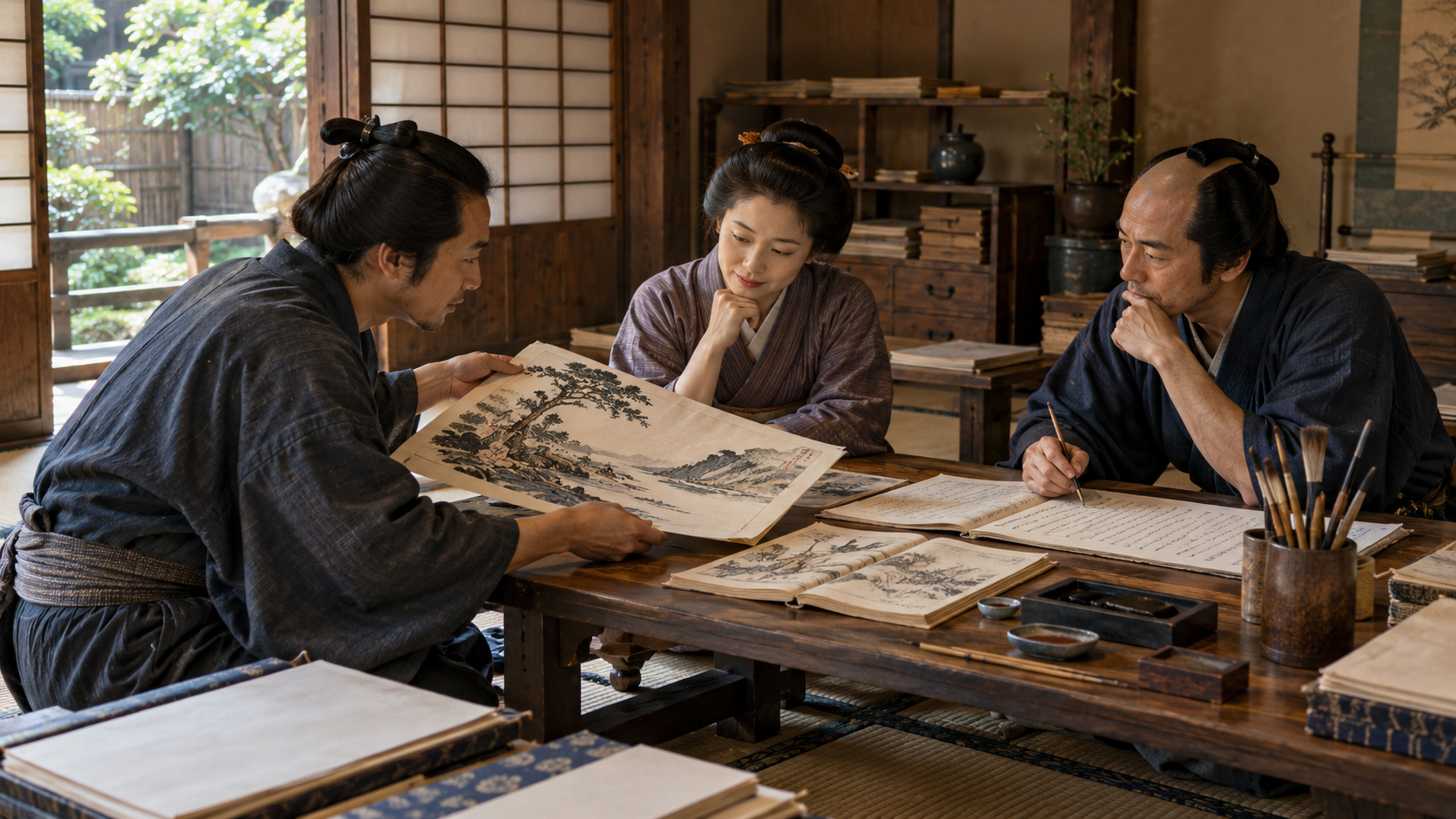
Tsutaya’s publications extended beyond guidebooks to illustrated fiction, sharebon, books of comic verse and colour prints. Different kinds of enjoyment involved different collaborators and different forms of publication.
Tokyo National Museum’s exhibition material presents relationships with writers and artists across these fields. The point is not simply to gather famous names, but to see how text and pictures could be joined within one product.
Ehon Mushi Erami of 1788 combines Utamaro’s pictures with kyoka, or comic verse. Looking at the book as a project reveals a connection between reading and viewing that is less clear when an image is isolated from its pages.
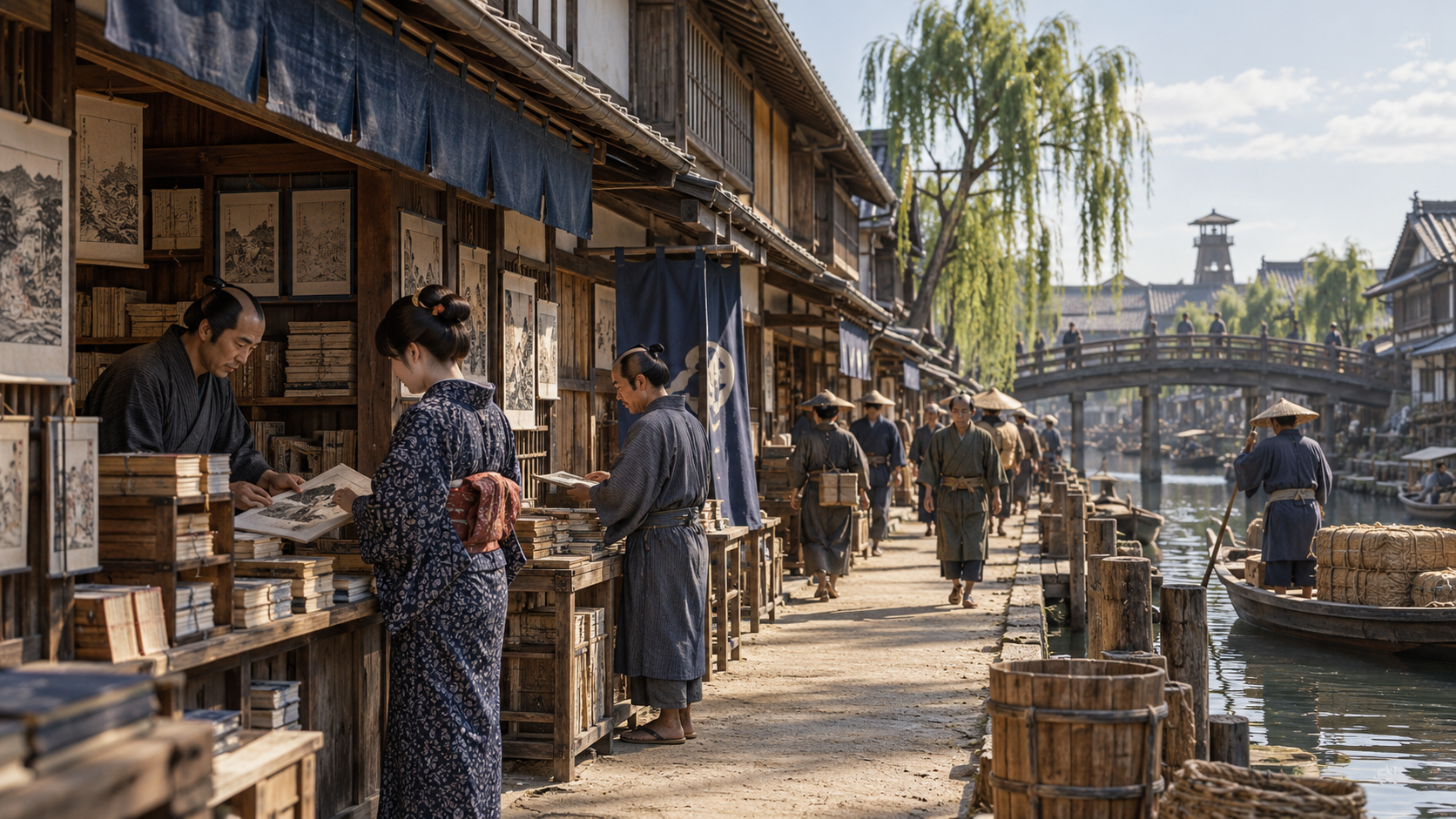
Scene 05
From Yoshiwara to Nihonbashi
In 1783, Tsutaya expanded into Toriaburacho in Nihonbashi. The business that began around Yoshiwara entered another setting important to Edo publishing. The two places help explain the geographical change.
A map can show relationships between locations without establishing exact travel times or the quantity of trade. Likewise, a picture of a shop needs to be placed in the period in which it was made.
The Tsutaya shop in an 1824 shopping guide belongs to the second proprietor after Juzaburo’s death. A shared name does not make that view a direct record of the first publisher standing in his shop.
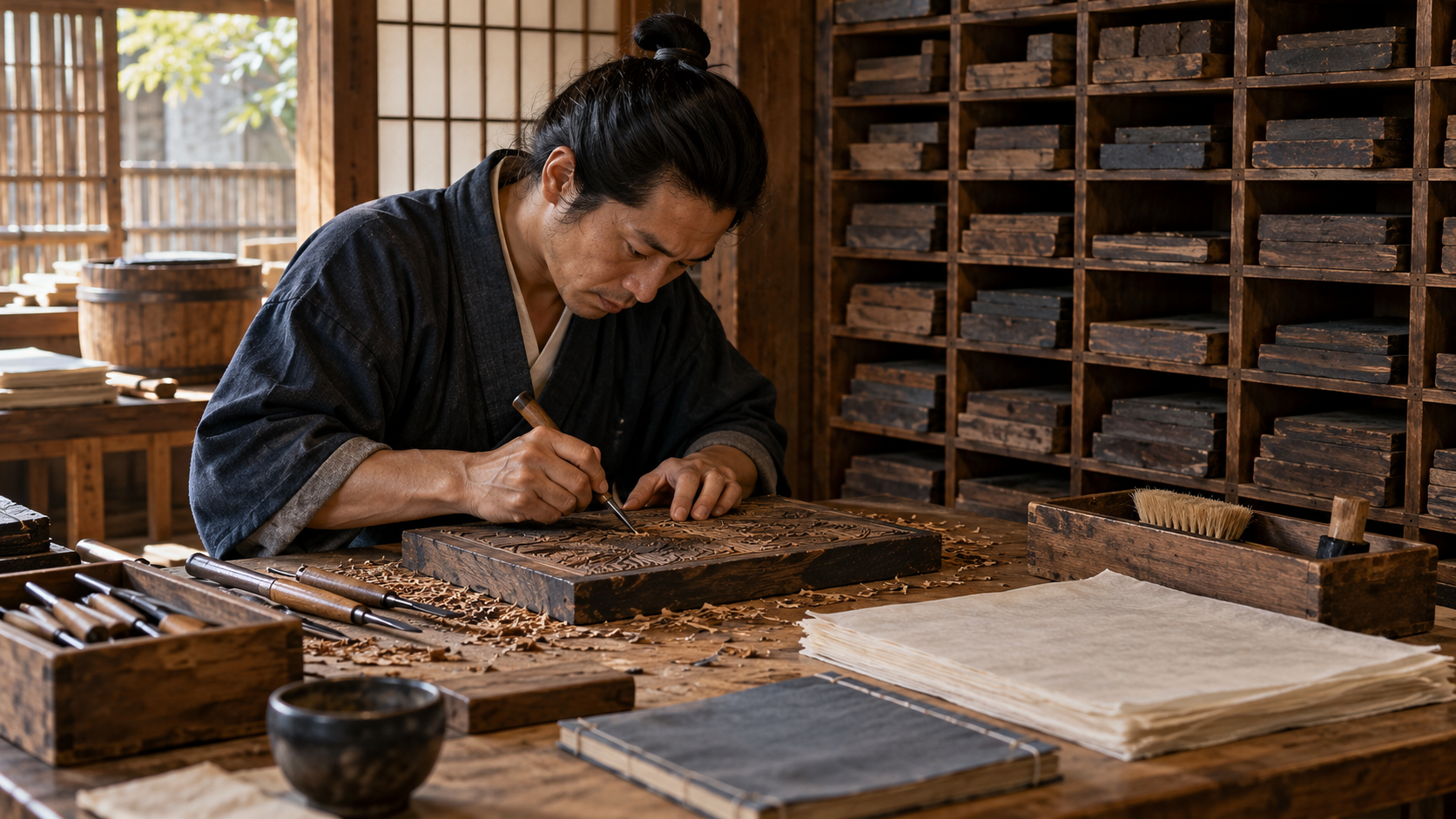
Scene 06
Transferring a drawing to wood
A design did not pass directly into a modern printing machine. Woodblock production required a drawing prepared for carving, followed by the carver’s work on the block that would print the outlines.
The artist’s line had to become a form remaining in wood. That was another skill, connecting a mark on paper with a surface able to transfer ink. The general sequence helps explain the division of labour.
The publisher connected carving with designing and printing. This is one reason an artist’s name alone cannot account for the completed sheet. The conceptual illustration introduces the activity; it is not a technical record of a particular historical block.
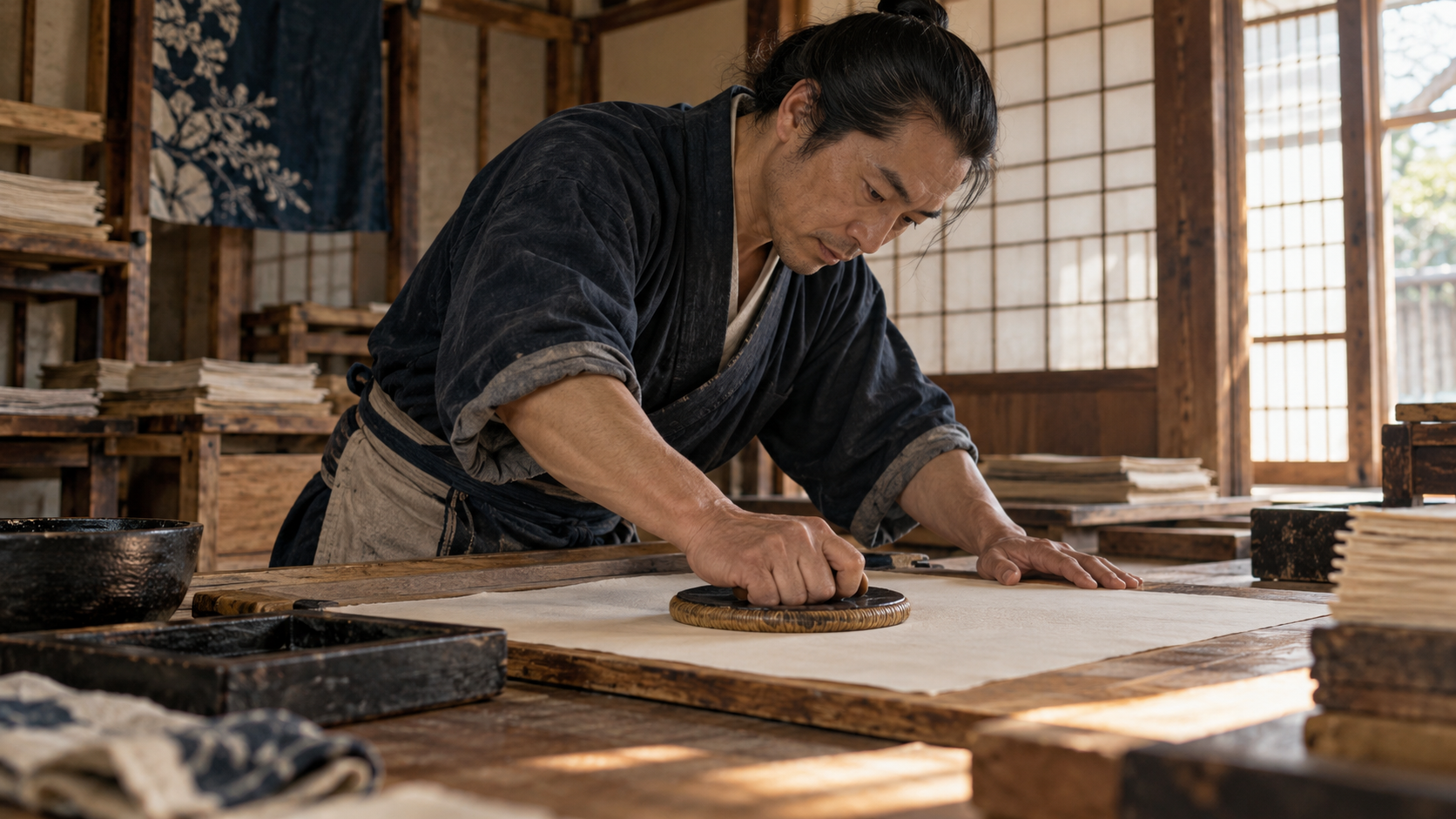
Scene 07
Colour was built through printing
After the outlines, blocks were prepared for the areas of colour. The printer aligned paper and blocks and built up the image through successive applications. The result depended on skilled work as well as the design.
This account gives a general sequence. It does not calculate the number of wooden blocks for a particular print simply by counting its visible colours, or reconstruct every operation performed on one historical sheet.
Modern reproduction demonstrations can help explain the craft, but belong to present-day practitioners. They are not moving images of an Edo workshop. The distinction matters whenever a current demonstration is used to understand an older process.
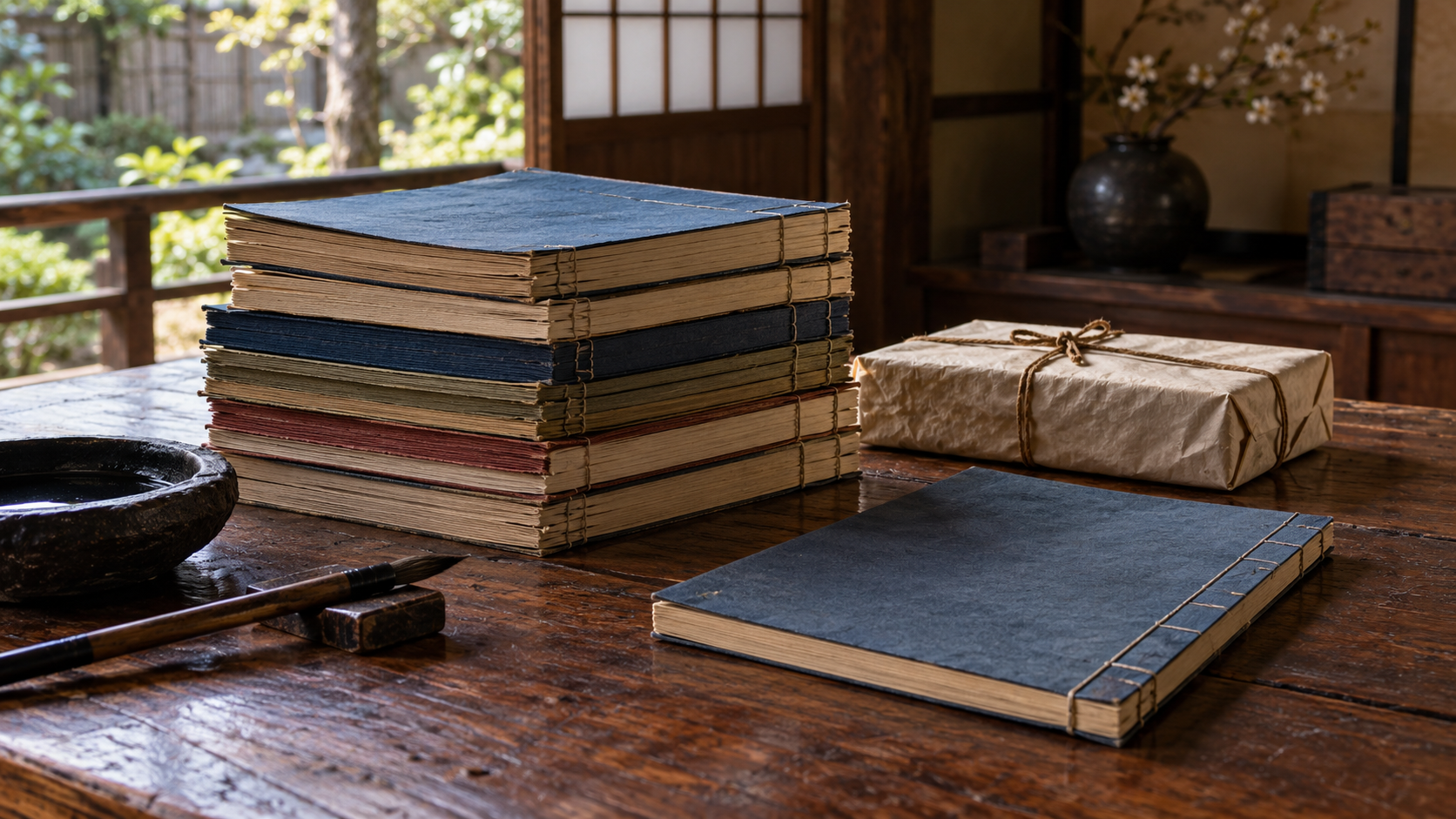
Scene 08
The last pages led to another book
The end of a book could also reveal publishing activity. CODH points to Tsutaya’s name and a list of published books at the end of Ehon Mushi Erami; the 1784 guide likewise has a Koshodo catalogue.
These pages connect one publication with others. They show a publisher placing a group of titles before readers, so that finishing a book could also become an opportunity to discover another.
The limited conclusion is that catalogues occur in these particular publications. It does not establish that Tsutaya invented back-of-book advertising for the whole world. A small piece of surviving evidence can be useful without carrying that larger claim.
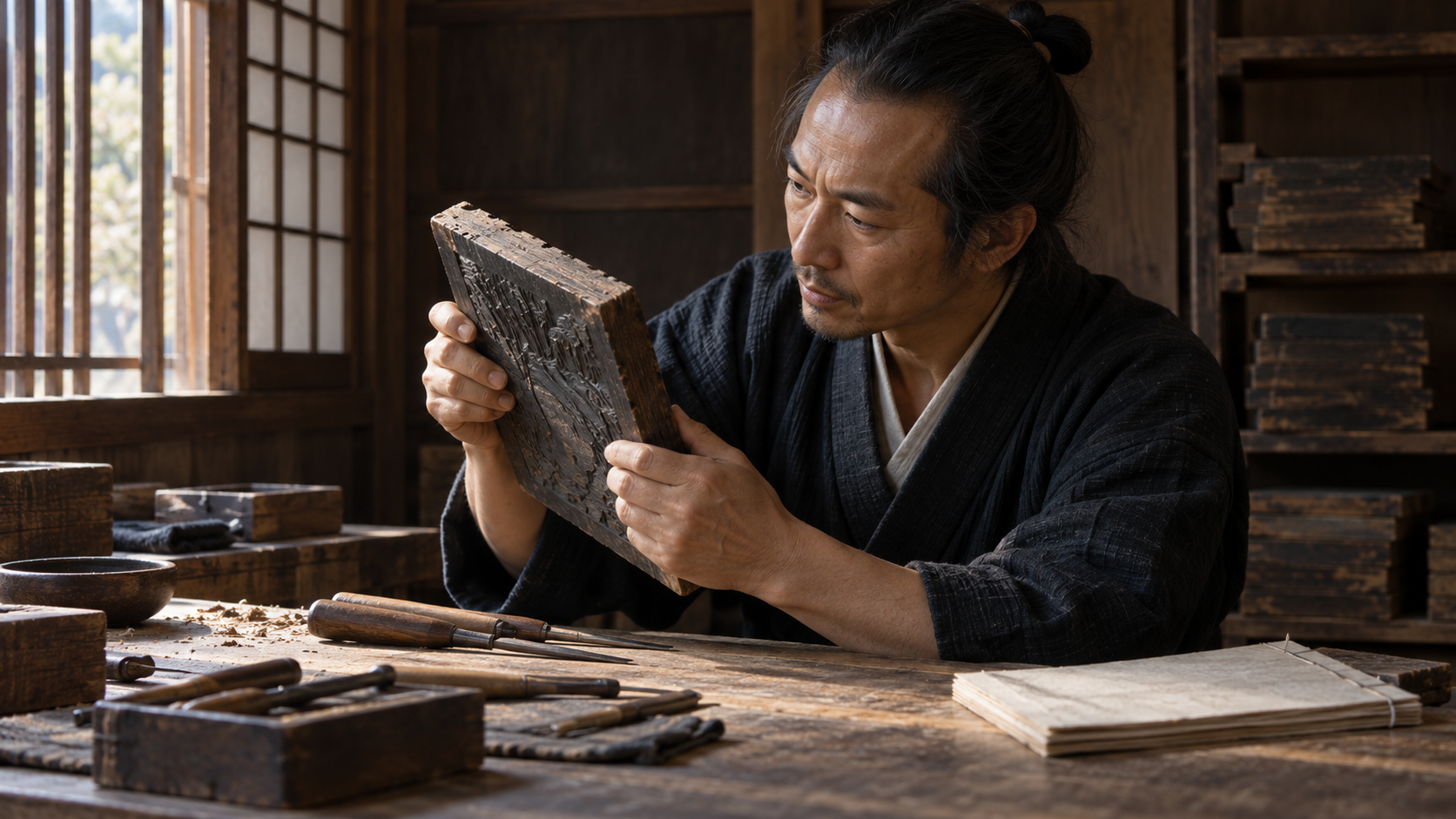
Scene 09
The histories of wooden blocks
Preparing blocks required materials and paid carving. Chiyoda Library explains joint publication, or aihan, in which publishers shared investment and returns. This is a general institutional example rather than a contract for every Tsutaya book.
Individual works could also pass between publishers. Tokyo Metropolitan Library’s Shingaku Hayasomegusa provides an example whose first publisher must be distinguished from later holders of the blocks and a proposed new cutting.
The same author and title therefore do not answer every question. When, by whom and in which edition a work appeared are separate matters. Following blocks and editions gives a publication a history beyond its first appearance.
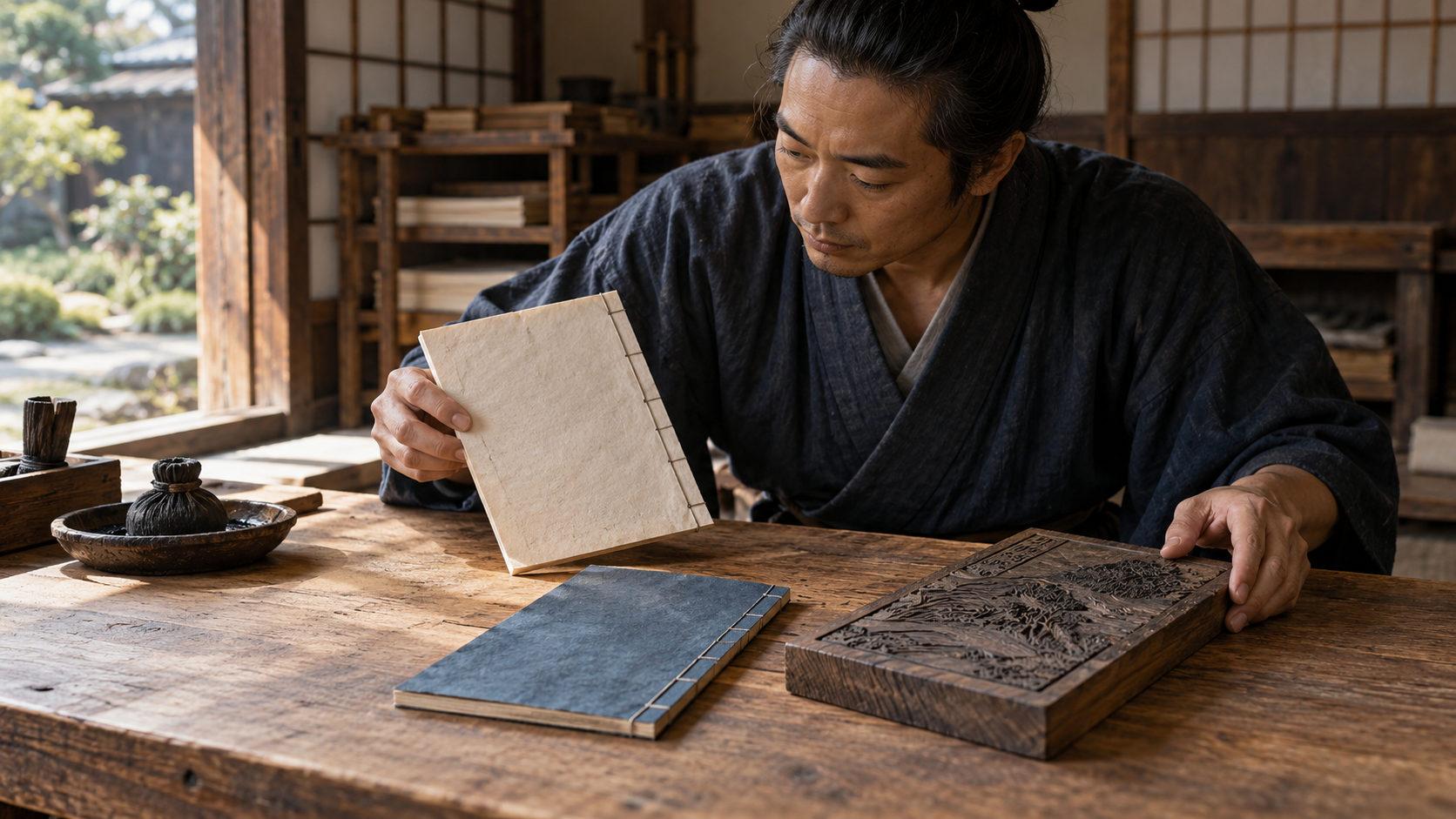
Scene 10
Boundaries around publication
Publishing also operated within systems of control. Chiyoda Library describes Kyoho-period requirements to name authors and publishers and checks within booksellers’ organizations. Conditions should not be treated as identical throughout the Edo period.
In 1791, three sharebon by Santo Kyoden led to punishment for Tsutaya as publisher. The National Diet Library account describes the loss of half his property. The specific works and responsibilities matter to interpreting the event.
The punishment should not become a claim that every form of entertainment or every picture was prohibited at once. Planning a publication involved institutional conditions as well as the costs of producing it.
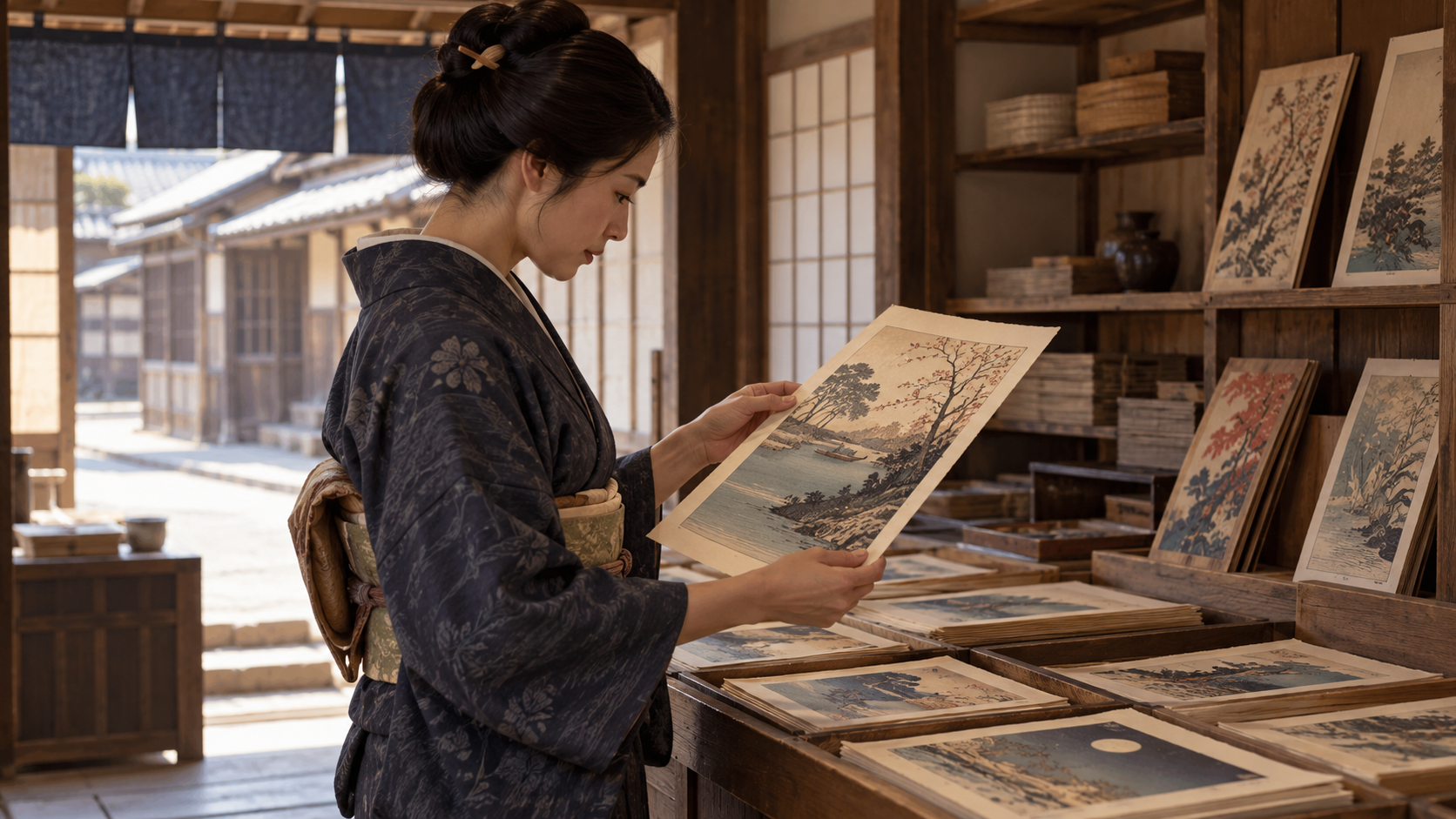
Scene 11
A masterpiece does not supply the sales ledger
Utamaro’s pictures of women and Sharaku’s actor prints of 1794 are central to Tsutaya’s reputation. Sharaku’s Actor Otani Oniji III as Edobei is one of the works that remains visually striking today.
Present recognition does not by itself establish the original sales or a publisher’s profits. Nor can one image alone settle the artist’s identity or the reasons for a brief period of activity.
Expression visible in a print and commercial results established from records are different questions. Keeping them apart broadens the publisher’s role: deciding what expression to bring out, with whom, and in what form.

Scene 12
Work between the names
Tsutaya Juzaburo died in 1797. The publications encountered today also require attention to later printing and reproduction. The National Diet Library’s exhibition includes images taken from later Meiji- and Taisho-period reproductions.
The date of a design and the date of the sheet being viewed need not be the same. Checking provenance helps distinguish what was made, what was printed later and what the present object actually represents.
Behind the paper were artists, writers, carvers, printers and publishers doing different work. From the publisher’s position connecting creators and readers, Edo culture becomes visible through the means that brought an image or book into the world.
How to read this work
History, interpretation, and reconstruction
The publisher’s role between creators and readers becomes visible through the form, production and provenance of books and prints.
This work is grounded in published sources and historical research. Interior thoughts, dialogue, and some visual details are cinematic reconstructions. Where historians disagree, the article presents the point as debated rather than settled fact.
Timeline
The story in time
-
Born in Yoshiwara.
Sources: s03 -
Expands into Toriaburacho in Nihonbashi.
Sources: s03 -
The guide catalogued as G26:769 includes a Koshodo catalogue at its end.
Sources: s09 -
The publisher is punished over three sharebon by Kyoden.
Sources: s01 -
The first Tsutaya Juzaburo dies.
Sources: s03 -
The Tsutaya shop in the shopping guide belongs to his successor.
Sources: s05
People & terms
A guide for new readers
Glossary
- Hanmoto 版元
- A publisher connecting planning, production and sale of books or prints.
- Yoshiwara saiken 吉原細見
- Guides presenting selected information about Yoshiwara, including establishments and courtesans.
- Kyoka 狂歌
- Comic verse, combined with illustrations in publications such as Ehon Mushi Erami.
- Aihan 相版
- Joint publication involving more than one publisher; a general practice, not an assumed contract for every Tsutaya title.
- Impression and reproduction 摺り・復刻
- The surviving sheet may be a later printing or reproduction, distinct in date from the original design.
Sources & method
How this article was built
The article follows the final accepted twelve-scene script, including its shorter closing scene. Directions specific to a video or diagram are adapted into prose. Source identifiers are mapped consistently into lower-case article identifiers, while original records remain unchanged.
The first proprietor, his successor, different 1784 guidebooks and later reproductions remain distinct. General production and joint-publication practices are not treated as proof of the exact blocks, expenses or contracts for every individual title.
Twelve generated workshop and reading scenes were selected from the adopted production materials after visual review and matching file hashes with their generation receipts. Their original actor is retained; an unavailable provider model is not invented.
No museum print, archive page, modern craft photograph or soundtrack is uploaded as an article illustration. The earlier YouTube rights review supplies provenance, while the selected generated stills receive a separate adoption for these Japanese and English articles.
Sources
References and further reading
- Tsutaya Juzaburo, a Pioneer of His Age 時代の風雲児・蔦屋重三郎 Title translated editorially for reader convenience. National Diet Library 国立国会図書館 Institutional exhibition on publications, the 1791 punishment and later reproductions. Its images are not reproduced in this article. Accessed 2026-11-04
- Tsutaya Juzaburo: Exhibition Press Release 蔦屋重三郎 コンテンツビジネスの風雲児 報道発表資料 Title translated editorially for reader convenience. Tokyo National Museum 東京国立博物館 Used for publishing relationships, Ehon Mushi Erami and Sharaku. Press imagery is not treated as automatically licensed for article illustration. Accessed 2026-11-04
- Koho Taito, 5 December 2024, No. 1362, page 2 広報たいとう 2024年12月5日 第1362号2面 Title translated editorially for reader convenience. Taito City 台東区 Municipal chronology corroborating birth, business, the move to Nihonbashi and death. The article retains the broader early-1770s wording for the beginning of the trade. Accessed 2026-11-04
- Shin Yoshiwara Saiken, Revised Monthly 新吉原細見 毎月改 Title translated editorially for reader convenience. Tokyo Metropolitan Library 東京都立図書館 Item Wa1400, published in 1784. Explains format, leaves and price; this July temporary-location guide is not treated as identical to G26:769. Accessed 2026-11-04
- Following the Footsteps of Tsutaya Juzaburo 蔦屋重三郎をデータでたどる Title translated editorially for reader convenience. ROIS-DS Center for Open Data in the Humanities CODH Introduces Ehon Mushi Erami’s catalogue and identifies the 1824 successor’s shop. The claim to an invention of advertising is not adopted. Accessed 2026-11-04
- How Are Ukiyo-e Made? 浮世絵ってどうやってできるの? Title translated editorially for reader convenience. Kumon Children’s Ukiyo-e Museum くもん子ども浮世絵ミュージアム General division of labour and woodblock process. Modern Adachi Foundation workshop photographs and the 1857 shop illustration are not reused or presented as Tsutaya-era photographs. Accessed 2026-11-04
- Exhibition Material: Colophons, Censorship and Publishing Rights 内務省委託本関連展示資料 Title translated editorially for reader convenience. Chiyoda Library 千代田図書館 Opening pages on Kyoho rules, booksellers’ organizations, block costs and joint publication. General arrangements are distinguished from an individual Tsutaya contract. Accessed 2026-11-04
- Shingaku Hayasomegusa 心学早染草 Title translated editorially for reader convenience. Tokyo Metropolitan Library 東京都立図書館 Explains an item prepared for recutting and the movement of blocks between publishers. Tsutaya is not misidentified as publisher of its first edition. Accessed 2026-11-04
- Yoshiwara Saiken, 1784, G26:769 吉原細見 天明4年 G26:769 Title translated editorially for reader convenience. University of Tokyo General Library 東京大学総合図書館 Individual catalogue identifies the publisher and Koshodo list at the end. Image public-domain status and metadata CC0 are separate statements; no archive image is uploaded here. Accessed 2026-11-04
- Actor Otani Oniji III as Edobei 三代目大谷鬼次の江戸兵衛 Title translated editorially for reader convenience. Chiba City Museum of Art 千葉市美術館 Collection item 2043001, dated 1794. Used for work identification, not proof of profits or a conclusive resolution of Sharaku’s identity. Accessed 2026-11-04
Continue reading
More stories from Shigeki
Shigeki English
The Soga Brothers: From the Revenge of 1193 to New Year Theatre
A hunt, a chronicle, changing narratives and the scenes selected by noh and kabuki.
- When The event in 1193, a chronicle compiled around 1300, later manuscripts and printed books, Edo theatre and subsequent performances
- Where The Fuji hunting grounds and later settings of narration, theatre, publishing and local remembrance
Shigeki English
The Einin Tokuseirei: Two Deeds and the Conditions for Recovering Land
Buyer status, twenty years and the legal work done by a sale deed and a transfer deed.
- When The order and transactions of 1297; a later use of the copied law in litigation in 1345
- Where The Kamakura government, its Rokuhara administration in Kyoto and a field in Yamashiro Province