
SHIGEKI ENGLISH STORYEN
Japanese history in English
Passing Hakone Checkpoint: Identity, Direction and Travel Documents
A pass mattered, but the inspection depended on more than possessing paper.
Follow Hakone’s inspection procedures through the regulations of 1711, conditional passage without a document, checks on women travelling west from Edo, staff responsibilities and procession exceptions. Distinguish the historical system from today’s reconstructed buildings and uncertain visual details.
At a glance
Before you enter the story
- When
- Edo-period Hakone; establishment at the present location around 1619, regulations of 1711 and later reconstruction
- Where
- The Tokaido road between Lake Ashi and the surrounding mountains at Hakone
- Key figures
- Travellers, Officials serving Odawara domain, Hitomionna inspectors, Jobannin permanent staff, Edo Castle officials issuing women’s passes
- What was at stake
- Who needed which document, how was the bearer checked, and why were travellers not all treated identically?
Why this story matters
The larger history behind the turning point
A checkpoint was a place where a journey met an administrative procedure. Asking only whether a person had a pass misses questions about identity, direction, purpose and exceptions, as well as the work of the people conducting the inspection.
The reconstructed site also demonstrates a historical method: a detailed repair record can support architectural decisions without revealing every official’s face or the colours of clothing. Evidence can permit a reconstruction while still leaving some particulars unknown.
Historical context
What an international reader needs to know
The account concerns Hakone’s particular procedures
The explanation follows the official Hakone Checkpoint materials. It does not convert the site’s rules into one uniform system applied at every checkpoint throughout Japan or every year of the Edo period. Local procedures and the dates of regulations matter.
At Hakone, deonna refers to women moving westward from Edo. Direction is part of the category. Treating the term as a rule applying to every woman travelling anywhere would remove a condition central to the museum’s explanation.
Documents, questioning and identification
Being allowed through without a particular pass did not necessarily mean passing without inspection. An official could ask a traveller’s name, origin, purpose and destination before deciding whether the person appeared suspicious. Possession of paper and examination of its bearer were related but different matters.
A woman’s required document could describe physical characteristics to be compared with the person present. The process involved receiving the paper, inspecting the bearer, reporting a result and granting permission. The illustrations are anonymous conceptual scenes, not genuine passes, identified officials or records of a particular inspection.
Watch the film
See the story in motion
The film currently uses Japanese audio. This English article provides the context and source trail; it does not imply that an English subtitle track is available.
Scene 01
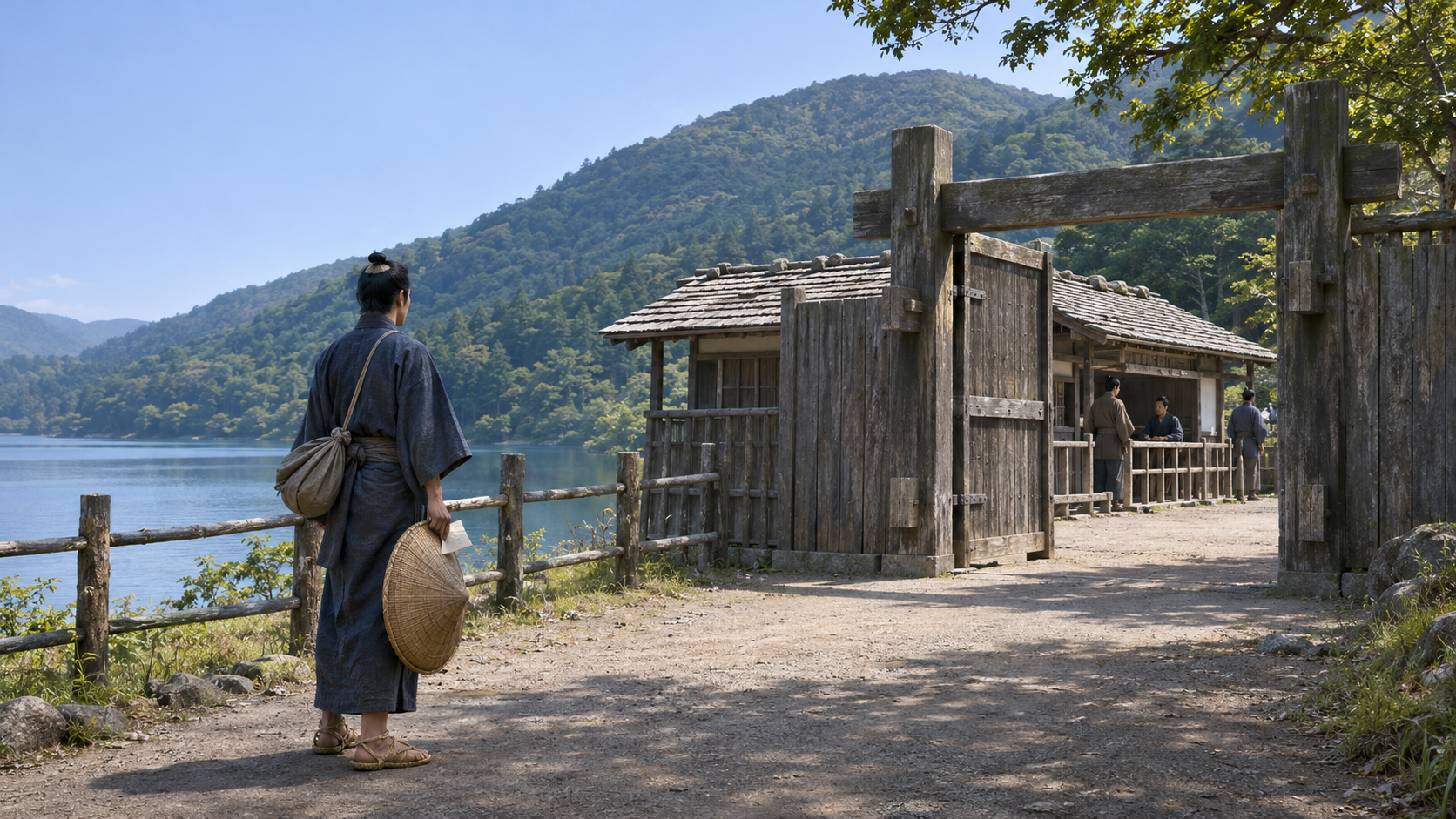
One gate, different inspections
Did everyone passing Hakone undergo the same inspection? The official explanation describes cases in which a man without a pass could be admitted after questioning. Women travelling west from Edo faced a different documentary and identification procedure.
Showing one sheet of paper was therefore not a universal description of passage. Officials considered who was moving, in which direction and for what purpose.
Following those distinctions gives the gate an administrative setting. The account asks how a traveller reached permission to pass, rather than assuming every person encountered one identical check.
Scene 02
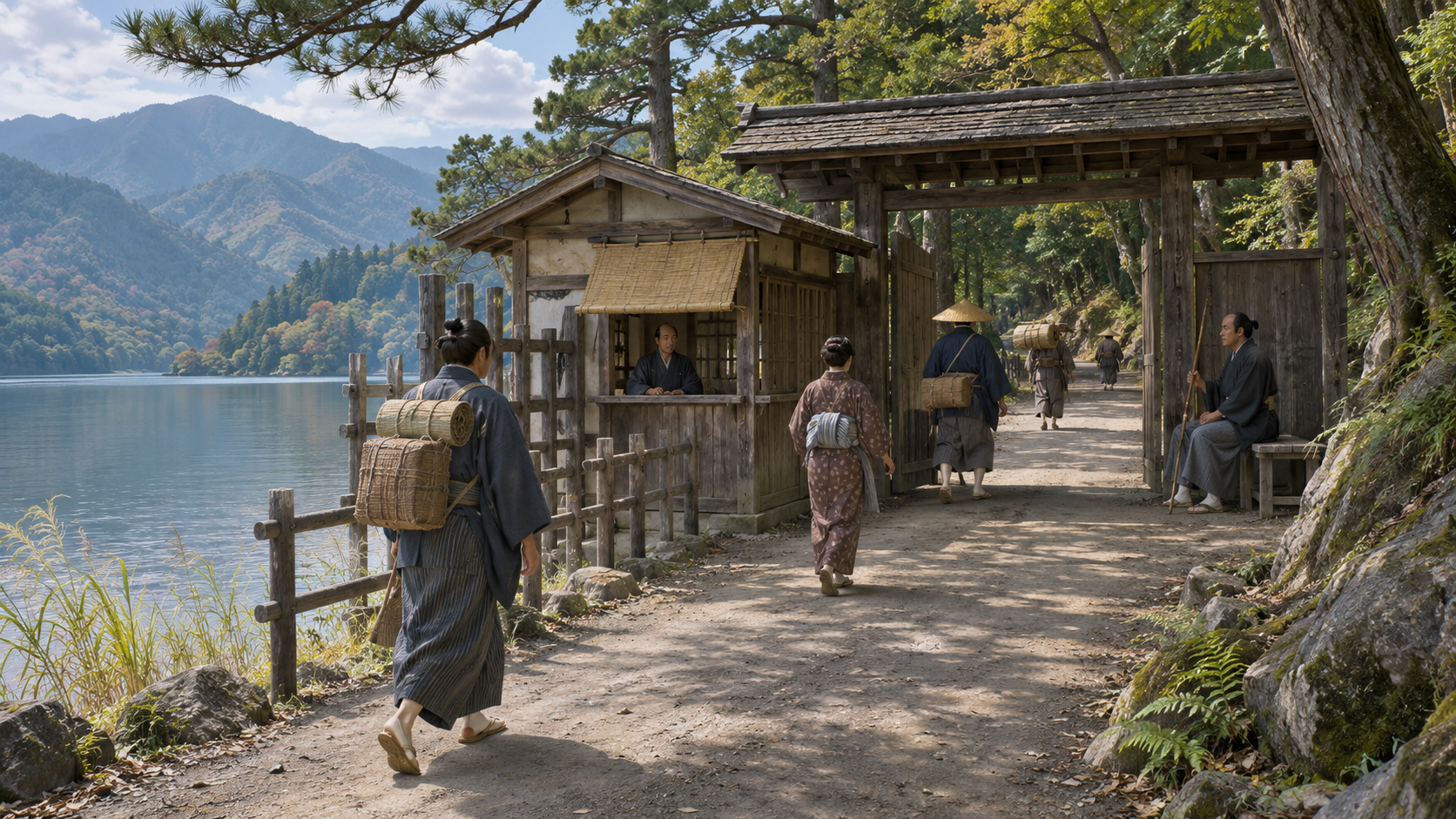
A road between lake and mountain
Hakone Checkpoint stood where the Tokaido passed beside Lake Ashi. The route narrowed between Togashima, projecting into the lake, and Mount Byobu. The terrain channelled movement toward a particular place.
This setting differs from an isolated gate in an open plain. Lake and mountain formed part of the physical conditions supporting the checkpoint’s work.
A narrow route does not prove that nobody could ever go around it. The site is considered here as a base for inspecting Tokaido travellers, without turning its geography into a claim of perfect control over all movement.
Scene 03
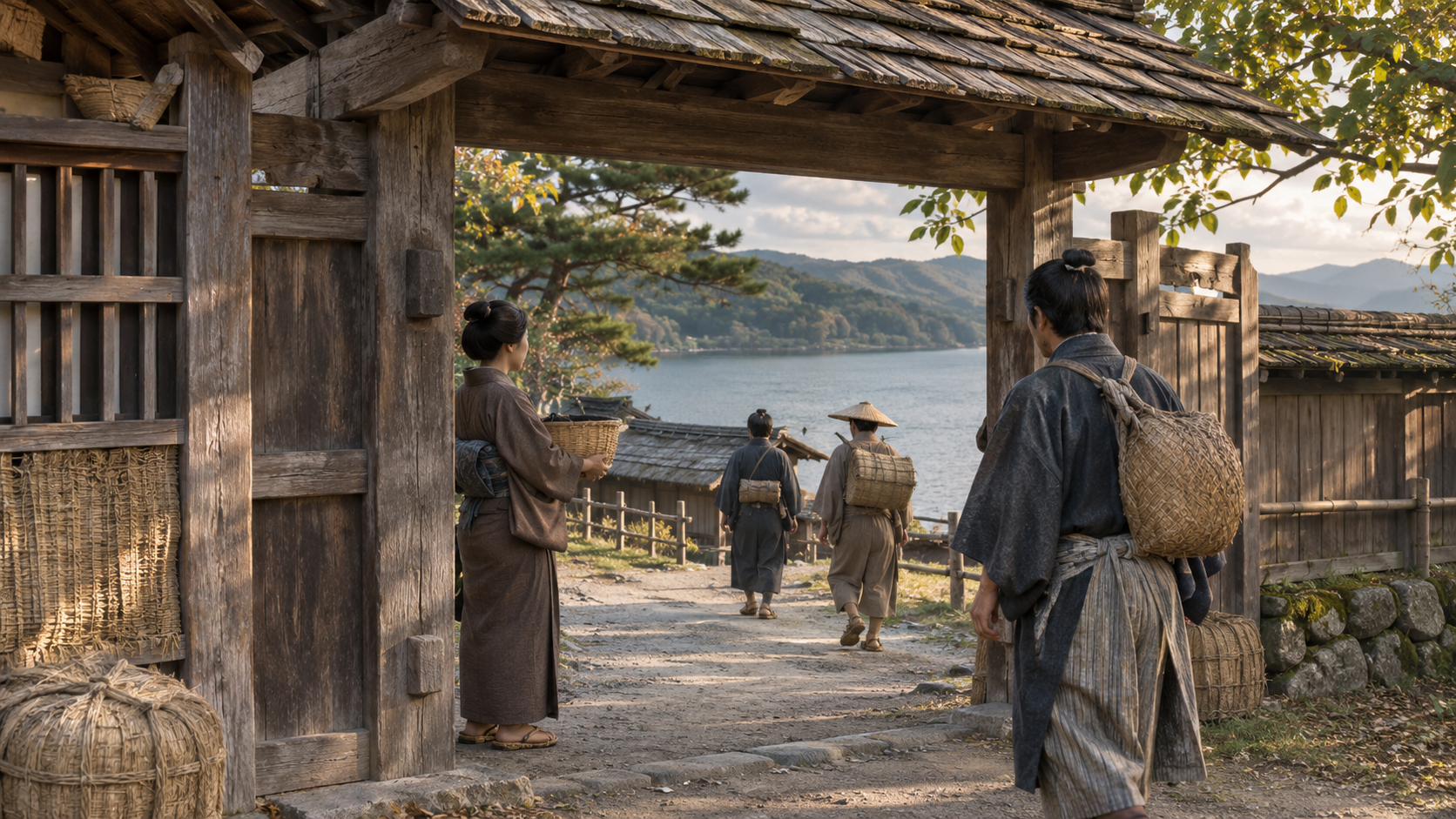
Around 1619, and evidence of an earlier checkpoint
The checkpoint is said to have been established at its present location around 1619. The qualification around must be retained. The museum also describes evidence for a checkpoint elsewhere in the Hakone mountains before that date.
Its explanation therefore raises the possibility of relocation. The establishment of the present site is different from the first appearance of a checkpoint system anywhere in Hakone.
The long Edo period should likewise not be imagined as one building governed by unchanged detailed rules from beginning to end. Dates identify particular stages in that history.
Scene 04
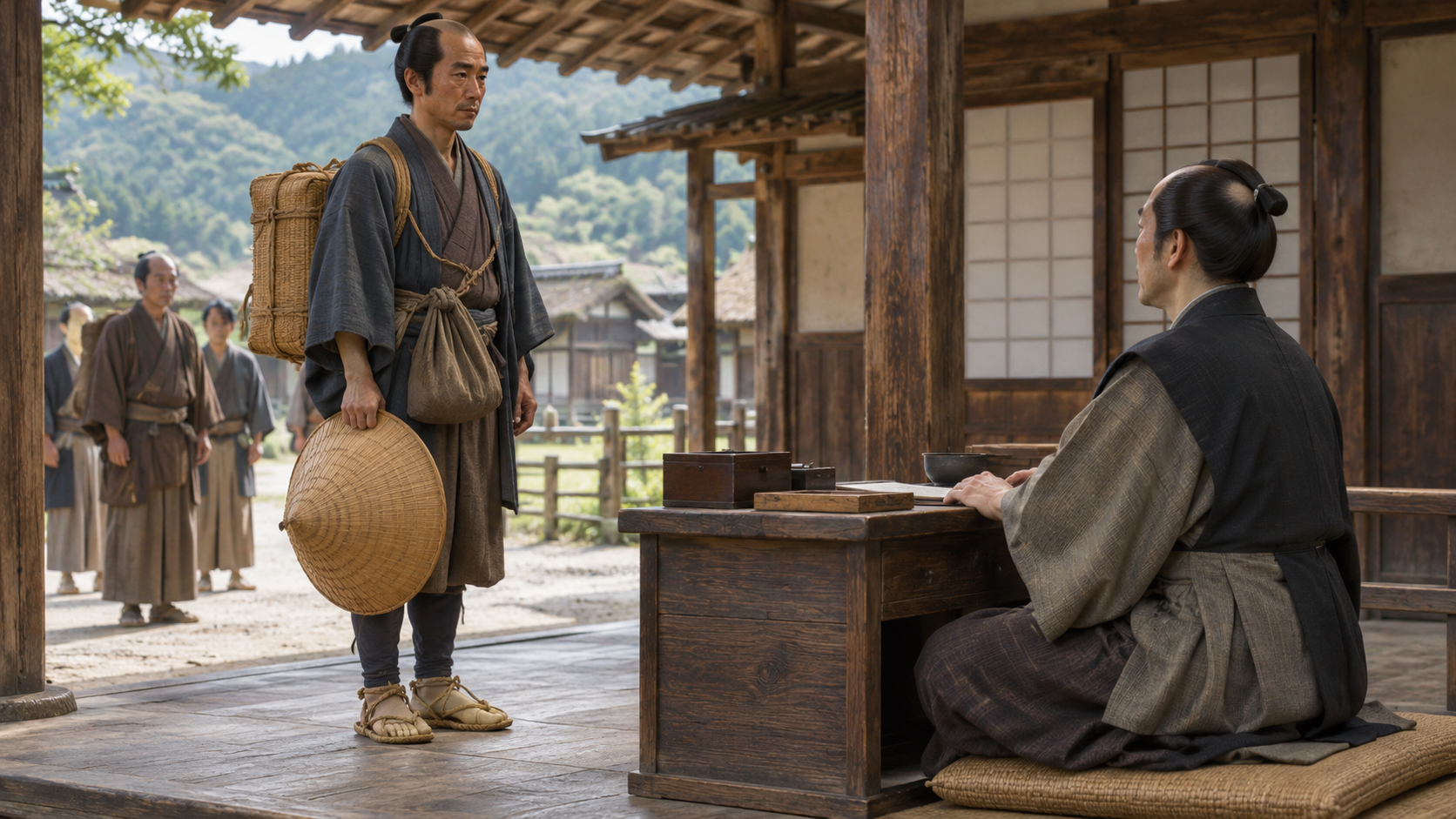
Five items in the regulations of 1711
The museum introduces five items in regulations dated 1711. They include removing hats or hoods to show the face and opening the doors of conveyances so that their interiors could be examined.
The other items concern detailed comparison of deonna with their documents, requirements for injured, deceased or suspicious people, and the handling of court-noble and daimyo processions.
The list begins to reveal differentiated inspection. Looking at a face, checking inside a vehicle and deciding which documentary requirement applied were connected actions, rather than one interchangeable test.
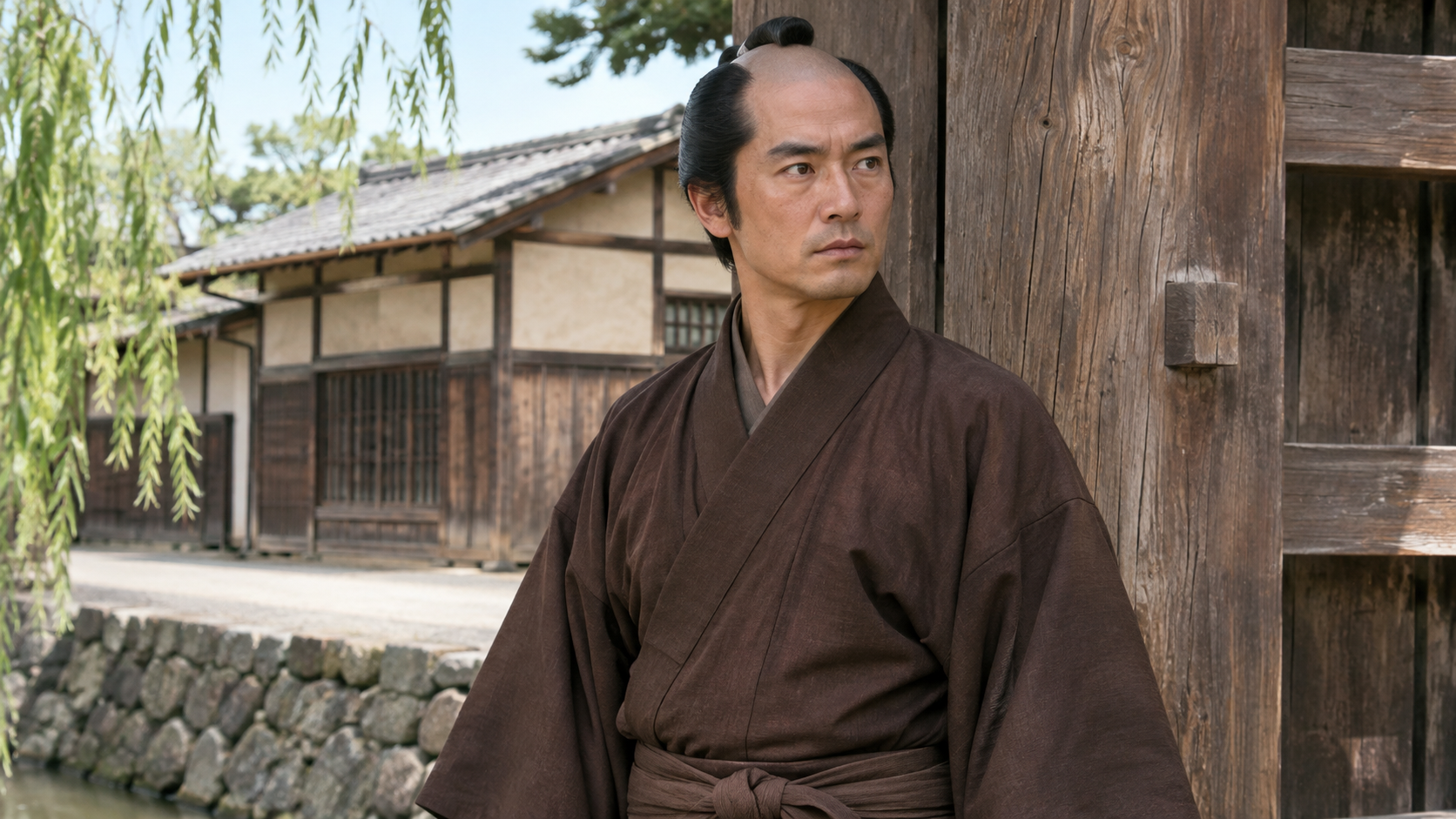
Scene 05
No pass did not mean no questioning
The official explanation allows passage without a pass in cases outside specified categories, including deonna and injured, deceased or suspicious persons. It does not describe an unconditional right for every man to walk through unexamined.
Names, places of origin, purposes of travel and destinations could be questioned in detail. Permission depended on the traveller not being judged suspicious.
The distinction is procedural: a document might not be mandatory in a particular case, while investigation still occurred. The absence of paper did not make the person’s identity or reasons for moving irrelevant.
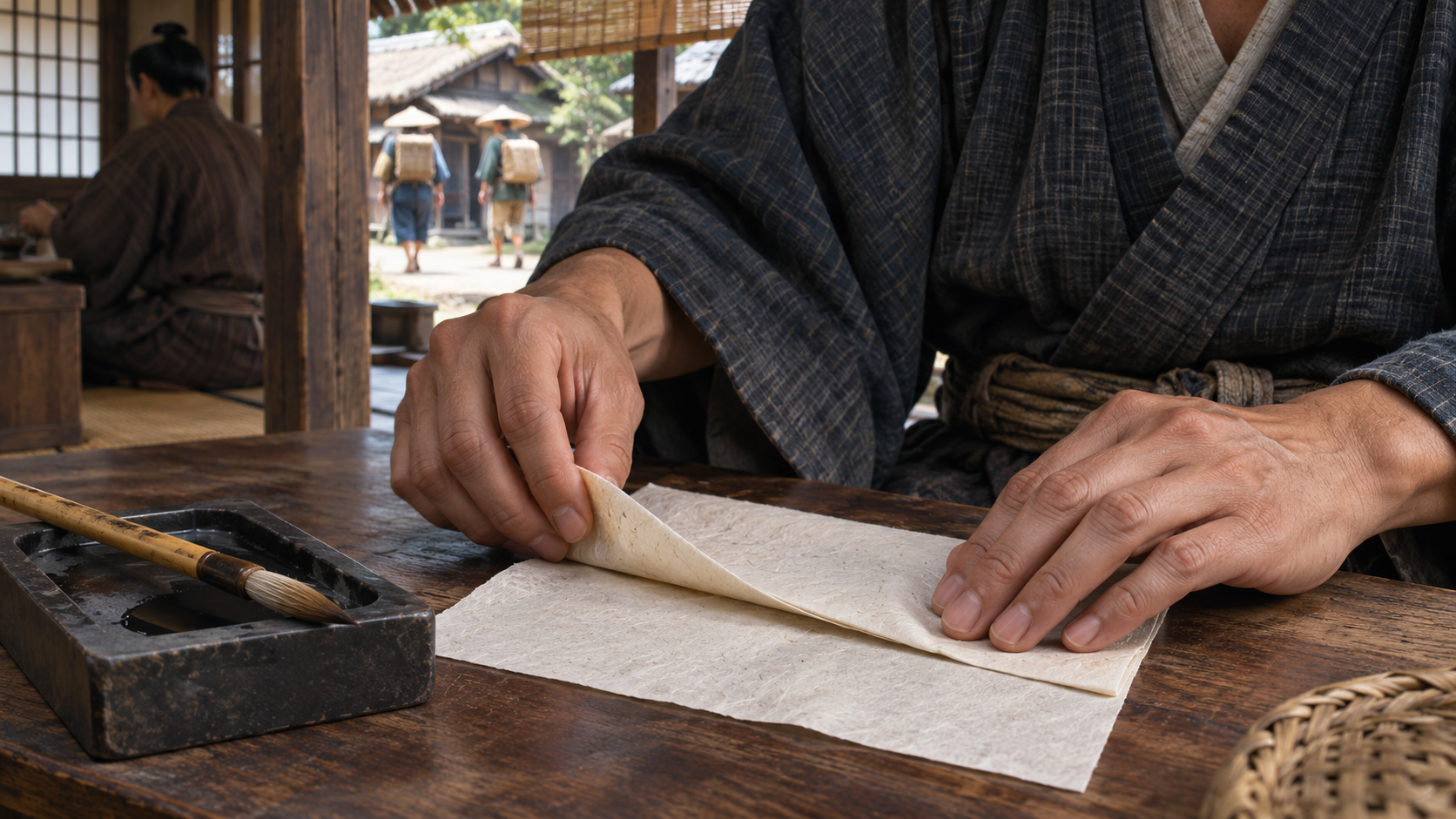
Scene 06
Who issued men’s passes?
The museum says many men did carry passes. Its interpretation is that these could reduce the burden of being regarded as suspicious or undergoing detailed questioning. This explanation of a possible practical reason is attributed to the institution.
Men’s documents could be issued by landlords or village heads, and some were written by innkeepers. Edo Castle officials did not issue every traveller’s document through one central process.
The shared label travel pass therefore covered different issuers and requirements. A useful account must identify both the person presenting a document and the authority or local relationship behind its production.
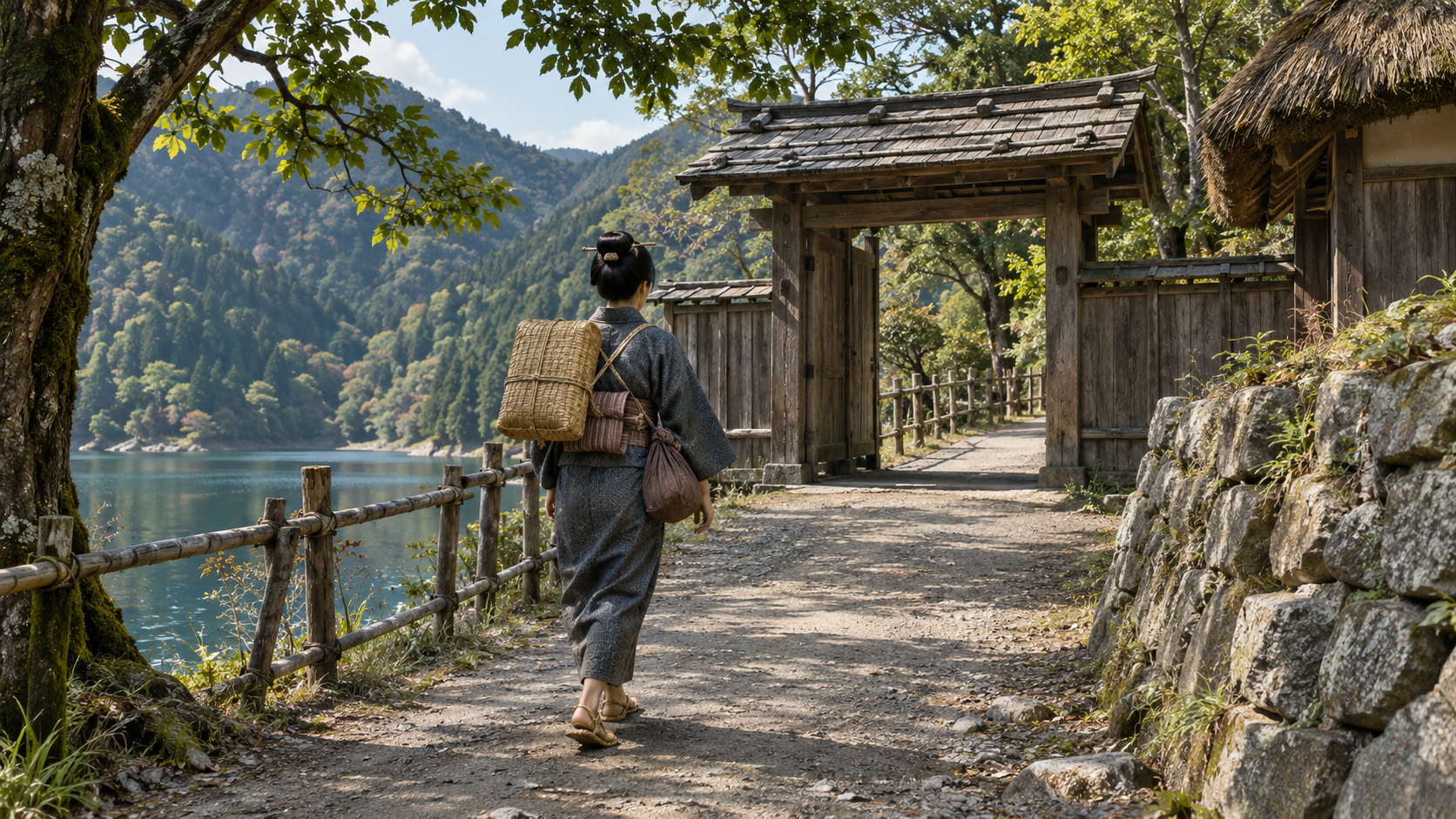
Scene 07
For deonna, direction mattered
At Hakone, deonna meant women travelling westward from Edo. The category depended on direction as well as the traveller’s sex. The museum explains that the inspection concerned ordinary women as well as daimyo families.
The required women’s travel pass was issued by the Rusui officials at Edo Castle. It described identity, purpose and destination, together with features of hair, face, hands and feet.
Those descriptions were compared with the bearer. This was a particular documentary procedure, distinct from men’s passes issued through various local authorities. It should not be extended unchanged to all women and all routes.
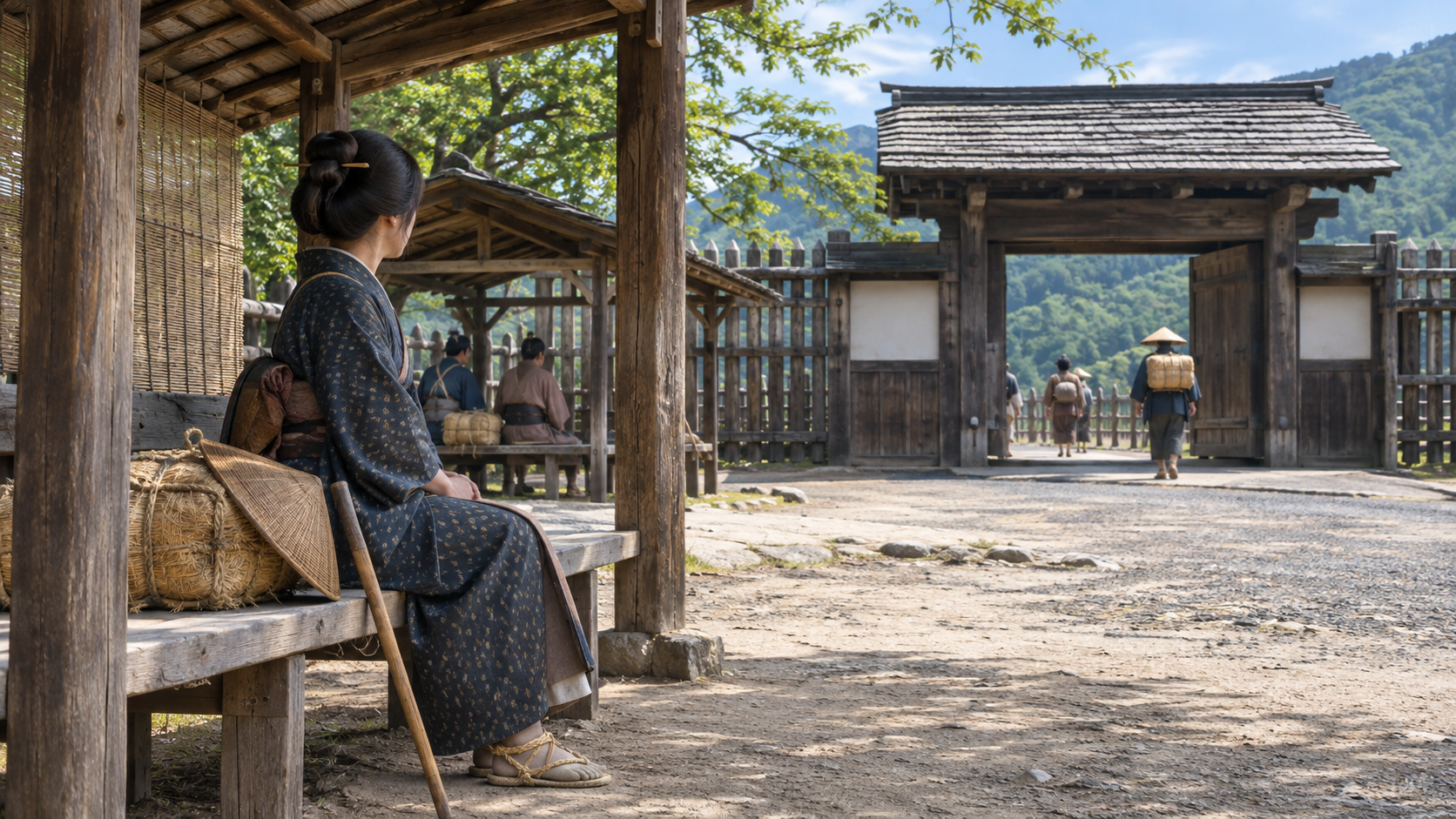
Scene 08
From waiting to comparison and permission
A deonna first waited in the Sennindamari on the Edo side while an official received and checked the document. A woman inspector called a hitomionna then examined physical characteristics and compared them with the written description.
The result was reported to an official before permission followed. According to the museum, a mismatch required obtaining a new document.
Other travellers waited in the areas on either side during this inspection. One person’s identification procedure therefore affected the flow through the gate more widely, connecting individual examination with the management of movement.
Scene 09
Rotating officers and locally continuing staff
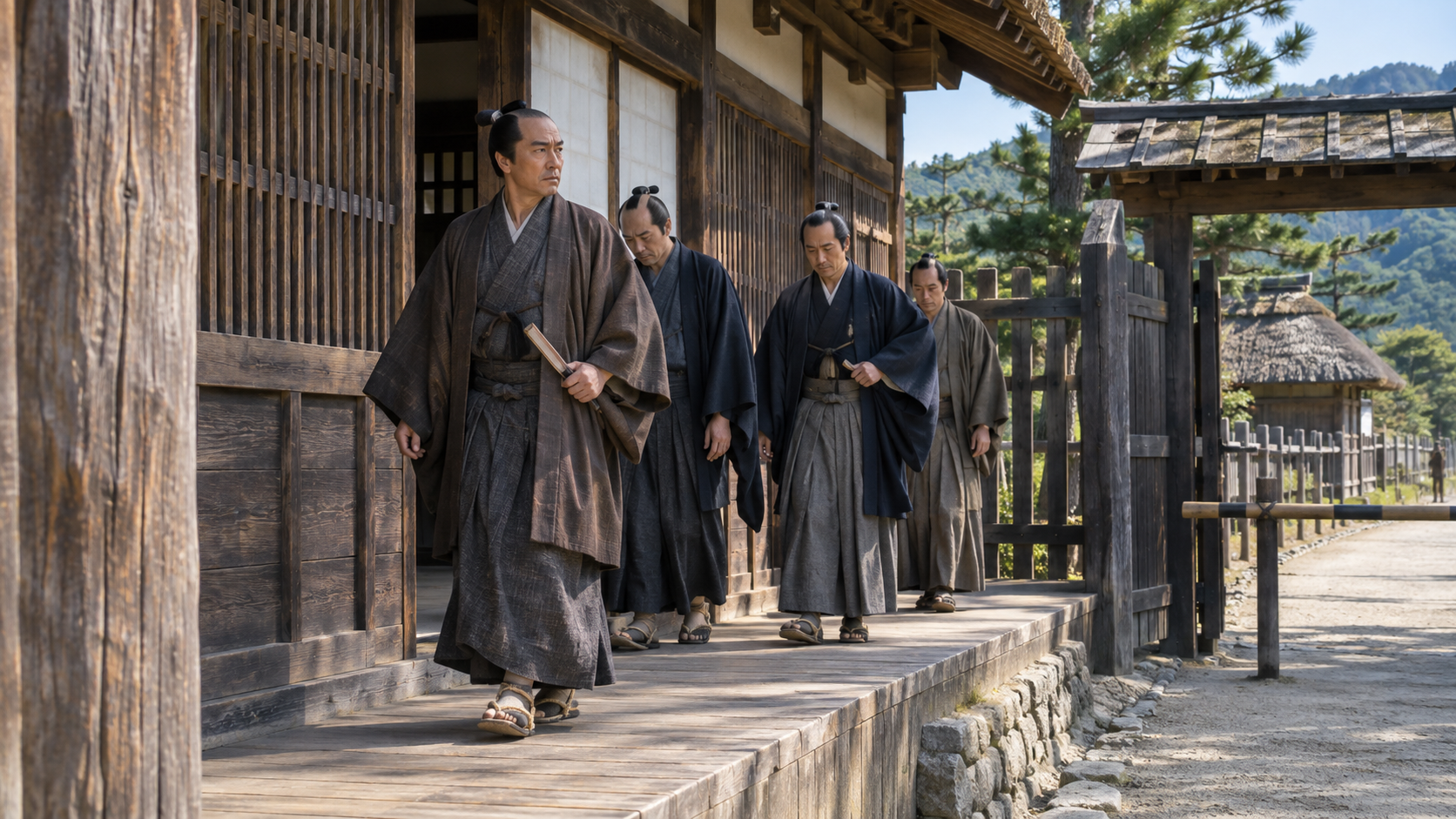
Checkpoint staff were not one undifferentiated group. Officials received stipends from Odawara domain. The museum explains that posts other than jobannin and hitomionna rotated monthly.
The jobannin and hitomionna lived nearby and served through hereditary arrangements. Permanent staff could hold detailed practical knowledge even without occupying the highest social rank.
Daily inspection thus depended on a combination of rotating officials and locally continuing roles. Administrative knowledge had to be available when personnel changed, rather than being recreated from nothing with each monthly rotation.
Scene 10
Processions also had conditions and exceptions
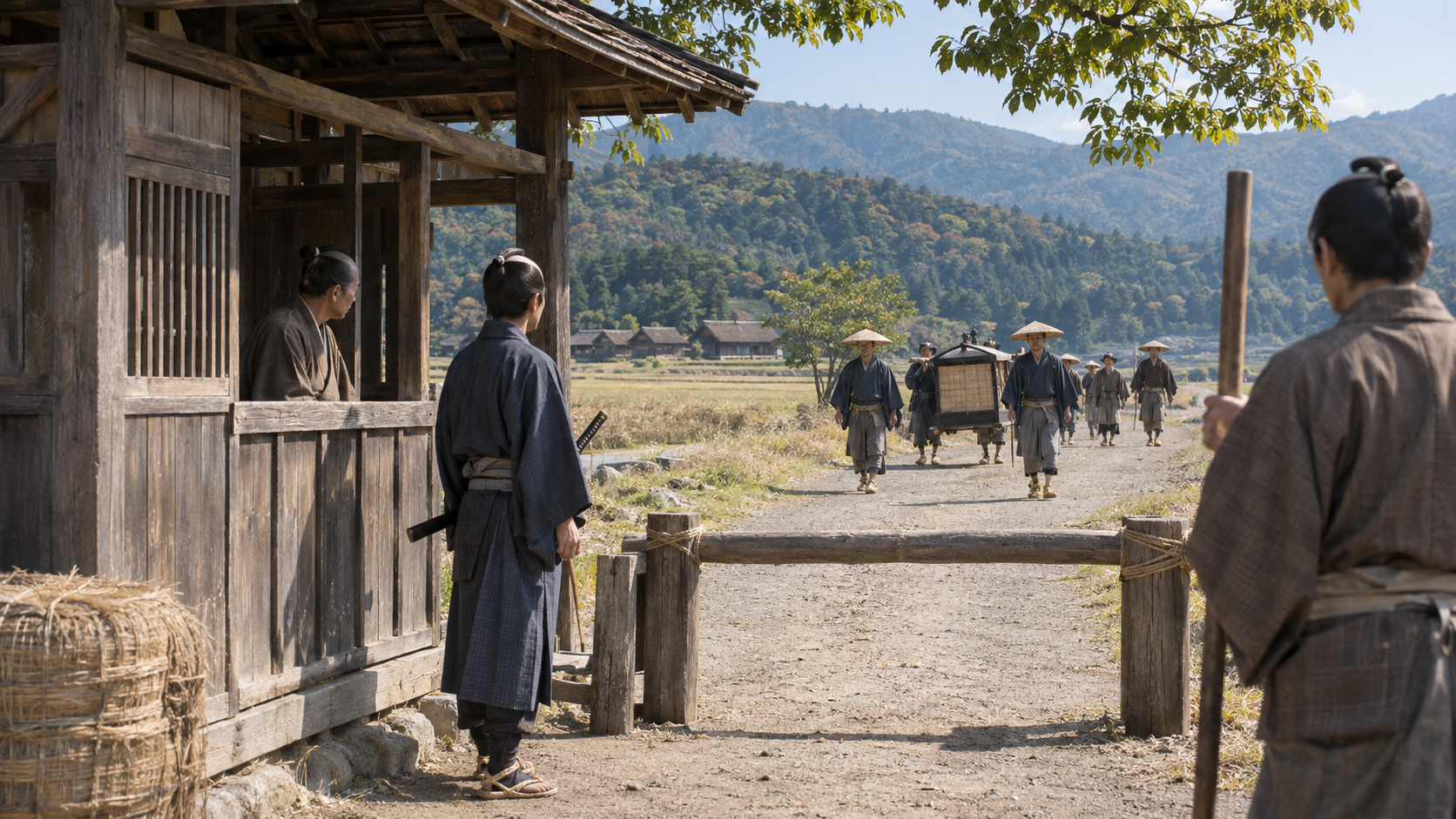
The museum’s explanation of the 1711 regulations describes special treatment for court-noble and daimyo processions. Formal advance notification could allow inspection to be omitted.
This was not unconditional passage based only on high rank. Suspicious people within a procession were still to be examined.
Advance information, documentary categories, the traveller’s circumstances and possible suspicion all shaped the procedure. The system was therefore more specific than simply putting every arrival through the same steps in the same order.
Scene 11
Reconstructed buildings and uncertain appearances
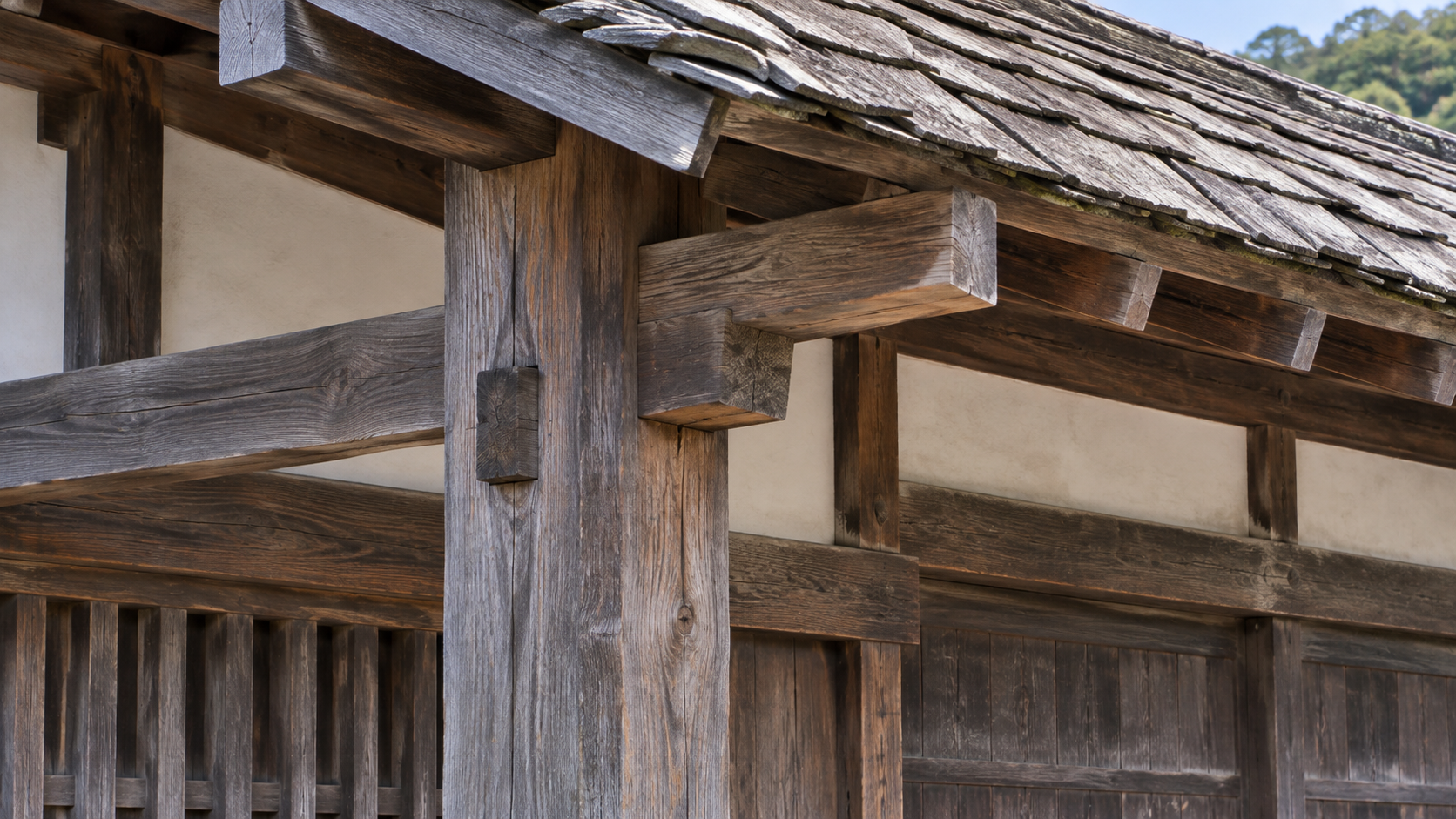
Today’s Hakone Checkpoint is a reconstruction based on documents and archaeological investigation, rather than an entire building complex continuously surviving from Edo times. A report of repairs in 1865 became a major source after its discovery in the Egawa Bunko in 1983.
A detailed building record does not disclose every official’s face or the precise colour and pattern of clothing. The museum’s explanation of its pale silhouette displays acknowledges those limits.
Reconstruction therefore involves both what evidence permits and what remains uncertain. The generated architectural illustration is not a survey of the present site or proof that every visual detail of the historical checkpoint has been recovered.
Scene 12
The gate checked identity and procedure
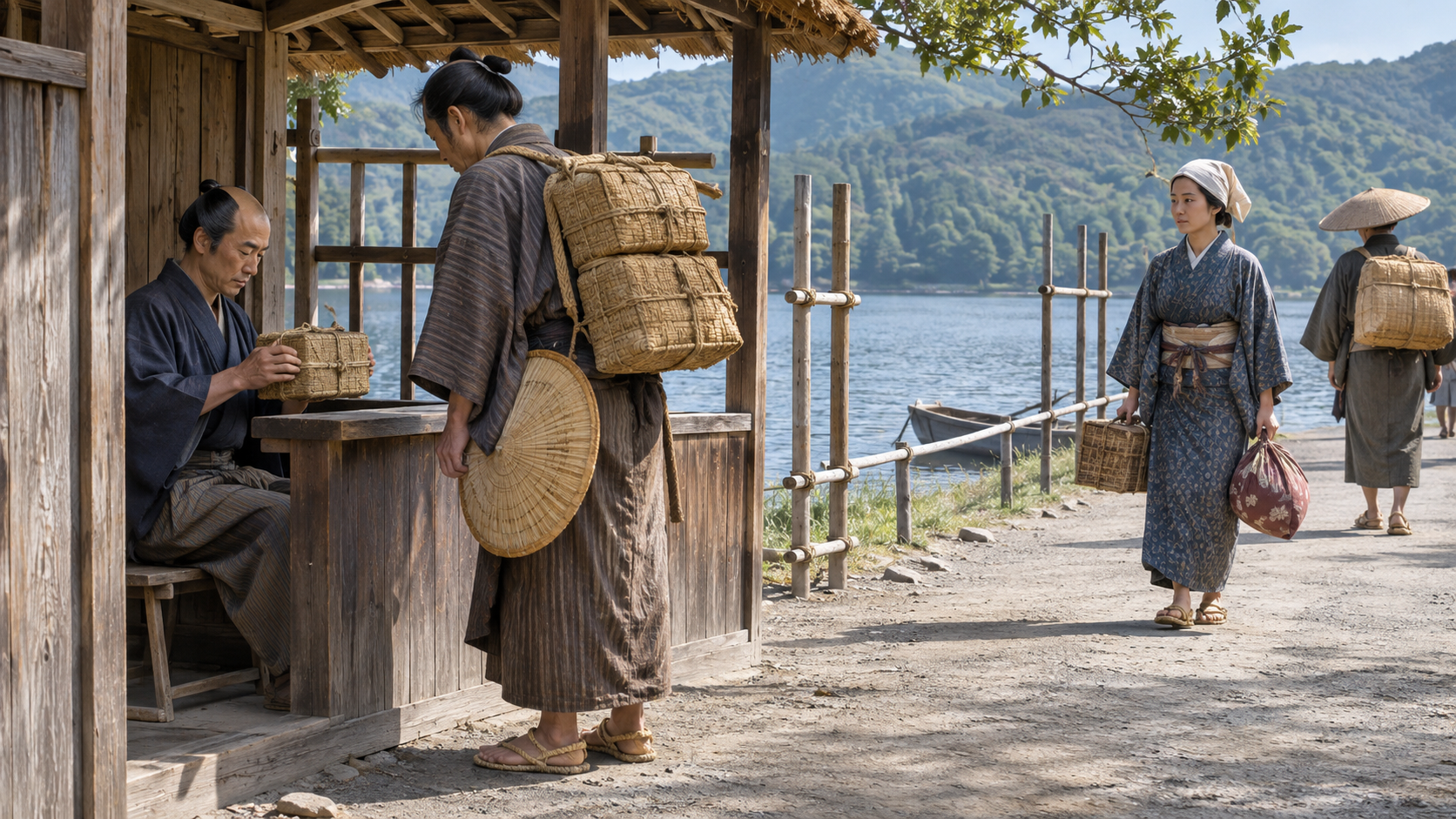
What did Hakone officials examine? Faces and conveyance interiors, purposes and destinations, and, where required, the correspondence between a document and its bearer. The answer extends beyond the simple presence of a pass.
Conditional passage without documents, direction-specific checks on deonna and notified processions with exceptions belonged to a differentiated arrangement. Different staff roles sustained its daily operation.
These conclusions follow the Hakone explanations and remain within that scope. The lakeside gate was a place where movement was examined through identity and procedure, while today’s reconstruction presents that history without making every uncertain detail certain.
How to read this work
History, interpretation, and reconstruction
Inspection at Hakone depended on a traveller’s identity, direction, purpose and circumstances, with documents and advance notices forming parts of a differentiated procedure.
This work is grounded in published sources and historical research. Interior thoughts, dialogue, and some visual details are cinematic reconstructions. Where historians disagree, the article presents the point as debated rather than settled fact.
Timeline
The story in time
-
The checkpoint is said to have been established at its present location, distinct from evidence of earlier Hakone checkpoints.
Sources: s06 -
The museum introduces five regulatory items distinguishing faces, conveyances, deonna, exceptional categories and processions.
Sources: s02 -
A repair-completion report was made for the checkpoint.
Sources: s09 -
The repair record was discovered in the Egawa Bunko and became evidence for reconstruction.
Sources: s09
People & terms
A guide for new readers
Glossary
- Sekisho 関所
- A checkpoint where movement could be examined through identity, documents and specified procedures.
- Tegata 手形
- A travel pass; issuers and requirements differed according to the traveller and procedure.
- Deonna 出女
- In this Hakone account, women travelling westward from Edo, a direction-specific category.
- Hitomionna 人見女
- A woman inspector who compared a bearer’s physical characteristics with the description in the required document.
- Jobannin 定番人
- Locally resident permanent checkpoint staff distinguished from the monthly rotating posts.
- Sennindamari 千人溜
- A waiting area used in the inspection process; other travellers could also be held while a deonna was examined.
Sources & method
How this article was built
Most references are sections of the same official Hakone resource. They describe different procedures but are not independent contemporary witnesses. The article uses the institution’s explanations without claiming a complete independent reading of every underlying original document.
Rules are identified by date where the explanation provides one. The approximate establishment date is retained, and male passage without a pass is distinguished from passage without questioning. The term deonna is explained with its direction rather than translated as every female traveller.
The modern site is treated as a reconstruction informed by evidence. Unknown appearance is not supplied as fact, and the generated scenes do not authenticate uniforms, buildings or named people. No present visitor timetable or travel recommendation is inferred from the historical material.
Sources
References and further reading
- Passing the checkpoint 箱根町 箱根関所:関所を通るには Title translated editorially for reader convenience. Hakone Town / Hakone Checkpoint 箱根町 箱根関所 Explains conditional passage without a pass and the questioning still required. Accessed 2026-11-06
- The checkpoint’s role at Hakone 箱根町 箱根関所:関所の役割(箱根) Title translated editorially for reader convenience. Hakone Town / Hakone Checkpoint 箱根町 箱根関所 Introduces the five items of the 1711 regulations, including processions and exceptions. Accessed 2026-11-06
- Checkpoint travel passes 箱根町 箱根関所:関所通行手形 Title translated editorially for reader convenience. Hakone Town / Hakone Checkpoint 箱根町 箱根関所 Distinguishes issuers and uses of men’s and women’s documents; the suggested practical reason for carrying a pass remains the museum’s interpretation. Accessed 2026-11-06
- Deonna 箱根町 箱根関所:出女 Title translated editorially for reader convenience. Hakone Town / Hakone Checkpoint 箱根町 箱根関所 Explains the direction-specific category, waiting, physical comparison, reporting and permission. Accessed 2026-11-06
- Checkpoint officials 箱根町 箱根関所:関所の役人たち Title translated editorially for reader convenience. Hakone Town / Hakone Checkpoint 箱根町 箱根関所 Describes domain employment, rotating posts and locally continuing roles. Accessed 2026-11-06
- Establishment of the checkpoint 箱根町 箱根関所:関所の設置 Title translated editorially for reader convenience. Hakone Town / Hakone Checkpoint 箱根町 箱根関所 Retains the approximate date of the present site and evidence for an earlier location. Accessed 2026-11-06
- The role of checkpoints in the Edo period 箱根町 箱根関所:江戸時代の関所の役割 Title translated editorially for reader convenience. Hakone Town / Hakone Checkpoint 箱根町 箱根関所 General institutional context used alongside the site-specific explanations, without asserting identical practice everywhere. Accessed 2026-11-06
- The checkpoint and stone-paved road 箱根ジオパーク:関所と石畳 Title translated editorially for reader convenience. Hakone Geopark 箱根ジオパーク Explains the lakeside and mountain setting. Narrow terrain is not treated as proof that all movement was perfectly controlled. Accessed 2026-11-06
- Repair-completion report for Hakone Checkpoint 箱根町 箱根関所:相州箱根御関所御修復出来形帳 Title translated editorially for reader convenience. Hakone Town / Hakone Checkpoint 箱根町 箱根関所 Explains the 1865 record and its discovery in 1983. This is not a claim to have independently deciphered the entire original report. Accessed 2026-11-06
- Silhouette displays 箱根町 箱根関所:シルエット展示 Title translated editorially for reader convenience. Hakone Town / Hakone Checkpoint 箱根町 箱根関所 Explains how uncertainty about appearance, colour and pattern affected the modern displays. Accessed 2026-11-06
- Jobannin 箱根町 箱根関所:定番人 Title translated editorially for reader convenience. Hakone Town / Hakone Checkpoint 箱根町 箱根関所 Introduces permanent staff and practical administrative knowledge. Accessed 2026-11-06
- Hakone checkpoint site: Japan Heritage 箱根関跡 日本遺産ポータル Title translated editorially for reader convenience. Agency for Cultural Affairs Japan Heritage portal / Mishima City 文化庁 日本遺産ポータル/文責 三島市 Supplementary overview of domain management, deonna inspection and evidence-based reconstruction, rather than a substitute original regulation. Accessed 2026-11-06
Continue reading
More stories from Shigeki
Shigeki English
Japan’s Land Tax Reform: Rice, Cash and the Land Certificate
The measurements and valuations behind a tax of three percent of land value.
- When Certificates associated with 1872; reform from 1873; rate reduction in 1877 and implementation continuing to 1881
- Where Japan, with regional examples from Gifu, Niigata, Kumamoto and Nagano
Shigeki English
Taira no Masakado: From a Family Conflict to Provincial Rebellion
Follow changes in opponents and authority between 935 and 940.
- When 935–940; later legends, manuscripts and printed editions considered separately
- Where Eastern Japan, including Hitachi, Shimotsuke, Kozuke and Shimosa, within a provincial geography different from modern prefectures