
SHIGEKI ENGLISH STORYEN
Japanese history in English
Perry at Uraga: How Did the Shogunate Respond to the Black Ships?
Direct the fleet to Nagasaki. Receive a presidential letter. Follow the work of negotiation along the shore that met four ships.
From Perry’s arrival off Uraga in 1853 to the letter’s reception at Kurihama and the amity treaty of 1854, follow advance information, officials’ responses and the terms that followed. Officers’ testimony, a later illustrated account and the American expedition record offer distinct positions from which to read the visit.
At a glance
Before you enter the story
- When
- Foreign information from the 1840s; arrival and letter in 1853; amity in 1854; commerce in 1858. Accounts published in 1856 and 1892 are dated separately.
- Where
- Uraga and Kurihama on the coast of present-day Yokosuka, Japan; Edo Bay and the following year’s negotiations at Yokohama.
- Key figures
- Matthew Perry, Nakajima Saburosuke, Kayama Eizaemon, Townsend Harris
- What was at stake
- Who would receive the American demands, where they would be handled and how the response would become written terms.
Why this story matters
The larger history behind the turning point
The Black Ships are a memorable image of change. Following the people who received information, directed visitors, prepared a hall and dealt with treaty provisions gives that image a sequence of actions. Keeping 1853, 1854 and 1858 distinct also preserves the differences between receiving a demand, establishing amity and agreeing on commerce.
Historical context
What an international reader needs to know
Officials and the channels for foreign relations
The bakufu, or shogunate, was Japan’s warrior government. At Uraga, magistrates and their subordinate yoriki dealt with the arriving fleet. Han were domains whose warriors could perform coastal guard duties; the illustrated account identifies four domains at Kurihama. These terms describe different responsibilities within the response.
Japan already received information and maintained channels for foreign relations. Nagasaki was the established place proposed by the Uraga officials for negotiations, and the Dutch trading post supplied foreign news. Perry’s arrival should not be read as the first information reaching a country wholly without overseas contacts. The question here is how existing arrangements met a demand to receive a letter in Edo Bay.
Places, calendars and the two treaties
Uraga and Kurihama are coastal places in present-day Yokosuka, at the entrance to the bay associated with Edo. The visit offshore and the reception on land were separate events; the negotiations at Yokohama took place the next year. Dates in this article use Gregorian equivalents alongside the older Japanese calendar when given by the cited institutions. The third day of the sixth month of Kaei 6 corresponds here to 8 July 1853, not 3 June in the modern calendar.
The Treaty of Peace and Amity of 1854 is also commonly called the Convention of Kanagawa. It addressed ports, ships’ supplies, shipwreck protection and additional conditions, but did not establish commercial provisions. The Treaty of Amity and Commerce followed in 1858 through Harris’s negotiations. Similar names and the broad expression opening Japan should not collapse these agreements into one event.
Watch the film
See the story in motion
The film currently uses Japanese audio. This English article provides the context and source trail; it does not imply that an English subtitle track is available.
Chapter 01
Four ships off the coast
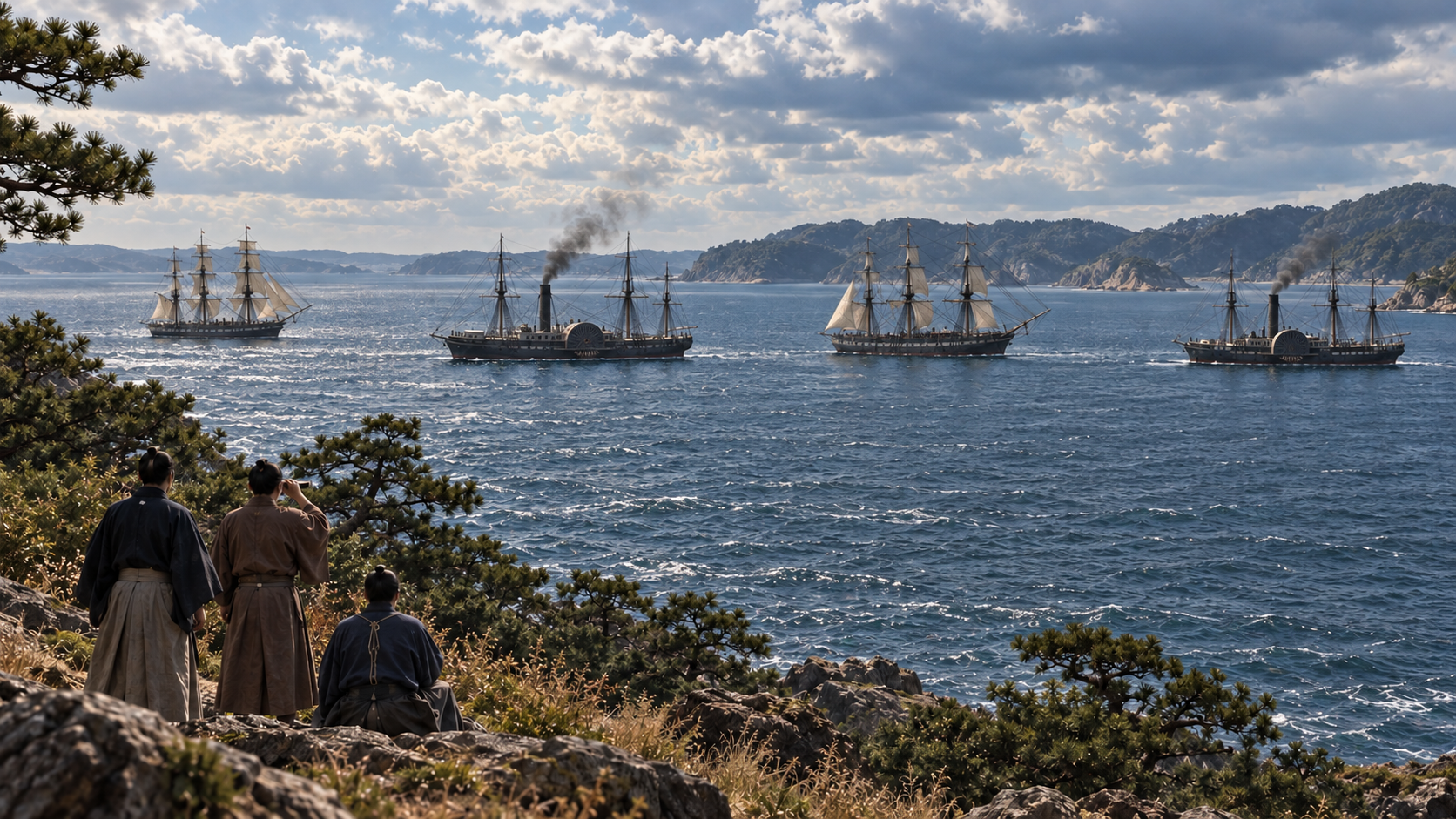
On 8 July 1853, four American warships appeared off Uraga: two steamships and two sailing ships. The fleet seen from the shore has shaped the remembered image of Perry’s arrival. Along that coast, however, work was beginning that would take the officials beyond simply watching the ships.
What had the visitors come to request? Who would respond, and where would discussions take place? How should the document they carried be handled? With the fleet at the entrance to Edo Bay, the arrangements for foreign relations became immediate questions of how to receive a particular visitor.
Following that work connects information received before the arrival, the actions of officials at the Uraga magistrate’s office and the reception hall prepared at Kurihama. Placing the day the ships appeared alongside decisions made before and afterward gives the familiar coastal scene a longer history.
From Uraga to Kurihama, and to Yokohama the following year, the places and dates help us follow people and documents. They show how the shogunate receiving the four ships established an entry into negotiations and went on to deal with the terms those negotiations would produce.
Chapter 02
The first direction was Nagasaki
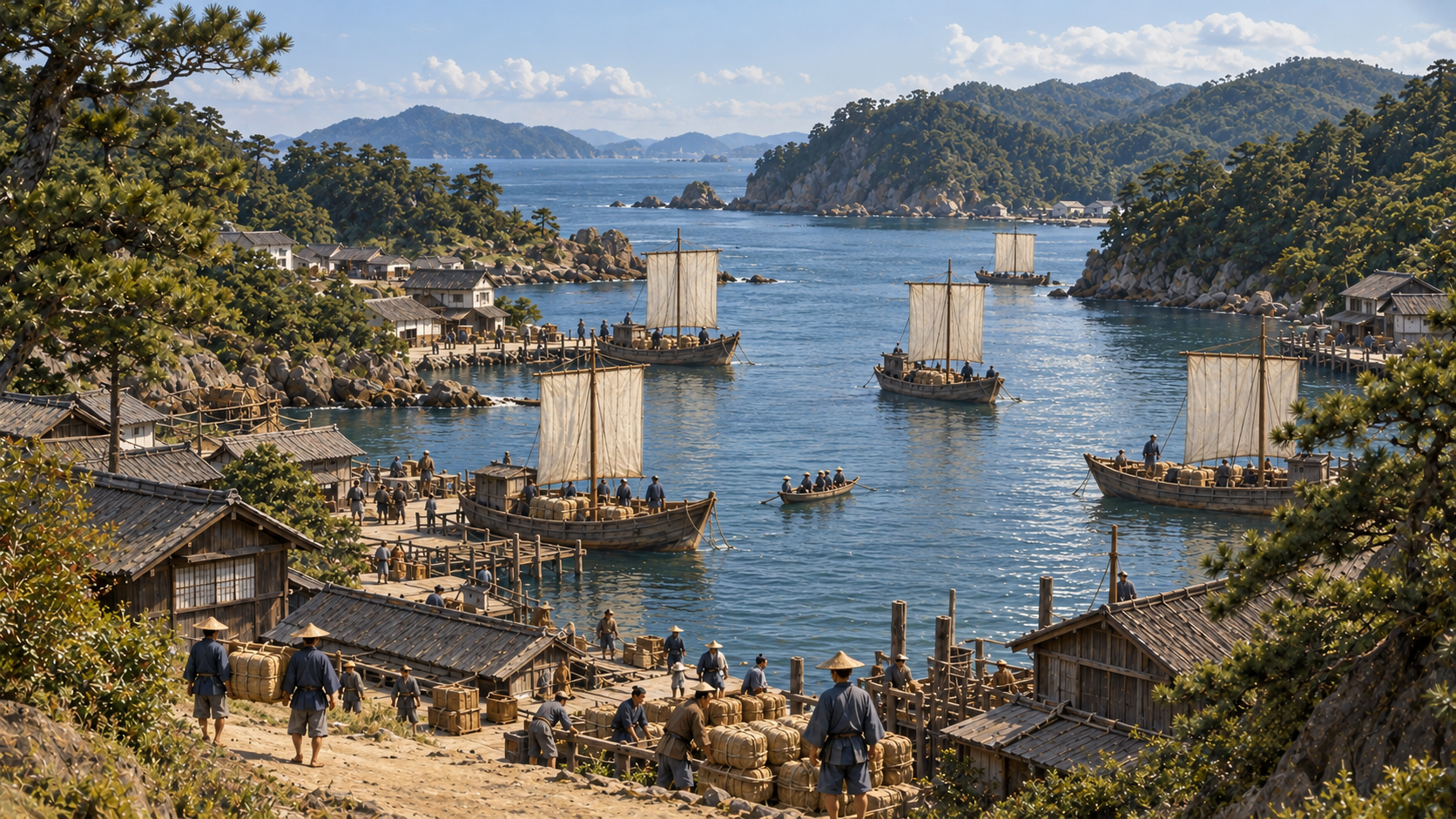
The National Archives of Japan’s explanation identifies Nakajima Saburosuke and other yoriki of the Uraga magistrate’s office among those who responded to the fleet. Yoriki were officials who carried out administrative duties under a magistrate. They told the American side that negotiations should take place at Nagasaki.
Nagasaki provided an established channel through which foreign relations had been handled. The Uraga officials attempted to direct the arriving fleet into those arrangements. Deciding where to send the visitors also concerned who would deal with them: the place of negotiation belonged to a system of responsibility.
Perry rejected this direction. He demanded that the American presidential letter be received in Edo Bay. The channel proposed by the shogunate and the location demanded by the fleet did not fit together. From the first response, the place where negotiations would occur was itself an issue.
The people who dealt with the fleet at Uraga cannot be described only as stunned and unable to act. Officials presented an established procedure; the visitors refused it. Their exchange brought a practical question to the shore: could this arrival be handled through the existing channel for foreign relations?
Chapter 03
News arrived before the ships
Documents bringing news from overseas had reached Japan before the fleet. According to the National Diet Library’s explanation, the Dutch trading post began submitting Betsudan Fusetsugaki, special reports on foreign affairs, from 1840. Beginning with detailed information about the Opium War, this channel continued to convey developments abroad.
In 1852, the head of the Dutch trading post warned of an American mission’s arrival. This was the year before the ships appeared off Uraga. A means of learning about developments across the sea existed, and the information reaching the shogunate included the specific prospect of an American delegation.
Policy toward foreign ships had also undergone change. In 1842, the order to drive away foreign vessels was relaxed: ships that drifted to Japan could be supplied with food, fuel and water before being sent away. Decisions about handling foreign vessels had already accumulated before Perry’s visit.
Receiving a warning, however, did not mean that all necessary preparations at the point of encounter were complete. How far had the information traveled, and whose actions had it informed? Once we establish that advance news existed, we must also follow where that news went within the government.
Chapter 04
Criticism from Uraga’s officers
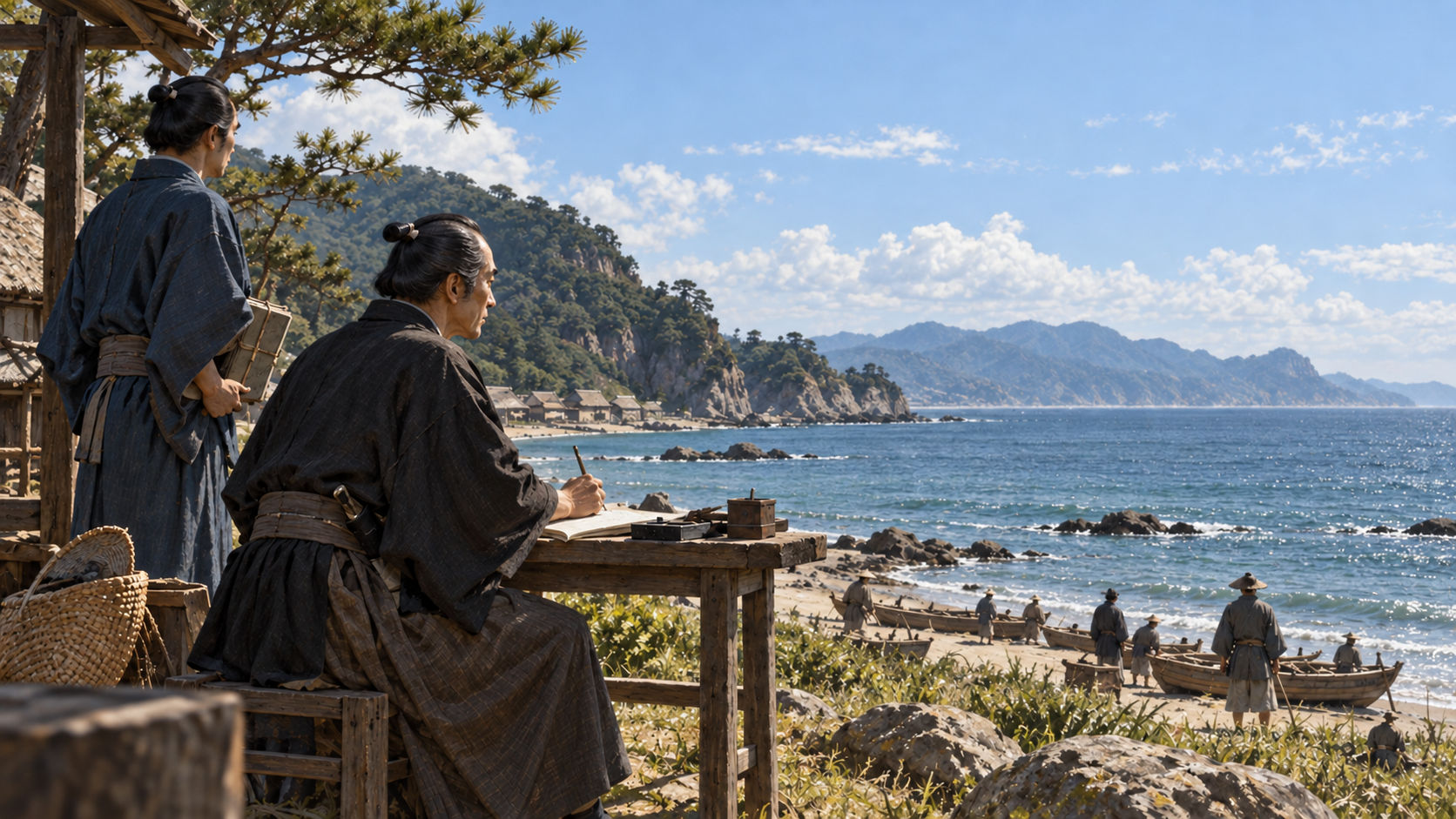
The records of people who performed the work at Uraga bring that question closer to the encounter. Uraga Yoriki yori no Kikigaki records accounts from five yoriki, including Kayama Eizaemon. The National Archives introduces the work as a copy made a little over a month after Perry’s departure from Japan.
Its explanation includes criticism by one of the officers. According to that account, senior officials who had information about the American mission kept it secret and failed to take measures; notification to the Uraga magistrate had not reached the yoriki. Someone involved in receiving the visitors questioned how information had been handled.
What survives here is criticism expressed from a particular officer’s position. The record does not speak for the thoughts of every official in the shogunate. It nevertheless offers a way to consider the distance between information being available at the top and being passed to the people who would respond.
What information had reached the men who approached the fleet and established its demands? Reading their recorded accounts reveals a problem less visible when we look only at the size of the Black Ships. The response on the coast was also connected to the movement of information leading there.
Chapter 05
Sea routes behind the letter
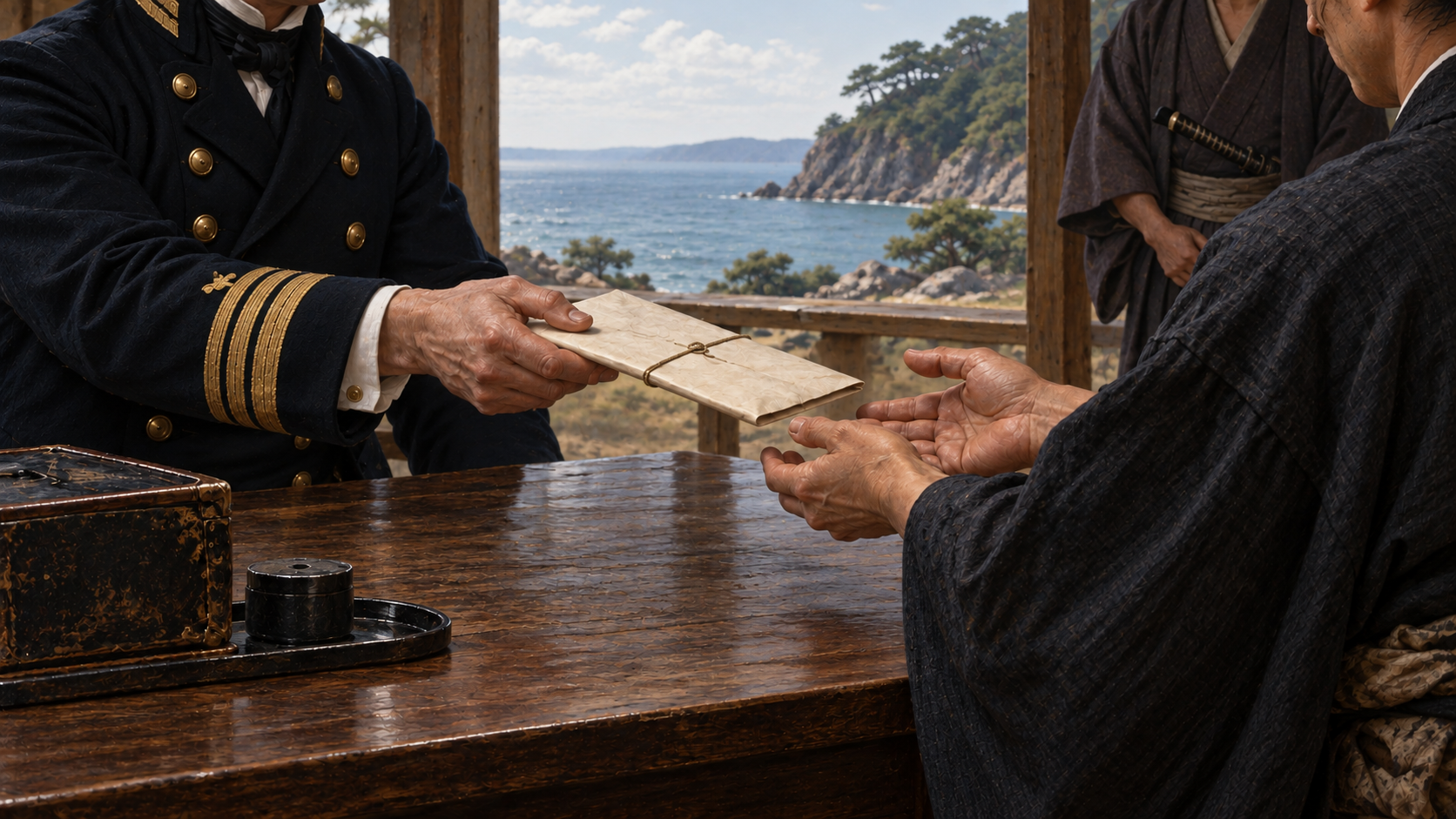
Perry carried a letter from President Millard Fillmore. The National Archives describes it as requesting friendship between the two countries and the start of commerce. At the center of the problem of receiving the fleet was a document that the visitors insisted the Japanese authorities accept.
Behind the mission lay steamship routes crossing the Pacific. A route connecting the United States and China required intermediate places where coal and other supplies could be obtained. There was also interest in the safety of whaling ships working near Japan and in securing ports where they could find refuge.
Fuel and materials to keep ships moving, reception for vessels in distress and the beginning of commerce: dealing with the letter meant dealing with these specific interests. The broad expression “opening Japan” contains more concrete questions about ports and ships, the uses of a harbor and the needs of a voyage.
Diplomacy through a document and pressure exerted by warships demanding its receipt occupied the same scene. Beyond the single letter that officials on the coast had to handle stretched issues of routes, replenishment and maritime safety. The paperwork at the shore connected to voyages extending much farther away.
Chapter 06
Six days later, reception at Kurihama
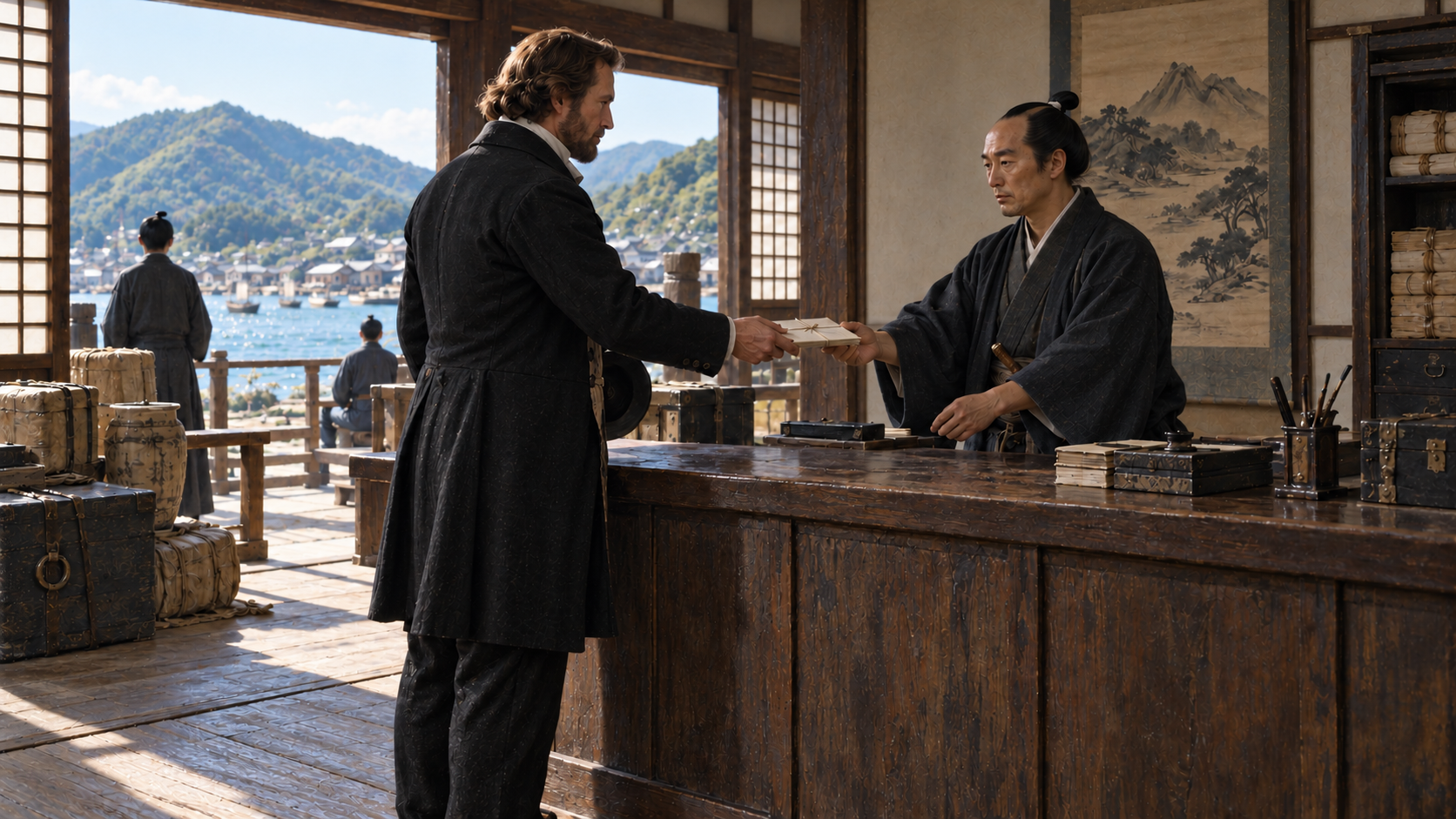
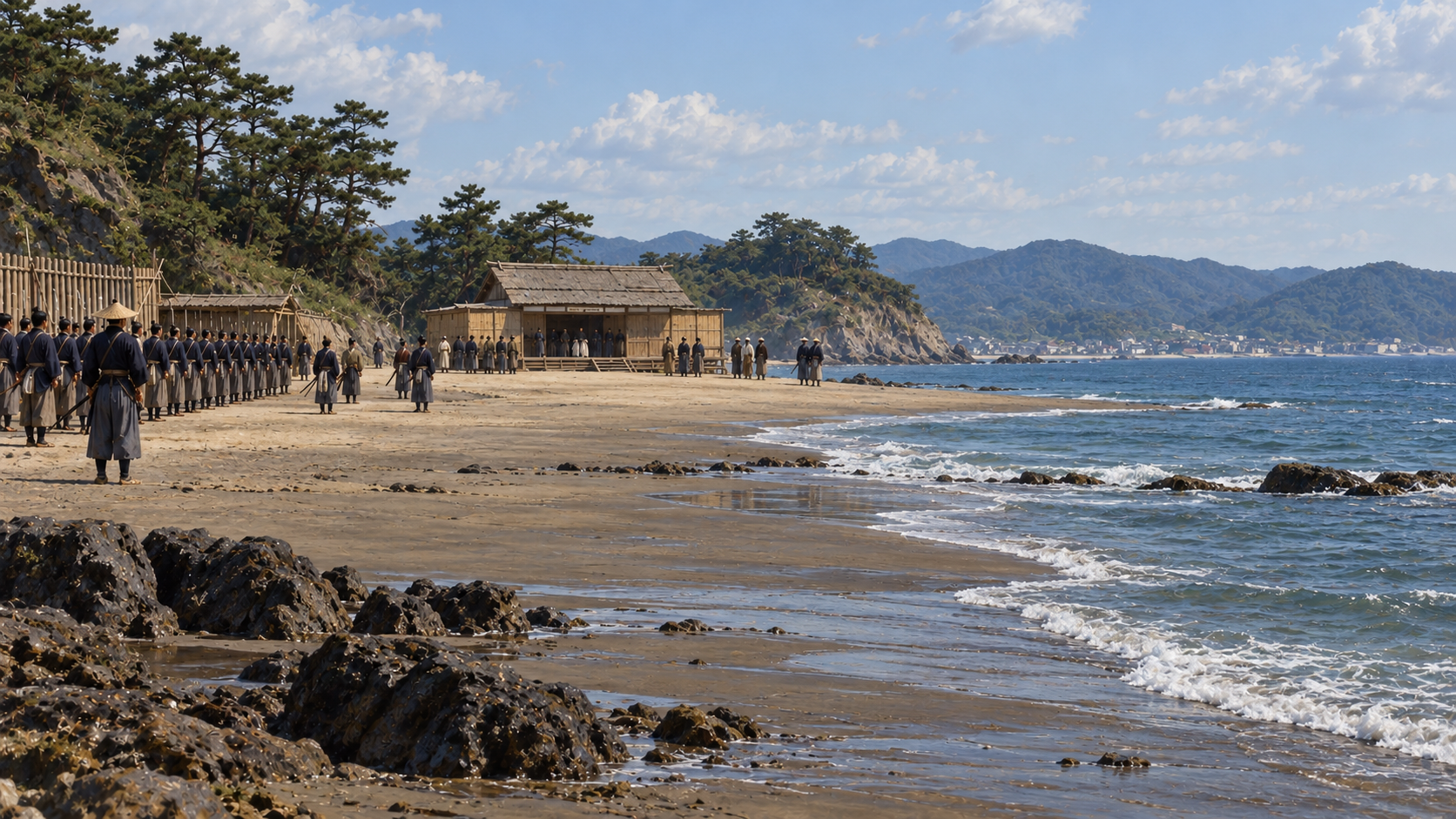
On 14 July 1853, six days after the arrival, the letter was handed over at Kurihama. In the Japanese calendar then in use, this was the ninth day of the sixth month of Kaei 6. The shogunate agreed to receive the document and prepared a reception hall on this coast.
The fleet’s arrival off Uraga and the landing at Kurihama were distinct places and occasions. Responding to ships offshore was followed by preparing somewhere on land for the document to change hands. The National Archives identifies the Uraga magistrates Toda Ujiyoshi and Ido Hiromichi as the Japanese officials who received it.
Receipt of the letter was not equivalent to accepting everything it requested. It meant taking the demands in written form and assuming the problem of making a response. There was still time between that stage and reaching agreement on particular conditions; receiving a document and agreeing to terms were separate steps.
The reception hall at Kurihama cannot be understood simply as a place where one landing settled everything. In a space prepared on the coast, the document was received and an entry into negotiations continuing into the following year was made. That sequence gives the handover its place in the longer account.
Chapter 07
Guards along the shore
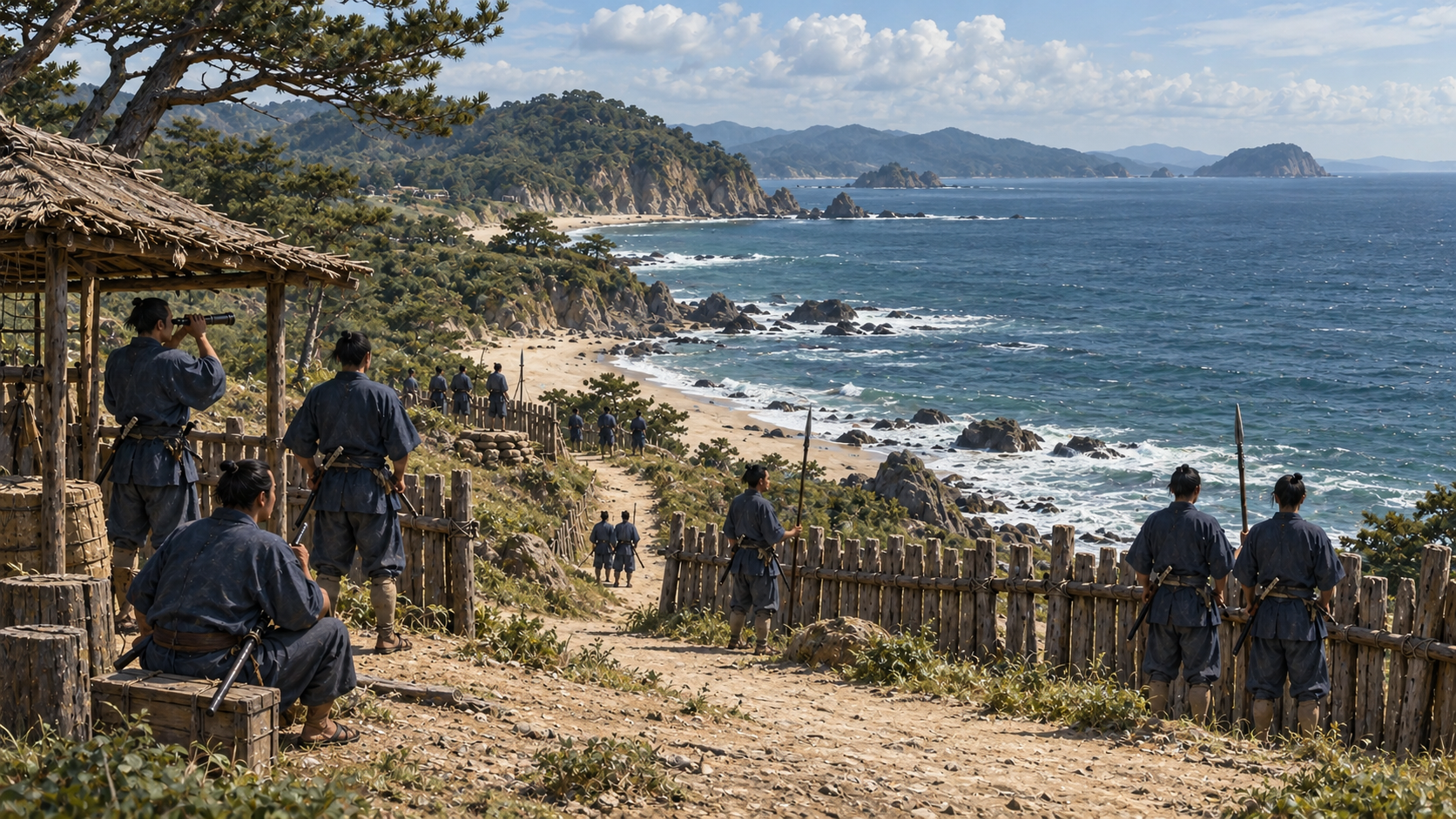
Alongside the reception hall where the letter was received, Kurihama had arrangements for security. The National Archives’ explanation of Nichibei Shodo Osetsu no Zusetsu describes warriors from the Hikone, Kawagoe, Aizu and Oshi domains guarding their respective positions. The reception and the deployment of guards belonged to the same coastal occasion.
Choosing where to receive the visitors did not complete the work at the shore. Men had to be positioned facing the ships and the place for the handover had to be guarded. The documents bring negotiation and security into view together, as different tasks performed around the reception.
This illustrated account was published in 1892; it was not a picture published on the day in 1853. Its editor and publisher, Takano Kichigoro, is identified as a member of the Hikone guard that day. We should keep visible the interval between an event and its later presentation by someone involved.
The fact that guards were deployed and an assessment of whether preparations were adequate are also separate matters. The National Archives describes Takano’s critical impressions of the batteries and ammunition. A response had been made, while criticism of deficiencies also remained from a person who had participated in it.
Chapter 08
Surveying after the exchange
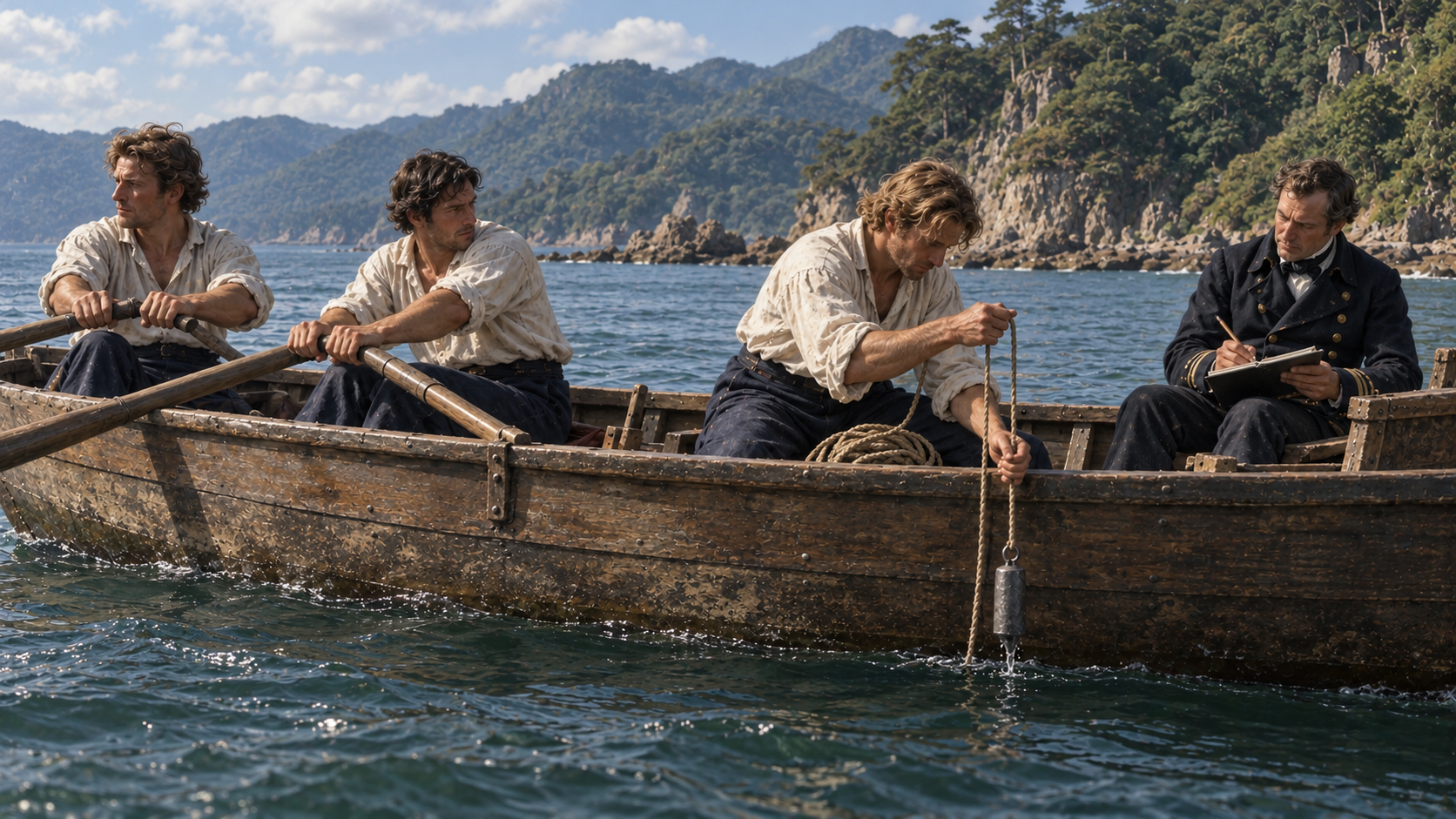
The fleet’s movements continued after the letter was delivered. According to the explanation of Edowan Okatame Ezu, the American ships entered farther into the bay and conducted surveys. Completing the exchange of documents and bringing the ships’ activity to an end were not one and the same task.
The Japanese side strongly protested this activity. The fleet returned toward Sarushima but reportedly continued surveying the bay. Outside the place of negotiation, officials still had to respond to what was happening on the water. A reception on land did not contain every part of the encounter.
Investigating the bay and its routes also bore on a fleet’s future return. While documents were received on the shore, the actions of warships at sea remained under scrutiny. Following both settings helps us see why responding to the arrival could not be completed within the reception hall alone.
The American reply recorded on the map is presented in paraphrase in the National Archives’ explanation. We do not turn it into invented verbatim dialogue. Instead, we follow the documented sequence of surveying, protest and surveying that continued. The pressure accompanying the paperwork also becomes visible in those actions.
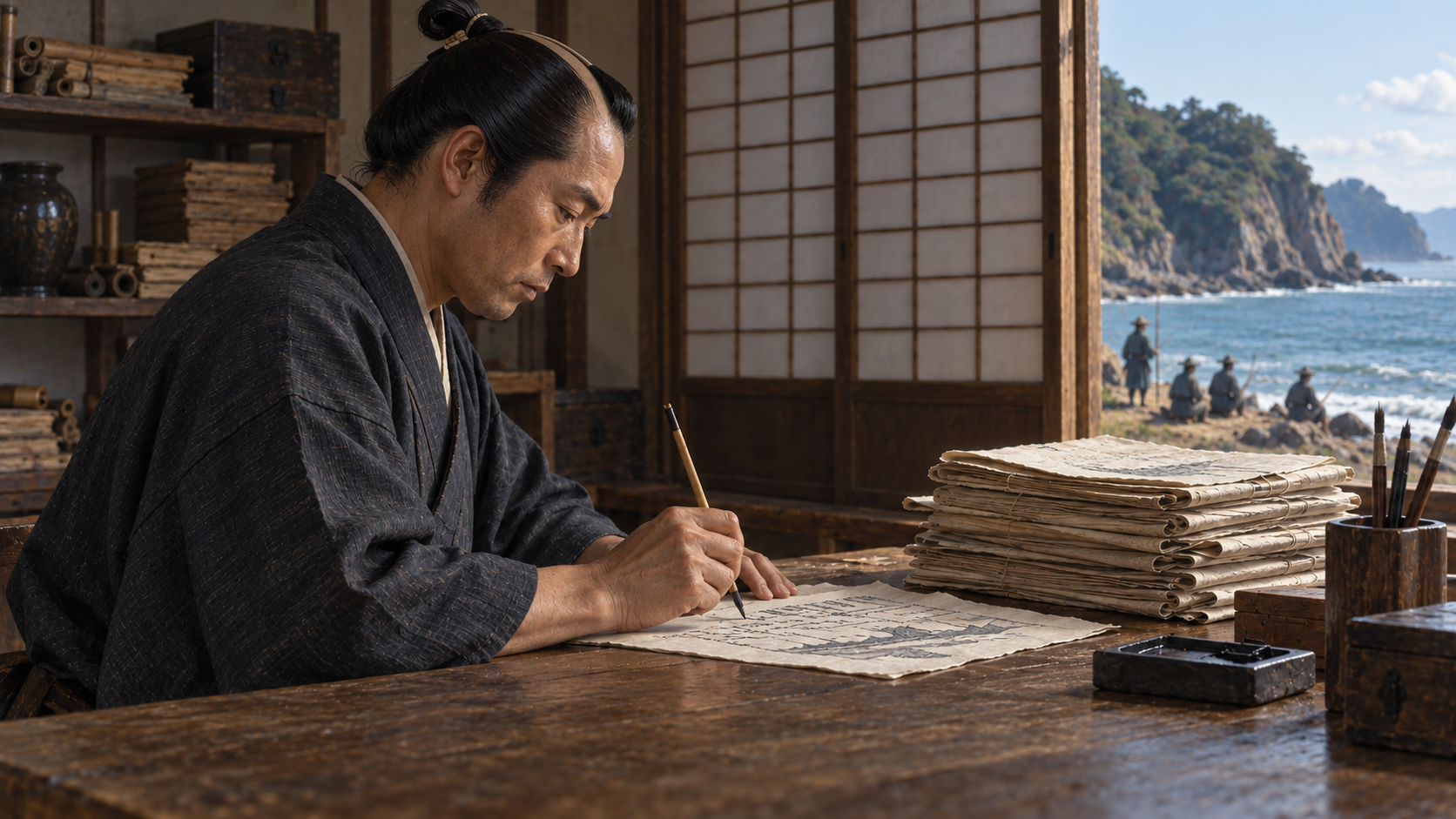
Chapter 09
The same visit, recorded from different positions
As the receiving side had recorded testimony, the visiting side also produced an account. Under Perry’s supervision, the American government compiled the expedition Narrative and published it in 1856. The National Archives describes a work assembled from diaries, notebooks, official documents and other writings concerning the expedition.
Those conducting the expedition and those responding to its demands at Uraga occupied different positions. A rich record does not necessarily convey both sides’ experiences equally. Identifying who assembled an account helps us understand the position from which it presents the events and the questions it can help us ask.
The Uraga officers’ collected accounts, the expedition Narrative compiled by the American government and the illustrated reception account published in 1892 all concern the visit. Their dates and forms nevertheless differ. This article compares the relevant institutional explanations; it does not claim a direct reading of every complete original work.
While following what happened, we can also attend to the records through which we know about it. Giving their names and dates helps keep the day on the coast distinct from the later work of passing its history onward. Both belong to the story, but they occupy different moments within it.
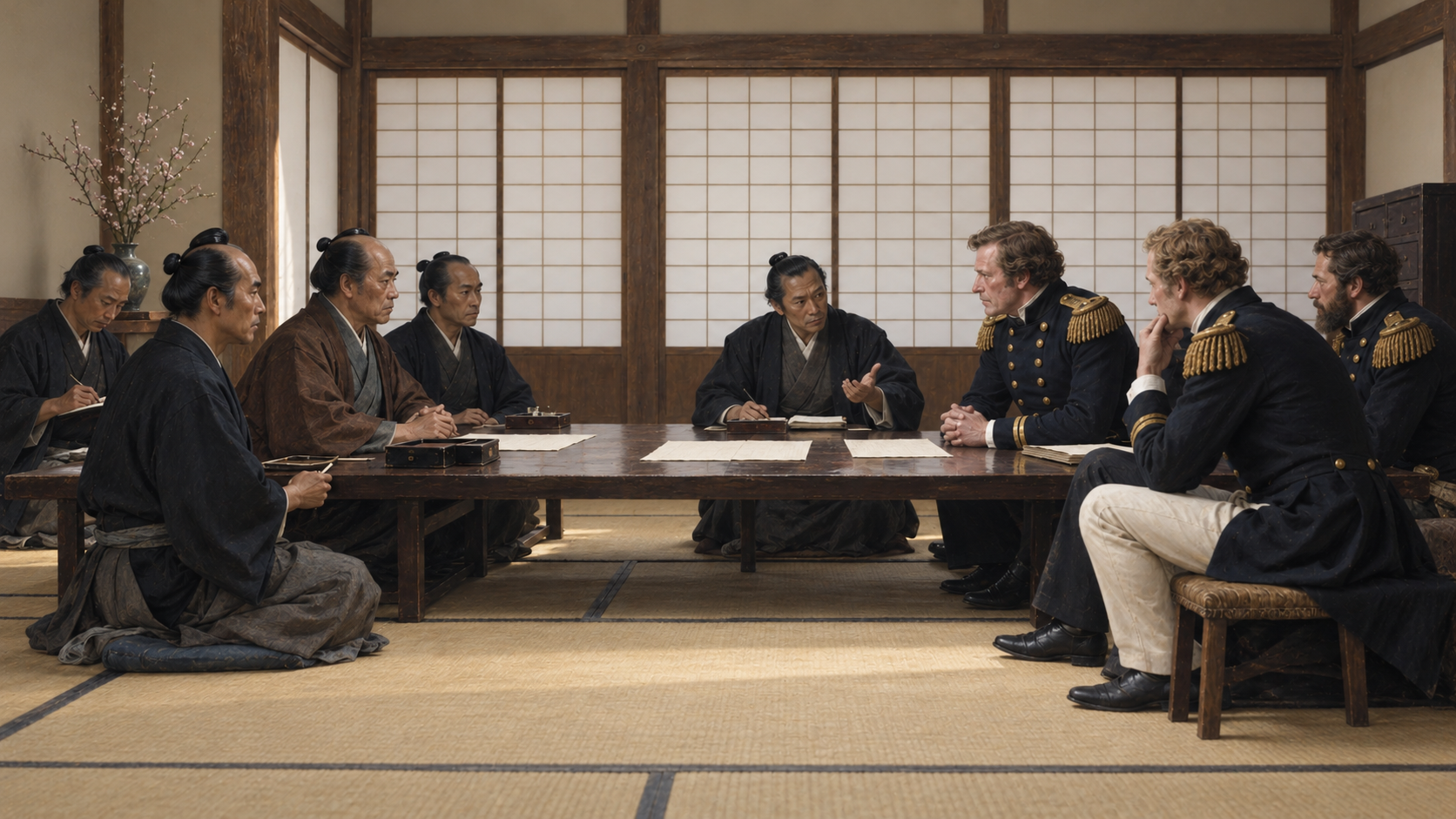
Chapter 10
The next year, a treaty at Yokohama
Perry returned in 1854, and negotiations with the shogunate continued. On 31 March, the Treaty of Peace and Amity, also known as the Convention of Kanagawa, was concluded at the reception hall in Yokohama. From receiving a letter at Kurihama the previous year, the parties moved to setting terms in a treaty.
The treaty opened the ports of Shimoda and Hakodate and provided for supplying American ships with necessities such as fuel, water and food, as well as protecting shipwrecked people. Opening ports involved deciding where vessels would be received and what would be provided; these were concrete arrangements concerning ships and their crews.
The Ministry of Foreign Affairs’ explanation also identifies permission for a consul at Shimoda and unilateral most-favored-nation treatment. This meant that advantageous terms Japan granted another country would also extend to the United States; the provision ran in favor of the American side. The agreement contained conditions beyond the ports themselves.
Keeping the year of the letter’s receipt separate from the year of the treaty’s signature makes the passage from receiving demands to putting agreed conditions into writing more visible. The memory of the Black Ships’ arrival can then be read alongside the particular content of the negotiations that followed it.
Chapter 11
Four years from amity to commerce
The National Archives explains that the 1854 Treaty of Peace and Amity did not yet contain provisions for commerce between the countries. Arrangements for receiving and provisioning ships at ports differed from arrangements establishing a system for trade. Calling both an “opening” can conceal the distinction between their agreed terms.
The Treaty of Amity and Commerce was concluded four years later, in 1858. Negotiations by Harris, the first American consul general in Japan, led to the setting of commercial terms. The treaties’ similar names should not obscure their different years or the difference in what each agreement established.
Four ships off Uraga, a letter received at Kurihama, an amity treaty concluded at Yokohama and the later commercial treaty: placing documents and locations in sequence reveals several stages within the expression “opening Japan.” Each stage can be followed without making the first encounter stand for everything that came afterward.
Looking back from later history, we may be tempted to place all the eventual outcomes on the coast in 1853. The people dealing with the arrival, however, had particular demands and conditions to handle at each stage. Separating the years restores the time during which negotiation continued.
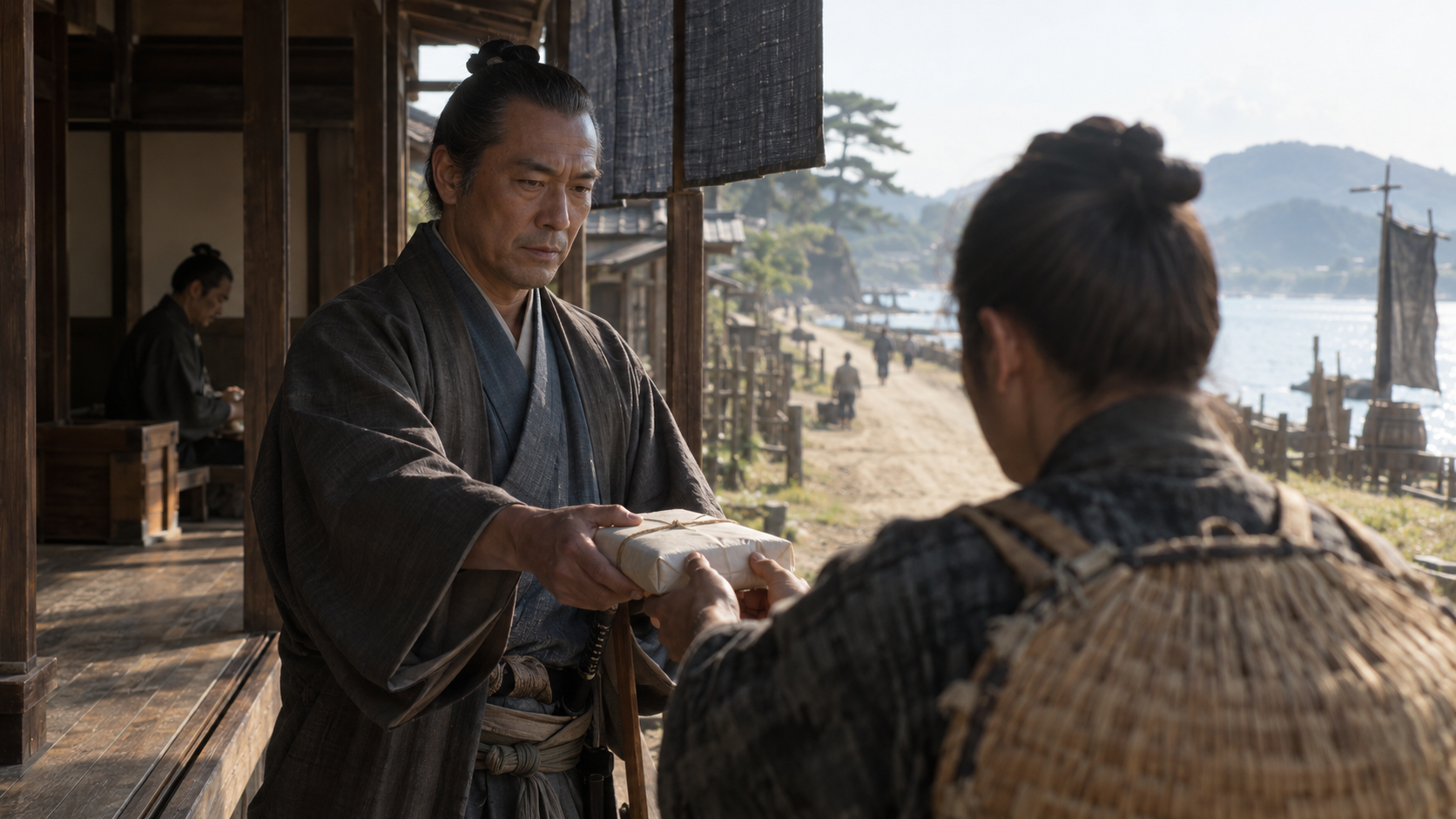
Chapter 12
The work behind the Black Ships
Returning to the shore, we can now see other movements around the four ships that first came into view. Yoriki responded at Uraga and proposed Nagasaki as the channel for negotiation. At Kurihama, a hall was prepared to receive the letter, while warriors from several domains provided security.
The existence of advance warning does not establish that information had been shared adequately or that preparations were sufficient. The collected testimony and later illustrated account preserve criticism from people connected to the work on the ground. A problem lay between acquiring information and connecting it to the response.
Receiving a document, protesting activity at sea and determining treaty conditions the following year offer concrete ways to answer how the shogunate acted. Following roles and surviving records brings the response into clearer view than assigning a single state of mind to everyone involved in it.
The coast that received the Black Ships carries more than the impression of large vessels. It also holds the work of handling demands, passing information and moving toward written terms. Along the route from Uraga through Kurihama to Yokohama, the remembered arrival opens into a history of negotiation.
How to read this work
History, interpretation, and reconstruction
Advance information, responses on the coast, receipt of a letter and subsequent treaty terms reveal the work through which the shogunate dealt with the Black Ships.
This work is grounded in published sources and historical research. Interior thoughts, dialogue, and some visual details are cinematic reconstructions. Where historians disagree, the article presents the point as debated rather than settled fact.
Timeline
The story in time
-
Betsudan Fusetsugaki reports begin providing detailed information on foreign affairs through the Dutch trading post.
Sources: s02 -
The policy of driving away foreign ships is relaxed; vessels drifting to Japan may receive food, fuel and water before departure.
Sources: s02 -
The head of the Dutch trading post warns of an American mission’s arrival.
Sources: s02 -
The fleet surveys Edo Bay; Japan protests, and surveying continues near Sarushima.
Sources: s05 -
The American government publishes the expedition Narrative compiled under Perry’s supervision.
Sources: s08 -
Negotiations by Harris lead to the Treaty of Amity and Commerce.
Sources: s07 -
The illustrated account of the first reception is published, decades after the 1853 events.
Sources: s04
People & terms
A guide for new readers
Key figures
- Matthew Perry
- American commodore who led the fleet, demanded receipt of the presidential letter and returned for treaty negotiations the following year.
- Nakajima Saburosuke
- A yoriki of the Uraga magistrate’s office who responded to the American fleet.
- Kayama Eizaemon
- An Uraga yoriki involved in the reception, whose account was recorded in the officers’ collected testimony.
- Townsend Harris
- The first American consul general in Japan, who negotiated toward the Treaty of Amity and Commerce of 1858.
Glossary
- Bakufu 幕府
- The warrior government, translated here as shogunate. The article follows its response to the American fleet.
- Yoriki 与力
- Officials serving under a magistrate; the Uraga officers in this account dealt with the arriving ships.
- Uraga bugyo 浦賀奉行
- The magistrates responsible for Uraga. Toda Ujiyoshi and Ido Hiromichi received the letter at Kurihama.
- Han 藩
- A domain governed by a territorial warrior lord; guards from Hikone, Kawagoe, Aizu and Oshi appear in the reception account.
- Betsudan Fusetsugaki 別段風説書
- Special reports on foreign affairs submitted through the Dutch trading post from 1840 in the cited explanation.
- Kokusho 国書
- A formal letter from a head of state; here, President Fillmore’s letter brought by Perry.
- Kaei 嘉永
- The Japanese era name used for the older calendar date of the 1853 visit. The sixth month is not modern June.
- Kaikoku 開国
- The opening of Japan. Here the expression covers several stages, from reception of demands to amity and later commerce.
- Most-favored-nation treatment 最恵国待遇
- A provision extending favorable terms granted to another country. The 1854 treaty gave this treatment unilaterally to the United States.
- Uraga Yoriki yori no Kikigaki 浦賀与力より之聞書
- Collected accounts from five Uraga officers, introduced through the National Archives’ explanation.
- Nichibei Shodo Osetsu no Zusetsu 日米初度応接之図説
- An illustrated account of the first reception, published in 1892, decades after the events it describes.
- Edowan Okatame Ezu 江戸湾御固絵図
- A map of Edo Bay’s defenses introduced by the National Archives for its account of surveying and protests.
Sources & method
How this article was built
This article translates the fixed, publicly verified Japanese manuscript, retaining its twelve chapters, four people, ten timeline entries and nine sources. All nine linked institutional explanations were actually opened and read. English source headings are editorial translations; historical document images and maps are not reproduced.
The National Archives and National Diet Library explanations support the fleet, proposed Nagasaki channel, advance reports, letter reception and treaty sequence. Advance knowledge is distinguished from information passed to officers who responded. The existence of foreign channels is not turned into a claim that every office was prepared.
Accounts from five Uraga officers, an illustrated reception account published in 1892 and the American government’s Narrative published in 1856 occupy different positions and dates. The article refers to institutional introductions rather than claiming direct reading of the complete original texts. Individual criticism, later recollection and institutional paraphrase do not become invented conversation or universal private thoughts.
The Ministry of Foreign Affairs explanation concerns a displayed replica derived from the American signed treaty copy. Treaty terms in 1854, including unilateral most-favored-nation treatment, are kept separate from the commercial agreement in 1858. The Yokosuka municipal page is used for calendar correspondence, place and vessel types; broad dramatization or an implication of immediate free trade is not adopted.
All twelve distinct canonical AI-generated illustrations were actually viewed and matched by SHA and article rights to the Japanese review. Their people and settings are fictional. They are not authenticated portraits, exact reception halls or deployments, original letters or treaties, or photographs of the historical events. The linked film has Japanese audio; an English subtitle track has not been verified.
Sources
References and further reading
- The Black Ships and the Opening of Japan 黒船と開国 Title translated editorially for reader convenience. National Archives of Japan 国立公文書館 Institutional explanation of the four ships, the Nagasaki proposal and refusal, the letter and Kurihama reception, and steamship routes, supplies and whaling interests. Accessed 2026-10-10
- The Opening of Japan and Japanese–Dutch Relations 日本の開国と日蘭関係 Title translated editorially for reader convenience. National Diet Library 国立国会図書館 Institutional explanation of the special foreign reports from 1840, the policy change of 1842 and the advance warning in 1852. The existence of news is distinguished from its circulation to responding officials. Accessed 2026-10-10
- Accounts Collected from the Uraga Yoriki 浦賀与力より之聞書 Title translated editorially for reader convenience. National Archives of Japan 国立公文書館 Introduction to testimony from five officers and a copy made after Perry’s departure. An officer’s criticism is not generalized into the thoughts of the entire government. No complete original manuscript reading is claimed. Accessed 2026-10-10
- Illustrated Account of the First Japanese–American Reception 日米初度応接之図説 Title translated editorially for reader convenience. National Archives of Japan 国立公文書館 Institutional introduction to the reception hall, guards from four domains and Takano Kichigoro’s participation and criticism. Publication in 1892 is distinguished from the events of 1853. Archival pictures are not reproduced. Accessed 2026-10-10
- Map of the Defenses of Edo Bay 江戸湾御固絵図 Title translated editorially for reader convenience. National Archives of Japan 国立公文書館 Institutional explanation of the fleet’s surveys, Japanese protests and continued activity near Sarushima. Its paraphrase of the American reply is not presented as verbatim dialogue. The original map is not reproduced or fully transcribed. Accessed 2026-10-10
- Treaty of Peace and Amity — Replica 日米和親条約(複製) Title translated editorially for reader convenience. Ministry of Foreign Affairs of Japan 外務省 Exhibition explanation of the signature on 31 March 1854, the two ports, supplies, shipwreck protection, consular presence and unilateral most-favored-nation treatment. The displayed replica derives from the American signed copy; no direct reading of an original treaty is claimed. Accessed 2026-10-10
- Treaties with Five Countries and Tariff Regulations 五ヶ国条約并税則 Title translated editorially for reader convenience. National Archives of Japan 国立公文書館 Institutional explanation distinguishing the 1854 amity treaty at Yokohama, its lack of commercial provisions and the 1858 commercial treaty negotiated by Harris. Accessed 2026-10-10
- Narrative of Perry’s Expedition to Japan ペリー提督日本遠征記 Title translated editorially for reader convenience. National Archives of Japan 国立公文書館 Institutional explanation of the American government’s compilation under Perry’s supervision from diaries, notebooks, documents and writings, published in 1856. The complete Narrative has not been directly read for this article. Accessed 2026-10-10
- Commodore Perry’s Arrival — Landing Commemoration ペリー提督の来航(水師提督ペリー上陸記念式典) Title translated editorially for reader convenience. City of Yokosuka 横須賀市 Official municipal page used for Gregorian and Japanese-calendar dates, the two steamships and two sailing ships, and the 14 July handover. Arrival, landing and the next year’s treaty are distinguished; broad claims about immediate free trade are not adopted. Accessed 2026-10-10
Continue reading
More stories from Shigeki
Shigeki English
Sakai’s Merchant City: Trade, Self-Government and Survival
A port, a merchant council and town communities—from changing authority to rebuilding after fire.
- When From the later fifteenth century through the Sengoku period, the fire of 1615 and early Edo-period reconstruction.
- Where Sakai, in present-day Osaka Prefecture, where maritime routes met roads on land.
Shigeki English
The Aburanokōji Incident: After Leaving the Shinsengumi
A separation in spring, a new base in summer, and two successive attacks.
- When Kyoto in Keiō 3 (1867). The incident’s historical date corresponds to December 13, 1867.
- Where Kyoto: the guards’ successive bases, the Aburanokōji attack site and the later place of remembrance.