
SHIGEKI ENGLISH STORYEN
Japanese history in English
Amakusa Shiro at Hara Castle: A Young Symbol in the Surviving Evidence
A banner, letters, picture maps and stone walls: what they tell us about Shiro, and what remains beyond them.
The Shimabara-Amakusa uprising of 1637–1638 is often remembered through its young leader, Amakusa Shiro. Follow the Hara Castle ruins, a Eucharistic banner, besiegers' letters and a claim of military merit to place his symbolic role within the history of the people around him.
At a glance
Before you enter the story
- When
- Kanei 14–15 (1637–1638); later copies and excavations are distinguished from the uprising itself
- Where
- Shimabara and Amakusa in southwestern Japan, culminating in the siege of Hara Castle
- Key figures
- Amakusa Shiro, Itakura Shigemasa, Matsudaira Nobutsuna, Chin, a Hosokawa retainer
- What was at stake
- What can surviving objects, reports and ruins establish about a young symbolic leader and the people who gathered around him?
Why this story matters
The larger history behind the turning point
Shiro's name connects a young person with a large collective conflict. Reading the surrounding people and places prevents their history from disappearing behind that name.
Different kinds of evidence answer different questions. A reported claim, a transmitted picture map and an excavated object gain meaning when their purposes and limits stay visible.
Historical context
What an international reader needs to know
Regions, faith and authority
Shimabara and Amakusa name the two regional settings of the uprising, on opposite sides of the sea in southwestern Japan. Hara and Shimabara are different castles; Tomioka is the castle attacked on the Amakusa side. Keeping those places separate helps explain how the conflict reached its final stronghold.
The shogunate was the military government whose forces suppressed the uprising, drawing on the armies of several domains. The Arima and Hosokawa names identify warrior houses in the sources. Former Arima retainers appear among those leading participants; Hosokawa retainers appear among the besieging side and its reports.
Christian faith, persecution, taxation and famine belong together in the adopted background. The Eucharist represented on the banner is a Christian sacrament. Explaining its chalice, host and praying angels helps readers recognize the imagery without assigning unrecorded intentions to its makers or users.
Dates and the forms of evidence
Kanei is a Japanese era name: its fourteenth and fifteenth years correspond to 1637 and 1638. Historical months and days retain the calendar then in use. The second month, day 29 on the claim of military merit is not rendered as Gregorian February 29.
A catalogue identifies a holding and may explain its contents. This article uses those public descriptions with their institutional attribution. It does not claim an independent full transcription of the original letters or authentication of their physical sheets. A nineteenth-century copy also has a history separate from the seventeenth-century event it depicts.
Japanese names generally place the family name first. The Hosokawa retainer submitting the claim is referred to here by the surname Chin; this edition does not supply an unverified pronunciation for the rest of his name. Descriptions of Shiro's age likewise retain their source rather than an unchecked conversion.
Watch the film
See the story in motion
The film currently uses Japanese audio. This English article provides the context and source trail; it does not imply that an English subtitle track is available.
Scene 01
A question at Hara Castle
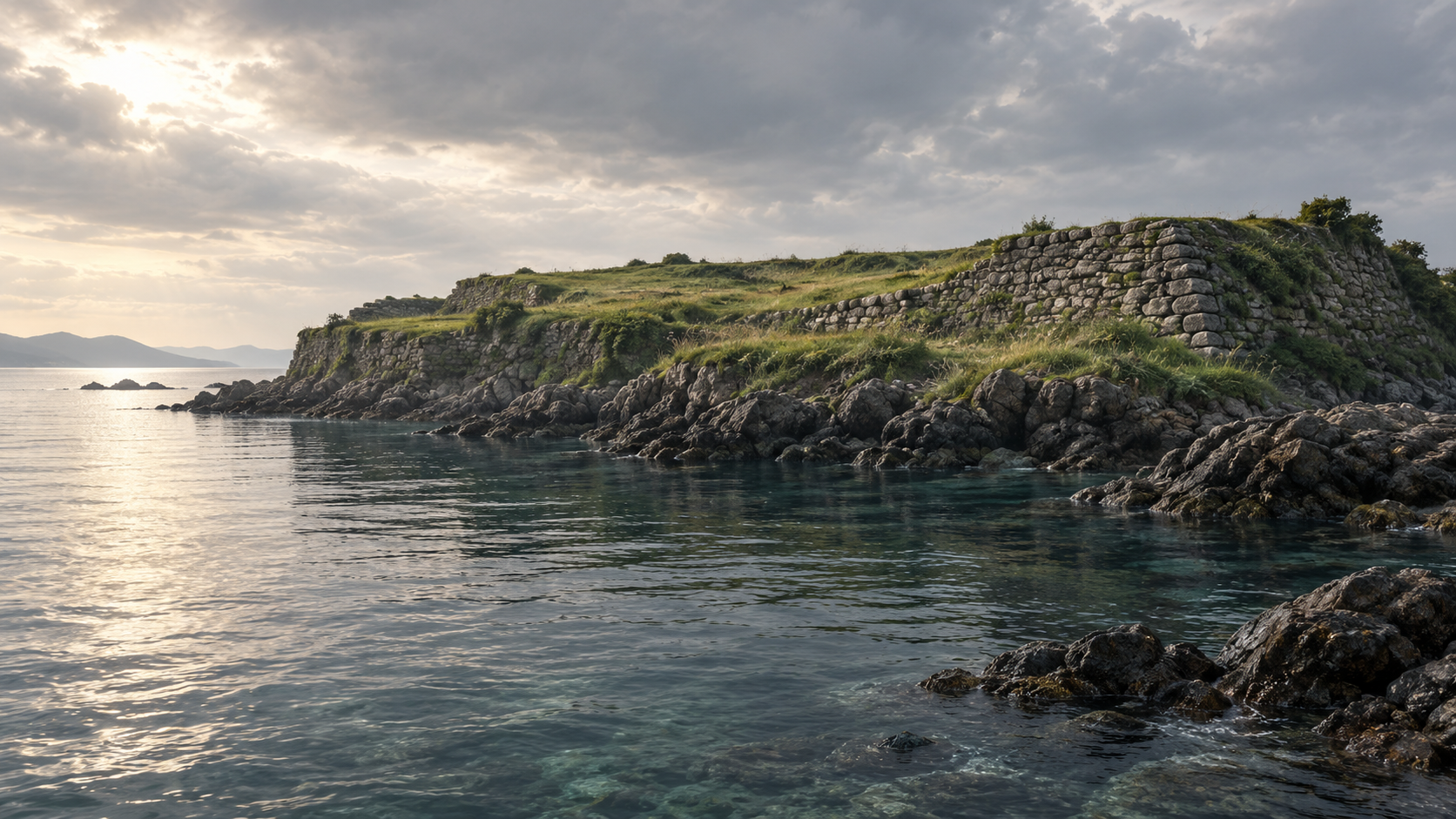
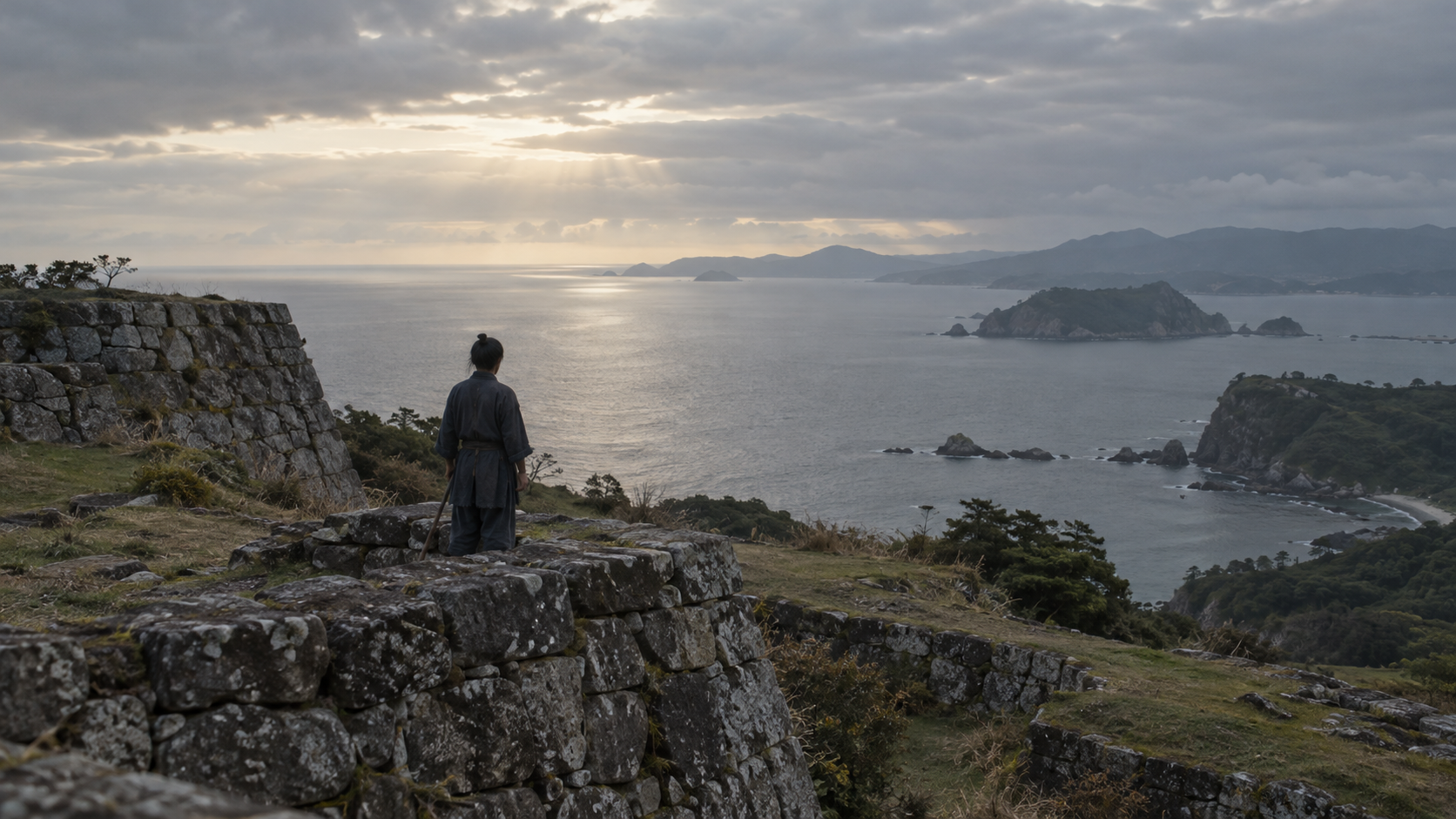
At Hara Castle, a plateau facing the sea and surviving stonework connect the landscape with a conflict fought in 1637 and 1638. Amakusa Shiro is remembered as the young figure at the center of the uprising. Beginning with the place, however, brings a question into view: how much do the surviving materials actually tell us about him?
A familiar name does not give us access to every decision, thought or command. The evidence includes a banner, documents, picture maps and objects recovered from the ground. Each preserves something different. An image of faith, a report of fighting and a surviving wall need to be read within their own circumstances.
This article follows the published Japanese account through those materials. It distinguishes Shiro's role as a symbol from the practical direction of military operations. It also separates what records report from the scenes a later reader might imagine around them.
The result is a view of Shiro within the history of the people who gathered at Hara. The castle, the surrounding regions and the interests of those who made the records remain part of his story. Reading them together provides a firmer outline than filling the gaps with a boy's unrecorded words.
Scene 02
An uprising on both sides of the sea
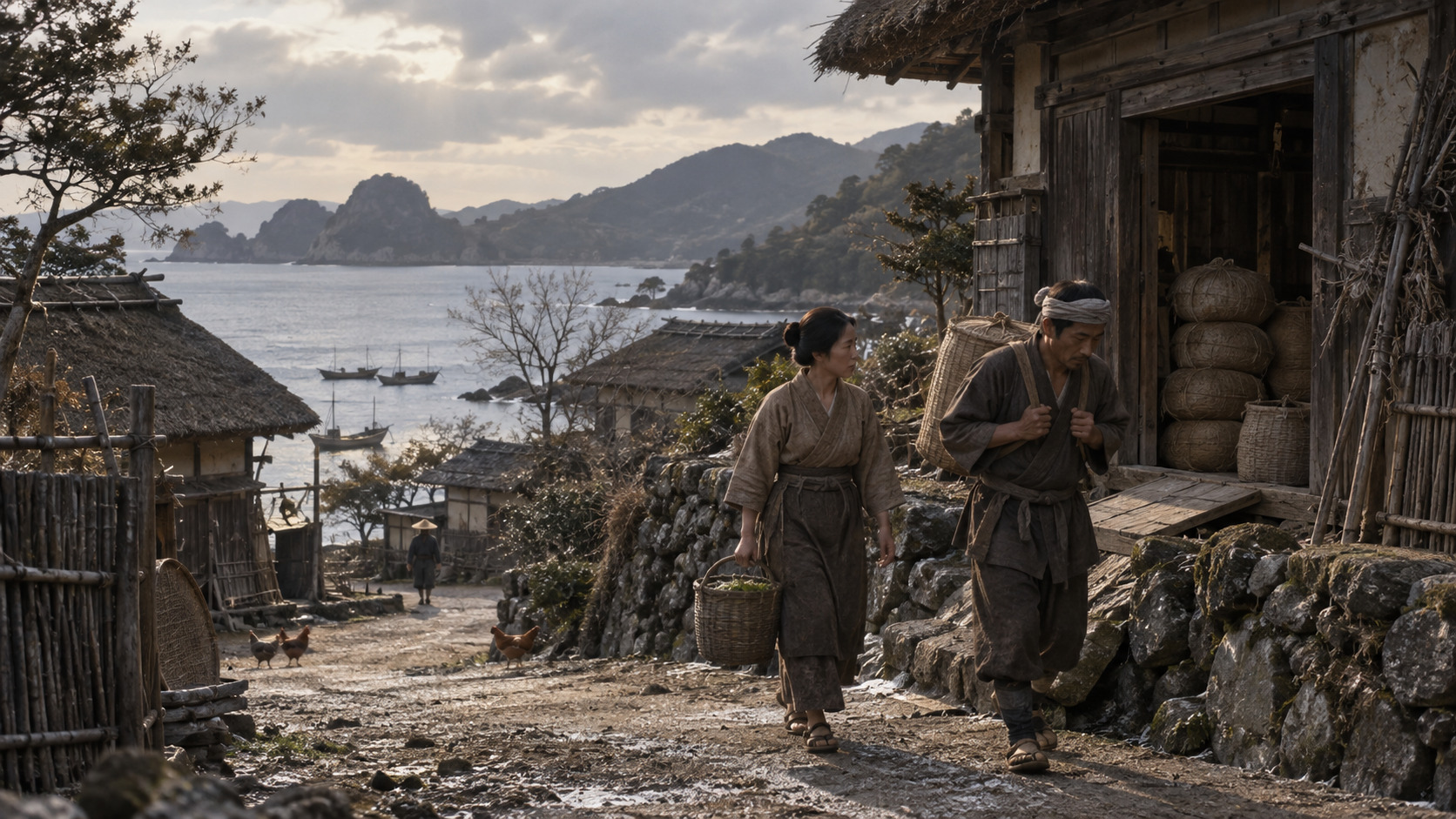
The conflict is often called the Shimabara Rebellion. Japanese institutional explanations also use Shimabara-Amakusa uprising. That name makes the Amakusa side visible alongside Shimabara. The regions faced each other across the sea, and Christian faith had spread in both.
The Shimabara City curator also draws attention to the language used to name the event. Describing it as a rebellion can carry the perspective of authorities confronting a disturbance of their order. A change of name does not settle the entire interpretation, but invites us to ask whose position a familiar term expresses.
Harsh taxation, the prohibition and persecution of Christianity, failed harvests and famine formed the adopted account's background. These conditions overlapped. Explaining the uprising through a single choice between religion and taxes would remove part of the situation in which people acted.
Before considering Shiro's fame, we therefore need to place the people around him in that setting. The conflict involved communities under pressure in more than one region. The sources do not require us to make one young person's influence the complete cause of everything that followed.
Scene 03
Youth, symbolism and military experience
Nagasaki Prefecture describes Shiro as a sixteen-year-old standard-bearer. Other public explanations present him as the commander-in-chief of the uprising. The age is retained as the institution gives it; this article does not silently turn it into a precise age calculated by modern birthday-based counting.
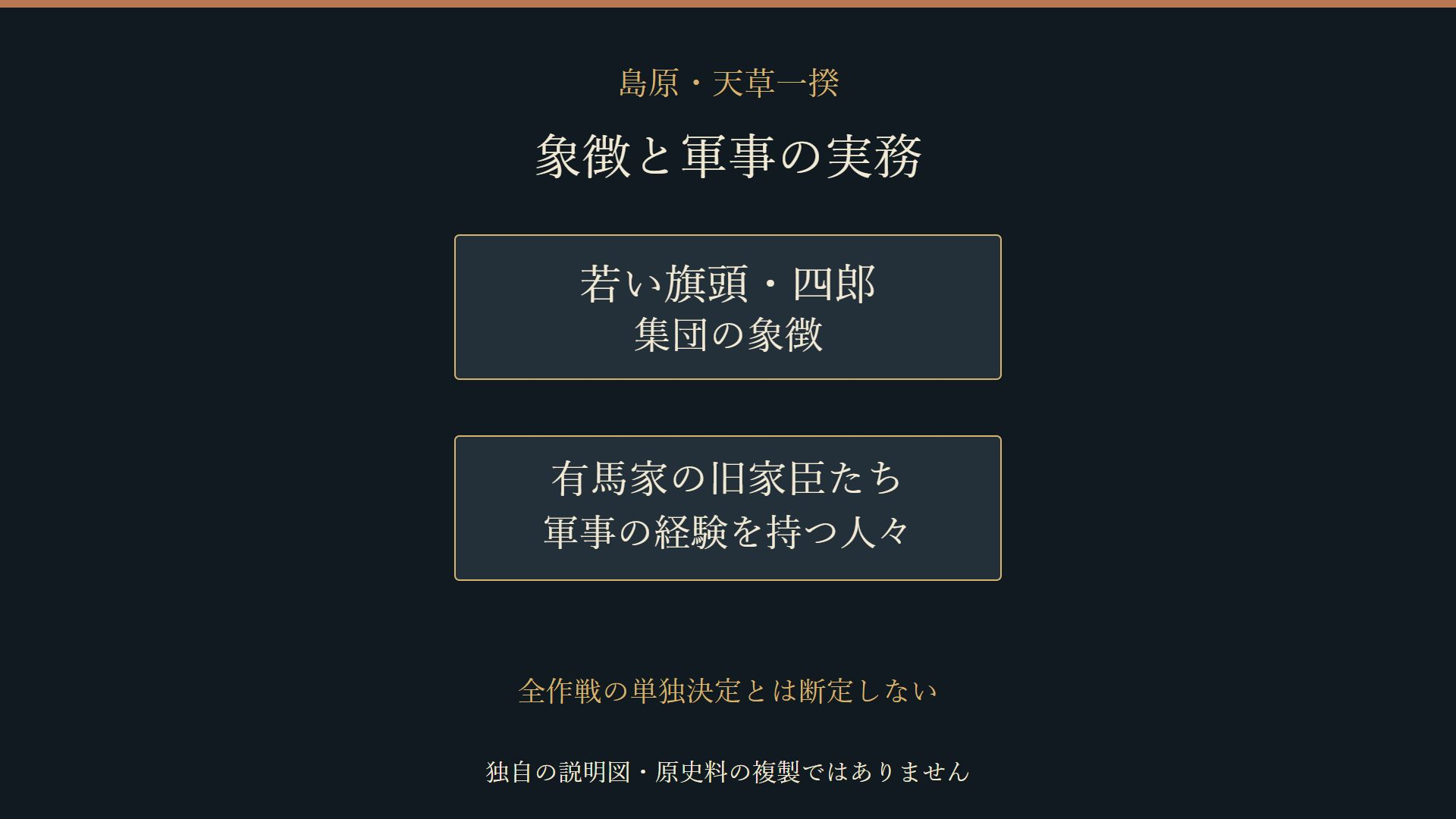
These descriptions identify a prominent young figure. They do not establish that he alone decided every tactic. The Tokyo National Museum's explanation of a picture map mentions former retainers of the Arima house among those leading the people who rallied around Shiro. Their presence adds military experience to the account.
The accompanying diagram sets out two roles: Shiro as the group's young symbol, and former Arima retainers as people with military experience. It organizes the adopted explanation without constructing a command chart for every operation or assigning decisions that the records do not attribute.
Keeping those roles in view lets us ask a more useful question than whether one boy could have directed everything. How did a symbolic leader belong to a group that also contained experienced people? The evidence permits that relationship to remain visible while leaving the allocation of particular orders unresolved.
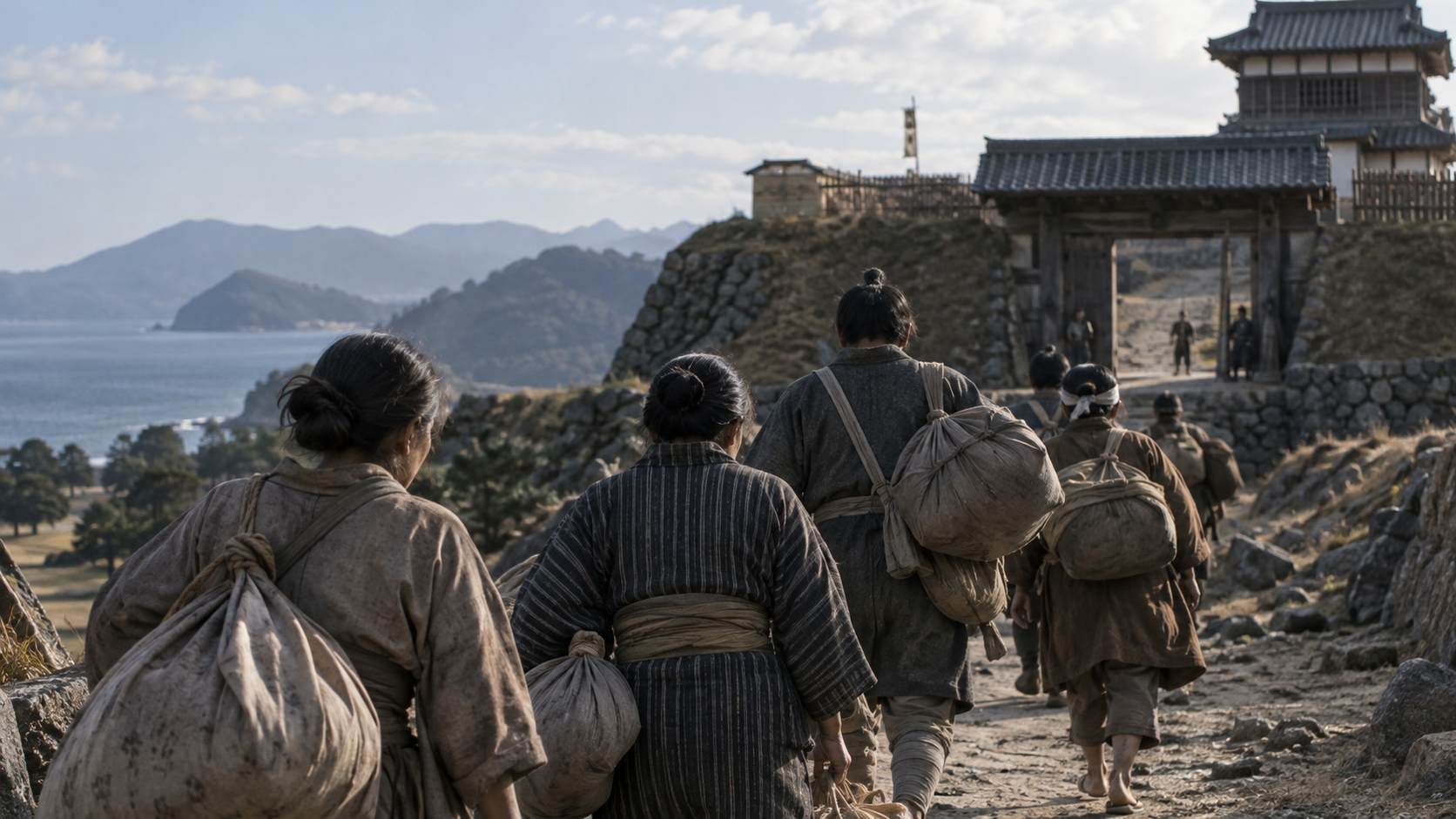
Scene 04
Hara was a stage reached during the conflict
The uprising did not begin as an occupation of Hara Castle. Participants attacked Shimabara Castle, the local lord's stronghold, and besieged Tomioka Castle on the Amakusa side. The people who later gathered at Hara had already been involved in fighting elsewhere.
Shimabara Castle did not fall. The city curator's explanation, drawing on a memorandum, describes townspeople and farmers carrying children who took refuge there, alongside the castle's defenders. That account complicates a picture in which every farmer automatically belongs to one side and every warrior to the other.
Different local circumstances and choices belong in the history of the uprising. A memorandum describing people seeking shelter preserves one part of that history; it does not identify the motives of every person in either region. Its particular view should not be expanded into an account of all the communities involved.
Gathering at Hara followed these earlier attacks. The sequence matters because it prevents us from treating the final stronghold as a fully prepared plan in place from the beginning. Shiro's story at Hara belongs to a conflict that had already changed shape through action in several places.
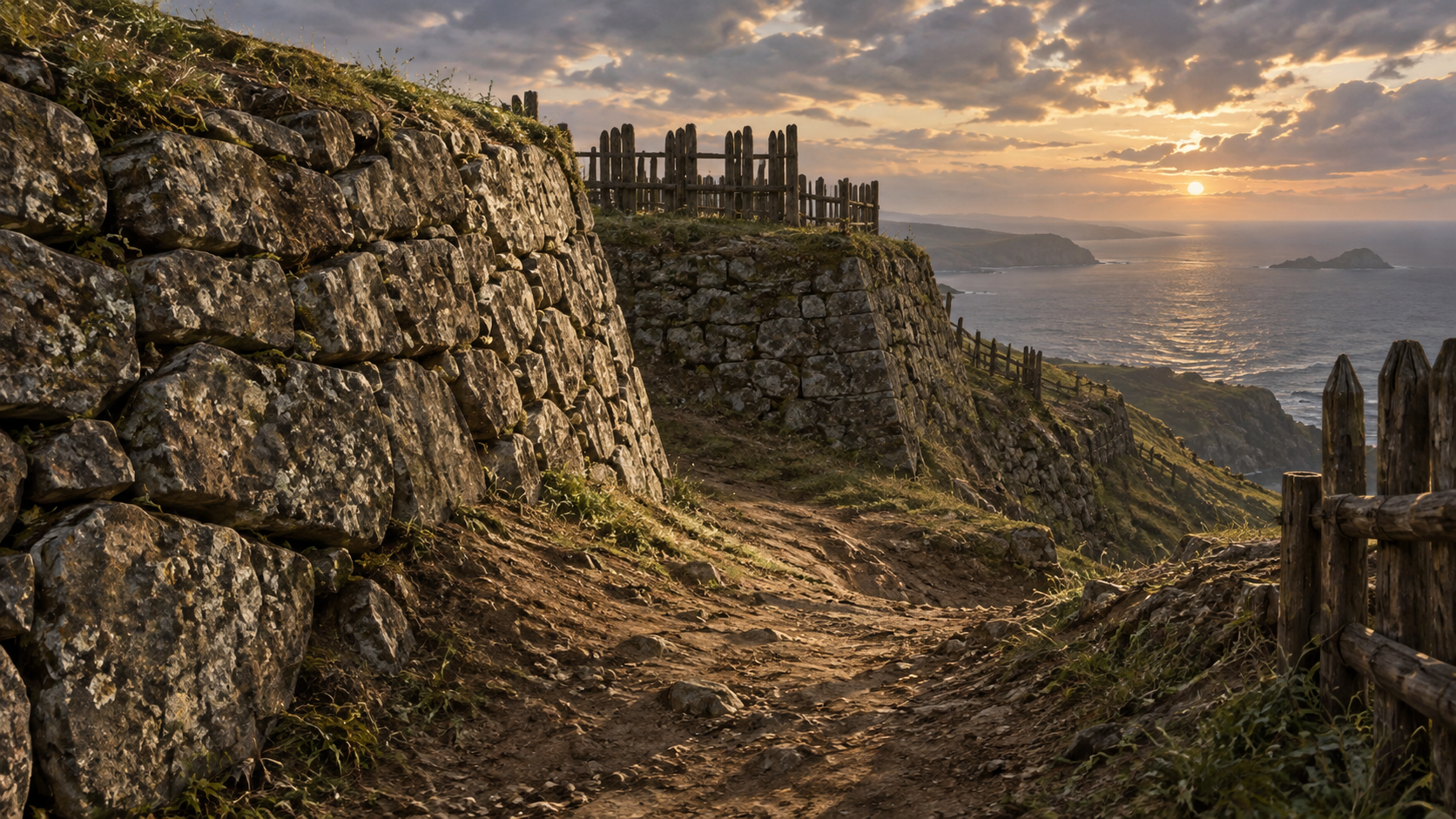
Scene 05
Why an abandoned castle could serve as a stronghold
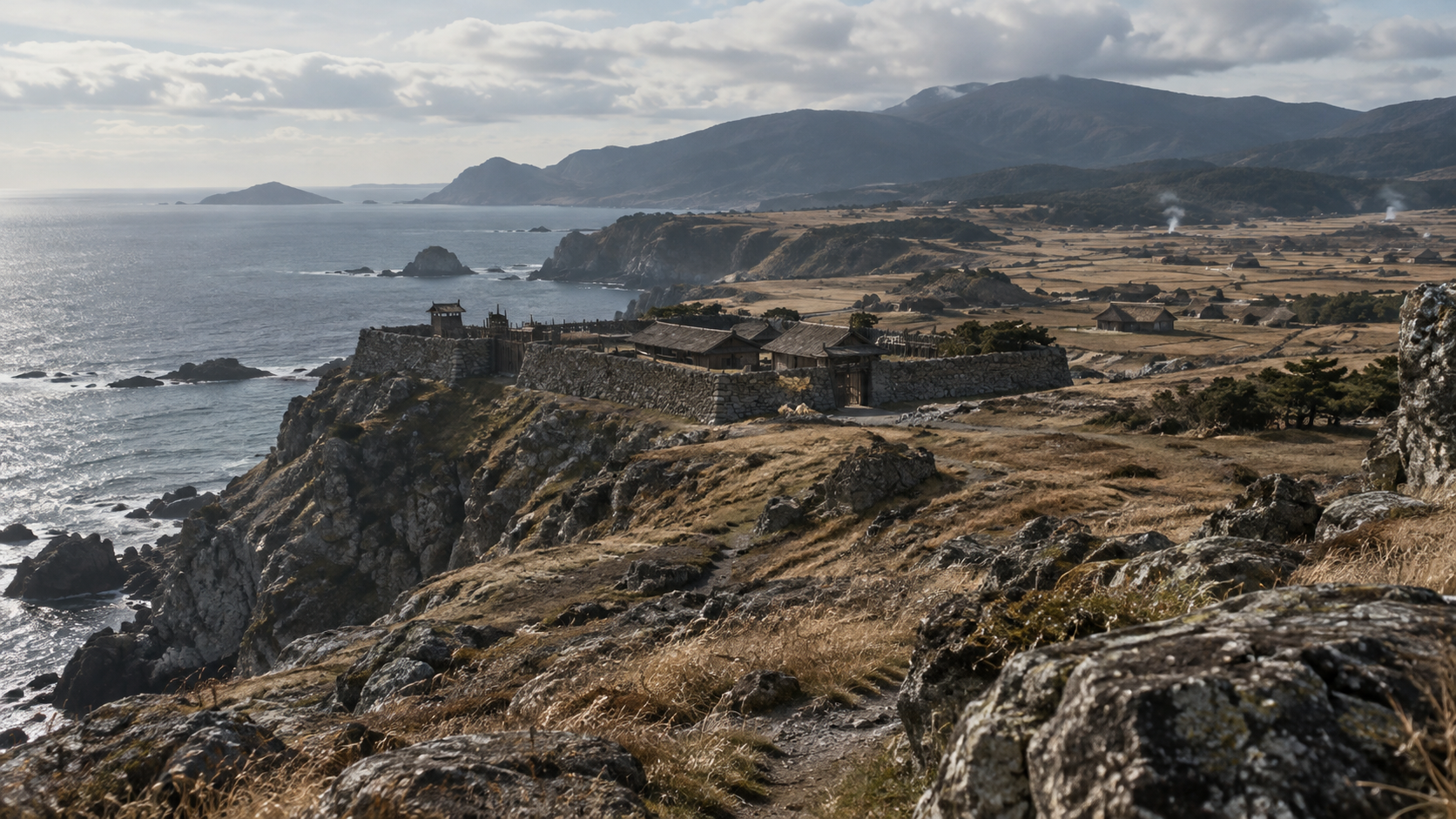
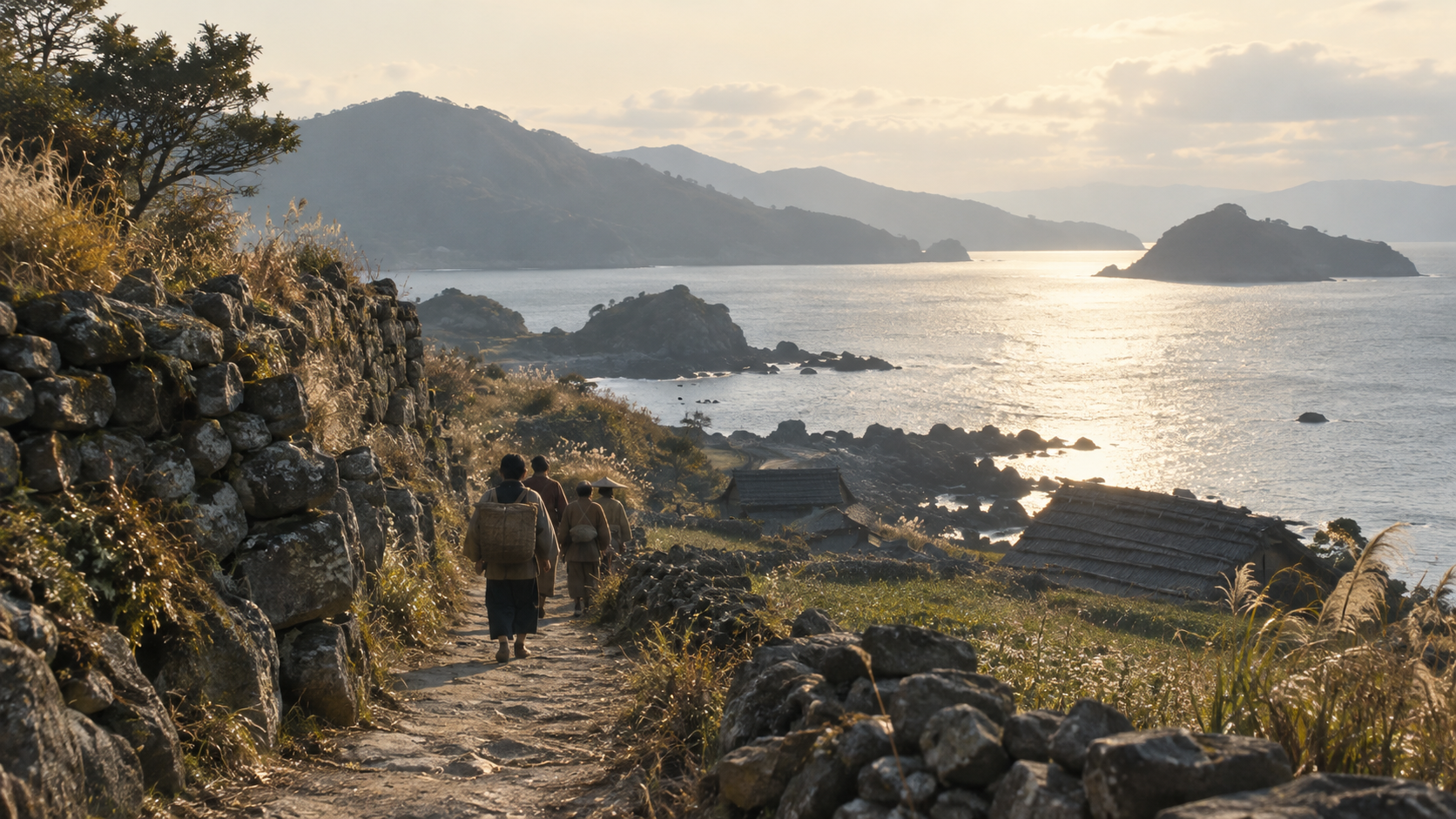
Hara had been a castle of the Arima house before the uprising. It was already abandoned as a functioning castle when the participants used it. They did not create a new fortress from nothing for the conflict of 1637 and 1638.
The site retained defensive advantages. Its plateau projected toward the sea, and its several enclosures used the terrain. Surviving structures could still serve people occupying it. A castle's loss of its former political function did not mean that every physical feature useful in defense had disappeared.
The cultural-property explanations connect the location, enclosures and stonework with the site's history. Those relationships help explain why Hara could become a stronghold. They do not supply the complete appearance of every building and wall on a particular day of the siege.
Present remains also bear the effects of later destruction, burial and excavation. Reading the site requires keeping those stages distinct. The conceptual illustration offers a coastal setting; it cannot stand in for a measured plan of Hara in 1637 or evidence of an exact route taken by Shiro.
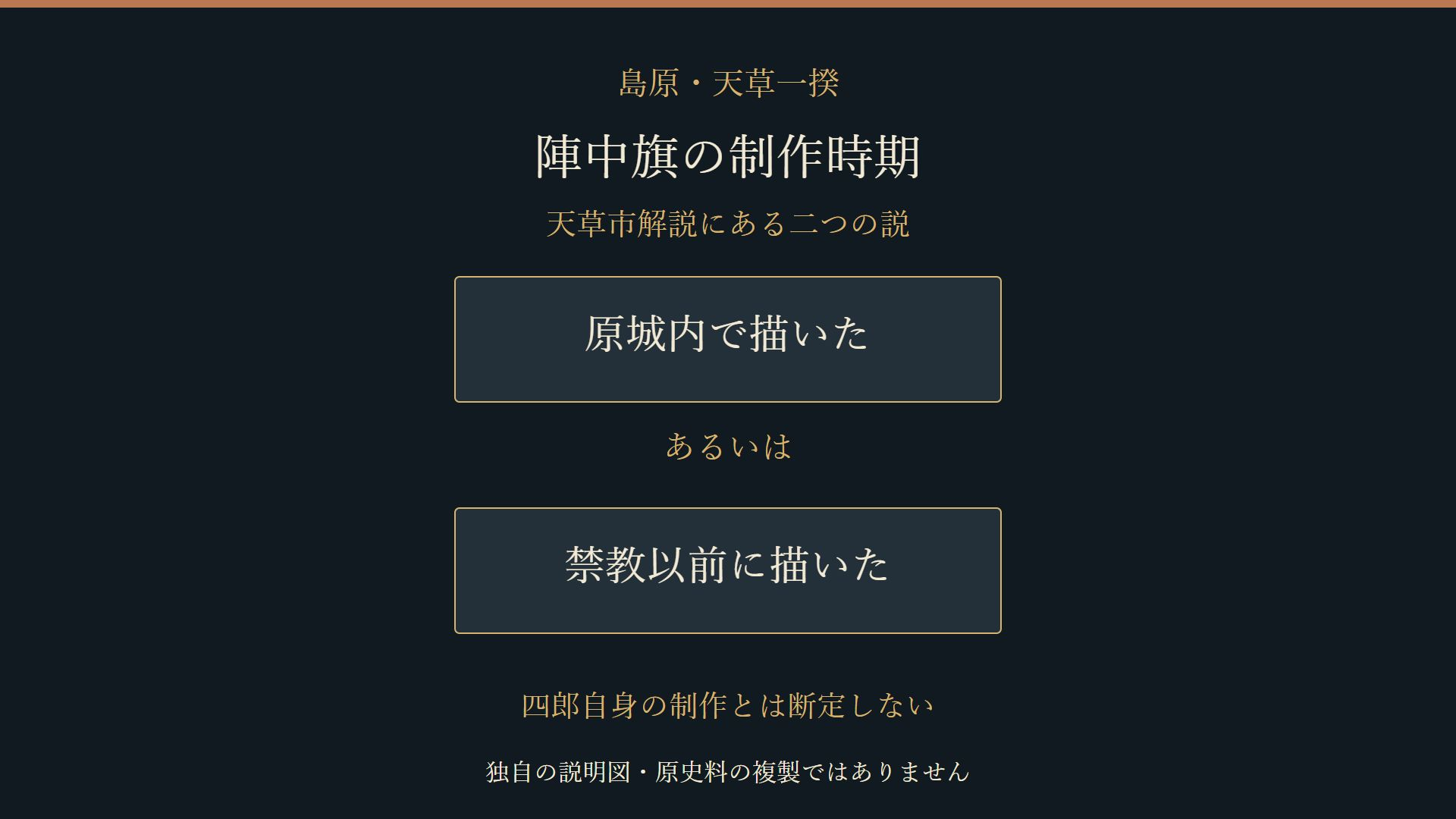
Scene 06
Faith represented on a banner
The object commonly called Amakusa Shiro's camp banner is formally described as a sashimono banner of the Eucharist. Amakusa City records the tradition that Shiro used it. Its design includes a chalice at the center, a Eucharistic host above and praying angels on either side.
Those motifs bring the group's Christian faith into view. They give us an object through which to consider faith and collective attachment. A tradition associating the banner with Shiro nevertheless has a different scope from evidence identifying its painter or documenting words spoken when it was carried.
Amakusa City introduces two views of when the banner was made: during the occupation of Hara, or before Christianity was prohibited. The diagram preserves both. It does not choose one through the fame of Shiro's name, and it does not claim that he painted the banner himself.
Reading the object in this way keeps its significance and uncertainty together. The design is evidence of religious imagery; the city's explanation records an association and competing accounts of origin. Neither supplies a complete statement of Shiro's private beliefs or an exact speech to the people around him.
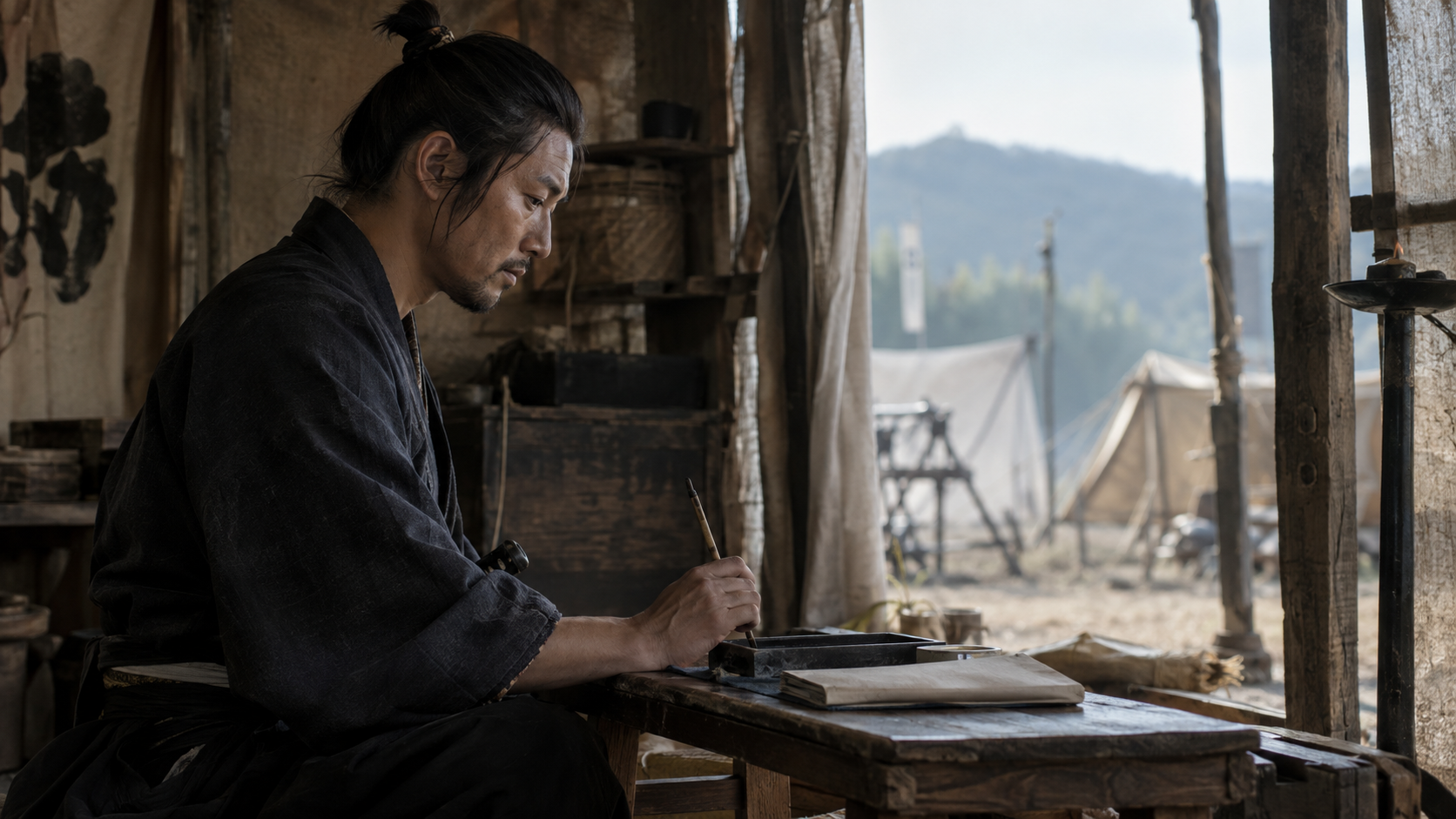
Scene 07
Records from the besieging side
The shogunate brought forces from several domains against the uprising. Itakura Shigemasa commanded the suppression effort and died in the fighting. Matsudaira Nobutsuna then took command. The castle resisted immediate capture, and the besieging forces pursued a siege that cut off food.
Many surviving accounts come from that side of the conflict. Kamiamakusa City introduces documents associated with the Hosokawa house, including letters reporting attacks, fire and heads taken. Such records preserve information generated by people involved in besieging Hara.
A military report has a writer, recipients and a reason for being sent. Asking what its author needed to report or claim helps explain the kind of view it offers. Descriptions of attacks and results do not automatically disclose what every person inside the castle experienced.
This perspective matters when reading about Shiro. The surviving documentation can show how opponents described the fighting and recognized achievements. It offers a way into the events, while leaving the inner life of the besieged and their precise decisions outside the account when the evidence does not reach them.
Scene 08
What picture maps can show
A picture map of the assault on Hara held in Miyakonojo is described as showing the castle and the positions of the besieging forces. It helps place the conflict in space. A different picture map in the Tokyo National Museum is catalogued as a nineteenth-century copy.
The date of a depicted event and the date of a surviving copy are separate matters. A later copy can preserve a transmitted representation, but its existence does not make the surviving sheet a drawing produced at the battlefield in 1638. The catalogue distinction stays visible in this account.
Picture maps can organize enclosures, approaches and surrounding positions. Their scale, flags, roads and forms also reflect choices made in drawing. They should not be treated automatically as modern surveyed maps or photographs of the moment they depict.
Read alongside letters, they can help connect reported movements with a spatial setting. That combination still does not locate Shiro at an exact point or identify an order he gave. Each material contributes within its limits, and those limits remain in place when the materials are brought together.
Scene 09
The fall and destruction of Hara
Hara fell in 1638. Food had been cut off, and the people inside could not withstand the final assault. Many died; Shiro also died at the fall of the castle. The institutional accounts place the end of the siege within this destructive outcome.
Figures for the people involved and those who died differ among accounts. This article does not select one total as a settled answer, or measure Shiro's influence by a number of participants. It also avoids turning a familiar claim about survival into an exact count unsupported by the adopted evidence.
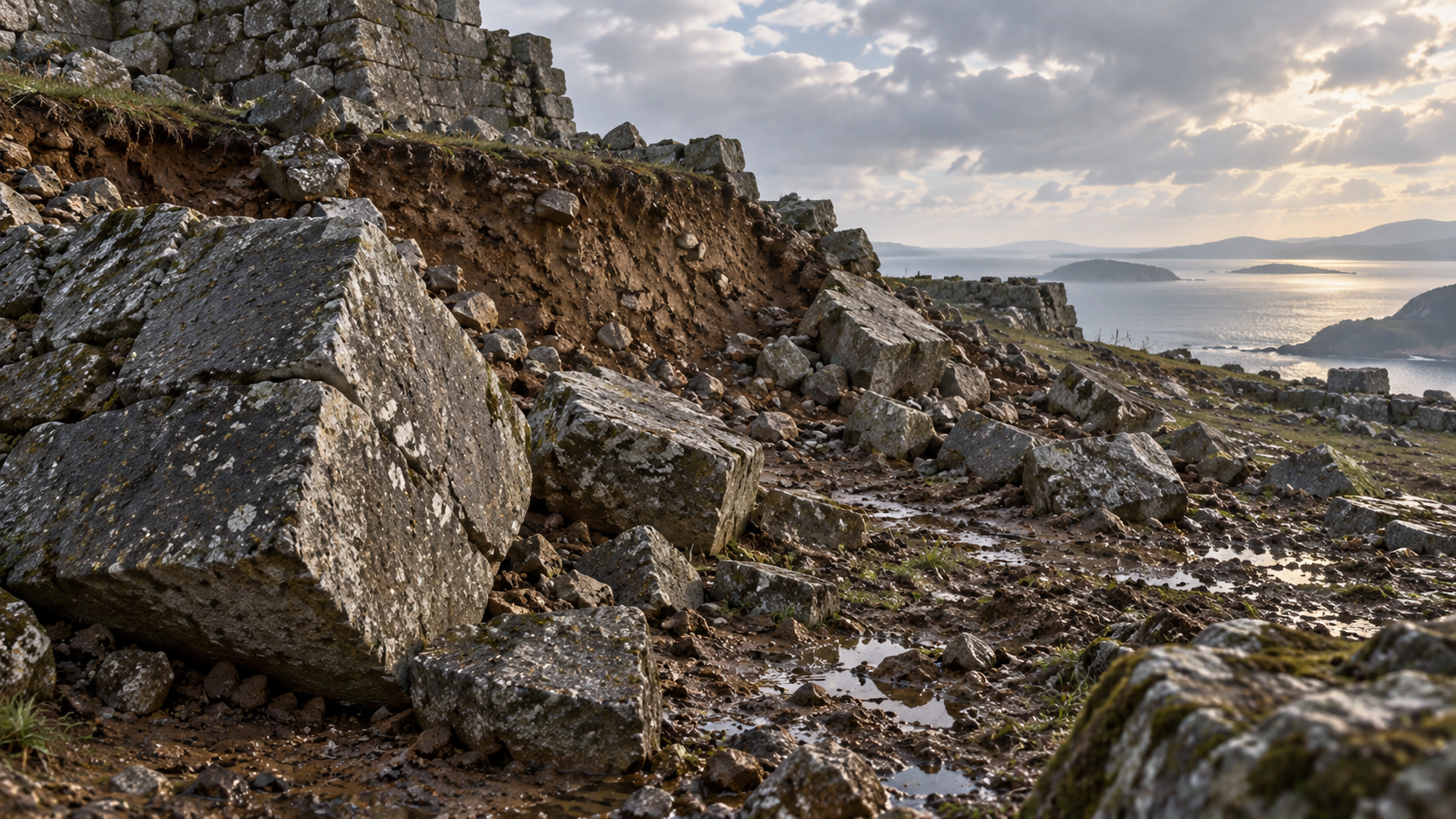
After the fighting, the castle was deliberately dismantled. Excavated gateways and stonework that had been broken and buried provide evidence of that treatment. Destruction prevented the structures from continuing to serve as a stronghold; the present landscape bears the consequences of those actions.
The ruins therefore reflect more than buildings gradually wearing away. The end of the uprising and what the authorities did afterward belong to the history of the site. Reading the stonework alongside documents helps keep that aftermath visible when looking back toward the young figure associated with Hara.
Scene 10
Shiro in a claim of military merit
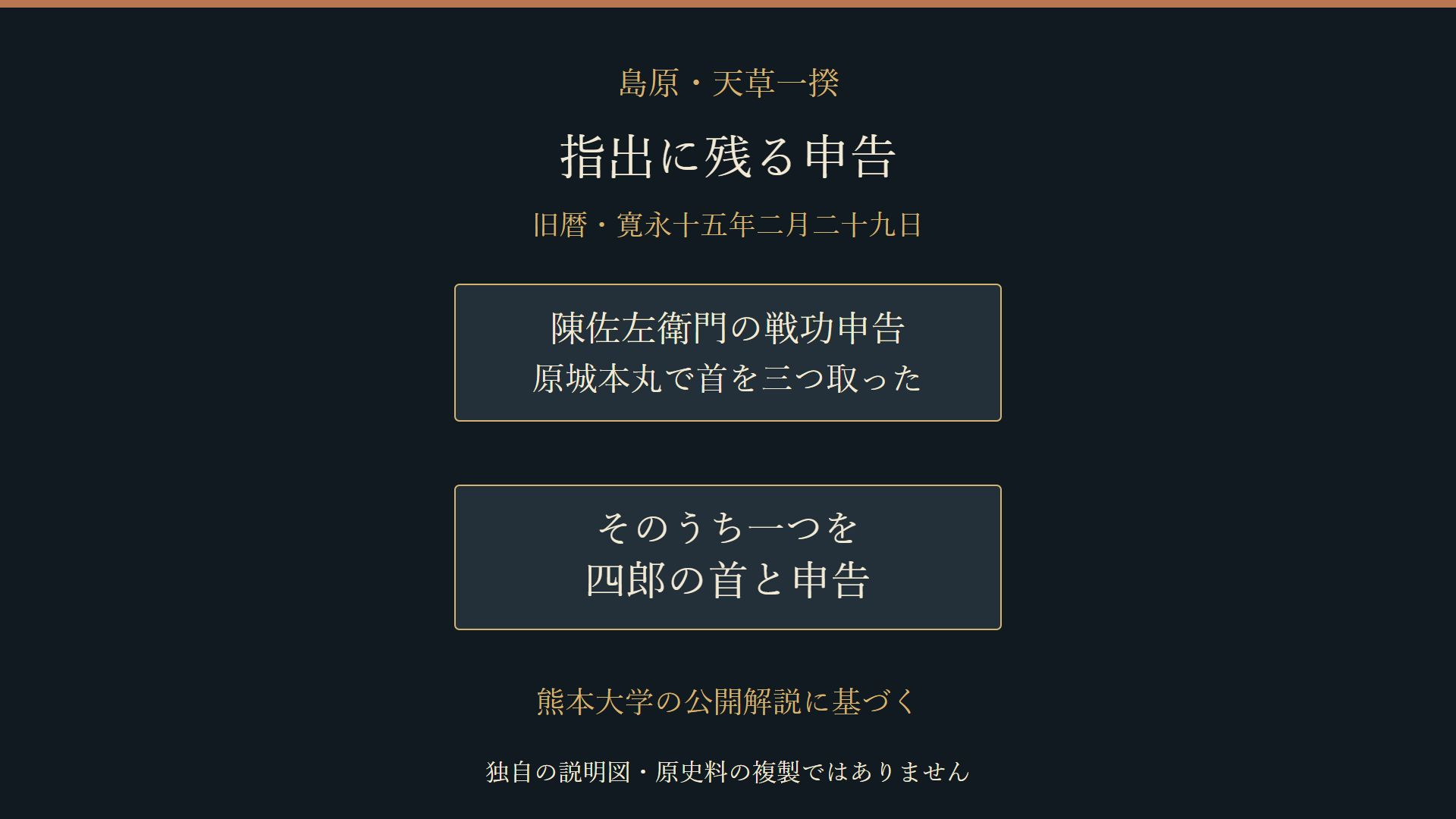
One particular document brings Shiro into a report made after the fighting. Kumamoto University's digital archive identifies it as a claim of military merit submitted by a Hosokawa retainer, referred to here by the surname Chin. It belongs to the Matsui family documents, item 3442.
The university's explanation says that Chin reported entering Hara's main enclosure and taking three heads, one of which he claimed was Shiro's. The article adopts this information as the university's account of the document. It is not an independent authentication of the physical manuscript or a new transcription of its whole text.
The catalogue gives the date as Kanei 15, second month, day 29. Kanei 15 corresponds to 1638, but the month and day belong to the Japanese calendar then in use. Writing February 29, 1638 would silently introduce a Gregorian conversion that this article has not made.
This record helps connect Shiro with the castle's final fighting through a named retainer's claim. Its contents do not supply Shiro's last words, facial expression or final conversation. Preserving the form and purpose of the report allows it to remain significant without turning it into a narrated death scene.
Scene 11
The people recovered from the ground
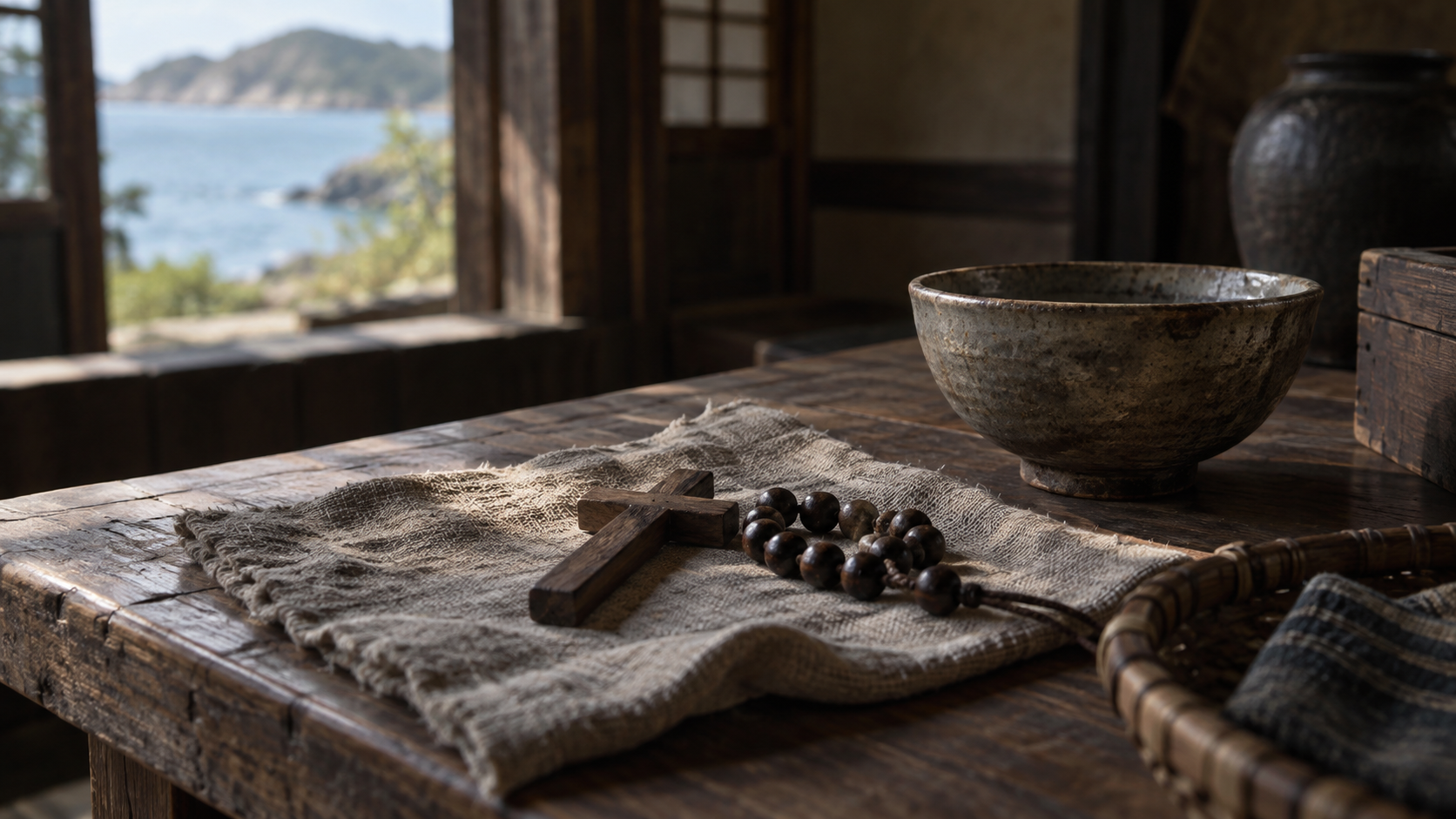
Excavations at Hara have brought back traces of the people within the castle. Institutional explanations describe ammunition, human remains and Christian objects such as crosses, religious medals and rosary beads. Fighting and faith have left evidence in the same place.
These finds broaden the account beyond one celebrated name. They can indicate the presence of people who lived, believed and fought at Hara without giving each of them an individual biography. The materials allow those unnamed people to remain part of the history.
An object's location and type matter when relating it to written records. A cross associated with the site is not automatically an object once owned by Shiro. Nor should every find be made to illustrate an episode in his life. The conceptual cross and beads shown here are imagined objects, not photographs of excavated specimens.
The people around Shiro had their own lives. Keeping them in the account helps explain how a symbolic figure belonged to a community under particular conditions. Archaeological evidence and documents can be read together to consider that community, without forcing every trace into a story centered on the boy alone.
Scene 12
Between a symbol and a historical person
Across these materials, Shiro appears as the young figure around whom people rallied, with Christian faith part of the group's identity. The adopted descriptions also place experienced former retainers among those involved. Shiro's death belongs to the fall of Hara in 1638.
His exact decisions, fears and final speech cannot be recovered from the selected explanations. Leaving those matters open preserves the weight of the evidence that does survive. A banner, a letter, a map and a wall each offer something more specific than an imagined interior life.
Read together, they return Shiro to the history of a group. The pressures preceding the uprising, fighting in several places, occupation of the abandoned castle and reports made by its opponents all belong to that setting. His symbolic role remains prominent within it.
The outline is therefore built by preserving different perspectives: an association recorded for the banner, a view organized in a picture map, a claim made in a military document and objects recovered by excavation. Their differences help us understand how a historical person became visible and which parts of his life remain beyond these records.
Editorial note: Historical months and days retain the Japanese calendar. Shiro's age follows the attributed institutional description rather than an unchecked modern conversion. No exact troop, casualty or survivor total is fixed. The account of the military-merit claim follows Kumamoto University's public description; catalogues and explanatory pages are not presented as full independent readings of original manuscripts. Images are conceptual scenes and original diagrams, not authenticated portraits or exact reconstructions.
How to read this work
History, interpretation, and reconstruction
Preserving the perspectives and limits of different materials helps place Shiro within the community at Hara, beyond a story built around one young hero.
This work is grounded in published sources and historical research. Interior thoughts, dialogue, and some visual details are cinematic reconstructions. Where historians disagree, the article presents the point as debated rather than settled fact.
Timeline
The story in time
People & terms
A guide for new readers
Key figures
- Amakusa Shiro
- Young standard-bearer and symbolic leader of the uprising; not established as sole decision-maker for every tactic
- Itakura Shigemasa
- Commander on the shogunate side who died in the fighting
- Matsudaira Nobutsuna
- Commander who led the suppression after Itakura's death
- Chin, a Hosokawa retainer
- Retainer who submitted a claim of military merit at Hara, described by Kumamoto University
Glossary
- Kanei 寛永
- Japanese era name. Kanei 14 and 15 correspond here to 1637 and 1638; months and days retain the historical calendar.
- Shimabara-Amakusa uprising 島原・天草一揆
- Name foregrounding both regions of the conflict often known in English as the Shimabara Rebellion.
- Shogunate 幕府
- The military government that organized the suppression through forces from several domains.
- Retainer 家臣
- A person serving a warrior house, such as the former Arima retainers or the Hosokawa retainer appearing in this account.
- Nengu 年貢
- The taxation discussed in the adopted institutional explanations of the uprising's background.
- Sashimono 指物
- A banner form; the object associated with Shiro is formally described as a Eucharistic sashimono banner.
- Eucharist 聖体
- Christian sacrament represented by the banner's chalice and host, with praying angels.
- Main enclosure 本丸
- The central castle enclosure, called honmaru, mentioned in the claim of military merit and excavation descriptions.
- Sashidashi 指出
- A submitted report; here a retainer's claim of military merit preserved in the Matsui family documents.
- Picture map 絵図
- A drawn representation of places and positions. Its creation, transmission, scale and purpose require attention separately from the depicted event.
Sources & method
How this article was built
This English edition follows the fixed published Japanese manuscript, preserving twelve scene identities, four people, five timeline entries and thirteen source identities in their original order. It adds reader context and explanations of terms without inventing new events, private thoughts or conversation.
The completed Japanese article review records reading of the adopted institutional explanations and inspection of the images. The English review inherits that work after matching source and image hashes. Targeted English-stage readings include the castle explanations, the Tokyo National Museum catalogue, Amakusa City's banner account and Kumamoto University's IIIF metadata, together with the fixed actual browser readbacks of the curator's article and exhibition announcement.
Catalogue descriptions, public explanations and exhibition notices retain their scope. They are not represented as full independent readings of all original manuscripts, artifact surfaces, exhibition objects or military chronicles. The reported identification in a military-merit claim remains attributed, and a later picture-map copy remains distinct from a contemporary battlefield record.
Historical calendar dates and attributed age descriptions are preserved. Precise totals, every tactical decision and Shiro's final words remain unresolved. Relating the different materials to a community history is the article's interpretation.
Editorial note on illustrations: ten AI-generated conceptual images, including the hero, and three original explanatory diagrams are SHIGEKI productions. They are not authenticated portraits, primary-source reproductions, images of the surviving banner, photographs of excavation finds or measured plans of Hara. Japanese diagram labels are explained in English captions. Article-specific rights clearance is inherited after matching all thirteen current images to the Japanese review. The connected film has Japanese audio; an English subtitle track has not been verified.
Sources
References and further reading
- The Shimabara-Amakusa Uprising 南島原市教育委員会・島原天草一揆 Title translated editorially for reader convenience. Minamishimabara City Board of Education 南島原市教育委員会 Background, attacks in several places, siege and fall of Hara. No single settled troop or survivor total is adopted. Accessed 2026-10-09
- Hara Castle Ruins: Nationally Designated Cultural Property 南島原市教育委員会・国指定文化財 原城跡 Title translated editorially for reader convenience. Minamishimabara City Board of Education 南島原市教育委員会 Location, enclosures, stonework and excavated objects. Present remains do not constitute a complete view of the castle during the uprising. Accessed 2026-10-09
- Reading the Shimabara-Amakusa Uprising: Fact and Fiction 南島原市×西南学院大学博物館・ウソ?ホント?島原天草一揆を読む Title translated editorially for reader convenience. Minamishimabara City and Seinan Gakuin University Museum 南島原市×西南学院大学博物館 Exhibition announcement distinguishing letters, memoranda and later military tales. It is not a full reading of every displayed object or chronicle. Accessed 2026-10-09
- The Shimabara-Amakusa Uprising and Shimabara Castle 島原市学芸員・島原天草一揆と島原城 Title translated editorially for reader convenience. Shimabara City 島原市学芸員 Curatorial explanation of naming and refuge in Shimabara Castle, drawing on a memorandum. Local choices are not reduced to one division between social groups. Accessed 2026-10-09
- The Shimabara Rebellion and the Remains of Hara Castle 長崎市ナガジン・島原の乱と原城跡遺構 Title translated editorially for reader convenience. Nagasaki City, Nagazine 長崎市ナガジン Taxation, prohibition of Christianity, failed crops, famine and the development toward the Hara siege. Exact totals and a sole-survivor claim are not adopted. Accessed 2026-10-09
- History of Minamishimabara 南島原市・市の歴史 Title translated editorially for reader convenience. Minamishimabara City 南島原市 Regional history connecting Christian faith, taxation, famine and uprising. Historical month and day are retained. Accessed 2026-10-09
- The Road to Hara Castle, Part Five 長崎県・原城への道程 その5 Title translated editorially for reader convenience. Nagasaki Prefecture 長崎県 Shiro is described as a sixteen-year-old standard-bearer. The age remains attributed; no precise modern conversion or imagined conversation is supplied. Accessed 2026-10-09
- Picture Map of the Amakusa Campaign 東京国立博物館・天草陣図(文化遺産オンライン) Title translated editorially for reader convenience. Tokyo National Museum, Cultural Heritage Online 東京国立博物館 Catalogued as a nineteenth-century copy. Its explanation mentions former Arima retainers among the leaders. The surviving copy is distinguished from the date of the depicted event. Accessed 2026-10-09
- Hara Castle Ruins 南島原市 世界遺産のまち・原城跡 Title translated editorially for reader convenience. Minamishimabara City, World Heritage 南島原市 世界遺産のまち Excavations, deliberately demolished and buried structures, and Christian objects. Finds are not assigned to Shiro as personal possessions. Accessed 2026-10-09
- Amakusa Shiro's Camp Banner 天草市・天草四郎陣中旗 Title translated editorially for reader convenience. Amakusa City 天草市 Tradition of Shiro's use of the Eucharistic banner, its motifs, and two views of its origin. The surviving artifact is not reproduced here. Accessed 2026-10-09
- Documents in the Collection of Yamazaki Shinichi 上天草市・山﨑信一氏所蔵文書 Title translated editorially for reader convenience. Kamiamakusa City 上天草市 Hosokawa-related letters concerning the fighting and reports of results. Used through the city's descriptions, not as a full independent transcription. Accessed 2026-10-09
- Picture Map of the Assault on Hara Castle in Amakusa 都城市・天草原城攻図 Title translated editorially for reader convenience. Miyakonojo City 都城市 Institutional explanation of a picture map showing the castle and besieging positions. It does not determine exact orders given by Shiro. Accessed 2026-10-09
- Claim of Military Merit by a Hosokawa Retainer: Matsui Family Documents 3442 熊本大学・陳佐左衛門指出 松井家文書3442 Title translated editorially for reader convenience. Kumamoto University Library 熊本大学 IIIF catalogue and explanatory metadata for the document by Chin. Its date retains the historical calendar and its reported identification of Shiro retains the character of a military-merit claim. Accessed 2026-10-09
Continue reading
More stories from Shigeki
Shigeki English
Sakai’s Merchant City: Trade, Self-Government and Survival
A port, a merchant council and town communities—from changing authority to rebuilding after fire.
- When From the later fifteenth century through the Sengoku period, the fire of 1615 and early Edo-period reconstruction.
- Where Sakai, in present-day Osaka Prefecture, where maritime routes met roads on land.
Shigeki English
The Aburanokōji Incident: After Leaving the Shinsengumi
A separation in spring, a new base in summer, and two successive attacks.
- When Kyoto in Keiō 3 (1867). The incident’s historical date corresponds to December 13, 1867.
- Where Kyoto: the guards’ successive bases, the Aburanokōji attack site and the later place of remembrance.