
SHIGEKI ENGLISH STORYEN
Japanese history in English
Hashiba Hideyoshi in 1582: From News of Honnoji to Political Initiative
Peace at Takamatsu, victory at Yamazaki and discussion at Kiyosu: the work that continued beyond the march.
After news of Nobunaga's death, Hideyoshi settled with the Mori side, turned east and defeated Mitsuhide. Oda succession and territorial rule remained to be addressed. Follow the Kiyosu discussion, a land grant and a copied account of his achievements through this year of growing influence.
At a glance
Before you enter the story
- When
- Tensho 10 (1582), from the Takamatsu siege through Yamazaki and Kiyosu to letters of the eighth and tenth months; historical calendar dates
- Where
- Bitchu Takamatsu in present-day Okayama, the Kyoto-area Yamazaki battlefield and the Kiyosu discussion
- Key figures
- Hashiba Hideyoshi, Oda Nobunaga, Akechi Mitsuhide, Shimizu Muneharu, Sanboshi, Arima Noriyori
- What was at stake
- How could a commander turn a crisis following his lord's death into a stronger military and political position?
Why this story matters
The larger history behind the turning point
The eastward return depended on conditions established at an existing front and cooperation near the next battlefield. Those connections give the movement a military and political setting.
Victory, succession discussions, land grants and explanations of achievement show different ways a position was strengthened. Reading them in sequence keeps 1582 within its own circumstances.
Historical context
What an international reader needs to know
Places and allegiances
Bitchu is a historical provincial name attached here to Takamatsu Castle, whose site is in present-day Okayama City. Chugoku denotes the western Honshu region into which Hideyoshi advanced under Nobunaga's orders. Kyoto is the setting of Honnoji; Yamazaki lies in the Kyoto-area setting explained by Nagaokakyo City.
Hideyoshi served the Oda house; the Takamatsu defenders were on the Mori side. Kinai identifies the region around the capital where cooperation with other commanders mattered. These places and allegiances explain why receiving news, ending a siege and confronting Mitsuhide were connected but distinct tasks.
The calendar and the documents
Tensho 10 corresponds to the year 1582. The second, thirteenth and twenty-seventh days of the sixth month retain the historical Japanese calendar. They should not be silently rendered as June dates in the Gregorian calendar. The eighth- and tenth-month letters follow the same convention.
A museum catalogue can identify a document and explain its significance while leaving a full independent reading of the manuscript outside this article's scope. The land-grant letter H-91 is catalogued as an original; Tani 462 is catalogued as a copy. A scholarly public abstract and a researcher's argument also retain their stated authorship and scope. Japanese personal names generally place the family name first.
Watch the film
See the story in motion
The film currently uses Japanese audio. This English article provides the context and source trail; it does not imply that an English subtitle track is available.
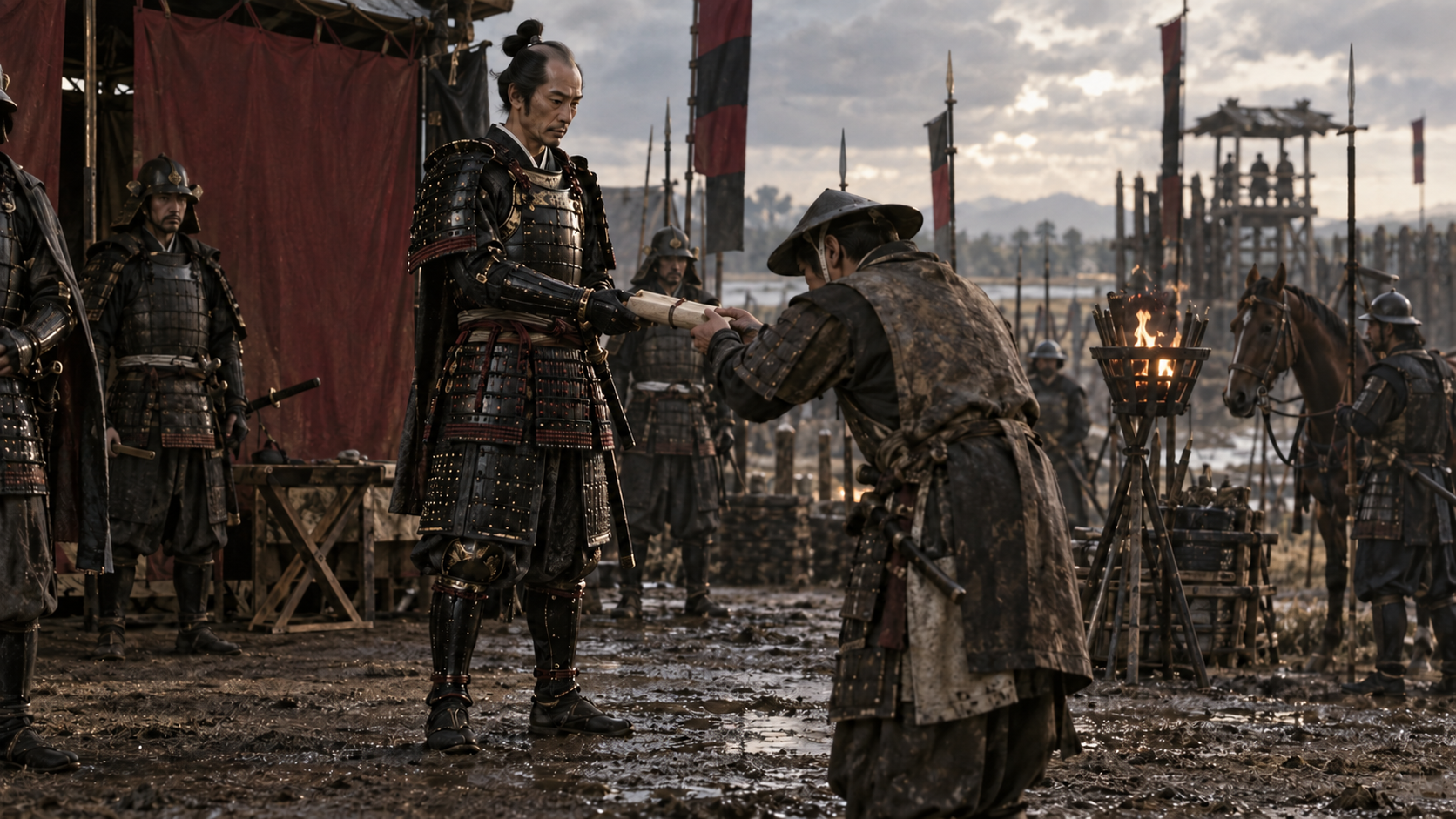
Scene 01
From news to political initiative
In 1582, the tenth year of the Tensho era, Hashiba Hideyoshi was besieging Bitchu Takamatsu Castle when news reached him that his lord, Oda Nobunaga, had died in Kyoto. The report connected a crisis at the center of the Oda house with an army committed to a distant front.
Hideyoshi subsequently reached a settlement with the Mori side, turned east and defeated Akechi Mitsuhide at Yamazaki. The victory was a major turning point. Yet succession within the Oda house and the work of consolidating territorial control continued after the fighting. His later position as ruler was still ahead.
Following this year requires attention to several kinds of action: arranging the conditions for leaving a battlefield, cooperating with other commanders, taking part in succession discussions and exercising authority through written documents. Each helped turn a military achievement into a stronger political position.
Knowing the eventual outcome can make the sequence seem inevitable. At the beginning of this account, however, Hideyoshi was a commander serving Nobunaga. We follow the tasks he faced in order, rather than work backward from his later success. Historical month and day throughout the article retain the Japanese calendar then in use.
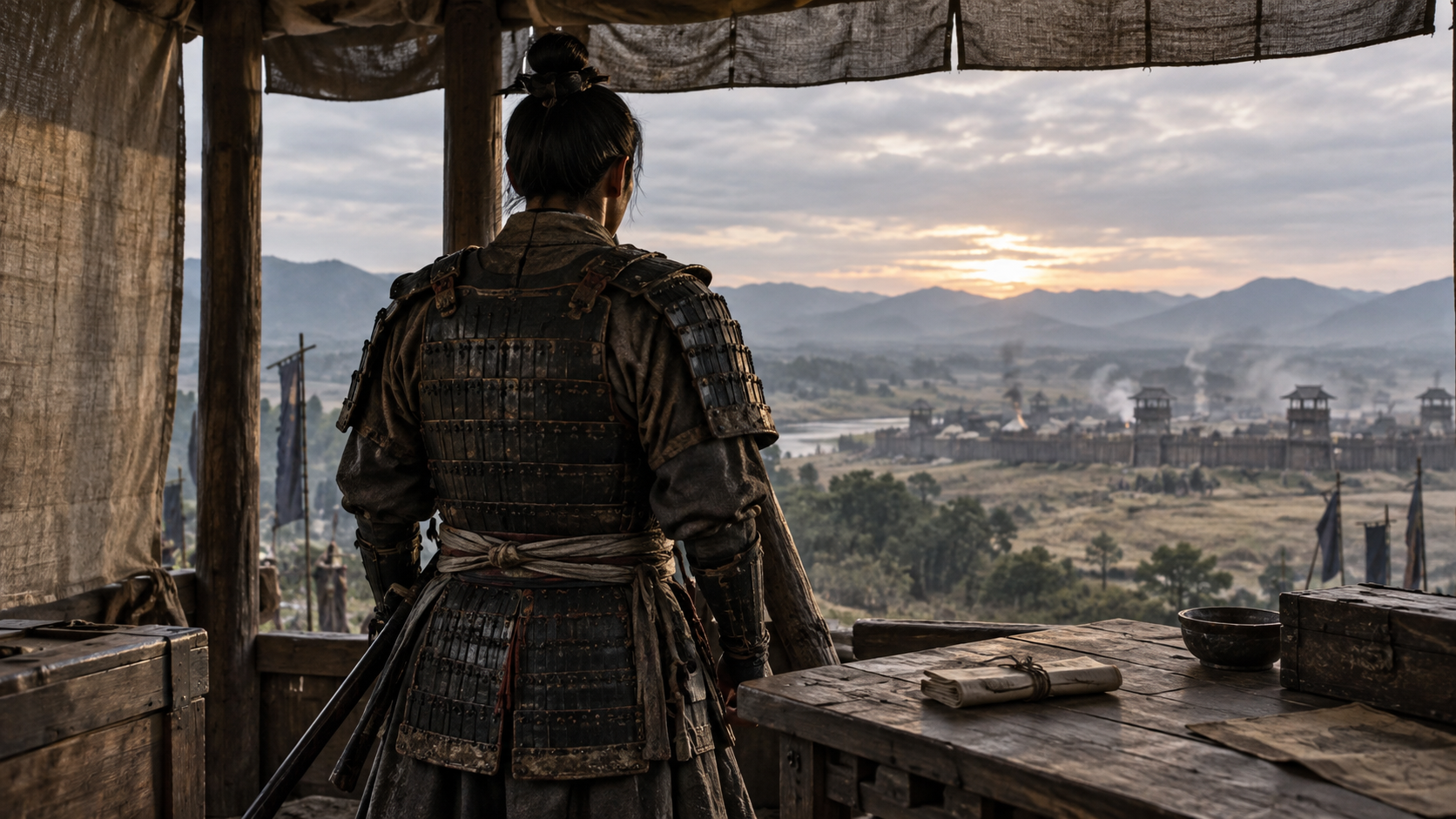
Scene 02
Takamatsu: a front with its own constraints
Hideyoshi was around Bitchu Takamatsu Castle, in present-day Okayama City. Acting under Nobunaga's orders, he had advanced into the Chugoku region of western Honshu. Shimizu Muneharu defended the castle on the Mori side. The confrontation at Takamatsu remained a military problem whatever happened in Kyoto.
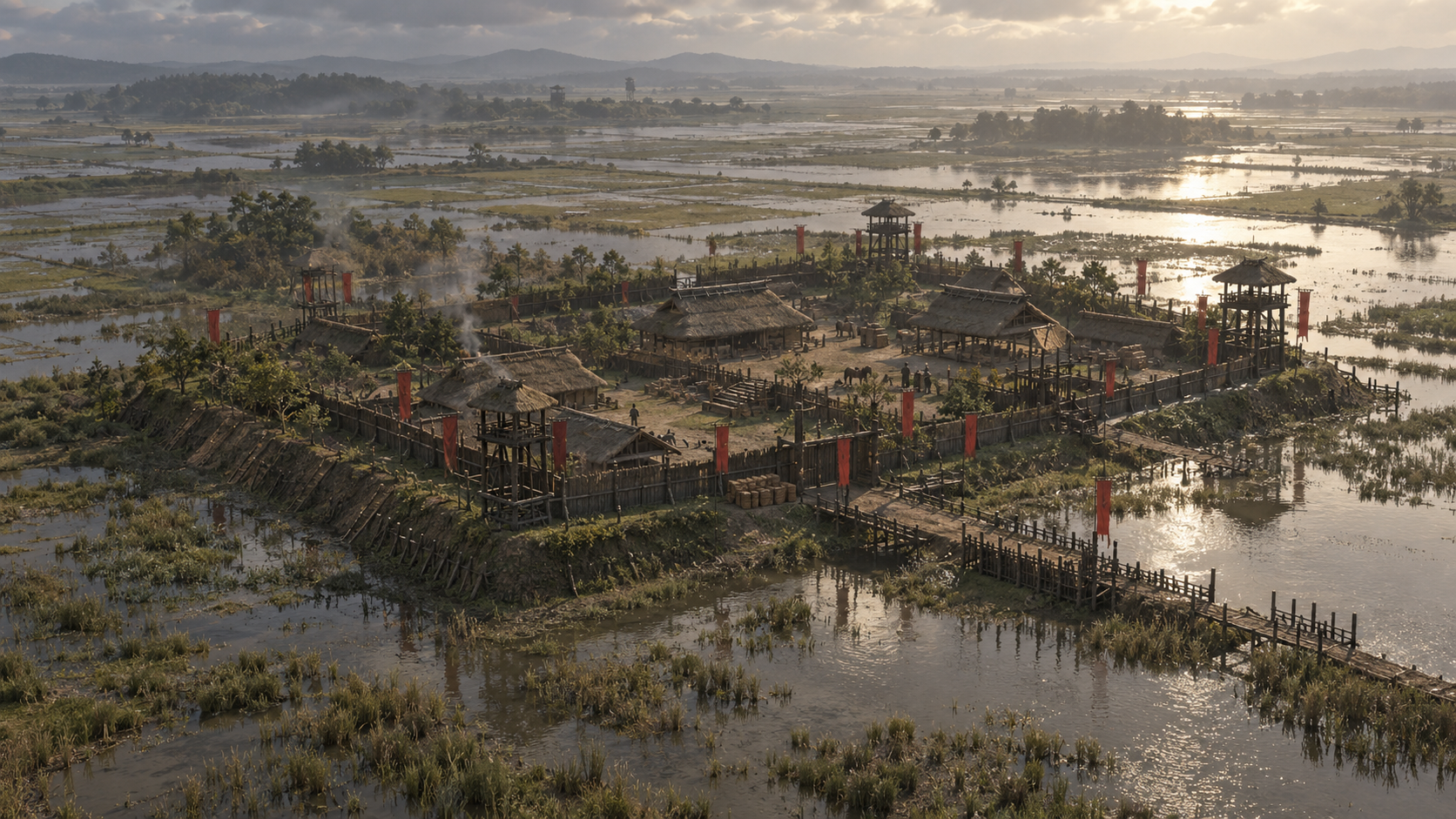
The castle stood on slightly raised ground within a plain, surrounded by low, wet terrain. That setting helped impede an attacker's approach. Understanding the site begins with the relationship between the raised ground, its defenses and the surrounding wetlands, as described in the prefectural and municipal explanations.
Surviving earthen platforms and traces of embankments provide a way to think about the siege through the landscape. They offer evidence of a place shaped by defensive and offensive work, while leaving the complete appearance of the castle and its surroundings on a particular day unresolved.
News from Kyoto therefore reached a commander whose movement depended on the situation before him. The castle's defenders, Mori forces and his own side's positions all mattered. Takamatsu should be understood as a front where several positions and forces confronted one another, with conditions that had to be addressed before an eastward move.
Scene 03
How the flood siege worked
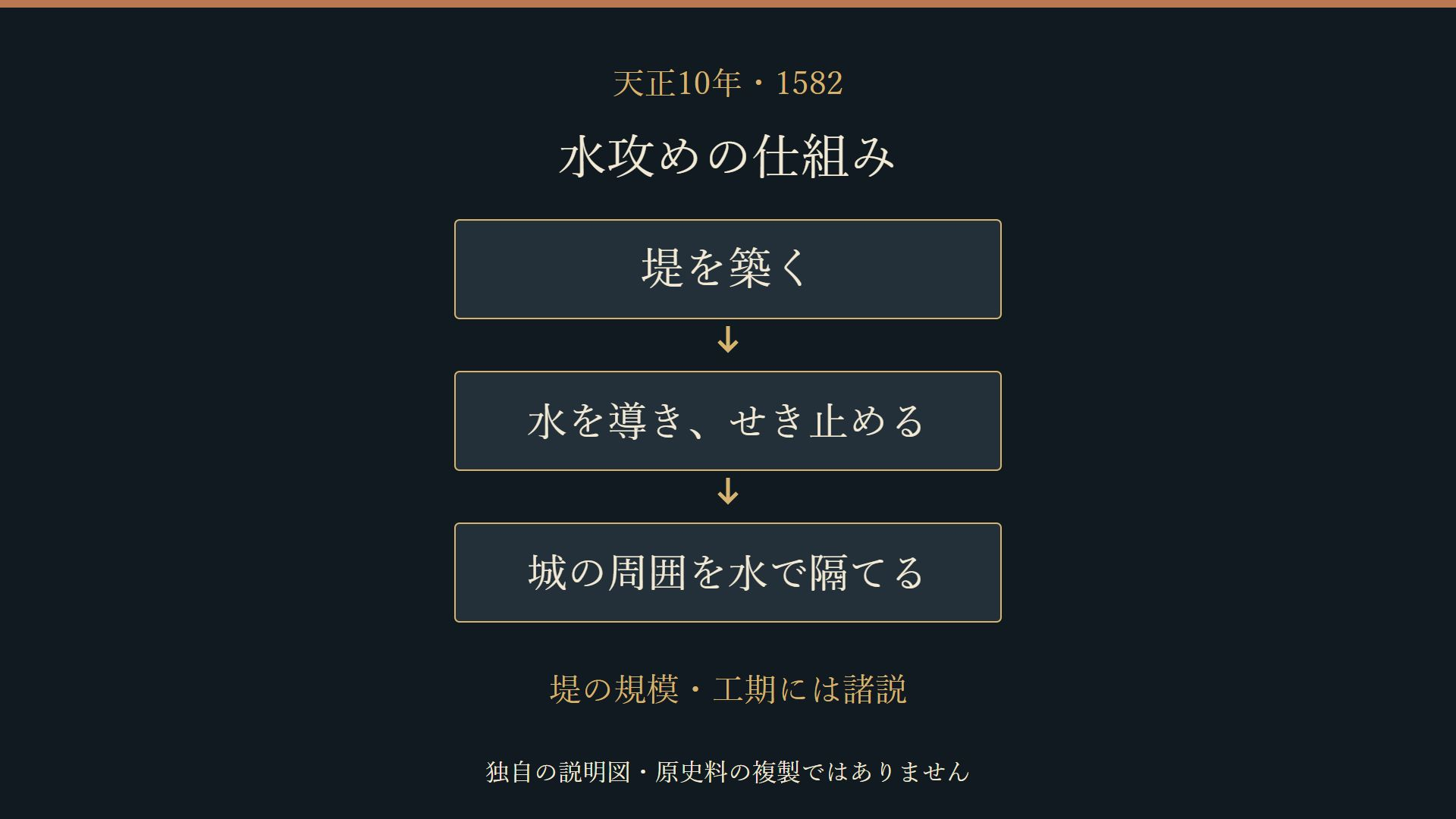
The flood siege is the best-known feature of the attack on Takamatsu. Hideyoshi's side built an embankment and directed water into the surrounding area. Engineering and terrain worked together: holding water around a castle on low ground could make that castle more isolated.
The general mechanism is clearer than every numerical detail of the undertaking. Okayama Prefecture's explanation notes differing views about the embankment's dimensions and construction time described in the later Taikoki. A confident account of the siege should keep that difference in certainty visible.
The original diagram organizes the mechanism into three steps: build an embankment, direct and hold back water, and isolate the castle through the surrounding water. It gives the relationship among those actions. It supplies no measured plan, settled water level or independently verified construction schedule.
Looking at surviving features and the terrain shifts attention toward what the siege made possible. Isolation could help create a situation in which fighting led to negotiation. Hideyoshi's eventual departure began from this front, where engineering, defense and a settlement were connected. The numbers in a later account alone cannot explain that transition.
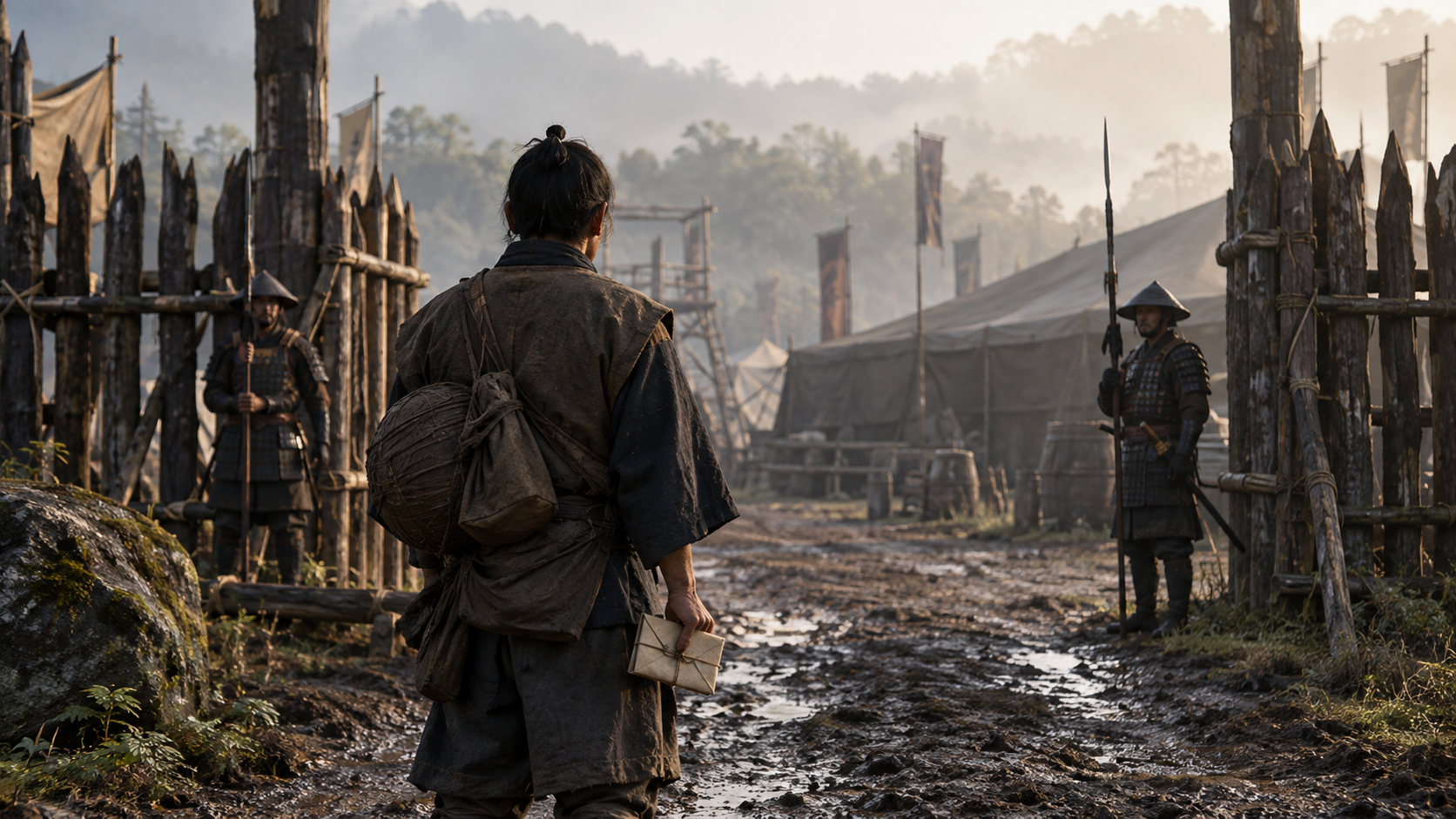
Scene 04
News from Honnoji
On the second day of the sixth month, Nobunaga died in Kyoto in the Honnoji Incident, initiated by Akechi Mitsuhide. These are historical calendar dates. The event at Kyoto and Hideyoshi's receipt of its news at Takamatsu occurred in different places and at different times.
Accounts of when and how Hideyoshi learned of the event need to be compared. This article leaves the receipt date and route unresolved. It follows the adopted Japanese account's distinction between an event, the transmission of information about it and subsequent descriptions of that transmission.
Hattori Hideo examines discrepancies among letters written during the movement and Hideyoshi's later accounts. His study raises questions about dates and the way achievements were presented afterward. Those questions remain attributed to the researcher; this article does not turn one reconstruction into an established answer for every detail.
The sequence we can follow is that Hideyoshi learned of Nobunaga's death, reached a settlement with the Mori side and moved toward a confrontation with Mitsuhide. At Takamatsu, acting on news required dealing with an existing opponent. A report could change the purpose of an army's next action, while leaving the conditions for moving it to be settled.
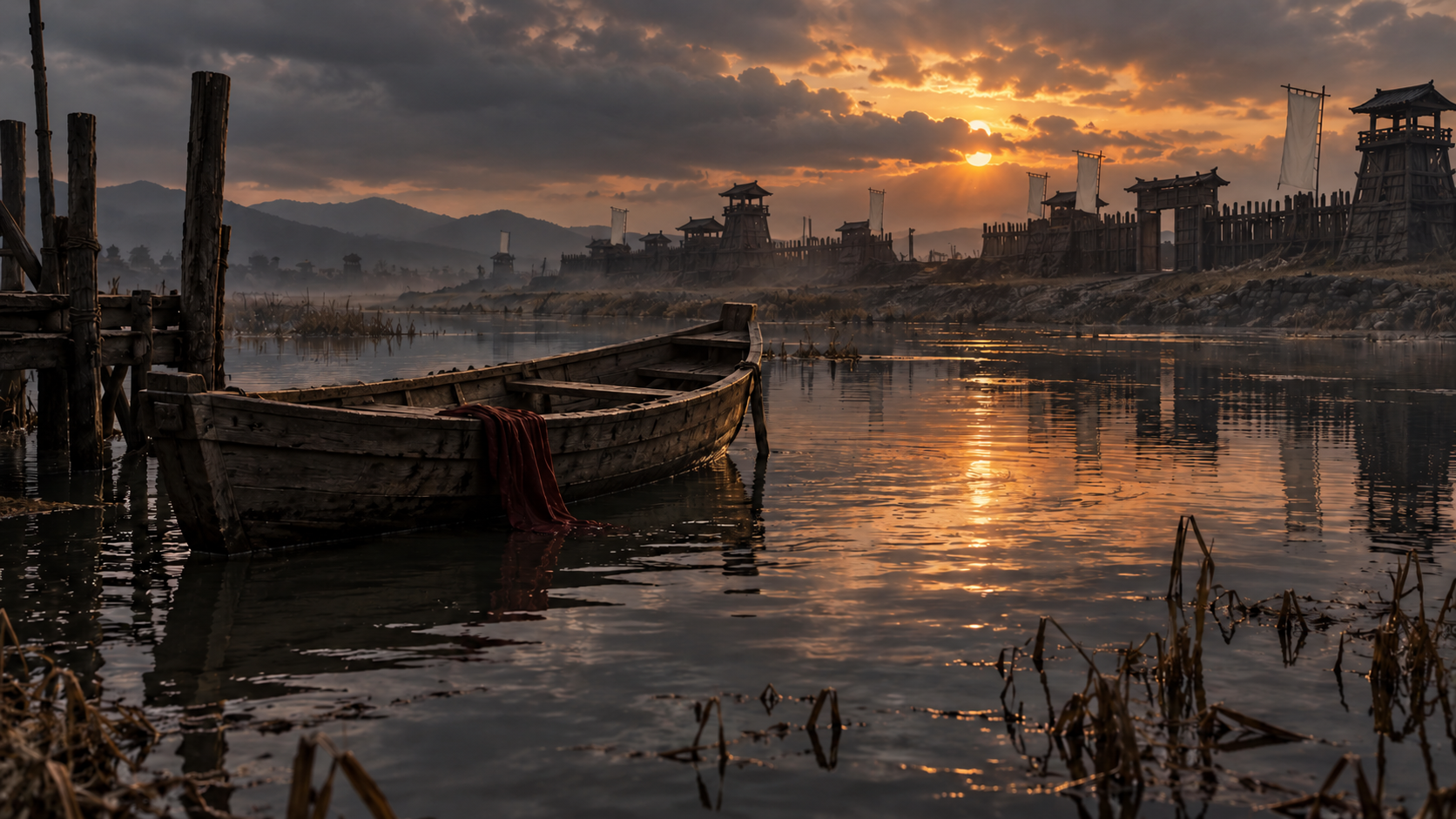
Scene 05
The settlement that made departure possible
Before turning east, Hideyoshi reached peace with the Mori side. Takamatsu's commander, Shimizu Muneharu, took his own life; sparing the castle's garrison was among the conditions of the settlement. The prefectural and library explanations place Muneharu's death and the garrison's survival within the end of the siege.
This episode deserves attention within the account of Hideyoshi's rise. A change of direction depended on bringing the immediate fighting to an end. Treating the settlement as a brief interval before a celebrated march would obscure the relationship between ending one military commitment and undertaking another.
Peace also depended on conditions the defending side accepted and on negotiations over territory. It involved relationships between opponents, with consequences for the people inside the castle. Muneharu's death belongs to that cost of the settlement and should remain visible when reading the opportunity it gave Hideyoshi.
The connection between diplomacy and military movement is the central point here. Following what was decided and which relationships were addressed gives a firmer basis for understanding the eastward turn than supplying words for Hideyoshi's private thoughts. The settlement was one important condition that enabled the action later called the Chugoku Ogaeshi.
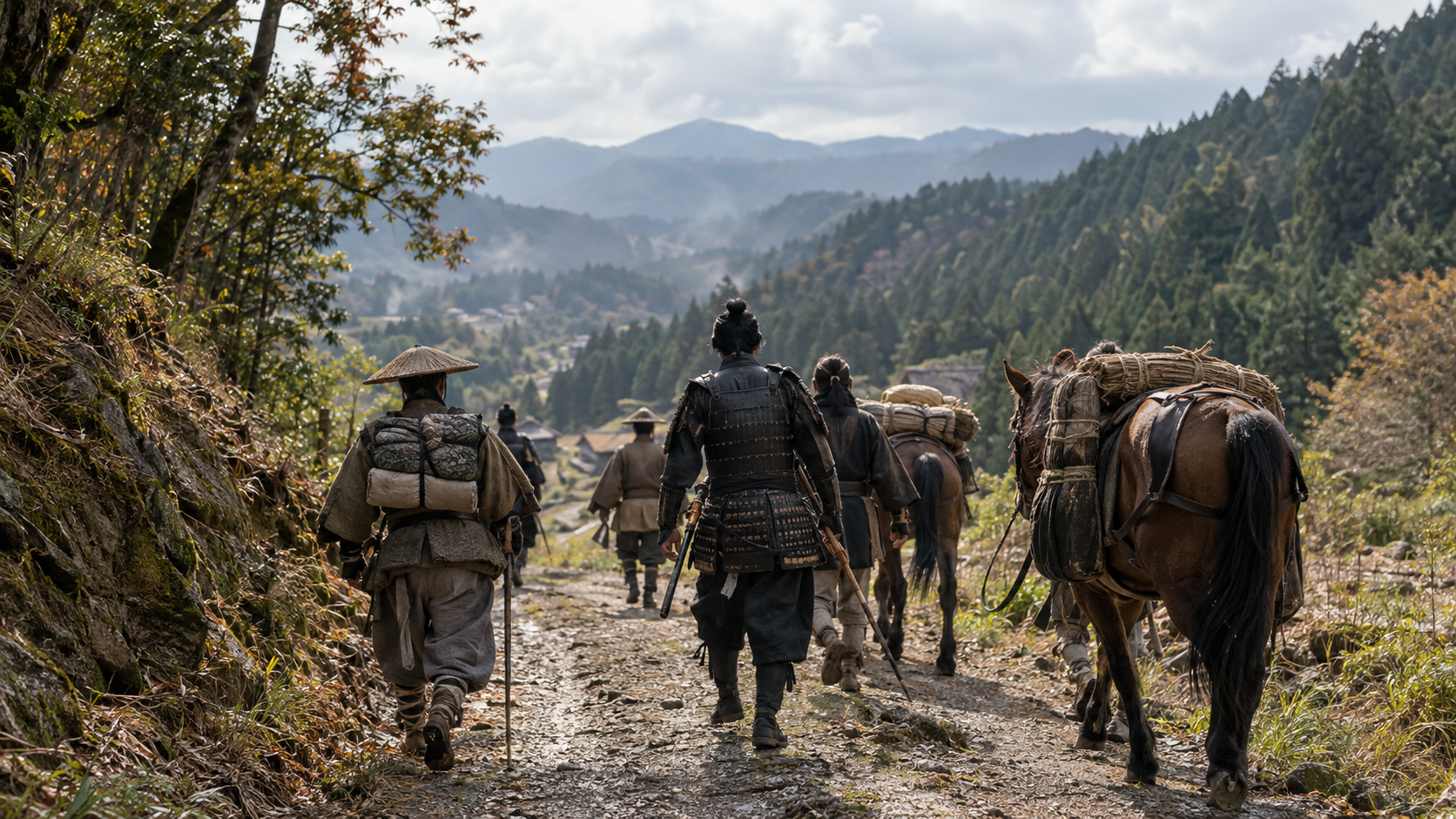
Scene 06
Reading the Chugoku Ogaeshi
After the settlement with the Mori side, Hideyoshi directed his army east. This movement later became known as the Chugoku Ogaeshi, the great return from the Chugoku region. Chugoku here names a region of Japan; the geographical term does not refer to a journey from China.
Takamatsu and Yamazaki locate the movement across a considerable stretch of western Japan toward the Kyoto area. Those places explain its broad direction. They do not require us to imagine every person leaving at one instant, remaining in one continuous column and traveling at an identical speed.
A detailed itinerary needs comparison of individual records. Hattori questions using Hideyoshi's retrospective presentation as a literal account of the march. His analysis is useful for distinguishing evidence produced during action from an explanation offered afterward, while its particular reconstruction remains a scholarly argument.
This account retains the broad order: settlement, eastward movement and the battle of Yamazaki. It leaves exact departure times, arrival stages and marching speeds open. That approach lets us examine the connection between military movement and political opportunity while preserving the difference between the march's familiar reputation and the matters established by the selected evidence.
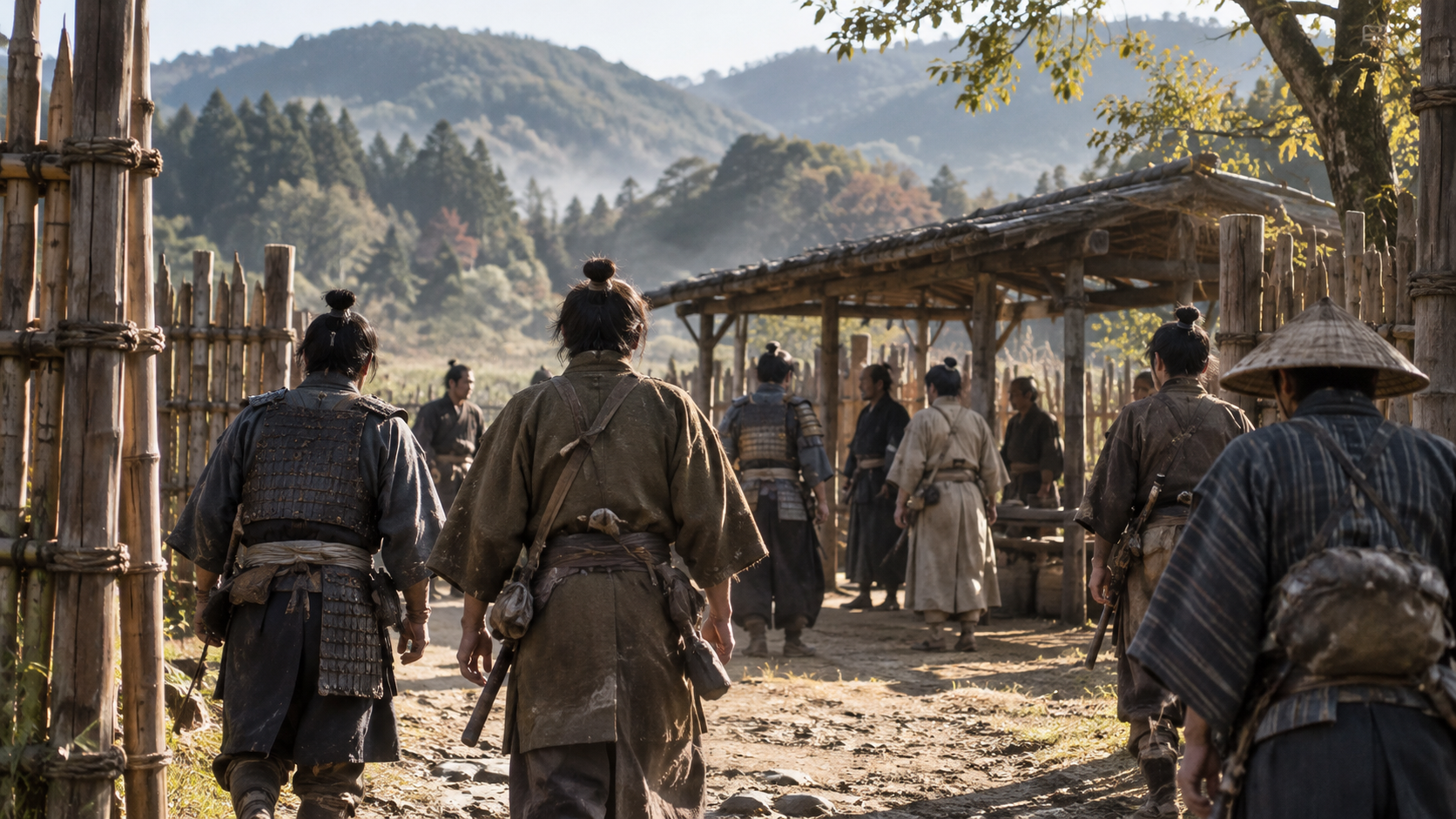
Scene 07
An army connected with other commanders
Hideyoshi's return brought him toward the forces opposing Mitsuhide. Cooperation with commanders in the Kinai region, the area around the capital, was part of the approach to Yamazaki. Reaching the region meant entering a network of military relationships as well as arriving near a battlefield.
An account centered entirely on one returning hero would leave those relationships out of view. Hideyoshi's side fought in connection with other commanders. The movement from Takamatsu acquired military significance through the people who could fight alongside him once the army reached its new setting.
Recognizing cooperation does not settle every unit's path, arrival time or strength. Establishing such details requires evidence for each claim. The exhibition material helps explain the regional sequence; its retrospective depiction of deployments is kept within the limits of an interpretation of the battle.
We therefore follow cooperation without compiling an unsupported roster or troop total. The important connection is between movement and a force able to confront Mitsuhide together. For the return to become a political turning point, arrival had to be followed by fighting in company with others. That relationship adds another condition to the story of speed.
Scene 08
Victory at Yamazaki
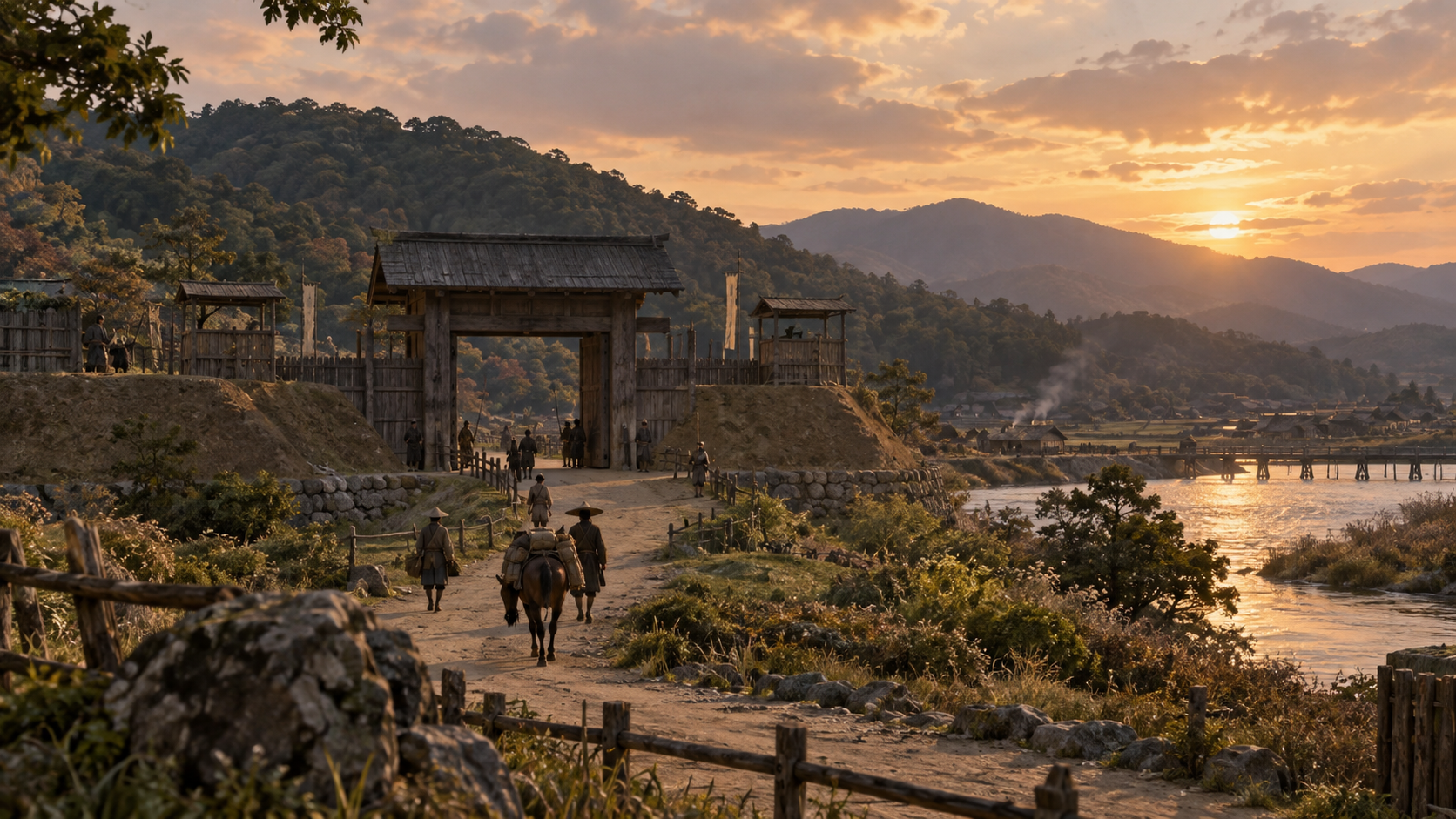
On the thirteenth day of the sixth month, Hideyoshi's side defeated Mitsuhide's at Yamazaki. The region between Mount Tennozan and the Yodo River helps locate the fighting. The historical month and day are retained here without an unchecked conversion to a modern calendar date.
Nearby Shoryuji Castle is identified in Nagaokakyo City's historical timeline as the place to which Mitsuhide retreated after his defeat. Mountain, river and castle give the event a geographical setting. They also allow the area of fighting and the subsequent destination of retreat to remain distinct.
Terrain contributes to understanding the battle, but cannot by itself explain the whole outcome. The accompanying illustration is an imagined gate and earthworks near hills and water. It offers a setting for considering geography, without depicting a verified position of a particular unit or the exact appearance of Shoryuji Castle in 1582.
Defeating Mitsuhide was a substantial military achievement for Hideyoshi. Succession within the wider Oda house still required attention. Who would succeed Nobunaga, and how would retainers support the arrangements that followed his death? The victory placed Hideyoshi in a stronger position while leaving those political questions to be addressed.
Scene 09
The questions taken to Kiyosu
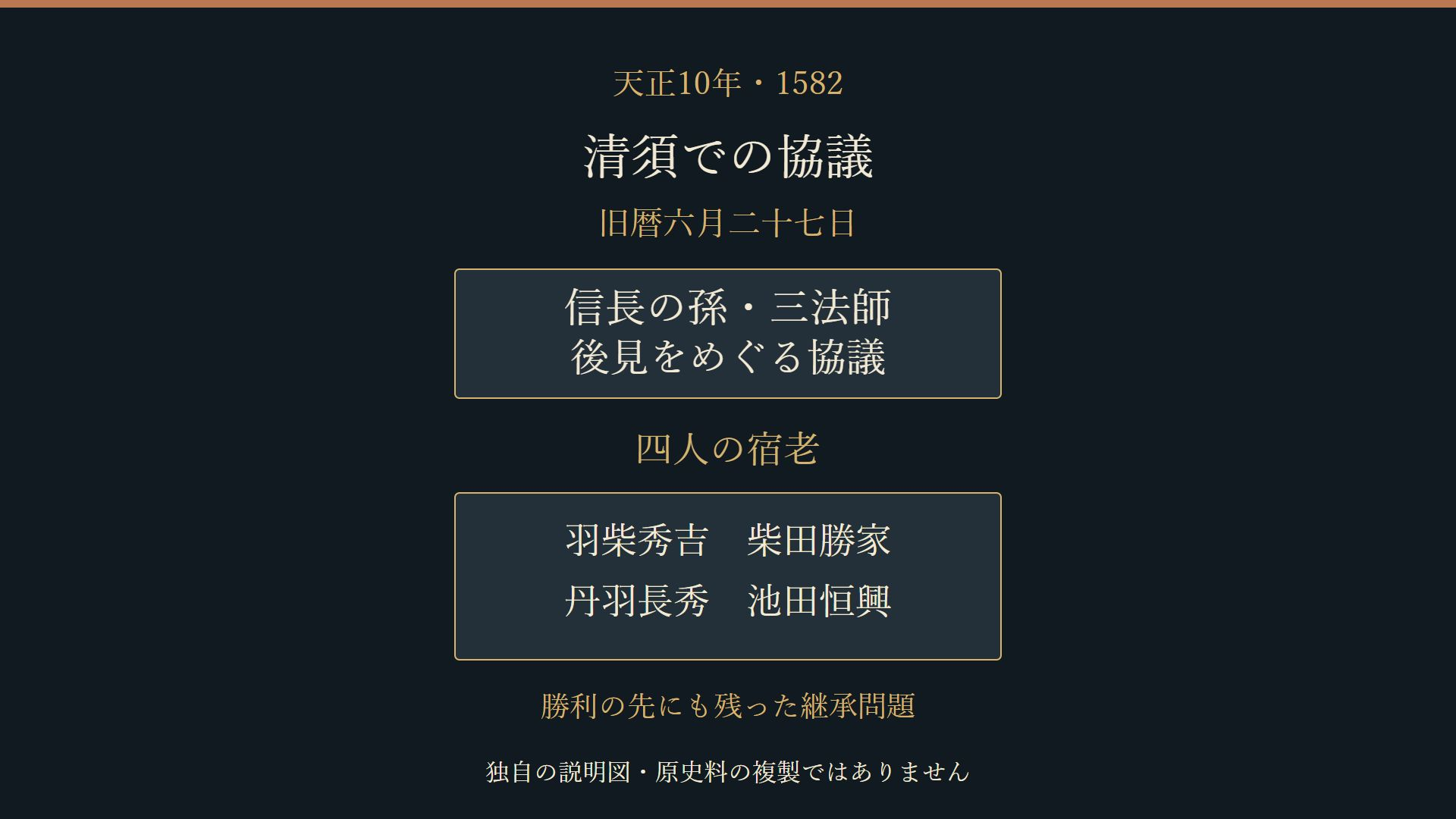
After Yamazaki, four senior Oda retainers met at Kiyosu on the twenty-seventh day of the sixth month: Hideyoshi, Shibata Katsuie, Niwa Nagahide and Ikeda Tsuneoki. The discussion concerned the Oda succession. Sanboshi, Nobunaga's grandson, figures in the question of guardianship.
Nakamura's publicly available abstract identifies choosing Sanboshi's guardians as the immediate purpose of the discussion. This account attributes that reading to the author and limits its use to the adopted explanation. The article does not rely on an independently read full text of the paper.
The diagram centers Sanboshi and the guardianship discussion, then names the four senior retainers. It organizes the people and issue described in the abstract. Evidence for the existence and purpose of discussion is kept separate from a dramatized meeting with dialogue, gestures or a room arrangement.
Hideyoshi remained one of the Oda house's retainers, even as the victor at Yamazaki. A major contribution in battle did not automatically transfer all authority to him. Kiyosu brings into view the need for agreement and the reorganization of political support after the victory. These were part of converting military standing into a durable position.
Scene 10
Authority expressed in a land grant
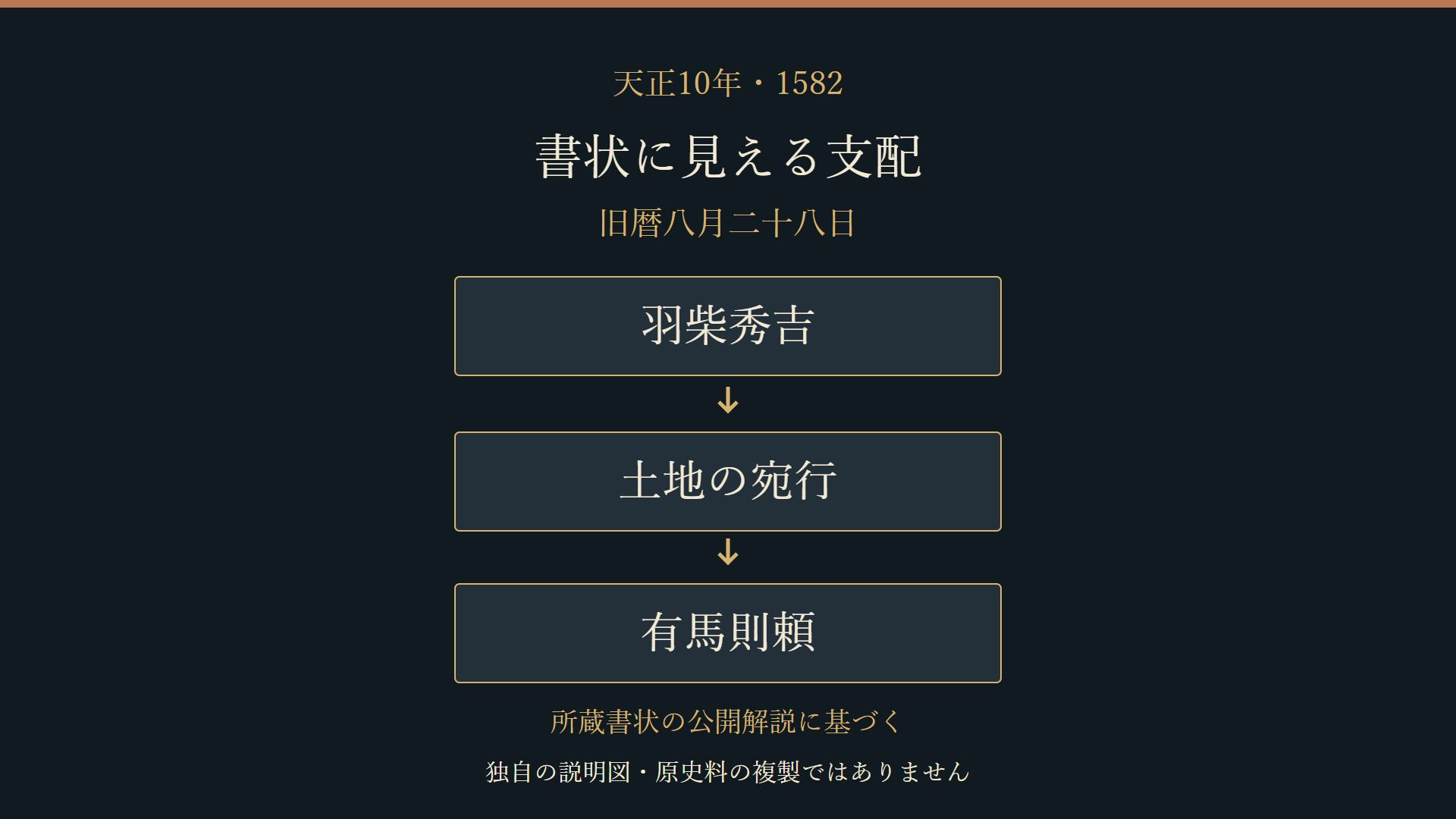
A letter held by the National Museum of Japanese History provides another view of Hideyoshi's activity that year. Dated the twenty-eighth day of the eighth month of Tensho 10, it grants land to Arima Noriyori. The museum identifies the collection item H-91 as an original document.
The museum describes the grant as part of consolidating control by assigning fiefs to subordinate commanders. The document thus connects a named recipient with an exercise of authority over land. Here it is used through the institution's catalogue and explanatory description.
That action extended beyond fighting. A written grant recorded a relationship concerning land and helped give it continuity. The article's interpretation connects such acts with the work of consolidating a political position after a military victory.
The diagram reduces the adopted information to date, grant and recipient: Hideyoshi, a grant of land, and Arima Noriyori. It is an original explanation, not an image or transcription of the letter. Reading a document from the same year offers a concrete action through which to consider Hideyoshi's rise.
Scene 11
Presenting his own achievements
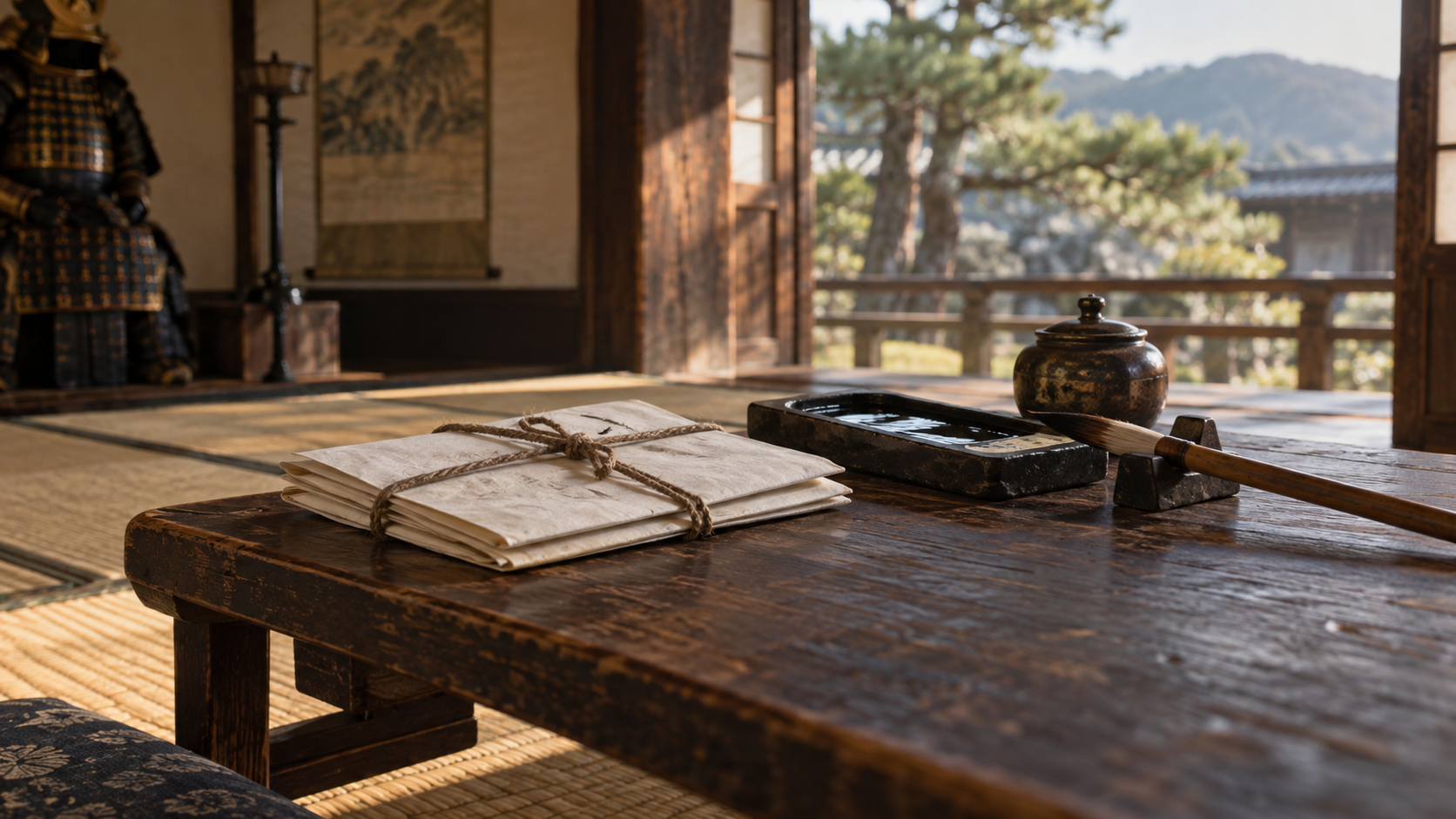
Other correspondence concerns Hideyoshi's presentation of his achievements. The Imperial Household Agency catalogues a copy of a letter dated the eighteenth day of the tenth month of Tensho 10, addressed to retainers of Oda Nobutaka. Its explanation describes an account of events after Honnoji that presses Hideyoshi's contribution.
This is a copy held and described by the institution. Its status matters when distinguishing the surviving material from an autograph original. The English article follows the catalogue and explanatory description, without reproducing the source photograph or a full transcription.
A participant's account deserves attention both for what it reports and for what it asks its recipients to recognize. Addressing others about one's contribution is itself an action in a political relationship. The article connects that act with the process through which military achievements acquired wider recognition.
A later explanation must also be read in relation to records made while events unfolded. The distinction helps us consider how the story of Hideyoshi's movement and decisions was conveyed. Political initiative could be shaped through communication and recognition as well as through the results achieved on a battlefield.
Scene 12
1582 as a beginning
A settlement at Takamatsu, movement east, victory at Yamazaki, discussions at Kiyosu and acts recorded in correspondence: placing these together reveals several stages in Hideyoshi's rise during 1582. Each addresses a different task within the transition from a military crisis to greater political initiative.
None guaranteed the later outcome in advance. Conditions had to be established for leaving Takamatsu; Mitsuhide had to be confronted; and success had to be connected with Oda politics and the work of territorial rule. The account follows those relationships as they developed within the year.
The familiar image of a commander returning with remarkable speed can push settlement terms, cooperation and written authority into the background. Bringing them into the same view makes success understandable through an accumulation of acts and relationships. This is the article's interpretation of the selected evidence, with its uncertainties retained.
1582 is therefore a starting point for Hashiba Hideyoshi's great rise. The year supplies military achievement, political discussions and documentary actions through which to study that rise. It leaves the subsequent establishment of his rule ahead, rather than presenting later unification as already accomplished at Yamazaki.
Editorial note: Month and day retain the historical Japanese calendar. The eighth-month letter is used through the National Museum of Japanese History's catalogue and explanation of an original; the tenth-month letter through the Imperial Household Agency's catalogue and explanation of a copy. Kiyosu's purpose is attributed to Nakamura's public abstract, and the questions about marching accounts to Hattori's study. The connection between settlement, succession and territorial authority is editorial interpretation. Illustrations are AI-generated concepts and original explanatory diagrams, rather than source reproductions or exact reconstructions.
How to read this work
History, interpretation, and reconstruction
Reading settlement, cooperation, succession discussions and written authority together helps explain Hideyoshi's rise in 1582 beyond the speed of his march.
This work is grounded in published sources and historical research. Interior thoughts, dialogue, and some visual details are cinematic reconstructions. Where historians disagree, the article presents the point as debated rather than settled fact.
Timeline
The story in time
-
Four senior Oda retainers discuss the succession at Kiyosu. The purpose of choosing Sanboshi's guardians is attributed to Nakamura's public abstract.
Sources: s08 -
Date of Hideyoshi's land-grant letter to Arima Noriyori, adopted through the museum catalogue and explanation.
Sources: s09 -
Date of the letter to Nobutaka's retainers presenting Hideyoshi's achievements; the surviving item described by the Imperial Household Agency is a copy.
Sources: s10
People & terms
A guide for new readers
Key figures
- Hashiba Hideyoshi
- Commander who settled at Takamatsu, defeated Mitsuhide at Yamazaki and took part in succession and territorial arrangements
- Oda Nobunaga
- Hideyoshi's lord, whose death at Honnoji left questions of Oda succession
- Akechi Mitsuhide
- Initiated the Honnoji Incident and was defeated by Hideyoshi's side at Yamazaki
- Shimizu Muneharu
- Defender of Bitchu Takamatsu Castle who took his own life at the settlement
- Sanboshi
- Nobunaga's grandson, whose guardianship figures in the Kiyosu discussion
- Arima Noriyori
- Recipient of the land grant in the letter dated Tensho 10, eighth month, day 28
Glossary
- Tensho 10 天正十年
- The era year corresponding to 1582. Month and day retain the historical Japanese calendar.
- Bitchu Takamatsu 備中高松
- The castle and siege setting in present-day Okayama City; Bitchu is a historical provincial name.
- Chugoku 中国地方
- The western Honshu region of Japan in this account. The name does not refer here to China.
- Chugoku Ogaeshi 中国大返し
- The later name for Hideyoshi's eastward return following the Takamatsu settlement. Exact times and speeds remain open here.
- Kinai 畿内
- The region around the capital, used when discussing cooperation with commanders near the Yamazaki setting.
- Flood siege 水攻め
- A siege using directed and retained water to isolate a castle. Embankment dimensions and construction time are disputed.
- Senior retainers 宿老
- The four senior Oda retainers named in the adopted explanation of the Kiyosu discussion.
- Fief 知行地
- Land assigned to a subordinate commander, as described in the museum's explanation of Hideyoshi's land grant.
- Land grant 土地宛行
- An assignment of land recorded in a document, here the letter to Arima Noriyori.
- Copy 写し
- The status recorded for Tani 462. This surviving copied letter is distinguished from an autograph original.
Sources & method
How this article was built
This English edition follows the fixed published Japanese manuscript and preserves twelve scene identities, six people, seven timeline entries and ten sources. The interpretation connects the conditions for departure, cooperation, succession and documentary authority; it supplies no unrecorded dialogue or private thoughts.
The completed Japanese article review records actual reading of the adopted institutional explanations, the Nagaokakyo exhibition PDF page, Nakamura's public abstract and the opening sections of Hattori's study. The English review inherits that work after checking the source and image hashes, with additional targeted readings of the letter catalogues, terrain explanation and Hattori's opening discussion. It does not claim a full independent reading of original manuscripts or of Nakamura's entire paper.
Receipt dates, exact march schedules, troop totals, settled embankment figures and detailed meeting actions remain unresolved. The eighth-month original and tenth-month copy retain their catalogue distinctions. Retrospective self-presentation is read as communication with an audience, rather than used automatically as a literal itinerary.
Editorial note on illustrations: ten AI-generated conceptual scenes, including the hero, and three original diagrams are created by SHIGEKI. They are not authenticated portraits, photographs from 1582, primary-source reproductions or measured maps. The Japanese diagram labels are explained in English captions. Article-specific rights clearance is inherited after matching each current image to the Japanese review. The connected film has Japanese audio; an English subtitle track has not been verified.
Sources
References and further reading
- Bitchu Takamatsu Castle Site 岡山県古代吉備文化財センター・備中高松城跡 Title translated editorially for reader convenience. Okayama Prefectural Ancient Kibi Cultural Properties Center 岡山県古代吉備文化財センター Castle terrain, flood siege and settlement. Dimensions and construction time in the later Taikoki are treated as disputed. Accessed 2026-10-09
- Takamatsu Castle Site and Flood-Siege Embankment Remains 岡山市・高松城跡附水攻築堤跡 Title translated editorially for reader convenience. Okayama City 岡山市 Lowland castle, earthen platforms and surviving embankment features. Present remains do not supply a complete view of the site on a day in 1582. Accessed 2026-10-09
- The Takamatsu Flood Siege through Library Collections 岡山市立図書館・図書館所蔵資料で見る高松城水攻 Title translated editorially for reader convenience. Okayama City Library 岡山市立図書館 Muneharu's death, sparing the garrison and territorial negotiations. Numerical claims for troops, embankment length and construction time are not adopted. Accessed 2026-10-09
- Historical Timeline of Nagaokakyo 長岡京市・長岡京市の歴史年表 Title translated editorially for reader convenience. Nagaokakyo City 長岡京市 Yamazaki on Tensho 10, sixth month, day 13, and Mitsuhide's retreat to Shoryuji Castle. Dates retain the historical calendar. Accessed 2026-10-09
- From the Honnoji Incident to the Battle of Yamazaki 長岡京市・本能寺の変から山崎の戦いへ Title translated editorially for reader convenience. Nagaokakyo City 長岡京市 The explanation on PDF page 4 supplies the regional sequence from settlement to battle. Later hypothetical deployments do not determine exact positions for every force. Accessed 2026-10-09
- Shoryuji Castle: A Key to the Defense of Kyoto 長岡京市・京都防衛の要 勝龍寺城 Title translated editorially for reader convenience. Nagaokakyo City 長岡京市 Castle location and the Yamazaki setting. The present park and buildings are not treated as the complete appearance of the castle in 1582. Accessed 2026-10-09
- The Purpose of the Kiyosu Discussion, by Nakamura 中村修也・清須会議の意味(文教大学教育学部紀要59) Title translated editorially for reader convenience. Bunkyo University, Faculty of Education 中村修也 Public abstract and bibliographic record in Faculty of Education bulletin 59. Choosing Sanboshi's guardians is attributed to the author. The full paper has not been independently read here; inferred private intentions are not adopted. Accessed 2026-10-09
- Letter of Hashiba Hideyoshi, H-91 国立歴史民俗博物館 khirin・羽柴秀吉書状 H-91 Title translated editorially for reader convenience. National Museum of Japanese History, khirin 国立歴史民俗博物館 khirin Catalogue and explanation identify an original letter granting land to Arima Noriyori, Tensho 10, eighth month, day 28. No source image or full transcription is reproduced. Accessed 2026-10-09
- Hideyoshi Letter Dated Tensho 10, Tenth Month, Day 18, Tani 462 宮内庁書陵部・天正10年10月18日秀吉書状 谷462 Title translated editorially for reader convenience. Imperial Household Agency, Archives and Mausolea Department 宮内庁書陵部 The catalogue identifies a copy, addressed to Nobutaka's retainers and describing Hideyoshi's contribution after Honnoji. A later account and an autograph original are distinguished. Accessed 2026-10-09
- Thoughts on Hideyoshi's Chugoku Ogaeshi, by Hattori Hideo 服部英雄・ほらの達人 秀吉 中国大返し考 Title translated editorially for reader convenience. Hattori Hideo, Kyushu University Institutional Repository 服部英雄 Study of differing news, departure and marching accounts, comparing correspondence during movement with later self-presentation. The researcher's challenge remains attributed, rather than presented as a scholarly consensus. Accessed 2026-10-09
Continue reading
More stories from Shigeki
Shigeki English
Sakai’s Merchant City: Trade, Self-Government and Survival
A port, a merchant council and town communities—from changing authority to rebuilding after fire.
- When From the later fifteenth century through the Sengoku period, the fire of 1615 and early Edo-period reconstruction.
- Where Sakai, in present-day Osaka Prefecture, where maritime routes met roads on land.
Shigeki English
The Aburanokōji Incident: After Leaving the Shinsengumi
A separation in spring, a new base in summer, and two successive attacks.
- When Kyoto in Keiō 3 (1867). The incident’s historical date corresponds to December 13, 1867.
- Where Kyoto: the guards’ successive bases, the Aburanokōji attack site and the later place of remembrance.