
SHIGEKI ENGLISH STORYEN
Japanese history in English
Haihan-Chiken: The Day Japan Abolished Its Domains, and the Work That Followed
Returning land and people, appointing officials, merging prefectures and keeping local offices working.
In 1871, Japan replaced its domains with prefectures. Follow the earlier return of land and people, the removal and appointment of regional administrators, changing territorial divisions and Aichi's transfer instructions to understand the decision and the work of implementing it.
At a glance
Before you enter the story
- When
- Meiji 2 (1869), Meiji 4 (1871), Aichi's reorganization in 1872 and later institutional development in 1890
- Where
- Japan nationwide, with Owari, Mikawa and Aichi as the regional example
- Key figures
- Former domain lords appointed as chihanji, The central government appointing regional officials, Local administrators continuing office work
- What was at stake
- How did a nationwide decision change regional authority while administration continued in the places being reorganized?
Why this story matters
The larger history behind the turning point
The reform becomes concrete through appointments, boundaries and administrative work. These relationships explain more than a simple replacement of one name by another.
Aichi's records bring local implementation into the national account. They show why a declaration and the procedures for continuing work answer different questions about the same reform.
Historical context
What an international reader needs to know
Domains and prefectures
A han, translated here as a domain, was the territorial governing unit associated with a domain lord. The reform ended domains as such units and moved administration to prefectures whose regional heads were appointed by the government. This article follows that change through the adopted archival explanations.
Fu and ken are separate Japanese administrative labels, both commonly translated as prefecture. The counts retain the distinction: three fu and 302 ken, a draft of three fu and 73 ken, and a later arrangement of three fu and 72 ken. Ken in these totals does not mean an unchanged domain counted under a new English word.
Owari and Mikawa are historical regional names in the example leading to Aichi. Chita is a district included with Mikawa in Nukata rather than with the remainder of Owari in Nagoya. These relationships explain the regional sequence without requiring a modern prefectural map to represent an earlier stage.
Two reforms and the calendar
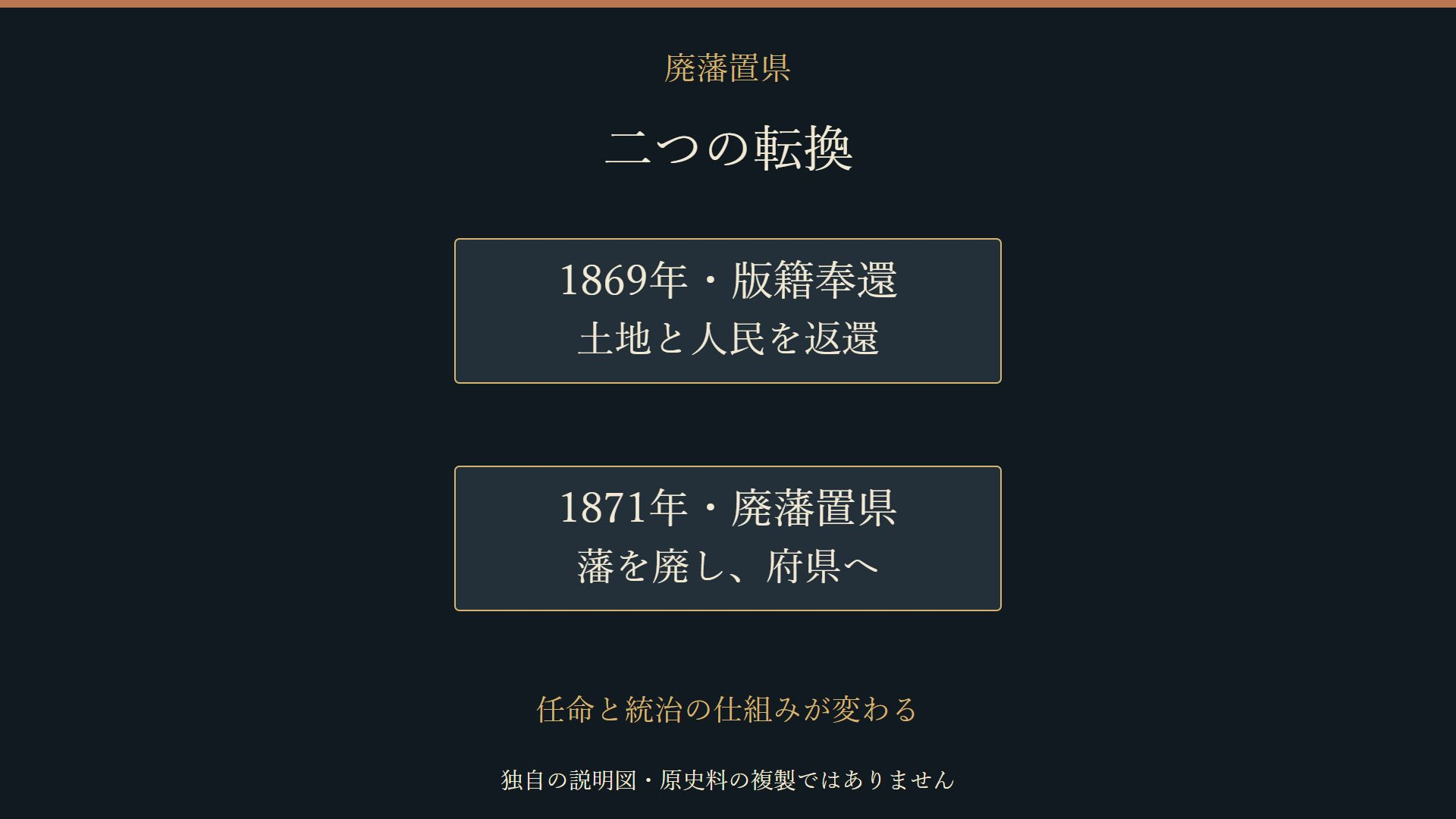
Hanseki hokan in 1869 means the return of land and people to the emperor. Former lords were then appointed as chihanji. Haihan-chiken in 1871 abolished the domains themselves, removed their governors and established administration through government-appointed prefectural officials. The two-year interval is part of the explanation.
Meiji is a Japanese era name. Its second and fourth years correspond to 1869 and 1871. The month and day given for the abolition are retained as the seventh month, day 14; they should not be silently rendered as Gregorian July 14. The months in the 1872 Aichi sequence follow the same historical-calendar convention.
The decree's declared purpose, a draft proclamation, a later territorial arrangement and instructions for continuing business are different kinds of information. Catalogues and institutional explanations help identify them; they are not presented here as independent full readings of every original document.
Watch the film
See the story in motion
The film currently uses Japanese audio. This English article provides the context and source trail; it does not imply that an English subtitle track is available.
Scene 01
What disappeared in 1871?
On the fourteenth day of the seventh month of Meiji 4, corresponding to the year 1871, an imperial edict abolished Japan's domains and replaced them with prefectures. The month and day follow the calendar then in use. The governors who had administered the domains lost their offices.
Changing a word on a map cannot fully explain this reform. Who would appoint the new regional administrators? How would scattered territories be brought together? Who would carry on the work of the offices serving those places? These questions show how the reform reorganized government.
The divisions immediately after abolition numbered three fu and 302 ken, two categories translated here as prefectures. That arrangement was an intermediate stage. Subsequent mergers continued to change the map, and the present system did not appear complete on the day of the edict.
This article follows the decision through appointments, territorial reorganization and the transfer of administrative work. The distinction between a decisive day and the tasks that followed is central to understanding haihan-chiken, the abolition of domains and establishment of prefectures.

Scene 02
The return of land and people two years earlier
Two years before the abolition, in the first month of Meiji 2 (1869), a petition was submitted in the names of the lords of Choshu, Satsuma, Hizen and Tosa. It requested hanseki hokan, the return of land and people to the emperor. The two parts of the term refer to land and people.
Other domains followed. In the sixth month, the government accepted the petitions and ordered domains that had not yet submitted one to make the return as well. The basis on which a lord governed his territory was changing.
The former lords did not all immediately leave local administration. The government appointed them anew as chihanji, governors of their former domains. Returning land and people therefore coexisted with continued administration by many of the same people.
Placing this stage before 1871 helps explain why the later abolition was another change. The return altered the relationship between the ruler, territory and central government, while leaving a domain governor and a domain administration in place. The next reform would address that remaining arrangement.
Scene 03
The same administrators in a changed position
The title chihanji indicates that former domain lords continued to administer their regions. Their position had changed, however. The National Archives of Japan explains that they were expected to act as government administrative officers, carrying out its policies.
The people governing locally were often the same, but the government now appointed them. At the same time, the domain remained an administrative unit. Recognizing both features makes the difference between the reforms of 1869 and 1871 easier to follow.
Hanseki hokan concerned the return of land and people. Haihan-chiken abolished the domains and transferred their administration to prefectures. Calling the second simply a repetition of the first would hide the organization that continued between them.
The diagram separates these stages and points to the changing arrangements for appointment and government. It is an original explanation of the institutional account. It does not reproduce either decree or present an exact chart of every office held across Japan.
Scene 04
The purpose expressed in the edict
Why did the edict present abolition as necessary? The content provided by the Japan Center for Asian Historical Records describes a wish to secure the people at home and face other countries abroad through unified government commands. That is the purpose adopted here from the institution's record.
The edict refers back to the return of land and people. It treats a gap between names and actual conditions, and divided channels of command, as problems. Its stated aim was to bring the country under a common direction.
A declared purpose and the process of carrying it out are different questions. The central document shows the policy being announced. It cannot by itself explain how each local office subsequently managed its work.
Reading a document of decision alongside instructions for an administrative transfer reveals another part of the reform. The first expresses an overall direction; the second helps explain what had to be arranged on the ground. This comparison follows the Japanese article's interpretation, without inventing conversations behind the policy.
Scene 05
Military strength behind the decision
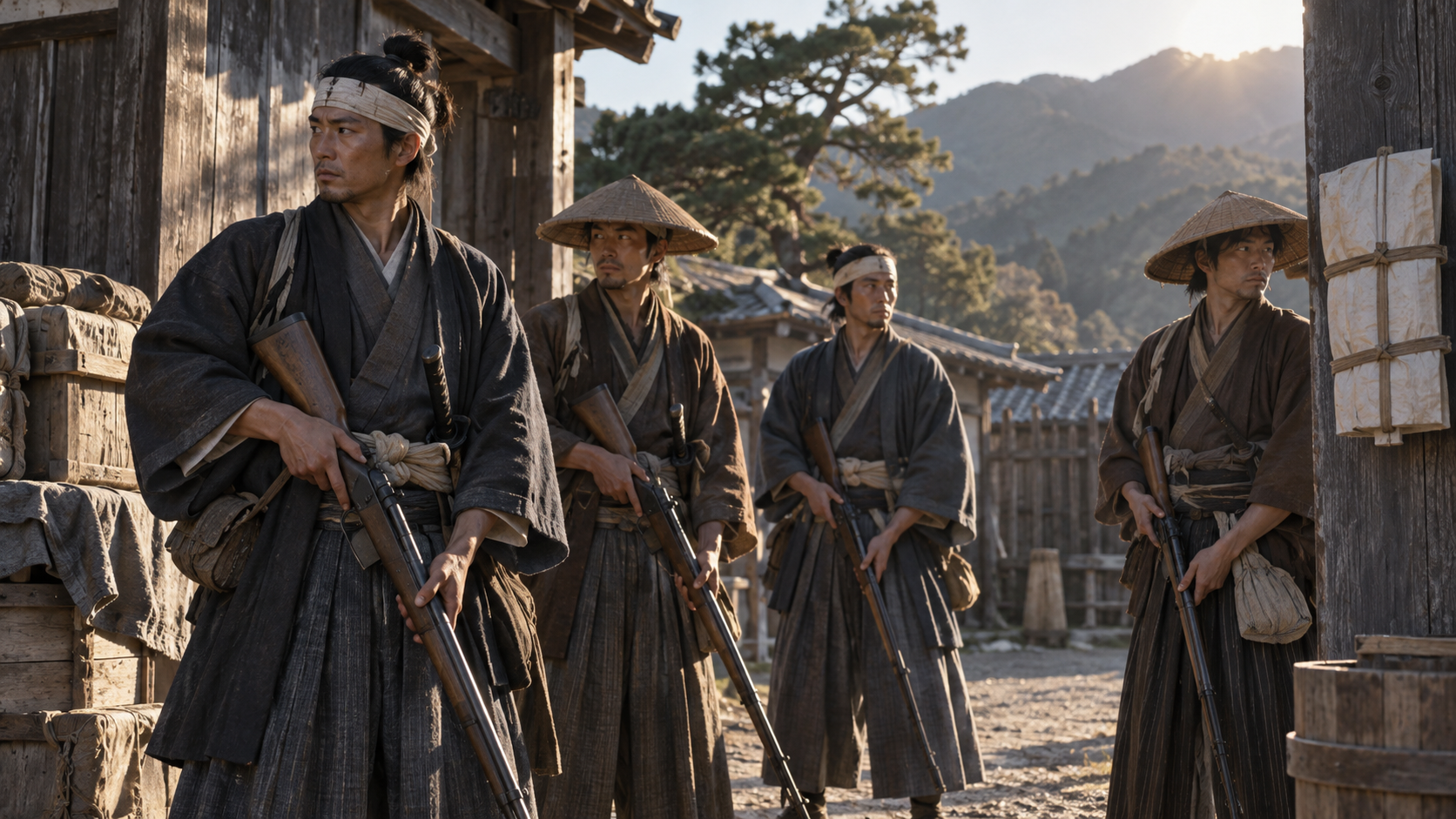
The government also needed strength behind its commands. It recruited goshimpei, troops drawn from the three domains of Satsuma, Choshu and Tosa. The National Archives describes the abolition as taking place with military power capable of confronting opposition in the background.
That account makes the relationship between policy and the ability to implement it visible. The written decree was one part of the change. The force supporting it also had origins in the domains whose administrative existence was being ended.
Troops recruited from domains thus helped support a policy abolishing domains. This connection belongs to the process of constructing the new government. It does not, by itself, establish that fighting occurred everywhere in Japan on the day of the reform.
The article keeps the capacity to enforce a decision separate from evidence of actual combat. The conceptual illustration shows anonymous armed men standing near a gate; it does not depict a verified battle, a named unit or a particular moment in the abolition.
Scene 06
Removing the domain governors
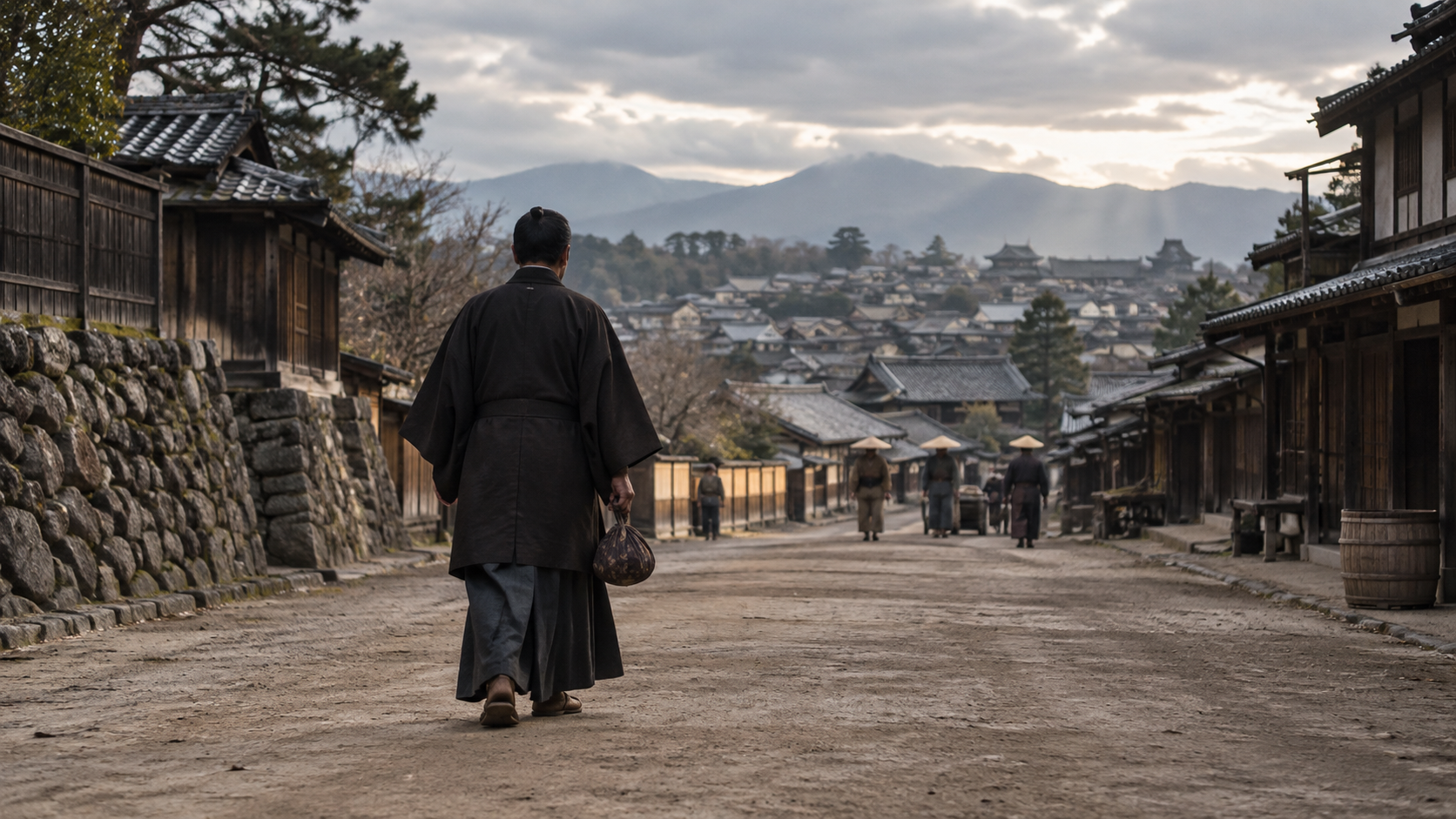
On the fourteenth day of the seventh month in 1871, the domain governors were dismissed and ordered to reside in Tokyo. The government that had appointed former lords as chihanji two years earlier now ended those offices.
A change of administrative name alone could have left the same people governing in the same way. This reform combined a change in territorial organization with a change in personnel and an instruction about where the former governors would live.
Considering these together shows how the link between local administration and the former lords was altered. The residence order belongs to the end of the arrangement under which they continued as governors in their former territories.
Dismissal does not reveal each individual's feelings or subsequent daily life. Those would require separate evidence. The article follows the documented political change without supplying private reactions, departure scenes or conversations for particular former governors.

Scene 07
Appointments connecting the prefectures to the government
In place of the former domain governors, officials appointed by the government would administer the prefectures. The names of the regional offices changed, including ken chiji at first and later kenrei. Their appointment by the central government is the relationship that matters here.
Centralization becomes concrete through that arrangement. Regional administrators were placed in office by the government, connecting administration in different places to it. Local offices continued to be necessary for work in the regions.
The reform moved those offices from a domain structure into a prefectural structure under the government. It reorganized their relationship to authority while retaining administration outside Tokyo. Centralization did not mean that the work of every region ceased to exist locally.
Following appointments therefore complements following names on a map. The new arrangement had to address who administered a place as well as the unit to which that place belonged. The illustrated clerks are anonymous concepts, not evidence for the identity or actions of actual appointees.

Scene 08
A map of three fu and 302 ken
Immediately after the reform, the country's administrative divisions numbered three fu and 302 ken. The figure describes the prefectural arrangement at that stage. It should not be read as proof that exactly 302 domains had previously existed in an identical form.
Initially replacing domains with prefectures left much of the inherited territorial shape in place. There were many detached parcels of territory, or enclaves. Changing an administrative name and reorganizing the territory it covered were distinct tasks.
After prefectures were established, work continued to bring scattered territories together and revise the arrangement. The decree did not settle every boundary or produce the map familiar to a reader today.
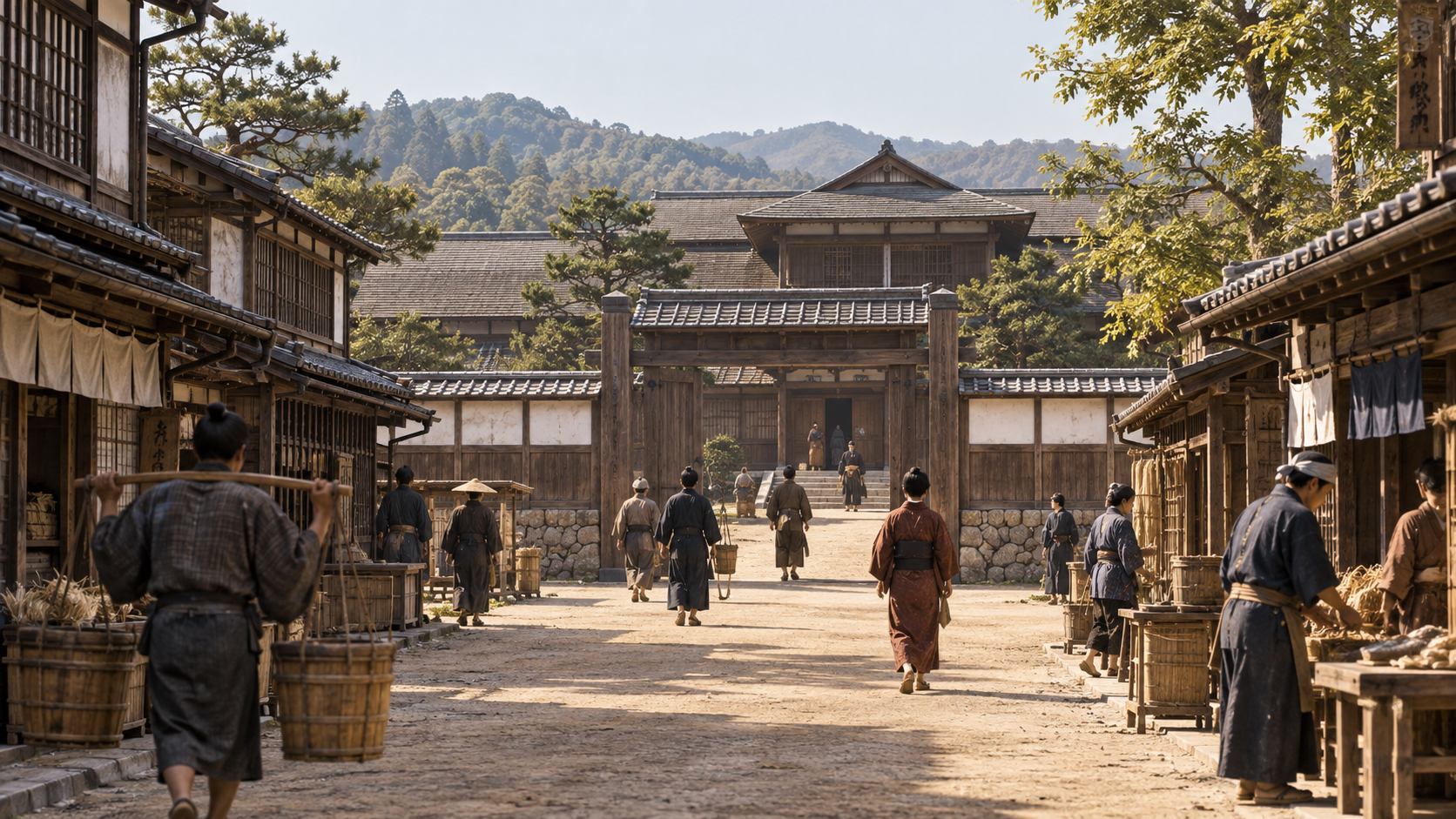
The intermediate map is therefore part of the history. Following its changes allows us to see the reform in progress. The river, road and fields in the conceptual image suggest a regional landscape; they do not draw the actual boundaries of any domain or prefecture.
Scene 09
Reorganization continued after the decision
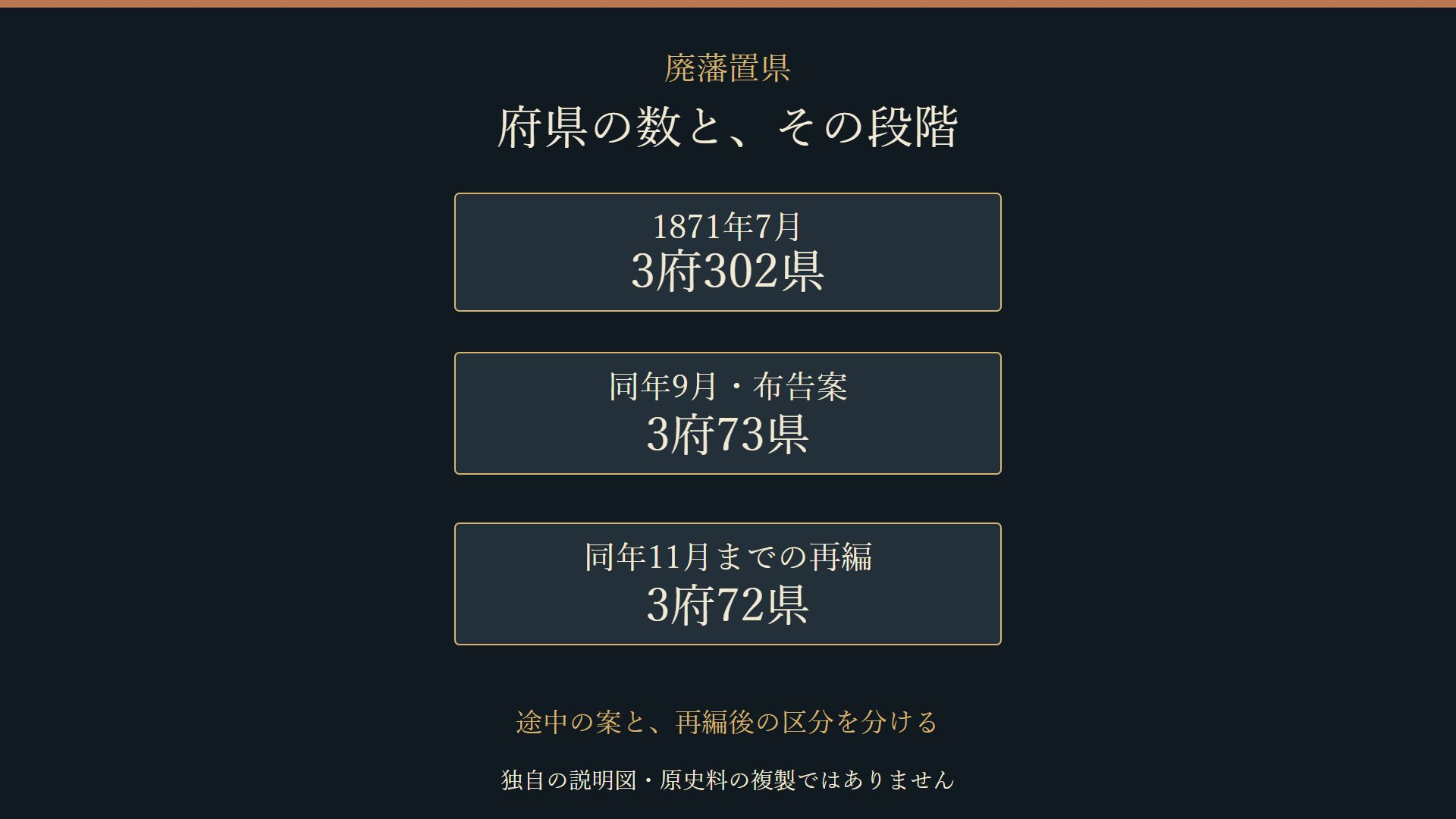
Mergers and other changes in the eighth, ninth and eleventh months of 1871 brought the arrangement to three fu and 72 ken. The National Archives exhibition also presents a draft proclamation from the ninth month proposing three fu and 73 ken.
The draft figure and the subsequent arrangement belong to different stages. The diagram labels the initial three fu and 302 ken, the draft three fu and 73 ken, and the later three fu and 72 ken separately. It keeps a proposal distinct from the result described in the exhibition.
The movement from more than 300 ken toward a smaller number shows the continued task of organizing regional administration. Abolishing domains and arranging the new prefectures formed a connected process, even though the decision and the successive territorial changes were different actions.
To see what that process could look like in one region, we turn to Owari and Mikawa, the areas brought together as Aichi. Their history gives a local example of changing names and areas. It does not establish an identical sequence for every region of Japan.
Scene 10
The intermediate arrangements in Aichi
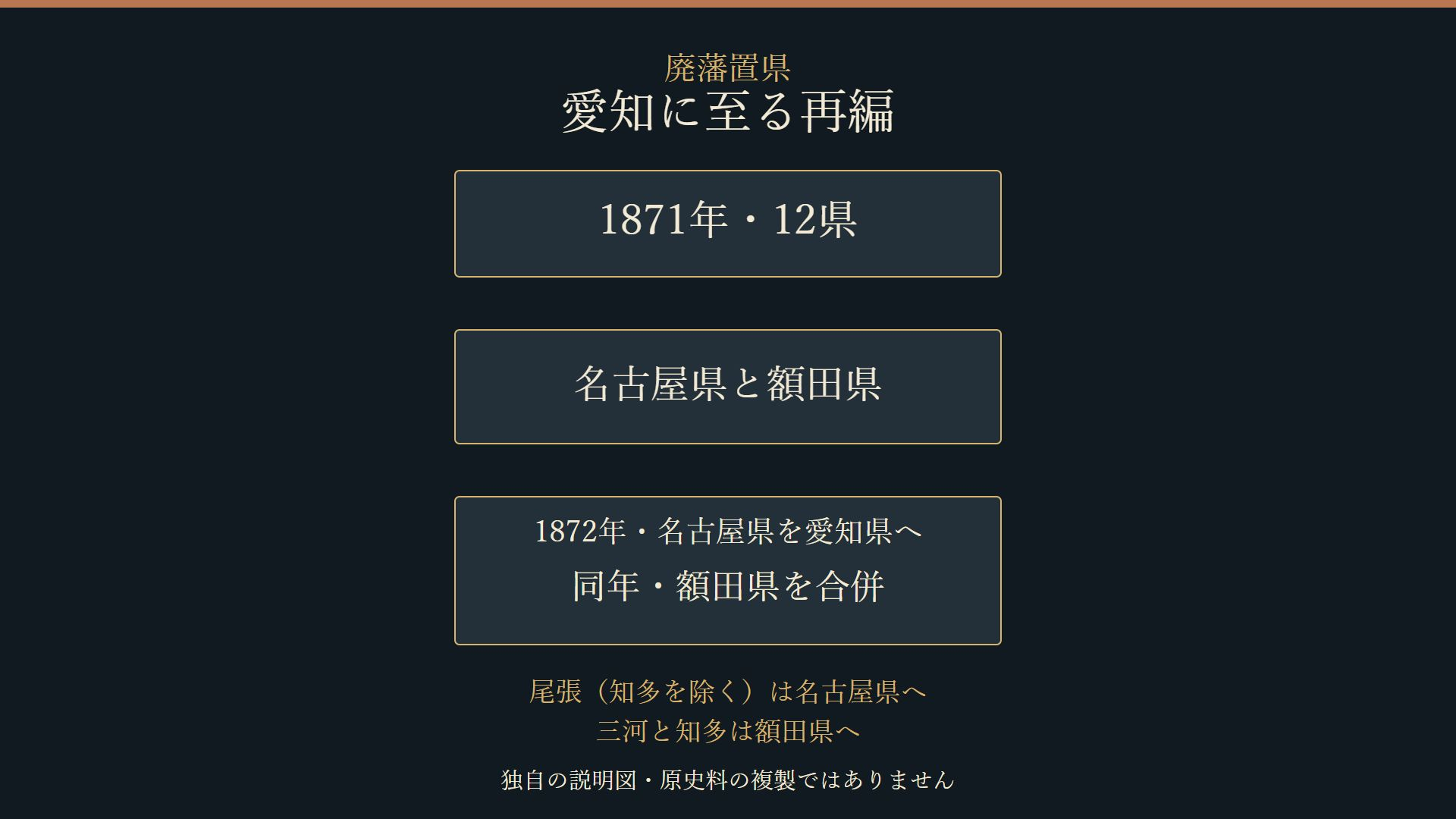
In the region corresponding to present-day Aichi, twelve prefectures were established following the abolition of domains. Owari, excluding Chita District, was then brought into Nagoya Prefecture. Mikawa and Chita District were brought into Nukata Prefecture.
The Aichi Prefectural Archives explains that Nagoya Prefecture was renamed Aichi in the fourth month of 1872, and Nukata was merged into it in the eleventh month of the same year. These months retain the calendar used at the time.
The familiar name Aichi can conceal the period when Nagoya and Nukata existed alongside each other. The sequence involved both renaming and territorial merger: twelve prefectures, then two, then one. Those are separate steps within the region's history.
The diagram summarizes those steps, with a note separating Owari excluding Chita from Mikawa together with Chita. It is a schematic of the adopted institutional explanation, not a map of measured boundaries. Aichi's sequence illustrates one regional process without making it a national rule.
Scene 11
Instructions for keeping office work going
What happened to an office's work when its prefecture was abolished in a merger? The Aichi Prefectural Archives introduces instructions for administering the new prefectures. Its explanation says that places where prefectures were abolished were to serve as branch offices and continue handling business as before.
The people living in those places still required administration while the new arrangement took effect. Changing the name or territory of an administrative unit did not remove the need for work to be carried on locally.
The archive reads the instructions as showing an effort to make the transfer from old prefectures to new ones run smoothly. This article retains that attribution. It uses the public explanation, rather than claiming a new full transcription of the original document.
Placed beside the edict, the instructions bring implementation into view. One document gives the overall policy; the other concerns carrying work through a transition. Reading both helps explain how a national decision could be followed by the local tasks needed to keep administration operating.
Scene 12
One day, followed by years of change
Prefectural mergers and the development of institutions continued after haihan-chiken. In 1890, regulations for prefectures and districts were promulgated. The National Archives explains their purpose in defining prefectural areas and arranging prefectural assemblies under government-appointed governors.
The path toward the present system extended over further years. The abolition of domains cannot be treated as the birth of every feature of modern local government in a single day. Later institutional arrangements belong to their own stages in that history.
The 1871 change was nevertheless substantial. Domain governors lost their offices, government-appointed regional officials took responsibility for administration, and territorial divisions were reorganized. Names, appointments, areas and transfers of work explain how the domains ceased to exist as governing units.
The day of abolition and the subsequent work belong together. Reading that sequence makes centralization visible through the relationships and procedures that changed, while keeping the people who continued local administration within the account.
Editorial note: Dates for 1869, 1871 and 1872 retain the historical Japanese calendar. Three fu and 73 ken is the ninth-month draft; three fu and 72 ken is the subsequent arrangement. The edict and transfer instructions are used through institutional records and explanations, not new full transcriptions. Aichi is a regional example. Illustrations are conceptual scenes and original explanatory diagrams.
How to read this work
History, interpretation, and reconstruction
Following names, appointments, territories and transfers of office work separately reveals the abolition of domains as a decision linked to a continuing process of implementation.
This work is grounded in published sources and historical research. Interior thoughts, dialogue, and some visual details are cinematic reconstructions. Where historians disagree, the article presents the point as debated rather than settled fact.
Timeline
The story in time
-
The abolition edict removes domain governors and replaces their administration with government-appointed prefectural officials.
Sources: s01 -
The initial three fu and 302 ken are consolidated into three fu and 72 ken. The ninth-month draft of three fu and 73 ken is kept separate.
Sources: s04 -
Prefectural and district regulations are promulgated as institutional development continues after domain abolition.
Sources: s05
People & terms
A guide for new readers
Glossary
- Haihan-chiken 廃藩置県
- Abolition of domains and establishment of prefectures in 1871, including changes in regional administrators and subsequent territorial reorganization.
- Hanseki hokan 版籍奉還
- The return of land and people to the emperor in 1869, followed by appointments of former domain lords as governors.
- Han 藩
- Domain: the territorial governing unit abolished in 1871.
- Chihanji 知藩事
- Governor of a domain. Former lords were appointed to this position after the return of land and people, before its abolition in 1871.
- Fu and ken 府・県
- Two administrative categories translated as prefectures. Their distinct counts are retained when discussing the successive arrangements.
- Kenrei 県令
- A title used for government-appointed prefectural heads. Regional office titles changed over time.
- Goshimpei 御親兵
- Troops drawn from Satsuma, Choshu and Tosa that supported the government's ability to carry out the abolition.
- Enclave 飛び地
- Detached territory, remaining in many initial prefectures and requiring attention during consolidation.
- Branch office 出張所
- A local office continuing business at a place whose prefecture had been abolished, as described in the transfer instructions.
- Prefectural and district regulations 府県制・郡制
- The regulations promulgated in 1890, part of institutional development after 1871.
Sources & method
How this article was built
This English edition follows the fixed published Japanese manuscript, preserving twelve scenes, five timeline entries and eight references. The account focuses on institutions and administrative roles. Reader context and definitions clarify terms without inventing additional events, personal motives or dialogue.
The Japanese article review records actual reading of all eight adopted public institutional sources and inspection of the article images. The English review inherits that work after checking source and image hashes. Targeted readings include the National Archives explanations of abolition, the earlier return, the draft prefectural count and the 1890 regulations, the Aichi Prefectural Archives explanation and the fixed actual browser readback of JACAR catalogue content.
The edict's purpose, regional appointments, territorial mergers and administrative continuation are kept distinct. The draft three fu and 73 ken is not substituted for the subsequent three fu and 72 ken. Aichi is a regional example rather than a sequence imposed on every part of Japan. Historical months and days for 1869–1872 retain their calendar.
Public catalogue content and institutional descriptions are used with their attribution. The article does not claim new complete transcriptions of the edict or transfer instructions, comparison of every line with original images, or full reading of an exhibition catalogue. Connecting decision and continuing local work is editorial interpretation.
Editorial note on illustrations: nine AI-generated conceptual images, including the hero, and four original explanatory diagrams are SHIGEKI productions. They do not identify real officials, exact offices, actual administrative boundaries, named military units or original documents. Japanese diagram labels are explained in English captions. Article-specific rights clearance is inherited after matching all thirteen current images to the Japanese review. The connected film has Japanese audio; an English subtitle track has not been verified.
Sources
References and further reading
- Abolishing the Domains and Establishing Prefectures 国立公文書館・日本のあゆみ「藩ヲ廃シ県ヲ置ク」 Title translated editorially for reader convenience. National Archives of Japan 国立公文書館 The 1871 edict, dismissal of domain governors, the Tokyo residence order, government appointments and the initial three fu and 302 ken. The original document images are not independently transcribed here. Accessed 2026-10-09
- Return of Land and People, and Abolition of the Domains 国立公文書館「版籍奉還と廃藩置県」 Title translated editorially for reader convenience. National Archives of Japan 国立公文書館 The position of chihanji after 1869, troops drawn from Satsuma, Choshu and Tosa, enclaves and prefectural consolidation. Military backing is distinguished from actual combat. Accessed 2026-10-09
- Four Domain Lords Petition for the Return of Land and People 国立公文書館「薩長土肥の4藩主が版籍奉還を願い出る」 Title translated editorially for reader convenience. National Archives of Japan 国立公文書館 The petition in the first month of 1869, acceptance in the sixth month, orders to remaining domains and appointments of former lords as chihanji. Accessed 2026-10-09
- A Proposal for Three Fu and 73 Ken Nationwide 国立公文書館「全国を3府73県に」 Title translated editorially for reader convenience. National Archives of Japan 国立公文書館 The exhibition distinguishes the ninth-month draft proclamation from the later three fu and 72 ken, and from the initial three fu and 302 ken. Accessed 2026-10-09
- The Last Domain Lords: From Abolition to Prefectural Regulations 国立公文書館「最後の殿様-廃藩置県から府県制へ-」 Title translated editorially for reader convenience. National Archives of Japan 国立公文書館 Post-abolition changes, mergers and the 1890 prefectural and district regulations. Modern local government is not presented as complete in 1871. Accessed 2026-10-09
- The Beginnings of Aichi Prefecture and the History of Its Offices 愛知県公文書館「愛知県のはじまりと県庁のあゆみ」 Title translated editorially for reader convenience. Aichi Prefectural Archives 愛知県公文書館 The Owari and Mikawa sequence and the instructions for continuing business at branch offices. Used through public explanations, without copying source images or independently transcribing the full document. Accessed 2026-10-09
- The Origins of Aichi 愛知県「あいちのおいたち」 Title translated editorially for reader convenience. Aichi Prefecture 愛知県 The progression from twelve prefectures through Nagoya and Nukata to Aichi. Aichi's sequence is not generalized to all regions. Accessed 2026-10-09
- Imperial Edict Abolishing Domains and Establishing Prefectures アジア歴史資料センター「廃藩置県ノ詔書」 Title translated editorially for reader convenience. Japan Center for Asian Historical Records アジア歴史資料センター Ref.A14110271200, held by the National Archives of Japan. The purpose is paraphrased from the catalogue content; no direct quotation or complete comparison with original document images is supplied. Accessed 2026-10-09
Continue reading
More stories from Shigeki
Shigeki English
Sakai’s Merchant City: Trade, Self-Government and Survival
A port, a merchant council and town communities—from changing authority to rebuilding after fire.
- When From the later fifteenth century through the Sengoku period, the fire of 1615 and early Edo-period reconstruction.
- Where Sakai, in present-day Osaka Prefecture, where maritime routes met roads on land.
Shigeki English
The Aburanokōji Incident: After Leaving the Shinsengumi
A separation in spring, a new base in summer, and two successive attacks.
- When Kyoto in Keiō 3 (1867). The incident’s historical date corresponds to December 13, 1867.
- Where Kyoto: the guards’ successive bases, the Aburanokōji attack site and the later place of remembrance.