
SHIGEKI ENGLISH STORYEN
Japanese history in English
Mogami Safflower: How Yamagata’s Fields Supplied Kyoto’s Red
From petals to dye cakes, along roads, down the Mogami River and across the Sea of Japan, and the goods and culture that came back.
In the Edo period, safflower from inland Yamagata was processed into benimochi and carried by road, river and sea to Kyoto and Osaka. Follow its production, prices, merchants, return cargo, decline and postwar revival.
At a glance
Before you enter the story
- When
- From the late Muromachi period through the height of the trade in the Edo period, the decline after the 1860s and the postwar revival.
- Where
- The Mogami River basin in present-day Yamagata Prefecture, with links to Ōishida, Sakata, Tsuruga, Kyoto and Osaka.
- Key figures
- Mogami Yoshiaki, Suzuki Seifū, Matsuo Bashō, Kawamura Zuiken, Aoyama Eikō
- What was at stake
- How a costly dye material from inland northern Japan reached the textile and cosmetics trades of Kyoto and Osaka.
Why this story matters
The larger history behind the turning point
Mogami safflower shows how an inland farming region could be tied to distant urban markets long before railways. Its value depended on processing, packing, overland carriage, river boats, sea routes and trusted merchants.
The trade also changed the places that supplied it. Hina dolls, storehouses, temple bells and merchant collections still record what came back along the same routes.
Historical context
What an international reader needs to know
Places and terms
Yamagata Prefecture lies in northern Honshu, facing the Sea of Japan. The Mogami River flows north through its inland basins and reaches the sea at Sakata. Kamigata means the region around Kyoto and Osaka.
Dates and names
Years are given in the Western calendar. Japanese names are given with the family name first. A ryō was a gold coin, and a chō was a unit of land area.
Watch the film
See the story in motion
The film currently uses Japanese audio. This English article provides the context and source trail; it does not imply that an English subtitle track is available.
Opening
Tracing Kyoto’s red back to the fields of Yamagata
In Edo-period Kyoto, the red used for Nishijin textiles and cosmetics could begin far to the north, in the Murayama district of Dewa Province. This was Mogami safflower, known in Japanese as Mogami benibana, grown in what is now inland Yamagata Prefecture.
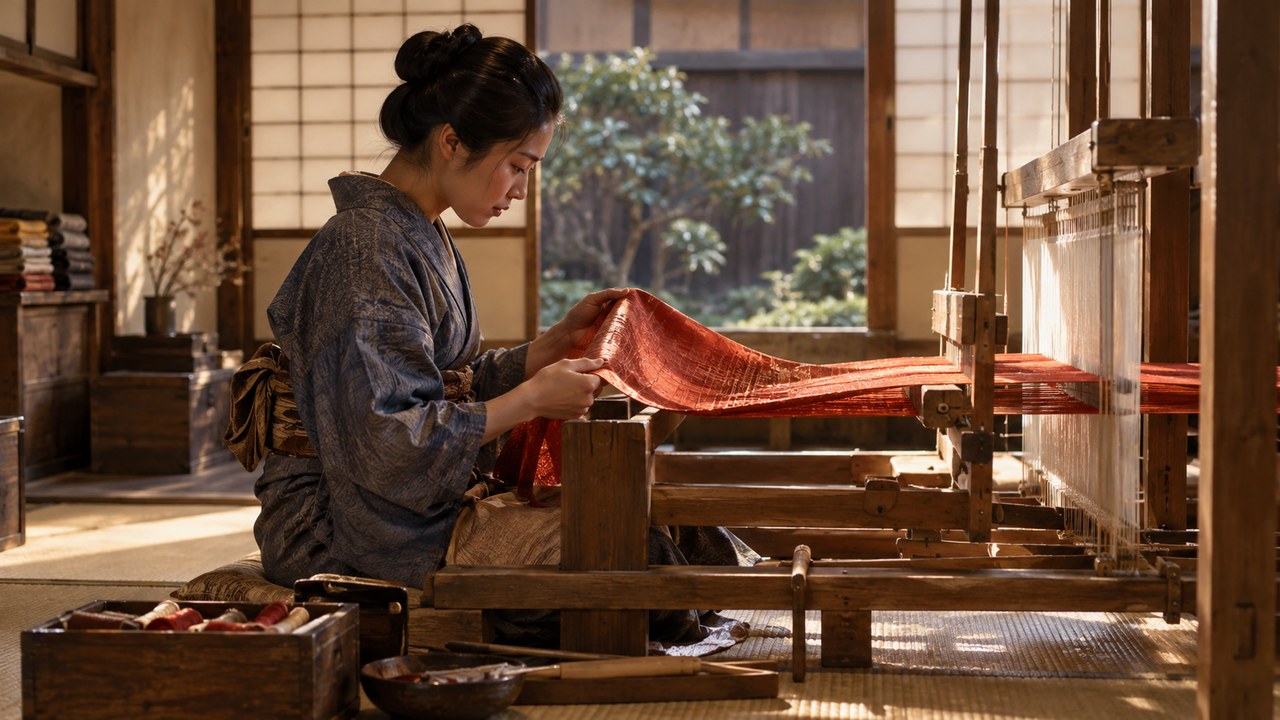
The flowers did not travel as flowers. Their petals were processed into a dye material called benimochi, packed in paper bags and rush matting, carried overland to the river, loaded onto boats and shipped by sea to the Kamigata region around Kyoto and Osaka.
This article follows that journey in order: fields, workshops, roads, river landings, ports, merchant houses and the goods that came back. Figures for output and market share vary from source to source, so those differences are shown along the way.
Chapter 1
Work that began in the morning mist
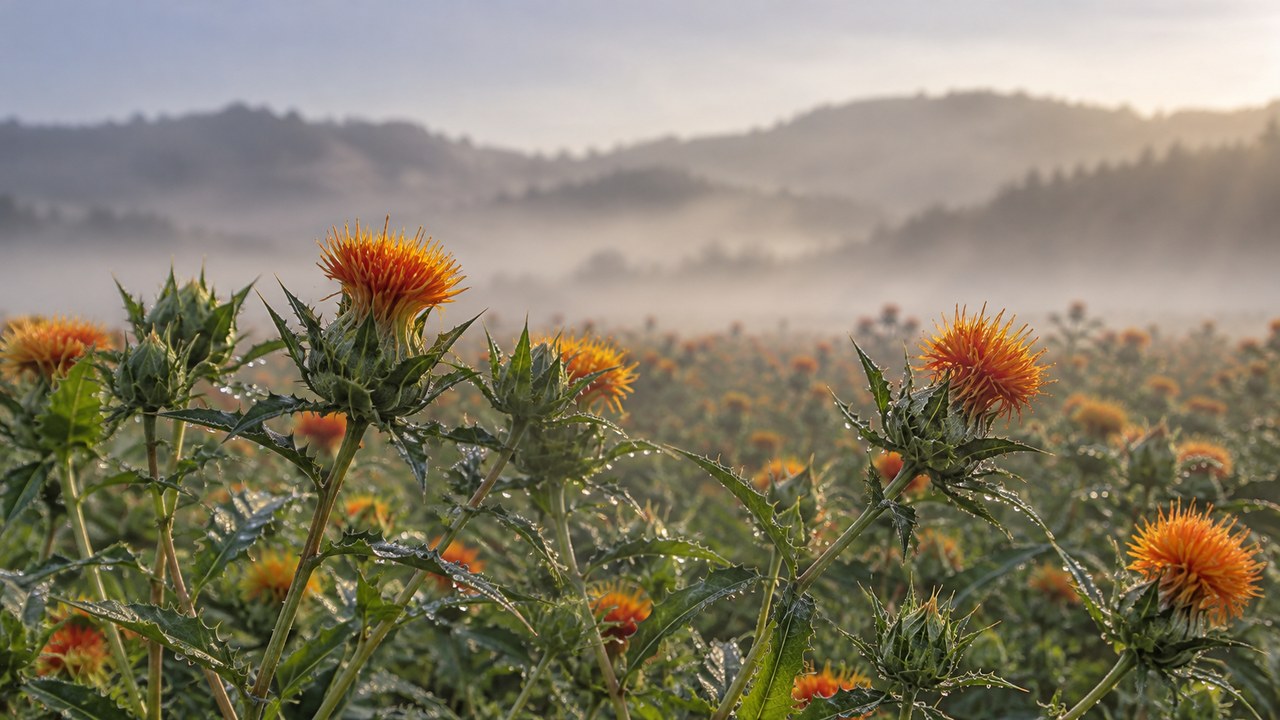
According to Japan’s agriculture ministry, safflower growing and processing for dye in the Mogami River basin go back to the late Muromachi period, about 450 years ago. A regional council’s application places the start around 1550 to 1570. A story linking the plant to Jikaku Daishi, the monk credited with founding the temple of Yamadera, is also told, but it cannot fix a date.
The Mogami River supported cultivation. Yamagata Prefecture explains that river sediment was used as fertilizer and that morning mist rising from the water dampened and softened the sharp spines of the plant. Before it carried cargo, the river was already helping farmers grow and pick the crop.
Most of the pigment in the petals is yellow, and only a small part is the red wanted for dye. An article in Waraku Web puts the actual red content at roughly 0.3 to 0.5 percent and reports that one cake of benimochi takes about 300 flowers.
Chapter 2
The region of “Mogami’s thousand loads”
The encyclopedia Wakan Sansai Zue, published in 1712, ranked Mogami and Yamagata first among safflower districts, with Ise and Chikugo next. By the early eighteenth century, the reputation of Mogami safflower had already reached the printed page.
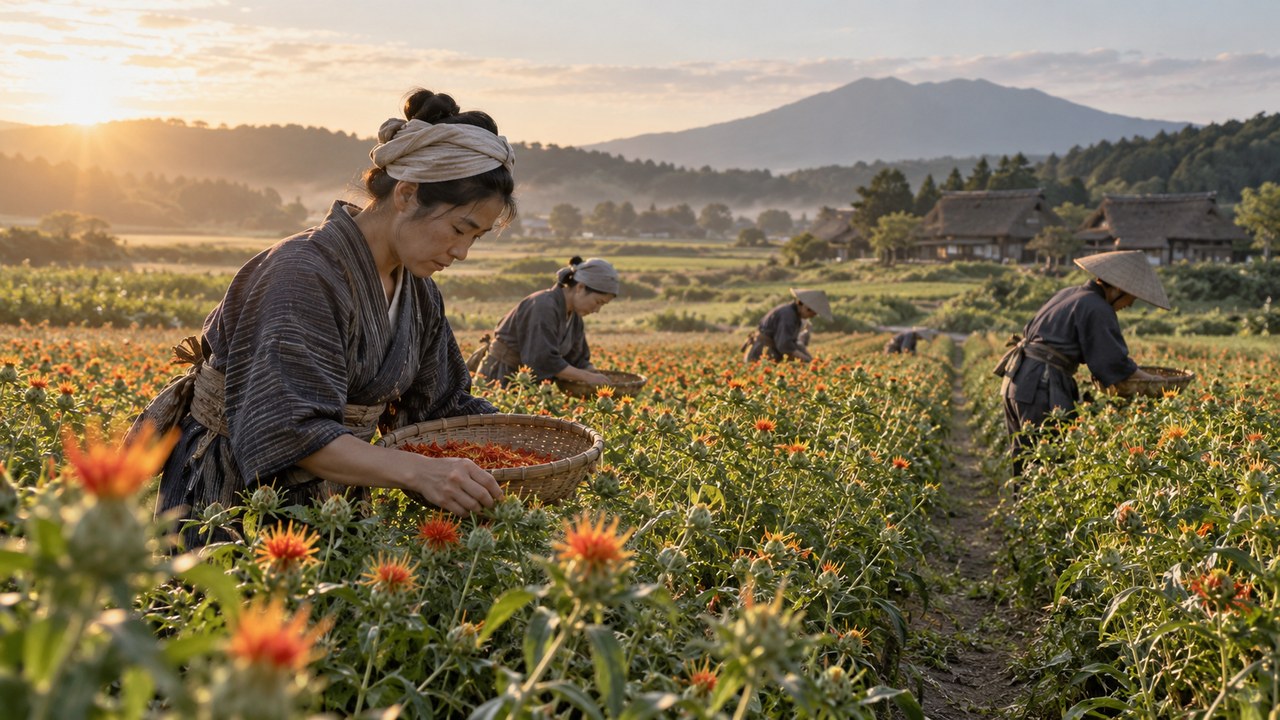
The council’s figures put output in the Mogami district at about 120 metric tons in 1786, the highest in Japan. In the Bunkyū era of 1861 to 1864, production reached about 1,550 da, or roughly 180 tons, and gave rise to the phrase Mogami senda, “Mogami’s thousand loads.” The planted area at its peak is estimated at 1,200 chō.
Estimates of the national share differ. Yamagata Prefecture’s Japan Heritage text gives 50 to 60 percent in the early Edo period, the council’s application gives the same range for the end of the period, and the council’s conservation plan says more than 40 percent in the eighteenth century. All agree that this was Japan’s leading producer.
Chapter 3
Turning petals into a material that could travel
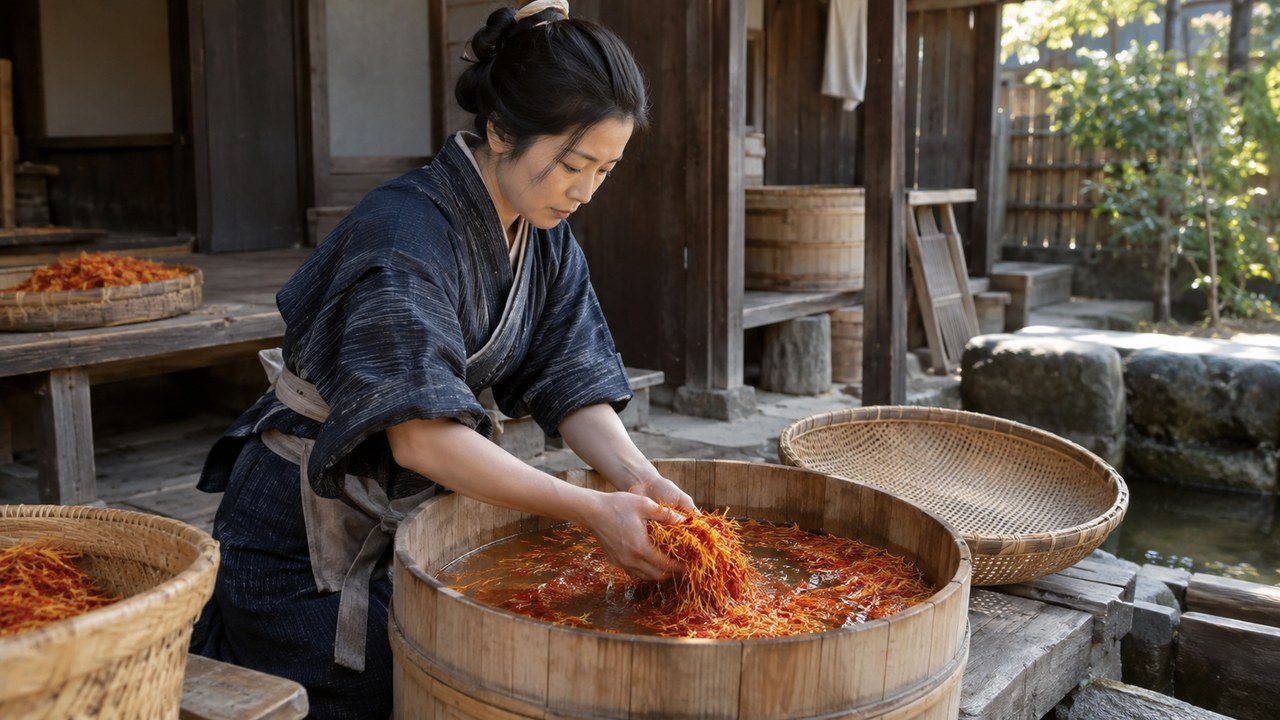
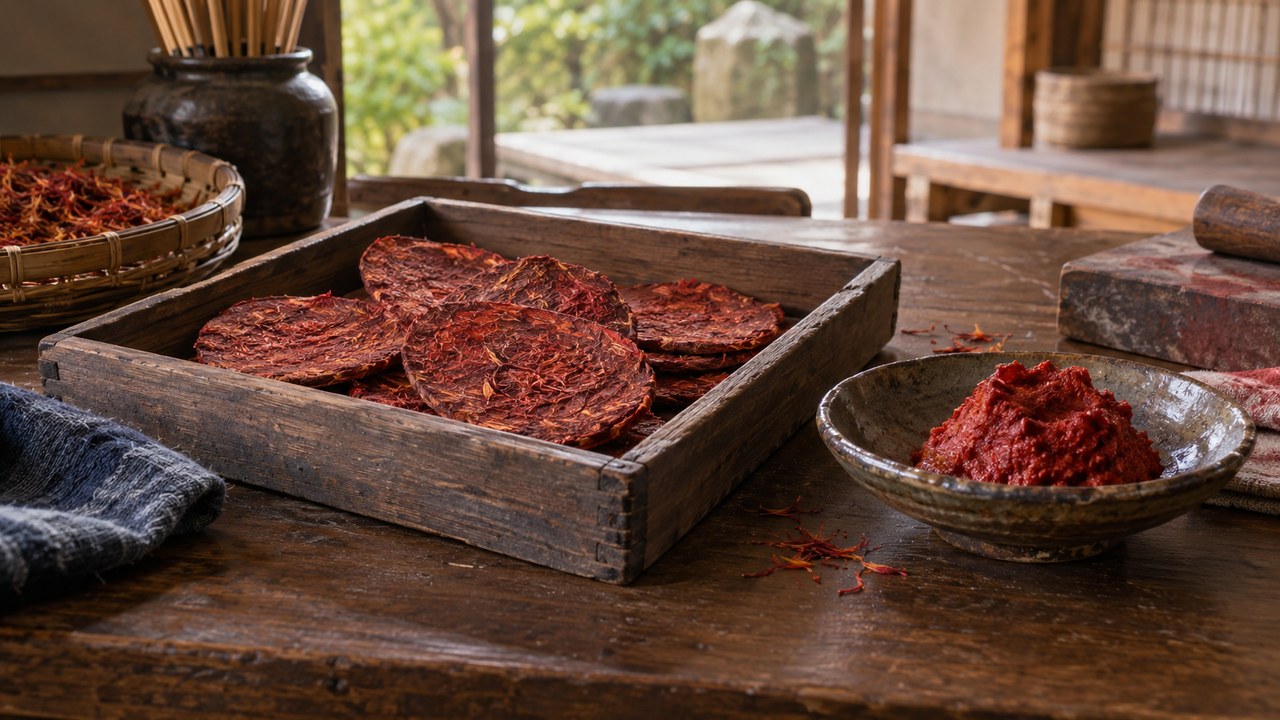
Making benimochi began with washing the picked petals to remove the yellow pigment. When the petals were then left to rest, enzymes brought out the red pigment. This stage is known as hananeshi, literally “putting the flowers to sleep.”
Accounts of the sequence differ. An agriculture ministry teaching resource says the petals were washed, fermented in the shade for two or three days and then pounded in a mortar. The council’s application says they were washed and pounded to damage their surface, then left for about two days.
Finally the mass was rolled into balls about three centimeters across, pressed flat like rice crackers and dried in sun and wind for three or four days. The council notes that this handwork has changed little from the processing shown in Aoyama Eikō’s Safflower Screens, painted at the end of the Edo period.
Chapter 4
One load worth a hundred bales of rice
Benimochi was an expensive commodity. The council’s application cites the saying “one da of safflower, one hundred bales of rice,” explaining that one da weighed 120 kilograms and that a hundred bales of rice were equivalent to 50 ryō.
Yamagata Prefecture also quotes the phrase “a hundred times the price of rice, ten times the price of gold,” and another prefectural text says safflower was said to equal or exceed gold. These expressions convey how costly the product was. They are not market records for a fixed time and quantity.
By the middle of the Edo period, sales of benimochi accounted for more than half the cash income of farmers who grew safflower. The council adds that as a money economy spread, the producing districts gave rise to many wealthy landowning farmers.
Chapter 5
Flower buyers and the paper that wrapped the cargo
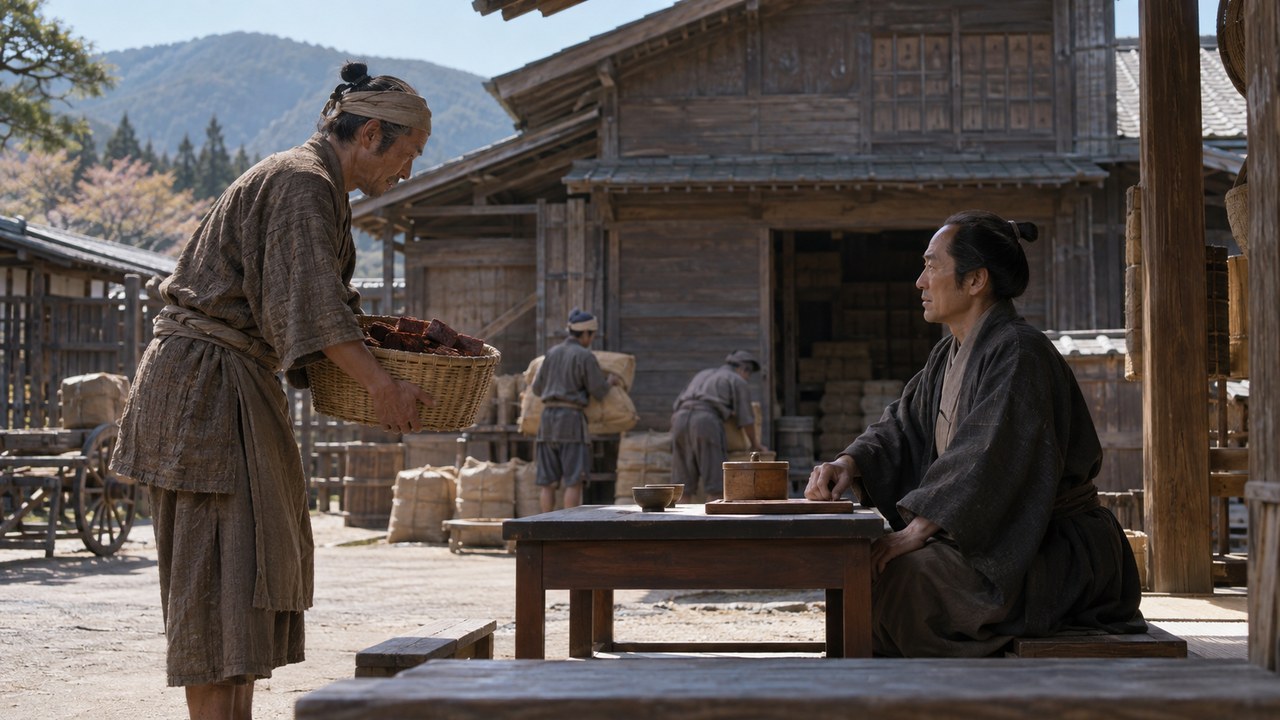
Merchants called hanagai, or flower buyers, collected safflower from the villages. Yamagata Prefecture describes how the flowers were then washed, dried and shaped into flat benimochi by many hands at the residences of safflower merchants.
The finished cakes went into hanabukuro, bags made from heavy paper, and were wrapped again in rush matting for shipment. Washi made in the Miyama district of Shirataka was used for bags holding local safflower, and the papermaking technique is still carried on there.
A single load therefore contained the work of farmers, processing workers, papermakers and merchants who prepared the goods for market. Once packed, the benimochi set out for the river.
Chapter 6
The road before the river
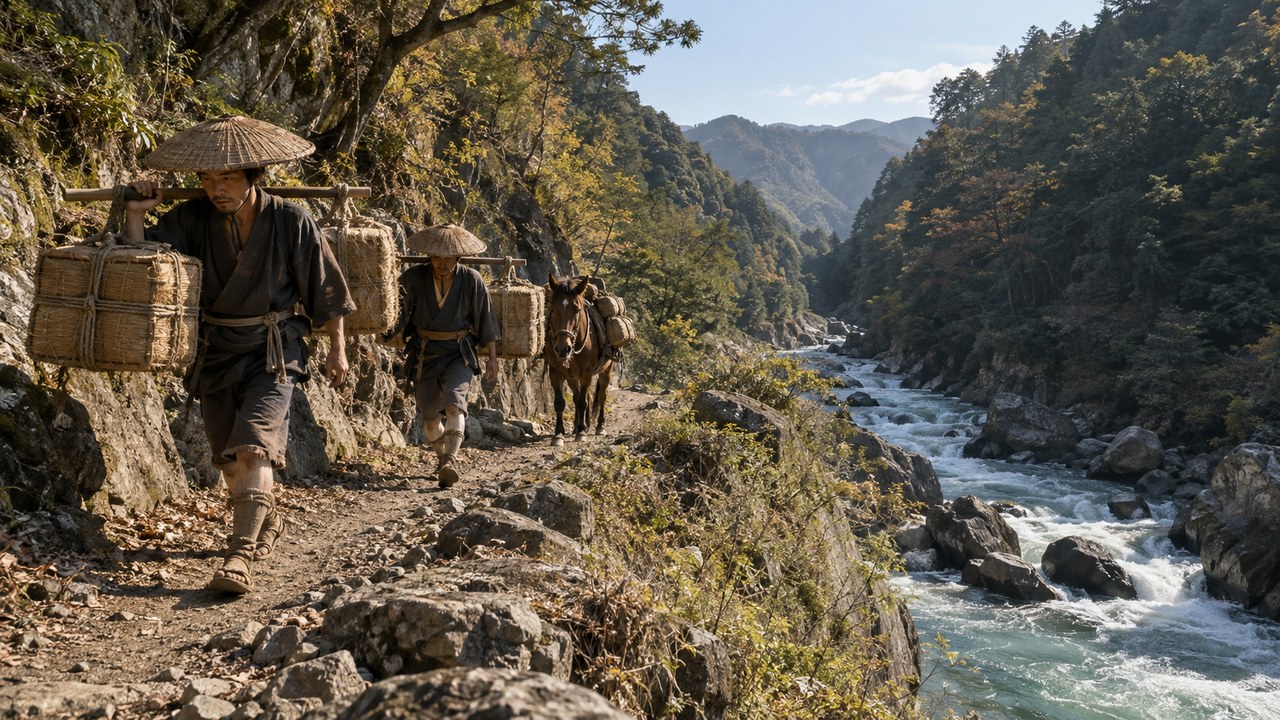
Growing near the Mogami River did not mean that safflower went straight onto a boat. Yamagata Prefecture explains that it was carried overland from the producing areas to Ōishida, avoiding dangerous stretches of the river, and loaded at the Ōishida landing.
The hazards were the rapids of Goten, Sangase and Hayabusa in the Murayama district. The Yamagata City Tourist Association notes that by the mid-Edo period the Ushū Kaidō highway served as the overland link to Ōishida for safflower bound for Kyoto by Kitamaebune trading ships.
When Yamagata Prefecture revised its Japan Heritage text, it added this overland stage between the processing of benimochi and loading at Ōishida. The official account now makes clear that the cargo traveled by road around the river’s most difficult section.
Chapter 7
Handing the cargo to the boats at Ōishida
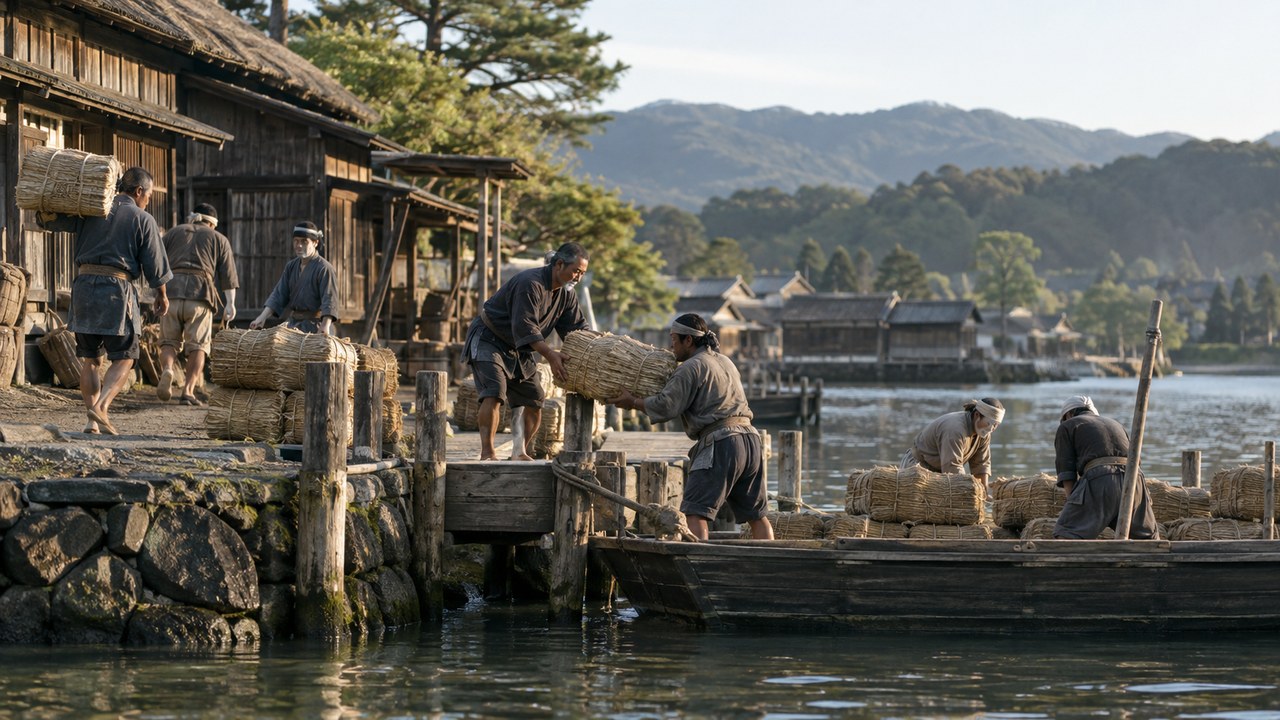
In 1601, the Yamagata lord Mogami Yoshiaki began clearing the three great hazards of the river and established landings including Ōishida. Yamagata Prefecture calls Ōishida the largest landing on the Mogami River in the Edo period, and an old map shows its embankments and a main street running along the river.
Nippon Tabi Magazine reports that in the Genroku era around 1700 there were 290 Ōishida boats and more than 250 Sakata boats. The flat-bottomed hirata boats were about 18 to 24 meters long and could carry 200 to 350 bales of rice. The trip down to Sakata took four or five days, the return upstream 14 or 15.
As traffic grew, the shogunate set up a river boat office at Ōishida in 1792. Boats going downstream carried tax rice, safflower, ramie, silk floss and wax, while those coming upstream brought salt, tea, sugar, marine products and cotton. The office remained until 1872.
Chapter 8
From Sakata to the sea road
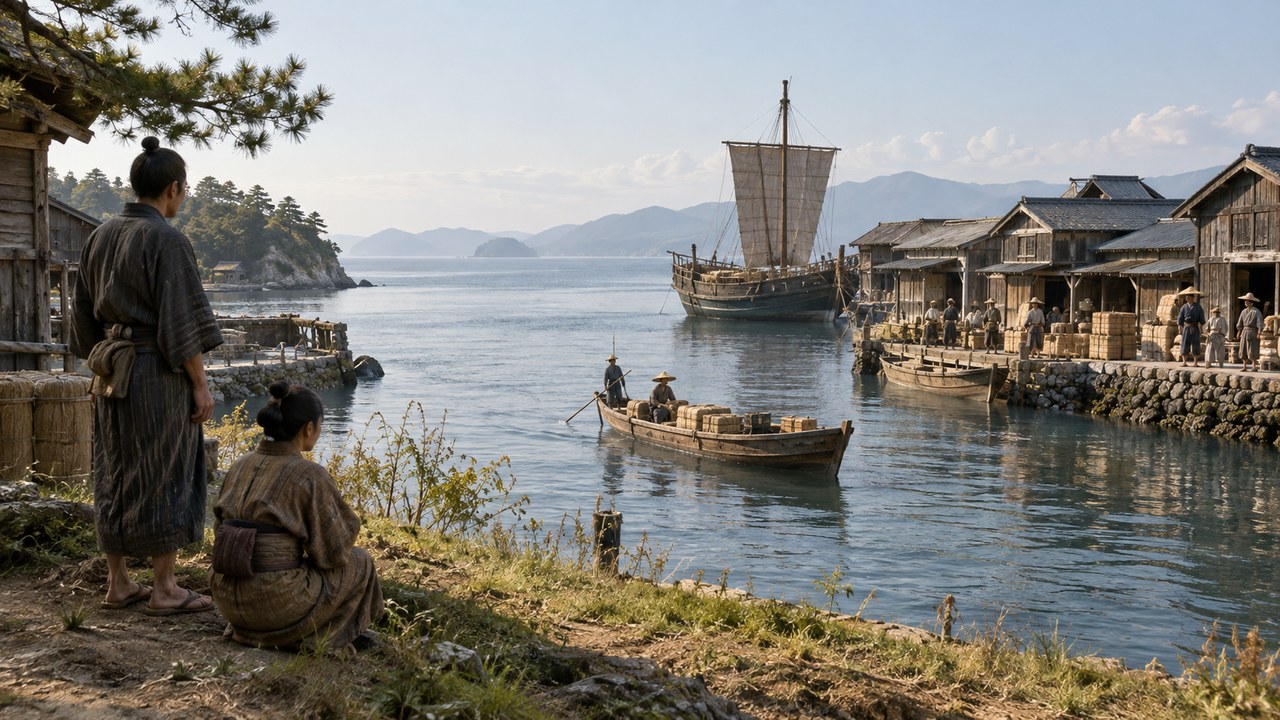
Cargo descending the Mogami River reached Sakata at its mouth. The port was developed in earnest under the Mogami clan in the Keichō era, and after the merchant Kawamura Zuiken opened the western sea route in 1672, the Sea of Japan became the greatest commercial artery of the Edo period.
From here benimochi traveled toward Kamigata aboard Kitamaebune and other ships. The left screen of Aoyama Eikō’s Safflower Screens shows benimochi being shipped, a Kitamaebune entering the port of Tsuruga and trading at the shop of a Kyoto safflower wholesaler. The merchant marks on the sails, however, are described as the painter’s invention.
The sources consulted here do not list ports of call or sailing times for individual shipments. The broad path from the Mogami River across the Sea of Japan to the wholesalers of Kamigata is clear, but it cannot be assumed that every load made the same journey.
Chapter 9
Merchants, and the man Bashō came to see
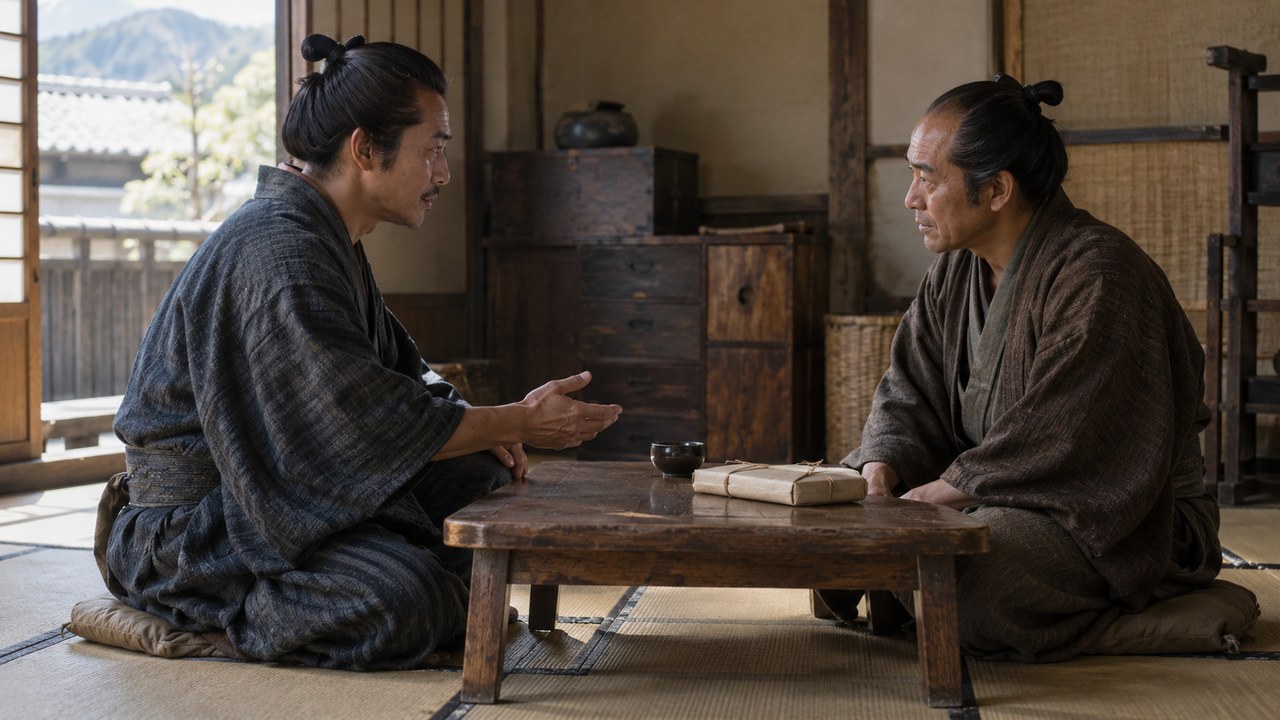
Omi merchants, from what is now Shiga Prefecture, handled much of the trade with Kamigata. Yamagata Prefecture links their arrival to Yamadera’s ties with Mount Hiei and to encouragement from Mogami Yoshiaki. Merchant houses in Yamagata’s Tōkamachi district sent safflower and ramie to Kyoto and Nara.
Wealthy traders also emerged locally. Suzuki Seifū of Obanazawa, head of the Shimadaya house, was called the “safflower magnate,” and the poet Matsuo Bashō visited him in 1689 during the journey recorded in The Narrow Road to the Deep North. A story that Seifū defeated a boycott by Edo merchants and made 30,000 ryō is tradition.
In Yachi, now part of Kahoku, another merchant family grew rich from safflower in the mid-Edo period. The site of its residence is open to the public as the Kahoku Town Safflower Museum, one of the places where the profits of the trade can still be seen.
Chapter 10
What the return boats brought
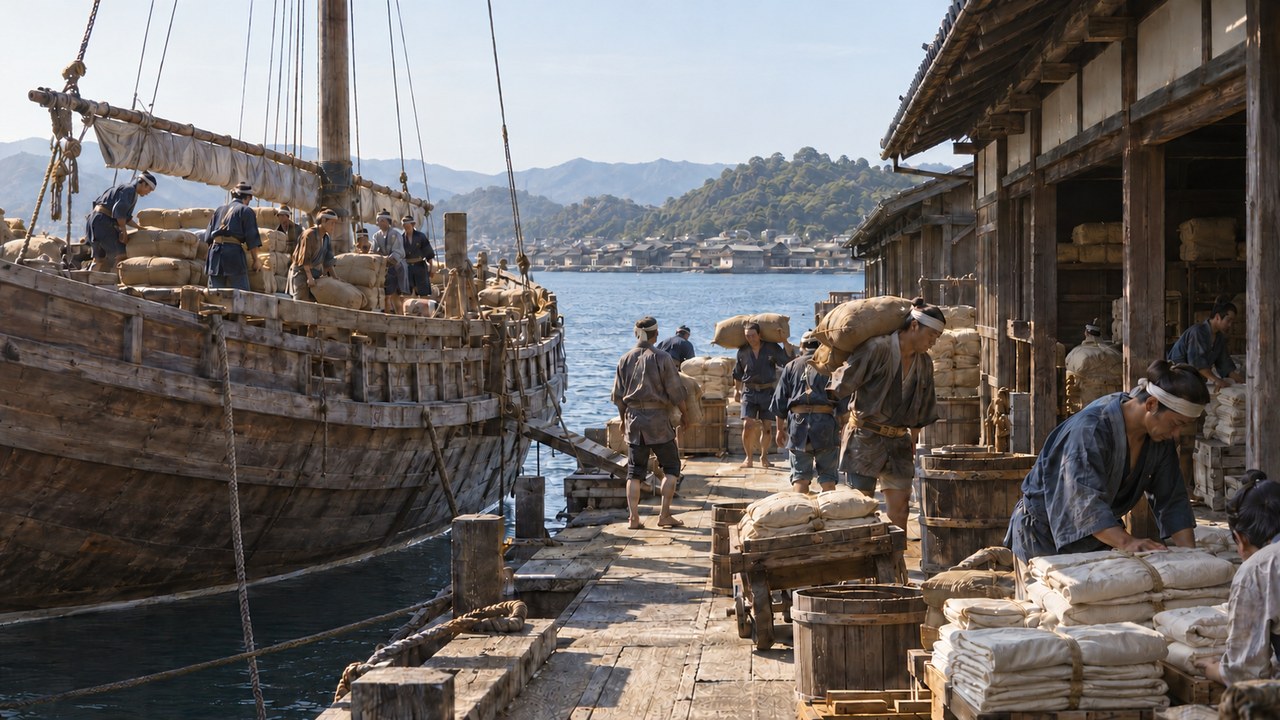
The trade ran in both directions. The Yamagata City Tourist Association lists cotton, secondhand clothing, salt, sugar, tea and small wares among the goods arriving from Kamigata. They came up the Mogami from Sakata to Teratsu, then moved in small boats along the Suka River to the Funamachi landing near Yamagata.
Culture came with the cargo. Yamagata Prefecture says that return voyages in the safflower trade brought the culture of the capital, and it singles out the old hina dolls preserved around the prefecture. Dolls in period styles such as Kyōhō-bina and Kokin-bina can still be found there.
Temple bells and Buddhist statues made in Kyoto and Osaka were also shipped north, and stone lanterns offered at Yamagata shrines bear the names of wholesale merchants from Kyoto, Osaka and Himeji. These objects record lasting ties between Kamigata traders and the town.
Chapter 11
Storehouses and two streams of culture
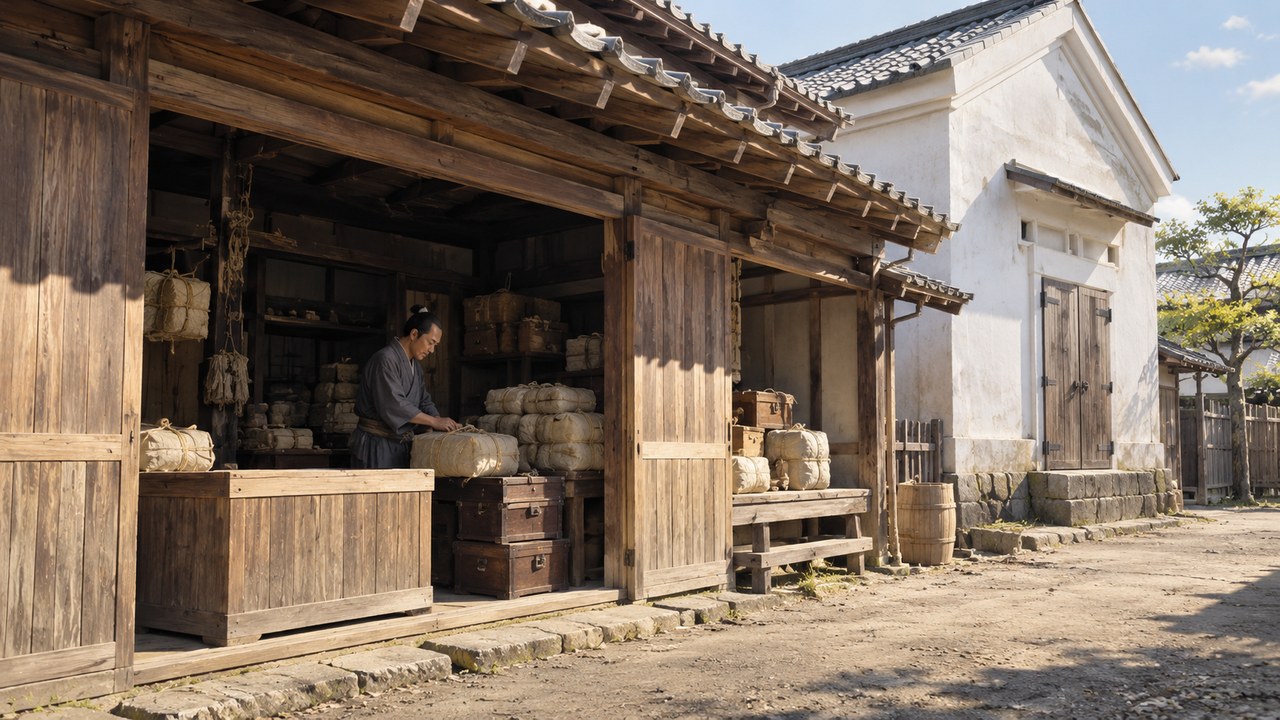
Prosperous merchant towns filled with storehouses. The Yamagata City Tourist Association sees storehouse parlors and Buddhist storehouses, both common in Kyoto, as signs of Kyoto culture taking root through river trade. Shop storehouses, rare in Kyoto and Osaka, are thought to reflect Edo culture arriving by the Ōshū and Ushū highways.
The collection of the wealthy Hasegawa merchant house also shows what the trade made possible. Yokoyama Kazan’s folding screen of safflower depicts the crop from cultivation to shipment to Kamigata, while Yosa Buson’s screen illustrating The Narrow Road to the Deep North is an Important Cultural Property.
Not every storehouse standing today dates from the Edo period. The association identifies one merchant house in Tōkamachi as a surviving example from the late Edo period and notes that many others were built after 1868 in the older style.
Final chapter
When the color faded, the seeds remained
The boom did not last. The council cites Chinese red dye at the end of the Edo period, imported chemical dyes after the Meiji Restoration and wartime controls on planting during World War II. Railways also ended the river trade, and the Rikuu West Line reached Sakata in 1914.
After the war, old seeds were found at a farm in the Takase district of Yamagata City, and cultivation began to recover. A safflower promotion society formed in 1950, a prefectural growers’ federation followed in 1965, safflower became the prefectural flower in 1982, and the Mogami system was recognized as a Japanese Nationally Important Agricultural Heritage site in 2019.
According to the conservation plan, the planted area grew from 6.6 hectares in 2009 to 15.7 hectares in 2024, and the number of growers reached 185. The fieldwork behind Kyoto’s red continues along the Mogami River, on a very different scale.
How to read this work
History, interpretation, and reconstruction
The Mogami safflower trade depended on a chain of fields, workshops, roads, river landings, ships and merchant houses. Following the cargo from hand to hand shows how many places stood behind one red color.
This work is grounded in published sources and historical research. Interior thoughts, dialogue, and some visual details are cinematic reconstructions. Where historians disagree, the article presents the point as debated rather than settled fact.
Timeline
The story in time
-
Safflower production is said to begin in the Mogami River basin.
Sources: s07 -
Mogami Yoshiaki clears the river’s three great hazards and establishes landings including Ōishida.
Sources: s03 -
Kawamura Zuiken opens the western sea route.
Sources: s09 -
Wakan Sansai Zue ranks Mogami and Yamagata first among safflower districts.
Sources: s13 -
Benimochi sales come to make up more than half the cash income of safflower farmers.
Sources: s07 -
Output in the Mogami district reaches about 120 tons, the highest in Japan.
Sources: s07 -
The shogunate establishes a river boat office at Ōishida.
Sources: s10 -
Benimochi output reaches about 1,550 da (about 180 tons), and the phrase “Mogami’s thousand loads” is used.
Sources: s07 -
The Rikuu West Line reaches Sakata, and river transport on the Mogami comes to an end.
Sources: s09 -
Old seeds are found at a farm in the Takase district, and cultivation begins to recover.
Sources: s06 -
The Yamagata Safflower Promotion Society is organized.
Sources: s07 -
The Yamagata Prefectural Federation of Safflower Growers’ Cooperatives is founded.
Sources: s07 -
Safflower is designated the flower of Yamagata Prefecture.
Sources: s07 -
“Safflower Culture Supported by Yamadera” is recognized as Japan Heritage.
Sources: s04 -
Safflower production and processing in the Mogami River basin are recognized as a Japanese Nationally Important Agricultural Heritage system.
Sources: s01
People & terms
A guide for new readers
Key figures
- Mogami Yoshiaki
- The lord of Yamagata who cleared hazards on the Mogami River in 1601 and established landings.
- Suzuki Seifū
- A safflower merchant of Obanazawa, known as the “safflower magnate,” who received Matsuo Bashō in 1689.
- Matsuo Bashō
- The poet who visited Obanazawa and Yamadera in 1689 and wrote poems on safflower.
- Kawamura Zuiken
- An Edo merchant who opened the western sea route in 1672.
- Aoyama Eikō
- A painter who depicted safflower growing and trade in his Safflower Screens (1817–1879).
Glossary
- Benibana 紅花
- Safflower, the crop whose petals supplied red dye and cosmetics.
- Mogami safflower 最上紅花
- The name for safflower from the inland Mogami River basin in present-day Yamagata Prefecture.
- Benimochi 紅餅
- Flat dried cakes made from fermented safflower petals and shipped as a dye material.
- Hananeshi 花寝せ
- The resting stage in which enzymes develop the red pigment in the petals.
- Da 駄
- A unit of cargo. The source cited here equates one da of safflower with 120 kilograms.
- Kashi 河岸
- A river landing where cargo was transferred to and from boats.
- Kitamaebune 北前船
- Trading ships that sailed the Sea of Japan coast and linked northern Japan with western markets.
- Kamigata 上方
- The region around Kyoto and Osaka.
Sources & method
How this article was built
This English edition follows the revised Japanese article scene by scene and keeps its fifteen sources, their order and its eighteen timeline entries. It draws on national and prefectural agencies, a regional council, a university library, a tourist association and published articles.
Institutional explanations and the interpretation offered here are kept separate. National share, processing order and sayings about price are described with the differences or limits found in the sources, and no private thoughts or conversations are invented.
Sources
References and further reading
- The Mogami River Basin, Yamagata Prefecture 山形県最上川流域(日本農業遺産) Title translated editorially for reader convenience. Ministry of Agriculture, Forestry and Fisheries 農林水産省 About 450 years of history, shipment of benimochi and the February 2019 recognition. Accessed 2026-11-19
- Revised Recognition of the Japan Heritage Story “Safflower Culture Supported by Yamadera” 日本遺産「山寺が支えた紅花文化」の変更認定 Title translated editorially for reader convenience. Yamagata Prefecture 山形県 Paper bags and Miyama washi, the overland route, the Ōishida map and the Hasegawa collection. Accessed 2026-11-19
- The Merchant Town of Yamagata and the Culture Brought by Trade 商人町山形・交易がもたらした京江戸文化 Title translated editorially for reader convenience. Yamagata City Tourist Association 山形市観光協会 River clearance in 1601, Sakata, Omi merchants, incoming goods and routes, and storehouses. Accessed 2026-11-19
- The Japan Heritage Story “Safflower Culture Supported by Yamadera” 日本遺産「山寺が支えた紅花文化」ストーリー Title translated editorially for reader convenience. Yamagata Prefecture 山形県 National share, flower buyers, benimochi, sayings about price, Omi merchants and Bashō’s poems. Accessed 2026-11-19
- Teaching Resource on Mogami Safflower 農業遺産教育資料「歴史と伝統がつなぐ山形の「最上紅花」」 Title translated editorially for reader convenience. Ministry of Agriculture, Forestry and Fisheries 農林水産省 The steps of benimochi processing and the length of fermentation. Accessed 2026-11-19
- Yamadera and Safflower 山寺と紅花 Title translated editorially for reader convenience. Yamagata Prefecture 山形県 Sediment and mist, comparisons with gold, culture on return voyages, decline and the seeds found at Takase. Accessed 2026-11-19
- Mogami Safflower: Application for Japanese Nationally Important Agricultural Heritage 歴史と伝統がつなぐ山形の「最上紅花」(日本農業遺産 申請資料) Title translated editorially for reader convenience. Yamagata Safflower Promotion Council 山形県紅花振興協議会 Origins, output in 1786 and the Bunkyū era, the value of one da, planted area, processing, decline and postwar groups. Accessed 2026-11-19
- Conservation Plan for the Agricultural Heritage System, Second Phase 世界農業遺産・日本農業遺産保全計画(第2期) Title translated editorially for reader convenience. Yamagata Safflower Promotion Council 山形県紅花振興協議会 The eighteenth-century share, the 83 producing localities, and planted area and growers in 2024. Accessed 2026-11-19
- Ōishida Landing Site 大石田河岸跡 Title translated editorially for reader convenience. Nippon Tabi Magazine ニッポン旅マガジン Numbers of boats in the Genroku era, the western sea route and the end of river transport. Accessed 2026-11-19
- Site of the Ōishida Boat Office 大石田舟役所跡(大門・塀蔵) Title translated editorially for reader convenience. Nippon Tabi Magazine ニッポン旅マガジン The office of 1792, boat size, travel times and cargo. Accessed 2026-11-19
- Bashō and Seifū History Museum 芭蕉・清風歴史資料館 Title translated editorially for reader convenience. Nippon Tabi Magazine ニッポン旅マガジン Suzuki Seifū, Bashō’s visit and the tradition of 30,000 ryō. Accessed 2026-11-19
- Commentary on the Safflower Screens 紅花屏風(解説) Title translated editorially for reader convenience. Yamagata University Library 山形大学附属図書館 Aoyama Eikō’s screens, the scenes at Tsuruga and Kyoto, and the imagined merchant marks. Accessed 2026-11-19
- Evaluation of Mogami Benibana (The Benibana Museum) Evaluation of Mogami Benibana(The Benibana Museum) Title translated editorially for reader convenience. Yamagata University Library 山形大学附属図書館 The ranking of safflower districts in Wakan Sansai Zue, 1712. Accessed 2026-11-19
- The Appeal of Mogami Safflower, Admired Around the World 世界からも注目される“最上紅花”の魅力とは?450年変わらぬ口紅の原料を訪ねて山形へ Title translated editorially for reader convenience. Waraku Web 和樂web The proportion of red pigment and the number of flowers in one cake. Accessed 2026-11-19
- Kahoku Town Safflower Museum 河北町紅花資料館 Title translated editorially for reader convenience. Tohoku Tourism Promotion Organization 東北観光推進機構(旅東北) The merchant residence and the museum. Accessed 2026-11-19
Continue reading
More stories from Shigeki
Shigeki English
From the Black Ships to Hakodate: Sixteen Years from Bakumatsu to Meiji
Treaties, the Sakuradamon incident, the Kinmon incident, the Satsuma–Choshu alliance, the return of power, Toba–Fushimi, Edo Castle, Aizu and Hakodate: diplomatic commitments, political authority and military command did not change at the same moment.
- When 1853–1869, with administrative changes in 1869 and 1871 placed separately
- Where Uraga, treaty ports, Edo, Kyoto, Toba–Fushimi, Aizu and Hakodate
Shigeki English
Nitta Yoshisada | Why the Man Who Took Kamakura Kept Fighting in Echizen
The uprising at Ikushina Shrine, three battles in Musashi, the Inamuragasaki legend, Toshoji, the Kenmu warrior office, Takenoshita and Kyoto, Shirahata Castle and Minatogawa, two princes at Kanegasaki, the recapture from Somayama, death at Tomyoji Nawate, and a helmet and a stone.
- When The family landscape from the mid-twelfth century; Yoshisada’s 1333–1338 career; seventeenth-century and later remembrance. Medieval months and days remain in the historical calendar.
- Where Nitta-shō around Ōta, Kamakura, Harima and the Hyōgo coast, then Kanegasaki near Tsuruga and the Echizen setting of renewed activity and death.