
SHIGEKI ENGLISH STORYEN
Japanese history in English
Uesugi Yozan and Yonezawa: Could Frugality Alone Rebuild a Domain?
Reducing expenditure and developing the capacity to support people’s lives.
Read Yozan’s reforms through investment, lacquer trees, mulberry and paper mulberry, textiles, irrigation, Takenomata Masatsuna, practical administrators and the Kojokan school. Follow a long process involving conflict and interruption, while distinguishing policies from the later image of an exemplary ruler and modern SDG interpretations.
At a glance
Before you enter the story
- When
- Yozan’s accession in 1767, the opening of Kojokan in 1776, Takenomata’s fall in 1782 and a longer reform process
- Where
- Yonezawa domain, with agricultural fields, production activities, irrigation works and the domain school
- Key figures
- Uesugi Yozan, Takenomata Masatsuna, Kuroi Hanshiro, Hosoi Heishu, Domain officials, producers and specialists
- What was at stake
- How did reducing expenditure relate to rebuilding the productive and educational foundations of the domain?
Why this story matters
The larger history behind the turning point
A story centered only on a ruler’s simple lifestyle leaves out the work required to sustain production. Considering water, raw materials, skills and education together shows why expenditure cuts and investment could belong to the same reform process. These activities depended on people beyond the lord himself.
Institutional accounts describe opposition and interruptions as well as persistence. Their combination challenges the idea of an instant recovery produced by one order. It also requires separating a policy’s name or ambition from demonstrated results, rather than treating a planting target as proof that every tree survived and generated income.
Historical context
What an international reader needs to know
A domain’s finances and productive capacity were connected
The domain was an administrative setting in which the lord, senior officials, retainers, merchants and rural producers had different roles. A financial problem was also connected with everyday production. Fields needed water, materials needed skilled processing, and new activities required people capable of organizing and sustaining them.
Here the reform process is followed through those relationships. The article does not supply a total debt, a modern-currency equivalent, a verified year of complete repayment or measured profits for each policy. Such claims would require their own accounting evidence beyond the institutional explanations used for this overview.
Descriptions, catalogue records and modern interpretation
The sources include municipal policy explanations, a museum exhibition introduction, a library catalogue and an agricultural ministry account. They serve different purposes. The library record establishes how a school-related letter is described; it is not a substitute for reading and transcribing the entire original letter.
Yonezawa’s present-day SDG pages organize the past through modern categories. Those categories can help a contemporary reader compare policies, but they must not be turned into words spoken by Yozan. Similarly, the generated illustrations are general explanatory scenes, not his possessions, original documents, exact canals or authenticated historical landscapes.
Watch the film
See the story in motion
The film currently uses Japanese audio. This English article provides the context and source trail; it does not imply that an English subtitle track is available.
Scene 01
Could saving alone rebuild the domain?
Rebuilding a domain burdened by debt may first suggest saving money. Yozan, remembered for reform in Yonezawa, did demonstrate a modest lifestyle. Yet a reduction in spending raises another question: what would it do for fields lacking water or households without enough productive work?
His reforms included rural works, attempts to develop industries and education alongside frugality. These were related efforts to support the conditions in which people lived and produced goods. They cannot be understood entirely from the amount consumed in the lord’s own household.
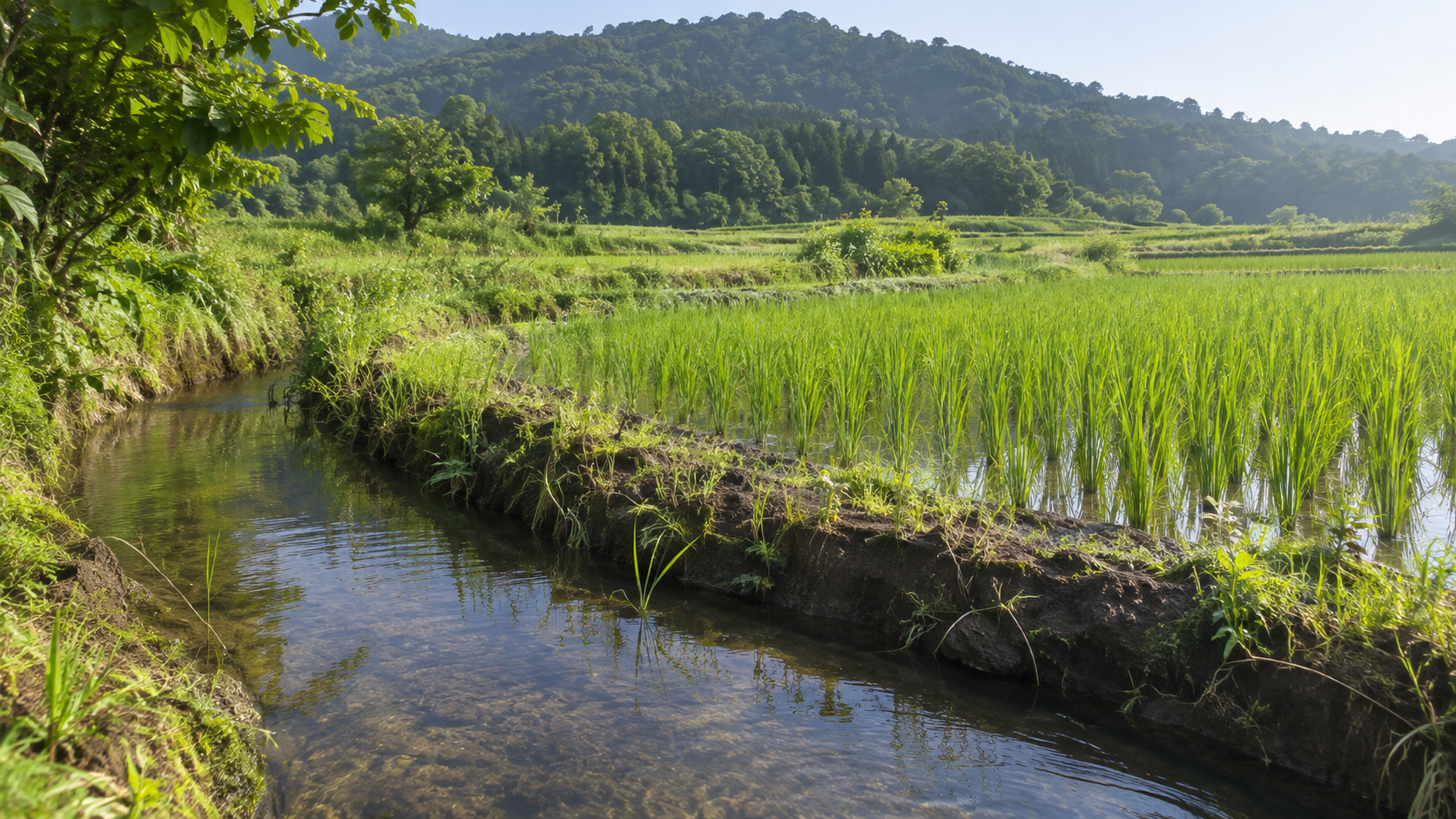
The following chapters therefore trace concrete kinds of work in Yonezawa. The question is how expenditure restraint related to the development of productive capacity. A general illustration of fields provides context, while the historical explanation rests on the cited accounts rather than a claim that the image records an actual reform project.

Scene 02
Accession in 1767 and a crisis in finances and livelihoods
Yozan became Yonezawa’s ninth domain lord in 1767. Yonezawa City and the Uesugi Museum describe a severe financial crisis. The domain’s finances and people’s livelihoods overlapped, so measures intended to rebuild its resources also needed to consider the ability to produce within its territory.
That connection does not mean every question about debt has already been settled. How much was owed and when it was all repaid are separate historical problems. They require records appropriate to those claims, rather than a dramatic number used merely to emphasize the seriousness of the situation.
This account avoids unsupported totals and conversions into modern money. Instead, it follows the policies described by the institutions. Keeping that boundary allows the crisis to remain meaningful without suggesting an independent audit of all the domain’s books or a precise financial result established for every year.
Scene 03
What was done with the money saved?
One part of reform concerned expenditure. Yonezawa City explains that Yozan reduced his own living expenses and demonstrated a simple way of life, encouraging frugality among retainers and other residents. Offices were also asked to reduce waste, placing household example alongside administrative measures.
The next step is central to the argument. The city describes funds obtained through savings and borrowing from merchants being used for investment in new activities. Reducing consumption and obtaining credit therefore belonged to a wider question about the resources available for rebuilding production.
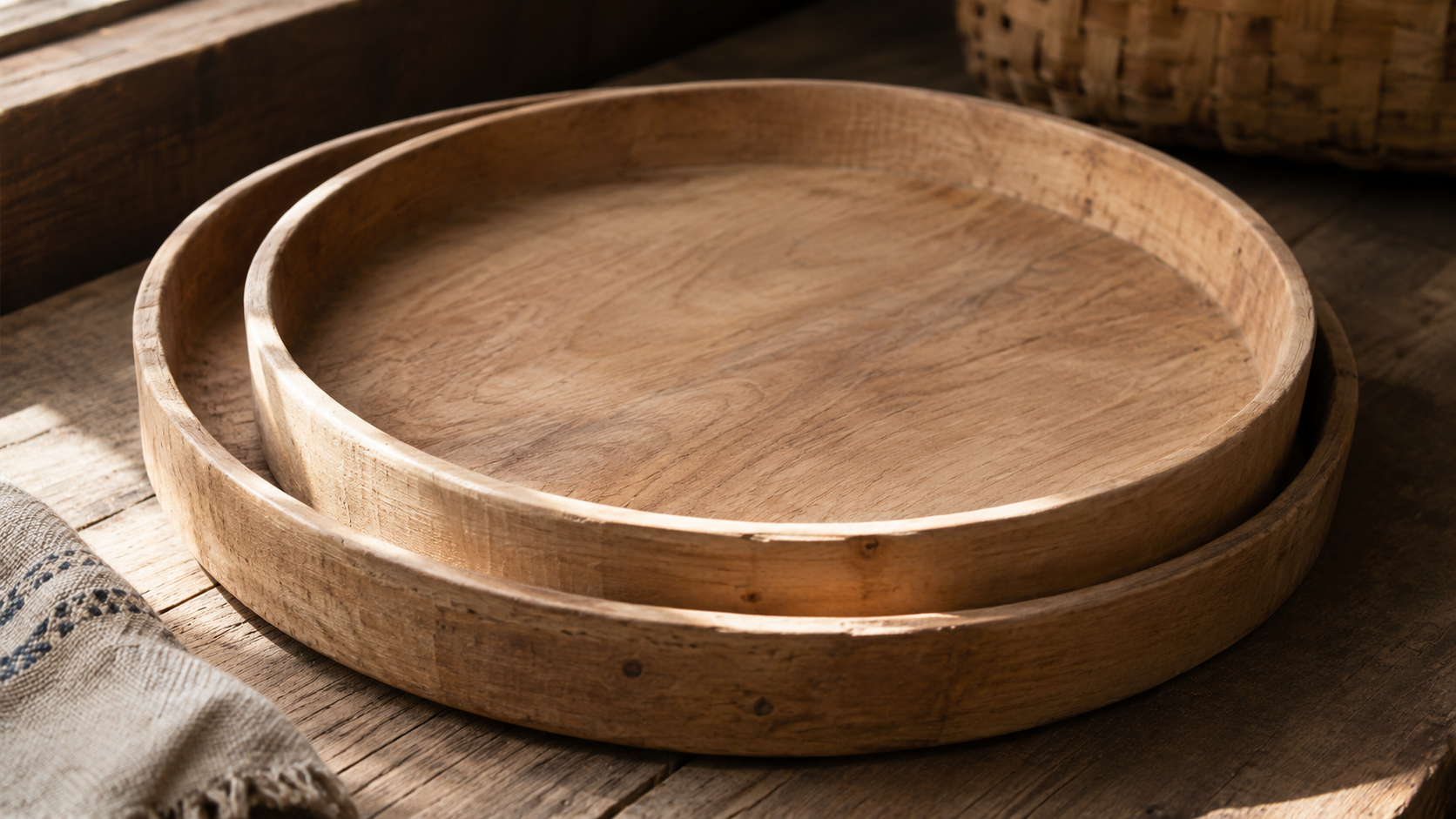
The story is not a blanket condemnation of borrowing. It asks what was reduced and what the available funds were intended to support. The conceptual wooden trays illustrate modest material surroundings; they do not reconstruct an authenticated meal, establish actual household costs or identify objects owned by Yozan.

Scene 04
Local resources and the encouragement of domestic production
Efforts were made to use resources within the domain for financial and rural recovery. Yonezawa City describes attempts to produce varied necessities locally, including paper, salt, tea and everyday vessels. The focus was broader than creating one celebrated specialty to represent the entire reform.
Producing nearby required materials and techniques as well as an intention to avoid purchasing everything from outside. The connection with livelihoods becomes visible here: goods people needed could also provide work. Encouragement of production therefore concerned practical activities close to everyday life, not simply a list of desirable commodities.
The city describes trial and error. An item proposed for local manufacture did not instantly become a profitable enterprise. The article retains that distinction between attempting production and demonstrating a successful result. No generated still life is treated as evidence of the origin, quality or profitability of a particular historical product.
Scene 05
Lacquer, mulberry and paper mulberry connected growers with production
Planting lacquer trees, mulberry and paper mulberry was one effort to establish an industrial foundation. Mulberry could feed silkworms, while paper mulberry supplied material for paper. The link between growing plants and using their products helps explain why the planting policy mattered beyond its name.
The municipal explanation describes participation extending beyond farmers to townspeople, temples, shrines and warriors. Some seedlings were supplied, and retainers and specialists provided instruction. Planting therefore involved relationships among those growing the materials, those guiding the work and the activities expected to use the eventual supply.
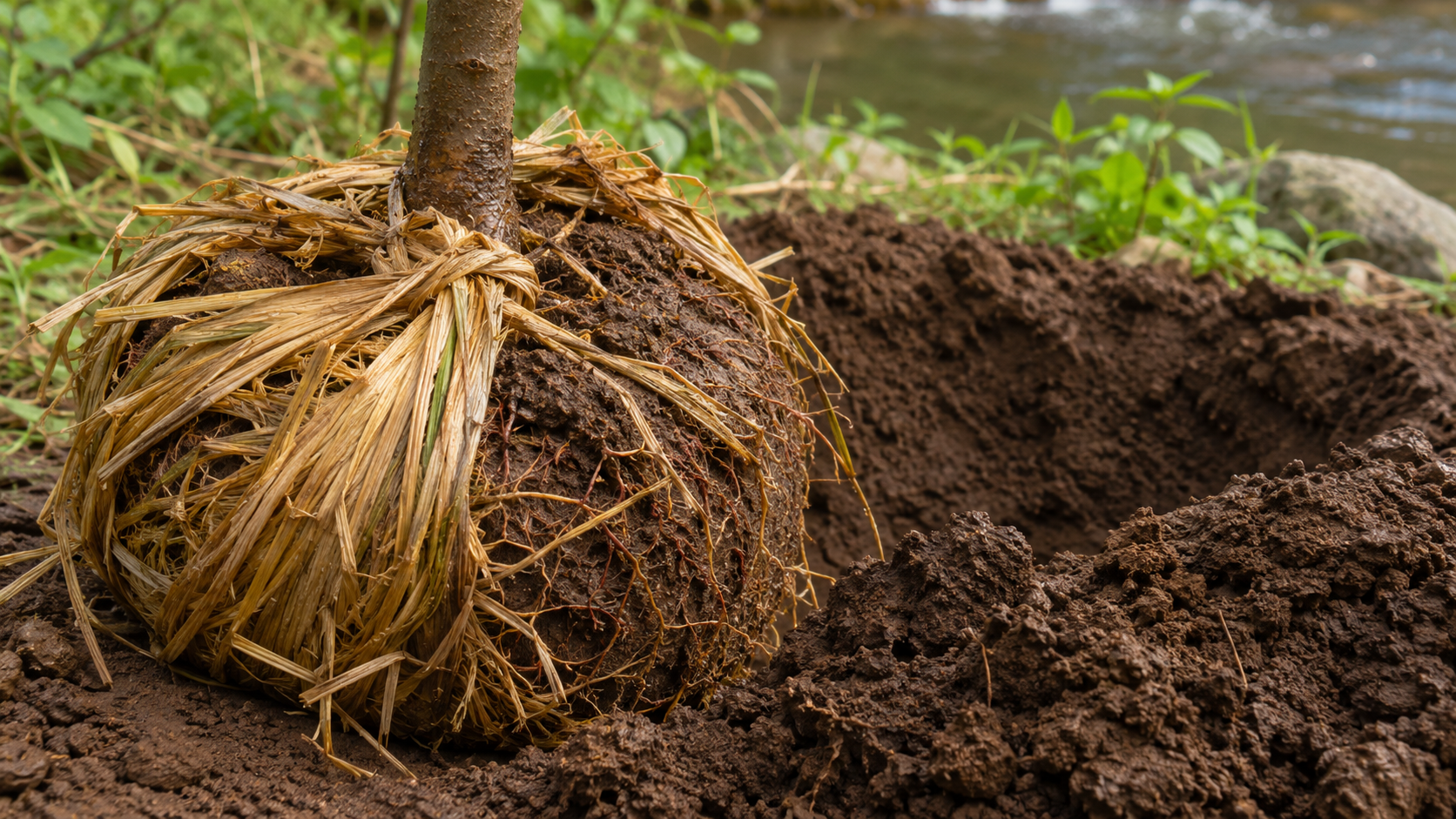
The plan is known through its million-tree terminology. That name is not a verified count of trees that were successfully planted, survived and generated income. The article treats a program’s target separately from its results, and the illustrative sapling is not presented as a botanical identification of one of the three crops.
Scene 06
From exporting material to finishing cloth
Yonezawa City explains that when Yozan became lord, cultivation of ramie fibre was encouraged and shipments to places including Echigo were central. The later emphasis extended beyond sending out raw material toward bringing techniques and skilled workers into the domain to finish textiles there.
Women in retainer households also participated in production, and activity developed into silk textiles. Materials, processing skills, makers, distribution and arrangements supporting quality had to be connected. A finished cloth depended on more than the presence of raw fibre or a policy encouraging people to weave.
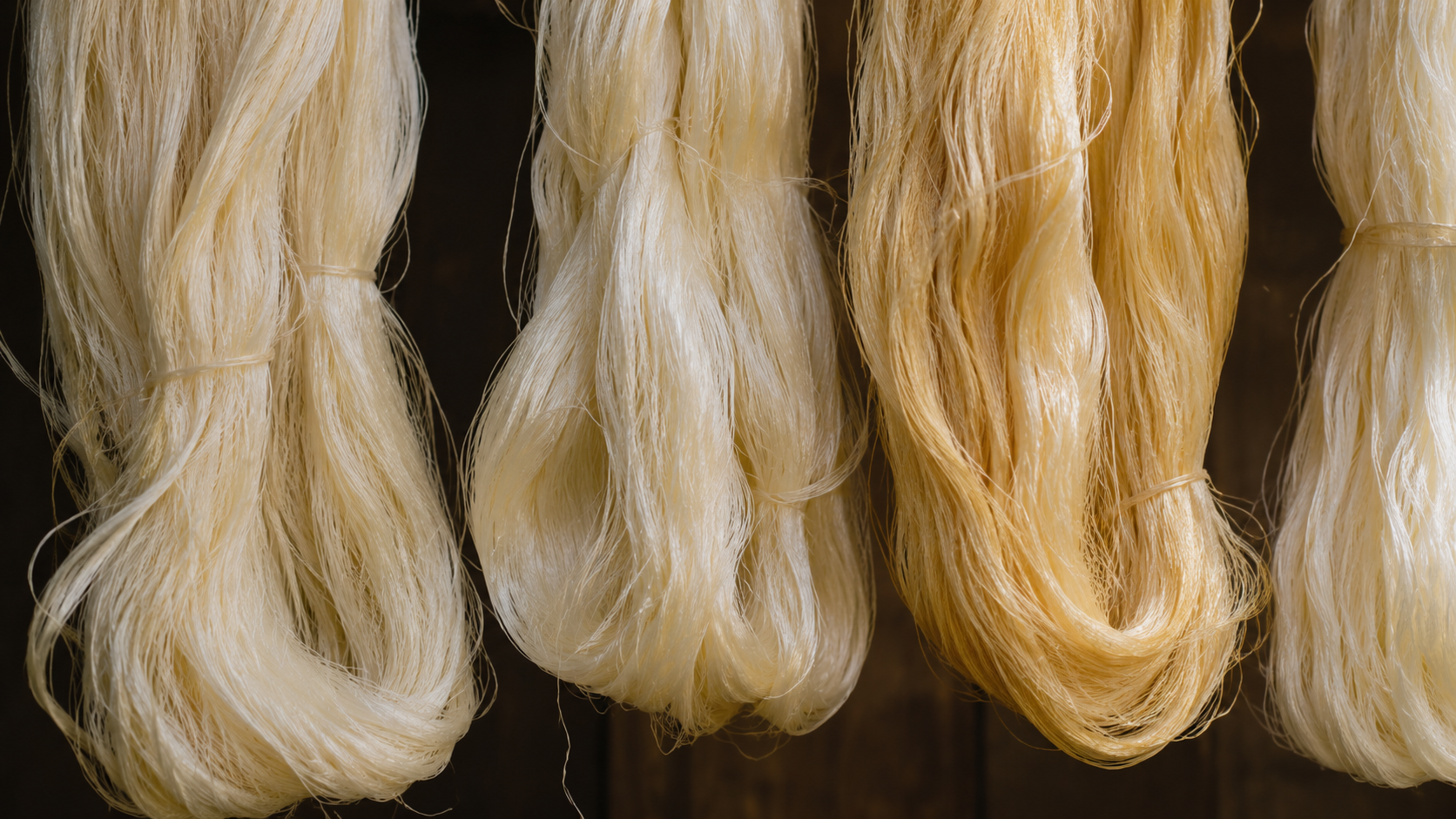
This was a way of developing income through productive work alongside restraint in spending. It did not make the process immediate or uniform. The fibres in the illustration provide a general visual context, without claiming to identify a specific historic material sample, workshop, production method or proven rate of return.
Scene 07
Delivering water to fields: Kuroi and Ana canals
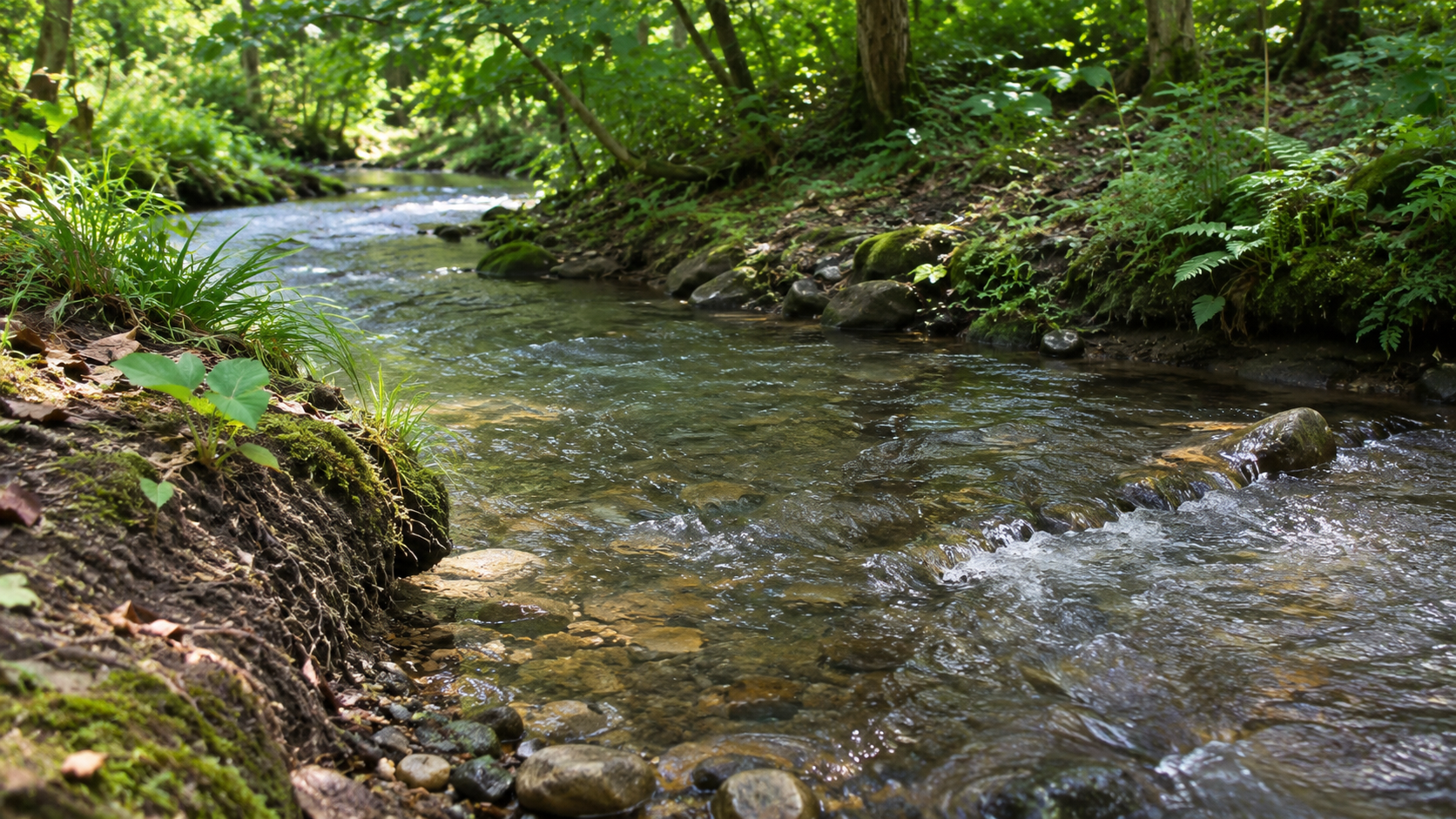
Water supply was an important rural undertaking. The Ministry of Agriculture, Forestry and Fisheries account describes Yozan ordering Kuroi Hanshiro to investigate water shortages associated with dry weather. The Kuroi and Ana canal works followed within the history of improving agricultural water supply.
Creating fields was insufficient if water was unavailable when crops needed it. Irrigation addressed a foundation of food production rather than merely changing an entry in the domain’s accounts. The importance of the undertaking can be explained through that role without assigning unverified yields or profits to the works.
Present-day watercourses should not automatically be treated as unchanged views of their original forms. Here their role is distinguished from exact routes, dimensions and a reconstruction of every historical feature. The conceptual stream does not establish the canal’s engineering, original landscape or the date of a particular construction stage.
Scene 08
Officials and specialists put reform into practice
Yozan did not carry out these activities alone. The Uesugi Museum explains the roles of senior officials, middle- and lower-ranking retainers, scholars and physicians. The work of such participants belongs within the explanation, rather than appearing only after the ruler’s personal resolve has supposedly accounted for everything.
Yonezawa City identifies Takenomata Masatsuna as a senior official who led reform. Its account connects him with financial support from merchants, cultivation encouragement, the invitation of textile specialists and the dispatch of officials into rural areas. Those activities linked plans with the people needed to carry them forward.
Fields and workshops did not change simply because a lord announced a policy. Investigation, instruction and coordination lay between an administrative intention and practical work. The illustration of joined wood is a conceptual comparison for connected activities; it is not evidence of a particular reform-era building or an individual official’s tools.

Scene 09
Kojokan and investment in learning
Education was another pillar of reform. Yonezawa City Library catalogues a letter associated with Kojokan’s establishment as a statement of purpose. Its description refers to the school’s opening in 1776 and to Yozan recording his views in response to a plan prepared by officials.
The catalogue supplies the document’s position and description, not an independently read transcription of the entire letter. Education can still be understood as part of developing people capable of learning and thinking about their work. It was connected with rebuilding the domain rather than an ornamental addition to the reform story.
The city’s education explanation describes inviting Hosoi Heishu, supporting study outside the domain and securing a special budget for Kojokan despite financial difficulties. Expenditure restraint could coexist with allocating funds to learning. No quotation or conversation is invented from the unread original letter to dramatize that relationship.
Scene 10
Conflict and interruption within a reform lasting over fifty years
A straight line from reform to success would leave out important difficulties. The Uesugi Museum identifies resistance among senior retainers, internal conflict, Takenomata’s fall and interruption associated with Yozan’s retirement. The city’s Takenomata account places his punishment and removal in 1782.
The museum describes reform continuing for more than fifty years through such crises. A single order or one round of saving did not transform every activity. Relations among the people carrying policies changed, and efforts could be interrupted. Continuity therefore needs to be understood alongside disruption.
The account includes time and multiple participants without claiming every project achieved the same result. This makes persistence a historical process to investigate, rather than proof that all difficulties disappeared through determination. The rain illustration is contextual, not evidence of an actual weather event accompanying the political disputes.

Scene 11
An exemplary ruler and a modern way of arranging the past
Yozan became widely remembered as an exemplary ruler. Understanding the reforms concretely, however, requires distinguishing praise from particular activities. Expenditure cuts, merchant finance, cultivation, textile techniques, water supply and education involved different participants and different lengths of time, even when later accounts grouped them under one ruler’s achievements.
Yonezawa City now presents such policies through sustainable regional development and the SDGs. That is a contemporary framework for reviewing the past. It should not be converted into Yozan’s own eighteenth-century vocabulary, a statement that he anticipated every modern category, or a quotation placed in his mouth.
The city’s environmental page discusses monuments honoring plants in the context of his era, explaining gratitude and memorial observance for cut vegetation. This is not evidence that Yozan personally erected every monument. Neither that discussion nor the modern category of environmental policy establishes words or intentions for him that the sources do not record.
Scene 12
Rebuilding the foundations of livelihoods and production
Was Yozan’s reform only about saving? The activities considered here show attempts to reduce expenditure and develop the capacity to produce at the same time. Water supply, cultivation, cloth-making, skills and learning belong within a shared account of rebuilding the domain’s productive and social foundations.
People delivering water to fields, growing materials, making cloth and transmitting techniques or learning were part of that history. Their work prevents the explanation from resting entirely on one person’s resolve. It also prevents one successful policy from being used as a substitute for examining the other activities.
Seen through these relationships, the reforms become a history of reconstructing livelihoods and production over time. Conflict, interruption and the limits of the evidence remain part of the account. The conclusion is an interpretation of connected undertakings, without adding an unsupported debt total, repayment date or quantified harvest to give it an artificial precision.
How to read this work
History, interpretation, and reconstruction
Yonezawa’s reforms combined frugality with production, irrigation and education through the sustained work of many participants over a long period.
This work is grounded in published sources and historical research. Interior thoughts, dialogue, and some visual details are cinematic reconstructions. Where historians disagree, the article presents the point as debated rather than settled fact.
Timeline
The story in time
-
Savings and merchant borrowing are used for investment in new activities.
Sources: city-economy -
Local products, lacquer, mulberry and paper mulberry cultivation, textile techniques and skilled workers; plans are distinguished from results.
Sources: city-economy, takenomata -
Kuroi Hanshiro’s investigation and the Kuroi and Ana canals; no exact work dates or routes established here.
Sources: water -
Takenomata Masatsuna falls from office.
Sources: takenomata -
Reform continues through conflict and interruption with multiple participants.
Sources: museum -
The Uesugi Museum presents Yozan’s relationship with retainers; this is not a current exhibition announcement.
Sources: museum -
Yonezawa City arranges policies through education, economy, society and environment; these categories are distinguished from the historical actor’s own words.
Sources: city-intro, education, environment
People & terms
A guide for new readers
Glossary
- Han 藩
- The domain setting within which the lord, officials, retainers and residents had different roles.
- Kenyaku 倹約
- Frugality or restraint in expenditure, considered here alongside investment.
- Kozo 楮
- Paper mulberry, a source of material for paper.
- Aoso 青苧
- Ramie fibre, described in the textile-production context and distinguished from silk.
- Kojokan 興譲館
- The domain school whose opening in 1776 is described by the library catalogue.
- Somokuto 草木塔
- A monument associated with gratitude and memorial observance for plants; the city’s explanation does not establish Yozan as the builder of every example.
Sources & method
How this article was built
The completed video’s twelve selected chapters provide the sequence. Eight substantive institutional references are used, issued by the city, museum, library and agricultural ministry. Different municipal pages serve different contextual purposes rather than becoming independent original eyewitness records.
The policy descriptions and relevant catalogue information were read. The school letter itself and the domain’s accounts are not claimed to have been fully read. Debt totals, modern monetary conversion, a complete-repayment year, quantified profits and exact canal reconstruction are not supplied.
Planting plans and results, actors and later reputation, and historical explanations and the city’s contemporary SDG framework are distinguished. Twelve approved generated stills are separately adopted as general article illustrations. Original documents, photographs, diagrams and audio are not reproduced.
Sources
References and further reading
- Uesugi Yozan and the SDGs 上杉鷹山とSDGs Title translated editorially for reader convenience. Yonezawa City 米沢市 Accession in 1767 and the range of policies. SDGs are a modern interpretation, not Yozan’s own terminology; no source photographs or diagrams reproduced. Accessed 2026-11-04
- Uesugi Yozan and the SDGs: Economic activities 上杉鷹山とSDGs 経済の取り組み Title translated editorially for reader convenience. Yonezawa City 米沢市 The body was read for savings, borrowing and investment, local production, planting and textiles. Targets are not treated as successful tree counts. This is not an independent accounting audit or profit measurement. Accessed 2026-11-04
- The life of Uesugi Yozan: Domain reform and retainers, 2021 exhibition 上杉鷹山の生涯 藩政改革と家臣団(2021年特別展) Title translated editorially for reader convenience. Yonezawa City Uesugi Museum 米沢市上杉博物館 Officials, scholars and physicians; opposition, removal, retirement-related interruption and more than fifty years of reform. The exhibition name follows the body despite a different browser title. No current event claim or source illustrations reproduced. Accessed 2026-11-04
- Uesugi Yozan and irrigation in Yonezawa domain 米沢上杉藩の水を拓いた上杉鷹山 Title translated editorially for reader convenience. Ministry of Agriculture, Forestry and Fisheries 農林水産省 The saved body was read for Kuroi Hanshiro and the Kuroi and Ana canals. An inconsistent birth-year era, territorial wording, Kennedy anecdote, quotation and repayment claims are not adopted. Present canals are not treated as complete original landscapes. Accessed 2026-11-04
- Takenomata Masatsuna’s grave: Exploring the castle town 竹俣当綱の墓 城下町ふらり歴史探訪 Title translated editorially for reader convenience. Yonezawa City 米沢市 The saved body was read for official responsibility, merchant support, cultivation, specialists, rural officials and the fall in 1782. No independent transcription of the entire epitaph or profit review for all policies is claimed. Accessed 2026-11-04
- Yozan’s school-foundation statement of purpose, AC067001 鷹山公学校設立御趣意書 AC067001 Title translated editorially for reader convenience. Yonezawa City Library 市立米沢図書館 Catalogue information was read for the opening in 1776 and the letter responding to officials’ plans. The entire original letter was not independently read or transcribed; no quotation invented. Accessed 2026-11-04
- Uesugi Yozan and the SDGs: Developing people 上杉鷹山とSDGs 人材育成の取り組み Title translated editorially for reader convenience. Yonezawa City 米沢市 Hosoi Heishu, outside specialists, study beyond the domain and a special school budget. Not equated with modern institutions; no diagram or statue photograph reproduced. Accessed 2026-11-04
- Uesugi Yozan and the SDGs: Environmental activities 上杉鷹山とSDGs 環境の取り組み Title translated editorially for reader convenience. Yonezawa City 米沢市 The body was read for the contextual discussion of plant monuments. Modern environmental categories and memorial explanations are distinguished. This is not evidence that Yozan built every monument; no photographs reproduced. Accessed 2026-11-04
Continue reading
More stories from Shigeki
Shigeki English
The Battle of Minatogawa: How Was the Defeated Masashige Remembered?
Separate the time of fighting from the times when records, images and memorials were made.
- When The battle in 1336; a report dated 1337; commemoration in 1692 and 1857; the tunnel, park and statue of the modern city
- Where Minatogawa and Kobe, considered alongside documents, war narratives and later images held or described by several institutions
Shigeki English
Railway Opening and the Takanawa Embankment: Where Trains and Boats Crossed
An embankment carrying trains into the sea also raised the question of keeping a way to the water.
- When Construction in the early 1870s, railway opening in 1872, later widening and reclamation, rediscovery in 2019 and additional designation in 2021
- Where The former coast at Takanawa between Shimbashi and Shinagawa, along the Shimbashi–Yokohama railway