
SHIGEKI ENGLISH STORYEN
Japanese history in English
Kanagawa Battery: Stone Walls and Technology beside the Opening of Yokohama
Opening a port and defending its waters proceeded along the same coast.
Explore Kanagawa Battery, completed in 1860 after Yokohama opened to foreign trade. Follow the defense order, construction by Iyo Matsuyama domain, three bastions, Manazuru stone, backfill and two approach roads, while distinguishing excavated structures from unconfirmed foundations, ceremonial salutes and later reclamation.
At a glance
Before you enter the story
- When
- The defense order of 1857, Yokohama’s opening and construction in 1859, completion in 1860, abolition in 1899 and later archaeological investigation
- Where
- The former shoreline of Kanagawa in Yokohama, distinct from the Shinagawa batteries in Tokyo
- Key figures
- The Tokugawa shogunate, Iyo Matsuyama domain, Katsu Kaishu
- What was at stake
- Why build an armed coastal installation beside a port being opened to foreign exchange, and what can its surviving stonework reveal?
Why this story matters
The larger history behind the turning point
Yokohama’s opening was also a problem of security, ceremony and construction. A battery beside the port shows these activities taking place in the same coastal setting. Its walls connect high-level orders with the people, stone, earth and routes needed to give a facility physical form.
The distinction between the battery’s main enclosure and its approach roads matters when interpreting excavation. Evidence from one location cannot automatically establish the structure of another. That discipline also helps separate Kanagawa from Shinagawa and an original feature from a later relocated stone display.
Historical context
What an international reader needs to know
A battery was part of a changing coastal landscape
A daiba was a fortified position for cannon. The familiar place name Odaiba in Tokyo refers to a different setting from Kanagawa Battery in Yokohama. Their related defensive purposes do not make them one construction project, nor do they make photographs of their surviving remains interchangeable.
The shoreline itself changed through reclamation and urban development. A present-day street map alone cannot reproduce the facility’s former relationship with the sea. Historical plans, later photographs and archaeological remains each preserve different information, from different moments, rather than a single unchanged view.
How to read construction evidence
The main battery, its east and west approach roads, visible wall faces and structures below those faces require separate questions. Excavation has revealed important details, but the cited archaeological bulletin explicitly leaves the foundation beneath the main battery’s wall unconfirmed. Evidence from a different battery cannot fill that gap by assumption.
Institutional explanations attribute design to Katsu Kaishu and construction to Iyo Matsuyama domain. Those attributions do not reconstruct every worker’s activity or every stage of building. The illustrations here are conceptual scenes, while the article identifies which claims come from municipal explanations, archaeological reporting or comparative contextual sources.
Watch the film
See the story in motion
The film currently uses Japanese audio. This English article provides the context and source trail; it does not imply that an English subtitle track is available.
Scene 01
Why put cannon beside a newly opened port?
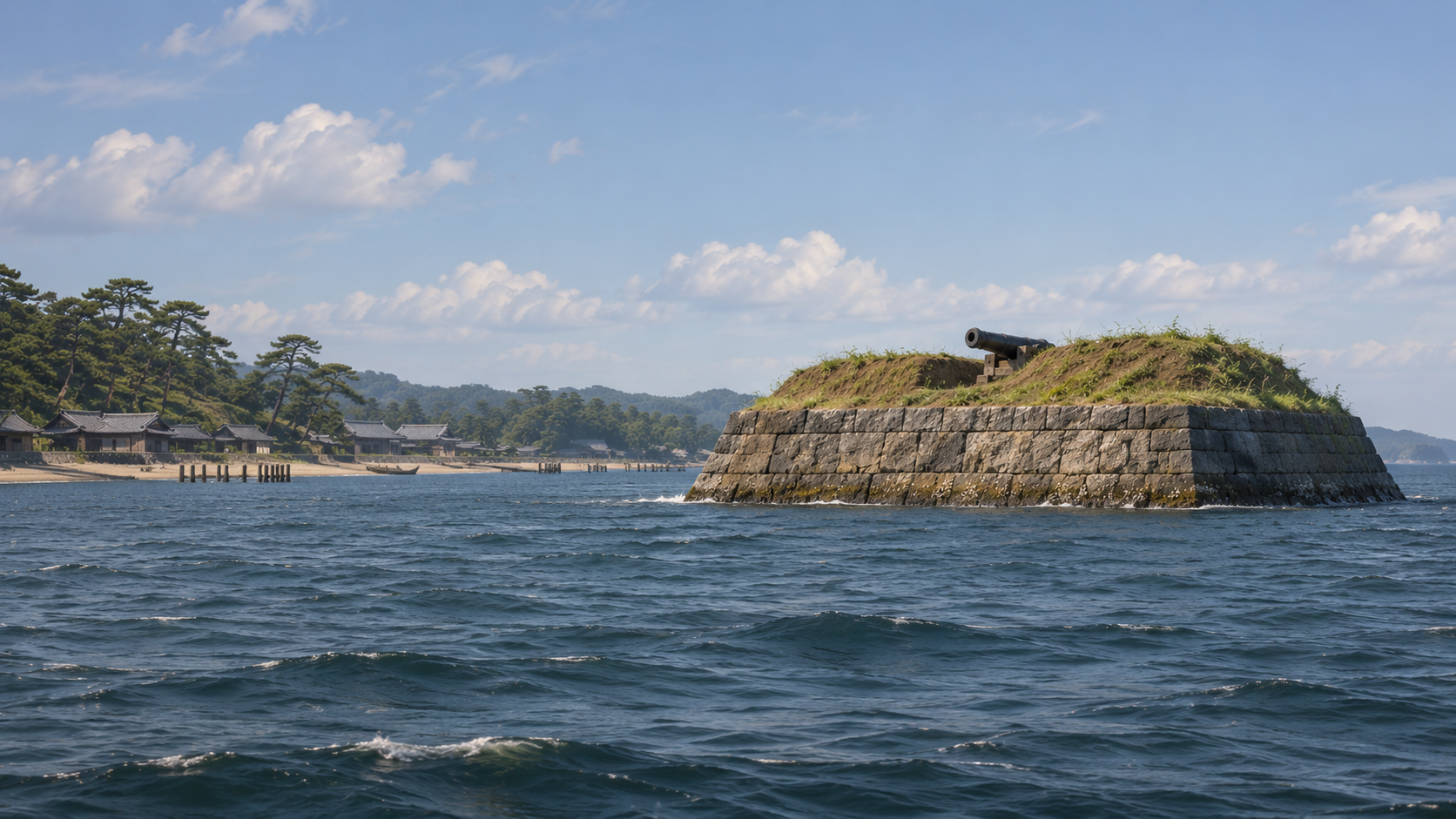
The year after Yokohama opened as a port, a coastal battery was completed nearby. This was Kanagawa Battery. Its presence raises a question about the opening itself: why did a place welcoming exchange with foreign countries also need a facility equipped with cannon?
Opening the port and guarding the sea were activities undertaken within the same landscape. They should be considered together, rather than placed in entirely separate stories. The battery helps make the overlap visible, connecting maritime security with the practical work of constructing and maintaining a coastal installation.
The account follows the battery’s outline and the stone walls remaining underground. It does not treat the generated illustration as a photograph of the original facility. The point is to understand a relationship among the port, the coast and construction, while keeping the different kinds of evidence identifiable.
Scene 02
Kanagawa and Shinagawa were different facilities
The word daiba may bring Tokyo’s Odaiba to mind. The setting here, however, is Kanagawa in Yokohama. The two sites differed in location and construction history, even though both belonged to the history of coastal batteries. Confusing them can also produce mistaken claims about materials or foundations.
The Yokohama archaeological center’s explanation places the beginning of the Shinagawa battery works in 1853–1854. Kanagawa Battery was built after Yokohama opened. Their defensive settings were related, but neither the dates nor the circumstances should be merged into one project with one uniform sequence.
The official Tokyo park history describes the designation of the third and sixth Shinagawa batteries as national historic sites in 1926 and the opening of the third as a park in 1928. That is a separate preservation history. A photograph of the Tokyo park cannot serve as a photograph of Kanagawa Battery.
Scene 03
A defense order, construction and completion were separate steps
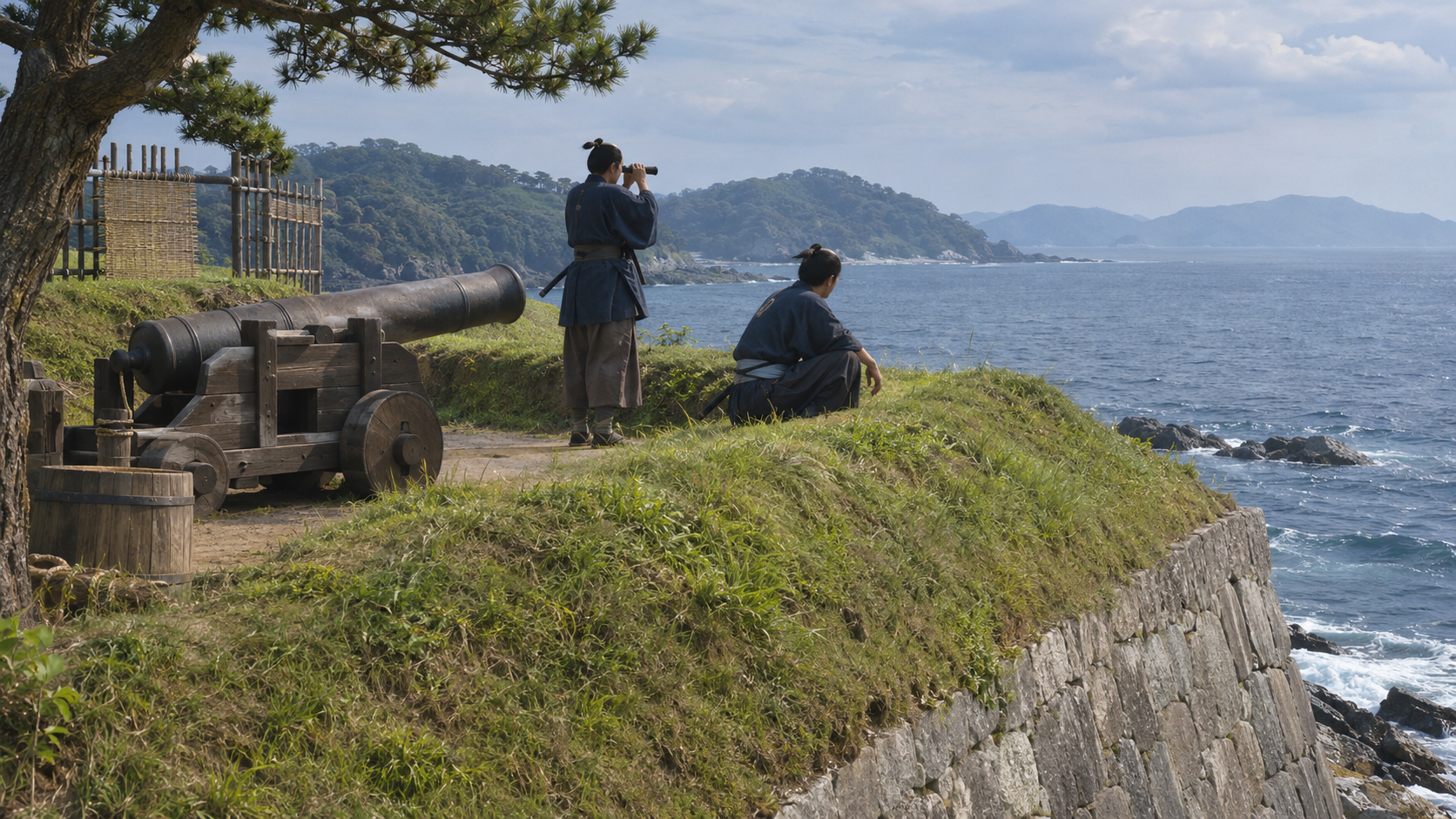
Yokohama City’s chronology records an order from the shogunate to Matsuyama domain to guard Kanagawa in 1857. It then places the start of Kanagawa Battery’s construction in 1859, the same year as Yokohama’s opening. These entries describe stages in a process rather than one instantaneous decision.
Completion followed in 1860, the first year of the Manen era. The earlier guard order, the port’s opening and the finished battery therefore have different dates. Keeping them distinct makes it possible to see security preparations and construction overlapping through time without assigning every activity to the opening day.
The chronology supplies the ordering of those events. It does not, by itself, recover a day-by-day account of the works or every person who participated. The interpretation rests on the sequence it actually provides, with no invented schedule or dialogue added to make that sequence appear more complete.
Scene 04
Shogunal orders and work by Iyo Matsuyama domain
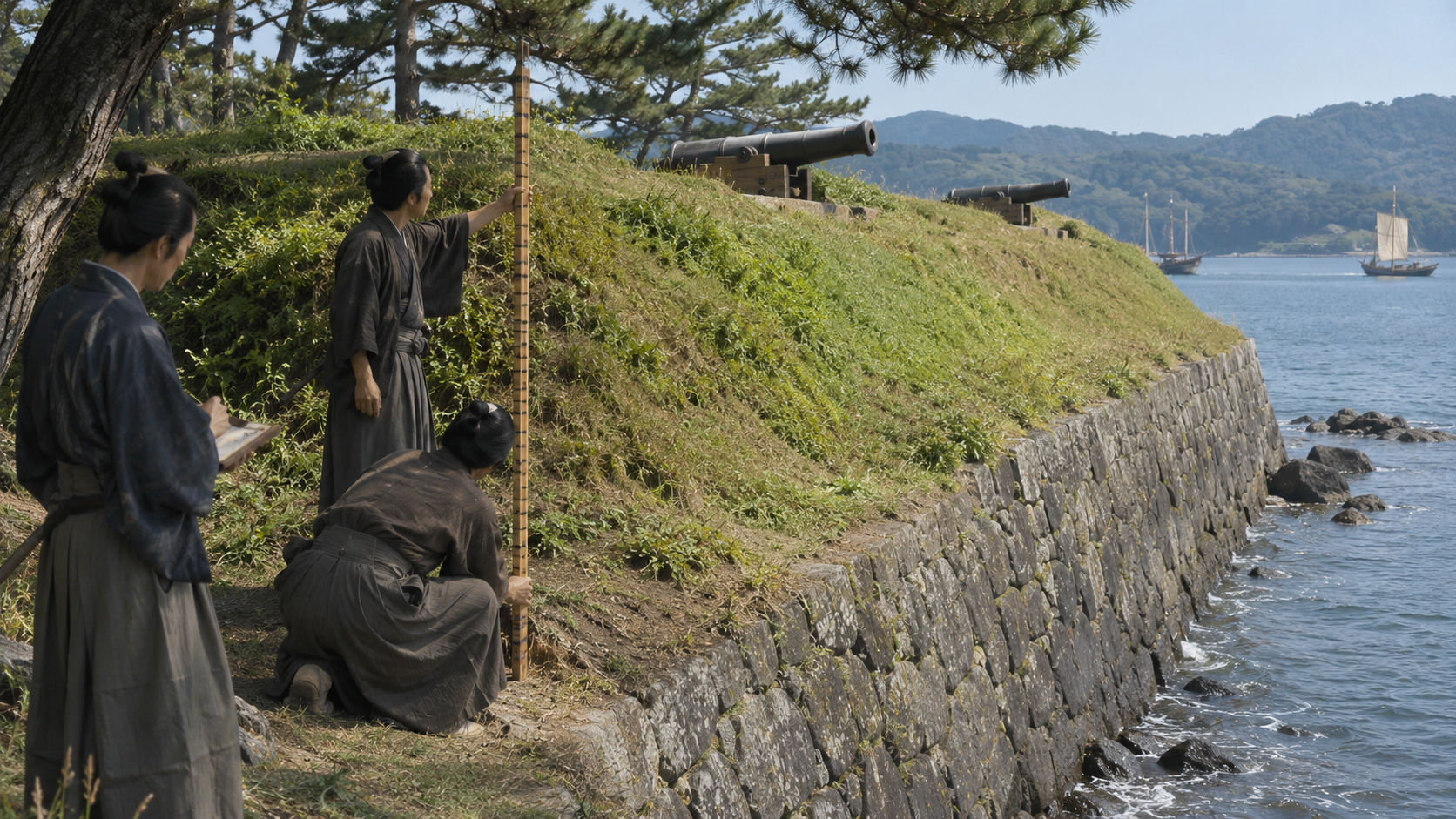
Yokohama City explains that the shogunate ordered Iyo Matsuyama domain to build the battery, using a design attributed to Katsu Kaishu. Naming the designer is useful, but it does not exhaust the history of construction. The institution ordering a project and those responsible for carrying it out occupy different roles.
Stone had to be assembled by the shore, earth placed behind it and the facility brought into shape. Such work required people and materials, not simply a finished drawing. Considering those tasks connects the shogunal order with the domain responsible for construction, without claiming to reconstruct individual workers’ experiences.
A 2017 prefectural archaeology lecture document, presented by a Yokohama Board of Education lecturer, identifies Iyo Matsuyama as the construction domain and lists stone walls and approach roads among the remains investigated. Design attribution, responsibility for building and the particular objects confirmed by excavation answer related but separate questions.
Scene 05
Three bastions and a half-star outline
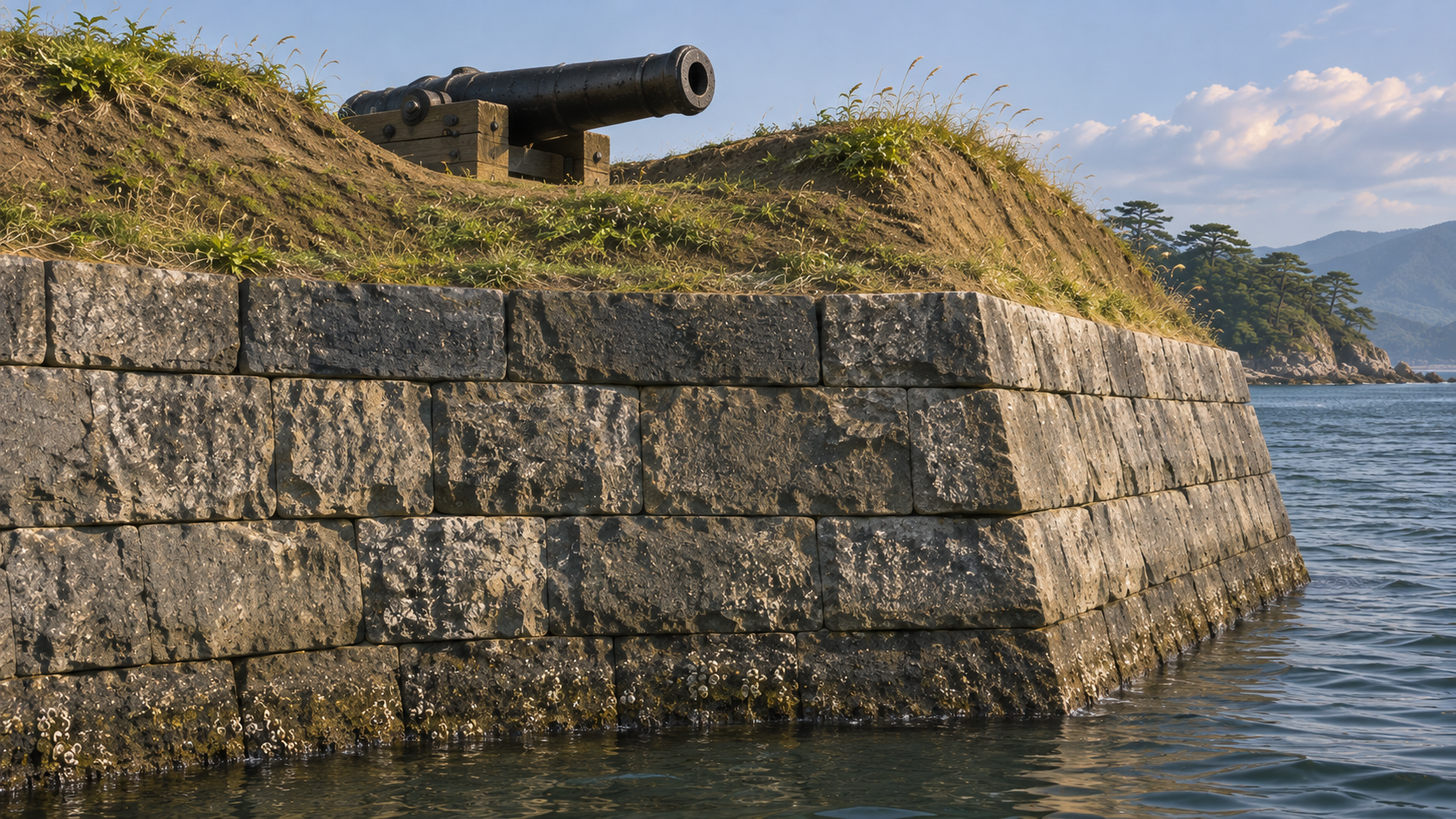
Kanagawa Battery projected into the sea, but describing it as a simple circular arc would lose part of its character. Issue 39 of Maibun Yokohama explains a half-star form with three bastions. The outward projections were part of the enclosure’s distinctive shape, not incidental decoration on an otherwise featureless boundary.
The plan reproduced in the bulletin shows an indented outline and an interior space. Cannon facing toward the sea and the earthworks surrounding the facility formed parts of a defensive arrangement. Reading those elements together is more useful than isolating a single gun or a single stretch of attractive masonry.
The reproduced historical drawing is evidence presented within a modern archaeological publication. It is not an original plan newly examined here in an archive, and its image is not reproduced in the article. The conceptual illustration likewise supplies neither exact dimensions nor a measured outline of the entire battery.
Scene 06
Manazuru stone and the supply of materials
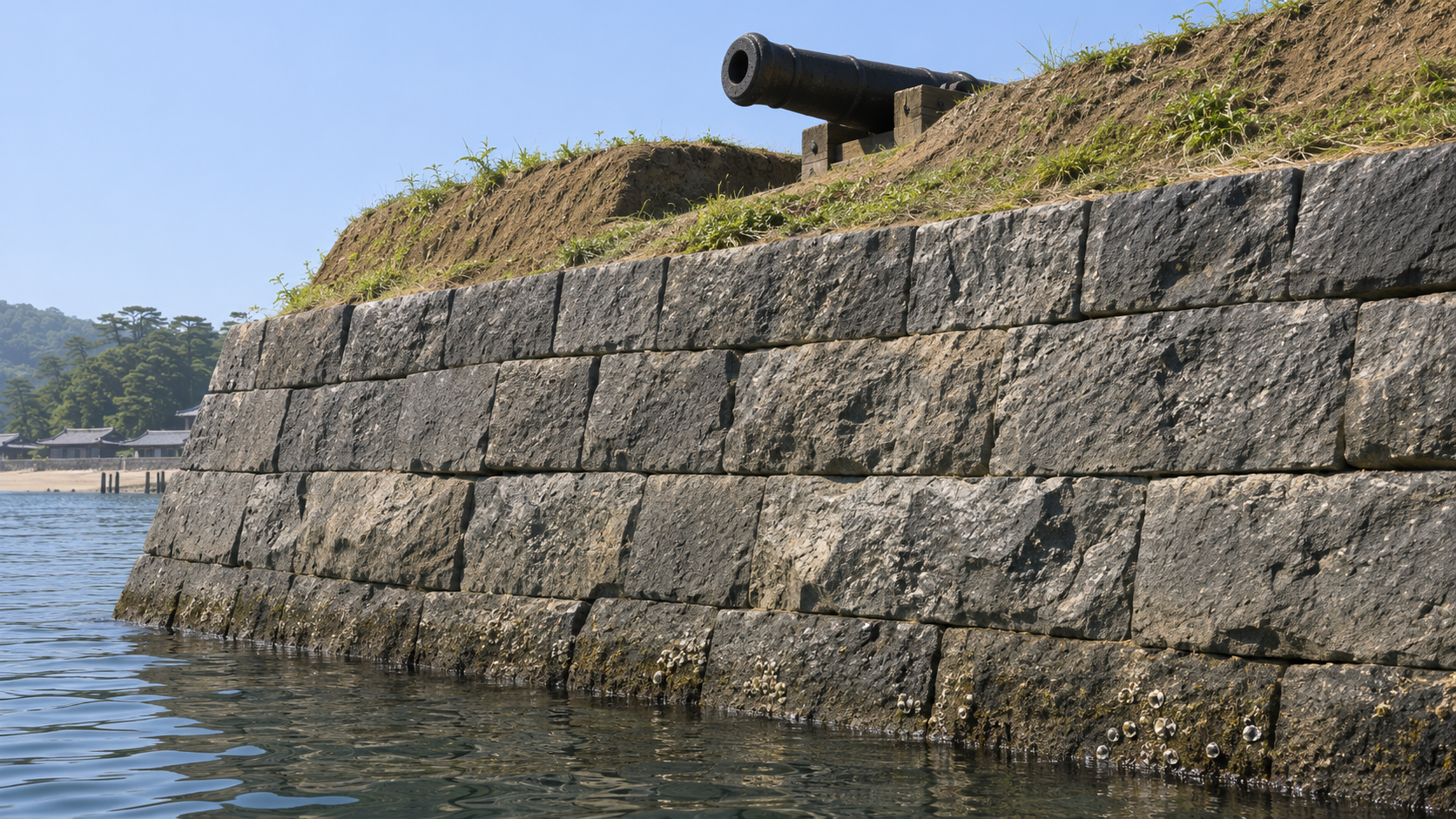
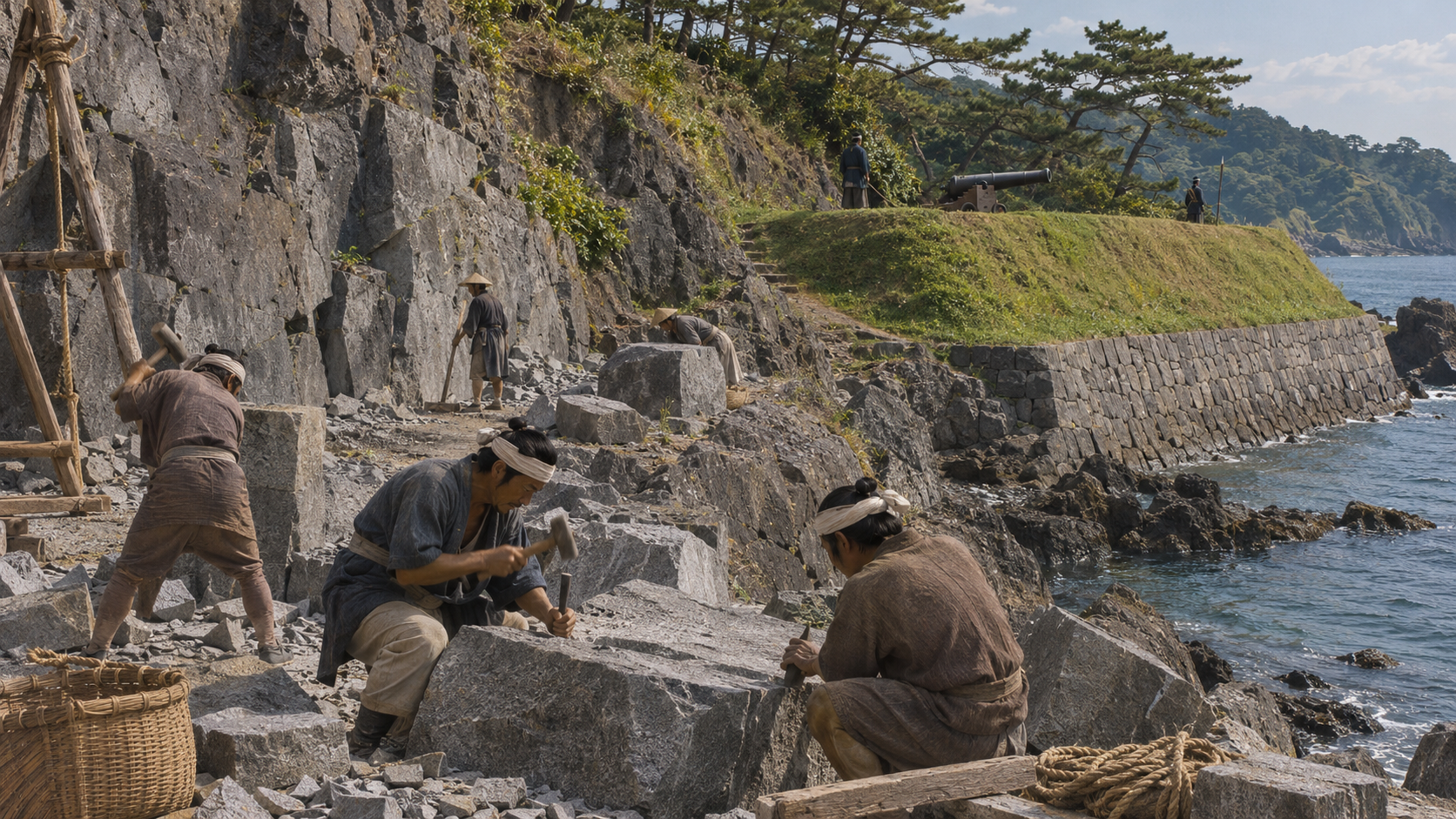
What stone was used in the walls? The Yokohama archaeological center explains that andesite from the Manazuru Peninsula was used predominantly at Kanagawa Battery. Looking only at the finished wall can conceal the work needed to obtain the material before it could become part of a coastal structure.
The stones were not all supplied from within the battery’s own footprint. Their use points toward connections between a producing region and a building site. This is a material dimension of coastal defense: the facility depended on supplies reaching the place where the wall and earthworks were being assembled.
Hakone Geopark’s quarry explanation describes wedge holes on the coast and the history of andesite production, including different names associated with peninsula and inland stone. That regional context does not identify every battery block’s exact quarry or prove a complete transport route. A broader quarry history and an individual stone’s provenance remain different claims.
Scene 07
The wall face and the structures behind it
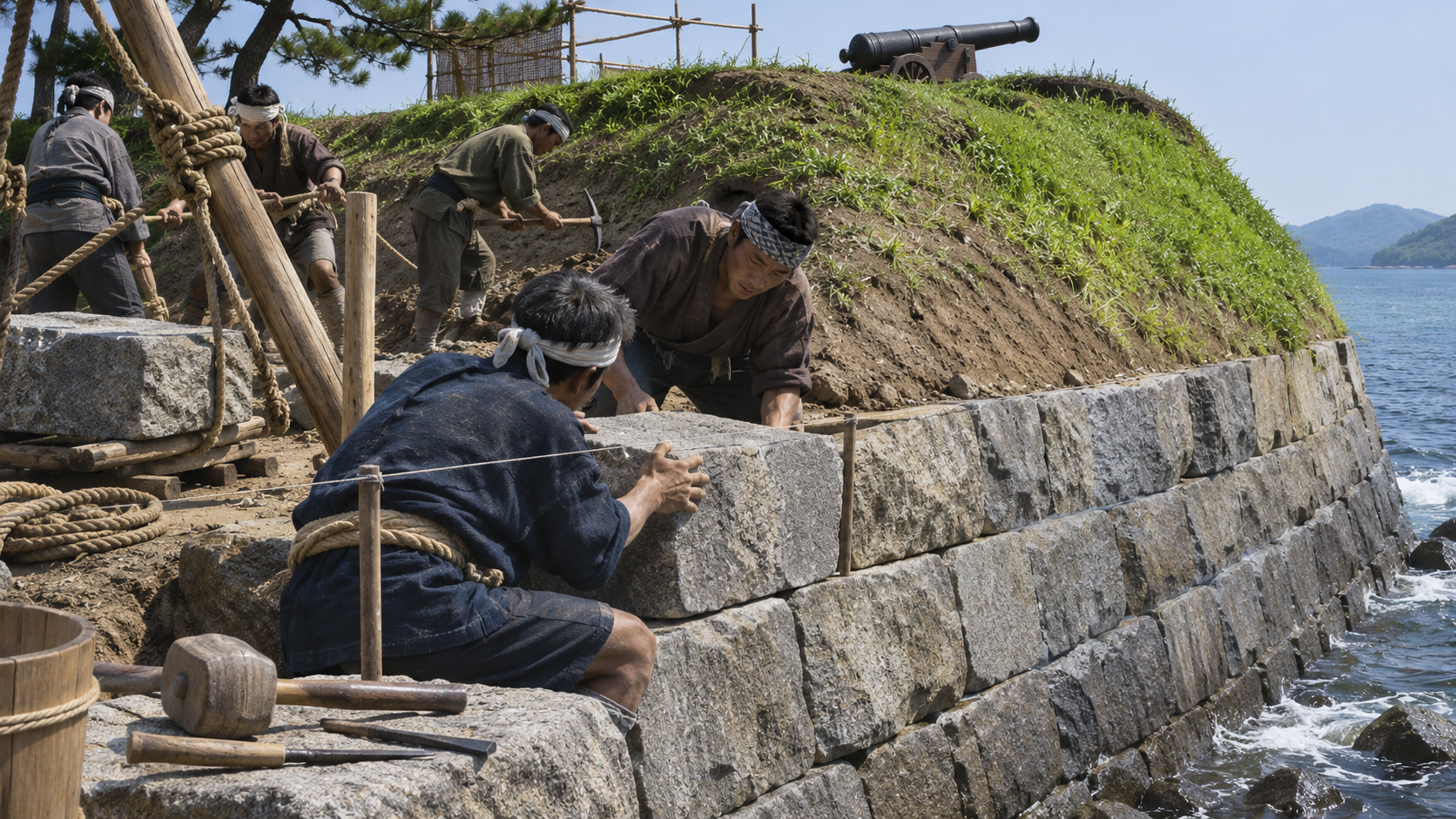
A stone wall consists of more than the stones visible on its surface. The archaeological reporting in issue 39 shows other stone and smaller rubble placed behind the facing stones. These materials matter when considering how a finished wall was supported, rather than regarding its surface as the whole structure.
The facing stones, the supporting material behind them and the ground below them are distinct parts of the problem. A visually orderly outer face does not reveal every layer carrying weight or helping stabilize the stones. Construction can therefore be investigated by following relationships that are largely hidden from a casual external view.
The article uses that distinction to explain the technique, while retaining the limits of the excavated evidence. It does not claim that the illustration reveals an exact section through the original battery. Nor should confirmed backing materials be mistaken for proof of every structure deeper beneath the main enclosure’s wall.
Scene 08
Two approach roads connected land and battery
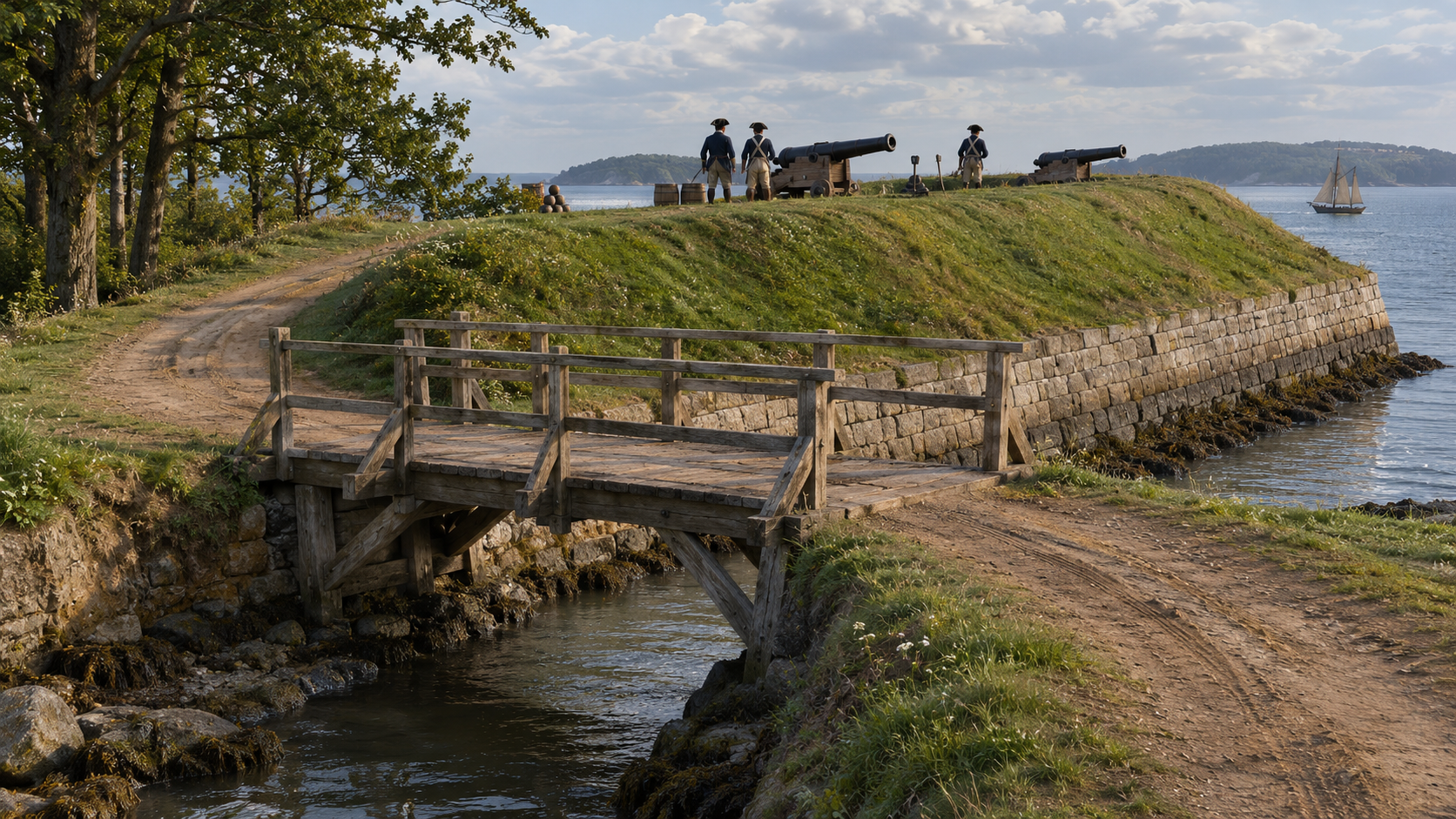
Two approach roads extended from the battery toward the land, one on the east and one on the west. They formed connections through which people and materials could reach the main installation. The battery should not be imagined solely as a detached island without working links to the shore.
Investigations of the western approach confirmed parts associated with an interruption in the road, a bridge and a water passage. Those observations concern particular portions of the approach. The route used for movement could have structural features different from those of the battery’s main body, despite belonging to the same overall facility.
The distinction has consequences for reading excavation results. A finding about the west approach does not automatically describe the entire enclosure or its foundations. Keeping the locations visible within the explanation makes the surviving evidence more informative, because each observation can be related to the part of the site it actually concerns.
Scene 09
The foundation beneath the main wall remains unconfirmed
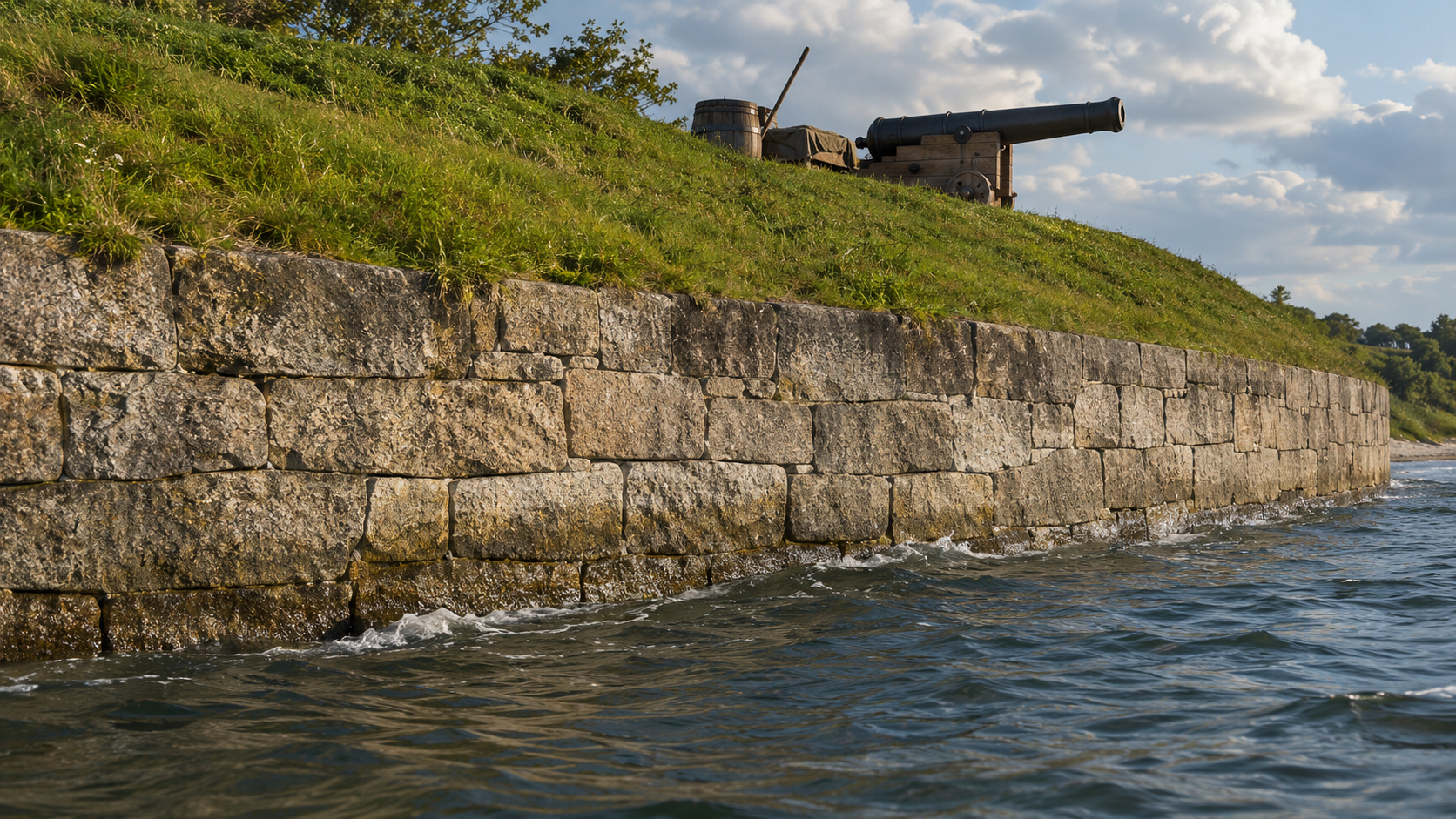
What lay below the main battery’s stone wall? The account must distinguish what has been established from what has not. Issue 39 states that the structures beneath that wall had not been confirmed by excavation. That limit belongs in the history of the site alongside the discoveries the investigations did make.
Piles or timber foundations found at another battery cannot simply be drawn beneath Kanagawa’s main wall as if they had been discovered there. Similar function is insufficient evidence of identical construction. A persuasive-looking reconstruction could otherwise turn comparison into a false statement about an excavated feature.
Investigations have examined layered structures at the approach roads. Those are useful observations in their own locations. The difference between the approach roads and the main battery therefore remains central: evidence should be assigned to the place investigated, with the unresolved foundation left unresolved rather than completed by analogy.
Scene 10
Coastal defense and diplomatic ceremony
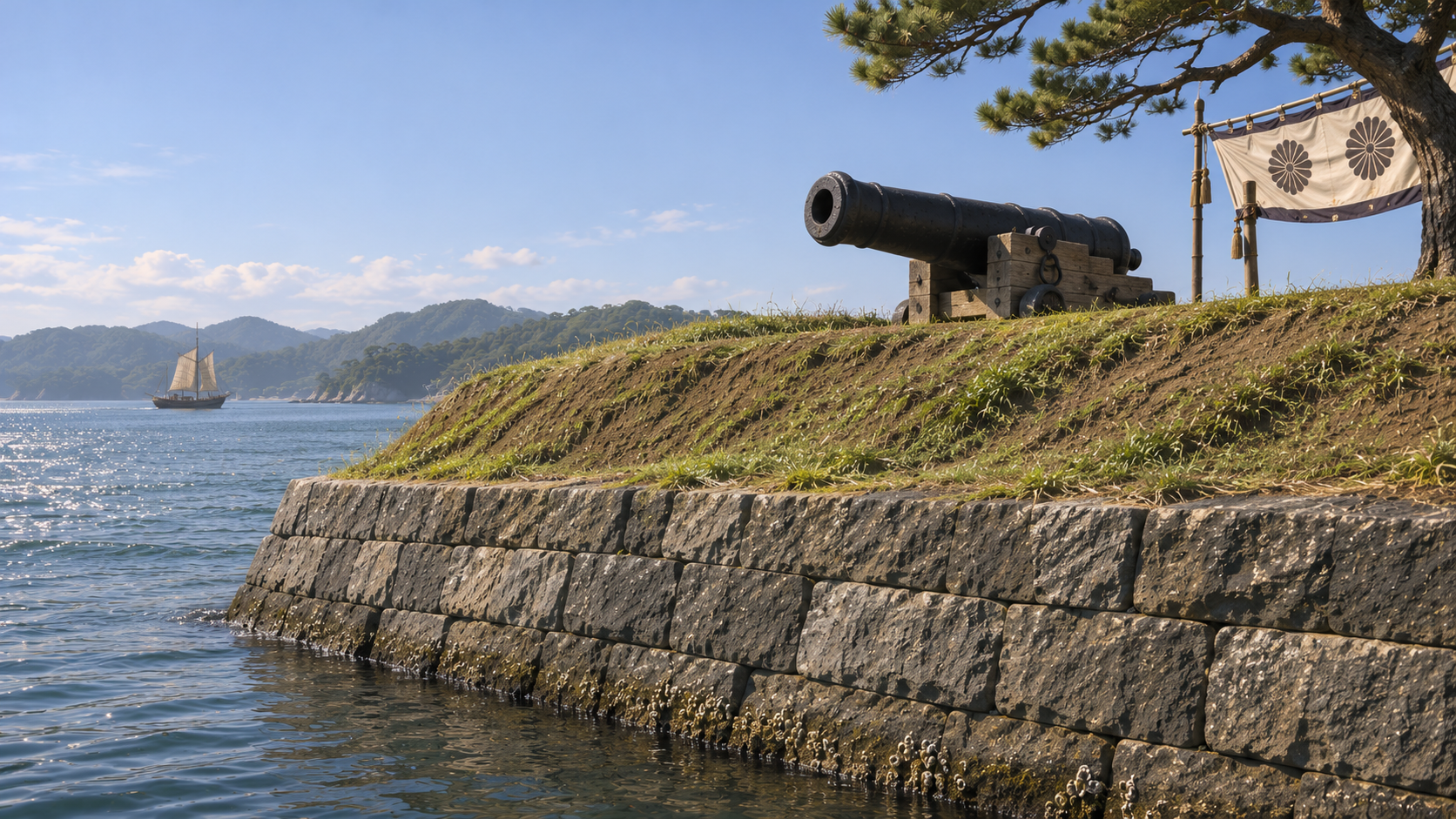
Were the cannon used only for fighting? Kanagawa Battery also fired celebratory and ceremonial salutes. Its role included diplomatic ritual as well as the defense of the waters near an open port. This combination helps explain why cannon and international exchange belonged within the same coastal setting.
The archaeological bulletin also discusses the relationship with Yokohama’s foreign settlement. Management and use changed between the late shogunate and the Meiji period, so the installation should not be treated as remaining institutionally unchanged from completion to abolition. Different purposes and different moments need to be considered together.
Yokohama Customs’ 2019 leaflet describes the establishment of the Kanagawa Unjosho in 1859. This was a different facility concerned with trade and cargo administration. Its shared Kanagawa name does not make it the battery. Security, salutes and customs administration were distinct activities associated with the opening of the same port.
Scene 11
Abolition, reclamation and stones above and below ground
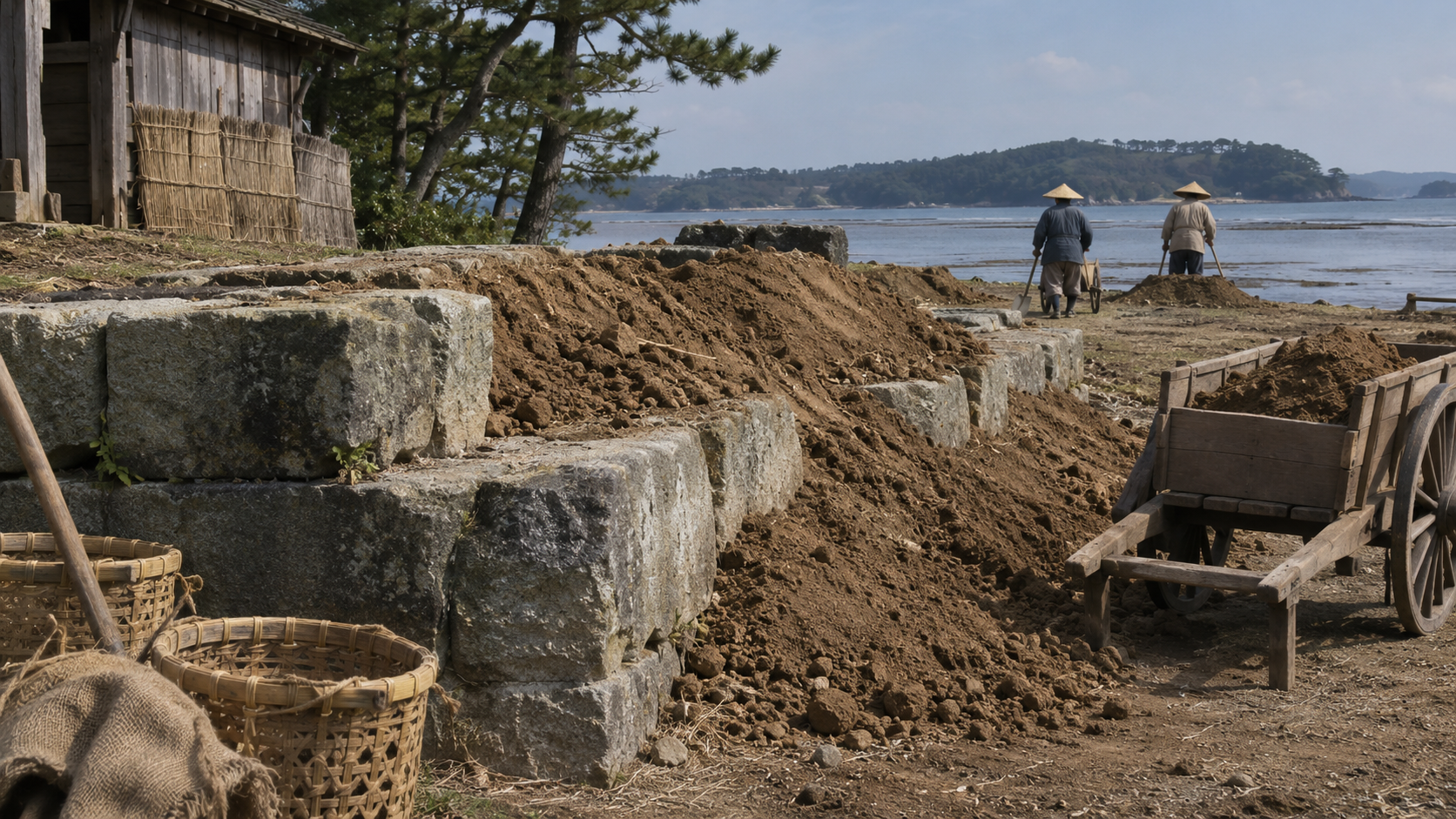
The battery was abolished in 1899, and reclamation subsequently transformed its surroundings. A facility once facing the sea became incorporated into an evolving urban landscape. Its historical outline cannot be recovered merely by assuming that the present shoreline and streets preserve the relationship they had when the battery was built.
Stones remaining in their original locations must also be distinguished from stones relocated for display. Buried remains, historical drawings and later photographs supply different evidence. They can be compared to understand the lost outline, but they do not show one date or one kind of survival simply because all concern the same site.
The walking map in issue 39 belongs to its publication in 2019 and does not guarantee current access. The bulletin also estimates that a postcard view of the west approach was photographed after 1899. A post-abolition view must not be presented as a photograph taken immediately after the battery’s completion in 1860.
Scene 12
Reading the opening of Yokohama through land and technology
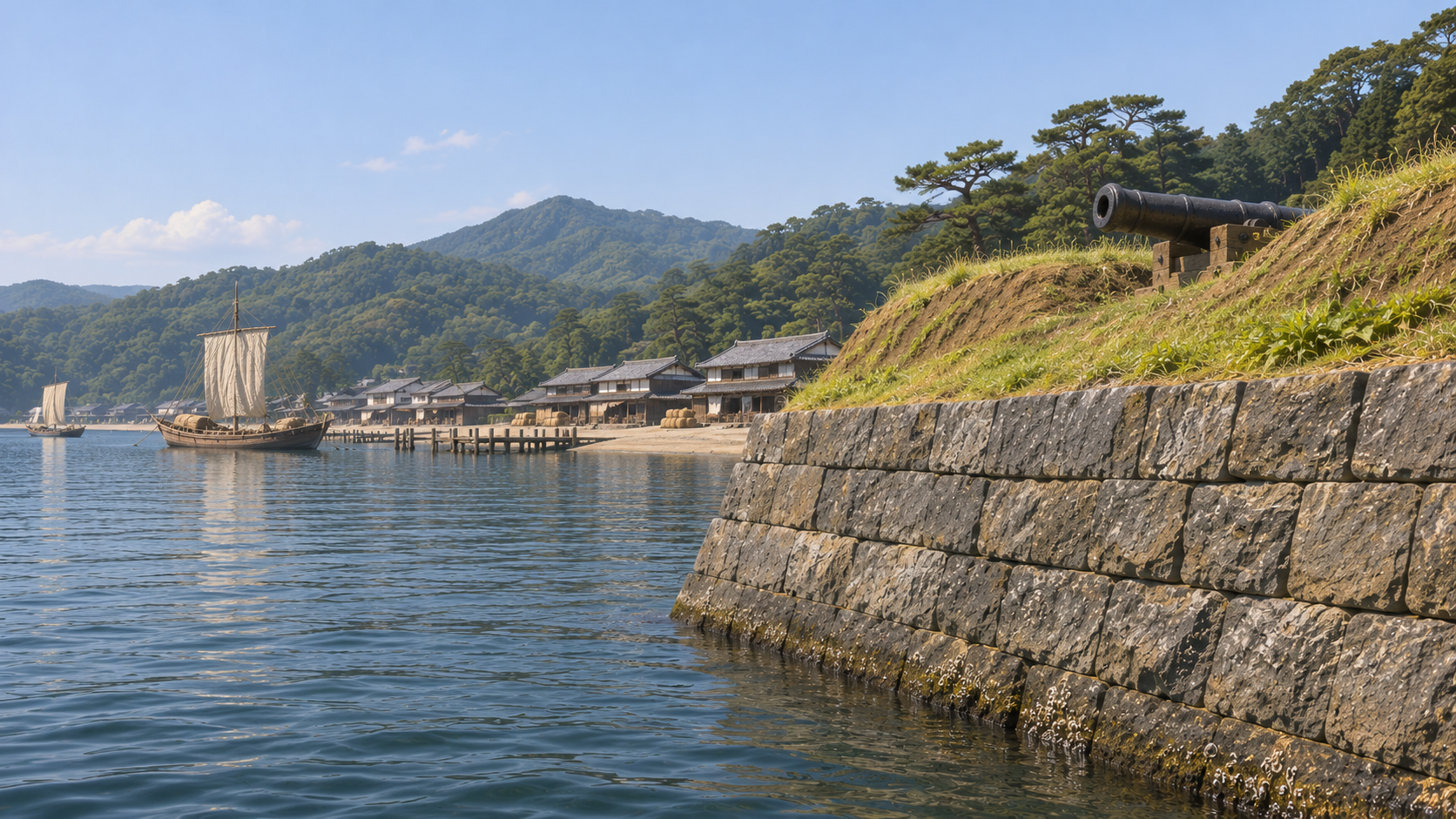
Kanagawa Battery was a coastal defense installation beside the newly opened Yokohama port. Its history brings together guarding foreign shipping, diplomatic ceremony, material procurement and the techniques supporting a stone wall. Those connections make the facility more than an isolated set of cannon or a surviving piece of masonry.
The former shoreline is difficult to see in the present city map alone. Considering the battery in relation to that earlier coast helps explain an era in which opening a port and defending the sea proceeded together. Neither activity needs to erase the other from the interpretation of the landscape.
The stonework offers a way to revisit the port’s opening through land and technology. Documents and buried remains make that possible, provided their dates, locations and limits remain visible. The conclusion rests on their combined contribution, without turning an unconfirmed foundation or a conceptual illustration into an established archaeological fact.
How to read this work
History, interpretation, and reconstruction
Kanagawa Battery brought together an open port, coastal defense, diplomatic ceremony, material supply and stonework; its history requires reading documents alongside buried remains.
This work is grounded in published sources and historical research. Interior thoughts, dialogue, and some visual details are cinematic reconstructions. Where historians disagree, the article presents the point as debated rather than settled fact.
Timeline
The story in time
-
Work on the Shinagawa batteries, with a construction history separate from Kanagawa’s.
Sources: maibun-qa, tokyo-park -
The shogunate orders Matsuyama domain to guard Kanagawa.
Sources: city-chronology -
Yokohama opens and construction of Kanagawa Battery begins.
Sources: city-chronology -
The Kanagawa Unjosho is established as a separate facility.
Sources: customs -
Management and uses change; celebratory and ceremonial salutes are among the battery’s functions.
Sources: maibun39 -
The estimated photography date of the west-approach postcard reproduced in the bulletin.
Sources: maibun39 -
Shinagawa’s third and sixth batteries receive historic designation, and the third opens as a park; this is not Kanagawa’s preservation chronology.
Sources: tokyo-park -
A prefectural lecture document introduces Kanagawa Battery’s construction, remains and investigation.
Sources: lecture -
Publication of Maibun Yokohama 39; its walking map is not a guarantee of present-day access.
Sources: maibun39
People & terms
A guide for new readers
Glossary
- Daiba 台場
- A fortified position for cannon; Kanagawa and Shinagawa refer to different facilities.
- Ryoho 稜堡
- An outward-projecting bastion; the bulletin describes three in Kanagawa’s half-star form.
- Toriwatari-michi 取渡り道
- An approach road connecting the battery with land, with east and west routes distinguished here.
- Andesite 安山岩
- The volcanic rock predominantly used in the battery’s walls, attributed to the Manazuru Peninsula.
- Unjosho 運上所
- A trade and cargo administrative facility, distinct from the coastal battery.
- Fushin 普請
- Construction work, identified in the lecture document with Iyo Matsuyama domain.
Sources & method
How this article was built
The twelve selected chapters of the completed video provide the sequence. Eight institutional references support construction chronology, archaeology and comparisons with Shinagawa, quarrying and customs administration; they are not eight independent eyewitness descriptions of the battery.
All four spreads of the archaeological bulletin were visually examined. The relevant lecture entry and first page of the customs leaflet were also visually read. The historical drawing is encountered as a reproduction in the bulletin, not as an independently examined archival original.
The main battery and its approach roads, excavated and unconfirmed structures, original and relocated stones, and different dates of drawings and photographs remain distinct. Generated stills are conceptual illustrations separately adopted for the article. No archival images, photographs, soundtracks or source illustrations are reproduced.
Sources
References and further reading
- Kanagawa Battery site 神奈川台場跡 Title translated editorially for reader convenience. Yokohama City 横浜市 The saved June 24, 2026 version was read for the city’s construction and design attribution, completion in 1860 and abolition in 1899. No CG, VR or photograph reproduced. Accessed 2026-11-04
- History chronology of Kanagawa Ward 神奈川区の歴史年表 Title translated editorially for reader convenience. Yokohama City 横浜市 Relevant entries distinguish the 1857 guard order, the 1859 opening and start of construction, and completion in 1860. Accessed 2026-11-04
- Differences between the Yokohama and Tokyo batteries 横浜の台場と東京の台場の違いについて Title translated editorially for reader convenience. Yokohama History Foundation, Archaeological Center 横浜市ふるさと歴史財団 埋蔵文化財センター Comparative explanation of places, dates, responsibility and stone. Structures confirmed at one site are not transferred automatically to the other; no photographs reproduced. Accessed 2026-11-04
- Maibun Yokohama 39: The batteries of Yokohama, March 31, 2019 埋文よこはま39 横浜の台場(2019年3月31日) Title translated editorially for reader convenience. Yokohama History Foundation 横浜市ふるさと歴史財団 All four physical spreads, printed pages 1–8, were visually examined. Materials on page 2, structures on page 3, the period walking map on pages 4–5, approaches and foundations on page 6, and history and reproduced plan on page 7. The 2026 URL directory is not its publication year. No source images reproduced. Accessed 2026-11-04
- History of the batteries: National historic sites remaining as parks 台場の歴史 公園として残る国指定の史跡 Title translated editorially for reader convenience. Tokyo Port Terminal Corporation 東京港埠頭 Official park history used for comparison with Shinagawa’s construction and preservation. Its photographs and modern-currency estimates are not adopted. Accessed 2026-11-04
- Touring Yokohama’s fortifications: Excavated Tsurumi Terao Castle and an overview, by Kondo Masaki 横浜城郭巡行 発掘された鶴見寺尾城と横浜の城郭概観(近藤匡樹) Title translated editorially for reader convenience. Kanagawa Prefectural Archaeological Center 神奈川県埋蔵文化財センター The Kanagawa Battery entry on PDF page 9, printed page 8, of the September 23, 2017 lecture document was read and visually examined. The lecturer belonged to Yokohama’s Board of Education. No claim of checking every castle and map in the document; no illustrations reproduced. Accessed 2026-11-04
- Manazuru Peninsula quarry site: Geosite explanation 真鶴半島採石場跡 ジオサイト解説 Title translated editorially for reader convenience. Hakone Geopark Promotion Council 箱根ジオパーク推進協議会 Wedge holes, andesite and different regional stone names provide quarry context. The page does not prove the exact quarry and transport route of every battery block. No photographs reproduced. Accessed 2026-11-04
- Kanagawa Unjosho: Yokohama Customs leaflet, June 2019 神奈川運上所 横浜税関リーフレット(2019年6月) Title translated editorially for reader convenience. Yokohama Customs 横浜税関 PDF page 1 was visually read for the establishment of the separate Unjosho in 1859. Historical images are not reproduced and old opening information is not adopted as current guidance. Accessed 2026-11-04
Continue reading
More stories from Shigeki
Shigeki English
The Battle of Minatogawa: How Was the Defeated Masashige Remembered?
Separate the time of fighting from the times when records, images and memorials were made.
- When The battle in 1336; a report dated 1337; commemoration in 1692 and 1857; the tunnel, park and statue of the modern city
- Where Minatogawa and Kobe, considered alongside documents, war narratives and later images held or described by several institutions
Shigeki English
Railway Opening and the Takanawa Embankment: Where Trains and Boats Crossed
An embankment carrying trains into the sea also raised the question of keeping a way to the water.
- When Construction in the early 1870s, railway opening in 1872, later widening and reclamation, rediscovery in 2019 and additional designation in 2021
- Where The former coast at Takanawa between Shimbashi and Shinagawa, along the Shimbashi–Yokohama railway