
SHIGEKI ENGLISH STORYEN
Japanese history in English
Why Did the Civil War That Burned Kyoto Refuse to End?
Rereading the Onin War as a conflict linking shogunal politics, disputed successions, provincial lordship, and local interests
From the fighting at Kamigoryo Shrine in 1467 to the dissolution of the Kyoto fronts in 1477, this article explains how succession disputes in the Ashikaga, Hatakeyama, and Shiba houses combined with shogunal appointments and provincial struggles, allowing war to continue even after its best-known leaders died.
At a glance
Before you enter the story
- When
- Primarily 1467–1477, conventionally called the Onin War, with political disputes before the outbreak and regional conflict continuing afterward
- Where
- Kyoto and the Kinai region of central Japan, with connected campaigns in provinces including Echizen, Omi, Tamba, Harima, Settsu, and Kawachi
- Key figures
- Ashikaga Yoshimasa, Ashikaga Yoshimi, Ashikaga Yoshihisa, Hino Tomiko, Hosokawa Katsumoto, Yamana Sozen, Hatakeyama Masanaga, Hatakeyama Yoshinari, Ouchi Masahiro
- What was at stake
- A struggle over who could lead houses, hold office, and control provinces turned Kyoto itself into a battlefield while producing conflicts no single capital-city settlement could end.
Why this story matters
The larger history behind the turning point
The Onin War is often treated as the moment medieval Japan simply fell into chaos, or as a family quarrel that burned the capital because one powerful woman wanted her son to succeed. Both versions are memorable and both are inadequate. The conflict joined decisions made in the Muromachi shogunate to disputed leadership within major warrior houses and to the actual possession of land, offices, followers, and strongholds across several provinces. Understanding that network explains why removing one person or settling one succession did not stop everyone else from fighting.
The war also changes how a city at war should be imagined. Kyoto was not consumed in one simultaneous fire and abandoned. Fortified compounds, roads, bridges, temples, neighbourhood associations, residents, military supply, and long-distance information all coexisted across more than a decade of changing violence. Diaries, official city histories, archaeological studies, provincial histories, and surviving military documents reveal different parts of that experience. Their limits matter as much as their detail: they do not justify invented casualty totals, fixed psychological motives, or a perfectly mapped battle panorama.
Historical context
What an international reader needs to know
How the Muromachi shogunate connected Kyoto to the provinces
The Ashikaga shogun headed a warrior government based in Kyoto. Powerful military governors, often called shugo in Japanese, controlled major provincial interests while also competing for offices and influence at the shogunal court. The office of kanrei, commonly translated as shogunal deputy, was especially important. Recognition in Kyoto could determine which claimant was treated as the legitimate head of a house and could therefore affect retainers and estates far from the capital.
A warrior house was not simply one nuclear family. Competing heirs could mobilise branches of the family, senior retainers, provincial followers, and allies in other houses. If the shogunate reversed its recognition of a claimant, the decision could protect one network while threatening another with the loss of office or territory. That is why a succession dispute that sounds private in a short genealogy could become a public military and administrative crisis.
Why 1477 marks an ending but not universal peace
Histories usually date the Onin War from 1467 to 1477 because the long confrontation between the eastern and western armies in Kyoto broke apart in the latter year. Ouchi Masahiro left the capital, Hatakeyama Yoshinari shifted his operations to Kawachi, and the western coalition's Kyoto presence dissolved. This is a defensible boundary for the capital's war, not proof that every connected provincial conflict ended on the same day.
The period is often linked to the emergence of the Warring States age, but no single battle instantly transformed all of Japan. Authority, vassal relationships, urban organisation, and regional power changed at different speeds in different places. Treating 1477 as a change in the centre and form of conflict, rather than a nationwide peace treaty, preserves those uneven timelines.
Watch the film
See the story in motion
The film currently uses Japanese audio. This English article provides the context and source trail; it does not imply that an English subtitle track is available.
Mid-fifteenth century
The war had several entrances, not one cause
The Onin War is commonly introduced as a dispute over the Ashikaga shogunal succession. Yet before open war, the Hatakeyama and Shiba houses were also divided over who should lead them. The shogunate's decision to recognise one claimant affected appointments such as kanrei and could reshape authority in provincial domains. Personnel decisions in Kyoto and control on the ground were connected from the beginning.
Within the Hatakeyama house, Masanaga and Yoshinari claimed the same position. Their struggle was not merely an argument between two relatives. Retainer groups divided, control in places such as Kawachi was at stake, and each claimant depended on relationships within the shogunal political arena. Recognition created a legitimate officeholder, but it also created a party that might lose estates, access, and protection.
The Shiba house likewise faced a succession struggle involving Shiba Yoshitoshi and Shiba Yoshikado. Their conflict implicated Echizen, Owari, Totomi, and the choices of retainers who had their own provincial interests. An agreement that benefited a claimant in Kyoto might endanger another network hundreds of kilometres away. No ruling could give every participant the same outcome.
Hosokawa Katsumoto and Yamana Sozen possessed enough influence to intervene in these contests, and they later became the best-known heads of the eastern and western armies. Personal rivalry between them is nevertheless insufficient as a complete explanation. It cannot tell us why so many other lords and local warriors continued fighting when the two leaders' circumstances changed. The coalitions were not political parties united by one programme.
This article interprets succession, shogunal office, provincial possession, and local alliances as parts of one political circuit. That does not mean one broken link would certainly have prevented war. It means that the institutions used to arbitrate disputes also became a place where distinct disputes could connect, allowing each side to seek leverage by joining a broader military alignment.
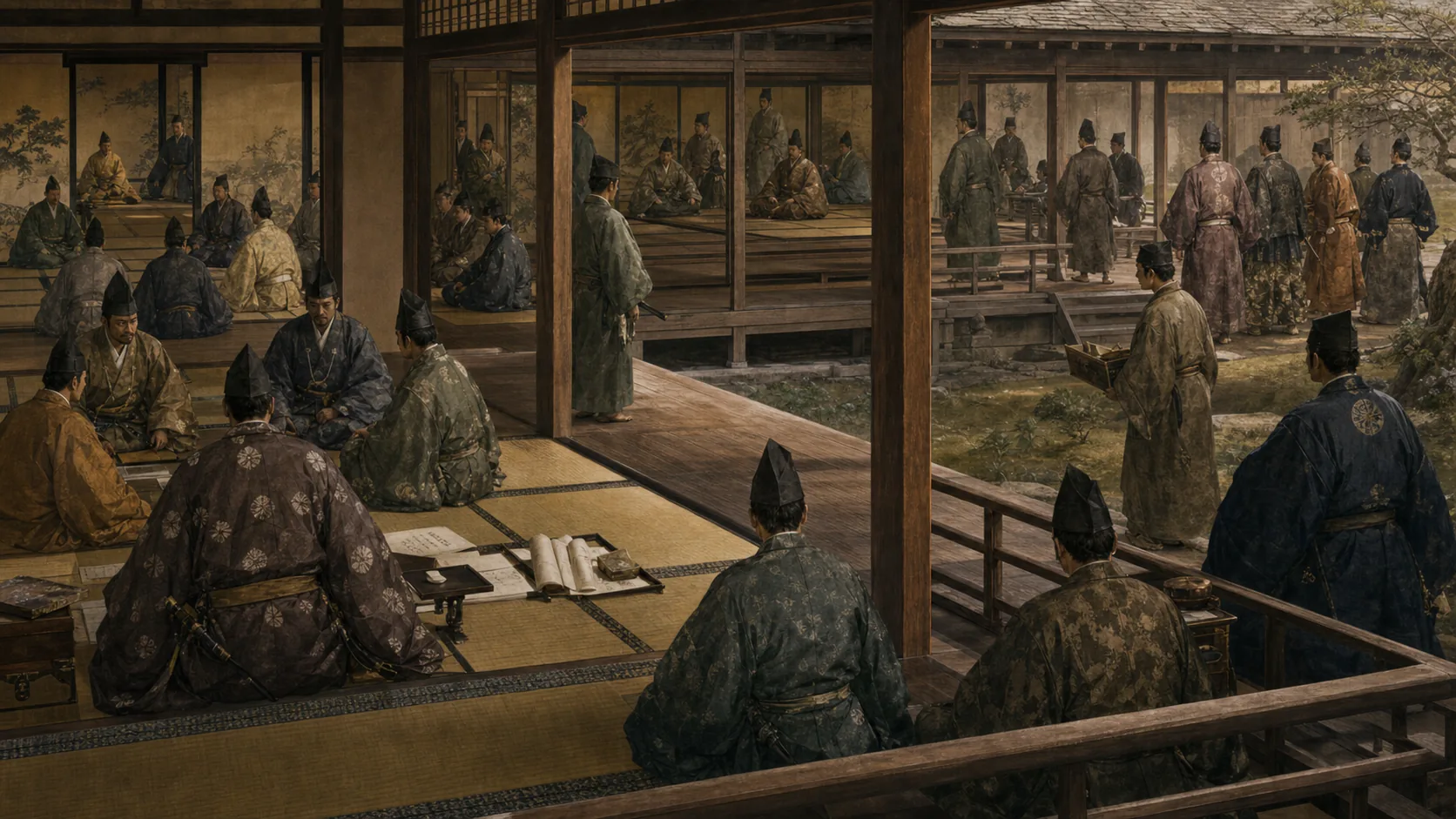
The image places documents, messengers, and several rooms of negotiation in one visual field. It is not a reconstruction of one council, a seating plan, a transcript, or the expressions of named figures. It uses simultaneity as a metaphor for separate negotiations that influenced one another. The historical argument comes from records of the overlapping disputes, not from the scene's invented physical details.
1464–1465
The story cannot be reduced to Hino Tomiko as mastermind
In 1464 Ashikaga Yoshimasa invited his younger brother Yoshimi to become his successor. The following year, Yoshimasa and Hino Tomiko had a son, Yoshihisa. More than one potential successor now existed, and that uncertainty mattered at the centre of shogunal politics. Yet the birth alone does not explain all the military action that began in 1467.
A later and widely repeated narrative claims that Tomiko asked Yamana Sozen to secure the succession for her son, thereby setting him against Hosokawa Katsumoto as Yoshimi's supporter. Modern scholarship has reconsidered this neat division. Relations among Tomiko, Sozen, Yoshimi, and the other principals did not begin as two fixed camps, and the evidence does not support treating Tomiko and Sozen as consistently committed from the outset to expelling Yoshimi.
Yoshimi moved to the western side only after the war had begun and political relationships had shifted. If he is labelled eastern and Yoshihisa western from the first day, a later alignment is projected backwards and transformed into an original cause. The chronology matters because alliances were outcomes of the developing conflict as well as conditions that shaped it.
The shogunal succession was unquestionably important: it concerned who might occupy the central office of the warrior government. At the same time, the Hatakeyama and Shiba disputes already involved their own retainers, offices, and provincial stakes. Even a compromise inside the Ashikaga family could not automatically restore lands or settle leadership in those other houses.
Making Tomiko the sole villain creates a simple chain from maternal ambition to national catastrophe. That simplicity hides the choices of military governors, house claimants, retainers, and local warriors. This article does not remove Tomiko from politics; it refuses to turn a politically active woman into a substitute for structural explanation when the surviving alignments were more changeable.
The scene again shows a male-dominated gathering but does not portray Tomiko, Yoshimasa, Yoshimi, or Yoshihisa. It cannot be used as evidence that Tomiko was absent from politics. No face, statement, or emotion belongs to a named person. The reconstruction supports an explanation of institutional and relational change, not a courtroom verdict on hidden intention.
Onin 1 (1467)
Fighting at Kamigoryo Shrine expanded into urban war
On 18 January 1467, the forces of Hatakeyama Masanaga and Hatakeyama Yoshinari fought at Kamigoryo Shrine. Kyoto City's historical marker identifies this engagement as the outbreak of the Onin War. Its immediate combatants came from the Hatakeyama succession struggle, but the contest occurred within a political field where several great lords and rival claimants were already manoeuvring.
One clash in January did not instantly produce the complete shape of a ten-year war. Forces continued gathering in and around Kyoto, and political positions became military deployments. From May 1467, large-scale fighting between the developing eastern and western armies spread across the city.
The eastern army, centred on Hosokawa Katsumoto, established positions around the Muromachi Palace. The western army, centred on Yamana Sozen, used areas including the vicinity of Yamana's residence. Ouchi Masahiro's forces arrived and joined the western side in August. Major fighting around Shokokuji followed in October, as recorded in Kyoto City materials and archaeological research summaries.
Residences, temples, and streets became military terrain while remaining parts of an inhabited capital. Ditches, earthworks, and wooden barriers fortified compounds. Roads and bridges channelled movement and supply. This was not a war fought only against detached castles; political and residential spaces were converted into adjacent defensive zones within a dense city.
A prohibitory order issued by Katsumoto in 1468 attempted to restrain violence and obstruction by troops. The existence of an order does not prove that every soldier obeyed it. It instead documents the need to regulate the contact between armed forces and urban life. Normative commands reveal both an intended standard and the behaviour authorities feared or encountered.
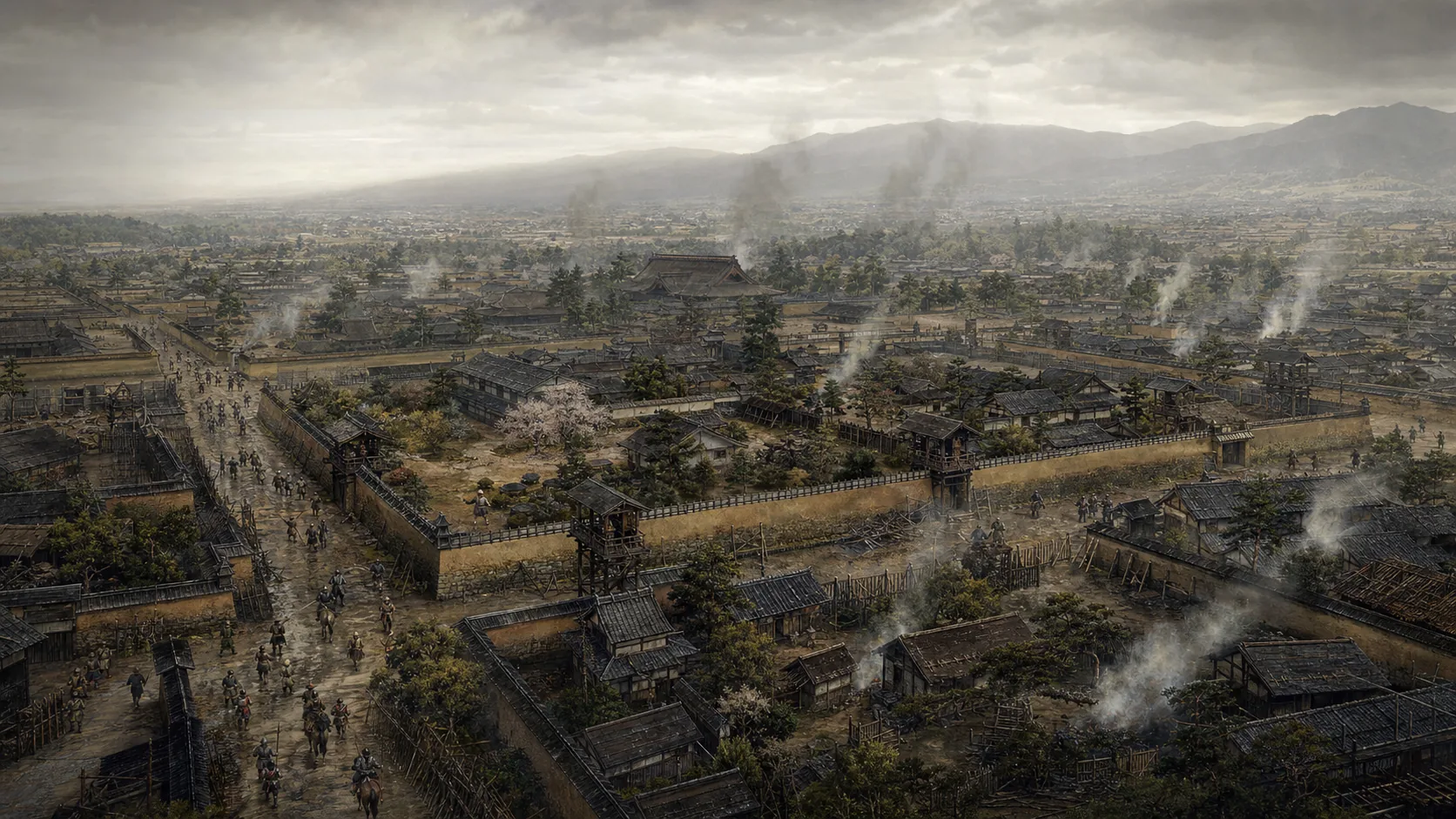
The image looks down on a reconstructed Kyoto divided by barriers and smoke. Its blocks, gates, troops, and plumes do not map Kamigoryo or Shokokuji, and it contains no reliable troop numbers or routes of advance. The aerial perspective is used only to make urban fortification legible; dates and locations remain grounded in the written and archaeological sources.
Fortifications and supply inside Kyoto
A search for decision became a war of endurance
In Kyoto, residences and adjoining blocks were enclosed or reinforced with ditches, earthworks, and barriers as the two armies obstructed one another's movement and supply. Kyoto City's urban history locates the fortified zone around the Muromachi Palace, western positions, the Dodobashi bridge area, and Mount Funaoka. Streets and buildings divided visibility and movement, making the battlefield a mosaic rather than an open plain.
Incendiary attacks in 1467 damaged temples, warrior residences, and neighbourhoods, especially in the northern part of the city known as Kamigyo. Fire could destroy an enemy position or block movement, but in a dense built environment it also spread danger to residents. The available sources do not justify attributing every burned building to one commander or compressing separate episodes into one order to burn Kyoto.
The claim that the entire city burned to the ground at once is equally misleading. Kyoto City's account distinguishes patterns in Kamigyo and Shimogyo and notes moments in which burning was restrained in the south, where neighbourhood organisation continued. The devastation was profound, yet people, property, and institutions did not all disappear in a single simultaneous catastrophe.
Maintaining forces required food, horses, weapons, information, labour, and lines of movement. Capturing one compound did not end the war if the opposing coalition retained supply and provincial bases. Even after the largest clashes diminished, holding positions in Kyoto preserved bargaining power. The endurance of the fronts depended on networks extending beyond the walls visible in any urban image.
From 1468, major battles in the capital became less frequent, but skirmishes and political conflict continued. A decline in battlefield intensity is not the same as a peace settlement. Without a decisive military result or agreements acceptable to all coalition members, armies could remain in place while negotiations and regional campaigns altered the balance slowly.
Several smoke columns and fortified blocks appear in the reconstruction, but their number and area are not statistics. Roof forms, trees, towers, mounted figures, and lines of defence are not verified restorations. The scene deliberately avoids one wall of flame and instead conveys the documented coexistence of contested military positions and inhabited districts.
Urban life within a battlefield
Life continued beyond each burned district
A history told only through commanders and battles makes the inhabitants of wartime Kyoto disappear. People faced fire, plunder, requisition, and displacement, and some moved possessions while looking for safer places. Temples, courtiers, warrior households, artisans, merchants, and other residents did not possess the same resources or access to refuge. The sources used here do not permit one uniform story of civilian experience.
Contemporary diaries recorded military events in the capital and nearby areas. The Historiographical Institute's publication note for the Hekizan Nichiroku explains that the monk Taikyoku sometimes described deployments he had observed and elsewhere transmitted reports reaching him from other places. One diarist could not see the entire war, but the distinction between observation and hearsay provides a valuable contemporary perspective and a warning about evidential reach.
Kyoto's urban history also describes continuing neighbourhood cohesion and defence in Shimogyo. A neighbourhood was not an autonomous sanctuary beyond military pressure. Even so, carrying goods, maintaining shelter, trading, sharing information, and eventually restoring public activities were necessary for the city to persist through and after the war. Urban continuity was active work, not proof that destruction was minor.
The Gion Festival's revival in 1500 is a useful chronological marker, but it does not mean everyday life returned to its prewar form immediately after 1467 or 1477. More than three decades separated the first battles from that restoration. Recovery had multiple starts and durations; it did not begin everywhere at one officially declared moment of peace.
This project cannot provide a defensible total death toll from its source set. It therefore does not invent casualty numbers or troop figures. Unknown quantity must not be interpreted as insignificant suffering. The responsible account identifies documented burned areas, disruption, movement, continuing neighbourhood life, and the long time between destruction and major public revival.
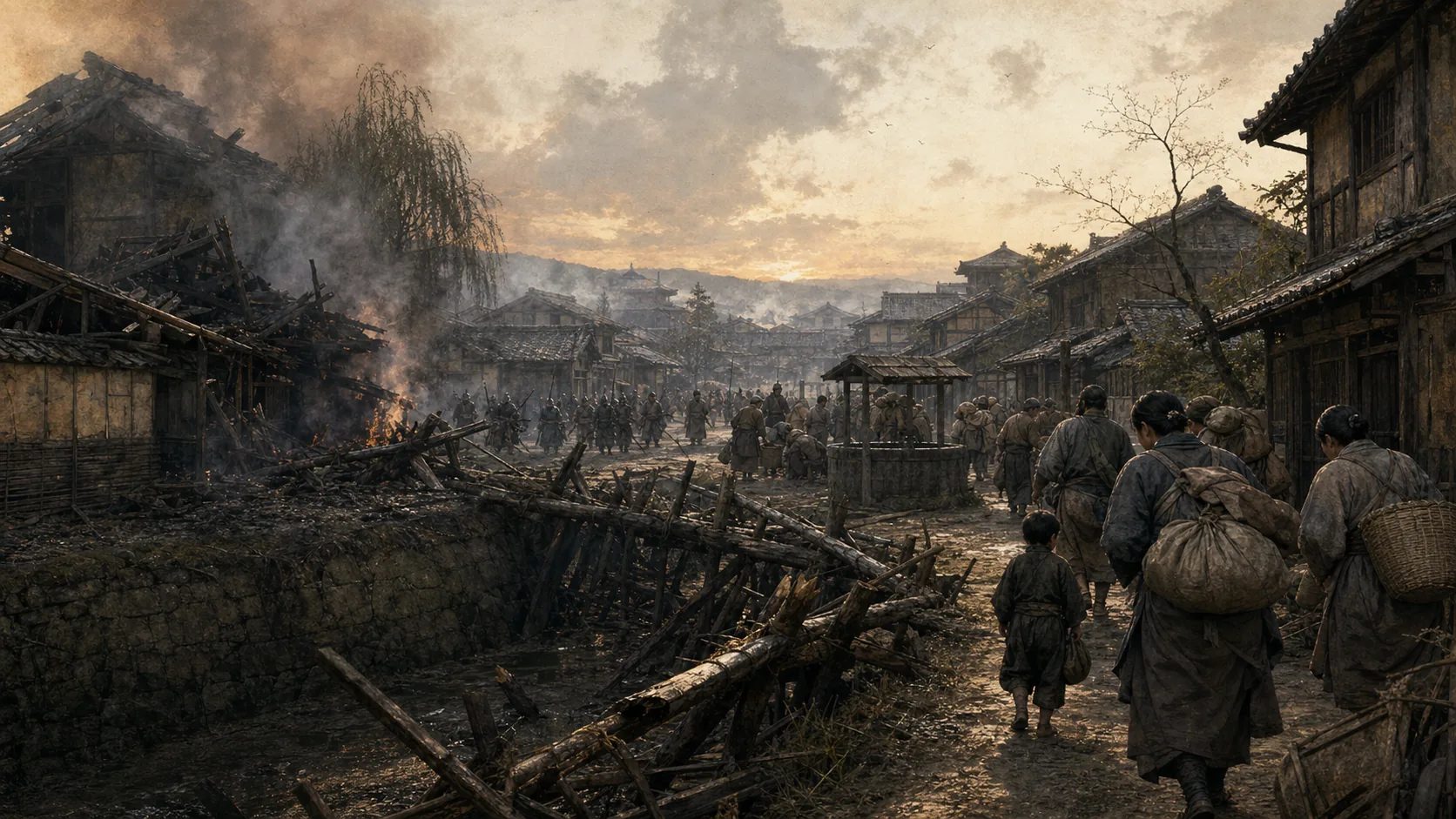
The scene shows residents carrying belongings beside a locally burned street. Their family relationships, possessions, destination, date, well, and nearby soldiers are constructed visual details, not portraits of known victims. Avoiding bodies and spectacle does not deny violence; it keeps the image from claiming evidence for individual deaths or experiences that the record cannot identify.
From Kyoto into the provinces
No single agreement could stop every connected war
The war's duration cannot be explained only by fortified positions in Kyoto. Conflicts unfolded in Echizen, Omi, Tamba, Harima, Settsu, Kawachi, and other regions, linked to the capital's coalitions while also driven by local struggles over house leadership, estates, retainers, and control on the ground. The eastern-western division connected these contests without making them identical.
The publication account of Hekizan Nichiroku notes reports concerning military conditions not only in Kyoto and its surroundings but also in Settsu, Omi, Kaga, Tamba, and Harima. The appearance of these place names in one diary does not prove common timing, command, or objectives. It demonstrates a wide information field in which news of distant campaigns reached a writer observing the crisis from a monastic setting.
Documents of the Miura family concerning followers of Ouchi Masahiro include military commendations and lists of wounds from fighting in Kyoto and Settsu. Individual orders and reports cannot describe an entire army, but they provide concrete evidence that forces coming from western Japan operated repeatedly in and around the capital. The war was sustained through people whose service connected distant home regions to specific engagements.
The full spread into southern Kawachi is dated around 1470 in the Tondabayashi city history and is tied to Hatakeyama Yoshinari's regional position. This was not a simple copy of Kyoto's two camps pasted over an empty province. Existing local rivalries joined the coalitions, and the onset and conclusion of conflict differed by region.
An agreement in Kyoto could not guarantee that a party facing territorial loss elsewhere would disarm. Conversely, success in a province could improve a lord's bargaining position in the capital. Decisions to remain in Kyoto or return home were connected to the need to defend provincial interests. The same coalition could therefore contain members moving toward peace and others for whom continued campaigning remained rational.
The image reuses an aerial Kyoto landscape with roads disappearing beyond the frame. Those roads symbolise connection rather than mapped routes to Echizen, Kawachi, or Settsu. No troop movement or battle order should be read from them. The specific regional evidence is kept in the text and sources so that one visual metaphor does not flatten distinct provincial histories.
1473–1474
The war survived the deaths of its leading commanders
Yamana Sozen and Hosokawa Katsumoto died in succession in 1473. In the same year, Ashikaga Yoshihisa became the ninth shogun. The deaths of the two figures most closely associated with the rival armies and the change of shogun were major political events. The conflict nevertheless continued, demonstrating that its participants did not all act only at those leaders' command.
In 1474, successors including Hosokawa Masamoto and Yamana Masatoyo moved toward peace. Agreement between the central houses of the eastern and western armies did not instantly dissolve the whole coalition. Ouchi Masahiro, Hatakeyama Yoshinari, and others retained separate stakes and continued to act in Kyoto or the Kinai. Reconciliation at the centre and demobilisation at every front were different processes.
From the beginning, participants pursued house leadership, land, office, the survival of retainer groups, and regional power. After nearly a decade of conflict, positions gained during the war and territories lost through it became additional disputes. Even if an original trigger could be resolved, the war had generated a new distribution of costs and advantages that demanded further negotiation.
Calling the outcome indecisive captures the absence of one overwhelming battlefield victor in Kyoto, but it is not the only measure. Some interpretations see the eastern army or the Hosokawa as politically advantaged. Military control, influence within the shogunate, and possession in individual provinces could produce different winners and losers. A single scorecard would conceal those levels.
Peace therefore required more than one document issued to the whole country. Armies had to leave positions, lords had to decide whether to return to their territories, and separate claims over land and house leadership had to be managed. If the cost of compromise fell heavily on one coalition member, that member had little reason to accept an agreement arranged by others.
The image shows multiple rooms and messengers rather than a single peace conference. It does not depict the faces or seating of Masamoto, Masatoyo, Masahiro, or Yoshinari. Its dispersed composition expresses the need to contact parties with different disputes. No private bargaining statement is supplied where the sources preserve only the broader course of negotiation.
Bunmei 9 (1477)
The end of the Kyoto front was not peace across Japan
In 1477 Ouchi Masahiro and his forces left Kyoto. Hatakeyama Yoshinari also moved into Kawachi, and the western army's remaining presence in the capital dissolved. The year conventionally ends the Onin War because the decade-long confrontation between eastern and western positions in Kyoto had ceased to structure the city in the same way.
Yoshinari's move was not simply a flight from battle into retirement. Tondabayashi's city history describes attacks on places including Wakae Castle and Konda Castle as he advanced military control in Kawachi. A force that departed Kyoto could continue fighting in a different theatre. Withdrawal and disarmament were not synonyms.
For that reason, 1477 should not be described as the moment warfare ended simultaneously throughout Japan. The Kyoto front ended while regional conflicts over house leadership and land persisted. The date is best understood as a shift in the centre and form of war, not the completion of nationwide peace.
The common description of the Onin War as the beginning of the Warring States period points toward a long transformation in shogunal arbitration, relationships between military governors and retainers, and regional rule. One urban war did not convert every province overnight. Change had different chronologies, and later developments should not be projected backwards as an instant national system already complete in 1477.
The central reason for the war's duration returns in its ending. The Ashikaga, Hatakeyama, and Shiba successions, shogunal office, major lords, and local warriors had been joined into two broad coalitions without acquiring one shared purpose. Solving one issue in Kyoto left other houses and regions with unsettled claims. The coalitions took years to unbundle because peace distributed losses as well as benefits.
The last scene returns to residents moving beside local destruction. It is not an image of the western army's departure on a specific day, Yoshinari's fighting in Kawachi, or the start of reconstruction. Its absence of a triumphal victor is deliberate. The Kyoto war ended through withdrawals, agreements, and relocation of conflict rather than one final cinematic battle.
How to read this work
History, interpretation, and reconstruction
The Onin War lasted more than a decade because several succession disputes, shogunal offices, provincial lordships, and local military interests were bundled into eastern and western coalitions whose separate conflicts could not all be settled by one agreement in Kyoto.
This work is grounded in published sources and historical research. Interior thoughts, dialogue, and some visual details are cinematic reconstructions. Where historians disagree, the article presents the point as debated rather than settled fact.
Timeline
The story in time
-
Ashikaga Yoshimasa invites his younger brother Yoshimi to become successor to the shogun.
Sources: gakushuin-yoshimi, kyoto-city-kamigoryo -
Ashikaga Yoshihisa is born to Yoshimasa and Hino Tomiko.
Sources: gakushuin-yoshimi, kyoto-city-kamigoryo -
The forces of Hatakeyama Masanaga and Hatakeyama Yoshinari fight at Kamigoryo Shrine.
Sources: kyoto-city-kamigoryo, kyoto-city-urban-history -
Large-scale fighting between the eastern and western armies begins across Kyoto.
Sources: kyoto-city-urban-history, kyoto-arc-leaflet-304 -
Ouchi Masahiro's forces arrive in Kyoto and join the western army.
Sources: kyoto-arc-leaflet-304, yamaguchi-miura -
Major fighting takes place around Shokokuji.
Sources: kyoto-arc-leaflet-304, kyoto-city-urban-history -
Large battles in Kyoto become less frequent while connected conflicts spread or continue in several provinces.
Sources: kyoto-city-urban-history, tokyo-hi-hekizan, fukui-kyoto-battle -
Yamana Sozen and Hosokawa Katsumoto die, and Ashikaga Yoshihisa becomes the ninth shogun.
Sources: fukui-end, kyoto-city-urban-history -
Successors of the main eastern and western leaders move toward peace, but other forces continue fighting.
Sources: fukui-end -
Ouchi Masahiro leaves Kyoto and Hatakeyama Yoshinari moves to Kawachi, dissolving the western coalition's Kyoto front.
Sources: fukui-end, tondabayashi-occupation -
The Gion Festival is revived in Kyoto after a long interruption.
Sources: kyoto-city-timeline
People & terms
A guide for new readers
Key figures
- Ashikaga Yoshimasa
- Eighth Ashikaga shogun, who invited his brother Yoshimi to become successor before the birth of his son Yoshihisa complicated the shogunal succession.
- Ashikaga Yoshimi
- Yoshimasa's younger brother, designated successor in 1464, whose alliances changed during the war and who later moved to the western side.
- Ashikaga Yoshihisa
- Son of Yoshimasa and Hino Tomiko, born in 1465 and installed as the ninth shogun in 1473.
- Hino Tomiko
- Yoshimasa's principal wife and Yoshihisa's mother; scholarship has challenged later stories that make her the sole cause or hidden mastermind of the war.
- Hosokawa Katsumoto
- A major military governor and former kanrei who became the leading figure of the eastern army and died in 1473.
- Yamana Sozen
- A powerful military governor who became the leading figure of the western army and died in 1473.
- Hatakeyama Masanaga
- A claimant to leadership of the Hatakeyama house who fought Hatakeyama Yoshinari at Kamigoryo Shrine in January 1467.
- Hatakeyama Yoshinari
- Masanaga's rival for Hatakeyama leadership, who moved to Kawachi in 1477 and continued military operations there.
- Ouchi Masahiro
- A powerful western-army commander who brought forces to Kyoto in 1467 and withdrew from the capital in 1477.
Glossary
- Onin War 応仁の乱
- The conventional English name for the civil conflict centred on Kyoto from 1467 to 1477, although fighting continued into the Bunmei era and varied by region.
- Muromachi shogunate 室町幕府
- The Ashikaga-led warrior government based in Kyoto, within which shogunal succession, major offices, and recognition of house leaders were contested.
- Shugo 守護
- A military governor with major provincial responsibilities and interests; the office and its practical power changed across time and place.
- Kanrei 管領
- A senior office often translated as shogunal deputy, held by leaders from powerful warrior houses including the Hosokawa and Hatakeyama.
- Katoku 家督
- Leadership and inheritance of a warrior house, involving recognised status, followers, offices, and control of resources rather than only private family property.
- Kamigyo 上京
- The northern part of Kyoto, where major warrior and court institutions were concentrated and where severe destruction occurred during the war.
- Shimogyo 下京
- The southern part of Kyoto, whose neighbourhood organisation and wartime experience differed in important ways from Kamigyo.
- Kinai 畿内
- The provinces surrounding the imperial capital, a central region in which Kyoto's political conflict intersected with local military struggles.
Sources & method
How this article was built
This English edition follows the claims, order, and qualifications of the Japanese source article. It compares Kyoto City's urban history and chronology with archaeological summaries, Fukui and Tondabayashi regional histories, university scholarship, contemporary-diary publication notes, archival documents, and a surviving military prohibition. No new causal claim, casualty total, private quotation, or psychological motive has been introduced in translation.
The sources operate at different scales. A city history can compare neighbourhoods and military positions; a provincial history traces one house or regional campaign; a diary records what one writer saw or heard; an order states behaviour an authority sought to regulate; an archaeological leaflet explains material traces. The article preserves those differences instead of turning every source into a complete narrative of all Japan from 1467 to 1477.
All visuals come from the cleared Japanese production package and remain explicitly labelled as AI-generated reconstructions. Rooms, barriers, people, fires, roads, belongings, and city views are not portraits, maps, or casualty records. Their purpose is to express relationships already supported by the evidence while the captions and notes prevent a visually coherent scene from being mistaken for a recovered historical photograph.
Sources
References and further reading
- Urban History 14: The Onin and Bunmei Wars 都市史14 応仁・文明の乱 Title translated editorially for reader convenience. Kyoto City and Kyoto City Library of Historical Documents 京都市・京都市歴史資料館 Supports the outbreak, positions of the two armies, fighting and fire, differing urban damage, neighbourhood life, and the course to 1477. Accessed 2026-07-28
- Historic Site of the Battle at Kamigoryo 御霊合戦旧跡 Title translated editorially for reader convenience. Kyoto City 京都市 Supports the battle of 18 January 1467 between the Hatakeyama claimants and its conventional place at the outbreak of the war. Accessed 2026-07-28
- Chronology of Kyoto History 京都の歴史年表 Title translated editorially for reader convenience. Kyoto City and Kyoto City Library of Historical Documents 京都市・京都市歴史資料館 Supports changes in Kamigyo and Shimogyo, later urban terminology, and the revival of the Gion Festival in 1500. Accessed 2026-07-28
- Kyoto Leaflet No. 304: The Onin and Bunmei Wars リーフレット京都 No.304 応仁・文明の乱 Title translated editorially for reader convenience. Kyoto City Archaeological Research Institute 京都市埋蔵文化財研究所 Supports the sequence of major fighting from May 1467, Ouchi Masahiro's arrival, combat near Shokokuji, and archaeological approaches to the wartime city. Accessed 2026-07-28
- History of Fukui Prefecture, Medieval Volume: The Battles in Kyoto 福井県史 通史編2 中世 京都の合戦 Title translated editorially for reader convenience. Fukui Prefectural Archives 福井県文書館 Supports the Hatakeyama and Shiba succession disputes, the coalitions, fighting in Kyoto, and connections to regional interests including Echizen. Accessed 2026-07-28
- History of Fukui Prefecture, Medieval Volume: The War's Conclusion 福井県史 通史編2 中世 乱の終息 Title translated editorially for reader convenience. Fukui Prefectural Archives 福井県文書館 Supports the deaths of Sozen and Katsumoto, negotiations in 1474, and the process ending with Ouchi Masahiro's departure in 1477. Accessed 2026-07-28
- Special Lecture in Japanese History: The Muromachi Shogunate, Court Nobles, the Ashikaga, and the Hino House 日本史特殊講義―室町幕府と公家衆―足利氏と日野家― Title translated editorially for reader convenience. Department of History, Faculty of Letters, Gakushuin University 学習院大学文学部史学科 Supports scholarly reconsideration of the later story that Tomiko and Sozen formed a fixed anti-Yoshimi alliance before the war. Accessed 2026-07-28
- Publication Commentary for Dai Nihon Kokiroku: Hekizan Nichiroku, Volume Two 大日本古記録 碧山日録 下 刊行解説 Title translated editorially for reader convenience. Historiographical Institute, The University of Tokyo 東京大学史料編纂所 Supports the character of Taikyoku's contemporary diary, including observed Kyoto deployments and reports concerning nearby and provincial military conditions. Accessed 2026-07-28
- Important Cultural Properties: Daijoin Jisha Zojiki and Kyokaku Shiyosho 重要文化財 大乗院寺社雑事記・経覚私要鈔 Title translated editorially for reader convenience. National Archives of Japan 国立公文書館 Supports the preservation and historical value of contemporary diaries for politics, economy, and society around the Onin War. Accessed 2026-07-28
- The Onin War and the Warring States Lords 2-2-5 応仁の乱と戦国大名 Title translated editorially for reader convenience. Yamaguchi Prefectural Archives 山口県文書館 Supports documentary evidence for followers of Ouchi Masahiro fighting and suffering wounds in Kyoto and Settsu. Accessed 2026-07-28
- History of Tondabayashi, Volume Two: The War Spreads into Southern Kawachi 富田林市史 第二巻 南河内への波及 Title translated editorially for reader convenience. Tondabayashi City Cultural Heritage Digital Archive 富田林市文化財デジタルアーカイブ Supports the spread of sustained fighting into southern Kawachi around 1470 and its relationship to the Hatakeyama conflict. Accessed 2026-07-28
- History of Tondabayashi, Volume Two: Hatakeyama Yoshinari's Occupation of Kawachi 富田林市史 第二巻 畠山義就の河内占領 Title translated editorially for reader convenience. Tondabayashi City Cultural Heritage Digital Archive 富田林市文化財デジタルアーカイブ Supports Yoshinari's move to Kawachi in 1477 and subsequent operations against locations including Wakae and Konda castles. Accessed 2026-07-28
- Prohibitory Order Issued by Hosokawa Katsumoto 細川勝元禁制 Title translated editorially for reader convenience. National Museum of Japanese History 国立歴史民俗博物館 Supports the existence of Katsumoto's 1468 order prohibiting violence and obstruction by military forces. Accessed 2026-07-28
Continue reading
More stories from Shigeki
Shigeki English
Oishi Kuranosuke: The Road from Surrendering Ako Castle to the Raid
Before the famous night came accounts, letters, separation, and an attempt to restore a fallen house.
- When Genroku 14–16, spanning 1701–1703; month and day references retain the old Japanese calendar
- Where Ako, Yamashina near Kyoto, and Edo
Shigeki English
The Sakuradamon Incident: A Shogunate Wounded, but Still Governing
Follow the assassination of Ii Naosuke through the orders, letters, and announcements that followed it.
- When 1860, with political background in 1858 and an aftermath extending into the 1860s
- Where Edo Castle and Hikone, with reports circulating beyond Edo