

SHIGEKI ENGLISH STORYEN
Japanese history in English
Ii Naosuke: Between Opening the Country and Political Repression
Reassessing a chief minister's choices through foreign pressure, political procedure, the Ansei Purge, and the long struggle to revise the treaties
From years of study at Umoreginoya to leadership of the shogunate, this article traces Ii Naosuke's role in the 1858 commercial treaty, the shogunal succession, the Ansei Purge, his assassination at Sakuradamon, and the later revision of the unequal treaties.
At a glance
Before you enter the story
- When
- From Ii Naosuke's birth in 1815 to his assassination in 1860, with an epilogue extending to treaty revision in 1894
- Where
- Hikone, Edo, Kyoto, Shimoda, and the treaty-port world that emerged around places including Kanagawa and Yokohama
- Key figures
- Ii Naosuke, Tokugawa Iesada, Tokugawa Yoshitomi, Hitotsubashi Yoshinobu, Hotta Masayoshi, Iwase Tadanari, Townsend Harris, Sanjo Sanetsumu, Yoshida Shoin
- What was at stake
- The crisis tested who could authorize foreign policy, who could shape the shogunal government, and whether perceived emergency could justify bypassing procedure and suppressing opposition.
Why this story matters
The larger history behind the turning point
Ii Naosuke is frequently reduced to one of two labels: the statesman who opened Japan or the autocrat responsible for the Ansei Purge. Both labels point to real parts of his career, yet each becomes distorted when it erases the other. The commercial treaties expanded diplomatic and trading relations while imposing unequal legal and tariff arrangements, and the government that accepted them also used coercion against opponents.
The story matters beyond biography because it asks a durable political question. When leaders face a credible external threat, does urgency permit them to cross established procedures? A documented fear of conflict can help explain a decision without automatically excusing the form it took. Likewise, condemning repression does not require pretending that foreign military pressure was imaginary.
The 1858 treaty was not drafted by Naosuke alone after he became tairo. Negotiations and much of the text preceded his appointment. His responsibility lay in governing the final decision within a divided political system, where shogunate officials, daimyo, the shogun, and the imperial court did not agree on who should authorize the next step.
The consequences outlived him. Ports and trade continued, while extraterritorial jurisdiction and limits on Japanese tariff authority became problems inherited by the Meiji government. The effort to revise those arrangements extended decades beyond Naosuke's assassination, showing why neither immediate opening nor immediate backlash is an adequate endpoint.
Historical context
What an international reader needs to know
What was the Tokugawa shogunate?
The Tokugawa shogunate was a warrior government headed by the shogun. The emperor and imperial court remained in Kyoto, while the shogunate governed from Edo through offices, hereditary warrior houses, and domains led by daimyo. Authority was therefore not a modern division between a ceremonial monarch and a cabinet; it rested on negotiated hierarchies whose boundaries became contentious in the 1850s.
A tairo was an extraordinary senior office often translated as great elder or chief minister. Naosuke became tairo in 1858 under Shogun Tokugawa Iesada. The office gave him exceptional responsibility, but it did not mean that every diplomatic clause, administrative act, or later punishment was conceived and executed by one man alone.
Foreign relations before 1858
Tokugawa Japan was not completely sealed from the world, but foreign contact and trade were tightly regulated. The arrival of Commodore Matthew Perry's American squadron in 1853 and Russian envoy Yevfimiy Putyatin intensified demands for formal relations. The 1854 Convention of Kanagawa opened Shimoda and Hakodate for limited purposes but did not yet establish ordinary commercial trade.
Townsend Harris arrived as the first United States consul general in 1856 and pressed for a commercial treaty. Negotiation involved ports, residence, representation, courts, and tariffs. These details matter: the argument was never only a slogan-level choice between opening and isolation, but also a question of the legal architecture under which foreign relations would operate.
Why imperial approval became central
The shogunate had long managed foreign affairs, yet the scale of the proposed commercial agreement prompted many daimyo to argue that imperial authorization should be obtained. Senior councillor Hotta Masayoshi went to Kyoto seeking approval and failed. By the time Naosuke took office, a nearly completed treaty and an unresolved constitutional problem had arrived together.
The dispute was not a parliamentary vote between neatly organized parties. It concerned relationships among the shogun's hereditary vassals, powerful collateral Tokugawa houses, outside lords, court nobles, and the emperor. Calls for consultation expanded political participation, and efforts to restore a narrow chain of command produced resistance.
Dates, names, and the language of inequality
This edition presents Gregorian dates when the Japanese source supplies them and retains era names where they clarify the contemporary record. Personal names follow Japanese order, family name first. Tokugawa Yoshitomi later became Shogun Tokugawa Iemochi, while Hitotsubashi Yoshinobu later became the fifteenth shogun, Tokugawa Yoshinobu.
The term unequal treaties refers here to provisions including one-sided consular jurisdiction and restrictions on Japanese tariff authority. The label should not erase the treaty's other provisions, such as diplomatic residence, ports, cities, and trade. A full evaluation requires attention to both the opening of relations and the constraints embedded in the agreements.
Watch the film
See the story in motion
The film currently uses Japanese audio. This English article provides the context and source trail; it does not imply that an English subtitle track is available.

1815–1846
The years of a man expected to remain obscure
If Naosuke's story begins with the commercial treaty of 1858, more than three decades disappear. He was born in Hikone in 1815, the fourteenth son of Ii Naonaka after Naonaka had retired as the eleventh lord of the house. His place at birth offered no direct path to becoming lord of the domain.
According to Hikone City and the Hikone Castle Museum, Naosuke spent fifteen years, from age seventeen to thirty-two, in a residence within the castle precinct. He called it Umoreginoya, often rendered as the House of the Buried Tree. It was not a waiting room prepared for a future national leader but a residence for a junior son who was not then in line to inherit.
His pursuits there were diverse. Hikone City lists Zen, martial arts, Noh and kyogen, Japanese learning and poetry, ceramics, and tea. The museum likewise describes intensive study and notes that he established a branch within the Sekishu tradition of tea practice.
In his writing on tea, Naosuke emphasized that even when the same people met again, that particular gathering would never recur. The phrase ichigo ichie, now widely translated as one time, one meeting, belongs to this tea context. It cannot by itself explain his later political decisions, but it prevents his cultural life from disappearing behind his official career.
It would be too simple to claim that years of disciplined study made his later policies inevitable or correct. Accomplishment in the arts neither predicts a diplomatic decision nor excuses political coercion. What the public record establishes is that he sustained several practices during a period when his political future remained uncertain.
Later biography can turn these years into a moral tale of patience, destiny, or hidden greatness. The stronger the imagined inner narrative becomes, the less visible the line between evidence and story. This article stays with verifiable age, place, subjects of study, and surviving writings rather than inventing private thoughts.
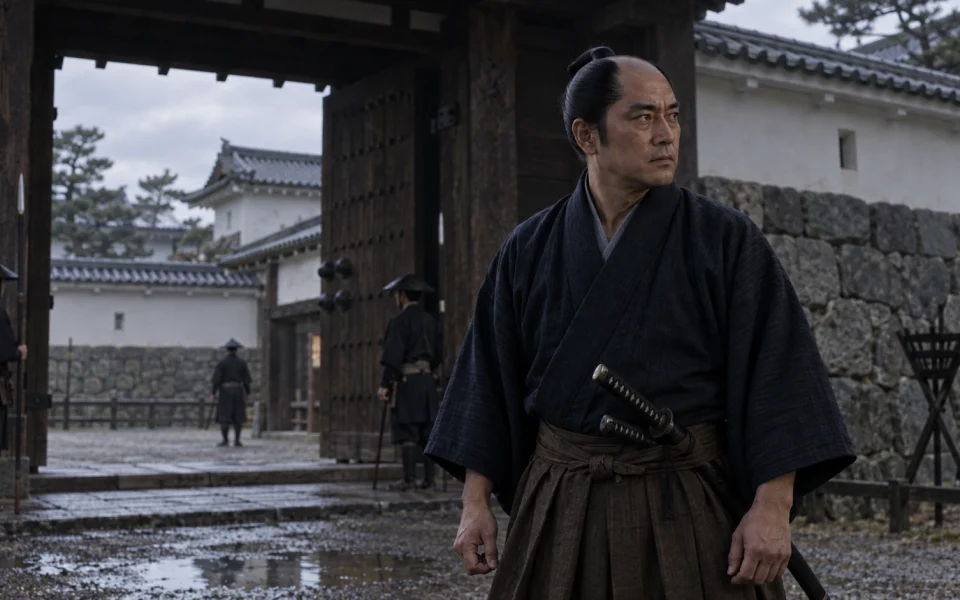
The image is an AI-generated reconstruction adapted from the Japanese edition. It does not reproduce the young Naosuke's face, the interior of Umoreginoya, documents, clothing, or companions. It functions as a chapter opening for time lived before the public political stage.

1846–1853
From unexpected heir to lord of Hikone
Naosuke's position changed when he was thirty-two. The Hikone Castle Museum explains that his elder brother Naomoto, who had been adopted by the twelfth lord Ii Naoaki as heir, died. Naosuke then replaced him in the line of succession. A junior son far from inheritance became the prospective head of the Ii house.
He spent about four years in Edo preparing as heir to the domain lord. In 1850, after Naoaki's death, he became lord of Hikone. The fifteen years at Umoreginoya and the four years as heir were not one continuous apprenticeship for high office; they involved different roles, locations, and expectations.
It would be narratively convenient to describe the change as a hidden talent suddenly discovered. The public museum account instead supplies a family succession and a period of preparation. Reading backward from his eventual appointment as tairo must not make every earlier event look planned.
The Ii were a fudai daimyo house with a special history in shogunate government. The Hikone Castle Museum explains that successive lords had supported the shogun in roles connected to the later office of tairo. Naosuke inherited not only territory but the house's position among senior hereditary Tokugawa retainers.
Three years after he became lord, Perry's squadron arrived in 1853. Naosuke now faced foreign policy not merely as the ruler of Hikone but as a senior lord whose opinion could be sought on the direction of the shogunate.
His movement from Umoreginoya to an Edo residence and then into central government shows that personal cultivation did not simply turn into national policy. Inheritance, hereditary status, and service to the shogun created the institutional position from which he would act. The grounds for his treaty policy must still be examined in political records rather than inferred from tea or poetry.

1853–1858
The treaty had taken shape before Naosuke became tairo
The foreign crisis did not begin on the day Naosuke took office. The National Archives chronology records the successive arrivals of Perry and Putyatin in 1853. The shogunate responded through diplomacy and coastal defense, including construction at Shinagawa and relaxation of restrictions on building large ships.
In 1854, the shogunate concluded the Convention of Kanagawa with the United States and opened Shimoda and Hakodate. As the National Archives explains, this agreement did not yet contain ordinary commercial provisions. Moving from supplies and protection of castaways toward trade became the next question.
Townsend Harris arrived in Shimoda in 1856 as the first American consul general. He argued from changing international conditions and the claimed benefits of trade while demanding a commercial agreement. Negotiators had to settle ports, foreign residence, representation, judicial authority, and customs rather than decide only between two abstract labels.
According to the Diplomatic Archives of Japan's Ministry of Foreign Affairs, senior councillor Hotta Masayoshi appointed Inoue Kiyonao and Iwase Tadanari as commissioners. They negotiated the substance of the agreement with Harris. The text was therefore not invented from nothing by Naosuke after his appointment.
A domestic authorization problem nevertheless remained. Many daimyo argued that imperial approval should precede signature, and Hotta went to Kyoto to obtain it but failed. Foreign negotiation over treaty content and an internal dispute over who could authorize national policy now occupied the same issue.
Beyond Japan, the Arrow War was being fought between Qing China and Britain and France. The use of European military force in East Asia demonstrated that the shogunate could not assume negotiations could be postponed without limit. Yet the existence of pressure did not mean that every possible domestic procedure became equally acceptable.
What Naosuke inherited as tairo was a bundle: a nearly completed treaty, an urgent demand for signature, imperial approval not obtained, and divided opinions among daimyo. Seeing that structure prevents him from becoming either a lone visionary who created opening or a solitary autocrat who suddenly destroyed a stable consensus.

Fourth month of 1858
Two crises on the tairo's desk
Naosuke became tairo on the twenty-third day of the fourth month of 1858, corresponding to June 4 in the Gregorian calendar. The Hikone Castle Museum explains that Shogun Iesada appointed him amid two linked difficulties: the commercial treaty and the choice of a shogunal successor. The office was not a foreign-affairs portfolio alone.
One group supported Hitotsubashi Yoshinobu as Iesada's successor, while another supported Tokugawa Yoshitomi of the Kii house. The National Diet Library's biographical account records Naosuke's support for Yoshitomi and his conflict with Yoshinobu's advocates. Yoshitomi later became the fourteenth shogun as Tokugawa Iemochi.
This was not an election comparing age and ability in isolation. It concerned who could participate in shogunate policy and how hereditary Tokugawa vassals, collateral Tokugawa houses, and outside daimyo should relate to central government. The succession controversy exposed competing ideas about the political order itself.
After Perry's arrival, the shogunate had solicited opinions from lords who had not previously participated directly in central policy. The Hikone Castle Museum describes how Tokugawa Nariaki, Matsudaira Yoshinaga, Shimazu Nariakira, and others increased their political interventions and also approached the imperial court. Consultation on diplomacy widened claims to political voice.
Hotta had returned from Kyoto without imperial approval for the treaty. At the same time, political mobilization continued around Yoshitomi and Yoshinobu. Soon after taking office, Naosuke had to set a direction on both issues, each of which affected the legitimacy and membership of government.
The Hikone Castle Museum's reading of the records says Naosuke consulted Iesada and provisionally settled on Yoshitomi as successor while considering a schedule for consolidating daimyo opinion and obtaining imperial approval for the treaty. That differs from the simple image of a man who considered imperial authorization irrelevant from the outset.
Diplomatic time moved faster than the contemplated domestic schedule. The key question from this point is not whether a crisis existed, but what Naosuke prioritized as time narrowed, which procedure was crossed, and who bore the political consequences.
June 19, 1858
Separating the treaty's substance from the procedure of signature
The Hikone Castle Museum explains that after a pause in the Arrow War in June 1858, Harris invoked the possibility that British and French forces might come to Japan and pressed for immediate conclusion. On June 18, shogunate leaders at Edo Castle debated when the agreement should be signed.
In the museum's reading, most senior officials favored immediate signature, while Naosuke prioritized an explanation to the emperor and a policy of delaying until that explanation. Diplomatic commissioners Iwase Tadanari and Inoue Kiyonao then asked whether they could sign in an emergency. Naosuke reportedly replied that it could not be helped, after which they signed that day.
This sequence does not absolve Naosuke of involvement. The treaty was concluded under his leadership and implemented as shogunate policy, so political responsibility remained. It does show why the process is more accurately understood as linked decisions by senior officials and commissioners rather than a single theatrical command moving every part.
The treaty date is the nineteenth day of the sixth month, corresponding to July 29, 1858. The Diplomatic Archives explicitly states that it was signed without imperial authorization. The short interval between failing to obtain approval and implementing the agreement deepened conflict within and beyond the shogunate.
The Treaty of Amity and Commerce permitted an American diplomatic representative in Edo, provided for opening Edo and Osaka as cities and several ports including Kanagawa, and established trade. It also recognized one-sided consular jurisdiction and set Japanese customs duties through treaty arrangements. Opening ports was only one part of the document.
The shogunate concluded similar treaties with the Netherlands, Russia, Britain, and France in the same year, together known as the Ansei Five-Power Treaties. A collection introduced by the National Archives indicates that Japanese texts of the agreements were printed in 1859, apparently for accurate distribution among shogunate institutions.
Three axes should remain separate: the policy of avoiding military conflict and entering commercial relations, the treaty substance that constrained judicial and tariff authority, and the domestic procedure that lacked imperial approval. Approval of one axis does not automatically validate the other two.
Conversely, criticism of unequal provisions and unauthorized signature does not prove that foreign pressure was absent. Understanding Naosuke's position requires placing the time imposed by international events beside the domestic procedure whose breach carried political costs.

Ten days after signature
Reading Naosuke's explanation without treating it as proof
Ten days after the treaty was signed, Naosuke sent a reply to former minister Sanjo Sanetsumu. The National Diet Library introduces this letter, dated the twenty-ninth day of the sixth month of 1858, as a record in which Naosuke explained why signature had been unavoidable.
Naosuke argued that Japan could not adequately confront foreign powers while domestic problems remained unresolved. He referred to the danger of following Qing China's defeat in the Arrow War and presented delay as a threat to the state. The letter therefore documents that international military danger formed part of his own explanation.
It was also a political statement sent by the decision-maker to an opponent. A document written by a principal actor is vital primary evidence, but it does not prove that the actor's judgment was correct. It must first be read as evidence of how he justified his policy.
The Japanese video asks what Naosuke feared and what he hoped to preserve. This article does not answer as if it could inspect his mind. The defensible conclusion is that his letter connected Qing defeat, domestic political division, and the perceived danger of postponing an agreement.
Recognizing that crisis perception does not automatically justify accepting the political cost of unauthorized signature. Explanation and evaluation occupy different steps. The same discipline is needed when later outcomes are used to celebrate or condemn a decision made under uncertainty.
Sanjo opposed Naosuke over the treaty and succession and was later implicated in the Ansei Purge and forced to enter religious retirement. The letter was therefore not a calm exchange between two people who shared a conclusion. It belonged to a relationship that would place one man among those imposing punishment and the other among those punished.
The same document can be recruited to portray Naosuke only as a far-sighted savior or only as a repressor leaving an excuse. A sounder method compares his explanation with the treaty text, the procedure used, and the coercion that followed before drawing a judgment.

1858–1859
How restoring order became the Ansei Purge
Soon after the treaty, Tokugawa Yoshitomi was confirmed as successor and took the name Iemochi as fourteenth shogun. For supporters of Hitotsubashi Yoshinobu, opposition to Naosuke now combined grievance over both foreign policy and the succession.
The Hikone Castle Museum explains that on the eighth day of the eighth month of 1858, an imperial communication criticizing shogunate policy was issued. The document known as the secret imperial instruction of the eighth month reached the Mito domain with an order that it be transmitted to other domains. The shogunate viewed a command passing from court to one domain without the shogun as a grave challenge to its chain of authority.
That account helps explain why the government reacted strongly. It does not decide how far punishment was permissible. A governing institution's perception that its command structure is endangered cannot by itself justify the scope of investigation or the severity of penalties.
The National Diet Library describes a large-scale repression of opponents of opening, including confinement imposed on daimyo and court nobles and death sentences for Yoshida Shoin and others. The National Archives chronology likewise records the beginning of repression against imperial-loyalist and anti-foreign activists in 1858.
The Ansei Purge was not one order applied simultaneously to people for an identical act. Investigations and punishments widened over time around the treaty, succession, communication with the imperial court, and political activism. Individual conduct and grounds for each penalty require case-by-case study.
This article does not give an unverified total number of people punished or reconstruct every arrest in sequence. The reliable outline is still severe: punishments reached daimyo, court nobles, and activists, and coercion including execution became a means of suppressing political opposition.
The Hikone Castle Museum also describes senior councillor Manabe Akikatsu traveling to Kyoto to explain the shogunate's position. By December, an imperial communication was issued that the museum interprets as accepting the treaty signature. Progress in court-shogunate explanation did not erase the resistance created by punishment.
Calling Naosuke's goal maintenance of shogunate order makes the government's logic visible. Placing beside it the result, large-scale punishment of opponents, makes another distinction necessary: the purpose asserted by a government and the means used to pursue it cannot be evaluated as though they were the same thing.

March 24, 1860 — and beyond
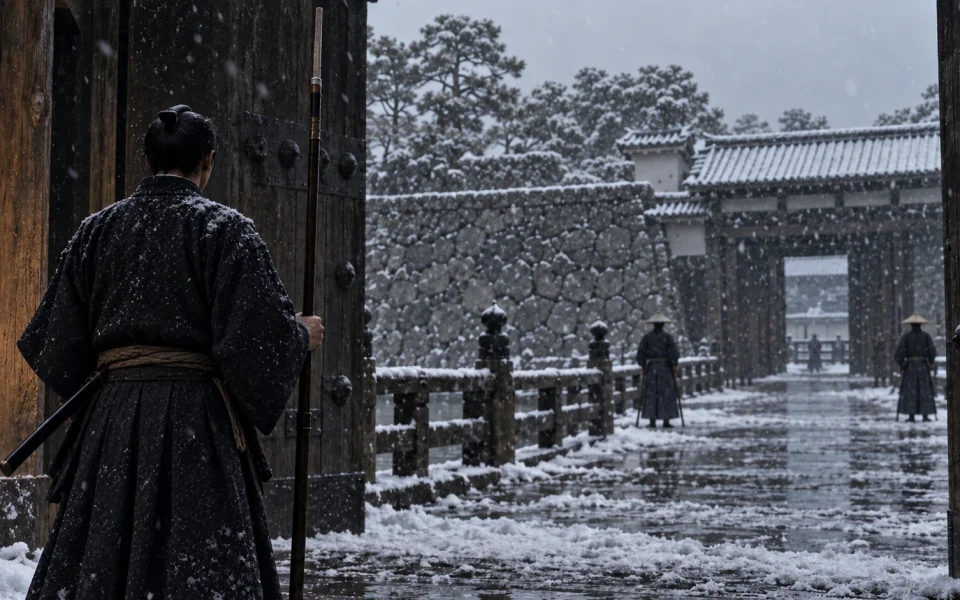
What did not end at the snowy castle gate
The shogunate demanded the return of the imperial instruction held by Mito. According to the Hikone Castle Museum, radical opponents within the domain broke from formal service and moved toward a plan to assassinate Naosuke and change shogunate policy. Treaty, succession, court communication, and punishment had converged into one political crisis.
On the third day of the third month of 1860, corresponding to March 24, Naosuke was attacked and killed outside the Sakurada Gate while traveling to Edo Castle. This edition does not reconstruct the attackers' exact positions, the order of blows, statements by Naosuke or his escort, or graphic details of injury.
The National Diet Library presents a diary written in May by Akamatsu Noriyoshi after his return from the United States aboard the Kanrin Maru. He recorded reports that the tairo had been killed on the way to the castle and anxiety that advocates of expelling foreigners might attack foreign residents.
The diary is not an eyewitness transcript. It records information heard after the event. Precisely because that distance is stated, it can be used for a different purpose: as evidence that news of the assassination was received together with fear about violence in the newly opened foreign relationship.
Killing the chief minister near the shogun's own castle gate deeply damaged the government's authority. It did not by itself predetermine the end of the shogunate. As the National Archives chronology shows, court-shogunate union, a shogunal journey to Kyoto, and military conflict involving Choshu followed during years of continued reorganization.
The commercial treaty system also survived Naosuke. Ports and trade expanded, while one-sided consular jurisdiction and tariff limits became diplomatic problems inherited by the Meiji state. Removing the political decision-maker did not remove an international agreement.
The Foreign Ministry explains that the Anglo-Japanese Treaty of Commerce and Navigation of 1894 enabled abolition of consular jurisdiction and partial recovery of tariff authority, while complete tariff autonomy still remained unresolved. Evaluation of 1858 must therefore include a timeline far longer than the immediate opening of ports.
Naosuke's reputation continued to change. The Hikone Castle Museum notes criticism under the Meiji government and, in Hikone, a stronger image of him as a benefactor of national opening around events such as a fiftieth-anniversary commemoration in 1909. The villain and benefactor portraits were themselves made within later politics and local memory.
Neither portrait is sufficient alone. Evidence supports Naosuke's argument that he sought to avert foreign conflict. The signature lacked imperial approval. The Ansei Purge inflicted coercive punishment. The treaty combined opened relations with unequal provisions. These facts must remain visible at the same time.
To ask what path Naosuke chose is to ask how far emergency can license political means. Benefits attributed to later opening do not erase procedure or victims. Criticism of repression does not erase contemporary military pressure. Biography becomes historically useful when it sustains both truths without converting either into an excuse.
How to read this work
History, interpretation, and reconstruction
Ii Naosuke tried to avoid a foreign military collision while preserving the Tokugawa chain of command, but signing without imperial approval and coercing political opponents deepened the very divisions he sought to contain. His record must be judged through outcome, procedure, and the cost of repression together.
This work is grounded in published sources and historical research. Interior thoughts, dialogue, and some visual details are cinematic reconstructions. Where historians disagree, the article presents the point as debated rather than settled fact.
Timeline
The story in time
-
Ii Naosuke is born in Hikone as the fourteenth son of the retired lord Ii Naonaka.
Sources: hikone-city-umoregi, hikone-museum-house -
Naosuke spends fifteen years at Umoreginoya, studying Zen, tea, Japanese learning, martial arts, Noh, kyogen, and other disciplines.
Sources: hikone-city-umoregi, hikone-museum-house -
After his elder brother Naomoto dies, Naosuke becomes heir to the lord of Hikone.
Sources: hikone-museum-house -
Naosuke succeeds Ii Naoaki as lord of the Hikone domain.
Sources: hikone-museum-house -
Perry's squadron arrives, and the shogunate intensifies its response to diplomacy and coastal defense.
Sources: archives-bakumatsu, hikone-museum-house -
The shogunate and the United States conclude the Convention of Kanagawa, which does not yet establish commercial trade.
Sources: archives-five-treaties -
Townsend Harris arrives at Shimoda and continues negotiations for a commercial treaty.
Sources: archives-bakumatsu, archives-five-treaties -
Ii Naosuke becomes tairo of the Tokugawa shogunate.
Sources: hikone-museum-politics, ndl-naosuke-letter -
The shogunate signs the Treaty of Amity and Commerce and trade regulations with the United States without imperial authorization.
Sources: mofa-harris-treaty, archives-five-treaties, ndl-treaty-index -
Naosuke sends Sanjo Sanetsumu a letter explaining that the treaty signature had been unavoidable.
Sources: ndl-naosuke-letter -
The secret imperial instruction is issued, and Mito is ordered to communicate it to other domains.
Sources: hikone-museum-politics -
Investigations and punishments over the treaty, succession, court-shogunate relations, and political activism expand into what becomes known as the Ansei Purge.
Sources: archives-bakumatsu, ndl-naosuke-letter, hikone-museum-politics -
Naosuke is attacked and killed outside the Sakurada Gate of Edo Castle by a group centered on former Mito retainers.
Sources: archives-bakumatsu, hikone-museum-politics, ndl-akamatsu-diary -
The Anglo-Japanese Treaty of Commerce and Navigation creates a path to ending consular jurisdiction and recovering part of Japan's tariff authority.
Sources: mofa-unequal-treaty
People & terms
A guide for new readers
Key figures
- Ii Naosuke
- Thirteenth lord of the Ii house of Hikone and tairo of the Tokugawa shogunate from 1858, responsible for policy involving the commercial treaty, shogunal succession, and punishment of opponents.
- Tokugawa Iesada
- Thirteenth Tokugawa shogun, who appointed Naosuke as tairo while the government faced both treaty negotiations and a contested succession.
- Tokugawa Yoshitomi
- Candidate from the Kii Tokugawa house selected as Iesada's successor; he later took the name Tokugawa Iemochi and became the fourteenth shogun.
- Hitotsubashi Yoshinobu
- Succession candidate supported by the Hitotsubashi faction who later became the fifteenth shogun under the name Tokugawa Yoshinobu.
- Hotta Masayoshi
- Senior councillor who advanced commercial treaty negotiations and traveled to Kyoto to seek imperial authorization before the treaty was signed.
- Iwase Tadanari
- Shogunate commissioner who negotiated with Harris alongside Inoue Kiyonao and signed the Treaty of Amity and Commerce.
- Townsend Harris
- First United States consul general to Japan, who pressed the shogunate to conclude a commercial treaty.
- Sanjo Sanetsumu
- Court noble who opposed Naosuke over the treaty and succession; Naosuke sent him a letter explaining the signature after it occurred.
- Yoshida Shoin
- Choshu-domain thinker and activist executed during the Ansei Purge.
Glossary
- Tairo 大老
- An extraordinary senior office of the Tokugawa shogunate, often translated as great elder or chief minister; Ii Naosuke held it from 1858 to 1860.
- Daimyo 大名
- A domain lord within the Tokugawa political order, connected to the shogunate through hereditary status and obligations.
- Fudai daimyo 譜代大名
- A daimyo house with long-standing hereditary ties to the Tokugawa and privileged access to shogunate office; the Ii house was a leading example.
- Imperial authorization 勅許
- Approval attributed to the emperor; failure to obtain it before the 1858 treaty signature became a central source of political conflict.
- Ansei Purge 安政の大獄
- The widening investigations and punishments of 1858–1859 directed at political opponents, including daimyo, court nobles, and activists.
- Secret imperial instruction 戊午の密勅
- An imperial communication criticizing shogunate policy that reached Mito in 1858 and was to be communicated to other domains, bypassing the shogun's usual chain of command.
- One time, one meeting 一期一会
- A principle associated with Naosuke's writing on tea: each gathering should be treated as unrepeatable, even when the same participants meet again.
Sources & method
How this article was built
This English edition preserves the Japanese article's eight-scene structure, nine people, fourteen timeline entries, and eleven sources in exactly the same ID order. It translates the argument while adding context for readers unfamiliar with the Tokugawa offices, daimyo politics, Japanese era dates, and the legal meaning of unequal treaty provisions.
The evidence comes from Hikone City, the Hikone Castle Museum, the Diplomatic Archives of Japan's Ministry of Foreign Affairs, the National Archives of Japan, and the National Diet Library. Museum interpretations of political records are identified as such; the Naosuke letter and Akamatsu diary are treated as primary accounts with their authorship, purpose, and distance from events kept visible.
The article does not infer Naosuke's private emotions beyond what his letter states, assign a verified total to the purge without source support, or reconstruct the order and dialogue of the Sakuradamon attack. Its analytical distinctions—external pressure versus domestic procedure, purpose versus means, and immediate opening versus long-term treaty constraint—are arguments drawn from the cited chronology rather than quotations from the actors.
AI-generated images inherited from the Japanese edition are disclosed as symbolic reconstructions and are not historical evidence. They do not claim accurate faces, interiors, documents, ships, clothing, arrest sequences, troop numbers, or positions at Sakuradamon.
Sources
References and further reading
- Cultural Heritage within Hikone Castle: Umoreginoya 彦根城内の文化財 埋木舎 Title translated editorially for reader convenience. Hikone City 彦根市 Used for Naosuke's position at birth, his fifteen years at Umoreginoya from age seventeen to thirty-two, and the disciplines he studied. Accessed 2026-07-29
- The Ii Lords of Hikone: Ii Naosuke 彦根藩主井伊家 井伊直弼 Title translated editorially for reader convenience. Hikone Castle Museum 彦根城博物館 Used for his cultivation at Umoreginoya, tea practice, selection as heir, preparation in Edo, accession in 1850, and career before becoming tairo. Accessed 2026-07-29
- On the Government of Tairo Ii Naosuke 井伊直弼の大老政治について Title translated editorially for reader convenience. Hikone Castle Museum 彦根城博物館 Used for his appointment, the succession, June 18 deliberations, treaty signature, the secret imperial instruction, the Ansei Purge, the Sakuradamon incident, and later competing reputations. Accessed 2026-07-29
- United States–Japan Convention of 1857, a Designated Important Cultural Property 日米約定(下田条約)(重要文化財) Title translated editorially for reader convenience. Diplomatic Archives, Ministry of Foreign Affairs of Japan 外務省外交史料館 Used for the 1857 Shimoda agreement and the one-sided consular jurisdiction later carried into the 1858 commercial treaty. Accessed 2026-07-29
- Treaty of Amity and Commerce Between Japan and the United States, a Designated Important Cultural Property 日米修好通商条約(重要文化財) Title translated editorially for reader convenience. Diplomatic Archives, Ministry of Foreign Affairs of Japan 外務省外交史料館 Used for Hotta, Inoue, and Iwase's negotiations, the failed request for approval, signature without authorization, and provisions on representation, cities, ports, trade, jurisdiction, and tariffs. Accessed 2026-07-29
- Chronology of the Turbulent Final Years of the Shogunate 激動幕末 年表 Title translated editorially for reader convenience. National Archives of Japan 国立公文書館 Used for Perry's arrival, the 1854 agreement, Harris, Naosuke's appointment, the five-power treaties, the Ansei Purge, Sakuradamon, and the subsequent course of late Tokugawa politics. Accessed 2026-07-29
- The Five-Power Treaties and Tariff Regulations 五ヶ国条約并税則 Title translated editorially for reader convenience. National Archives of Japan 国立公文書館 Used to distinguish the 1854 and 1858 agreements, confirm Harris negotiations and major treaty terms, and document printing and distribution of the Japanese texts in 1859. Accessed 2026-07-29
- In Their Own Hand: Letter of Ii Naosuke, Twenty-Ninth Day of the Sixth Month, 1858 あの人の直筆 井伊直弼書簡 安政5年6月29日 Title translated editorially for reader convenience. National Diet Library 国立国会図書館 Used for the biographical context and Naosuke's letter to Sanjo explaining the treaty decision and referring to Qing China's defeat. Accessed 2026-07-29
- Treaty of Amity and Commerce Between Japan and the United States 日本国米利堅合衆国修好通商条約 Title translated editorially for reader convenience. National Diet Library, Index of Laws and Ordinances 国立国会図書館 日本法令索引 Used to cross-check the bibliographic and legal record of the 1858 treaty before the modern cabinet system. Accessed 2026-07-29
- Diary of Akamatsu Noriyoshi, Fifth Day of the Fifth Month, 1860 赤松則良 万延元年5月5日の日記より Title translated editorially for reader convenience. Modern Japanese Political History Materials Room, National Diet Library 国立国会図書館憲政資料室 Used for a post-event diary report of the Sakuradamon assassination and anxiety about possible attacks on foreigners; it is not treated as an eyewitness account. Accessed 2026-07-29
- Historical Documents and Commentary: Unequal Treaties and the Abolition of Consular Jurisdiction 外交史料館 史料と解説 不平等条約・領事裁判権の撤廃 Title translated editorially for reader convenience. Diplomatic Archives, Ministry of Foreign Affairs of Japan 外務省外交史料館 Used for the Meiji government's inheritance of the treaty problem and the 1894 agreement ending consular jurisdiction and restoring part of tariff authority. Accessed 2026-07-29
Continue reading
More stories from Shigeki
Shigeki English
Oishi Kuranosuke: The Road from Surrendering Ako Castle to the Raid
Before the famous night came accounts, letters, separation, and an attempt to restore a fallen house.
- When Genroku 14–16, spanning 1701–1703; month and day references retain the old Japanese calendar
- Where Ako, Yamashina near Kyoto, and Edo
Shigeki English
The Sakuradamon Incident: A Shogunate Wounded, but Still Governing
Follow the assassination of Ii Naosuke through the orders, letters, and announcements that followed it.
- When 1860, with political background in 1858 and an aftermath extending into the 1860s
- Where Edo Castle and Hikone, with reports circulating beyond Edo