

SHIGEKI ENGLISH STORYEN
Japanese history in English
The Honnoji Incident: Was Nobunaga the Only Target?
Oda Nobunaga and the heir who already held the headship fell in separate battles on the same morning
Before dawn on 21 June 1582, Oda Nobunaga was at Honnoji while his eldest son Oda Nobutada was at Myokakuji. Both died in Kyoto that morning. Following the disputed order of attack, reports mixed with false rumours, and the eleven days to Yamazaki, this story separates documented events from interpretation and visual reconstruction.
At a glance
Before you enter the story
- When
- 21 June 1582, corresponding to the second day of the sixth month of Tensho 10 in the contemporary Japanese calendar; aftermath through 2 July 1582
- Where
- Kyoto and the corridor east towards Azuchi, then the Yamazaki area south-west of Kyoto
- Key figures
- Akechi Mitsuhide, Oda Nobunaga, Oda Nobutada, Hashiba Hideyoshi
- What was at stake
- The same morning removed both the dominant political figure of the Oda regime and the son who had already received the family headship, forcing allies and rivals to rebuild chains of command amid uncertain information.
Why this story matters
The larger history behind the turning point
The Honnoji Incident is often compressed into a single burning temple and a single famous death. That frame is memorable, but it hides a second battle in the same city. Oda Nobutada was not merely waiting to become his father's successor: he had received the Oda headship in 1575 and had led major military operations. His death at Nijo New Palace changed what the morning meant.
The incident also shows why a successful surprise attack is not the same as the creation of a durable government. Mitsuhide gained the initiative in Kyoto, yet still had to seek recognition and cooperation. Hideyoshi, meanwhile, returned from the western front while rebuilding alliances. Information, legitimacy, movement, and command mattered alongside the fighting itself.
For an international reader, this story offers a way into late sixteenth-century Japan without relying on a simple hero-and-traitor script. Some events are well documented, some sequences remain disputed, and many celebrated speeches or dramatic final moments belong to later storytelling. Keeping those layers apart makes the political shock more, not less, compelling.
Historical context
What an international reader needs to know
Headship and authority
The transfer of family headship did not mean that Nobunaga retired or surrendered every political and military power. He remained central to the expanding Oda regime. Yet Nobutada's headship was not an empty promise about a distant future: it gave him a defined place at the top of the house and accompanied substantial military responsibility.
This is why the word successor can mislead. Nobutada was certainly Nobunaga's eldest son and dynastic heir, but by 1582 he had already crossed an institutional threshold. The essay therefore treats father and son as two connected centres of authority without pretending that their powers were identical or neatly divided.
Kyoto was not one stage
The temple called Honnoji at the time of the incident stood in a different part of Kyoto from the modern temple. Myokakuji, where Nobutada lodged, and Nijo New Palace, where he fought, were separate sites. The Nijo New Palace in this account must not be confused with the surviving Nijo Castle known to visitors today.
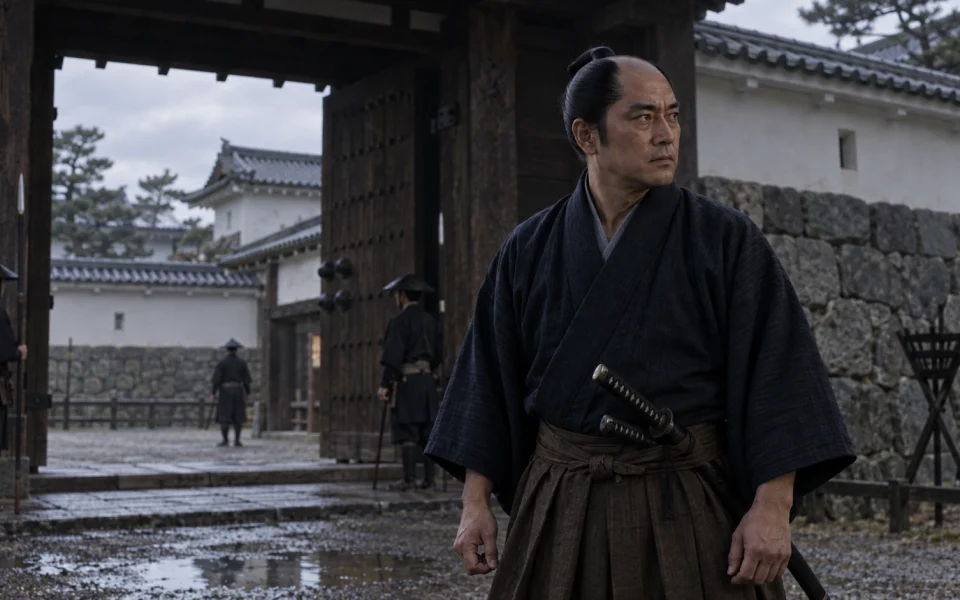
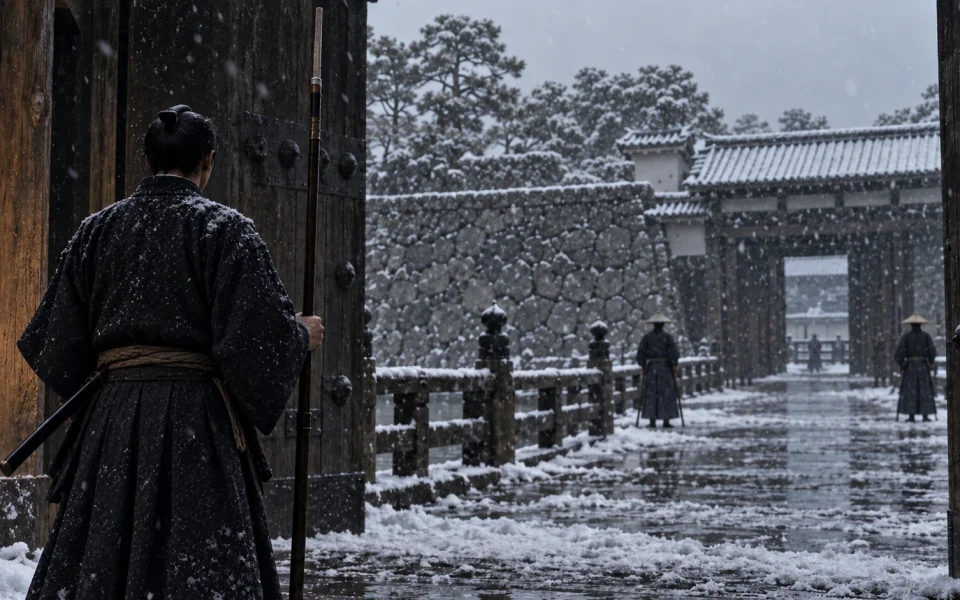
Those distinctions matter because the event unfolded through movement between places. Nobunaga and Nobutada did not begin the morning under one roof, and their battles did not occur on one field. The images used here evoke those movements, but they are not maps, architectural restorations, or claims about exact routes.
Watch the film
See the story in motion
The film currently uses Japanese audio. This English article provides the context and source trail; it does not imply that an English subtitle track is available.

Before dawn, 21 June 1582
Three movements converging on one morning
Return to Kyoto before dawn on the second day of the sixth month of Tensho 10. Oda Nobunaga was lodged at Honnoji. His eldest son, Oda Nobutada, was staying at Myokakuji. From the west, the forces of Akechi Mitsuhide were approaching the capital. Three positions were converging before most of the city knew that a political rupture had begun.
Father and son were in the same city, but not beneath the same roof. The night sky, the lines of lamps, and the appearance of the marching troops can only be visual reconstructions. The underlying structure is firmer: Nobunaga and Nobutada occupied different lodgings, and Mitsuhide's force moved into Kyoto before the two separate battles of that morning.
Nobunaga died at Honnoji. Nobutada later fought and died at Nijo New Palace. Those outcomes are clear, but the initial plan is not. The sources do not settle whether both men were targets from the beginning or precisely when troops turned towards Nobutada. A known result must not be mistaken for a fully known intention.
The story therefore begins with positions rather than imagined thoughts. It introduces the people, fixes the places as carefully as possible, and then places competing explanations beside one another. Entering the scene should not require pretending that the darkness left by the record has already been filled.

A second centre of authority in Kyoto
Oda Nobutada had already inherited the headship
Nobutada was not simply a son who happened to be in Kyoto. According to the Nagahama Castle Historical Museum, Nobunaga transferred the Oda family headship to him in 1575. Seven years before Honnoji, Nobutada had ceased to be merely a young man expected to inherit at some later date.
The same museum's account places him at the forefront of the 1582 campaign against the Takeda. This was not only a matter of title. He appeared at the head of large-scale military operations and carried responsibilities that shaped how the Oda house acted in war.
Calling him only Nobunaga's son or an heir in waiting removes that institutional and military history. It makes his death seem like the loss of future potential alone. The evidence instead directs attention to authority already transferred and duties already performed.
This distinction does not make Nobutada equal to Nobunaga in every sphere, nor does it imply that Nobunaga had withdrawn. It establishes a narrower but essential point: by June 1582, the Oda house had both a dominant father and a son who already held its headship.

18-20 June 1582
One city, two lodgings, three positions
Nobunaga entered Honnoji on the twenty-ninth day of the fifth month. The temple involved in the incident stood near Shijo and Nishinotoin, not at the modern Honnoji site near Teramachi and Oike. Kyoto City's site information and archaeological material keep the historical and present locations distinct.
On the first day of the sixth month, a tea gathering at Honnoji included court nobles, merchants, and Nobutada. That night Nobutada returned to his lodging at Myokakuji while Nobunaga remained at Honnoji. Their separation was ordinary before it became decisive.
Around the same time, Mitsuhide led troops out from Kameyama Castle in Tanba. The approaching force, Nobunaga at Honnoji, and Nobutada at Myokakuji formed three positions whose distances narrowed through the night and collided on the following morning.
Modern landmarks cannot simply be laid over this geography. The incident-era Honnoji was elsewhere, and Nijo New Palace was not today's Nijo Castle. Reconstructing the sequence begins by refusing those convenient substitutions, even when the precise appearance of the old city cannot be restored.

Two explanations
Did Mitsuhide divide his army?
An account from the Japan Arts Council describes Mitsuhide's troops entering Kyoto and dividing into two bodies, one directed towards Honnoji and another towards the area where Nobutada was staying. Read this way, pressure on father and son appears to have developed in parallel from the opening of the operation.
A study by Kumada Chihiro in the bulletin of Kyoto Sangyo University's Institute of Japanese Culture presents a different reading. Drawing attention to sources that place the Honnoji attack first, it argues for a sequential advance towards the Myokakuji area after the initial assault.
The common ground is limited but important. Honnoji was attacked, and Nobutada fought Mitsuhide's forces at Nijo New Palace on the same morning. The unresolved issue is whether soldiers moved in two directions from the outset or shifted towards Nobutada after the assault on Honnoji had begun.
That difference affects what one might infer about planning, but it does not reveal Mitsuhide's orders or inner purpose. A two-pronged advance could make Nobutada look like an initial target; a sequential attack leaves more room for a response to unfolding circumstances. Neither reading permits certainty about intention.

Before dawn, 21 June
Honnoji becomes a battlefield
Before dawn, Mitsuhide's troops surrounded Honnoji. The Japan Arts Council account relates that Nobunaga, alerted to the attack, resisted with bow and arrow. The defence did not continue for long against the force around the temple.
Nobunaga withdrew further inside, and Honnoji burned. Later narratives have supplied the silence with famous words, gestures, and a complete final state of mind. This account does not place an invented speech in the room or claim to know what he thought.
The documented core is enough: Nobunaga was attacked at Honnoji, died there, and the temple burned. Because the temple stood at a different site from the present Honnoji, the event cannot be projected directly onto today's precincts.
If the lens remains only on Honnoji, the incident seems to close with one death and one ruin. Elsewhere in Kyoto, however, Nobutada learned of the crisis and began to move. The political break would not be confined to a single burning compound.

The same morning in Kyoto
From Myokakuji to Nijo New Palace
At Myokakuji, Nobutada learned of the turmoil at Honnoji and is said to have attempted to move towards his father. With Mitsuhide's troops already pressing into the area, he instead transferred to the nearby Nijo New Palace. The path to a reunion did not remain open.
Crown Prince Sanehito, younger members of the imperial family, and court women were present at the palace. According to the institutional account, they withdrew before the fighting after Kyoto administrator Murai Sadakatsu urged their departure. Nobutada stayed with Sadakatsu and others to meet the approaching troops.
Nobutada died after the fighting, on the same day as Nobunaga. The man lost at Nijo New Palace was not a youth waiting to receive a role, but the figure who had already received the family headship and led major campaigns.
The site demands careful language. Historical records and later explanations use several names, including Nijo Palace and Nijo New Palace, and descriptions of the location have sometimes been confused. This edition uses Nijo New Palace and explicitly separates it from the standing Nijo Castle.

The central interpretation
Two centres lost on the same morning
Hold the documented points in place. Nobunaga was attacked at Honnoji. On the same morning, Nobutada fought Mitsuhide's forces at Nijo New Palace and died. The order of attack remains unsettled, but the loss of both men on one day does not.
Nobutada had received the Oda headship in 1575 and had stood at the front of the 1582 Takeda campaign. Losing him together with Nobunaga therefore meant more than the deaths of a father and son. It removed the dominant political leader and the person linking the house's headship to its continuing military action.
The next step is interpretation. Oda commanders, troops, and territories still existed, so the entire organisation did not disappear on 21 June. Yet decisions about whose orders to follow, which position to defend, and with whom to cooperate had to be remade under severe pressure. In that sense, a major space opened at the centre of command.
The political consequence must remain separate from an assertion about Mitsuhide's original aim. That the two deaths created a command gap does not prove that creating precisely that gap had been planned from the start. Result, intention, and later interpretation belong to different evidential layers.

Records from the immediate aftermath
The news arrived mixed with error
From a later vantage point, the morning can be arranged into a clean chronology. Contemporaries did not receive such a chronology. Messengers, letters, and rumours brought fragments, and people had to decide how to act before they could verify the whole event.
The Ietada Diary, introduced by the National Archives of Japan, records both news of Nobunaga's death and a report that Oda Nobuzumi had participated in the plot. An entry for the fourth day of the sixth month corrected that claim. Even two days after the attack, basic information about responsibility remained unstable.
This false report does not establish the outcome at Yamazaki or the details of Mitsuhide's death. Its value here is narrower: it reveals the form in which the political shock reached one contemporary observer. What later generations organise into one narrative initially circulated through uncertainty.
The command gap can therefore be understood as informational as well as personal. Commanders had to judge who was alive, who was allied with whom, and which report could support the movement of troops. This connection is an interpretation, grounded in the documented presence and correction of misinformation.

Three layers of explanation
Why did Mitsuhide act?
Many motives have been proposed: resentment, ambition, conflict over policy towards Shikoku, anxiety about Mitsuhide's future, or a hidden instigator such as the imperial court or Ashikaga Yoshiaki. No decisive record has been confirmed in which Mitsuhide gives one complete and exclusive reason for the rebellion.
These explanations need to be sorted into layers. One layer consists of contemporary letters and political relationships. A second consists of resentments and dramatic scenes spread by military chronicles and later popular writing. A third consists of hypotheses developed by modern scholars who reconnect known circumstances or newly studied documents.
The relationship between Shikoku policy and the incident is one issue emphasised in Kumada's study, which re-examines the event with documents of the Ishitani family among its materials. That is a scholarly interpretation, not a confession that fixes Mitsuhide's mind in a single sentence.
Later storytelling remains historically important because it shaped public memory. It cannot, however, be moved backwards and treated as a transcript of 1582. This edition avoids an invented interior monologue and asks instead where troops moved, who died, and what cooperation Mitsuhide did or did not secure.

21 June-1 July 1582
Time stopped at Seta while Hideyoshi began to move
Killing Nobunaga and Nobutada did not by itself establish a new order. At Azuchi, the custodian Gamo Katahide withdrew with members of Nobunaga's family. The bridge at Seta could not be crossed, and Mitsuhide went towards Sakamoto before entering Azuchi on the fifth day of the sixth month after repairs to the bridge.
Mitsuhide approached the court and sought cooperation or submission from warriors in different regions. Here the essay moves from documented actions to interpretation: the speed that had delivered the initiative in Kyoto now had to be converted into political recognition and military coordination. The measure of success had changed.
Hashiba Hideyoshi, then at Bitchu Takamatsu in the west, learned of the incident on the third day and reached peace with the Mori side on the fourth. The institutional chronology follows his departure from Takamatsu on the sixth, arrival at Himeji on the eighth, and advance into Settsu by the eleventh.
A copy of a letter dated the tenth, preserved through the Kobe University Library archive, shows Hideyoshi requesting that Nakagawa Kiyohide deploy while reporting contact with other commanders. The source is a copy rather than the original. It supports a reading of the celebrated return as an effort to rebuild cooperation while moving, not merely a feat of distance.

2 July 1582
Yamazaki, eleven days later
By the twelfth day of the sixth month, the two sides had broadly taken position around Yamazaki and some small clashes occurred. Full fighting followed on the thirteenth. Under the pressure of Hideyoshi's attack, Mitsuhide's force broke and withdrew towards Shoryuji Castle.
A familiar story says that whichever side seized Mount Tenno won the battle. That single move offers a satisfying explanation, but the Japan Arts Council account warns that treating the mountain alone as decisive is a later simplification. The battle involved several formations and movements rather than one theatrical switch.
Mitsuhide left Shoryuji Castle and is said to have died while attempting to reach Sakamoto Castle. Specific stories of an escape through the north gate or a final encounter on a dark road appear in sources written long after the event or in military tales. This edition does not freeze that uncertain ending into one image.
Eleven days connected the attack in Kyoto, confused information, efforts to gain support, Hideyoshi's return, and defeat at Yamazaki. The initial assault had removed two centres of Oda authority, but removing them and turning the resulting space into stable rule were not the same achievement.
How to read this work
History, interpretation, and reconstruction
This edition reads the incident as a political rupture in which the deaths of Nobunaga and Nobutada, who had already received the Oda headship, created a major gap in the centre of Oda command. It does not claim that eliminating both men was Mitsuhide's proven objective, because the surviving evidence neither establishes that intention nor resolves the order of attack.
This work is grounded in published sources and historical research. Interior thoughts, dialogue, and some visual details are cinematic reconstructions. Where historians disagree, the article presents the point as debated rather than settled fact.
Timeline
The story in time
-
Oda Nobunaga enters Honnoji in Kyoto, where he remains for several days.
Sources: ntj-honnoji -
A tea gathering is held at Honnoji. Nobutada returns to his lodging at Myokakuji that night, while Mitsuhide's force departs from Kameyama Castle in Tanba.
Sources: ntj-honnoji -
Mitsuhide's troops attack Honnoji. Nobutada moves from Myokakuji to Nijo New Palace and dies fighting there. Accounts differ over whether the forces divided at the outset or attacked sequentially.
Sources: ntj-honnoji, ntj-nijo, ksu-honnoji-reconsidered -
The Azuchi custodian Gamo Katahide reaches Hino Castle with members of Nobunaga's family.
Sources: ntj-nijo -
Hideyoshi learns of the incident and concludes peace with the Mori side.
Sources: ntj-yamazaki-route -
After waiting for repairs to the Seta bridge, Mitsuhide enters Azuchi and continues efforts to secure political and military support.
Sources: ntj-nijo -
Hideyoshi advances from Takamatsu through Himeji towards Settsu. A letter dated 29 June records efforts to coordinate with allied commanders.
Sources: ntj-yamazaki-route, kobe-hideyoshi-letter -
The two forces broadly complete their deployments around Yamazaki, where limited clashes begin.
Sources: ntj-yamazaki -
The battle at Yamazaki becomes general. Mitsuhide's army is defeated and retreats to Shoryuji Castle; Mitsuhide is said to die while attempting to return to Sakamoto.
Sources: ntj-yamazaki, ntj-mitsuhide-end, nagaokakyo-shoryuji
People & terms
A guide for new readers
Key figures
- Akechi Mitsuhide
- The commander who rebelled against Oda Nobunaga and led the forces that entered Kyoto.
- Oda Nobunaga
- The central figure of the Oda regime who was attacked and died at Honnoji.
- Oda Nobutada
- Nobunaga's eldest son, who had received the Oda family headship in 1575 and died fighting at Nijo New Palace.
- Hashiba Hideyoshi
- The Oda commander who returned from the western campaign and fought Mitsuhide at Yamazaki.
Glossary
- Honnoji Incident 本能寺の変
- The 1582 rebellion in which Akechi Mitsuhide attacked Oda Nobunaga in Kyoto; this article treats it as a wider political rupture involving Nobutada and the subsequent struggle for support.
- Family headship 家督
- The formal leadership of a warrior house. Nobutada received the Oda headship in 1575, although Nobunaga continued to exercise extensive political and military power.
- Nijo New Palace 二条新御所
- The Kyoto residence where Nobutada fought and died. It is not the surviving Nijo Castle familiar to present-day visitors.
- Chinese-region return 中国大返し
- The conventional name for Hideyoshi's rapid return from the western campaign after learning of the incident; the article also stresses the political coordination conducted during the movement.
- Military chronicle 軍記
- A genre of war narrative that preserved and reshaped memories of conflict. Such works can be historically important without serving as direct transcripts of every event or speech they describe.
- Tensho era 天正
- The Japanese era name covering the incident. Dates in the article use the Gregorian calendar first while retaining the era in contextual explanations.
Sources & method
How this article was built
This English edition follows the source order, people, scene identifiers, timeline entries, image assets, and evidence assignments of the reviewed Japanese story. It translates and expands context for readers unfamiliar with the period, but it does not introduce an independent factual narrative detached from that source package.
Public institutional explanations establish the basic chronology and locations. The Kyoto Sangyo University paper is used to preserve a genuine disagreement over attack order and to introduce one modern motive interpretation. Bibliographic records whose full texts were not reviewed remain research leads and do not support detailed claims.
All illustrations are inherited AI-generated reconstructions cleared in the Japanese package. No source photograph, map, manuscript image, or museum display is reproduced. Documented events, disputed sequences, this edition's political interpretation, and purely visual reconstruction are identified separately.
Sources
References and further reading
- The Course of the Honnoji Incident 本能寺の変の経緯 Title translated editorially for reader convenience. Japan Arts Council, Cultural Digital Library 日本芸術文化振興会 文化デジタルライブラリー Supports Nobunaga's and Nobutada's lodgings, the attack on Honnoji, and the public account in which the force divides. No images from the source are reproduced, and the attack sequence is compared with a different scholarly reading. Accessed 2026-07-21
- Nijo and Azuchi at the Time of the Incident その時の二条城と安土城 Title translated editorially for reader convenience. Japan Arts Council, Cultural Digital Library 日本芸術文化振興会 文化デジタルライブラリー Supports Nobutada's move from Myokakuji to Nijo New Palace, his resistance there, and Mitsuhide's subsequent movement towards Azuchi. It is not used to identify the site with modern Nijo Castle. Accessed 2026-07-21
- Theories about Mitsuhide's Reasons for Rebellion 光秀謀叛の理由諸説 Title translated editorially for reader convenience. Japan Arts Council, Cultural Digital Library 日本芸術文化振興会 文化デジタルライブラリー Provides a public overview of resentment, ambition, Shikoku policy, and hidden-instigator theories. Later military-tale material is not treated as settled fact. Accessed 2026-07-21
- Reconsidering the Honnoji Incident: Connecting Earlier Research with Facts Revealed by the Ishitani Family Documents 本能寺の変の再検証――先行研究の成果と『石谷家文書』から判明した史実の結合 Title translated editorially for reader convenience. Bulletin of the Institute of Japanese Culture, Kyoto Sangyo University, volume 25 京都産業大学日本文化研究所紀要 第25号 Kumada Chihiro's 2020 study discusses the Shikoku-policy interpretation and argues for an Honnoji-first, sequential attack. Its conclusions are presented as a scholarly position, not consensus. Accessed 2026-07-21
- People Around Hideyoshi: Oda Nobutada 秀吉をめぐる人々――織田信忠 Title translated editorially for reader convenience. Nagahama Castle Historical Museum 長浜城歴史博物館 Supports the transfer of headship in 1575 and Nobutada's leading role in the 1582 campaign against the Takeda. Exhibition images are not reproduced. Accessed 2026-07-21
- Where Did Oda Nobutada, Nobunaga's Eldest Son, Die? 織田信長の嫡子・信忠が亡くなった場所はどこか Title translated editorially for reader convenience. National Diet Library Collaborative Reference Database 国立国会図書館 レファレンス協同データベース Used to identify variation and confusion in the names and locations described as Nijo Palace, Nijo Castle, or Nijo New Palace. Accessed 2026-07-21
- Oda Nobunaga and Kyoto 織田信長と京都 Title translated editorially for reader convenience. Kyoto City Archaeological Research Institute and Kyoto City Archaeological Museum 京都市埋蔵文化財研究所・京都市考古資料館 Supports the historical locations and archaeological context of Nijo New Palace and Honnoji. Figures in the source PDF are not reproduced. Accessed 2026-07-21
- The Struggle around Mount Tenno 天王山の攻防 Title translated editorially for reader convenience. Japan Arts Council, Cultural Digital Library 日本芸術文化振興会 文化デジタルライブラリー Supports the deployments and fighting on the twelfth and thirteenth days and cautions against reducing the battle to a simple contest for Mount Tenno. Accessed 2026-07-21
- The Battle of Yamazaki: The Road to the Battle 山崎の戦い――合戦までの経緯 Title translated editorially for reader convenience. Japan Arts Council, Cultural Digital Library 日本芸術文化振興会 文化デジタルライブラリー Supports the report reaching Hideyoshi, peace with the Mori side, the route from Takamatsu through Himeji and Settsu, and the movements before Yamazaki. Troop numbers are not asserted. Accessed 2026-07-21
- Copy of a Letter from Hashiba Hideyoshi 羽柴秀吉書状写 Title translated editorially for reader convenience. Kobe University Library Digital Archive 神戸大学附属図書館デジタルアーカイブ Supports the contents and scholarly description of the copied letter dated the tenth day of the sixth month, including Hideyoshi's request for Nakagawa Kiyohide to deploy. The manuscript image is not reproduced. Accessed 2026-07-21
- The Death of Mitsuhide 光秀の最期 Title translated editorially for reader convenience. Japan Arts Council, Cultural Digital Library 日本芸術文化振興会 文化デジタルライブラリー Supports the retreat after Yamazaki and the broad account of Mitsuhide's death. Precise final scenes and death poems are left out because later storytelling shaped them. Accessed 2026-07-21
- Oda Nobutada: Eldest Son of the Ruler of the Realm 織田信忠――天下人の嫡男 Title translated editorially for reader convenience. National Diet Library Search 国立国会図書館サーチ Bibliographic record for Wada Yasuhiro's 2019 book. Because the book text was not reviewed for this edition, the record is retained as a research lead rather than evidence for specific claims. Accessed 2026-07-21
- Site of Honnoji 本能寺跡 Title translated editorially for reader convenience. Kyoto City 京都市 Supports the extent and location of Honnoji at the time of the incident and distinguishes it from the present temple site. The monument image is not reproduced. Accessed 2026-07-21
- Former Site of Daiunin 大雲院跡 Title translated editorially for reader convenience. Kyoto City 京都市 Provides information on the former temple established to commemorate Nobunaga and Nobutada. It is not used as evidence for Nobutada's headship or authority. Accessed 2026-07-21
- A Stage of War: Shoryuji Castle and the Battle of Yamazaki 戦乱の舞台――勝龍寺城と山崎合戦 Title translated editorially for reader convenience. Nagaokakyo City 長岡京市 Supports Mitsuhide's retreat to Shoryuji Castle on the thirteenth day and notes that some escape narratives appear only in later sources. Site images are not reproduced. Accessed 2026-07-21
- The Honnoji Incident in the Ietada Diary 本能寺の変――家忠日記 Title translated editorially for reader convenience. National Archives of Japan 国立公文書館 Supports the report of Nobunaga's death, the erroneous information implicating Oda Nobuzumi, and the later correction. It is not used as evidence for Yamazaki or Mitsuhide's death. Accessed 2026-07-21
Continue reading
More stories from Shigeki
Shigeki English
Oishi Kuranosuke: The Road from Surrendering Ako Castle to the Raid
Before the famous night came accounts, letters, separation, and an attempt to restore a fallen house.
- When Genroku 14–16, spanning 1701–1703; month and day references retain the old Japanese calendar
- Where Ako, Yamashina near Kyoto, and Edo
Shigeki English
The Sakuradamon Incident: A Shogunate Wounded, but Still Governing
Follow the assassination of Ii Naosuke through the orders, letters, and announcements that followed it.
- When 1860, with political background in 1858 and an aftermath extending into the 1860s
- Where Edo Castle and Hikone, with reports circulating beyond Edo