
SHIGEKI ENGLISH STORYEN
Japanese history in English
Fukushima Masanori: Castle Repairs, Rules and the Loss of Hiroshima
Follow the stages between flood damage, construction and punishment.
The Hiroshima case involved a flood in 1617, repairs in 1618 and punishment in 1619. Read the reporting dispute, conditional pardon and response separately, while distinguishing the 1615 regulations from a 1616 draft, a 1635 copy and later repair procedures.
At a glance
Before you enter the story
- When
- 1615–1619, with documents of 1616 and 1635 and later preservation history
- Where
- Hiroshima Castle and Takaino in Shinano
- Key figures
- Fukushima Masanori, Tokugawa Hidetada, Asano Nagaakira, Shogunal intermediaries and officials
- What was at stake
- How could necessary maintenance become a dispute about a lord’s relationship with the central government?
Why this story matters
The larger history behind the turning point
An apparently simple statement that a lord lost his territory for repairing a wall conceals several administrative stages. Reporting, conditions for pardon and the judgement of compliance were connected but distinct questions. Keeping their order visible makes the explanation more precise.
Documents with the same familiar title need not represent the same version of a law. Identifying a draft, a later copy and a modern explanation prevents later provisions or interpretations from silently becoming the original rule applied in an earlier case.
Historical context
What an international reader needs to know
A castle combined local responsibility and central control
A lord needed a functioning administrative and defensive base. Maintaining buildings, walls and water systems was part of governing a territory. Yet possession of that territory did not necessarily give him unlimited authority to alter the castle without reference to the shogunate.
The Buke shohatto placed several aspects of daimyo conduct within a framework of central control. Castle work was one part of that framework, alongside other matters such as marriage. The text was not simply a building manual for individual craftsmen or a prohibition on every later repair.
Read versions and evidence at their own dates
The first regulations discussed here date to 1615. The heritage explanation concerns a manuscript draft associated with revision in 1616, while Kumamoto University introduces a copy of the 1635 regulations. These objects should not be merged into one unchanged original document.
The immediate sources are institutional explanations and the relevant sections of Hiroshima’s preservation plan. They do not provide access to the private thoughts of every participant. Generated stones, paper, timber and modern books are explanatory analogies, not photographs of the 1619 works or original commands.
Watch the film
See the story in motion
The film currently uses Japanese audio. This English article provides the context and source trail; it does not imply that an English subtitle track is available.
Scene 01
Even necessary repairs could become a political problem
Masanori lost his Hiroshima territory after a dispute involving repairs to the castle. Saying that he fixed a damaged wall and was immediately punished removes important stages between construction and the eventual decision.
Questions concerned reporting to the government, later conditions and the response judged to have been made to those conditions. The need to repair damage and the procedures required of a lord remained separate aspects of the same case.
This account follows those stages through the regulations and public historical explanations. It treats castle construction as part of the relationship between shogunate and daimyo, without turning a short summary into proof of one person’s hidden plan.
Scene 02
Masanori inherited an existing castle
Hiroshima Castle did not begin with Masanori. Its construction belonged to Mori Terumoto’s period, and Masanori took over the castle and territory following Sekigahara. Municipal history also describes the Fukushima house’s work on the castle town.
The castle supported government as well as warfare. Its buildings and defences required continuing maintenance. Taking over a territory therefore brought practical responsibilities, but those responsibilities did not amount to unrestricted control over its military architecture.
The overlap matters: a castle could support a lord’s local power while remaining subject to central supervision. The fact that Masanori was its lord cannot establish that every alteration lay within his independent discretion.

Scene 03
The regulations governed more than buildings
The shogunate presented the Buke shohatto to daimyo in 1615. The cultural-property explanation describes provisions concerning conduct, castle repair and new construction, marriage and other matters. The framework extended beyond one technical category of work.
The regulations were subsequently supplemented and revised. A source carrying the same title may consequently belong to a different moment. Its provisions must be identified before they are used to explain an earlier incident.
Kumamoto University’s introduced copy dates to 1635. Its entire content cannot be projected back twenty years. This article concentrates on early Edo castle work and keeps later versions visible as later evidence, rather than treating every clause as unchanged.
Scene 04
Repair and new construction were different categories
Ako Castle’s official explanation presents the requirement to report repairs to an existing residence castle. Reporting upward and the separate prohibition on new castles should be read as related but distinct provisions.
Maintenance was therefore not automatically a matter for the lord alone. At the same time, one clause does not prove that every small repair throughout the Edo period was uniformly forbidden under identical procedures.
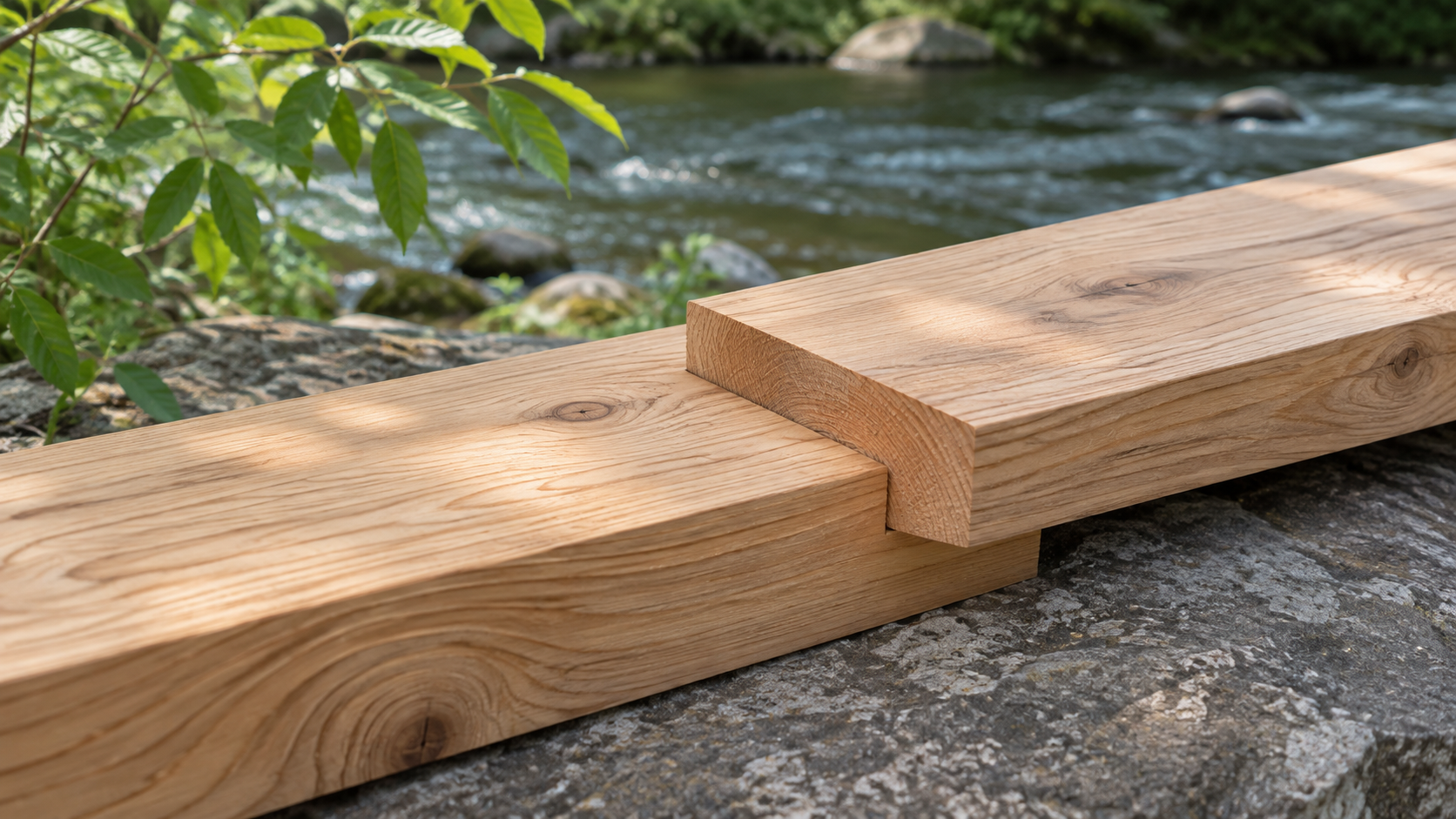
To understand Hiroshima, the general requirement and the treatment of the particular works must both be examined. A conceptual timber joint illustrates the idea of repair; it does not identify the construction method, material or exact disputed work at Hiroshima.
Scene 05
Keep the flood and the works in sequence
Hiroshima’s preservation plan places flood damage in 1617 and Masanori’s repairs in the following year. The disaster, subsequent works and eventual punishment should not be compressed into one undated event.
The existence of damage supports a need for maintenance. It does not settle whether the reporting procedure was adequate. Conversely, the word repair does not itself establish that the works were preparation for rebellion.
The sources do not give direct access to Masanori’s feelings or prove that concern for residents was his sole motive. Beginning with the sequence of damage and construction allows the administrative dispute to be discussed without inventing psychological certainty.

Scene 06
The handling of an application needs careful attribution
The government treated the work as lacking the necessary advance reporting. Explanations differ, however, over attempted applications and how an approach was transmitted. The preservation plan discusses those circumstances alongside subsequent responses.
The official castle history presents its own account of reporting after the works. These explanations should not be flattened into a fully established private conversation or a single unquestioned account of every intermediary’s action.
In particular, the existence of an intermediary does not prove deliberate suppression by Honda Masazumi or a personal trap. The government’s treatment of the works and interpretations of how that situation arose remain distinguishable matters.
Scene 07
After the work came conditions for pardon
The dispute did not end with a single immediate response. Hiroshima’s preservation plan explains that a conditional pardon was offered and that demolition of parts of the castle was among the requirements.
The account then concerns compliance with a new order. The plan distinguishes what the government required to be dismantled from what Masanori instructed should be dismantled. The article does not supply an unrecorded reason for that difference.
The case therefore involved more than the initial reporting issue. Later actions were also judged against stated conditions. Following that stage prevents the whole dispute from being reduced to the act of placing or replacing one stone.

Scene 08
The loss of Hiroshima followed a judgement of compliance
In 1619 Masanori lost Hiroshima and moved to a reduced holding at Takaino in Shinano. The preservation plan places failure to fulfil the required conditions by the deadline within the sequence leading to punishment.
Three stages remain visible: the repairs became a problem, conditions for pardon were set, and the response was judged insufficient. An explanation that stops after the first stage omits much of the recorded administrative process.
Different interpretations of background circumstances do not erase those stages. Beginning by deciding whose conspiracy the case must have been would reverse the order of enquiry. The sequence can be studied while questions of motive and wider political interpretation remain open.
Scene 09
A change of lord did not erase the castle town
Asano Nagaakira took over Hiroshima after Masanori’s departure. Municipal explanations trace Mori, Fukushima and Asano periods. The removal of one lord did not mean that every structure, institution or part of the town disappeared with him.
At Takaino, historic places and inherited stories also preserve memories of Masanori. Takayama Village’s explanation presents that later local memory alongside the move to the area.
A tradition of good government in the later locality cannot independently prove his motive during the earlier Hiroshima repairs. The administrative decision at Hiroshima and memory developed at the place of exile are connected histories, but they ask different evidential questions.
Scene 10
Repairs continued under later procedures
The preservation plan describes applications for repairs after damage during the Asano period. It also notes differing treatment of minor works and consultation when the appropriate category was uncertain. Regulation did not mean all maintenance stopped.
Ako’s later construction with government permission offers another example of a particular decision. That permission cannot be transferred backwards as a guarantee of how Masanori’s earlier case should have been decided.
The shared point is that identifying a practical need did not complete the relationship with the government. Applications, classifications and decisions remained important. The broad word prohibition should not replace investigation of those more specific procedures.

Scene 11
Date the document and the visible object
The heritage database’s Suden manuscript concerns revision in 1616, after the first promulgation. Kumamoto’s copy belongs to another year. A similar title does not remove the historical difference between the documents.
Hiroshima’s old keep was lost in 1945. A current photograph or a later structure cannot simply become the view that Masanori saw. The dates of buildings matter just as the dates of texts do.
The illustrations here are explicitly explanatory: ordinary stones, timber, blank paper and a modern book with a magnifying glass. They are not original orders, source facsimiles, excavation photographs or evidence of the precise tools used in the disputed works.
Scene 12
Necessary work remained within a relationship of authority
Why could repairing a castle become a matter of losing a territory? The case shows that a lord’s maintenance responsibilities operated within the shogunate’s control. Practical need alone did not decide the administrative outcome.
Advance reporting and the later conditions for pardon formed different stages. An immediate punishment merely for repairing one wall is therefore too compressed an account. The intervening decisions remain essential to understanding what happened.
The castle expressed local power and the relationship between lord and government at the same time. Following the repairs and procedures makes that relationship concrete, while differences in explanations and uncertainty about private motives remain honestly identified.
How to read this work
History, interpretation, and reconstruction
Castle maintenance was a lord’s responsibility within shogunal control; Masanori’s punishment requires attention to the procedures after construction as well as the original repairs.
This work is grounded in published sources and historical research. Interior thoughts, dialogue, and some visual details are cinematic reconstructions. Where historians disagree, the article presents the point as debated rather than settled fact.
Timeline
The story in time
-
The Konchiin manuscript relates to revision, distinct from the original promulgation.
Sources: s01 -
The regulations copied in the Kumamoto University item belong to this year, not the original 1615 text.
Sources: s06 -
The old keep was lost; current views are not direct records of Masanori’s period.
Sources: s08
People & terms
A guide for new readers
Glossary
- Buke shohatto 武家諸法度
- Regulations governing military houses, issued and revised at different dates.
- Daimyo 大名
- A territorial lord whose local authority operated within relations with the shogunate.
- Reporting upward 言上
- Formally presenting a matter to a superior authority; repair and new construction need separate consideration.
- Conditional pardon 宥免
- Permission to avoid punishment subject to requirements, whose fulfilment could itself become disputed.
- Removal from a holding 改易
- Loss or alteration of a lord’s territorial position, distinct from destruction of the entire town.
- Takaino 高井野
- The Shinano locality associated with Masanori’s move after losing Hiroshima.
Sources & method
How this article was built
The immediate evidence consists of official explanations and the indicated preservation-plan sections. Original letters and diary entries mentioned within them are not represented as independently transcribed. Application circumstances, later requirements and the judgement of response retain their separate roles.
The inaccessible older planning-document link has been replaced by the inspected official castle history. The current preservation plan remains the source for differences in accounts of applications. Several references belong to Hiroshima’s institutions and are not eight independent eyewitnesses.
Document versions, later repair practice, local traditions and present buildings are dated separately. Illustrations are openly modern explanatory analogies. No private speech, deliberate suppression by a named intermediary, uniform ban on every repair, or exact reconstruction of the disputed works is invented.
Sources
References and further reading
- Buke shohatto: the 1616 Konchiin draft 武家諸法度(金地院所蔵・元和二年草稿) Title translated editorially for reader convenience. Agency for Cultural Affairs / Cultural Heritage Database 文化庁/文化遺産データベース The cultural-property explanation distinguishes the 1615 provisions and a subsequent draft. No full independent reading of the handwriting is claimed. Accessed 2026-11-06
- Hiroshima Castle preservation and utilisation plan, chapter 2, pages 44–47 史跡広島城跡保存活用計画 第2章 pp44–47 Title translated editorially for reader convenience. Hiroshima City 広島市 Relevant Fukushima and early Asano sections, not the entire plan or independently read original correspondence. The sequence and application circumstances are kept distinct. Accessed 2026-11-06
- The Fukushima house’s arrival and removal; Asano rule 福島氏の入国と改易/浅野氏の治世 Title translated editorially for reader convenience. Hiroshima Castle Associates 広島城アソシエイツ Official history of work, reporting, conditions and relocation, with later repair applications. Interpretations of the application circumstances are attributed rather than turned into a proven personal conspiracy. Accessed 2026-11-06
- Hiroshima history: the early modern period 広島の歴史(令和4年版広島市勢要覧)近世 Title translated editorially for reader convenience. Hiroshima City 広島市 Relevant Mori, Fukushima and Asano historical paragraphs, without projecting later population totals or town figures back to 1619. Accessed 2026-11-06
- The construction history of Ako Castle 赤穂城築城史 Title translated editorially for reader convenience. Ako City / Ako Castle Digital Museum 赤穂市/赤穂城デジタルミュージアム The reporting provision and a later authorised construction case; neither an original temple manuscript reading nor a guarantee of identical treatment in Hiroshima. Accessed 2026-11-06
- Copy of the Buke shohatto, Matsui documents 289 武家諸法度写(松井家文書289) Title translated editorially for reader convenience. Kumamoto University Library 熊本大学附属図書館 Bibliography and explanation identifying a 1635 copy. Later provisions are not all treated as the 1615 regulations. Accessed 2026-11-06
- Site associated with Masanori’s cremation 福島正則荼毘所跡 Title translated editorially for reader convenience. Takayama Village, Nagano 長野県高山村 The move and later local memory, including traditions distinguished from proof of earlier motives. Later loss of family income is not confused with the 1619 decision. Accessed 2026-11-06
- Hiroshima Castle online panel exhibition Web展示会 広島城パネル展 Title translated editorially for reader convenience. Hiroshima City 広島市 Historical overview and the loss of the old keep in 1945; no claim to have inspected every exhibition image. Accessed 2026-11-06
Continue reading
More stories from Shigeki
Shigeki English
The Second Choshu Expedition: Four Fronts and a Negotiated Withdrawal
Read weapons together with terrain, training, command and support.
- When 1866, distinct from the first expedition in 1864; the process of ending extended into January 1867
- Where Oshima, the Aki border, Iwami and the Kanmon Strait facing Kokura
Shigeki English
Hasedo: Why Fighting Continued after Sekigahara
Separate the siege, the arrival of news, and withdrawal under pursuit.
- When 1600; month and day references use the calendar of the time
- Where Hasedo and Yamagata in Dewa, connected with Aizu and distant Sekigahara