
SHIGEKI ENGLISH STORYEN
Japanese history in English
The Ako Incident: The Raid of the Forty-Seven Ronin and the Story of Chushingura
From an attack in Edo Castle to punishment, theater and prints: following the event beyond its most familiar scene.
Follow the Ako incident from Asano's attack in Edo Castle through the raid and punishment of his former retainers. Then explore how Kanadehon Chushingura and woodblock prints retold it, while keeping historical actions, disputed judgments and stage imagery distinct.
At a glance
Before you enter the story
- When
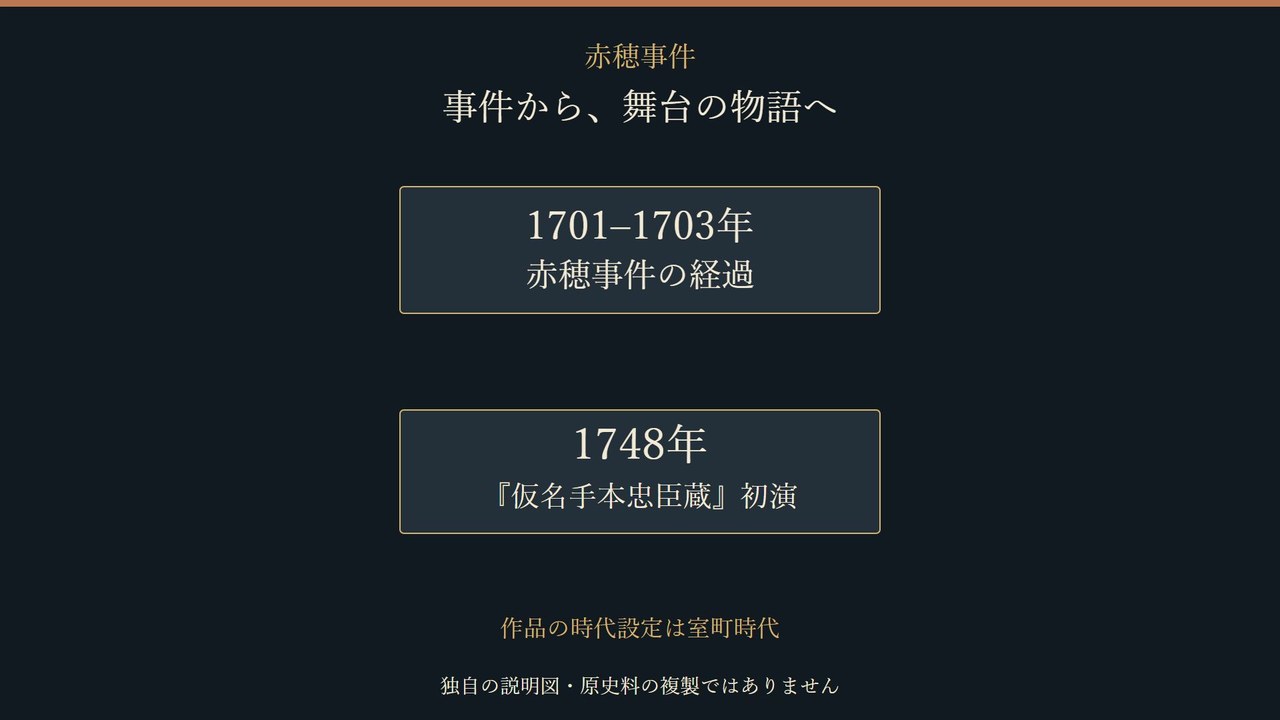
- Genroku 14–16 (1701–1703); Kanadehon Chushingura premiered in 1748. Historical month and day references retain the calendar then used.
- Where
- Ako and Edo, including Edo Castle and Kira's residence; the former retainers later entered the custody of four daimyo houses.
- Key figures
- Asano Takumi-no-kami, Kira Kozuke-no-suke, Oishi Kuranosuke
- What was at stake
- How did a castle attack lead to a raid and punishment, and how did the incident become a familiar story on stage and in prints?
Why this story matters
The larger history behind the turning point
The famous raid belongs to a sequence of decisions and consequences. Following the earlier castle attack, the loss of the Asano house and the later punishment gives that night a wider historical setting.
The same incident could prompt different judgments about loyalty and governing authority. Its later retellings also make it possible to ask which details come from records of events and which belong to the history of performance.
Historical context
What an international reader needs to know
Houses, retainers and governing authority
Edo, the city now called Tokyo, was the center of the Tokugawa shogunate. A shogunate was the government headed by the shogun. Daimyo were territorial lords, and retainers served their houses. In this article, the abolition of Asano's house concerns the end of that ruling house's position and its consequences for the people who served it.
Ako lay away from Edo, in the area of present-day Hyogo Prefecture. Asano was its lord; Oishi was a chief retainer of his house. Takumi-no-kami, Kozuke-no-suke and Kuranosuke are the forms of address used for the three figures in the adopted account. Ronin denotes retainers without a lord, rather than the title of one organization or a guarantee that all followed the same path.
Dates, punishment and dramatic forms
Genroku is a Japanese era name. Genroku 14, 15 and 16 correspond to 1701, 1702 and 1703. The historical calendar differs from the modern Gregorian calendar; the month and day are retained here without conversion. In particular, the raid's fourteenth night and fifteenth early morning are portions of the same overnight interval.
Seppuku was a form of death involving ritual suicide, here ordered as punishment. Ningyo joruri is puppet theater with narration, and kabuki is a different theatrical form performed by actors. The earlier Muromachi period supplies the setting of Kanadehon Chushingura, while the incident that inspired it took place in the Genroku era.
Watch the film
See the story in motion
The film currently uses Japanese audio. This English article provides the context and source trail; it does not imply that an English subtitle track is available.
Scene 01
Beyond the night of the raid
The Ako incident is familiar through the raid on Kira's residence and the story of the forty-seven former retainers. Yet that night was one part of a longer sequence. An attack inside Edo Castle, the abolition of Asano's house, the former retainers' assault and the shogunate's subsequent punishment each have their own setting.
Later theater and prints made the story memorable. They also supplied images, names and scenes through which many people encounter it. Knowing a dramatic scene does not by itself tell us which part of the historical sequence it represents, or what kind of evidence supports the details that seem familiar.
We follow the course of the incident and then the ways it became Chushingura. The sources used here are public explanations by cultural institutions and a museum library. Historical month and day references retain the Japanese calendar used at the time. The aim is to understand how actions, judgments and later storytelling became connected.
Scene 02
An attack inside Edo Castle
On the fourteenth day of the third month of Genroku 14 (1701), Asano Takumi-no-kami attacked Kira Kozuke-no-suke inside Edo Castle. Asano was the lord of Ako. Edo Castle was the shogun's residence and a place for government and ceremony. An assault there was considered within that particular institutional setting.
The Japan Arts Council's Cultural Digital Library explains the strict prohibition on drawing a blade inside the castle. It also introduces the denchu-zashi, the ornamental short sword worn for formal occasions there. This was the setting of an official ceremony and the restrictions attached to it, rather than a battlefield with opposing armies.
Asano was ordered to commit seppuku that day, and his house was abolished. These were related consequences of the castle incident, affecting the lord and the continued existence of his domain's ruling house. The speed and extent of the punishment belong to the sequence that preceded the later raid; they are not enough to establish Asano's private reasons for the attack.
Scene 03
What the ruling addressed
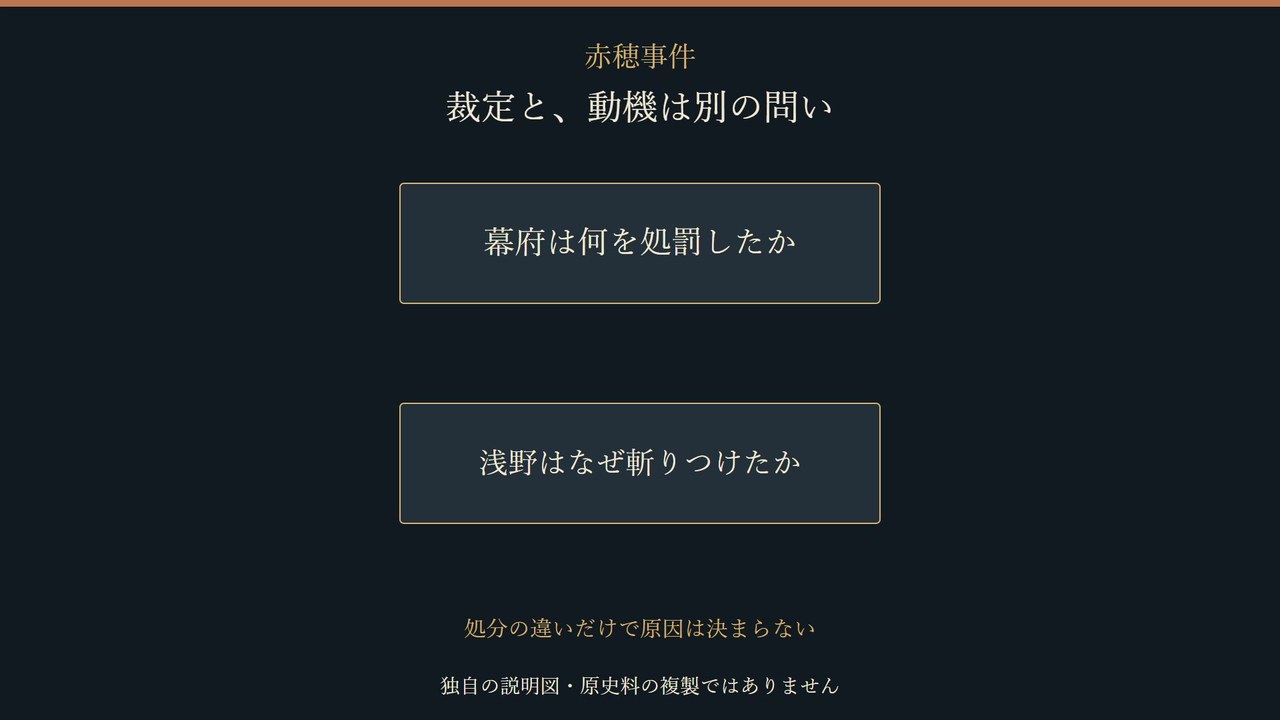
Kira survived the attack and was not punished. The different treatment of Asano and Kira became a significant part of the story. To understand that difference, however, it is necessary to ask how the shogunate framed its ruling, as well as why Asano had attacked in the first place.
The Cultural Digital Library explains that a key question in the ruling was whether Kira had reached for his short sword in an attempt to resist. In its account, he fled without fighting back, so kenka-ryoseibai, the principle of punishing both sides in a quarrel, was not applied. That is an explanation of the distinction used in the decision.
The same institutional account states that the reasons for Asano's resentment were not examined. A basis for punishment and a cause of the attack are different questions. The unequal penalties cannot establish a particular insult by Kira, a single conspiracy or dialogue later placed in a stage villain's mouth. The public explanation leaves that limit visible.
Scene 04
People whose lordly house had ended
The abolition of the Asano house did not end with the death of one lord. The retainers lost the house they served and had to leave Ako. According to a chronology published by Minato City in Tokyo, news of the attack reached Ako on the twentieth day of the third month, and Ako Castle was surrendered on the nineteenth day of the fourth month. The later raid is easier to follow when this wider consequence is kept in view, rather than moving directly from the castle attack to the assault on Kira.
The official overview records that some former retainers found service with other houses. Those who eventually took part in the raid were therefore not the entirety of Asano's former following. The word ronin describes their condition without a lord; it does not mean that everyone in that condition followed the same course.
The castle attack occurred in Genroku 14, and the raid came near the end of Genroku 15, the following year. There was an interval in which former retainers took different paths. Following the participants requires attention to that passage of time and to people who did not participate, without assigning an undocumented private choice to each individual.
Scene 05
A statement placed outside the house
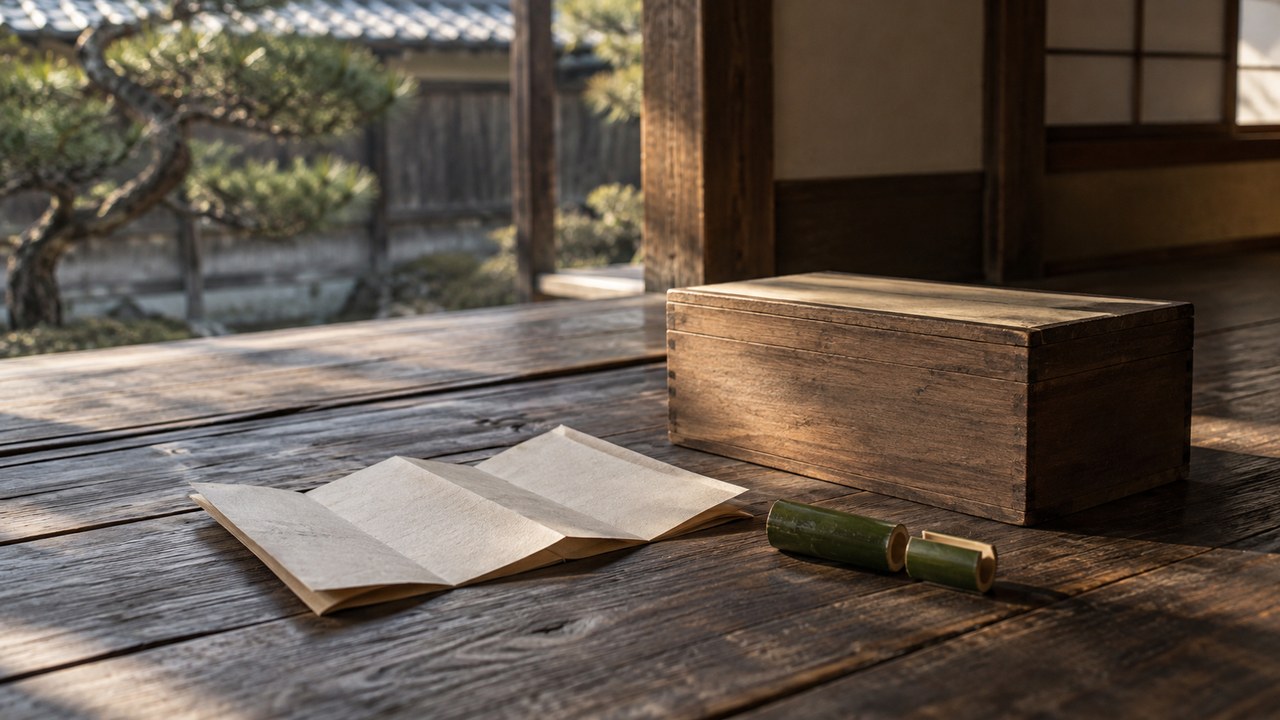
Materials concerning the raid include a document about how the participants presented their action. The Cultural Digital Library introduces a statement by the retainers of Asano Takumi-no-kami, known as a koujou-sho. Its presence places an act of explanation beside the act of attacking the residence.
According to the institutional introduction, the statement was put in a box, held between green bamboo and placed in front of the entrance to Kira's residence on the day of the raid. The attackers had prepared something through which to explain themselves to people outside their group. The library's description supplies those details about its presentation.
A statement issued by participants needs to be read as their explanation. Its existence does not turn that explanation into a ruling accepted by an independent authority. This article uses the institution's public introduction; it does not claim a complete transcription or a new reading of the original document. No further text or spoken words are supplied to complete its contents.
Scene 06
From the fourteenth night to the fifteenth morning
The former retainers raided Kira's residence during the night of the fourteenth day into the early hours of the fifteenth day of the twelfth month of Genroku 15 (1702). The public accounts use both the fourteenth night and the fifteenth before dawn. These descriptions identify portions of an event that continued across midnight. It came roughly one year and nine months after the attack in the castle. A walking guide published by Sumida City and its tourism association marks the place near Ryogoku Bridge where the group is said to have gathered and rested before moving on to Kira's residence.
Those month and day references follow the historical Japanese calendar. Reading them as an unconverted modern December date would change their meaning. Keeping the calendar and the overnight interval explicit helps explain why an account focused on the beginning of the night can differ from one focused on the early morning.
The Japan Arts Council's overview gives forty-seven participants and identifies Oishi Kuranosuke, the former chief retainer, as their leader. Kira was killed in the assault. These public explanations establish the outline of the raid. They do not supply the exact positions of all participants, all their actions, spoken exchanges or the weather later represented in a production.
Scene 07
Custody in four houses and the punishment of forty-six
Kira's death did not conclude the authorities' response. After the raid, according to the Minato City account, the former retainers went to Asano's grave at Sengakuji temple in Takanawa to report what they had done. They then reported to the shogunate's ometsuke, senior inspectors, and awaited a decision. Their movement from the residence to custody formed another stage of the incident, with its own institutions and eventual consequences. Today the graves of Asano and of the former retainers stand together at Sengakuji.
They were placed in the custody of four daimyo houses: the Hosokawa of Kumamoto, the Matsudaira of Iyo-Matsuyama, the Mori of Nagato-Chofu and the Mizuno of Mikawa-Okazaki. These names identify the houses and their associated territories. The story now moves from the site of an assault to those custodial arrangements and the shogunate's judgment.
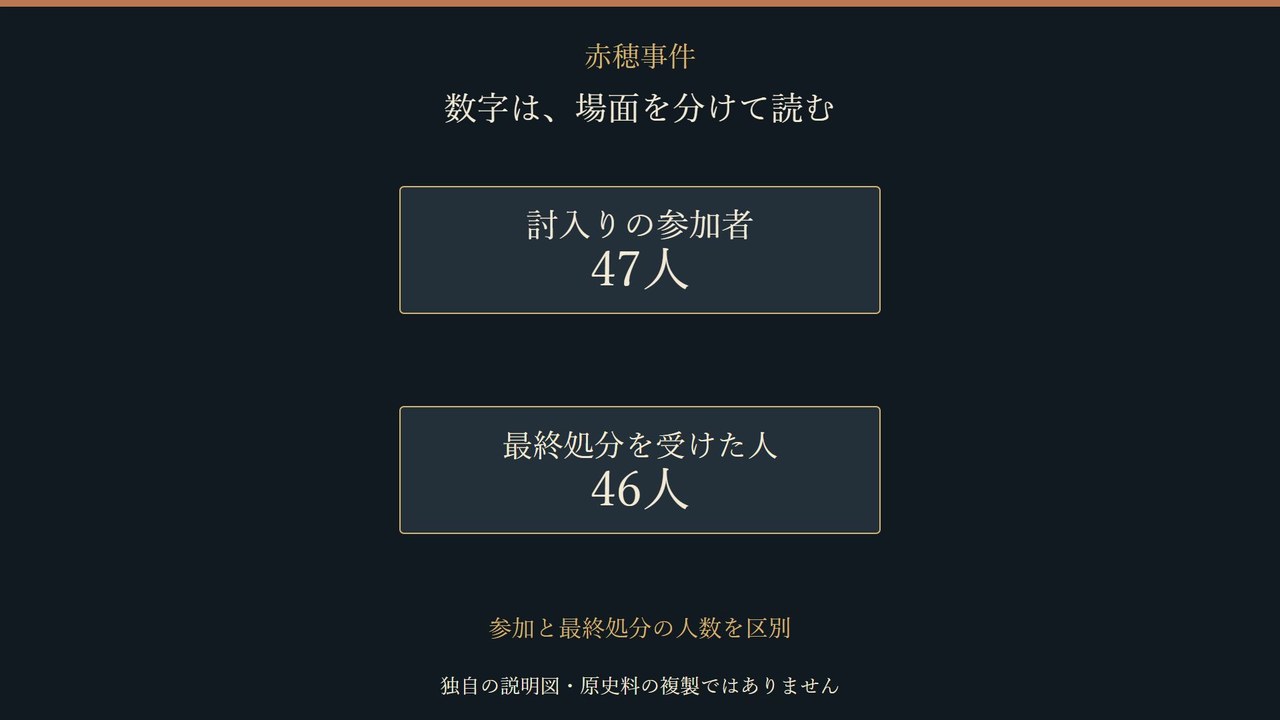
On the fourth day of the second month of Genroku 16 (1703), the forty-six who remained were sentenced to seppuku. Forty-seven participants and forty-six people receiving the final punishment count different stages. This article preserves the distinction without asserting a settled explanation for the remaining participant's departure or role. Before reconciling numbers, it asks what each number counts.
Scene 08
Praise for loyalty and disagreement over punishment
Some regarded the action as an expression of loyalty to a dead lord. Another view emphasized the collective, unauthorized assault carried out in opposition to the shogunate's ruling. Loyalty and the authority to decide punishment did not simply produce one shared conclusion about what should follow the raid.
The Cultural Digital Library explains that opinions within the shogunate and among Confucian scholars were divided over pardon and punishment. It gives the shogunate's reasoning that Kira had not killed Asano and therefore could not be treated as the enemy who had killed their lord. The participants' explanation and the governing authority's judgment were separated by that difference.
Calling the participants gishi, or righteous retainers, itself expresses an assessment. Evidence that praise existed does not establish that every inhabitant of Edo agreed, or that all the participants experienced one identical inner necessity. The incident includes both what people did and how others judged it. The disagreement belongs to its history, alongside the resulting punishment.
Scene 09
The clothing audiences recognize
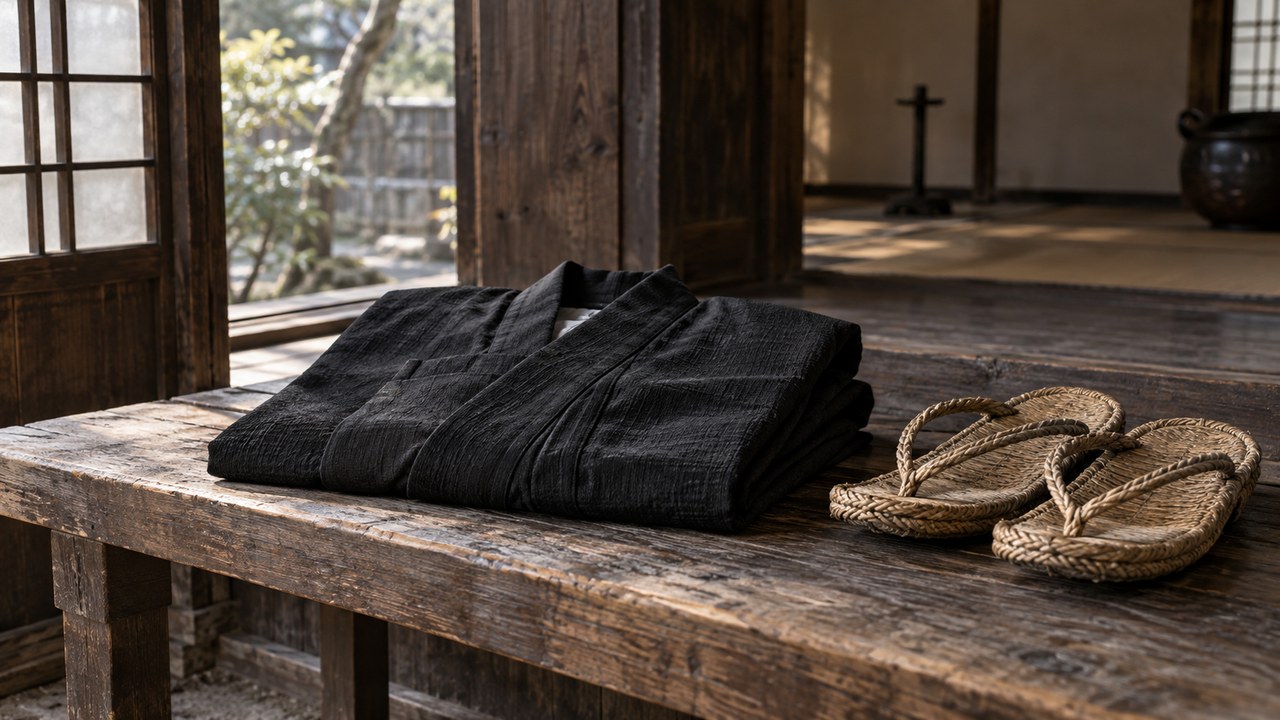
Matching raid costumes with striking black and white patterns are familiar from the stage and pictures. Their visual force can make them seem like a settled record of what every participant wore. The Edo-Tokyo Museum library's reference answer instead preserves uncertainty about the actual clothing and equipment.
The library states that the participants are thought to have agreed to wear black kosode and to have equipped themselves individually. Kosode refers here to a type of garment. The answer does not authenticate one complete, identical costume for everyone. It is an explanation with qualifications, not an inventory of each participant's clothing on the night.
The library also introduces differing theories about the origins of the theatrical firefighting-style costumes and their patterns. Stage clothing can help audiences recognize characters and situations. That purpose differs from documenting historical equipment. A familiar design thus offers a useful question about the history of performance without supplying a definitive reconstruction of the raid.
Scene 10
The world of Kanadehon Chushingura
In 1748, Kanadehon Chushingura premiered as ningyo joruri, puppet theater accompanied by narrative performance, and subsequently entered kabuki. The Edo-Tokyo Museum's exhibition explanation places the play's setting in the earlier Muromachi period. It did not present the Genroku incident using the historical participants' own names and dates.
The Japan Arts Council explains a device in the title Kanadehon: the forty-seven characters of the iroha syllabary correspond to the forty-seven former retainers. It also describes the association between the stage character Oboshi Yuranosuke and Oishi Kuranosuke. Names and a familiar ordering of characters gave audiences clues to the incident behind the work.
Shifting the time and changing the names did not remove those points of recognition. They belong to the construction of a drama and help explain how it could evoke the event. A character's words and actions within that work, however, cannot be quoted as the historical person's recorded dialogue. The relation between the play and the incident is itself part of the story.
Scene 11
A story carried by prints
Chushingura circulated beyond performance. The story also appeared in nishiki-e, multicolor woodblock prints, reaching people through images of scenes and performers. Prints added another form to the process through which the dramatic version of the incident became familiar and was repeatedly encountered.
The Edo-Tokyo Museum introduces a range of such works, including theater pictures of representative scenes from the acts and actor portraits showing the people who performed the roles. Even with a shared subject, different artists and forms of representation gave figures and scenes different appearances. A print could bring together a story, a performer and the artist's choices.
A picture of a theatrical scene is not an image recorded at the raid itself. Asking which scene it represents, when it was made and what it was intended to show changes the information we can take from it. It becomes evidence of how a story was represented and transmitted, with its own context, rather than a replacement for records of the original event.
Scene 12
Reading the incident and its afterlife
The Ako incident unfolded through an attack in Edo Castle, the abolition of the Asano house, the former retainers' raid, custody in four houses and the punishment of forty-six people. One scene from the raid cannot encompass that entire course. Following the stages makes the changes in circumstances and authority easier to see.
Assessments differed at the time. Praise for loyalty existed alongside arguments for punishment. Later theater adapted the period, names, clothing and presentation of scenes, giving the material a life as drama. Enjoying that drama and examining the historical event can remain connected activities, each asking appropriate questions of the materials it uses.
A familiar scene can be read alongside an institutional explanation of the incident or of the work's creation. Each encounter makes clearer what can be established and what remains uncertain. Beyond the night of the raid lies the time in which people continued to read, perform, picture and retell it.
How to read this work
History, interpretation, and reconstruction
Read the Ako incident through its successive stages and differing judgments, then examine the theatrical and visual forms through which its story continued.
This work is grounded in published sources and historical research. Interior thoughts, dialogue, and some visual details are cinematic reconstructions. Where historians disagree, the article presents the point as debated rather than settled fact.
Timeline
The story in time
People & terms
A guide for new readers
Key figures
- Asano Takumi-no-kami
- Lord of Ako; ordered to commit seppuku after attacking Kira in Edo Castle.
- Kira Kozuke-no-suke
- Survived Asano's castle attack and was later killed in the former retainers' raid.
- Oishi Kuranosuke
- Former chief retainer of Asano's house and leader of the raid.
Glossary
- Ronin 浪人
- A retainer without a lord; the condition does not imply that all former Asano retainers joined the raid.
- Daimyo 大名
- A territorial lord; four daimyo houses held participants in custody after the raid.
- Seppuku 切腹
- Death through ritual suicide, in this sequence imposed as punishment.
- Kenka-ryoseibai 喧嘩両成敗
- A principle of punishing both sides in a quarrel, which the adopted institutional account says was not applied to Kira.
- Koujou-sho 口上書
- A written statement through which the participants presented their action; its introduction is distinguished from a full transcription.
- Ometsuke 大目付
- Senior inspectors of the shogunate to whom the participants reported after the raid.
- Gishi 義士
- Righteous retainers, a term that contains praise rather than a neutral description shared by everyone.
- Kosode 小袖
- A type of garment; the museum library describes a probable agreement to wear black kosode with equipment obtained individually.
- Ningyo joruri 人形浄瑠璃
- Puppet theater with narration, the form in which Kanadehon Chushingura premiered in 1748.
- Nishiki-e 錦絵
- Multicolor woodblock prints, including pictures of theatrical scenes and portraits of performers.
- Iroha いろは
- An ordering of forty-seven kana characters used in the play's title to evoke the forty-seven former retainers.
Sources & method
How this article was built
This English article follows the revised Japanese article: twelve scenes, three people, ten references from four publishers and a seven-entry timeline.
It relies on public explanations by the Japan Arts Council, the Edo-Tokyo Museum, Minato City and Sumida City. It does not claim a complete transcription of the original statement or a full examination of original documents. The basis of the ruling is kept separate from unverified motives for Asano's attack.
Historical month and day references use the Japanese calendar of the period. Forty-seven participants and forty-six receiving final punishment count different stages, and no definitive explanation is added for the remaining participant's departure or role.
The probable clothing described by the museum library and later stage costumes are kept distinct. The 1748 play, its earlier setting, altered names and theatrical prints are treated as later representations. Stage dialogue, exact equipment and private thoughts are not imported into the historical event.
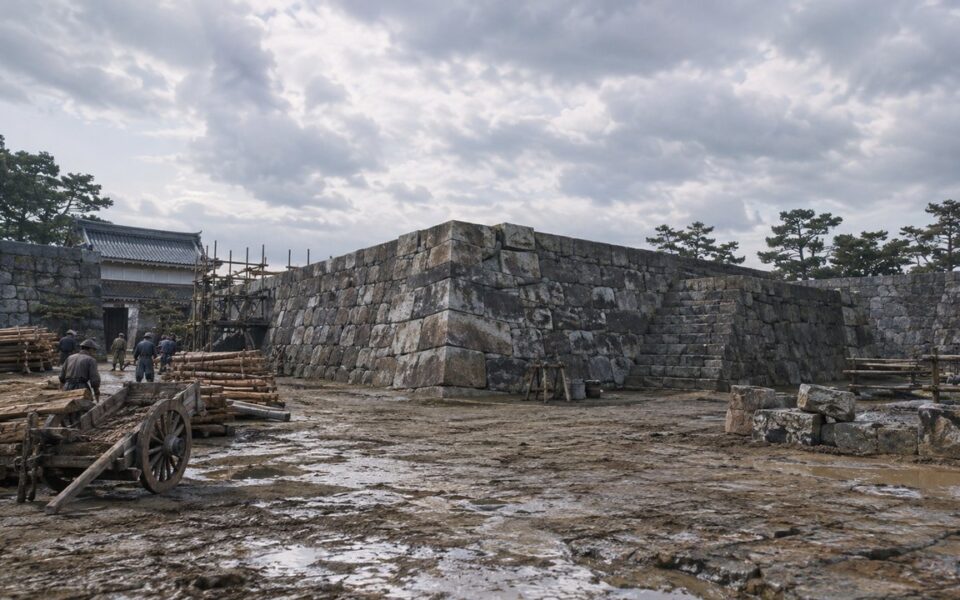
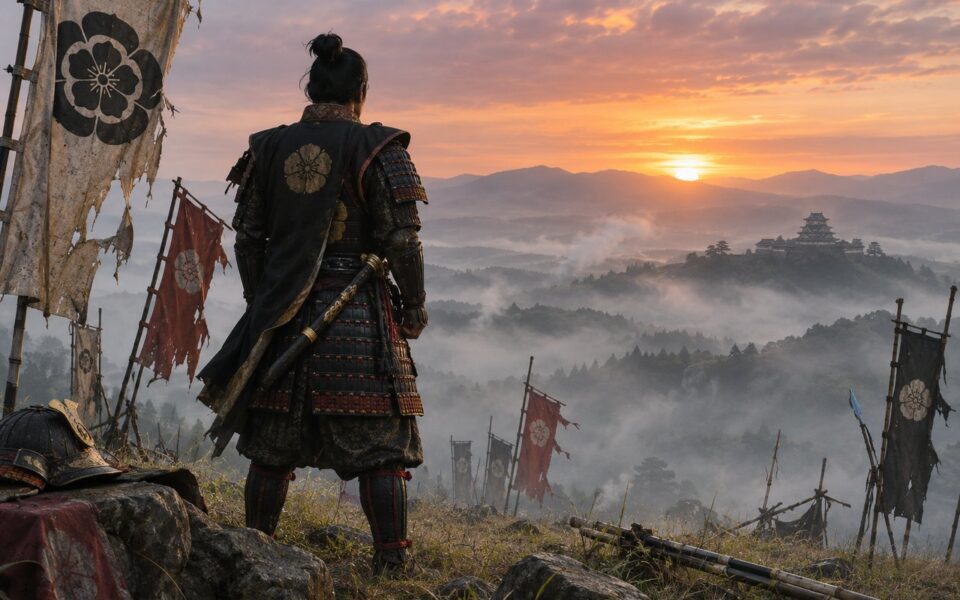
Illustrations are AI-generated conceptual scenes and original SHIGEKI diagrams. No institutional photographs, costumes or original prints are reproduced. The film has Japanese audio.
Sources
References and further reading
- The Ako Incident: Overview 赤穂事件・事件のあらまし Title translated editorially for reader convenience. Japan Arts Council 日本芸術文化振興会 Public account of the castle attack, abolition of the house, former retainers, raid and statement, and the distinct participation and punishment totals. Accessed 2026-10-09
- Drawing a Blade in the Castle 殿中における刃傷とは Title translated editorially for reader convenience. Japan Arts Council 日本芸術文化振興会 Public explanation of the castle prohibition and ceremonial denchu-zashi. Accessed 2026-10-09
- The Judgment on Asano 幕府の裁定と波紋 Title translated editorially for reader convenience. Japan Arts Council 日本芸術文化振興会 Institutional explanation of the ruling and the treatment of Kira, distinct from establishing Asano's motives. Accessed 2026-10-09
- The Raid and Its Aftermath 討ち入りとその後 Title translated editorially for reader convenience. Japan Arts Council 日本芸術文化振興会 Public account of the raid, four custodial houses and the shogunate's reasoning about punishment. Accessed 2026-10-09
- Different Assessments of the Former Retainers 浪人から義士へ Title translated editorially for reader convenience. Japan Arts Council 日本芸術文化振興会 Institutional explanation of disagreement over pardon and punishment; praise is not treated as unanimous opinion. Accessed 2026-10-09
- The Devices of Kanadehon Chushingura 『仮名手本忠臣蔵』という名の由来 Title translated editorially for reader convenience. Japan Arts Council 日本芸術文化振興会 Explanation of the title, the iroha characters and the association between stage and historical names. Accessed 2026-10-09
- What Did the Ako Retainers Wear for the Raid? 討入りの装束は揃いの火事装束だったか Title translated editorially for reader convenience. Edo-Tokyo Museum 江戸東京博物館 Library reference answer preserving uncertainty about actual clothing and differing accounts of theatrical costume. Accessed 2026-10-09
- Kanadehon Chushingura: The World of Prints 錦絵にみる忠臣蔵 Title translated editorially for reader convenience. Edo-Tokyo Museum 江戸東京博物館 Exhibition explanation of the 1748 puppet play, later kabuki, its Muromachi setting, stage pictures and actor portraits. Accessed 2026-10-09
- Chushingura: Ako Gishi Raid Walking Course (map) 忠臣蔵 赤穂義士討ち入りコース(まち歩きマップ) Title translated editorially for reader convenience. Sumida City and Sumida City Tourism Association 墨田区・墨田区観光協会 Used for the interval of about one year and nine months, the gathering place near Ryogoku Bridge and the site of Kira's residence. Accessed 2026-11-18
- Case File Tracing: Explore the Scene of the Genroku Ako Incident 港区事件簿を追って――元禄赤穂事件の現場を訪ねる(英語版) Minato City 港区 Used for the attack and same-day seppuku, the news reaching Ako, the surrender of the castle, the report at Sengakuji, the seppuku of 1703 and the graves at Sengakuji. Accessed 2026-11-18
Continue reading
More stories from Shigeki
Shigeki English
The Great Meireki Fire: Three Outbreaks and a Recovery Without a Keep
In the first month of 1657, fires from Hongo, Koishikawa and Kojimachi burned most of Edo. Follow the disputed figures, the robe legend, snow and relief, the mound for the dead, firebreaks and relocations, Ryogoku Bridge, Honjo and the keep base through thirteen scenes.
- When From the dry winter of 1656 and the fire of the 18th–20th days of the 1st month of 1657 to the recovery of 1658–1661 and the withdrawal and return of Honjo in 1682–1688, with later events in 1720, 1859 and 1863. Months and days follow the historical calendar.
- Where Hongo, Koishikawa, Kojimachi and Edo Castle, the burned town, the Sumida River crossing, Eko-in, Asakusa and the developing lands of Honjo and Fukagawa.
Shigeki English
Ishida Mitsunari: How a Magistrate of 190,000 Koku Came to Stand at the Center of Sekigahara
Was Sekigahara a war Mitsunari plotted? Fourteen scenes follow the third son of a village family from the survey fields and supply lines to the center of the decisive battle, and to the riverbed at Rokujō.
- When From his birth in 1560 to his execution on the 1st day of the 10th month of 1600.
- Where Ōmi (today Shiga Prefecture), Sakai, Kyushu and Hakata, Oshi in Musashi, Korea, Sawayama, Fushimi, Ōgaki, Sekigahara and Kyoto.