
SHIGEKI ENGLISH STORYEN
Japanese history in English
The Second Choshu Expedition: Four Fronts and a Negotiated Withdrawal
Read weapons together with terrain, training, command and support.
Follow the 1866 fighting at Oshima, Geishu, Sekishu and Kokura through islands, rivers and the Kanmon Strait. Distinguish local reverses from the overall result, military equipment from training, rice and silver support from a complete supply system, and Katsu Kaishu’s negotiations from the end of every front.
At a glance
Before you enter the story
- When
- 1866, distinct from the first expedition in 1864; the process of ending extended into January 1867
- Where
- Oshima, the Aki border, Iwami and the Kanmon Strait facing Kokura
- Key figures
- Choshu forces, Shogunal and participating domain forces, Local residents and suppliers, Katsu Kaishu
- What was at stake
- Why did a large coalition struggle across different fronts, and what made withdrawal possible?
Why this story matters
The larger history behind the turning point
The overall result of a war does not establish the result of every local encounter. Comparing different sides’ reports can reveal reverses, command problems and civilian experiences that disappear when the conclusion is allowed to determine every preceding scene.
Military operations required more than battlefield equipment. Food, money, storage, movement and agreements over withdrawal connected armies to regional communities and political negotiation. These relationships help explain both how fighting continued and how it could be brought toward an end.
Historical context
What an international reader needs to know
Four fronts were different geographical problems
The four mouths or approaches were directions of fighting around Choshu, rather than four modern prefectures. Oshima involved islands and maritime access; Geishu faced Aki across river routes; Sekishu extended toward Iwami; Kokura required movement across the Kanmon Strait.
A broad location is not an exact front line. A path joining place names cannot establish where every unit stood, how far particular artillery reached or which landing point was used on a particular day. Those questions require more specific evidence than a general campaign summary.
Separate explanations, catalogues and original documents
The account draws on institutional explanations, a researcher’s public lecture and catalogues identifying historical objects. A catalogue can establish that rice, silver or a sketch map is represented in a collection without providing a complete transcription or a reconstruction of the whole system.
The lecture compares records associated with different domains. Its interpretation is attributed to that comparison rather than presented as an independent reading of every quoted manuscript. Generated pictures supply conceptual settings only; no historical print, map or original document image is reproduced here.
Watch the film
See the story in motion
The film currently uses Japanese audio. This English article provides the context and source trail; it does not imply that an English subtitle track is available.
Scene 01
One campaign occupied several places
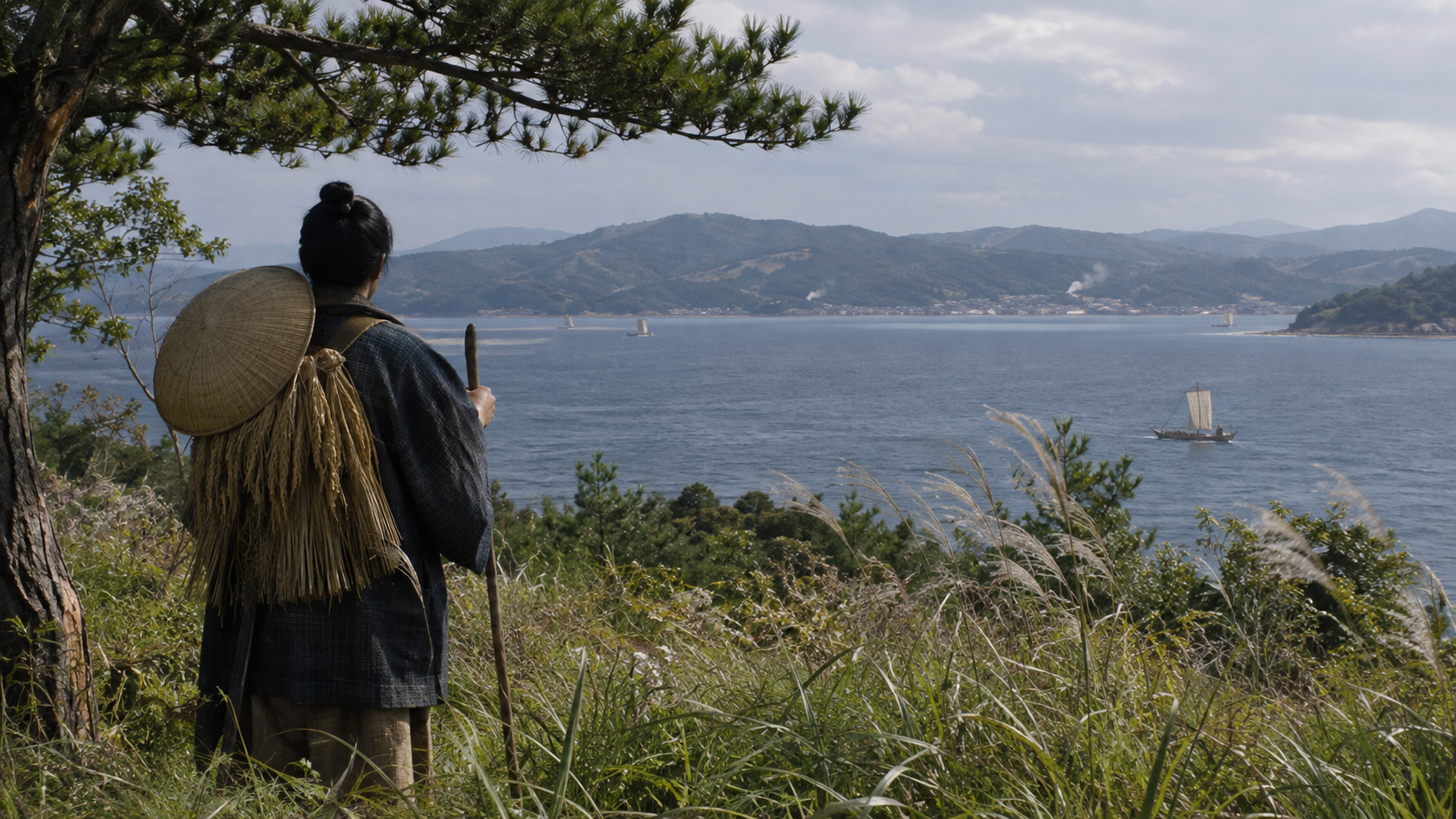
In 1866 the shogunate and Choshu fought across more than one location. Oshima, Geishu, Sekishu and Kokura formed the four approaches associated with the name Four Fronts War. Islands, rivers, mountain routes and a strait created different conditions.
The shogunal side’s difficulties therefore need more than one battlefield explanation. New firearms matter, but their presence alone does not explain how troops moved, cooperated, received supplies or eventually withdrew.
This account follows those relationships before reaching negotiations over the safety of departing forces. It does not assume that one weapon or one heroic individual supplied a complete explanation for every front and every phase of the campaign.
Scene 02
The expeditions of 1864 and 1866 were distinct
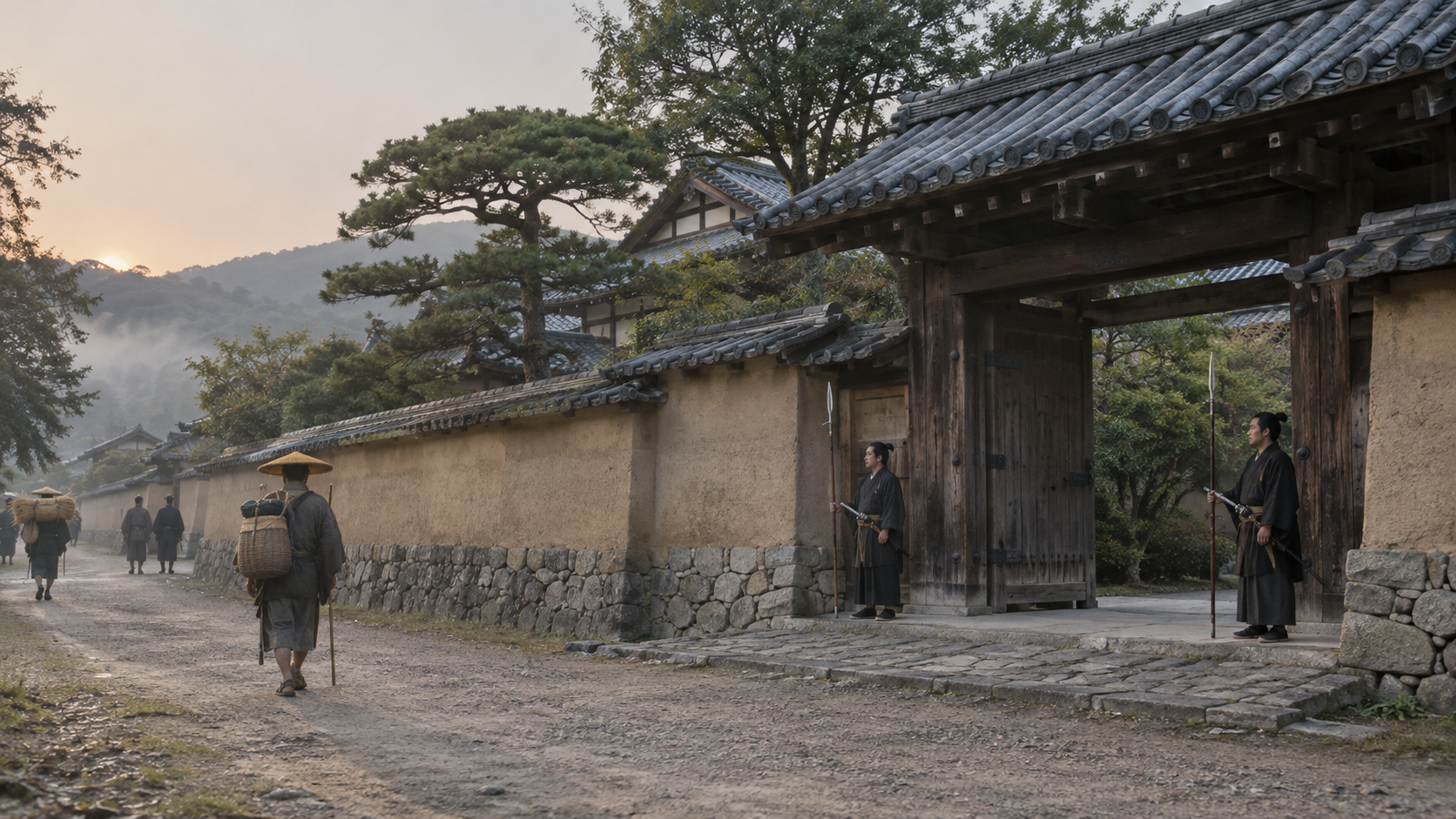
The National Archives chronology places the Kinmon incident and the first Choshu expedition in 1864, and the second expedition in 1866. They were not one continuous battle within the same year.
Political change within Choshu and renewed shogunal action belong to the interval. The principal fighting examined here is that of 1866, while the earlier expedition provides a chronological distinction rather than a merged opening scene.
Month and day references normally retain the calendar then in use. A modern-calendar equivalent is supplied only where checked. Nor should the four fronts be assumed to have opened and closed together on identical dates merely because they share a campaign name.
Scene 03
The four approaches offered different routes
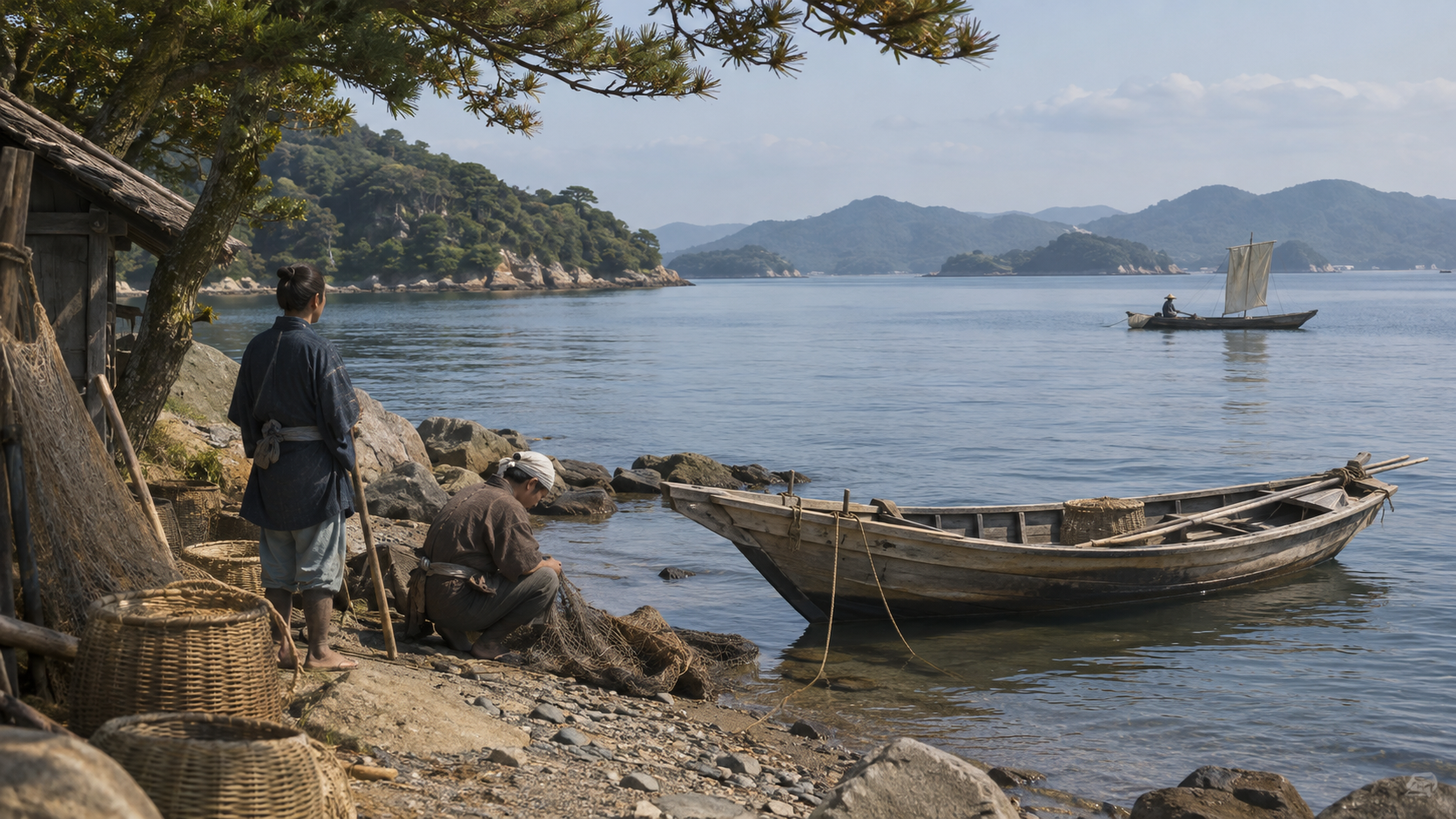
Oshima lay among the islands of the Inland Sea; Geishu faced the Aki boundary; Sekishu connected with Iwami; and Kokura lay across the Kanmon Strait. These names describe directions of conflict around Choshu.
Their relationship shows why maritime movement and overland movement cannot be treated as the same problem. A force crossing water encountered different conditions from a unit advancing along a mountain road or confronting an opponent across a river.
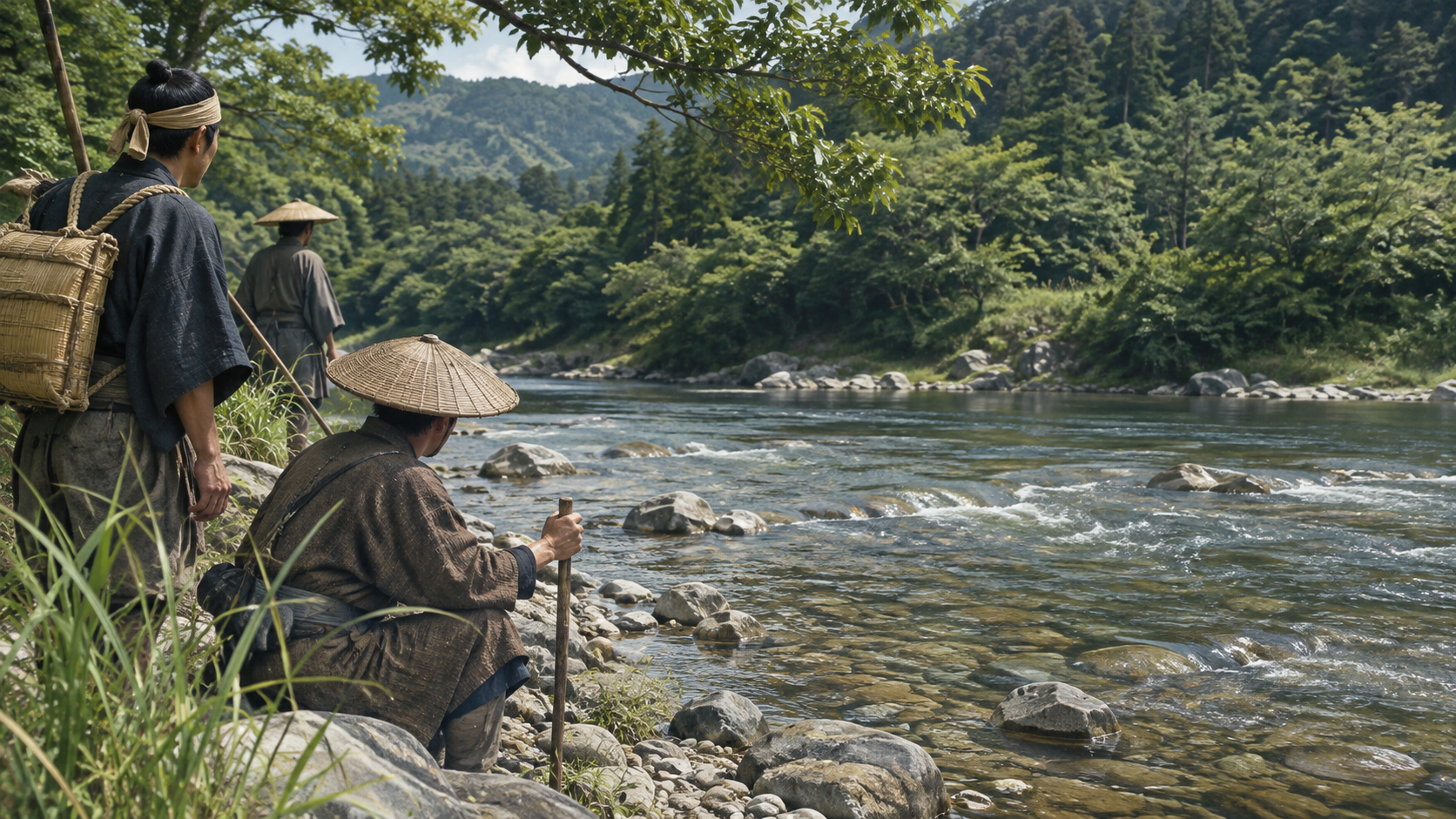
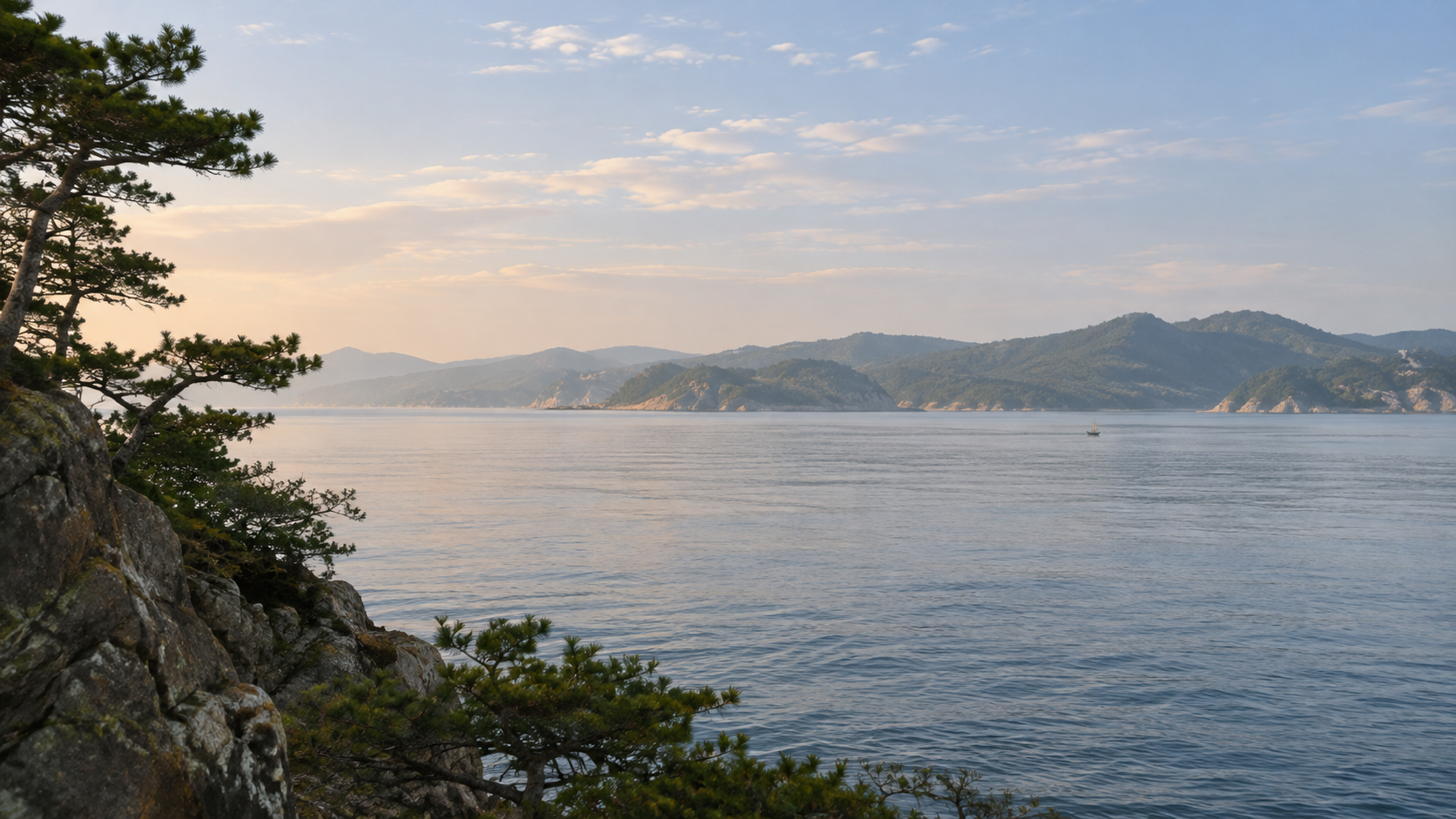
The broad geography establishes questions to ask rather than exact answers about deployments. Routes, artillery positions and supply movements need their own records. A conceptual shore scene therefore identifies no authenticated landing or measured front line.
Scene 04
At Oshima, the opening was difficult for Choshu
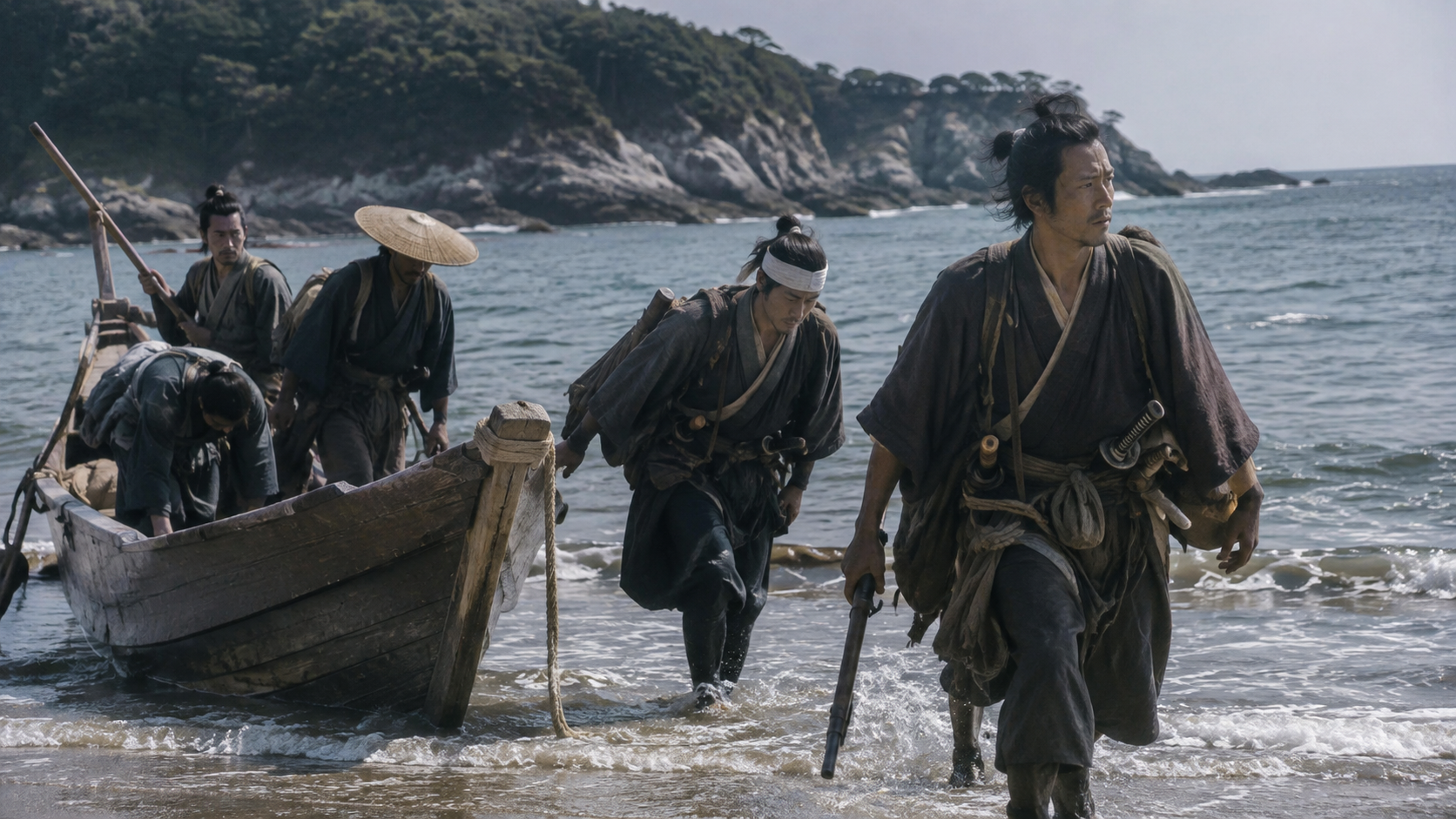
Suo-Oshima Town introduces the sixth month, seventh day of 1866 as the beginning of the fighting there. Choshu initially faced bombardment and landings and struggled in the island’s defence before moving to counterattack.
Ships moving around the island, places of approach and the island’s relief all mattered. The campaign involved access from the sea as well as the position of soldiers once they were on land.
The town explanation also includes island residents and different units. Following those combined actions makes the setting more intelligible than assigning the entire reversal to a single hero. No precise casualty total, universal occupation claim or invented landing dialogue is added.
Scene 05
At Geishu, read the river and the printed image separately
Yamaguchi’s library explanation places fighting at Waki in Iwakuni territory before the Oze River engagement. A river is a narrow line on a map but a practical question of crossing points and visibility on the ground.
The introduced battle print represents Choshu fire against opponents depicted with spears and swords. That is an aspect of the image’s presentation, not proof that every soldier on the shogunal side lacked a firearm.
The article uses the institutional explanation and catalogue rather than claiming independent close inspection of every detail of the original print. Pictorial emphasis and evidence of a unit’s equipment must remain different kinds of statement.
Scene 06
Equipment needed training and coordination
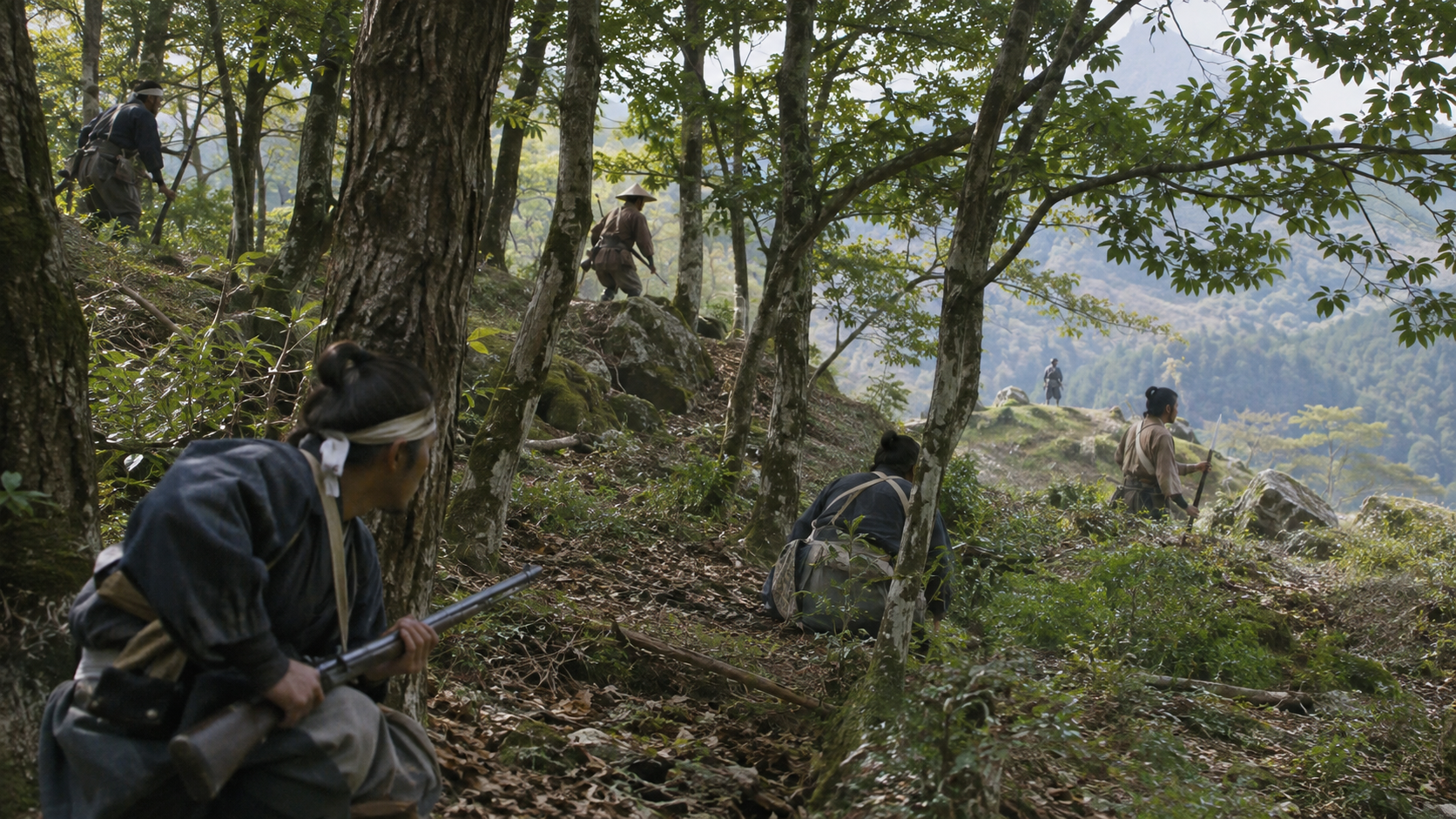
New firearms were an important element of the campaign. Yet a list of weapon names would not explain how troops fought. The library introduces dispersed tactics and the drill book associated with training for them.
Using ground and cover required preparation and coordination as well as tools. Finding an opponent, aiming and fitting a movement to others were practical activities rather than automatic consequences of acquiring a different gun.
The participating shogunal forces also varied in equipment and response. A simple division between uniformly modern Choshu and uniformly old-fashioned opponents would erase that variation. More specific claims should return to records of the particular units involved.
Scene 07
At Sekishu, gathering forces was different from directing them
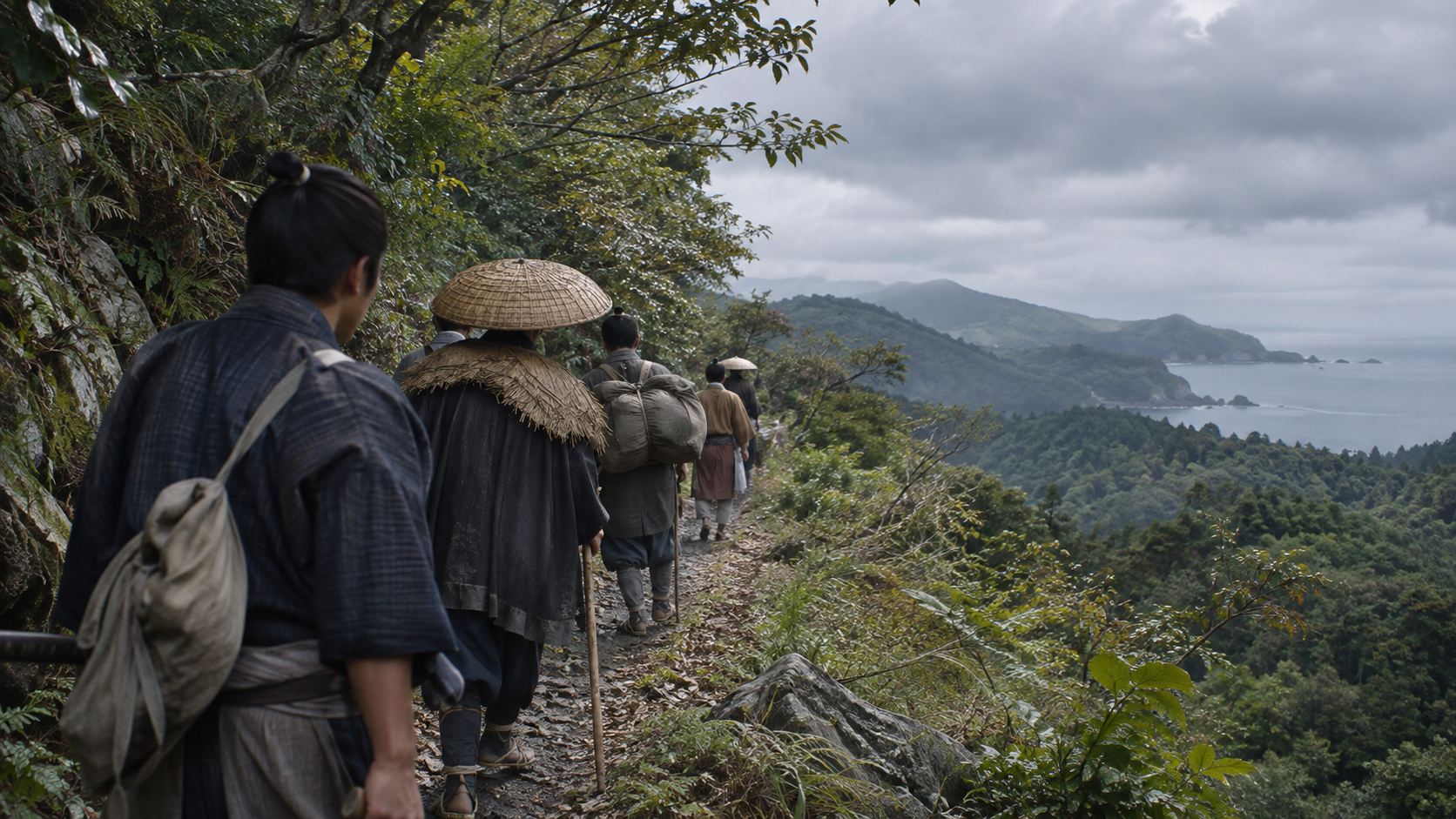
On the northern front, fighting extended from Masuda toward Hamada. Kishimoto Satoru’s public lecture materials compare evidence connected with Choshu, Kishu, Hamada, Fukuyama, Matsue, Tottori and other sides.
Different reporting positions could produce different views of the same fighting. Following only Choshu’s advance might make all opponents appear to have retreated as a single coherent force, although the domains had their own units and command relationships.
The lecture’s comparison raises the distinction between assembling soldiers and directing them under a common policy. This article attributes that discussion to the researcher; it does not claim to have independently read every original volume quoted in the teaching materials.
Scene 08
The final result did not determine every local encounter
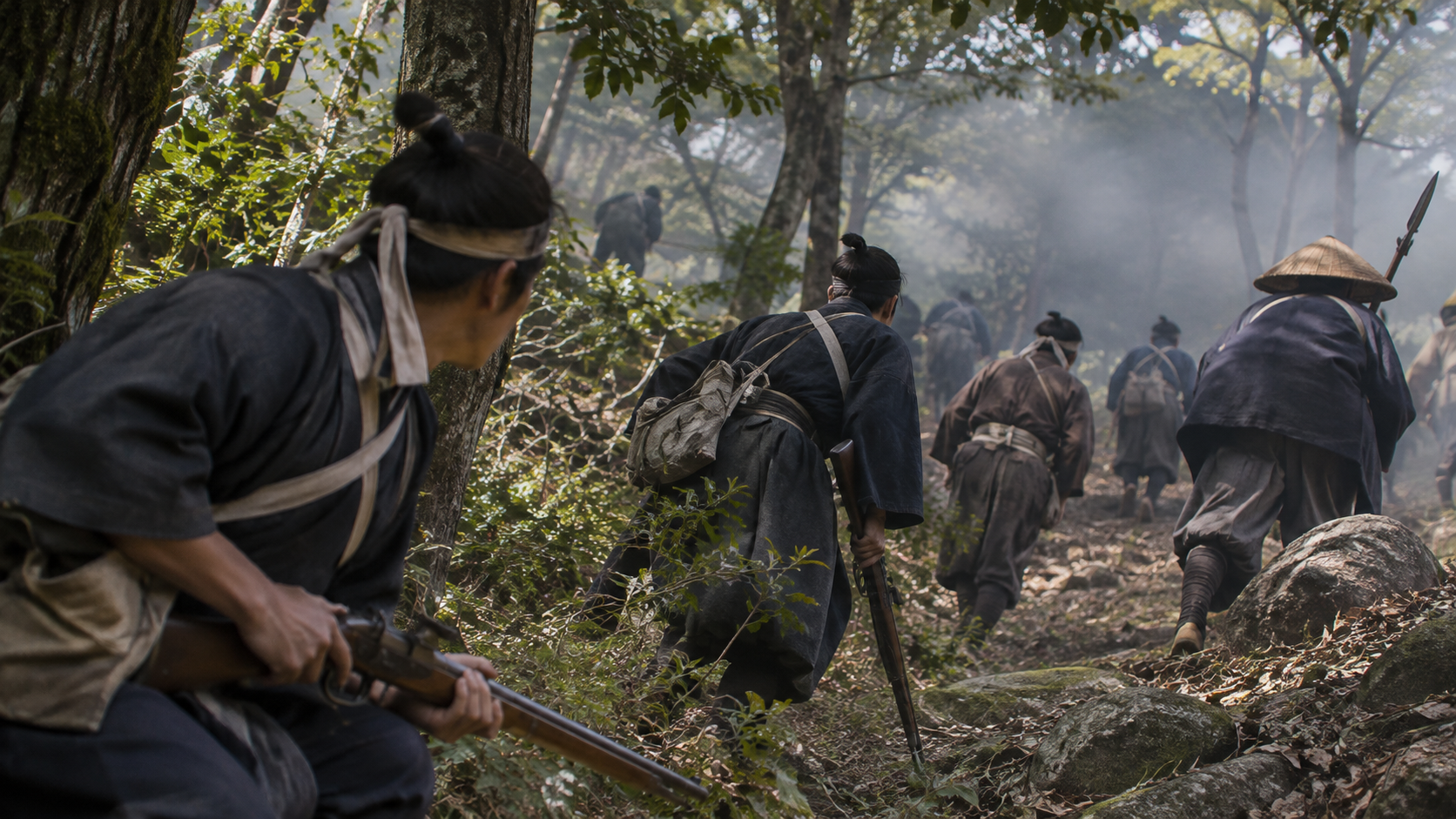
The same lecture examines local moments in which Choshu was pushed back, including reports from the Matsue side. A campaign’s overall outcome and a particular engagement operate at different scales.
Whether a withdrawal was planned or forced cannot be decided solely by a later triumphant account. Comparing other participants’ records can complicate a story that seems straightforward when read from only one side.
This account does not assign one definitive total to every loss or settle each tactical episode numerically. Its point is to avoid reasoning backwards from the final result as though every Choshu action had necessarily succeeded everywhere.
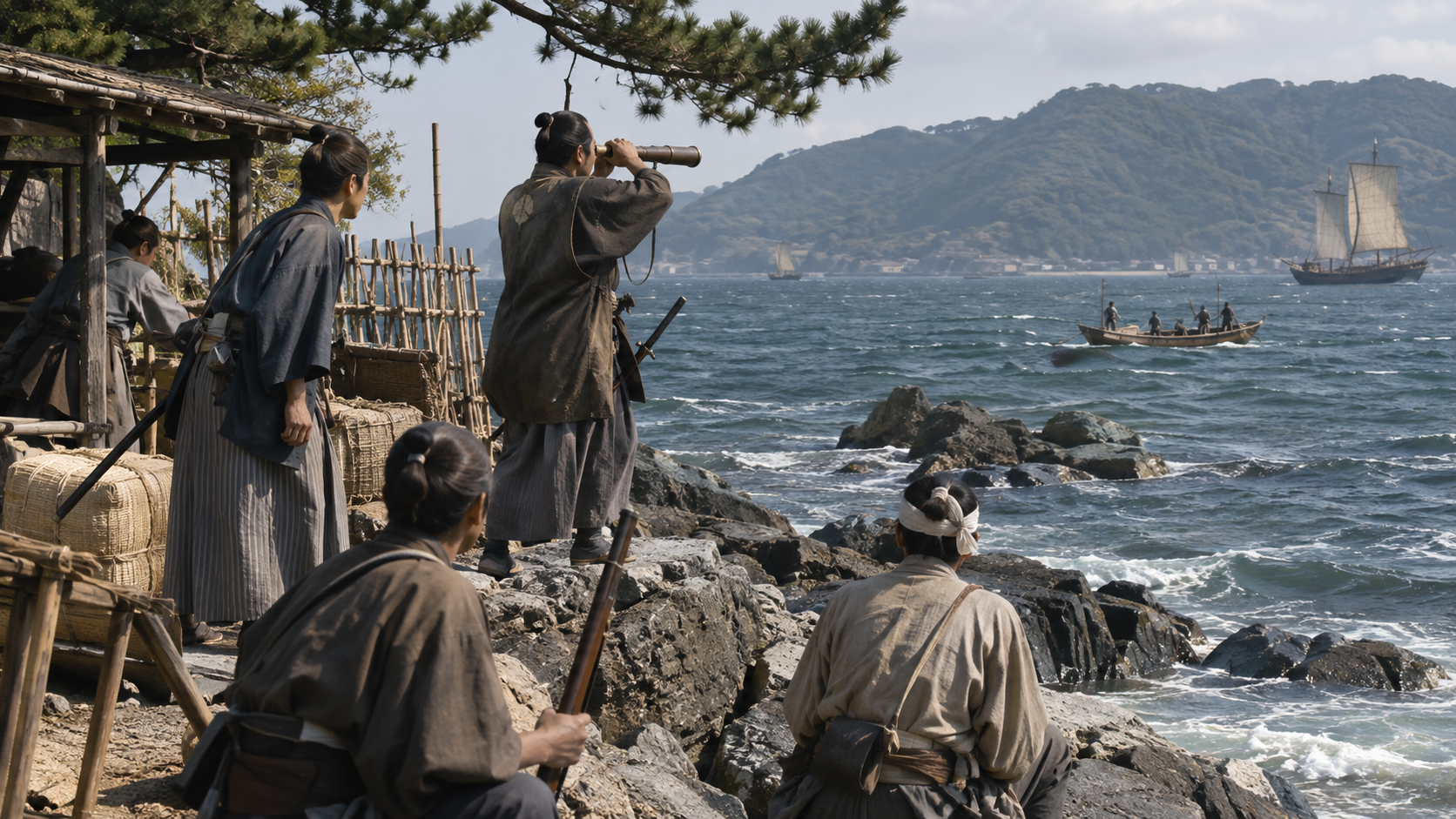
Scene 09
Kokura connected two shores
Yamaguchi University Library introduces a terrain sketch of Kokura viewed from the Shimonoseki side. Its annotations help frame the relationship across the strait. The library’s dating of what the sketch represents includes an element of inference.
A current coastline or building cannot simply be substituted for the historical battlefield. The image’s viewing direction and the limits of its date remain part of its interpretation.
The front connected crossing the sea with fighting on land. That relationship differed from both the island setting at Oshima and the northern overland campaign. The generated coastal observation scene is not a reproduction of the sketch or evidence of an exact crossing route.
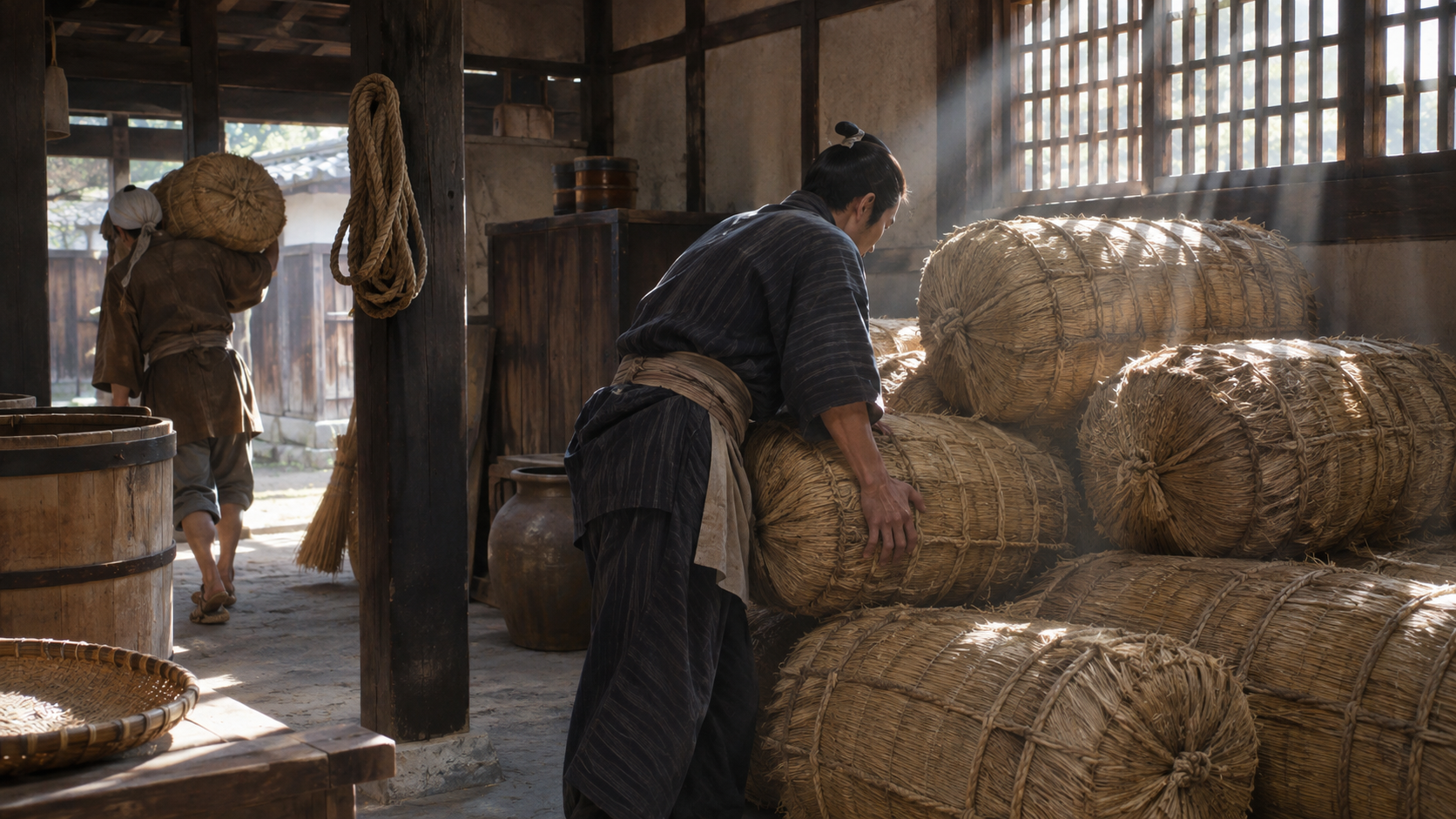
Scene 10
Rice and silver supported the soldiers
The university exhibition catalogue identifies documents concerning support to units, receipts involving rice and silver, and a drawing of rice-storage arrangements. These entries direct attention to the material work behind an armed force.
Food and money had to be collected, stored and transferred before soldiers could remain in position. Community relationships and administrative tasks consequently belonged to the military story, even when no fighting was occurring at that particular location.
The existence of these objects does not reconstruct every supply route on all four fronts. It supports a more limited enquiry into who received resources and how such support was recorded, without inventing a complete logistical network from a short catalogue.
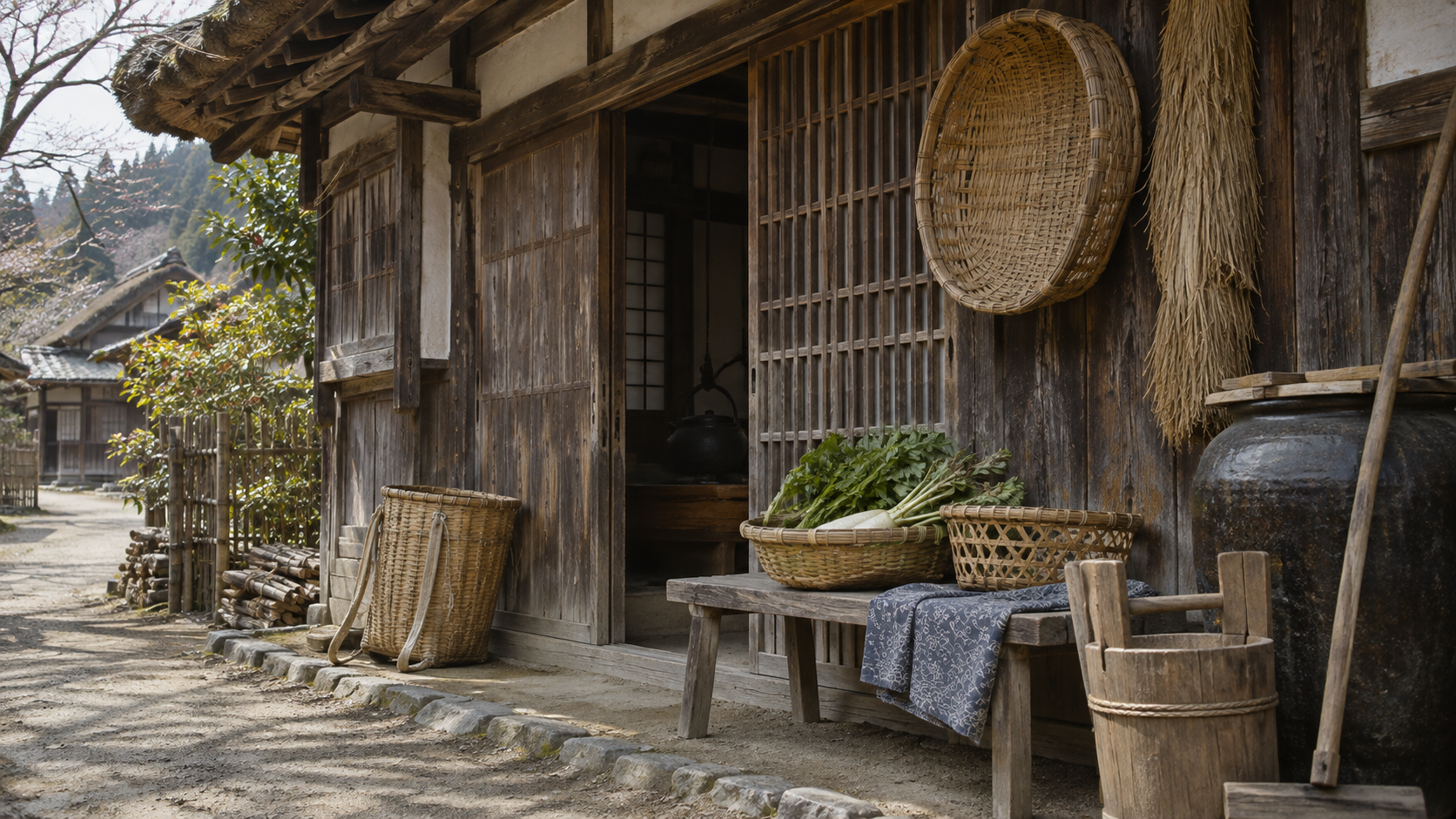
Scene 11
The battlefield was also a place of ordinary life
The Shimane lecture also considers fire and residents’ records on the Sekishu front. Accounts attempt to distinguish damage caused by gunfire from deliberate burning as a tactical act. These different possibilities should not be silently merged.
For a military participant, an action could appear as an operational choice; for those whose houses were affected, it became another kind of experience. The records of communities help make that difference visible.
No invented resident’s speech is used to dramatise the point. Nor does a generic village picture identify the agent responsible for a particular fire. Reading what was recorded keeps community costs within the campaign without replacing evidence with imagined psychology.
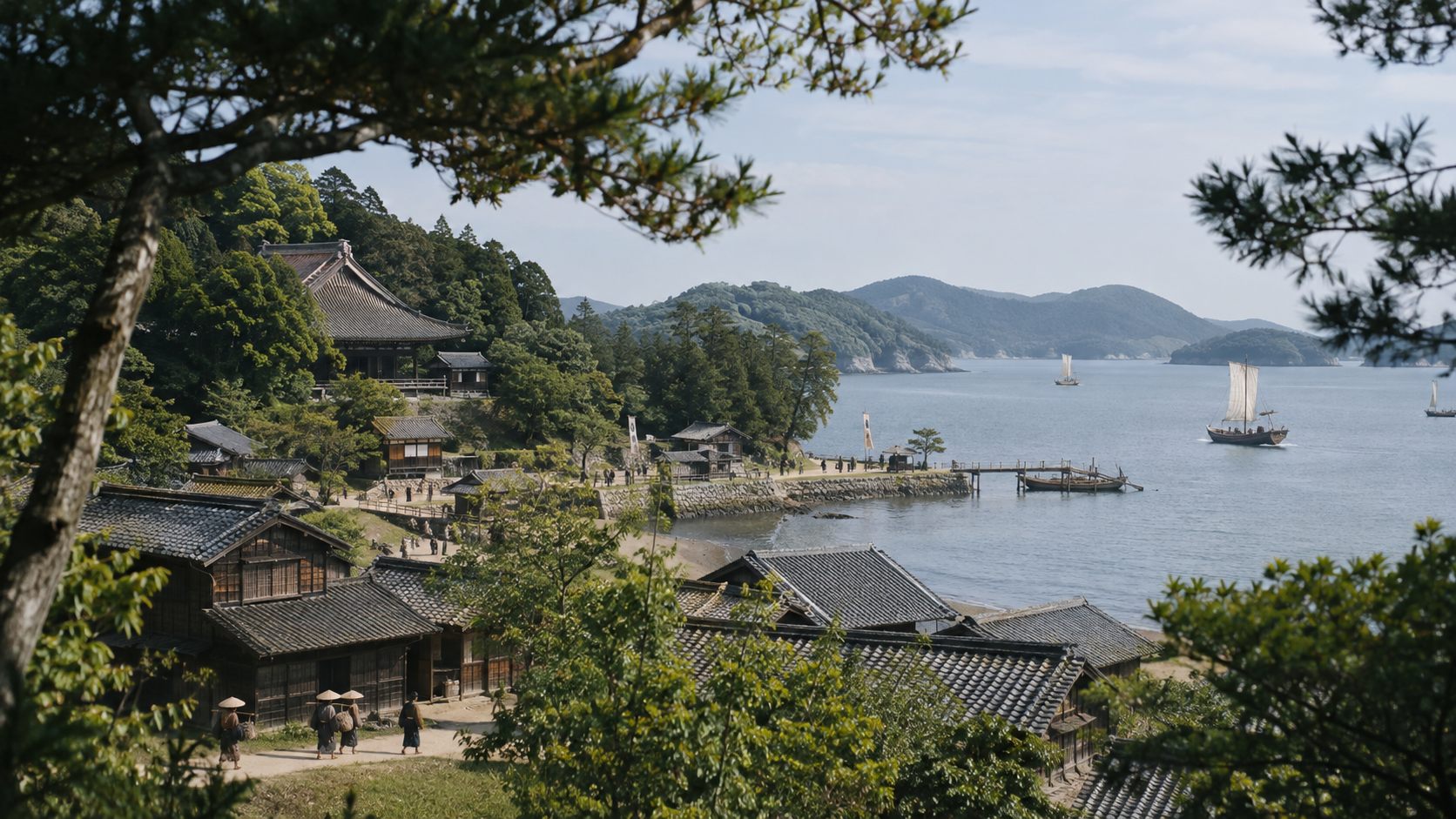
Scene 12
Negotiation concerned the safety of withdrawal
The National Diet Library explains that after Shogun Iemochi’s death, the government decided to stop the expedition and Katsu Kaishu undertook negotiations. Its diary introduction dates the meeting to the ninth month, second day of 1866.
The checked modern-calendar equivalent is 10 October 1866. Katsu met Choshu representatives at Daiganji on Miyajima. The discussions included conditions intended to prevent pursuit when shogunal troops withdrew.
Deciding to retreat did not by itself make a return safe. Military movement and securing an agreement with the opponent were connected tasks. The account paraphrases the library’s explanation rather than presenting an invented transcript or a full independent reading of the original diary.
Scene 13
The meeting and the end of the war were different markers
The meeting date should not be made the instant every front stopped simultaneously. Shimonoseki’s museum-exhibition introduction extends its account to the war’s ending in January of the following year.
Weapons and training, command, regional rice and financial support, and negotiation each illuminate part of the process. Their combination explains more than a contrast between a large shogunal army and a final Choshu victory.
The four-front campaign was a military and political sequence across different places. Keeping those places and stages distinct allows the records and terrain to generate further questions without pretending that a single battle, agreement or technical advantage explains everything.
How to read this work
History, interpretation, and reconstruction
The campaign cannot be explained by newer weapons alone; different terrain, training, command relationships, local support and negotiation must be considered together.
This work is grounded in published sources and historical research. Interior thoughts, dialogue, and some visual details are cinematic reconstructions. Where historians disagree, the article presents the point as debated rather than settled fact.
Timeline
The story in time
-
The Kinmon incident and first Choshu expedition, distinct from the fighting of 1866.
Sources: s02 -
Suo-Oshima Town identifies this as the opening at Oshima, not a simultaneous opening on all fronts.
Sources: s04 -
Katsu negotiated at Daiganji on Miyajima, including conditions against pursuit during withdrawal.
Sources: s01 -
The Shimonoseki exhibition introduction extends to the ending of the war, distinct from an earlier meeting and any claim of simultaneous cessation.
Sources: s09
People & terms
A guide for new readers
Glossary
- Four Fronts War 四境戦争
- A name referring to fighting on four approaches around Choshu, not four modern prefectures.
- Oshima approach 大島口
- The island and maritime setting in the Inland Sea.
- Geishu approach 芸州口
- The eastern front toward Aki, including Waki and the Oze River setting.
- Sekishu approach 石州口
- The northern front toward Iwami, involving multiple domains and local records.
- Kokura approach 小倉口
- The front across the Kanmon Strait, linking maritime crossing and land operations.
- Dispersed tactics 散兵戦術
- A form of fighting using spacing, terrain and cover, requiring training and coordination as well as weapons.
Sources & method
How this article was built
The chronology separates 1864 from 1866 and distinguishes different fronts and local outcomes. Period-calendar dates remain explicit; the checked modern equivalent is supplied for Katsu’s meeting. The later ending is not made simultaneous with that meeting.
Institutional descriptions, catalogue entries and a researcher’s comparative lecture retain their own scope. Listing an item establishes neither a full reading of its text nor a complete reconstruction of all four fronts’ supply or command systems. The lecture’s assessment is not presented as a new independent transcription of every cited source.
The illustrations are generated conceptual scenes with no borrowed source imagery. Equipment, training, command, community support and negotiation are read together. Exact troop losses, routes, private conversations, individual responsibility for unverified fires and a single technical cause for the whole outcome are not invented.
Sources
References and further reading
- Katsu Kaishu: the diary entry for the ninth month, second day of 1866 国立国会図書館「勝海舟:慶応2年9月2日の日記より」 Title translated editorially for reader convenience. National Diet Library 国立国会図書館 Published explanatory text and calendar correspondence; paraphrase of withdrawal negotiations, not a complete reading of the original diary manuscript. Accessed 2026-11-06
- Chronology: Meiji prime ministers 国立公文書館「明治宰相列伝」年表 Title translated editorially for reader convenience. National Archives of Japan 国立公文書館 The distinct years of the first and second expeditions, checked against the published chronology. Accessed 2026-11-06
- Historical documents: Bakumatsu and Restoration, volume 4 山口県「史料編 幕末維新4」案内 Title translated editorially for reader convenience. Yamaguchi Prefecture 山口県 Publication introduction and contents separating the central administration and four fronts; not a reading of all 1,043 pages. Accessed 2026-11-06
- Commemorating the Four Fronts campaign 周防大島町「四境の役150周年記念事業」 Title translated editorially for reader convenience. Suo-Oshima Town 周防大島町 Relevant opening and counterattack explanation. Commemorative praise is not adopted as an independent explanation of the entire campaign. Accessed 2026-11-06
- Late-Edo battle prints 山口県立図書館・文書館「幕末の瓦版」 Title translated editorially for reader convenience. Yamaguchi Prefectural Library and Archives / ADEAC 山口県立図書館・山口県文書館/ADEAC Institutional explanation and catalogue for the Oze River print and training materials. Pictorial emphasis does not establish every unit’s equipment. Accessed 2026-11-06
- Shimane and battlefields in the late-Edo and Restoration period 島根県公開講座「幕末・維新期の島根と戦場」岸本覚、2021年 Title translated editorially for reader convenience. Kishimoto Satoru / Shimane Prefecture public lecture 島根県公開講座 Relevant text on pages 2–6 and 9. Comparative interpretation is attributed; the underlying original collections are not all claimed as independently read. Accessed 2026-11-06
- The 2003 Choshu exhibition catalogue 山口大学附属図書館 2003年展示資料目録 Title translated editorially for reader convenience. Yamaguchi University Library 山口大学附属図書館 Explanations for items 1–7 concerning support, rice storage and the Kokura sketch. Individual images and all original texts are not independently reconstructed. Accessed 2026-11-06
- Guide to Bakumatsu and Restoration materials 山口県立山口博物館 山田稔「幕末維新関係資料ガイド」2017年 Title translated editorially for reader convenience. Yamada Minoru / Yamaguchi Museum 山口県立山口博物館/山田稔 Text explanation for figure 32 on PDF page 67; identification and viewpoint, not independent close inspection or reuse of the original images. Accessed 2026-11-06
- Historical Museum special exhibition introduction, October 2026 bulletin 下関市「市報しものせき2026年10月号」歴史博物館特別展紹介 Title translated editorially for reader convenience. Shimonoseki City 下関市 The introduction includes the process of withdrawal and ending into January of the following year, distinct from the earlier negotiation date. Accessed 2026-11-06
Continue reading
More stories from Shigeki
Shigeki English
Hasedo: Why Fighting Continued after Sekigahara
Separate the siege, the arrival of news, and withdrawal under pursuit.
- When 1600; month and day references use the calendar of the time
- Where Hasedo and Yamagata in Dewa, connected with Aizu and distant Sekigahara
Shigeki English
Fukushima Masanori: Castle Repairs, Rules and the Loss of Hiroshima
Follow the stages between flood damage, construction and punishment.
- When 1615–1619, with documents of 1616 and 1635 and later preservation history
- Where Hiroshima Castle and Takaino in Shinano