
SHIGEKI ENGLISH STORYEN
Japanese history in English
Nagasaki and Dejima: Connecting Goods, Languages and Overseas News
Beyond the ships were institutions handling trade and people doing the work of translation.
Distinguish Dejima’s construction in 1636 from the Dutch trading post’s move in 1641. Follow controlled trade, interpreters, overseas reports and journeys to Edo, then separate changes after the opening of the ports from the reconstructed landscape seen today.
At a glance
Before you enter the story
- When
- From construction in 1636 through the late Edo period, opening of the ports and modern reconstruction
- Where
- Dejima in Nagasaki, with connections to Hirado, overseas trading networks and Edo
- Key figures
- Portuguese residents, Dutch trading-post personnel, Japanese interpreters, Nagasaki officials and merchants, People brought from Java and elsewhere
- What was at stake
- How could contact continue through a place where movement, trade and the circulation of information were separately controlled?
Why this story matters
The larger history behind the turning point
A trading ship did not connect overseas experience to Japan without further work. Transactions required institutions and negotiation; knowledge required reading and translation. Dejima reveals those processes within a system of restrictions rather than an unrestricted meeting place.
The island also changed. Its first residents, later Dutch trading post and present reconstructed buildings belong to different stages. Keeping those stages separate helps explain both the historical role of the place and what a visitor encounters today.
Historical context
What an international reader needs to know
A window with several controls
Permission to trade did not confer freedom to travel anywhere or trade with anyone on any terms. People crossing the bridge, commodities changing hands and reports being sent to Edo were subject to different arrangements.
Calling Dejima a window to Europe is useful only if the mechanisms around that window remain visible. Ships, merchants, interpreters and officials had different roles. Nor did a Dutch ship make every commodity aboard it a product manufactured in the Netherlands.
Records and reconstruction
Historical documents, modern institutional explanations and reconstructed buildings answer different questions. The Netherlands’ National Archives identifies trading-post records at Hirado and Dejima as a resource for further research, not as a substitute for reading particular daily entries.
The dates covered by an archive need not match the institutional closing date of the trading post. Likewise, the existence of a reconstructed street does not mean its buildings have survived unchanged since the seventeenth century. The illustrations here are conceptual scenes rather than precise surveys or historical photographs.
Watch the film
See the story in motion
The film currently uses Japanese audio. This English article provides the context and source trail; it does not imply that an English subtitle track is available.
Scene 01
Goods and language passed through a small island
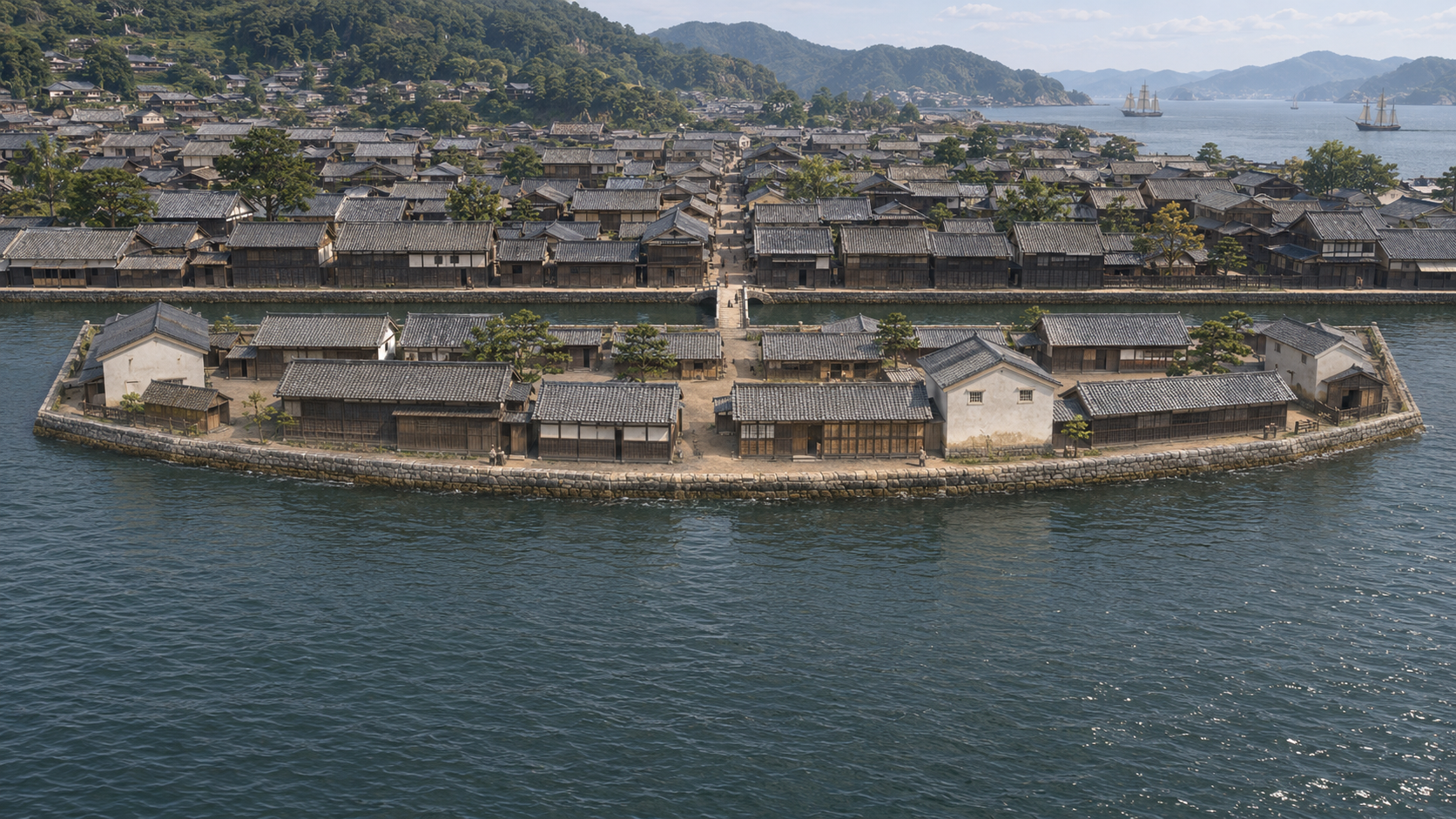
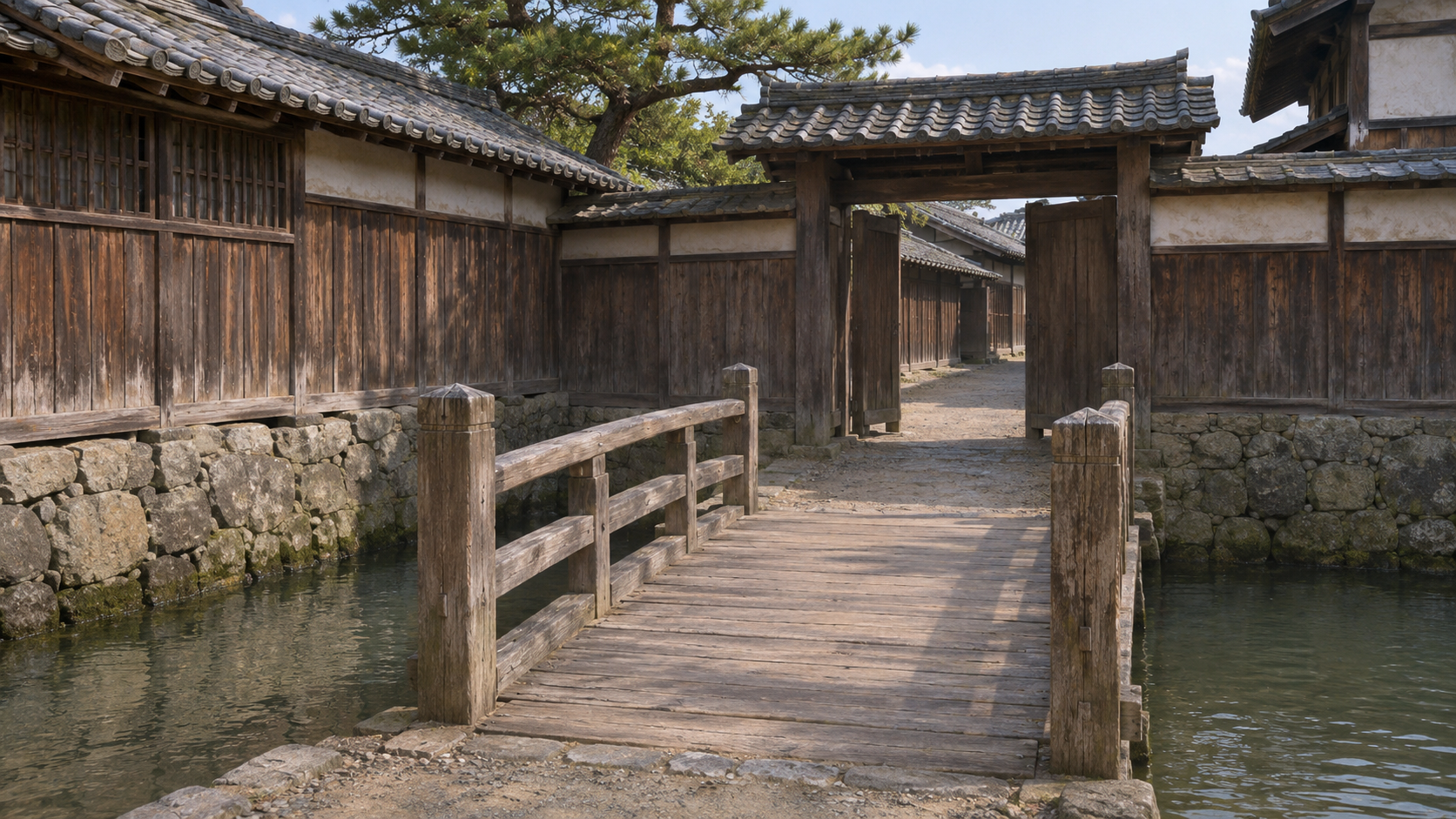
Dejima was a small artificial island in Nagasaki’s harbour, connected to land by a bridge. Ships brought goods and information to a place where entry was restricted and commerce operated under rules.
Contact with the outside world nevertheless continued. Asking who lived there, who mediated languages and what crossed the sea makes the connection more concrete than the image of an island alone.
The Netherlands’ National Archives introduces the trading-post records of Hirado and Dejima as resources for their shared history. Establishing that trade existed and verifying individual transactions from those records remain different stages of inquiry.
Scene 02
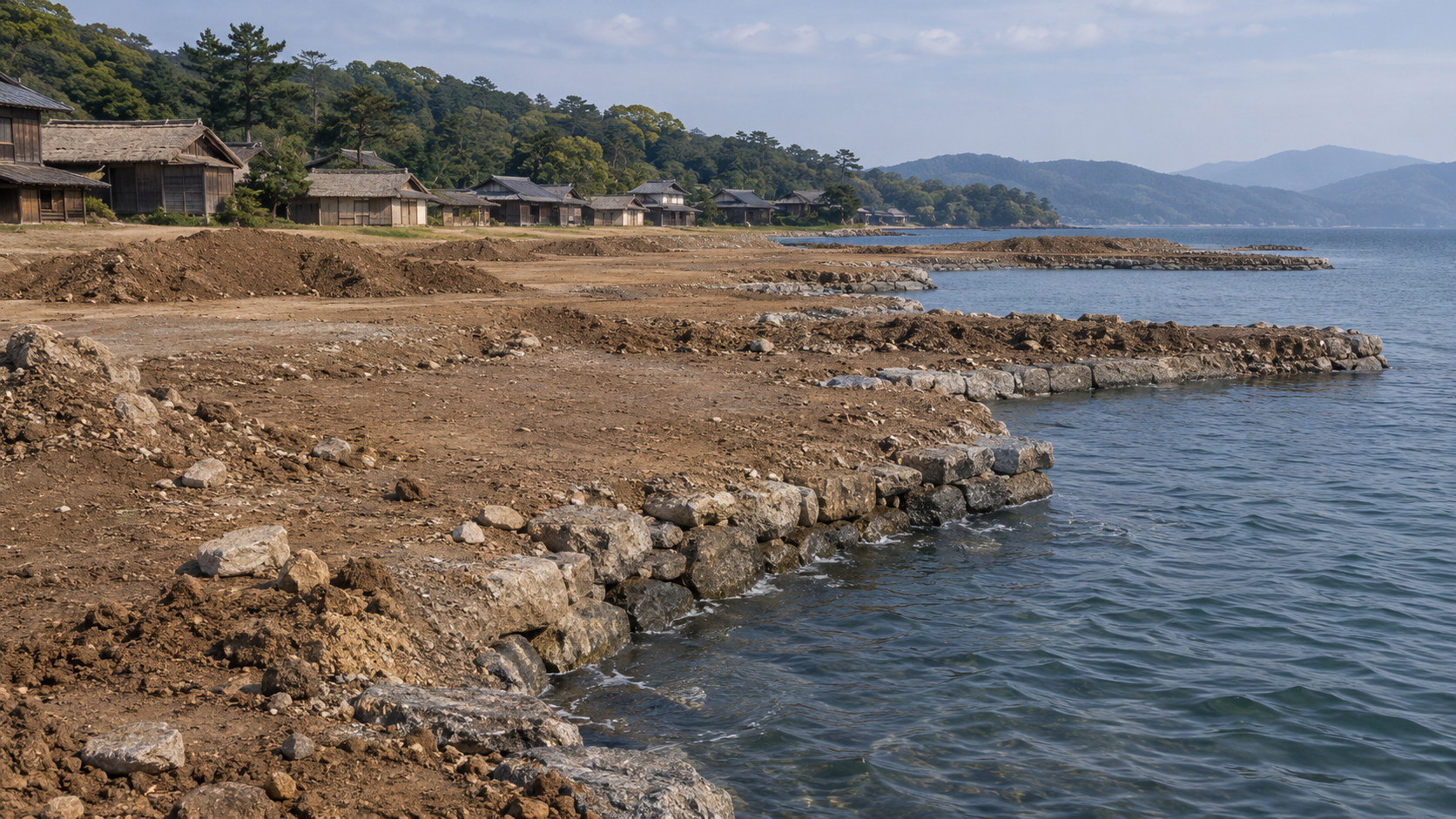
The first residents in 1636
Dejima was completed in 1636. Its first designated residents were Portuguese, rather than the Dutch traders most often associated with the later island.
The shogunate sought to concentrate Portuguese residents of Nagasaki in one place as part of efforts to restrict Christian missionary activity. The artificial island therefore served purposes of control alongside contact.
Its construction should not be described simply as providing a ready-made Dutch trading post. The sequence begins with a different group and a different stage in the government’s foreign policy.
Scene 03
Keeping 1639 and 1641 apart
In 1639, Portuguese people were expelled and their arrival was prohibited. That changed the use of the recently built island. Two years later, the Dutch trading post moved there from Hirado.
Construction in 1636 and the move in 1641 were not the same event. Describing the island as intended only for Dutch residents from the outset would erase this change.
The role of Dejima developed with government policy. The dates identify stages rather than one unchanging purpose fixed at construction and retained throughout its history.
Scene 04
Permission to trade and restrictions on movement
The Dutch stated that they would not engage in Christian missionary work and were allowed to continue trading. This did not preserve the conditions under which their post had operated in Hirado.
The move to Dejima placed personnel under stricter supervision. Being allowed to conduct commerce and being permitted unrestricted activity were different things.
Ships approaching from the sea, residents on the island and the route across to land were incorporated into arrangements set by Japanese authorities. Connection continued through those arrangements rather than outside all control.
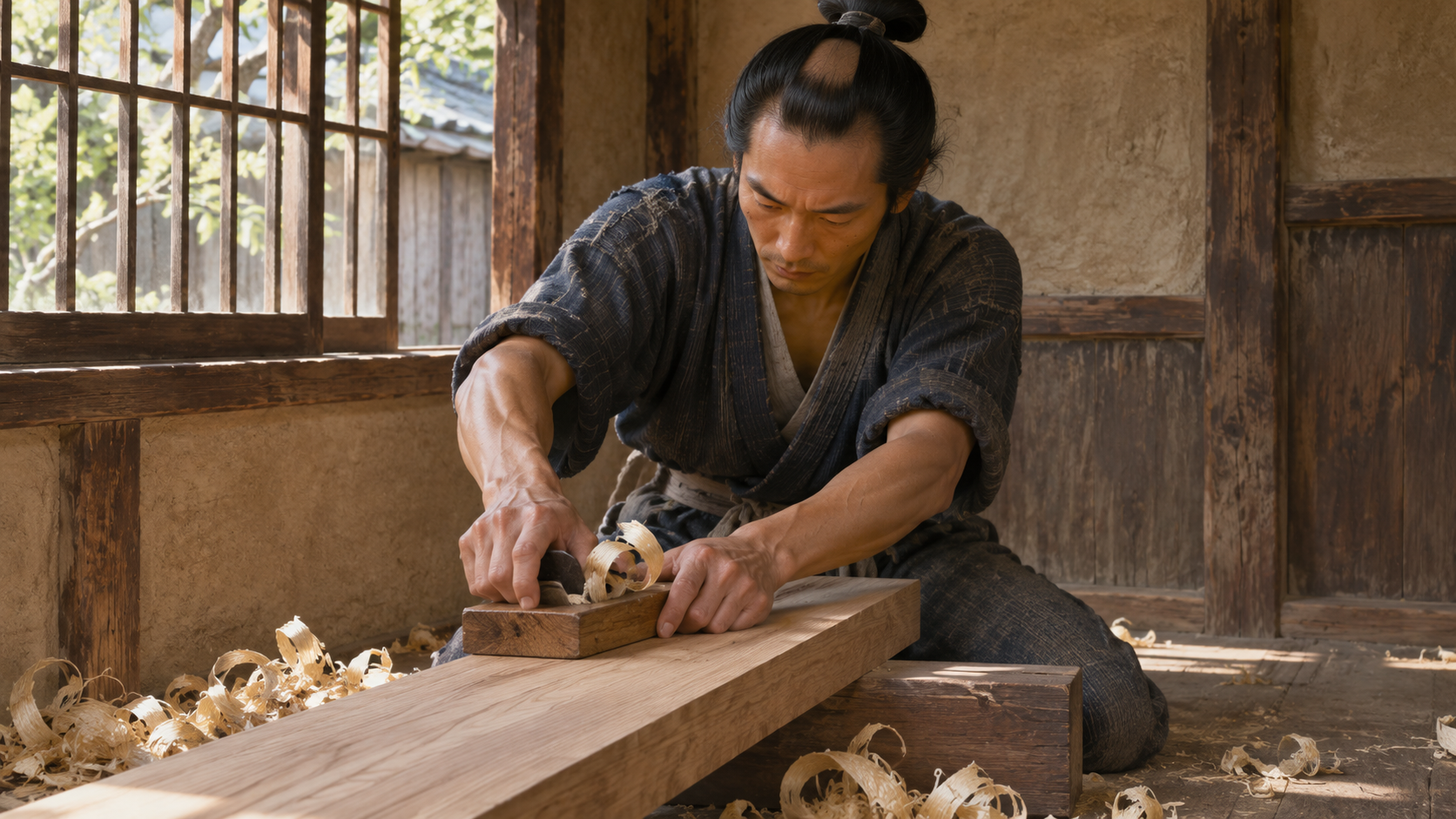
Scene 05
People who supported the island
The island’s work involved more than the head of the trading post and its clerks. Doctors, carpenters and cooks contributed to life there, while Japanese interpreters also worked within the system.
The National Diet Library explanation includes people brought from Java and elsewhere as servants. The personnel therefore cannot be reduced to a self-contained miniature Dutch country.
People of different positions and origins were involved, while Dutch movement beyond the island and Japanese entry were restricted. A shared place did not erase those differences in position or freedom.
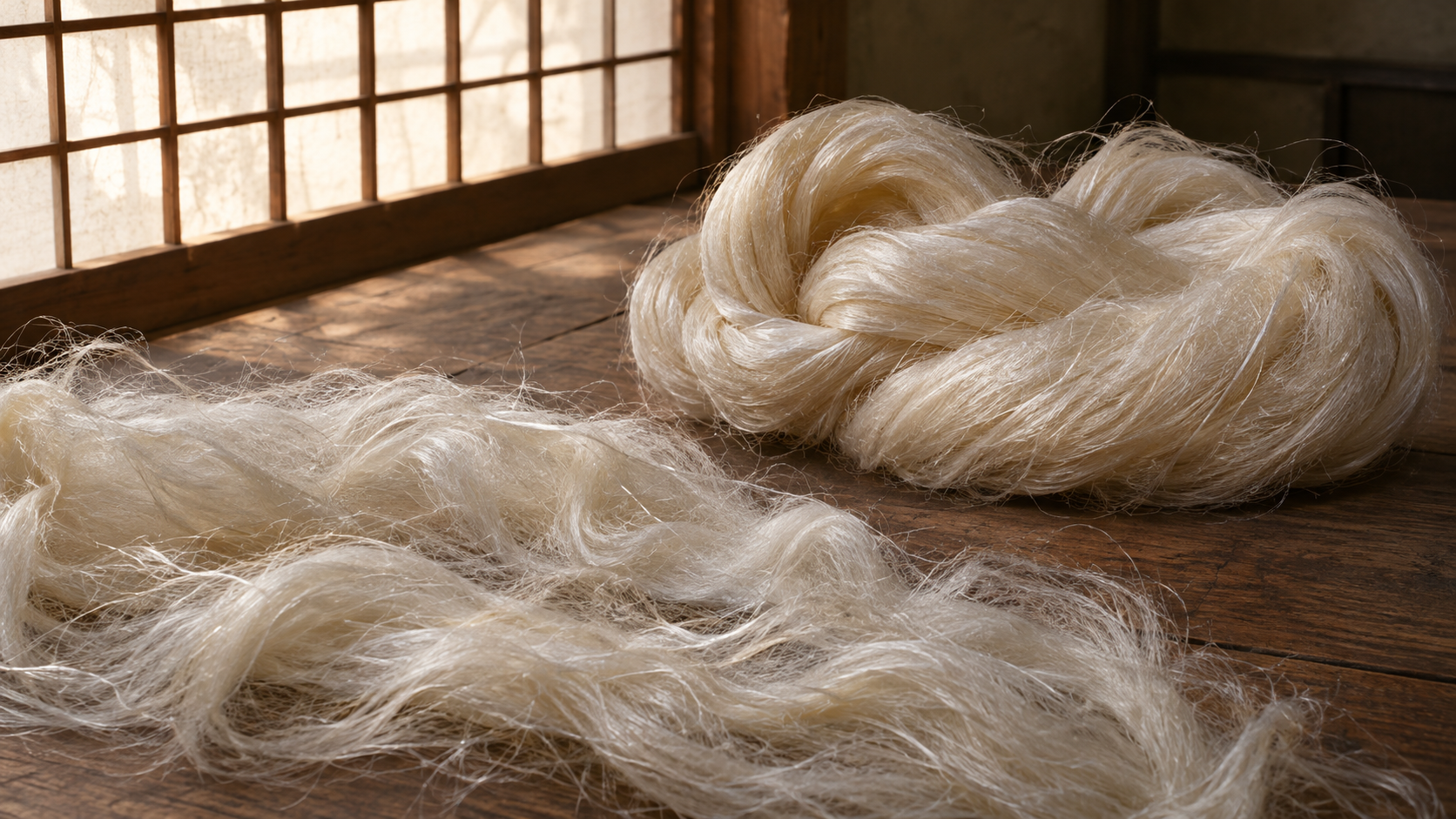
Scene 06
A ship’s origin was not a commodity’s origin
Imports included raw silk and silk textiles, sugar, aromatic woods, pepper and medicines. Their arrival aboard a Dutch ship did not make all of them products of the Netherlands.
The National Diet Library lists Chinese raw silk among principal imports. The country associated with the vessel and the place where a commodity was produced must therefore be considered separately.
Cargo connected overseas production and distribution with Japanese merchants and consumers. Looking beyond the harbour reveals a wider network rather than a simple exchange of goods manufactured only in the two named countries.
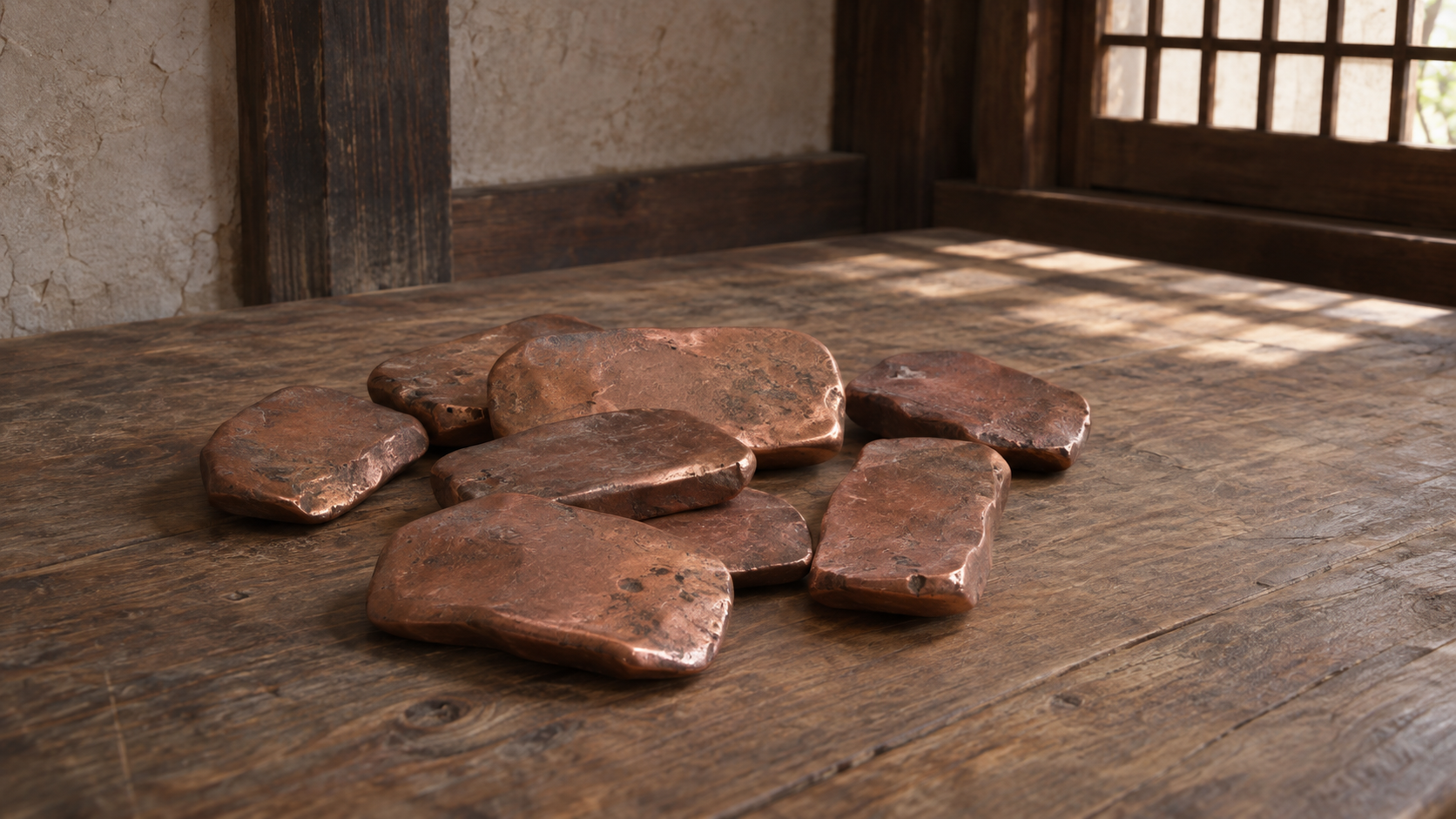
Scene 07
Exports changed with time
Exports from Japan also changed. Silver and gold were important earlier, while copper later took a central place. Ceramics and lacquerware were among the other goods shipped abroad.
The National Diet Library explanation dates the prohibition of silver exports from 1668 and gold exports to 1763. A single list without a date would hide changes in the conditions of trade.
The apparent continuity of the island’s outline should not imply identical cargoes across its whole history. What could be loaded and the arrangements governing it changed over time.
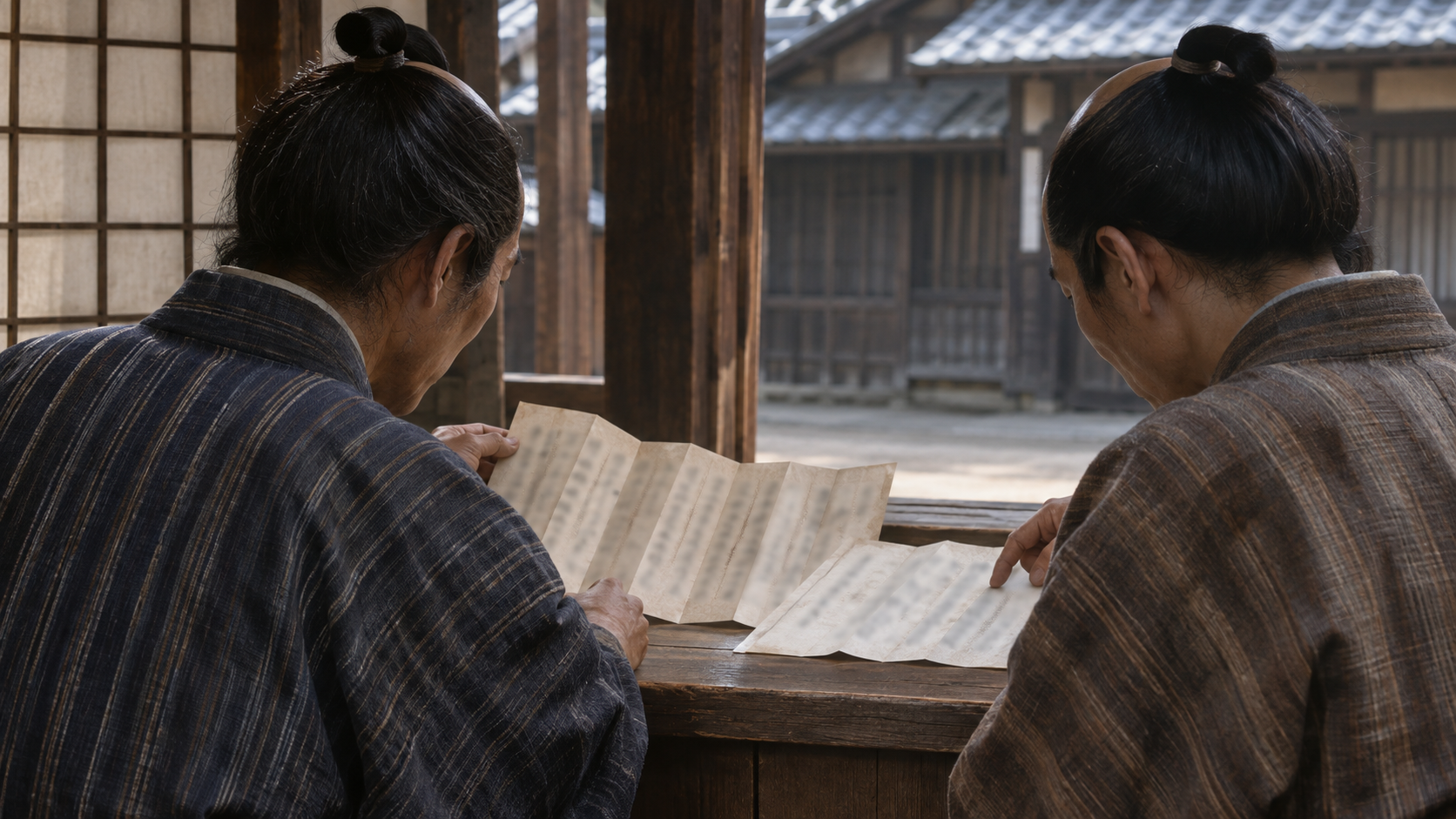
Scene 08
The Nagasaki Kaisho after 1698
Trading-post personnel could not freely set every price or deal with anyone they chose. The items, quantities and prices involved were subject to regulation.
From 1698 the Nagasaki Kaisho managed trade collectively, buying imports and selling them on to merchants while supplying corresponding exports to the Dutch. The National Diet Library describes purchase prices as set on the Japanese side.
The ship was therefore only one part of the transaction. An institution determining the terms of exchange was part of the connection between overseas cargo and Japanese commerce.
Scene 09
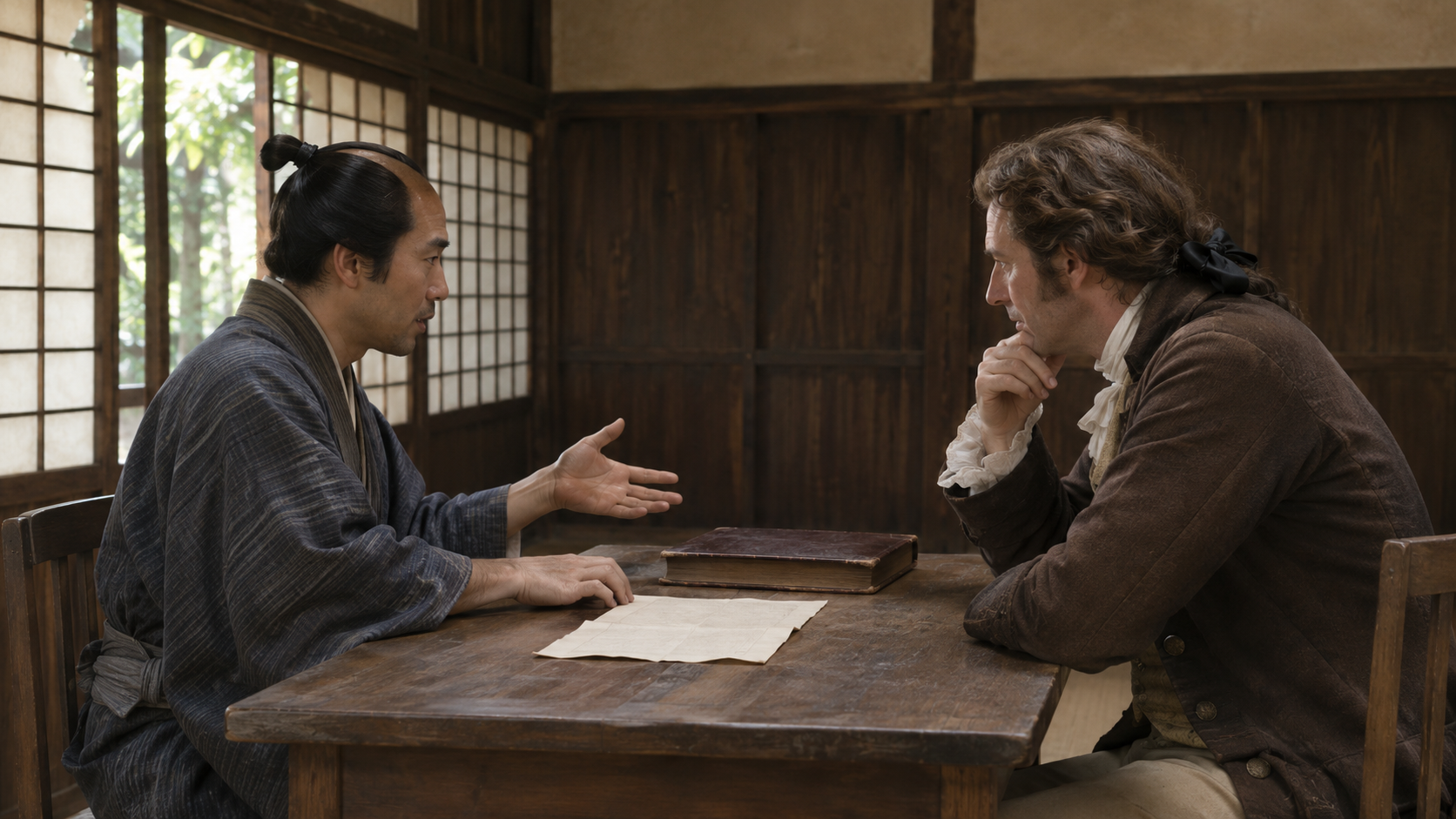
Interpreters negotiated, studied and translated
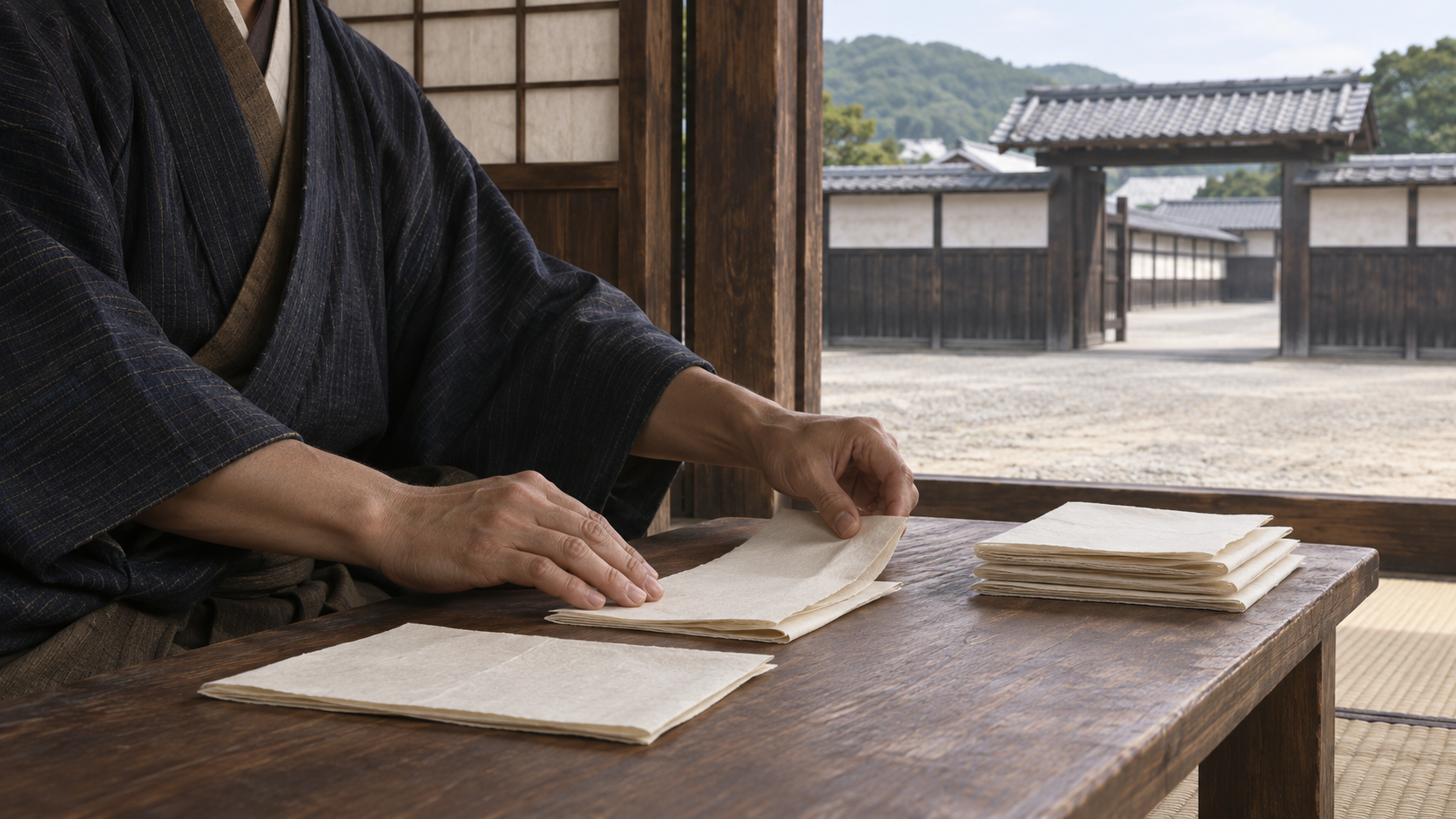
Dutch interpreters supported trade by interpreting speech and translating documents. Questions about quantities and conditions made language work part of negotiation itself.
Some interpreters also studied subjects such as medicine and physics, taught other Japanese people and translated Dutch books. Knowledge did not spread simply because a vessel had unloaded; people had to read and convey it.
Dictionary work offers another example. The National Diet Library describes translation begun by the trading-post head Doeff and completed by Nagasaki interpreters in 1833 as Dufu Haruma after his departure. The work connected an individual beginning with later completion by others.
Scene 10
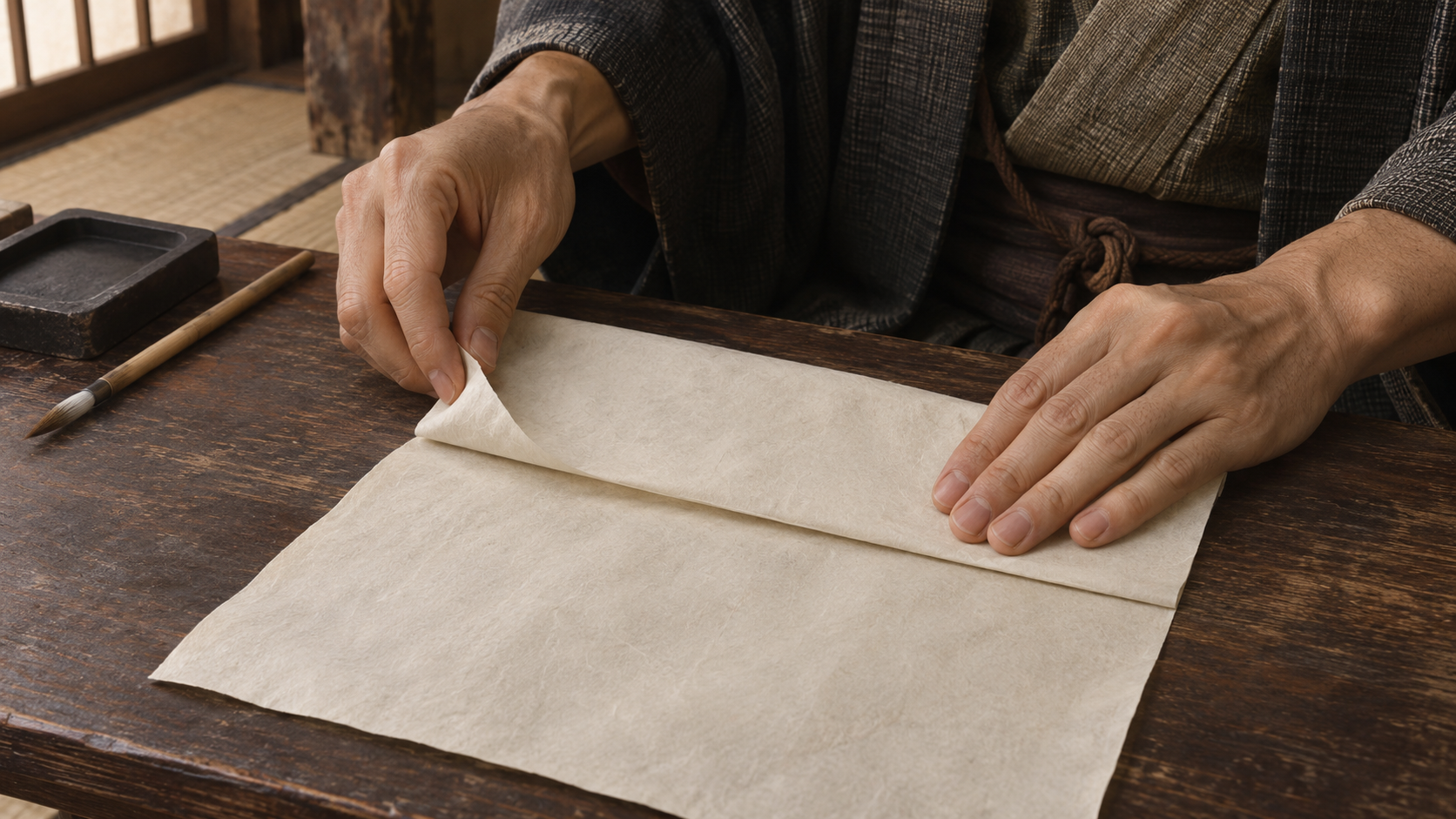
Who received the overseas news?
The shogunate required reports about overseas affairs when ships arrived. Interpreters rendered them into Japanese and they were sent to Edo. Receiving such information did not mean publishing it for everyone.
Access was limited to central officials and figures such as the Nagasaki magistrates, although information could pass beyond them and copies circulated, especially later. The National Archives introduces Ahen Shokaroku as Japanese translations of four more detailed reports from 1840–1843.
The Foreign Ministry also presents a copy of an 1852 report containing information before Perry’s arrival. The report, its later inclusion in a documentary compilation and the present exhibition explanation remain distinct. Neither example is presented here as a newly deciphered complete original.
Scene 11
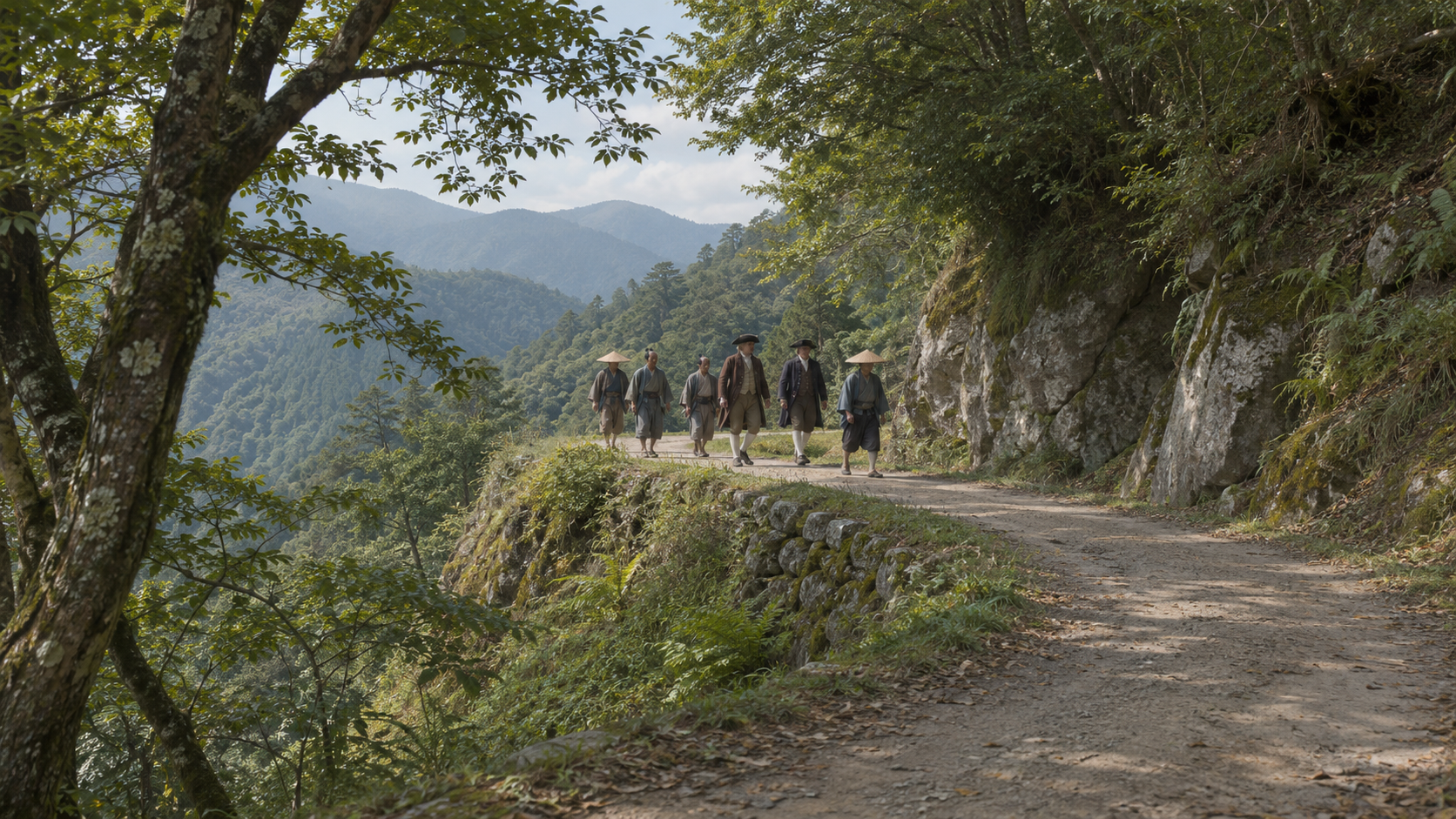
Questions and answers on the journey to Edo
Trading-post heads also travelled to Edo, met the shogun and offered gifts in acknowledgement of continued trade. The National Diet Library describes these journeys as initially annual and later once every four years.
Doctors and other participants travelled with Japanese attendants. Contacts along the route and in Edo created occasions for questions from scholars and domain lords within an otherwise regulated system of movement.
People interested in the West visited Nagasakiya, the party’s lodging in Edo. A prescribed itinerary could still create opportunities for knowledge to be conveyed through particular questions and responses.
Scene 12
Institutional change and a changing landscape
The opening of the ports changed Dejima’s role again. The official chronology records the abolition of the Dutch trading post and its change to a consulate in 1859. Later reclamation and harbour works altered the surrounding geography.
The buildings seen today should not be treated as an untouched streetscape surviving from the Edo period. Historical maps, building records, archaeological work and reconstruction contribute different kinds of evidence.
Nagasaki Prefecture describes finds associated with trade and daily life from layers of different periods. The present landscape includes work of investigation and restoration. A change in trading institutions and a change in the physical island need their own chronologies.
Scene 13
Exchange continued within a regulated system
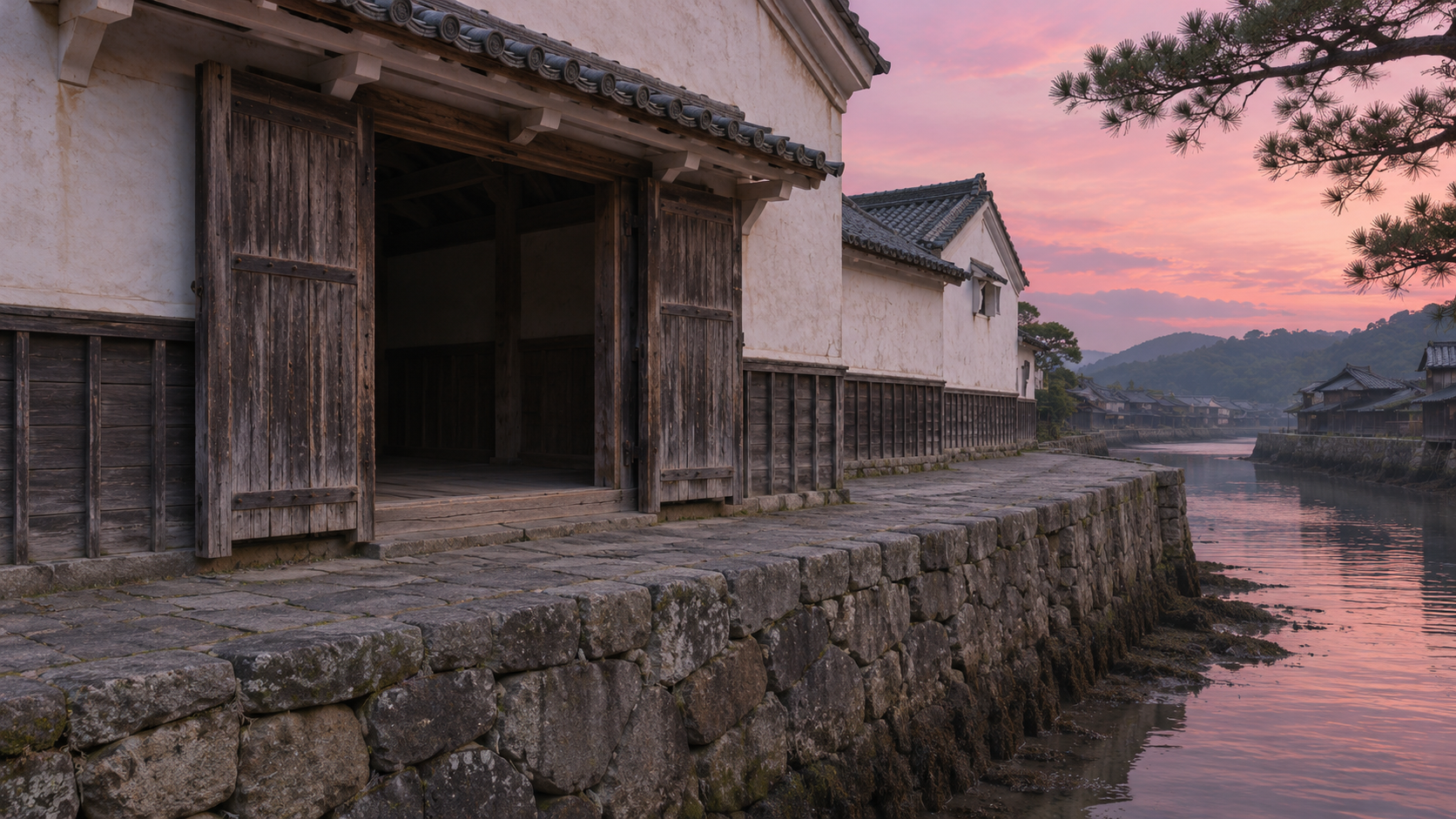
Ships were not the only means connecting Dejima with the wider world. There were arrangements for handing over goods, interpreters negotiating meanings and routes by which reports reached officials.
People, commodities and information did not all circulate with the same freedom. Who could enter, what could be traded and who received a report were matters subject to control.
The island first made for Portuguese residents became the site of the Dutch trading post, while cargoes and forms of contact also changed. Following those distinctions reveals specific ways in which a small place remained connected across the sea.
How to read this work
History, interpretation, and reconstruction
Dejima connected regulated flows of people, goods and information, while its institutions and physical landscape changed at different times.
This work is grounded in published sources and historical research. Interior thoughts, dialogue, and some visual details are cinematic reconstructions. Where historians disagree, the article presents the point as debated rather than settled fact.
Timeline
The story in time
-
Portuguese arrival is prohibited.
Sources: dejima -
The National Diet Library dates the prohibition of silver exports from this year.
Sources: ndl -
The Nagasaki Kaisho begins handling trade collectively.
Sources: ndl -
The National Diet Library dates the prohibition of gold exports to this year.
Sources: ndl -
Nagasaki interpreters complete Dufu Haruma.
Sources: ndl-language -
Period of the detailed overseas reports compiled in Ahen Shokaroku.
Sources: naj-opium-reports -
Year of the report copy introduced in the Foreign Ministry exhibition.
Sources: mofa-1852-report -
The Dutch trading post is abolished and changes to a consulate; later land reclamation is a separate stage.
Sources: dejima -
Nagasaki City undertakes planning for the site.
Sources: restoration -
Full-scale reconstruction proceeds, distinguished from the historical landscape.
Sources: restoration
People & terms
A guide for new readers
Glossary
- Trading post 商館
- The institution through which Dutch trade operated, distinct from the date the island itself was constructed.
- Nagasaki Kaisho 長崎会所
- The institution described as collectively handling trade from 1698, including the exchange of imports and exports.
- Tsuji (interpreter) 通詞
- Interpreters who mediated speech and documents; some also contributed to scholarship and translation.
- Fusetsugaki 風説書
- Reports of overseas information submitted to the shogunate through Nagasaki, rather than automatically released to the public.
- Edo sanpu 江戸参府
- Journeys by trading-post heads and their parties to Edo, within which formal obligations and opportunities for contact coexisted.
Sources & method
How this article was built
The thirteen chapters accompany the completed video, including the later change of institutions and landscape. Additional institutional explanations supply bounded examples of dictionary work, detailed overseas reports and the relationship between surviving remains and reconstruction.
Chronology is kept explicit: construction differs from Dutch relocation, and the closing of an institution differs from the end date of an archival series. The current streetscape is understood through its modern restoration history.
The sources distinguish a general explanation of trade from individual records of daily activity. This article does not claim a complete new reading of the Dutch diaries, dictionaries, historical maps or overseas-report originals.
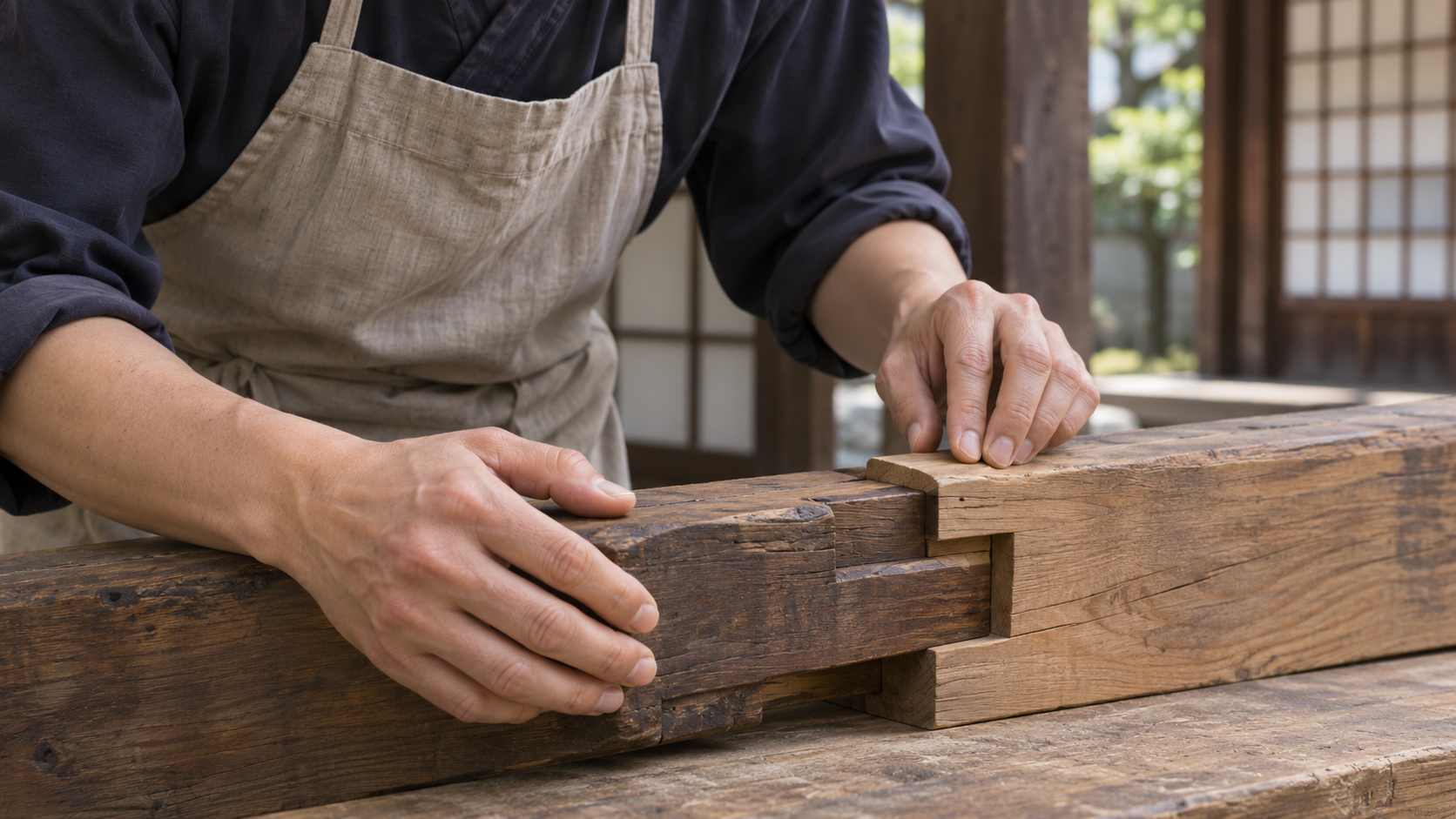
The illustrations are conceptual generated scenes rather than authentic portraits or precise surveys. The carpentry image represents the idea of reconstruction, not a documented modern worksite or an Edo-period photograph. Historical collection images remain with the linked institutions.
Sources
References and further reading
- Dejima History 出島の歴史 Title translated editorially for reader convenience. Nagasaki City 長崎市 Official chronology for construction, Portuguese exclusion, Dutch relocation and the 1859 change. Its inconsistent opening duration statement is not copied; individual dates are kept distinct. Accessed 2026-11-04
- Japan–Netherlands Exchange in the Edo Period: The Trading Post on Dejima 江戸時代の日蘭交流 第1部 出島の商館 Title translated editorially for reader convenience. National Diet Library 国立国会図書館 Institutional account of personnel, trade, reports and Edo journeys. Vessel origin, commodity origin, translation and public access are separate questions; linked originals are not all newly read. Accessed 2026-11-04
- Dejima Reconstruction Project 出島 復元整備事業 Title translated editorially for reader convenience. Nagasaki City 長崎市 Explains planning from fiscal 1951 and full-scale reconstruction from fiscal 1996. Future plans are not counted as completed, and construction photographs are not reused. Accessed 2026-11-04
- Nagasaki Cultural Properties Database: Site of the Dutch Trading Post 長崎県文化財データベース 出島和蘭商館跡 Title translated editorially for reader convenience. Nagasaki Prefecture 長崎県 Explains layers of different periods, reclamation and reconstruction. The trading-post period is not measured from the earlier construction of the island; differing area figures are not adopted. Accessed 2026-11-04
- Japan: Research Guide Japan オランダ国立公文書館 調査案内 Title translated editorially for reader convenience. National Archives of the Netherlands オランダ国立公文書館 Identifies trading-post archives 1.04.21, including Hirado and Dejima records. The archive coverage end date is not substituted for the trading post’s institutional closing date; no complete Dutch transcription is claimed. Accessed 2026-11-04
- Japan–Netherlands Exchange: Learning Dutch 江戸時代の日蘭交流 第2部 オランダ語の学習 Title translated editorially for reader convenience. National Diet Library 国立国会図書館 Used for interpreters’ study and the completion of Dufu Haruma in 1833 after Doeff’s departure. The whole dictionary and all manuscript copies are not independently checked. Accessed 2026-11-04
- The Turbulent Late Edo Period: Ahen Shokaroku 激動幕末 阿片招禍録 Title translated editorially for reader convenience. National Archives of Japan 国立公文書館 Exhibition explanation identifies translations of four detailed reports from 1840–1843. These are distinguished from routine reports; no collection image or complete original transcription is reproduced. Accessed 2026-11-04
- Dutch Ship Report Arriving in Kaei 5 嘉永五年子入津阿蘭陀船風説書 Title translated editorially for reader convenience. Ministry of Foreign Affairs of Japan 外務省 Introduces a copy of an 1852 report and its preservation in Zoku Tsushin Zenran. It provides an example of information before Perry’s arrival, not proof that every prediction came true. Accessed 2026-11-04
Continue reading
More stories from Shigeki
Shigeki English
The Battle of Minatogawa: How Was the Defeated Masashige Remembered?
Separate the time of fighting from the times when records, images and memorials were made.
- When The battle in 1336; a report dated 1337; commemoration in 1692 and 1857; the tunnel, park and statue of the modern city
- Where Minatogawa and Kobe, considered alongside documents, war narratives and later images held or described by several institutions
Shigeki English
Railway Opening and the Takanawa Embankment: Where Trains and Boats Crossed
An embankment carrying trains into the sea also raised the question of keeping a way to the water.
- When Construction in the early 1870s, railway opening in 1872, later widening and reclamation, rediscovery in 2019 and additional designation in 2021
- Where The former coast at Takanawa between Shimbashi and Shinagawa, along the Shimbashi–Yokohama railway