
SHIGEKI ENGLISH STORYEN
Japanese history in English
Takashima’s Yuan Wrecks: Reading the 1281 Invasion Beneath the Sea
Timber, bowls and a ceramic weapon casing, with measured remains distinguished from reconstructed ships.
Explore the Takashima wrecks through hull structure, ceramics and tetsuhau. Distinguish a measured twelve-metre keel from an estimated twenty-metre-class ship, a 1274 scroll scene from the 1281 expedition, and discovery from continuing preservation.
At a glance
Before you enter the story
- When
- The 1281 Koan invasion, examined through investigations from 1980 to the 2026 announcement
- Where
- Off Takashima, Imari Bay, Matsuura, Nagasaki Prefecture
- Key figures
- Shipbuilders and people aboard the expedition vessels, Local finders and archaeological investigators
- What was at stake
- What can surviving parts establish about a fleet, and how can they be studied without filling the gaps with invented certainty?
Why this story matters
The larger history behind the turning point
The familiar storm narrative can make the fleet disappear from view as quickly as it enters the story. Physical remains make it possible to ask more specific questions about ships, objects and locations. The value of those questions depends on preserving the distinction between a measured find and a proposed reconstruction.
Archaeology also has a history after discovery. Recording context and preserving the underwater site are part of keeping evidence available. A dramatic illustration can help orient a reader, but collection photographs, documentary images and conceptual scenes need clear separation so that the image does not become an unsupported claim.
Historical context
What an international reader needs to know
Two invasions, different sources
Bunei and Koan are Japanese era names used here to identify the invasions of 1274 and 1281. The article concerns Takashima remains connected with the latter. The reproduced scroll-copy scene concerns the former; the seven-year difference remains visible in both text and caption.
An image can record or depict a different event from the one discussed beside it. A ceramic casing also has a collection history and missing contents. Comparing the sources does not mean identifying one pictured burst with one recovered object, or treating every historical image as an eyewitness photograph.
A part, a whole and a site
The keel is a long structural member along a ship’s bottom. The approximately twelve-metre confirmed portion at wreck No. 1 and the estimated twenty-metre-class vessel are different statements. One is a measurement of surviving material; the other concerns an interpretation of original size.
Finds also gain meaning from their relationships. Location, associated objects and structural arrangement help distinguish an archaeological site from a group of attractive things. Anonymous generated people, boats and timber assemblies are explanatory and do not supply missing measurements or the identity of an original user.
Watch the film
See the story in motion
The film currently uses Japanese audio. This English article provides the context and source trail; it does not imply that an English subtitle track is available.
Scene 01
A ship beneath the seabed
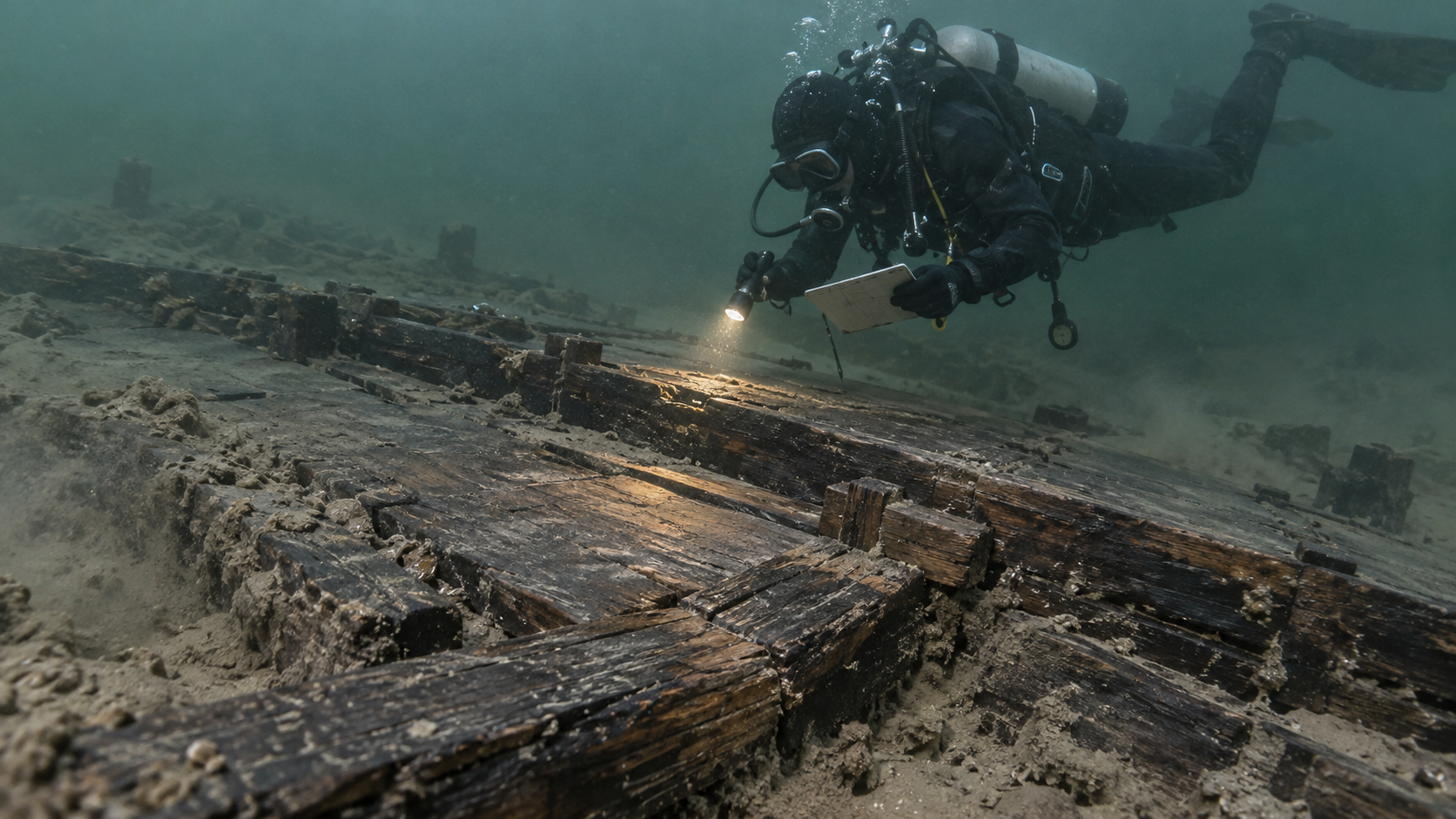
Part of a ship’s backbone survived beneath the sea for more than seven centuries. Off Takashima, an island in Imari Bay in present-day Matsuura, Nagasaki Prefecture, investigators found wreckage connected with the Yuan expedition of 1281, known in Japan as the Koan invasion.
Below more than twenty metres of water, and then beneath seabed mud, long timbers and regularly arranged planks appeared. They offered material evidence to set beside the familiar account of a fleet lost in a storm. The question becomes what parts of that history the remains can actually establish.
The vessel did not emerge complete with sails and decks. This article follows surviving hull material, ceramic bowls and a gunpowder weapon’s casing, distinguishing the excavated portion from a reconstruction of the whole. A partial structure can be significant without being turned into an intact ship.
Scene 02
The second expedition
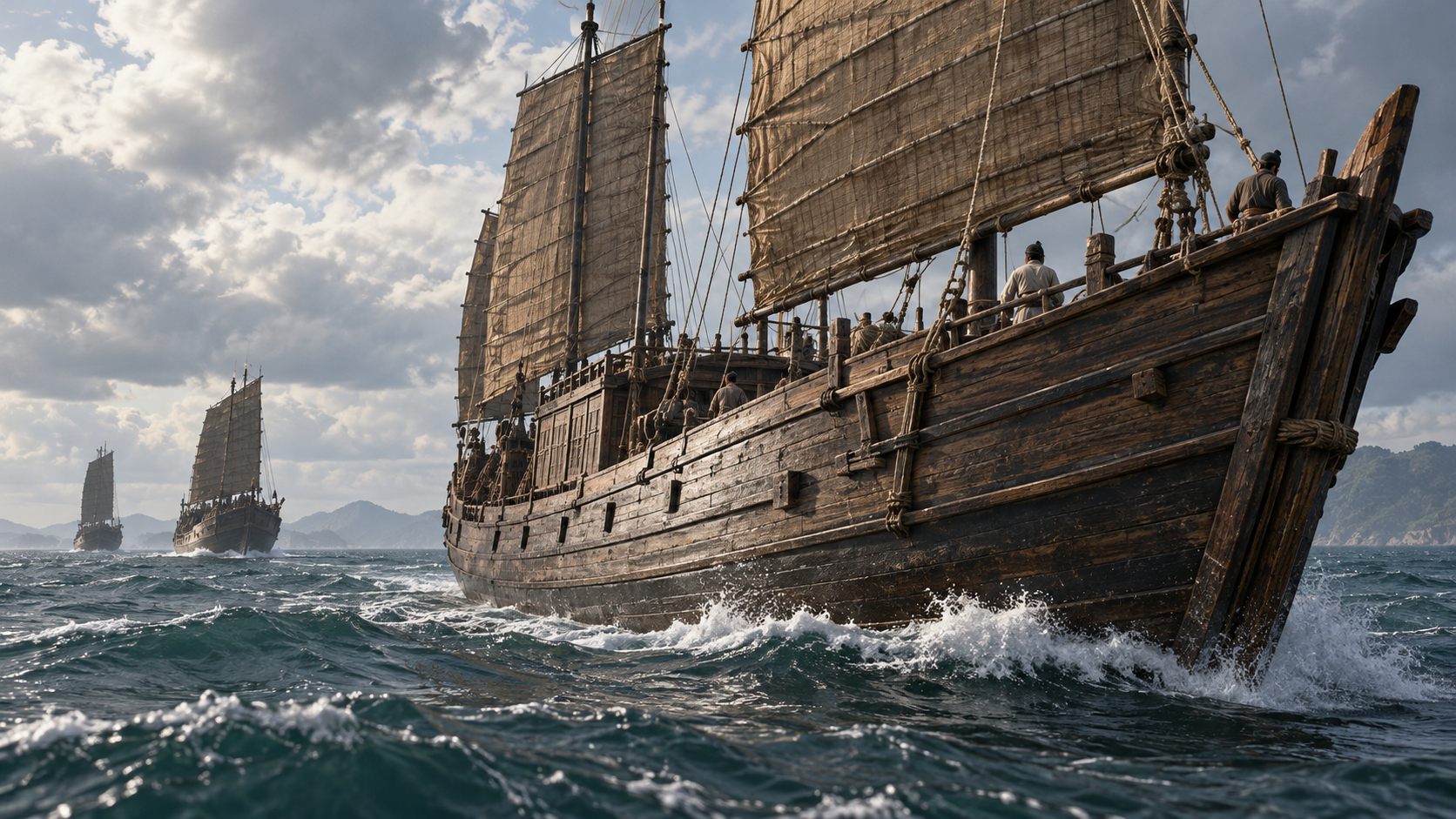
Two invasions must be kept separate: the Bunei invasion of 1274 and the Koan invasion seven years later, in 1281. The Takashima wrecks discussed here concern the later expedition. A picture connected with the earlier fighting cannot simply become an illustration of the same event.
Forces from Yuan and Goryeo crossed the sea, while Japanese defenders responded through coastal fortifications and guarding. During the conflict a violent storm struck the fleet, many ships were lost and the expedition moved toward withdrawal. The storm is central to the account, but does not explain every part of the fighting by itself.
Questions about which vessel broke apart, where it lay and how its remains relate to written events require comparison. The archaeological setting extends beyond Hakata Bay to the southern shore of Takashima, where substantial traces of that wider maritime history survived.
Scene 03
From fishing waters to an archaeological site
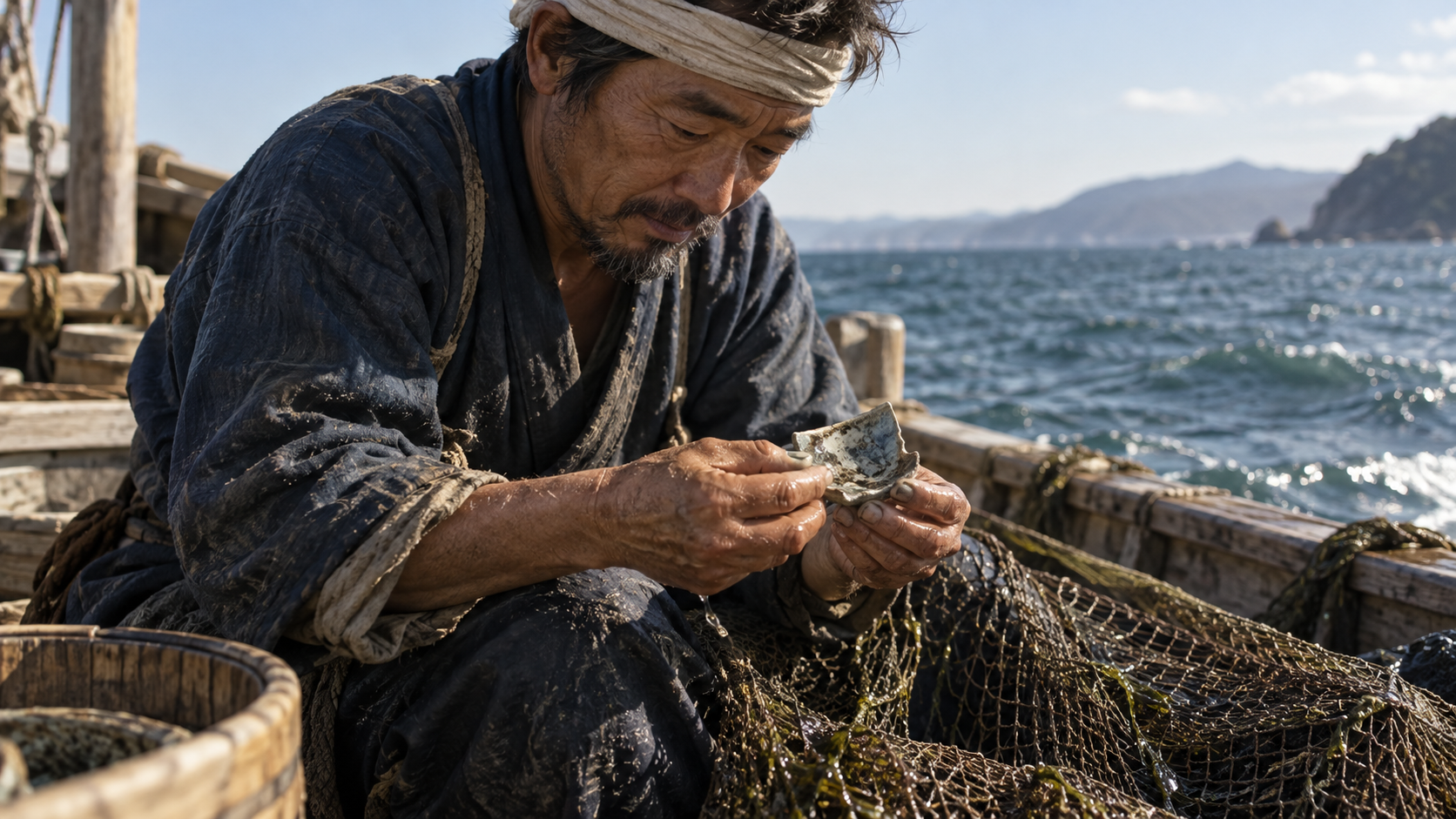
Local fishing waters supplied early clues. Fishers off Takashima’s southern shore had brought up jars, blades and anchor stones before systematic excavation. Their experience indicated the presence of old objects beneath the sea, without by itself establishing a complete account of the site.
Excavation began in 1980. Ceramics, ship components, weapons and other military equipment were subsequently investigated. Anchors also provided important evidence of vessels. Their significance lay not just in appearance, but in the relationships between finds and their locations.
Recording what an object was found beside and where it lay turns a collection of things into evidence about a place. The history of the site consequently includes the gradual accumulation of records, rather than only the recovery of impressive objects. The generated fisher is anonymous and does not depict a documented finder.
Scene 04
The backbone of wreck No. 1
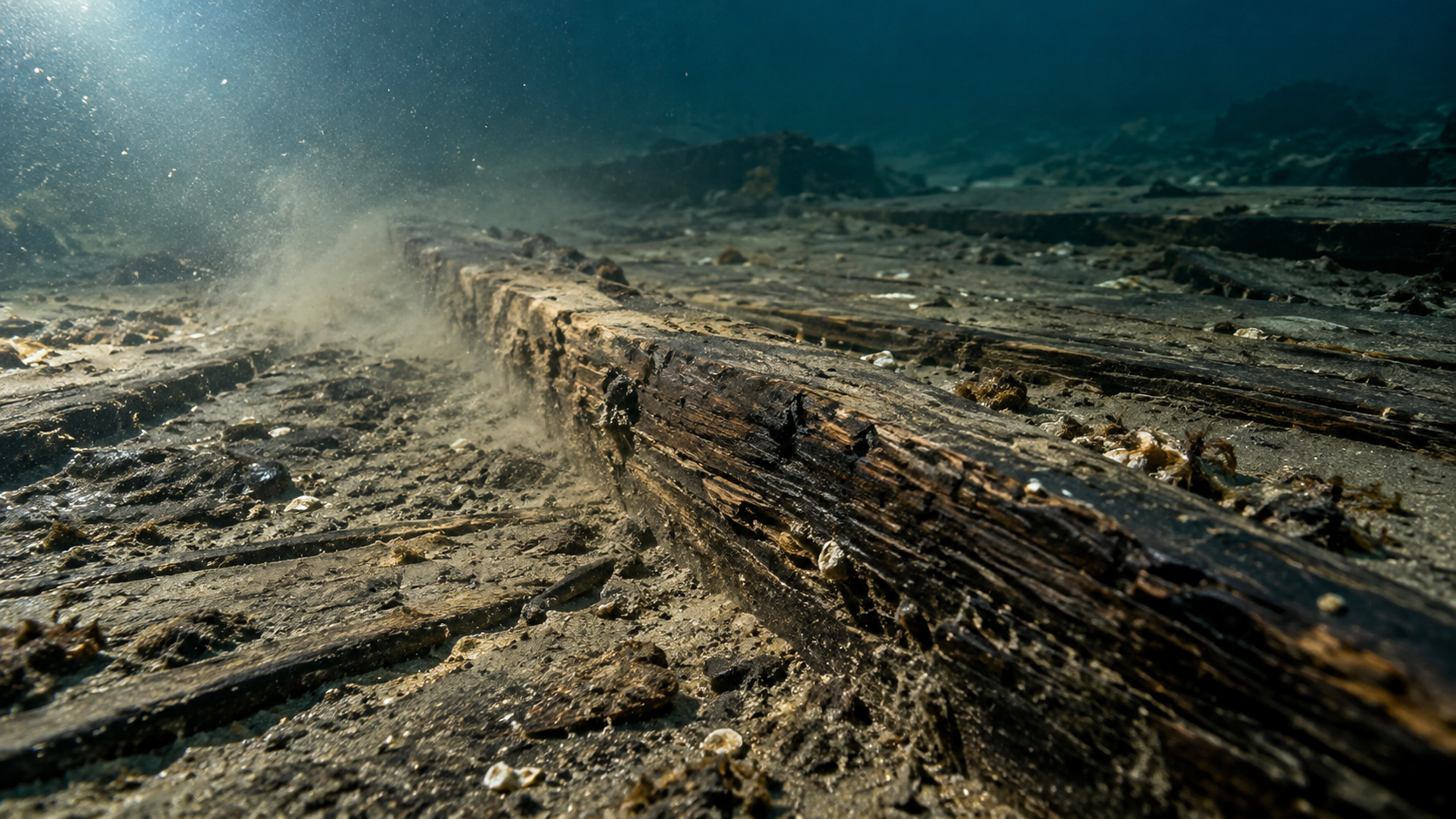
A major development came in autumn 2011, when a research group including Professor Ikeda Yoshifumi of the University of the Ryukyus confirmed a hull off Takashima. The vessel is now referred to as wreck No. 1.
The remains lay in water approximately 23–25 metres deep, with the keel and surrounding hull planking about another metre below the seabed. A keel is a longitudinal member along the bottom of a vessel, often compared with a backbone.
The comparison helps explain the function of the surviving timber, rather than supplying missing parts of the ship. What had been confirmed was a connected portion of structure beneath sediment. The illustration is not the excavation photograph or a measured record of the location.
Scene 05
Does twelve metres mean the whole ship?
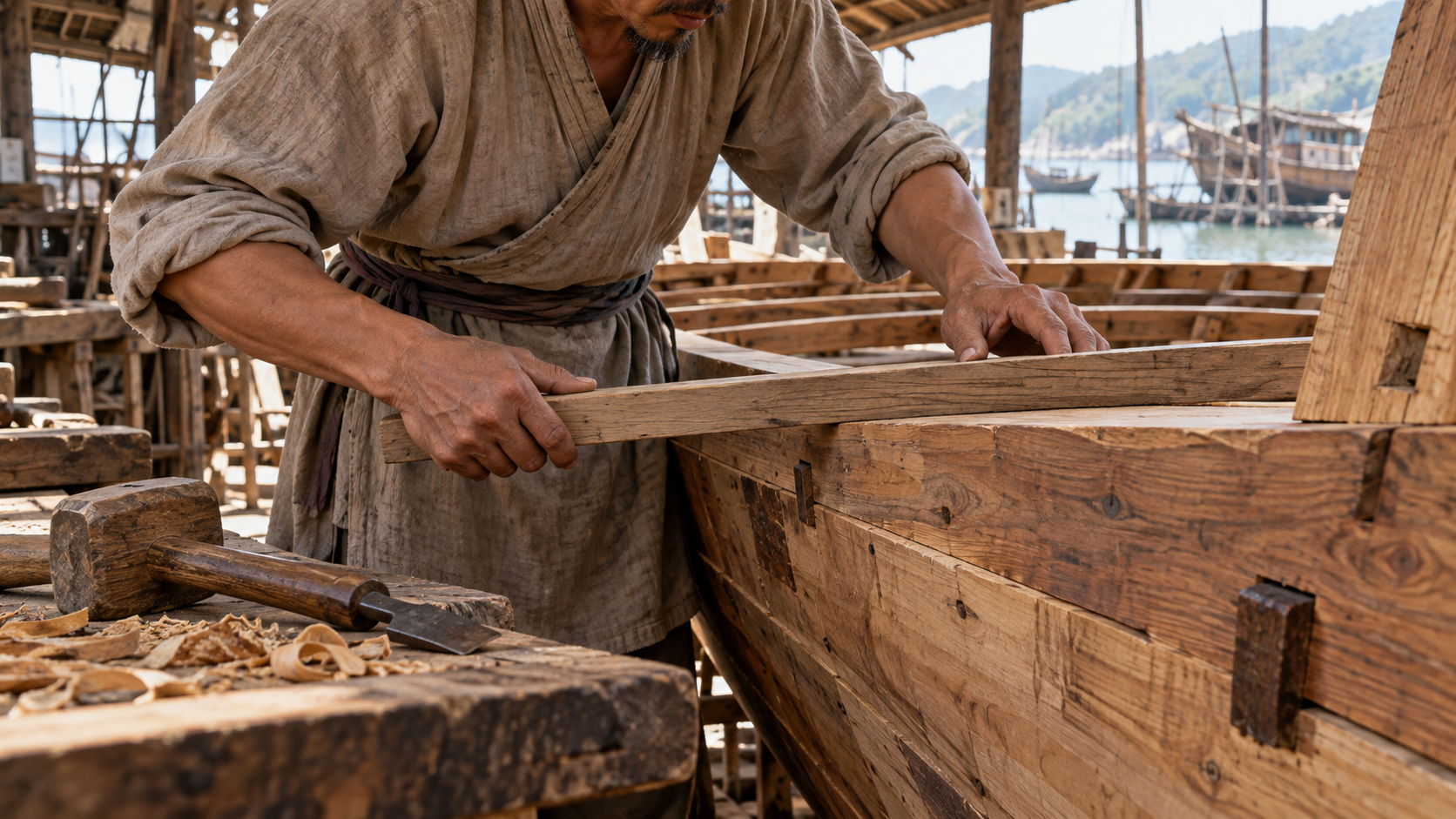
The confirmed length was about twelve metres. That measurement concerns the surviving keel, not the entire original vessel. Matsuura City explains that the ship is estimated to have been in the twenty-metre class.
Measured remains and an estimate of original overall size answer different questions. Keeping them separate prevents a short figure from becoming a claim that the whole vessel has been recovered, or a larger estimate from being presented as a directly measured hull.
The significance includes the survival of connected structure rather than scattered fragments alone. From that material, researchers can consider the former ship while identifying the limits of what is present. The conceptual shipwright supplies neither an authenticated construction method nor a scale drawing.
Scene 06
Wreck No. 2 and the arrangement of its planks
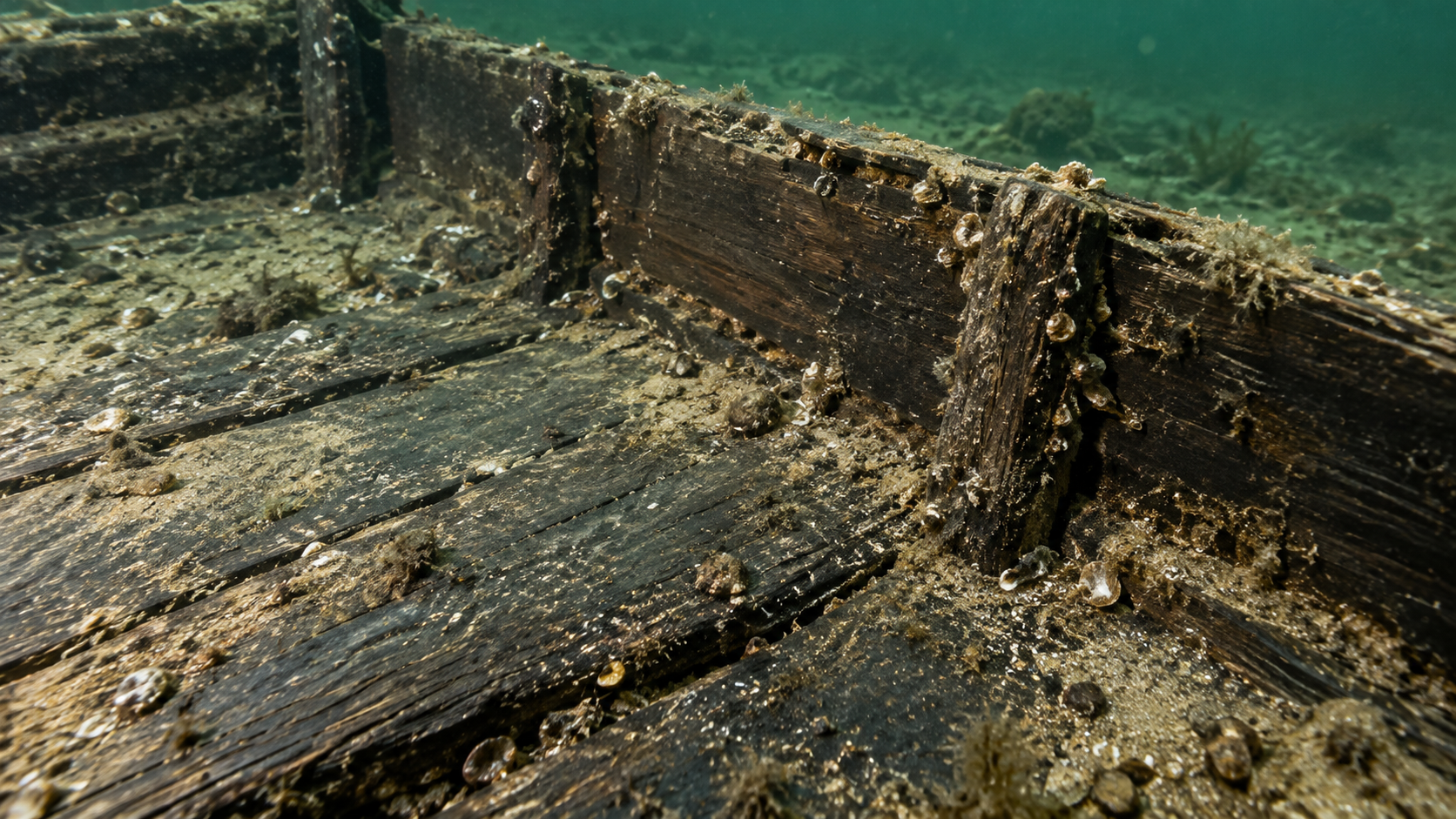
Another vessel was discovered in October 2014 and confirmed as an invasion wreck in the 2015 investigation. Its lower timber structure survived in good condition, providing evidence for study of the vessel’s construction.
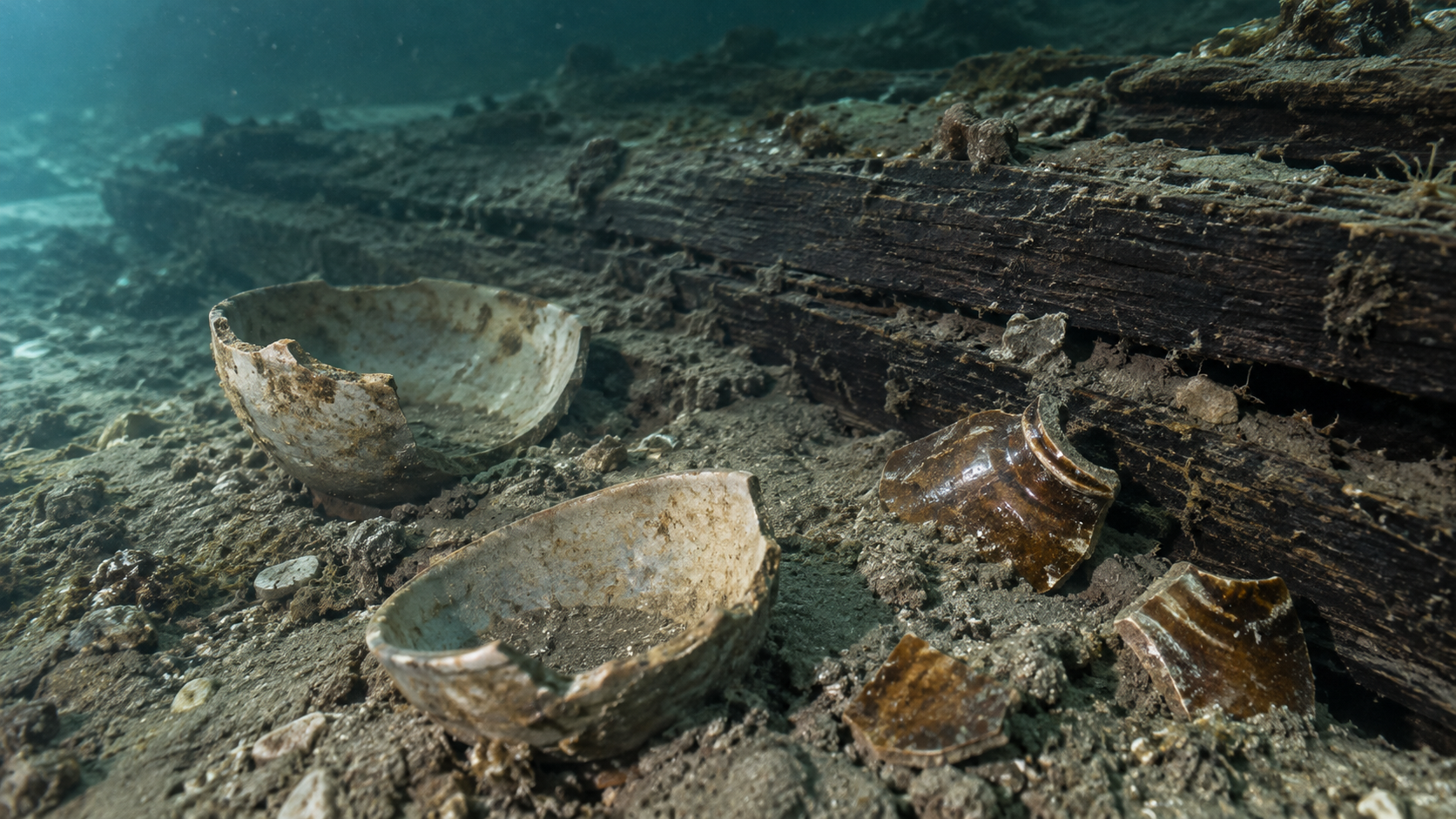
Chinese white-porcelain bowls, brown-glazed pottery jars and tenmoku bowls were also identified. Hull structure and ceramics offer different kinds of evidence at the same site. Recording their positions and character supports consideration of date and function.
Following investigation, wreck No. 2 was reburied and preserved in place. The city describes periodic monitoring to check deterioration. Discovery, investigation and preservation are therefore separate stages; finding the ship did not mean immediately raising it onto land.
Scene 07
Bowls and jars in a military landscape
A wreck associated with fighting can contain more than weapons. A force crossing the sea carried people and supplies aboard ships, so bowls and jars direct attention toward the objects connected with life on board as well as combat.
Their shapes alone cannot identify a particular user or establish exactly what a jar contained. Those questions need evidence beyond a plausible story. The article does not invent meals, ownership or a named crew member from an anonymous vessel.
The Agency for Cultural Affairs explains how pottery dates, origins and combinations were considered alongside weapons and ship material in identifying cargo associated with the 1281 expedition. Ordinary objects contribute to the interpretation through comparison and context. The conceptual image does not document a group excavated together.
Scene 08
Tetsuhau: a ceramic weapon casing
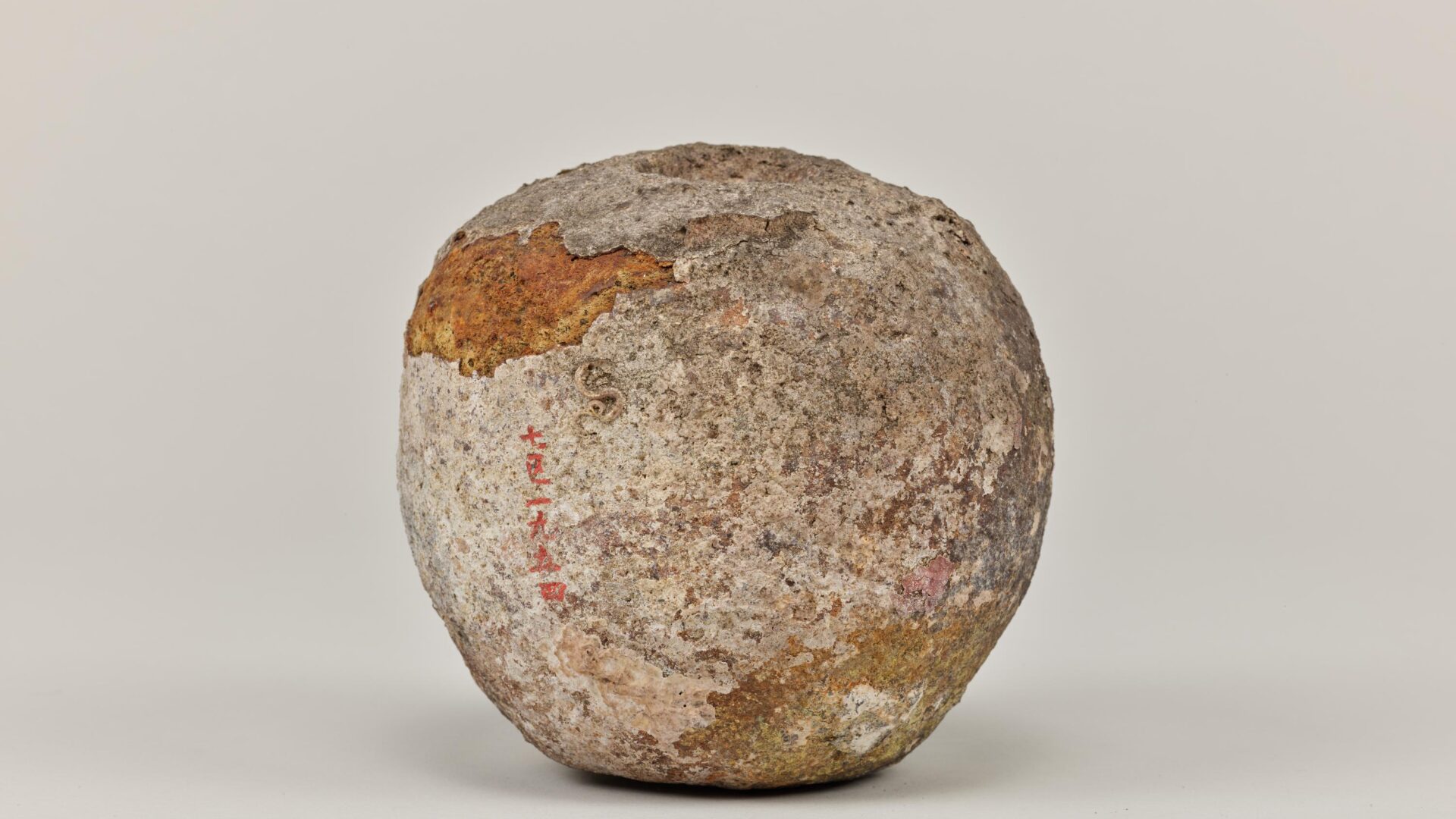
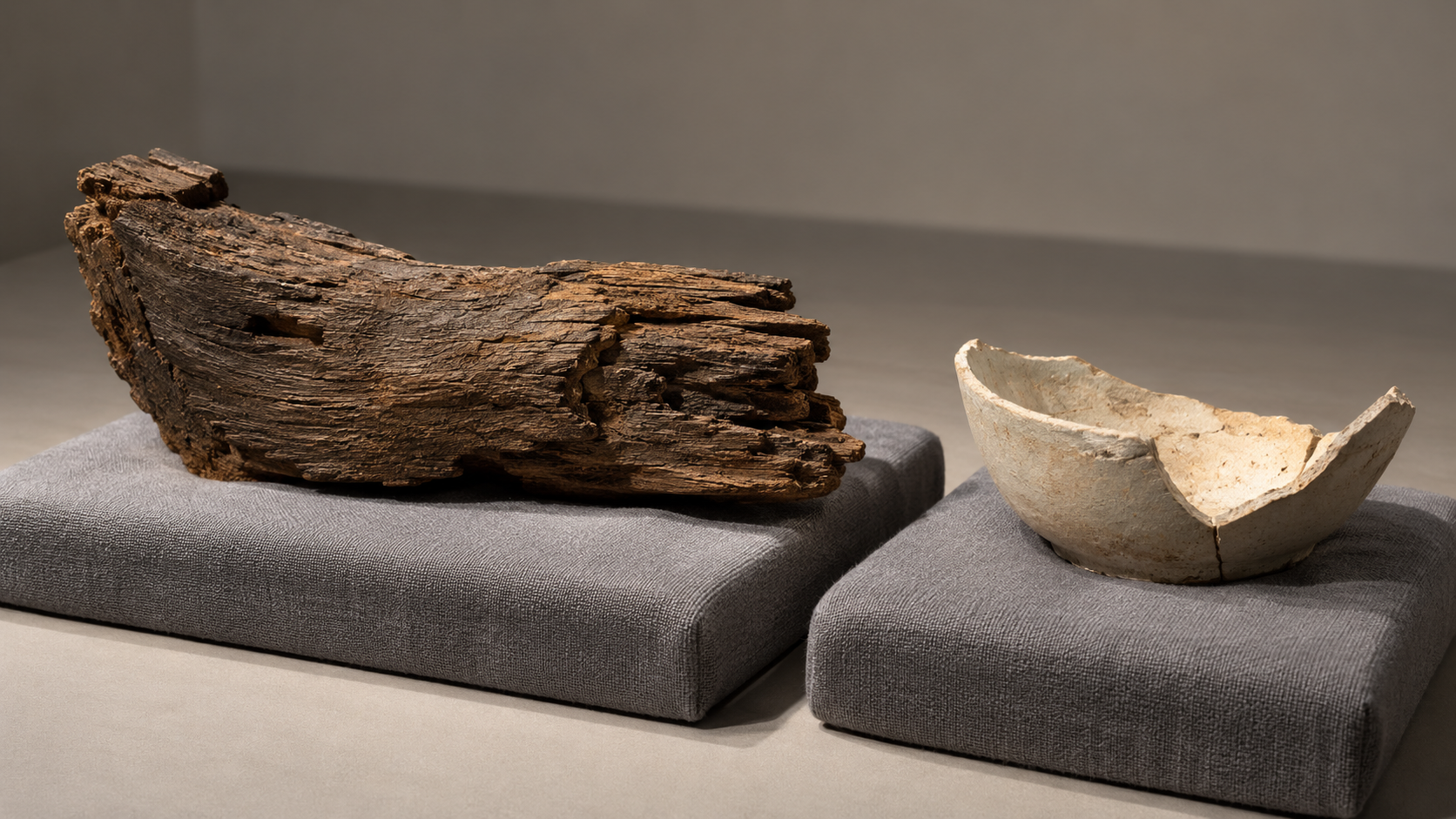
The name tetsuhau may suggest a gun to a modern reader, but the Takashima Kanzaki object held by Tokyo National Museum is the ceramic body of a gunpowder weapon. It is not an early depiction of a firearm or a cannon.
Dated to the thirteenth century in the Kamakura period, this example was recovered during the Meiji period. Its contents no longer survive. The museum explains the weapon as originally using fragments such as iron or pottery with an explosive effect; the existing casing and an explanation of former contents remain distinct.
Here the illustration is a photograph of an actual collection object, unlike the surrounding generated scenes. The collection number is G-3308. Modern cataloguing markings visible on the surface are not interpreted as a medieval inscription, and the photograph cannot restore the missing contents.
Scene 09
An image and an excavated object
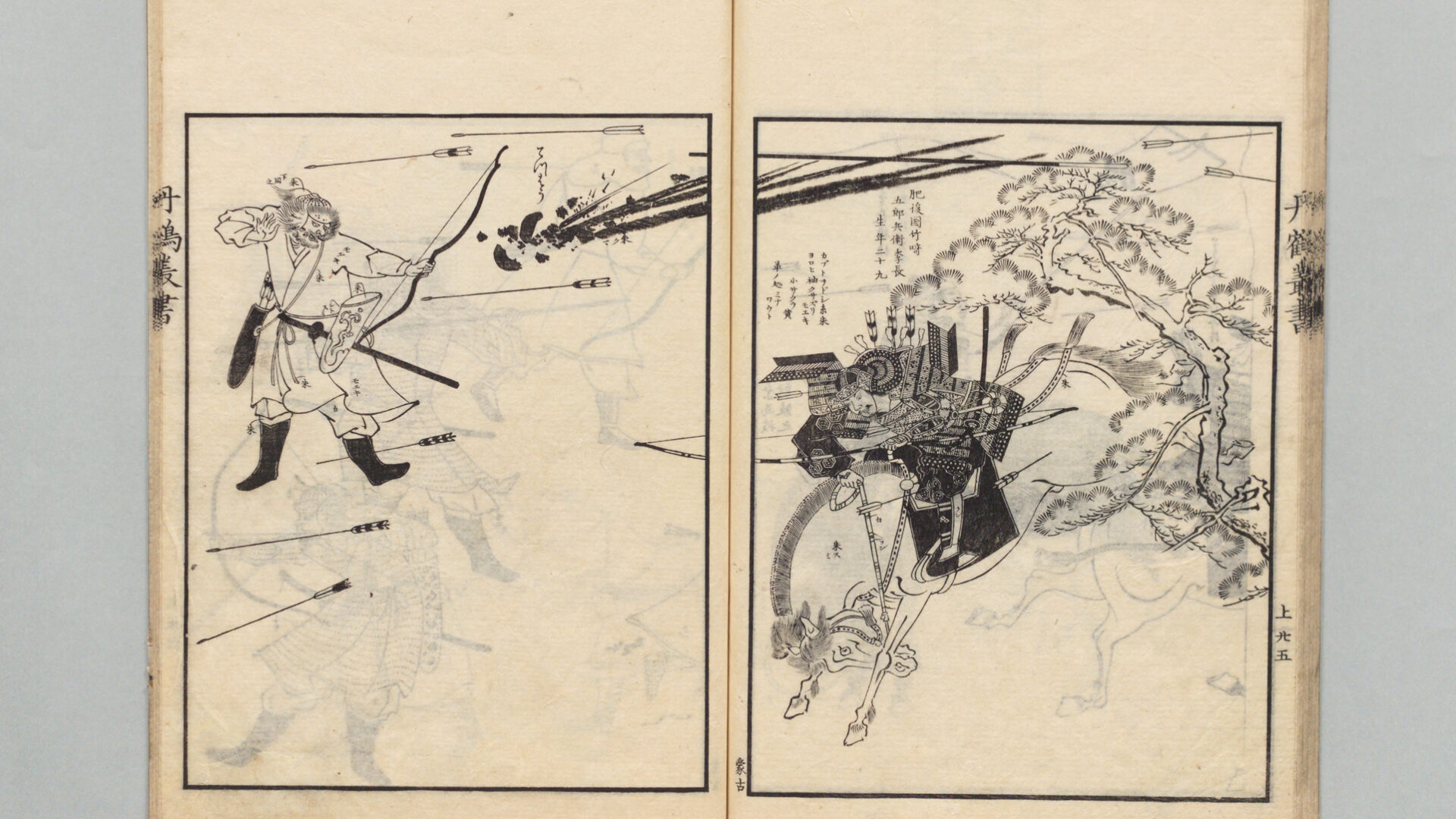
The Mongol Invasion Scroll depicts a bursting weapon called tetsuhau. An image of a weapon and an object recovered from the sea can be considered together, while remaining different types of evidence.
They do not establish that the single burst in the picture and the museum object represent the same item used at the same place. That identification would require evidence beyond the fact that both concern this kind of weapon.
The copy reproduced here, held by the National Archives of Japan as 216-0002, shows a scene of the Bunei fighting in 1274. The wrecks connected with Takashima’s 1281 Koan expedition belong to a different date. The picture is therefore not a record of their sinking or of the particular casing shown above.
Scene 10
Wreck No. 3 and continuing investigation
Matsuura City confirmed wreck No. 3 in October 2024 at a depth of about eighteen metres. Ceramics and metal objects were identified with the hull, and the 2025 fiscal-year investigation confirmed the keel and a joining section. The city says the complete picture remains unresolved.
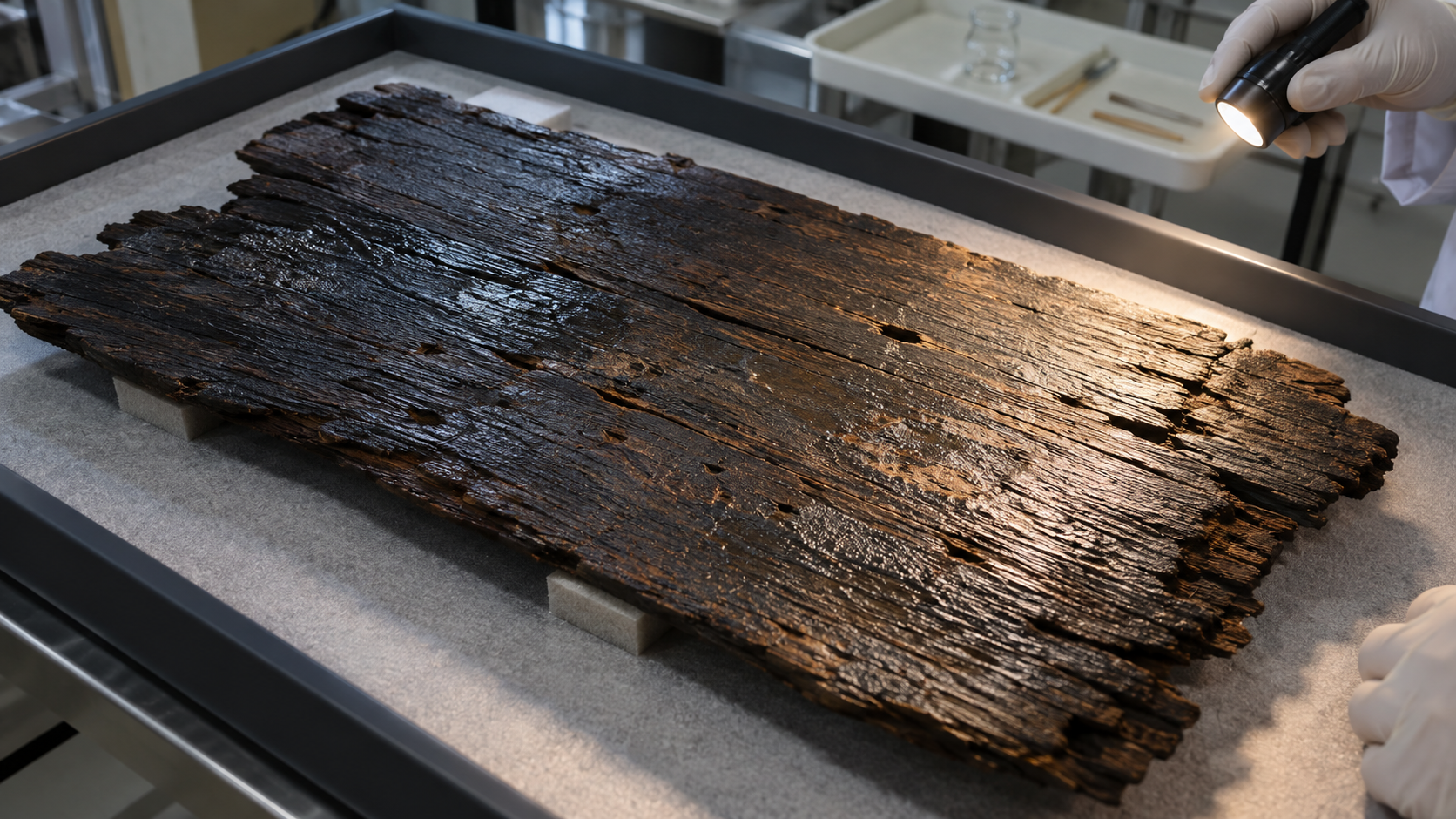
In April 2026 the city’s board of education announced an ink-inscribed wooden board from the wreck. Hiroshima University’s notice confirms the announcement and scholarly assistance in reading it. This article does not extend that notice into an independent decipherment of the writing or a claim about its exact use.
The new material adds questions and more specific evidence rather than making the whole vessel understood at once. The generated board is not the original find, an inscription facsimile or a translation of confirmed characters.
Scene 11
Work continues after discovery
A ship’s discovery does not automatically lead to its raising. For wreck No. 2, the city explains preservation through reburial in place and regular monitoring for deterioration. Protecting remains and examining their condition are continuing parts of archaeological work.
On 27 March 2012, Takashima Kozaki was designated a national historic site, the first seabed archaeological site in Japan to receive that designation. The underwater location is treated as a historical place requiring protection, as well as a source of finds.
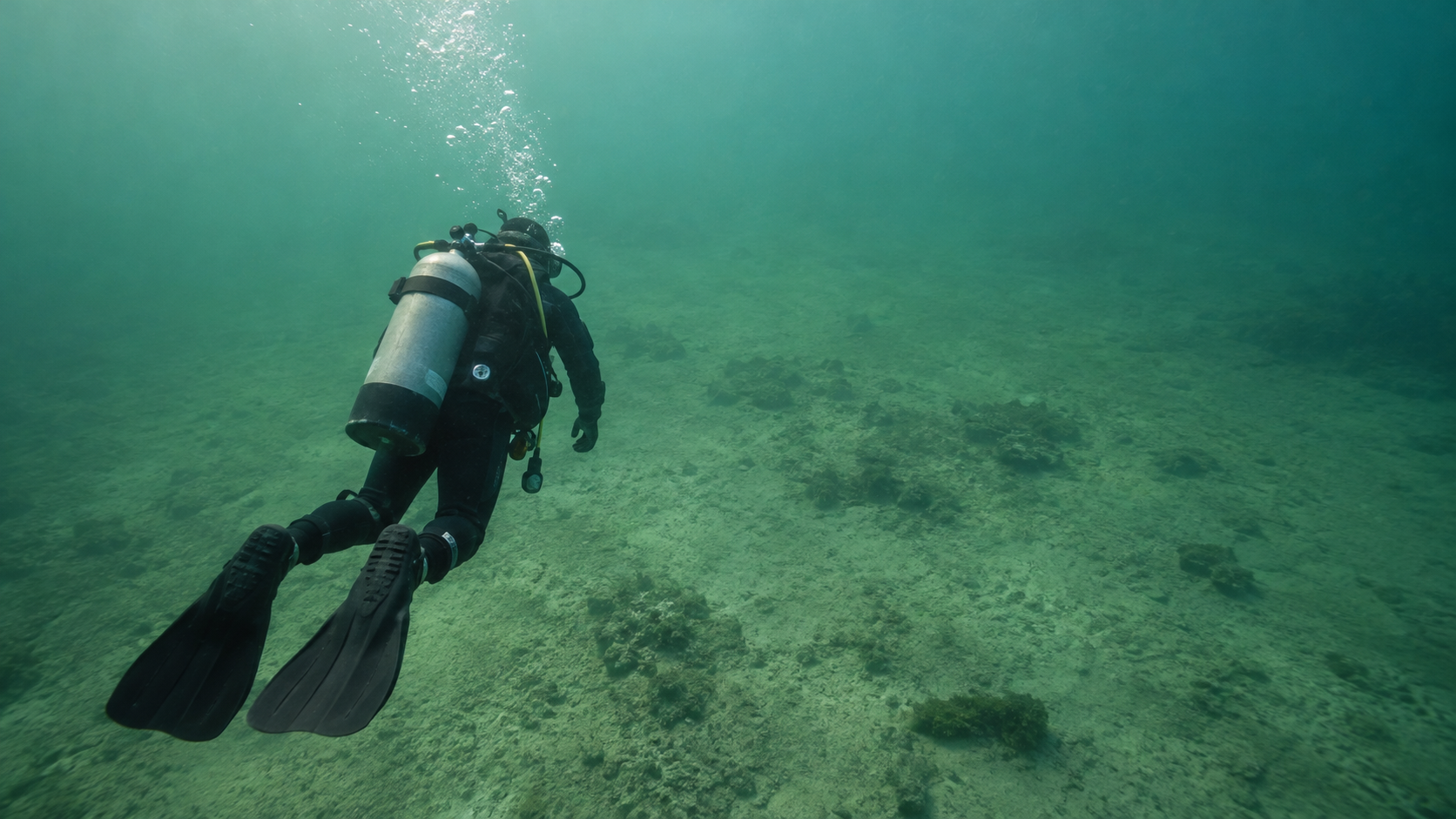
What appears in an excavation image is the portion investigation has established. Respecting that boundary leaves unexamined parts open to future work. The conceptual diving scene does not show a recorded operation, and preservation policy for the cited vessel is not generalized into an unsupported claim about every wreck.
Scene 12
Looking again at the Koan invasion
The sea off Takashima preserved more than a single record announcing victory or defeat. Ship timber, ceramics and weapons illuminate the same broad historical setting from different directions. They make the expedition tangible through the things that carried and accompanied it.
A twelve-metre keel does not show the complete vessel, yet it turns a ship known through words and pictures into physical evidence from a particular sea. Ceramics shift attention toward people aboard, while new discoveries remind the reader that much remains outside the confirmed picture.
The invasion need not end in the retelling at a storm scene. Following surviving ships and objects brings the wider maritime event back into view, with measured findings and interpretation kept distinct. The account does not add a total for lost ships, a claim that all crews died or an explanation based solely on poor construction.
Image note: explanatory scenes use AI-generated conceptual images and are not excavation photographs or precise hull reconstructions. The tetsuhau and scroll-copy images are collection materials with separate institutional credits and sources in their captions.
How to read this work
History, interpretation, and reconstruction
The Takashima remains reveal the 1281 expedition through material evidence whose confirmed dimensions, dates and interpretations must be kept distinct.
This work is grounded in published sources and historical research. Interior thoughts, dialogue, and some visual details are cinematic reconstructions. Where historians disagree, the article presents the point as debated rather than settled fact.
Timeline
The story in time
-
The Bunei invasion, depicted in the reproduced scroll-copy scene.
Sources: s08 -
The keel and hull planking of wreck No. 1 are confirmed.
Sources: s01 -
Takashima Kozaki is designated a national historic site.
Sources: s04 -
Wreck No. 2 is discovered and subsequently confirmed as an invasion wreck.
Sources: s02 -
Wreck No. 3 is confirmed, followed by investigation of its keel and joint.
Sources: s03 -
An ink-inscribed board from wreck No. 3 is announced; the account does not claim an independent reading of its characters or a complete understanding of the ship.
Sources: s07
People & terms
A guide for new readers
Glossary
- Koan invasion 弘安の役
- The 1281 expedition associated here with the Takashima wrecks.
- Bunei invasion 文永の役
- The 1274 invasion depicted in the reproduced scroll-copy scene, distinct from the 1281 wreck context.
- Keel 竜骨
- A longitudinal structural member at a ship’s bottom, compared in the article with a backbone.
- Tetsuhau てつはう
- The ceramic gunpowder weapon represented by museum object G-3308, rather than a gun or cannon.
- Tenmoku bowl 天目碗
- One of the ceramic types recorded with wreck No. 2; no individual user is identified.
- Preservation in place 現地保存
- The approach described for wreck No. 2, involving reburial and monitoring at the site.
- Ink-inscribed board 墨書木板
- A wooden find announced from wreck No. 3; the conceptual image supplies neither a facsimile nor a decipherment.
Sources & method
How this article was built
The English edition follows every Japanese scene, timeline entry and source identifier. Source titles are editorial translations. Municipal pages, university information, museum data and archival explanations support different parts of the account; they are not interchangeable forms of direct evidence.
Measurements of surviving structure are distinguished from estimated whole-ship size. The 1274 scroll-copy image and 1281 wreck context remain separate. The third wreck and board announcement were rechecked against institutional pages; no new original report reading or independent decipherment is claimed.
Ten conceptual generated scenes remain separate from two credited documentary images: the Tokyo National Museum object via ColBase and the National Archives scroll copy. The original image files are unchanged. No total losses, universal crew fate or claim that a storm alone determines the entire history is added.
Sources
References and further reading
- Takashima wreck No. 1 松浦市・鷹島1号沈没船 Title translated editorially for reader convenience. Matsuura City 松浦市 Used for autumn 2011 confirmation, water and sediment depths, the approximately twelve-metre keel and the estimated twenty-metre-class vessel. Measurement and estimate remain distinct. Accessed 2026-10-29
- Takashima wreck No. 2 松浦市・鷹島2号沈没船 Title translated editorially for reader convenience. Matsuura City 松浦市 Used for the 2014 discovery, 2015 confirmation, lower timber structure, ceramic types and preservation through reburial and monitoring. Accessed 2026-10-29
- Takashima wreck No. 3 松浦市・鷹島3号沈没船 Title translated editorially for reader convenience. Matsuura City 松浦市 Used for October 2024 confirmation, approximate depth and fiscal 2025 keel investigation. The city describes the whole vessel as unresolved. Accessed 2026-10-29
- Takashima Kozaki national historic site 松浦市・国指定史跡鷹島神崎遺跡 Title translated editorially for reader convenience. Matsuura City 松浦市 Used for the southern Takashima location, investigations from 1980 and designation on 27 March 2012. Accessed 2026-10-29
- Takashima Kozaki historic site: explanatory material, 22 March 2013 文化庁・史跡鷹島神崎遺跡について(2013年3月22日資料) Title translated editorially for reader convenience. Agency for Cultural Affairs 文化庁 Used for local recoveries and comparison of ceramics, weapons and ship components. The document’s erroneous Bunei 2 (1274) is distinguished from Bunei 11 (1274). Accessed 2026-10-29
- Tetsuhau: Cultural Heritage Online 文化遺産オンライン・てつはう(東京国立博物館所蔵) Title translated editorially for reader convenience. Agency for Cultural Affairs / Tokyo National Museum 文化庁・東京国立博物館 Used for the ceramic body, thirteenth-century dating, Meiji recovery and missing contents. Checked alongside collection data for G-3308. Accessed 2026-10-29
- Press announcement concerning the ink-inscribed Takashima board 広島大学・鷹島海底遺跡墨書木板報道発表 Title translated editorially for reader convenience. Hiroshima University 広島大学 Confirms the April 2026 announcement and assistance with reading. It does not independently support detailed characters or a precise purpose for the board. Accessed 2026-10-29
- Japan and Mongolia, Chapter 1 国立公文書館・日本とモンゴル 第1章 Title translated editorially for reader convenience. National Archives of Japan 国立公文書館 Used for the two invasions and the scroll-copy context. The reproduced 1274 scene is kept separate from 1281 wrecks. Accessed 2026-10-29
- Takashima Kozaki: cultural property database 長崎県・鷹島神崎遺跡文化財データベース Title translated editorially for reader convenience. Nagasaki Prefecture 長崎県 Used for anchors, ship parts, weapons and ceramics, including the archaeological setting of an anchor detected in the 1994 investigation. Accessed 2026-10-29
- Tetsuhau (G-3308): ColBase ColBase・てつはう(G-3308) Title translated editorially for reader convenience. National Institutes for Cultural Heritage / Tokyo National Museum 国立文化財機構・東京国立博物館 Collection data, source and image conditions identify the actual museum object. The unmodified image is credited; missing contents and modern surface markings are not misrepresented. Accessed 2026-10-29
Continue reading
More stories from Shigeki
Shigeki English
Kobayakawa Hideaki after Sekigahara: Work beyond Okayama’s Keep
The outer moat offers a way into a short period of castle government.
- When Hideaki’s Okayama rule, 1600–1602; earlier construction in 1597 and later changes considered separately
- Where Okayama Castle, its outer enclosures and former western moat; Bizen and Mimasaka
Shigeki English
Passing Hakone Checkpoint: Identity, Direction and Travel Documents
A pass mattered, but the inspection depended on more than possessing paper.
- When Edo-period Hakone; establishment at the present location around 1619, regulations of 1711 and later reconstruction
- Where The Tokaido road between Lake Ashi and the surrounding mountains at Hakone