
SHIGEKI ENGLISH STORYEN
Japanese history in English
The Tenpō Reforms: From Frugality to an Order over Land
Prices, migration, theatre, publishing and the boundaries of rule: follow policies through their aims and the interests they encountered.
Explore the Tenpō Reforms through frugality, merchant associations, village return, cultural controls, foreign-ship supplies and the contested land order. Distinguish commands from outcomes.
At a glance
Before you enter the story
- When
- Currency changes from 1832, the reforms of 1841–1843, Mizuno’s return in 1844 and the separate Hamamatsu disturbances of 1846; historical month-and-day dates retained.
- Where
- Edo’s shops, theatres and publishing, rural communities, coastal policy, lands near Edo and Osaka, and later Hamamatsu.
- Key figures
- Mizuno Tadakuni, Tokugawa Ienari, Tamenaga Shunsui, Ryūtei Tanehiko
- What was at stake
- Whether government could alter livelihoods, organizations, movement and territorial authority through commands, and where those policies encountered resistance.
Why this story matters
The larger history behind the turning point
The Tenpō Reforms can be reduced to an image of severe frugality. Looking across their policies reveals different problems: money already changed, commercial trust, livelihoods tied to place, cultural production and authority over land. Each makes the distinction between issuing an order and achieving its intended result more concrete.
Historical context
What an international reader needs to know
One Era Name Does Not Mean One Starting Date
Tenpō appears in the names of coins and reforms, but the developments did not begin together. Recoinage from 1832, the coin issue of 1835 and the five-ryō coin of 1837 preceded the campaign led by Mizuno from 1841. The earlier monetary background should not be silently assigned to the later campaign’s start.
Month-and-day dates also need care. The association and publishing orders use the historical calendar, as does the dismissal on the thirteenth day of the intercalary ninth month in 1843. The latter is not Gregorian 13 September. Later manufacture of a theatre drum and a later disturbance have their own dates rather than automatically recording the moment of reform.
Authority, Interests and Different Kinds of Evidence
Rōjū means senior councillor, and the political structure contained more actors than Mizuno alone. The land order involved authority held by domain lords and direct retainers as well as the shogunate’s plan for direct control. Recognizing those interests distinguishes a proposed rearrangement near two cities from an accomplished seizure of all land nationwide.
Evidence for commands differs from evidence for their reception. A course handout, museum explanation, author’s commentary and article examining satire answer different questions. The account of merchant trust cannot supply unrecorded bankruptcy totals; a satirical interpretation is not automatically its maker’s intent or the opinion of every town resident.
Watch the film
See the story in motion
The film currently uses Japanese audio. This English article provides the context and source trail; it does not imply that an English subtitle track is available.
Chapter 01
From Everyday Life to the Boundaries of Rule
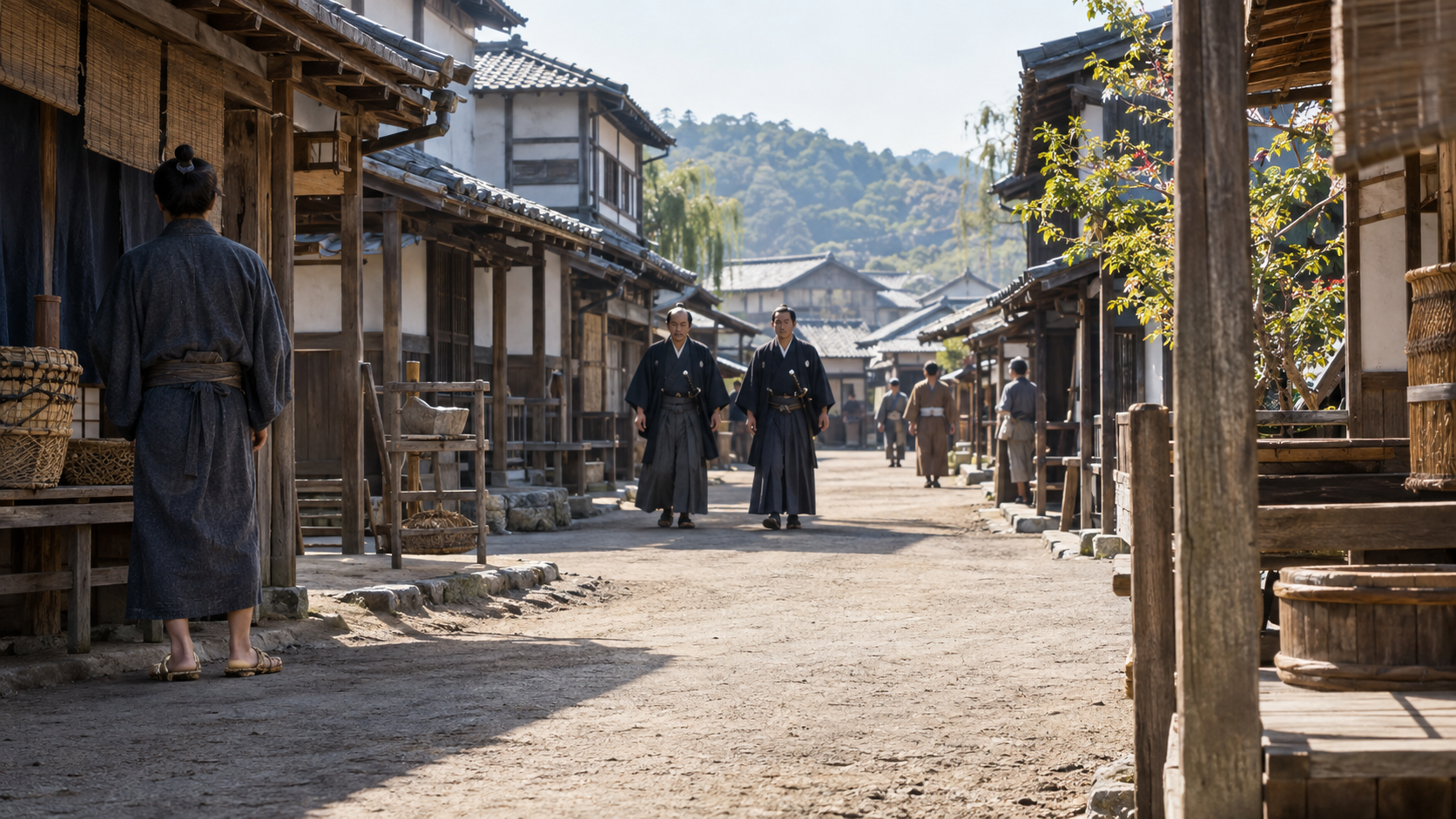
Restraining purchases, changing commercial organizations and returning people to villages were among the ways the Tenpō Reforms sought to reorder life. Commands from the shogunate reached into daily activities. Their effects cannot be understood only as statements written by officials: they also involved people whose work and living arrangements were being addressed.
When policy moved toward bringing lands near Edo and Osaka under direct shogunate control, opposition came from domain lords and direct retainers as well. Reform touched authority among those who governed, not only the lives of ordinary people receiving orders. The political relationships surrounding land therefore form part of the same account as restrictions in the town.
The leading senior councillor was Mizuno Tadakuni. Looking back on the reforms of 1841–1843 only as excessively strict frugality would make their different commercial, population and territorial questions less visible. A single judgement about severity does not explain how each policy was intended to work or where it met resistance.
What was to change, whose livelihood or authority was involved, and where did opposition arise? The narrative follows the destinations of commands from shopfront to territorial boundary. This is a way of connecting the institutional explanations, not a claim to recover one universal experience shared by everyone living under the reforms.
Chapter 02
Money Had Changed before the Reforms Began
Problems involving shogunate finance and prices preceded the start of the reforms. The Currency Museum’s account introduces Bunsei and Tenpō recoinage as measures to supplement finances and describes a relationship with rising prices. This background belongs before the orders later associated with Tadakuni, rather than being silently moved to the same starting date.
Tenpō recoinage began in 1832; the Tenpō tsūhō was issued in 1835; and the five-ryō coin followed in 1837. All preceded the reforms led by Mizuno from 1841. Sharing the name of an era does not make these developments simultaneous parts of one measure. Their distinct years provide the chronological framework used here.
Placing changes to money first gives the problems inherited by reform a longer history. The argument is not that every later price movement can be calculated from these dates alone. The institution’s explanation supplies context without establishing a new series of quantities, an exact inflation rate or a complete model of the economy.
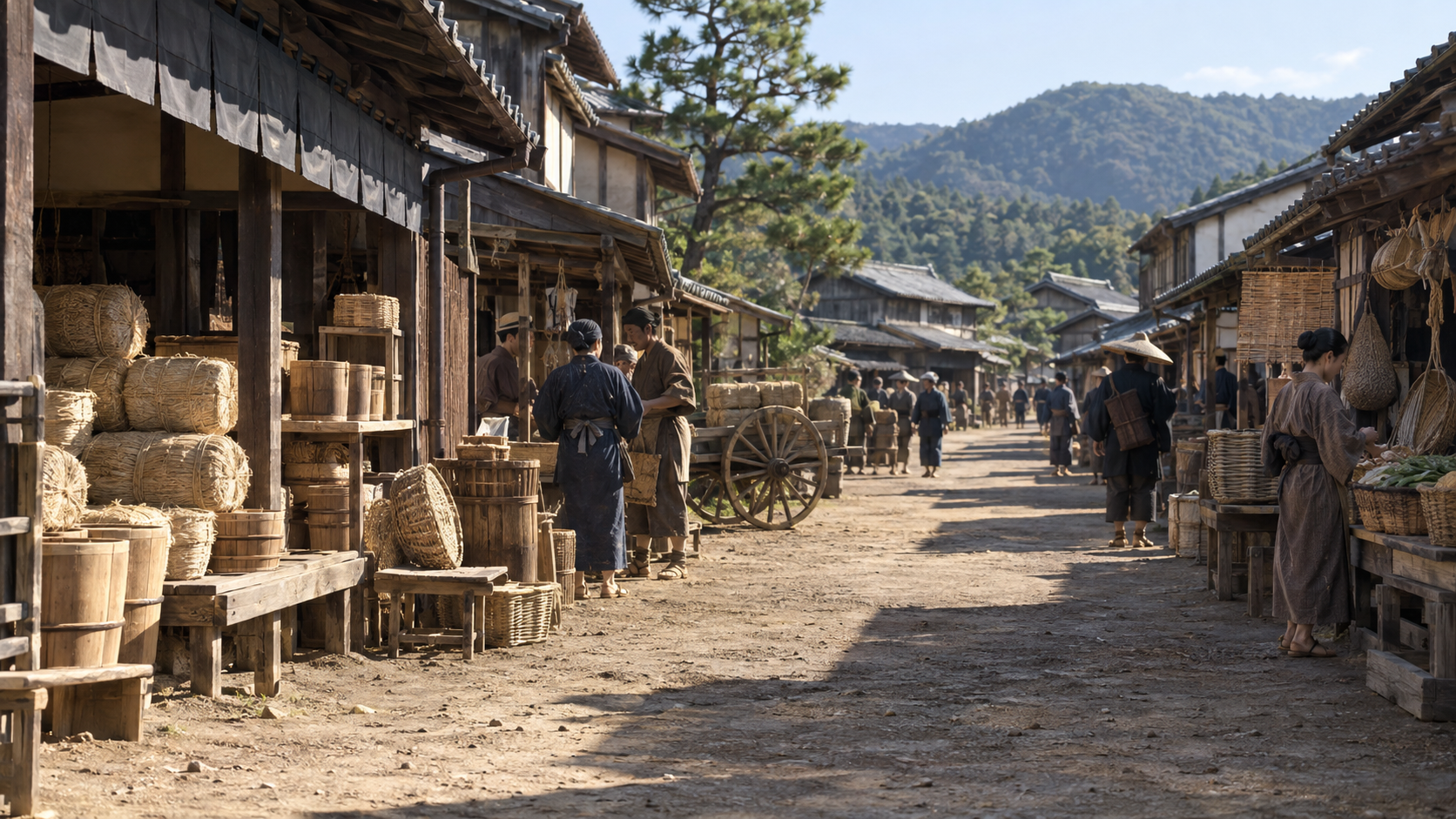
An order seeking lower prices could not erase earlier changes merely by regulating sellers. Considering prices in the town also requires attention to the money the shogunate itself had altered. The generated shop and bundles illustrate commercial life, not an actual market survey or a measured record of prices and goods.
Chapter 03
Mizuno and the Government Issuing Commands
In 1841, the former shogun Tokugawa Ienari, known as the ōgosho, died. The Japan Arts Council’s educational material explains that Mizuno then took a central role in pursuing reform. Ienari’s position as retired shogun should remain clear; the account is not identifying him as the reigning shogun throughout the reform campaign.
The stated concerns included restoring finances, reviving rural communities, tightening warrior discipline and responding to foreign affairs. Controls on urban entertainment were one part of policies reaching more widely. Looking only at theatres or luxury consumption would therefore leave other purposes of the reforms outside the picture.
Research published by Kariya City’s museum also considers the participation of other senior councillors and cases in which policy was conveyed under the name of the councillor responsible for coastal defense. Not every government command can be explained solely by attaching Mizuno’s name to it. Leadership and the distribution of administrative roles need to be distinguished.
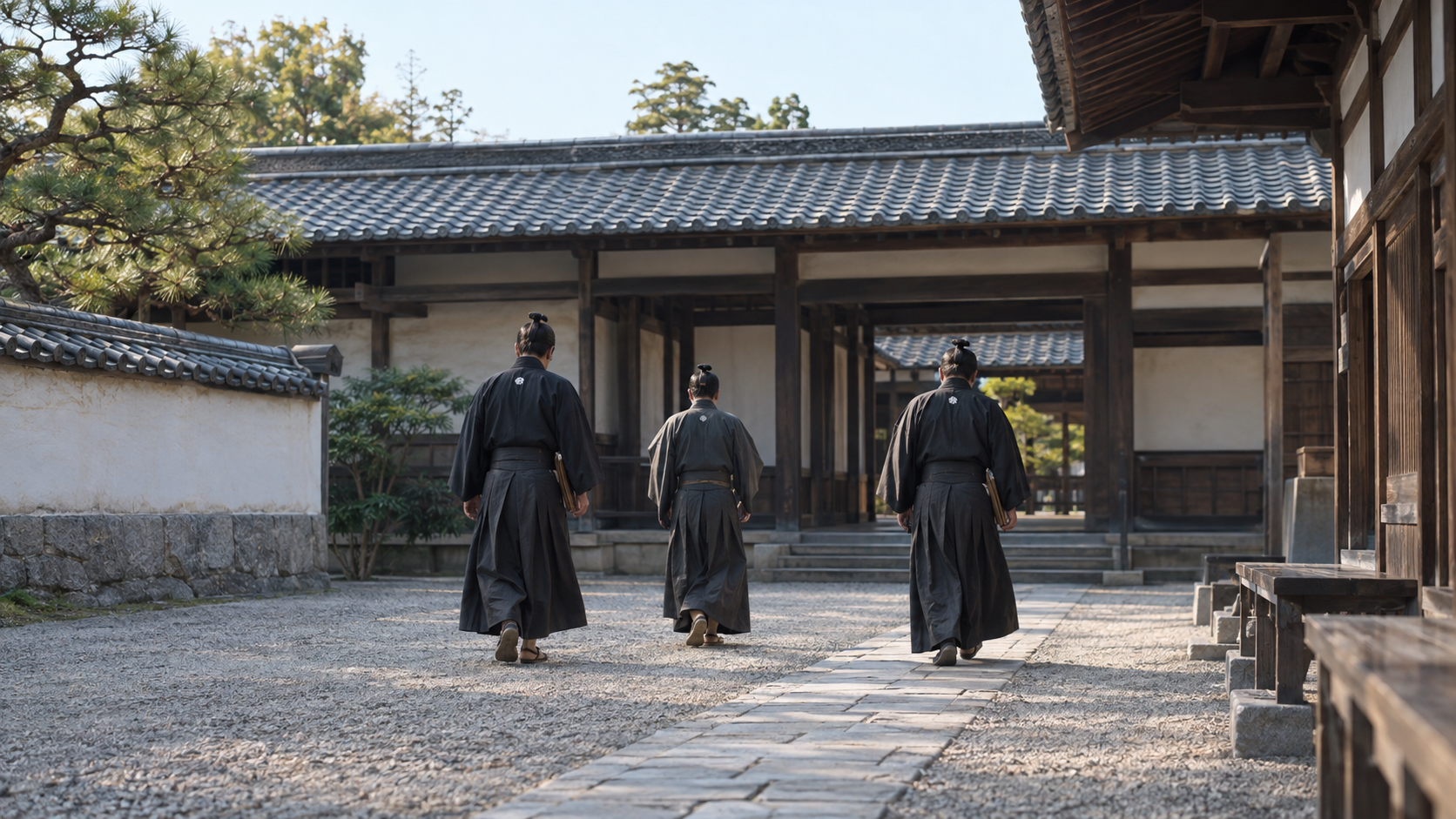
Even with a leading figure, political work involved different responsibilities and positions. The government pursuing reform contained its own interests. Keeping that point in mind prepares the later discussion of land and resistance without inventing a meeting or attributing otherwise unrecorded views to a particular official. The illustrated officials are anonymous explanatory figures.
Chapter 04
Frugality Also Reached the Seller’s Work
Orders to curb luxury and reduce expenditure were not introduced for the first time by the Tenpō Reforms. The Edo-Tokyo Museum explains that the period added various controls to earlier injunctions about frugality. A reform named for one era can therefore contain both continuities and new combinations of measures.
Warrior life was not the only target. Regulations also concerned what townspeople bought and enjoyed. A policy presented as restoring order reached ordinary choices about consumption. Its social effect involved the relationship between the purpose stated by government and what those choices meant within the lives and work of the people concerned.
An item forbidden to a purchaser also had people who made, carried and sold it. Restricting consumption could therefore reach the seller’s means of livelihood as well as the buyer’s spending. This interpretation connects the policy with economic relationships without claiming a quantified loss for a particular shop or reconstructing an actual enforcement case.
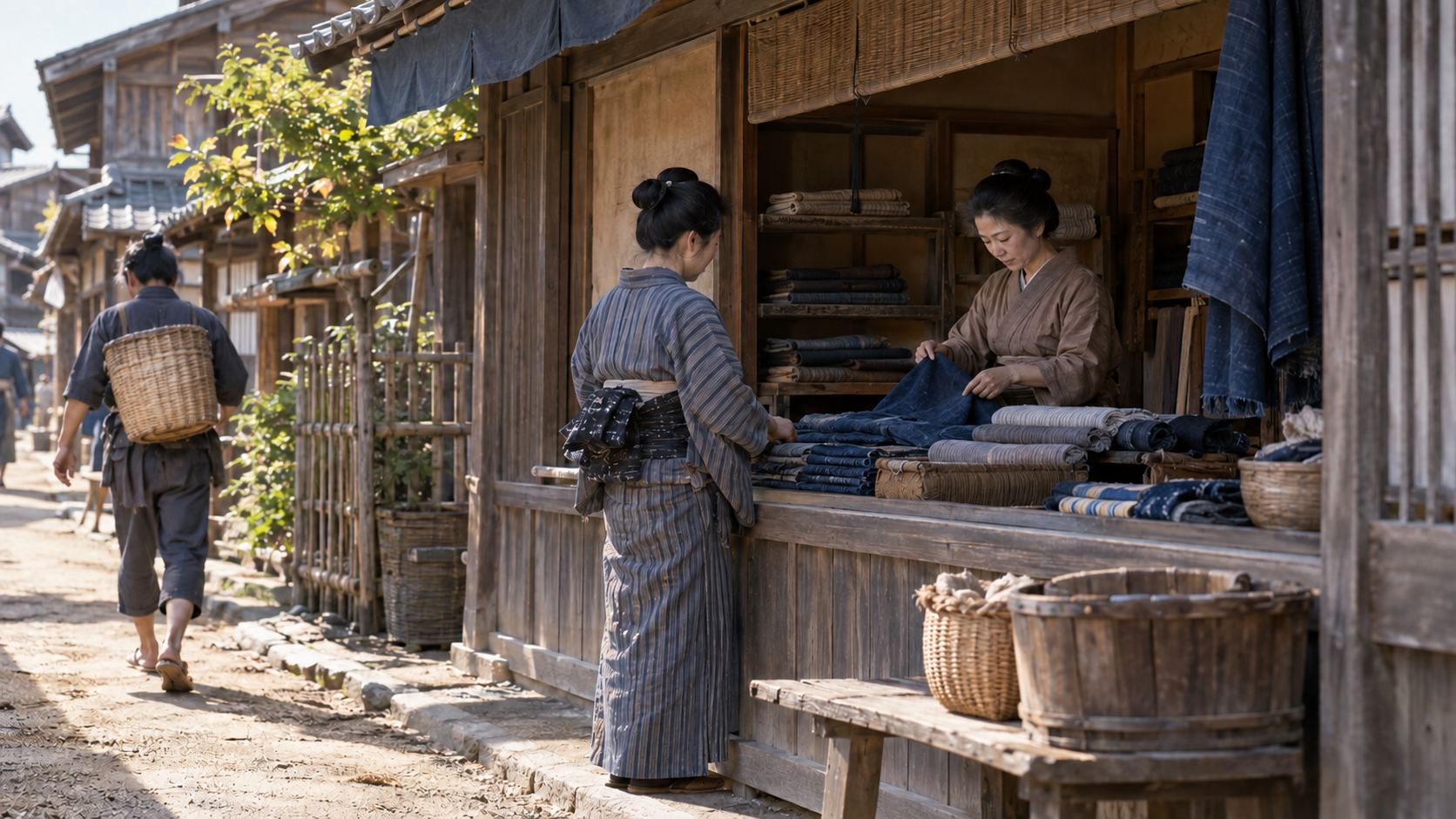
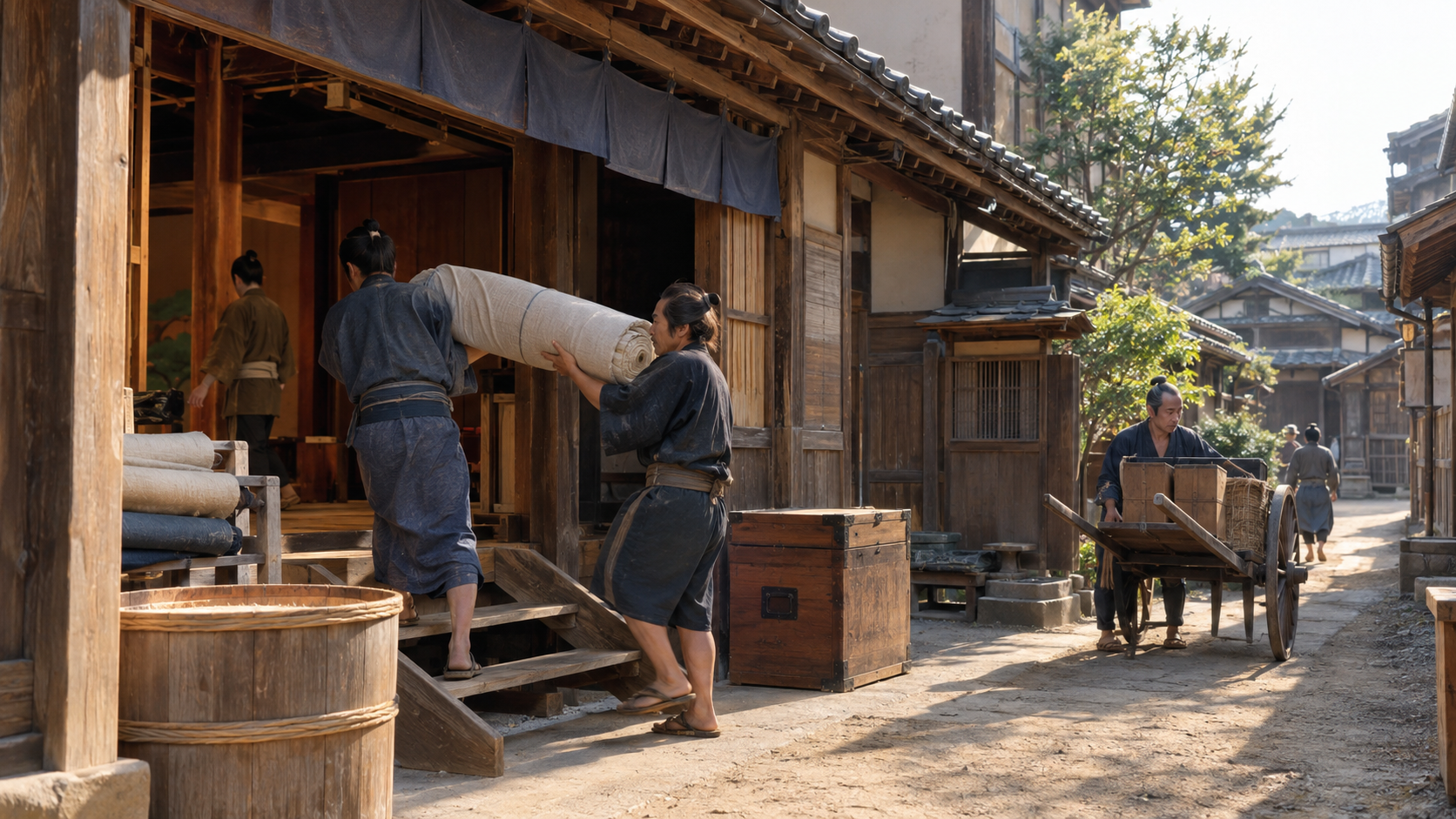
The Japan Arts Council’s material describes strict regulations provoking discontent among ordinary people. Deciding what counted as luxury also concerned what could remain in everyday life. The generated cloth shop evokes that relationship; it does not depict an authenticated violation, inspection or punishment under a specified order.
Chapter 05
Would Dissolving Merchant Associations Lower Prices?
Commercial organizations were also altered. The National Institute of Japanese Literature’s course material places the dissolution order for kabunakama in the twelfth month of 1841 in the calendar then in use. The shogunate intervened in associations of people holding commercial rights. The historical month is not silently converted into Gregorian December.
An order dissolving an organization and the actual sale of goods at lower prices are separated by arrangements for trade. Looking only at commercial privileges risks missing other functions of an association. The narrative therefore asks what relationships were affected rather than treating removal of an institution as an automatic measurement of the intended result.
Commentary by Nakahara published by the Bank of Japan introduces practices supporting trust, including a collective cessation of dealings with a dishonest trading partner. Associations were involved in who could be trusted and how commitments might be enforced. This is attributed to the author’s explanation; it is not a newly reconstructed agreement among named merchants.
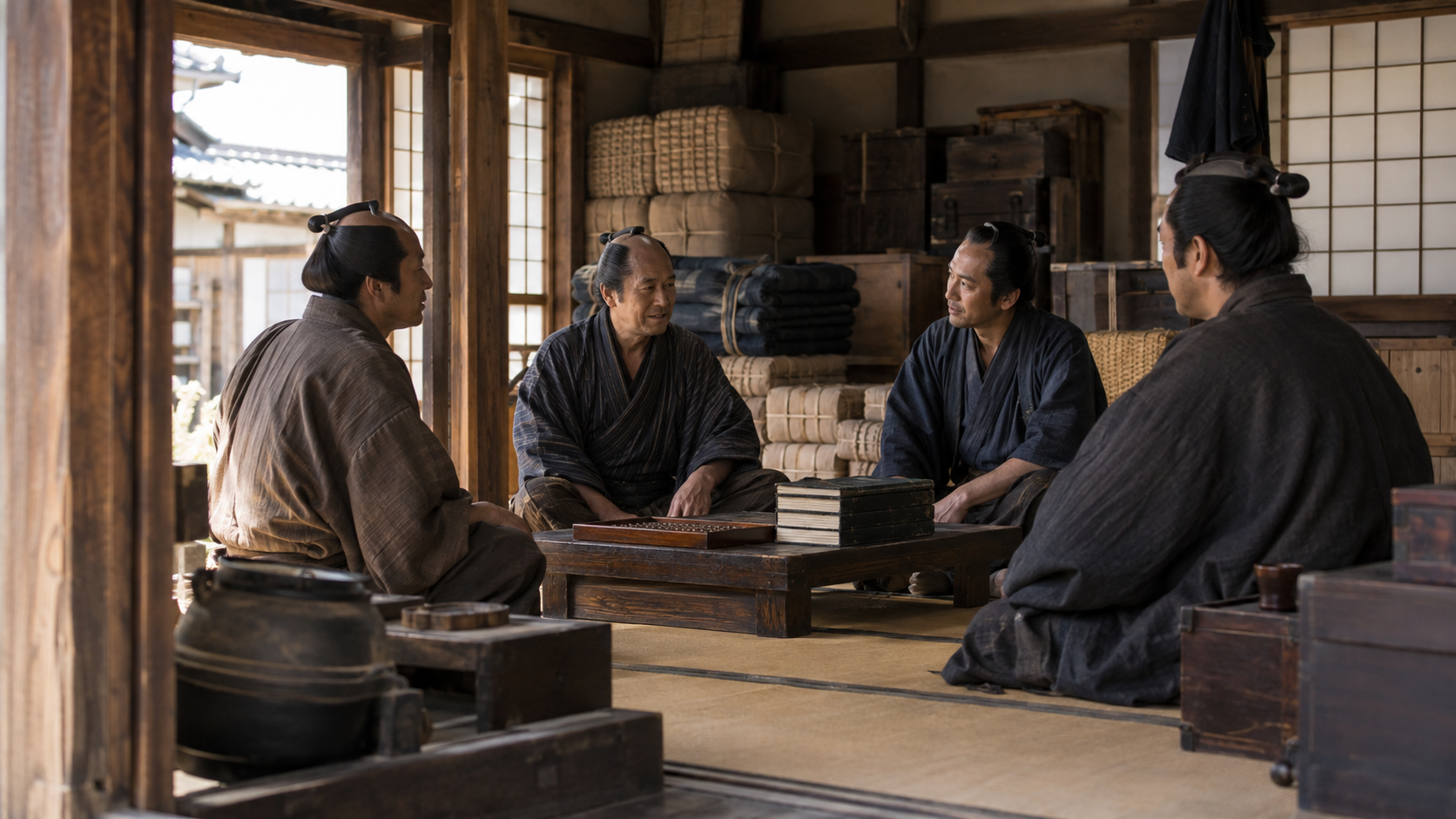
That account cannot yield an exact fall in prices or a count of bankruptcies after dissolution. It nevertheless helps identify functions that could change alongside rights when an organization was removed. The imagined merchants around a ledger are not an actual association, meeting house or scene in which the dissolution order was delivered.
Chapter 06
Returning to a Village and Continuing to Live There
Reform also addressed where people lived. The return-to-village order identified by the Edo-Tokyo Museum sought to move people who had migrated to cities back to rural communities. The aim of rural recovery was thus connected with instructions concerning human movement. A population policy reached into existing arrangements for housing and work.
Returning people could be presented as returning workers who would support villages. Stating that direction in an order, however, did not remove the circumstances of people already living in town. For them, changing residence could also mean changing employment. The policy’s intended destination and the conditions for making a living there were distinct questions.
Restoring a population number and enabling life to continue in a place are not identical. Looking from the lives of those addressed by the policy makes the distance between town and village more than a line on a map. This is interpretation, not an independently measured record of the experience of an individual household.
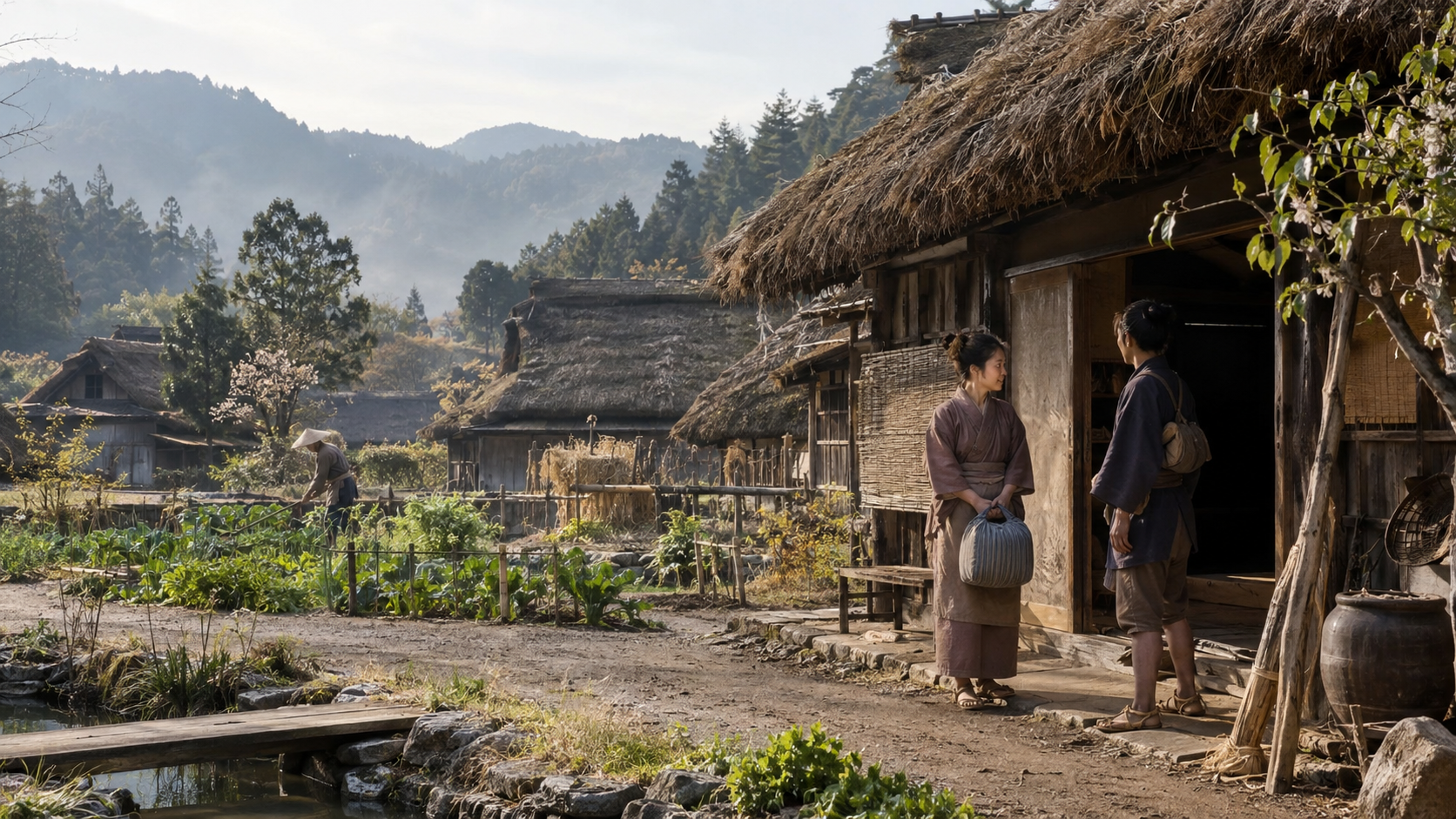
The Japan Arts Council’s explanation describes the policy of sending people back to rural areas as unpopular. Placing the stated aim alongside the circumstances of those instructed to move helps explain differences in reception. The generated travellers and rural house are not documentary images of a forced move to a named village.
Chapter 07
Theatres Changed Their Location
Cultural controls also changed places within the town. Taitō City’s cultural-property explanation records theatres and people associated with them moving to Saruwaka-chō in Asakusa in 1842 as part of the Tenpō Reforms. The event concerned the location of activity as well as its permitted content.
Relocating theatre involved more than plays and performers alone. Work supporting the theatre and places where associated people lived also moved. Following the formation of a theatre district provides another approach to the relation between cultural regulation and livelihood. It does not require inventing the exact task or journey of an individual worker.
The ward explains that Saruwaka-chō subsequently flourished into the late Tokugawa and early Meiji periods. The relocation did not exhaust the district’s later history. People continued to conduct theatrical activity there after the initial change of place. A single order and the continuing life of an area should therefore remain separate parts of the chronology.
The former Ichimura-za drum introduced on the same page was made in 1878. An object conveying the district’s history is not necessarily an object dating from the reforms themselves. The beginning of a place and the manufacture of a surviving tool need distinct dates. No image of that collection drum is reproduced here.
Chapter 08
Controls on the Work of Making Books
Publishing was also regulated. The National Institute of Japanese Literature’s course material explains that an ordinance was issued in the sixth month of 1842 in the historical calendar and that authors including Tamenaga Shunsui and Ryūtei Tanehiko were punished. The historical month should not become an unmarked Gregorian June date.
Before a book reached a reader, people wrote and made it. Cultural control therefore concerned not only the content of reading but those who carried out the work of producing it. The narrative follows this relationship without staging the punishment of a named author or reproducing an original ordinance as though it had been independently transcribed.
The course material does not treat publishing controls as an entirely new phenomenon of the Tenpō years. It also indicates connections with ordinances from the Kyōhō period and differences in treatment between Edo and the Kyoto–Osaka region. Earlier institutional arrangements and regional variation belong within the account.
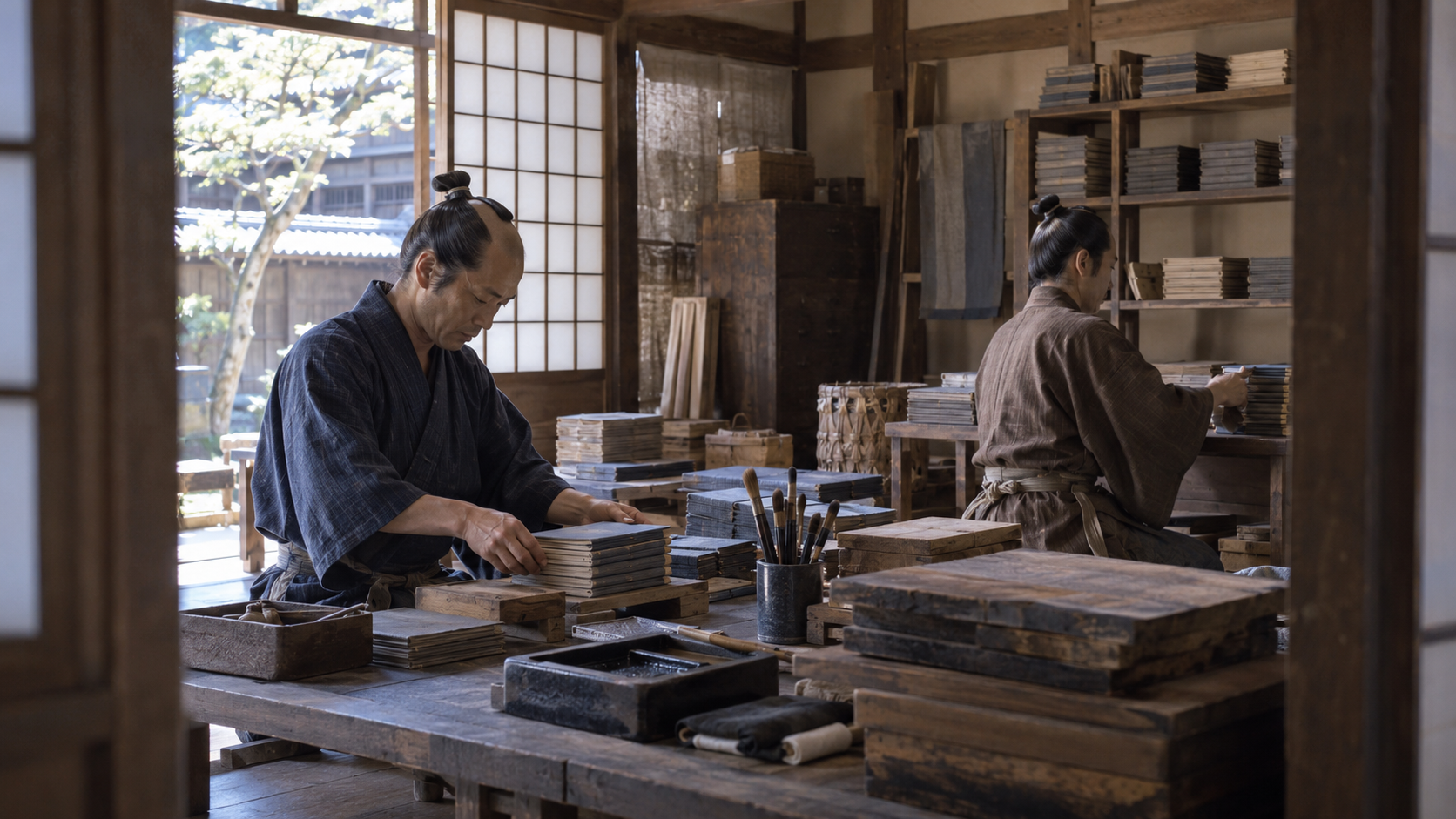
One reform name does not mean that every form of entertainment disappeared simultaneously in every region. Retaining continuity and difference makes the reach of regulation more specific. The generated workshop evokes the making of books, not an authenticated portrait of Shunsui or Tanehiko, an original document or a particular punitive action.

Chapter 09
Sending Visiting Ships Away with Supplies
While domestic life was being tightened, policy toward ships from overseas also changed. The National Archives’ chronology records the Morrison incident in 1837 and the beginning of the Opium War in 1840. These precede the 1842 measure discussed here and provide a sequence for considering the government’s response without moving a more familiar later encounter ahead of them.
In 1842, the shogunate revised its policy of driving off foreign ships and ordered that arriving vessels be given firewood, water and food before being sent away. This was the supply order commonly described through its provision of firewood and water. It changed the response from a uniform expulsion approach.
Supplying vessels for their departure was not the same as permitting unrestricted foreign trade. Domestic restrictions and foreign policy cannot therefore be fully explained through one simple label of opening or closure. The stated action and the broader policy that a reader might infer from it must be kept separate.
Perry arrived in 1853, after the reforms began. The narrative follows the order of events the government faced rather than beginning with a later scene familiar to modern readers. The generated sailing vessel, wood and water containers illustrate the supply question, not the Morrison, Perry’s fleet or a verified diplomatic encounter.
Chapter 10
An Order That Touched Territorial Authority
The land-resumption order sought to bring areas near Edo and Osaka under direct shogunate control. At this point reform addressed the territorial authority of domain lords and direct retainers. The issue was different from an instruction concerning a purchase or an individual’s movement back to a village.
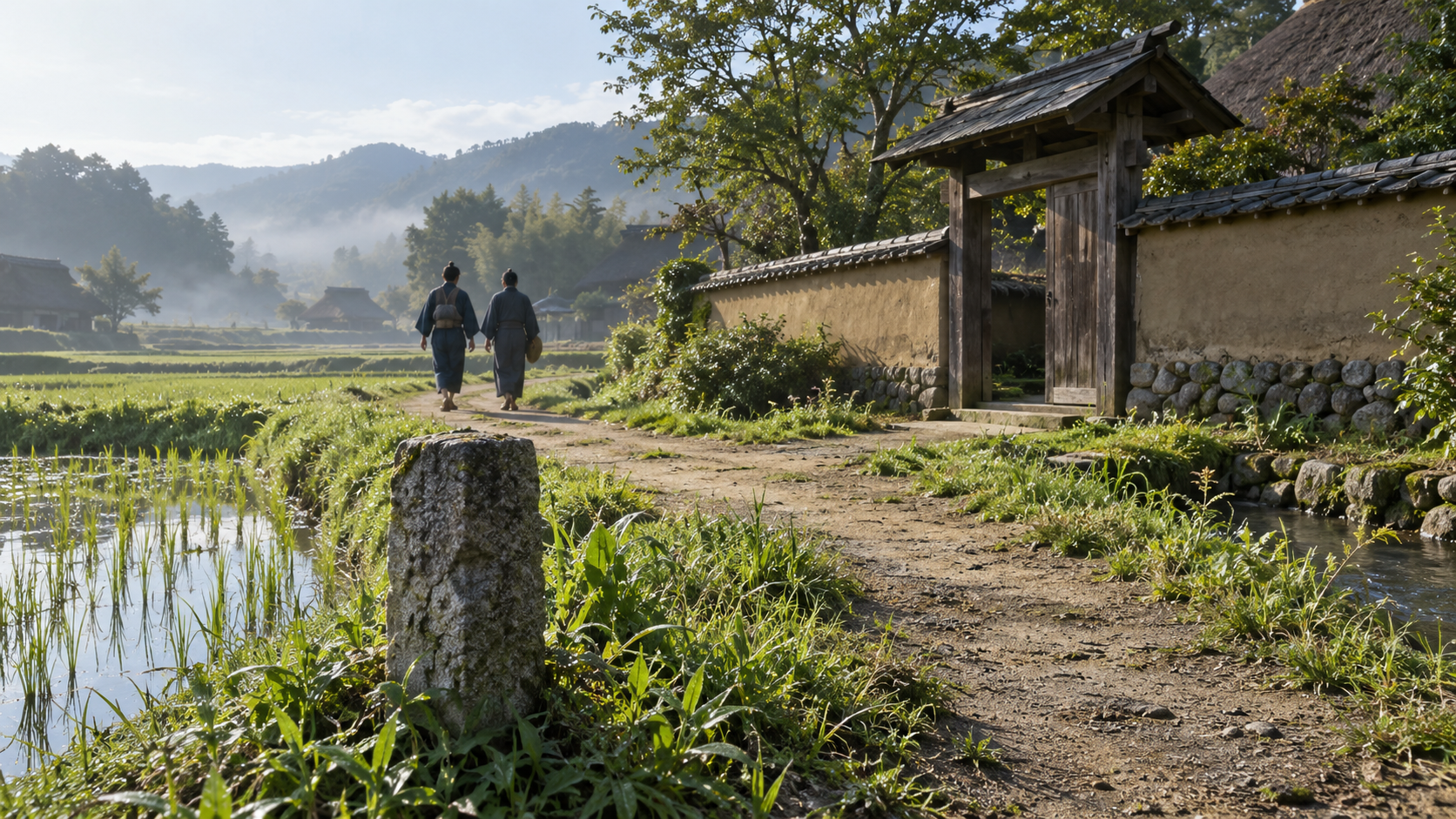
People on the governing side also maintained interests through land. Reform therefore encountered relationships within the structure of rule itself. The boundaries shown by the policy were not merely lines separating fields; they also concerned who exercised authority. The interpretation does not turn the generated blank marker into a surveyed administrative boundary.
The Japan Arts Council’s material explains that opposition to this policy led to Mizuno’s dismissal as senior councillor and interruption of the reforms. Possessing authority to issue an order did not ensure its implementation across the interests of those receiving it. The intended change and the political conditions for carrying it out were different matters.
The order cannot be described as a completed confiscation of every private holding throughout Japan. Separating its target regions, intended direct control and interruption through resistance reveals a limit the reforms did not overcome. No nationwide seizure map or military appropriation is asserted by the illustration or the narrative.
Chapter 11
Dates and Satire Surrounding Dismissal
Mizuno was dismissed as senior councillor in 1843. The Kariya City museum study gives the date as the thirteenth day of the intercalary ninth month of Tenpō 14. It cannot simply be read as 13 September in the present calendar. The extra month is part of the historical dating, not an optional detail that can be dropped.
The study considers how ordinary people viewed Mizuno and other senior councillors through rumours, posted writings and satire. Reactions to government survived in forms different from documents issuing commands. Their evidentiary value concerns those particular forms of expression and reception; they should not automatically become a complete survey of everyone in a city.
The research also warns that a viewer’s interpretation of an image need not coincide with its maker’s intention. A satirical figure cannot simply be treated as the actual appearance or thought of the person to whom it was related. The narrative follows that caution without claiming independent authentication of original pictures or posted texts.
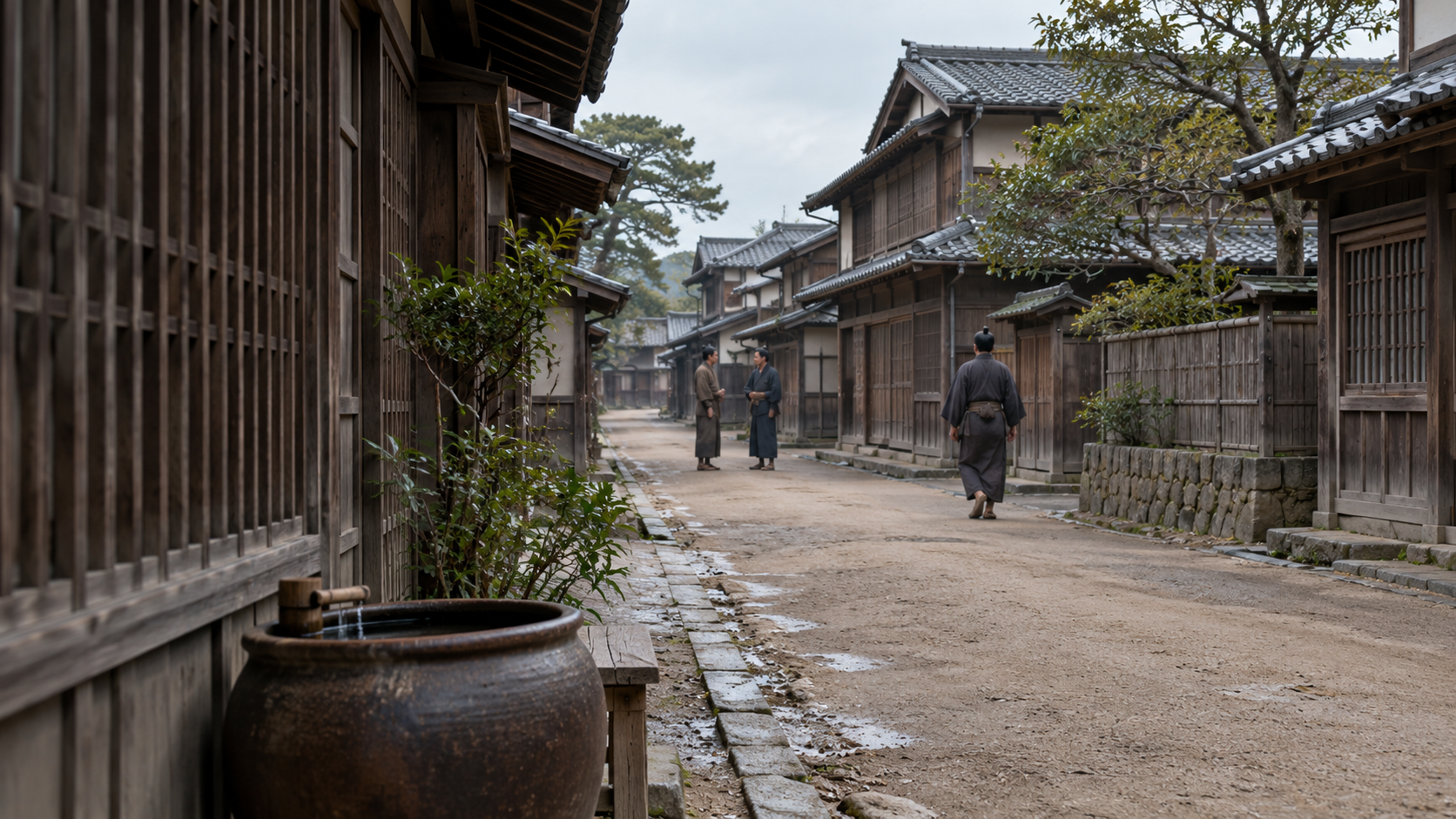
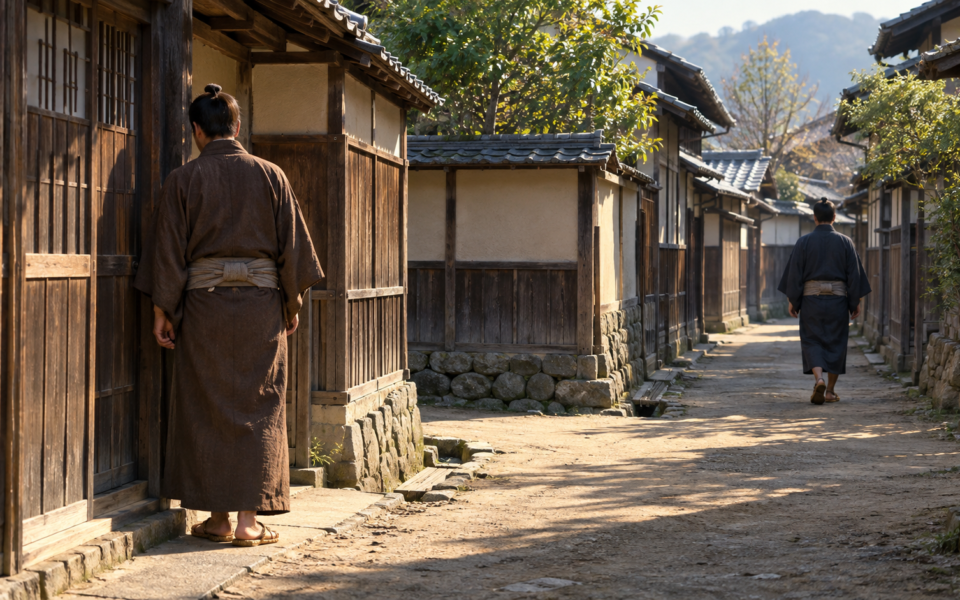
Surviving criticism does not prove that every resident held the same opinion. Considering what each source can convey allows reactions to remain varied rather than painted in one colour. The imagined people in a quiet lane are not a recreation of an actual satirical print or a record of public opinion on the dismissal date.
Chapter 12
Life Continued after the Reform Campaign
Mizuno returned to the senior councillor position in 1844. Even when his fall in 1843 is used as a dividing point, political developments and the problems confronting reform did not all end together. The later appointment belongs in the account without turning it into an assertion that the entire earlier campaign simply resumed unchanged.
The destructive disturbances introduced by Hamamatsu City’s museum concern another event in the Hamamatsu domain in 1846. They must not be merged with reactions in Edo in 1843. Describing responses to reform also requires separate places and dates, rather than treating every later disturbance as part of one simultaneous episode.
The Tenpō Reforms addressed prices, arrangements for conducting work, residence, culture and territorial government. Beyond each command were people with livelihoods and interests. Comparing the policies makes it possible to see more than their shared name, without assuming that they all had identical effects or were received in the same way.
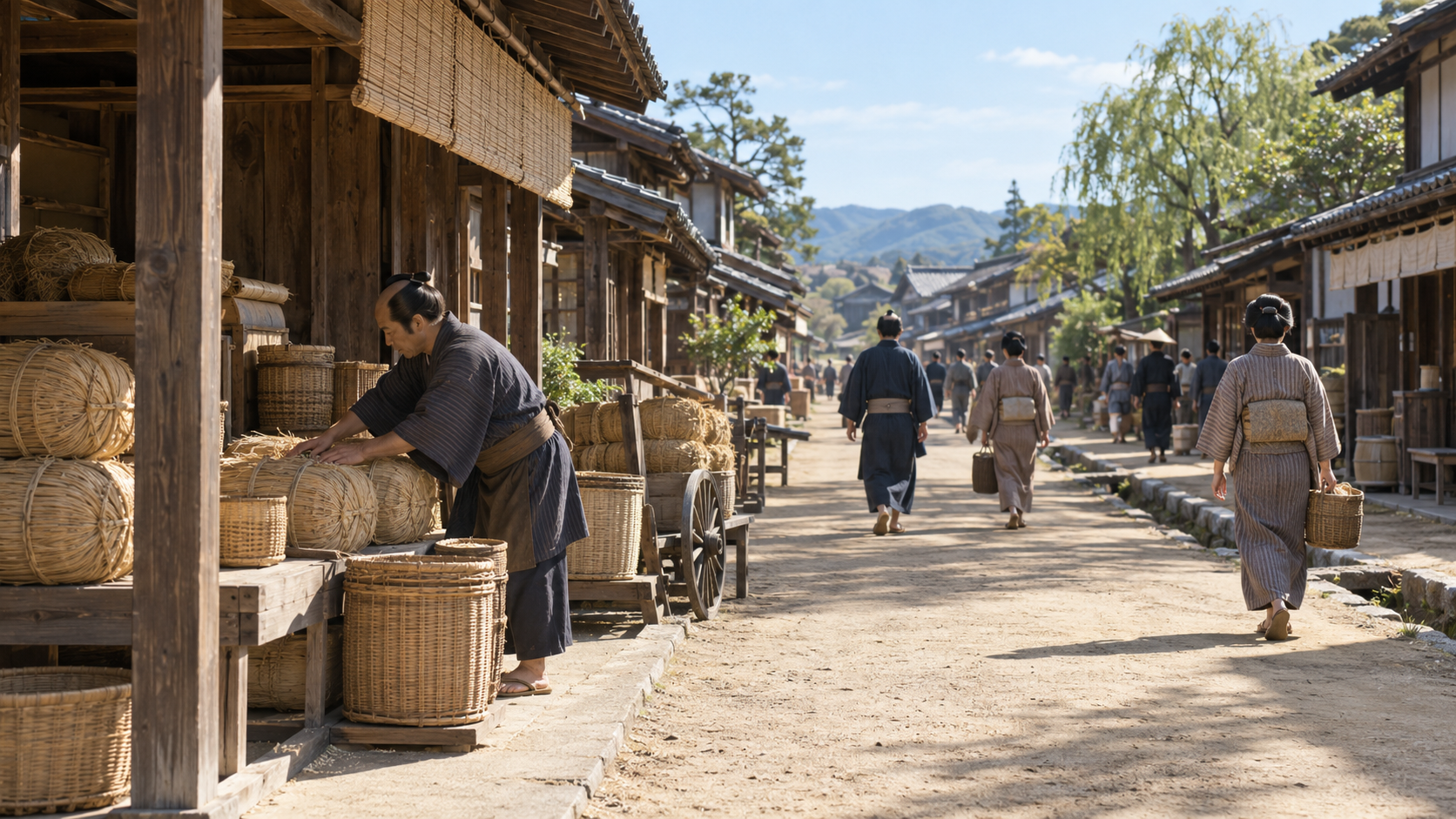
Closing the story only with the campaign’s short duration would obscure its reach. What did government seek to change, and what could commands alone not move? Reading shopfront and territorial boundary together reveals difficulties of rule. The final generated commercial scene illustrates continuing life, not the riots of either Edo in 1843 or Hamamatsu in 1846.
How to read this work
History, interpretation, and reconstruction
Reading each command through its aim, implementation and the circumstances of those affected reveals the different limits of reform.
This work is grounded in published sources and historical research. Interior thoughts, dialogue, and some visual details are cinematic reconstructions. Where historians disagree, the article presents the point as debated rather than settled fact.
Timeline
The story in time
-
Tenpō recoinage began, earlier than the reform campaign from 1841.
Sources: s02 -
The Tenpō tsūhō was issued.
Sources: s02 -
The Opium War began.
Sources: s06 -
Tokugawa Ienari died and Mizuno took a leading role in pursuing reform.
Sources: s01 -
The merchant-association dissolution order was issued.
Sources: s05 -
An ordinance regulating publishing was issued.
Sources: s05 -
Mizuno returned to the senior councillor position.
Sources: s07 -
Destructive disturbances occurred in the Hamamatsu domain, separate from Edo’s reactions in 1843.
Sources: s08
People & terms
A guide for new readers
Key figures
- Mizuno Tadakuni
- The senior councillor who led the Tenpō Reforms, was dismissed in 1843 and returned to office in 1844.
- Tokugawa Ienari
- The retired shogun, known as the ōgosho, who died in 1841.
- Tamenaga Shunsui
- An author of ninjōbon fiction punished during the controls on publishing.
- Ryūtei Tanehiko
- An author of gōkan illustrated fiction punished during the controls on publishing.
Glossary
- Tenpō Reforms 天保の改革
- The reform campaign led by Mizuno in 1841–1843; distinct from earlier coin issues bearing the same era name.
- Rōjū 老中
- Senior councillors in shogunate government; leadership by Mizuno did not erase other councillors’ roles.
- Ōgosho 大御所
- The title associated here with retired shogun Ienari, who died in 1841.
- Recoinage 改鋳
- Reminting described in the Currency Museum’s account; its Tenpō phase began before the reform campaign.
- Tenpō tsūhō 天保通宝
- The coin issued in 1835 in the currency chronology.
- Kabunakama 株仲間
- Merchant associations with commercial rights and functions involving trust and collective dealings.
- Return-to-village order 人返令
- The policy seeking to move people from cities back to rural communities.
- Saruwaka-chō 猿若町
- The Asakusa district to which theatres and associated people moved in 1842.
- Ninjōbon 人情本
- A category of fiction associated here with the author Tamenaga Shunsui.
- Gōkan 合巻
- A category of illustrated fiction associated here with Ryūtei Tanehiko.
- Supply order for foreign vessels 薪水給与令
- The 1842 instruction to provide supplies and send visiting vessels away, distinct from unrestricted commerce.
- Land-resumption order 上知令
- The attempted measure to bring lands near Edo and Osaka into direct shogunate control; not a completed nationwide confiscation.
- Hatamoto 旗本
- Direct shogunal retainers whose interests were involved alongside those of domain lords in the land question.
- Intercalary month 閏月
- An additional month in the historical calendar; the ninth-month dismissal date is not Gregorian 13 September.
- Uchikowashi 打ちこわし
- Destructive disturbances; the Hamamatsu event discussed here belongs to 1846 and is distinct from Edo’s 1843 reactions.
Sources & method
How this article was built
This English narrative translates the fixed Japanese article and retains the nine source identifiers and their order. English titles are editorial translations. Additional explanation clarifies offices, policy terms and historical calendar distinctions. Connections between policy and livelihood are presented as interpretation, not invented quotations or personal experiences.
Consulted material includes institutional HTML explanations and selected PDF text. Reading scope for the lecture handout and museum article is recorded in the review evidence; the full PDF publications and original documents are not claimed independently read or transcribed. A retained extraction inherited from the Japanese review is identified separately from a new live PDF retrieval.
The Bank-published commentary on trust is attributed to its author and is not used to calculate prices or bankruptcies after dissolution. The satire discussion distinguishes audience reception from authorial intention. Neither criticism nor a surviving document is expanded into a claim of unanimous public reaction.
The theatre drum’s 1878 date, Mizuno’s reappointment in 1844 and the Hamamatsu disturbances in 1846 are kept separate from the principal 1841–1843 campaign. The land measure remains an attempted change in specific regions; supply and departure for foreign ships remain distinct from unrestricted trade.
All illustrations retain SHIGEKI’s AI-generated explanatory scenes with matching rights and image bytes. They do not authenticate officials, meetings, enforcement cases, maps, original books, the collection drum or particular disturbances. Departmental and museum source labels are consolidated under the relevant publishing organizations rather than counted once per page.
Sources
References and further reading
- Mokuami: Social Change and Reform 黙阿弥・世直しと改革 Title translated editorially for reader convenience. Japan Arts Council 日本芸術文化振興会 Educational material on the 1841–1843 reforms, their purposes, resistance to the land measure and interruption following Mizuno’s dismissal. Accessed 2026-10-19
- Japanese Currency History: Bunsei and Tenpō Recoinage 日本貨幣史・文政天保の改鋳 Title translated editorially for reader convenience. Bank of Japan 日本銀行金融研究所貨幣博物館 Currency Museum chronology of 1832 recoinage, the 1835 coin and the five-ryō issue of 1837, distinguished from the reform campaign’s beginning. Accessed 2026-10-19
- Gifts from Citizens, 2019 市民からのおくりもの2019 Title translated editorially for reader convenience. Tokyo Metropolitan Foundation for History and Culture 江戸東京博物館 Edo-Tokyo Museum explanation of earlier frugality combined with Tenpō controls, return orders, merchant associations and conduct; a past exhibition. Accessed 2026-10-19
- The Former Ichimura-za Drum at Saruwaka-chō 猿若町旧市村座太鼓 Title translated editorially for reader convenience. Taitō City 台東区 Cultural-property explanation distinguishing theatre relocation in 1842 from the displayed drum’s manufacture in 1878; collection image not copied. Accessed 2026-10-19
- Classical Books Course: Publishing in Edo 日本古典籍講習会・江戸の出版 Title translated editorially for reader convenience. National Institute of Japanese Literature 国文学研究資料館 Selected course-material pages on associations, the 1842 ordinance and punishment, earlier precedents and regional variation; not a claim to have read the full PDF or independently transcribed originals. Accessed 2026-10-19
- The Turbulent Late Tokugawa Period: Chronology 激動幕末・年表 Title translated editorially for reader convenience. National Archives of Japan 国立公文書館 Chronology distinguishing the Morrison incident, Opium War, supply policy and Perry’s later arrival; supplies for departure are not free trade. Accessed 2026-10-19
- Museum Bulletin 5: Views of Senior Councillors during the Tenpō Reforms 研究紀要5・天保改革期における老中への視線 Title translated editorially for reader convenience. Kariya City 刈谷市歴史博物館 Selected research article on senior councillors, dismissal and return to office, and the distinction between satirical reception and authorial intention. Accessed 2026-10-19
- Historical Documents in the Museum Collection 館蔵資料紹介歴史資料 Title translated editorially for reader convenience. Hamamatsu City 浜松市博物館 Museum introduction to records of the Hamamatsu disturbances in 1846, not an eyewitness record of Edo in 1843. Accessed 2026-10-19
- Learning from History about Banking: Commentary by Nakahara 歴史に学ぶ銀行の在りかた・中原眞寄稿 Title translated editorially for reader convenience. Bank of Japan 日本銀行 An author’s explanation published by the Bank, used for association practices supporting trust; not evidence of post-dissolution price changes or bankruptcy totals. Accessed 2026-10-19
Continue reading
More stories from Shigeki
Shigeki English
Sakai’s Merchant City: Trade, Self-Government and Survival
A port, a merchant council and town communities—from changing authority to rebuilding after fire.
- When From the later fifteenth century through the Sengoku period, the fire of 1615 and early Edo-period reconstruction.
- Where Sakai, in present-day Osaka Prefecture, where maritime routes met roads on land.
Shigeki English
The Aburanokōji Incident: After Leaving the Shinsengumi
A separation in spring, a new base in summer, and two successive attacks.
- When Kyoto in Keiō 3 (1867). The incident’s historical date corresponds to December 13, 1867.
- Where Kyoto: the guards’ successive bases, the Aburanokōji attack site and the later place of remembrance.