
SHIGEKI ENGLISH STORYEN
Japanese history in English
Takeda Katsuyori | What Happened at Shinpu Castle, His Last Residence?
Build. Move. Depart. Follow Katsuyori’s territory through the brief use of his last residence.
In 1581, Takeda Katsuyori moved his headquarters to the unfinished Shinpu Castle. Follow the terrain of Shichiriiwa, the contest over Takatenjin, administrative documents, his wife’s prayer and archaeological findings toward his departure in 1582. The years between Nagashino and the Takeda’s fall reveal work that continued beyond the battlefield.
At a glance
Before you enter the story
- When
- Administrative documents from 1573 onward; Takatenjin in 1574 and 1581; Nagashino in 1575; move to Shinpu in 1581; departure, deaths and later reuse in 1582. Month and day numbers retain the older Japanese calendar.
- Where
- Shinpu in Kai, present-day Nirasaki in Yamanashi Prefecture; Takatenjin in Totomi, present-day Kakegawa in Shizuoka Prefecture; Tano in present-day Koshu, Yamanashi.
- Key figures
- Takeda Katsuyori, Katsuyori’s wife (Hojo family), Takeda Nobukatsu, Tokugawa Ieyasu
- What was at stake
- The effort to establish a new center while the territory’s military circumstances changed, followed by departure and the end at a different place.
Why this story matters
The larger history behind the turning point
A castle used briefly can still reveal the work of construction and government. Following Shinpu’s terrain, documents and later archaeological investigation gives Katsuyori’s final years a sequence beyond one defeat or one fire. The end at Tano and the site’s subsequent use each retain their own place and time.
Historical context
What an international reader needs to know
A headquarters within a changing territory
The Takeda, Oda, Tokugawa and Hojo were warrior families whose struggles shaped this part of Japan in the sixteenth century. Katsuyori succeeded Shingen as the Takeda leader. His headquarters provided a center for a territory whose history included both administration and contests over strongholds. The documents introduced here concern grants, offices and obligations as well as the military events described elsewhere.
Kai and Totomi are historical province names. Shinpu stood in Kai, at present-day Nirasaki in Yamanashi Prefecture. Takatenjin was in Totomi, at present-day Kakegawa in Shizuoka Prefecture. Tano, the place of the family’s deaths, is in present-day Yamato, Koshu City, Yamanashi. The new headquarters, the contested stronghold and the final place were distinct locations.
Earthworks, dates and surviving evidence
The castle’s terms describe spaces shaped in the ground: kuruwa are enclosures, honmaru the main enclosure and dorui earthen banks. A masugata entrance incorporates turns in the route inward. These features help explain a castle whose history can be approached through the terrain and remains even after its buildings have gone.
Dates with numbered months and days retain the older Japanese calendar. The twenty-fourth day of the twelfth month of Tensho 9 is presented within the Japanese year corresponding to 1581, without converting it to 24 December in the Gregorian calendar. The second and third months of Tensho 10 are treated in the same way. Contemporary documents, later institutional explanations and modern excavation have different dates and provide different kinds of evidence.
Watch the film
See the story in motion
The film currently uses Japanese audio. This English article provides the context and source trail; it does not imply that an English subtitle track is available.
Chapter 01
Leaving a New Castle the Following Year
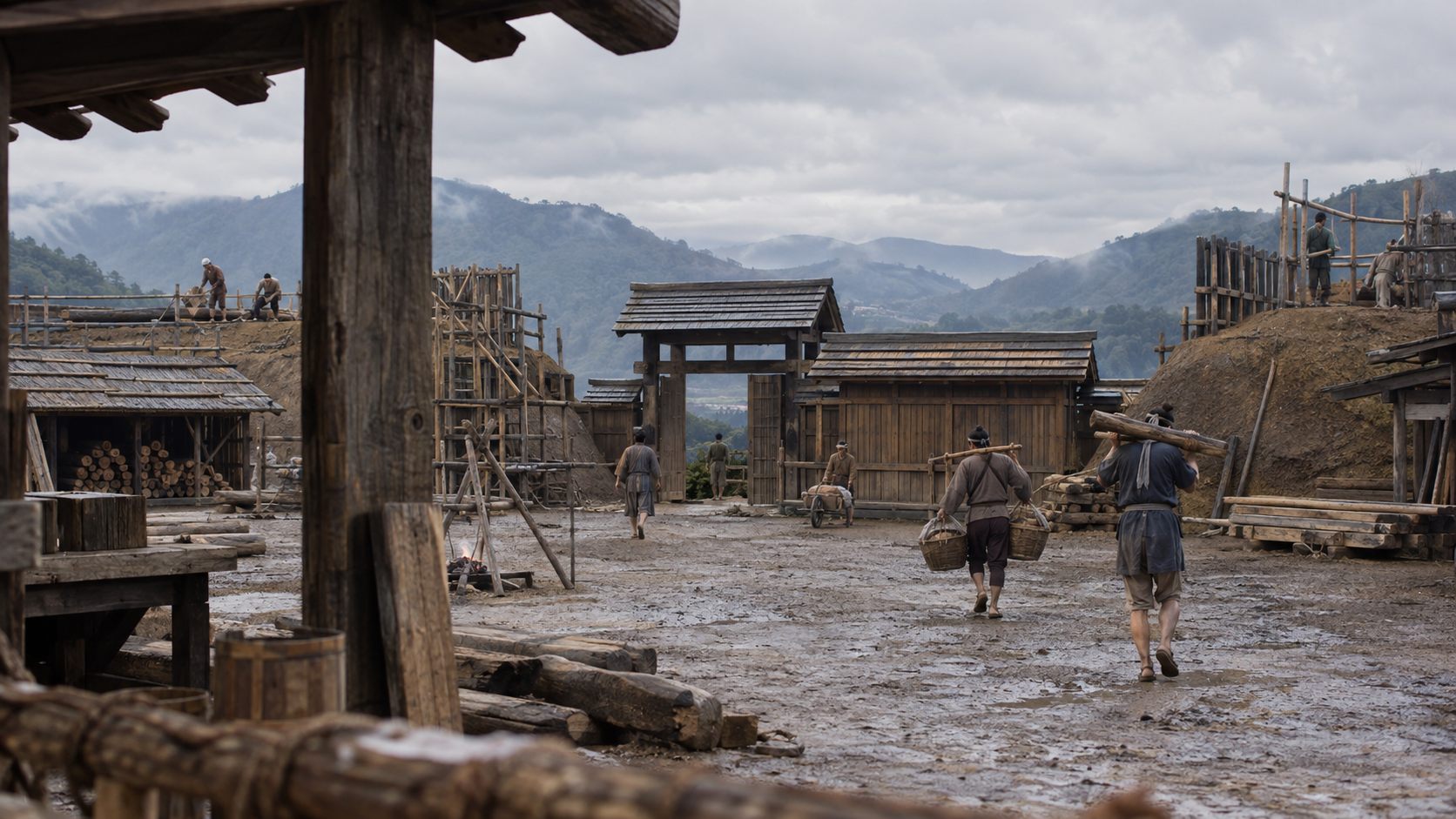
In 1581, Takeda Katsuyori moved the center of his territory to Shinpu Castle in Kai. In 1582, he set fire to the castle and departed. The place intended to become a new headquarters served as his residence for only a short time. That brief interval lies at the heart of its history.
The ruins are in present-day Nirasaki, Yamanashi Prefecture. Looking back from Katsuyori’s final year can make his defeat at Nagashino seem to lead directly to the Takeda’s collapse. Years separated those events, however. During that interval, people continued to build, issue documents and fight over places beyond the new castle.
There was work before the departure: choosing ground, shaping a castle and establishing a new center while fighting continued around the territory. Starting with that work allows us to follow the sequence leading to the last residence. Its short occupation does not remove the actions that brought it into use.
The terrain, earthen banks, surviving documents and archaeological findings provide different ways into that sequence. Together, they widen the story beyond the image of a burning castle. We can follow what was built and administered, then place the departure within the changing circumstances around it.
Chapter 02
A Plateau Above the Rivers
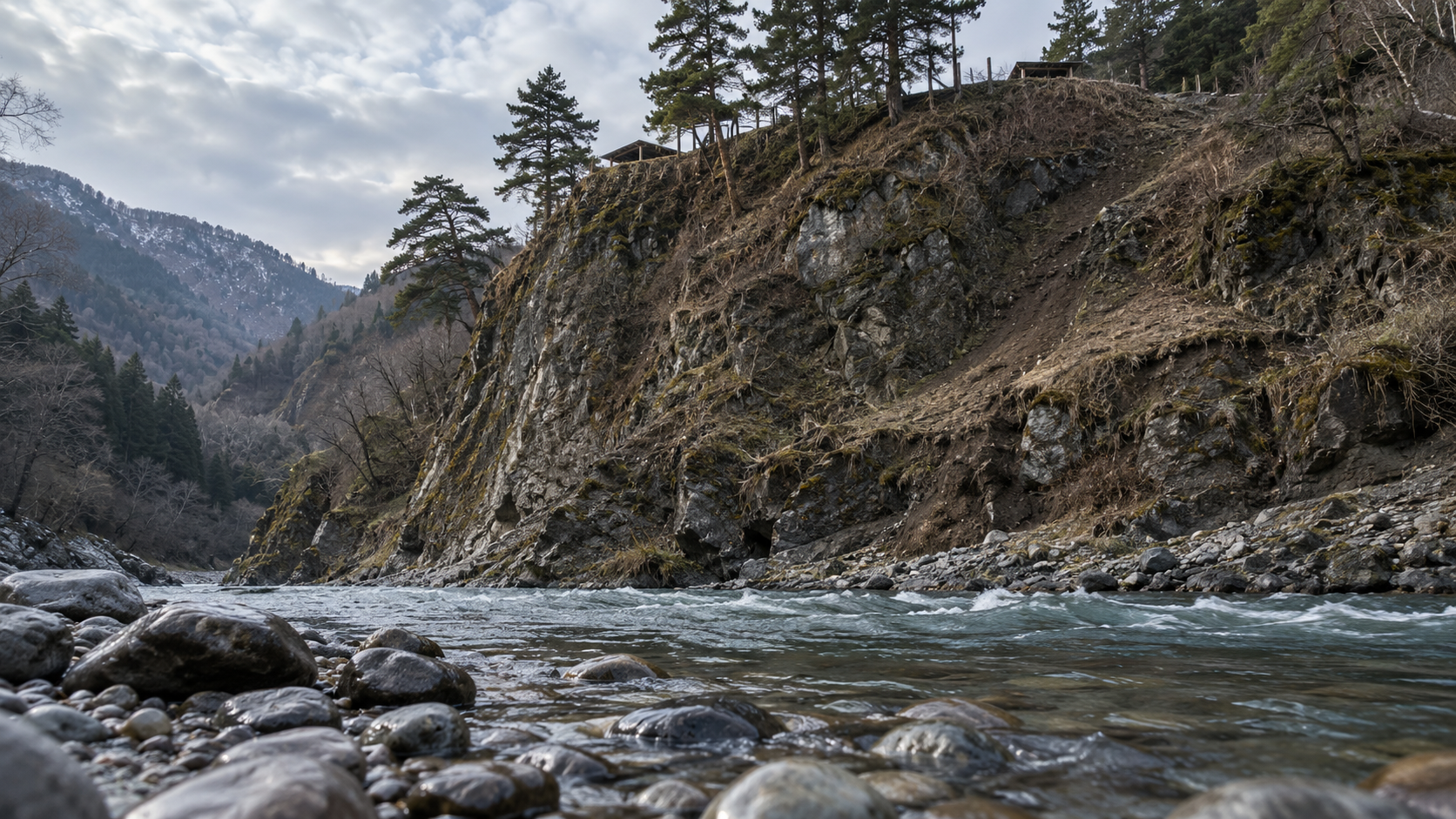
Shinpu stood on Shichiriiwa, a plateau formed from debris associated with a collapse of Mount Yatsugatake and shaped by erosion from the Kamanashi and Shio rivers. Nirasaki City describes a steep cliff along its western side. Before any bank or gate was built, the ground already had a distinctive form.
A short distance on a flat map need not mean an easy approach. A river below and the edge of a plateau above create a difference in height that a line on paper can hide. Reading the castle’s position requires attention to slopes and cliffs as well as the space between places.
The builders chose a site with these existing conditions. The castle can therefore be approached first as a use of terrain, before imagining the appearance of its buildings. Its platform and western cliff were part of the ground on which a new headquarters took shape.
That ground alone could not ensure the security of Katsuyori’s territory. Fighting and the loss of other strongholds unfolded beyond the castle. The defensive possibilities of the plateau and the wider military situation belong to related but separate questions, both of which matter when following Shinpu’s brief use.
Chapter 03
Moving Earth, Turning a Path
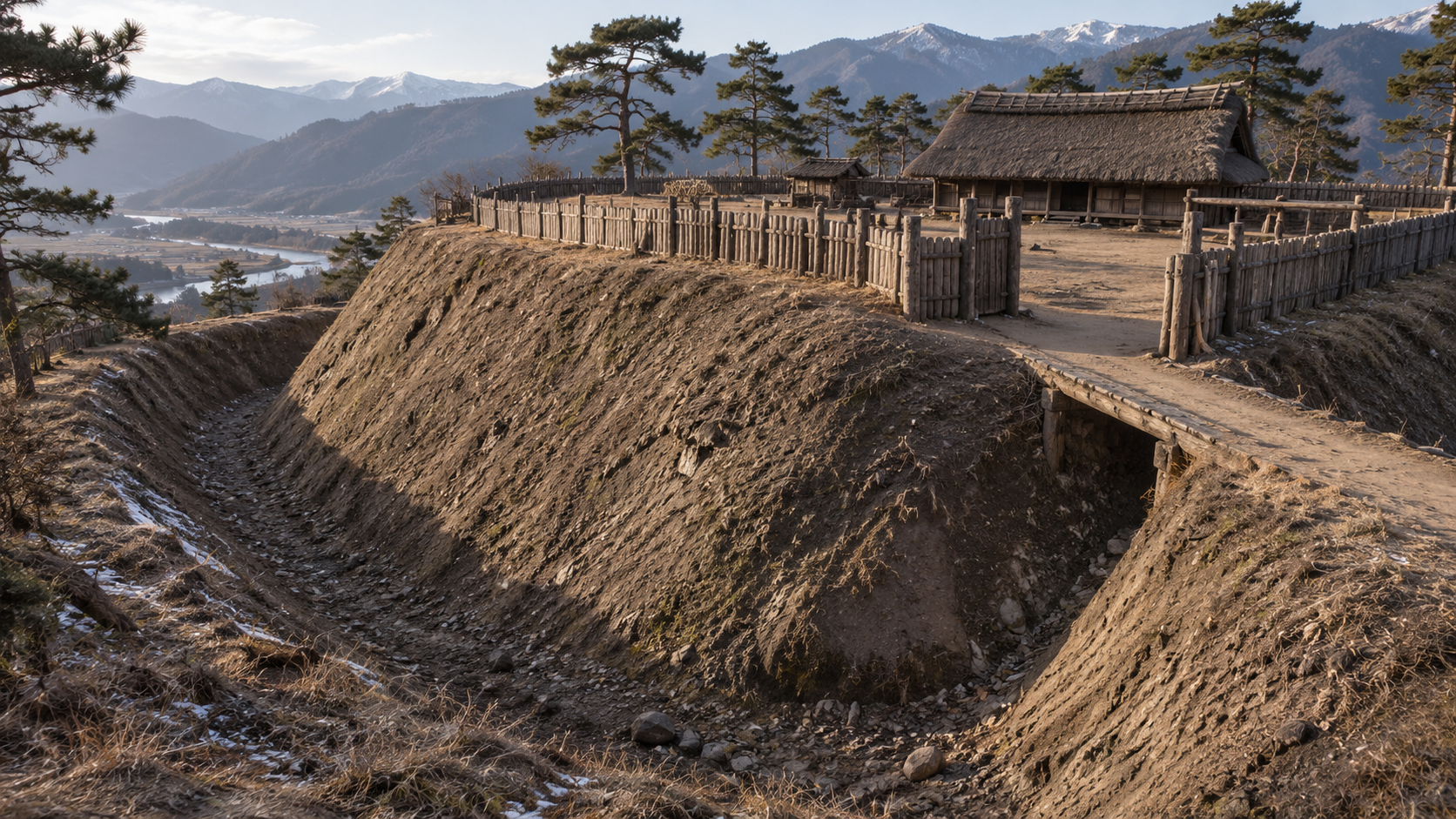
Shinpu was formed by cutting and filling the ground. Enclosures, moats and earthen banks divided the site, with the honmaru, or main enclosure, at its center. The arrangement emerges from these separate spaces. Understanding it means following how earth was moved and how one part connected to another.
The castle also had an entrance arrangement called a masugata. Its turns interrupted a direct path inward. The relationship between an entrance, the route beyond it and the enclosing banks gives another way to read the castle. A path was shaped along with the ground it crossed.
An image of a large stone castle with a towering keep can make these earthworks easy to overlook. Here, banks and moats deserve attention in their own right. They were part of the construction through which the selected terrain became a castle, dividing space and directing movement within it.
Although buildings have disappeared, the surviving ground still offers questions to follow. An enclosure, a bank or a change of direction along a route can point back toward the labor of construction. The castle’s history is present in those earthworks as well as in accounts of its departure.
Chapter 04
A Castle Taken, Then Lost Seven Years Later
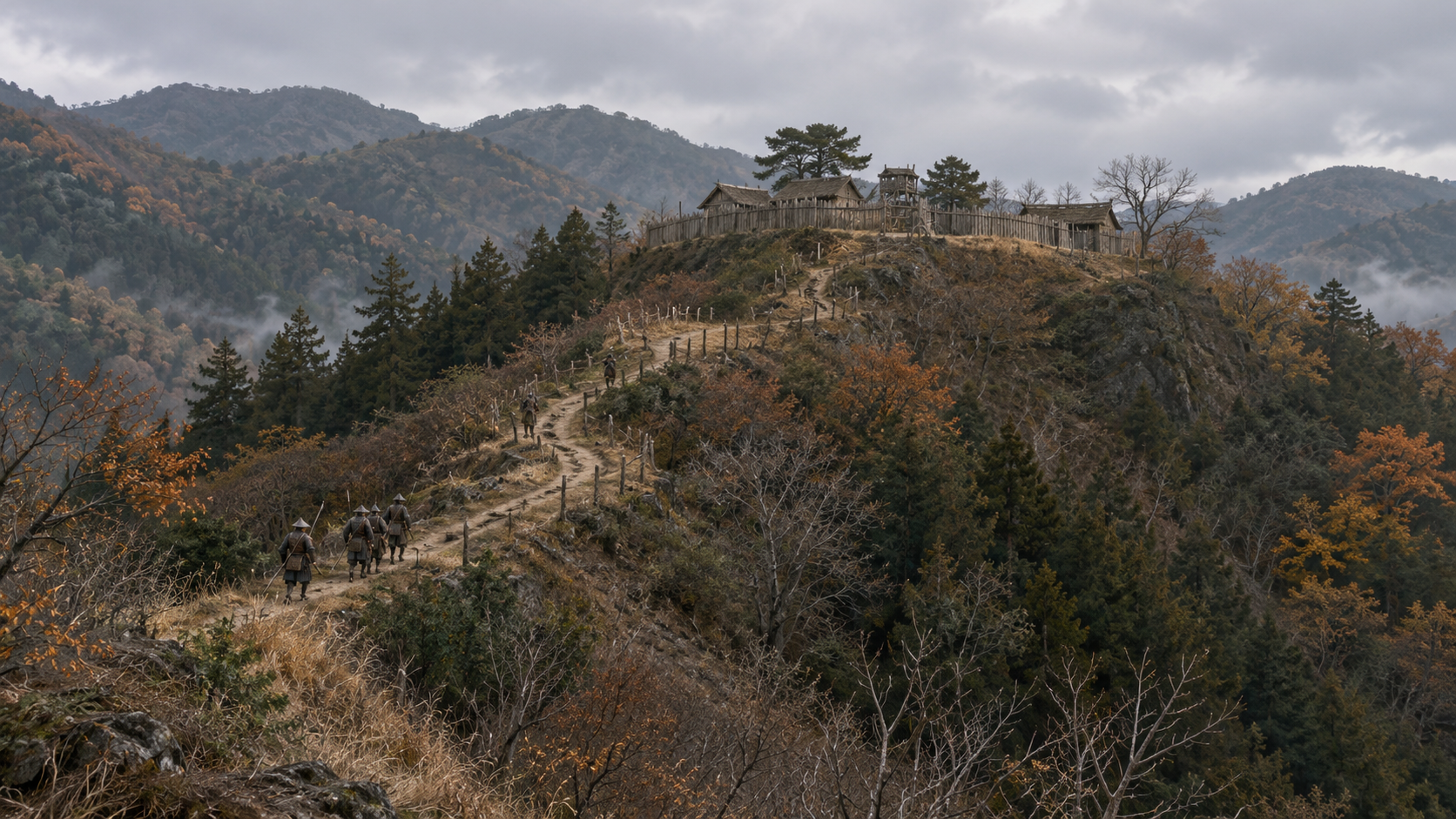
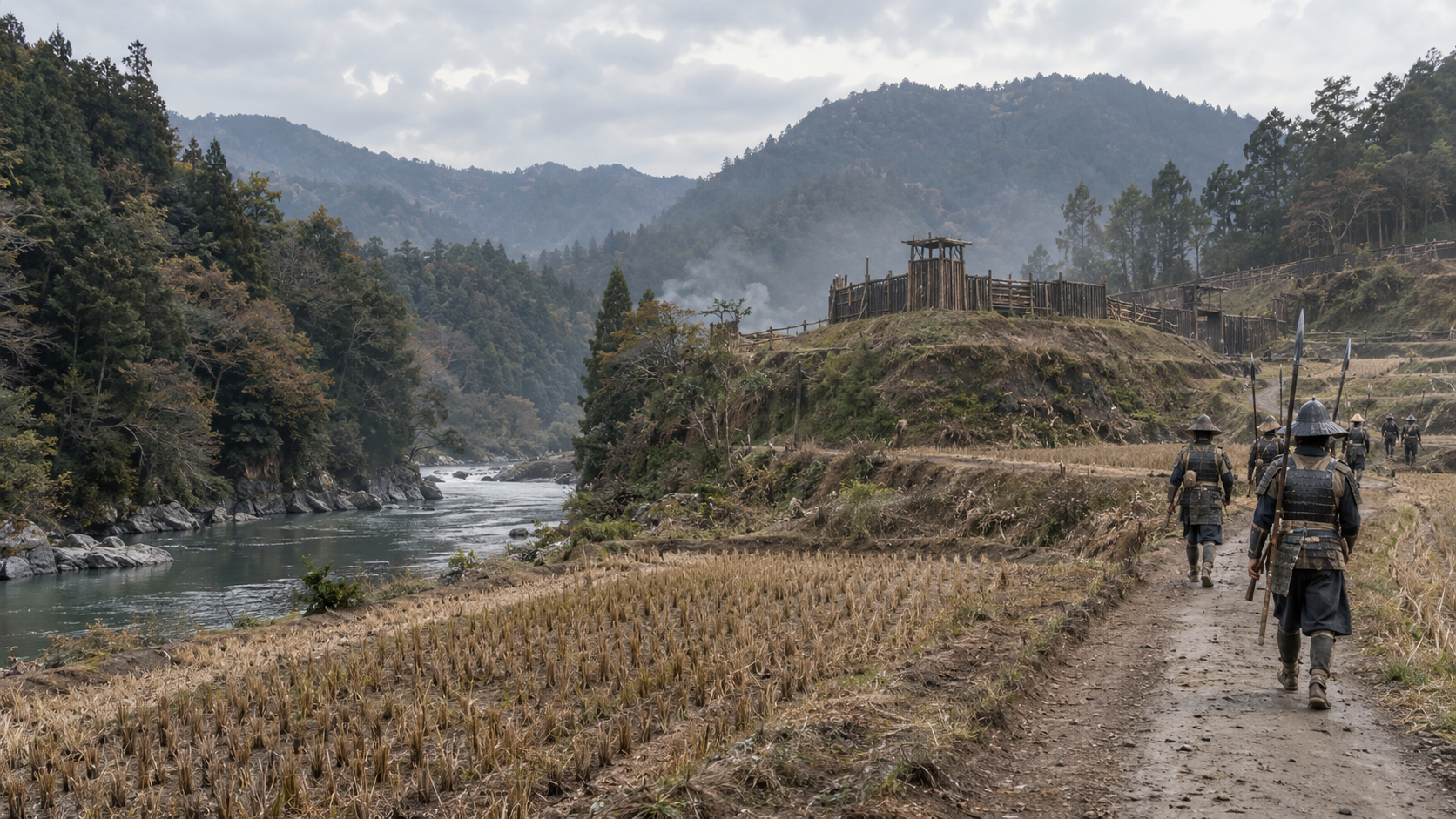
In the year that Katsuyori built Shinpu, the Tokugawa side recovered Takatenjin Castle in Totomi. Katsuyori had taken that stronghold in 1574. Its capture and its fall in 1581 mark different moments in a continuing contest, while the new headquarters in Kai was being established.
Shizuoka Prefecture describes repeated fighting with the Tokugawa after the 1574 capture, followed by a siege by Ieyasu’s forces with support from Oda Nobunaga in 1581. Kakegawa City’s chronology also places these events in sequence. Its entries identify differing documentary and narrative sources, which should retain their distinctions.
A record of loss should therefore be read alongside the earlier capture. Taking a stronghold and keeping it through later changes are tasks separated by time. Following both dates gives Katsuyori’s actions a course, rather than allowing the final outcome to replace every stage that preceded it.
In 1581, work on a new center in Kai coincided with the loss of a position in Totomi. Setting those events beside each other connects construction within the territory with change beyond it. The new castle was taking shape within a region whose military circumstances were also changing.
Chapter 05
The Years Between Nagashino and Shinpu
Katsuyori succeeded Takeda Shingen. In 1575, he was defeated by the Oda and Tokugawa forces in the fighting associated with Nagashino. Shinshiro City’s museum explanation distinguishes the siege of Nagashino Castle, the arrival of relief forces and the battle at nearby Shitaragahara. Those locations form parts of the campaign.
The Takeda did not disappear in 1575. Katsuyori moved to Shinpu in 1581, and the family’s rule ended in 1582. Keeping these years separate leaves room to examine the work that continued after the defeat: documents, contests over strongholds and the construction of another headquarters.
The Yamanashi Prefectural Museum’s introduction to its 2025 exhibition describes a reassessment of Katsuyori through related materials and recent research. It notes how comparisons with Shingen and Katsuyori’s position as the final Takeda ruler helped shape earlier judgments. That introduction offers a reason to look more closely at the intervening years.
The defeat still belongs within the story. Reading the later years does not require minimizing it. It requires placing it beside actions with their own dates and evidence, so that the battle, the move to a new residence and the final collapse remain distinct stages in Katsuyori’s history.
Chapter 06
Documents Beyond the Battlefield
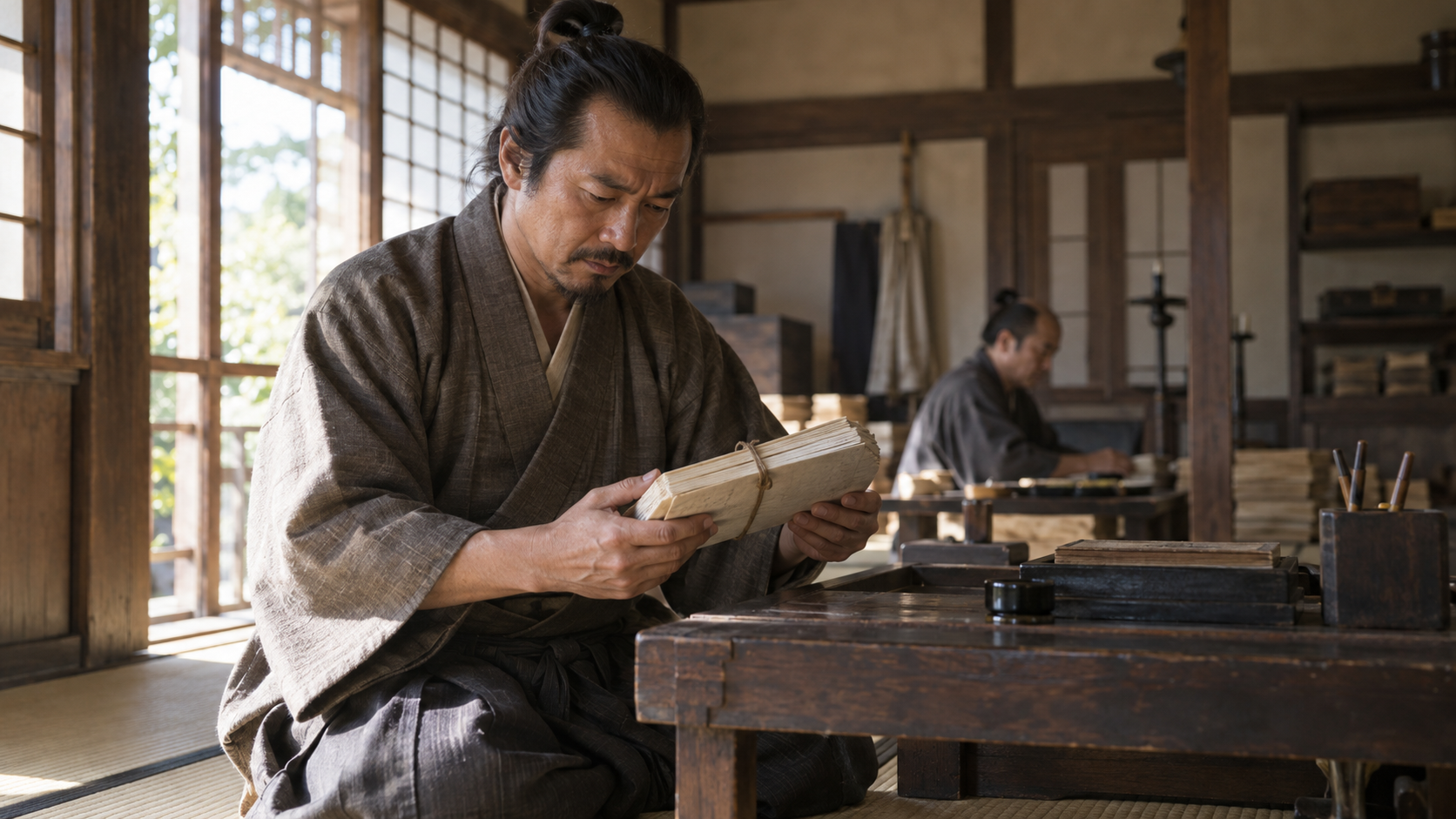
Katsuyori’s activity also appears in documents concerning people, offices and land. The Shizuoka Prefectural Central Library’s catalogue of the Fuji family archive lists a grant document from 1573 concerning land given to Fuji Nobumichi. It places an act of territorial administration within the same years often approached through military events.
The catalogue also includes Nobumichi’s appointment as chief priest in 1577 and documents from 1578 concerning prohibitions and exemptions from various dues and service obligations in Omiya town. These entries point toward rights and responsibilities within the Takeda territory. Their subjects extend beyond the movement of an army.
The catalogue and its brief abstracts introduce the documents; they do not amount to a reading of every line of the originals. Nor does issuing a document prove that every provision operated without difficulty. The existence and described subject of a record should remain distinct from claims about its complete implementation.
A lord’s work involved governing people and rights as well as fighting. Seen alongside these documents, a new headquarters can be read as part of the continuing work of territorial administration. This connection is an interpretation of the evidence, giving the castle a place within the wider activity of Katsuyori’s rule.
Chapter 07
Moving Into an Unfinished Castle
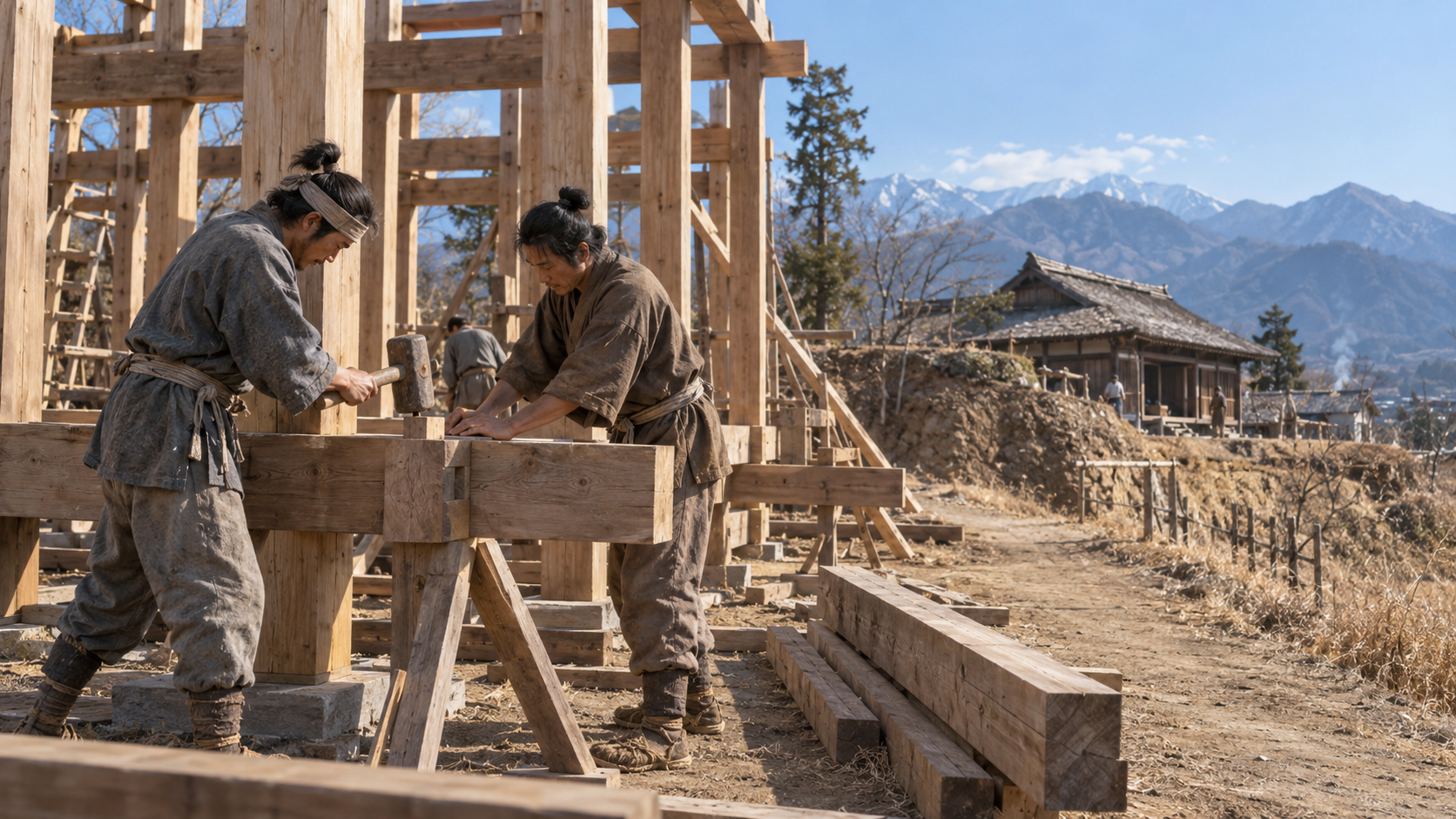
Nirasaki City dates Katsuyori’s move from Tsutsujigasaki to Shinpu to the twenty-fourth day of the twelfth month of Tensho 9, the Japanese year corresponding to 1581. The castle was still unfinished. The month and day follow the calendar used at the time; they are not a Gregorian date of 24 December.
Starting construction, moving the headquarters and completing a castle are separate events. Katsuyori’s move occurred before completion. Keeping that distinction changes how we approach the place: its period of residence began amid unfinished work, rather than at the end of a fully completed building program.
The move itself can be followed without supplying Katsuyori’s private feelings. We do not need to invent words spoken on arrival or a measure of his confidence. The dated action and the unfinished state of the castle give us a starting point for reading what happened there.
The later departure can easily dominate that starting point. Yet the move deserves to be placed in its own moment, before the outcome that followed. A new headquarters came into use while construction remained incomplete. Preserving that sequence makes the short period at Shinpu easier to understand.
Chapter 08
A Prayer Before the Departure
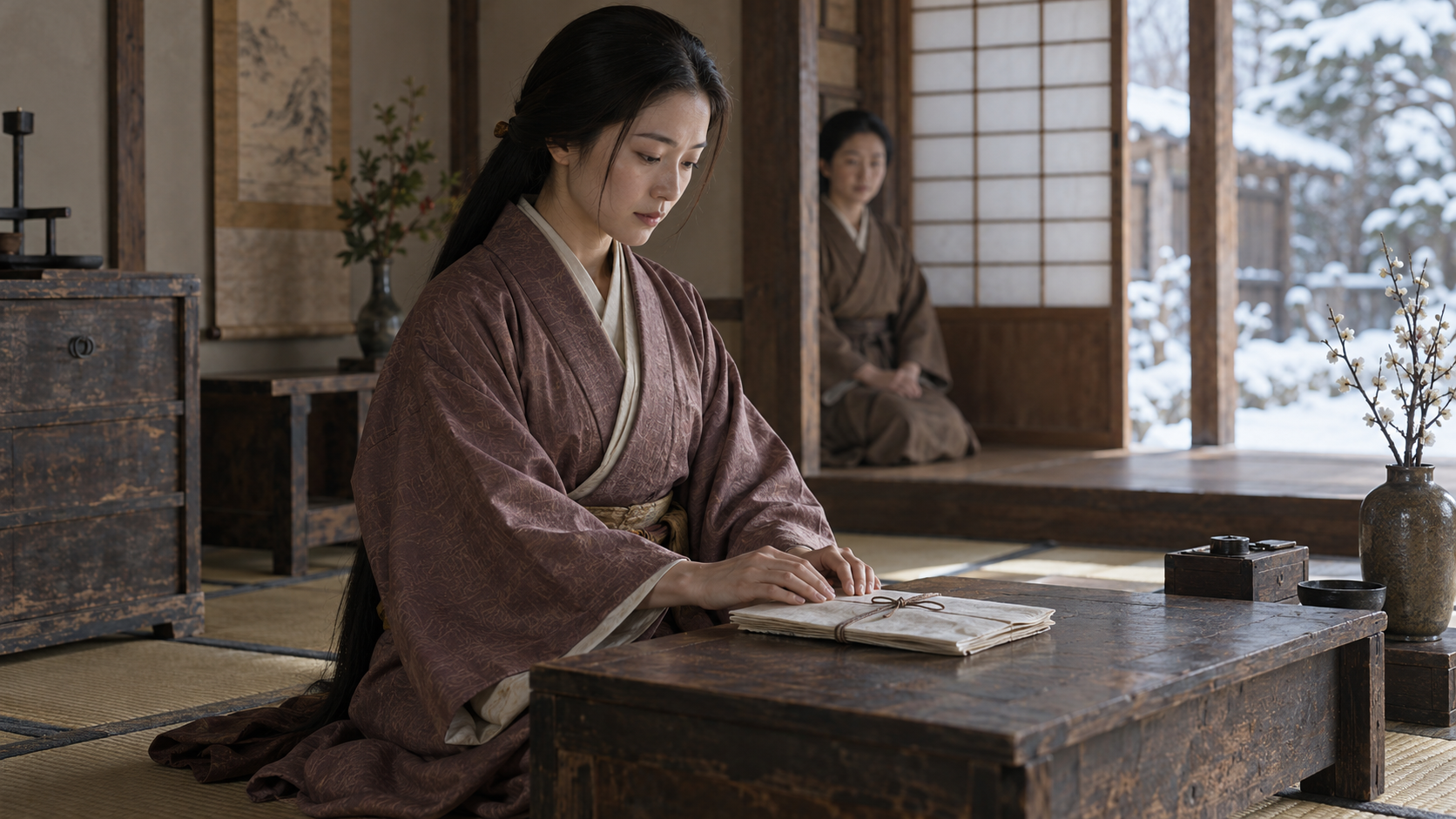
In 1582, the Oda invasion brought the Takeda into crisis. During the second month, Katsuyori’s wife, from the Hojo family, submitted a prayer to Takeda Hachiman Shrine. Nirasaki City introduces the surviving document and the circumstances surrounding it. The prayer belongs to the time before the departure from Shinpu.
The document offers an approach different from terrain or the movement of armies. A prayer was entrusted to a shrine amid the crisis. Its existence, place and date let us set that act within the sequence of events, while retaining the difference between a written appeal and military action.
The wish expressed in a prayer and the outcome that followed are separate things. Knowledge of the family’s later deaths should not be read back into the document as proof that its writer foresaw them. It records an appeal made at its own moment, before the later course was complete.
There is no need to add a conversation between Katsuyori and his wife or describe every thought they shared. Keeping the document’s existence and timing in view allows it to speak to this short interval. Its place in the story comes from a recorded act, without invented private dialogue.
Chapter 09
Leaving Shinpu, Dying at Tano
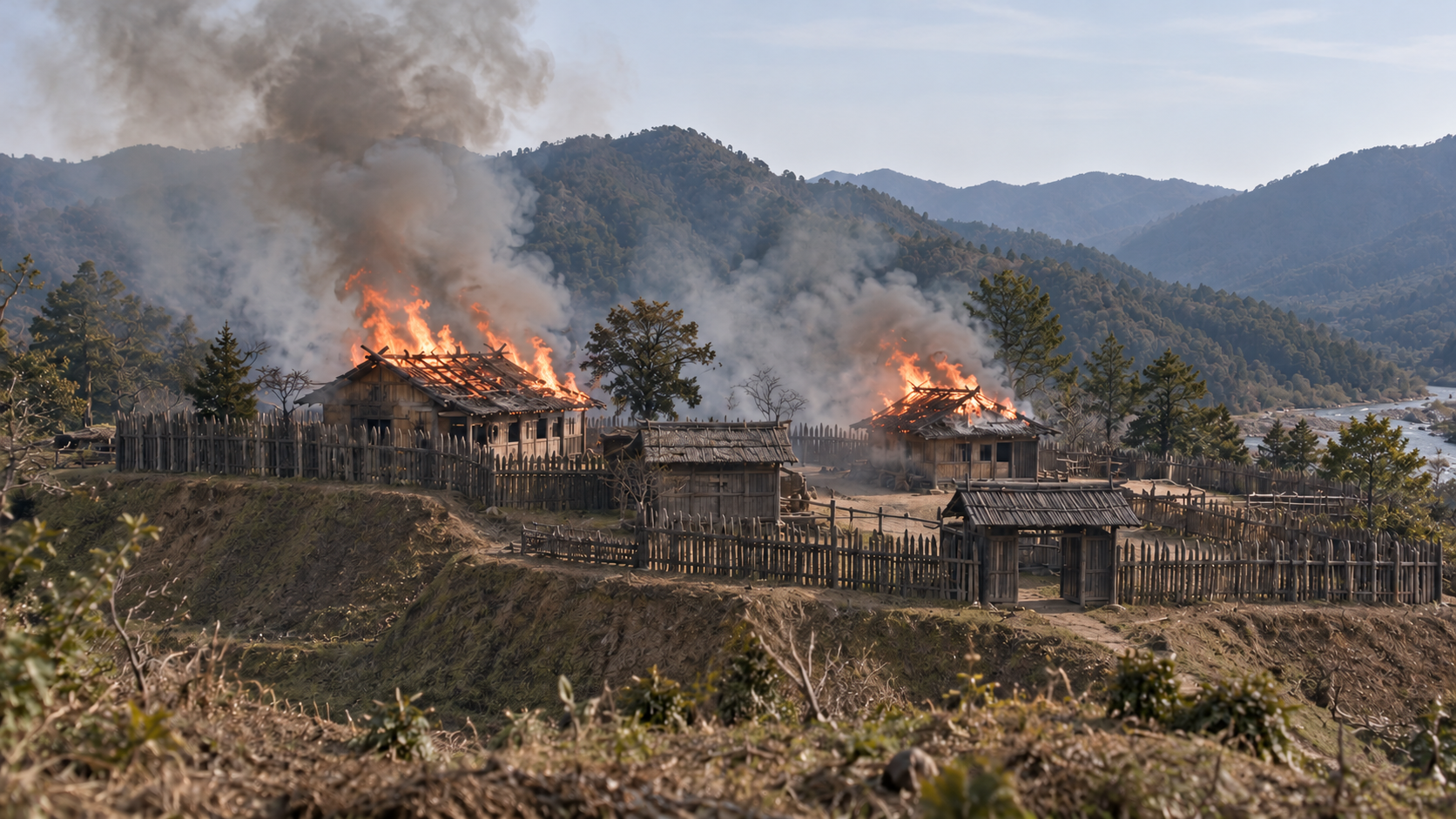
On the third day of the third month of Tensho 10, the Japanese year corresponding to 1582, Katsuyori set fire to Shinpu and departed. It was the year after his move there. Leaving the place newly brought into use as a residence began another, still shorter part of the sequence.
On the eleventh day of that third month, Katsuyori, his wife and his son Nobukatsu died by suicide at Tano. The Yamanashi Archaeological Center identifies the place with the site of Keitokuin in present-day Yamato, Koshu City. These month and day numbers also follow the older Japanese calendar.
The move to Shinpu, the fire and departure, and the deaths at Tano happened at different places and dates. Placing the family’s deaths inside an image of the burning castle would erase the time after they left it. Shinpu and Tano must retain their separate places within the final sequence.
Even without farewell speeches or an invented scene along an exact route, the locations and dates preserve a course of events. Katsuyori lost the new headquarters, then met his end at Tano. Following those two places gives us a basis for reading the brief time that remained after departure.
Chapter 10
Reading Burned Earth From the Present
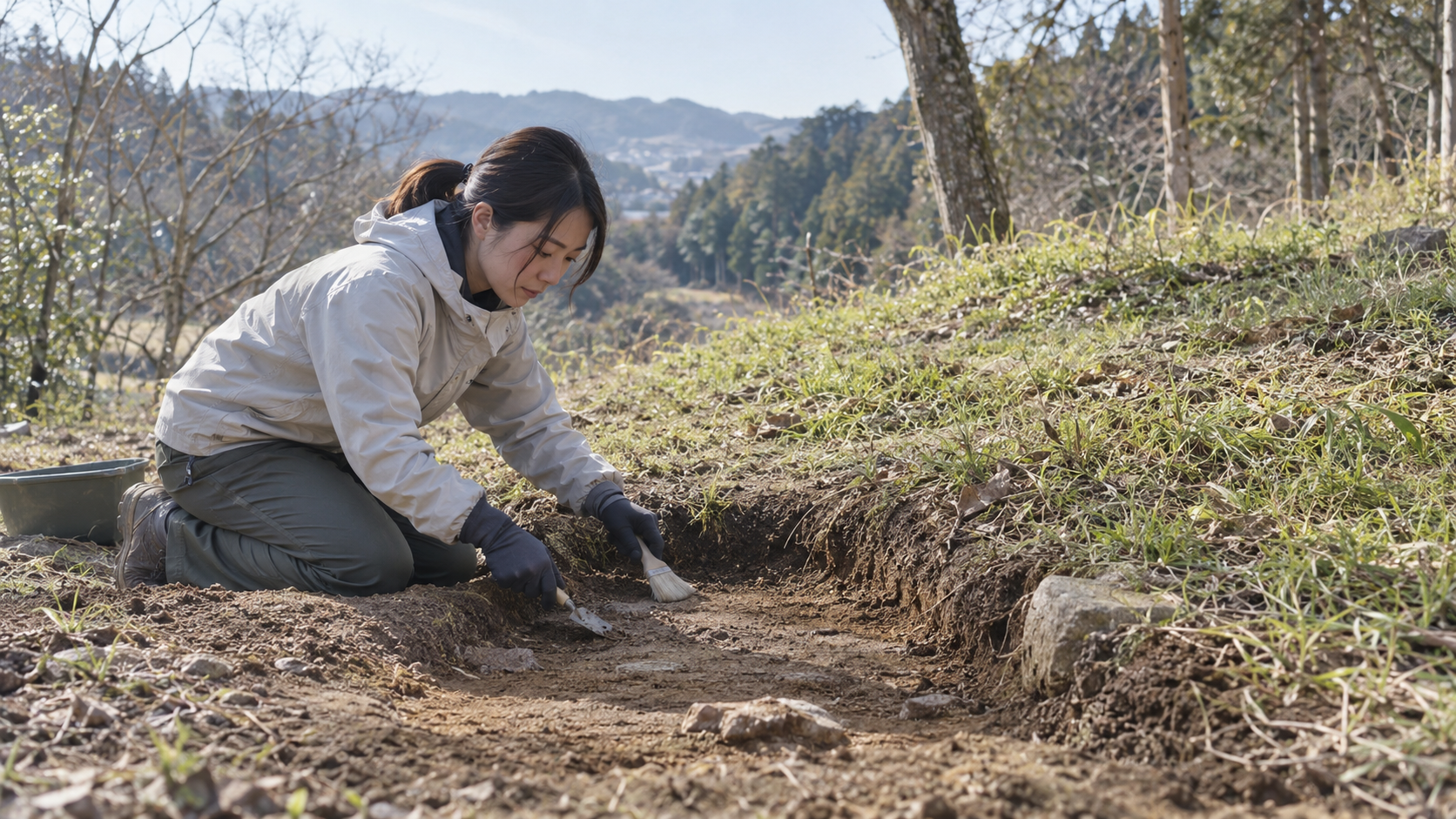
From the time of those who left, we can return to the ruins studied today. Shinpu has also been investigated through traces below the ground. Nirasaki City’s account of excavation includes gate foundation stones, charred timber, iron nails and burned soil. These findings approach facilities whose buildings no longer stand.
The city interprets some of those remains as traces of the fire in 1582. Its explanation contains both a record of what was recovered and a judgment connecting finds with a dated event. Keeping those elements separate preserves the difference between a discovered object and the interpretation of its history.
Charred wood cannot tell us the words exchanged at a particular place. Gate remains and earthen structures can nevertheless bring lost facilities closer to view. Archaeology adds questions that documents alone may not answer, approaching the castle through the physical remains of construction and use.
Reading an excavation means retaining both findings and uncertainty about their interpretation. Traces associated with fire offer evidence to examine, while a proposed date remains a proposal where the explanation treats it as such. Work on the castle’s final period continues from the present, through investigation of what survives.
Chapter 11
The Place Was Used Again
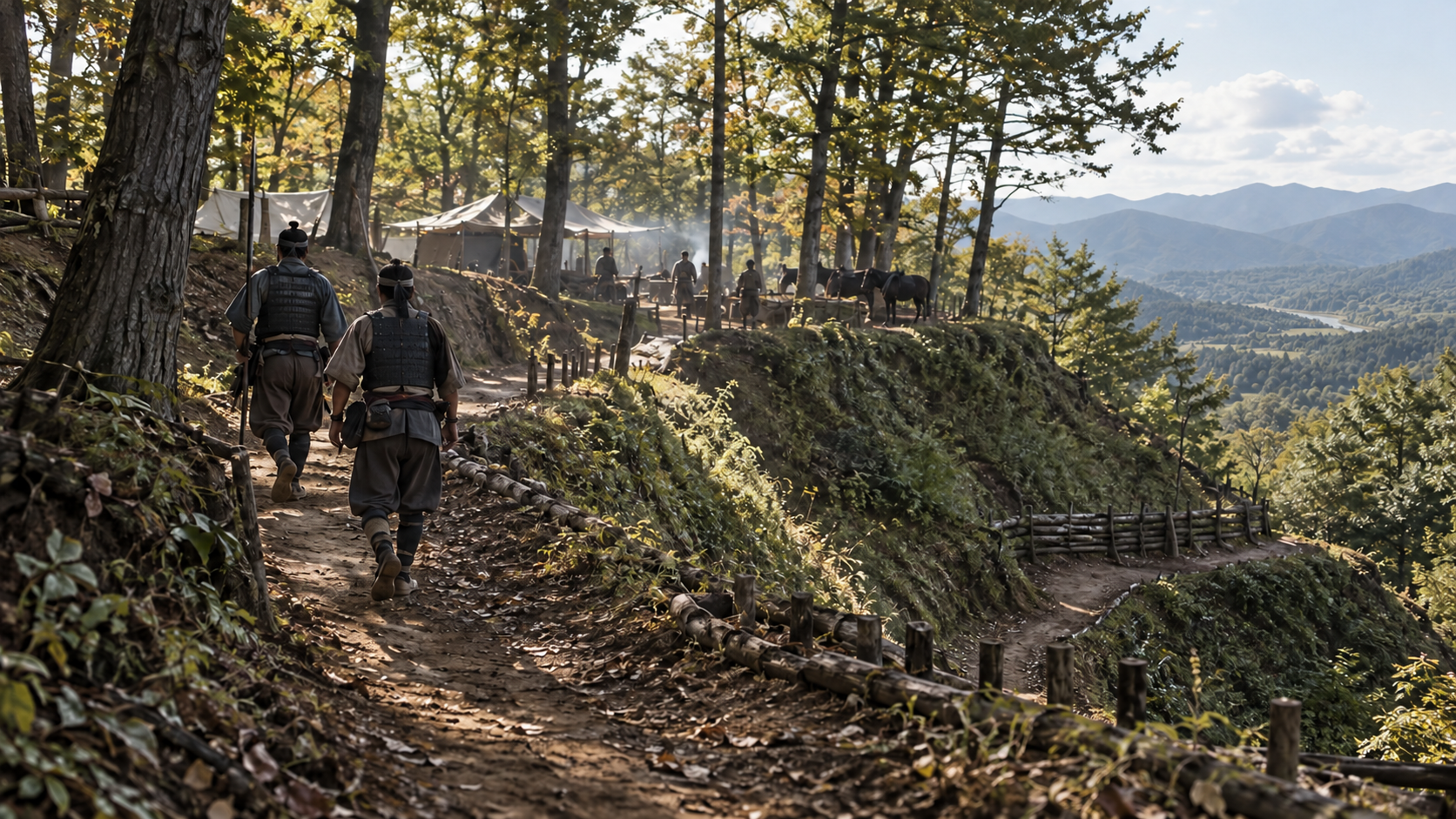
Conflict over Kai continued after the fall of the Takeda. Following the Honnoji Incident in 1582, the Tokugawa and Hojo fought in the conflict known as Tensho Jingo. According to Nirasaki City, Ieyasu reused Shinpu as his headquarters during that fighting. Another period of use followed Katsuyori’s departure.
Katsuyori leaving and Ieyasu later using the place belong to different stages of its history. Ieyasu’s headquarters cannot be inserted into a scene from Katsuyori’s occupation. The same ground carries actions by different people at different times; following those dates lets each period retain its own setting.
Burning buildings did not remove the conditions of the land. The plateau, cliffs and spaces shaped upon them can be considered alongside the fate of individual structures. Later reuse, however, does not by itself reveal the condition of every facility or prove which buildings survived the earlier fire.
Who used the place, when, and for what purpose? Applying those questions to Shinpu brings its later history into view alongside its position as Katsuyori’s last residence. Its short occupation by Katsuyori ended, but the site continued to have a place in the conflicts that followed in Kai.
Chapter 12
Work Left at the Last Residence
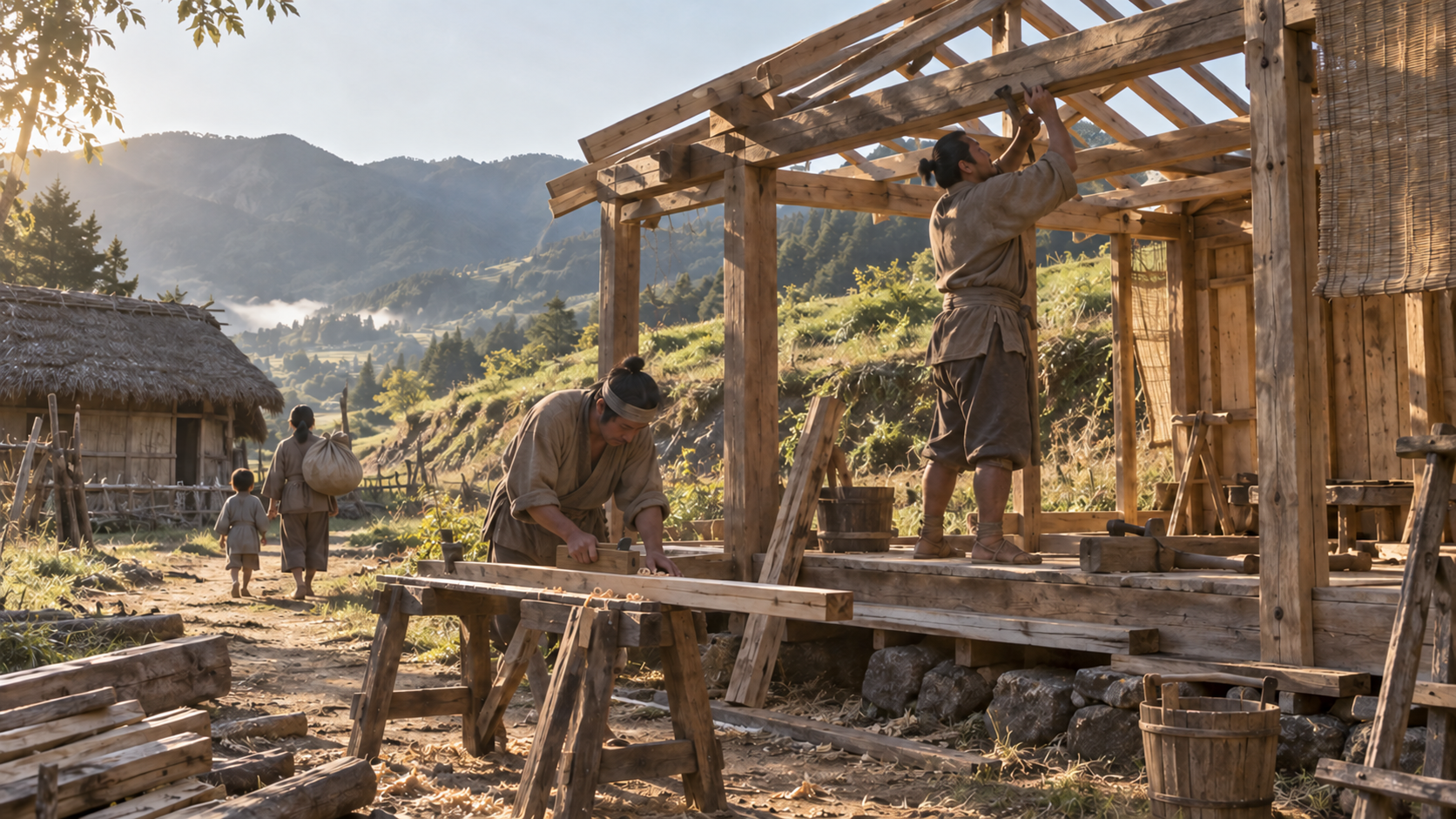
Following events at Shinpu brings us to a move into an unfinished castle and a departure the next year. Around it, strongholds such as Takatenjin remained objects of conflict. Within the territory, documents concerning people and rights were issued. The last residence stood within these different, continuing kinds of work.
It is easy to judge every earlier action through a single ending. Building a castle, administering a territory and responding to invasion each have a course that deserves examination. Their dates and evidence allow us to follow those courses before drawing them together around the final period at Shinpu.
Terrain invites questions about how a place might be defended. Documents identify people and rights involved in administration. Excavation offers clues to lost facilities. Bringing these forms of evidence together gives Katsuyori’s years a wider setting than the impression left by a battle alone.
Reconsidering the last residence means attending to the work before the ending and to traces left afterward. The ending remains part of that history. Beyond Shinpu’s banks and moats lies the effort to establish a new center within a short span of time, an effort still approached through the surviving evidence.
How to read this work
History, interpretation, and reconstruction
Construction, relocation, administrative documents and surrounding battles together offer a way to read the work left at Katsuyori’s last residence.
This work is grounded in published sources and historical research. Interior thoughts, dialogue, and some visual details are cinematic reconstructions. Where historians disagree, the article presents the point as debated rather than settled fact.
Timeline
The story in time
-
The Fuji family archive catalogue lists a grant document concerning land given by Katsuyori.
Sources: s04 -
The Fuji family archive catalogue lists records concerning a chief priest’s appointment, prohibitions in a town and exemptions from various dues and service obligations.
Sources: s04 -
Katsuyori moves his headquarters from Tsutsujigasaki to the unfinished Shinpu Castle.
Sources: s01 -
Katsuyori’s wife submits a prayer to Takeda Hachiman Shrine.
Sources: s05 -
Katsuyori sets fire to Shinpu Castle and departs.
Sources: s01 -
Ieyasu reuses Shinpu as his headquarters during the Tensho Jingo conflict.
Sources: s01
People & terms
A guide for new readers
Key figures
- Takeda Katsuyori
- Successor to Takeda Shingen. Moved his headquarters to Shinpu Castle and left it the following year.
- Katsuyori’s wife (Hojo family)
- Submitted a prayer to Takeda Hachiman Shrine in the second month of 1582. Died at Tano alongside Katsuyori and Nobukatsu.
- Takeda Nobukatsu
- Katsuyori’s son. Died at Tano alongside his father and Katsuyori’s wife.
- Tokugawa Ieyasu
- Head of the Tokugawa side that recovered Takatenjin Castle. Used Shinpu as his headquarters after the fall of the Takeda.
Glossary
- Kai 甲斐
- The historical province containing Shinpu; the castle ruins are in present-day Nirasaki, Yamanashi Prefecture.
- Totomi 遠江
- The historical province containing Takatenjin Castle, whose ruins are in present-day Kakegawa, Shizuoka Prefecture.
- Shichiriiwa 七里岩
- The plateau on which Shinpu stood, shaped by deposited mountain debris and erosion by the Kamanashi and Shio rivers.
- Kuruwa 曲輪
- A divided enclosure within a castle site.
- Honmaru 本丸
- The main enclosure within the castle’s arrangement of spaces.
- Dorui 土塁
- An earthen bank forming part of a castle’s works.
- Masugata 桝形
- A castle entrance arrangement incorporating turns that interrupt a direct route inward.
- Hanmono 判物
- An authorized document bearing a signature mark; the catalogue examples here concern grants of land.
- Daiguji 大宮司
- Chief priest, the office involved in the appointment recorded in the Fuji family archive.
- Kinzei 禁制
- A document setting out prohibitions, here concerning Omiya town.
- Shoyaku 諸役
- Various dues and service obligations. An exemption from these is not rendered as a universal exemption from every tax.
- Tensho Jingo 天正壬午
- The name used for the conflict after the Honnoji Incident in 1582 in which the Tokugawa and Hojo contested Kai.
- Older Japanese calendar 当時の暦
- The calendar used for the month and day numbers in this article. A numbered month is not equated with the same numbered Gregorian month.
Sources & method
How this article was built
This article translates the fixed, publicly verified Japanese manuscript, retaining its twelve chapters, four people, ten timeline entries and eight sources. The linked institutional explanations were actually opened and their relevant passages read. English source headings are editorial translations. Original document images, archaeological photographs, maps and portraits are not reproduced.
Nirasaki City’s castle explanation supports the terrain, earthworks, unfinished move, departure and later reuse. Kakegawa City’s chronology and Shizuoka Prefecture’s heritage entry support the distinct capture and loss of Takatenjin. Shinshiro City’s museum explanation supports the Nagashino siege, relief forces and battle at Shitaragahara; exact troop totals and disputed firing or cavalry descriptions are not adopted.
The Fuji family archive is used through the Shizuoka Prefectural Central Library’s catalogue and brief abstracts. Listing a grant or appointment does not demonstrate flawless implementation, and catalogue reading is not a claim to have read every original line or authenticated handwriting and seals. Exemption from various obligations is not expanded into universal tax exemption.
The introduction to Katsuyori’s wife’s prayer supports its existence, timing and setting. The family’s later fate does not become foreknowledge or invented private conversation. The archaeological center’s explanation identifies Tano and the date of the deaths; the departure from Shinpu remains separate. The wife is not identified here as Nobukatsu’s biological mother.
Modern excavation findings and their proposed connection to the 1582 fire are distinguished. Later reuse in the Tensho Jingo conflict is kept apart from Katsuyori’s occupation. The museum’s 2025 exhibition introduction explains a modern reassessment, without claiming that all questions of succession or governance have been settled.
All twelve distinct canonical AI-generated illustrations were actually viewed and their hashes and article rights matched to the Japanese review. Their people and settings are fictional; they are not original documents, exact castle plans or photographs documenting historical events or actual excavation. The linked film has Japanese audio; an English subtitle track has not been verified.
Sources
References and further reading
- Shinpu Castle Ruins 新府城跡 Title translated editorially for reader convenience. Nirasaki City 韮崎市 Municipal explanation of Shichiriiwa, earthworks, the unfinished move in 1581, departure and deaths at Tano in 1582, subsequent reuse and excavation. Dating burned remains to the 1582 fire is described as an interpretation. Full excavation reports have not been read and their images are not reproduced. Accessed 2026-10-10
- The History of Takatenjin Castle 高天神城に関する歴史について Title translated editorially for reader convenience. Kakegawa City 掛川市 Municipal chronology used for the capture in 1574, Nagashino in 1575 and the castle’s fall in 1581. Its differing documentary and narrative references remain distinct. Troop totals, verbatim speech and private thoughts are not adopted. Accessed 2026-10-10
- Nagashino Castle Historical Museum: The Siege and the Battle at Shitaragahara 長篠城址史跡保存館――長篠の攻防と設楽原の決戦 Title translated editorially for reader convenience. Shinshiro City 新城市 Museum explanation used for the 1575 siege, Oda and Tokugawa relief forces and the battle at Shitaragahara. It does not serve here as verification of three rotating firing lines, a charge by all cavalry or exact troop totals. Accessed 2026-10-10
- Mount Fuji Digital Library: Fuji Family Documents 富士山関係資料デジタルライブラリー(富士家文書) Title translated editorially for reader convenience. Shizuoka Prefectural Central Library 静岡県立中央図書館 Catalogue and brief abstracts used for grants in 1573, the chief priest’s appointment in 1577 and prohibitions and exemptions in 1578. This is not direct reading of every original document or authentication of handwriting or seals. Accessed 2026-10-10
- Prayer by Katsuyori’s Wife of the Hojo Family 武田勝頼夫人北条氏祈願文 Title translated editorially for reader convenience. Nirasaki City 韮崎市 Municipal introduction used for the document’s existence, submission in the second month of 1582 and the crisis surrounding it. No verbatim transcription, independent textual edition or original document image is reproduced. Accessed 2026-10-10
- Special Exhibition: Takeda Katsuyori, a Warrior Renowned Across Japan 特別展 武田勝頼 日本に隠れなき弓取 Title translated editorially for reader convenience. Yamanashi Prefectural Museum / Yamanashi Prefecture 山梨県立博物館/山梨県 The 2025 exhibition introduction explains Katsuyori’s position as Shingen’s successor and reassessment through materials and research. No resolution of succession or regency theories is claimed; portraits and exhibition images are not reproduced. Accessed 2026-10-10
- Shizuoka Cultural Heritage Guide: Takatenjin Castle Ruins しずおか文化財ナビ 高天神城跡 Title translated editorially for reader convenience. Shizuoka Prefecture 静岡県 Official explanation used for Katsuyori’s capture in 1574, continuing fighting with the Tokugawa and the fall in 1581. The page’s photographs and maps are not reproduced. Accessed 2026-10-10
- Archaeological Site Topics No. 0322: Katsuyori’s Grave and Sutra Stones 遺跡トピックスNo.0322 武田勝頼の墓・経石 Title translated editorially for reader convenience. Yamanashi Archaeological Center 山梨県埋蔵文化財センター Institutional explanation used for the deaths of Katsuyori, his wife and Nobukatsu at Tano on the eleventh day of the third month of 1582 in the older calendar. Ages, numbers of followers and memorial traditions are not adopted; artifact photographs are not reproduced. Accessed 2026-10-10
Continue reading
More stories from Shigeki
Shigeki English
Sakai’s Merchant City: Trade, Self-Government and Survival
A port, a merchant council and town communities—from changing authority to rebuilding after fire.
- When From the later fifteenth century through the Sengoku period, the fire of 1615 and early Edo-period reconstruction.
- Where Sakai, in present-day Osaka Prefecture, where maritime routes met roads on land.
Shigeki English
The Aburanokōji Incident: After Leaving the Shinsengumi
A separation in spring, a new base in summer, and two successive attacks.
- When Kyoto in Keiō 3 (1867). The incident’s historical date corresponds to December 13, 1867.
- Where Kyoto: the guards’ successive bases, the Aburanokōji attack site and the later place of remembrance.