
SHIGEKI ENGLISH STORYEN
Japanese history in English
Kusunoki Masashige: From Chihaya Castle to Minatogawa, and the Making of a Loyal Retainer
Military actions, scenes from a war tale, and later commemoration: following three kinds of evidence.
How far do the defense of Chihaya, Masashige's death at Minatogawa and his later image as a loyal retainer overlap? Follow castle terrain, military and administrative records discussed through city history, Taiheiki's narrative scenes, and later tomb inscriptions and textbooks.
At a glance
Before you enter the story
- When
- 1331–1336, followed by commemoration in 1692, 1872, 1909 and 1935; the letter's month and day retain the contemporary calendar
- Where
- Akasaka and Chihaya in Kawachi, Kyoto, and Minatogawa in the Hyogo coastal setting
- Key figures
- Kusunoki Masashige, Emperor Go-Daigo, Ashikaga Takauji, Kusunoki Masatsura
- What was at stake
- What can actions, a war tale and later monuments each tell us about a commander remembered for loyalty?
Why this story matters
The larger history behind the turning point
Chihaya and Minatogawa offer different military settings within a changing political alignment. Following them in order makes room for other warriors and administrative work before the final defeat.
Tomb inscriptions, shrines and textbooks show how later generations remembered Masashige. Their messages become clearer when the evidence for remembrance is kept alongside the evidence for actions.
Historical context
What an international reader needs to know
The emperor, the shogunate and changing sides
The Kamakura shogunate was the warrior government opposed by Go-Daigo in this account. Kyoto is the setting of the imperial court and of the new government begun after the shogunate's collapse in 1333. Masashige's actions connect mountain defenses with that wider political conflict.
Takauji stood against the shogunate in 1333 before later fighting Go-Daigo's side. He and Masashige therefore cannot be placed on permanently opposing sides throughout the narrative. Japanese personal names here generally place the family name first.
Places, documents and dates
Kawachi and Izumi are the historical provinces associated with the offices mentioned here; Settsu also appears in the city history's reading of the army. Chihaya is a mountain defensive setting, while Minatogawa is introduced through Kobe's account of the Hyogo coast. These names identify the geographical relationships used by the sources, without defining an exact battle map.
An era year such as Genko 3 corresponds here to 1333. The letter's tenth month and twenty-sixth day belong to the contemporary Japanese calendar, without a conversion to a Western month and day. Catalogue metadata, a city history's explanation of a document, and a complete reading of the original are different forms of access to evidence.
Watch the film
See the story in motion
The film currently uses Japanese audio. This English article provides the context and source trail; it does not imply that an English subtitle track is available.
Scene 01
Chihaya and Minatogawa: two settings
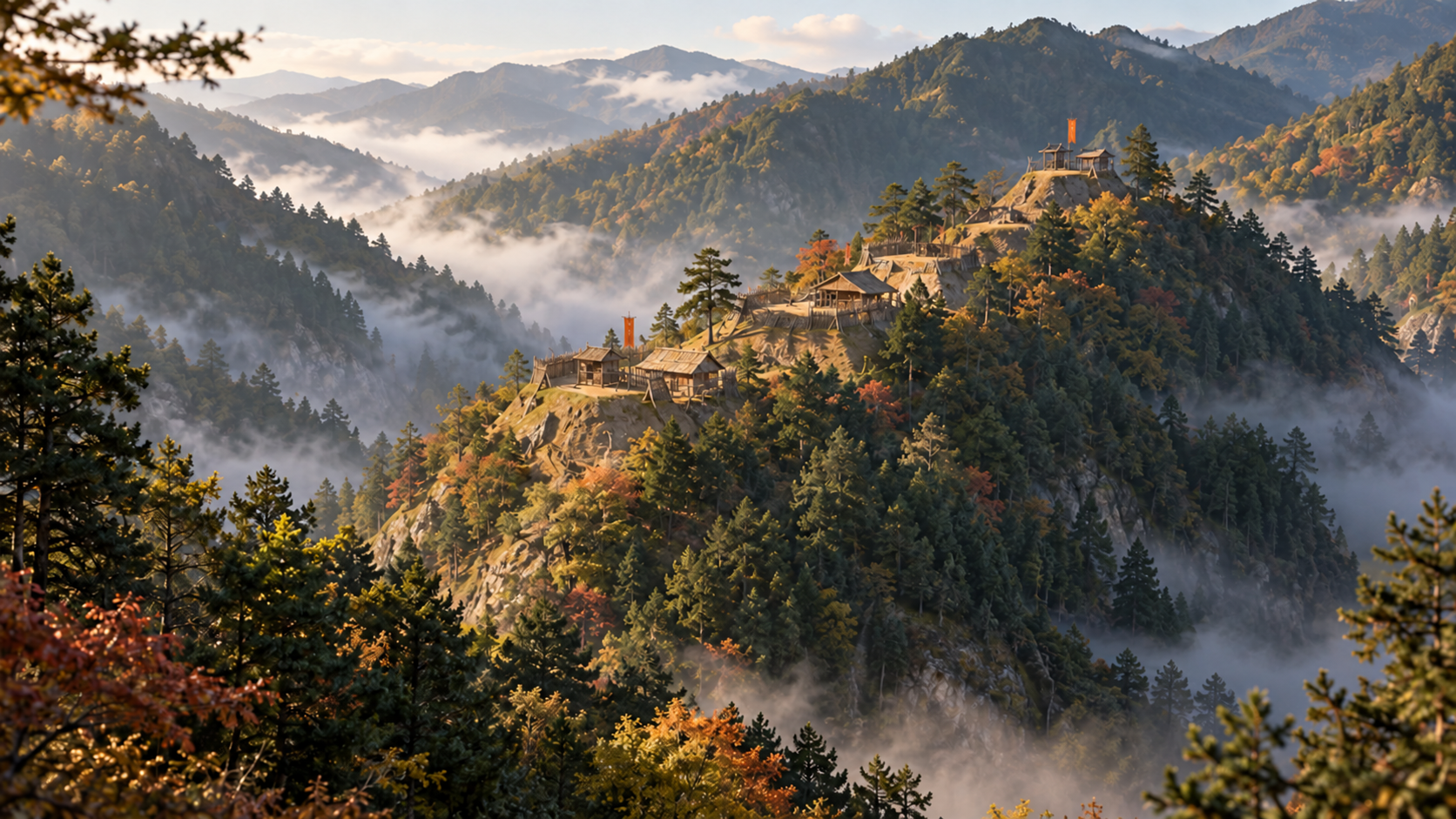
A commander withstands an army at a mountain castle. Three years later, he dies fighting near the sea. Following Kusunoki Masashige brings us to two settings: Chihaya Castle, remembered for surviving the siege of 1333, and Minatogawa, where he fought Ashikaga Takauji in 1336.
Later generations erected a tomb inscription, founded a shrine and passed down an image of Masashige as an exemplary loyal retainer. Those acts of remembrance belong to later centuries. The defense of the castle, the death in battle and the commemoration should each retain their own place in the chronology.
Starting with the final defeat can make everything before it appear to lead toward a predetermined sacrifice. Yet the earlier evidence also concerns terrain, other warriors and work performed away from the battlefield. These details deserve attention before the ending becomes an explanation for an entire life.
How far does the later image overlap with the actions the sources describe? We follow the castle landscape, documents introduced through a municipal history, scenes transmitted by a war tale, and objects of commemoration. Each offers a different way of approaching Masashige.
Scene 02
Leaving the early years unresolved
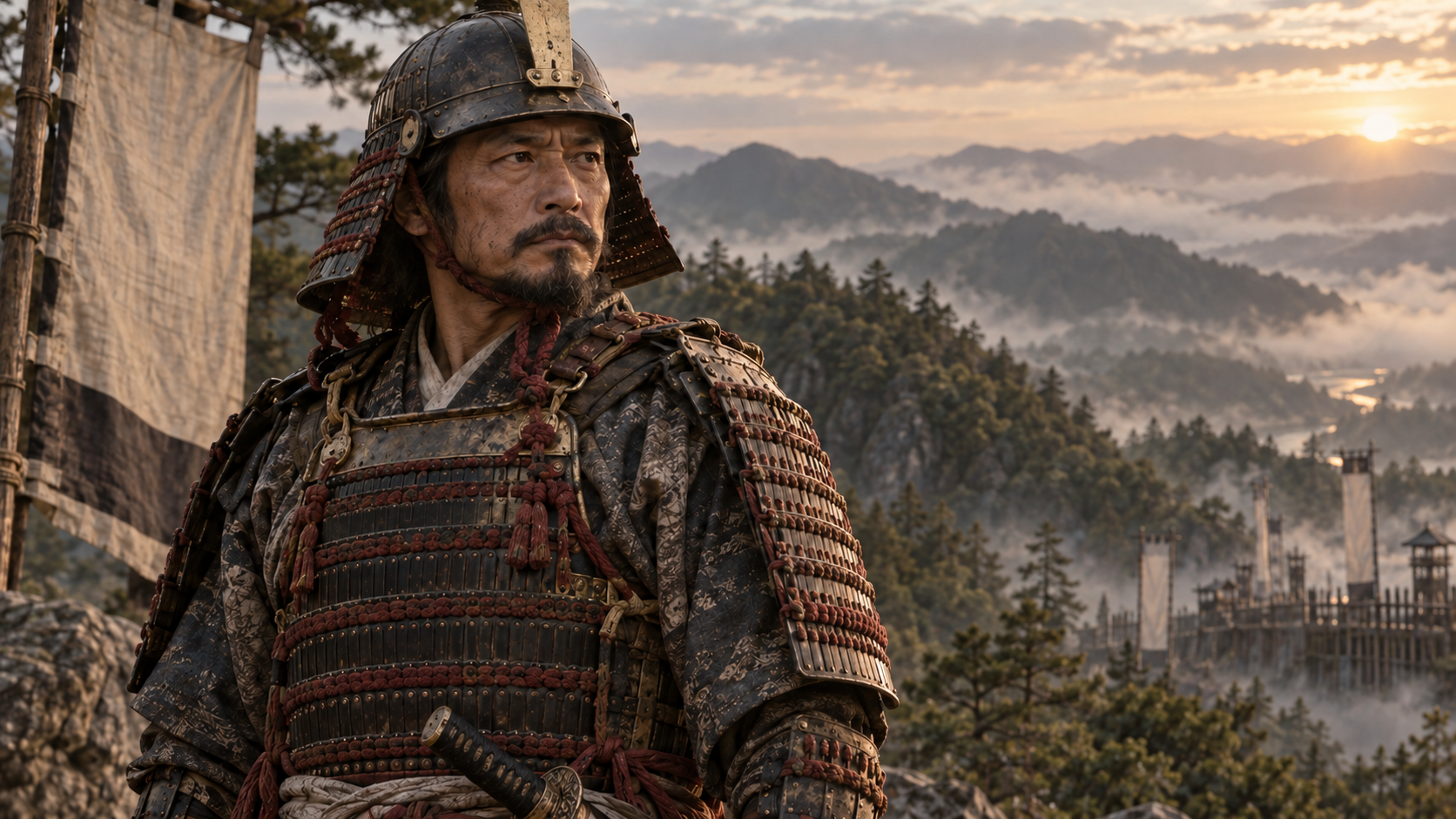
Much of Masashige's early life remains uncertain. Tondabayashi City History explains that evidence about his origins and career before the conflict with the shogunate is scarce, and that the available theories have not produced an accepted conclusion. The gaps are part of the history that survives.
A place associated with a birth tradition is different from a record directly establishing someone's birth there. The English account keeps that distinction. It does not turn a traditional birthplace into proof of a birth date or supply a childhood narrative to fill the missing years.
Taiheiki is an important war tale for this period. The National Archives describes its forty volumes, its unidentified author and its estimated composition in the latter half of the fourteenth century. Its vivid scenes help us understand how the conflict was narrated, while their dialogue cannot be treated as words recorded at the moment of speaking.
This leaves a useful starting point: actions supported by the selected evidence. We can proceed without resolving every question about ancestry, education or early ambitions. The richness of a story and the strength of evidence for a particular event are different things to assess.
Scene 03
Resistance at Akasaka in 1331
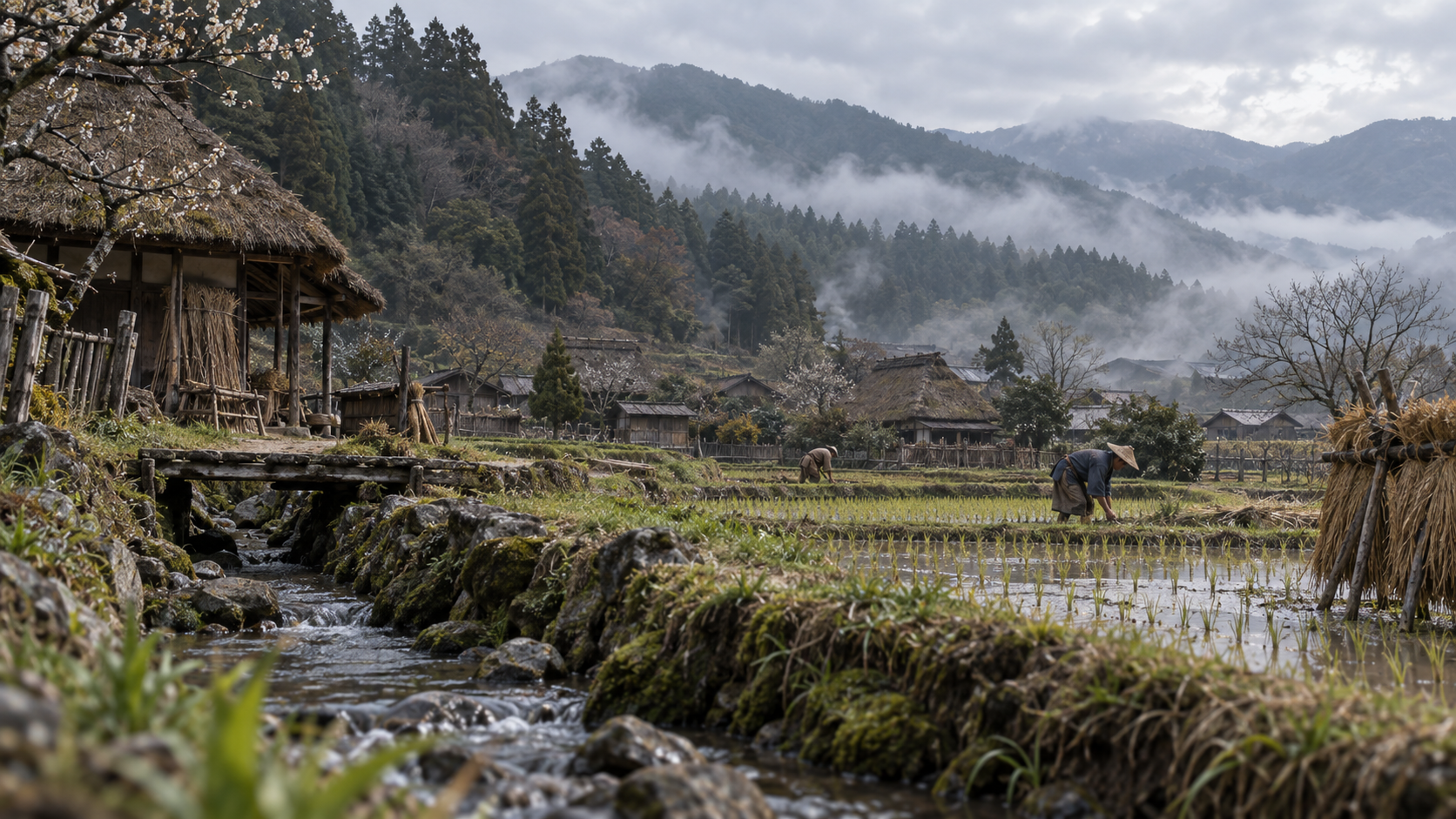
In 1331, Emperor Go-Daigo's conflict with the Kamakura shogunate brought Masashige into resistance. Chihayaakasaka Village's cultural heritage explanation associates the construction of Shimo Akasaka Castle with his rising that year. It gives us a fortified position within the conflict, without establishing every detail of the castle or its fighting.
The documents discussed in Tondabayashi City History also require careful reading. An inventory concerning temple estates transmits a rumor of interference attributed to a person understood to be Masashige. The city history itself leaves open whether the reported infringement actually took place.
The label akuto appears in this discussion. Translating it simply as a modern moral judgment, such as a bad person, would obscure its use by those enforcing authority. An accusation in a record has an author and a standpoint; it does not automatically establish the full conduct of the accused.
Later praise and earlier accusation therefore both need their context. Here the article retains the village's account of the rising and the city history's caution about the estate record. It supplies neither a proven offense nor a hidden motive from a rumor alone.
Scene 04
The army behind a celebrated commander
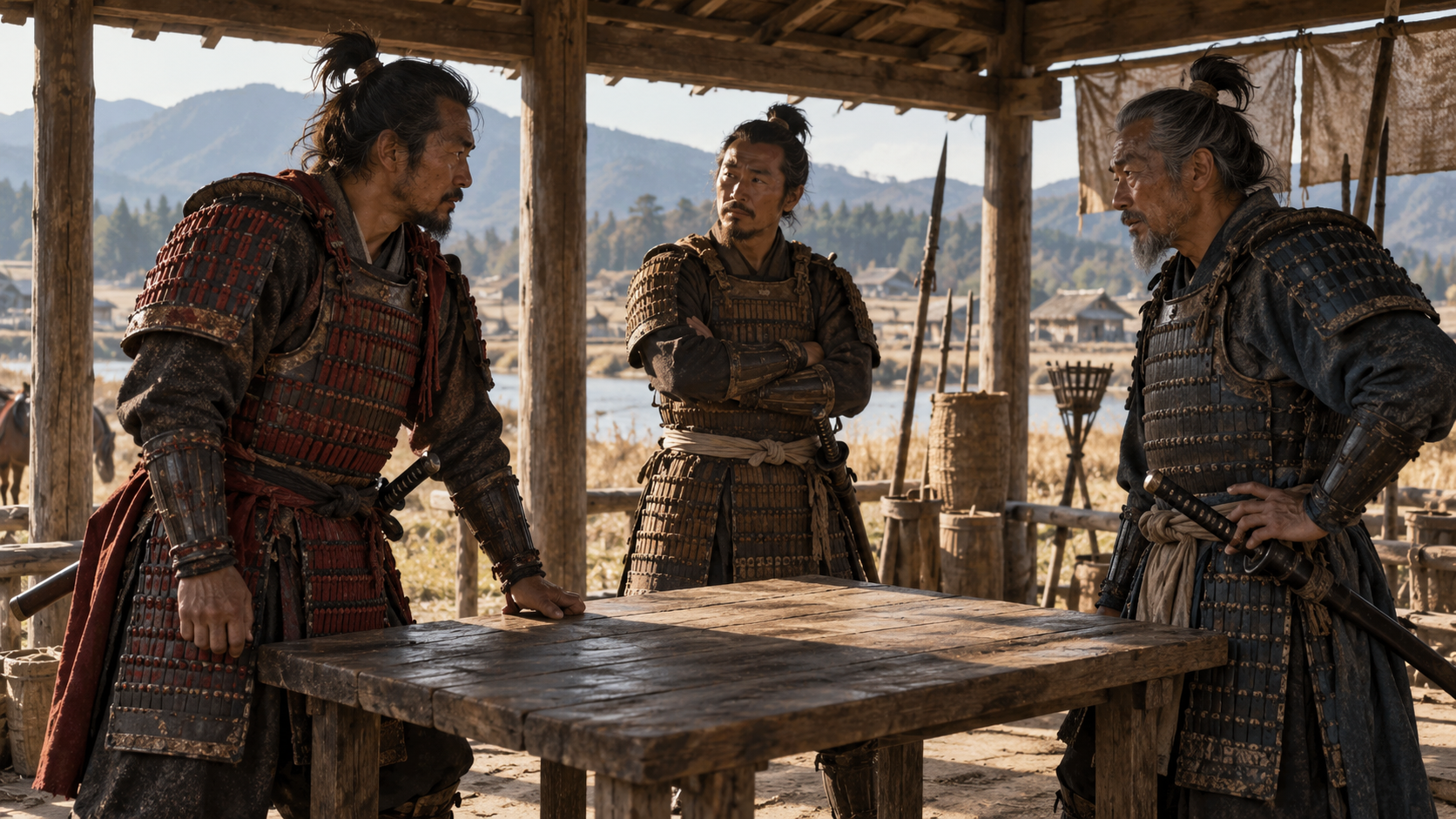
An army operates through more people than its best remembered commander. Drawing on Kusunoki Kassen Chumon, Tondabayashi City History discusses the composition of the force that attacked Tennoji in 1333. The account names warriors beyond the Kusunoki family.
The city history reads this as a group involving southern Kawachi and part of Settsu. That geographical interpretation broadens the picture beyond one household. The backgrounds of individual participants and their reasons for joining remain uncertain, so the article does not assign them a shared private intention.
The evidence nevertheless makes other warriors visible behind the acts of attacking, defending and moving. A story centered entirely on one person's ingenuity can lose those participants. Reading the military record gives us another question to ask: who appears alongside the commander?
The NII catalogue identifies a reproduced edition of Kusunoki Kassen Chumon. That bibliographic record and the municipal history's explanation are distinct resources. This article follows the latter for the military group; it does not claim a new transcription or independent reading of the entire original document.
Scene 05
Reading the terrain at Chihaya
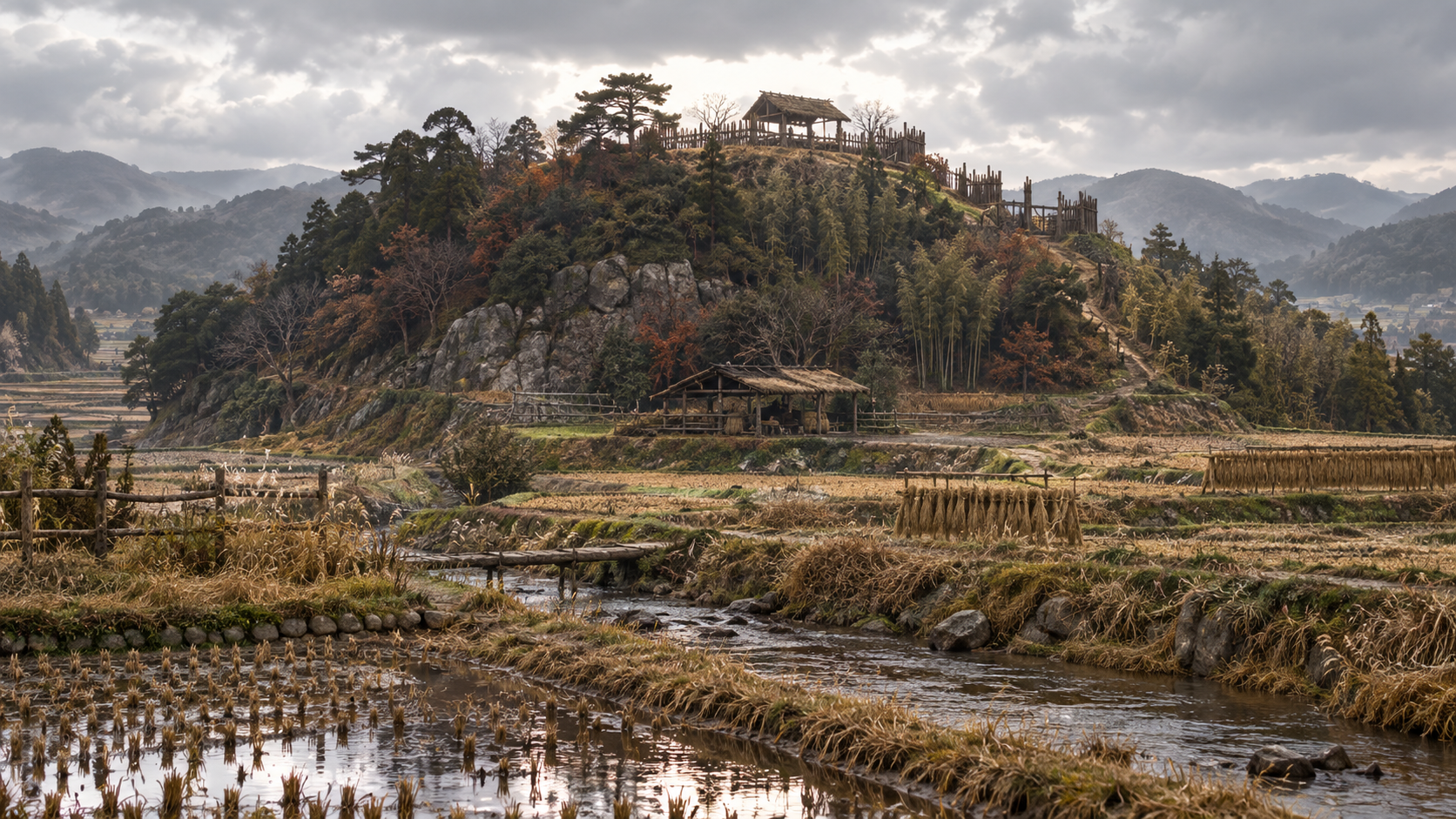
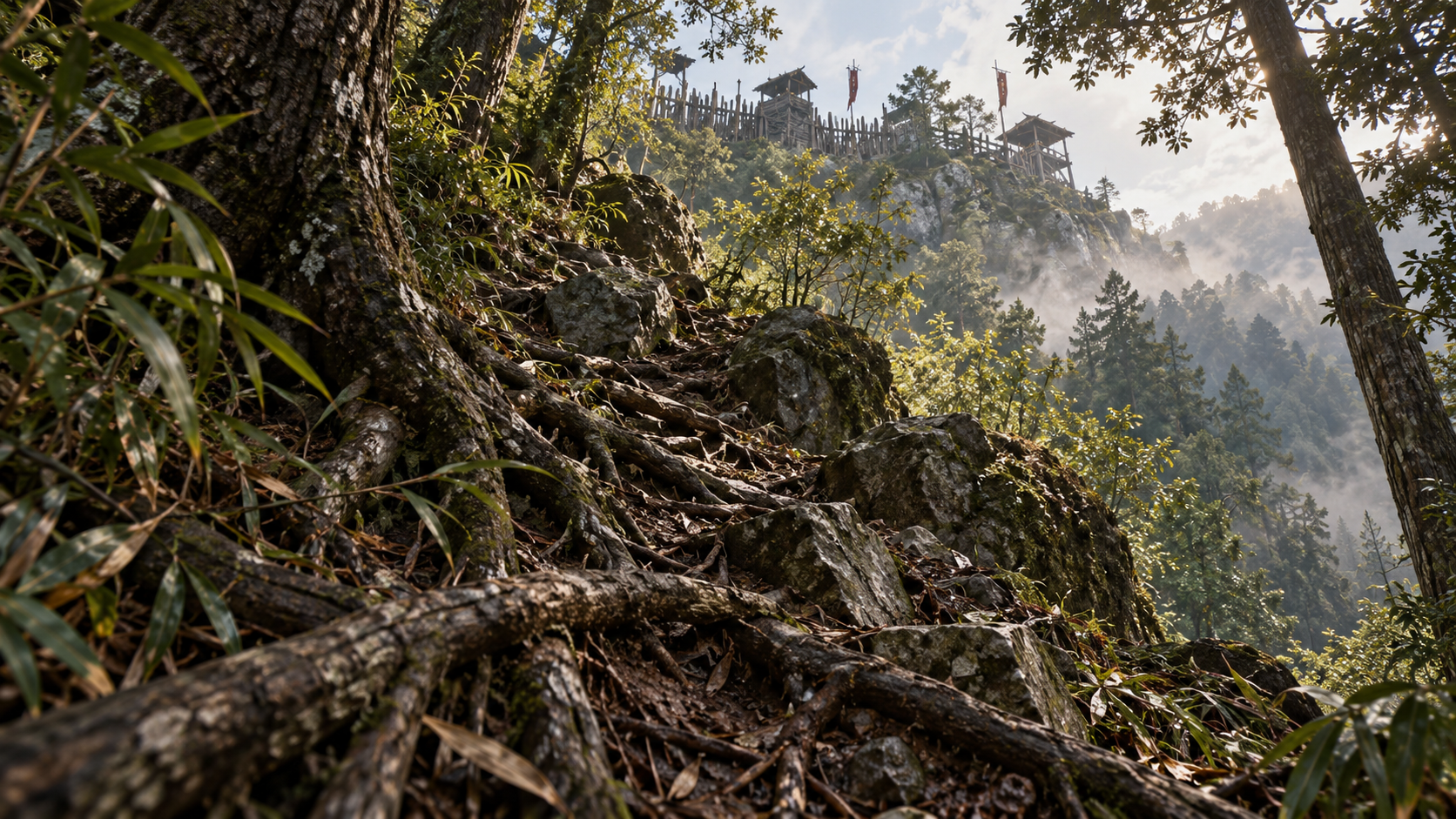
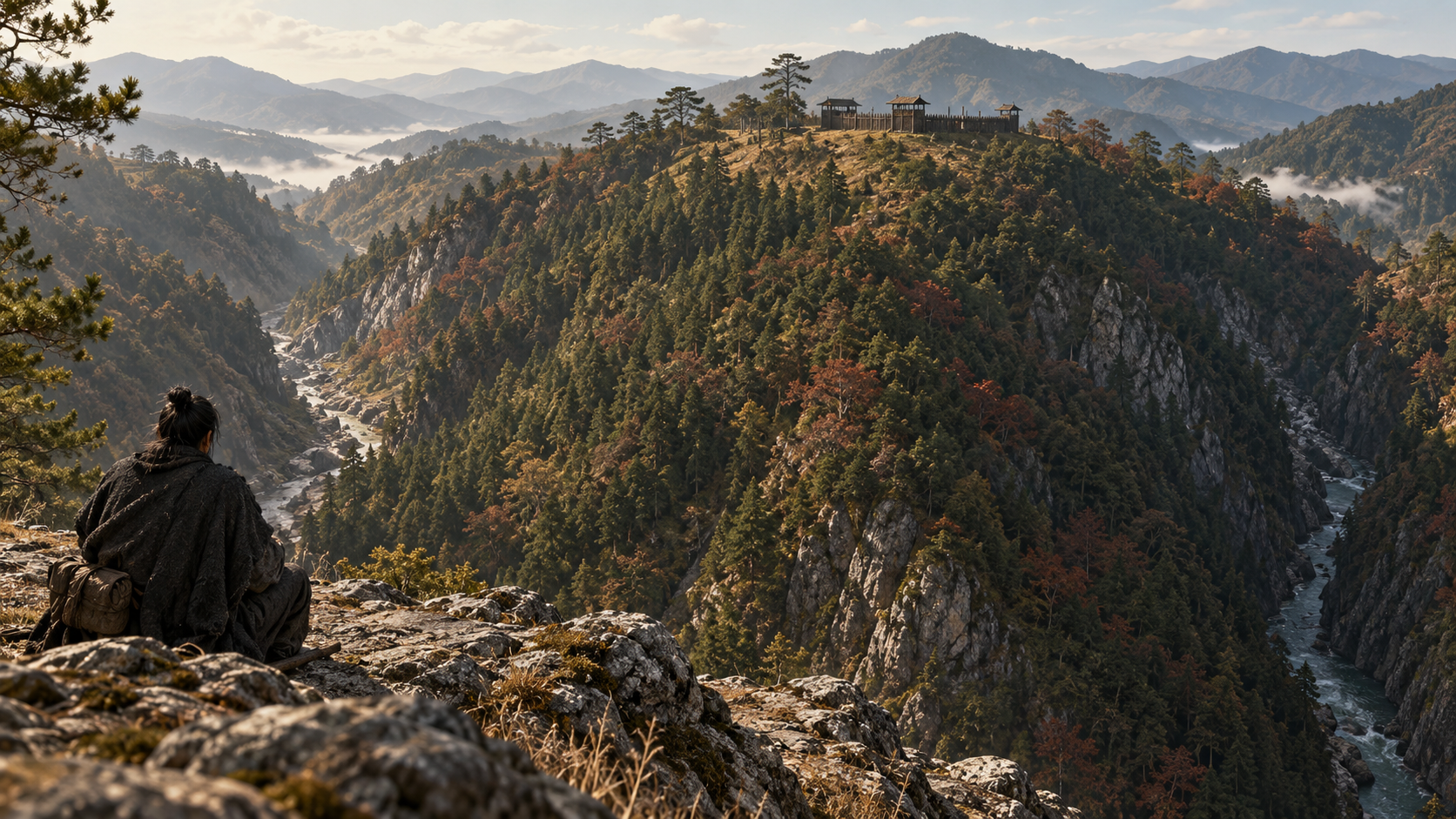
The village's castle material describes Chihaya at the tip of a subsidiary ridge extending west from Mount Kongo, surrounded by deep valleys. The enclosures on the ridge, called kuruwa, are areas artificially made level. These features offer a way into the physical conditions of defending the site.
Climbing a slope toward a narrow position differs from arranging a large force across level ground. That is an inference about defensive conditions drawn from terrain. It does not establish precisely where each unit stood during the siege or which part of a slope every attacker used.
The distinction matters when looking at a castle site today. The surviving landscape cannot, on its own, determine the height of the fences, the appearance of every structure or the positions of soldiers in 1333. The site is an entry into the setting, rather than a complete view of the battle.
The accompanying image likewise introduces a mountain defensive landscape. Its timber structures and viewpoint are conceptual. The account relies on the described ridge, valleys and leveled areas while keeping the illustration separate from an archaeological plan or a surveyed reconstruction.
Scene 06
Thrown stones and stories of ingenuity
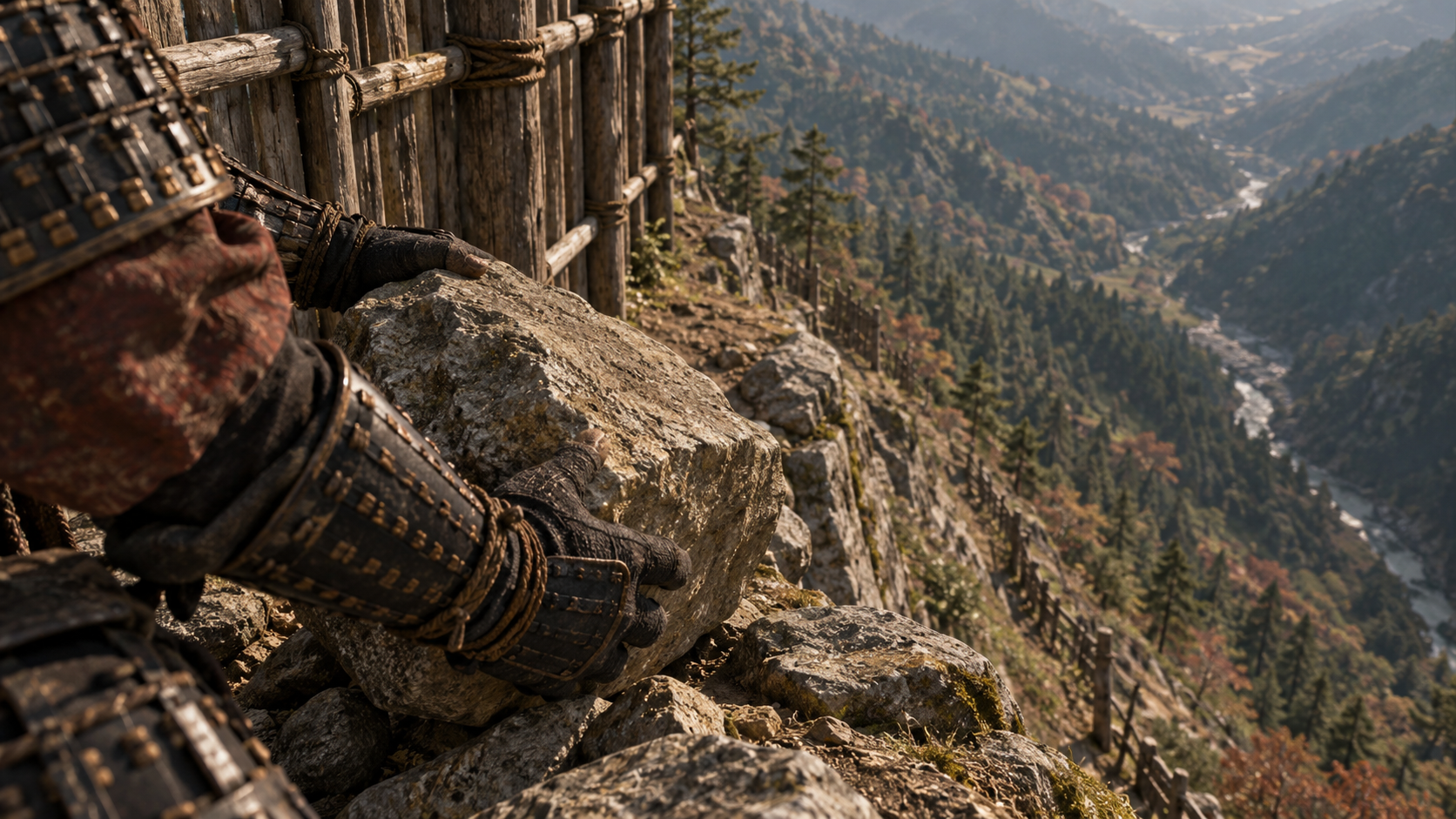
Descriptions of the defense have different evidentiary foundations. Tondabayashi City History, drawing on Kusunoki Kassen Chumon, introduces injuries suffered by attackers from stones thrown down from above. Throwing stones from a high position is therefore represented in the documentary material discussed by the city history.
Other familiar devices belong to the war tale. The village's explanatory material attributes such stratagems as armored straw figures to Taiheiki. That attribution tells us where the story comes from; it should remain visible when an ingenious episode is retold.
A report of stone injuries cannot confirm every stratagem at the same level of certainty. The article keeps the documentary report and the literary description separate, rather than letting the evidence for one defense authenticate all the dramatic details associated with the siege.
The same care applies to the very large forces and striking sequences narrated in a war tale. We do not adopt them as measured troop totals or fully established operational procedures. The selected evidence lets us discuss defense without constructing a precise battle simulation.
Scene 07
A castle holds while the shogunate falls
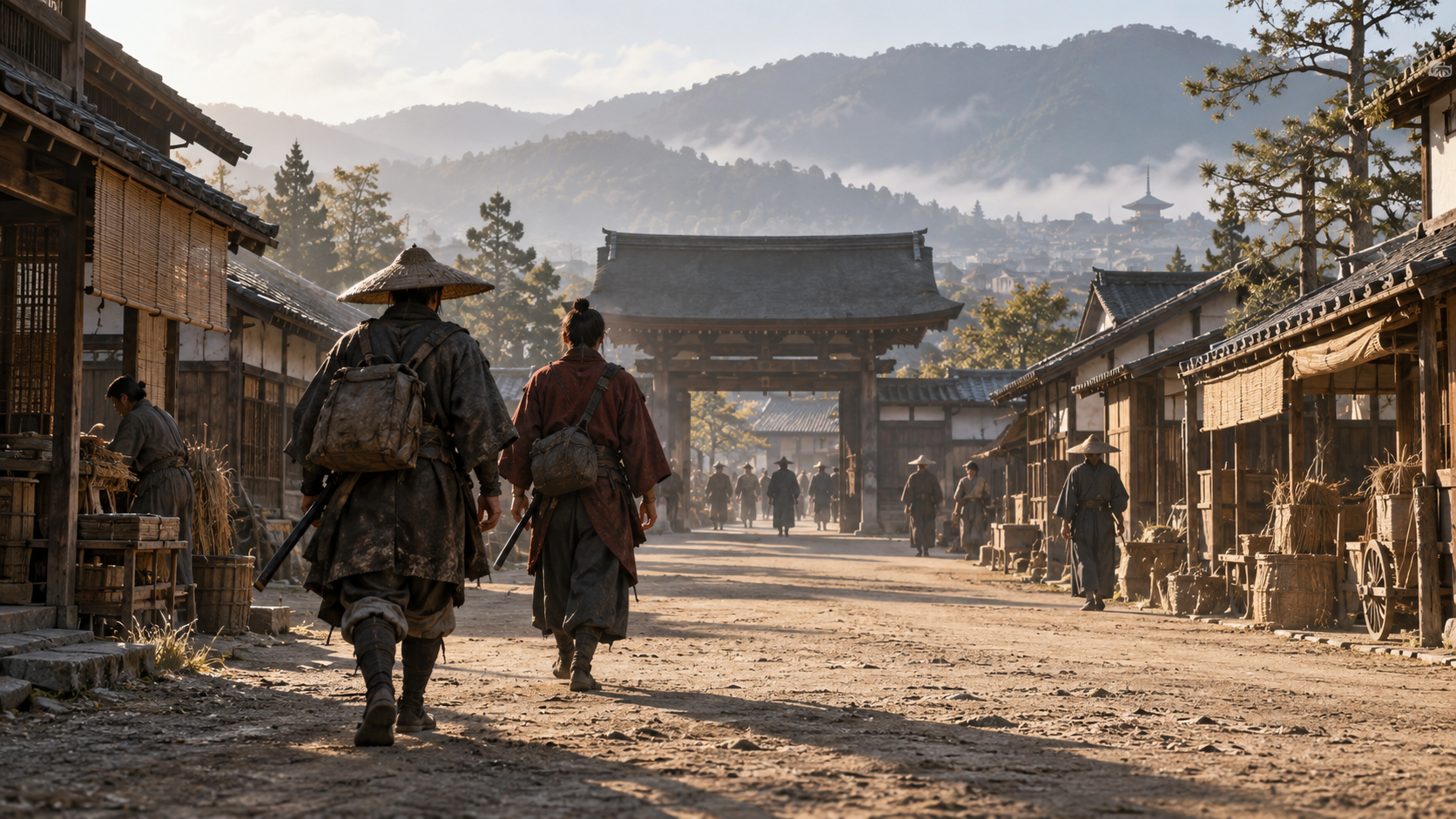
Events elsewhere changed the political setting while Chihaya resisted. In 1333, the Rokuhara Tandai, the shogunate's institution in Kyoto, fell, and the Kamakura shogunate came to an end. Actions involving Ashikaga Takauji around Kyoto and Nitta Yoshisada around Kamakura also formed part of that collapse.
Go-Daigo then began a new government in Kyoto. The survival of one castle and the fall of the shogunate are related parts of the period, but they cannot be reduced to a victory achieved by Masashige alone. The record opens onto developments beyond the mountain position.
Tondabayashi City History also notes the lack of certain evidence for the date on which the Chihaya siege ended. We retain that uncertainty. A precise final day would make the sequence look tidier, but it would go beyond the evidence adopted by the Japanese article.
At this stage, Takauji and Masashige were both on the side opposing the shogunate. Their later confrontation belongs to a changed alignment. Following the years in order prevents the opponent of 1336 from being inserted into every earlier scene as though the relationship had never changed.
Scene 08
Masashige away from the battlefield
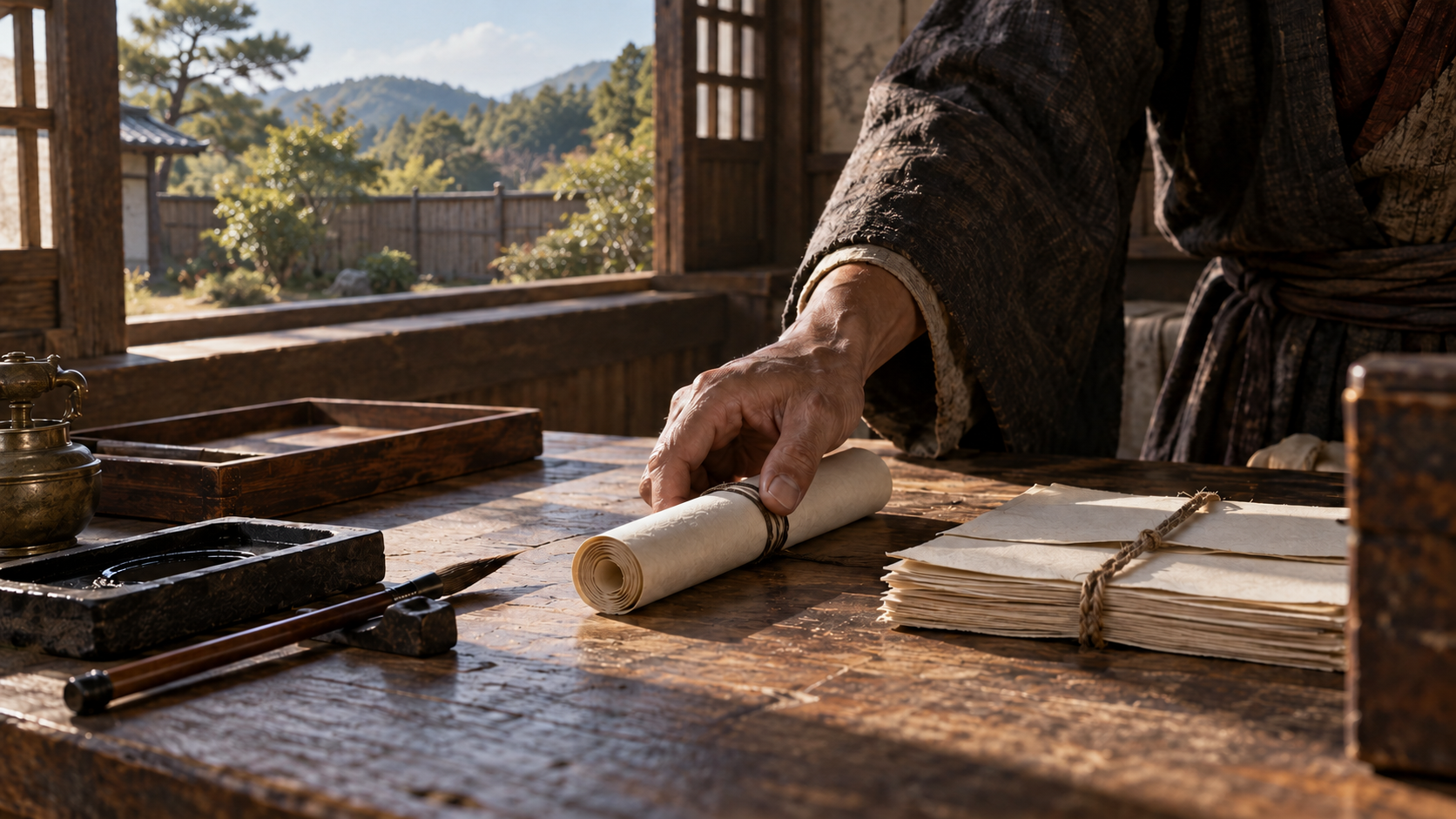
Masashige also held responsibilities in the new government. Tondabayashi City History describes him as shugo of Kawachi and Izumi and as a yoriyudo in the Records Office. These offices place him within administrative activity as well as military action.
Here shugo refers to a provincial office associated with military authority, while yoriyudo identifies a person serving within the government institution. Keeping the terms visible avoids turning them into an exact equivalent of a modern governor or civil service grade. Their relevance is the work associated with the new political order.
An autograph letter preserved at Kanshinji is dated Genko 3, the twenty-sixth day of the tenth month. The year corresponds to 1333, and the month and day belong to the contemporary Japanese calendar. The expression should not silently become October 26 in the Gregorian calendar.
Kawachinagano's catalogue and the National Diet Library search record confirm the document's existence and date. The city history explains its business: communicating an imperial command to the temple and proposing that they go to Kyoto together. One letter cannot reveal an entire philosophy, but it records a specific connection between temple and court.
Scene 09
Toward Minatogawa in 1336
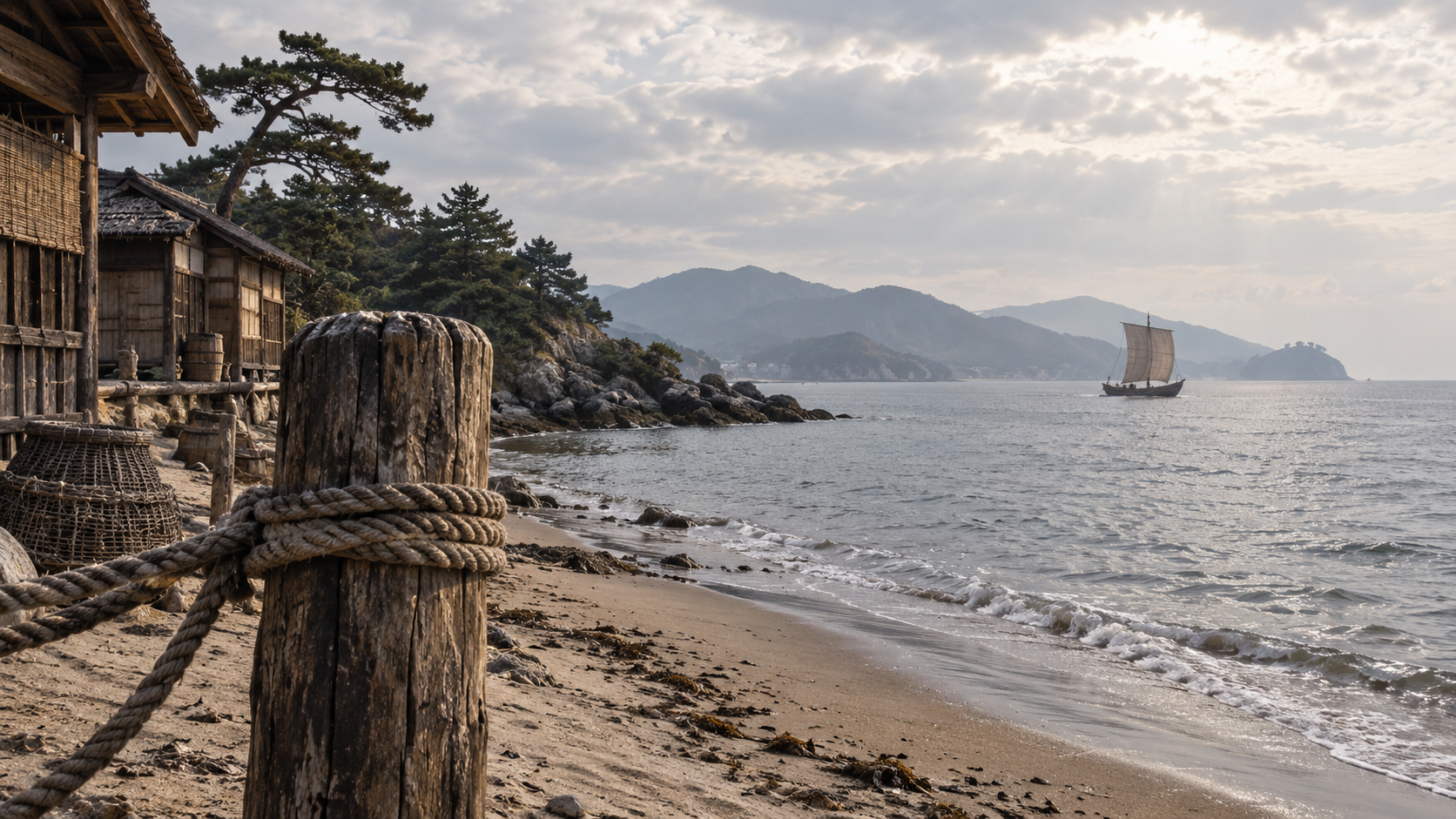
Takauji later fought Go-Daigo's side. In 1336, Masashige was defeated and died at Minatogawa. Kobe City's local history guide describes an Ashikaga approach by sea and a place traditionally associated with a headquarters. These identify a coastal setting and a remembered site.
A monument marking a traditional headquarters location does not determine the detailed disposition of forces on the day. We keep the known outcome separate from a precise reconstruction of the battle. The conceptual coastal illustration provides a setting, without plotting the positions of particular ships or units.
Taiheiki portrays Masashige proposing another strategy that is not adopted before he departs for Hyogo. The scene brings military judgment and obedience together, but remains a literary account rather than a transcript of his advice. Nor does his eventual death establish that he had wanted to die from the beginning.
Scene 10
Sakurai and the wish for seven lives
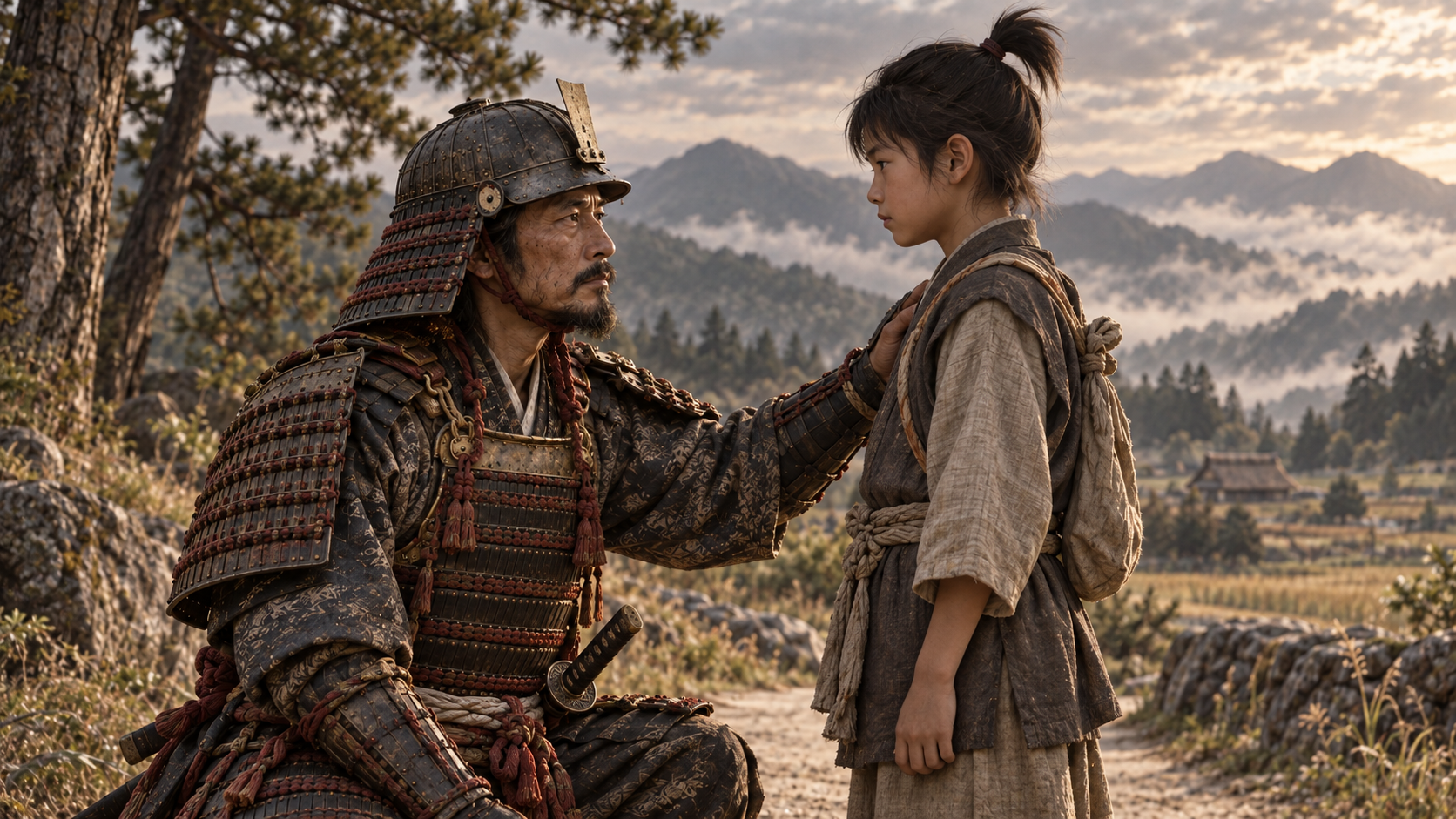
The farewell at Sakurai is also a scene transmitted by Taiheiki. Osaka Prefecture introduces the account of Masashige sending his son Masatsura back to Kawachi as a tradition from that war tale. Its later appearance in paintings, poetry and songs belongs to the history of remembrance.
The tale also gives Masashige and his brother a final exchange about being born as humans seven times to destroy their enemies. This is attributed speech within the narrative. The four-character expression shichisho hokoku should not be presented as a verbatim utterance established for Masashige.
The narrative calls the wish akunen, an evil or unwholesome thought, through Masashige's own attributed words. That complication should remain alongside the familiar image of loyal resolve. Preserving attribution allows us to discuss the story's influence without verifying its conversations as spoken history.
Scene 11
Loyalty in a tomb inscription, shrine and textbook
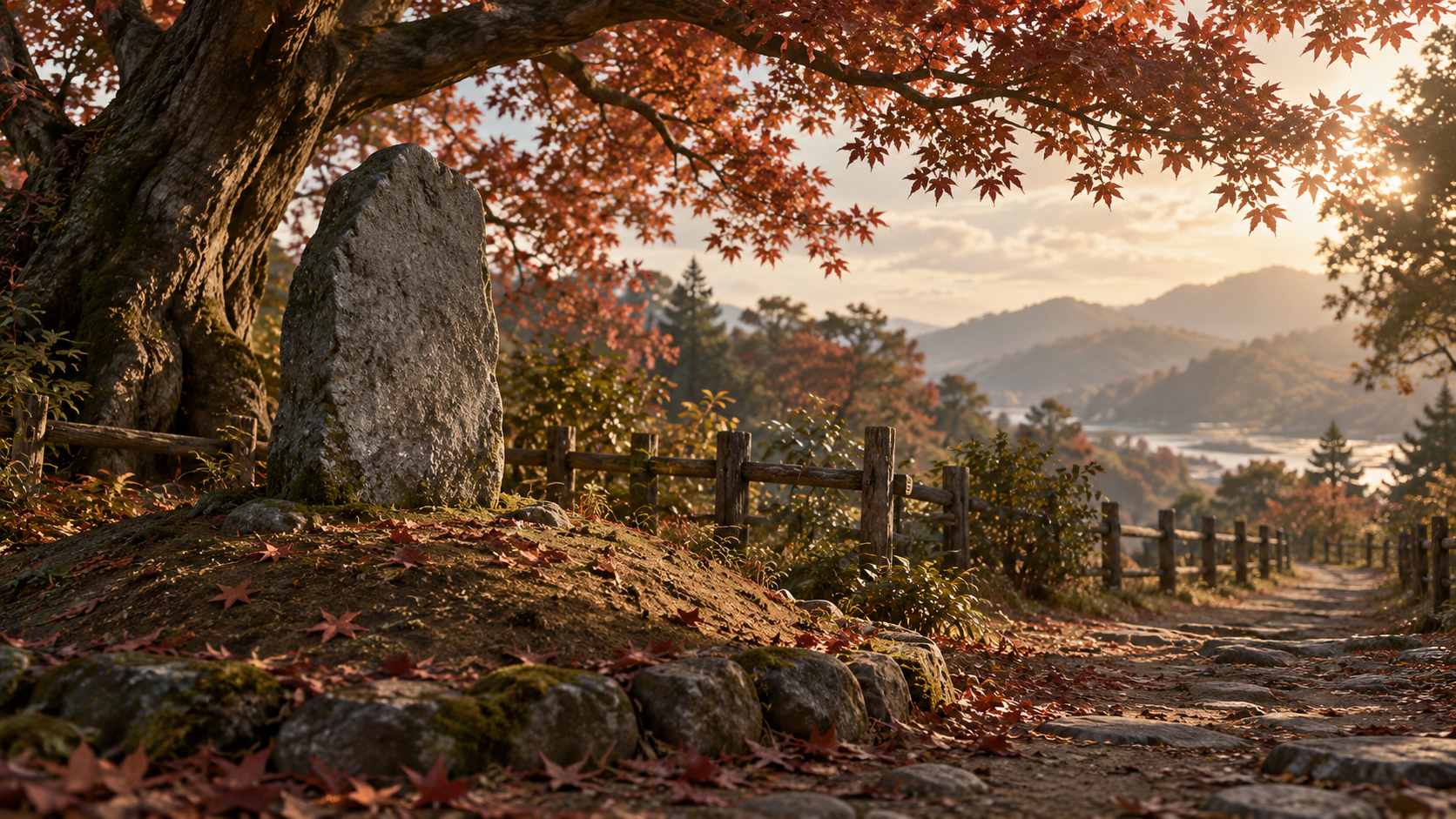
The later image can be followed through dated acts of commemoration. Kobe's history bulletin describes a tomb inscription erected by Tokugawa Mitsukuni in 1692, using the language of the loyal retainer. The inscription belongs to a later judgment about Masashige, more than three centuries after his death.
Minatogawa Shrine was founded in 1872. The tomb inscription and the shrine are evidence of later honoring and remembrance. Their existence does not turn the language of commemoration into a contemporary statement of Masashige's thoughts during the fourteenth-century fighting.
A 1909 elementary school reader, Jinjo Shogaku Tokuhon, included the Sakurai farewell. The National Archives explains how father and son were transmitted as models of loyalty and filial piety in education. This gives the literary scene another setting: a text used to teach later children.
Kobe also retains a statue erected in 1935. Across the tomb inscription, shrine, reader and statue, different periods made Masashige visible in different forms. Following these objects lets us ask what later generations chose to communicate, while keeping the military events in their earlier chronology.
Scene 12
Actions and the remembered loyal retainer
Masashige led a force containing other warriors, fought the shogunate, participated in imperial government and died fighting the Ashikaga side at Minatogawa. Those actions provide grounds for discussing his support for the emperor's side. They do not, by themselves, establish every private motive or one unchanging belief across his whole life.
The war tale supplies scenes and attributed conversations; later commemoration presents an example of loyalty. Terrain prompts questions about defense. Military records prompt questions about the people who acted together. A tomb inscription or textbook prompts questions about the message chosen by a later age.
Reading those materials separately makes their overlap easier to understand. We can see why Masashige was remembered as a loyal retainer while also following actions that require more detail than that description supplies. The record, the story and the commemorative object each contribute to the picture.
Editorial note: Historical statements follow municipal history, official heritage explanations and institutional catalogues or exhibitions. Kusunoki Kassen Chumon and the Kanshinji document are discussed through the city history, without a new complete transcription of the originals. Taiheiki's stratagems, advice, farewell and final wishes remain attributed narrative scenes. Origins, troop totals, the siege end date and detailed battle dispositions remain unresolved. The letter's month and day retain the contemporary calendar. All illustrations are AI-generated concepts, rather than verified portraits, period photographs or exact replicas of castles, documents and monuments.
How to read this work
History, interpretation, and reconstruction
Separating recorded actions, literary scenes and later commemoration helps explain both the remembered loyal retainer and the military activity that the label alone cannot describe.
This work is grounded in published sources and historical research. Interior thoughts, dialogue, and some visual details are cinematic reconstructions. Where historians disagree, the article presents the point as debated rather than settled fact.
Timeline
The story in time
-
The village explanation associates Shimo Akasaka Castle with Masashige's rising against the shogunate.
Sources: s04 -
Tokugawa Mitsukuni erects the tomb inscription: later commemoration.
Sources: s16 -
Minatogawa Shrine is founded: later commemoration.
Sources: s16 -
The elementary reader presents father and son as models of loyalty and filial piety.
Sources: s18 -
The Masashige statue in Kobe is erected: later commemoration.
Sources: s10
People & terms
A guide for new readers
Key figures
- Kusunoki Masashige
- Commander who resisted the shogunate at Chihaya and died on Go-Daigo's side at Minatogawa
- Emperor Go-Daigo
- Emperor who opposed the shogunate and began a new government in Kyoto
- Ashikaga Takauji
- Participant against the shogunate who later fought Go-Daigo's side
- Kusunoki Masatsura
- Masashige's son; the Sakurai farewell remains a tradition transmitted by Taiheiki
Glossary
- Taiheiki 太平記
- A forty-volume war tale estimated to have been composed in the latter half of the fourteenth century. Its author is unidentified; narrative dialogue is not a contemporary transcript.
- Kamakura shogunate 鎌倉幕府
- The warrior government opposed by Go-Daigo's side in this account and brought to an end in 1333.
- Kawachi 河内
- Historical province associated with Masashige's military activity and a provincial office in the new government.
- Kuruwa 曲輪
- An artificially leveled castle enclosure. At Chihaya, these are discussed as features of the ridge setting.
- Akuto 悪党
- A label used from the standpoint of those enforcing authority. In the estate-record discussion, it should not simply become a modern moral description of a bad person.
- Shugo 守護
- A provincial office associated with military authority. The city history identifies Masashige with Kawachi and Izumi offices.
- Yoriyudo 寄人
- A person serving within the government institution, here the Records Office; not an exact modern civil service rank.
- Genko 3 元弘三年
- The era year corresponding to 1333. Month and day attached to the letter retain the contemporary Japanese calendar.
- Chushin 忠臣
- A loyal retainer. Here it identifies an image of Masashige transmitted through later commemoration.
- Shichisho hokoku 七生報国
- An expression about serving the country through seven lives, associated with later remembrance. The four characters are not treated as Masashige's documented verbatim words.
- Akunen 悪念
- An evil or unwholesome thought: the term attributed to Masashige in Taiheiki's final-wish scene.
Sources & method
How this article was built
This English edition follows the fixed published Japanese manuscript, preserving its twelve scene identities, eighteen source identities, four people and eight timeline entries. Background explanations stay within the geographical, political and documentary relationships used by those sources.
The Japanese article review records reading the eighteen references and inspecting the relevant village PDF and Kobe bulletin pages. Its image and article-rights review is inherited only after matching the actual retained image hashes. The English review additionally checked selected institutional explanations; it does not claim a new complete reading of every original historical document.
The inconsistent year parenthesis in the city history is not used to date Genko 3 to 1336; the letter catalogues give 1333. Likewise, the Kobe bulletin's inconsistent 1972 parenthesis is not used for the shrine foundation: its same-page date is 1872. These editorial corrections remain distinguished from the letter's unconverted contemporary-calendar month and day.
All illustrations are generated concepts and inherit the Japanese article's cleared assets. No archive photograph or source-document image is reproduced. The associated film has Japanese audio; an English subtitle track has not been verified. Historical claims, interpretation, literary scenes and visual reconstruction retain their different roles.
Sources
References and further reading
- Chihaya Castle Site, National Historic Site 千早赤阪村「国史千早城跡」 Title translated editorially for reader convenience. Chihayaakasaka Village 千早赤阪村 Used for the castle setting, enclosures and its survival of the siege. The present site is not treated as a complete reconstruction of the structures in 1333. Accessed 2026-10-08
- Taiheiki: History and Story exhibition 国立公文書館「22.太平記」 Title translated editorially for reader convenience. National Archives of Japan 国立公文書館 Used for the work's forty volumes, unidentified authorship and estimated late-fourteenth-century composition. Narrative conversations are not treated as contemporary transcripts. Accessed 2026-10-08
- Tondabayashi City History, volume 2: The origins of Kusunoki Masashige 富田林市史 第二巻「楠木正成の出自」 Title translated editorially for reader convenience. Tondabayashi City 富田林市 Used for uncertainty about his early life and the estate inventory's report of a rumor. The alleged interference is not established as an actual offense; akuto retains the standpoint of the enforcing authorities. Accessed 2026-10-08
- Akasaka Castle Site (Shimo Akasaka Castle), National Historic Site 千早赤阪村「国史赤阪城跡(下赤阪城跡)」 Title translated editorially for reader convenience. Chihayaakasaka Village 千早赤阪村 Used for the construction associated with the rising in 1331. Tower counts and stratagems for retaking the castle are not adopted. Accessed 2026-10-08
- Tondabayashi City History, volume 2: Composition of the Kusunoki army 富田林市史 第二巻「楠木軍の構成」 Title translated editorially for reader convenience. Tondabayashi City 富田林市 The city history discusses the 1333 Tennoji attack through Kusunoki Kassen Chumon, including warriors outside the family and a regional interpretation. Individual motives and a troop total are not supplied. Accessed 2026-10-08
- Kusunoki Kassen Chumon; Hakata Nikki: catalogue record NII CiNii Books「楠木合戦注文 ; 博多日記」 Title translated editorially for reader convenience. National Institute of Informatics 国立情報学研究所 Bibliographic identification of the 1936 reproduced edition from the Maeda Sonkeikaku collection. A catalogue lookup does not constitute a new full reading or transcription of the original. Accessed 2026-10-08
- Chihaya Castle: explanatory PDF 千早赤阪村「千早城跡」解説PDF Title translated editorially for reader convenience. Chihayaakasaka Village 千早赤阪村 Used for the western subsidiary ridge of Mount Kongo, deep valleys and leveled enclosures. Armored straw figures are attributed to Taiheiki; terrain-based defensive observations remain interpretation. Accessed 2026-10-08
- Tondabayashi City History, volume 2: The battle at Chihaya Castle 富田林市史 第二巻「千早城の戦い」 Title translated editorially for reader convenience. Tondabayashi City 富田林市 Used for the injury report involving stones thrown from above, through the city history's discussion of Kusunoki Kassen Chumon. No casualty total, troop total or new original transcription is asserted. Accessed 2026-10-08
- Tondabayashi City History, volume 2: Masashige under the Kenmu government 富田林市史 第二巻「建武新政の発足」 Title translated editorially for reader convenience. Tondabayashi City 富田林市 Used for offices, uncertainty about the siege's end and the business of the Kanshinji letter. The text's inconsistent parenthetical year is not adopted: Genko 3 corresponds to 1333, checked against the other dating records. Accessed 2026-10-08
- Hyogo history: Ashikaga Takauji and Kusunoki Masashige 神戸市兵庫区「尊氏 正成と戦の時代」 Title translated editorially for reader convenience. Kobe City 神戸市 Used for the 1336 fighting, seaborne approach, a traditional headquarters site and the 1935 statue. Site tradition does not establish precise battle dispositions; its photographs are not reproduced. Accessed 2026-10-08
- Taiheiki Museum: Masashige's battle and death 兵庫県立美術館・兵庫文学館「太平記館」 Title translated editorially for reader convenience. Hyogo Prefectural Museum of Art, Hyogo Literature Museum 兵庫県立美術館・兵庫文学館 Used as an explanation of the literary advice and final exchange, including akunen. These scenes retain narrative attribution; troop counts and reconstructed dialogue are not adopted. Accessed 2026-10-08
- Sites associated with Kusunoki Masashige and Masatsura 大阪府「楠木正成・楠正行ゆかりの地」 Title translated editorially for reader convenience. Osaka Prefecture 大阪府 Used for the Sakurai tradition and its later reception. A traditional birth year and the farewell conversation are not established as documented biographical facts. Accessed 2026-10-08
- Ancient and medieval chronological table 長岡京市「年表(古代・中世)」 Title translated editorially for reader convenience. Nagaokakyo City 長岡京市 Used to check 1333 for the fall of Rokuhara and the Kamakura shogunate. The end date of the Chihaya siege remains unresolved. Accessed 2026-10-08
- Autograph letter of Kusunoki Masashige: catalogue record 国立国会図書館サーチ「楠木正成自筆書状」 Title translated editorially for reader convenience. National Diet Library 国立国会図書館 Used to confirm the document and its Genko 3 date. The metadata date 1333-10-26 is not a Gregorian conversion; a blank rights field does not grant permission to reproduce an image. Accessed 2026-10-08
- Autograph letter of Kusunoki Masashige: Kanshinji collection catalogue 河内長野市立図書館ADEAC「楠木正成自筆書状」 Title translated editorially for reader convenience. Kawachinagano City Library 河内長野市立図書館 Used for the document's existence, collection and contemporary-calendar date. The catalogue and the city history's explanation of the letter's business remain distinct. Accessed 2026-10-08
- Kobe no Rekishi, no. 30: postcards and the Ikuta and Minatogawa shrines 神戸市史紀要『神戸の歴史』30号 福井真奈美「絵葉書にみる生田神社・湊川神社」 Title translated editorially for reader convenience. Kobe City 神戸市 PDF pages 47–48, printed pages 45–46, discuss the 1692 tomb inscription and 1872 shrine foundation. The inconsistent 1972 parenthesis is not adopted; the same page gives 1872. No source image is reproduced. Accessed 2026-10-08
- Jinjo Shogaku Tokuhon: History and Story exhibition 国立公文書館「24.尋常小学読本」 Title translated editorially for reader convenience. National Archives of Japan 国立公文書館 Used for the 1909 reader and its educational presentation of father and son as examples of loyalty and filial piety. This is evidence of reception, rather than proof of a fourteenth-century conversation. Accessed 2026-10-08
- Ashikaga Takauji: gallery ジャパンサーチ 足利尊氏 Title translated editorially for reader convenience. Japan Search, National Diet Library ジャパンサーチ Background reading for his participation against the shogunate and subsequent conflict with Go-Daigo's side. The changing alignment is retained in chronological order. Accessed 2026-10-08
Continue reading
More stories from Shigeki
Shigeki English
Sakai’s Merchant City: Trade, Self-Government and Survival
A port, a merchant council and town communities—from changing authority to rebuilding after fire.
- When From the later fifteenth century through the Sengoku period, the fire of 1615 and early Edo-period reconstruction.
- Where Sakai, in present-day Osaka Prefecture, where maritime routes met roads on land.
Shigeki English
The Aburanokōji Incident: After Leaving the Shinsengumi
A separation in spring, a new base in summer, and two successive attacks.
- When Kyoto in Keiō 3 (1867). The incident’s historical date corresponds to December 13, 1867.
- Where Kyoto: the guards’ successive bases, the Aburanokōji attack site and the later place of remembrance.