
SHIGEKI ENGLISH STORYEN
Japanese history in English
Taira no Tomomori: From the Capital to Dan-no-ura, Through the Tale of the Heike
Armour, companions, and remembered words: how different sources shape a warrior's final scene
Follow Tomomori through the Tale of the Heike, from the departure from the capital to Ichi-no-tani and Dan-no-ura. Compare the accounts of his death, distinguish literary speech from verified testimony, and trace the figure's later life on the stage.
At a glance
Before you enter the story
- When
- The Heike's departure from the capital and subsequent battles, leading to Dan-no-ura in 1185; later literary and theatrical reception
- Where
- The capital, Kyoto; western Japan; Yashima; and Dan-no-ura, identified by the National Archives with the Kanmon Strait at present-day Shimonoseki
- Key figures
- Taira no Tomomori, Taira no Tomoakira
- What was at stake
- How can we follow a historical warrior through a powerful literary tradition while keeping its versions, images, and attributed words distinct?
Why this story matters
The larger history behind the turning point
Tomomori can seem familiar before we have read a source: a warrior, the sea, a final gesture. This article begins with that familiarity and asks where it comes from. A compact image can preserve a story while concealing the choices made in telling it.
The route through the Tale of the Heike opens a second question. A named son, a retreat, or a final companion changes the scale of a scene. Following those details through the sources lets us consider both the family's defeat and the ways later readers understood one participant.
Historical context
What an international reader needs to know
Names, family, and the imperial setting
The Heike are the Taira family at the centre of this tale. Heike is also the name used in its familiar English title, the Tale of the Heike. Taira no Tomomori is the warrior followed here; Taira no Tomoakira is his son. Similar names recur across the exhibition, so identifying the person and relationship matters more than recognizing a name alone.
The departure from the capital includes Emperor Antoku and the family around him. That setting connects military movement with the imperial court. The exhibition presents a collective retreat, within which individual departures differ. Our focus on Tomomori is a route into that larger narrative, rather than evidence that he personally directed every decision.
Places on the route, and the kind of source describing them
The National Archives identifies Yashima with present-day Takamatsu in Kagawa, Ichi-no-tani with the Suma area of Kobe, and Dan-no-ura with the Kanmon Strait at Shimonoseki. These modern references help an overseas reader orient the story. They do not supply Tomomori's daily itinerary, a ship's course, or the location of every encounter.
The same exhibition explains its method: it introduces the tale through illustrations from an early Edo-period printed book and consults the rufubon and Kakuichi texts. Its pages therefore guide us through a literary work preserved and presented long after the fighting. The age of an illustration and the age of the event it depicts must remain visible together.
Watch the film
See the story in motion
The film currently uses Japanese audio. This English article provides the context and source trail; it does not imply that an English subtitle track is available.
Scene 01
Begin with the image, then ask where it came from
Armour and seawater form a memorable image of Tomomori's end. Yet the Japan Arts Council's Cultural Digital Library presents differing accounts of his death. Its explanation associates one account with his uncle Norimori, another with the retainer Ienaga, and the tale with the wearing of two suits of armour.
The differences are small enough to disappear inside a retelling and substantial enough to alter the scene. A companion implies a relationship; armour gives the body a visible outline. Collecting every detail into one picture would create a new combination without establishing which account that picture represents.
The question guiding this article is how Tomomori reached us through those descriptions. We follow the departure from the capital, the fighting in the west, Ichi-no-tani, and Dan-no-ura as the National Archives exhibition presents the Tale of the Heike. At each stage, the source's perspective stays in view.
Following the path toward Dan-no-ura means reading the figure portrayed in a war tale while preserving the distance from what contemporary records can establish. The scenes here are read with their manner of transmission attached. Stepping back from the powerful final image offers another way into Tomomori's story.
Scene 02
A tale passed through voices and books
The Tale of the Heike tells the rise and fall of the Taira. The National Institute of Japanese Literature describes a work that developed through recitation and copying, with additions and revisions producing different texts. A shared title therefore does not guarantee identical wording in every surviving witness.
The National Diet Library's exhibition distinguishes texts associated with recitation from texts arranged for reading. It places an early printed Heike and a manuscript from the Nagato tradition alongside one another. They make the existence of different forms of the work tangible, without making either displayed object a battlefield report.
For a reader, the practical consequence is a simple question before any quotation: which text is being used? A passage located in one version should be read in that version. Joining phrases remembered from several books would produce an editorial sentence, even if each fragment sounded familiar.
The distinction also makes the work richer to read. We can ask what a version emphasizes, where it expands a scene, and how an exhibition chooses to introduce it. Those questions examine the transmission of Tomomori's image while leaving a separate task for evidence about his historical actions.
Scene 03
Leaving the capital as a family
In the exhibition's account, Kiso Yoshinaka's forces approach the capital, and the Heike decide to leave with Emperor Antoku. The story opens outward: Tomomori belongs to a family moving through a political and military crisis, rather than standing alone at the centre of an isolated adventure.
The departures do not all take the same form. The exhibition describes poetry entrusted to someone remaining behind, families separated, and a branch that stays in the capital. Such details give the collective movement several human scales. A family name on a map can conceal those differences.
The family's departure with Emperor Antoku brings politics, warfare and separation from relatives into the same movement. The exhibition's different farewells show that leaving the capital did not hold one identical meaning for everyone. Tomomori's name and actions can be placed within that collective setting.
Westward movement will connect this departure to later places in the tale. It provides an order for reading the episodes. A line drawn between those places would remain a guide to the narrative, however, unless additional records established that it was also this individual's route.
Scene 04
Tomomori appears in the western fighting
Leaving the capital does not end the Heike's military role in the exhibition narrative. Yashima becomes a base, and the account names Tomomori and Noritsune among the commanders whose force defeats an army sent by Yoshinaka. Tomomori appears through a relationship to other participants and to the family's recovery.
In this account, Tomomori appears alongside other warriors continuing to fight. The exhibition supplies the episodes of the war tale and their sequence. It is not a collection of orders or daily operational records. His role is read within the family's attempt to regain strength.
The exhibition's brief account does not establish every order, troop number, or date of a manoeuvre. Naming a commander is not a complete explanation of an army's success. We therefore retain the participation described by the source and avoid turning it into a verdict about solitary military genius.
Yashima also recurs at different stages of the story. The earlier use of the place as a base and the later battle there should remain in sequence. Repeated place names can help readers recognize the setting while still requiring attention to which episode is being described.
Scene 05
Ichi-no-tani: the son's death and the father's portrayal
The exhibition describes Ichi-no-tani as a major Heike defeat. Within it, Tomoakira dies protecting his father, while Tomomori and other surviving warriors escape toward the sea. A military reversal is also presented as a break between a father and son.
The Cultural Digital Library explains the tale's portrayal of Tomomori's remorse after failing to help Tomoakira. That attribution matters. We are reading an account of how the work depicts him, rather than words preserved in a diary by the father himself.
A final call from the son or an answer from the father might make a vivid adaptation, but it would need its own textual basis. Nothing in this article supplies such dialogue. The scene can carry emotional weight through the relationship and the tale's portrayal already identified by the sources.
The separation of father and son became a powerful scene in the transmission of Tomomori's image. Reading the pain as characterization within the war tale helps identify the shape of that image. We can then widen our view to ask what the same account says happened to others at Ichi-no-tani.
Scene 06
The defeat extends beyond a single household
The same Ichi-no-tani page names other people killed or captured. The father-and-son scene sits among those outcomes. Its intimacy can make it easier to remember, but the exhibition's narrative continues to describe a broader loss of people and military position.
Following Tomomori is a useful thread through this material. It becomes misleading if every event is made to exist only for his character development. The other named figures belong to the account in their own right, even where our article does not expand each of their stories.
A wider view does not require invented experiences for people the source leaves unnamed. Nor does a list of selected names produce a casualty total. Both limits matter when an adaptation moves from a close scene to a panoramic image and appears to show a whole battle.
Our reading alternates between those scales: one relationship, then the family's defeat. Holding them together helps preserve what the tale has selected for attention. It also leaves room to ask what other evidence would be needed to investigate the battle beyond these selected episodes.
Scene 07
From Yashima toward the final sea battle
After the defeat at Yashima, the exhibition follows the Heike farther west to Dan-no-ura. The sequence changes the setting again. A story that began with the capital and family departure now approaches its ending on the water.
Modern place references help us follow that progression, especially when Japanese provincial names are unfamiliar. They give orientation. They do not show the departure hour of a particular vessel, its intermediate stops, or who stood together aboard it.
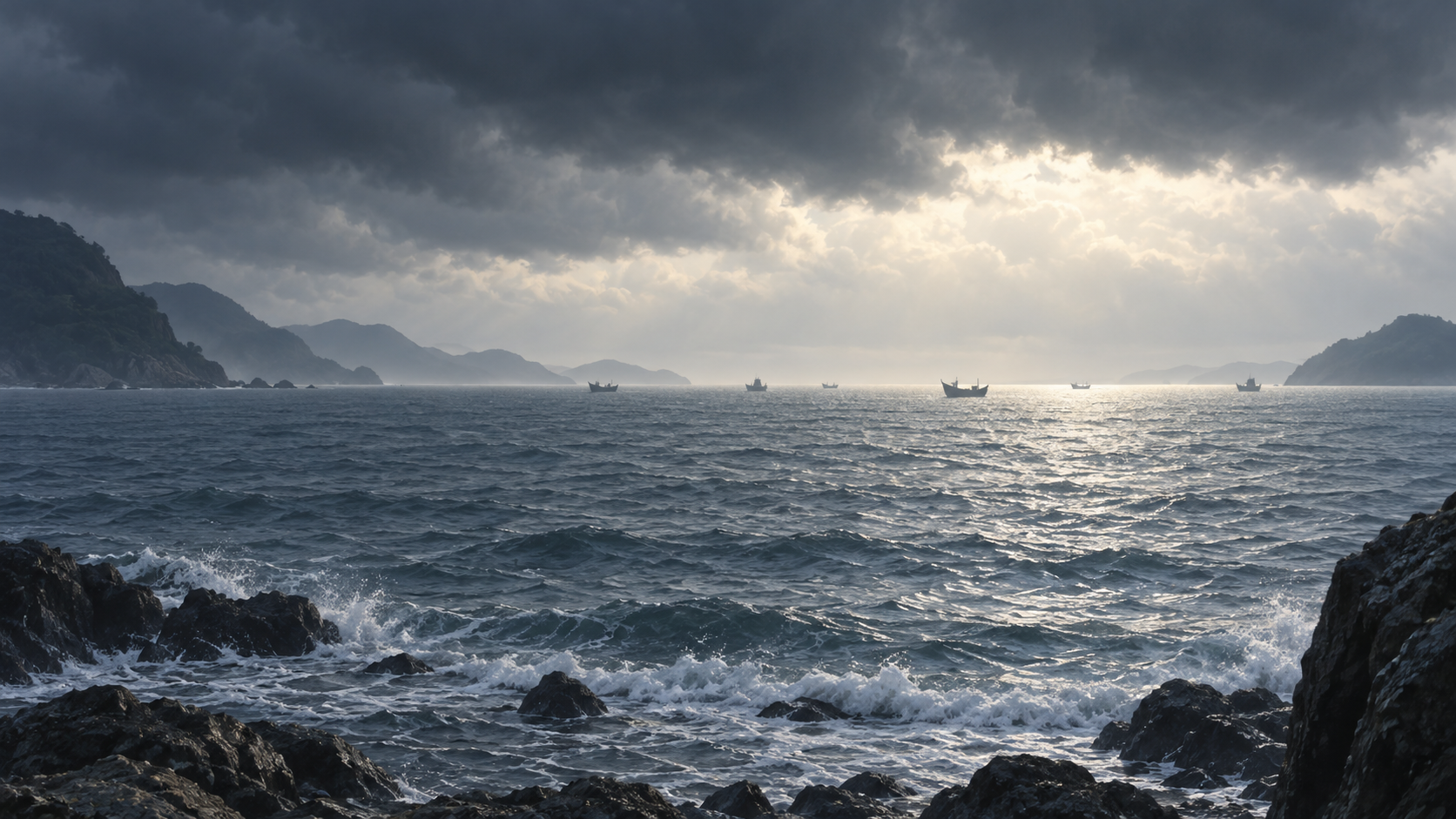
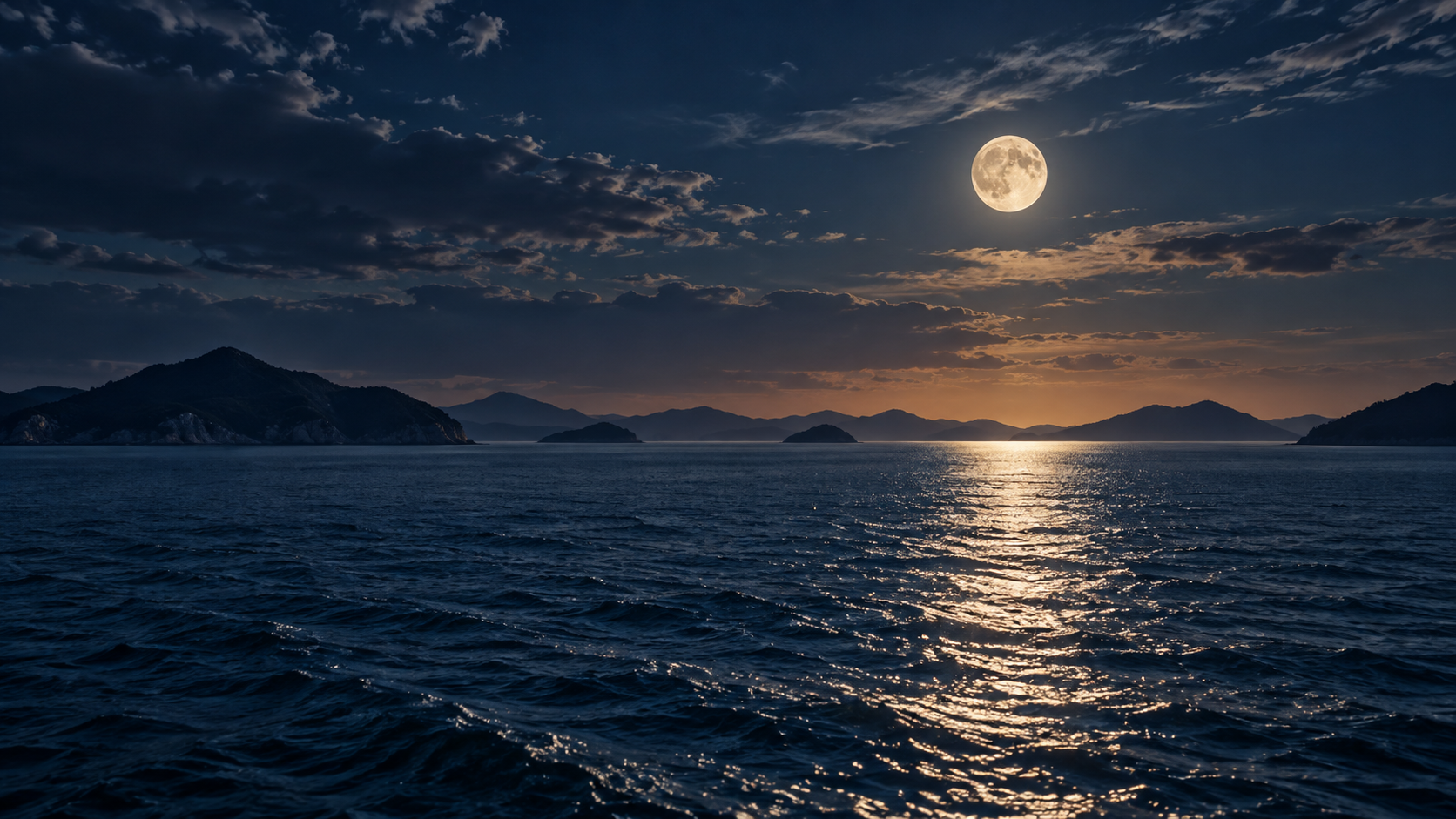
A coastal landscape can serve the same limited purpose. Water, distance, and a shore offer a visual setting for the next episode. Precise-looking sails or waves would still require evidence before they could be used to establish ships, formations, or conditions on a particular day.
We consequently keep the family's broad movement and Tomomori's personal itinerary as separate questions. The former is part of the exhibition's narrative. The latter would require a closer investigation than drawing a continuous route between the places named by that narrative.
Scene 08
Dan-no-ura within the tale
The Archives page introducing Dan-no-ura describes the Heike defeat, people entering the sea and people taken captive. Tomomori appears among those who enter the water. His death is placed within the ending reached by the family that had left the capital.
We are reading a modern exhibition's presentation of a transmitted war tale. Establishing the outcome described or a person's fate requires a different inquiry from establishing particular words, gestures or positions on the water. Each level of detail needs an appropriate basis.
The memorable details attached to Tomomori's death also belong to differing accounts. Taking armour from one description and a companion from another could produce a composite scene found in neither. Before selecting a detail, we need to identify the account it comes from.
The family narrative followed from the capital now divides between those who enter the sea and those who are captured. Tomomori's ending is one part of that larger conclusion. Its form can be read more closely through the words and traditions considered in the following scenes.
The exhibition's illustrations also show how later people received this ending. Distinguishing where a figure is placed in an image from what the accompanying explanation describes reveals another aspect of the tale's transmission. The composition itself does not fix a position on the battlefield.
Scene 09
Before a famous saying becomes a quotation
Tomomori has become associated with words conveying that he had seen what there was to see. A study of the Kakuichi text in Doho Kokubun examines the Book Eleven scene in which he speaks before entering the sea. The paper considers those words in relation to the tale's treatment of impermanence. The Japanese article presents the sense of the remark without quoting the classical sentence.
Even a familiar saying requires an identified text and checked wording before it can be printed as a quotation. In a work preserved in different textual forms, expressions from separate versions cannot be assembled from memory into one original sentence. A modern paraphrase and a direct quotation from the classical text also serve different purposes.
Reading the saying as a direct confession of Tomomori's private thoughts raises a different question from reading it as words placed at a character's death within a war tale. This article follows the latter approach, using the Kakuichi context and the interpretation offered by the study. Direct quotation would require a separately identified edition and comparison of its wording.
Even confirming words in a literary text would establish their place in that text. It would not demonstrate that the historical warrior spoke the identical sentence on that day. Distinguishing a literary scene from verified historical speech allows us to follow the transmission of Tomomori's voice with the evidence kept in view.
Scene 10
Keep the endings beside one another
Return to the differences introduced at the beginning. The Cultural Digital Library describes death beside Norimori in one account, entering the sea hand in hand with Ienaga in another, and the tale's description involving two suits of armour. They remain distinguishable descriptions.
Their appearance together in an explanatory page does not demonstrate that every detail happened together. Nor does their presence there decide which description should be accepted as the historical sequence. Investigating that question requires the sources and transmission of each account.
Before imagining the ending, we can trace the source of its details: who accompanies Tomomori, how armour is treated and what words are placed in the scene. Reading the descriptions separately reveals selected elements as well as differences left within the familiar image.
The differences therefore give us something to read, rather than a gap to close by choosing the most dramatic combination. They show which relationship or gesture a description asks us to notice. Our interpretation concerns that effect; it does not resolve the historical ending.
Norimori and Ienaga are different companions, and the difference concerns a relationship as well as a name. The person beside whom a character meets death can change the meaning of a scene for readers. Placing the traditions alongside one another preserves that difference for examination.
Scene 11
The figure continues onto the stage
The Cultural Digital Library links the tale's armour-and-sea episode to the Noh work Funa Benkei. Its explanation appears within learning material for Yoshitsune Senbon Zakura. These settings place Tomomori within a history of performance and reception as well as a history of reading.
A theatrical connection asks how a later work uses a figure or episode. It does not by itself establish what a twelfth-century warrior wore or how he moved. The line connecting tale and theatre should therefore be labelled as the transmission of a subject, rather than a chain of battlefield eyewitnesses.
That approach allows the stage image to have its own significance. We can attend to what a performance invites an audience to remember while identifying the work being discussed. The name Tomomori may link the works, but it does not erase the differences in their purposes.
Reading which period and which work portrays Tomomori has significance in its own right. Following the figure from the war tale into performance makes it possible to ask separate questions about the historical person and the image that later audiences continued to encounter.
What passes from the tale to the stage includes a recognizable character as well as episodes. Identifying the work and its period allows investigation of the battle and investigation of later responses to that character to continue with their own forms of evidence.
Scene 12
A recognizable figure, and questions that remain
Departure from the capital, continued fighting in the west, the loss of a son at Ichi-no-tani, then Dan-no-ura after Yashima: through this narrative, Tomomori is portrayed within the fate of the family. A father's remorse and words at the end of his life have given later readers a strong outline of the character.
The final companion, armour and words cannot all be gathered into one confirmed scene. The explanations introduce differing descriptions, and direct quotation requires checking a selected text. Familiarity with a figure does not establish that every detail has been verified.
Comparing contemporary records with the war tale, examining the wording of a chosen text and investigating the relationship between traditions remain further tasks. The exhibition's narrative alone cannot establish each personal journey or inner thought. Understanding a transmitted image offers a starting point for turning to other records.
Reading what each source conveys allows Tomomori to emerge beyond the role of a famous final saying. A historical person has reached later audiences through voices, manuscripts, exhibitions and performance. Investigating his actions requires continuing comparison with other evidence while retaining the tale's interest as a work of narrative.
Editorial note: This edition follows the public institutional explanations and the Kakuichi study identified in the published Japanese article. It examines portrayals in a war tale and later performance; it does not authenticate Tomomori's thoughts or speech through contemporary testimony. The synthesis of traditions is interpretive. All thirteen illustrations are AI-generated conceptual images, not verified portraits, routes, currents or fleet formations. Original exhibition, manuscript and performance photographs have not been reproduced. The film has Japanese audio; an English subtitle track has not been verified.
How to read this work
History, interpretation, and reconstruction
Tomomori's memorable final scene becomes clearer when its details remain attached to their sources: a war tale, differing traditions, and later theatre answer different questions about the same figure.
This work is grounded in published sources and historical research. Interior thoughts, dialogue, and some visual details are cinematic reconstructions. Where historians disagree, the article presents the point as debated rather than settled fact.
Timeline
The story in time
-
The exhibition's account of the tale follows the Heike leaving with Emperor Antoku.
Sources: exile -
Yashima becomes a base in the narrative; Tomomori and Noritsune appear in the western fighting.
Sources: exile -
The tale depicts Tomoakira's death and the escape of Tomomori and other surviving warriors toward the sea.
Sources: ichinotani, ntj-heike -
The exhibition follows the family farther west toward Dan-no-ura; a personal voyage is not established.
Sources: dannoura -
The Cultural Digital Library connects the tale's episode with Funa Benkei and introduces Tomomori in a theatrical learning context.
Sources: ntj-heike
People & terms
A guide for new readers
Key figures
- Taira no Tomomori
- Taira warrior whose portrayal in the Tale of the Heike and later performance is the subject of this article
- Taira no Tomoakira
- Tomomori's son, depicted in the tale's Ichi-no-tani episode
Glossary
- Heike / Taira 平家/平氏
- The family at the centre of the Tale of the Heike. The article uses Heike when following the narrative and Taira in personal names.
- Genji / Minamoto 源氏
- The name used for the Minamoto side in the exhibition's accounts of the fighting. An army or individual must still be identified within each episode.
- Gunki monogatari 軍記物語
- A war tale: a literary form that narrates warfare and people associated with it. The genre designation does not establish every passage as contemporary testimony.
- Biwa hoshi 琵琶法師
- Reciters associated with transmitting the tale with biwa accompaniment. The National Archives discusses recitation alongside manuscript and print transmission.
- Kakuichi text 覚一本
- A named textual form of the Tale of the Heike. It is one of the texts consulted for the National Archives exhibition; a quotation still requires an identified edition and passage.
- Rufubon 流布本
- The widely circulated textual form identified by the National Archives among the exhibition's sources. Its name should not be read as meaning that every version shares identical wording.
- Textual witness 伝本
- A particular copy or transmitted text through which a work is known. Distinguishing witnesses makes it possible to ask where a wording or detail occurs.
- Yashima 屋島
- The base and later battle setting in the exhibition narrative, identified with present-day Takamatsu in Kagawa. The repeated name belongs to different stages of the story.
- Dan-no-ura 壇ノ浦
- The final sea-battle setting followed here, identified by the National Archives with the Kanmon Strait at Shimonoseki. The place reference does not establish fleet positions or currents.
Sources & method
How this article was built
This English edition follows the fixed, verified published Japanese manuscript. Its scene identities, people, source links, images and timeline remain aligned with that source. Explanations orient overseas readers to family names, geography and textual transmission while preserving the attribution of literary episodes.
The sources introduce the Tale of the Heike and its transmission. The Doho study is identified as an article in Doho Kokubun, no. 17, March 1984, pages 39-59. Its title page and the passage on printed page 57 were inspected in retained images from the Japanese publication review. This confirms the reference and literary discussion used here; it does not establish the words as contemporary testimony or replace checking an adopted classical edition.
The images inherit the article-specific rights and visual review of the verified Japanese publication. Their English descriptions identify conceptual reconstructions. They cannot prove a likeness, voyage, manuscript wording, ship formation or precise death scene. No original archival, exhibition or performance images are reproduced.
The article distinguishes historical verification, literary description and interpretation. It introduces no invented speech, private thoughts, casualty totals, voyage details or composite account of the death. The Long and dedicated Short have verified public identities in the source records. Their Japanese audio and the absence of a verified English subtitle track remain explicit.
Sources
References and further reading
- Tomomori in the Tale of the Heike 源平語りごと――平家物語にみる知盛の人生 Title translated editorially for reader convenience. Japan Arts Council, Cultural Digital Library 日本芸術文化振興会・文化デジタルライブラリー Editorial English title for the Tomomori section of the performance-learning page. Consulted for the portrayal at Ichi-no-tani, differing accounts of the death, and the Funa Benkei connection. It is an institutional explanation of literary and performance traditions, not contemporary testimony. Accessed 2026-10-08
- Reading the Tale of the Heike through illustrations: introduction 挿絵で読む平家物語――展示の概要 Title translated editorially for reader convenience. National Archives of Japan 国立公文書館 Explains the exhibition's early Edo-period illustrated book and its use of the rufubon and Kakuichi texts. The exhibition's literary synopsis is distinguished from evidence contemporary with the battles. Accessed 2026-10-08
- The Tale of the Heike: transmission and differing texts 平家物語|書物で見る日本古典文学史 Title translated editorially for reader convenience. National Institute of Japanese Literature 国文学研究資料館 Introduces recitation, copying, addition, and revision. Used for textual context, rather than to settle an individual passage or the relationship between particular death traditions. Accessed 2026-10-08
- The Heike's departure from the capital and the Hojuji battle 平家都落ち・法住寺合戦 Title translated editorially for reader convenience. National Archives of Japan 国立公文書館 Exhibition synopsis supporting the collective departure, the contrasting farewells, Yashima as a base, and Tomomori's appearance in the western fighting. The article does not convert the synopsis into a daily personal itinerary. Accessed 2026-10-08
- The battle of Ichi-no-tani 一ノ谷の合戦 Title translated editorially for reader convenience. National Archives of Japan 国立公文書館 Used for the tale's presentation of Tomoakira's death, the retreat toward the sea, and other named deaths and captures. A literary account of a battle is not used to authenticate invented dialogue or casualty totals. Accessed 2026-10-08
- The battles of Yashima and Dan-no-ura 屋島・壇ノ浦の合戦 Title translated editorially for reader convenience. National Archives of Japan 国立公文書館 Supports the exhibition's narrative sequence and modern place reference. Neither its illustration nor the generated landscapes are treated as fleet diagrams or measurements of sea conditions. Accessed 2026-10-08
- The Character of the Kakuichi Text of the Tale of the Heike: Through a Consideration of the Word Aware 沼波政保「覚一本『平家物語』の性格――『あはれ』の語の考察を通して」 Title translated editorially for reader convenience. Doho University institutional repository 同朋大学学術機関リポジトリ Doho Kokubun, no. 17, March 1984, pp. 39-59. The Japanese publication review checked the repository bibliography and printed p. 57 (PDF p. 19); the retained title page and p. 57 were inspected again for this English revision. Used for the Book Eleven literary scene and the interpretation of impermanence. Neither direct classical quotation nor verified historical speech is asserted. Accessed 2026-10-08
- The Tale of the Heike and Noh texts: learning through inherited classics 平家物語・謡曲|国立国会図書館開館60周年記念貴重書展 Title translated editorially for reader convenience. National Diet Library 国立国会図書館 The exhibition distinguishes recitation and reading traditions and presents an early printed Heike and a Nagato manuscript. Used as supplementary transmission context, not as a collation of the final speech. Accessed 2026-10-08
Continue reading
More stories from Shigeki
Shigeki English
Sakai’s Merchant City: Trade, Self-Government and Survival
A port, a merchant council and town communities—from changing authority to rebuilding after fire.
- When From the later fifteenth century through the Sengoku period, the fire of 1615 and early Edo-period reconstruction.
- Where Sakai, in present-day Osaka Prefecture, where maritime routes met roads on land.
Shigeki English
The Aburanokōji Incident: After Leaving the Shinsengumi
A separation in spring, a new base in summer, and two successive attacks.
- When Kyoto in Keiō 3 (1867). The incident’s historical date corresponds to December 13, 1867.
- Where Kyoto: the guards’ successive bases, the Aburanokōji attack site and the later place of remembrance.