
SHIGEKI ENGLISH STORYEN
Japanese history in English
Tsumago: Preserving a Town That Supported Travel
Accommodation, transport and the work of residents: reading the different periods within a Nakasendō post town.
Tsumago supported lodging and transport along the Nakasendō. Its inns, transport administration and fire precautions reveal a working town; Meiji-period buildings, a reconstructed honjin and preservation from 1968 onward reveal how later residents carried its landscape forward.
At a glance
Before you enter the story
- When
- Edo-period post-station functions; Meiji-period transport and architecture; preservation from 1968 onward.
- Where
- Tsumago in Kiso, along the Nakasendō route connecting Edo and Kyoto.
- Key figures
- The Shimazaki and Hayashi families; residents involved in preservation
- What was at stake
- How a town’s accommodation and transport functions, later building histories and preservation work can be read without collapsing them into a single period.
Why this story matters
The larger history behind the turning point
A historic street can look like one continuous past while containing different building dates, repairs and changing functions. Tsumago makes it possible to follow both the work that supported travelers and the later choices that preserved a living town.
Historical context
What an international reader needs to know
A post town was more than a place to sleep
The English term “post town” here refers to a station along a historical route, not simply a modern postal office. The adopted account identifies rest, accommodation and the transport of people and goods for official journeys as connected functions. Honjin, wakihonjin, hatago and toiyaba describe different facilities or kinds of work within that setting.
Tsumago’s number in the sequence is counted from the Edo end of the Nakasendō. Magome’s following number helps locate the towns in relation to each other; it does not provide a modern route survey. The general dictionary definitions explain the system, while the local official account identifies Tsumago’s Shimazaki and Hayashi families.
A historic role is not a construction date
Three dates should remain separate while reading the townscape. The Hayashi residence’s main house belongs to the Meiji period, with framework raising in 1877 and construction completed in 1879. The honjin visible today was reconstructed in 1995 from a late Edo-period plan. Neither fact erases the earlier history of the lodging roles associated with those places.
Likewise, the 1976 selection of a preservation district and the 2007 proposal concerning the World Heritage Tentative List are different records. A proposal is not an inscription decision. The preservation history explains deliberate work on an inhabited landscape rather than presenting every building as an unchanged Edo-period survival.
Watch the film
See the story in motion
The film currently uses Japanese audio. This English article provides the context and source trail; it does not imply that an English subtitle track is available.
CHAPTER 01
A journey through a working town
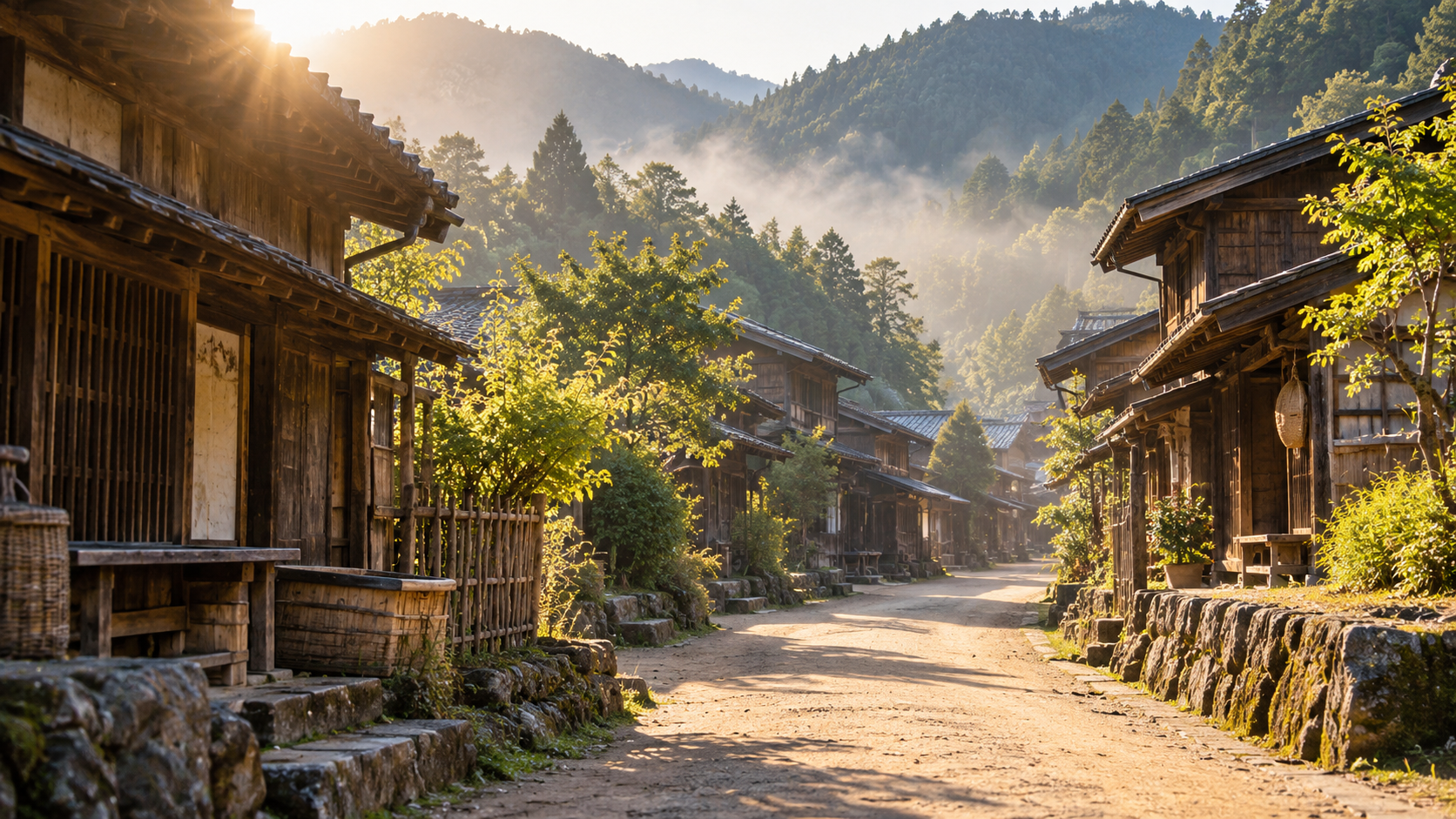
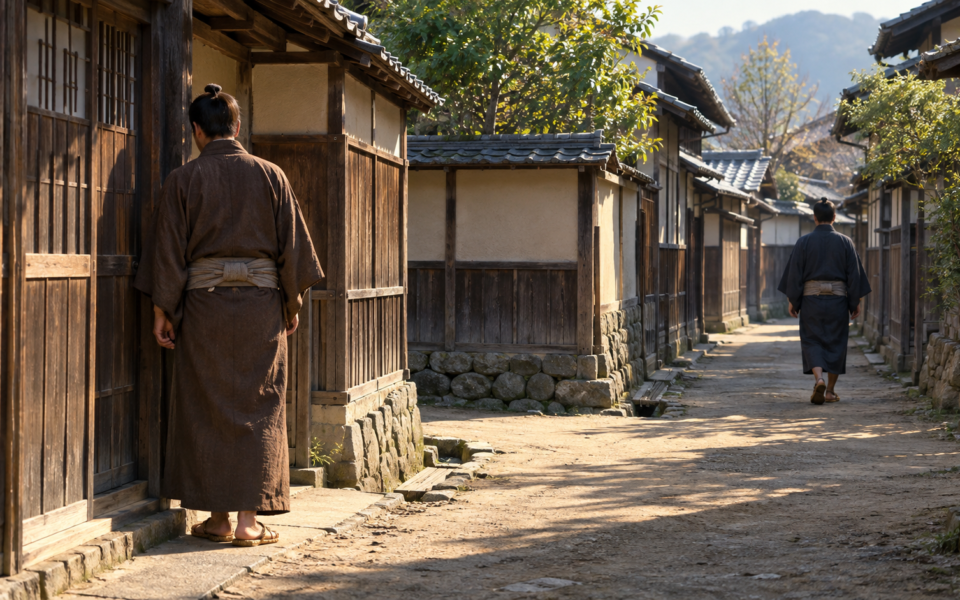
The street of Tsumago, in Kiso, invites thoughts of travel in the Edo period. Wooden buildings follow the road, and the town’s appearance encourages the visitor to imagine an earlier journey. Yet the history of a post town cannot be understood through the image of a traveler finding a bed alone.
A post town also supported journeys on official business and the movement of people and goods. Accommodation and transport were connected functions. Looking at both helps explain why a settlement along a highway had work to do beyond welcoming someone for a single night.
Tsumago provides an entry into this history: the roles of the honjin, other inns and the transport office; preparations against fire; and the preservation that followed changes in transport. The buildings are approached through the tasks associated with them, rather than through an invented traveler’s diary.
The townscape visible today contains buildings of different dates and the results of later repairs. The history belongs both to people passing through and to people living there. Keeping those two perspectives together makes it possible to ask how a town supported travel and how its residents subsequently preserved its landscape.
CHAPTER 02
One stop on the Nakasendō
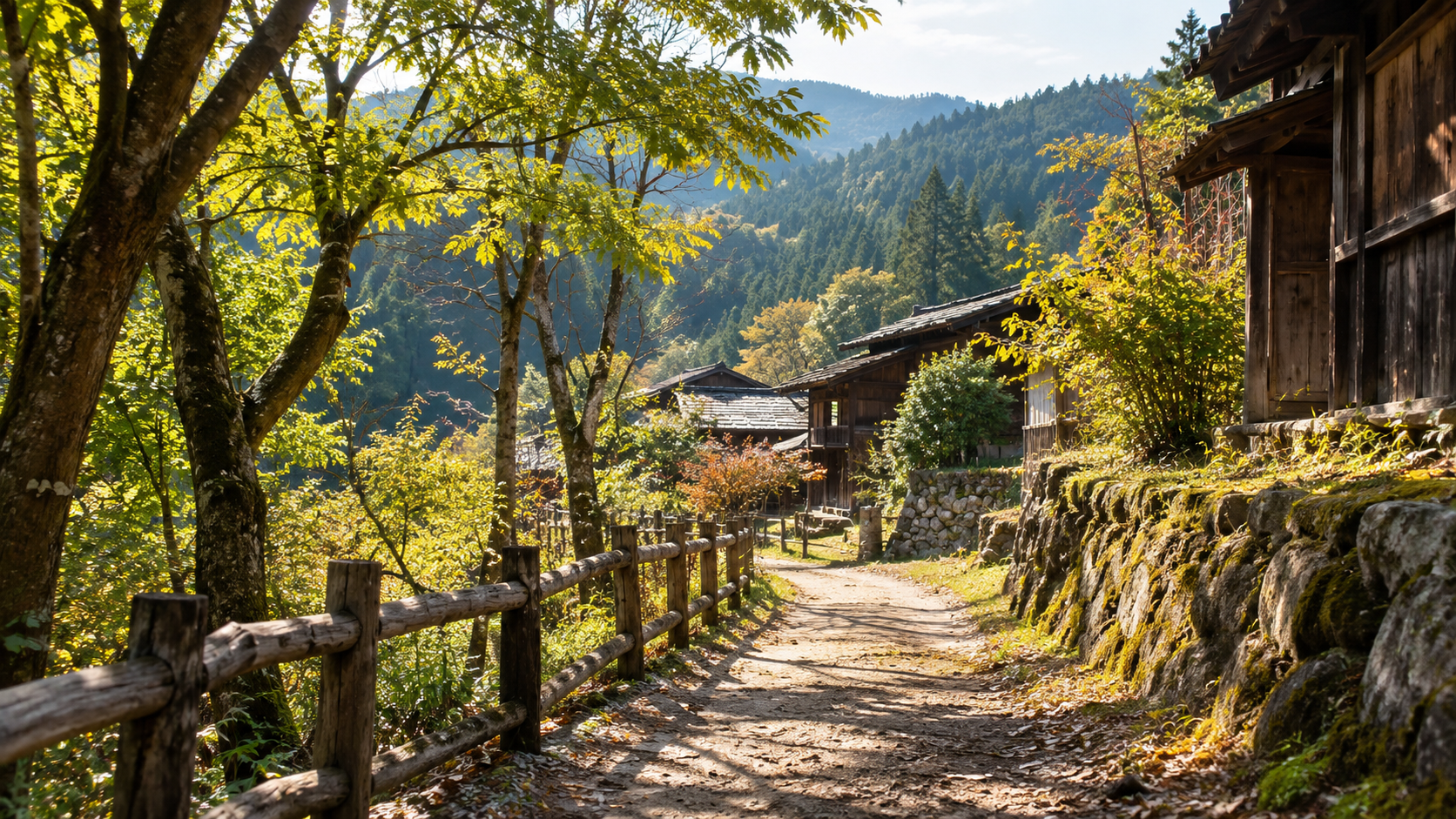
Tsumago was one of the post towns along the Nakasendō. An Agency for Cultural Affairs document identifies it as the forty-second when counted from the Edo end of the route. Neighboring Magome was the forty-third. These numbers place the two settlements in a sequence of stops along a longer road.
The sequence matters because the road connected Edo and Kyoto, and Tsumago stood on the way to another place. A post town was not an isolated destination. Its location made sense in relation to the settlements before and after it and the work that enabled a journey to continue.
A highway can be drawn as a line on a map, but that line alone does not show its functions. Along the route were places for rest and accommodation, as well as arrangements for transport. Reading the road through those activities makes the connections between towns more concrete.
A line drawn over present roads cannot, by itself, establish every historical alignment of the Edo-period route. Here the numbered relationship between the post towns is the starting point. It allows us to consider the system supporting movement without pretending to reconstruct an entire journey from a modern map.
CHAPTER 03
Accommodation and onward transport
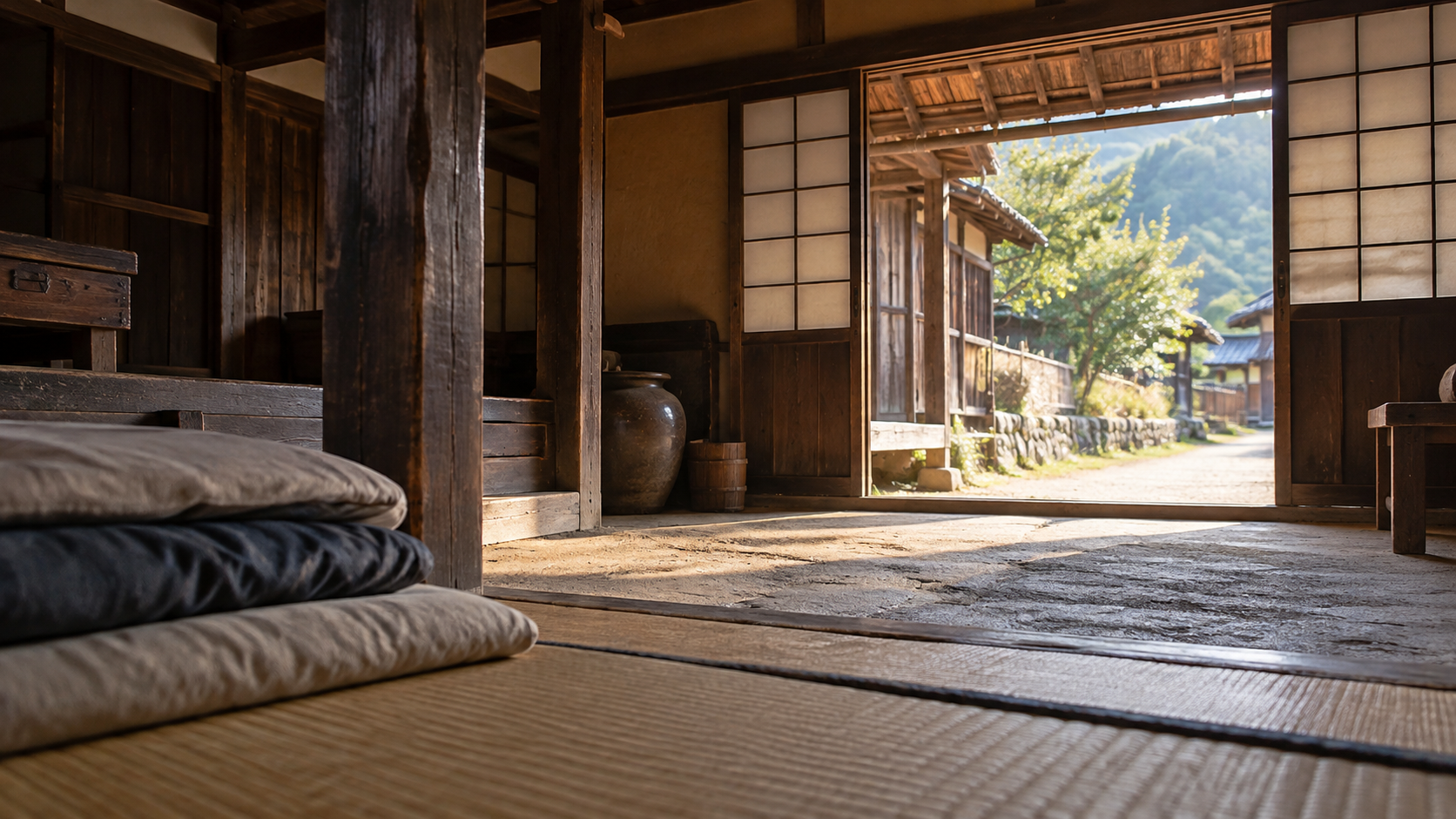
Tsumago’s official account explains that the Nakasendō post stations were established to provide rest and accommodation for official travelers and to transport their people and goods. Continuing a journey required somewhere to stop, but it also required arrangements for moving onward.
These two functions bring different kinds of work into view. One task was to receive travelers needing a place to stay; another was to connect them and their loads with the next stage. Thinking about the town’s workers in this way gives the buildings a practical setting.
The evidence does not supply a particular traveler’s arrival time, conversation or movements through the town. No such individual is invented here. An account of the functions of a post station is valuable in its own right, even when it cannot become a minute-by-minute reconstruction of a day.
Separating those functions also changes how a row of buildings can be read. Doorways and rooms become part of the work of supporting travel, while transport arrangements extend the town’s role beyond its own street. This is an interpretation of the documented functions, not a newly recovered itinerary.
CHAPTER 04
The work of the transport office
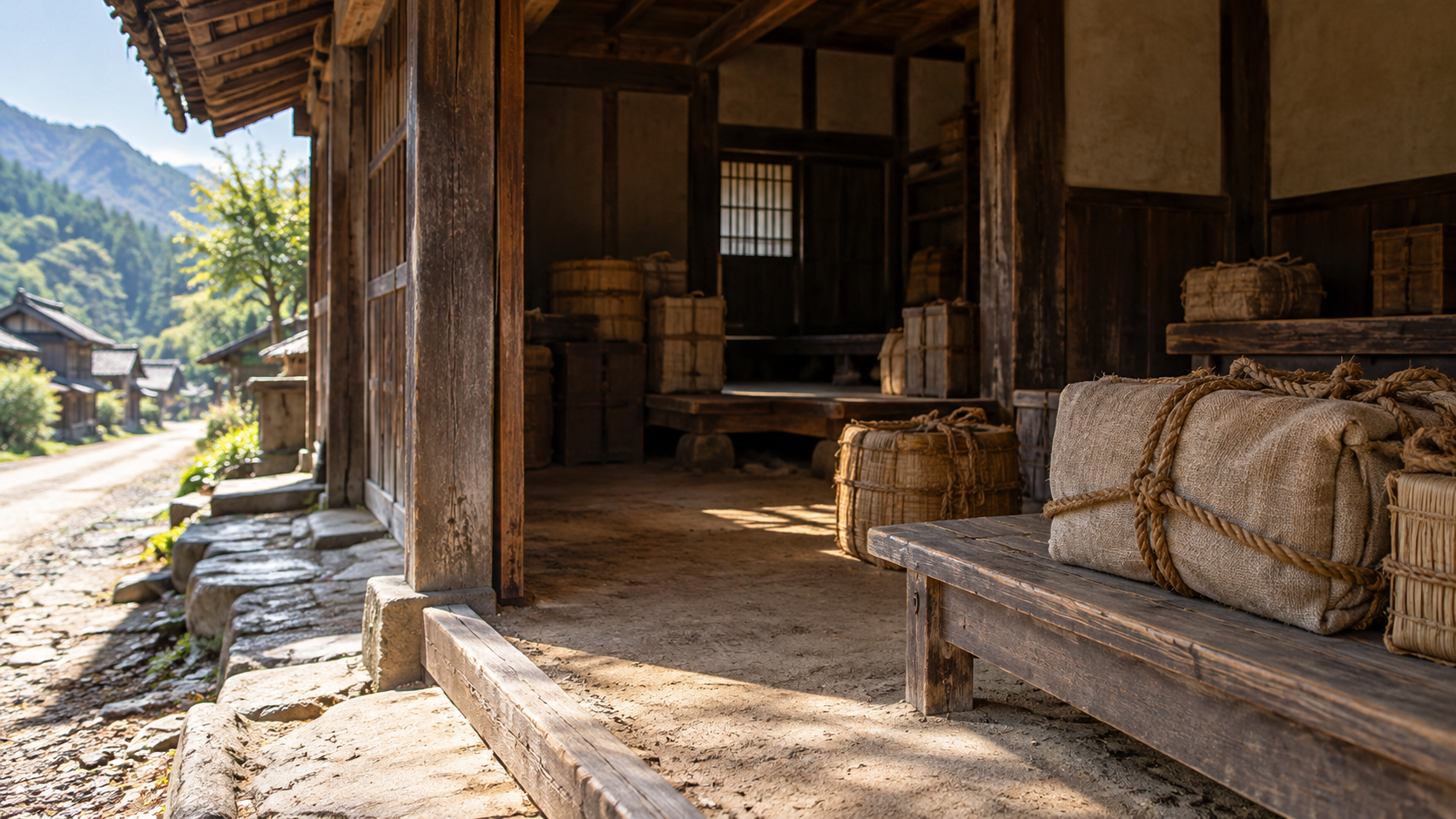
One term associated with a post town is toiyaba, the office handling administrative work concerning people and horses for official transport. The Gakken dictionary explains this general function. Its definition helps identify a type of work that might otherwise remain invisible behind the townscape.
Tsumago’s official account identifies the Shimazaki and Hayashi families as the toiya responsible for post-station duties. The dictionary and the local account answer different questions: one defines the function, while the other identifies the families associated with it in this particular place.
A road did not organize the movement of people and loads by itself. Administrative work was also part of the town’s operation. Placing that work beside accommodation helps us understand a post station as a place where onward movement had to be arranged.
The sources used here do not reconstruct a day’s ledger or provide the exact number of people assigned to a particular journey. Keeping the local family account separate from the general definition avoids filling those gaps with imagined detail. What remains clear is the presence of an organized transport function.
CHAPTER 05
Honjin and wakihonjin: roles and building dates
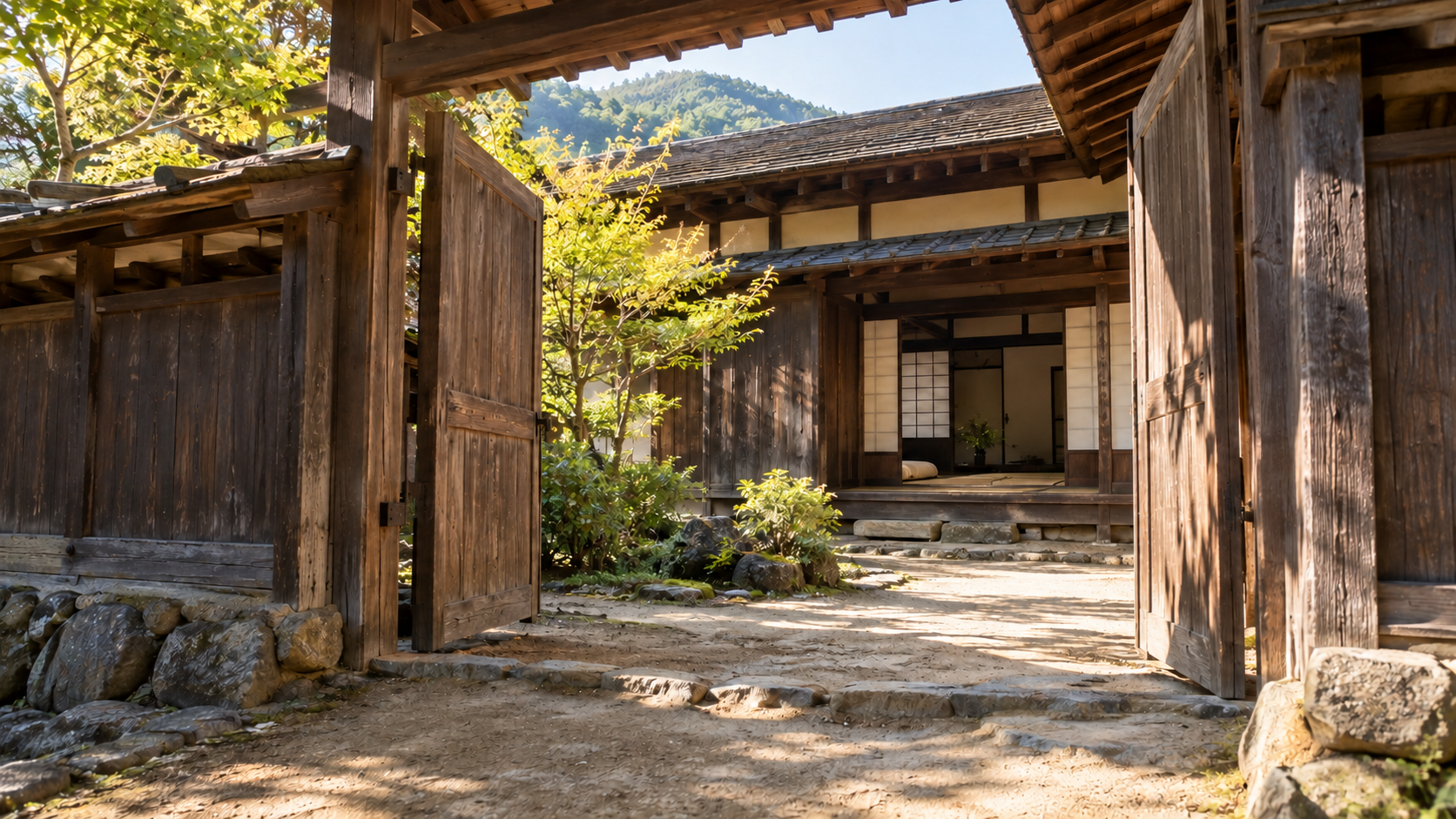
The honjin and wakihonjin were lodging facilities associated with journeys on official business. At Tsumago, the Shimazaki family held the honjin role and the Hayashi family the wakihonjin role. These names preserve the history of functions, but a function’s age is not automatically the age of the building now carrying its name.
The present honjin is not a structure that has stood unchanged since the Edo period. According to Nagiso Town Museum’s introduction, the earlier building was demolished in the Meiji period. In 1995, the honjin was reconstructed using a late Edo-period floor plan.
The present main house of Wakihonjin Okuya, meanwhile, dates from the Meiji period. Cultural Heritage Online records its framework raising in May 1877 and the completion of construction in April 1879. Its architectural value includes the combination of an early-modern townhouse tradition with design from the modern period.
These are different layers of time: an established lodging role, a later reconstruction, and a main house rebuilt in the Meiji era. Reading the building name alongside its construction history makes the evidence more precise. The town can illuminate Edo-period travel without every building having to be an untouched survival from that period.
CHAPTER 06
Hatago and the town’s daily work
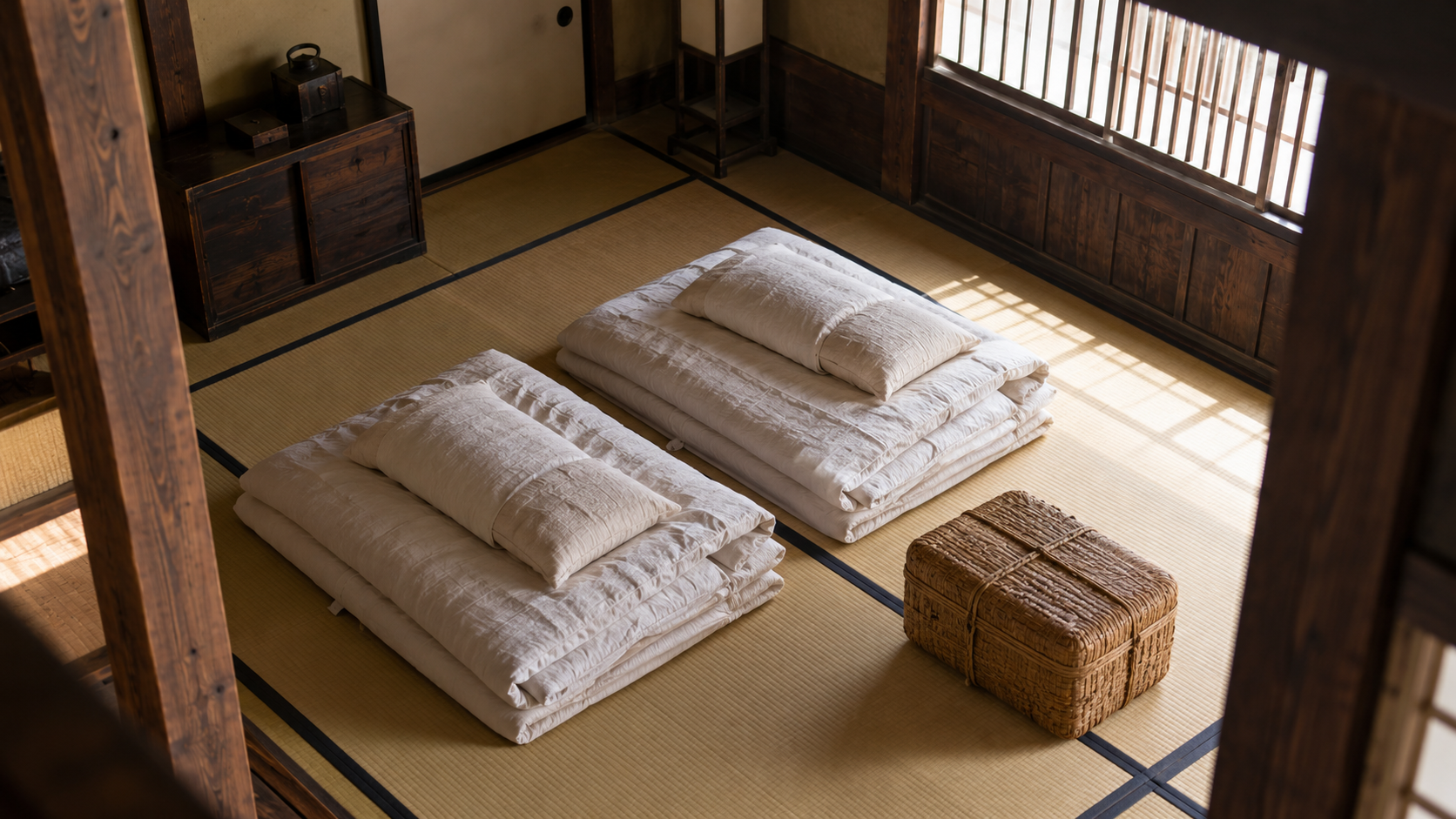
Alongside the honjin and wakihonjin were hatago, inns where travelers stayed. Gakken’s entry defines hatago as accommodation other than the honjin and wakihonjin. Its post-town entry also introduces inns and teahouses among the facilities associated with such settlements.
Different reasons for travel brought people through a town where others worked and lived. Seeing the entrances and buildings as places with distinct functions helps explain how the settlement operated. The differences between lodging types are therefore more than labels attached to attractive architecture.
The adopted definitions do not establish a particular traveler’s meal or payment. Adding an invented menu or price would turn a general account of facilities into a claim about an individual stay. The focus remains on the roles of the buildings and the work they made possible.
Accommodation of different kinds and the administration of transport were brought together along the road. Those functions provide a grounded starting point for thinking about a day on the Nakasendō. They do not require a fictional conversation to connect the traveler’s journey with the town’s livelihood.
CHAPTER 07
Preparing for fire
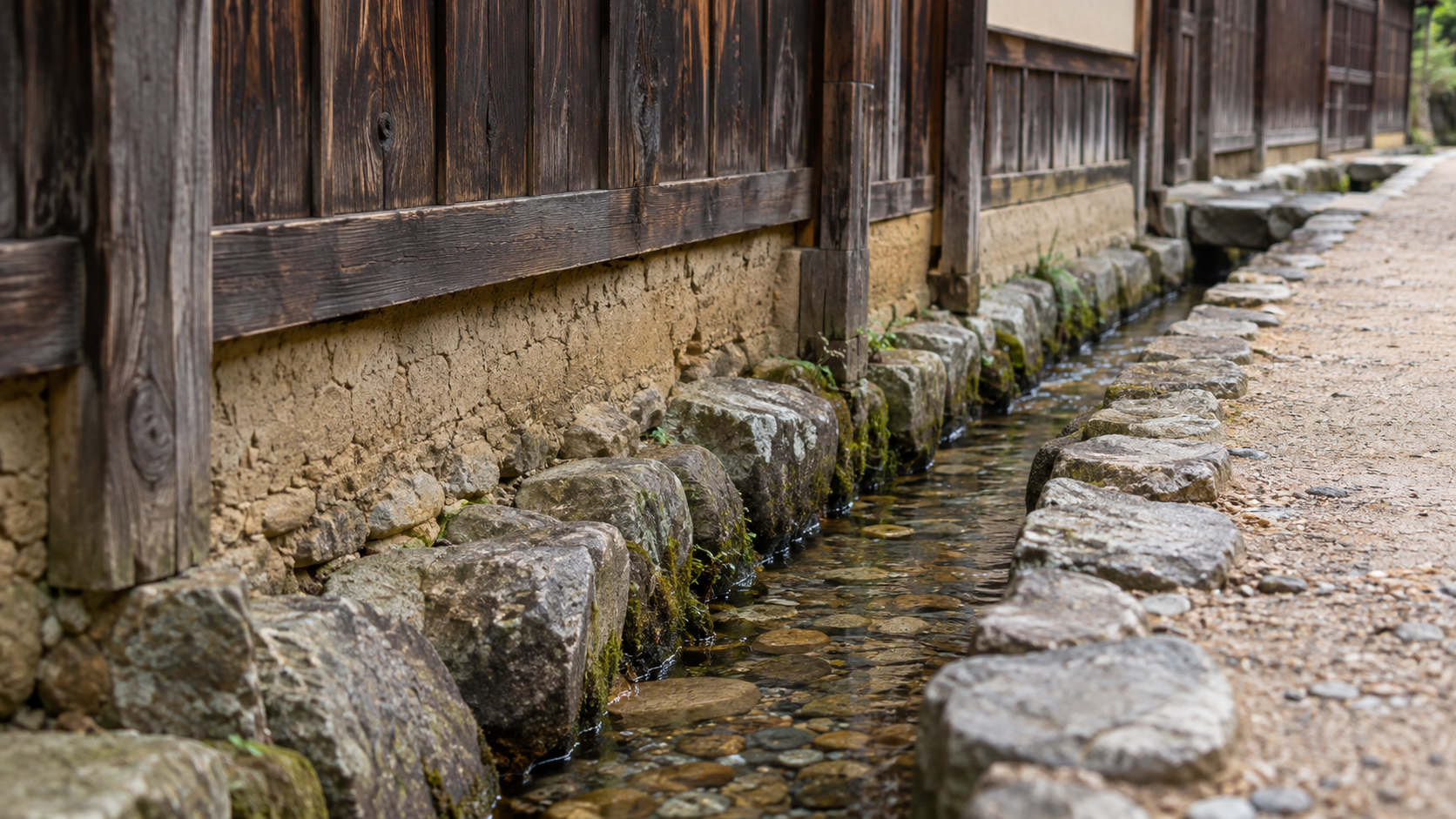
Tsumago’s official explanation also considers the relationship between a post town and fire. It notes surviving records of fires and discusses udatsu, high walls and the town’s water channels as features that can be considered in relation to fire prevention.
Protecting a settlement of adjoining buildings involved more than receiving travelers. Fire was another concern for the town and its residents. However, the shape of a surviving building cannot establish exactly how a feature performed during a particular fire.
An explanation of a feature’s possible role is different from an account of the course of an individual disaster. The distinction matters when looking at a wall or a water channel. Their presence should not be converted into an undocumented story of a fire successfully stopped.
Considering these preparations adds another way of reading the townscape. The buildings and the water running beside them can be approached through the work of protection as well as appearance. The place supporting journeys was also a place where people had lives and property to safeguard.
CHAPTER 08
When transport changed
The role of the Edo-period post town did not continue indefinitely in the same form. Tsumago’s official account explains that changes in transport from the Meiji period onward caused it to lose its post-station functions. Decline and depopulation followed in the later course of its history.
When routes and means of moving people and goods change, the work of a town along the road changes too. The survival of older buildings cannot therefore be explained as a deliberate suspension of time for preservation from the outset.
Changes in transport and livelihoods came before the later preservation effort. Leaving room for that interval prevents the old post station and today’s historic townscape from being treated as one continuous, unchanging condition. Preservation was a subsequent response, not the original purpose of decline.
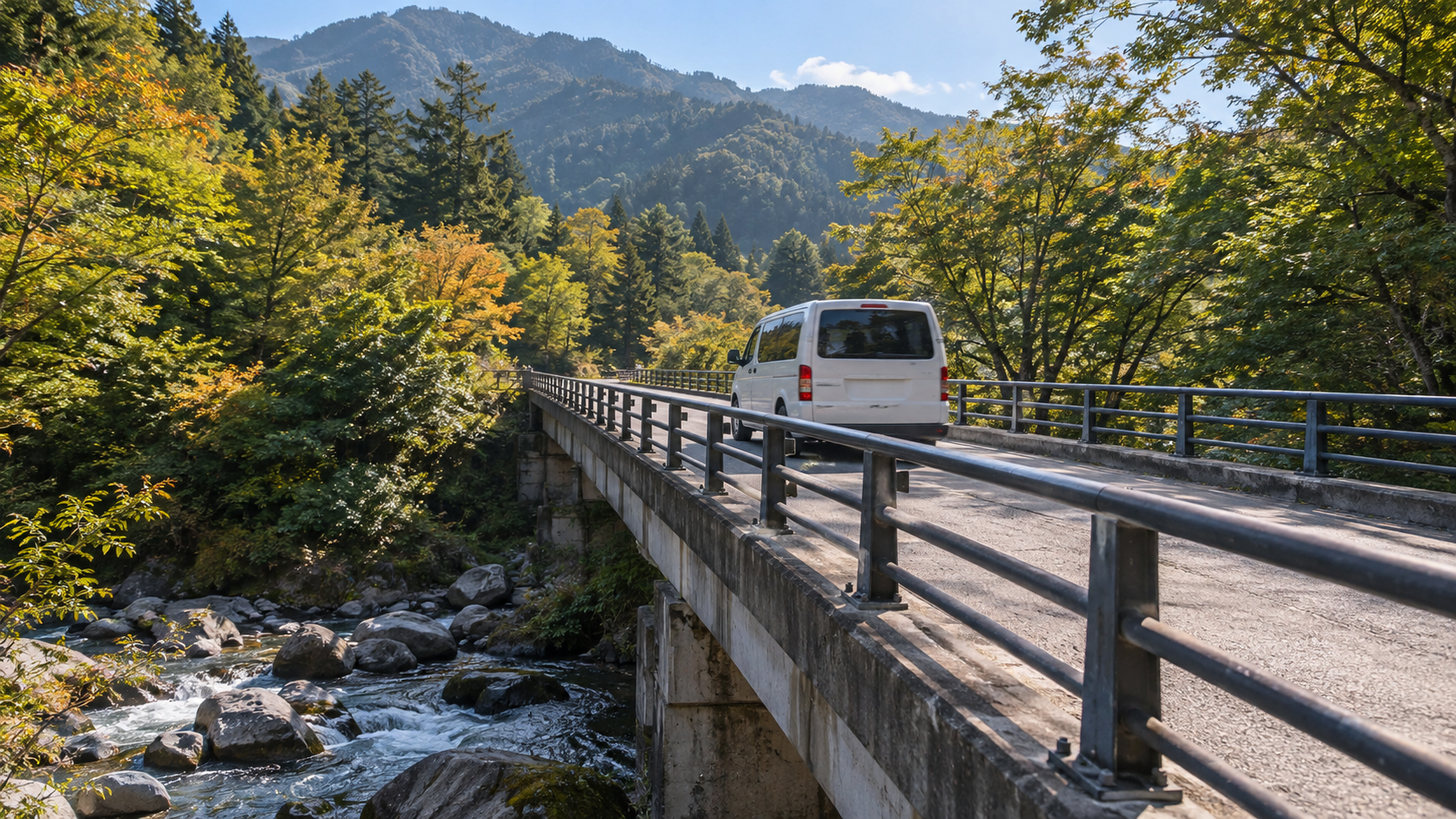
A town that had supported Edo-period travel experienced a change in its role. Later residents then faced the question of what to carry forward. The image for this chapter shows imagined present-day transport; it does not reconstruct a Meiji-period road or vehicle.

CHAPTER 09
Preservation as deliberate work
In Tsumago, the decision to carry out a preservation project was made in 1968. A three-year plan began the following year, undertaking reconstruction and work to improve the townscape. The official account describes different categories of work, including dismantling and reconstruction and repairs of different scales.
The fact that old houses survived does not, by itself, explain the town’s present appearance. Investigation, repair and work on the landscape also contributed. Preservation has its own history of action, which belongs alongside the earlier history of the post station.
Learning which parts were reconstructed does not negate the townscape’s value. It offers a way to understand what people sought to pass on and how they approached that task. A repaired building can carry evidence of both an earlier form and a later decision to preserve it.
Rather than assuming that every house visible today was completed in the same year, we can read the changes and repairs as part of its history. The landscape is supported not only by the work of the old post town but also by the subsequent work of keeping the town in existence.
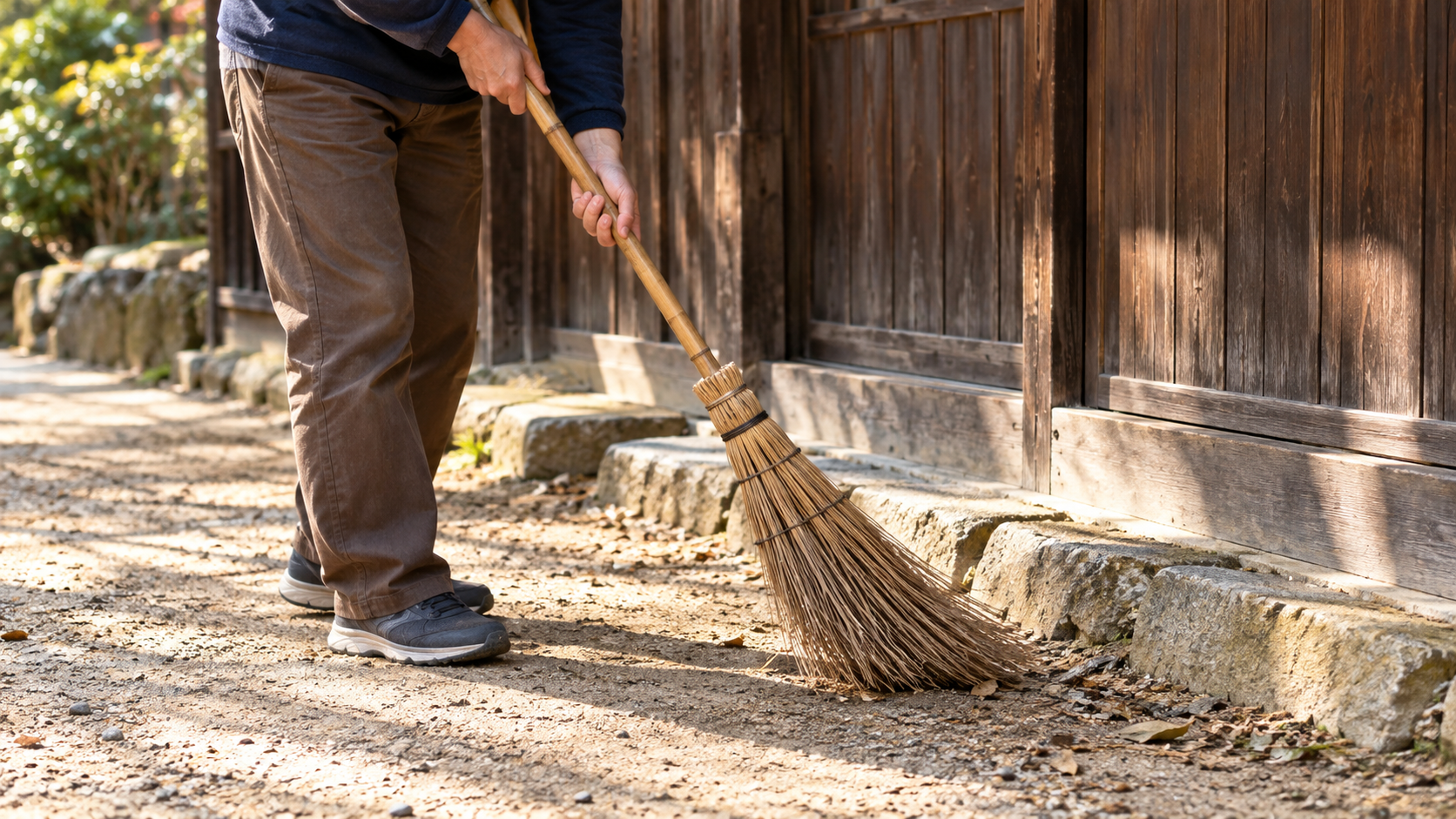
CHAPTER 10
A town protected by its residents
Residents were involved in the preservation effort. Tsumago’s official account introduces three principles concerning houses and land: not selling, not renting out and not destroying them. It also describes the residents’ charter declared in 1971.
Preserving a town does not end with retaining the exterior of a single building. It raises questions about how land and houses are treated and how a place of everyday life is passed on. The principles give those questions a concrete place in the account of preservation.
A visitor may see a beautiful street where residents also have a living environment. Holding both perspectives together makes the continuing work of preservation and use easier to recognize. The townscape is not only a view encountered during someone else’s journey.
This article follows the published introduction to the principles and charter; it does not claim an independent examination of the charter original or establish a present-day legal rule for every property. The point is to recognize a place maintained by people, rather than consume it only as a historical backdrop.
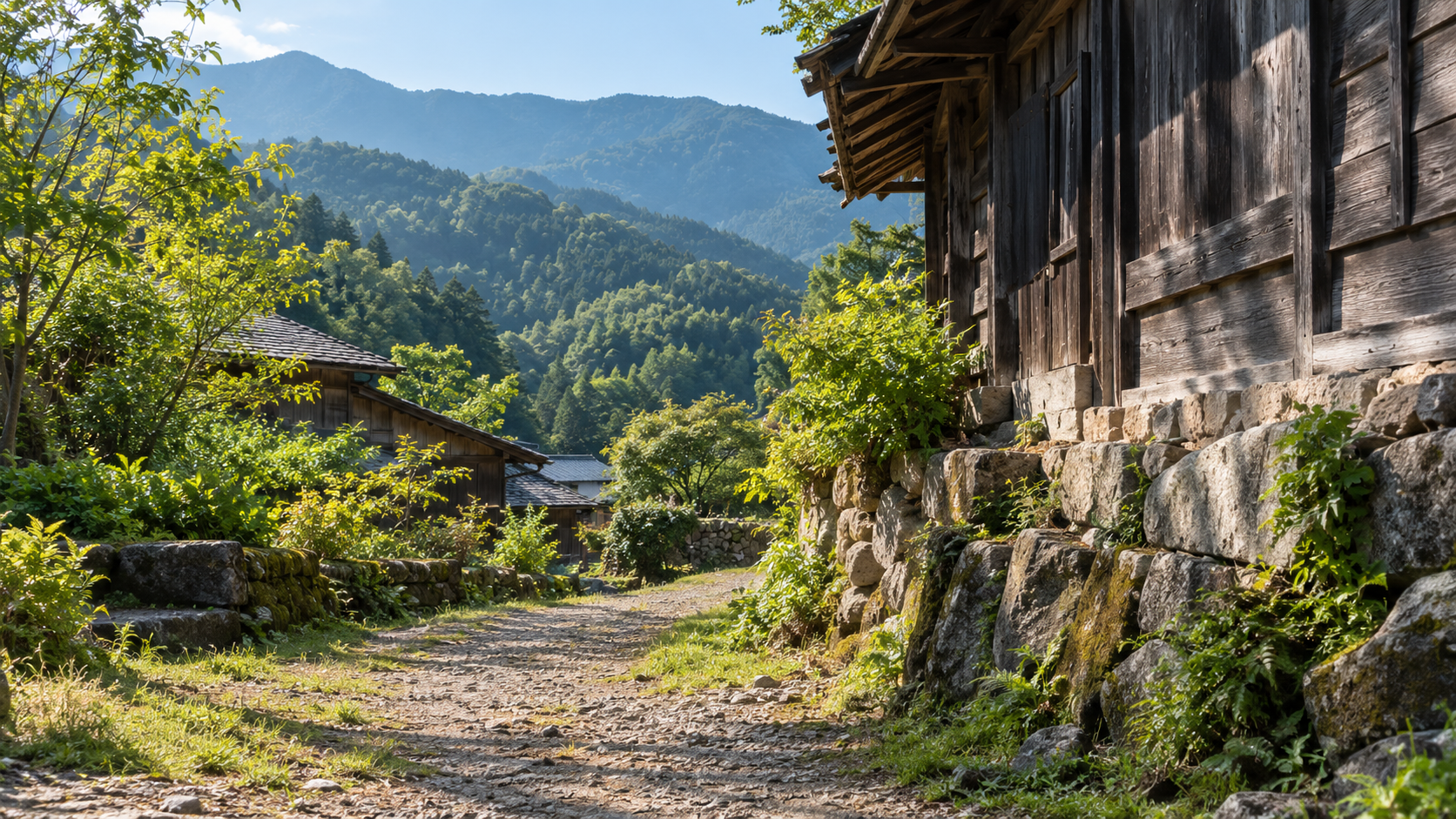
CHAPTER 11
Preserving a district
Tsumago-juku was selected as an Important Preservation District for Groups of Traditional Buildings on September 4, 1976. Cultural Heritage Online describes the post-town district, rural settlement areas and surrounding extent. The object of preservation was therefore wider than a single building.
The same account describes the post-town area as retaining the character of the late Edo and Meiji periods. The national council of preservation districts also introduces the reconstructed honjin alongside the Hayashi residence, a modern Japanese-style house. Different architectural histories coexist within the same preserved district.
An Agency for Cultural Affairs document for fiscal 2007 contains a renewed proposal concerning Tsumago, Magome and the Nakasendō for addition to the World Heritage Tentative List. A proposal of this kind is not evidence of a decision to inscribe the site as World Heritage. It must also be distinguished from the 1976 district selection.
The history followed here is that of a post town and a district preserving its landscape. Looking at roads and surrounding environments as well as buildings makes the meaning of district preservation more concrete. It also helps keep distinct the different forms of recognition and documentation associated with the place.
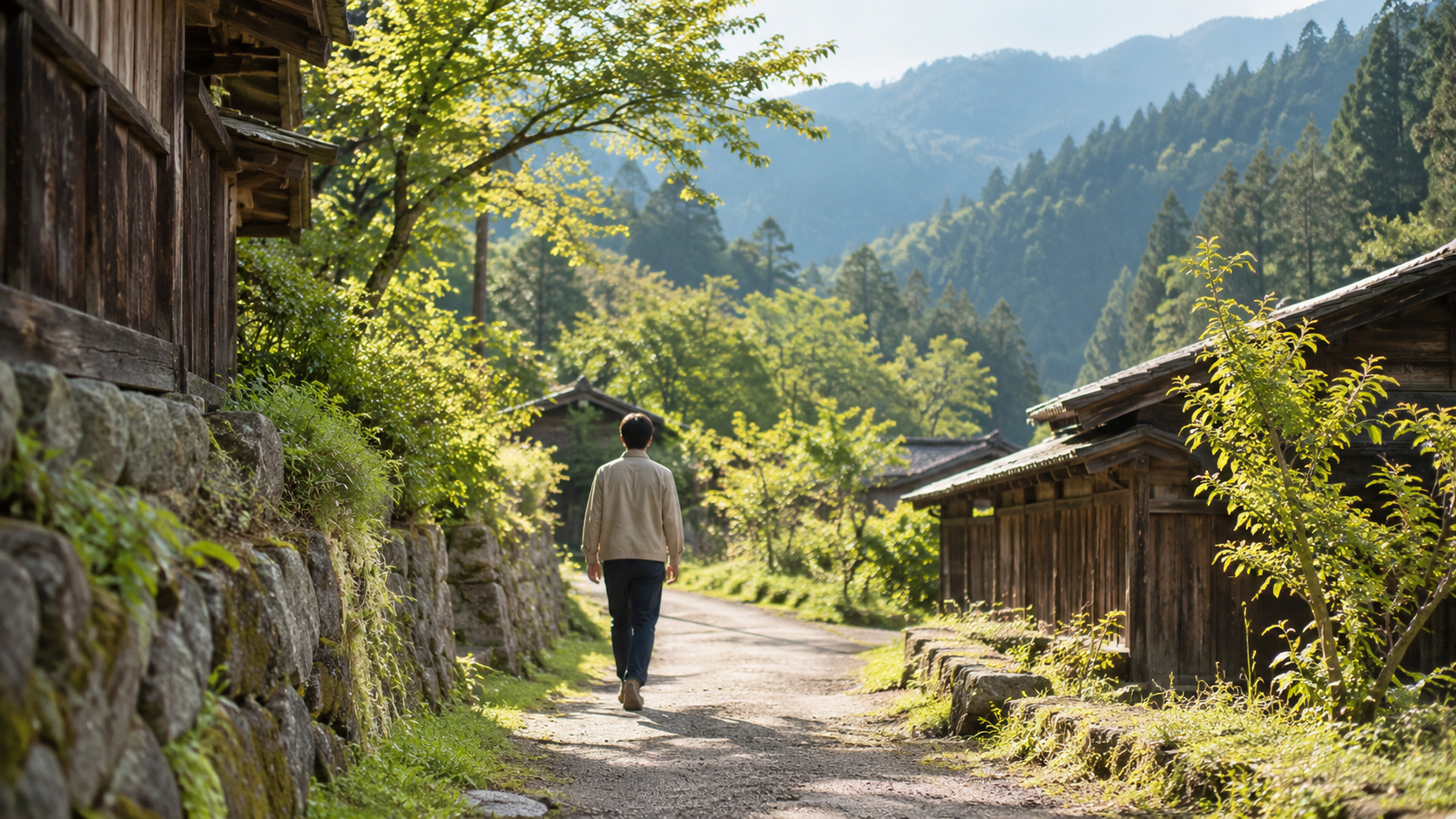
CHAPTER 12
A road for journeys and everyday life
Following Tsumago brings together accommodation, the transport of people and goods, preparations against fire, changing transport and preservation by residents. A town on the road was supported not only by those passing through but also by the work of those who lived there.
The present townscape conveys both the survival of older things and the later work of repairing and protecting them. Asking what belonged to the former post-station functions and what belongs to subsequent preservation makes those layers legible. Neither needs to disappear from the story.
Nagiso Town Museum was established in 1995 and comprises the honjin, Wakihonjin Okuya and a history museum. Encountering buildings and consulting material about their origins and the preservation movement can therefore be connected within the town. Looking at the present landscape becomes another starting point for reading its history.
Imagining a day on the Nakasendō does not require invented lines spoken by a fictional traveler. The town’s documented functions already open a way into the journey. Tsumago was a post town supporting travel and transport, and it is also a town whose landscape has been passed on while people continue to live there.
How to read this work
History, interpretation, and reconstruction
Read Tsumago through both its functions as a post town and the later work of residents preserving a place where people continued to live.
This work is grounded in published sources and historical research. Interior thoughts, dialogue, and some visual details are cinematic reconstructions. Where historians disagree, the article presents the point as debated rather than settled fact.
Timeline
The story in time
-
The Hayashi residence’s main house has its framework raised in 1877; construction is completed in 1879.
Sources: s07 -
A preservation project is approved in 1968, followed by a three-year plan beginning in 1969.
Sources: s02 -
The residents’ charter is declared, setting out three principles for protecting houses and land.
Sources: s02 -
Tsumago-juku is selected as an Important Preservation District for Groups of Traditional Buildings.
Sources: s03 -
The honjin is reconstructed, and Nagiso Town Museum is established with its three facilities.
Sources: s06
People & terms
A guide for new readers
Glossary
- Nakasendō 中山道
- The historical route connecting Edo and Kyoto on which Tsumago and Magome were successive post towns.
- Shukuba / juku 宿場・宿
- A post town or station supporting journeys, including accommodation and transport functions.
- Honjin 本陣
- A lodging facility associated with official travel; at Tsumago the role was held by the Shimazaki family. The present building is a 1995 reconstruction.
- Wakihonjin 脇本陣
- Another lodging facility associated with official journeys; at Tsumago the role was held by the Hayashi family.
- Hatago 旅籠
- An inn distinguished in the adopted dictionary from the honjin and wakihonjin.
- Toiyaba 問屋場
- An office handling administrative work for official transport involving people and horses.
- Toiya 問屋
- The role responsible for post-station business; the local account identifies the Shimazaki and Hayashi families.
- Udatsu うだつ
- An architectural feature discussed in the local account among possible fire-prevention provisions; its presence does not prove the outcome of a particular fire.
- Reconstruction 復原
- Re-creation of a building or earlier form on the basis of evidence; the Tsumago honjin was reconstructed from a late Edo-period floor plan.
- Preservation district 伝統的建造物群保存地区
- A district-based approach encompassing groups of buildings and their surroundings rather than only one structure.
- Residents’ charter 住民憲章
- The charter introduced in the official account as declared in 1971; this article uses that account without claiming an independent reading of the original.
Sources & method
How this article was built
The verified Japanese article’s twelve chapters, six timeline entries and eight source IDs are retained. No individual biographies are added. Source titles are editorial translations. The three Agency for Cultural Affairs pages count as one parent publisher, and the two Gakken entries as one, giving five actual parent publishers.
The Japanese source review and its stated reading scopes are inherited. Institutional explanations and general dictionary entries are used within those limits. Original travel papers, daily ledgers, the original residents’ charter and original plans have not been independently deciphered or edited for this article.
Edo-period functions, Meiji-period buildings, later reconstruction, district selection and a World Heritage-related proposal remain distinct. The text does not invent a traveler’s conversation, timetable, menu, payments or staffing figures, nor does it infer the success of particular fire precautions.
All accompanying images are owned AI-generated explanatory illustrations. They are not site photographs, precise reconstructions of named buildings or documentary records. The vehicle, repair work, sweeping and walking scenes are identified as modern. No institutional photographs, maps or long source passages are reproduced.
Sources
References and further reading
- Fiscal 2007 Renewed Proposal Summary: Tsumago-juku, Magome-juku and the Nakasendō 文化庁・平成19年度再提案概要「妻籠宿・馬籠宿と中山道」 Title translated editorially for reader convenience. Agency for Cultural Affairs 文化庁 Item 10 supplies the forty-second and forty-third positions and the relationship with surrounding settlements. This proposal is not evidence of World Heritage inscription. Accessed 2026-10-23
- Preserving the Townscape: Tsumago’s Official Account 妻籠宿公式・町並みの保存について Title translated editorially for reader convenience. Tsumago Tourism Association 妻籠観光協会 Used for post-station functions, fire precautions, transport change, preservation work and the introduction to the 1971 residents’ charter. Original travel papers, ledgers and the charter manuscript have not been independently examined. Accessed 2026-10-23
- Cultural Heritage Online: Tsumago-juku, Nagiso Town 文化遺産オンライン・南木曽町妻籠宿 Title translated editorially for reader convenience. Agency for Cultural Affairs 文化庁 Used for the district selection date and description, including the late Edo-to-Meiji character of the townscape. Accessed 2026-10-23
- Gakken Dictionary: Post Town 学研キッズネット・辞典「宿場」 Title translated editorially for reader convenience. Gakken 学研キッズネット A general explanation of facilities and transport administration; it is distinguished from evidence about individual operations in Tsumago. Accessed 2026-10-23
- Gakken Dictionary: Hatago 学研キッズネット・辞典「旅籠」 Title translated editorially for reader convenience. Gakken 学研キッズネット Used for the general definition of an inn, not to establish a particular inn’s menu or charges. Accessed 2026-10-23
- Nagiso Town Museum: Honjin and Wakihonjin Okuya 南木曽町博物館・本陣と脇本陣奥谷の紹介 Title translated editorially for reader convenience. Nagiso Town 南木曽町 The museum introduction distinguishes the 1995 honjin reconstruction from the Meiji-period rebuilding of the wakihonjin. Opening hours and admission charges are not adopted. Accessed 2026-10-23
- Cultural Heritage Online: Hayashi Residence, Main House 文化遺産オンライン・林家住宅 主屋 Title translated editorially for reader convenience. Agency for Cultural Affairs 文化庁 The architectural account records the framework raising in May 1877 and completion in April 1879. This is the Tsumago residence, not another house with the same family name. Accessed 2026-10-23
- Tsumago-juku, Nagiso Town 全国伝統的建造物群保存地区協議会・南木曽町妻籠宿 Title translated editorially for reader convenience. National Council of Preservation Districts for Groups of Traditional Buildings 全国伝統的建造物群保存地区協議会 Used for the settlement’s location, the reconstructed honjin and modern house, and preservation involving the town and residents. Its map images are not reproduced. Accessed 2026-10-23
Continue reading
More stories from Shigeki
Shigeki English
Sakai’s Merchant City: Trade, Self-Government and Survival
A port, a merchant council and town communities—from changing authority to rebuilding after fire.
- When From the later fifteenth century through the Sengoku period, the fire of 1615 and early Edo-period reconstruction.
- Where Sakai, in present-day Osaka Prefecture, where maritime routes met roads on land.
Shigeki English
The Aburanokōji Incident: After Leaving the Shinsengumi
A separation in spring, a new base in summer, and two successive attacks.
- When Kyoto in Keiō 3 (1867). The incident’s historical date corresponds to December 13, 1867.
- Where Kyoto: the guards’ successive bases, the Aburanokōji attack site and the later place of remembrance.