

SHIGEKI ENGLISH STORYEN
Japanese history in English
Minamoto no Yoshitsune: How a Victorious Commander Became a Fugitive
From Ichi-no-Tani and Dannoura to Koshigoe, the failed western escape, and death at Koromogawa
Minamoto no Yoshitsune joined his half-brother Yoritomo in 1180 and became prominent in the campaigns that destroyed the Taira. After victory in 1185, questions of court office, military command, and warrior allegiance deepened their conflict. This article separates the documented sequence from the tragic hero created by later literature.
At a glance
Before you enter the story
- When
- From Yoshitsune's meeting with Yoritomo in 1180 through the Taira campaigns of 1184 to 1185 and his death at Koromogawa in 1189
- Where
- Eastern and western Honshu, Shikoku, the Shimonoseki Strait, Kyoto and Kamakura, and finally Hiraizumi in northern Japan
- Key figures
- Minamoto no Yoshitsune, Minamoto no Yoritomo, Minamoto no Noriyori, Minamoto no Yukiie, Fujiwara no Hidehira, Fujiwara no Yasuhira
- What was at stake
- The dispute tested who could command warriors, distribute authority, and mediate relations with the imperial court after the common enemy had been defeated.
Why this story matters
The larger history behind the turning point
Yoshitsune occupies an unusual place in Japanese historical memory. He is celebrated for victories that helped end Taira power, yet his life is remembered above all as a tragedy of rejection, flight, and death. Later tales, theatre, and popular culture made that reversal emotionally immediate. Historical explanation requires an additional step: identifying which events are documented, which conclusions are scholarly interpretations, and which memorable episodes belong to later storytelling.
The conflict also illuminates a structural problem at the beginning of warrior government. A commander could be useful when distant battlefields demanded initiative but troubling when postwar rule required a recognised chain of command. Court appointments, control of military followers, and access to political legitimacy all mattered. Yoshitsune's career therefore opens a window onto institutions as well as family conflict.
Historical context
What an international reader needs to know
The conflict between the Minamoto and Taira
The wars of the 1180s grew from a wider struggle involving the imperial court, regional warriors, and rival branches of elite military families. Yoritomo established a base in Kamakura and organised warriors in eastern Japan, while the Taira remained powerful around the court before retreating west. Yoshitsune joined Yoritomo's military cause and later commanded forces in the campaigns against their opponents.
The labels Minamoto and Taira can make the conflict look like two unified modern parties. In practice, military coalitions, kinship, regional interests, and court authority overlapped. Yoshitsune's position depended not only on being Yoritomo's half-brother but also on the commanders, warriors, and institutions through which orders were transmitted.
Why later chronicles and tales must be distinguished
The Azuma Kagami is a chronicle centred on the Kamakura government and compiled around a century after Yoshitsune's lifetime. It is indispensable, but it is not a neutral diary written at the moment of every event. The Gikeiki, completed in the medieval period even later, is a narrative work that greatly expanded Yoshitsune's adventures and the roles of companions such as Benkei.
A later source can preserve valuable material, and an entertaining tale can reveal how historical memory developed. Neither principle allows every speech, leap, duel, or death scene to become fact. This article uses the chronicles, court diary, public timelines, regional histories, and research guides for the questions they can answer, while treating the tragic hero as a separate history of reception.
Watch the film
See the story in motion
The film currently uses Japanese audio. This English article provides the context and source trail; it does not imply that an English subtitle track is available.

1185 — From victor to fugitive
The legendary hero and the Yoshitsune of the record are not identical
Yoshitsune is widely known as the brilliant commander of Ichi-no-Tani, Yashima, and Dannoura. His encounter with Benkei, the descent at Hiyodori Pass, the leap across boats, and the last stand at Koromogawa became memorable through later tales and performance. Together they created a coherent tragic hero whose popularity has long outlived the political world of the 1180s.
The principal texts do not all have the same character. The Azuma Kagami is a Kamakura-centred chronicle compiled long after the events it narrates; it is not Yoshitsune's contemporary diary. The Gikeiki is a later narrative work whose purpose and form allowed the hero's adventures and relationships to grow. Both deserve study, but they cannot be read as interchangeable eyewitness reports.
This edition preserves that distinction rather than trying to strip the legend away. Military movements, appointments, the stop at Koshigoe, the autumn confrontation, flight, and death in Hiraizumi can be followed through chronicles, a court diary, public timelines, and regional histories. Dialogue, secret thoughts, superhuman feats, and perfectly staged final words are not used as causal evidence.
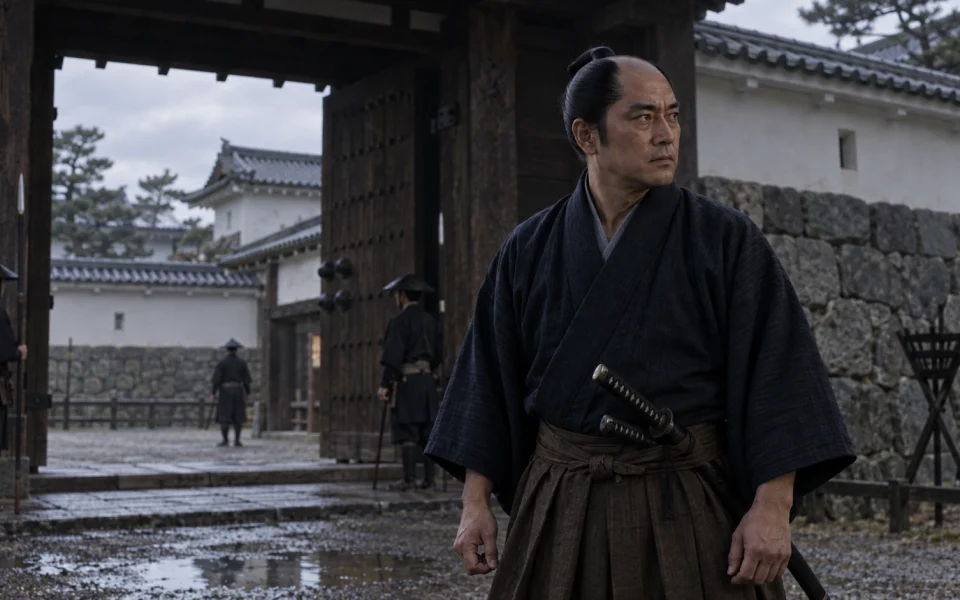
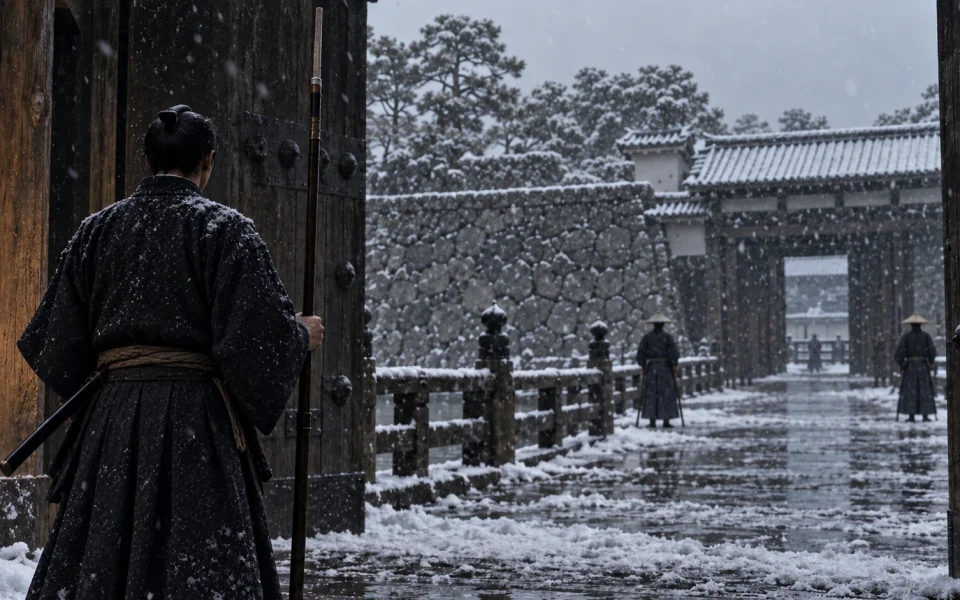
The guiding question is why a victorious commander became a man pursued by the same brother whose cause he had served. Instead of inventing jealousy or ambition, the article follows changes in orders, office, access, allegiance, and military action. The image similarly avoids fixing one authentic face and uses sea, banners, a closed road, and northern snow as openly interpretive symbols.

1180 to 1184
The Yoshitsune visible in the record entered Yoritomo's military enterprise
Yoshitsune's youth is surrounded by later traditions. The public sources used here place a comparatively firm point of entry in 1180, when he is said to have met Yoritomo near the Kise River. Yoritomo was building a base at Kamakura and organising eastern warriors; Yoshitsune entered the military action associated with that cause rather than beginning as an independent adventurer.
In early 1184, forces aligned with Yoritomo removed Minamoto no Yoshinaka from Kyoto and then turned against the Taira. Kobe City's public history describes Noriyori's and Yoshitsune's armies taking different approaches at Ichi-no-Tani. The broad structure of multiple forces and routes is better supported than a single definitive reconstruction of the famous steep-slope attack.
Yoshitsune's role brought individual distinction, but the troops and warrior followers existed within a wider political framework. Yoritomo's authority, regional commanders, and multiple armies all shaped the campaign. Separating personal fame from institutional membership is essential because the later dispute concerned precisely who could direct and reward warriors after the common campaign ended.
No source used here gives a reliable transcript of the brothers' reunion or Yoshitsune's youthful expectations. The article therefore starts with the meeting and documented military sequence. Even where the route at Ichi-no-Tani remains disputed, the relationship between battlefield achievement and belonging to Yoritomo's enterprise can be examined without manufacturing a heroic origin scene.

1185
At Yashima and Dannoura, military success reached its height
In 1185, Yoshitsune continued the campaign against the Taira. Public timelines and relevant Azuma Kagami entries establish the sequence from Yashima in the second month to the battle of Dannoura on March 24. The operations carried the war across different terrain and culminated in the Taira's defeat in the Shimonoseki Strait.
At Yashima, the article retains the military movement across the water and pressure on the Taira position as its backbone. The famous episode of an archer striking a fan target is not necessary to explain the political sequence and is not treated as a securely reconstructed incident here. At Dannoura, tides, formations, and individual actions likewise remain subjects that cannot be compressed into one unquestioned tactical diagram.
As long as the objective was pursuit of the Taira, Yoshitsune's mobility and judgement contributed to victory. Once the opposing power collapsed, the central problems changed. Captives, rewards, court office, relations with warrior followers, and communication with the imperial court demanded forms of authority different from the initiative rewarded on a distant battlefield.
Victory did not automatically cause the brothers' conflict, but it exposed questions that wartime urgency could postpone. Yoshitsune's military fame and his political position were not the same asset. By treating the end of the campaign as a shift in the criteria of success, the article explains how a celebrated victor could enter a far less secure postwar landscape.

After the military victories
Battlefield discretion and Kamakura control followed different logics
A familiar explanation says that Yoshitsune lost Yoritomo's trust because he accepted appointment as kebiishi without permission. A court office could indeed conflict with Yoritomo's effort to control how warrior followers received commands and honours. The appointment is therefore important, but importance is not the same as being a complete, isolated cause.
Research summarised in the sources questions a simple one-event narrative. The timing of Yoritomo's response, Yoshitsune's later offices, and his continued holding of the kebiishi position complicate the idea that the first appointment instantly completed the break. Treating the relationship as already irreparable at that moment would leave the later stop at Koshigoe and the autumn escalation insufficiently explained.
Two forms of authority overlapped around Yoshitsune. The imperial court could grant office, while Yoritomo sought to place warriors and military command within an order centred on Kamakura. Yoshitsune was simultaneously a commander, a court office-holder, and Yoritomo's brother. The evidence does not demonstrate that accepting office amounted to a fully designed independent regime.
A distant commander needed room to make decisions under battlefield conditions. Postwar rule placed greater emphasis on who issued orders, who mediated court relations, and who could bind followers. An effective wartime habit could appear as disobedience within a different institutional setting. This structural explanation does not claim access to Yoritomo's jealousy or Yoshitsune's ambition; it follows offices, commands, exclusions, and pursuit.

May 1185
Even after reaching Koshigoe, Yoshitsune could not enter Kamakura
After Dannoura, Yoshitsune travelled east with Taira captives. The Azuma Kagami records that on May 24 he was kept at Koshigoe and not admitted into Kamakura. Whatever the full chain of private communications, the political result was visible: military victory did not grant the commander direct access to the centre of Yoritomo's power.
A document later known as the Koshigoe Letter presents an appeal grounded in loyalty and the brothers' relationship. Its powerful language has often been read as Yoshitsune's own voice. The exact status, wording, and transmission of the document are debated, however, and the Kamakura City guide carefully describes it as a letter Yoshitsune is said to have written.
The Azuma Kagami itself was compiled roughly a century after the events and from a Kamakura-centred perspective. A document embedded in that chronicle cannot automatically be treated as an unquestionably preserved autograph. The article therefore uses the recorded stop at Koshigoe as its firm narrative spine without performing the letter as a transparent confession or inventing Yoritomo's silent response.
Debate over the letter does not make the entire episode disappear. Different levels of certainty can coexist: exclusion from Kamakura, a transmitted appeal whose textual history requires caution, and the continuation of conflict. Distinguishing those layers preserves the political meaning of the closed road while preventing literary immediacy from posing as direct access to Yoshitsune's mind.

Autumn 1185
Distrust developed into an openly military confrontation
The conflict did not end when Yoshitsune left Koshigoe. In the autumn of 1185, he and Minamoto no Yukiie moved against Yoritomo and sought authority through the court. Yoritomo's side pursued action against them in return. Political suspicion had become a contest involving orders, mobilisation, and the threat or use of force.
Yoshitsune does not appear to have secured broad support around Kyoto. A later plan to move west also failed. Relevant entries in the courtier Kujo Kanezane's diary Gyokuyo and the Kamakura-centred Azuma Kagami describe departure by sea in November followed by storm, failure, and dispersal, though the sources' viewpoints and details are not identical.
The exact departure point, weather sequence, passenger arrangement, and position of each vessel remain open to examination. The article retains the supported outline: Yoshitsune and his companions attempted a western movement, the maritime effort failed, and they became fugitives. It does not use a spectacular storm scene as a complete explanation for the political collapse.
Appointment, court authority, warrior mobilisation, and direct opposition had now accumulated. The break was not a single rebuke suddenly transformed into tragedy. Reading the spring and autumn events as separate stages shows distrust widening into armed politics. The image uses divergent lines between Kamakura, Kyoto, and the sea rather than inventing a face-to-face quarrel between the brothers.

1186 to 1189
Hiraizumi changed from refuge into the setting of the final attack
Unable to establish himself in the west, Yoshitsune remained in hiding and eventually reached Hiraizumi in northern Japan. Hiraizumi's public timeline places his return around 1186 to 1187 and identifies Fujiwara no Hidehira as his protector. The refuge extended the conflict beyond a dispute between two brothers to relations between Kamakura and the Northern Fujiwara.
Hidehira died in 1187. Yoritomo continued demanding action against Yoshitsune and applied pressure to Hidehira's successor Yasuhira. The political setting cannot be understood by treating Hiraizumi as an empty remote hideout: it was the centre of a regional power whose leadership and relationship with Kamakura had their own stakes.
For the intercalary fourth month, day 30, in 1189, the Azuma Kagami records an attack by Yasuhira's side at Koromogawa and Yoshitsune's death. The layout of the residence, his final speech, and Benkei's standing death do not share the same evidentiary status. They belong to later or elaborated memory unless separately demonstrated.
Yoshitsune's end was produced through a chain of pressure, succession, and choice rather than by fraternal emotion alone. His military fame did not provide safety outside Yoritomo's order. Keeping the political relations visible allows the tragedy to remain powerful without replacing the Northern Fujiwara and Kamakura with a self-contained last-stand tableau.
Political conclusion and later memory
No single emotion or appointment explains why Yoshitsune was pursued
The Gikeiki and later performing arts expanded Yoshitsune's life into a narrative of companions, adventures, flight, and tragic death. That tradition has historical value of its own: it shows how a defeated fugitive became one of Japan's enduring heroic figures. Its emotional coherence should not be mistaken for a complete contemporary record of cause and effect.
No source used here securely demonstrates Yoritomo's jealousy as the decisive cause, nor does it establish one comprehensive plan of ambition by Yoshitsune. The kebiishi appointment mattered, but it does not by itself explain Koshigoe, the autumn bid for court authority, the failed western movement, the years of flight, and the pressure placed on Hiraizumi.
What can be traced is a sequence. Yoshitsune fought within Yoritomo's military enterprise, gained court office, was denied entry to Kamakura, moved into opposition with Yukiie, failed to relocate west, and ultimately died under pursuit in Hiraizumi. Each step changed his political position even when the motives of the brothers remain inaccessible.
Taken together, the events show battlefield initiative and fame colliding with a postwar order concerned with command, warrior allegiance, and relations with the court. Yoshitsune won battles yet lost a secure place in the authority that victory helped create. Later legend and institutional history can both be preserved when the first is read as memory and the second is argued from dated actions rather than imagined psychology.
How to read this work
History, interpretation, and reconstruction
Yoshitsune's fall cannot securely be reduced to Yoritomo's jealousy or to one unauthorised appointment: battlefield discretion, court rank, Yoritomo's developing control of warrior followers, and the escalation from political distrust to armed opposition all overlapped after the Taira's defeat.
This work is grounded in published sources and historical research. Interior thoughts, dialogue, and some visual details are cinematic reconstructions. Where historians disagree, the article presents the point as debated rather than settled fact.
Timeline
The story in time
-
Minamoto no Yoshitsune is said to meet his half-brother Yoritomo near the Kise River and joins the military enterprise associated with him.
Sources: fukushima-yoshitsune, hiraizumi-timeline -
Forces aligned with Yoritomo remove Minamoto no Yoshinaka from Kyoto, after which Noriyori's and Yoshitsune's armies attack the Taira at Ichi-no-Tani by different approaches.
Sources: kobe-ichinotani, hiraizumi-timeline -
The battles of Yashima and Dannoura end a major phase of the campaign with the defeat of the Taira.
Sources: takamatsu-yashima, shimonoseki-dannoura, ndl-azumakagami -
The Azuma Kagami records Yoshitsune being held at Koshigoe, unable to enter Kamakura, while an appeal was transmitted.
Sources: ndl-azumakagami, kamakura-yoshitsune-guide -
Yoshitsune and Yukiie move into opposition to Yoritomo, while Yoritomo's side pursues action against them.
Sources: ndl-azumakagami, archives-gyokuyo, hiraizumi-timeline -
Yoshitsune and his companions attempt to move west, but their maritime departure ends in failure and dispersal.
Sources: hi-gyokuyo-weather, amagasaki-yoshitsune-west, ndl-azumakagami -
Yoshitsune reaches Hiraizumi and receives Fujiwara no Hidehira's protection; Hidehira dies in 1187.
Sources: hiraizumi-timeline, hiraizumi-fujiwara -
Forces of Fujiwara no Yasuhira attack Yoshitsune at Koromogawa, where Yoshitsune dies.
Sources: ndl-azumakagami, hiraizumi-timeline
People & terms
A guide for new readers
Key figures
- Minamoto no Yoshitsune
- A son of Minamoto no Yoshitomo and half-brother of Yoritomo who commanded forces against the Taira, later opposed Yoritomo, and fled to Hiraizumi.
- Minamoto no Yoritomo
- The leader based at Kamakura who organised eastern warriors and sought to place military command and warrior allegiance within his developing political order.
- Minamoto no Noriyori
- A brother of Yoritomo and fellow participant in the campaign against the Taira, whose army took a route distinct from Yoshitsune's in western operations.
- Minamoto no Yukiie
- A Minamoto warrior who acted with Yoshitsune during the political and military confrontation with Yoritomo in the autumn of 1185.
- Fujiwara no Hidehira
- The leader of the Northern Fujiwara in Hiraizumi who protected Yoshitsune after his flight from Yoritomo.
- Fujiwara no Yasuhira
- Hidehira's son and successor, whose forces attacked Yoshitsune at Koromogawa in 1189 amid pressure from Yoritomo.
Glossary
- Azuma Kagami 吾妻鏡
- A chronicle centred on the Kamakura government, covering events of the late twelfth and thirteenth centuries but compiled after Yoshitsune's lifetime.
- Gikeiki 義経記
- A later medieval narrative about Yoshitsune that greatly shaped the legendary hero and the stories of his companions and flight.
- Kebiishi 検非違使
- A court office concerned with policing and judicial functions in the capital; Yoshitsune's appointment became one issue in debates over his relationship with Yoritomo.
- Koshigoe Letter 腰越状
- The name later given to an appeal associated with Yoshitsune's exclusion from Kamakura, whose wording and textual status require historical caution.
- Warrior follower 御家人
- A warrior bound through service and protection to the Kamakura leader; control of such relationships was central to Yoritomo's developing order.
- Hiraizumi 平泉
- The northern political and cultural centre of the Northern Fujiwara, where Yoshitsune found protection and later died under attack.
- Intercalary month 閏月
- An extra lunar-calendar month inserted to keep the calendar aligned; Yoshitsune's death is dated to the intercalary fourth month of 1189.
Sources & method
How this article was built
The English edition preserves every person, scene, timeline entry, and source identifier in the order of the Japanese master. It compares a Kamakura-centred compiled chronicle, a court diary, public institutional explanations, regional histories, and modern research guidance without treating any one source as a transparent transcript of Yoshitsune's inner life.
Later traditions are discussed as evidence for Yoshitsune's cultural memory, not silently imported into the factual chain. All visuals inherit cleared AI-generated assets from the Japanese edition and are labelled as reconstructions. No archival image, manuscript page, authentic portrait, dramatic quotation, precise troop formation, final speech, or unsupported motive is added.
Sources
References and further reading
- History and Narrative: Azuma Kagami 歴史と物語:吾妻鏡 Title translated editorially for reader convenience. National Archives of Japan 国立公文書館 Explains the chronicle's period, Kamakura-centred perspective, date of compilation, and character as an edited historical source. Its displayed images are not reused. Accessed 2026-07-30
- Collected National Histories, Volume Four: Azuma Kagami 国史大系 第4巻 吾妻鏡 Title translated editorially for reader convenience. National Diet Library Digital Collections 国立国会図書館デジタルコレクション Supports entries concerning Dannoura, Koshigoe, the autumn 1185 conflict and western movement, and the attack at Koromogawa in 1189. OCR is checked against page images, which are not reproduced. Accessed 2026-07-30
- History and Narrative: Gikeiki 歴史と物語:義経記 Title translated editorially for reader convenience. National Archives of Japan 国立公文書館 Explains the later narrative's medieval formation and its role in expanding Yoshitsune's image and stories involving Benkei. It is not used as the sole evidence for historical events. Accessed 2026-07-30
- Gyokuyo 玉葉 National Archives of Japan Digital Archive 国立公文書館デジタルアーカイブ Provides access to the diary of courtier Kujo Kanezane, used to compare the Kyoto-side record of the autumn 1185 crisis. No archival image is reused. Accessed 2026-07-30
- Library Bulletin 150: The Imagined and Historical Minamoto no Yoshitsune 図書館だより第150号 源義経の虚像と実像 Title translated editorially for reader convenience. Fukushima Prefectural Library 福島県立図書館 Supports treating the 1180 meeting near the Kise River as a comparatively firm point in Yoshitsune's traceable career and helps separate historical records from later traditions. Accessed 2026-07-30
- Kamakura Studies: Researching Minamoto no Yoshitsune 鎌倉学 源義経を調べる Title translated editorially for reader convenience. Kamakura City Central Library 鎌倉市中央図書館 Provides a chronology and research guide, including careful wording that the Koshigoe Letter is said to have been written by Yoshitsune. Its illustrations are not reused. Accessed 2026-07-30
- The Medieval Nishi Ward: The Battle of Ichi-no-Tani 中世の西区 一ノ谷合戦 Title translated editorially for reader convenience. Kobe City 神戸市 Supports the broad account that Noriyori's and Yoshitsune's forces used different approaches in 1184. It does not settle every detail of the celebrated steep descent. Accessed 2026-07-30
- Historical Timeline of Yashima 屋島歴史年表 Title translated editorially for reader convenience. Takamatsu City 高松市 Supports the date and regional context of the Battle of Yashima in 1185. Later narrative episodes such as the fan target are not treated as established fact. Accessed 2026-07-30
- The Battle of Dannoura 壇ノ浦の合戦 Title translated editorially for reader convenience. Shimonoseki City 下関市 Supports the broad account and date of the March 24, 1185 battle. Photographs and illustrations on the page are not reused. Accessed 2026-07-30
- Timeline of Hiraizumi History 平泉の歴史 年表 Title translated editorially for reader convenience. Hiraizumi Town 平泉町 Cross-checks the 1180 meeting, campaigns of 1184 to 1185, Koshigoe, autumn flight, return to Hiraizumi, and Yoshitsune's death in 1189. Accessed 2026-07-30
- History of the Northern Fujiwara 奥州藤原氏の歴史 Title translated editorially for reader convenience. Hiraizumi Town 平泉町 Supports the public account of Hidehira and Yasuhira, Yoritomo's pressure, and the political end of Northern Fujiwara Hiraizumi. Accessed 2026-07-30
- Research Perspectives on the Conflict Between Yoshitsune and Yoritomo 源義経と頼朝の対立をめぐる研究紹介 Title translated editorially for reader convenience. Nippon Communications Foundation nippon.com Summarises scholarship reconsidering the first kebiishi appointment as the sole cause, later office-holding, and questions around the Koshigoe Letter. It is used as a research guide, not a primary source. Accessed 2026-07-30
- Compilation of Weather Records from Historical Diaries 古記録による天候記録集成 Title translated editorially for reader convenience. Historiographical Institute, The University of Tokyo 東京大学史料編纂所 Locates Gyokuyo evidence connected to the November 1185 western departure and maritime failure. Weather is not converted into a fully reconstructed cinematic scene. Accessed 2026-07-30
- Amagasaki Regional History: Yoshitsune's Attempted Journey to Western Japan 尼崎地域史事典 中世・義経の西国下向 Title translated editorially for reader convenience. Amagasaki City Historical Museum 尼崎市立歴史博物館 Supports the regional outline of the November 1185 movement, limited mobilisation, and failure at sea. Its illustrations are not reused. Accessed 2026-07-30
Continue reading
More stories from Shigeki
Shigeki English
Oishi Kuranosuke: The Road from Surrendering Ako Castle to the Raid
Before the famous night came accounts, letters, separation, and an attempt to restore a fallen house.
- When Genroku 14–16, spanning 1701–1703; month and day references retain the old Japanese calendar
- Where Ako, Yamashina near Kyoto, and Edo
Shigeki English
The Sakuradamon Incident: A Shogunate Wounded, but Still Governing
Follow the assassination of Ii Naosuke through the orders, letters, and announcements that followed it.
- When 1860, with political background in 1858 and an aftermath extending into the 1860s
- Where Edo Castle and Hikone, with reports circulating beyond Edo