

SHIGEKI ENGLISH STORYEN
Japanese history in English
Why Was Tsurugajo Castle Besieged? The Aizu War Across the Northeastern Front
How the Kyoto Shugoshoku, petitions by northeastern domains, the breakthrough at Bonari Pass, and a month-long siege became one connected war
Why did the Aizu domain face a siege by the new imperial government in 1868? Rather than reducing the Aizu War to the Byakkotai, this article traces the political conflict inherited from Kyoto, failed negotiations after Toba-Fushimi, the northeastern alliance, the fronts at Shirakawa, Nihonmatsu, and Bonari Pass, and the surrender of Tsurugajo Castle.
At a glance
Before you enter the story
- When
- From Matsudaira Katamori's appointment as Kyoto Shugoshoku in 1862 through the Aizu War of 1868 and its postwar consequences
- Where
- Kyoto, the northeastern domains of Honshu, and the Aizu Basin in present-day Fukushima Prefecture
- Key figures
- Matsudaira Katamori, Aizu retainers and the people of the castle town and domain
- What was at stake
- The settlement of Aizu's status after the fall of the Tokugawa government became entangled with the authority of the new government, regional security, and the survival of communities drawn into a widening civil war.
Why this story matters
The larger history behind the turning point
The Aizu War is often remembered through two powerful images: the shell-damaged walls of Tsurugajo Castle and the deaths of members of the Byakkotai on Iimori Hill. Those memories matter, but neither image by itself explains why fighting reached the castle town. The siege becomes intelligible only when it is placed after years of political conflict in Kyoto, the defeat of the former shogunate forces at Toba-Fushimi, unsuccessful attempts to negotiate Aizu's treatment, and military reversals across a very large northeastern theatre.
This wider view also changes how we understand a castle siege. A fortified enclosure can resist an assault while still losing the roads, supplies, reinforcements, and political relationships that make continued defence possible. Tsurugajo held for nearly a month, yet the people inside included wounded soldiers and noncombatants as well as defenders. Endurance therefore cannot be treated simply as a heroic measure of walls and weapons; it carried growing costs for a community under bombardment and cut off from the fronts beyond the basin.
The story offers an important example of historical method. Public records support dates, offices, battles, petitions, the broad scale of the siege, and the later history of the castle. They do not provide every conversation, private emotion, troop count, movement, or household experience. This English edition preserves that boundary. Its images are openly identified as AI-generated reconstructions, and its causal argument is labelled as interpretation rather than presented as a recovered eyewitness account.
Historical context
What an international reader needs to know
From Tokugawa government to imperial government
For more than two and a half centuries, the Tokugawa shogunate governed through a political order that linked the shogun with territorial domains ruled by daimyo. The emperor and court remained in Kyoto, while the shogunate's administrative centre was in Edo. By the 1860s, domestic political conflict and pressure from foreign powers had destabilised that order. The restoration of imperial rule announced in late 1867 did not instantly settle who controlled military force, territory, or the terms under which former shogunate supporters would enter the new system.
The Boshin War began in 1868 as forces aligned with the new imperial government fought those connected to the former shogunate. It moved from the Kyoto region toward Edo and then into northeastern Honshu and later Hokkaido. Labels such as imperial government and former shogunate describe coalitions whose membership and purposes changed over time; they should not be read as two perfectly unified modern national armies.
Why Aizu carried unusual political weight
Aizu was a domain in the Tokugawa political order, centred on the castle town of Wakamatsu in a mountain basin. Its lord, Matsudaira Katamori, became Kyoto Shugoshoku in 1862. The office made him responsible for security in a capital where the court, shogunate, domains, and political activists were in fierce contention. Aizu forces also became associated with policing organisations such as the Shinsengumi and with armed conflict against Choshu interests.
That history made Aizu more than a distant regional domain when the old regime collapsed. To supporters of the new government, Aizu had been an important defender of the shogunate's authority in Kyoto and had participated in the battle of Toba-Fushimi. To Aizu, surrender and punishment involved the domain's lord, territory, military organisation, and collective future. The resulting conflict cannot be reduced either to personal revenge or to a purely local quarrel.
Calendars, domains, and place names
The events occurred before Japan fully adopted the Gregorian calendar. Japanese sources commonly give dates by era name and the lunisolar calendar. In September 1868, the era name changed from Keio to Meiji and was applied retroactively to the beginning of that year. This article therefore uses Keio 4 and Meiji 1 where the source chronology requires them and identifies old-calendar dates explicitly. A Gregorian conversion is added only when the Japanese source provides or supports it.
Modern prefectures did not yet exist in their present form. Aizu, Sendai, Yonezawa, Choshu, Satsuma, and other names in this article refer to domains or historical regions rather than modern prefectural governments. Present-day geography is used only to help readers locate places. The eastern and northern fronts were shaped by castles, roads, ports, passes, and domain boundaries that did not match the later prefectural map.
Watch the film
See the story in motion
The film currently uses Japanese audio. This English article provides the context and source trail; it does not imply that an English subtitle track is available.
Keio 4 / Meiji 1 (1868)
The siege of Tsurugajo did not begin as a war confined to Aizu
On the twenty-third day of the eighth month in the old calendar, the Aizu domain withdrew into Tsurugajo Castle and entered a siege against the new imperial government forces. Today, the Aizu War is often remembered through the Byakkotai or the bombardment of the castle. Yet the closing of the castle gates cannot by itself explain why Aizu had been driven into such a position.
Before the siege came political conflict in Kyoto, the defeat at Toba-Fushimi, and negotiations over the punishment of Aizu. Fighting also continued on several fronts in northeastern Honshu and the Hokuriku region, including Shirakawa, Echigo, and Nihonmatsu. Aizu's troops and its relationships with supporting domains were stretched across this broad area rather than concentrated around the castle.
Tsurugajo was not besieged simply because its walls were weak, nor had the castle always been the single target of the campaign. Outer fronts retreated, and the defence at Bonari Pass, an eastern route into the Aizu Basin, was broken. That breakthrough allowed war that had covered a large region to move rapidly into the castle town.
This article therefore turns back from the moment of encirclement. It follows the political background, petitions and alliance, the changing fronts across the northeast, the pass breakthrough, entry into the town, the siege, and surrender. Documented events are kept distinct from the article's interpretation of how those events formed a causal sequence.
The lines of troops, smoke, and burning town shown in the image are not archival photography. They are AI-generated reconstructions intended to clarify relationships among events. They do not present precise violence against named individuals or turn personal death and suffering into spectacle.
On the eighth day of the ninth month of Keio 4, the era name changed to Meiji and was applied retroactively to the first day of that year. This is why the events of the Aizu War may be dated either Keio 4 or Meiji 1. Old-calendar dates are identified here so that the order of events is not obscured by mixing calendar systems.

From Bunkyu 2 (1862)
Aizu's conflict with anti-shogunate domains deepened during the Kyoto Shugoshoku years
In 1862, Matsudaira Katamori, lord of Aizu, was appointed Kyoto Shugoshoku, an office charged with maintaining order in the imperial capital. Kyoto had become an arena in which the court, shogunate, domains, and activists associated with the movement to revere the emperor and expel foreigners competed and sometimes fought. The post placed Aizu under a heavy political and military burden.
Aizu placed the Shinsengumi under its authority and confronted Choshu-aligned forces during events including the political change of the eighteenth day of the eighth month in 1863 and the Kinmon Incident of 1864. These were not battles of the later Aizu War, but they deepened distrust between Aizu and political forces that would become central to the new government.
It would nevertheless be misleading to describe the attack on Aizu only as revenge for events in Kyoto. After the restoration of imperial rule, the new government sought to establish military and administrative authority. The treatment of a powerful former-shogunate domain raised questions about the security and legitimacy of the emerging regime as well as memories of earlier conflict.
The sources used here do not preserve complete conversations among Katamori, his retainers, court officials, or anti-shogunate leaders. They also do not establish what each person privately felt when receiving an order or confronting an opponent. The narrative is therefore grounded in documented offices, incidents, and changes in political position, not invented dialogue or psychology.
Aizu consequently came to be viewed not merely as one regional domain but as a symbol of the order that had supported the Tokugawa government in Kyoto. That political weight contributed to the difficulty of negotiating Aizu's treatment after the defeat at Toba-Fushimi.
Explaining Katamori's office does not justify every Aizu action or reduce every new-government decision to private hostility. It shows how an institutional responsibility within the old order became a political liability after regime change. The same history could be understood differently by the groups trying to settle the war.

First month of Keio 4 (1868)
After Toba-Fushimi, Aizu expressed submission but could not recover its former position
The battle of Toba-Fushimi began on the third day of the first month of Keio 4. Troops from Aizu and Kuwana were among the former shogunate forces, but the new imperial government side won, and Tokugawa Yoshinobu withdrew to Edo. What had begun as fighting near Kyoto developed into a civil war aimed at settling the power of former-shogunate forces across the country.
Katamori returned to Aizu. In the second month he transferred the headship of the domain and expressed an intention to submit. This sequence matters because it shows that Aizu did not choose only one unchanging strategy of retreating into the castle. While reforming its military preparations, the domain also looked for a route through which punishment and submission might be negotiated.
From the new government's perspective, however, Aizu had supported the shogunate's security order in Kyoto and had fought at Toba-Fushimi. Even after Edo Castle was surrendered in the fourth month, the treatment of Aizu and Shonai in the northeast remained unresolved.
A National Diet Library account explains that early surrender terms included conditions such as Katamori's execution, the surrender of the castle, and confiscation of territory, which Aizu found very difficult to accept. Questions remain about how particular formulations and conditions were transmitted, so this article does not reconstruct a complete ultimatum. It records the large distance between the positions in negotiation.
An intention to submit and a growing willingness to resist conditions of disarmament or punishment are not mutually exclusive. Aizu itself should not be represented as a single mind whose choice was fixed from the beginning. The evidence instead reveals a narrowing range of political options.
Nor should the record be simplified into either claim that submission made war automatically avoidable or that military preparation proved submission insincere. Statements of intent, conditions demanded by an opponent, and defensive preparations are different kinds of evidence. They were unfolding at the same time and must be assessed separately.

Intercalary fourth month to fifth month
Rejected petitions pushed a regional alliance from mediation toward armed resistance
The northeastern domains did not all begin from a shared desire for total war on Aizu's behalf. Sendai, Yonezawa, and other domains attempted to petition the new government for more lenient treatment of Aizu. Aizuwakamatsu City's chronology records a meeting at Shiroishi Castle and the rejection of the petition.
As petitions failed, domains formed the Northern Alliance, later joined by domains in Echigo and commonly known as the Ouuetsu Reppan Domei. The coalition encompassed overlapping aims, including relief for Aizu, regional defence, and resistance to the new government. The participating domains did not all have identical interests, resources, or degrees of commitment.
The National Archives of Japan describes an alliance of twenty-five northern domains together with domains in the Hokuriku region. Counts and labels can vary according to date and method. This article therefore describes domains in the northeast and Echigo rather than presenting one number as eternally fixed or treating the alliance as a perfectly unified army.
The coalition opened possibilities of support for Aizu, but it also meant that military operations extended across Shirakawa, Hirakata on the Pacific coast, the Hokuriku front, and the direction of Akita. Each domain had to respond to the circumstances and threats confronting its own territory.
The alliance was not a single shield placed around Tsurugajo. It grew from unsuccessful negotiation into a broad political and military relationship, then weakened and fragmented as the campaign worsened. That change progressively increased Aizu's isolation.
Care is also required before reading the alliance as a later programme for a unified northeastern nation. What the evidence securely demonstrates is narrower: petitions about Aizu's punishment became linked with military responses across several domains, creating an extensive theatre of war in a short period. Shared action did not erase differences among its members.

Shirakawa, Echigo, and Nihonmatsu
The fronts of the Aizu War extended hundreds of kilometres beyond Tsurugajo
Aizu could not defend only one border route. Intense fighting continued around Shirakawa from the intercalary fourth month, while the Hokuriku campaign included contests over Nagaoka Castle. Within the territory of present-day Fukushima Prefecture, Nihonmatsu, the Pacific coastal area, and other localities also became battlefields.
A map of the Aizu War held by the National Museum of Japanese History marks castles and forces across a broad space that includes Dewa, Echigo, and Mutsu. Its reported troop numbers and results cannot automatically be treated as exact modern statistics. It does show, however, that contemporary representation did not confine the conflict to the Aizu Basin.
A wide theatre dispersed troops, ammunition, information, and command. Aizu units operated toward Shirakawa, Echigo, Nikko, and other approaches instead of remaining concentrated close to the castle town. Supporting domains also withdrew or redirected forces as their own positions deteriorated, weakening coordination within the alliance.
The new imperial government forces entered the northeast by sea and over multiple land routes, adjusting their fronts as domains surrendered or left the alliance. A single arrow would oversimplify that advance. The accompanying visual therefore shows several lines approaching Aizu at different times rather than one simultaneous movement.
To understand the later siege, the outer fronts matter before the strength of the castle walls. Once those fronts collapsed, even a strong fortress could lose reinforcement and supply and become isolated from the military geography that had supported it.
Lines drawn on a modern explanatory map do not mean that every force shared one continuous boundary at the same moment. Roads, passes, castles, and ports saw movement and battle on different dates. The reconstruction represents the scale of the theatre while avoiding the false image of a complete, simultaneous ring.

Old-calendar eighth month, twenty-first day
The breakthrough at Bonari Pass turned a broad campaign into a rapid advance on the castle town
Mountain country lies east of the Aizu Basin, and Bonari Pass was one of the strategic routes from the Inawashiro side toward Wakamatsu. On the twenty-first day of the eighth month in the old calendar, new imperial government forces broke the Aizu defensive line at the pass.
Sources differ on troop strength, so this article does not explain victory by asserting one precise pair of numbers. The essential consequence is better documented: after the defence was broken, the advancing force moved rapidly from Inawashiro toward the Aizu castle town.
Aizu had troops deployed in several directions and had limited time to recall them after Bonari Pass fell. Retreat from the Inawashiro side, fighting at Tonoguchihara, and withdrawal from the Takizawa headquarters occurred in a compressed sequence. The castle town itself then became a battlefield.
Parts of the Byakkotai were deployed within this situation. Their later tragedy was not the entire reason the castle came under siege. The regional fronts had already been retreating, and the use of young age-based units was itself one sign that the defenders' margin had diminished.
The image shows a column crossing a pass, morning mist in the basin, and messengers moving toward the town. It does not restore the exact road, weather, formation, or words spoken. Its purpose is to visualise the short interval between the breakthrough of an eastern defence line and the arrival of war near the castle.
The proximity of the dates matters: the pass was broken on the twenty-first day, and the siege began on the twenty-third. That short interval indicates how little time existed to reorganise defence. It does not give us a complete continuous record of every unit and encounter during those two days, and the missing movements should not be invented.

From the old-calendar eighth month, twenty-third day
Entry into the town made Tsurugajo both a defensive position and an isolated refuge
Two days after the breakthrough at Bonari Pass, the siege of Tsurugajo began on the twenty-third day of the eighth month in the old calendar. New imperial government forces entered the castle town, encircled the fortress, and bombarded it. Fighting and fires spread through the town, which became covered in smoke.
Tsurugajo had stone walls, moats, and turrets and did not fall immediately. The National Diet Library account states that roughly five thousand people gathered inside, including approximately one thousand older people, women, and children. These figures are treated as estimates preserved in compiled historical materials, not a complete modern census.
The castle became both a military stronghold and a place holding wounded people and noncombatants. Under bombardment, those inside had to maintain treatment, cooking, firefighting, and defence. As time passed, shortages of food, ammunition, sanitation, and rest became more severe.
Nearly a month of resistance should not be converted into a simple legend of an impregnable castle. Walls could continue to stand while external fronts and supply disappeared. In that situation, endurance also meant an increasing burden on the people confined within the enclosure.
The present keep was reconstructed in 1965 and is not the surviving building of 1868. The artwork does not copy a modern photograph. It uses a non-photoreal arrangement suggesting late-Tokugawa red roof tiles, stonework, bombardment, and smoke without claiming architectural precision.
A title such as the battle of Tsurugajo can draw attention toward the castle alone, but the surrounding town was also a battlefield. A responsible account keeps the defence inside the castle connected to civilian harm outside it while refusing to invent the fate of an individual household or resident where no supporting record has been established.

Inside the castle and on Iimori Hill
The memory of the Byakkotai cannot contain every experience inside the castle and town
When the Aizu War is retold, the members of the second Shichu unit of the Byakkotai who died by suicide on Iimori Hill occupy a central place. A widely known tradition says that they saw smoke over the town and believed the castle had fallen. The smoke did not mean that the castle itself had already burned and disappeared.
The Byakkotai was one part of an Aizu military organisation arranged by age and included several units. The experience of one group on Iimori Hill must not be generalised into the experience of every Byakkotai member, every Aizu combatant, or every resident of the domain.
At the same time, wounded people, women, children, and older people were inside the castle. Residents in the town and surrounding villages also experienced fighting, fire, evacuation, and demands for materials. Differences in what was recorded and what later generations commemorated have made some experiences highly visible while others remain difficult to recover.
The National Diet Library introduces Aizu-compiled materials describing hospital wards under bombardment and shortages of provisions. This project does not convert their most distressing language into graphic spectacle. Dark passages, bandages, diminishing sacks, and dust falling from a wall are used only as restrained symbols of pressure within the castle.
Making this distinction does not diminish the deaths of the young men. It resists consuming one tragedy in isolation and asks why age-based youth units had been sent into the fighting at all. Their deployment must be viewed alongside the collapsing regional fronts and the many people enduring the siege.
Later commemoration and tourism are valuable evidence for how a society remembered the war, but they cannot alone reconstruct the complete situation of 1868. This article acknowledges the story that became central to memory while also stating that other experiences at the same time and in other places are less visible in the surviving record.

Old-calendar ninth month, twenty-second day
Surrender ended the encirclement, but the consequences continued far beyond the castle
The siege lasted for nearly a month. On the twenty-second day of the ninth month in the old calendar, Aizu surrendered and handed over Tsurugajo. The National Diet Library gives the corresponding Gregorian date as 6 November 1868. The two dates are presented together without treating the old calendar and Gregorian calendar as interchangeable.
Bombardment severely damaged the castle, which remained in a ruined condition after the war. In 1874, buildings within the enclosure were demolished while the stone walls remained. The present keep was rebuilt in 1965, and its roof was changed to red tiles in 2011.
The Aizu domain was abolished, and Katamori and others were placed under confinement. The Matsudaira house was later permitted to re-establish itself in the Tonan domain, and many former Aizu retainers and their families moved north. Some later became involved in settlement and security in Hokkaido. The end of fighting therefore marked the beginning of difficult efforts to rebuild lives.
Why, then, was Tsurugajo besieged? The answer cannot be found in the castle's defences alone or in political hostility dating from Kyoto alone. Negotiations over the treatment of Aizu did not reach a settlement; the alliance's broad fronts retreated; Bonari Pass was broken; and a war losing reinforcement and supply converged on the castle town.
This answer makes the Aizu War a long process in which political negotiation, military geography, and regional society were connected, rather than a single day of tragedy. The memories held by the surviving stone walls mark an endpoint in that process, not its beginning.
Nor did the experience of Aizu's people end with surrender. Confinement, migration, separation from former lands, demolition of the castle, and later reconstruction belong to different periods of postwar history and require their own evidence. After explaining the siege, we must still ask how its consequences persisted in livelihoods and memory beyond the language of victory and defeat.
How to read this work
History, interpretation, and reconstruction
The siege of Tsurugajo was not an isolated attack on one castle. It was the outcome of accumulated political conflict over Aizu, failed negotiations, retreat across several northeastern fronts, and the breakthrough at Bonari Pass, which brought the war rapidly into the castle town.
This work is grounded in published sources and historical research. Interior thoughts, dialogue, and some visual details are cinematic reconstructions. Where historians disagree, the article presents the point as debated rather than settled fact.
Timeline
The story in time
-
Matsudaira Katamori is appointed Kyoto Shugoshoku.
Sources: aizuwakamatsu-150-timeline, aizuwakamatsu-cultural-plan -
Aizu and allied forces fight Choshu forces in the Kinmon Incident.
Sources: aizuwakamatsu-150-timeline -
The battle of Toba-Fushimi begins, ending in defeat for the former shogunate forces.
Sources: jacar-boshin, archives-boshin, aizuwakamatsu-150-timeline -
Matsudaira Katamori transfers the Aizu domain headship, returns to Aizu, and expresses submission.
Sources: aizuwakamatsu-150-timeline -
Northeastern domains meet at Shiroishi Castle and petition for lenient treatment of Aizu, but the petition is not accepted.
Sources: aizuwakamatsu-150-timeline -
The Northern Alliance is formed and later develops into the Ouuetsu Reppan Domei with domains from the Hokuriku region.
Sources: archives-boshin, aizuwakamatsu-150-timeline -
New imperial government forces break the Aizu defensive line at Bonari Pass and advance rapidly toward the castle town.
Sources: aizuwakamatsu-150-timeline, aizuwakamatsu-cultural-plan -
The Aizu domain withdraws into Tsurugajo, beginning a siege that lasts for approximately one month.
Sources: aizuwakamatsu-150-timeline, ndl-aizu-column -
Aizu surrenders and hands over Tsurugajo Castle.
Sources: aizuwakamatsu-150-timeline, ndl-aizu-column, fukushima-modern -
The buildings within Tsurugajo are demolished, while the stone walls remain.
Sources: archives-boshin, aizuwakamatsu-castle-history -
The present keep of Tsurugajo is reconstructed.
Sources: aizuwakamatsu-castle-history
People & terms
A guide for new readers
Key figures
- Matsudaira Katamori
- The ninth lord of Aizu domain. He served as Kyoto Shugoshoku during the final years of the Tokugawa government, returned to Aizu after Toba-Fushimi, expressed submission, and became the central political figure within the besieged Tsurugajo Castle.
- Aizu retainers and the people of the castle town and domain
- A deliberately broad category that includes fighting men as well as older people, women, children, wounded people, and residents affected inside and outside the castle. Their different positions and experiences must not be compressed into a single voice.
Glossary
- Kyoto Shugoshoku 京都守護職
- A late-Tokugawa office responsible for security in Kyoto. Matsudaira Katamori of Aizu held the post from 1862.
- Boshin War 戊辰戦争
- The civil war beginning in 1868 between forces aligned with the new imperial government and groups connected with the former Tokugawa shogunate.
- Ouuetsu Reppan Domei 奥羽越列藩同盟
- A coalition of domains in northeastern Honshu and the Echigo region formed during the Boshin War after petitions over Aizu's treatment failed.
- Tsurugajo 鶴ヶ城
- The castle at Wakamatsu in Aizu, also known as Wakamatsu Castle; its present keep is a twentieth-century reconstruction.
- Byakkotai 白虎隊
- Age-based youth units within Aizu's military organisation. The deaths of members of one unit on Iimori Hill became a central memory of the war.
- Domain 藩
- A territorial and administrative unit governed by a daimyo within the Tokugawa political order; it was not identical to a modern prefecture or sovereign nation-state.
- Tonan domain 斗南藩
- The northern domain created after the Aizu defeat when the Matsudaira house was permitted to re-establish itself, prompting the relocation of many former Aizu families.
Sources & method
How this article was built
This English edition follows the structure, scene order, people identifiers, timeline, and source list of the Japanese source article. Dates and institutional facts were kept at the level supported by the listed public records. Where the sources offer an approximate number, such as the population inside the castle, the English text preserves that qualification instead of converting it into an exact count.
The causal claim that several regional fronts converged on the Aizu Basin is a synthesis, not a quotation from one document. It is built by comparing the Aizuwakamatsu City chronology with national archival accounts, the Fukushima Prefecture overview, the National Diet Library column, and the broad historical map held by the National Museum of Japanese History. Differences in alliance membership counts, troop strength, and detailed movements are not resolved by inventing a single figure or continuous route.
All accompanying images are inherited AI-generated reconstructions whose cleared status is recorded in the Japanese source package. They are not archival photographs, portraits, battle maps, or measured architectural restorations. No source image is copied. Names and specialist terms are romanised for international readers, while original Japanese forms appear only in the glossary.
Sources
References and further reading
- The Boshin War 戊辰戦争 Title translated editorially for reader convenience. Japan Center for Asian Historical Records アジア歴史資料センター Used to confirm the broad course from Toba-Fushimi and the surrender of Edo through the northeastern and Hokkaido campaigns. Images from the page are not reproduced. Accessed 2026-07-31
- The Emergence of Modern Japan: 1. The Boshin War 近代国家 日本の登場 1.戊辰戦争 Title translated editorially for reader convenience. National Archives of Japan 国立公文書館 Used for the eastern expedition, the northeastern alliance, the surrender of Aizu, and records of damage to Wakamatsu Castle and proposals concerning its abandonment. Images are not reproduced. Accessed 2026-07-31
- The Aizu War and Wakamatsu Castle 会津戦争と若松城 Title translated editorially for reader convenience. National Diet Library 国立国会図書館 Used for the Kyoto background, surrender conditions, broad fronts, estimated population inside the castle, bombardment, shortages, the approximately month-long siege, and the Gregorian surrender date. Accessed 2026-07-31
- Aizu History of the Boshin War 会津戊辰戦史 Title translated editorially for reader convenience. National Diet Library Digital Collections 国立国会図書館デジタルコレクション A 1933 compilation by the Aizu Boshin War History Compilation Association, consulted through its persistent record and compared with public institutional accounts. Page images and illustrations are not reproduced. Accessed 2026-07-31
- Boshin War 150th Anniversary Commemorative Publication: Chronology 戊辰150周年記念誌 年表 Title translated editorially for reader convenience. Aizuwakamatsu City 会津若松市 Used for the Kyoto Shugoshoku, Toba-Fushimi, submission, northeastern petitions, alliance, Bonari Pass, the siege, surrender, and postwar settlement. Restricted photographs and illustrations are not reused. Accessed 2026-07-31
- Aizuwakamatsu City Regional Plan for the Preservation and Use of Cultural Properties 会津若松市文化財保存活用地域計画 Title translated editorially for reader convenience. Aizuwakamatsu City 会津若松市 Used for Aizu's Kyoto role, the Shinsengumi connection, the northeastern front, Tonoguchihara, the Byakkotai, and the siege in its regional cultural-property context. Images and maps are not reused. Accessed 2026-07-31
- Tsurugajo Keep Reconstruction Sixtieth Anniversary: History of Tsurugajo 鶴ヶ城天守閣再建60周年記念事業・鶴ヶ城の歴史 Title translated editorially for reader convenience. Aizuwakamatsu City 会津若松市 Used to confirm the 1868 siege, demolition in 1874, reconstruction of the keep in 1965, and replacement with red roof tiles in 2011. Modern castle photographs are not reproduced. Accessed 2026-07-31
- Modern and Contemporary History 近・現代 Title translated editorially for reader convenience. Fukushima Prefecture 福島県 Used to confirm fighting across the area now within Fukushima Prefecture and the surrender of Wakamatsu Castle in the ninth month of Meiji 1. Modern prefectural borders are not projected backward as domain borders. Accessed 2026-07-31
- Map of the Aizu War 会津戦争 地図 Title translated editorially for reader convenience. National Museum of Japanese History, khirin 国立歴史民俗博物館 khirin Used as evidence that the war was represented across Dewa, Echigo, Mutsu, and other broad regions. The image is not reproduced, and troop counts written on it are not treated as definitive values. Accessed 2026-07-31
- Chapter 2: The Boshin War and the Settlement of Former Aizu Retainers 第2章 戊辰戦争と会津藩士の入植 Title translated editorially for reader convenience. Fukushima Prefecture 福島県 Used for the abolition of Aizu, the establishment of Tonan domain, and the involvement of some former Aizu retainers in migration, settlement, and security in Hokkaido. Postwar experiences are not treated as uniform. Accessed 2026-07-31
Continue reading
More stories from Shigeki
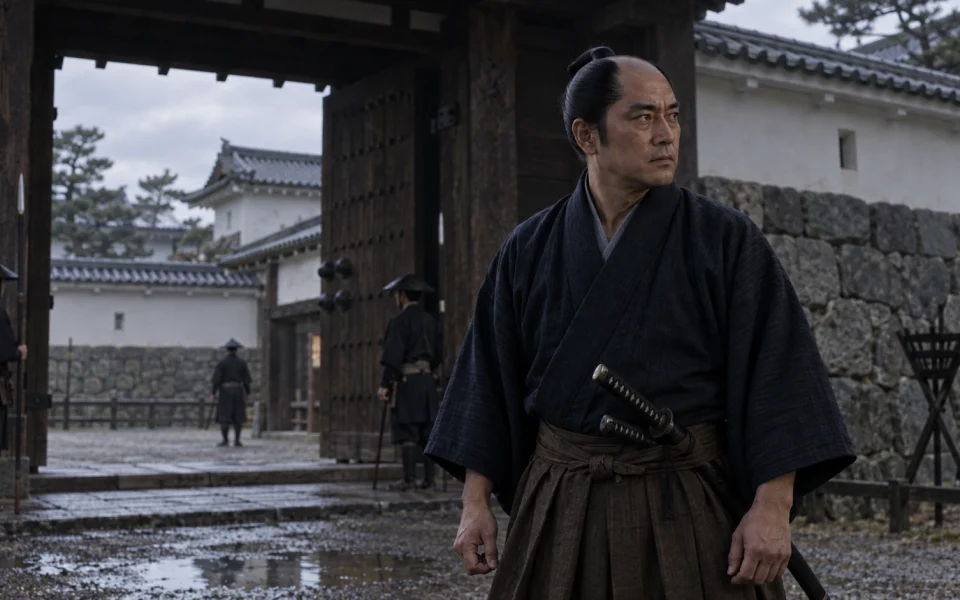
Shigeki English
Oishi Kuranosuke: The Road from Surrendering Ako Castle to the Raid
Before the famous night came accounts, letters, separation, and an attempt to restore a fallen house.
- When Genroku 14–16, spanning 1701–1703; month and day references retain the old Japanese calendar
- Where Ako, Yamashina near Kyoto, and Edo
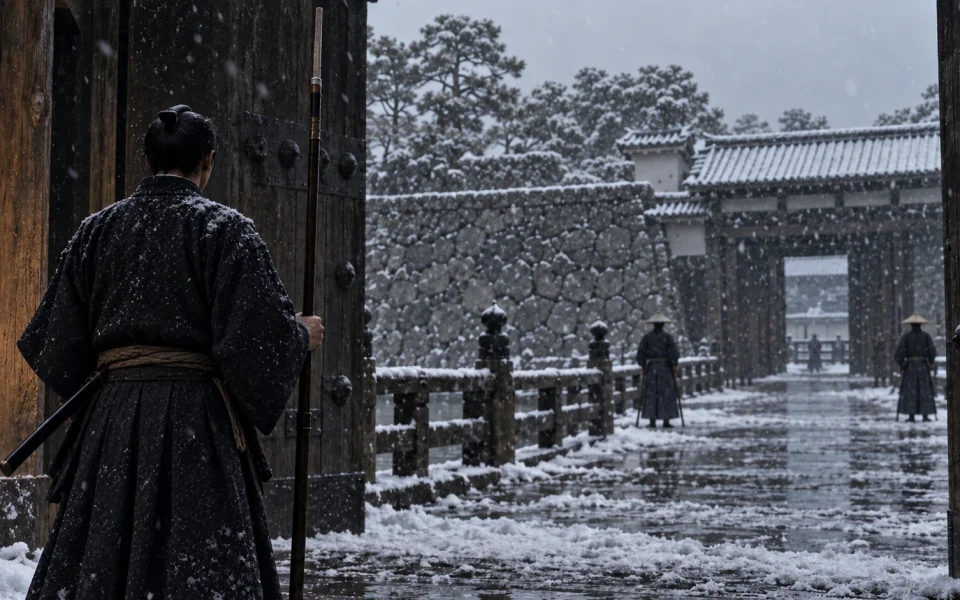
Shigeki English
The Sakuradamon Incident: A Shogunate Wounded, but Still Governing
Follow the assassination of Ii Naosuke through the orders, letters, and announcements that followed it.
- When 1860, with political background in 1858 and an aftermath extending into the 1860s
- Where Edo Castle and Hikone, with reports circulating beyond Edo