
SHIGEKI ENGLISH STORYEN
Japanese history in English
Kawagoe and the Shingashi River: Landings, Merchants and Boatmen on the Route to Edo
From rebuilding materials after a great fire to the Five Landings, shipping merchants, night boats, railways and the order that ended navigation in 1931.
What work connected Kawagoe with Edo along the Shingashi River? This article follows the shipments after the 1638 fire, Matsudaira Nobutsuna and the Ninety-Nine Bends, the Five Landings and Fukuoka, shipping merchants and boatmen, the Kawagoe night boat, the coming of the railways and the end of navigation in 1931.
At a glance
Before you enter the story
- When
- From shipments after the 1638 fire through the Edo-period landings, the railways of the Meiji and Taishō eras, the 1931 navigation order and the disappearance of boats around 1935.
- Where
- Kawagoe and the Shingashi River in present-day Saitama Prefecture, the Five Landings of Kawagoe, Fukuoka in present-day Fujimino, and Asakusa in Edo.
- Key figures
- Matsudaira Nobutsuna, Sawada Jin'emon, Ōshimaya Uhei, Hoshino Senzō
- What was at stake
- How a winding river became a commercial link between villages, a castle town and the capital, and how that link came to an end.
Why this story matters
The larger history behind the turning point
A boat moving down a river can hide the work that made its journey possible. Following the cargo brings producing villages, shipping merchants, boatmen and their families back into the history of Kawagoe and Edo.
The story also shows how a transport system ends. Merchant houses closed at different times, some river merchants invested in railways, and the boats disappeared gradually even after navigation was officially halted.
Historical context
What an international reader needs to know
A river, a town and the city called Edo
Kawagoe lies northwest of Tokyo, which was called Edo until 1868. The Shingashi River flows toward the Sumida River system, and boats on it connected the Kawagoe area with Asakusa on the eastern side of the city.
The Five Landings of Kawagoe and the Fukuoka landing in present-day Fujimino were separate places with separate histories. This article keeps them distinct while following the single waterway that linked them.
Reading dates and numbers with care
Years of establishment and official recognition mark administrative milestones and do not always show when activity first began at a landing. Where sources disagree, as they do over what the first shipments were meant to rebuild, the article says so.
Boat lengths and bale capacities come from particular local explanations and museum features. They describe those boats and should not be taken as fixed measurements for every vessel on the river.
Watch the film
See the story in motion
The film currently uses Japanese audio. This English article provides the context and source trail; it does not imply that an English subtitle track is available.
Opening
Where cargo passed into boats
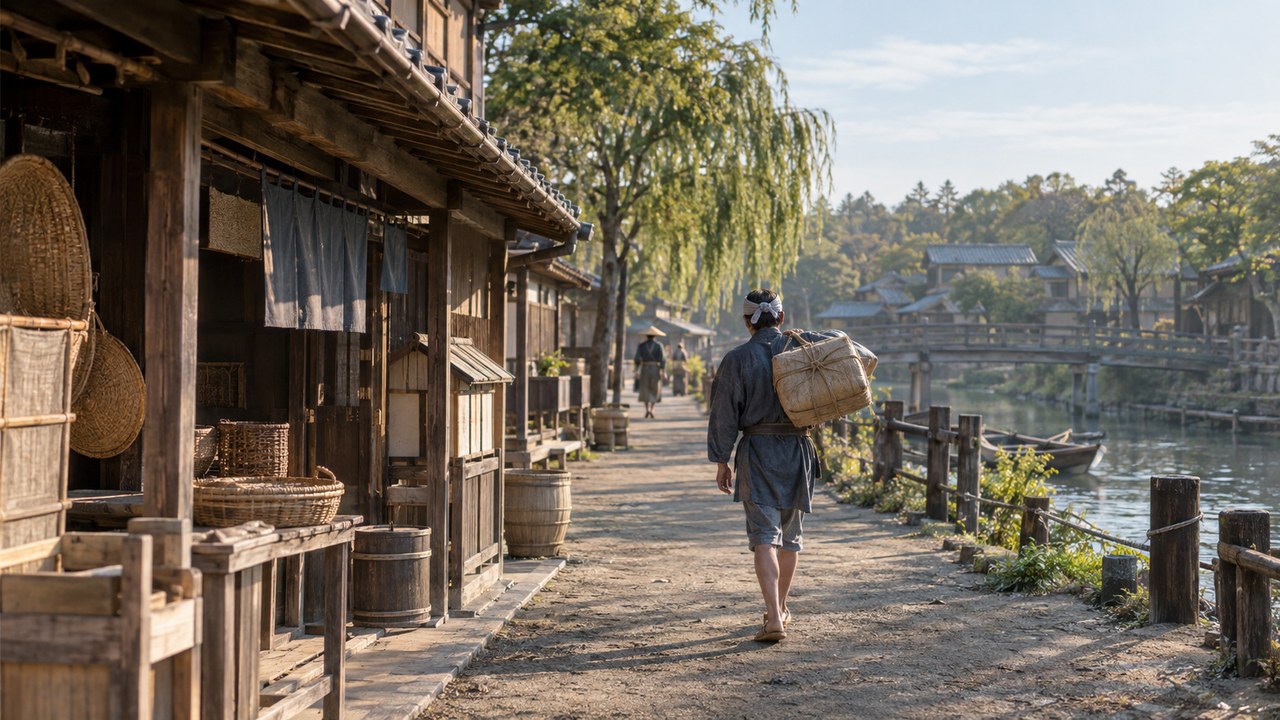
Between Kawagoe, in present-day Saitama Prefecture, and the city of Edo there once ran a working waterway: the Shingashi River. According to material published by Kawagoe City, boats carried rice, wheat, textiles and sweet potatoes from the Kawagoe area down to Edo, and brought clothing, sugar, fertilizer and other goods back upstream.
Boats were only one part of this system. Villages produced the cargo, river landings known as kashi received it, shipping merchants ran the business, and boatmen moved the vessels. Each of these kinds of work depended on the others, and together they turned a winding river into a commercial route linking town, countryside and the shogun's capital.
This article follows that route in order, from a great fire in 1638 through the growth of the landings and merchant houses, the overnight passenger boats, the arrival of the railways and the order that halted navigation in 1931. Where sources describe the same event differently, the differences are noted rather than smoothed away.
Chapter 1
A fire and the materials for rebuilding
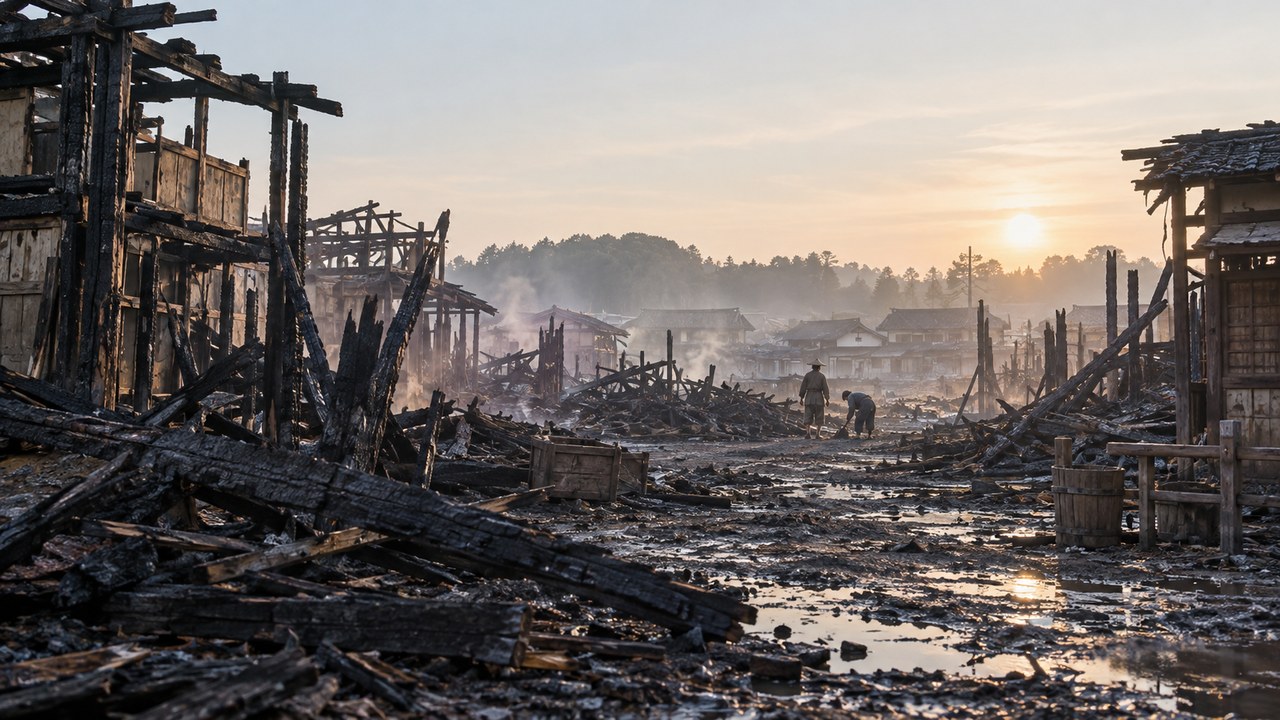
In 1638 a great fire swept through Kawagoe, destroying the temple of Kitain and the Tōshō shrine. Explanations by Fujimino City and the Kawagoe City Museum trace the beginning of river transport to the shipment of rebuilding materials for the Senba Tōshōgū shrine, which were brought from Edo by water after the disaster.
The materials are said to have been landed near Terao. An origin record of the Terao landing dated 1798 explains that the Oibukuro and Hirakata landings on the Arakawa River had first been planned for the work, but that low water made them unusable. A new landing was therefore established at Terao on the Shingashi River.
Sources differ over exactly what was being rebuilt. Some name the Tōshōgū, others name both the shrine and Kitain, and a Ministry of Finance feature names Kitain alone. Kawagoe City's chronology records the rebuilding of the Senba Tōshō shrine in 1640. The shared point is that reconstruction after the fire set boats moving on this river.
Chapter 2
Matsudaira Nobutsuna and the ninety-nine bends
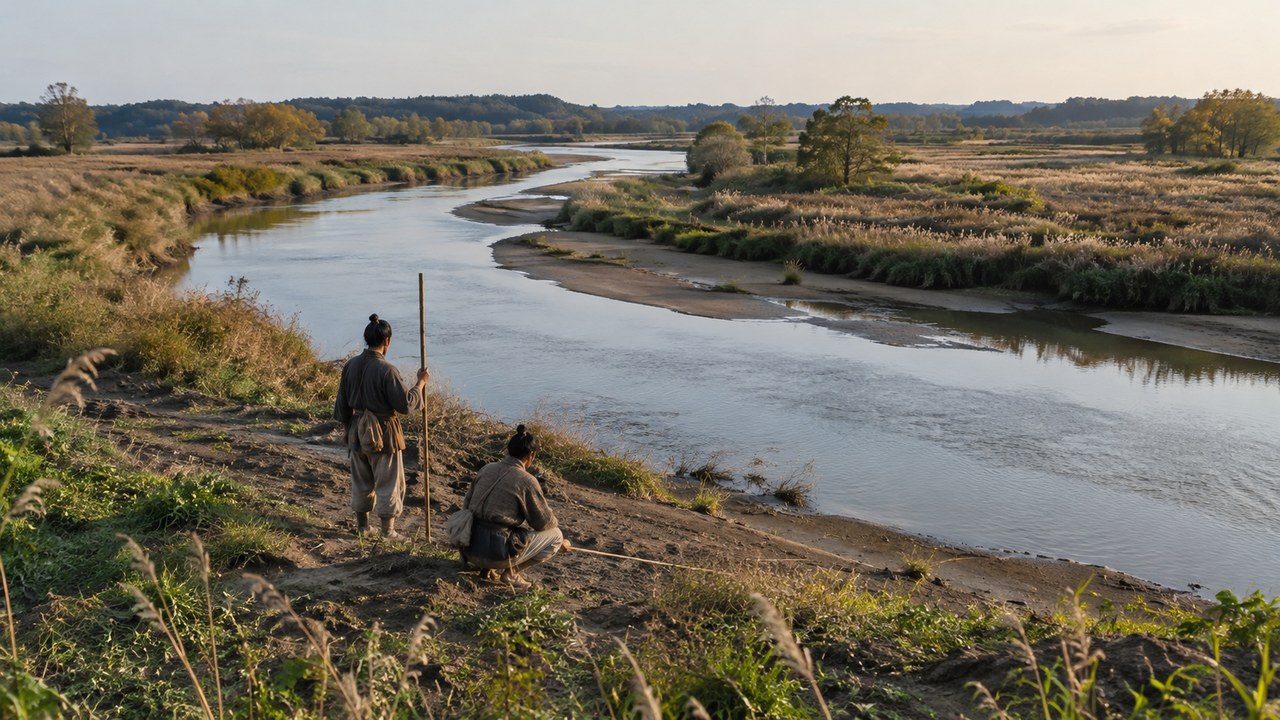
Matsudaira Nobutsuna became lord of Kawagoe in 1639. According to a historical gazetteer, he ordered a man named Sawada Jin'emon to improve the course of the river and maintain its water level. Fujimino City likewise explains that Nobutsuna worked to improve the channel in 1647, making the river an important link between the Kawagoe area and Edo.
The river was known for its winding course and was also called the Ninety-Nine Bends. Material from Kawagoe City explains that the meanders were part of a river improvement intended to secure enough water. A feature in The Japan News adds that the winding flow kept the channel deep enough for vessels more than fifteen meters long.
The waterway then known as the Uchikawa flourished through this traffic and eventually came to be called the Shingashi River, after the new landing at Shingashi. The name itself is a record of the river's working life. It tells later readers that the river was understood through its boats and landings as much as through its geography.
Chapter 3
The five landings of Kawagoe
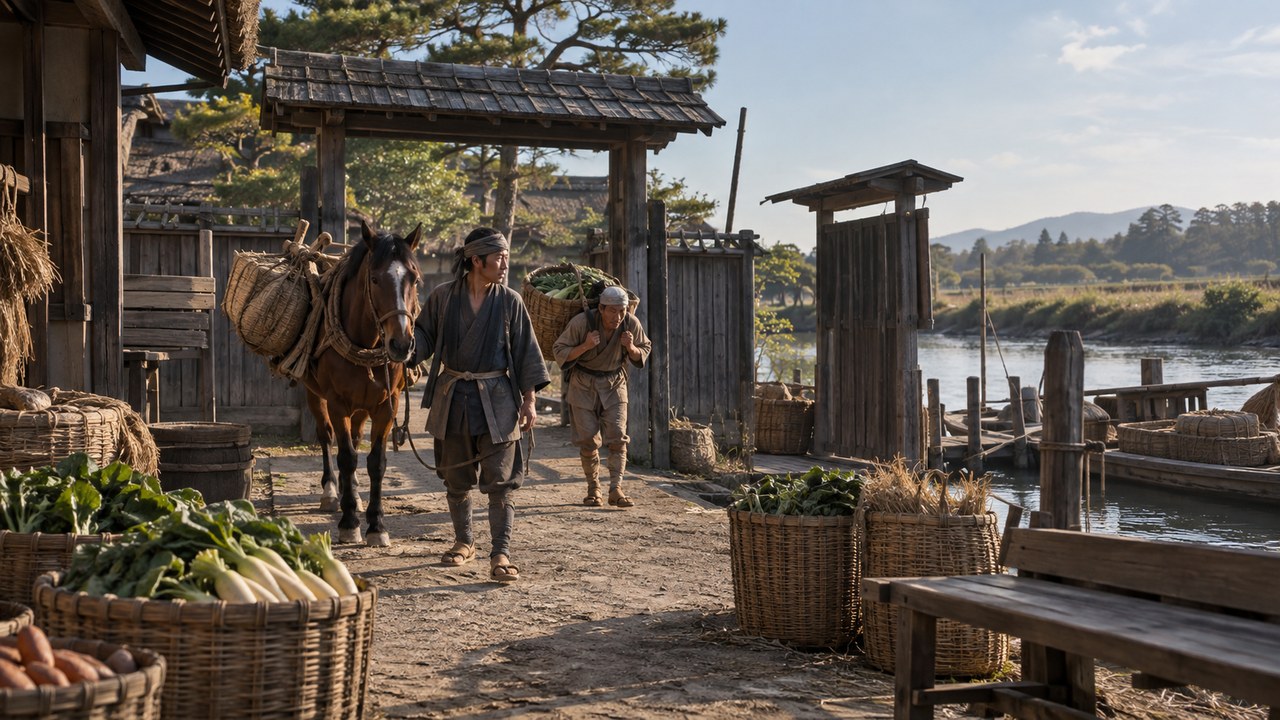
Kawagoe's outer port took shape as a group of five river landings. Listed from upstream, they were Ōgi, Kami-Shingashi, Ushiko, Shimo-Shingashi and Terao. Together they became known as the Five Landings of Kawagoe, and they connected the castle town and its merchants to the boats that travelled down the river toward Edo.
The five did not appear at the same time. Kami-Shingashi and Shimo-Shingashi were formally established in 1651. A petition of 1734 states that the Ushiko landing was created in 1664, and Ōgi is placed in the Kanbun era of 1661 to 1673. Terao, as noted above, is linked with the landing of the rebuilding materials.
Even these dates need care. A later regional gazetteer reports that the name Shingashi already appeared in a land survey of 1648, which suggests that a settlement existed before the formal establishment of the two landings in 1651. The recorded years are best read as administrative milestones rather than as the absolute beginning of activity at each place.
Chapter 4
How the shipping merchants worked
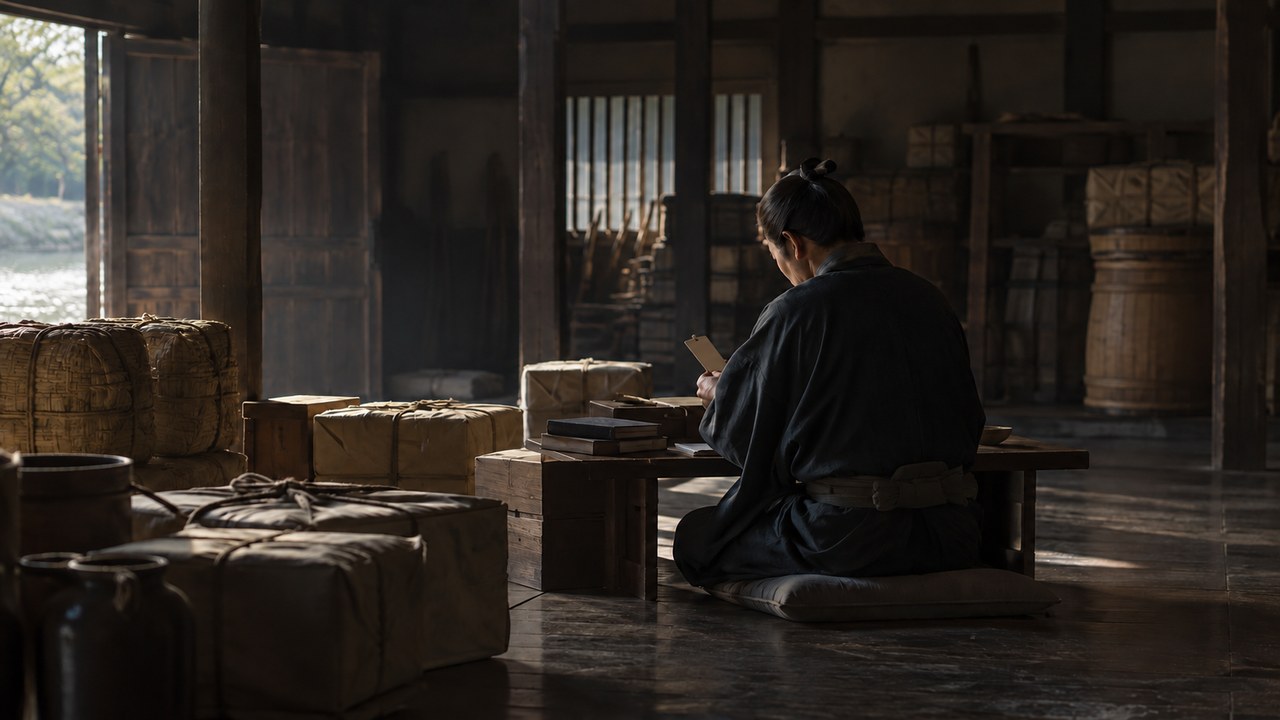
Shipping merchants, or funadonya, lined the landings, and Kawagoe City material says boats arrived and departed day and night. In 1731 merchant operating rights were officially recognized at the three landings of Ōgi, Kami-Shingashi and Shimo-Shingashi. In 1776 the shipping merchants of the five landings formed an association, showing how the trade was gradually organized.
A vivid picture of this business comes from the papers of the Shimamura family, who ran a shipping house called Ōshimaya at the Ushiko landing. The papers are said to have been discovered by chance around 1972, when an old storehouse was being demolished. With records from other landings, 261 documents were designated a Kawagoe City cultural property in 1989.
These documents show that in the final years of the shogunate, under Ōshimaya Uhei, the house owned no boats of its own. Instead it engaged boat-owning boatmen known as deishū to carry its cargo, and many written contracts with them survive. The merchant's power rested on agreements and relationships as much as on physical ownership of vessels.

Chapter 5
Cargo going down, cargo coming up
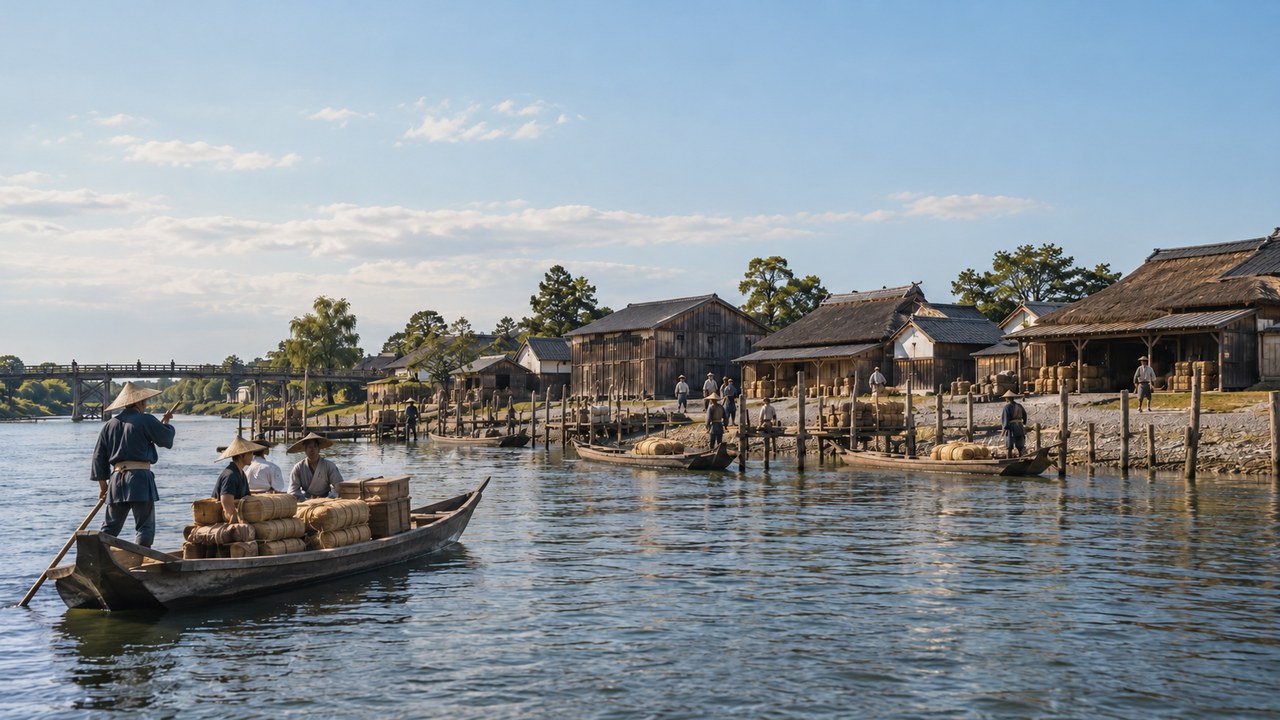
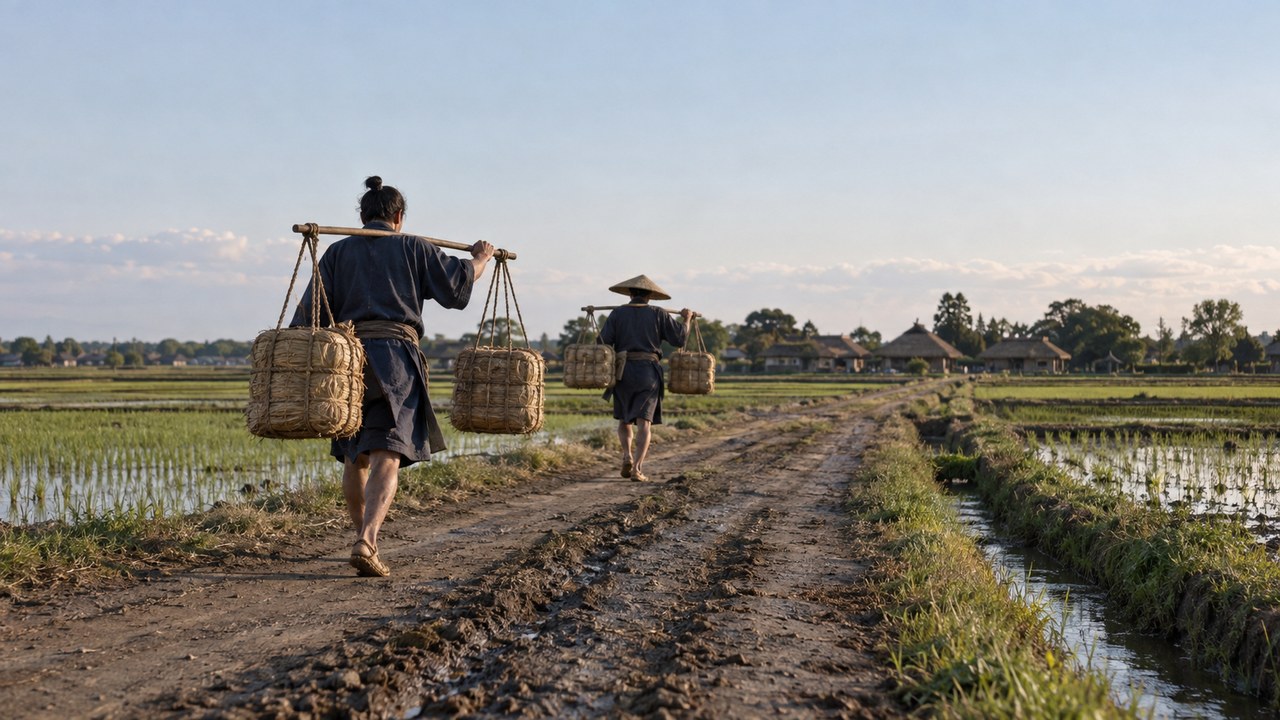
The goods sent toward Edo included rice, wheat, other grains, sōmen noodles, textiles, tea, sweet potatoes and timber from Kawagoe and the surrounding region. Fujimino City explains that farm produce, firewood and charcoal from places such as Ōi, Tokorozawa and Hannō were carried to the landings and loaded onto river boats bound for the city.
Sweet potatoes suited river transport especially well. Kawagoe City material says cultivation in the Kawagoe area began in 1751, and that the crop was shipped to Edo during the fashion for roasted sweet potatoes in the later eighteenth century. Bulky and heavy, the potatoes were far easier to move by boat than along a road.
Boats returning from Edo carried clothing, miscellaneous goods, sugar, dried foods and fertilizer. Raw materials for kimono fabric and indigo dyeing also travelled upstream to Kawagoe. The river therefore did more than feed a great city. Its two-way traffic supplied the town's shops and workshops, and the farms around it, with goods they could not easily obtain nearby.
Chapter 6
Landings along the whole river
River landings were not limited to Kawagoe. Fujimino City reports that more than twenty were established along the Shingashi River. Within the present city, the Fukuoka landing was created around 1733 and received official recognition from the shogunate in 1773. Its history is separate from that of the Five Landings, although it served the same waterway.
Fukuoka's first shipping merchants were three houses: Yoshinoya, Edoya and Tomita Monzaemon. The Tomita family later left the trade, and in 1831 a house called Fukudaya opened for business. Local sources describe Fukuoka as a lively landing centered on three shipping houses that handled the transport and sale of goods passing through this stretch of the river.
From Fukuoka to Hanakawado in Asakusa, in Edo, the journey was about 120 kilometers. The landing documents designated by Kawagoe City include records not only from the Five Landings but also from Furuichiba, Fukuoka and Hikimata. Taken together, they show cargo moving through a network of landing places spread along the river rather than through one single port.
Chapter 7
Cargo boats and the boatmen's village
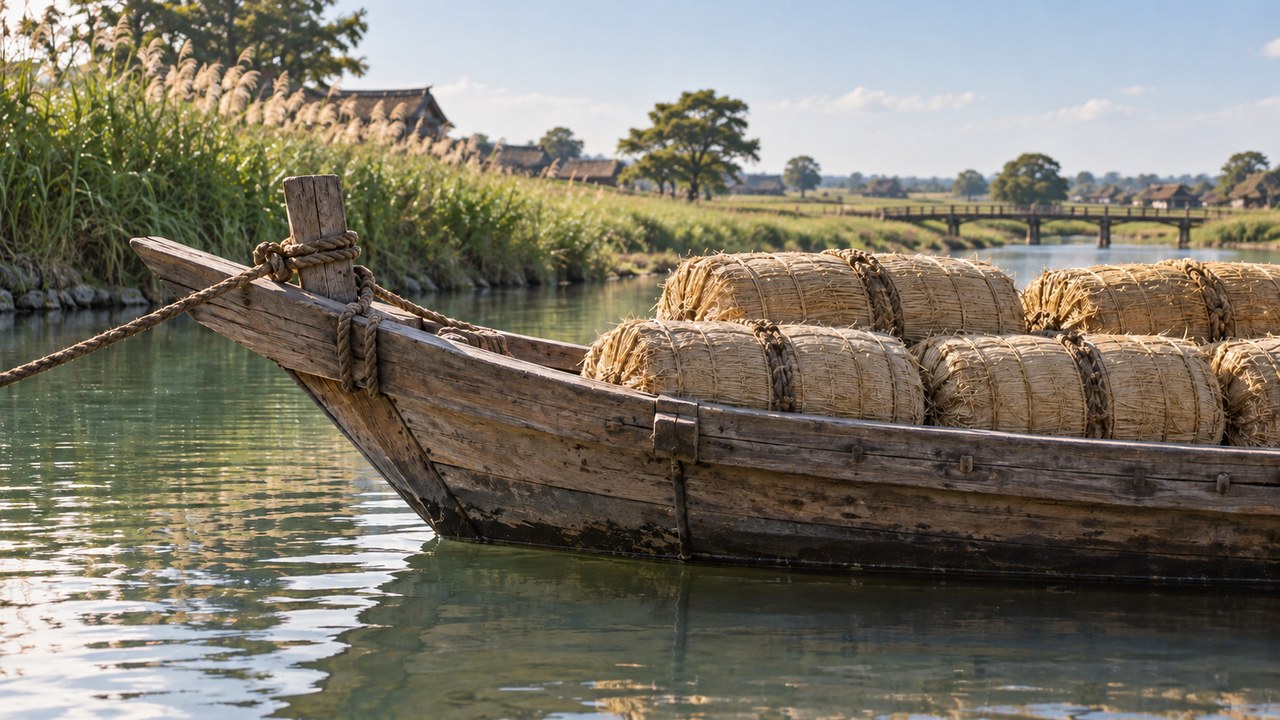
Boatmen who used the Fukuoka landing owned wooden river boats about fifteen meters long that could carry 200 to 250 bales. The Japan News describes a flat-bottomed takasebune at a Kawagoe museum as able to carry 200 straw bags of rice weighing 60 kilograms each. A horse, the article notes, could carry only two such bags.
Many of these boatmen lived in Shimo-Fukuoka, a community also known as the boatmen's village. Their work on the water was closely tied to homes and families on shore. Seen from this angle, river transport was not simply a matter of vessels passing through a landscape, but a way of life rooted in particular riverside communities.
The Ōsugi Shrine preserves another trace of that world. Shipping merchants and boatmen at Fukuoka took the lead in building it in 1878, and in 1885 about one hundred boatmen from across the Kantō region dedicated a votive plaque there. The offering suggests that the people of the river trade formed connections reaching well beyond any single landing.
Chapter 8
Fast boats and the Kawagoe night boat
People as well as goods travelled to Edo by river. Hayabune, or fast boats, carried passengers and light, urgent freight. According to a cultural properties newsletter from Fujimino City, a fast boat left Shingashi at three o'clock in the afternoon and reached its terminus at Asakusa around midday on the following day, after a night on the water.
Because passengers could sleep through much of the journey, the service is said to have been nicknamed the Kawagoe night boat, or Kawagoe yofune. For travellers it offered a very different experience from walking the highway. The trip continued through the darkness while the boat carried them toward the city, turning hours of travel into a night's rest.
Fast boats could also bring distant luxuries to Kawagoe. The Japan News reports that a wealthy Kawagoe merchant obtained hot spring water from Atami and fresh fish caught off Edo by express boat. The anecdote shows how speed on the river could serve private wealth as well as trade, and how closely the prosperous town was tied to the capital.
Chapter 9
Where the highway met the river
The river was not the only route between Kawagoe and Edo. The Kawagoe Kaidō highway was developed in the mid-seventeenth century as a branch of the Nakasendō, and the road to Kawagoe covered about eleven ri, or roughly 45 kilometers. Land and water routes therefore ran side by side through the same broad region.
Overland transport also fed the river trade. Farm produce and textiles brought by road gathered in Kawagoe, helping the town grow into a commercial center full of wholesale merchants. Farther downstream, the Azusawa landing stood at a point of contact with the Nakasendō and is said to have been especially useful because of that connection.
Placing the two routes together clarifies Kawagoe's position. The castle town collected goods from surrounding villages and connected them with Edo by both boat and highway. This reading is SHIGEKI's interpretation of the sources, but it helps explain why a town some distance from the capital could become such an active center of regional commerce.
Chapter 10
The peak of the trade and the coming of rail
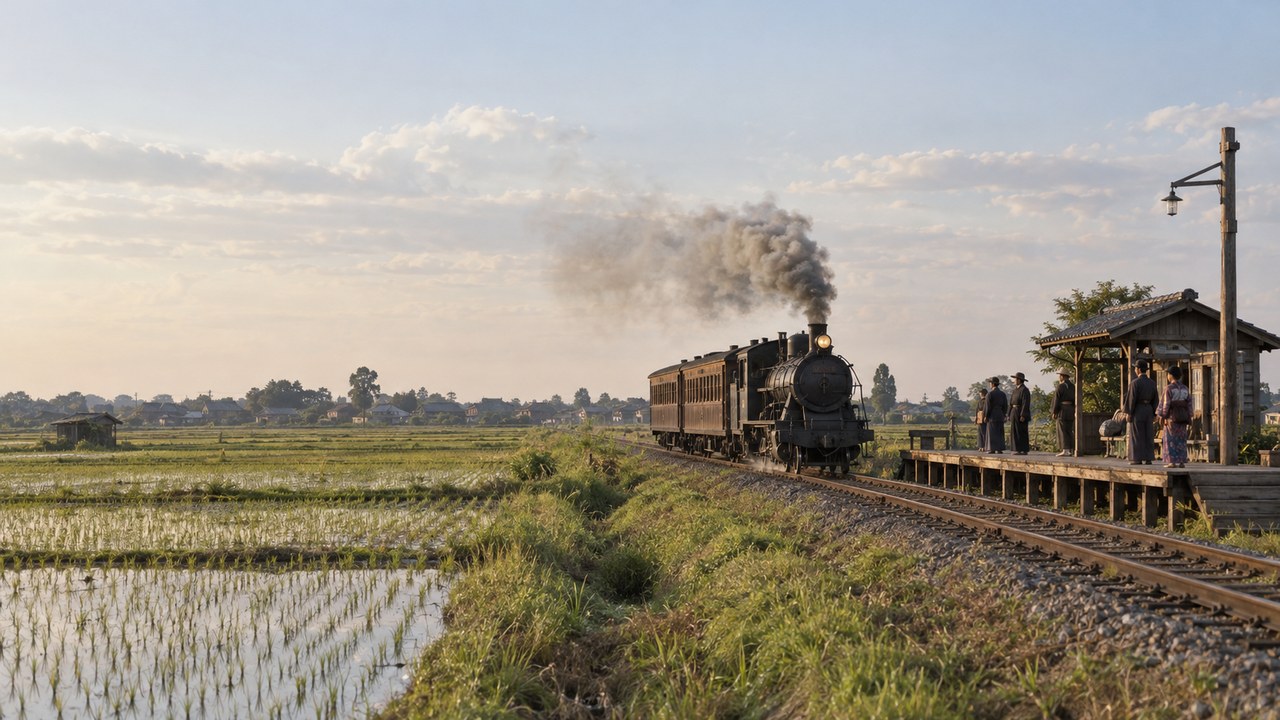
River transport is said to have reached its height between the end of the Edo period and the middle of the Meiji era. Development continued after the Meiji Restoration: in 1869 work began on a cut extending the route upstream from Ōgi toward Senba, nearer the town, and the Senba landing opened ten years later, in 1879.
In 1895 the Kawagoe Railway opened between Kawagoe and Kokubunji. Local business leaders whose town had prospered through river trade opposed its construction, but the advantages of rail soon became clear. As plans emerged for a direct line between Kawagoe and Tokyo, shipping merchants who had grown rich on the river began joining the promoters of those railway schemes.
Hoshino Senzō, the tenth head of the Fukudaya shipping house, also served as a director of the Tōjō Railway. When that line opened between Ikebukuro and Kawagoe in May 1914, the decline of river transport became decisive. The merchants of the old waterway were not merely victims of change, since some of them helped to finance and lead the new transport system.
Chapter 11
The end of navigation
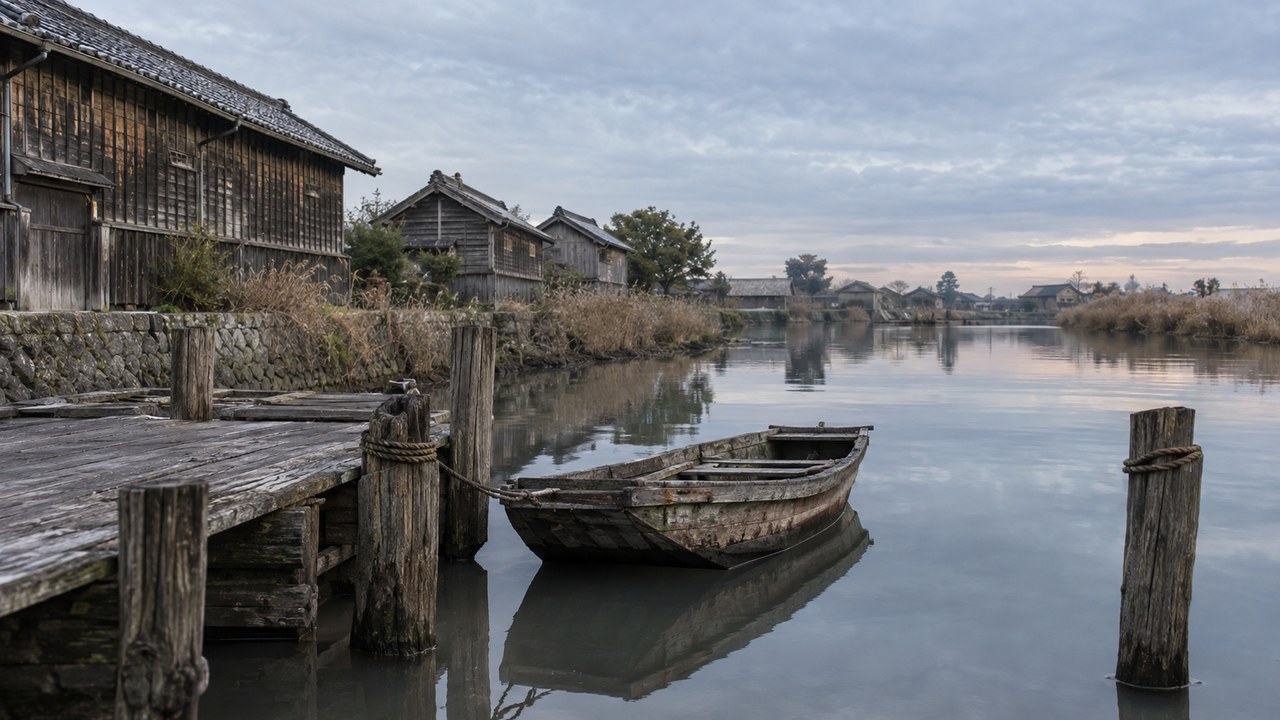
The end came in stages. At Fukuoka, Fukudaya and Edoya gave up the shipping business around the end of the Meiji era. Yoshinoya closed during the Taishō era, after the opening of the Tōjō Line and river improvement works ended the Shingashi River's role as a transport route. No single date can stand for the closing of every business.
Falling water levels added to the difficulties, and improvement works in the early Shōwa era straightened much of the once winding channel. In 1931 a prefectural order halted navigation on the Shingashi River. The Senba landing was abolished in the same year, and the route that had carried goods for nearly three centuries lost its legal place in regional transport.
Even then the boats did not vanish overnight. Fujimino City explains that boatmen sold their vessels and that boats travelling back and forth on the river had disappeared by around 1935. The few years between the order and that disappearance are a reminder that the end of a working river was gradual, and was experienced differently from place to place.
Chapter 12
What remains on the riverbank
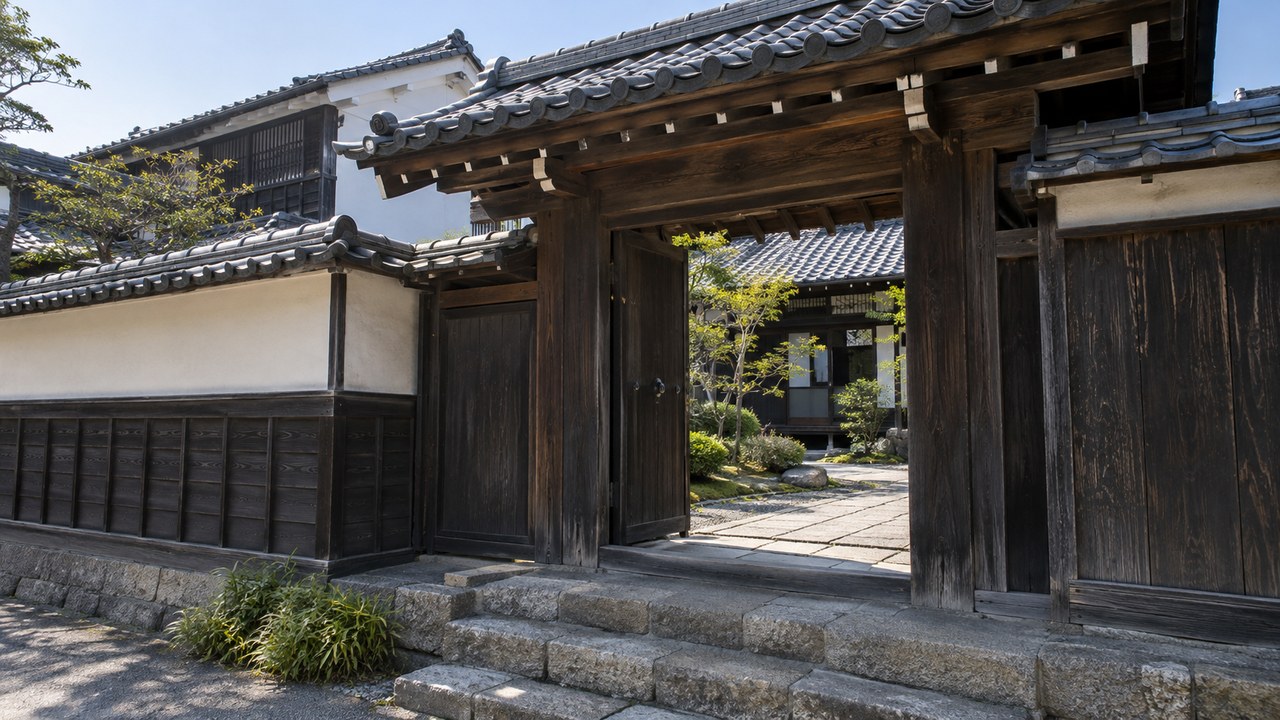
Fukudaya operated as a shipping house at Fukuoka from 1831 until around the end of the Meiji era. Its main house and kitchen wing, an unusual three-story annex for receiving guests, and a storehouse still stand. Designated a Fujimino City cultural property in 1989, the buildings are open to the public as the Fukuoka Kashi Memorial Hall.
At Shimo-Shingashi in Kawagoe, the site of the Iseyasu shipping house can still be traced, although Kawagoe City explains that its main building was rebuilt in 1999. The former Senba landing became a historic park in 2004. What visitors see along the river today therefore belongs to several different periods, and each layer deserves to be dated separately.
A route that began with materials for rebuilding after a fire went on to connect village produce, town commerce and the lives of boatmen for about three hundred years. What joined Kawagoe and Edo was not only the flow of the river, but the daily work of the people who passed each load on to the next.
How to read this work
History, interpretation, and reconstruction
Following producing villages, cargo landings, shipping merchant houses and boatmen reveals the work connecting Kawagoe with Edo.
This work is grounded in published sources and historical research. Interior thoughts, dialogue, and some visual details are cinematic reconstructions. Where historians disagree, the article presents the point as debated rather than settled fact.
Timeline
The story in time
-
Matsudaira Nobutsuna becomes lord of Kawagoe and is said to order work on the river course and its water level.
Sources: s11 -
According to a petition of 1734, the Ushiko landing is established.
Sources: s05 -
Merchant operating rights are recognized at the Ōgi, Kami-Shingashi and Shimo-Shingashi landings.
Sources: s01 -
The Fukuoka landing is established.
Sources: s02 -
The shogunate officially recognizes the Fukuoka landing.
Sources: s02 -
The shipping merchants of the Five Landings of Kawagoe form an association.
Sources: s01 -
The Senba landing opens.
Sources: s09 -
Boats travelling back and forth on the river disappear.
Sources: s02
People & terms
A guide for new readers
Key figures
- Matsudaira Nobutsuna
- Lord of Kawagoe from 1639, associated with work on the river course and the improvement of the channel in 1647.
- Sawada Jin'emon
- The man said to have been ordered by Matsudaira Nobutsuna to improve the river course and maintain its water level.
- Ōshimaya Uhei
- Head of the Ōshimaya shipping house at the Ushiko landing in the final years of the shogunate.
- Hoshino Senzō
- Tenth head of the Fukudaya shipping house at Fukuoka and a director of the Tōjō Railway.
Glossary
- Shingashi River 新河岸川
- The river route followed here through its cargo landings, merchants and boatmen.
- Kashi 河岸
- A river landing serving as a transport hub, where overland cargo could pass into boats.
- Funadonya 船問屋
- A shipping merchant house involved in commerce at river landings; the term identifies the merchant business rather than the boatman’s work afloat.
- Sendō 船頭
- A boatman operating a vessel; the Fukuoka account also locates many boatmen’s homes in Shimo-Fukuoka.
- Ton’ya kabu 問屋株
- Recognized merchant operating privileges mentioned in the chronology. The detailed institutional rules are not reconstructed here.
- Nakama 仲間
- An association, here referring to the shipping merchants’ organization recorded for the five landings in 1776.
- Tawara 俵
- A straw bale, used in the Fukuoka account’s description of cargo capacity. No uniform conversion into kilograms is supplied here.
- Kaidō 街道
- An established road route or highway; the Kawagoe Kaidō forms part of the overland transport context.
- Denma 伝馬
- The relay arrangement forwarding official travelers’ baggage between road stations using people and horses; distinct from landing commerce.
- Edo and later period names 江戸・明治・大正・昭和
- Edo is the city name used before its renaming as Tokyo in 1868, as the city chronology records. Meiji, Taishō and Shōwa are the successive period names used for the later railway and navigation milestones.
- Hayabune 早船
- A fast boat carrying passengers and light, urgent freight on the Shingashi River.
- Deishū 出居衆
- Boat-owning boatmen engaged by the Ōshimaya shipping house at the Ushiko landing.
- Kawagoe Five Landings 川越五河岸
- The landings of Ōgi, Kami-Shingashi, Ushiko, Shimo-Shingashi and Terao.
Sources & method
How this article was built
This English edition follows the revised Japanese article scene by scene and keeps its fourteen sources, their order and its fifteen timeline entries. It draws on Kawagoe City, Fujimino City, the Kawagoe City Museum, the Ministry of Finance, Kotobank, Sumitomo Mitsui Trust Realty, The Japan News and Nippon Tabi Magazine. Titles given in English are editorial translations unless the source is in English.
Origin records, petitions and the 1931 prefectural order are cited as municipal and reference sources describe them and were not independently transcribed. Boat sizes and loads are attributed to the sources that give them.
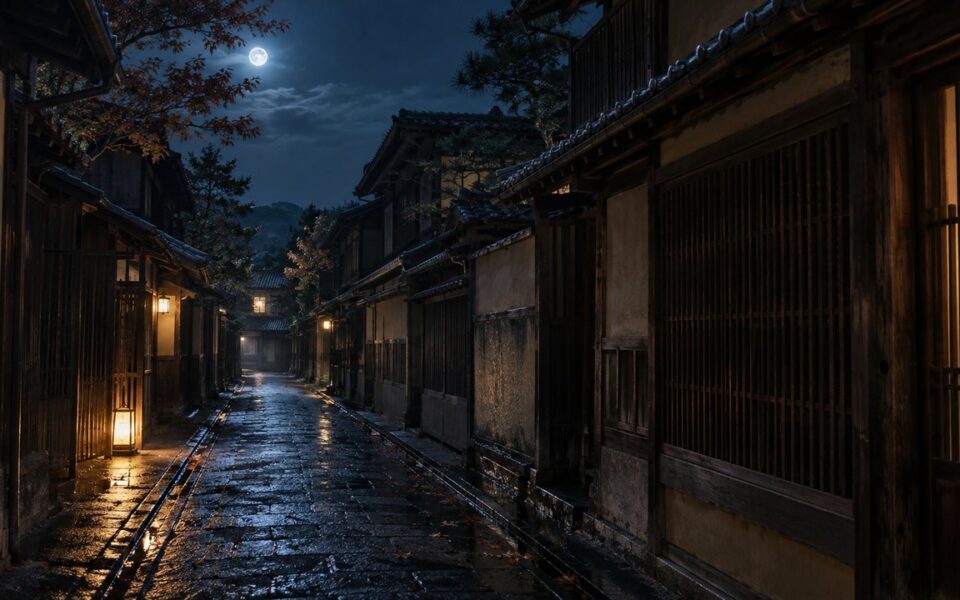
The images are AI-generated imaginative reconstructions by SHIGEKI. They are not historical photographs or exact reconstructions of the landings, boats, buildings or people described.
Sources
References and further reading
- Chronology of Kawagoe’s history 川越の歴史年表 Title translated editorially for reader convenience. Kawagoe City 川越市 Used for the 1638 fire, the 1640 rebuilding, the landings and merchant institutions, the Kawagoe Railway and the 1931 order. Accessed 2026-11-18
- Fujimino’s history: the Edo period ふじみ野市の歴史-江戸時代 Title translated editorially for reader convenience. Fujimino City Museum and Cultural Properties Protection Office ふじみ野市立博物館・文化財保護係 Used for the origins of river transport, channel work, the number of landings, cargo, the Fukuoka landing, boats and boatmen, the closing of merchant houses, the disappearance of boats and the Kawagoe Kaidō. Accessed 2026-11-18
- Kawagoe Hundred Views, Course Map 1: commentary on Shingashi River transport and Kawagoe’s history 川越百景コースマップ1・新河岸川舟運と川越の歴史めぐり 解説部分 Title translated editorially for reader convenience. Kawagoe City Urban Landscape Division 川越市都市景観課 Used for the Iseyasu shipping house and the date of its rebuilt main building. Accessed 2026-11-18
- Museum Newsletter No. 68: exhibition on Shingashi River transport and Kawagoe’s five landings 博物館だより 第68号 第38回企画展「新河岸川舟運と川越五河岸のにぎわい」 Title translated editorially for reader convenience. Kawagoe City Museum 川越市立博物館 Used for the museum explanation of the rebuilding shipments and the Five Landings. Accessed 2026-11-18
- Shimamura family documents from Ushiko Landing and other documents from Shingashi River landings 牛子河岸島村家文書他新河岸川河岸場文書 Title translated editorially for reader convenience. Kawagoe City Cultural Properties Protection Division 川越市文化財保護課 Used for the Shimamura family papers, the Ōshimaya business, the deishū boatmen and the landings covered by the designated documents. Accessed 2026-11-18
- Introducing a designated cultural property: the Fukudaya shipping house (Cultural Properties Newsletter No. 11) 市指定文化財の紹介 回漕問屋 福田屋(文化財だより 第11号) Title translated editorially for reader convenience. Fujimino City Board of Education ふじみ野市教育委員会 Used for the dates of the Fukudaya business, its surviving buildings, the 1989 designation and the memorial hall. Accessed 2026-11-18
- Cultural Properties Newsletter (issued March 15, 2023) 文化財だより(令和5年3月15日発行) Title translated editorially for reader convenience. Fujimino City Board of Education ふじみ野市教育委員会 Used for the fast boat timetable, the Ōsugi Shrine and its plaque, and Hoshino Senzō. Accessed 2026-11-18
- Foods of Kawagoe: The Appeal of Kawagoe Produce 川越の食材《川越の農産物の魅力》 Title translated editorially for reader convenience. Kawagoe City (document on the city website) 川越市(市ウェブサイト掲載資料) Used for the start of river transport, the winding channel, the goods carried in each direction and sweet potatoes. Accessed 2026-11-18
- Town Archives: Kawagoe, Saitama Prefecture このまちアーカイブス 埼玉県川越市 Title translated editorially for reader convenience. Sumitomo Mitsui Trust Realty 三井住友トラスト不動産 Used for the landing at Terao, the Uchikawa, the order of the Five Landings, the Senba landing and its later park. Accessed 2026-11-18
- History Along the Line: Tobu Tojo Line 沿線の歴史散策 東武東上線 Title translated editorially for reader convenience. Sumitomo Mitsui Trust Realty 三井住友トラスト不動産 Used for opposition to the Kawagoe Railway and the part played by shipping merchants in later railway plans. Accessed 2026-11-18
- Shingashi River 新河岸川 Title translated editorially for reader convenience. Kotobank (Nihon Rekishi Chimei Taikei, Nipponica and other reference works) コトバンク(日本歴史地名大系・日本大百科全書ほか) Used for the Terao origin record, Nobutsuna and Sawada Jin'emon, the establishment of the landings, the Ninety-Nine Bends and the early Shōwa river works. Accessed 2026-11-18
- Reading Town History Through Land Values, No. 66: Kawagoe, Saitama (Finance, August 2025) 路線価でひもとく街の歴史 第66回 埼玉県川越市(ファイナンス 令和7年8月号) Title translated editorially for reader convenience. Ministry of Finance, Japan 財務省 Used for an account of the start of river transport, the railways and the decline of the river trade after 1914. Accessed 2026-11-18
- Let's go to the museum: Discovering Kawagoe's bustling Edo period Let's go to the museum: Discovering Kawagoe's bustling Edo period The Japan News (The Yomiuri Shimbun) The Japan News(読売新聞) Used for the winding channel and depth, the takasebune and its load, goods from Edo and the anecdote of the express boat. Accessed 2026-11-18
- Azusawa Kashi Plaza 小豆沢河岸広場 Title translated editorially for reader convenience. Nippon Tabi Magazine ニッポン旅マガジン Used for the name Kawagoe night boat and the position of the Azusawa landing. The fire date in this feature is not followed; the article uses the Kawagoe City chronology. Accessed 2026-11-18
Continue reading
More stories from Shigeki
Shigeki English
Oishi Riku: Beyond the End of Chushingura, the Family That Lived On
Born in Toyooka, a wife in Ako, then Yamashina, Toyooka again and Hiroshima: a spring homecoming and an autumn divorce letter, the deaths of husband and son, further losses, and a son’s appointment in Hiroshima.
- When 1669–1736, with the events of 1702 kept in their separate seasons, and later memory from 1748 to 2014
- Where Toyooka, Ako, Yamashina and Hiroshima
Shigeki English
The Ōmiya Incident: The Night Ryōma and Nakaoka Were Attacked, Read Through the Surviving Records
The Teradaya, the return of power, the move to the Ōmiya, the night of the attack, three deaths, the funeral at Ryōzen, the Mimawarigumi testimony and theories of a hidden hand, with what can be confirmed kept apart from competing accounts.
- When The attack on the 15th day of the 11th month of Keiō 3 (10 December 1867), with its background from 1865 and later testimony, the 1927 marker and the 1962 statues
- Where The Ōmiya, a soy-sauce merchant’s shop on Kawaramachi in Kyoto.