
SHIGEKI ENGLISH STORYEN
Japanese history in English
The Battle of Nagashino and Shitaragahara: From a Besieged Castle to a Battlefield of Fences
A castle where two rivers meet, Okudaira's defense and the messenger Torii Suneemon, the Rengo River and its terraces, and the battle of the twenty-first day, with a fresh look at three thousand guns, three-rank fire, recovered bullets and deployment maps.
In 1575 Takeda Katsuyori besieged the Tokugawa castle of Nagashino, and fought the relieving Oda-Tokugawa army a few kilometers to the west at Shitaragahara. This article follows the castle's setting and siege, the messenger tradition, the deployment of the armies and the terrain, and the battle of the twenty-first day of the fifth month, then examines the number of guns, three-rank fire, recovered bullets and later deployment maps, keeping different kinds of evidence apart.
At a glance
Before you enter the story
- When
- Tensho 3 (1575): the siege of Nagashino Castle and the battle at Shitaragahara on the 21st day of the fifth month, with background from 1508 and consequences to 1582
- Where
- Nagashino Castle at the Toyokawa-Ure confluence, and the Rengo River lowlands and terraces at Shitaragahara, in present-day Shinshiro, Aichi
- Key figures
- Takeda Katsuyori, Okudaira Sadamasa (later Nobumasa), Oda Nobunaga, Tokugawa Ieyasu, Torii Suneemon, Sakai Tadatsugu
- What was at stake
- How did a castle siege become a decisive battle on different ground, and what do we really know about the famous musket tactics?
Why this story matters
The larger history behind the turning point
Nagashino is often remembered as the battle where massed muskets behind fences destroyed mounted warriors. Following the campaign in order, from castle to battlefield, gives a more concrete picture of how it unfolded.
Recent work questions the three thousand guns and the three-rank fire long taught as fact. Separating what institutions, chronicles and later maps can each show helps readers see what is secure and what is still debated.
Historical context
What an international reader needs to know
One campaign, two settings
Nagashino Castle and the battlefield of Shitaragahara belong to the same campaign but lie several kilometers apart. The castle stands at the meeting of two rivers; the battlefield lies along the Rengo River, with lowland and terraces on either side.
Okudaira Sadamasa defended the castle; Takeda Katsuyori besieged it and then faced the relief army; Oda Nobunaga and Tokugawa Ieyasu fought together against him. Keeping these roles and places apart makes the sequence of the campaign easier to follow.
Remains, reconstructions and later explanations
The fences visible today are reconstructions, the recovered bullets are introduced through modern museum texts, and the deployment maps were compiled later from surviving records. Each is useful, but none records everything that happened on the day.
Army sizes, the number of guns and the method of firing vary between sources. This article presents them as disputed rather than choosing a single figure.
Watch the film
See the story in motion
The film currently uses Japanese audio. This English article provides the context and source trail; it does not imply that an English subtitle track is available.
Opening
The castle and the fences are not the same place
On the twenty-first day of the fifth month of Tensho 3, the year 1575, the allied armies of Oda Nobunaga and Tokugawa Ieyasu defeated the army of Takeda Katsuyori at Shitaragahara in Mikawa Province. The battle of Nagashino is remembered through one image above all: a line of wooden fences with musketeers firing from behind them. Month and day follow the lunar calendar used at the time.
Yet Nagashino Castle, which gave the battle its name, and Shitaragahara, where the decisive fighting took place, are two different places. Aichi Prefecture's guide to historic sites introduces them separately: the castle ruins at the meeting of two rivers, and the battlefield where fences have been rebuilt along the Rengo River several kilometers to the west.
The campaign began as the siege of a castle and only turned into a field battle when a relief army arrived. This article follows that sequence in order, from the castle's setting and the siege to the messenger, the deployment of the armies, the battle itself and the modern rethinking of the famous musket tactics, while keeping different kinds of evidence apart.
Chapter 1
A castle where two rivers meet
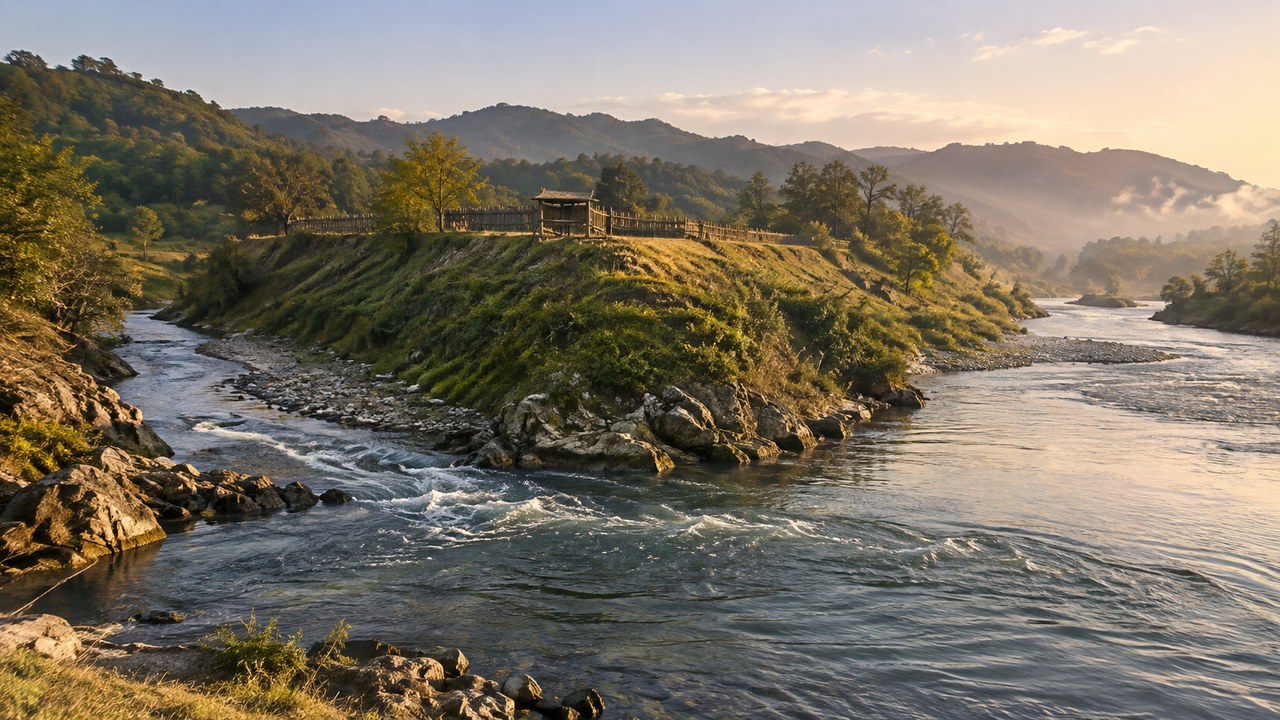
Nagashino Castle was built in 1508 by Suganuma Motonari. It stood on cliffs above the point where the Toyokawa, known in its upper course as the Kansa River, joins the Ure River. The two rivers served as natural moats, and the defenders strengthened the site with earthen ramparts and an inner moat cut into the ground.
None of the original buildings survive, but large sections of the inner moat and earthworks remain. The site is a National Historic Site and one of the Japan Castle Foundation's 100 Fine Castles of Japan. A small museum, the Nagashino Castle Ruins Preservation Museum, stands in the former main enclosure and displays material connected with the battle.
The castle lay on the frontier between the Tokugawa and the Takeda. According to nippon.com, Ieyasu captured it in 1573 from the Suganuma, who were then under Takeda control. The man who would be left to hold it for the Tokugawa side was Okudaira Sadamasa, a young local lord who had come over to Ieyasu. Holding a castle on such a frontier meant that it was likely to be the first target if the Takeda struck back.
Chapter 2
Katsuyori sets out to take it back
Takeda Katsuyori had succeeded his father, the famous warlord Takeda Shingen, and was pushing the family's power westward. According to the National Archives of Japan, in 1574 he captured Akechi Castle from the Oda and Takatenjin Castle from the Tokugawa, two important successes that put pressure on both of the allied houses.
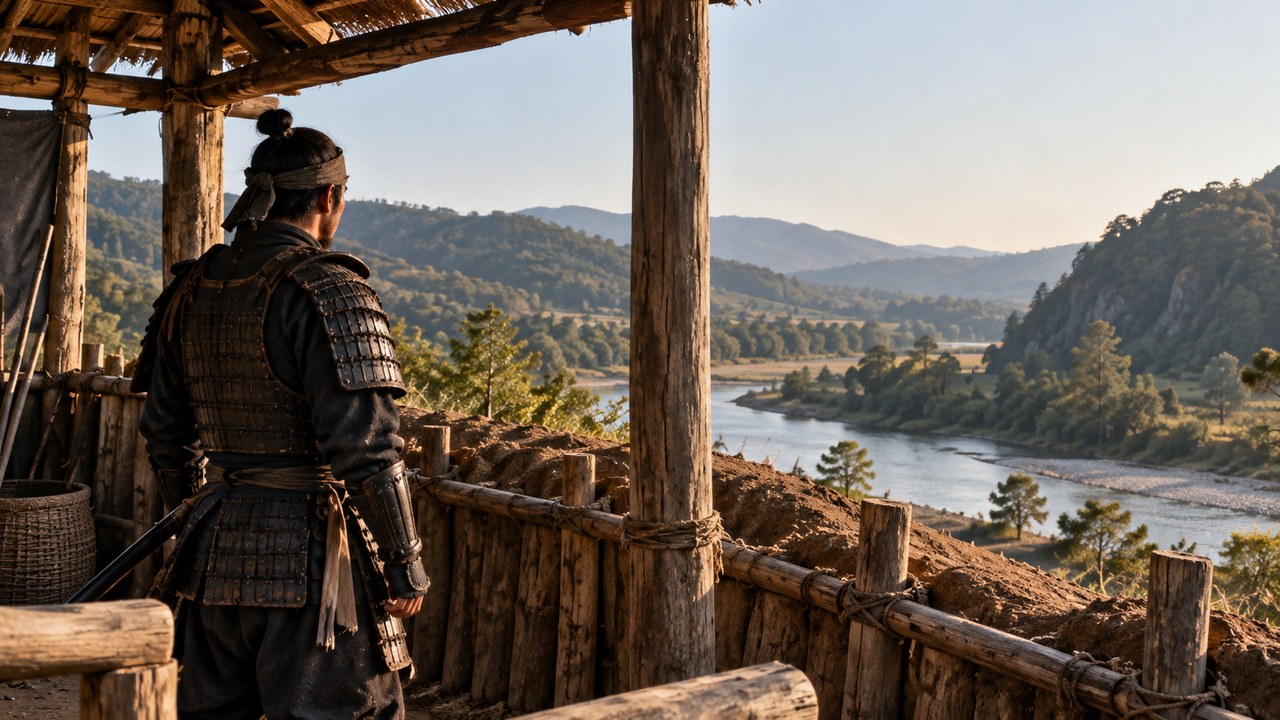
In the following year Katsuyori surrounded Nagashino Castle in order to recover it from the Tokugawa. Explanations differ on whether his attack began in the fourth or the fifth month of 1575. This article does not choose between them, since the sources consulted here do not settle the point. What all of them agree on is that the castle was the starting point of the campaign, not the field where it was decided.
The defenders under Okudaira are usually said to have numbered around 500 men, and the Takeda army about 15,000, although both figures are disputed. The Shitaragahara Historical Museum explains that while he attacked the castle, Katsuyori placed his headquarters on Ioji Hill, close to the castle and the temple of the same name.
Chapter 3
The messenger who left the castle
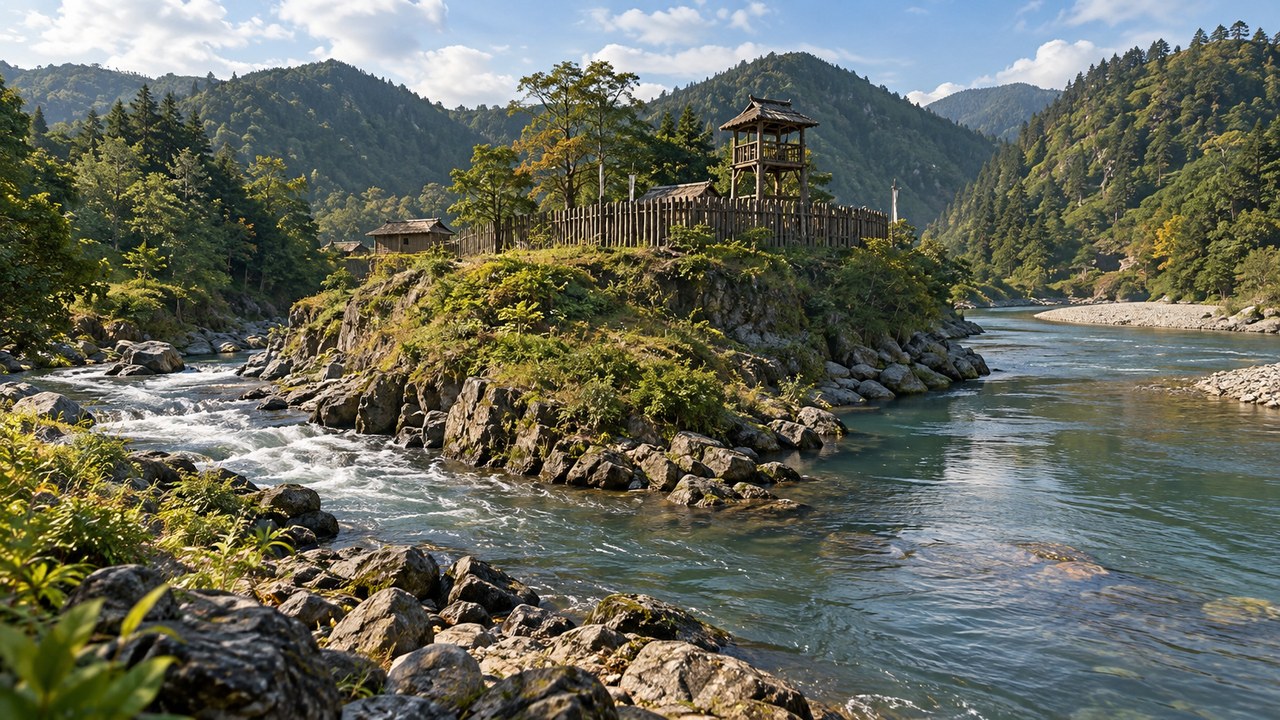
For a small garrison under siege, everything depended on whether help would come. The best-known story from this stage of the campaign concerns one of Okudaira's retainers, a low-ranking warrior named Torii Suneemon, whose name is still remembered in the area around the castle. His story has been retold for centuries as an example of loyalty under pressure.
According to the travel magazine Nippon Tabi Magazine, Suneemon slipped out of the castle on the fourteenth day of the fifth month, travelled about four kilometers down the Toyokawa to get past the besiegers, and reached Okazaki, where he asked Ieyasu for help and learned that Nobunaga's army had also arrived.
On his way back to the castle, however, he was captured by the Takeda and put to death on a cross. A memorial stone to his execution, erected in 1912, still stands in the Aruumi district of Shinshiro. Because this story has come down partly as tradition, its details are not treated here as firmly established fact.
Chapter 4
The relief army comes to Shitaragahara
According to the National Archives of Japan, Nobunaga left Gifu on the thirteenth day of the fifth month of 1575. Local accounts say that on the fourteenth he prayed for victory at Atsuta Shrine, on the fifteenth entered Ieyasu's castle at Okazaki, and on the eighteenth took up position at Shitaragahara.
Nobunaga placed his headquarters on Gokurakuji Hill and Ieyasu on Takamatsu Hill, also called Danjo Hill. The allied army thus halted not at the castle itself but at Shitaragahara, several kilometers to the west of it, and prepared to meet the Takeda there rather than marching straight into the siege lines. The choice of ground would matter a great deal once the fighting began.
At Nobunaga's headquarters, it is said, the senior Tokugawa retainer Sakai Tadatsugu proposed a surprise attack on the Takeda fort at Tobigasuyama, one of the positions the besiegers held around the castle. In this way the siege and the coming battle at Shitaragahara became linked within a single plan of operations.
Chapter 5
Katsuyori moves up to the Rengo River
When the relief army arrived, Katsuyori kept part of his force around the castle and turned his main army toward Shitaragahara. The Shitaragahara Historical Museum explains that he moved his headquarters from Ioji Hill first to Kiyoida and then forward to Sainokami.
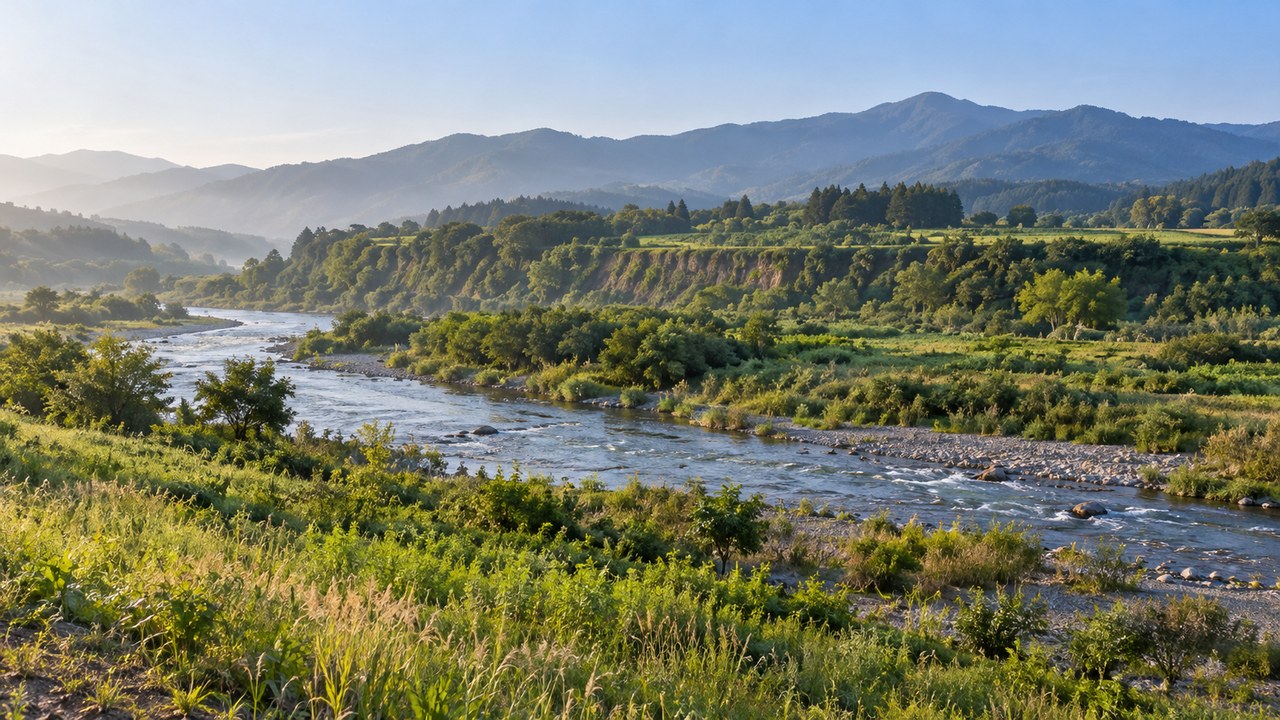
Sainokami looked down closely over the Rengo River and lay on the front line, within range of the allied guns. With the river between them, the Oda and Tokugawa armies faced the Takeda across a short distance, the allies on the western side and the Takeda on the eastern side.
The center of the campaign had now shifted from the area around the castle to the two banks of the Rengo River. Why Katsuyori chose to give battle while still besieging the castle is hard to confirm from the records, and this article does not try to guess what he was thinking. What can be followed is where his headquarters moved and how close the two armies came.
Chapter 6
Terraces and muddy lowland
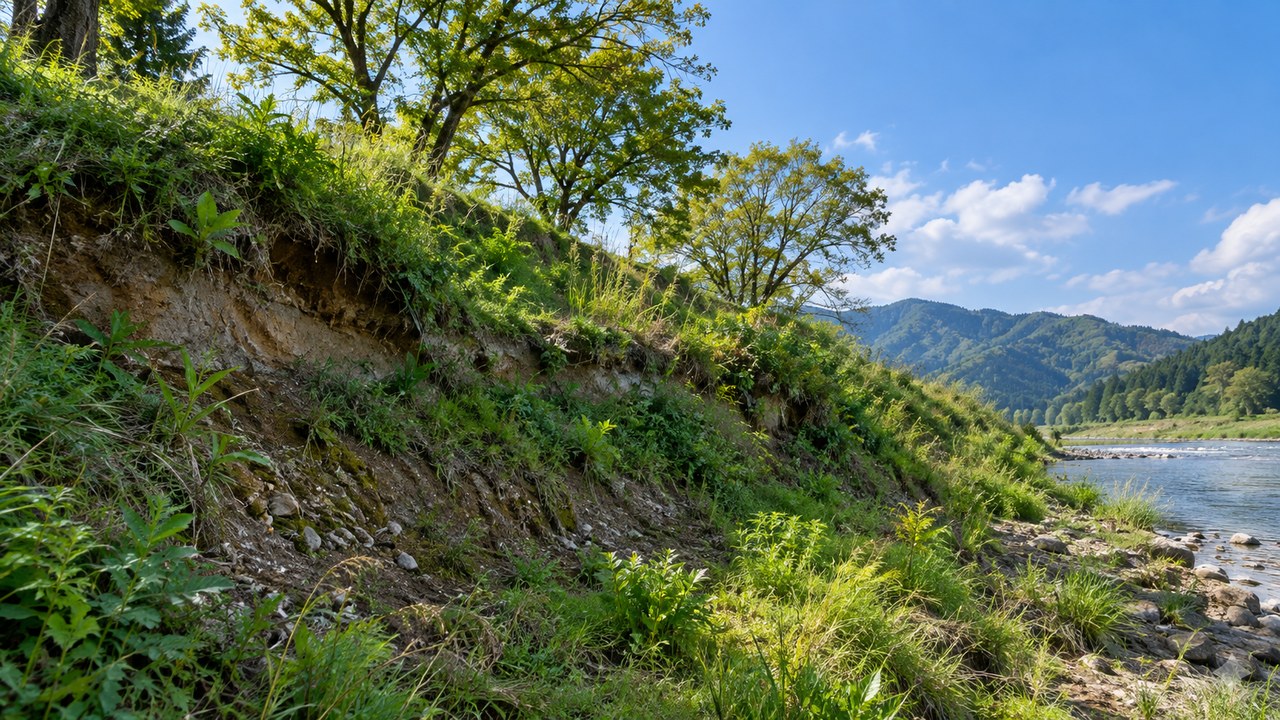
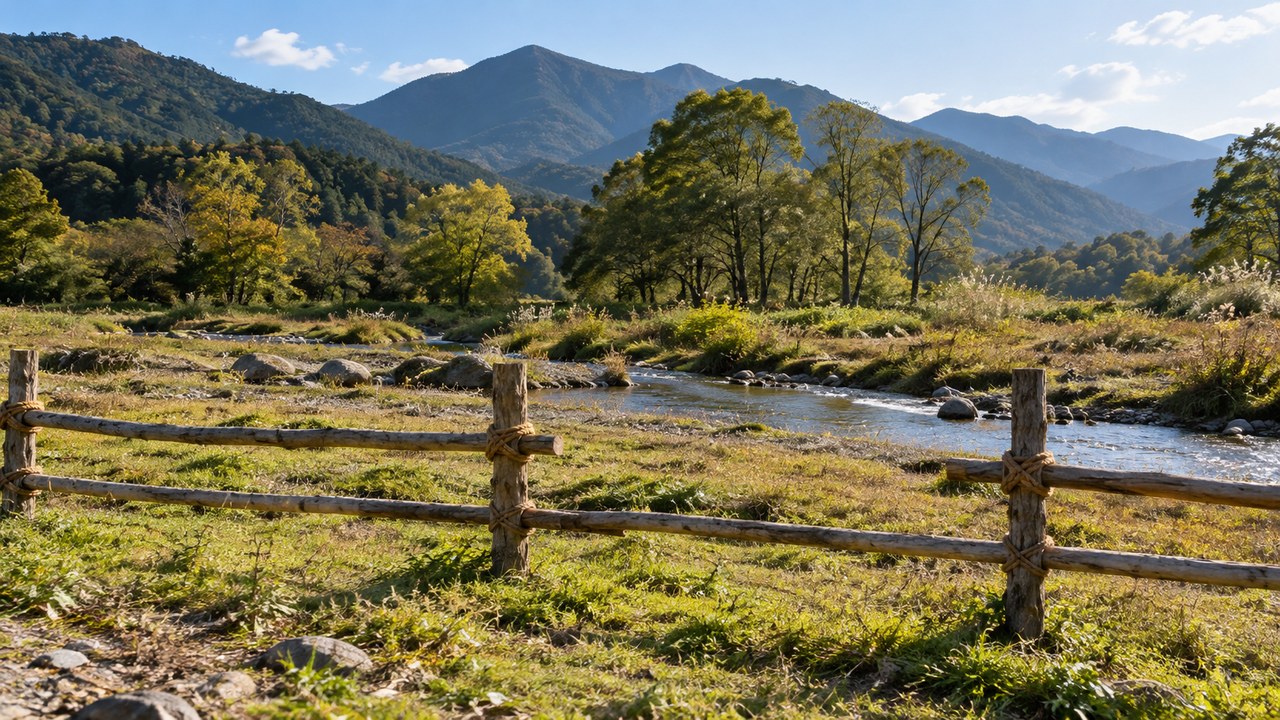
Shitaragahara is not a flat, open plain. Aichi Prefecture's account of the local landforms explains that the Rengo River runs through a strip of lowland formed by river deposits, and that on either side of it rise river terraces of different heights, the remains of older valley floors.
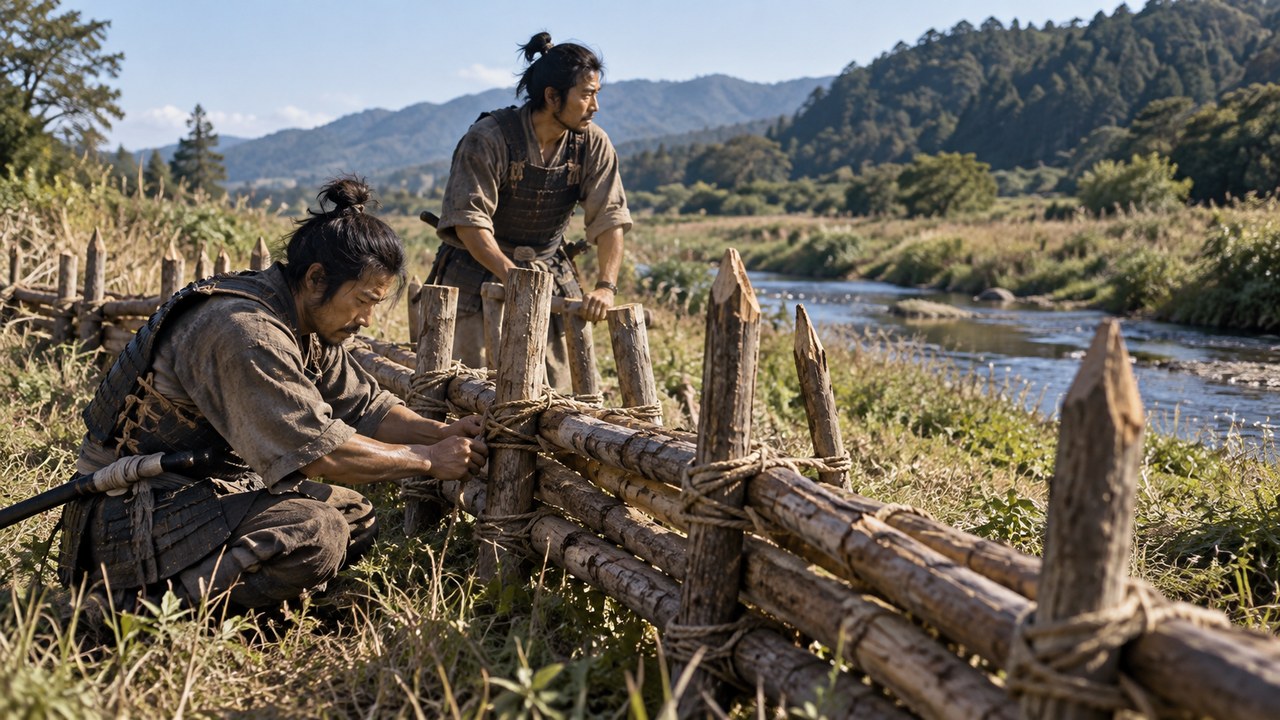
The rebuilt anti-cavalry fences stand along the line where the foot of a terrace cliff meets the lowland, in the same position as the original fences, according to the prefecture. It adds that the battle took place in the rainy season, and that the Takeda, who had deployed on the higher terrace, ran down the cliff only to be held up by the muddy lowland and the fire from behind the fences.
This is the prefecture's reading of the battle from the present landscape, not a survey of the ground made on the day. Even so, the terrain makes it easy to picture how hard it was to cross a river, move over ground of different heights and close in on a line of fences while under fire.
Chapter 7
The battle of the twenty-first day
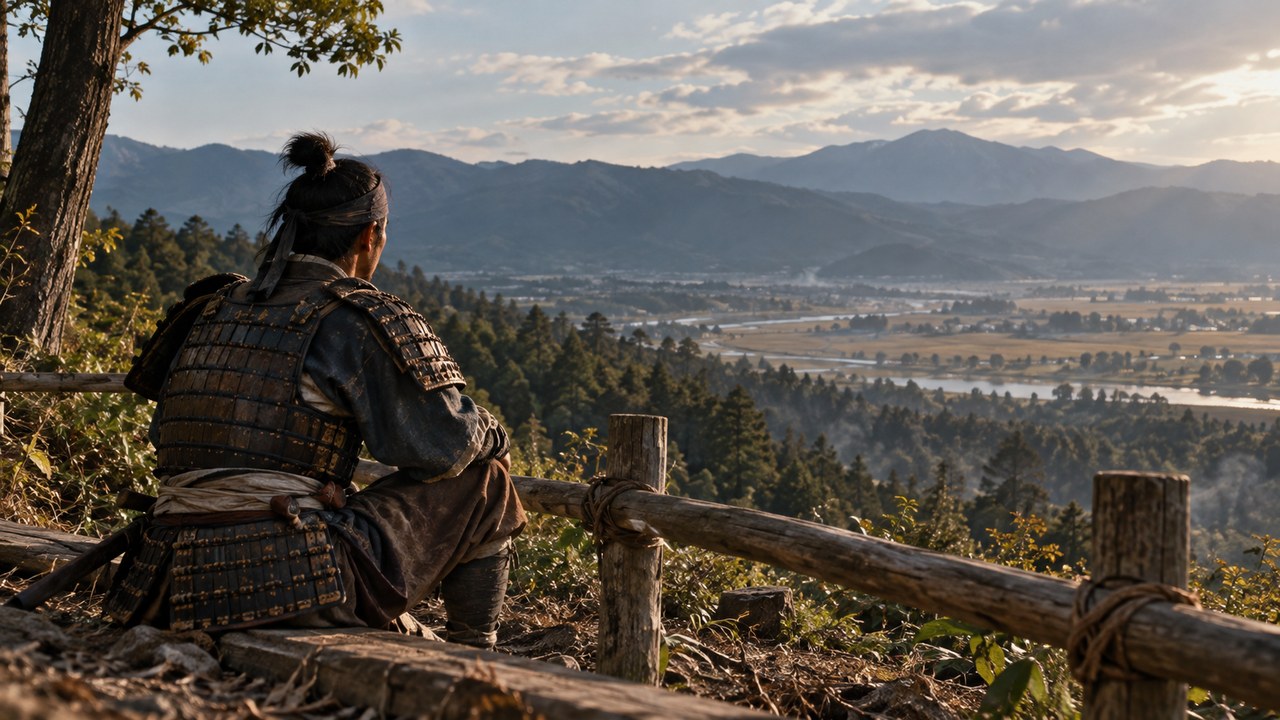
According to the National Archives of Japan, the battle began on the twenty-first day of the fifth month. The allied army is said to have dealt the Takeda a devastating blow with its musket units and anti-cavalry fences, and the fighting ended in victory for the Oda and Tokugawa forces.
The fences are said to have stretched for about two kilometers and to have been built in a rush over three days. Shinchokoki, the chronicle of Nobunaga written by his retainer Ota Gyuichi, describes the guns being fired again and again, which suggests that the allied side relied on a great deal of musket fire.
On the Takeda side, well-known commanders such as Yamagata Masakage, Baba Nobuharu, Hara Masatane and Tsuchiya Masatsugu were killed. The total number of dead is not given in the sources checked for this article, so no figure is offered here. The loss of so many experienced commanders in a single day was nonetheless a heavy blow to the Takeda.
Chapter 8
Three thousand guns and three-rank fire reconsidered
Nagashino is famous for the image of three thousand muskets arranged in three ranks that took turns to fire, a tactic known in Japanese as sandan-uchi. A battlefield guide from the Shitaragahara Historical Museum, updated in 2019, still describes about three thousand matchlocks being fired without pause.
The number of guns, however, is uncertain. An article on nippon.com points out that copies of Shinchokoki give both one thousand and three thousand, and that another chronicle, Todaiki, says the Negoro and Saika groups brought two thousand guns. The true number, it concludes, cannot be determined from these records.
The method of firing has also been reconsidered. In 2025 the Shitaragahara Historical Museum held an exhibition announcing that three-rank fire is now widely thought not to have been used. Heavy musket fire and a specific drill of three alternating ranks are separate claims that need to be judged separately.
Chapter 9
Bullets from the soil
The battle has also left traces in the ground. According to the museum, only 38 musket balls have so far been found at Nagashino Castle and Shitaragahara, a remarkably small number for a battle so closely associated with firearms.
The museum shows a calculation: if three thousand guns each fired ten shots, some thirty thousand balls should be lying in the area. To explain why so few have been found, it suggests that balls sank deep into the soil of the surrounding fields, or that they were collected and recast after the battle.
Analysis of the lead in the recovered balls found that besides lead from Japan, some came from mines in China, Korea and Thailand. From this the museum explains that Nobunaga gathered large quantities of lead through trade with Europeans and other overseas merchants, the so-called Nanban trade. As with the other figures in the museum's text, these conclusions rest on analysis and inference that this article has not checked independently.
Chapter 10
Who drew the deployment map?
A deployment map lets readers see the whole battlefield at a glance. The map owned by Soken-ji temple and deposited with the Shitaragahara Historical Museum records the names of more than a hundred commanders across Shitaragahara and shows the anti-cavalry fences along the Rengo River.
Many such maps color the Takeda army red and the allied army black. The museum explains that the village names and roads they show belong to the time when the maps were drawn, and that they were compiled from surviving records by people who had long studied the battle.
A deployment map helps us understand the battle, but it is not a plan drawn by someone on the field that day. Read as a record of how later generations organized their knowledge of the battle, its value becomes much clearer, and so do its limits as evidence for the positions of 1575. The same caution applies to the famous painted screens of the battle, which were also made long after the event.
Conclusion
After the battle, two places
After the battle, Okudaira Sadamasa, who had held the castle, received a character from Nobunaga's name and became Okudaira Nobumasa. He married Kamehime, Ieyasu's eldest daughter, and in 1576 built a new castle, Shinshiro Castle, whose earthworks still survive in part. The site is now occupied by an elementary school, with a stone marker on the eastern rampart.
The defeated Takeda went on fighting the Tokugawa, especially over Takatenjin Castle, but in the third month of 1582 Katsuyori took his own life at Tenmokuzan, and the Takeda house came to an end. The National Archives places the fall of the Takeda as the last chapter of this long struggle.
Nagashino Castle at the meeting of two rivers, and Shitaragahara with its river, terraces and lowland: following the two places separately shows that the battle of Nagashino was not a single scene of fences and guns, but a campaign that moved from the siege of a castle to a decisive battle on different ground. The rebuilt fences and the museum displays can be seen anew in that light.
How to read this work
History, interpretation, and reconstruction
The battle of Nagashino cannot be explained by fences and guns alone. Following how the campaign moved from the siege of a castle to a battle at Shitaragahara, and the river, terraces and lowland that shaped it, shows which parts of the familiar story are secure and which are being reconsidered.
This work is grounded in published sources and historical research. Interior thoughts, dialogue, and some visual details are cinematic reconstructions. Where historians disagree, the article presents the point as debated rather than settled fact.
Timeline
The story in time
-
Suganuma Motonari builds Nagashino Castle where the Toyokawa and Ure rivers meet.
Sources: s09 -
Tokugawa Ieyasu captures Nagashino Castle, then under Takeda control.
Sources: s09 -
Takeda Katsuyori captures Akechi Castle and Takatenjin Castle.
Sources: s08 -
Oda Nobunaga leaves Gifu.
Sources: s08 -
Torii Suneemon is said to slip out of the castle to seek help.
Sources: s11 -
Sadamasa, now Nobumasa, marries Ieyasu's eldest daughter Kamehime and builds Shinshiro Castle.
Sources: s07 -
Katsuyori takes his own life at Tenmokuzan and the Takeda house falls.
Sources: s08
People & terms
A guide for new readers
Key figures
- Okudaira Sadamasa
- Defended Nagashino Castle in 1575.
- Takeda Katsuyori
- Besieged Nagashino Castle before facing the allied forces at Shitaragahara.
- Oda Nobunaga
- Fought the Takeda army in alliance with the Tokugawa side.
- Tokugawa Ieyasu
- Fought the Takeda army in alliance with the Oda side.
- Torii Suneemon
- Okudaira retainer said to have slipped out of the besieged castle to seek help
- Sakai Tadatsugu
- Senior Tokugawa retainer said to have proposed the attack on Tobigasuyama
Glossary
- Nagashino Castle 長篠城
- The castle defended by Okudaira Sadamasa and besieged by Katsuyori in 1575, distinct from the Shitaragahara battlefield.
- Shitaragahara 設楽原
- The site of the decisive encounter between the Oda–Tokugawa alliance and Takeda forces after the siege phase.
- Rengogawa 連吾川
- The river discussed with the lowlands, terraces and recreated fences in the prefectural landform account.
- Kansagawa 寒狭川
- The name also used for the upper Toyokawa in the account of Nagashino Castle’s confluence setting.
- Uregawa 宇連川
- The river meeting the upper Toyokawa at the castle’s setting in the prefectural guide.
- Babo-saku 馬防柵
- Anti-cavalry fencing; the feature introduced by modern guides is reconstructed, not surviving 1575 timber.
- River terrace 河岸段丘
- Stepped higher ground discussed with lowlands in the landform account; not a complete record of soldiers’ movements.
- Three-rank firing 三段撃ち
- The familiar explanation of alternating fire discussed critically in the museum’s past exhibition announcement; not established in detail by that short notice.
- Deployment map 布陣図
- A later representation assembled through research using surviving material, not a complete contemporary census of positions.
- Teppōdama 鉄砲玉
- Bullets introduced as finds from Shitaragahara; their recovery alone does not determine total guns or shots.
- Honoka 広報ほのか
- The public-information publication whose January and March 2012 articles were reproduced in the museum’s bullet and map introductions.
- Oda–Tokugawa alliance 織田・徳川連合軍
- The allied side that defeated the Takeda army at Shitaragahara in the municipal account.
- Reconstructed landscape 復元景観
- A later explanatory representation of the past; its date and purpose should be distinguished from original remains.
- Tobigasuyama 鳶ヶ巣山
- A Takeda fort among the siege positions around Nagashino Castle, said to have been the target of a surprise attack proposed by Sakai Tadatsugu.
- Shinchokoki 信長公記
- The chronicle of Oda Nobunaga written by his retainer Ota Gyuichi; its surviving copies differ on the number of guns at Nagashino.
Sources & method
How this article was built
This English edition follows the revised Japanese article scene by scene and keeps its sources, their order and its timeline. It draws on explanations by Shinshiro City and its Shitaragahara Historical Museum, Aichi Prefecture and the National Archives of Japan, together with articles on nippon.com and in Nippon Tabi Magazine.
Army sizes, the number of guns, the method of firing and the month in which the siege began differ between sources and are presented as such. The story of Torii Suneemon includes tradition and is not treated as fully established. The prefecture's reading of the terrain is an interpretation of the present landscape, not a record of the ground on the day.
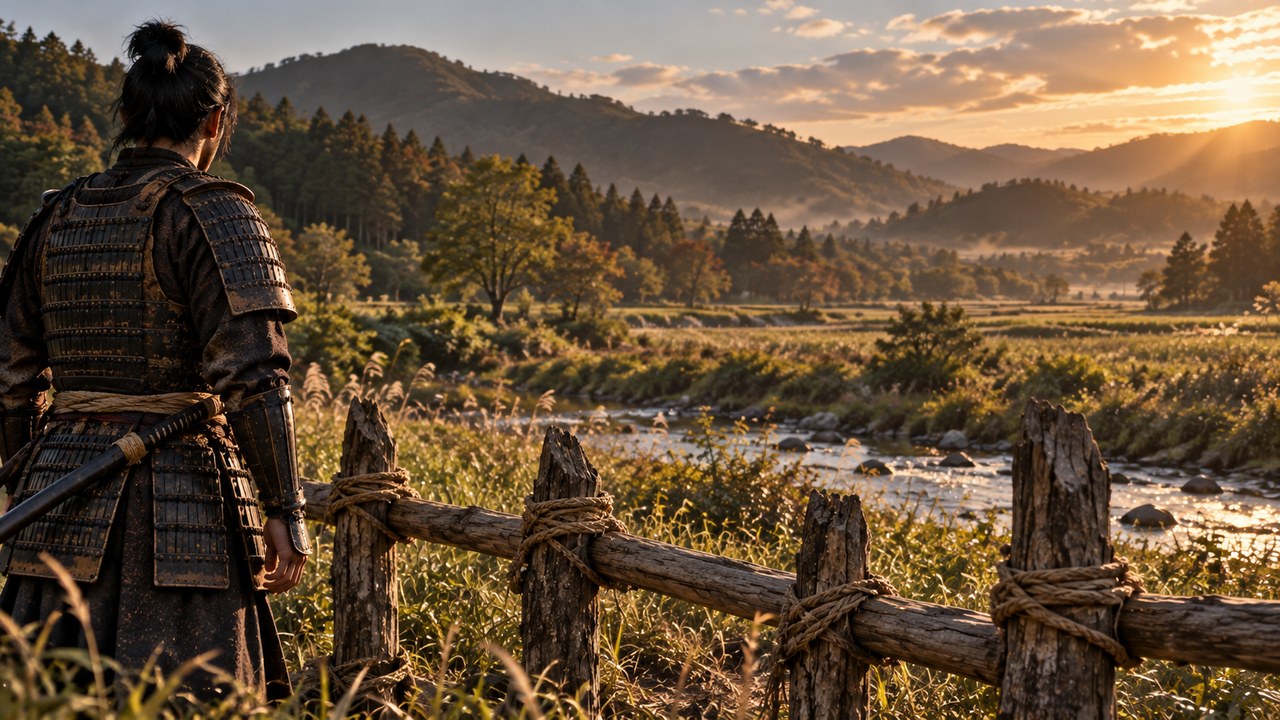
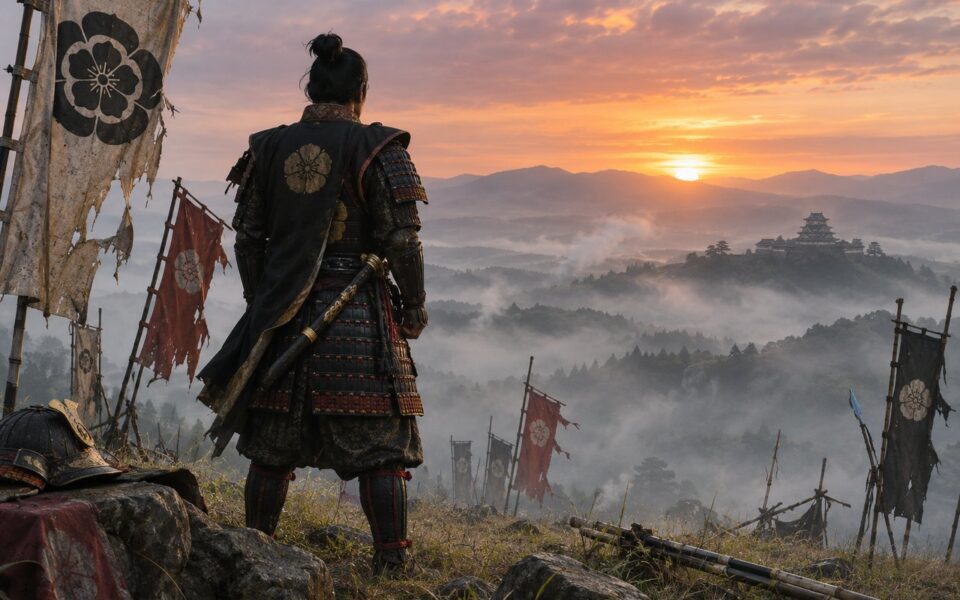
Images are AI-generated conceptual scenes by SHIGEKI. They are not portraits of real people, original maps or exact reconstructions of the historic sites. The film has Japanese audio.
Sources
References and further reading
- Exhibition: The Mystery of Three-Rank Musket Fire 企画展「鉄砲三段撃ちの謎」 Title translated editorially for reader convenience. Shinshiro City 新城市・設楽原歴史資料館 Past 2025 exhibition announcement identifying questions about conventional firing explanations; not the exhibition’s full argument or a final resolution of research. Accessed 2026-11-18
- Shitaragahara’s Anti-Cavalry Fences and River Terraces 設楽原の馬防柵と河岸段丘 Title translated editorially for reader convenience. Aichi Prefecture 愛知県東三河総局新城設楽振興事務所 Landform guide concerning the Rengogawa, lowlands, terraces and reconstructed fence. Terrain-based interpretation distinguished from complete knowledge of the 1575 surface. Accessed 2026-11-18
- Visiting Sites of Sengoku-Period Battles 戦国の戦い史跡めぐり Title translated editorially for reader convenience. Aichi Prefecture 愛知県東三河総局新城設楽振興事務所 Historical-site guide introducing Nagashino Castle and Shitaragahara separately, including the confluence, ditches, ramparts and recreated fences. Accessed 2026-11-18
- Following History 歴史を辿る Title translated editorially for reader convenience. Shinshiro City 新城市 Municipal overview of siege and decisive battle; troop figures and a simple old-versus-new tactical contrast are not adopted as verified totals or a sole cause. Accessed 2026-11-18
- The Shitaragahara Deployment Map: Ten Museum Highlights 設楽原布陣図-設楽原歴史資料館 名品10選! Title translated editorially for reader convenience. Shinshiro City 新城市・設楽原歴史資料館 Reproduction of a March 2012 Honoka article explaining later investigators’ work on the map; collection image not reproduced or independently authenticated. Accessed 2026-11-18
- Bullets Recovered from Shitaragahara: Ten Museum Highlights 設楽原から出土した鉄砲玉-設楽原歴史資料館 名品10選! Title translated editorially for reader convenience. Shinshiro City 新城市・設楽原歴史資料館 Reproduction of a January 2012 Honoka article. Introduced objects distinguished from transmitted gun counts, assumed firing calculations and conjecture; analytical papers not independently verified. Accessed 2026-11-18
- Visiting the Battlefield 古戦場を訪れる Title translated editorially for reader convenience. Shinshiro City 新城市・設楽原歴史資料館 Guide updated in 2019; its conventional firearm-versus-mounted-force explanation is read separately from the purpose and date of the 2025 exhibition notice. Accessed 2026-11-18
- The Battle of Nagashino (Tokugawa Ieyasu: His Life through the Shogunal Library) 長篠の戦い|徳川家康―将軍家蔵書からみるその生涯 Title translated editorially for reader convenience. National Archives of Japan 国立公文書館 Used for Katsuyori's captures of 1574, the siege to recover Nagashino, Nobunaga's departure from Gifu on the 13th, the headquarters on Gokurakuji and Takamatsu hills, the start of battle on the 21st and the fall of the Takeda in 1582. Accessed 2026-11-18
- 100 Fine Castles of Japan: Nagashino Castle, Aichi 【日本100名城®】愛知県・長篠城 Title translated editorially for reader convenience. nippon.com (Nippon Communications Foundation) nippon.com(公益財団法人ニッポンドットコム) Used for the castle's construction in 1508, its cliff-top setting at the river confluence, Ieyasu's capture in 1573 and the garrison of about 500 under Okudaira. Accessed 2026-11-18
- The Nagashino Battle Screens: Depicting One of the Great Battles of the Warring States 戦国時代屈指の戦いを描いた『長篠合戦図屏風』 Title translated editorially for reader convenience. nippon.com (Nippon Communications Foundation) nippon.com(公益財団法人ニッポンドットコム) Used for disputed army sizes, the differing records of the number of guns, doubts about three-rank fire, the scale of the fences and the Takeda commanders killed. Numbers are not treated as fixed. Accessed 2026-11-18
- Memorial Stone to the Execution of Torii Suneemon 鳥居強右衛門磔死之碑 Title translated editorially for reader convenience. Nippon Tabi Magazine ニッポン旅マガジン Used for the tradition of Suneemon's escape on the 14th, his appeal at Okazaki, his capture and execution, and the location and date of the memorial. Not treated as fully established fact. Accessed 2026-11-18
- Nagashino-Shitaragahara Battlefield: Site of Oda Nobunaga's Headquarters 長篠設楽原古戦場・織田信長戦地本陣跡 Title translated editorially for reader convenience. Nippon Tabi Magazine ニッポン旅マガジン Used for Nobunaga's stops at Atsuta on the 14th and Okazaki on the 15th, his arrival at Shitaragahara on the 18th, the Gokurakuji headquarters and the tradition of Sakai Tadatsugu's proposal to attack Tobigasuyama. Accessed 2026-11-18
Continue reading
More stories from Shigeki
Shigeki English
Ishida Mitsunari: How a Magistrate of 190,000 Koku Came to Stand at the Center of Sekigahara
Was Sekigahara a war Mitsunari plotted? Fourteen scenes follow the third son of a village family from the survey fields and supply lines to the center of the decisive battle, and to the riverbed at Rokujō.
- When From his birth in 1560 to his execution on the 1st day of the 10th month of 1600.
- Where Ōmi (today Shiga Prefecture), Sakai, Kyushu and Hakata, Oshi in Musashi, Korea, Sawayama, Fushimi, Ōgaki, Sekigahara and Kyoto.
Shigeki English
Taira no Kiyomori: From the First Warrior Noble to a Capital by the Sea
Born as Tadamori’s heir, he rose through the Hogen and Heiji conflicts to grand minister of state, then turned from Fukuhara to Itsukushima, Owada no Tomari and Song ships, before the transfer and return of the capital, his death and the end of his family.
- When 1118–1181, from his birth to his death, with the defeat at Dan-no-ura in 1185 and the statue of 1967
- Where Kyoto, Fukuhara in present-day Kobe, Owada no Tomari, Itsukushima, the Ondo Strait and Dan-no-ura