
SHIGEKI ENGLISH STORYEN
Japanese history in English
The Army That Had Lost Its Castle
How the Toyotomi side fought its last campaign after Osaka Castle lost the defenses that had sustained it
From the filling of Osaka Castle's moats after the Winter Campaign to the battles at Domyoji, Yao, Wakae, Tennoji, and Okayama, this article follows the Toyotomi side's narrowing choices, the castle's fall, and the end of the house in May 1615.
At a glance
Before you enter the story
- When
- From the settlement of the Winter Campaign in December 1614 to the end of the Summer Campaign on May 8, 1615
- Where
- Osaka Castle and battlefields to its south and southeast in present-day Osaka Prefecture, including Domyoji, Yao, Wakae, Tennoji, and the Kawachi plain
- Key figures
- Toyotomi Hideyori, Yodo-dono, Tokugawa Ieyasu, Tokugawa Hidetada, Sanada Nobushige, Goto Mototsugu, Kimura Shigenari, Chosokabe Morichika
- What was at stake
- The campaign decided the survival of the Toyotomi house and reshaped both the political order and the physical form of Osaka Castle.
Why this story matters
The larger history behind the turning point
The Summer Campaign is often remembered through the last attack of Sanada Nobushige against Tokugawa Ieyasu's headquarters. That episode matters, but it becomes misleading if detached from the months in which the military setting changed. The story begins with a negotiated settlement, the filling of moats, and the loss of the defensive depth that had made Osaka Castle formidable during the preceding winter.
For readers outside Japan, the campaign offers a clear view of how early modern warfare joined fortification, roads, rivers, timing, and political authority. A castle was not merely a palace behind walls. Its moats and successive enclosures slowed an attacker and gave defenders time to concentrate. Once that system was impaired, the Toyotomi commanders had to fight over a much wider landscape.
The result also shaped the city seen today. The stone walls and moats visible above ground at Osaka Castle largely belong to the Tokugawa reconstruction begun in 1620. Remains of the Toyotomi-period castle survive beneath later fill. The defeated castle therefore persists not as an untouched monument but as an archaeological layer below the victor's rebuilding.
This account separates documented events from interpretation and visual reconstruction. It does not invent final conversations for Hideyori or Yodo-dono, precise words spoken in battle, troop numbers not established by the cited sources, or a single certain location for every named battlefield. The uncertainty is part of the history, not an obstacle to be covered with drama.
Historical context
What an international reader needs to know
Two campaigns, one changing fortress
The conflict conventionally called the Siege of Osaka unfolded in a Winter Campaign in 1614 and a Summer Campaign in 1615. During the winter, forces loyal to the Toyotomi house defended Osaka Castle against Tokugawa armies. A settlement ended that phase, but it did not produce a durable political resolution. Work to fill the castle's moats began only days after the agreement.
Japanese castle defenses combined water or dry moats, earthen and stone ramparts, gates, walls, and nested compounds. Their value lay partly in delay: an attacker had to cross obstacles while defenders could restrict approaches and move within protected space. The Summer Campaign was fought after this system had ceased to offer the Toyotomi side the same conditions it had possessed in winter.
Political context: Toyotomi and Tokugawa
Toyotomi Hideyori was the son and heir of Toyotomi Hideyoshi, the ruler who had unified much of Japan before his death in 1598. Tokugawa Ieyasu established the Tokugawa shogunate after victory at Sekigahara in 1600 and received the title of shogun in 1603. By 1615, Hideyori's court at Osaka remained a political focus outside the Tokugawa order.
The combatants were not modern national armies. They were formations assembled through warrior houses, retainers, and commanders whose movements had to be coordinated across roads, passes, rivers, and separate fronts. The campaign's rapid sequence demonstrates why a plan on paper did not guarantee that units would reach the same battlefield at the same time.
Geography south and east of Osaka
Osaka Castle stood north of the final battlefields discussed here. Routes from Yamato to the east entered the Kawachi plain near the Yamato River. Domyoji lay to the southeast; Yao and Wakae formed additional fronts farther north; Tennoji and Okayama lay immediately south of the castle. Fighting on May 6 and 7 therefore extended across several connected but distinct places.
Present-day streets and place names cannot simply be treated as a transparent map of 1615. Rivers, routes, settlement patterns, and administrative names have changed. Kashiwara City's own discussion of Komatsuyama cautions that the familiar battle name cannot be fixed to a modern point without qualification.
Names and historical memory
Sanada Nobushige is widely known by the later popular name Yukimura. This article uses Nobushige, the form employed by the Japanese source article, while acknowledging that visitors to Osaka will often encounter Yukimura in monuments and tourism materials. Later commemoration is evidence of memory, not direct evidence for every detail of the battle.
The spelling Osaka is used throughout the English text. The historical written form is often romanized as Osaka or Ozaka depending on scholarly convention. The distinction does not alter the identity of the castle or campaigns discussed here.
Watch the film
See the story in motion
The film currently uses Japanese audio. This English article provides the context and source trail; it does not imply that an English subtitle track is available.
December 1614
The moats lost before the last battle
If the Summer Campaign is opened with the charge of May 7, 1615, the most important change in the battlefield has already happened offstage. To understand why Toyotomi forces finally moved outside the castle, we must return to the end of the Winter Campaign and ask what became of Osaka's defenses immediately afterward.
A settlement concluded the Winter Campaign on December 19, 1614. The Toyotomi side had defended the castle, including an outwork constructed by Sanada Nobushige that became known as the Sanada Maru. The National Archives of Japan describes a campaign in which Tokugawa forces encircled Osaka while its defenders continued to exploit the fortress.
According to the Osaka Castle Museum timeline, the Tokugawa side began filling the castle's moats on December 23, four days after the settlement. A moat was not decorative water around a residence. Together with walls and compounds, it delayed approach, narrowed the points defenders had to hold, and converted distance into time.
Tension persisted. On March 5, 1615, Kyoto deputy Itakura Katsushige reported to Ieyasu about Toyotomi activity, including work on the castle and an increase in masterless warriors. The official timeline and the National Archives account both show that the agreement had not removed the political and military confrontation.
The precise understanding of the settlement, the extent of the filling, and the intentions attributed to each party cannot be reduced to one simple explanation after the fact. The secure point is narrower: filling advanced after the agreement, and the castle faced renewed war without the same defensive conditions it had possessed during the winter.
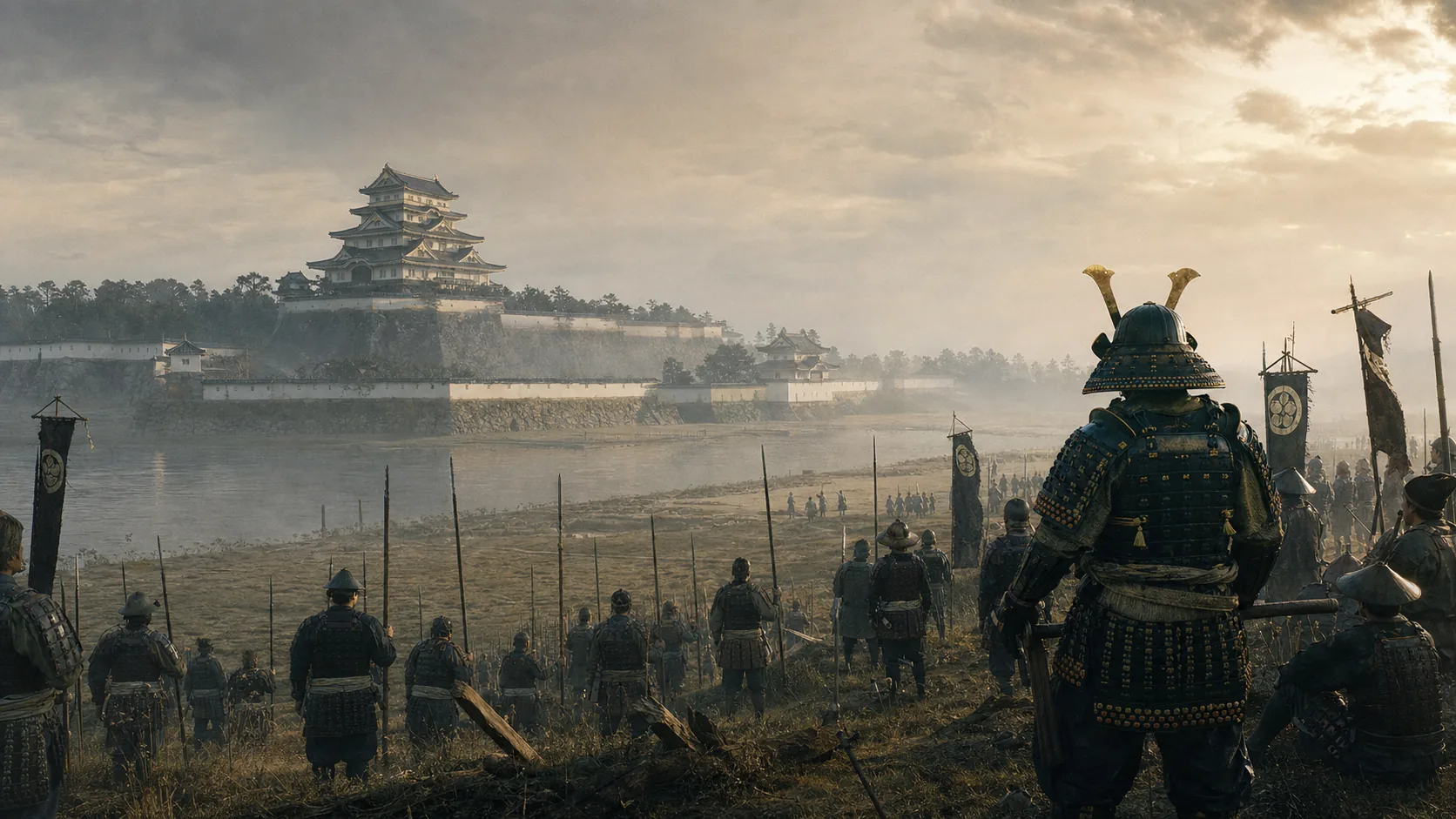
The accompanying image is an AI-generated reconstruction of a filled moat and troops moving beyond the castle. It does not reproduce the order of the work, water levels, the exact compounds, or unit positions. It is a spatial metaphor for defenses altered before the summer fighting began.
April 1615
Seeking a decision beyond the walls
The National Archives dates the opening of the Summer Campaign to April 25, 1615. The Toyotomi side no longer possessed the same capacity to remain within the walls and hold a besieging army at distance. The arena of war therefore expanded from the castle itself toward routes entering the Kawachi plain and the ground southeast of Osaka.
Kashiwara City's cultural heritage account explains that Toyotomi forces left the castle and tried to block Tokugawa troops advancing from Yamato near Kokubu, where the Yamato River emerges into the plain. If a route could be held in constrained terrain, an approaching force might be engaged before it deployed across more open ground.
The same account says the Tokugawa advance reached Kokubu earlier than the Toyotomi side expected, leaving Goto Mototsugu to fight first with limited troops. A plan does not make roads, passes, rivers, messengers, and separate columns move on schedule. Those practical conditions turned an intended concentration into successive contacts.
The phrase seeking a decision beyond the walls is not a quotation attributed to a council of Toyotomi commanders. It is this article's interpretation connecting the weakened castle, the attempted defense near Kokubu, and the field battles of May 6 and 7. It describes the range of action visible in the evidence without inventing a unanimous declaration.
That course contained both opportunity and danger. Fighting at a constricted route or attacking before the Tokugawa deployment was complete could create a local advantage. Yet if the offensive stalled, the Toyotomi army had far less capacity to retreat behind outer works and exchange space for time.
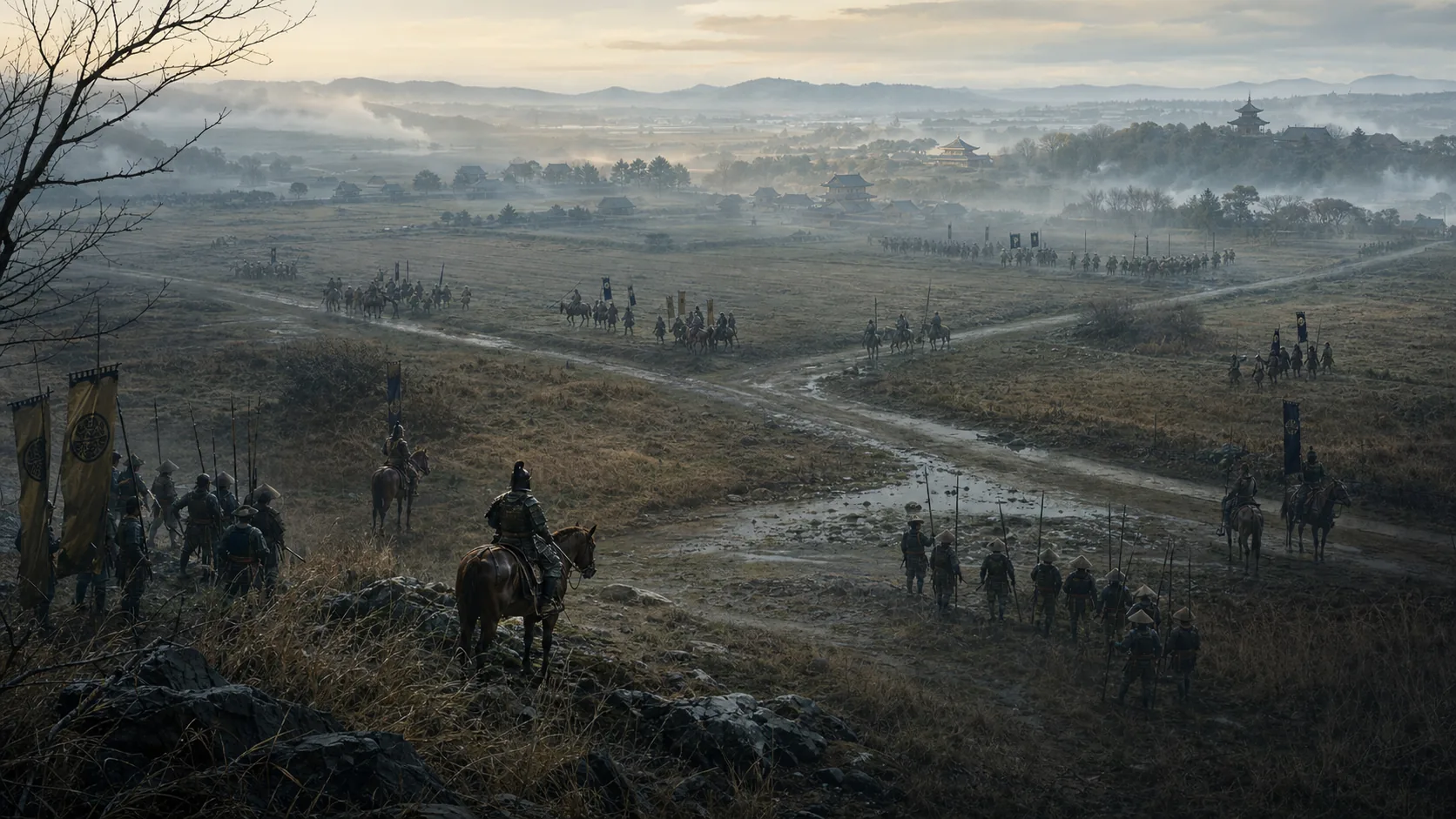
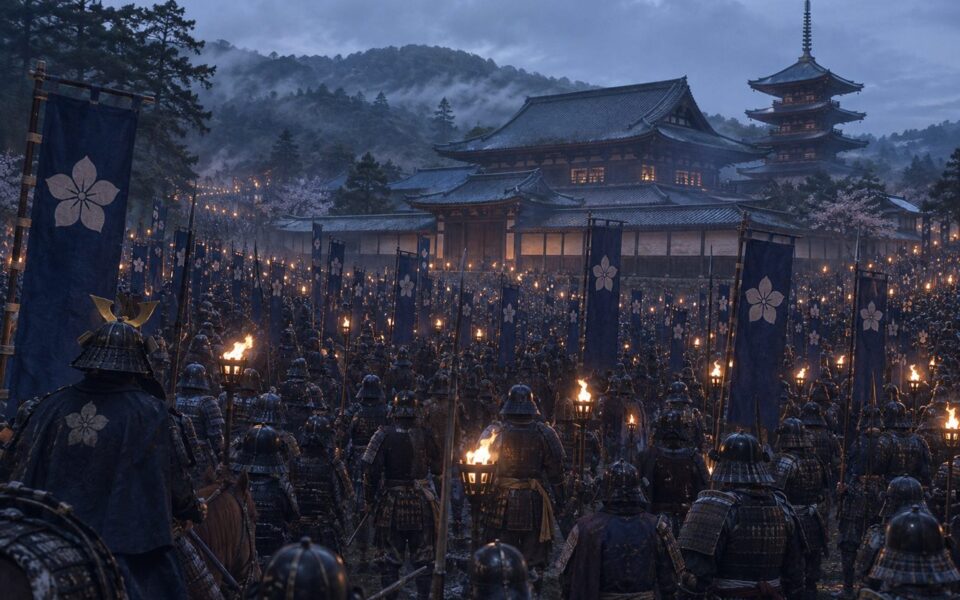
The image places marching troops and the distant castle in a single symbolic frame. It is not a record of the actual route, standards, formation, weather, or an individual's moment of decision. Its purpose is to make visible the strategic shift from defending within a fortified system to fighting across open approaches.
May 6, 1615 — Domyoji
The battle began before the force assembled
Early on May 6, fighting opened around the Tamateyama hills southeast of Osaka Castle. Kashiwara City distinguishes an initial Battle of Komatsuyama and a wider sequence that moved from Tamateyama toward Domyoji. The battlefield was mobile and cannot be contained by one present-day place name.
Goto Mototsugu met Tokugawa troops first and was killed near Komatsuyama. Kashiwara's account then records the arrival of forces under Mori Katsunaga and Sanada Nobushige. They fought from the western bank of the Ishikawa River near Domyoji toward Konda before withdrawing toward Osaka in the evening.
The central fact is not simply that several Toyotomi units fought in the same region. They did not all assemble at one point and open battle in an ordered formation at the same time. If the official account of an unexpectedly rapid Tokugawa advance is followed, the interval between early and late arrivals became part of the battle itself.
Even the name Komatsuyama requires care. Kashiwara City's cultural heritage specialists note that the name is absent from local maps and small place-name records they examined, and they consider how the term in written accounts relates to the modern landscape. A famous battle name is not automatically a precise coordinate.
Reducing the episode to Goto's final stand hides the campaign's structure. Advance contact, delayed arrivals, movement westward, and retreat at evening show the difficulty of connecting multiple units beyond the castle. That difficulty was visible a full day before the better-known final battle at Tennoji.
The image is an AI-generated reconstruction of forces meeting among hills and river terrain. It does not identify Komatsuyama's exact location, troop strength, arrival times, or Goto's death scene. It visualizes separation produced by terrain and timing rather than claiming eyewitness accuracy.
May 6, 1615 — Yao and Wakae
Separate fronts on the same day
While combat continued around Domyoji on May 6, Toyotomi and Tokugawa forces also collided farther north at Yao and Wakae. The Osaka Castle Museum timeline places these engagements on the same day, while Yao City's account distinguishes two fields spanning areas of present-day Yao and Higashiosaka.
At Wakae, troops of the Ii house descended from the Jusan Pass and advanced along the Jusan road before engaging Kimura Shigenari's force. Yao City records that Kimura was killed, as were Todo Yoshikatsu and Yamaguchi Shigenobu on the Tokugawa side. The record preserves severe losses on both sides rather than a frictionless victory.
At Yao, the main force of the Todo house fought Chosokabe Morichika's troops near Jokoji and the temple settlement of Kyuhoji. Yao and Wakae are often paired under one battle name, but their units, opponents, and surviving sites of memory were not identical.
Placing Domyoji, Yao, and Wakae on one day's map shows Toyotomi strength being used across a broad area. The cited public sources do not establish when information from one battlefield reached another or how fully any single commander understood the whole. It would therefore be unsafe to invent a centralized real-time view.
Yao City introduces graves associated with Kimura Shigenari and Yamaguchi Shigenobu at Wakae and memorial stones for the Todo dead at Jokoji. A later illustrated guide to notable places in Kawachi also depicted such memorials. The battle ended in 1615, but the names of dead from both sides remained embedded in local landscapes.
The scene image divides troops toward multiple directions. It is not a literal viewpoint from which Yao and Wakae could be surveyed together, nor does it reproduce the exact Ii, Todo, Kimura, or Chosokabe deployment. It represents concurrent but separate contact.
May 7, 1615
A local breakthrough and the whole war
On May 7, the final battle moved to the Tennoji and Okayama approaches south of Osaka Castle. After losing commanders and formations in the fighting at Domyoji, Yao, and Wakae, the Toyotomi side committed its remaining strength. Failure here left a castle behind them without the defensive depth it had possessed in winter.
The Tennoji district includes slopes and valleys descending south from the area of Shitennoji. Osaka City's local guide draws attention to elevation changes and places traditionally connected with the opposing armies. Present roads cannot be equated with the 1615 battle line, but the landscape warns against imagining a perfectly flat board.
According to the National Archives, Sanada Nobushige's force penetrated toward Ieyasu's headquarters and temporarily threw the Tokugawa side into confusion. This core episode is present in an official historical account, not only in later heroic tales. Precise dialogue, Ieyasu's private emotions, and every step of the attack do not carry the same evidentiary support.
Shaking a headquarters was not the same as collapsing the entire Tokugawa army. Other sectors and following units remained, and the Toyotomi attack did not become a campaign-wide reversal. A local success could exert intense pressure without instantly erasing an opponent's numerical and organizational depth across a wider front.
A narrative centered on Sanada is an effective entrance to the battle's violence. Yet removing the previous day's three regions, lost commanders, delayed concentration, and the diminished fortress makes one charge seem to have decided everything. This article holds the heroic episode apart from the larger military structure, then reads them together.
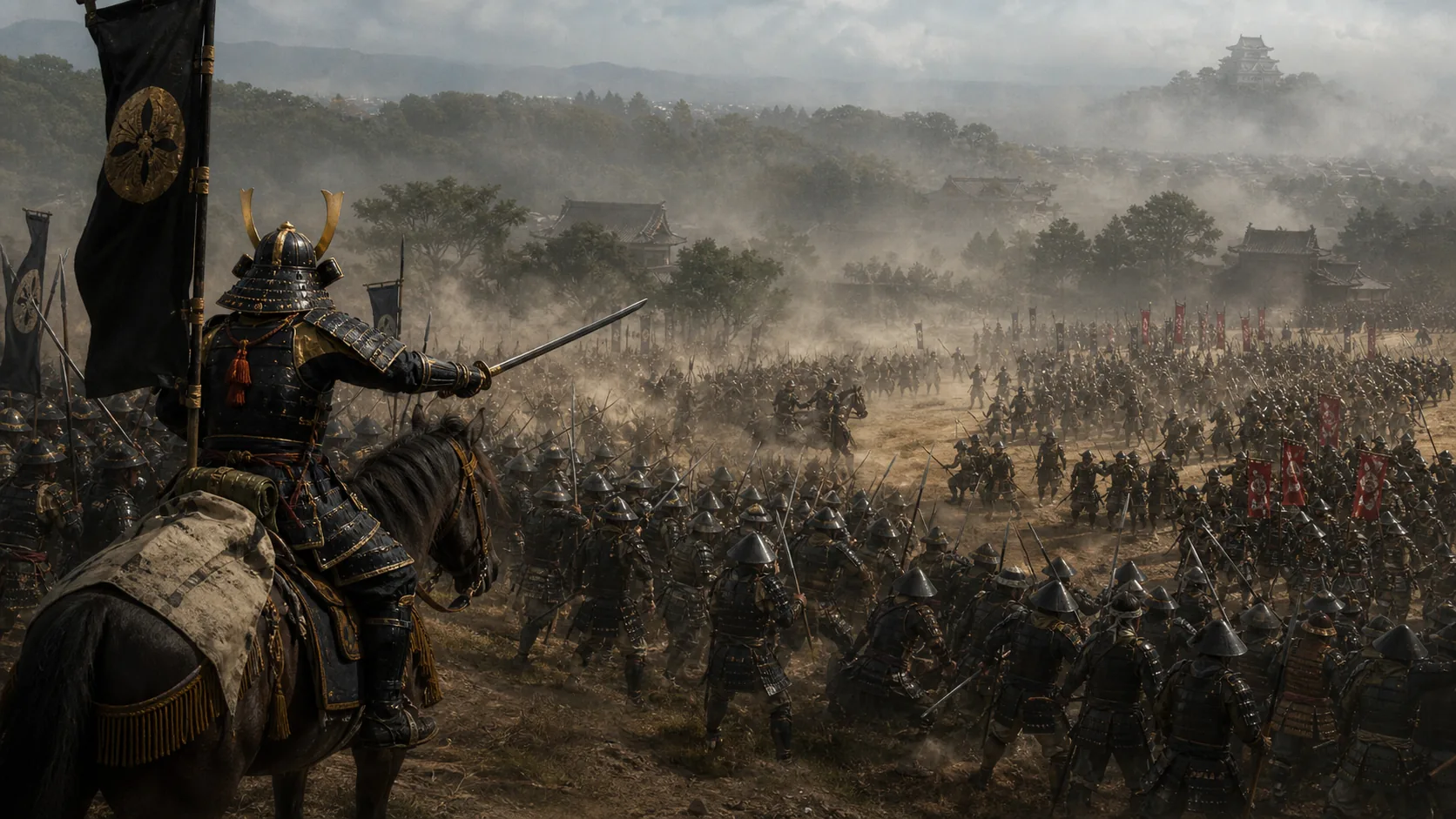
The image compresses the Tennoji and Okayama attacks into one composition. It does not recreate the instant of entry into Ieyasu's headquarters, Sanada's face, accurate standards, troop numbers, or attack order. It contrasts concentrated local pressure with the surrounding breadth of the Tokugawa line.
May 7, 1615
No intact fortress waited behind the retreat
When the Toyotomi offensive stopped and the battle line moved back toward Osaka, the castle altered after the settlement again became decisive. During the winter, returning defenders could use moats and outer compounds to slow an approach. In summer, much of the system that had created that time was gone.
The Osaka Castle Museum timeline and Kashiwara City's account place the castle's fall on the same day as the final battle, May 7. Counted from the field battles at Domyoji, Yao, and Wakae the previous day, the interval from widespread combat to the fall was extraordinarily short. Courage within one episode could not repair that temporal structure.
The fall should not be treated as a sudden event detached from everything before it. The December settlement, moat filling, March tension, April renewal of war, and dispersed battles on May 6 accumulated before the boundary between battlefield and castle broke down on May 7. The castle's fall was the end of that sequence.
It is equally unsafe to claim that one different decision would certainly have saved the Toyotomi side. Tokugawa forces, advances from multiple directions, the condition of the castle, arrival times, and prior losses interacted. Knowledge of the outcome does not permit historians to divide contemporary options into one obvious answer and one foolish mistake.
The Osaka Castle Museum reports traces of the intense fire of the Summer Campaign on buried Toyotomi-period stonework. Fire is therefore more than a cinematic symbol; material evidence survives on excavated structures. It cannot, however, reveal every action or individual scene inside the castle.
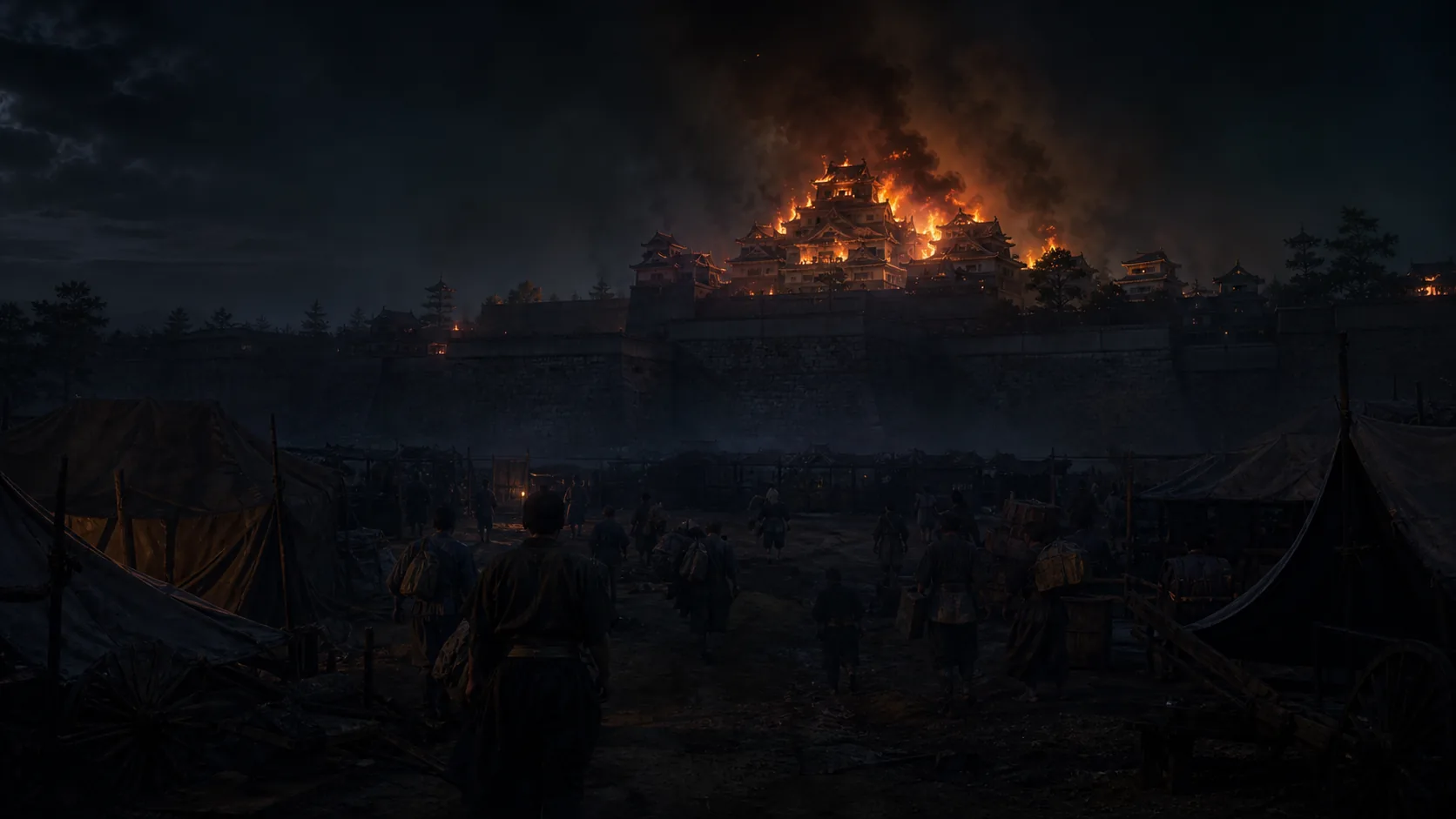
The image shows smoke and flame around the distant castle. It is not a contemporary record of where fire began, how it spread, who was inside, or the exact hour. It functions as a restrained chapter image for the result of the battle reaching the fortress itself.
May 8, 1615 — and afterward
From imagined last words back to surviving records
On May 8, Toyotomi Hideyori and Yodo-dono died by suicide, and the Summer Campaign ended. The Osaka Castle Museum, National Archives, and Kashiwara City accounts all place the end of the Toyotomi house on this date. The castle's fall on May 7 and the deaths on May 8 should remain distinct events.
The public materials do not establish what Hideyori and Yodo-dono said or thought at the end. If an article fills that silence with dialogue, a reader may receive invention as history. This edition does not stage their deaths as dramatic spectacle or place imagined conversations beyond the verified date and result.
The National Archives digital exhibition introduces several written works concerning the Osaka campaigns. They were not all produced under identical circumstances or by the same kind of observer. Saying that a detail appears in a historical text does not automatically give every detail equal reliability.
Memory also survived outside written chronicles. Yao City describes graves associated with Kimura Shigenari and Yamaguchi Shigenobu at Wakae and memorial stones for Todo troops at Jokoji. A guide to notable places in Kawachi produced during the Edo period later presented these graves with illustrations.
This local transmission complicates a story divided neatly between victor and vanquished. Communities preserved names and places associated with dead on both sides, and later visitors encountered the battle through that landscape. Sanada's name likewise remains in Tennoji monuments and community memory, but later celebration must be distinguished from evidence for May 1615.
The final image combines a quiet post-battle castle with a viewpoint looking back on surviving records. It does not depict the deaths of Hideyori, Yodo-dono, or any soldier, and it is not a facsimile of a grave or manuscript. The image redirects attention from unknowable inner lives to evidence that remains.
From 1620 to the present
Two Osaka Castles, above and below
The walls and moats visible in Osaka Castle Park today cannot simply be identified as the fortress in which Hideyori lived. The Osaka Castle Museum states that the above-ground stonework and moats belong to the Tokugawa reconstruction. The National Diet Library likewise traces the destruction of the Toyotomi castle and rebuilding under the shogunate.
Tokugawa reconstruction began in 1620. Osaka City's cultural heritage account describes three phases of work extending through 1629. The landscape now encountered by visitors is therefore not the Toyotomi castle preserved unchanged but the monumental layer created by the political power that followed its fall.
The Toyotomi castle did not disappear in every sense. The Tokugawa rebuilding used extensive fill that covered earlier stone walls. An excavation in 1984 identified stonework from the Toyotomi-period inner compound, and traces attributed to the fire of the Summer Campaign were observed on its surface.
This vertical relationship inscribes the outcome into the ground. Tokugawa fortifications stand above; Toyotomi stonework remains below. Defeat ended the Toyotomi house politically, but it also changed the castle's architecture and the historical view available to people centuries later.
Discovery of buried masonry does not automatically restore a complete image of 1615. Excavated structures, later maps, written sources, and present terrain are different kinds of evidence. They must be compared while leaving gaps open instead of forcing them into a seamless reconstruction.
The image presents the modern ground level and buried Toyotomi stonework as though in section. It is not a survey drawing of an excavation, an exact pattern of masonry, or a measurement of fill. It closes the article by visualizing two historical castles occupying different layers of the same place.
How to read this work
History, interpretation, and reconstruction
The Summer Campaign of Osaka was not simply a final heroic charge. Once its moats and outer works had been neutralized, the Toyotomi side could no longer rely on a prolonged siege and was compelled to seek a rapid decision across several field battles.
This work is grounded in published sources and historical research. Interior thoughts, dialogue, and some visual details are cinematic reconstructions. Where historians disagree, the article presents the point as debated rather than settled fact.
Timeline
The story in time
-
A settlement concludes the Winter Campaign of Osaka.
Sources: osaka-castle-jin-timeline, archives-ieyasu-osaka -
The Tokugawa side begins filling Osaka Castle's moats.
Sources: osaka-castle-jin-timeline -
Kyoto deputy Itakura Katsushige reports Toyotomi activity, including work on the castle and an increase in masterless warriors, to Ieyasu.
Sources: osaka-castle-jin-timeline, archives-ieyasu-osaka -
The National Archives account marks this as the start of the Summer Campaign.
Sources: archives-ieyasu-osaka -
Fighting begins around Tamateyama, and Toyotomi commander Goto Mototsugu is killed.
Sources: kashiwara-komatsuyama, kashiwara-kamenose, kashiwara-osaka-exhibition -
Later-arriving forces including those of Mori Katsunaga and Sanada Nobushige fight from Domyoji toward Konda and withdraw toward Osaka in the evening.
Sources: kashiwara-komatsuyama -
Ii troops engage Kimura Shigenari at Wakae, while Todo troops fight Chosokabe Morichika at Yao.
Sources: osaka-castle-jin-timeline, yao-yao-wakae -
The final battle is fought at the Tennoji and Okayama approaches. Sanada's force temporarily disrupts Ieyasu's headquarters, but Osaka Castle falls the same day.
Sources: osaka-castle-jin-timeline, archives-ieyasu-osaka, kashiwara-komatsuyama -
Toyotomi Hideyori and Yodo-dono die by suicide, ending the campaign and the Toyotomi house.
Sources: osaka-castle-jin-timeline, archives-ieyasu-osaka, kashiwara-komatsuyama -
The Tokugawa shogunate begins reconstructing Osaka Castle.
Sources: osaka-castle-toyotomi-wall, osaka-city-castle-remains -
Excavation confirms stonework from the Toyotomi-period inner compound beneath the later castle.
Sources: osaka-castle-toyotomi-wall -
The Osaka Castle Toyotomi Stone Wall Museum opens to present the excavated Toyotomi-period remains.
Sources: osaka-castle-toyotomi-wall
People & terms
A guide for new readers
Key figures
- Toyotomi Hideyori
- Head of the Toyotomi house at Osaka Castle. His final conversations and inner thoughts cannot be verified from the public sources and are not reconstructed here.
- Yodo-dono
- Hideyori's mother, recorded as having died by suicide with him on May 8, 1615.
- Tokugawa Ieyasu
- Retired shogun and principal Tokugawa leader, whose headquarters in the final battle stood in the Tennoji sector.
- Tokugawa Hidetada
- Second shogun of the Tokugawa government and a central commander on the Tokugawa side in the Okayama sector.
- Sanada Nobushige
- Toyotomi commander whose force penetrated toward Ieyasu's headquarters at Tennoji and temporarily threw Tokugawa troops into confusion.
- Goto Mototsugu
- Toyotomi commander also known as Goto Matabei, killed in the fighting around Komatsuyama on May 6.
- Kimura Shigenari
- Toyotomi commander killed while fighting forces of the Ii house at Wakae on May 6.
- Chosokabe Morichika
- Toyotomi commander who fought troops of the Todo house near Jokoji and the temple town of Kyuhoji at Yao on May 6.
Glossary
- Osaka Campaigns 大坂の陣
- The Winter Campaign of 1614 and Summer Campaign of 1615 fought between the Tokugawa side and forces based at Toyotomi Osaka Castle.
- Shogun 将軍
- The military ruler at the head of the Tokugawa government; Tokugawa Hidetada held the office during the campaign while Ieyasu remained politically and militarily powerful.
- Ronin 牢人
- A warrior without a current lord or domain affiliation; many gathered at Osaka in Toyotomi service.
- Kuruwa 曲輪
- A fortified castle compound or enclosure, usually integrated with moats, walls, gates, and embankments.
- Sanada Maru 真田丸
- An outwork associated with Sanada Nobushige that formed part of Osaka Castle's defensive system during the Winter Campaign.
- Fudai house 譜代
- A warrior house with established hereditary ties to the Tokugawa and privileged access to shogunate office; the Ii house was a leading example.
Sources & method
How this article was built
This English edition follows the Japanese source article's eight scenes, twelve timeline entries, people, and ten-source list without changing their order. Dates are presented first in the Gregorian calendar for international readability, while Japanese era terminology is retained where it helps explain the source chronology.
The evidence base consists of public materials from the Osaka Castle Museum, National Archives of Japan, National Diet Library, Osaka City and Tennoji Ward, Kashiwara City, and Yao City. Institutional summaries are compared across chronology, place, fortification, archaeology, and local memorial practice. An editorial English title is supplied when a source does not provide an official English title.
Documented actions are separated from the article's interpretation of diminished defensive depth, operational timing, and local versus campaign-wide success. AI-generated images inherited from the Japanese edition are disclosed as symbolic reconstructions. They are not used as evidence and do not assert exact troop numbers, formations, dialogue, private thoughts, or unverified topography.
Sources
References and further reading
- Chronology of the Osaka Campaigns: To the Stage of Fierce Battle 大坂の陣年表 いざ、激戦の舞台へ! Title translated editorially for reader convenience. Osaka Castle Museum 大阪城天守閣 Used for the Winter Campaign settlement, moat filling, renewed tension, and the principal sequence from May 6 through May 8. Accessed 2026-07-29
- The Winter and Summer Campaigns of Osaka 大坂冬の陣・夏の陣 Title translated editorially for reader convenience. National Archives of Japan 国立公文書館 Used for the winter defense, post-settlement tension, opening of the summer campaign, Sanada's attack toward Ieyasu's headquarters, the campaign's end, and introduced historical records. Accessed 2026-07-29
- Osaka Castle Toyotomi Stone Wall Museum 大阪城 豊臣石垣館 Title translated editorially for reader convenience. Osaka Castle Museum 大阪城天守閣 Used for the castle's fall, Tokugawa reconstruction, buried Toyotomi stonework, the 1984 discovery, and traces of campaign fire. Accessed 2026-07-29
- Osaka Castle 大阪城 Title translated editorially for reader convenience. National Diet Library 国立国会図書館 Used to confirm the castle's establishment under Toyotomi Hideyoshi, destruction in the Summer Campaign, and reconstruction by the Tokugawa shogunate. Accessed 2026-07-29
- Introducing the Many Sanada Yukimura Sites of Tennoji Ward 天王寺区のいろいろな「真田幸村」をご紹介! Title translated editorially for reader convenience. Tennoji Ward Office, City of Osaka 大阪市天王寺区役所 Used for present-day topography, traditional sites, the Chausuyama monument, and local commemoration in Tennoji. Accessed 2026-07-29
- Notes on the Battle of Komatsuyama, Part 1 小松山の戦いこぼればなし(1) Title translated editorially for reader convenience. Kashiwara City 柏原市 Used for the Komatsuyama and Domyoji fighting, Goto Mototsugu's death, later-arriving units, withdrawal, and caution about the geographical name. Accessed 2026-07-29
- Notes on Kamenose, Part 7 亀の瀬こぼればなし(7) Title translated editorially for reader convenience. Kashiwara City 柏原市 Used for the geography where the Yamato River enters the Kawachi plain, the Toyotomi defensive concept, and the unexpectedly rapid Tokugawa advance. Accessed 2026-07-29
- Special Exhibition: The Osaka Campaigns and Kashiwara 特集展示「大坂の陣と柏原」 Title translated editorially for reader convenience. Kashiwara City 柏原市 Used to place the Komatsuyama fighting in the Tamateyama hills and connect it to the movement of battle toward Domyoji. Accessed 2026-07-29
- Revisiting an Illustrated Guide to Kawachi, Part 3: The Summer Campaign and the Grave of Kimura Shigenari 続・河内名所図会を訪ねて(3) 大坂夏の陣と木村重成の墓 Title translated editorially for reader convenience. Yao City 八尾市 Used for the opposing forces at Wakae and Yao, losses on both sides, surviving graves and memorials, and Edo-period local memory. Accessed 2026-07-29
- Osaka Castle Site and Main Tower 大坂城跡(天守閣) Title translated editorially for reader convenience. City of Osaka 大阪市 Used to confirm that the visible moats and stone walls are Tokugawa-period works and that reconstruction proceeded in three phases from 1620 through 1629. Accessed 2026-07-29
Continue reading
More stories from Shigeki
Shigeki English
Oda Nobunaga: Why Was He Killed at Honnoji on the Verge of Unifying Japan?
From the boy called a fool to Okehazama, Tenka Fubu, Nagashino, Azuchi Castle and the night at Honnoji.
- When 1534 to 1582, ending with the Honnoji incident on the second day of the sixth month of 1582
- Where Owari (around Nagoya), Mino (Gifu), Kyoto and Azuchi on Lake Biwa
Shigeki English
The Second Choshu Expedition: Four Fronts and a Negotiated Withdrawal
Read weapons together with terrain, training, command and support.
- When 1866, distinct from the first expedition in 1864; the process of ending extended into January 1867
- Where Oshima, the Aki border, Iwami and the Kanmon Strait facing Kokura