
SHIGEKI ENGLISH STORYEN
Japanese history in English
Sado Gold and Silver Mines: The Technology and People Behind Underground Wealth
From placer deposits and hand-cut veins to drainage, furnaces, administration and working lives.
Follow Edo-period Sado from deposits to coins, distinguishing placer mining from vein ore, processing from refining, and skilled work from labour under restrictions. Surviving remains, documents and modern reconstructions reveal different parts of the system.
At a glance
Before you enter the story
- When
- The Edo period, with later extraction traces and modern reconstruction clearly distinguished
- Where
- Nishimikawa, Aikawa and Tsurushi on Sado Island
- Key figures
- Mining and processing specialists, Drainage workers, The Sado magistrate’s administration
- What was at stake
- How did different deposits become usable metal, and whose work and restrictions sustained the process?
Why this story matters
The larger history behind the turning point
A gold coin gives little immediate indication of the work needed to make it. Following ore through excavation, drainage, selection and furnace treatment reveals a sequence of intermediate products and different skills. Production depended on the links between those stages as well as the performance of each one.
The landscape also raises questions about people. Specialist work and administration existed alongside drainage labour performed under restrictions on movement and departure. Keeping those distinctions visible makes it possible to discuss technical achievement without losing the differences in workers’ circumstances.
Historical context
What an international reader needs to know
Placer deposits and veins
Placer gold occurs here in deposits worked at Nishimikawa, while the Aikawa and Tsurushi areas involved gold- and silver-bearing veins in rock. The Japanese institutional sources and UNESCO’s property description distinguish these settings. A single riverbed or tunnel cannot represent every form of extraction on the island.
Ore is material containing useful constituents alongside other matter. Extracting it from a mountain therefore does not complete metal production. The article follows the stages that made it suitable for further processing, without assigning an unverified efficiency or output figure to the methods described.
Dates, buildings and working status
The main account concerns the Edo period. Lower blasting traces at Doyu no Warito belong to the Meiji period onward, and the magistrate’s office visible today was reconstructed in 2000. These features can be seen together in the present landscape but do not all document the same moment.
Mushuku is a historical classification used in the cited municipal report. The drainage arrangement beginning in 1778 concerns a particular group and task; it is not a description of all Sado miners. Wages, supervised movement and conditions for return or town residence must be considered together.
Watch the film
See the story in motion
The film currently uses Japanese audio. This English article provides the context and source trail; it does not imply that an English subtitle track is available.
Scene 01
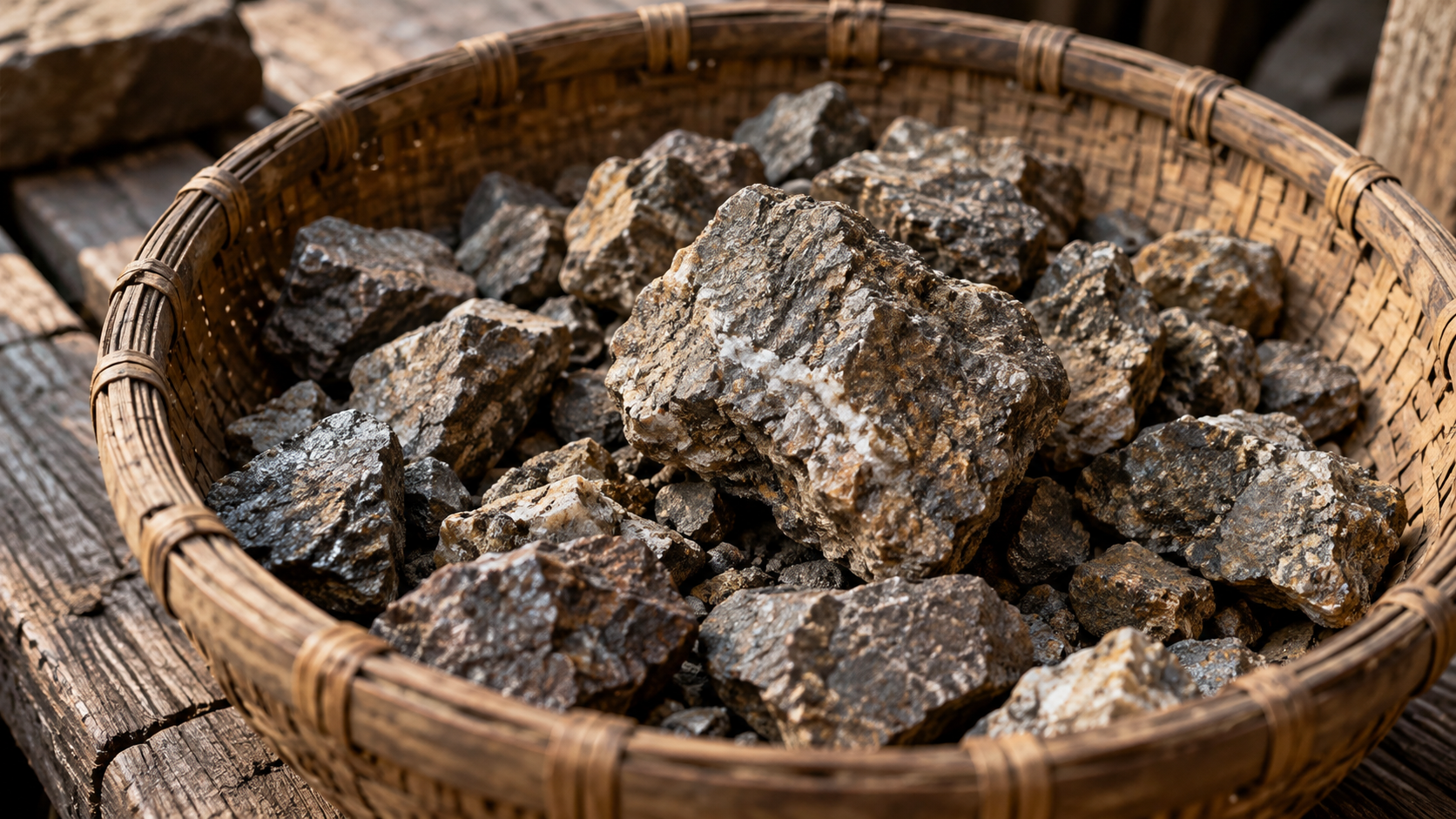
Ore is not yet gold
A piece of ore carried from a Sado mountain does not look like a finished coin. Gold and silver did not emerge from the ground already in the form in which the government or a merchant could use them.
Rock had to be excavated, water removed, stone crushed and useful material selected before further treatment at a furnace. These were different tasks requiring different skills, not one action performed by a single miner.
The work also required people to be recruited and production to be organized. The mine therefore had an administrative and social setting alongside its tools and techniques.
This article concentrates on the Edo period. It distinguishes placer deposits from ore veins and follows the chain from excavation to the town and its workers. The finished coin is the outcome of that chain, rather than a complete picture of how it operated.
Scene 02
Different deposits, different methods
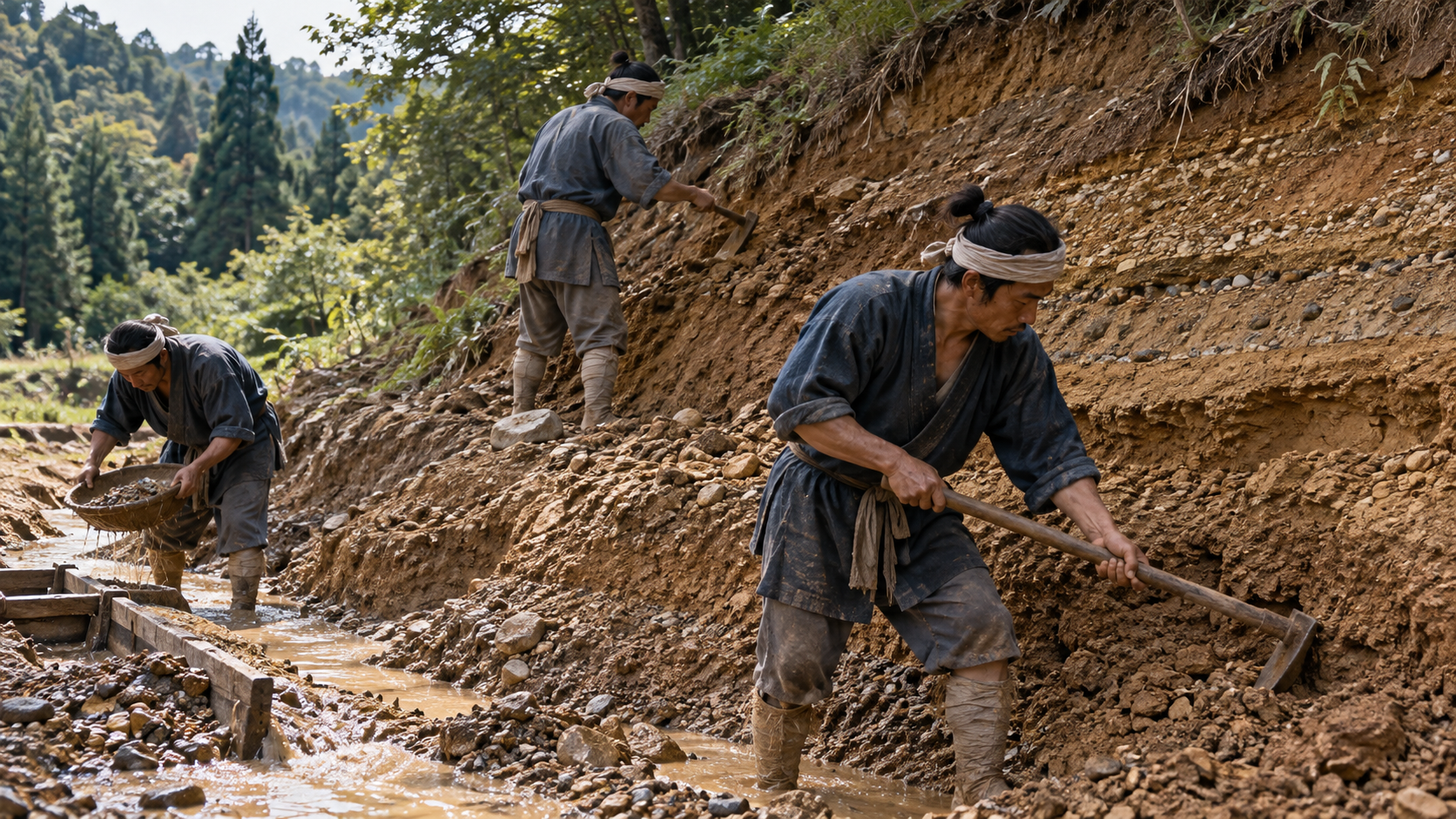
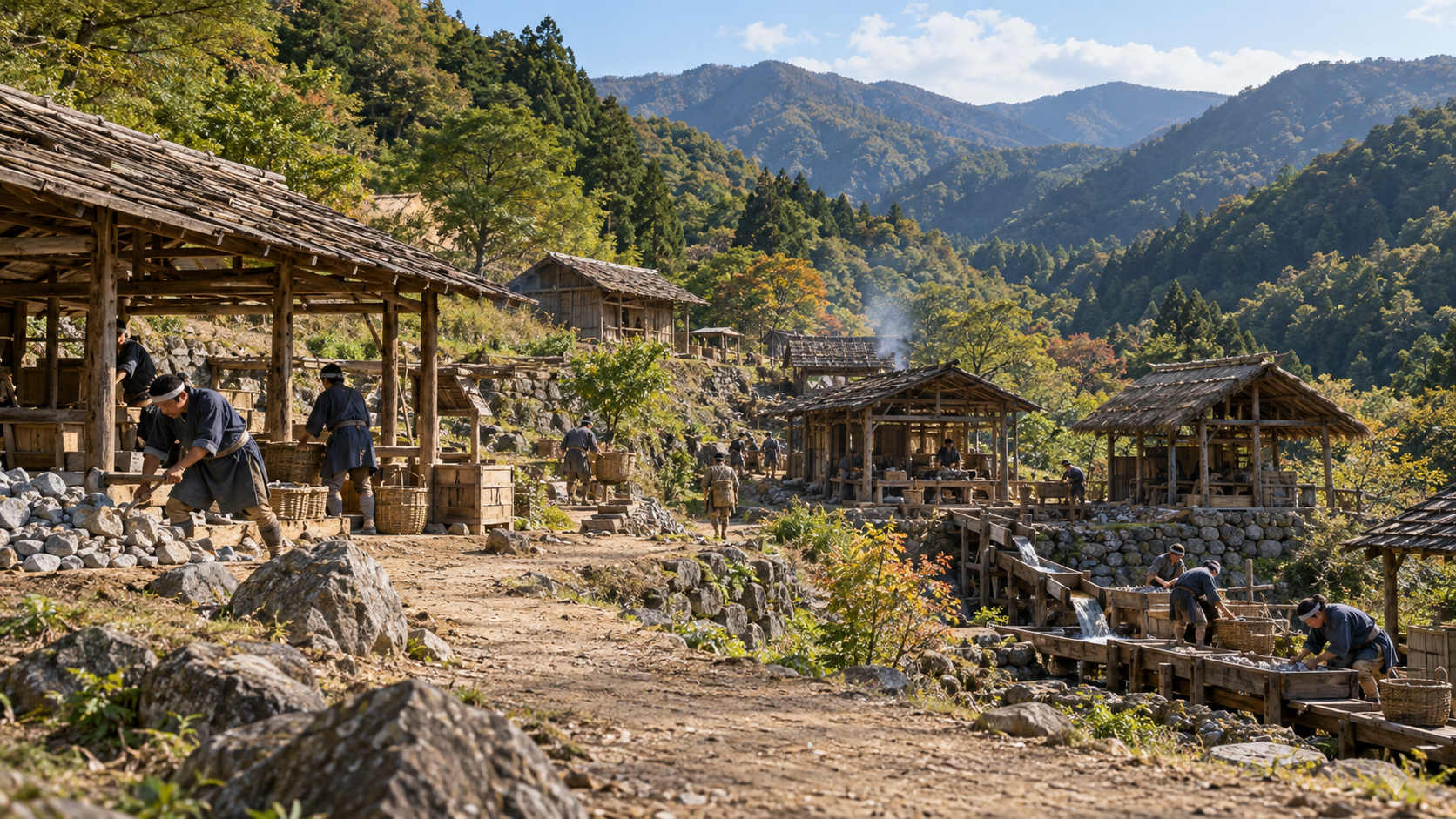
Sado's mining areas did not all begin with the same kind of deposit. At Nishimikawa, the work targeted layers containing placer gold. At Aikawa and Tsurushi, miners extracted gold- and silver-bearing ore from veins in rock.
Different ground conditions required different uses of excavation and water. A scene of collecting sand from a riverbed cannot stand for the whole island's production, and neither can a single underground tunnel.
The UNESCO World Heritage Centre also distinguishes the Nishimikawa placer area from the Aikawa-Tsurushi vein-mining areas. That independent account corroborates the distinction made in the local sources.
Waterways and underground workings consequently need to be read in their different settings. The techniques were responses to particular deposits and conditions, rather than interchangeable examples of one uniform method. The generated slope is not a reconstruction of Nishimikawa's exact terrain.
Scene 03
Water used to move a mountain's soil
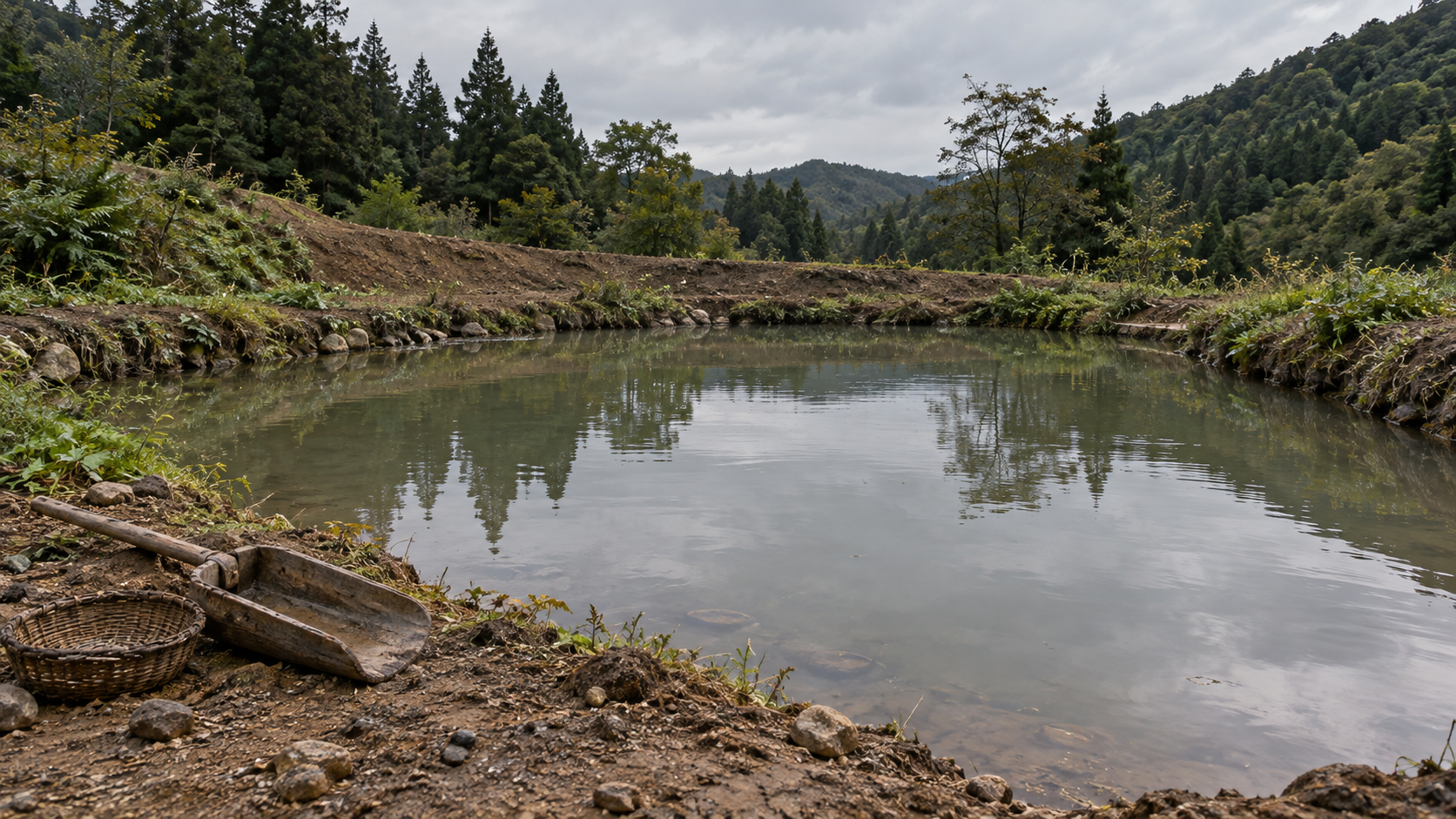
A characteristic technique at Nishimikawa was onagashi. Workers broke down earth containing placer gold and used collected water to wash away unwanted material, taking advantage of differences in what moved with the water and what was more likely to remain.
The operation extended beyond the immediate digging site. Waterways collected water, embankments stored it, and places for releasing it were connected with the mining ground.
Groups of villagers carried out the work and transmitted the techniques. Mining and settlement were related activities, with later changes in livelihoods adding further layers to the landscape.
The remaining channels and altered ground are evidence of a system that moved water and soil. The conceptual reservoir illustrates the role of stored water; it is not a photograph or identification of one surviving structure.
Scene 04
Hand tools following a vein
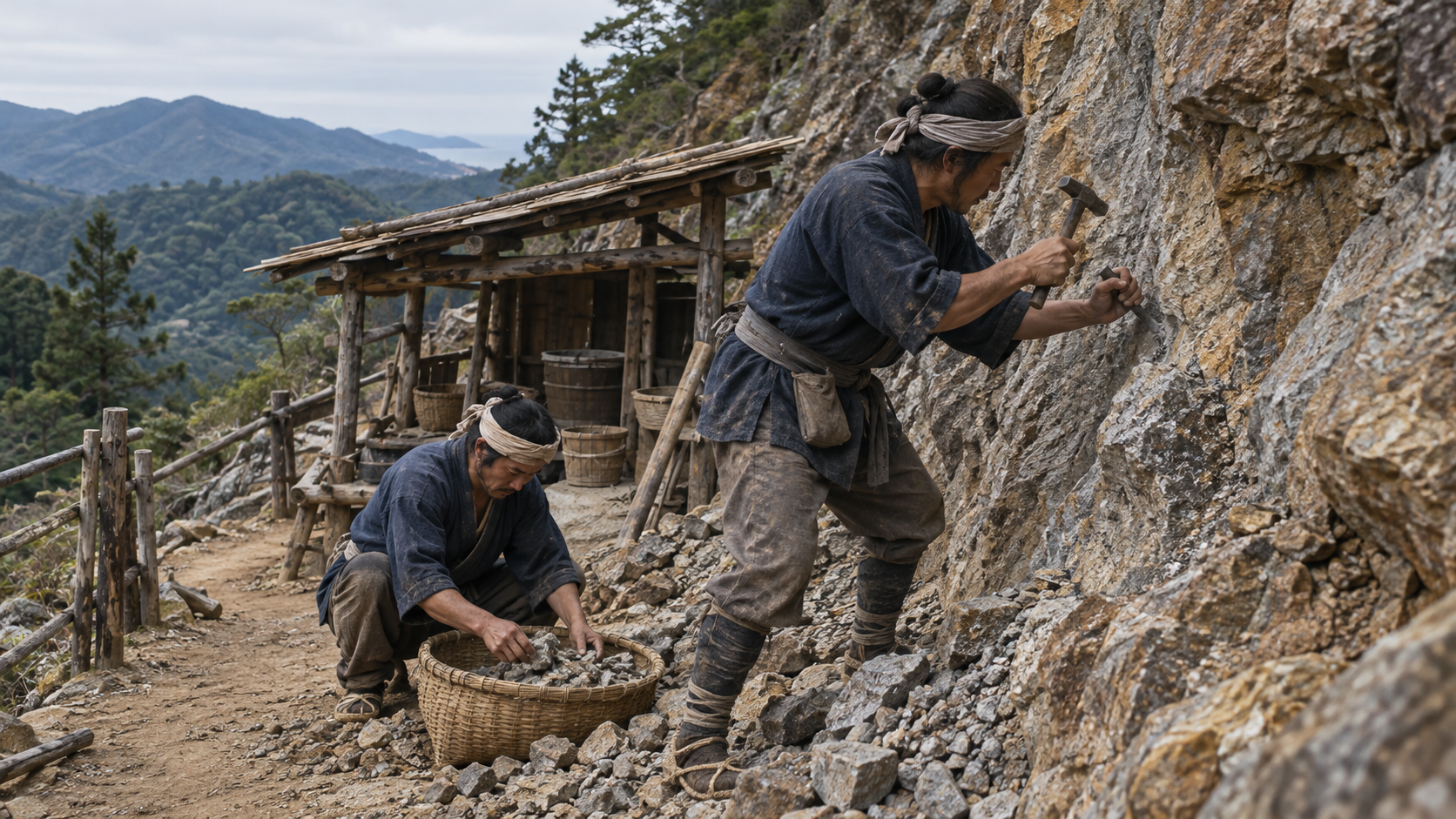
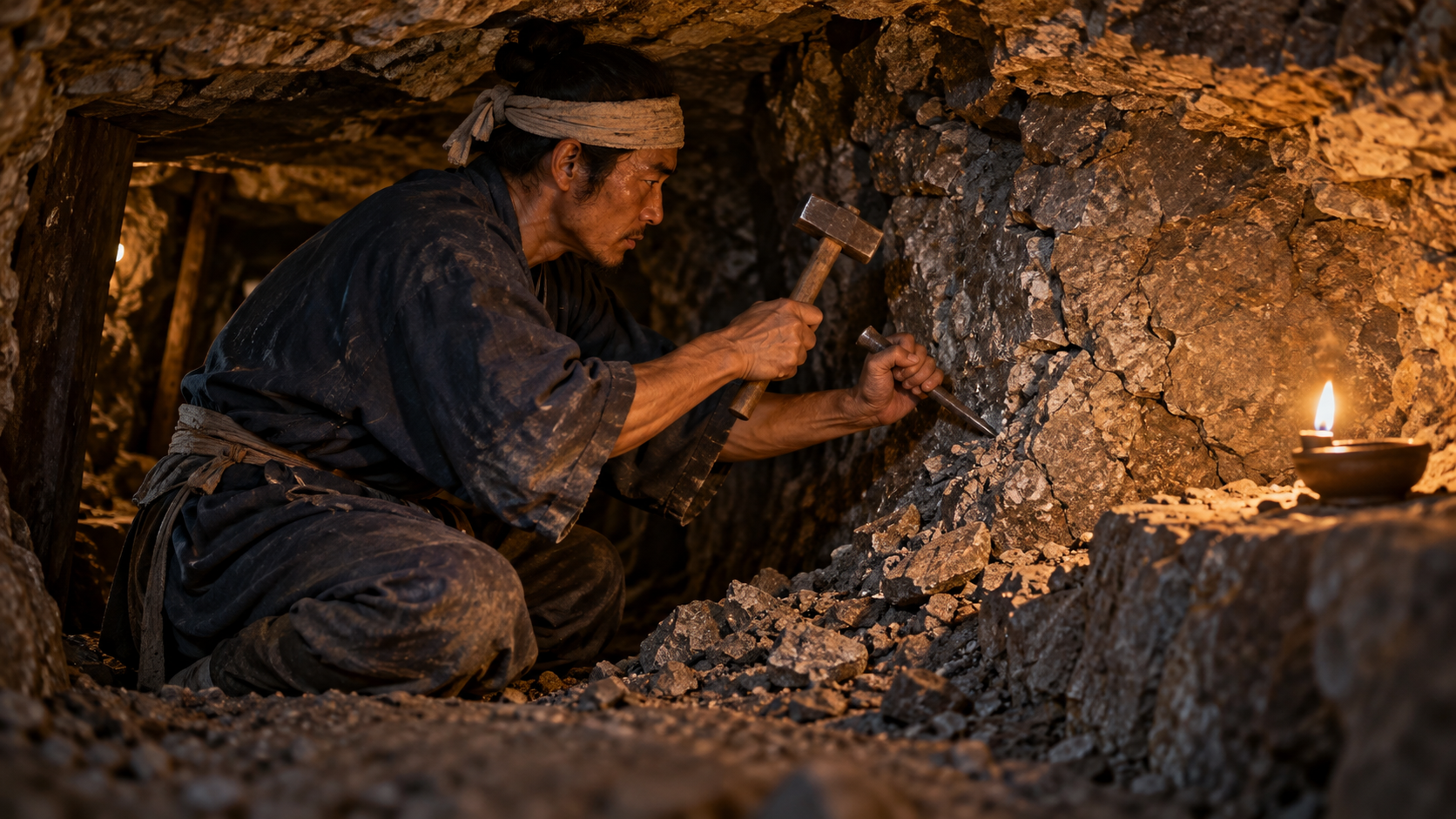
At Aikawa, miners following veins confronted hard rock. They worked an exposed vein at the surface and followed it underground. Specialist workers used tools including chisels and hammers to break the rock.
Supporting excavated spaces also mattered. Digging the ore-bearing ground was only part of making it possible to continue working inside a tunnel.
The large feature known as Doyu no Warito preserves different periods of extraction. The upper part associated with Edo-period hand excavation must be distinguished from the lower traces of blasting from the Meiji period onward.
The present opening therefore contains layers of work using different methods. Its scale should not be attributed to a single period or a single tool. A dramatic view of the feature still needs chronological interpretation before it can explain how the mine developed.
Scene 05
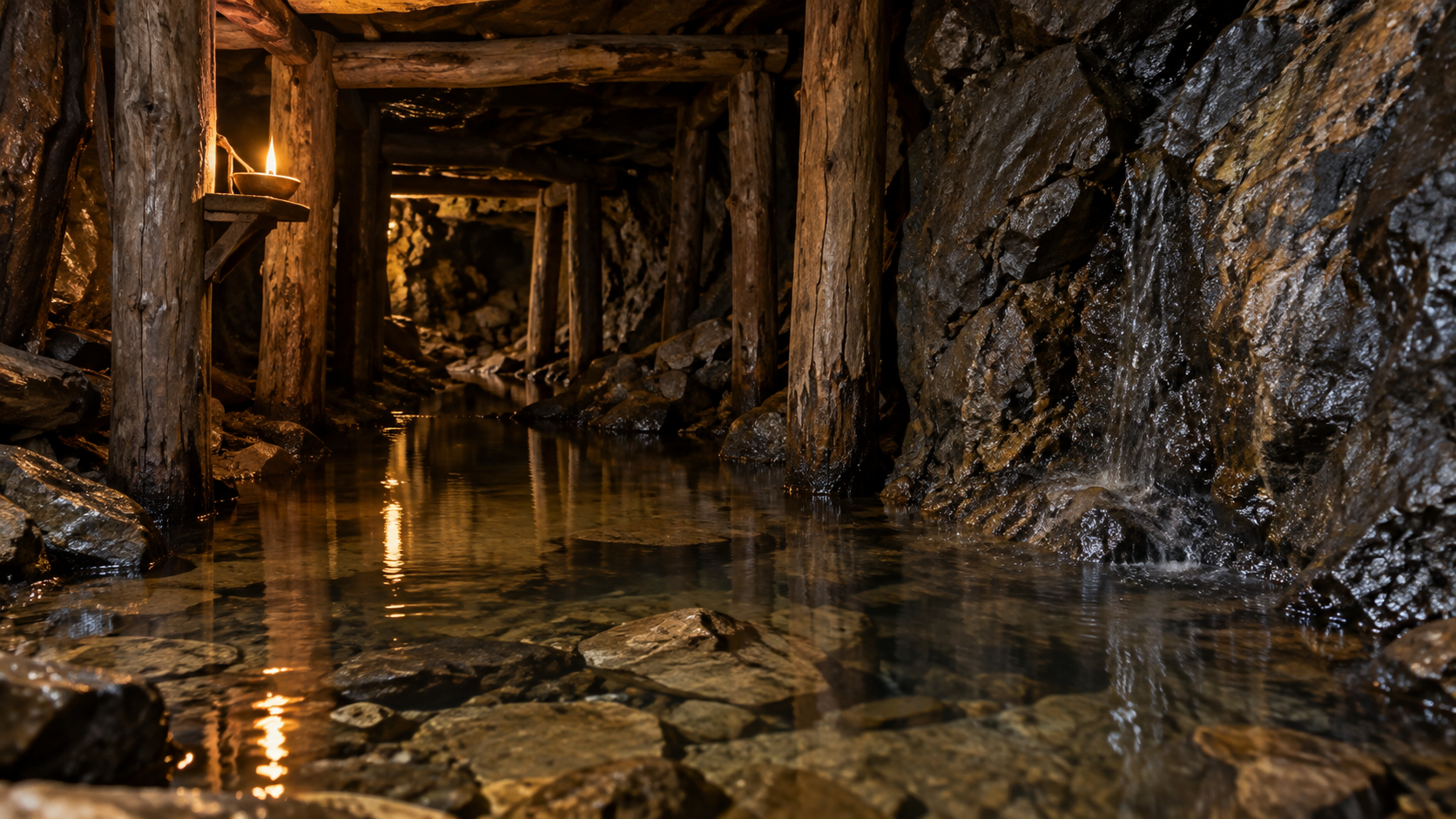
Keeping groundwater out
As tunnels went deeper, groundwater became a problem. Producing ore required not only excavating rock but also continuing to remove the water entering the workings.
People raised water, while drainage techniques and tunnels intended to carry it away also formed part of the mine's infrastructure. Minamizawa drainage tunnel was constructed as a route for discharging water toward the sea.
No single mechanism should be assumed to have served every tunnel throughout the mine's history. The location and depth of extraction changed the conditions to which drainage had to respond.
Underground space thus had more than one purpose. Routes for moving ore existed alongside work that maintained the conditions needed for excavation itself. The illustration is a conceptual tunnel, not a measured reconstruction of Minamizawa or a specific drainage device.
Scene 06
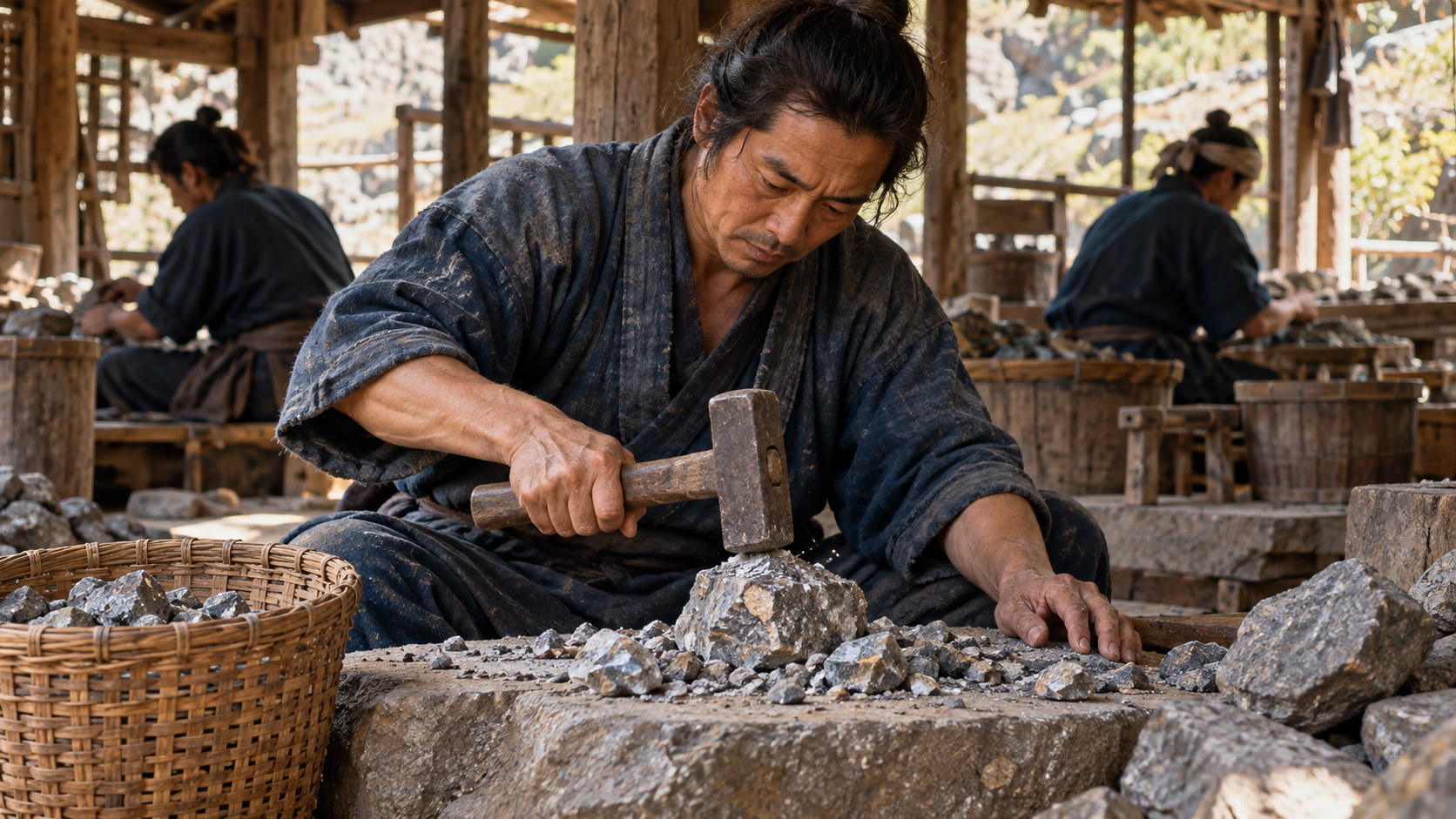
Crushing, grinding and selecting
Ore leaving the tunnel still needed processing. Ore dressing separated useful gold- and silver-bearing material from other components, rather than simply collecting visible lumps of pure gold.
Workers broke the stone and ground it more finely, including with stone mills. Methods using water and differences in density belonged to this sequence of selection and preparation.
Each stage passed material onward in a form suitable for the next task. Crushing, grinding and selecting took effort and skill even though their results were intermediate products rather than finished metal.
Placer mining and the crushing of vein ore had different starting points. Both can be understood by following how material was collected and passed into further processing. The article gives no measured diagram or unverified specification for the illustrated tools.
Scene 07
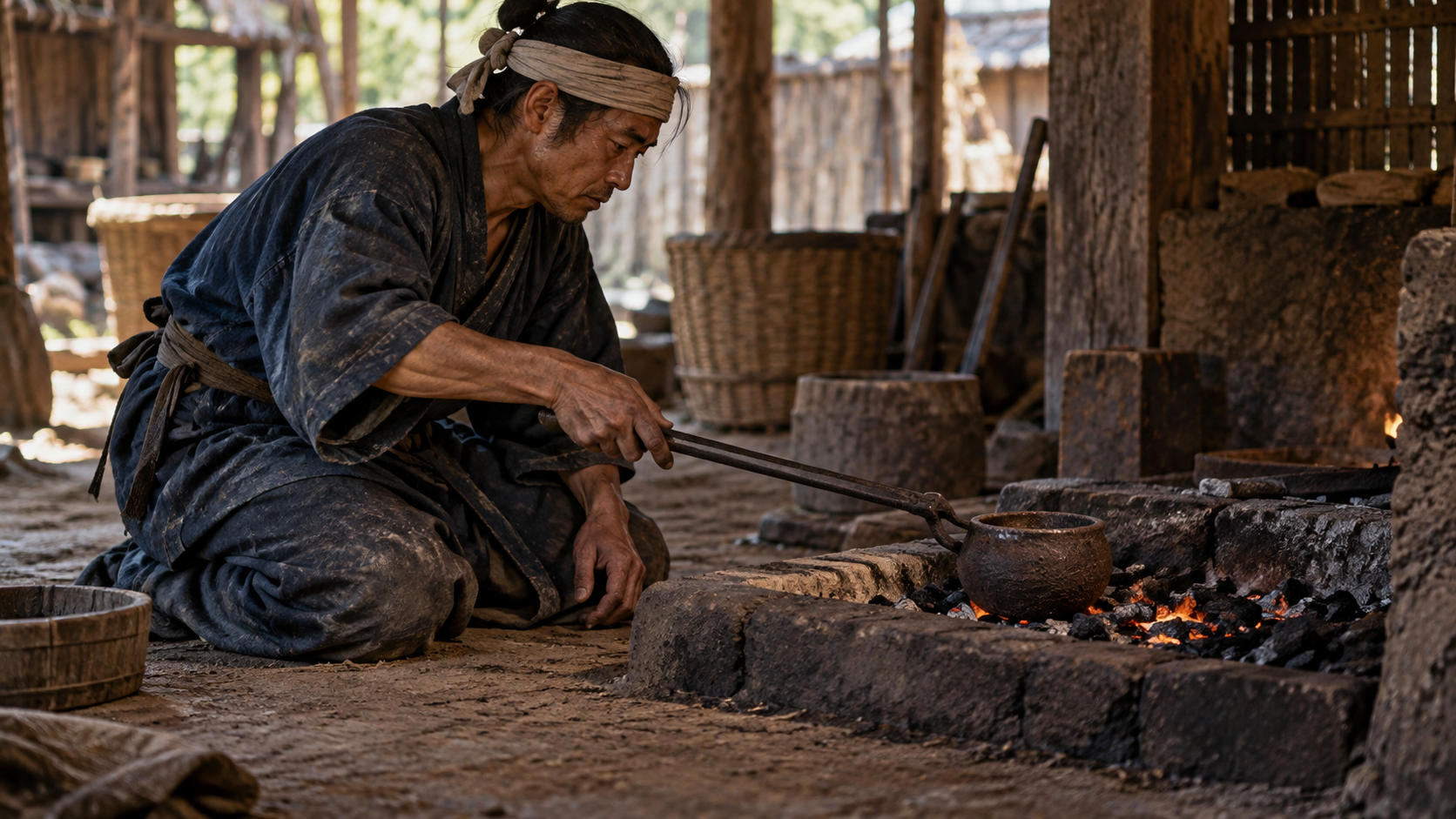
Different tasks around the furnace
Selected material passed into smelting, which extracted gold and silver, and further refining, which adjusted purity. Processes involving lead and the technique known as cupellation belonged to this work. The ore was moving through a sequence rather than entering a furnace and immediately becoming pure gold.
Removing lead and separating gold from silver were different stages with different purposes. Describing them separately prevents the heat of a furnace from becoming a misleading explanation for every change in the material. This article does not supply an unverified chemical recipe or an exact operating specification.
The knowledge needed beside a furnace differed from the skills used with underground hand tools. Metal production depended on both. A worker receiving an intermediate product needed to understand what treatment came next, even when the earlier excavation had taken place elsewhere.
Following those handovers reveals the division of labour connecting the mountain with usable metal. The conceptual furnace illustrates a stage in that chain. Its depicted temperature, arrangement and anonymous operator are not measurements or documentary evidence of a particular historical workshop.
Scene 08
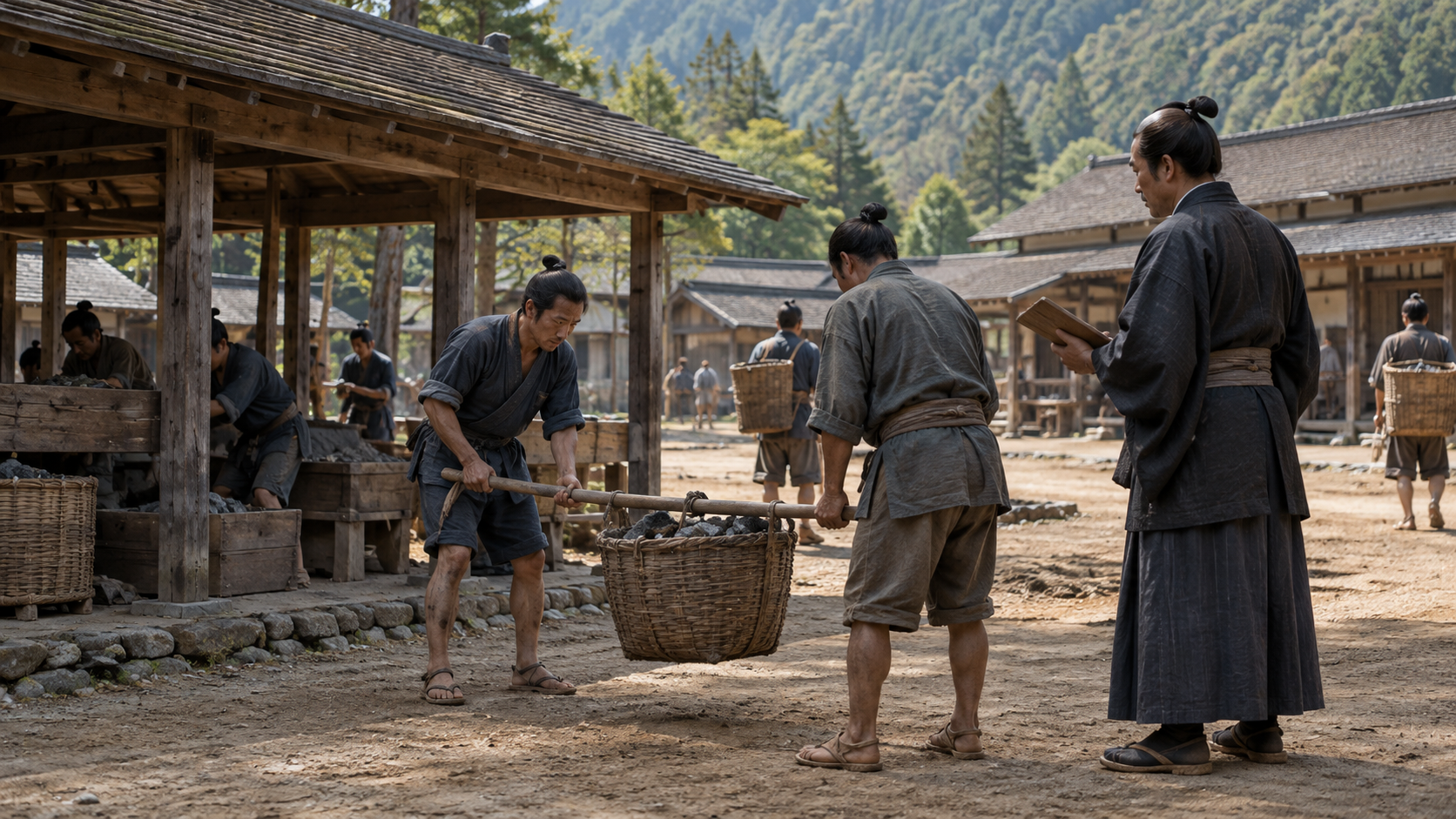
Production and the magistrate’s office
Gold and silver production was connected with shogunal administration. The Sado magistrate’s office was a centre of that system. In Aikawa, homes and workplaces concerned with ore dressing and smelting stood close together, linking production with the organization of the town.
The arrangement changed over time. From around the middle of the eighteenth century, processes previously scattered through the town were increasingly concentrated around the magistrate’s office. That concentration should not be projected unchanged back onto the seventeenth century.
The conceptual diagrams in the prefectural commemorative publication distinguish the seventeenth century from the period beginning in the mid-eighteenth century. They help explain changes in the placement of facilities. They are period-based explanatory diagrams rather than proof that every building existed simultaneously.
The building visitors can see today is also a separate layer of evidence. Reconstructed in 2000 to represent its Ansei-period appearance, it is not the original office surviving intact. Administration, changing production arrangements and modern reconstruction each have their own date.
Scene 09
Skill, work and restrictions on freedom
The mine employed people in different tasks: breaking rock, carrying and crushing ore, selecting material, treating it at furnaces and raising water from underground. Sharing a mining landscape did not mean that everyone held the same position or worked under the same conditions.
During the later Edo period, people classified as mushuku were also sent to Sado under shogunal measures and made to perform drainage work. The cited municipal report dates the beginning of this arrangement to 1778. It does not identify every miner as a member of that group.
Drainage workers received pay, but payment alone did not mean they could freely choose the work or leave the island. Going out was supervised, and return or residence in the town depended on conditions. Describing wages without those restrictions would give an incomplete account of their circumstances.
The history therefore includes specialist craftsmanship and labour under strict control. Mushuku is retained as a historical category rather than equated directly with modern homelessness. The anonymous generated workers cannot establish a specific person’s identity, status or private experience; the article makes no invented personal testimony.
Scene 10
Coins leaving, supplies arriving
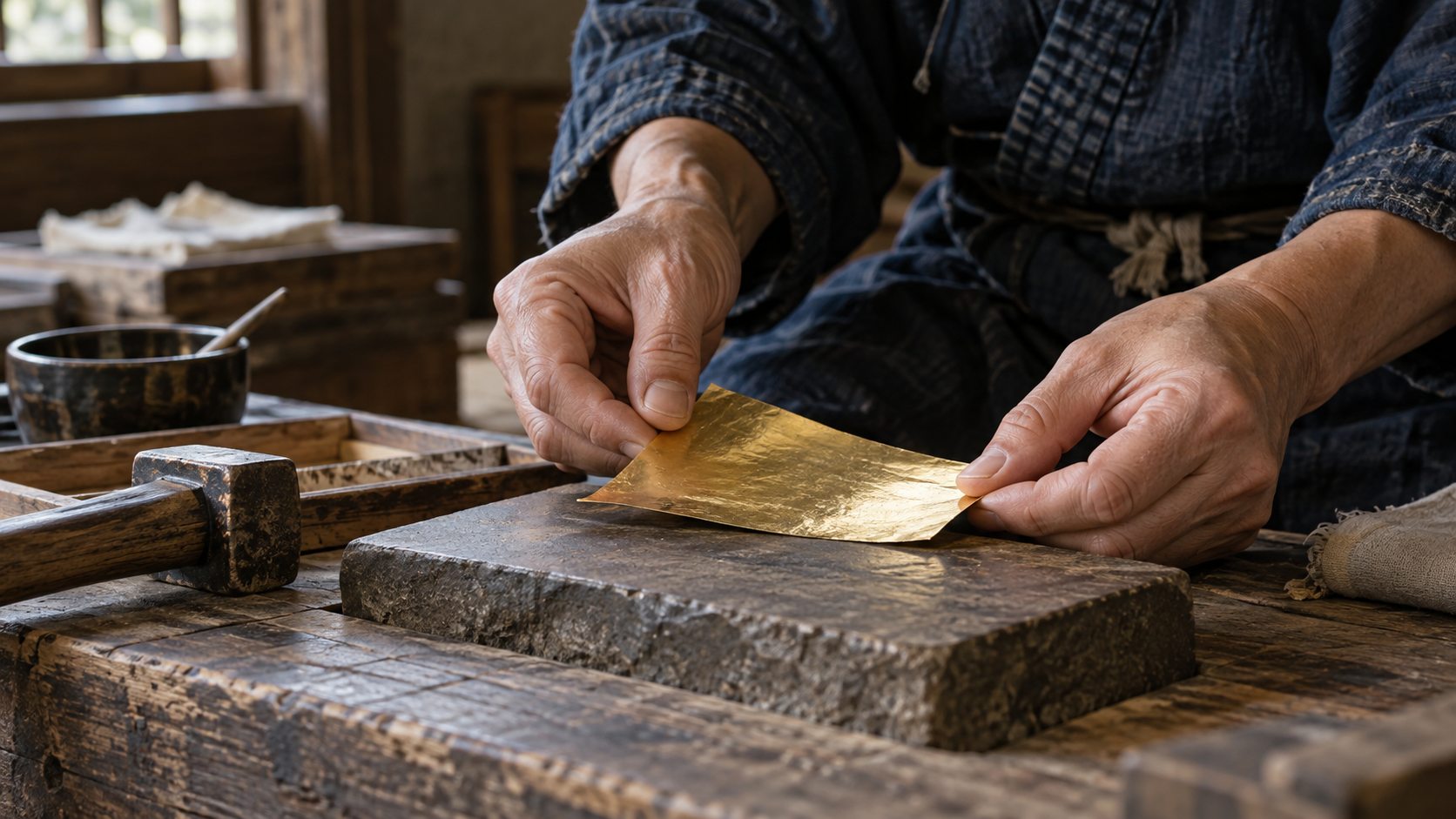
Extracted and refined metal could pass into the manufacture of koban coins. Cutting and hammering material into shape required further craft work. A coin was another product of skilled operations, rather than the form in which the metal had been discovered inside the mountain.
Koban should not be imagined as identical sheets of pure gold throughout their history. The proportions of gold and silver varied by period. This account does not add a single fixed fineness or an unsupported production total to stand for every issue.
While metal moved outward, a working island also required rice and other everyday supplies. Large numbers of people engaged in production needed provisions, linking the mine with the movement of goods through ports and with life in the surrounding town.
Sado was consequently a place receiving people and materials as well as sending wealth away. Following the coin back through its stages makes those connections easier to see. The illustration of a workshop is conceptual; it is not a reproduction of an authenticated coin type or a measured minting process.
Scene 11
Reading scrolls alongside surviving ground
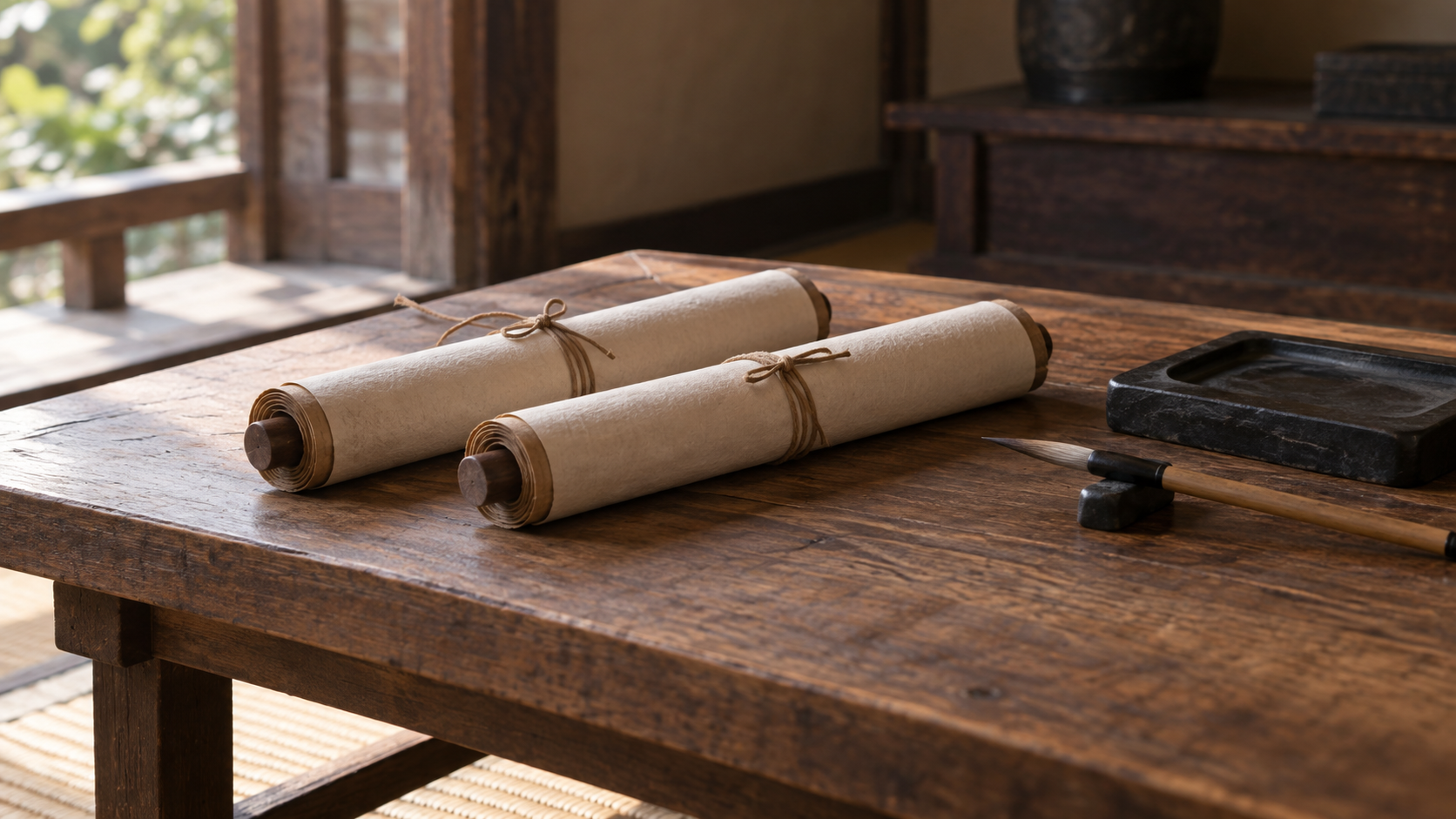
Illustrated scrolls, written documents and excavated remains offer different clues to mining work. Scrolls depicting Sado production show ore dressing and furnace work as well as extraction. They expand the questions that can be asked beyond the underground tunnel alone.
Textual records, images and physical traces can be considered together when following processes and the organization of the town. A picture, however, should not be treated as a photograph of the mine’s earliest years. Its date and purpose affect what it can establish.
The same care applies on the ground. Edo-period remains coexist with equipment from the Meiji period onward and recent reconstructions. A present view may contain these layers within a single frame, even when their construction and uses were separated by a long interval.
Identifying which period a trace represents is part of interpreting it. The cited institutional descriptions support that reading; this article does not claim a new decipherment of original manuscripts or reproduce a historical scroll. Its conceptual images remain distinct from the documentary and archaeological evidence.
Scene 12
Underground wealth as a connected system
Sado’s underground wealth was not extracted by one tool or one exceptional craftsperson. Methods responded to different deposits. Water had to be gathered in some settings and removed in others, while ore passed through crushing, selection and treatment at furnaces.
Production also depended on administration and on people carrying out distinct tasks. Their activities linked the mountain with workshops, settlements, ports and the supplies needed to sustain everyday life. The finished coin represents an outcome of those relationships rather than an explanation of them.
The history includes ingenuity and accumulated skill alongside hard work and restrictions on freedom. Recognizing those experiences together avoids allowing either a striking technology or the appearance of wealth to stand for everyone who worked at the mine.
Cavities in the mountains and stonework in the town can thus invite questions about processes and social arrangements invisible in a coin. Reading the landscape means distinguishing dates, functions and evidential limits, then considering how the different parts sustained production. Those distinctions remain central to this account.
How to read this work
History, interpretation, and reconstruction
Sado’s gold and silver came from connected technologies, administrative arrangements and different forms of labour, rather than from excavation alone.
This work is grounded in published sources and historical research. Interior thoughts, dialogue, and some visual details are cinematic reconstructions. Where historians disagree, the article presents the point as debated rather than settled fact.
Timeline
The story in time
-
Mushuku people begin to be sent to Sado for drainage work. This classification does not apply to every miner.
Sources: s10 -
Blasting adds extraction traces to the lower part of Doyu no Warito.
Sources: s07 -
The Sado magistrate’s office building is reconstructed to its Ansei-period appearance.
Sources: s07
People & terms
A guide for new readers
Glossary
- Placer gold 砂金
- Gold contained in sedimentary deposits, distinguished here from metal-bearing veins in rock.
- Vein ore 鉱石
- Material extracted from rock that requires further treatment before usable metal is obtained.
- Onagashi 大流し
- A Nishimikawa technique using collected water to wash earth containing placer gold.
- Ore dressing 選鉱
- Breaking, grinding and selecting material before subsequent metal-extraction processes.
- Cupellation 灰吹法
- A refining technique discussed among the stages involving lead; it is distinguished from subsequent separation of gold and silver.
- Mushuku 無宿
- A historical classification applied to people sent for drainage work from 1778; it is not a label for all miners or a direct equivalent of modern homelessness.
- Mizukae 水替
- The work of removing water from mine workings.
- Koban 小判
- An oval coin made through additional manufacturing processes; its gold and silver proportions differed by period.
Sources & method
How this article was built
Every Japanese scene, timeline entry and source identifier is retained in this English edition. Source titles are editorial translations. Departments belonging to Sado City are grouped under that city; joint prefectural and municipal publication is not counted as an additional independent institution.
The account separates placer and vein deposits, smelting and refining, lead removal and gold-silver separation, and different dates within the surviving landscape. The municipal report supports both wages and restrictions in the drainage arrangement beginning in 1778. No unsupported worker totals or individual testimony are added.
UNESCO supplies corroboration for the property’s deposits and production landscape alongside prefectural and municipal material. The main period remains Edo. Conceptual images are clearly labelled and no third-party photograph, historical scroll or original technical diagram is reproduced.
Sources
References and further reading
- About the Sado Island Gold Mines 佐渡島の金山とは Title translated editorially for reader convenience. Niigata Prefecture 新潟県 Used for deposits, production technology and administration. The different mining areas are not treated as a single uniform technique. Accessed 2026-10-27
- From ore to koban 鉱石から小判ができるまで Title translated editorially for reader convenience. Niigata Prefecture 新潟県 Used for mining, dressing, cupellation, gold-silver separation and coin manufacture. Coin fineness varies by period. Accessed 2026-10-27
- Introducing and improving technology 先端技術の導入と改良 Title translated editorially for reader convenience. Sado City 佐渡市 Used for drainage methods including Minamizawa drainage tunnel. Edo hand work is distinguished from later mechanization. Accessed 2026-10-27
- Illustrations and documents supporting the value of the mines 佐渡金銀山の価値を裏付ける絵図・文献資料 Title translated editorially for reader convenience. Sado City 佐渡市 Used for the character of mining scrolls, technical books and records; no new reading of an original manuscript is claimed. Accessed 2026-10-27
- Changes in settlement structure 集落構造の変遷 Title translated editorially for reader convenience. Niigata Prefecture 新潟県 Used for production organization and settlement in Nishimikawa, Tsurushi and Kami-Aikawa, retaining differences of place and period. Accessed 2026-10-27
- Nishimikawa placer gold mine 西三川砂金山 Title translated editorially for reader convenience. Niigata Prefecture 新潟県 Used for onagashi, waterways, embankments, settlement and later changes in livelihoods. Accessed 2026-10-27
- Aikawa gold and silver mine 相川金銀山 Title translated editorially for reader convenience. Niigata Prefecture 新潟県 Used for the town, incoming supplies, differently dated traces at Doyu no Warito and the office reconstructed in 2000. Accessed 2026-10-27
- Culture fostered by mining 鉱山が育んだ文化 Title translated editorially for reader convenience. Niigata Prefecture 新潟県 Used for specialists, workers, merchants and craftspeople coming from different places and their connection with everyday culture. Accessed 2026-10-27
- World Heritage registration commemorative publication, Part 2 Chapter 3 「佐渡島の金山」世界遺産登録記念誌 第2部第3章 資産の概要 Title translated editorially for reader convenience. Niigata Prefecture and Sado City 新潟県・佐渡市 Printed pages 107 and 109 distinguish production stages and settlement arrangements, including seventeenth-century and later concentration. The diagrams are not reproduced. Accessed 2026-10-27
- Sado Aikawa mining urban landscape preservation report, Chapter 3 Section 1 佐渡相川の鉱山都市景観 保存調査報告書 第3章第1節 相川の形成史と社会像 Title translated editorially for reader convenience. Sado City 佐渡市世界遺産推進課 Printed pages 47, 48, 67 and 68 support the 1778 drainage arrangement, wages, supervision and conditions for return or town residence. The modern labour discussion in page 68’s right column is kept separate. Accessed 2026-10-27
- Sado Island Gold Mines UNESCO世界遺産センター Sado Island Gold Mines Title translated editorially for reader convenience. UNESCO World Heritage Centre UNESCO世界遺産センター The property description and Outstanding Universal Value distinguish deposits, Edo non-mechanized production and the proximity of production, settlement and administration. This does not claim examination of the entire nomination dossier or all modern labour history. Accessed 2026-11-04
Continue reading
More stories from Shigeki
Shigeki English
Kobayakawa Hideaki after Sekigahara: Work beyond Okayama’s Keep
The outer moat offers a way into a short period of castle government.
- When Hideaki’s Okayama rule, 1600–1602; earlier construction in 1597 and later changes considered separately
- Where Okayama Castle, its outer enclosures and former western moat; Bizen and Mimasaka
Shigeki English
Passing Hakone Checkpoint: Identity, Direction and Travel Documents
A pass mattered, but the inspection depended on more than possessing paper.
- When Edo-period Hakone; establishment at the present location around 1619, regulations of 1711 and later reconstruction
- Where The Tokaido road between Lake Ashi and the surrounding mountains at Hakone