
SHIGEKI ENGLISH STORYEN
Japanese history in English
Ashio Copper Pollution: A Bottle of Sand, Downstream Lives and Yanaka Village
Follow the records before Tanaka Shozo's attempted petition, and the history of the land that continued afterward.
Ashio's copper production grew while pollution affected communities along the Watarase River. A sediment sample, Tanaka Shozo's parliamentary work, preventive orders and Yanaka Village's displacement reveal a history extending beyond his attempted petition to the emperor.
At a glance
Before you enter the story
- When
- Mainly 1877–1906, with river improvement works through 1922 and the subsequent preservation of historic sites.
- Where
- Ashio and the Watarase River basin; Konaka in present Sano City and the former Yanaka Village area in present Tochigi City, Japan.
- Key figures
- Tanaka Shozo, Furukawa Ichibei, Sakano Hatsujiro
- What was at stake
- How industrial growth and pollution became connected with agricultural livelihoods, official investigation and the future of an inhabited village.
Why this story matters
The larger history behind the turning point
A familiar act of protest becomes more understandable when placed among earlier appeals and later struggles over land. Following samples, administrative records and village history shows how industrial change affected people at a distance, and why the completion of a preventive measure did not close every question about their livelihoods.
Historical context
What an international reader needs to know
The mine, the river and the Meiji setting
The story centers on Japan during the Meiji era, when Ashio's copper production expanded under Furukawa. Ashio was upstream on the Watarase River. Farther downstream, people farmed and fished in a basin where floods could carry sediment onto agricultural land. These geographical connections are essential to the sequence.
Tanaka Shozo entered the House of Representatives in its first election in 1890. The Imperial Diet was the parliamentary setting in which he questioned the government about pollution. The direct petition of 1901 was a later attempt to deliver an appeal to Emperor Meiji personally; the cited accounts describe it as blocked.
A flood basin and the village already there
A retarding basin is an area used to hold floodwater temporarily. The plan for Yanaka concerned low land between three rivers, where residents already maintained homes and livelihoods. The proposal therefore joined questions about river management with questions about people's ability to remain on that land.
Administrative dissolution, residents' movements and the construction of river works have different chronologies. Yanaka was merged into Fujioka Town in 1906. The river improvement project started in 1910, and the principal works were completed in 1922. Keeping these stages distinct helps explain what each date establishes.
Watch the film
See the story in motion
The film currently uses Japanese audio. This English article provides the context and source trail; it does not imply that an English subtitle track is available.
Chapter 01
What a small bottle preserved
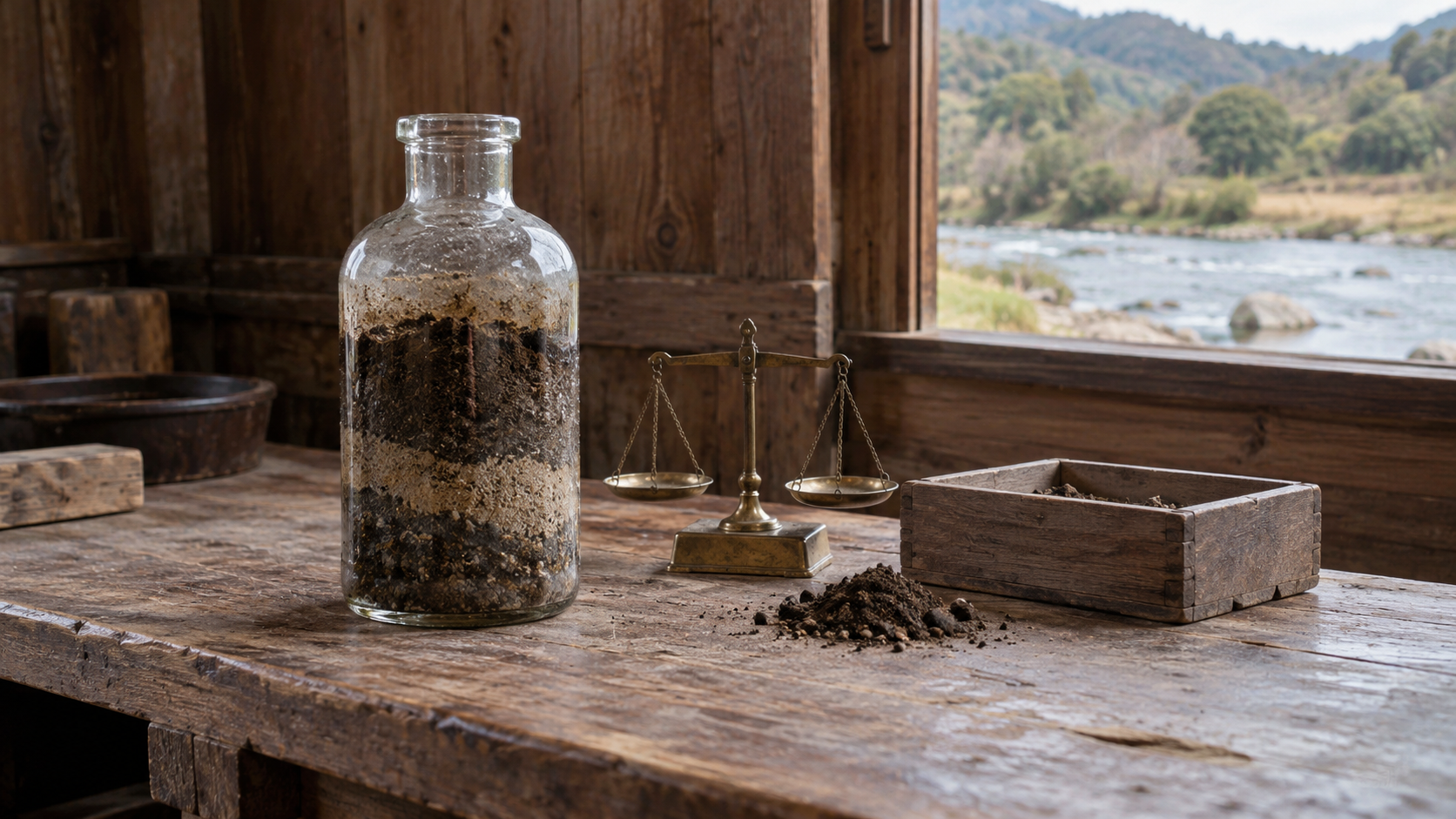
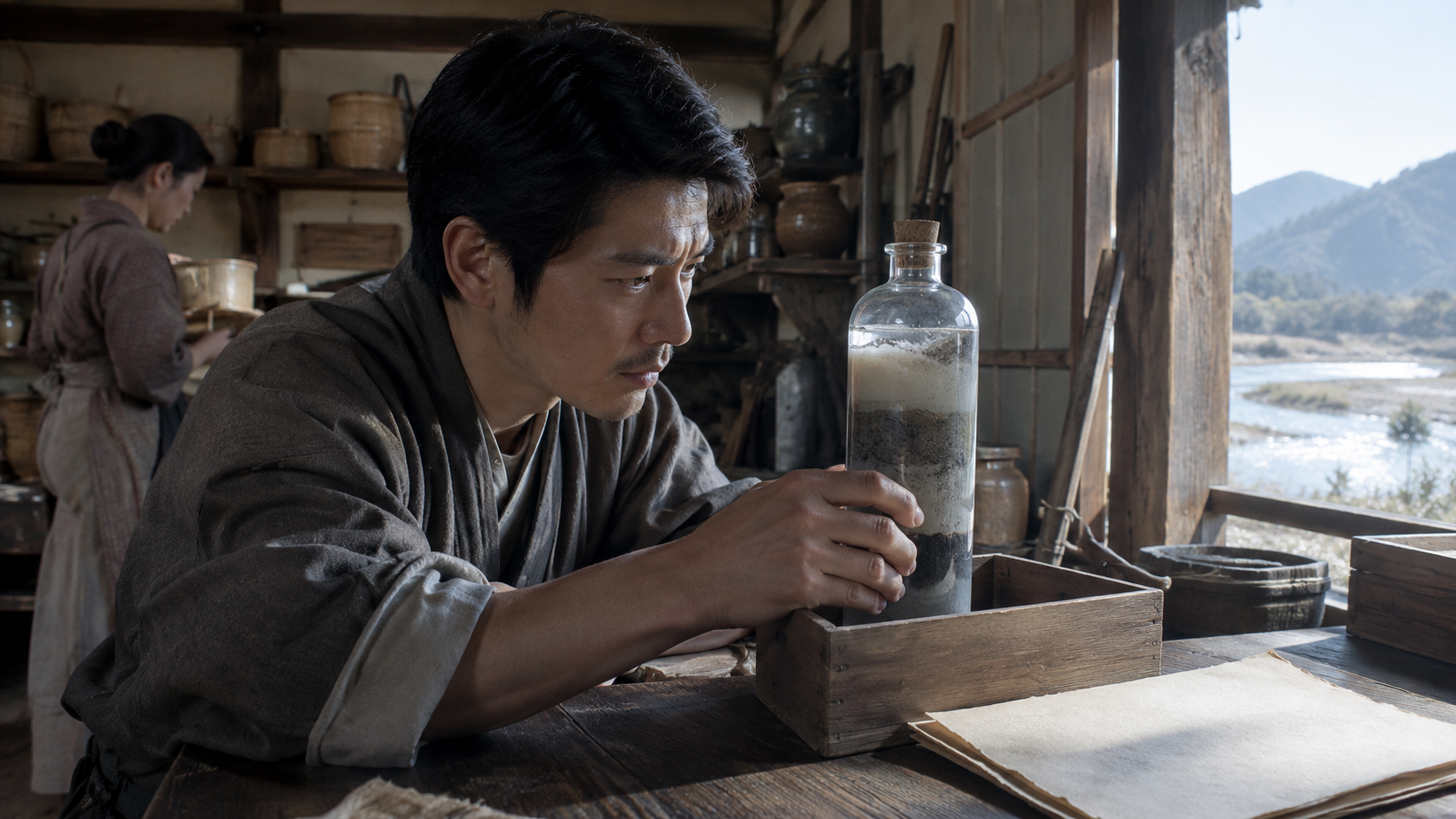
A bottle of sand survives among the National Archives of Japan's records of the Ashio copper pollution affair. It accompanied a report examining copper in sediment from the Watarase River, as a reference sample. Beside the documents, this small object offers an entrance to a history that unfolded downstream from a growing mine.
For many readers, the affair is associated with Tanaka Shozo's attempt to petition the emperor directly. That action came after years of reporting harm and calling for investigation. The problems surrounding the land where people lived continued after it. Following the earlier and later events gives the celebrated episode a wider setting.
What changed at the copper mine, and what reached the communities along the river? How was the damage investigated, and how far did prevention measures go? We begin upstream, then follow the river toward farms and villages, using the surviving sequence of records to connect these places.
One bottle cannot explain the damage throughout an entire river basin. Its significance is more particular: disturbances to people's livelihoods entered a record through a sample and a report. It brings us to a point where industrial growth, administrative investigation and everyday life meet.
Chapter 02
The mine's years of growth
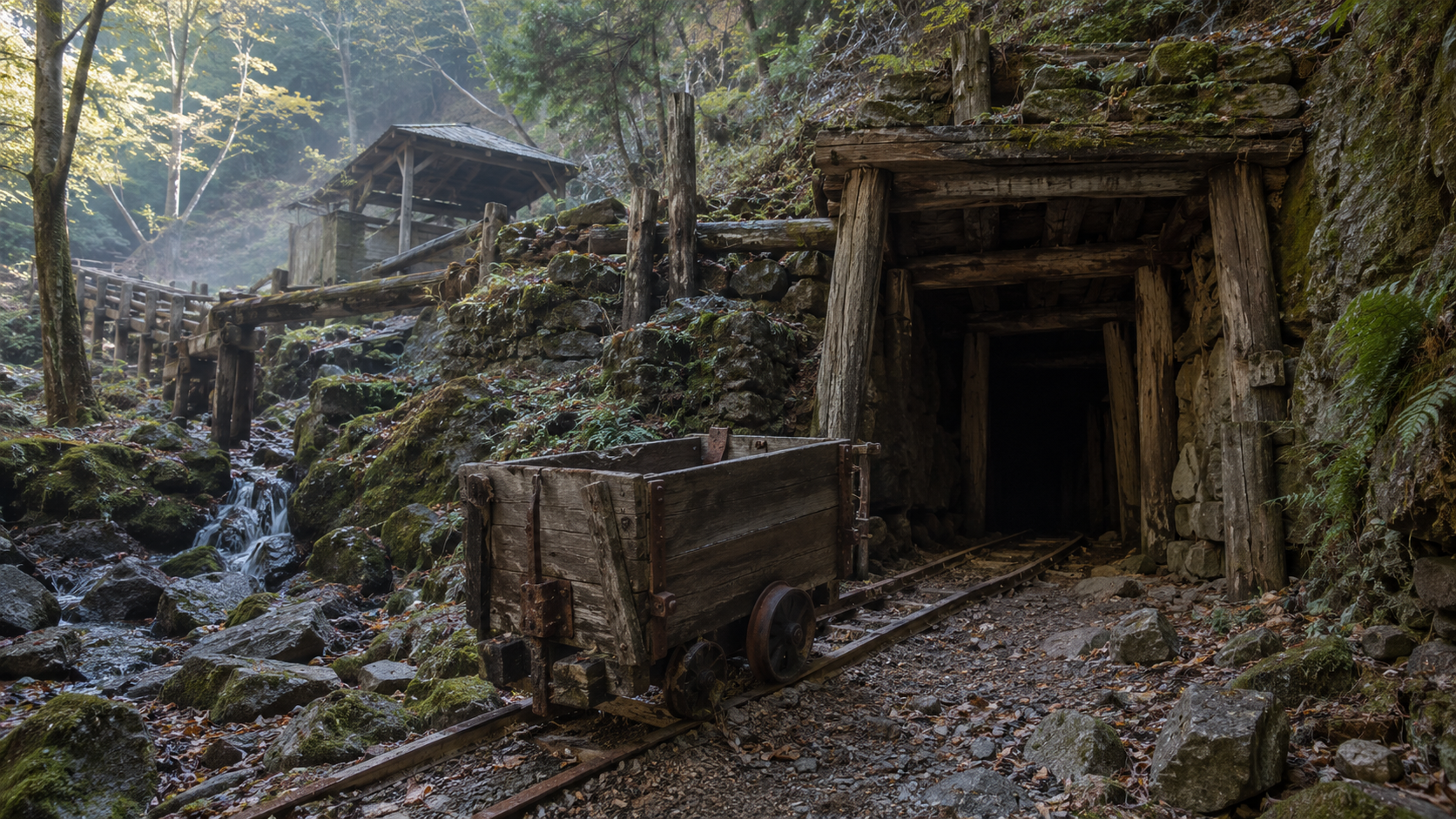
Ashio Copper Mine had a history extending back into the Edo period, before Japan's Meiji era. It declined toward the end of the Edo period and into the early Meiji years. In 1877, the businessman Furukawa Ichibei acquired it. Discoveries of rich ore in the 1880s helped bring a turn toward expanding production.
Nikko City's historical explanation describes new technology entering the different stages of production and the methods used to transport material. The mine's growth involved more than digging ore from the ground. Discoveries, equipment and work across the production system came together in the operation.
A timeline of discoveries and new equipment can outline this development. To understand what happened nearby and farther downstream as copper output increased, however, we also need records from those places. The history of production becomes fuller when it is read alongside the history of the river basin.
Moving beyond the mine's boundary changes our view of the same industry. The river connected mining activity to land at a distance. Placing the years of expansion beside the years of reported damage allows histories recorded in different settings to be followed together.
Chapter 03
Damage carried downstream
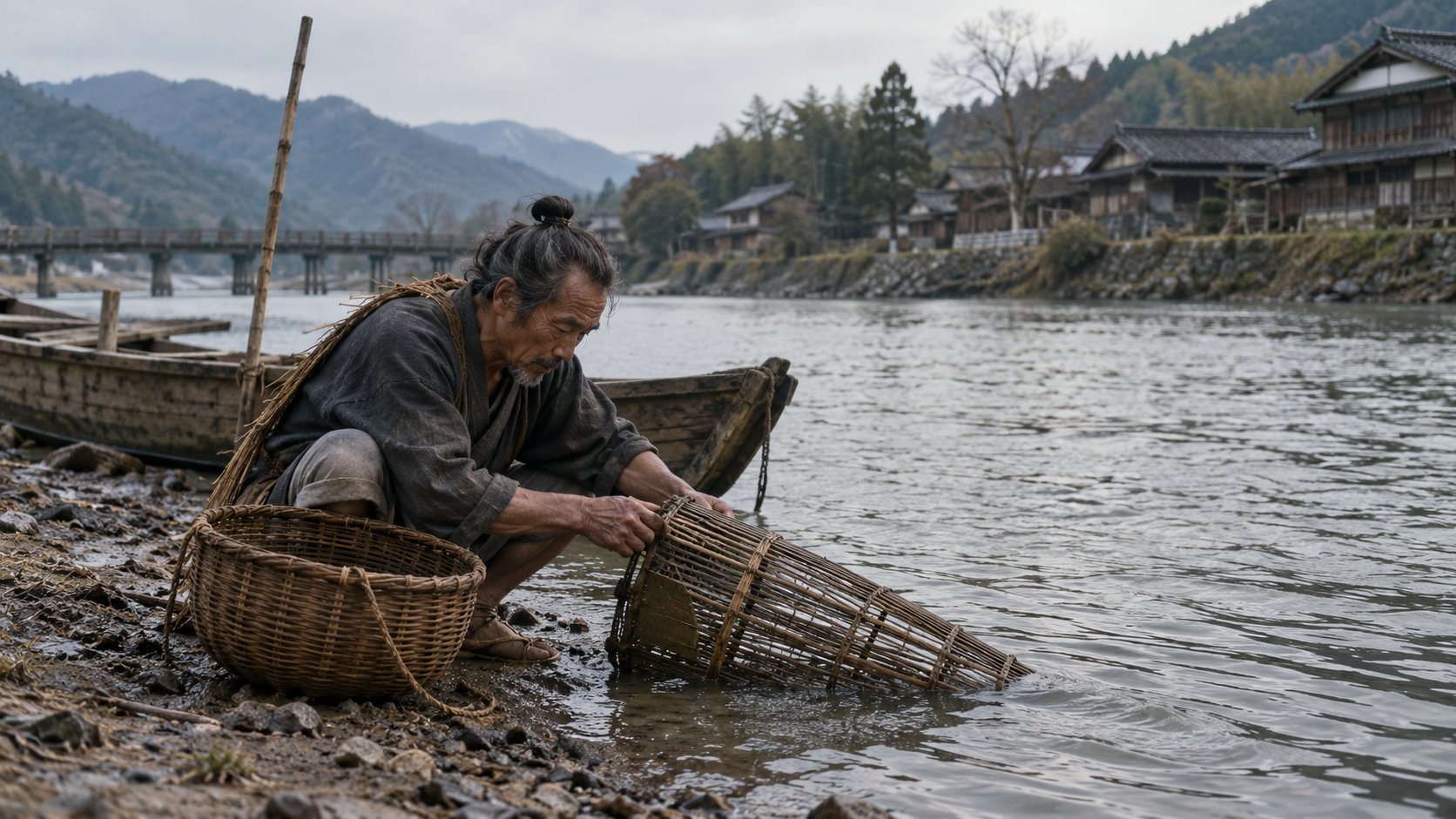
By the late 1880s, declining fish and dying plants in and around the Watarase River had become a matter of concern. The National Archives' account explains that pollution from Ashio, upstream, was suspected as a cause. That wording preserves the contemporary question about the connection between the mine and the changes being reported.
The problem was carried by more than wastewater. Nikko City describes sediment containing harmful substances from wastes produced during mining, ore dressing and smelting. Alongside it came sediment eroded from land damaged by smelter emissions. These processes combined within the river basin.
Water and sediment carried consequences of upstream activity farther along the river. Flooding made the problem especially visible as damage to agricultural land. The mine and the farms were separated by distance, yet what happened in the upper basin could affect the fields below.
Reports of disturbances and investigations into their causes need to be read in sequence. This account cannot diagnose the condition of every fish or crop. It follows the routes of harm described by the cited institutions, keeping the initial suspicions and the later explanations in their respective settings.
Chapter 04
Questions brought into the Diet
Tanaka Shozo was born in Konaka Village, now Konaka-cho in Sano City. He won a seat in the first election to the House of Representatives in 1890. In December 1891, during the second session of the Imperial Diet, he raised the problem of pollution from Ashio. The affair had entered parliamentary proceedings well before his direct petition.
The National Archives describes questions concerning the cancellation of mining permission, relief for people who had suffered harm, and ways to prevent future mining damage. The claims concerned losses already experienced and damage that might follow. Both became matters put before the government.
Beginning Tanaka's story with the later petition can obscure this earlier parliamentary work. Downstream problems were already being addressed through a public institution. The archive also displays an opinion paper from 1891; that displayed document should not simply be called the same submitted paper as the parliamentary questions.
The recording of a question did not itself secure people's livelihoods. Following the 1891 proceedings into the later floods and prevention measures helps explain why appeals continued. The interval between bringing a problem into public debate and preventing further harm forms part of this history.
Chapter 05
Appeals after the flood
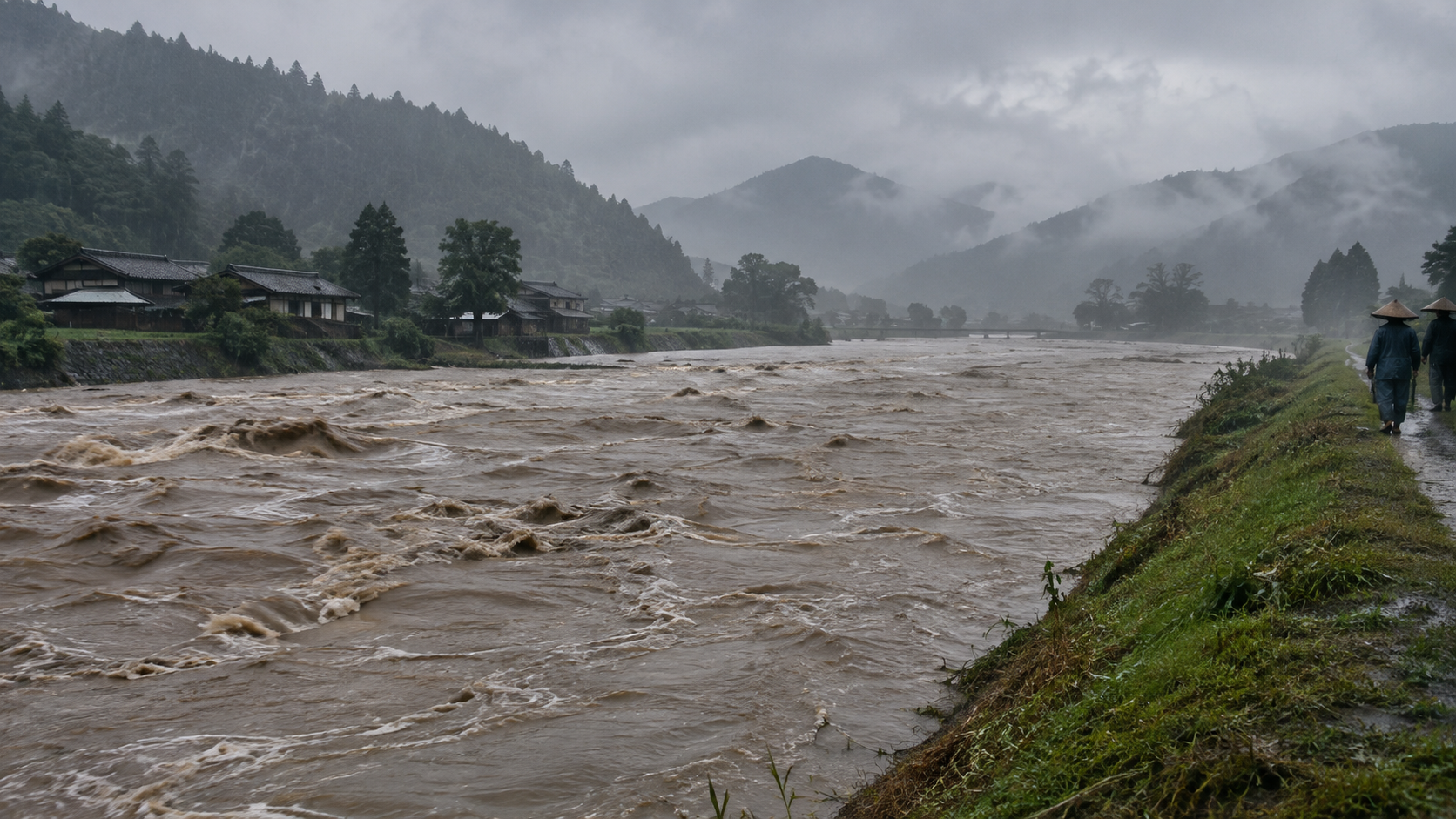
A major flood in 1896 spread pollution damage across agricultural land. According to the National Archives, Tanaka established a pollution office in Watarase Village, coordinated activity among affected areas, and called in the Diet for mining operations to stop. The effort connected places experiencing harm downstream.
Watarase Village and Yanaka Village, where Tanaka later lived, are different places. Keeping their names distinct helps reveal the geographical spread of activity around the pollution problem. The sequence did not unfold within one village or at one site alone.
What floodwater carries can depend on industrial activity in the basin. Understanding the rise of the river and examining what the mine discharged were both relevant to the damage experienced on farms. The relationship between flooding and pollution calls for attention to the water and to the material moving with it.
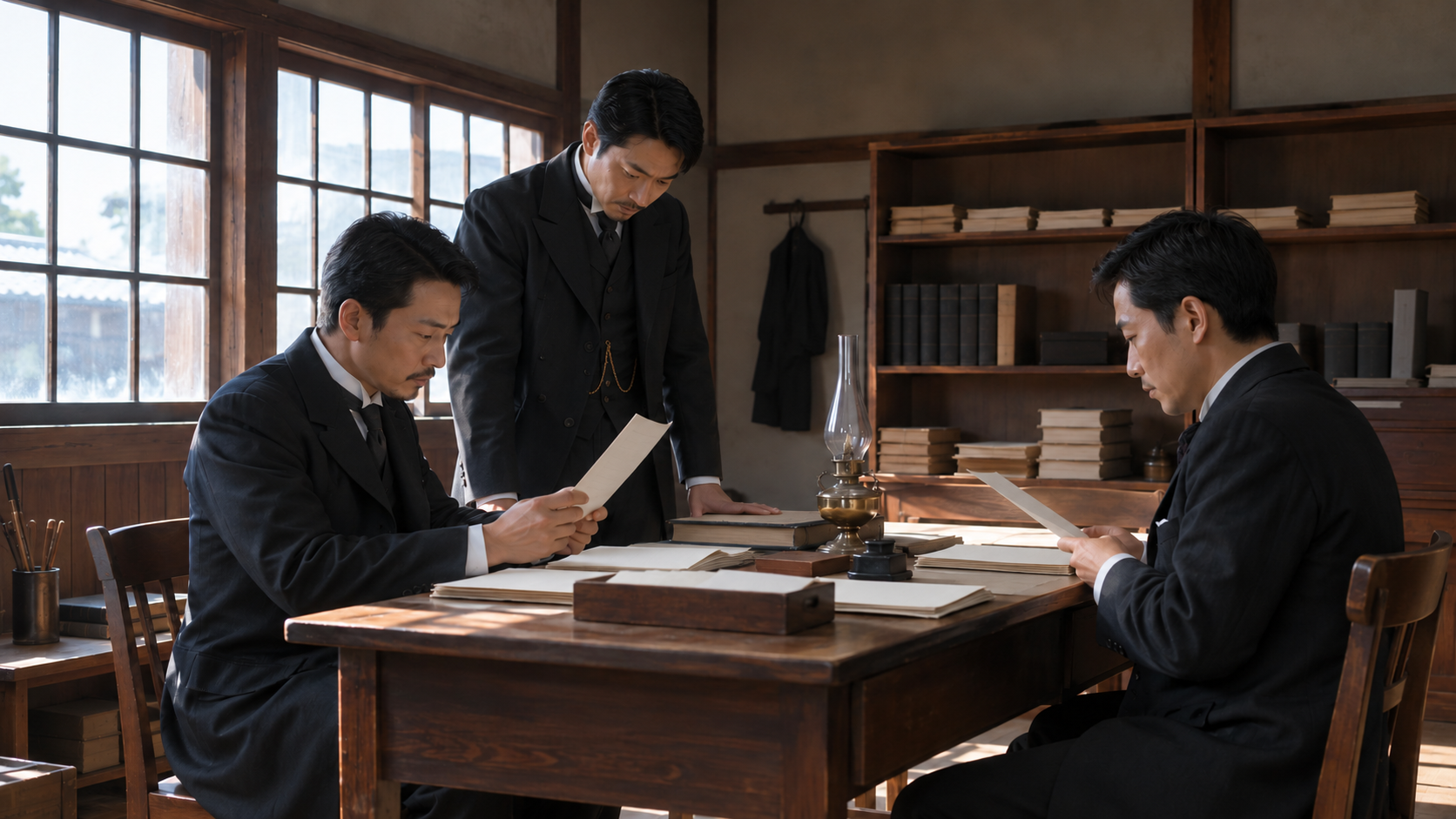
The appeals lead us toward the work of investigation. Reports from affected communities needed to be considered alongside records examining the damage. The transition from describing changes in daily life to taking samples and writing a report made the problem available to another kind of scrutiny.
Chapter 06
Taking sand, leaving a report
In 1897, the cabinet established a commission to investigate the Ashio copper pollution affair. The National Archives introduces an analysis of damaged farmland along the Watarase River by Sakano Hatsujiro, an engineer at an agricultural experimental station. His report connects a particular investigation with the surviving sample.
The report recorded measurements of the proportion of copper in sediment. The bottle introduced at the beginning accompanied it as reference material. A sample taken from the river was preserved with the account of what had been examined, allowing the object and the written investigation to be read together.
The bottle makes the word investigation tangible. Sediment had to be collected, examined and connected with a report. Through that work, a problem affecting land downstream left evidence that later readers could approach. The report and sample are traces of this process, rather than substitutes for the whole history.
A sample belongs to a place and to the conditions under which it was collected and analyzed. This article does not offer a new reading of the original report's entire measurement table or extrapolate one concentration across the basin. It follows the Archives' explanation of the relationship between the sample and the report.
Chapter 07
Orders directed at the mine
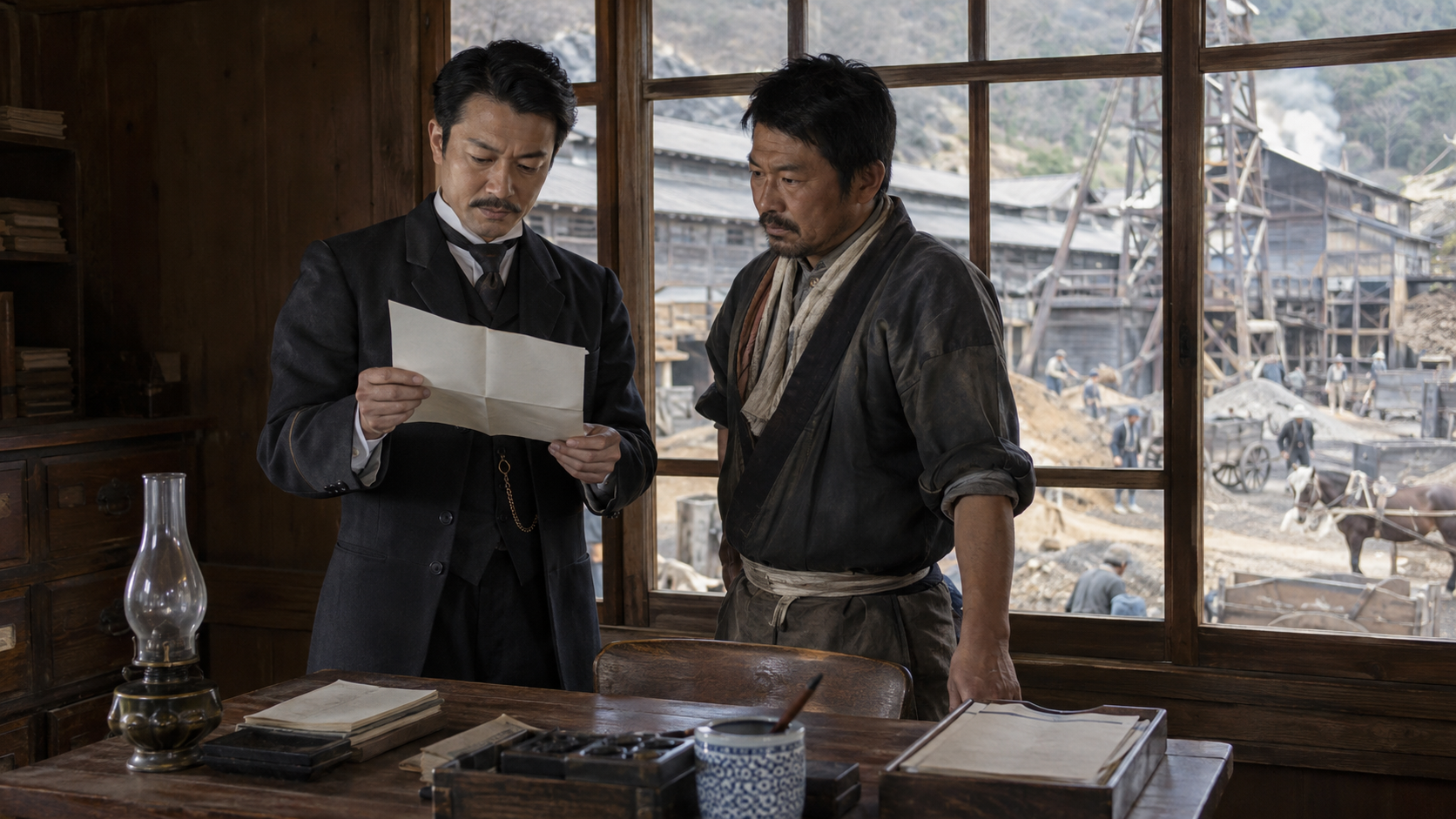
In 1897, preventive works were ordered at Ashio. Nikko City groups the third order around three concerns: treating wastewater, managing mining waste and addressing smelter emissions. The measures were directed at the operation producing the pollutants, alongside the attention being given to the affected areas.
Wastewater was to pass through settling and filtration ponds. Mining wastes containing copper were to be collected in managed storage areas. Smoke was to be treated before release. These requirements concerned different stages and forms of discharge, reflecting the several routes by which the operation affected its surroundings.
The works had deadlines, with mining to be halted if completion was delayed. Looking at the content of the order gives substance to the movement from investigation to official intervention. The response involved specified changes to facilities and the handling of waste.
Issuing an order, finishing the required construction and adequately preventing subsequent harm are stages that need to be examined separately. A record of instructions establishes what was demanded. To assess the outcome, we must follow what happened after the works as well.
Chapter 08
Problems beyond the construction
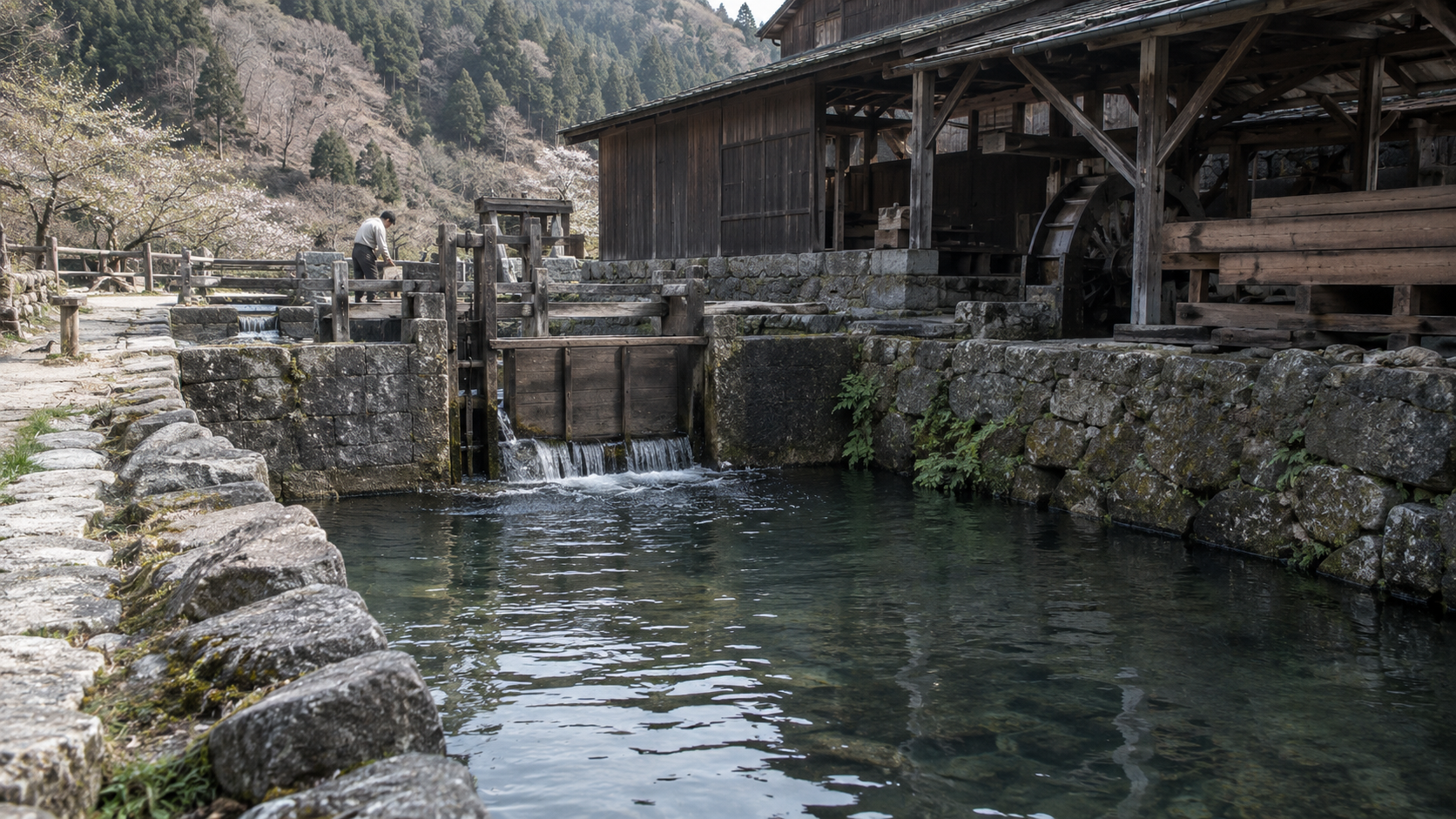
The preventive works improved the treatment of wastewater and mining waste. Nikko City's explanation also describes the limits of measures against smoke damage: they did not achieve a fundamental resolution. Further floods followed, and the pollution problem continued to attract attention.
Installing water treatment facilities did not make damaged land, or the sediment eroding from it, disappear at once. Several routes of harm called for attention to the progress of the different measures. Improvements within one part of the operation cannot stand for the disappearance of every problem in the basin.
Records that works were undertaken matter. So do the questions of what improved and what remained afterward. Returning our attention to livelihoods downstream brings the consequences back into view. The completion of equipment was one stage in a history that continued around it.
About ten years separated Tanaka's questions in the Diet in 1891 and his attempt to petition the emperor in 1901. Appeals continued during a period in which countermeasures had begun. Placing the petition within this span helps us follow the persistence of the affair.

Chapter 09
A petition that did not reach its destination
In 1901, Tanaka resigned from the House of Representatives and attempted to petition Emperor Meiji directly. His effort to deliver the petition was blocked. The Ashio Copper Mine Museum's timeline and Sano City's explanation describe the attempt and its failure to reach its intended recipient.
The episode has a strong place in the remembrance of the pollution affair. Before it came parliamentary activity and coordination among affected areas. After it came further efforts concerned with people's homes and livelihoods. The attempted petition belongs within this longer sequence.
The accounts cited here do not license invented words or private thoughts for Tanaka or the emperor. What we can establish for this narrative is the attempt and the fact that it was obstructed. From that event, we turn toward the land where Tanaka later continued his activity.
That place was Yanaka Village, downstream on the Watarase. There, responses to pollution and flooding became bound up with the question of whether people could remain where they lived. The history moves from a petition seeking attention to a dispute over an inhabited landscape.
Chapter 10
A village living with water
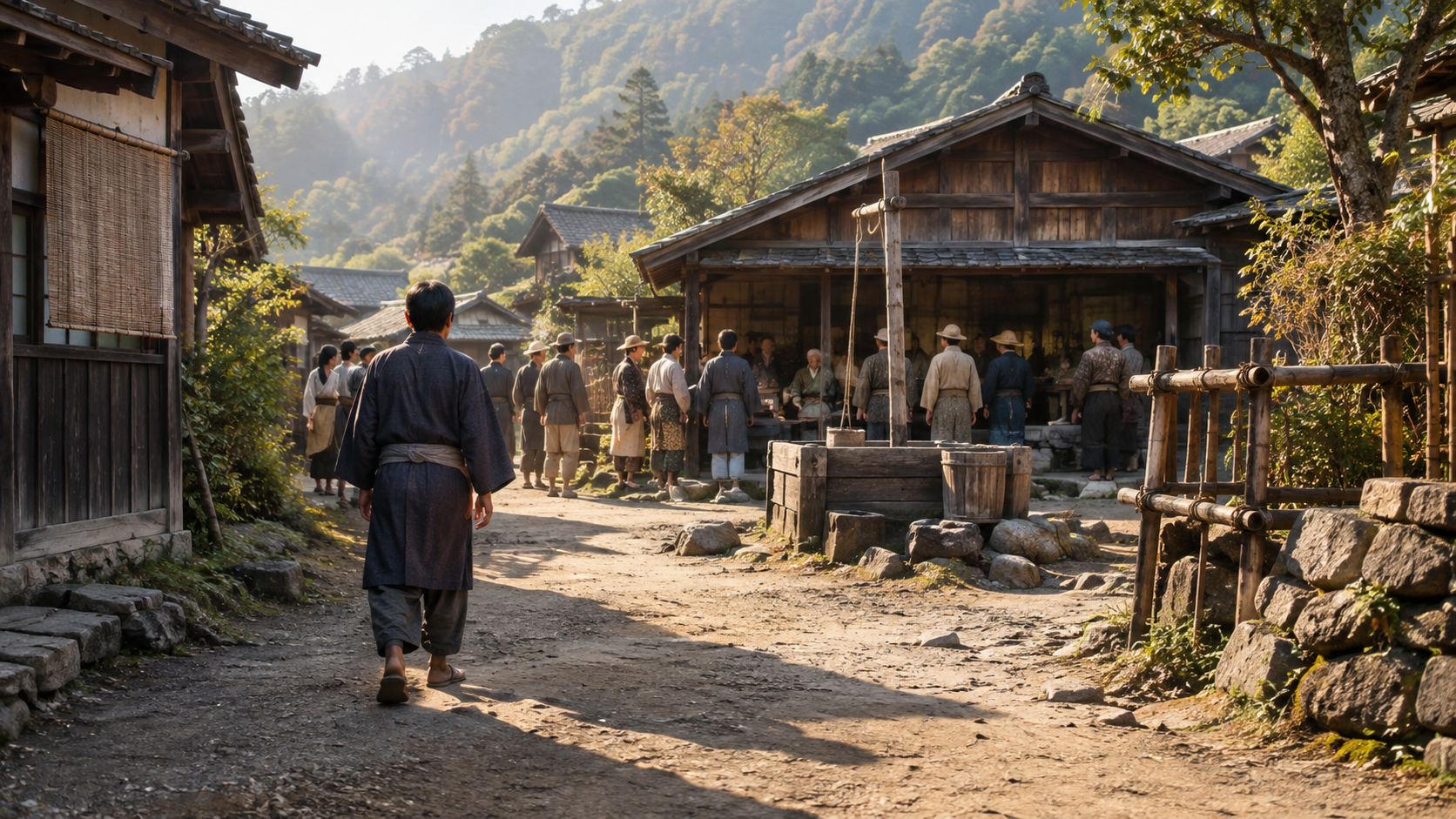
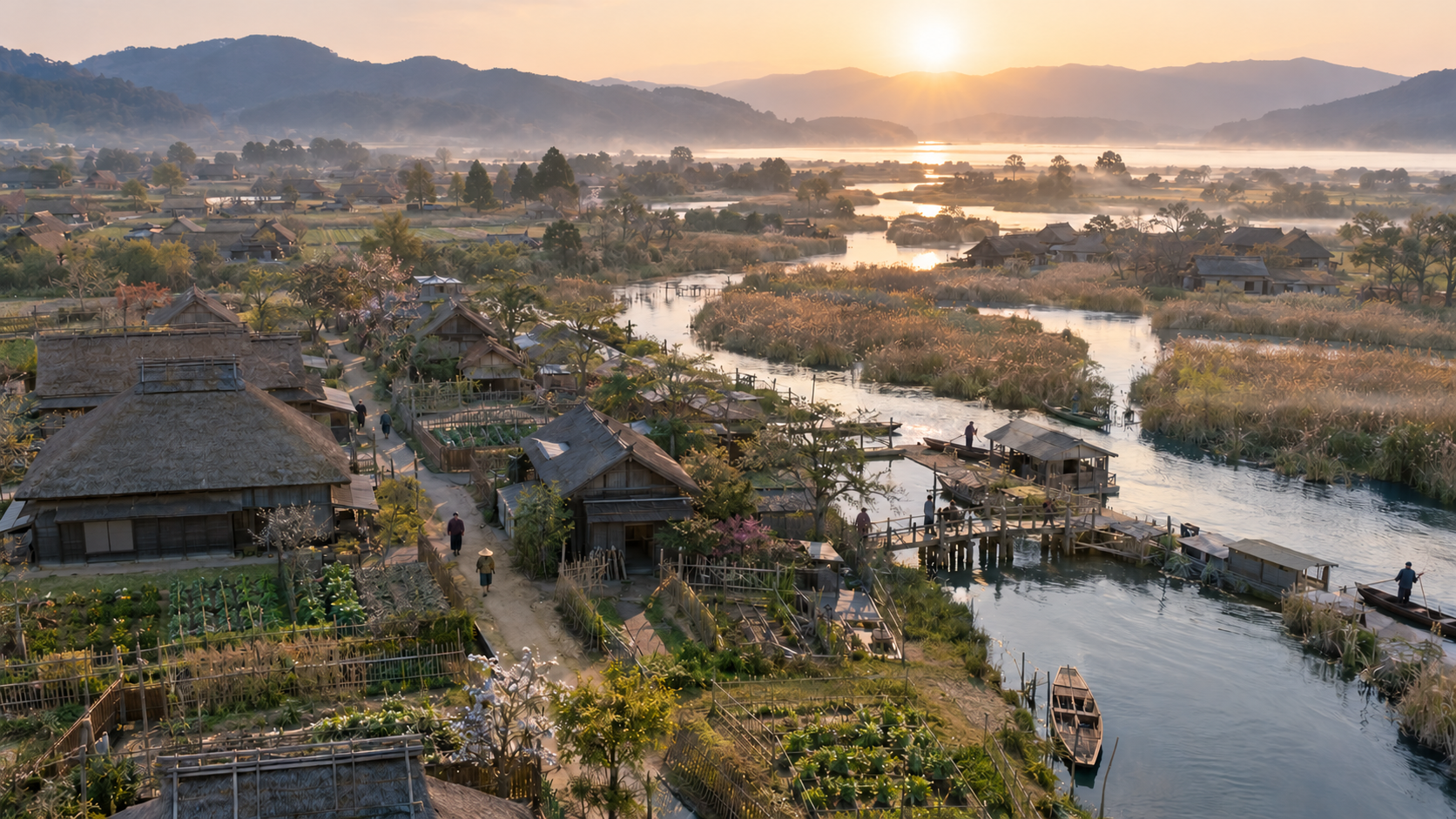
Yanaka lay on low ground between the Watarase, Uzuma and Omoi rivers. Vulnerable to flooding, it was surrounded by protective embankments. Tochigi City describes households with mizuka and agefune, arrangements for preparing for floods. Water was already part of the conditions in which village life was organized.
The city's account introduces rice and upland farming, fishing in ponds and waterways, work using reeds and sedges, and sericulture. The wetland and channels were connected with several kinds of livelihood. To understand the land considered for a flood basin, we need to keep those activities in view.
In 1903, the government decided to turn the Yanaka area into a retarding basin as a response to flooding and pollution damage. Tanaka opposed the plan. In 1904, he moved to the village and continued working with its residents against the proposed use of the land.
The area designated for the scheme already contained homes and work. A plan to hold floodwater there concerned a lived landscape, as well as the management of the river. Reading the proposal alongside the village's livelihoods makes the consequences for its inhabitants part of the account.
Chapter 11
Dissolution, and the land's continuing history
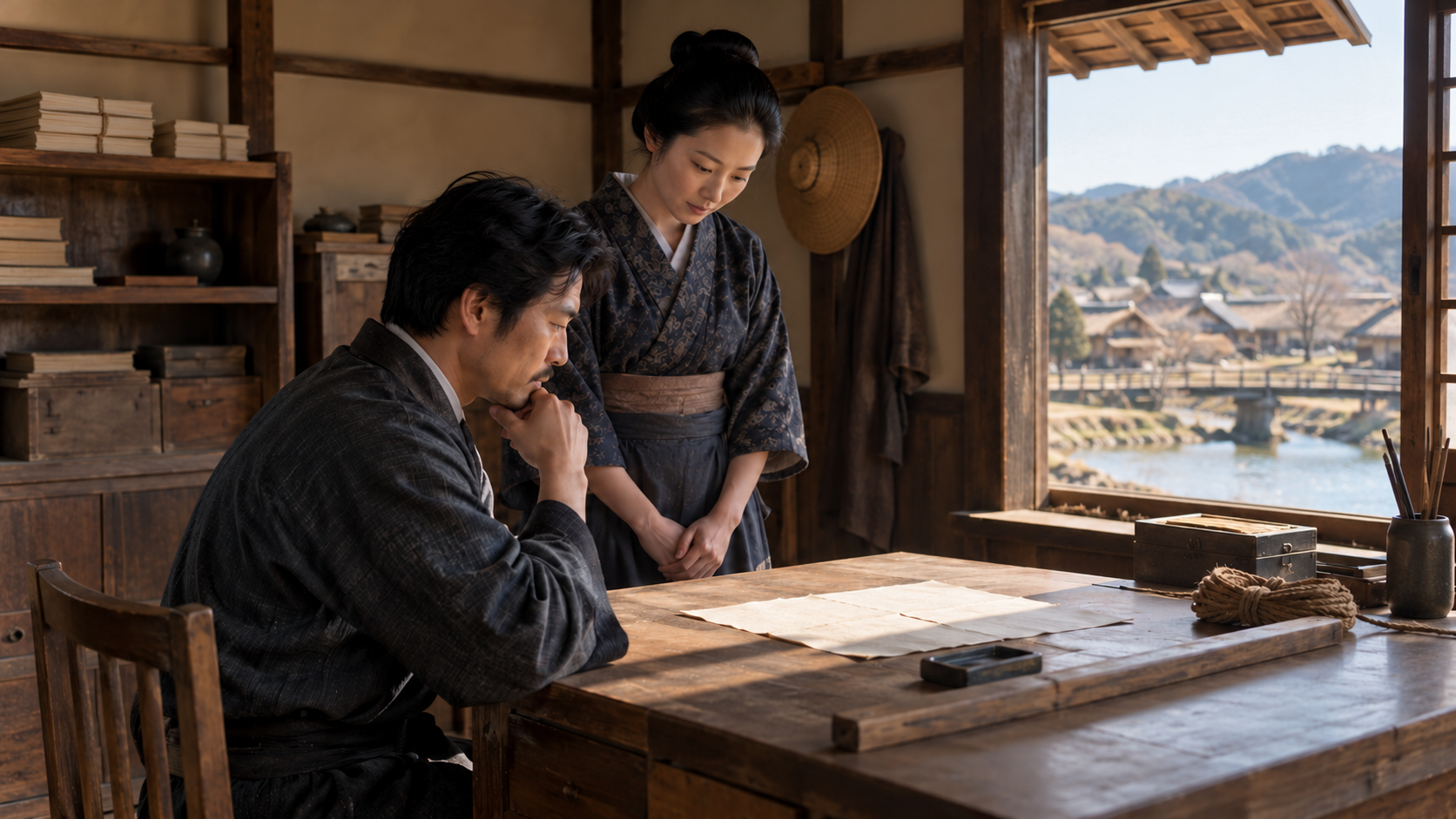
Tochigi Prefecture began acquiring land from 1905. In 1906, Yanaka was merged into Fujioka Town and dissolved as an administrative village. This was a major point in the sequence leading toward the retarding basin. It marked a change in the village's official existence.
The date should not be treated as a day on which everyone left the entire former village area together. Tochigi City describes descendants of former villagers living in parts of that area. Changes in place names and administrative boundaries do not encompass every continuing relationship with the land.
Construction also had its own subsequent chronology. Tochigi City's account of the works records the start of the river improvement project in 1910 and the completion of the principal works in 1922. The village's administrative dissolution in 1906 and the later completion of construction were different events.
The former village's central area now has preserved sites, including the village office site, shrine remains and mizuka. Places carrying the village's history survive within a landscape changed by the project. They give the land a continuing role in understanding what happened there.
Chapter 12
The people beyond the bottle
The growth of Ashio, damage downstream, questions in the Diet, the examination of sand, preventive works and the displacement of Yanaka belong to a connected history. Following this sequence brings Tanaka's actions into view alongside the lives of people associated with the mine, river and agricultural land.
Tanaka's birthplace house is preserved as a historic site in Konaka-cho, Sano City. Downstream are remnants of the former village; in the Archives are a sample and its report. The clues survive in different places and in different forms. Together, they offer ways to continue reading this history.
A bottle of sand cannot replace the voices of the people who experienced the affair. Yet the work that joined a sample to a written investigation has left an entrance to questions about what happened downstream. Preserving that particular relationship makes the object useful without requiring it to tell everything.
Considering industrial development alongside burdens experienced at a distance is the editorial approach taken here. Moving beyond the single moment of the attempted petition reveals a wider history of livelihoods, investigation, intervention and land. The river connects the places; the records help us follow the people and decisions associated with them.
Editorial note: this article uses institutional historical explanations. It does not present a new complete transcription of the original opinion paper, analysis report or petition. An inconsistent commission dissolution year, total casualty figures, the engineer's cause of death, claims that the entire village emptied on one day and details of house demolition are excluded. The AI-generated illustrations are imaginative reconstructions, not authenticated portraits, original document photographs or exact views of Ashio, Yanaka or the Imperial Diet.
How to read this work
History, interpretation, and reconstruction
Read the mine's growth together with downstream harm, investigation, preventive works and the continuing history of Yanaka's livelihoods and land.
This work is grounded in published sources and historical research. Interior thoughts, dialogue, and some visual details are cinematic reconstructions. Where historians disagree, the article presents the point as debated rather than settled fact.
Timeline
The story in time
-
Changes affecting fish and plants in the Watarase basin raise concern about pollution from the mine.
Sources: s01 -
A major flood spreads damage to farmland; affected areas coordinate and mining suspension is sought.
Sources: s02 -
Tanaka opposes the retarding basin plan and moves to Yanaka in 1904.
Sources: s06 -
The river improvement project begins in 1910; the principal retarding basin works are completed in 1922.
Sources: s07
People & terms
A guide for new readers
Key figures
- Tanaka Shozo
- Raised the pollution problem in the Diet, attempted a direct petition in 1901 and later worked with residents in Yanaka Village.
- Furukawa Ichibei
- The businessman who acquired Ashio Copper Mine in 1877.
- Sakano Hatsujiro
- An agricultural experimental station engineer whose analysis of damaged farmland is introduced by the National Archives. His cause of death is not addressed here.
Glossary
- Meiji era 明治時代
- The period of Japanese history in which the nineteenth-century mine expansion, parliamentary appeals and village dispute discussed here occurred.
- Imperial Diet 帝国議会
- The parliamentary institution in which Tanaka raised the pollution problem in December 1891.
- Kodoku 鉱毒
- The Japanese term for the harmful pollution associated with mining in this affair; it should not reduce the described routes of harm to wastewater alone.
- Ore dressing 選鉱
- Processing ore to separate useful mineral material, one stage of production included in Nikko City's explanation.
- Preventive works 予防工事
- Works ordered at the mine to address wastewater, solid wastes and smelter emissions. An order and the elimination of all harm are distinct.
- Direct petition 直訴
- An attempt to deliver an appeal directly to the emperor. Tanaka's attempt in 1901 was blocked.
- Retarding basin 遊水地
- An area used to hold floodwater temporarily; the Yanaka scheme affected land already used for homes and livelihoods.
- Mizuka 水塚
- A household flood preparation arrangement named in Tochigi City's account; such features are also preserved among the village sites.
- Agefune 揚舟
- A boat arrangement kept as a household preparation for flooding, named alongside mizuka in the city's account.
- Sericulture 養蚕
- Raising silkworms, one of the livelihoods recorded for Yanaka.
- Administrative dissolution 廃村
- The ending of Yanaka's existence as a separate administrative village through its 1906 merger; not a claim that every resident departed on that date.
Sources & method
How this article was built
This English article follows the fixed, publicly verified Japanese manuscript and its twelve chapters. The relevant explanations on all eight adopted institutional pages were actually read. Nikko City's official HTML was fetched and its relevant history and preventive-works sections read after the web reader timed out. Source titles are editorial English translations.
The National Archives' explanations are used for the 1891 proceedings and the report and sand sample. This article does not claim a new complete transcription of the original opinion paper, question document, measurement tables or petition. The displayed opinion paper is kept distinct from the parliamentary questions, and individual sample values are not generalized across the river basin.
The source page's inconsistent commission dissolution year is omitted, as are total casualty figures and the engineer's cause of death. Watarase Village and Yanaka Village remain distinct. A blocked petition is not a delivered petition; a preventive order is not proof that every form of harm ended. Village dissolution and the later completion of river works are separate events. Interpretation of their connections is editorial.
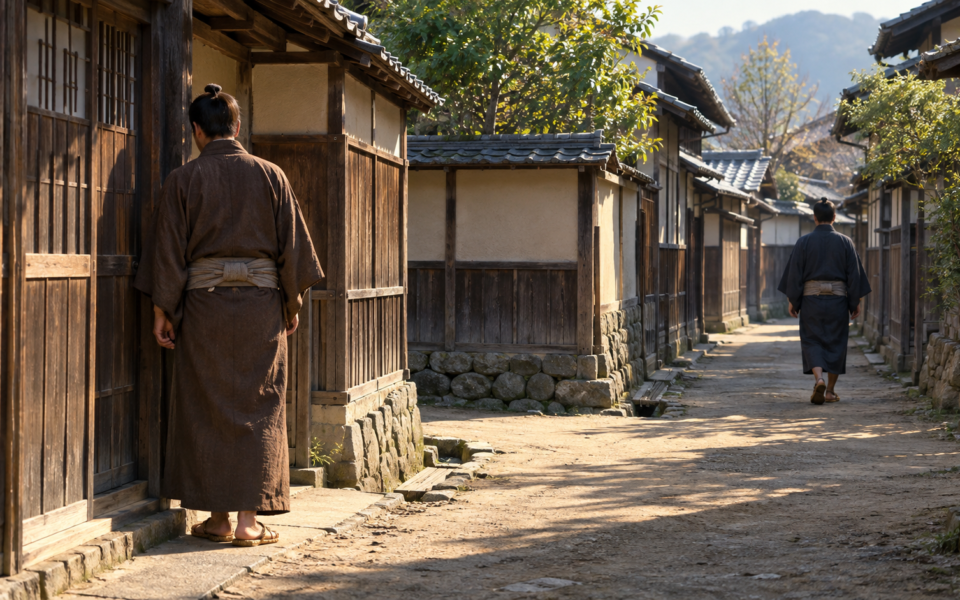
The hero and twelve chapter illustrations use twelve distinct AI-generated SHIGEKI images. All twelve current images were viewed individually; hashes and article rights are matched to the Japanese review. Anonymous figures, papers, sample bottles, village landscapes and assembly rooms are imaginative representations, not authenticated portraits or exact historical views. No institutional source-site photographs are reproduced. The linked film has Japanese audio; an English subtitle track has not been verified.
Sources
References and further reading
- Pollution from Ashio Copper Mine becomes an issue 足尾銅山の鉱毒が問題化する Title translated editorially for reader convenience. National Archives of Japan 国立公文書館 Introduces late-1880s disturbances and the December 1891 Diet questions. The displayed opinion paper and the questions are kept distinct. Accessed 2026-10-09
- Sand in a bottle: records of the Ashio copper pollution affair 瓶入りの砂―足尾銅山鉱毒事件関係資料 Title translated editorially for reader convenience. National Archives of Japan 国立公文書館 Introduces the 1896 flood, investigation commission and the engineer's report and sediment sample. An inconsistent dissolution year is excluded. Accessed 2026-10-09
- History and tradition: Tanaka Shozo and the pollution affair 歴史・伝統―鉱毒事件に生涯を捧げた正造翁 Title translated editorially for reader convenience. Sano City 佐野市 Introduces his origins, election, parliamentary activity and blocked petition. The present location of Yanaka is checked against Tochigi City's account. Accessed 2026-10-09
- About Ashio Copper Mine 足尾銅山について Title translated editorially for reader convenience. Ashio Copper Mine Museum 足尾銅山記念館 Timeline used for the 1877 acquisition and the 1901 resignation and unsuccessful petition. Accessed 2026-10-09
- The history of Ashio Copper Mine 足尾銅山の歴史 Title translated editorially for reader convenience. Nikko City 日光市 The mine's growth, combined routes of harm, preventive orders and improvements with continuing smoke damage. Relevant official HTML sections actually read. Accessed 2026-10-09
- The history of the Watarase retarding basin 渡良瀬遊水地の歴史 Title translated editorially for reader convenience. Tochigi City 栃木市 Village livelihoods, flood preparations, the 1903 plan, Tanaka's 1904 move, land acquisition, dissolution and preserved sites. Accessed 2026-10-09
- Flood control and water use: developing the Watarase retarding basin 治水・利水―渡良瀬遊水地整備の経緯 Title translated editorially for reader convenience. Tochigi City 栃木市 Distinguishes administrative dissolution from the river improvement project starting in 1910 and the principal works completed in 1922. Accessed 2026-10-09
- Tochigi Prefecture historic site: Tanaka Shozo's former house 栃木県指定文化財/田中正造旧宅 Title translated editorially for reader convenience. Sano City 佐野市 Identifies his birthplace house and its preservation. Source-site photographs and books are not reproduced. Accessed 2026-10-09
Continue reading
More stories from Shigeki
Shigeki English
Sakai’s Merchant City: Trade, Self-Government and Survival
A port, a merchant council and town communities—from changing authority to rebuilding after fire.
- When From the later fifteenth century through the Sengoku period, the fire of 1615 and early Edo-period reconstruction.
- Where Sakai, in present-day Osaka Prefecture, where maritime routes met roads on land.
Shigeki English
The Aburanokōji Incident: After Leaving the Shinsengumi
A separation in spring, a new base in summer, and two successive attacks.
- When Kyoto in Keiō 3 (1867). The incident’s historical date corresponds to December 13, 1867.
- Where Kyoto: the guards’ successive bases, the Aburanokōji attack site and the later place of remembrance.