
SHIGEKI ENGLISH STORYEN
Japanese history in English
The Mongol Invasions of Japan: Was It Really a Divine Wind That Saved the Country?
Kublai Khan's letter, one day at Hakata Bay, the stone wall, the storm at Takashima, the wrecks on the seabed and the rewards that never came.
In 1274 and 1281 great Yuan fleets attacked Japan. Was the first retreat really caused by a storm, and what kept the second army at sea until the typhoon came? This article follows the story from Kublai Khan's letter to the stone wall of Hakata Bay, the wrecks off Takashima, the dispute over rewards and the growth of the kamikaze legend.
At a glance
Before you enter the story
- When
- 1268 to 1281, with the aftermath of the invasions and modern underwater research
- Where
- Dazaifu, Tsushima, Iki, Hakata Bay, Shikanoshima and Takashima in northern Kyushu, and Kamakura
- Key figures
- Kublai Khan, Hojo Tokimune, Takezaki Suenaga, Adachi Yasumori, Kono Michiari, Du Shizhong, Taira no Yoritsuna
- What was at stake
- Was Japan saved by a divine wind, or by something more complicated?
Why this story matters
The larger history behind the turning point
The word kamikaze comes from this history, and the legend shaped how Japan saw itself up to the Second World War.
New finds from the seabed off Takashima continue to change what is known about the invading fleets.
Historical context
What an international reader needs to know
Japan and East Asia in the thirteenth century
Japan was ruled jointly by the imperial court in Kyoto and the Kamakura shogunate, whose regents came from the Hojo family.
The Mongol Empire had conquered much of Eurasia. Under Kublai Khan it subdued Goryeo in Korea and fought the Southern Song dynasty of China, which fell in 1279.
Dates and sources
Dates before the modern era follow the Japanese lunar calendar used at the time, including the intercalary seventh month of 1281, and ages use the traditional Japanese count.
Troop and ship numbers come from historical records and reference works and should be treated as approximate. Debated points are marked as such.
Watch the film
See the story in motion
The film currently uses Japanese audio. This English article provides the context and source trail; it does not imply that an English subtitle track is available.
Opening
A question on the seabed
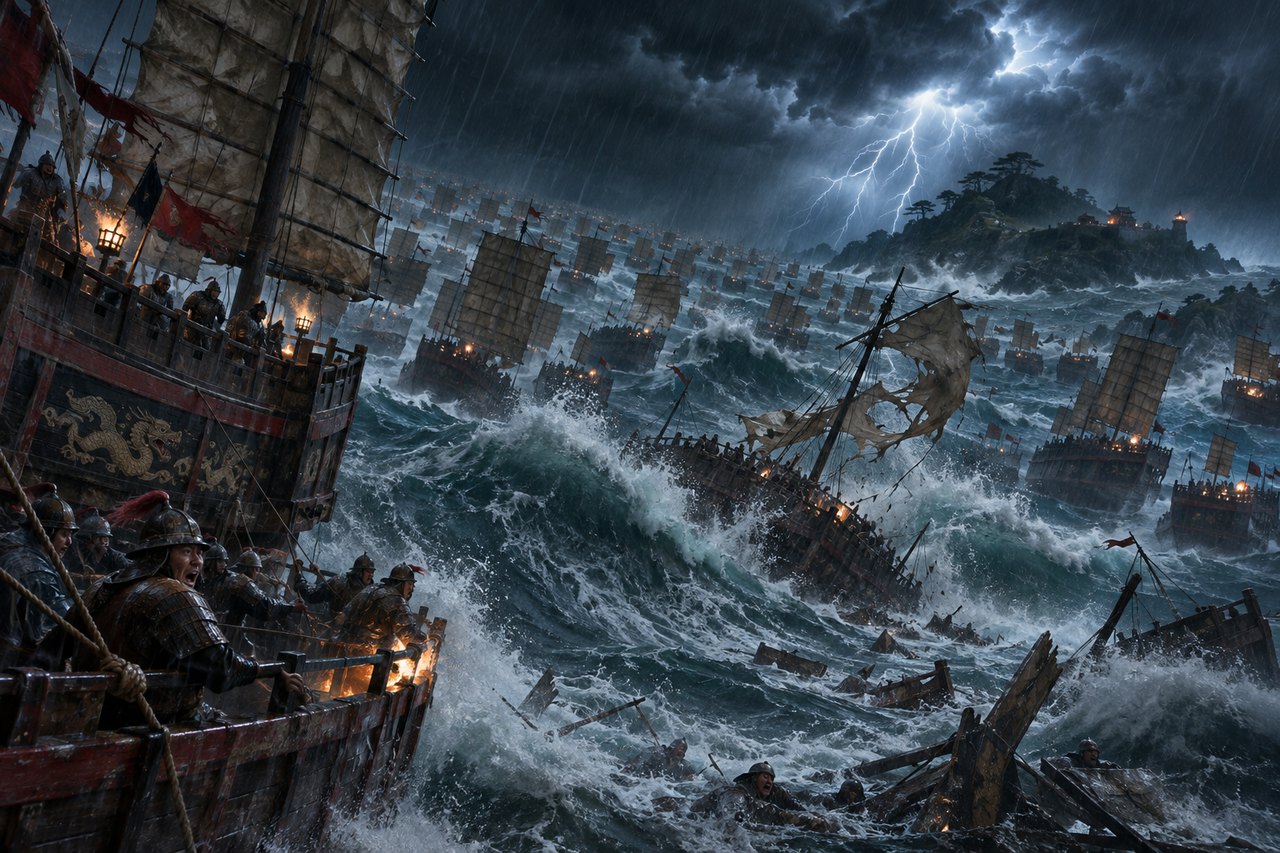
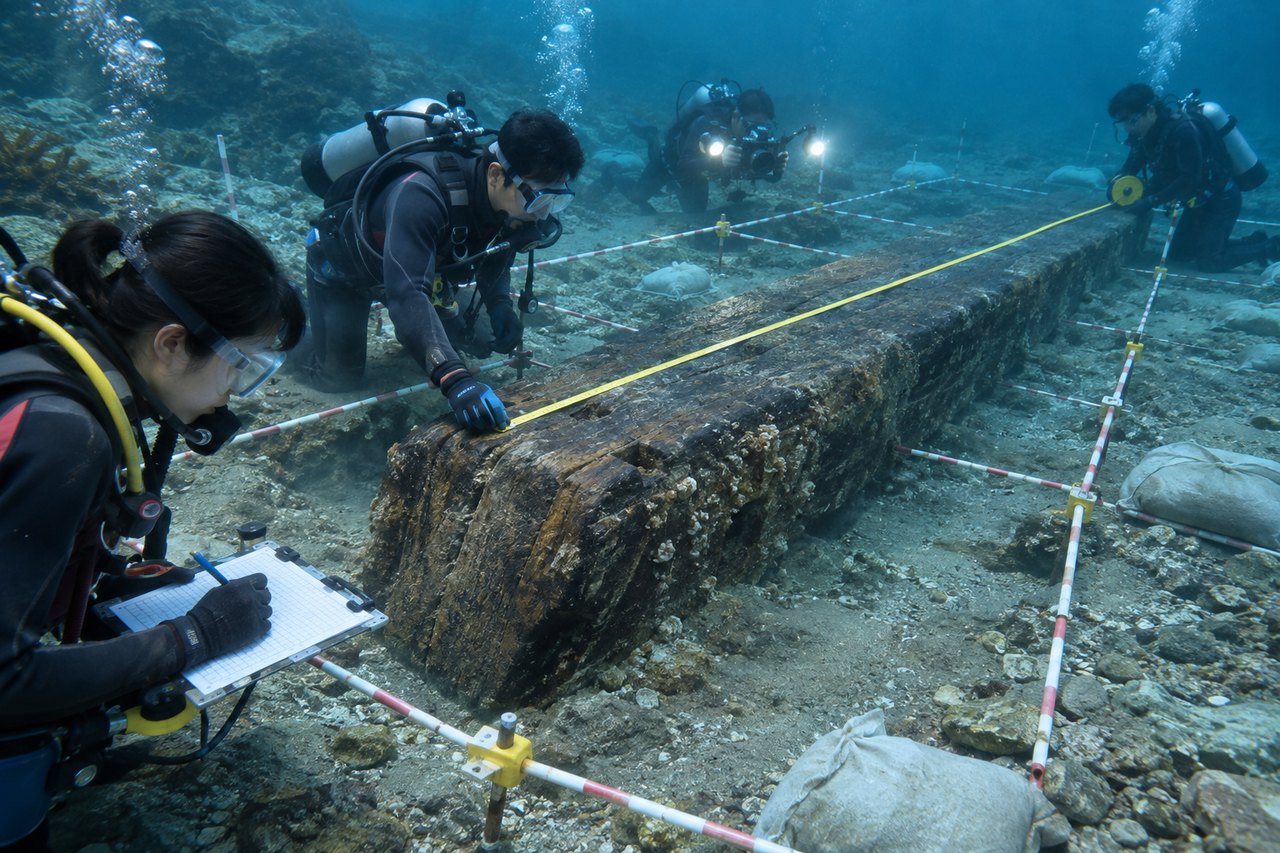
In 2011, on the seabed off Takashima island in Matsuura, Nagasaki Prefecture, researchers uncovered the keel of a Yuan warship lying 23 to 25 meters below the surface. The timber was about 50 centimeters wide and about 12 meters long. In waters where a great fleet was long said to have gone down in the storm of 1281, a real ship had been waiting.
The Mongol invasions of Japan are usually told as the story of a divine wind, the kamikaze, that saved the country. Yet the first invasion, in 1274, took place in what is now late November, well outside the typhoon season. And in the second invasion, in 1281, nearly two months of fighting came before the storm ever arrived.
Was it really a divine wind that saved Japan? This article follows events from the arrival of Kublai Khan's letter through the two campaigns, the dispute over rewards and the growth of the kamikaze legend. It draws on written records and underwater archaeology, and it keeps firm evidence apart from debated interpretations.
Chapter 1
Kublai Khan's letter
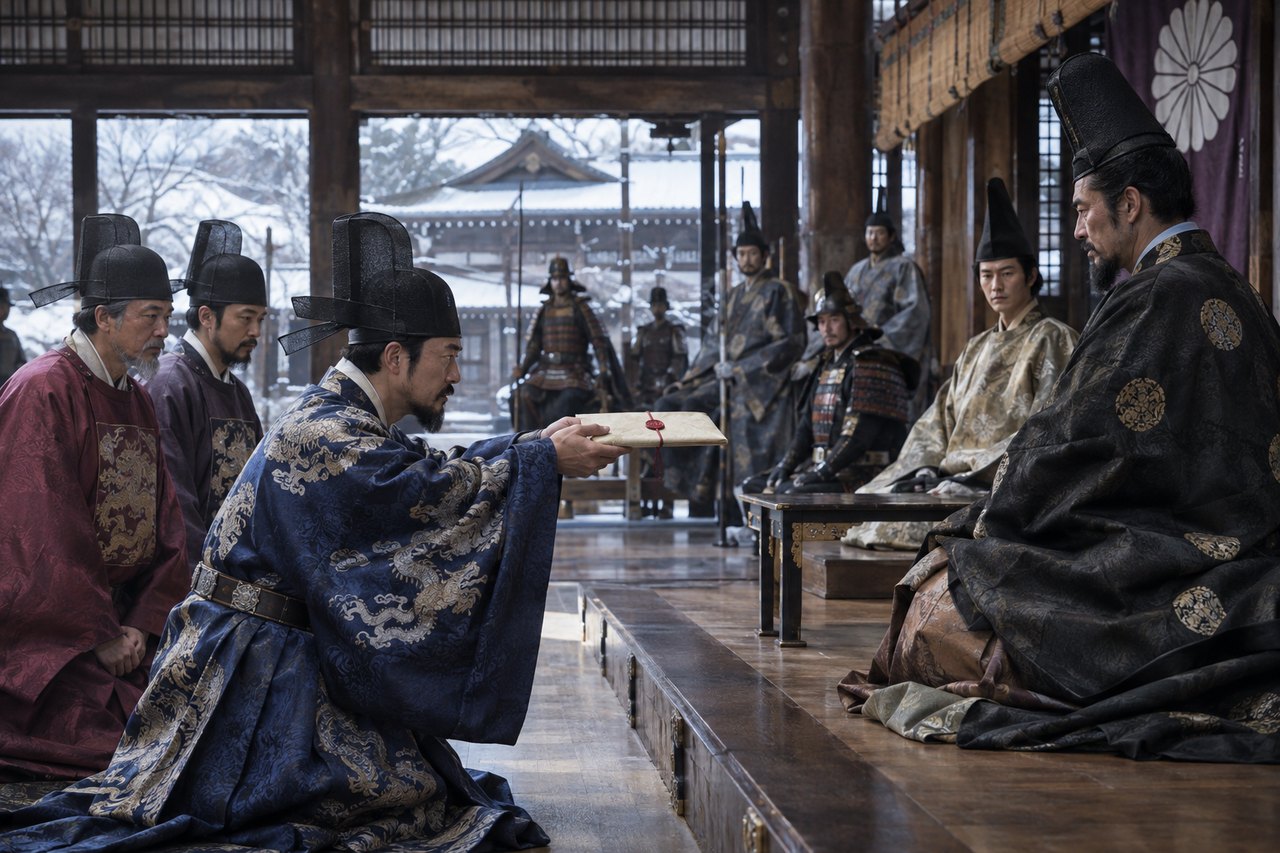
In 1268 envoys from the Korean kingdom of Goryeo reached Dazaifu, the government headquarters in northern Kyushu, carrying a letter from the Mongol emperor Kublai Khan. A copy survives through Todaiji temple in Nara. The imperial court received the letter from the shogunate in the second month of that year, and a court noble wrote in his diary that it was a grave matter for the state.
The letter invited Japan to exchange envoys and enter into friendly relations, but it also asked who would wish to resort to military force. The line can be read as a sincere hope for friendship or as a veiled threat, and historians still read it in both ways.
Kublai's motives are thought to have included cutting the link between Japan and the Southern Song dynasty of China, his great rival, and controlling Japanese sulfur, an ingredient of gunpowder. The court decided not to reply, and the envoys were sent home without an answer.
Chapter 2
Hojo Tokimune, regent at eighteen
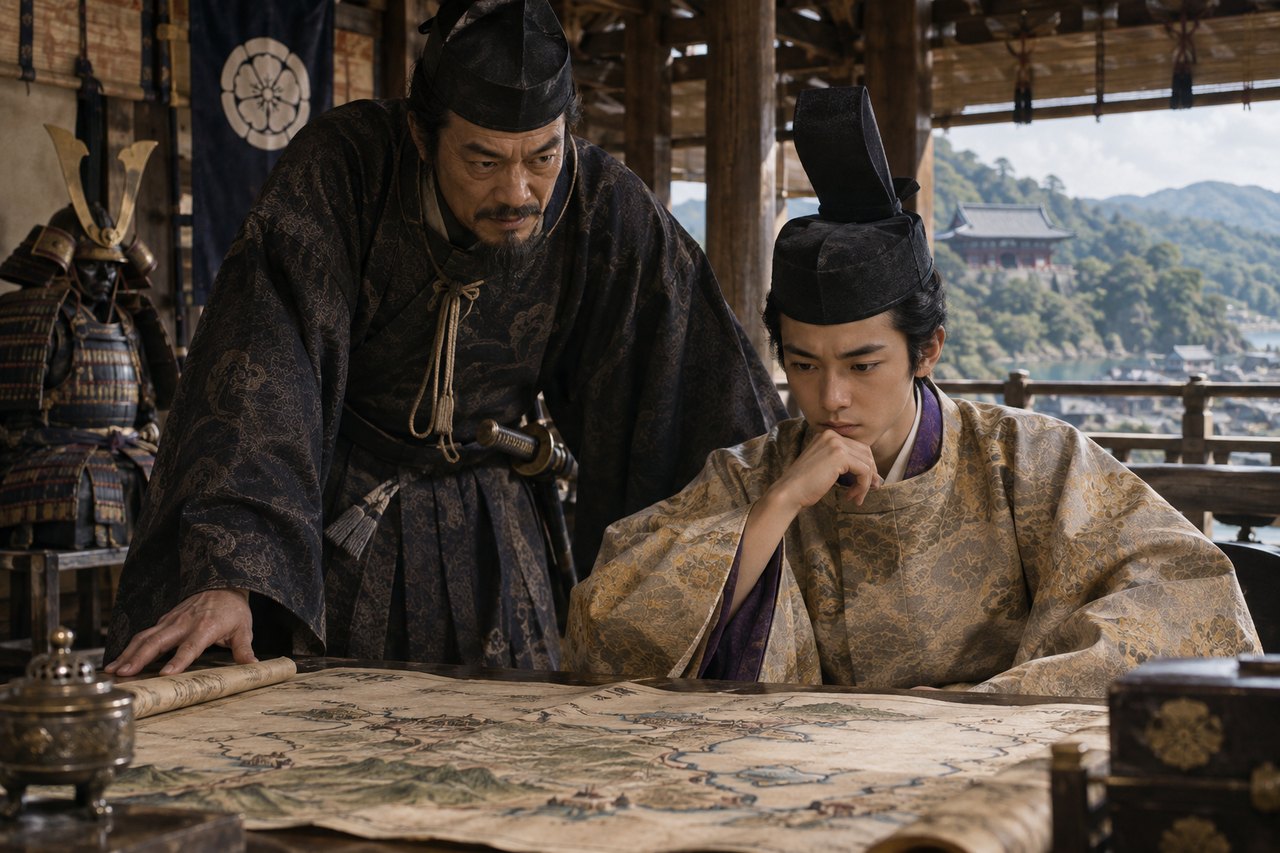
In the third month of 1268, the same year the letter arrived, Hojo Tokimune became regent of the Kamakura shogunate at the age of eighteen. Born in 1251, he took on from the very start of his rule the problem of how to answer the demands of a vast continental empire.
Trouble also came from inside the shogunate. In the second month of 1272, in the incident known as the February Disturbance, Tokimune's elder half-brother Hojo Tokisuke was accused of plotting rebellion and killed, while Nagoe Tokiakira and Nagoe Noritoki died in Kamakura. Tokiakira was later found to have had no part in any plot.
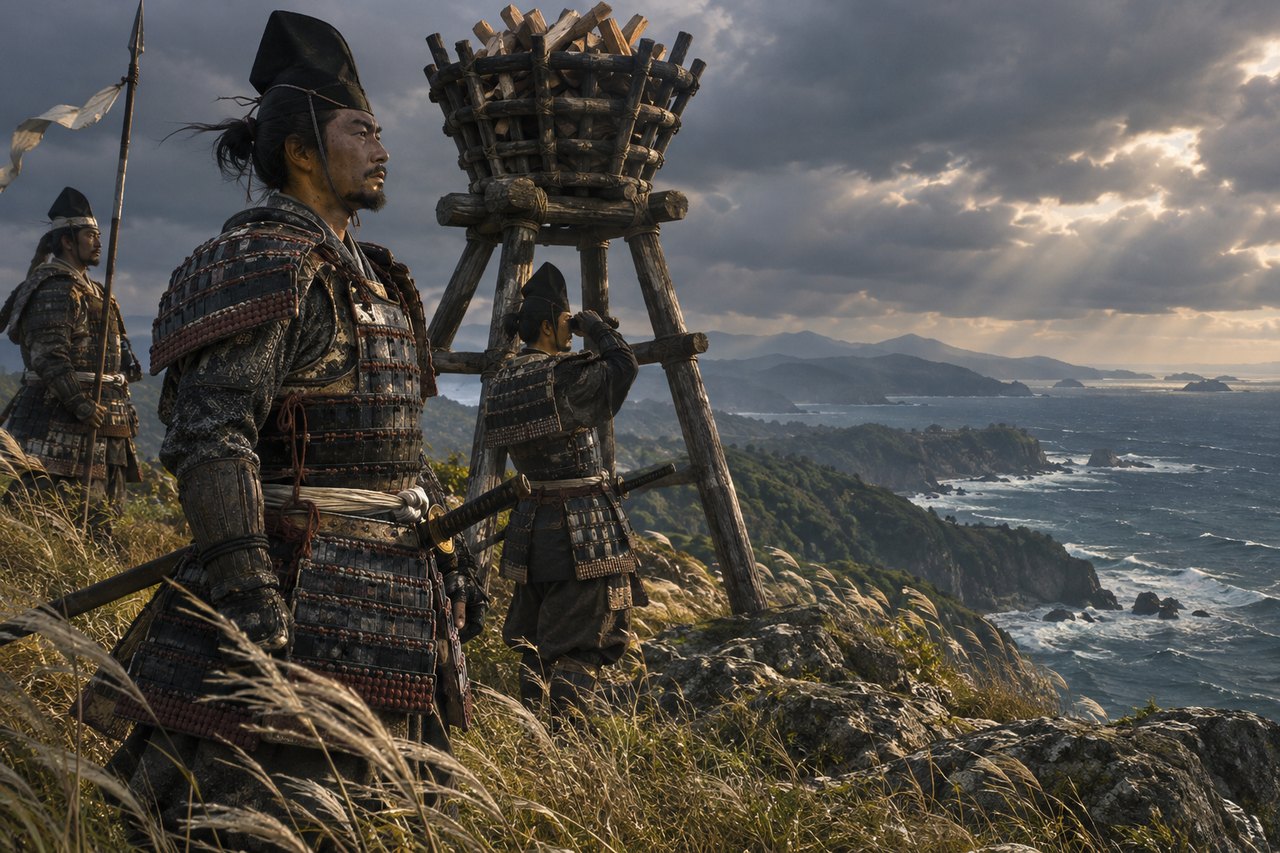
The same year saw the creation of the Ikoku Keigo Banyaku, a guard duty for the coast of Kyushu. Under Tokimune the shogunate took a hard line with Yuan envoys, strengthened the shoreline defenses and even considered an expedition across the sea.
Chapter 3
The country that would not answer
In 1271 Kublai adopted the dynastic name Yuan. Missions to Japan were sent six times in all, and in 1273 the envoy Zhao Liangbi came to Japan once again. The shogunate still sent no reply, and no path to negotiation opened between the two sides.
Kublai is said to have ordered Goryeo to prepare 10,000 troops and 1,000 warships. For a kingdom that had already been forced to submit to the Mongols, this was a heavy burden, and the preparations for the invasion of Japan drew the people of the Korean peninsula into the conflict.
Japan, for its part, had set up the watch along the Kyushu coast. But it had no reliable way of knowing when the empire across the sea would strike, or how many soldiers it would send.
Chapter 4
Tsushima, Iki and the road to Hakata
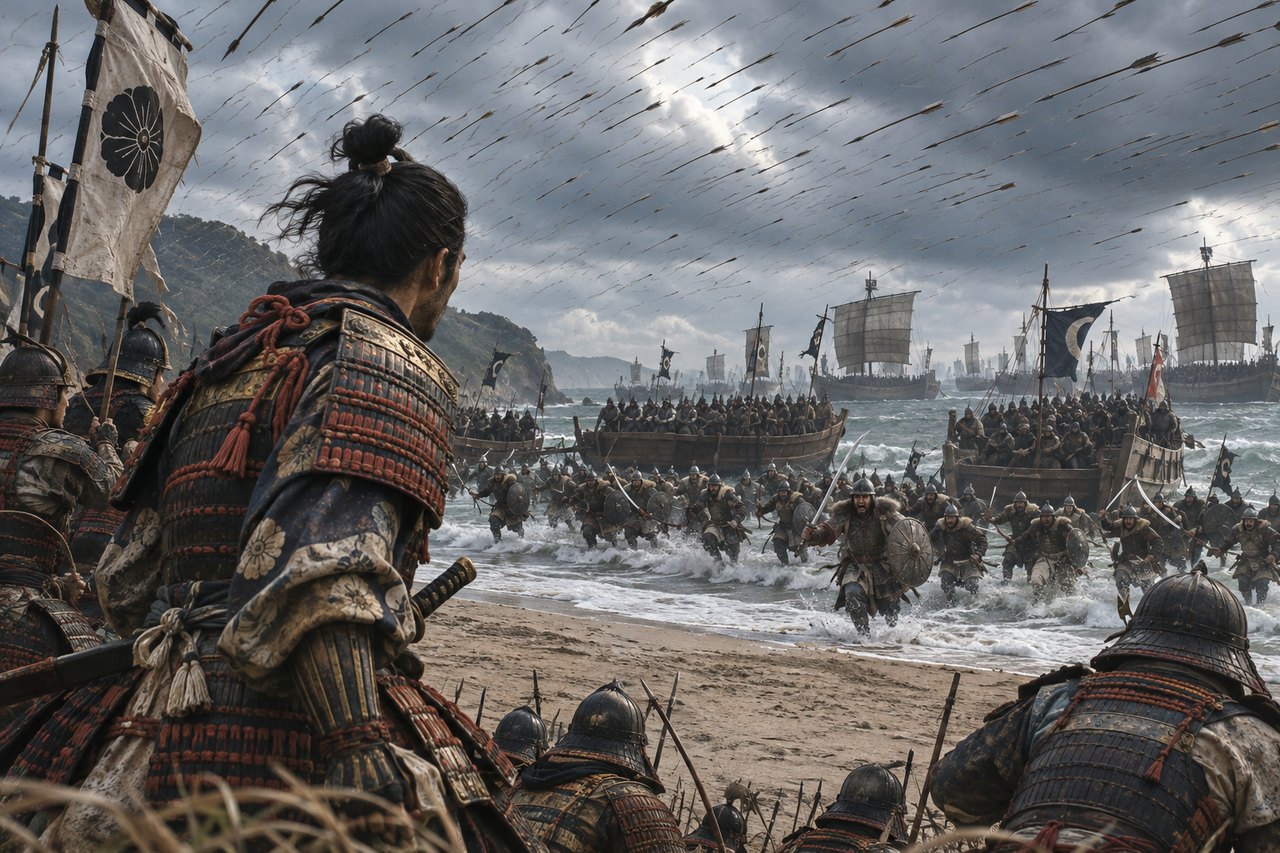
On the third day of the tenth month of 1274, in the eleventh year of the Bun'ei era, about 28,000 Mongol and Goryeo soldiers sailed from Happo on the southern coast of Korea. The fleet is said to have numbered about 900 ships. Other estimates speak of tens of thousands of men, and no exact figure is known.
On the fifth day the fleet appeared at Tsushima, where the deputy governor So Sukekuni and his men were killed. On the fourteenth day it struck Iki, where the deputy governor Taira no Kagetaka also died. The island garrisons could not hold out for long against such a force.
Having broken through Tsushima and Iki, the fleet appeared in Hakata Bay before dawn on the twentieth day, about two weeks after first reaching Tsushima. For the warriors of Kyushu, it was the first day of open battle against a great foreign army.
Chapter 5
One day at Hakata Bay
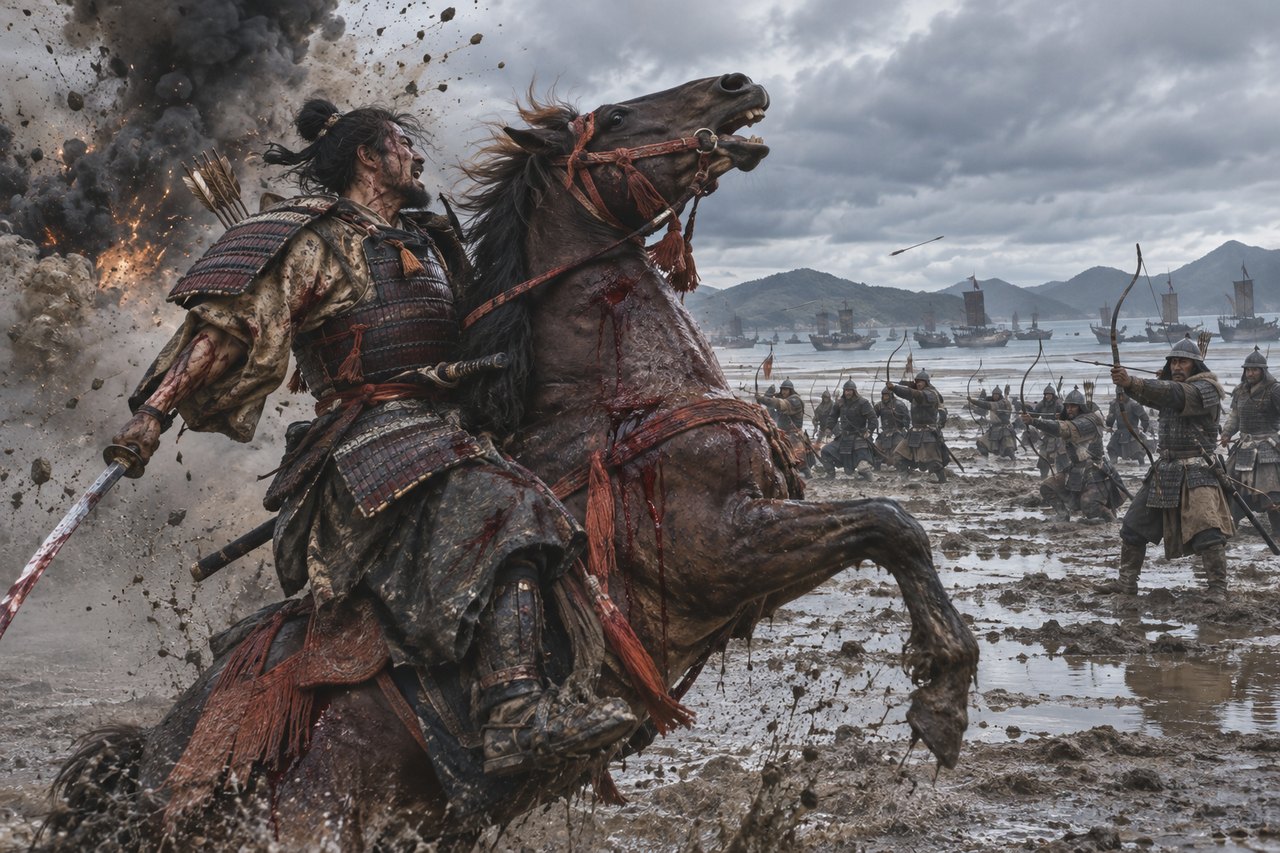
On the twentieth day the allied army landed at about three points along Hakata Bay and concentrated its strength on the beach at Torikai. The invaders used explosive weapons called teppo and short, highly mobile bows, while the long Japanese bow is said to have been harder to handle on horseback.
Takezaki Suenaga, a retainer from Higo Province, rode against the enemy with just five followers. Leaving the camp at Hakozaki, he passed through Hakata and Akasaka and met the Mongol forces on the tidal flats at Torikai. His fight was later preserved in the Moko Shurai Ekotoba, the illustrated scrolls he commissioned.
The invaders could not take the Japanese position on the high ground and are said to have camped on Sohara hill for the night. By tradition, they had vanished by the following day. That story of a fleet gone overnight became the starting point of the kamikaze legend.
Chapter 6
The mystery of the vanished fleet
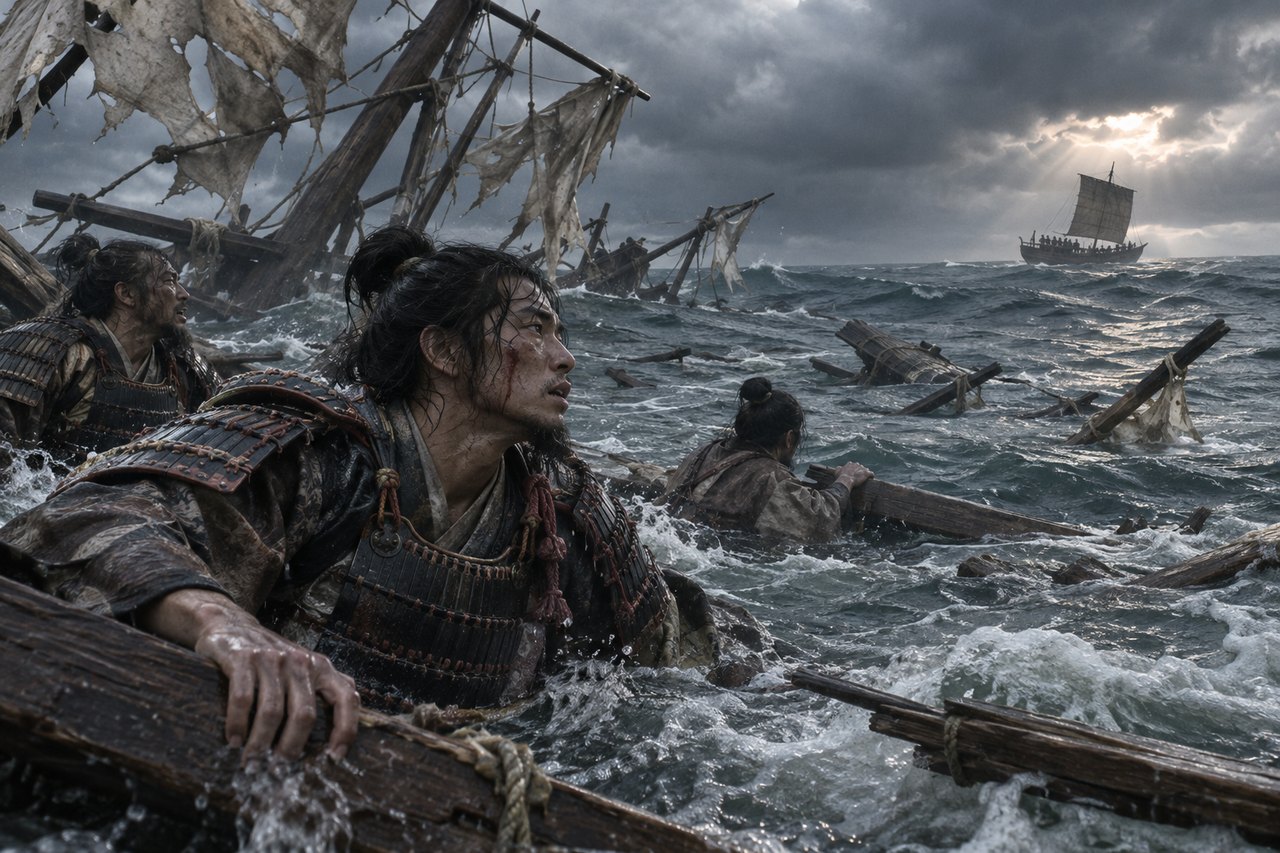
Why did the fleet disappear? The encyclopedia Nihon Daihyakka Zensho records a withdrawal that night, heavy damage from a storm and more than 13,500 men who never returned. The diary of a Kyoto court noble, the Kanchuki, also repeats a report that a sudden contrary wind blew the enemy back to their own country.
A meteorological study published in the journal Tenki points out that the twentieth day of the tenth month corresponds to 26 November in the modern calendar, when a typhoon is very unlikely. Using weather notes from Kyoto and other evidence, it concludes that any storm was probably not severe enough to bring violent wind and rain.
The older view was that the invaders withdrew as planned. The historian Hattori Hideo argues instead, citing a reference to a battle at Dazaifu on the twenty-fourth day in the Kanto Hyojoden, that the army fought on for several days and retreated when it could not break through. Even the idea of a fleet gone in one night is now in question.
Chapter 7
Executed envoys and a wall of stone
In the fourth month of 1275 the Yuan envoy Du Shizhong and his party arrived at Murotsu in Nagato Province. They were sent on to Kamakura, and Du and four others were beheaded at Tatsunokuchi. A memorial to the five men still stands at Joryuji temple in Fujisawa. Envoys who came to Hakata in the sixth month of 1279 were also put to death.
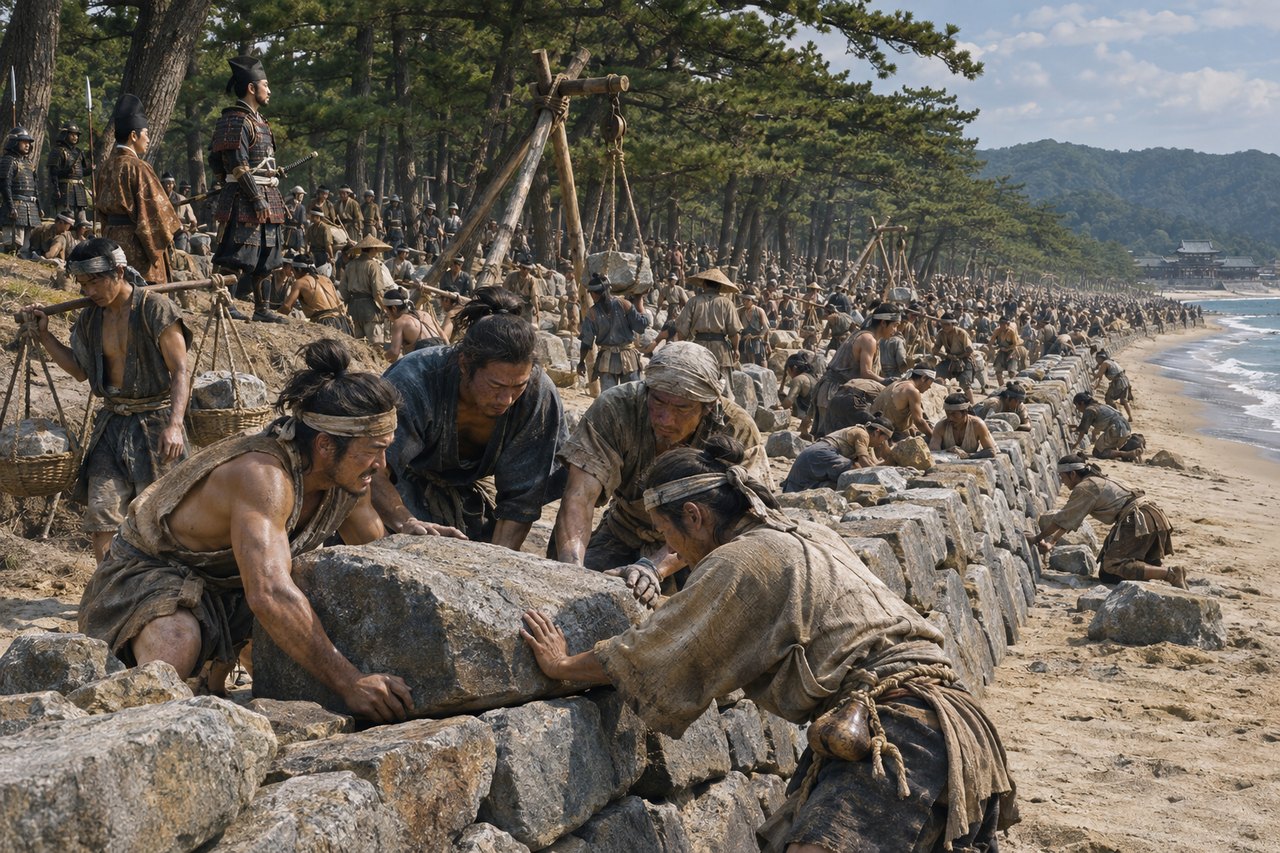
In the third month of 1276 work began on a stone wall, the Ishitsuiji, along about 20 kilometers of Hakata Bay from Kashii to Imazu. Nine provinces of Kyushu each took responsibility for a section: Osumi and Hyuga built at Imazu, for example, and Higo at Iki-no-Matsubara.
The work is said to have taken only about half a year, and the wall rose to a height of about two to three meters. Its foundations and stonework differ from place to place because different provinces built each stretch. This wall would change the shape of the next battle.
Chapter 8
The shore that stopped a landing
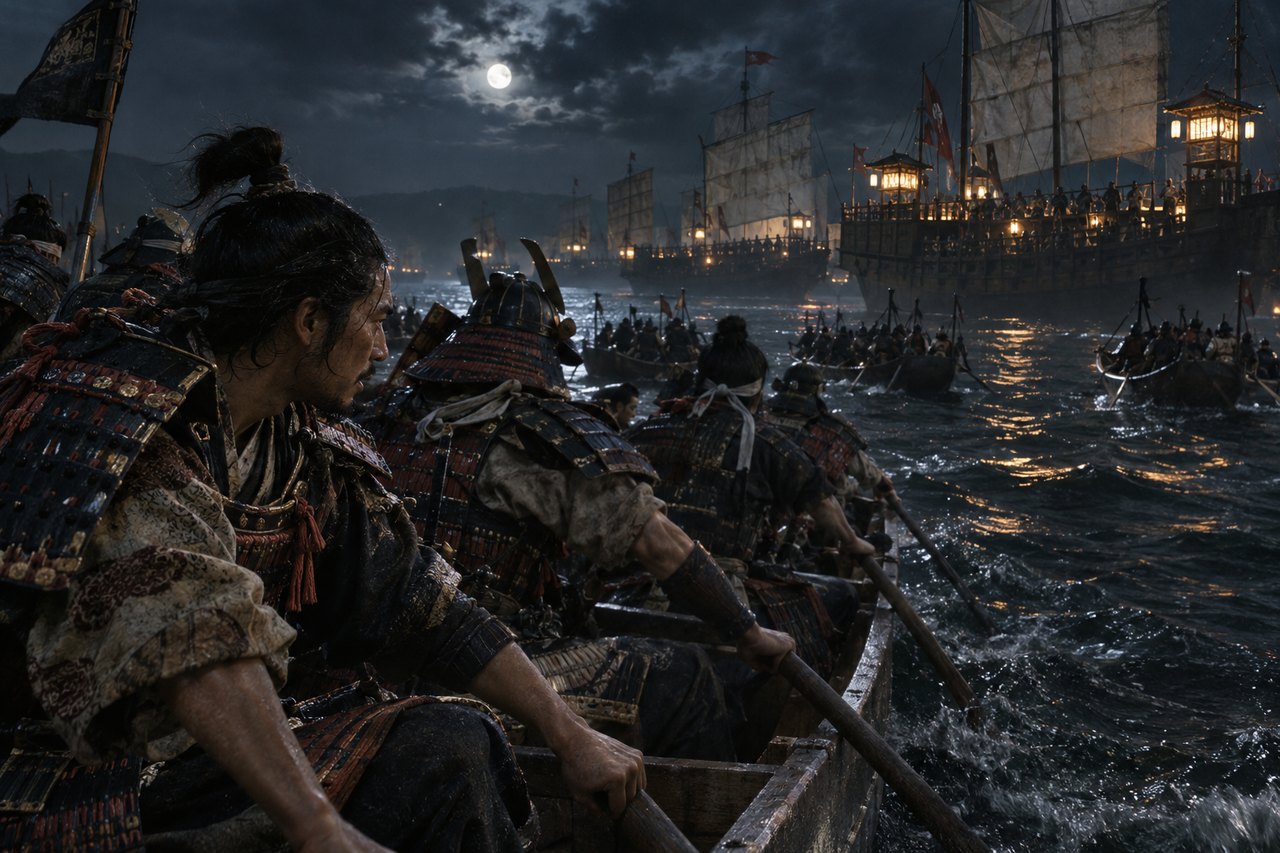
In 1281, the fourth year of the Koan era, the Yuan sent two armies. The Eastern Route Army from Korea is recorded at about 40,000 men and 900 ships, and the Jiangnan Army from southern China at 100,000 men and 3,500 ships. The Eastern Route Army left Happo on the third day of the fifth month, attacked Tsushima and Iki, and entered Hakata Bay on the sixth day of the sixth month.
This time the shore was lined with stone. Blocked by the wall and by Japanese resistance, the main force turned toward Shikanoshima island. Kono Michiari of Iyo camped in front of the wall, earning the name Kono of the Rear Wall, and is said to have attacked Yuan ships in small boats and captured an enemy commander.
Takezaki Suenaga is also said to have boarded an enemy ship. Unable to gain a foothold at Hakata, the Eastern Route Army fell back to Iki and then toward Takashima in Hizen. The Jiangnan Army, which left Qingyuan only on the eighteenth day of the sixth month, was badly delayed, and the two forces finally met near Hirado in the seventh month.
Chapter 9
The storm at Takashima
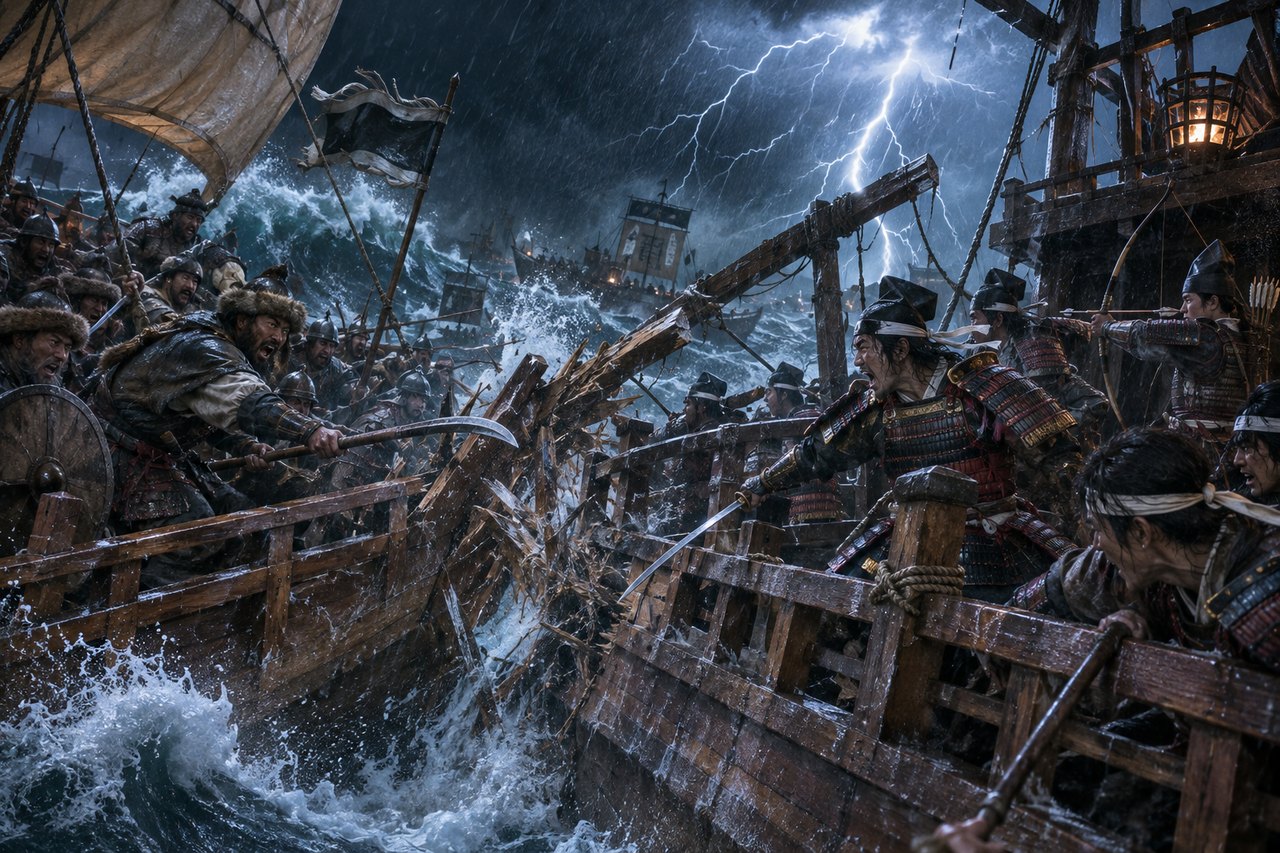
On the twenty-seventh day of the seventh month the allied fleet moved to Takashima. A violent storm struck on the night of the thirtieth, and by the first day of the intercalary seventh month the Yuan force was almost destroyed. In the modern calendar this was August, the typhoon season, and unlike the storm of 1274, this one is confirmed by many records.
On the bed of Lake Daija in Amakusa, Kumamoto Prefecture, researchers found a 63-centimeter layer of sediment from the thirteenth century that they interpret as the trace of a very large typhoon. The archaeologist Ikeda Yoshifumi believes the tightly packed Jiangnan ships were driven north and smashed into one another, which made the damage worse.
Korean records state that about 100,000 men of the Yuan force and more than 7,000 men of Goryeo failed to return. Some scholars, however, think much of the Eastern Route Army sailed home from Iki, so losses probably varied between the two armies. Fighting is said to have continued on Takashima after the storm.
Chapter 10
What the seabed has revealed
Surveys off Takashima began in 1980, and on 27 March 2012 the Takashima Kozaki site became the first underwater site in Japan to be designated a national historic site. Finds include parts of ship hulls, ceramics, swords, helmets and other arms and armor, along with fragments of the explosive teppo.
Three wrecks are now known: Ship No. 1, found in 2011; Ship No. 2, found in October 2014; and Ship No. 3, confirmed in October 2024 at a depth of about 18 meters. The hull shapes and bulkheads of the first two identify them as ships of the Jiangnan Army.
In August 2026 it was reported that part of an arrow with features of Southern Song arrows had been found in the mud beneath a sunken ship. It suggests that the Yuan may have reused weapons seized from the Song in the attack on Japan. Work on the seabed is still changing the picture of the invading army.
Chapter 11
A victory without rewards
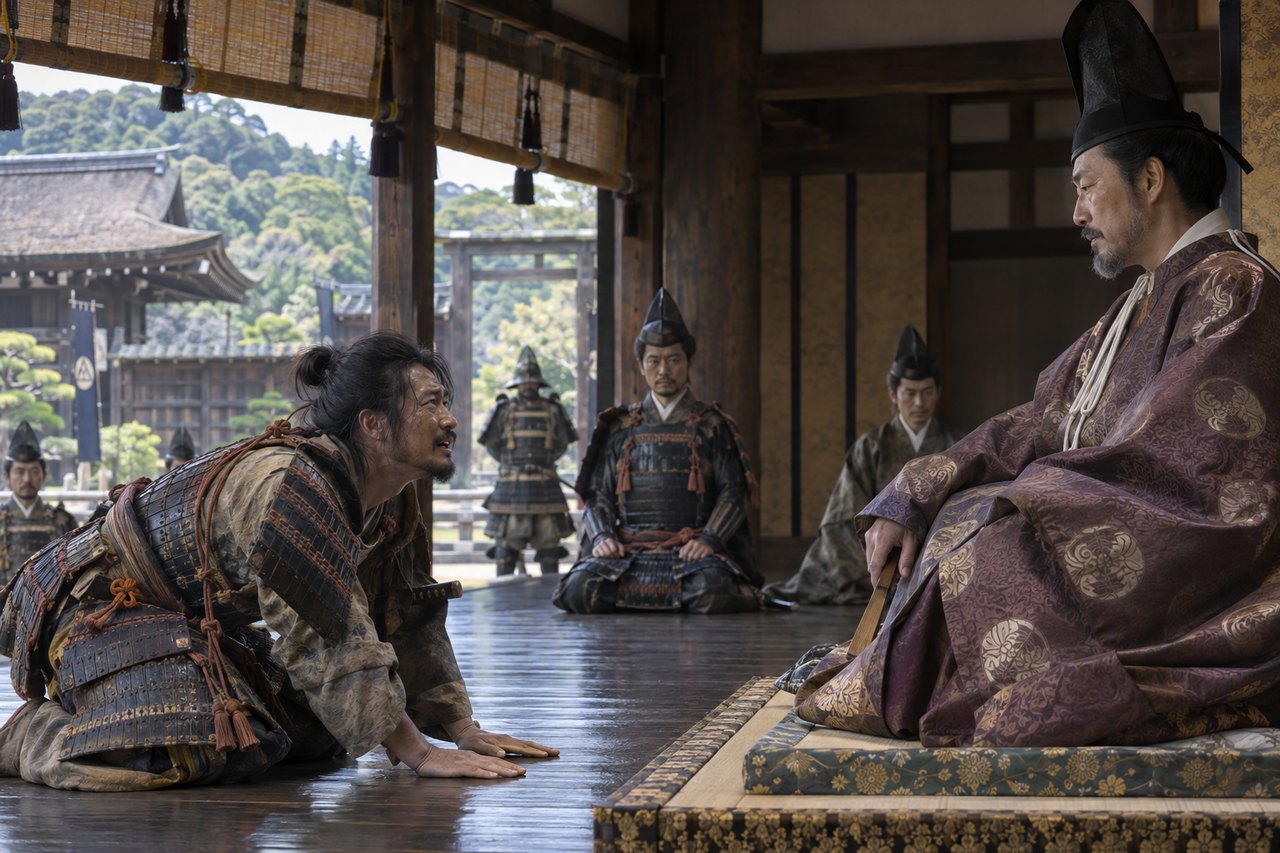
A war of defense left no conquered land to hand out as rewards. The year after the first invasion, Takezaki Suenaga traveled to Kamakura and appealed directly to Adachi Yasumori, the official in charge of rewards, and he was made steward of Kaito in Higo Province. Few warriors were rewarded in this way.
Temples and shrines also claimed credit for their prayers, and some recovered lost estates. Tokimune died in the fourth month of 1284 at the age of thirty-four. On the seventeenth day of the eleventh month of 1285, in the Shimotsuki Incident, Adachi Yasumori, who had worked to protect the shogunate's retainers, was destroyed in his struggle with Taira no Yoritsuna.
In 1297 the Einin Tokusei decree allowed retainers to recover land they had sold or pawned. The shortage of rewards and the poverty of the warrior class are considered among the causes of the fall of the Kamakura shogunate about fifty years later. The war that defended the country slowly weakened the regime that had fought it.
Conclusion
How the divine wind was told, and what saved Japan
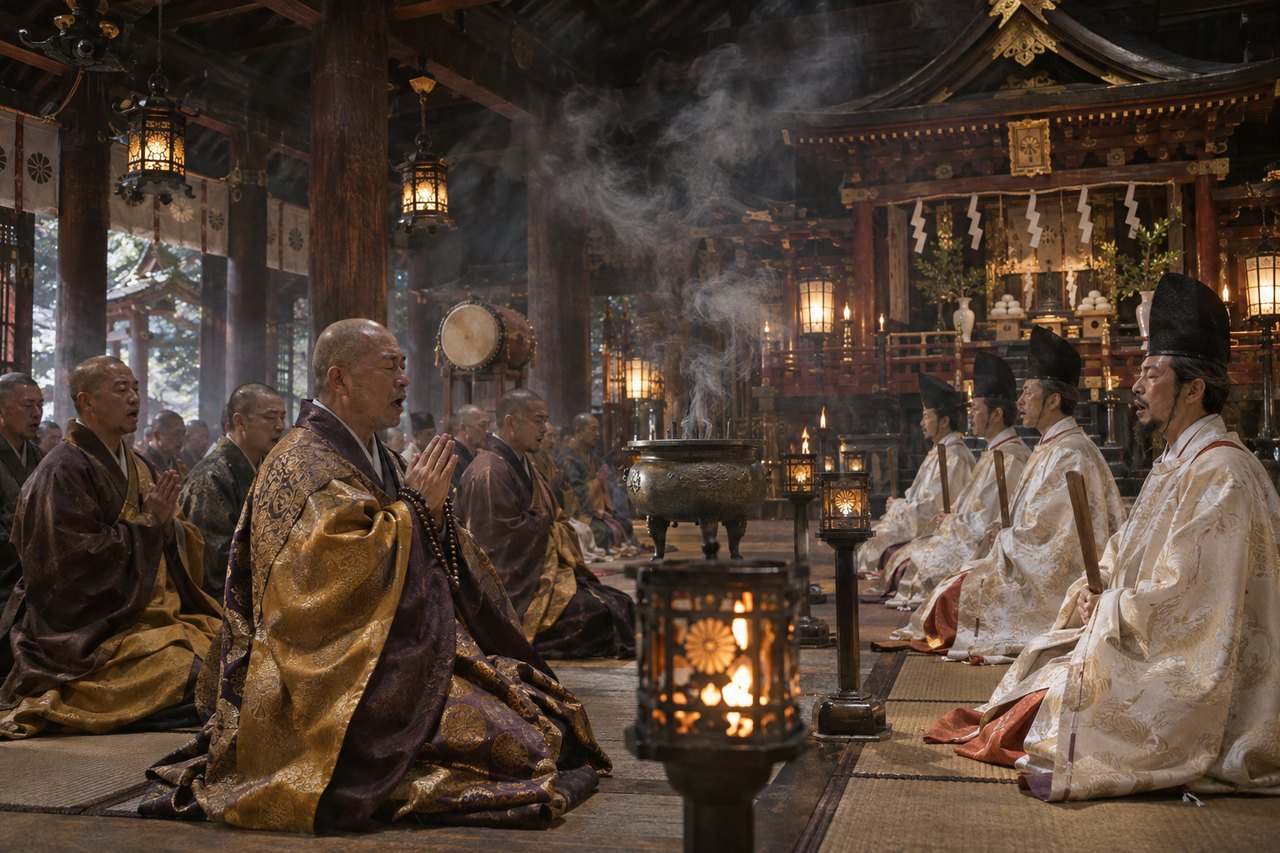
In 1293 the Kaze-no-Miya shrine at the Outer Shrine of Ise was raised to the rank of a detached shrine, in thanks for the fierce wind said to have driven off the invaders. Claims made by religious institutions helped spread the idea of Japan as a land protected by the gods. Hattori Hideo notes that the warriors of the time did not themselves think in terms of a divine wind.
In modern times the legend became a tool of national propaganda. In 1931, the 650th anniversary of the Koan campaign, commemorations were held across Japan, and the word kamikaze entered the state school textbooks. The myth of an unbeatable nation helped to win support for a reckless war and led on to the tragedy of the kamikaze special attack units.
Whether a storm struck in 1274 is still debated, while a great storm certainly struck in 1281. Before that storm, however, the stone wall and the warriors who fought behind it kept the Yuan army from landing, and the late meeting of the two fleets left that army waiting at sea. Japan was saved not by a divine wind alone but by these factors together.
How to read this work
History, interpretation, and reconstruction
Whether a storm decided the campaign of 1274 is still debated. The storm of 1281 is certain, but the stone wall, the warriors who defended it and the late meeting of the two Yuan fleets had already kept the invaders at sea. Japan was not saved by a divine wind alone.
This work is grounded in published sources and historical research. Interior thoughts, dialogue, and some visual details are cinematic reconstructions. Where historians disagree, the article presents the point as debated rather than settled fact.
Timeline
The story in time
-
Kublai adopts the dynastic name Yuan.
Sources: s02 -
About 28,000 Mongol and Goryeo soldiers sail from Happo.
Sources: s07 -
Tsushima and then Iki are attacked, and their deputy governors are killed.
Sources: s07 -
Yuan envoys who come to Hakata are put to death.
Sources: s07 -
The Eastern Route Army leaves Happo (the Koan campaign).
Sources: s08 -
Hojo Tokimune dies at the age of thirty-four.
Sources: s09 -
Adachi Yasumori is destroyed in the Shimotsuki Incident.
Sources: s12 -
The Kaze-no-Miya at the Outer Shrine of Ise is raised to a detached shrine.
Sources: s23 -
The Einin Tokusei decree is issued.
Sources: s13 -
The Takashima Kozaki site becomes the first underwater national historic site in Japan.
Sources: s18 -
A third Yuan wreck is confirmed off Takashima.
Sources: s21
People & terms
A guide for new readers
Key figures
- Kublai Khan
- Mongol emperor and first emperor of the Yuan dynasty, who demanded submission from Japan and ordered both invasions.
- Hojo Tokimune
- Regent of the Kamakura shogunate from 1268, at the age of eighteen, who led the response to both invasions.
- Takezaki Suenaga
- A retainer from Higo Province who fought in both campaigns and commissioned the Moko Shurai Ekotoba scrolls.
- Adachi Yasumori
- A senior shogunate official in charge of rewards, destroyed in the Shimotsuki Incident of 1285.
- Kono Michiari
- A warrior from Iyo Province who camped in front of the stone wall during the 1281 campaign.
Glossary
- Kamikaze 神風
- The "divine wind" believed to have destroyed the invading fleets; the term later became a wartime slogan.
- Ishitsuiji 石築地
- The stone wall built around Hakata Bay from 1276, also known as the Genko Borui.
- Teppo てつはう
- A ceramic explosive weapon used by the Yuan forces, found on the seabed off Takashima.
- Ikoku Keigo Banyaku 異国警固番役
- The guard duty imposed on warriors to defend the coast of Kyushu against foreign attack.
- Moko Shurai Ekotoba 蒙古襲来絵詞
- Illustrated scrolls made for Takezaki Suenaga recording his service in the two campaigns.
Sources & method
How this article was built
The narrative is based on the National Archives of Japan, Matsuura City, Fukuoka City and Fukuoka Prefecture, Ise Jingu, reference works, a study in the journal Tenki and recent reporting.
Where views differ, such as the reason for the retreat of 1274 and the size of the armies, the main positions are presented. Private thoughts and conversations are not reconstructed.
Images are generated conceptual scenes, labeled as such, and do not depict real people or exact historical places.
Sources
References and further reading
- Japan and Mongolia, Chapter 1 国立公文書館「日本とモンゴル 第1章」 Title translated editorially for reader convenience. National Archives of Japan 国立公文書館 Used for the arrival of the letter, Takezaki Suenaga, the stone wall and the scale of the 1281 fleet. Accessed 2026-11-18
- The Mongol Invasions at 750 (1): Why the Mongol Empire Attacked Japan 蒙古襲来750年(1):モンゴル帝国はなぜ極東の島国・日本を攻めてきたのか Title translated editorially for reader convenience. Nippon.com ニッポンドットコム Used for the text of the letter, the motives of the expedition, the name Yuan and the coastal guard. Accessed 2026-11-18
- The Mongol Invasions at 750 (2): The First Landing and the Advance on Dazaifu 蒙古襲来750年(2):元軍が初上陸、内陸の大宰府に迫る Title translated editorially for reader convenience. Nippon.com ニッポンドットコム Used for the fighting at Hakata Bay, the view of Hattori Hideo and the sections of the wall. Accessed 2026-11-18
- The Mongol Invasions at 750 (3): The Execution of the Yuan Envoys 蒙古襲来750年(3):モンゴル出身の横綱・照ノ富士らが供養に訪れた寺、元の使者斬首の悲劇 Title translated editorially for reader convenience. Nippon.com ニッポンドットコム Used for the execution of the envoys in 1275 and their memorial. Accessed 2026-11-18
- The Mongol Invasions at 750 (4): The Yuan Warships on the Seabed 蒙古襲来750年(4):海底の元の軍船が物語る「弘安の役」 Title translated editorially for reader convenience. Nippon.com ニッポンドットコム Used for the features of the Jiangnan ships and the views of Ikeda Yoshifumi. Accessed 2026-11-18
- The Mongol Invasions at 750 (Final): The Kamikaze Legend and Wartime Propaganda 蒙古襲来750年(最終回):大戦時の国威発揚に利用された「神風」伝説 Title translated editorially for reader convenience. Nippon.com ニッポンドットコム Used for the Lake Daija sediment, the rewards to temples and the modern uses of the legend. Accessed 2026-11-18
- Genko (Nihon Daihyakka Zensho and other reference works) 元寇(日本大百科全書ほか) Title translated editorially for reader convenience. Kotobank コトバンク Used for dates, troop numbers, the executions, the wall and losses. Accessed 2026-11-18
- Koan no Eki (Yamakawa Nihonshi Shojiten and other reference works) 弘安の役(山川 日本史小辞典ほか) Title translated editorially for reader convenience. Kotobank コトバンク Used for the forces, routes and the storm of the intercalary seventh month. Accessed 2026-11-18
- Hojo Tokimune 北条時宗 Title translated editorially for reader convenience. Kotobank コトバンク Used for his dates, his regency, the February Disturbance and his Yuan policy. Accessed 2026-11-18
- Takezaki Suenaga 竹崎季長 Title translated editorially for reader convenience. Kotobank コトバンク Used for his birth year, his appeal in Kamakura, the stewardship of Kaito and the 1281 campaign. Accessed 2026-11-18
- Kono Michiari 河野通有 Title translated editorially for reader convenience. Kotobank コトバンク Used for his camp before the wall and his attacks in small boats. Accessed 2026-11-18
- Shimotsuki Sodo 霜月騒動 Title translated editorially for reader convenience. Kotobank コトバンク Used for the incident of 1285 and the rivalry of Adachi Yasumori and Taira no Yoritsuna. Accessed 2026-11-18
- Einin no Tokuseirei 永仁の徳政令(国史大辞典・日本大百科全書ほか) Title translated editorially for reader convenience. JapanKnowledge ジャパンナレッジ Used for the content of the decree of 1297. Accessed 2026-11-18
- Did a Storm Blow During the Bun'ei Campaign? Tenki 56(11), 2009 水越允治「文永の役に嵐は吹いたのか」『天気』56巻11号(2009年) Title translated editorially for reader convenience. Meteorological Society of Japan 日本気象学会 Used for the season, the calendar conversion, the Kanchuki and the assessment of the storm. Accessed 2026-11-18
- Fukuoka Prefecture Cultural Properties Database: Genko Borui 福岡県文化財データベース 元寇防塁 Title translated editorially for reader convenience. Fukuoka Prefecture 福岡県 Used for the date, extent, provincial sections and historic-site status of the wall. Accessed 2026-11-18
- Imazu Genko Borui 今津元寇防塁 Title translated editorially for reader convenience. Nishi Ward, Fukuoka City 福岡市西区 Used for the division among nine provinces, the height and the building time. Accessed 2026-11-18
- Moko Shurai Ekotoba Exhibition (No. 120) 蒙古襲来絵詞展(No.120) Title translated editorially for reader convenience. Fukuoka City Museum 福岡市博物館 Used for Suenaga's route and the making of the scrolls. Accessed 2026-11-18
- National Historic Site: Takashima Kozaki Site 国指定史跡 鷹島神崎遺跡 Title translated editorially for reader convenience. Matsuura City 長崎県松浦市 Used for the survey history, the discovery of Ship No. 1 and the designation. Accessed 2026-11-18
- Takashima Ship No. 1 鷹島1号沈没船 Title translated editorially for reader convenience. Matsuura City 長崎県松浦市 Used for the location, depth, keel and finds of the first wreck. Accessed 2026-11-18
- Takashima Ship No. 2 鷹島2号沈没船 Title translated editorially for reader convenience. Matsuura City 長崎県松浦市 Used for the discovery of the second wreck in October 2014. Accessed 2026-11-18
- Takashima Ship No. 3 鷹島3号沈没船 Title translated editorially for reader convenience. Matsuura City 長崎県松浦市 Used for the confirmation of the third wreck in October 2024 and its depth. Accessed 2026-11-18
- Joryuji Temple 常立寺 Title translated editorially for reader convenience. Fujisawa City Tourist Association 藤沢市観光協会 Used for the memorial to Du Shizhong and the four others. Accessed 2026-11-18
- Detached Shrines of the Outer Shrine (Geku) 別宮|豊受大神宮(外宮) Title translated editorially for reader convenience. Ise Jingu 伊勢神宮 Used for the history of Kaze-no-Miya and its promotion in 1293. Accessed 2026-11-18
- Arrow from the Mongol invasions found in sunken ship off Nagasaki (20 August 2026) 元寇の矢、長崎の沈没船から発見 南宋から接収し日本戦に転用か(2026年8月20日) Title translated editorially for reader convenience. Kumamoto Nichinichi Shimbun (Kyodo News) 熊本日日新聞(共同通信) Used for the report on the arrow found at the Takashima underwater site. Accessed 2026-11-18
Continue reading
More stories from Shigeki
Shigeki English
The Ōmiya Incident: The Night Ryōma and Nakaoka Were Attacked, Read Through the Surviving Records
The Teradaya, the return of power, the move to the Ōmiya, the night of the attack, three deaths, the funeral at Ryōzen, the Mimawarigumi testimony and theories of a hidden hand, with what can be confirmed kept apart from competing accounts.
- When The attack on the 15th day of the 11th month of Keiō 3 (10 December 1867), with its background from 1865 and later testimony, the 1927 marker and the 1962 statues
- Where The Ōmiya, a soy-sauce merchant’s shop on Kawaramachi in Kyoto.
Shigeki English
Amakusa Shiro at Hara Castle: A Young Symbol in the Surviving Evidence
An Arima castle, Matsukura taxes, risings in Shimabara and Amakusa, Itakura’s death, Nobutsuna’s siege and the fall of the castle: the history of the people who gathered under a boy’s name, told within the limits of the sources.
- When Kan’ei 14–15 (1637–1638), with the castle’s construction (1599–1604) and modern excavation and World Heritage inscription (2018) as background
- Where Shimabara and Amakusa in southwestern Japan, culminating in the siege of Hara Castle