
SHIGEKI ENGLISH STORYEN
Japanese history in English
Itsukushima Shrine and Taira no Kiyomori: Faith, Offerings and the Sea
A shrine before the Heike, twelfth-century patronage, and the landscape maintained after their fall.
Follow Kiyomori's association with Itsukushima through the Heike Nokyo offering, rebuilding and visits. The account separates foundation tradition from written records, surviving buildings from inherited design, and evidence of patronage from interpretations of motive.
At a glance
Before you enter the story
- When
- From the foundation tradition of 593 and the record of 811 through twelfth-century patronage and later rebuilding
- Where
- Miyajima, also called Itsukushima, in the Seto Inland Sea in present-day Hiroshima Prefecture
- Key figures
- Taira no Kiyomori, Saeki Kagehiro, Retired Emperor Go-Shirakawa
- What was at stake
- How can acts of patronage explain the relationship without reducing a long religious history to one powerful man?
Why this story matters
The larger history behind the turning point
A famous patron can make an old institution appear to begin with him. Itsukushima offers a different way to read the relationship. The shrine existed before Kiyomori, received significant support in his time and continued after the Heike fell. Tracing that sequence reveals both the scale of the family's contribution and the longer work of maintaining a sacred place.
The buildings also pose a question familiar far beyond Japan: what does it mean for an old place to survive? A design, a ritual practice, a manuscript collection and the timber in a hall do not all have the same history. Their different dates help make continuity visible as a process.
Historical context
What an international reader needs to know
Names, places and the Heike
Taira is the family name; Heike is another name used for the Taira house in this story. Kiyomori was a leading figure of that family in the twelfth century. Miyajima and Itsukushima refer here to the island associated with the shrine, while Aki is the historical province named in Kiyomori's appointment. These terms identify different kinds of place and political affiliation.
The capital and Hakata appear as points in a wider maritime context. The article uses that setting to help explain why a shrine beside the Seto Inland Sea could matter to patrons concerned with travel and exchange. It does not reconstruct an individual voyage from a modern map.
Reading a shrine through different kinds of evidence
A shrine's account of its foundation, a modern heritage evaluation, an object catalogue and a historical chronology do different jobs. Foundation tradition explains remembered origins; a catalogue can identify an inscription on one item; an architectural account can date a surviving building. A source describing an earlier record is not the same as direct inspection of that record.
The Japanese research preserved these distinctions, which this edition retains. In particular, the 1164 offering is not used to date every surviving object, and the 1168 rebuilding is not used to date every existing hall. Calendar years are retained without adding an unverified exact day.
Watch the film
See the story in motion
The film currently uses Japanese audio. This English article provides the context and source trail; it does not imply that an English subtitle track is available.
Scene 01
A shrine older than Kiyomori
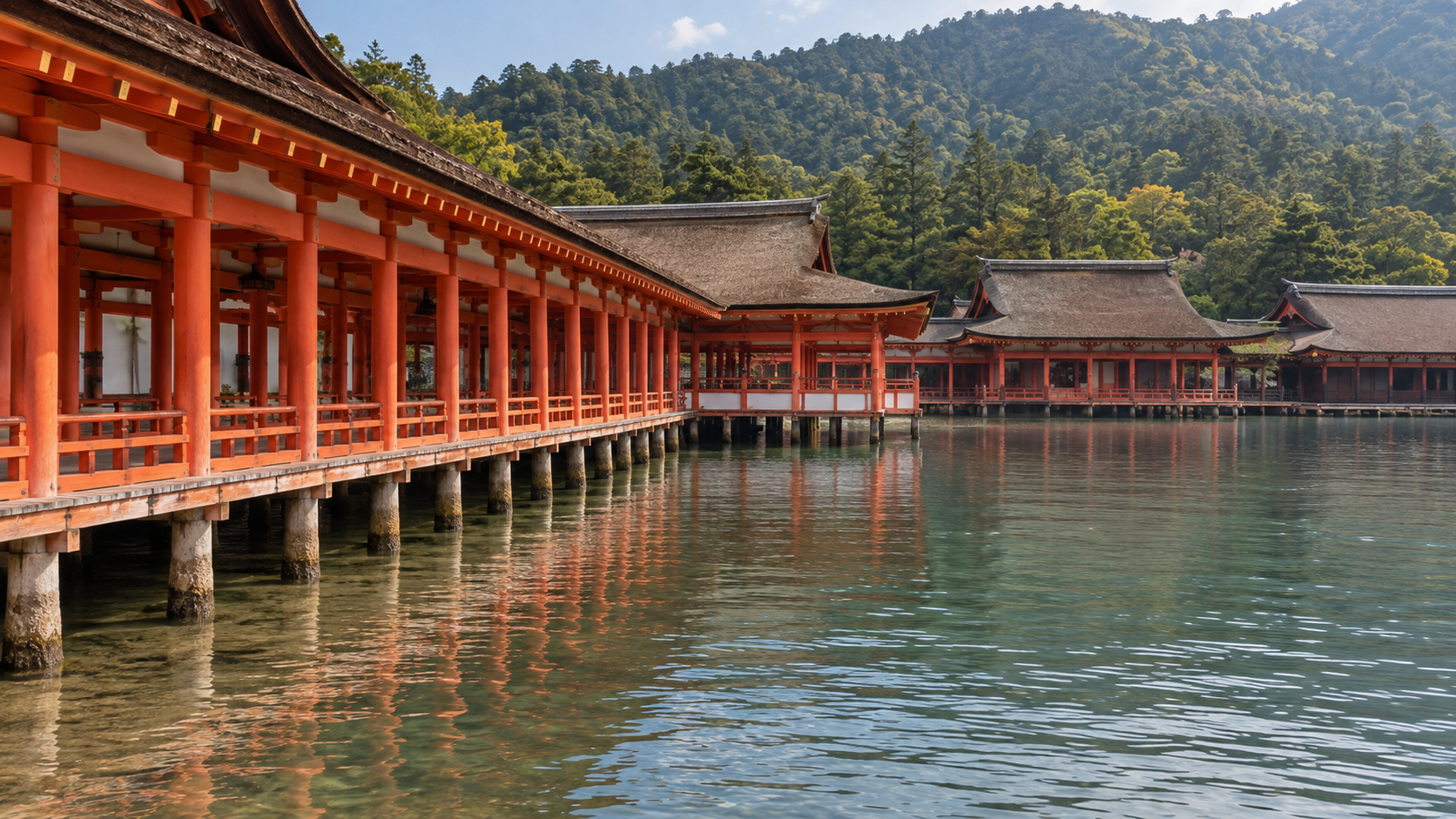
Vermilion buildings appear to rest on the sea at Itsukushima, on the island also known as Miyajima. The place is closely associated with Taira no Kiyomori, the twelfth-century leader whose family is called the Heike. Yet beginning its history with him would leave out a much older religious setting.
The shrine traces its foundation to 593 in its own tradition. A written record of the shrine appears in 811. These dates answer different questions: one belongs to the account of its origins, while the other identifies a surviving historical reference. They should not be presented as equally documented construction dates.
Both help place Kiyomori in a longer sequence. He became a major patron of a place of worship that preceded him. The relationship between an established shrine and a powerful supporter is therefore the starting point for this story.
The question is how that relationship took material form. Buildings, offerings and visits provide evidence to follow. A single claim about what Kiyomori privately intended cannot replace those traces.
Scene 02
An appointment in Aki Province
Kiyomori became governor of Aki Province in 1146. Aki was the historical province associated with the area around the shrine. His appointment gives the relationship a chronological setting; it does not establish that he lived continuously beside the shrine.
Itsukushima became an important place of worship for the Heike. The shrine describes its deities as protectors at sea, a religious role that helps readers understand the setting of a sanctuary beside the water.
The decisive reason for Kiyomori's devotion remains uncertain. Later stories, institutional histories and records of offerings have different evidential roles. They should be read with those differences intact.
Following the appointment with concrete acts of patronage lets the story develop without inventing an encounter, a vow or a conversation. The sources tell us more securely about support given to the shrine than about a single moment that supposedly explains it all.
Scene 03
The rebuilding associated with 1168
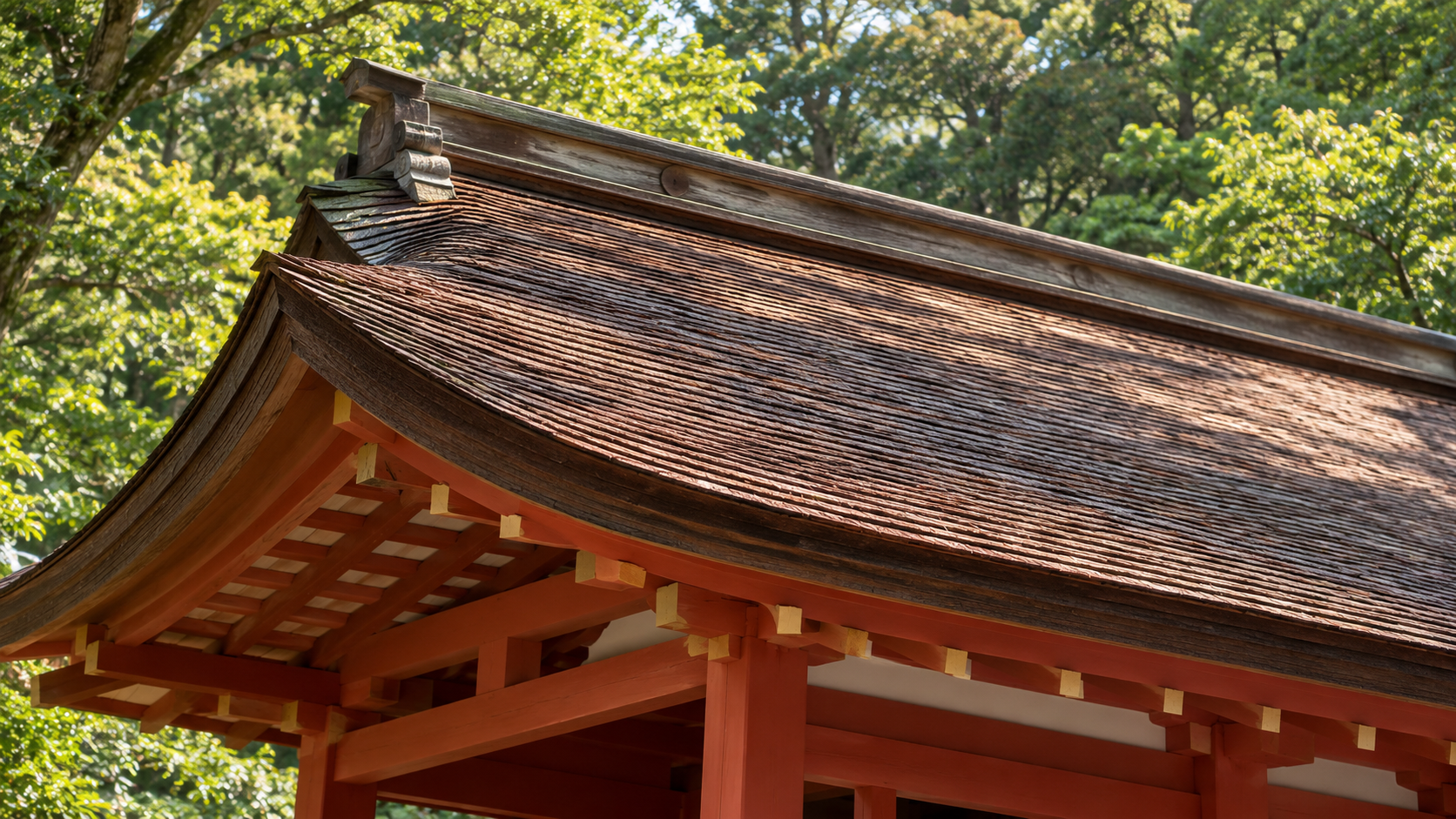
The next major date is 1168. The shrine's history associates that year with rebuilding that incorporated shinden-style architecture. Shinden was a form associated with aristocratic residences; here it helps describe an architectural influence rather than the age of every surviving timber.
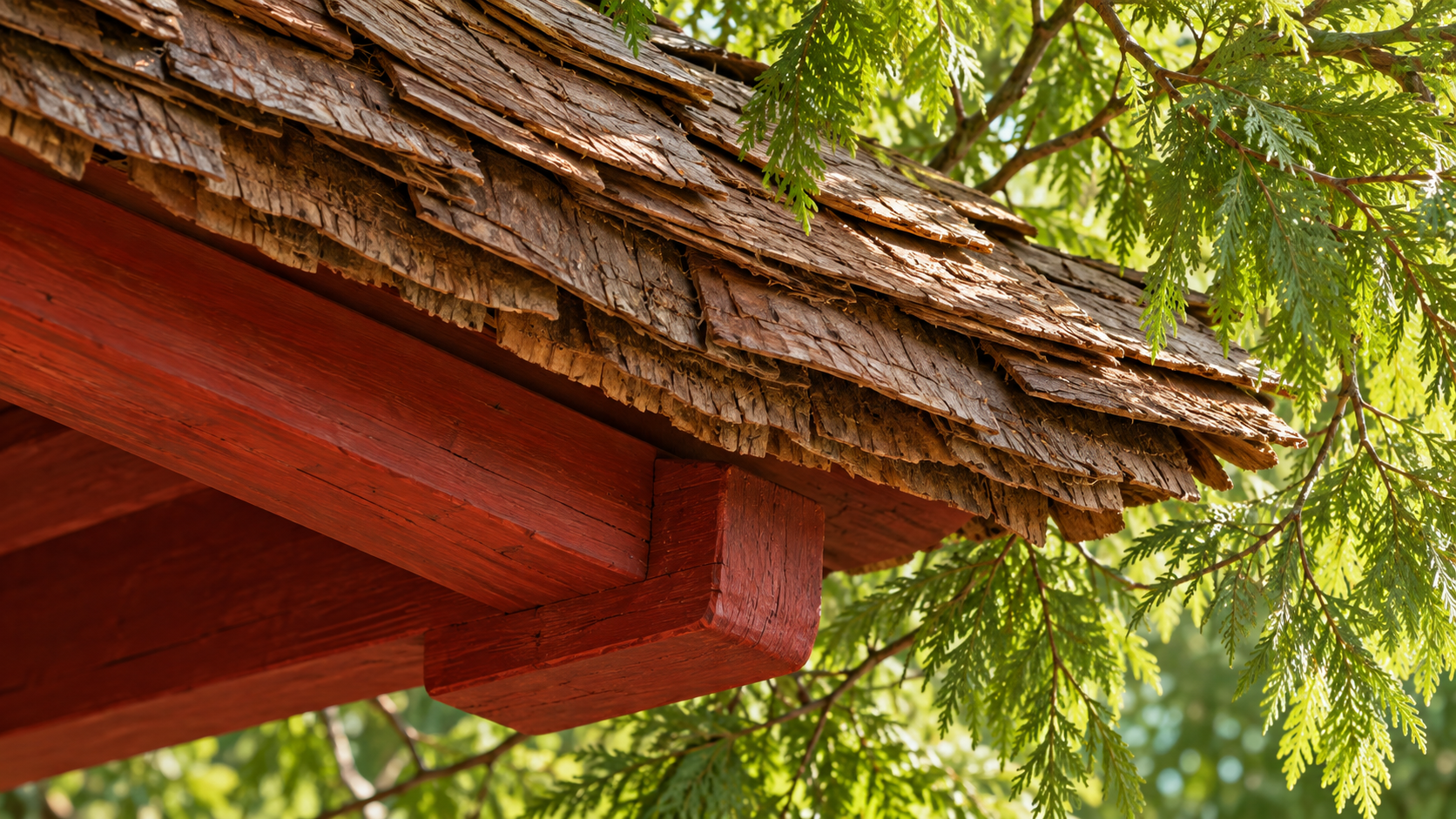
The heritage evaluation explains that the priest Saeki Kagehiro reported rebuilding to the court that year. Its account discusses enlarged buildings, changes from board roofing to cypress-bark roofing in part of the complex, and the supposition that Kiyomori supplied support.
This brings the people maintaining the shrine into view alongside the famous patron. Kiyomori need not be turned into the sole builder for his contribution to be significant. The local religious institution and its supporters belong in the same account.
A report dated to one year also cannot prove that all the buildings were finished on one day. The date is a milestone in the construction history. The evaluation is the source consulted here; this article does not claim a new reading of Kagehiro's original report.
Scene 04
The different ages of the buildings
The main sanctuary visible today is dated to 1571 in Hiroshima Prefecture's architectural explanation. The offering hall and worship hall are associated with rebuilding in 1241. Those dates are later than Kiyomori's lifetime.
The distinction does not sever the shrine's connection with the late Heian period. Architectural arrangements and forms could be carried forward through later rebuilding. The date of a surviving structure and the history of the design it preserves need separate attention.
Fire, repair and reconstruction belong to the story of transmission. Calling the complex medieval should not suggest that every piece of wood has remained in place since the twelfth century.
Looking at Itsukushima as a maintained landscape changes the question. We can ask how buildings and their relationships were preserved through successive interventions, rather than treating the shrine simply as an untouched object left behind by one patron.
Scene 05
An offering of sutras in 1164
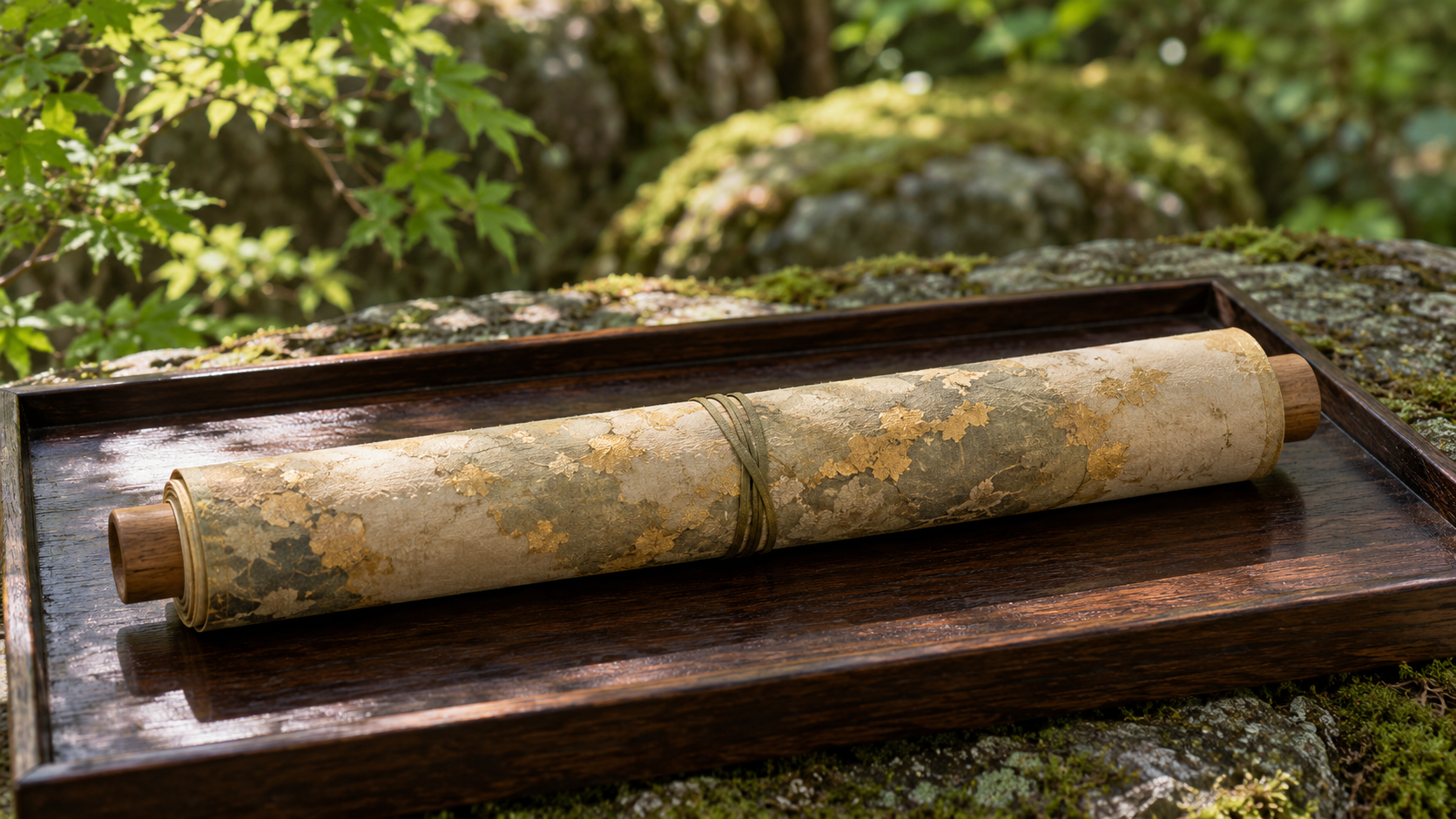
Before the rebuilding report came the offering known as the Heike Nokyo, associated with 1164. These richly decorated Buddhist scriptures connect the Heike's prayers for their family's prosperity with a tangible gift to Itsukushima.
The offering adds another dimension to patronage. Support was expressed through manuscripts as well as buildings. However, the present designated collection should not be treated as a group in which every item was produced simultaneously in 1164.
The Heart Sutra bears a colophon dated 1167. The chest used to hold the scrolls has an inscription from a still later period. A colophon is a written note associated with the making or transmission of a manuscript, and its date needs to remain attached to the particular item it describes.
The offering event and the composition of the surviving collection therefore have overlapping histories. Keeping them distinct allows us to see the care and additions through which the manuscripts reached later generations.
Scene 06
Supporting worship and performance
The Heike's support also extended to performance. Hiroshima's historical chronology records a gift of seven bugaku masks by members of the family in 1173. Bugaku combines music and dance in a ceremonial setting.
Accounts of bugaku at Itsukushima refer to transmission or influence from Shitennoji. That relationship concerns the movement of cultural practices; it does not mean that Kiyomori invented the art itself.
Nor can a festival as it is conducted today simply be placed in the twelfth century. The account of the Kangen-sai festival screen explains that aspects of the present sequence and arrangement of boats developed later.
Continuity includes such changes. Offerings, religious performance and the later history of a festival can all belong to the shrine's heritage without becoming one unchanging ceremony. The dated gift of masks is a more specific piece of evidence than a general image of timeless tradition.
Scene 07
A visit by the retired emperor in 1174
In 1174, the retired emperor Go-Shirakawa visited Itsukushima. The chronology names Kenshunmon-in and Kiyomori among those accompanying him. The visit shows a circle of worshippers extending beyond the Heike household.
Kenshunmon-in must be distinguished from Kenreimon-in, the title later borne by Kiyomori's daughter. Similar-looking names can obscure different people and change the meaning of the visit if they are silently combined.
The article retains the year and the named visitors. It does not choose an exact month and day where the chronology used in the Japanese research and the prefectural chronology differ.
A joint visit also has limits as political evidence. It establishes participation in a visit to the shrine, not a permanent agreement between Go-Shirakawa and Kiyomori on every political question. Religious attendance and political relationships should not be made interchangeable.
Scene 08
After the fall of the Heike
The Heike fell in 1185. Itsukushima's history continued beyond that defeat. A narrative centred only on the family's rise and fall would end too soon for the shrine itself.
Miyajima's chronology records an offering of funds for kagura by Minamoto no Yoritomo in 1189. The shrine's own history also describes reverence continuing under the Minamoto and under later powerful warrior houses.
This is evidence of continuing support, not of every ceremony and structure remaining identical. Damage, rebuilding and repair are part of the same long history of maintaining a place of worship.
Later supporters broaden the field of view. The landscape seen today bears the work of people living in periods after Kiyomori, as well as the effects of his family's patronage. The shrine cannot be reduced to a memorial to one political house.
Scene 09
A tide that changes the view
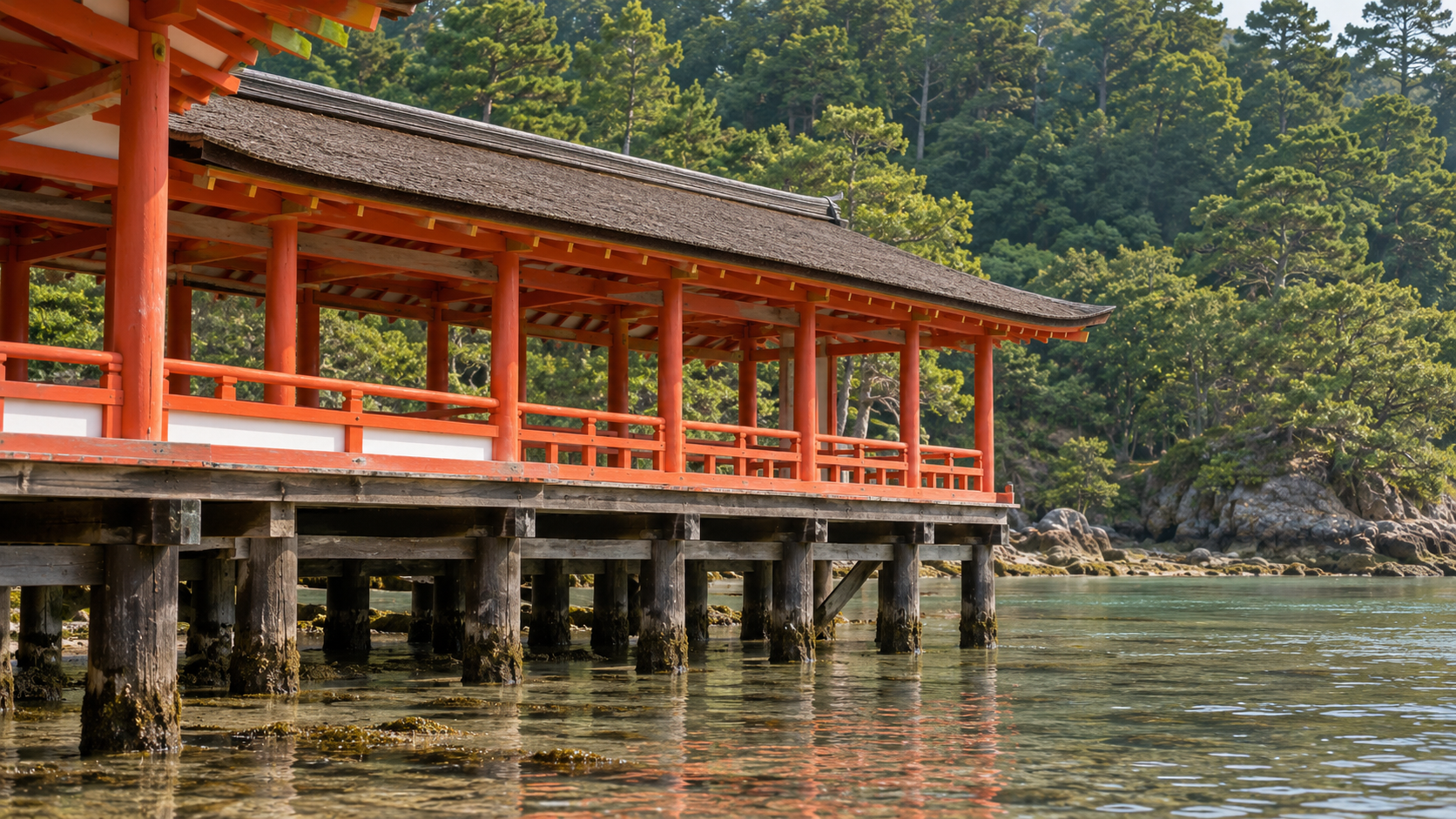
The shrine stands where seawater rises and falls. When water surrounds the structures, they can appear to float; when the tide recedes, the ground beneath them becomes visible. The buildings themselves are supported structures.
The account of the shrine's setting connects it with the sanctity attributed to the island as a whole. Building in the tidal area is explained in relation to reverence for that land.
This is an account of religious origins. It should not be promoted into proof of a single construction cause, or used to establish that the height of the sea and the shoreline were exactly the same in the twelfth century.
The changing relationship between water and buildings is enough to make the setting remarkable. It gives a viewer a way to understand the familiar description of a shrine on the sea while keeping appearance, structural support and historical explanation distinct.
Scene 10
Sea routes and prayers for safe passage
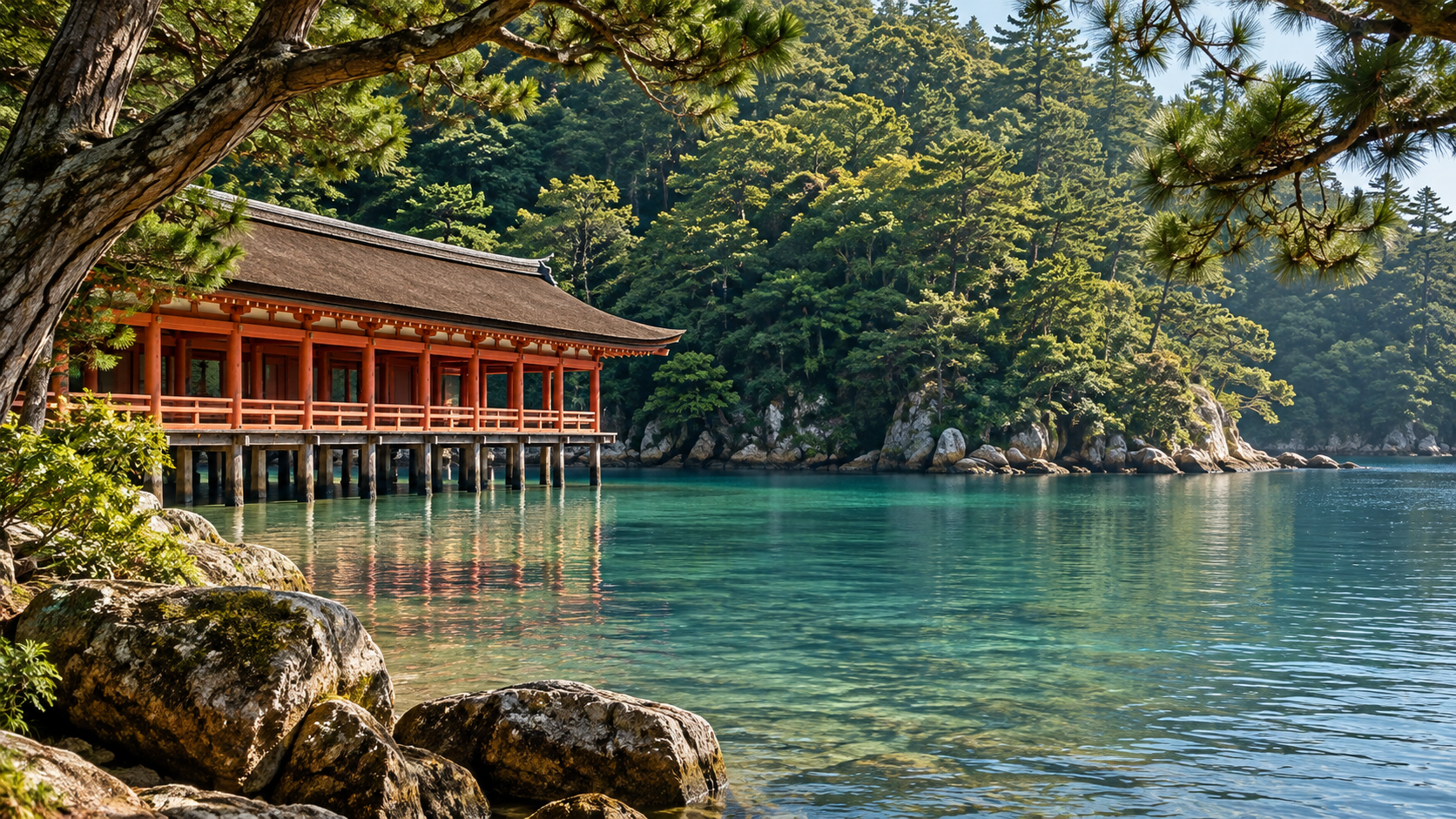
Hakata, a gateway for trade with Song China, and the routes linking Kyushu with the capital provide background to the Heike's relationship with the Seto Inland Sea. Geography connects the religious setting to movement across the water.
Hiroshima Prefecture's educational material discusses an overlap between improving routes for visiting Itsukushima and developing routes between Kyushu and the capital. The shrine's deities were also revered as protectors at sea.
Concern with maritime exchange and prayers for a safe voyage can therefore be considered together. This is a contextual interpretation. It does not identify a particular ship's route or establish a commercial calculation as Kiyomori's sole motive.
Placed beside the offerings and architectural support, that context gives the relationship several dimensions. Worship, travel and patronage can be examined in connection with one another without turning a broad historical setting into evidence of a private intention.
Scene 11
Sea, forest and architecture
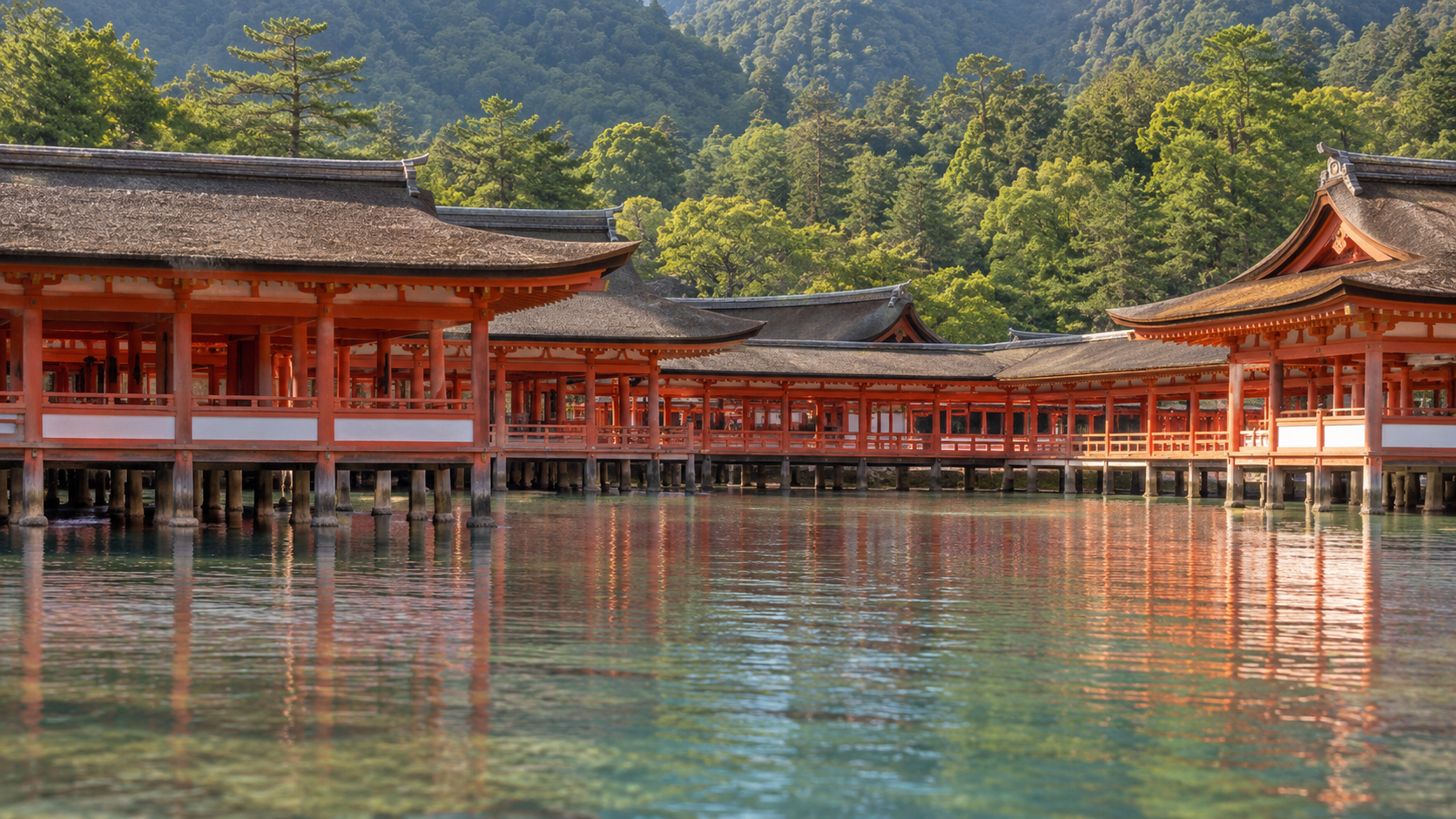
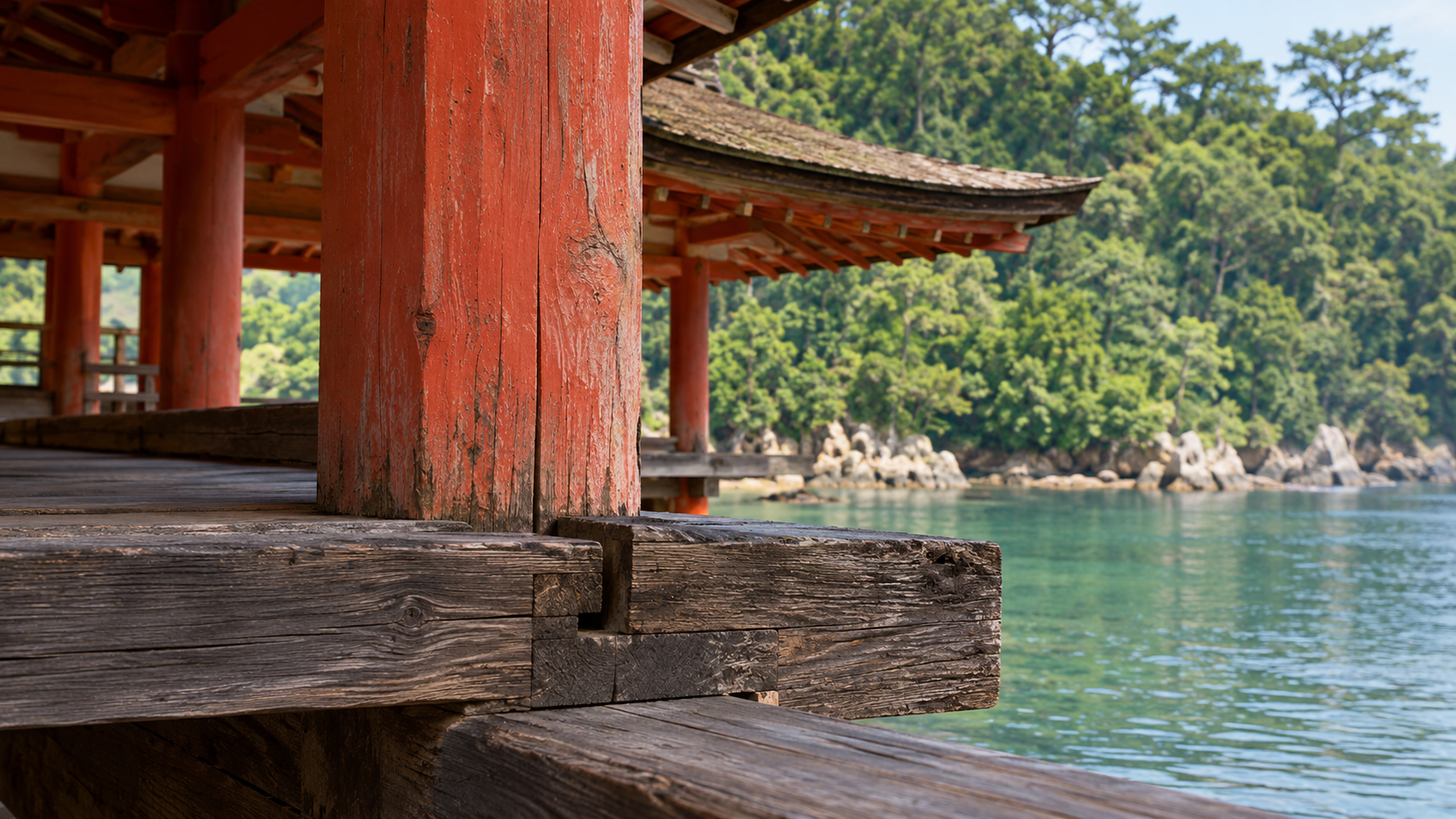
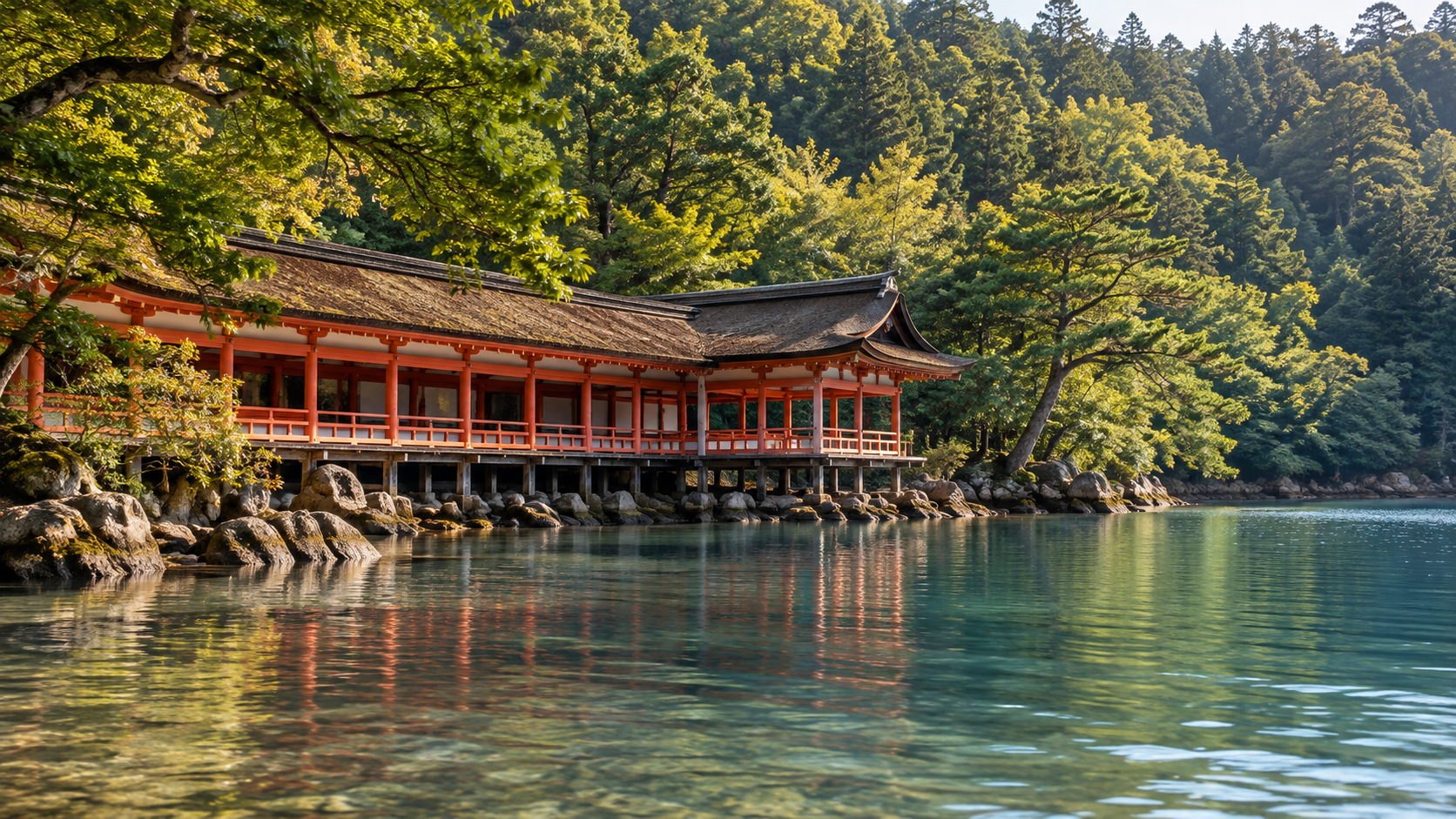
Itsukushima's landscape includes more than buildings and a sheet of water. Forested slopes behind the shrine, structures arranged along the bay and corridors joining different parts of the complex form a connected view.
The prefectural architectural explanation compares the arrangement with an aristocratic shinden-style residence. The heritage account also directs attention to the relationship among human construction, the sea and the mountains.
Following a corridor toward another structure, with water or woodland beyond it, gives a way to notice those relationships. This description concerns spatial arrangement; the accompanying generated images do not document an exact historical viewpoint.
A date attached to one hall cannot convey the whole ensemble. Rebuilding and maintenance preserved relationships among elements as well as particular buildings. The landscape is a useful scale at which to read that work across time.
Scene 12
Why did Kiyomori value this shrine?
The surviving evidence does not let us compress Kiyomori's reasons into one sentence spoken in his own voice. It does let us follow donations, architectural support and a relationship with an existing place of worship.
Devotion to deities protecting sea travel, the setting of maritime exchange and the family's offerings are complementary parts of the explanation. Their connection is an interpretation grounded in the cited accounts, rather than a recovered statement of a single motive.
The shrine's history also reaches backward before the Heike and forward after their fall. That longer span keeps the patron's contribution significant while making room for the priests, craftspeople and later supporters who maintained the place.
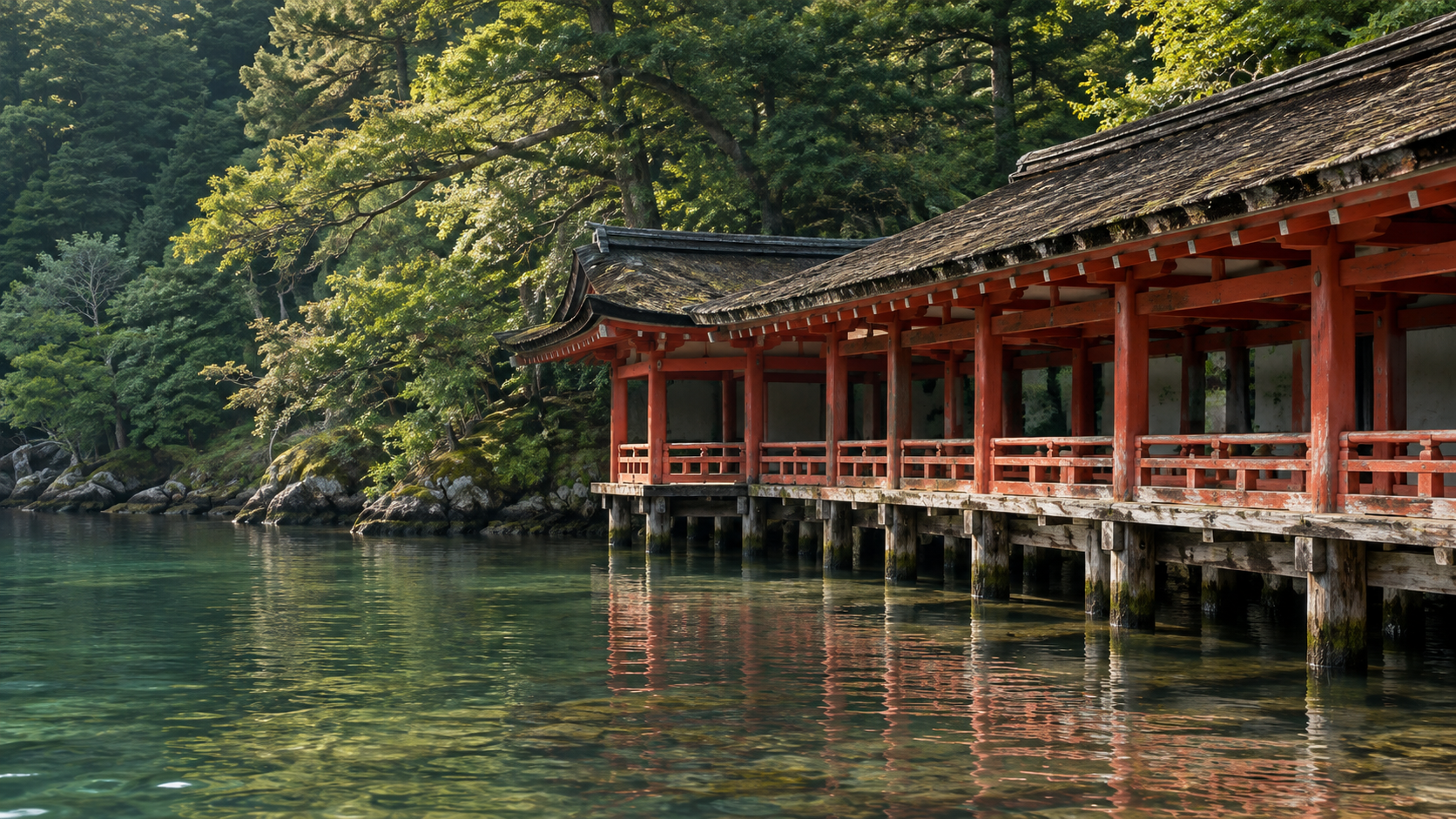
When looking at the vermilion buildings, consider those different layers: an earlier religious tradition, twelfth-century acts of patronage, later rebuilding and the landscape preserved through them. Itsukushima's association with Kiyomori becomes richer when it remains part of that longer history.
How to read this work
History, interpretation, and reconstruction
Itsukushima's relationship with Kiyomori is best traced through specific offerings and support, placed within a history of worship and rebuilding that extends before and after the Heike.
This work is grounded in published sources and historical research. Interior thoughts, dialogue, and some visual details are cinematic reconstructions. Where historians disagree, the article presents the point as debated rather than settled fact.
Timeline
The story in time
-
The shrine's foundation is traditionally attributed to Saeki Kuramoto.
Sources: s01 -
The Heike donate seven bugaku masks.
Sources: s13 -
Minamoto no Yoritomo makes an offering for kagura.
Sources: s12 -
Dates associated with the surviving offering and worship halls, and the main sanctuary, respectively.
Sources: s06
People & terms
A guide for new readers
Glossary
- Heike 平家
- The Taira house, the family associated here with Kiyomori and the offerings to Itsukushima.
- Aki Province 安芸国
- The historical province named in Kiyomori's appointment; the shrine lies in present-day Hiroshima Prefecture.
- Shinden style 寝殿造
- An architectural form associated with aristocratic residences, used to explain influences on the shrine's arrangement.
- Heike Nokyo 平家納経
- The decorated Buddhist scriptures offered to Itsukushima by the Heike, associated with an offering in 1164.
- Colophon 奥書
- A written note attached to a manuscript; the date it gives belongs to that particular item.
- Bugaku 舞楽
- Ceremonial dance with music, supported at Itsukushima through gifts including masks.
- Kagura 神楽
- Religious performance named in the record of Yoritomo's offering of funds in 1189.
- Kangen-sai 管絃祭
- A festival whose present arrangements include developments from periods later than Kiyomori's lifetime.
Sources & method
How this article was built
This English edition follows the fixed Japanese article, its source identifiers and its research notes. Source titles are editorial English translations for readers. The URLs and evidential links are inherited from the Japanese source. No original historical text, manuscript or complete exhibition catalogue is claimed as newly examined.
The inherited research records its access limits, including an evaluation read in extracted text and an institutional page consulted through returned search text. The relevant prefectural PDF pages had been visually examined. Foundation tradition, recorded dates, later reconstruction and present festival practice remain separate. Photographs and institutional illustrations are not reproduced.
The generated illustrations provide atmosphere. They are not documentary photographs or measured reconstructions. The interpretation of patronage combines the cited acts of support with religious and maritime context while leaving a single decisive personal motive unresolved.
Sources
References and further reading
- History of Itsukushima Shrine 嚴島神社 御由緒 Title translated editorially for reader convenience. Itsukushima Shrine 嚴島神社 The shrine's own account of its origins, maritime deities and patronage. The traditional foundation date is identified as tradition. Accessed 2026-10-24
- Itsukushima Shrine: Japanese visitor explanation 宮島観光協会 嚴島神社 Title translated editorially for reader convenience. Miyajima Tourist Association 宮島観光協会 Institutional explanation used for the appointment in Aki, devotion and the shrine's setting. Conflicting counts of corridor bays are not used. Accessed 2026-10-24
- Itsukushima Shrine: English visitor explanation 宮島観光協会 英語嚴島神社解説 Title translated editorially for reader convenience. Miyajima Tourist Association 宮島観光協会 Used for the distinction between early records, later rebuilding and architectural form. No photographs are reproduced. Accessed 2026-10-24
- Itsukushima: 1996 advisory evaluation ICOMOS厳島評価書1996 Title translated editorially for reader convenience. ICOMOS / UNESCO World Heritage Centre ICOMOS/UNESCO世界遺産センター The inherited Japanese research consulted the English history section. It is an evaluation describing a historical report, not a new reading of that original report. Accessed 2026-10-24
- The Taira and Itsukushima culture ひろしま文化大百科 平氏と厳島文化 Title translated editorially for reader convenience. Hiroshima Cultural Encyclopedia ひろしま文化大百科 The inherited research used institutional text returned in search; direct access was restricted. Used cautiously for uncertainty about motives and cultural transmission. Accessed 2026-10-24
- Itsukushima Shrine: Hiroshima architectural heritage 広島県ひろしまたてものがたり 嚴島神社 Title translated editorially for reader convenience. Hiroshima Prefecture 広島県 The architectural account distinguishes the main sanctuary dated 1571 from the offering and worship halls dated 1241. Building dates are separated from inherited design. Accessed 2026-10-24
- Taira no Kiyomori exhibition 広島県立美術館 平清盛展 Title translated editorially for reader convenience. Hiroshima Prefectural Art Museum 広島県立美術館 Exhibition introduction used for the 1164 offering and its context. The number of scrolls displayed is not treated as the total surviving collection. Accessed 2026-10-24
- Heike Nokyo collection: cultural property record 国指定文化財等DB 平家納経一具 Title translated editorially for reader convenience. Agency for Cultural Affairs 文化庁 Catalogue information distinguishes the 1167 Heart Sutra colophon and a later chest. Conflicting chest dates are not resolved by choosing one. Accessed 2026-10-24
- Dated inscription record 4502 東京文化財研究所 年紀資料4502 Title translated editorially for reader convenience. Tokyo National Research Institute for Cultural Properties 東京文化財研究所 Catalogue and inscription information used for a 1164 colophon. This is not a claim to have inspected the original scroll. Accessed 2026-10-24
- Dated inscription record 10497 東京文化財研究所 年紀資料10497 Title translated editorially for reader convenience. Tokyo National Research Institute for Cultural Properties 東京文化財研究所 Catalogue information used for a colophon associated with Kiyomori and 1164. The original scroll and the cited exhibition catalogue were not newly examined. Accessed 2026-10-24
- Brief chronology of Miyajima 宮島観光協会 歴史略年表 Title translated editorially for reader convenience. Miyajima Tourist Association 宮島観光協会 Used for the sequence of appointment, offerings and visits. The year and participants of the 1174 visit are retained without selecting a disputed month and day. Accessed 2026-10-24
- Hiroshima historical chronology: ancient period 広島県史年表 古代 Title translated editorially for reader convenience. Hiroshima Prefectural Archives 広島県立文書館 The inherited research inspected the relevant PDF pages for the masks and visits. The listed original historical records are not claimed as newly read. Accessed 2026-10-24
- Itsukushima Shrine and Taira no Kiyomori: educational material 広島県教材 厳島神社と平清盛 Title translated editorially for reader convenience. Hiroshima Prefecture 広島県 Used for maritime context and performance traditions. The teaching diagram is not presented as proof of a particular voyage and is not reproduced. Accessed 2026-10-24
- Explanation of a Kangen-sai festival screen 観光庁 管絃祭屏風解説 Title translated editorially for reader convenience. Japan Tourism Agency 観光庁 Used to distinguish later festival arrangements from twelfth-century patronage. A screen from 1928 is not a contemporary view of the Heian period. Accessed 2026-10-24
- Annual observances at Itsukushima Shrine 嚴島神社 年中行事 Title translated editorially for reader convenience. Itsukushima Shrine 嚴島神社 A supplementary reference for the continuing practice of performance at the shrine. Present dates and programmes are not projected back into the twelfth century. Accessed 2026-10-24
- Itsukushima Shinto Shrine: World Heritage property UNESCO世界遺産センター 厳島神社 Title translated editorially for reader convenience. UNESCO World Heritage Centre UNESCO世界遺産センター Used for the relationship between buildings, sea and forest. Surviving building dates are checked separately against the prefectural architectural account. Accessed 2026-10-24
Continue reading
More stories from Shigeki
Shigeki English
The Second Choshu Expedition: Four Fronts and a Negotiated Withdrawal
Read weapons together with terrain, training, command and support.
- When 1866, distinct from the first expedition in 1864; the process of ending extended into January 1867
- Where Oshima, the Aki border, Iwami and the Kanmon Strait facing Kokura
Shigeki English
Hasedo: Why Fighting Continued after Sekigahara
Separate the siege, the arrival of news, and withdrawal under pursuit.
- When 1600; month and day references use the calendar of the time
- Where Hasedo and Yamagata in Dewa, connected with Aizu and distant Sekigahara